EP0576972A1 - Spectromètre à diffusion d'ions - Google Patents
Spectromètre à diffusion d'ions Download PDFInfo
- Publication number
- EP0576972A1 EP0576972A1 EP93109977A EP93109977A EP0576972A1 EP 0576972 A1 EP0576972 A1 EP 0576972A1 EP 93109977 A EP93109977 A EP 93109977A EP 93109977 A EP93109977 A EP 93109977A EP 0576972 A1 EP0576972 A1 EP 0576972A1
- Authority
- EP
- European Patent Office
- Prior art keywords
- ions
- ion
- sample
- atoms
- mass
- Prior art date
- Legal status (The legal status is an assumption and is not a legal conclusion. Google has not performed a legal analysis and makes no representation as to the accuracy of the status listed.)
- Withdrawn
Links
- 238000004969 ion scattering spectroscopy Methods 0.000 title claims abstract description 25
- 150000002500 ions Chemical class 0.000 claims abstract description 150
- 239000000203 mixture Substances 0.000 claims abstract description 8
- 239000007787 solid Substances 0.000 claims description 8
- 230000001678 irradiating effect Effects 0.000 claims 1
- 238000001228 spectrum Methods 0.000 description 12
- 238000010586 diagram Methods 0.000 description 7
- 238000005259 measurement Methods 0.000 description 6
- 239000002245 particle Substances 0.000 description 4
- 238000004458 analytical method Methods 0.000 description 3
- 239000007789 gas Substances 0.000 description 3
- 238000010884 ion-beam technique Methods 0.000 description 3
- 238000000034 method Methods 0.000 description 3
- 239000000463 material Substances 0.000 description 2
- 238000001514 detection method Methods 0.000 description 1
- 230000005684 electric field Effects 0.000 description 1
- 230000005672 electromagnetic field Effects 0.000 description 1
- 238000012916 structural analysis Methods 0.000 description 1
- 239000000126 substance Substances 0.000 description 1
- 239000000758 substrate Substances 0.000 description 1
Images




Classifications
-
- H—ELECTRICITY
- H01—ELECTRIC ELEMENTS
- H01J—ELECTRIC DISCHARGE TUBES OR DISCHARGE LAMPS
- H01J49/00—Particle spectrometers or separator tubes
- H01J49/44—Energy spectrometers, e.g. alpha-, beta-spectrometers
- H01J49/443—Dynamic spectrometers
- H01J49/446—Time-of-flight spectrometers
-
- G—PHYSICS
- G01—MEASURING; TESTING
- G01N—INVESTIGATING OR ANALYSING MATERIALS BY DETERMINING THEIR CHEMICAL OR PHYSICAL PROPERTIES
- G01N23/00—Investigating or analysing materials by the use of wave or particle radiation, e.g. X-rays or neutrons, not covered by groups G01N3/00 – G01N17/00, G01N21/00 or G01N22/00
- G01N23/20—Investigating or analysing materials by the use of wave or particle radiation, e.g. X-rays or neutrons, not covered by groups G01N3/00 – G01N17/00, G01N21/00 or G01N22/00 by using diffraction of the radiation by the materials, e.g. for investigating crystal structure; by using scattering of the radiation by the materials, e.g. for investigating non-crystalline materials; by using reflection of the radiation by the materials
- G01N23/20091—Measuring the energy-dispersion spectrum [EDS] of diffracted radiation
-
- G—PHYSICS
- G01—MEASURING; TESTING
- G01N—INVESTIGATING OR ANALYSING MATERIALS BY DETERMINING THEIR CHEMICAL OR PHYSICAL PROPERTIES
- G01N23/00—Investigating or analysing materials by the use of wave or particle radiation, e.g. X-rays or neutrons, not covered by groups G01N3/00 – G01N17/00, G01N21/00 or G01N22/00
- G01N23/20—Investigating or analysing materials by the use of wave or particle radiation, e.g. X-rays or neutrons, not covered by groups G01N3/00 – G01N17/00, G01N21/00 or G01N22/00 by using diffraction of the radiation by the materials, e.g. for investigating crystal structure; by using scattering of the radiation by the materials, e.g. for investigating non-crystalline materials; by using reflection of the radiation by the materials
- G01N23/203—Measuring back scattering
-
- G—PHYSICS
- G01—MEASURING; TESTING
- G01N—INVESTIGATING OR ANALYSING MATERIALS BY DETERMINING THEIR CHEMICAL OR PHYSICAL PROPERTIES
- G01N2223/00—Investigating materials by wave or particle radiation
- G01N2223/05—Investigating materials by wave or particle radiation by diffraction, scatter or reflection
- G01N2223/053—Investigating materials by wave or particle radiation by diffraction, scatter or reflection back scatter
-
- G—PHYSICS
- G01—MEASURING; TESTING
- G01N—INVESTIGATING OR ANALYSING MATERIALS BY DETERMINING THEIR CHEMICAL OR PHYSICAL PROPERTIES
- G01N2223/00—Investigating materials by wave or particle radiation
- G01N2223/05—Investigating materials by wave or particle radiation by diffraction, scatter or reflection
- G01N2223/056—Investigating materials by wave or particle radiation by diffraction, scatter or reflection diffraction
- G01N2223/0568—Investigating materials by wave or particle radiation by diffraction, scatter or reflection diffraction spectro-diffractometry
-
- G—PHYSICS
- G01—MEASURING; TESTING
- G01N—INVESTIGATING OR ANALYSING MATERIALS BY DETERMINING THEIR CHEMICAL OR PHYSICAL PROPERTIES
- G01N2223/00—Investigating materials by wave or particle radiation
- G01N2223/10—Different kinds of radiation or particles
- G01N2223/104—Different kinds of radiation or particles ions
Definitions
- the present invention relates to a time-of-flight (TOF) type ion scattering spectroscope (ISS) for performing a chemical and structural analysis of a surface of a solid sample.
- TOF time-of-flight
- ISS time-of-flight
- a beam of ions of a known fixed kinetic energy is irradiated onto a surface of a solid sample, and the energy spectrum of ions colliding with the atoms in the surface or subsurface and scattered within a preset small solid angle is measured.
- a method known as the time-of-flight (TOF) method is used.
- a TOF type ISS is illustrated with Fig. 7.
- a beam of ions 46 is irradiated onto a sample 41, the ions collide with the atoms of the sample 41 and are scattered backward. Some of the scattered ions come into a flight tube 43 through the gate 42.
- the space within the flight tube 43 is a drift space in which no electromagnetic field is present and the ions fly without being exerted by an external force. Since the speed of an ion is proportional to the square root of its energy, the flight time of an ion in the flight tube 43, thus the arriving time of an ion at an ion detector 40 placed at an end of the flight tube 43, depends on the energy of the ion.
- its energy E is calculated using the formula (1).
- the length of time period from the time when the beam of ions is chopped to the time when the ions scattered by the sample surface arrives to the detector is measured, the speed of scattered ions is calculated, and the mass of atoms of the sample that scattered the ions is calculated.
- the formula (2) also teaches that the motion of the ion after the collision depends on the mass of the ion m i and the mass of the atom m o .
- m o >> m i , that is the mass m o of the stationary atom is far larger than the mass m i of the colliding ion, the speed v2 of the ion after the collision is almost the same as the speed v1 before the collision, and the diversity in the speed of scattered ions is so small that the precision of the measurement is low.
- the present invention addresses the problem and provides an improved TOF type ion scattering spectroscope which need not such change of ion source according to the object atom.
- Fig. 1 is a schematic diagram of a TOF type ion scattering spectroscope of an embodiment of the present invention.
- Fig. 2 is a diagram showing colliding particles.
- Fig. 3 is a diagram showing a relationship between the mass and speed of a particle.
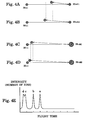
- Fig. 4A through 4D are diagrams showing light-weight ions colliding with light and heavy object atoms
- Fig. 4E is a flight time spectrum (energy spectrum) of the scattered light-weight ions.
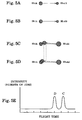
- Fig. 5A through 5D are diagrams showing middle-weight ions colliding with light and heavy object atoms
- Fig. 5E is a flight time spectrum (energy spectrum) of the scattered heavy-weight ions.
- Fig. 6A through 6D are diagrams showing mixed-weight ions colliding with light and heavy object atoms
- Fig. 6E is a flight time spectrum (energy spectrum) of the scattered mixed-weight ions.
- Fig. 7 is a cross sectional view of a sample and a flight tube receiving ions scattered by the sample.
- Fig. 8 is a diagram showing colliding particles.
- a coaxial impact collision ion scattering spectroscope (CAICISS) embodying the present invention is described referring to Fig. 1 through 6.
- ions are generated in an ion source 4 and ejected as a beam 6 from the ion source 4 then from a tube 3 onto a sample 1 in a sample chamber 2.
- the ions are scattered, and those scattered backward 7 re-enters the tube 3 and detected by an ion detector 10.
- the ion source 4 is controlled by an ion source controller 5, and the ion detector 10 is powered by the power source 16.
- the tube 3 and the ion source 4 are evacuated by respectively provided pumps (turbo-molecular pumps 20, 21 and a rotary pump 25).
- the energy spectrum of the scattered ions is observed as follows.
- the ion beam 6 from the ion source 4 is chopped by a pair of chopping electrodes 13 which are applied a chopping pulse signal from a chopping controller 14.
- the chopping controller 14 gives a start pulse to a timer 12 at the same time as it gives the chopping pulse signal to the chopping electrodes 13, when the timer 12 starts counting time.
- the chopped ion beam (pulsated beam) 6 hits the sample 1 and some of the ions 7 are scattered backward to be detected by the ion detector 10 as mentioned before.
- the ion detector 10 When the ion detector 10 detects an ion, it gives a detection signal (a stop pulse) to the timer 12 through a pre-amp 11, by which the timer 12 stops counting time.
- the time interval (between the start pulse and the stop pulse) counted by the timer 12 is the time spent by the ions to fly from the chopping electrodes 13 via the sample 1 to the detector 10.
- the counted time (flight time) is given to a data processor 15, which calculates the energy of the ion based on the flight time and the known flight distance.
- the ion source 4 generates mixture of ions of various masses.
- An element analysis of a sample 1 in the CAICISS of the present embodiment is now explained referring to Figs. 4A through 4E, 5A through 5E, and 6A through 6E.
- two kinds of heavy-weight atoms and two kinds of light-weight atoms are included in the (surface of the) sample 1.
- the argument below is of course applicable to a greater variety of atoms.
- the first case refers to Figs. 4A through 4E in which an ion lighter than the lightest atom in the (surface of the) sample 1 is used.
- m il represents the light-weight (injecting) ion
- m ol1 represents a light-weight (object) atom
- m ol2 represents another light-weight atom but slightly heavier than the atom m ol1
- m oh1 represents the heavy-weight atom
- m oh2 represents another heavy-weight atom slightly heavier than the atom m oh1 .
- the length of the arrows corresponds to the speed of the particles.
- the ion m il gets a slightly greater speed when it collides with the slightly heavier (light-weight) atom m ol2 than when it collides with the slightly lighter (light-weight) atom m ol1 .
- the situation is explained with Fig.
- m i is an injecting ion
- v i is the injecting speed
- m o1 is an object atom
- m o2 is another object atom lighter than the atom m o1
- v21 is the speed of the ion m i scattered by the heavier atom m o1
- v22 is the speed of the ion m i scattered by the lighter atom m o2 .
- a graph (a flight time spectrum or an energy spectrum) as shown in Fig. 4E is obtained in which the peak 'a' corresponds to the ions m il scattered as in Fig. 4A and the peak 'b' corresponds to the ions m il scattered as in Fig. 4B.
- Fig. 4C shows a case in which a light-weight ion m il collides with a heavy-weight object atom m oh1
- Fig. 4D shows a case in which the same ion m il collides with another heavy-weight atom m oh2 .
- the speed of the ion m il scattered by the slightly heavier heavy-weight atom m oh2 gets a slightly larger speed than that scattered by the slightly lighter heavy-weight atom m oh1 .
- the difference of the speeds is smaller in this case compared to the previous case (Figs. 4A and 4B) as the mass of the object atoms are heavier and the denominator of the formula (3) is greater.
- the peaks 'c' and 'd' of the scattered ions in the case of figs 4C and 4D appear in proximity in the flight time spectrum of Fig. 4E.
- light-weight object atoms m ol1 and m ol2 of slightly different masses can be precisely discriminated when ions having a mass smaller than the smallest mass of the atoms in the sample surface is used, but heavy-weight atoms m oh1 and m oh2 of slightly different masses are hardly discriminated.
- the second case refers to Figs. 5A through 5E in which ions of an intermediate mass m ih is used. That is, the mass of the ions m ih is between the mass of the heavy-weight atoms m oh1 and m oh2 and the mass of the light-weight atoms m ol1 and m ol2 .
- This case also corresponds to the conventional case in which ions of a kind are used in the analysis.
- the mass of the injecting ion m ih is larger than the object atom m ol1 or m ol2 , the ion is not scattered backward and no measurement is possible.
- Fig.3 The difference between the case of Fig.4A through 4D and the case of figs 5A through 5D is illustrated with Fig. 3. Since the speed of an ion is inversely proportional to the square root of the mass of the ion, the speed v il of a lighter ion m il is larger than that v ih of a heavier ion m ih . Thus the speed of the heavier injecting ions m ih in Figs. 5A through 5D is smaller than that of the lighter injecting ions m il in Figs. 4A through 4D.
- heavy-weight object atoms m oh1 and m oh2 can be precisely discriminated when ions having an intermediate mass between the heavy-weight atoms and light-weight atoms are used, while the light-weight atoms m ol1 and m ol2 are impossible to be analyzed.
- the third case refers to Figs. 6A through 6E in which mixture of ions of the first case and the second case are used.
- This case is the feature of the present embodiment.
- intermediate-weight ions m ih work well as shown by Figs. 6C and 6D, and the scattered ions construct distinct peaks 'C' and 'D'.
- atoms of any mass in the sample surface can be precisely analyzed.
- a mixture of He and Ar gases can be used as the ion source (in which case, [He] ⁇ [C, O, Al] ⁇ [Ar] ⁇ [Ga, As]).
- a CAICISS is taken as an example for simplicity of explanation and calculation of kinematics
- the present invention is applicable to any kind of TOF type ISS other than the coaxial impact collision type including the type of ISS shown in Fig. 7.
Landscapes
- Chemical & Material Sciences (AREA)
- Analytical Chemistry (AREA)
- Crystallography & Structural Chemistry (AREA)
- Physics & Mathematics (AREA)
- Health & Medical Sciences (AREA)
- Life Sciences & Earth Sciences (AREA)
- Biochemistry (AREA)
- General Health & Medical Sciences (AREA)
- General Physics & Mathematics (AREA)
- Immunology (AREA)
- Pathology (AREA)
- Dispersion Chemistry (AREA)
- Analysing Materials By The Use Of Radiation (AREA)
- Electron Sources, Ion Sources (AREA)
- Other Investigation Or Analysis Of Materials By Electrical Means (AREA)
Applications Claiming Priority (2)
| Application Number | Priority Date | Filing Date | Title |
|---|---|---|---|
| JP173351/92 | 1992-06-30 | ||
| JP17335192A JP3271304B2 (ja) | 1992-06-30 | 1992-06-30 | 飛行時間形イオン散乱分光装置 |
Publications (1)
| Publication Number | Publication Date |
|---|---|
| EP0576972A1 true EP0576972A1 (fr) | 1994-01-05 |
Family
ID=15958809
Family Applications (1)
| Application Number | Title | Priority Date | Filing Date |
|---|---|---|---|
| EP93109977A Withdrawn EP0576972A1 (fr) | 1992-06-30 | 1993-06-23 | Spectromètre à diffusion d'ions |
Country Status (3)
| Country | Link |
|---|---|
| US (1) | US5371366A (fr) |
| EP (1) | EP0576972A1 (fr) |
| JP (1) | JP3271304B2 (fr) |
Cited By (1)
| Publication number | Priority date | Publication date | Assignee | Title |
|---|---|---|---|---|
| EP2245648A4 (fr) * | 2008-01-25 | 2017-03-29 | Ionwerks, Inc. | Spectrométrie de masse à temps de vol de surfaces |
Families Citing this family (5)
| Publication number | Priority date | Publication date | Assignee | Title |
|---|---|---|---|---|
| US5504326A (en) * | 1994-10-24 | 1996-04-02 | Indiana University Foundation | Spatial-velocity correlation focusing in time-of-flight mass spectrometry |
| US6037586A (en) * | 1998-06-18 | 2000-03-14 | Universite Laval | Apparatus and method for separating pulsed ions by mass as said pulsed ions are guided along a course |
| DE102005039765A1 (de) * | 2005-08-23 | 2007-03-01 | Robert Bosch Gmbh | Sensiervorrichtung |
| GB0606891D0 (en) * | 2006-04-05 | 2006-05-17 | Council Cent Lab Res Councils | Raman Analysis Of Pharmaceutical Tablets |
| US8963081B2 (en) * | 2013-03-06 | 2015-02-24 | Canon Kabushiki Kaisha | Mass selector, and ion gun, ion irradiation apparatus and mass microscope |
Citations (2)
| Publication number | Priority date | Publication date | Assignee | Title |
|---|---|---|---|---|
| EP0488067A2 (fr) * | 1990-11-30 | 1992-06-03 | Shimadzu Corporation | Spectromètre utilisant la diffusion d'ions |
| EP0501257A2 (fr) * | 1991-02-22 | 1992-09-02 | Shimadzu Corporation | Spectromètre à ions rétrodiffusés |
Family Cites Families (2)
| Publication number | Priority date | Publication date | Assignee | Title |
|---|---|---|---|---|
| JPS63102150A (ja) * | 1986-10-17 | 1988-05-07 | Rikagaku Kenkyusho | イオン散乱分光顕微鏡 |
| JPH0290049A (ja) * | 1988-09-28 | 1990-03-29 | Shimadzu Corp | イオン散乱分光装置 |
-
1992
- 1992-06-30 JP JP17335192A patent/JP3271304B2/ja not_active Expired - Fee Related
-
1993
- 1993-06-17 US US08/077,366 patent/US5371366A/en not_active Expired - Fee Related
- 1993-06-23 EP EP93109977A patent/EP0576972A1/fr not_active Withdrawn
Patent Citations (2)
| Publication number | Priority date | Publication date | Assignee | Title |
|---|---|---|---|---|
| EP0488067A2 (fr) * | 1990-11-30 | 1992-06-03 | Shimadzu Corporation | Spectromètre utilisant la diffusion d'ions |
| EP0501257A2 (fr) * | 1991-02-22 | 1992-09-02 | Shimadzu Corporation | Spectromètre à ions rétrodiffusés |
Non-Patent Citations (5)
| Title |
|---|
| JAPANESE JOURNAL OF APPLIED PHYSICS vol. 29, no. 10, October 1990, TOKYO JP pages L1922 - L1925 N.SUGIYAMA ET AL. 'IN SITU ANALYSIS OF GALLIUM ARSENIDE SURFACES BY COAXIAL IMPACT COLLISION ION - SCATTERING SPECTROSCOPY WITH AN OFF-AXIS ION SOURCE' * |
| NUCLEAR INSTRUMENTS AND METHODS IN PHYSICS RESEARCH B33 vol. B33, no. 1-4, June 1988, AMSTERDAM NL pages 871 - 875 K.SUMITOMO ET AL. 'A TOF-ISS/ERDA APPARATUS FOR SOLID SURFACE ANALYSIS' * |
| NUCLEAR INSTRUMENTS AND METHODS IN PHYSICS RESEARCH SECTION B vol. B33, no. 1-4, June 1988, AMSTERDAM NL pages 857 - 861 M.KATAYAMA ET AL. 'COAXIAL IMPACT-COLLISION ION SCATTERING SPECTROSCOPY (CAICISS)' * |
| PATENT ABSTRACTS OF JAPAN vol. 012, no. 337 (E-657)12 September 1988 & JP-A-63 102 150 ( RIKAGAKU KENKYUSHO ) 7 May 1988 * |
| PATENT ABSTRACTS OF JAPAN vol. 014, no. 293 (P-1066)25 June 1990 & JP-A-02 090 049 ( SHIMADZU ) 29 March 1990 * |
Cited By (1)
| Publication number | Priority date | Publication date | Assignee | Title |
|---|---|---|---|---|
| EP2245648A4 (fr) * | 2008-01-25 | 2017-03-29 | Ionwerks, Inc. | Spectrométrie de masse à temps de vol de surfaces |
Also Published As
| Publication number | Publication date |
|---|---|
| US5371366A (en) | 1994-12-06 |
| JP3271304B2 (ja) | 2002-04-02 |
| JPH0620636A (ja) | 1994-01-28 |
Similar Documents
| Publication | Publication Date | Title |
|---|---|---|
| US8373858B2 (en) | System and method for real time determination of size and chemical composition of aerosol particles | |
| Eland | The dynamics of three-body dissociations of dications studied by the triple coincidence technique PEPIPICO | |
| JP4208674B2 (ja) | 多重周回型飛行時間型質量分析方法 | |
| DE69935517T2 (de) | Flugzeit-massenspektrometer | |
| JP2567736B2 (ja) | イオン散乱分析装置 | |
| EP0576972A1 (fr) | Spectromètre à diffusion d'ions | |
| Merz et al. | Experimental and theoretical studies of simple attractive Penning ionization systemsag | |
| Ntemou et al. | Picosecond pulsed beams of light and heavy keV ions at the Time-of-Flight Medium energy ion scattering system at Uppsala University | |
| US5182453A (en) | Ion scattering spectrometer | |
| JPS6355846A (ja) | 二次中性粒子質量分析装置 | |
| Geno et al. | 252Cf Plasma desorption mass spectrometry at low acceleration voltages using the electrostatic particle guide | |
| Orzel et al. | Time-resolved studies of ultracold ionizing collisions | |
| Jana et al. | Dissociation of OCS by high energy highly charged ion impact | |
| Gotts et al. | A new perspective to the photodissociation of cluster ions: the detection of neutral fragments following the photoexcitation of Ar+ 3 | |
| Doering et al. | Asymmetric (e, 2 e) measurement of vibrational intensities in the 100-eV electron-impact ionization of N 2 to the N 2+ X 2 Σ g+ and A 2 Π u states | |
| Weickhardt et al. | Determination of kinetic energy release distributions by metastable peak shape analysis in an ion trap reflectron time-of-flight instrument | |
| US20050269508A1 (en) | Apparatus and methods for detecting compounds using mass spectra | |
| Continetti et al. | Coincidence imaging techniques | |
| Dhuicq et al. | The He++ H2→ HeH++ H*(2s, 2p) reaction: Study of the s and p contributions in a coincidence-correlation experiment | |
| JPH07280752A (ja) | 高感度表面多元素同時質量分析方法 | |
| JPH0748373B2 (ja) | 飛行時間型粒子分析装置 | |
| RU2064707C1 (ru) | Способ анализа количественного состава поверхности твердого тела | |
| JPH0548576B2 (fr) | ||
| Verkhoturov et al. | A novel approach for coincidence ion mass spectrometry | |
| JP2895860B2 (ja) | 質量分析方法 |
Legal Events
| Date | Code | Title | Description |
|---|---|---|---|
| PUAI | Public reference made under article 153(3) epc to a published international application that has entered the european phase |
Free format text: ORIGINAL CODE: 0009012 |
|
| AK | Designated contracting states |
Kind code of ref document: A1 Designated state(s): DE FR GB |
|
| 17P | Request for examination filed |
Effective date: 19940628 |
|
| 17Q | First examination report despatched |
Effective date: 19970321 |
|
| GRAG | Despatch of communication of intention to grant |
Free format text: ORIGINAL CODE: EPIDOS AGRA |
|
| GRAG | Despatch of communication of intention to grant |
Free format text: ORIGINAL CODE: EPIDOS AGRA |
|
| GRAH | Despatch of communication of intention to grant a patent |
Free format text: ORIGINAL CODE: EPIDOS IGRA |
|
| GRAH | Despatch of communication of intention to grant a patent |
Free format text: ORIGINAL CODE: EPIDOS IGRA |
|
| STAA | Information on the status of an ep patent application or granted ep patent |
Free format text: STATUS: THE APPLICATION HAS BEEN WITHDRAWN |
|
| 18W | Application withdrawn |
Withdrawal date: 19980528 |