EP0577235A1 - Hohlprofil für die Verstärkung einer Kraftfahrzeugtür - Google Patents
Hohlprofil für die Verstärkung einer Kraftfahrzeugtür Download PDFInfo
- Publication number
- EP0577235A1 EP0577235A1 EP93250155A EP93250155A EP0577235A1 EP 0577235 A1 EP0577235 A1 EP 0577235A1 EP 93250155 A EP93250155 A EP 93250155A EP 93250155 A EP93250155 A EP 93250155A EP 0577235 A1 EP0577235 A1 EP 0577235A1
- Authority
- EP
- European Patent Office
- Prior art keywords
- hollow profile
- area
- reinforced
- tubular
- door
- Prior art date
- Legal status (The legal status is an assumption and is not a legal conclusion. Google has not performed a legal analysis and makes no representation as to the accuracy of the status listed.)
- Granted
Links
Images



Classifications
-
- B—PERFORMING OPERATIONS; TRANSPORTING
- B60—VEHICLES IN GENERAL
- B60J—WINDOWS, WINDSCREENS, NON-FIXED ROOFS, DOORS, OR SIMILAR DEVICES FOR VEHICLES; REMOVABLE EXTERNAL PROTECTIVE COVERINGS SPECIALLY ADAPTED FOR VEHICLES
- B60J5/00—Doors
- B60J5/04—Doors arranged at the vehicle sides
- B60J5/042—Reinforcement elements
- B60J5/0422—Elongated type elements, e.g. beams, cables, belts or wires
- B60J5/0438—Elongated type elements, e.g. beams, cables, belts or wires characterised by the type of elongated elements
- B60J5/0443—Beams
- B60J5/0444—Beams characterised by a special cross section
Definitions
- the invention relates to a hollow profile for the reinforcement of a motor vehicle door according to the preamble of the main claim.
- Door reinforcements serve to secure the passenger compartment of a passenger car by stiffening the entire door structure and absorbing a considerable amount of deformation work.
- the door amplifier is attached to the inside of the vehicle door using various techniques.
- One of the usual methods is the forming of the pipe or profile ends and the making of a hole in the formed area (see brochure MW "Door reinforcement pipes made of high-strength fine-grained steel for the automotive industry", 1988 edition).
- the door reinforcement profile is attached directly to the door using standard fastening elements such as screws or rivets.
- Another possibility is to weld a holding plate to both pipe or profile ends and to connect them to the door using resistance welding.
- the object of the invention is to provide an improved hollow profile for the reinforcement of a motor vehicle door, which can be connected inexpensively to the door and whose inner surface can be treated in a simple manner.
- An essential feature of the improved hollow profile is the double-walled reinforcement in the fastening area, which extends perpendicular to the direction of loading.
- This reinforcement area is adjoined in the same direction, ie perpendicular to the direction of loading, by an approximately tubular area which is open at both ends when viewed in the longitudinal direction.
- the profile which in this form extends over the entire length, can be attached directly to the door in the reinforcement area, be it by welding or by screwing or by riveting.
- the most varied variants of this hollow profile according to the invention result.
- a particularly intimate connection to the door is achieved when the contour in the longitudinal direction of the profile is adapted to the contour of the door.
- the proposed profile has the advantage that the necessary lateral installation space is small and it is not necessary to reshape the profile at the ends.
- the profile which is open at both ends, can be surface-treated in a simple manner.
- the profiles can be stained, primed and then painted in a short cycle. This is important for long-term rust protection, since there is always moisture in the space between the motor vehicle doors.
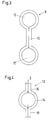
- a first simple embodiment of the hollow profile 1 according to the invention is shown in cross section in FIG.
- the example has a reinforced double-walled area 2, which for fastening this hollow profile 1 to the inside of the not shown here Serves motor vehicle door and an adjoining approximately tubular region 3.
- This area 3 serves to absorb the impact energy.
- the profile 1 is arranged in the motor vehicle door so that the direction of loading, shown here by the arrow 4, is perpendicular to the main axis 5 of the profile 1.
- the depth of the profile 1 is determined by the outer dimension 6 of the tubular region 3. It is easy to see that this dimension 6 can be reduced in that the tubular area 3, comparable to that shown in FIG. 4, is more oval, the long axis of the oval being in the main axis 5.
- FIGS. 2 and 3 show two further embodiments in the same cross section as FIG. 1.
- the hollow profile 7 or 8 each has a reinforced area 9 or 10 and two adjoining approximately tubular areas 11, 11 'or 12, 12'.
- the main axis of these profiles 7, 8 lies in relation to the load direction 4 exactly as shown in the example according to FIG. 1, so that repetition is not necessary.
- the profile 7 can be arranged in the door the other way round, for example in mirror image of the main axis.
- FIGS. 4 to 6 show three further exemplary embodiments in which two reinforced areas are combined with a tubular area.
- the hollow profile 13 shown in FIG. 4 is symmetrical, so that the tubular region 14 and the two reinforced regions 15, 15 'lie symmetrically to the main axis 5.
- the vertical regions 18, 18 'and 19, 19' are asymmetrical to the respective tubular regions 20 and 21.
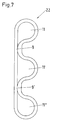
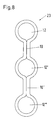
- the exemplary embodiments 22, 23 shown in FIGS. 7 and 8 can be derived directly from those shown in FIGS. 2 and 3, only with the difference that these two reinforced regions 9, 9 'and 10, 10' and a total of three tubular ones Have areas 11, 11 ', 11' 'or 12, 12', 12 ''.
- FIG. 9 Another variant of FIG. 4 is shown in FIG. 9.
- This hollow profile 24 has three reinforced areas 15, 15 ', 15' 'and two tubular areas 14, 14'.
- Figure 10 shows a variant of the embodiment shown in Figure 3.
- This hollow profile 25 also has only one reinforced region 26, each with an adjoining tubular region 12, 12 '.
- the difference from the embodiment according to FIG. 3 is that in the reinforced area 26 the double wall does not lie directly on top of one another, but is at a slight distance 27. This has proven to be advantageous in the manufacture of such a profile.
- This distance also has the advantage that when the two slightly apart wall regions are pressed together, the hollow profile 26 is pretensioned, which has a favorable effect on its deformation behavior in the event of an impact.
- This variant can also be used for similarly designed hollow profiles, for example according to FIG. 2, FIG. 22, FIG. 23 and FIG.
Landscapes
- Engineering & Computer Science (AREA)
- Mechanical Engineering (AREA)
- Body Structure For Vehicles (AREA)
Abstract
Description
- Die Erfindung betrifft ein Hohlprofil für die Verstärkung einer Kraftfahrzeugtür gemäß dem Gattungsbegriff des Hauptanspruches.
- Türverstärker dienen zur Sicherung des Fahrgastraumes eines Personenkraftwagens, indem sie die gesamte Türkonstruktion versteifen und einen erheblichen Anteil an Verformungsarbeit aufnehmen. Die Befestigung des Türverstärkers auf der Innenseite der Fahrzeugtür erfolgt mit verschiedenen Techniken. Eine der üblichen Verfahren ist die Umformung der Rohr- bzw. Profilenden und die Anbringung einer Bohrung im umgeformten Bereich (siehe Prospekt MW "Türverstärkerrohre aus hochfestem feinkörnigen Stahl für die Automobilindustrie", Ausgabe 1988). In diesem Fall wird das Türverstärkerprofil unmittelbar mit üblichen Befestigungselementen wie Schrauben oder Nieten an der Tür befestigt. Eine andere Möglichkeit besteht darin, ein Halteblech an beide Rohr- bzw. Profilenden anzuschweißen und diese mittels Widerstandsschweißen mit der Tür zu verbinden.
- Das letztgenannte Verfahren ist recht aufwendig und hat den Nachteil, daß die Verbindung Tür-Profil im Hinblick auf die gewünschte Steifigkeit nicht optimal ist. Für die an den Enden geschlossenen Türverstärkerprofile ist weiterhin nachteilig, daß die innere Oberfläche der Profile nur schwer oder gar nicht oberflächenbehandelt werden kann.
- Aufgabe der Erfindung ist es, ein verbessertes Hohlprofil für die Verstärkung einer Kraftfahrzeugtür anzugeben, das kostengünstig mit der Tür verbindbar ist und dessen innere Oberfläche in einfacher Weise behandelt werden kann.
- Diese Aufgabe wird mit den im kennzeichnenden Teil des Hauptanspruches angegebenen Merkmalen gelöst. Vorteilhafte Weiterbildungen sind Bestandteil von Unteransprüchen.
- Wesentliches Merkmal des verbesserten Hohlprofiles ist die doppelwandige Verstärkung im Befestigungsbereich, die sich senkrecht zur Belastungsrichtung erstreckt. An diesen Verstärkungsbereich schließt sich in der gleichen Richtung, d. h. senkrecht zur Belastungsrichtung ein etwa rohrförmiger Bereich an, der in Längsrichtung gesehen an beiden Enden offen ist. Das Profil, das sich in dieser Form über die ganze Länge erstreckt, kann im Verstärkungsbereich unmittelbar an der Tür befestigt werden, sei es durch Schweißen oder durch Schrauben oder durch Nieten. Je nach Anordnung einer oder mehrerer doppelwandiger Verstärkungsbereiche in Verbindung mit einem oder mehreren rohrförmigen Bereichen ergeben sich die unterschiedlichsten Varianten dieses erfindungsgemäßen Hohlprofiles. Eine besonders innige Verbindung zur Tür wird dann erreicht, wenn die Kontur in Längsrichtung des Profiles dem Konturverlauf der Tür angepaßt ist.
- Das vorgeschlagene Profil hat den Vorteil, daß der notwendige seitliche Bauraum gering und eine Umformung des Profiles an den Enden nicht erforderlich ist. Außerdem kann das an den beiden Enden offene Profil in einfacher Weise oberflächenbehandelt werden. Beispielsweise können die Profile in kurzer Taktzeit gebeizt, grundiert und anschließend lackiert werden. Das ist im Hinblick für einen langfristigen Rostschutz von Bedeutung, da im Zwischenraum der Kraftfahrzeugtür immer Feuchtigkeit vorhanden ist.
- In der Zeichnung wird anhand einiger Ausführungsbeispiele das erfindungsgemäße Hohlprofil näher erläutert.
Es zeigen: - Fig.1
- einen Querschnitt durch eine erste Ausführungsform des erfindungsgemäßen Hohlprofiles mit einem verstärkten und einem rohrförmigen Bereich
- Fig. 2-3
- einen Querschnitt durch zwei weitere Ausführungsformen mit einem verstärkten Bereich und zwei rohrförmigen Bereichen
- Fig. 4-6
- einen Querschnitt durch drei weitere Ausführungsformen mit zwei verstärkten Bereichen und einem rohrförmigen Bereich
- Fig. 7-8
- einen Querschnitt durch zwei weitere Ausführungsformen mit zwei verstärkten und drei rohrförmigen Bereich
- Fig. 9
- einen Querschnitt durch eine Ausführungsform mit drei verstärkten Bereichen und zwei rohrförmigen Bereichen.
- Fig. 10
- ähnlich Fig. 3 mit einem einen Abstand aufweisenden verstärkten Bereich
- In Figur 1 ist im Querschnitt eine erste einfache Ausführungsform des erfindungsgemäßen Hohlprofiles 1 dargestellt. Das Beispiel weist einen verstärkten doppelwandigen Bereich 2 auf, der zur Befestigung dieses Hohlprofiles 1 an der Innenseite der hier nicht dargestellten Kraftfahrzeugtür dient und einen daran anschließenden etwa rohrförmigen Bereich 3 auf. Dieser Bereich 3 dient zur Aufnahme der Aufprallenergie. Das Profil 1 ist so in der Kraftfahrzeugtür angeordnet, daß die Belastungsrichtung, hier dargestellt durch den Pfeil 4, senkrecht zur Hauptachse 5 des Profiles 1 liegt. Die Bautiefe des Profiles 1 wird durch das äußere Maß 6 des rohrförmigen Bereiches 3 bestimmt. Es ist leicht einzusehen, daß man dieses Maß 6 verringern kann, indem der rohrförmige Bereich 3, vergleichbar wie in Figur 4 dargestellt, mehr oval ist, wobei die lange Achse des Ovals in der Hauptachse 5 liegt.
- Die Figuren 2 und 3 zeigen im gleichen Querschnitt wie Fig. 1 zwei weitere Ausführungsformen. In diesen Fällen weist das Hohlprofil 7 bzw. 8 je einen verstärkten Bereich 9 bzw. 10 auf und zwei daran anschließende etwa rohrförmige Bereiche 11,11' bzw. 12,12'. Die Hauptachse dieser Profile 7,8 liegt im Verhältnis zur Belastungrichtung 4 genau wie im Beispiel gemäß Figur 1 dargestellt, so daß sich eine Wiederholung erübrigt. Bei dieser grundsätzlichen Anordnung bedarf es auch keines weiteren Hinweises, daß das Profil 7 beispielsweise spiegelbildlich zur Hauptachse auch anders herum in der Tür angeordnet werden kann.
- Die Figuren 4 bis 6 zeigen drei weitere Ausführungsbeispiels, bei denen zwei verstärkte Bereiche mit einem rohrförmigen Bereich kombiniert sind. Das in Figur 4 dargestellte Hohlprofil 13 ist symmetrisch ausgebildet, so daß der rohrförmige Bereich 14 und die zwei verstärkten Bereiche 15,15' symmetrisch zur Hauptachse 5 liegen. Im Unterschied dazu liegen bei den in den Figuren 5 und 6 dargestellten Hohlprofilen 16,17 die vertikalen Bereich 18,18' bzw. 19,19' asymmetrisch zum jeweiligen rohrförmigen Bereich 20 bzw. 21.
- Die in den Figuren 7 und 8 dargestellten Ausführungsbeispiele 22,23 sind direkt ableitbar von denen in den Figuren 2 und 3 dargestellten Beispielen, nur mit dem Unterschied, daß diese zwei verstärkte Bereiche 9,9' bzw. 10,10' und insgesamt drei rohrförmige Bereiche 11,11',11'' bzw. 12,12',12'' aufweisen.
- Eine weitere Variante zu Figur 4 ist in Figur 9 dargestellt. Dieses Hohlprofil 24 weist drei verstärkte Bereiche 15,15',15'' und zwei rohrförmige Bereiche 14,14' auf.
- Es erübrigt sich darauf hinzuweisen, daß die in den Figuren 5 und 6 dargestellten Ausführungsformen 16,17 in gleicher Weise variiert werden können wie die letztgenannten.
- Figur 10 zeigt eine Variante der in Figur 3 dargestellten Ausführungsform. Auch dieses Hohlprofil 25 weist nur einen verstärkten Bereich 26 mit je einem daran anschließenden rohrförmigen Bereich 12,12' auf. Der Unterschied zur Ausführungsform gemäß Figur 3 besteht darin, daß im verstärkten Bereich 26 die Doppelwand nicht unmittelbar aufeinanderliegt, sondern einen geringfügigen Abstand 27 aufweist. Dies hat sich bei der Herstellung eines solchen Profiles als vorteilhaft erwiesen. Dieser Abstand hat außerdem den Vorteil, daß beim Zusammenpressen der beiden etwas auseinanderstehenden Wandbereiche das Hohlprofil 26 unter Vorspannung gebracht wird, was sich günstig auf dessen Umformverhalten beim Aufprall auswirkt. Diese Variante ist für ähnlich ausgelegte Hohlprofile beispielsweise gemäß Figur 2, Figur 22, Figur 23 und Figur 24 ebenso anwendbar.
Claims (10)
- Hohlprofil für die Verstärkung einer Kraftfahrzeugtür, insbesondere eines Personenkraftwagens, das auf der Innenseite der Fahrzeugtür festlegbar ist,
dadurch gekennzeichnet,
daß das Hohlprofil (1,7,8,13,16,17,22,23,24,25) im Befestigungsbereich doppelwandig verstärkt ist und dieser Bereich senkrecht zur Belastungsrichtung (4) liegt und sich über die ganze Länge des Hohlprofiles erstreckt und der daran anschließende etwa rohrförmige Bereich (3,11,11',11'',12,12',12'',14,14',14'',20,21) an beiden Enden offen ist. - Hohlprofil nach Anspruch 1,
dadurch gekennzeichnet,
daß das Hohlprofil (1,7,8,25) nur einen doppelwandig verstärkten Bereich (2,9,10,26) aufweist. - Hohlprofil nach Anspruch 2,
dadurch gekennzeichnet,
daß der verstärkte Bereich (2) oben oder unten liegt und der rohrförmige Bereich (3) sich unmittelbar daran anschließt. - Hohlprofil nach Anspruch 2,
dadurch gekennzeichnet,
daß der verstärkte Bereich (9,10,26) in der Mitte des Hohlprofiles (7,8,25) liegt und je ein rohrförmiger Bereich (11,11',12,12') sich nach oben oder unten anschließt. - Hohlprofil nach Anspruch 4,
dadurch gekennzeichnet,
daß der verstärkte Bereich (26) einen geringfügigen Abstand (27) voneinander aufweist. - Hohlprofil nach Anspruch 1,
dadurch gekennzeichnet,
daß das Hohlprofil (13,20,21,22,23) zwei doppelwandig verstärkte Bereiche (15,15',18,18',19,19',9,9'10,10') aufweist. - Hohlprofil nach Anspruch 6,
dadurch gekennzeichnet,
daß der rohrförmige Bereich (14,20,21) in der Mitte liegt und daran sich die zwei verstärkten Bereiche (15,15',18,18',19,19') anschließen. - Hohlprofil nach Anspruch 6,
dadurch gekennzeichnet,
daß das Hohlprofil (22,23) drei rohrförmige Bereiche (11,11',11'',12,12',12'') aufweist mit je einem dazwischenliegenden verstärkten Bereich (9,9',10,10'). - Hohlprofil nach Anspruch 1,
dadurch gekennzeichnet,
daß das Hohlprofil (24) drei doppelwandig verstärkte Bereiche (15,15',15'')aufweist. - Hohlprofil nach einem der vorhergehenden Ansprüche,
dadurch gekennzeichnet,
daß die Kontur des Hohlprofiles (1,7,8,13,16,17,22,23,24,25) in Längsrichtung dem Konturverlauf der Tür angepaßt ist.
Applications Claiming Priority (2)
| Application Number | Priority Date | Filing Date | Title |
|---|---|---|---|
| DE9208957U DE9208957U1 (de) | 1992-06-30 | 1992-06-30 | Hohlprofil für die Verstärkung einer Kraftfahrzeugtür |
| DE9208957U | 1992-06-30 |
Publications (2)
| Publication Number | Publication Date |
|---|---|
| EP0577235A1 true EP0577235A1 (de) | 1994-01-05 |
| EP0577235B1 EP0577235B1 (de) | 1995-12-13 |
Family
ID=6881254
Family Applications (1)
| Application Number | Title | Priority Date | Filing Date |
|---|---|---|---|
| EP93250155A Expired - Lifetime EP0577235B1 (de) | 1992-06-30 | 1993-06-03 | Hohlprofil für die Verstärkung einer Kraftfahrzeugtür |
Country Status (3)
| Country | Link |
|---|---|
| EP (1) | EP0577235B1 (de) |
| DE (2) | DE9208957U1 (de) |
| ES (1) | ES2080583T3 (de) |
Cited By (3)
| Publication number | Priority date | Publication date | Assignee | Title |
|---|---|---|---|---|
| DE4423687A1 (de) * | 1994-07-06 | 1996-01-18 | Bayerische Motoren Werke Ag | Verstärkungsträger als Seitenaufprallschutz in der Tür eines Fahrzeuges |
| DE10254027A1 (de) * | 2002-11-20 | 2004-06-03 | Bayerische Motoren Werke Ag | Kraftfahrzeug mit einer Seitenwand |
| US6896314B2 (en) | 2003-03-28 | 2005-05-24 | Shape Corporation | Low-profile high-strength vehicle door beam |
Families Citing this family (1)
| Publication number | Priority date | Publication date | Assignee | Title |
|---|---|---|---|---|
| DE4421934A1 (de) * | 1994-06-23 | 1996-01-04 | Ford Werke Ag | Metallisches Profil als Verstärkung einer Kraftfahrzeugtür |
Citations (3)
| Publication number | Priority date | Publication date | Assignee | Title |
|---|---|---|---|---|
| US4838606A (en) * | 1986-09-01 | 1989-06-13 | Nissan Motor Co., Ltd. | Door guard bar |
| US4948196A (en) * | 1987-06-23 | 1990-08-14 | Hashimoto Forming Industry Co., Ltd. | Protective beam for automobile side doors |
| US5026111A (en) * | 1989-10-16 | 1991-06-25 | Excel Industries, Inc. | Vehicle door structure with improved energy absorption characteristics |
-
1992
- 1992-06-30 DE DE9208957U patent/DE9208957U1/de not_active Expired - Lifetime
-
1993
- 1993-06-03 ES ES93250155T patent/ES2080583T3/es not_active Expired - Lifetime
- 1993-06-03 EP EP93250155A patent/EP0577235B1/de not_active Expired - Lifetime
- 1993-06-03 DE DE59301150T patent/DE59301150D1/de not_active Expired - Fee Related
Patent Citations (3)
| Publication number | Priority date | Publication date | Assignee | Title |
|---|---|---|---|---|
| US4838606A (en) * | 1986-09-01 | 1989-06-13 | Nissan Motor Co., Ltd. | Door guard bar |
| US4948196A (en) * | 1987-06-23 | 1990-08-14 | Hashimoto Forming Industry Co., Ltd. | Protective beam for automobile side doors |
| US5026111A (en) * | 1989-10-16 | 1991-06-25 | Excel Industries, Inc. | Vehicle door structure with improved energy absorption characteristics |
Cited By (5)
| Publication number | Priority date | Publication date | Assignee | Title |
|---|---|---|---|---|
| DE4423687A1 (de) * | 1994-07-06 | 1996-01-18 | Bayerische Motoren Werke Ag | Verstärkungsträger als Seitenaufprallschutz in der Tür eines Fahrzeuges |
| DE10254027A1 (de) * | 2002-11-20 | 2004-06-03 | Bayerische Motoren Werke Ag | Kraftfahrzeug mit einer Seitenwand |
| DE10254027B4 (de) * | 2002-11-20 | 2011-06-16 | Bayerische Motoren Werke Aktiengesellschaft | Kraftfahrzeug mit einer Seitenwand |
| US6896314B2 (en) | 2003-03-28 | 2005-05-24 | Shape Corporation | Low-profile high-strength vehicle door beam |
| US7055886B2 (en) * | 2003-03-28 | 2006-06-06 | Shape Corporation | Low-profile high-strength vehicle door beam |
Also Published As
| Publication number | Publication date |
|---|---|
| EP0577235B1 (de) | 1995-12-13 |
| DE59301150D1 (de) | 1996-01-25 |
| DE9208957U1 (de) | 1992-09-10 |
| ES2080583T3 (es) | 1996-02-01 |
Similar Documents
| Publication | Publication Date | Title |
|---|---|---|
| DE69201797T2 (de) | Strukturierter träger und verfahren zu seiner herstellung. | |
| DE4031678C2 (de) | Verstärkungselement für die Karosserie eines Automobils | |
| EP0479401A1 (de) | Aufprallträger | |
| EP2994367A1 (de) | Säule für eine kraftfahrzeug-rohbaustruktur, verfahren zur herstellung einer säule und kraftfahrzeug-rohbaustruktur | |
| EP1002680A2 (de) | Türrahmen für einen Personenkraftwagen | |
| EP2332810A2 (de) | Karosserie eines Kraftfahrzeugs | |
| DE102007062597A1 (de) | Karosserieteil für eine Karosserie eines Kraftwagens | |
| DE102013107179A1 (de) | Stoßabsorptionsvorrichtung für ein Kraftfahrzeug | |
| EP0577235B1 (de) | Hohlprofil für die Verstärkung einer Kraftfahrzeugtür | |
| DE10348354A1 (de) | Karosseriestruktur für ein Kraftfahrzeug | |
| DE69707522T2 (de) | Türverstärkungsvorrichtung für Kraftfahrzeug | |
| EP1931557B1 (de) | Aus mindestens zwei vorkonfektionierten baugruppen zusammengesetzte fahrzeugkarosserie und verfahren zu ihrer herstellung | |
| EP0109577A1 (de) | Kotflügel in Blechkonstruktionsbauweise für insbesondere Lastkraftfahrzeuge | |
| DE10327194A1 (de) | Verbindungsanordnung im Dachbereich eines Personenkraftwagens | |
| EP0584898B1 (de) | Aufprallträger für eine Kraftfahrzeugtür | |
| DE102015204917A1 (de) | Seitentür für ein Fahrzeug sowie Fahrzeug mit einer derartigen Seitentür | |
| DE29622715U1 (de) | Prallträger für ein Kraftfahrzeug | |
| EP0733540B1 (de) | Hohlprofil für eine Trägerstruktur eines Kraftfahrzeuges | |
| DE19929872B4 (de) | Schachtleiste für eine Kraftfahrzeugtür und Verfahren zur Herstellung einer Schachtleiste | |
| DE10108352B4 (de) | Strukturbauelement für den Fahrzeugbau | |
| DE102009047956A1 (de) | Säule für einen Kraftwagen | |
| DE10155403C1 (de) | Platine, Karosserieteil und Verfahren zur Herstellung eines solchen Karosserieteils | |
| DE102020118816B4 (de) | Seitenlängsträgereinheit eines Fahrgestells eines mehrachsigen Kraftfahrzeugs | |
| DE10007421A1 (de) | Verstärkungsstrebe für ein Kfz im Seitenbereich | |
| DE10116437A1 (de) | Karosserie eines Fahrzeuges |
Legal Events
| Date | Code | Title | Description |
|---|---|---|---|
| PUAI | Public reference made under article 153(3) epc to a published international application that has entered the european phase |
Free format text: ORIGINAL CODE: 0009012 |
|
| AK | Designated contracting states |
Kind code of ref document: A1 Designated state(s): DE ES FR GB IT |
|
| 17P | Request for examination filed |
Effective date: 19931124 |
|
| 17Q | First examination report despatched |
Effective date: 19950516 |
|
| GRAA | (expected) grant |
Free format text: ORIGINAL CODE: 0009210 |
|
| AK | Designated contracting states |
Kind code of ref document: B1 Designated state(s): DE ES FR GB IT |
|
| ET | Fr: translation filed | ||
| REF | Corresponds to: |
Ref document number: 59301150 Country of ref document: DE Date of ref document: 19960125 |
|
| REG | Reference to a national code |
Ref country code: ES Ref legal event code: FG2A Ref document number: 2080583 Country of ref document: ES Kind code of ref document: T3 |
|
| ITF | It: translation for a ep patent filed | ||
| GBT | Gb: translation of ep patent filed (gb section 77(6)(a)/1977) |
Effective date: 19960314 |
|
| PGFP | Annual fee paid to national office [announced via postgrant information from national office to epo] |
Ref country code: FR Payment date: 19960521 Year of fee payment: 4 |
|
| PGFP | Annual fee paid to national office [announced via postgrant information from national office to epo] |
Ref country code: ES Payment date: 19960618 Year of fee payment: 4 |
|
| PGFP | Annual fee paid to national office [announced via postgrant information from national office to epo] |
Ref country code: DE Payment date: 19960715 Year of fee payment: 4 |
|
| PLBE | No opposition filed within time limit |
Free format text: ORIGINAL CODE: 0009261 |
|
| 26N | No opposition filed | ||
| PG25 | Lapsed in a contracting state [announced via postgrant information from national office to epo] |
Ref country code: GB Effective date: 19970603 |
|
| PG25 | Lapsed in a contracting state [announced via postgrant information from national office to epo] |
Ref country code: ES Free format text: LAPSE BECAUSE OF EXPIRATION OF PROTECTION Effective date: 19970604 |
|
| REG | Reference to a national code |
Ref country code: FR Ref legal event code: TP |
|
| GBPC | Gb: european patent ceased through non-payment of renewal fee |
Effective date: 19970603 |
|
| PG25 | Lapsed in a contracting state [announced via postgrant information from national office to epo] |
Ref country code: FR Free format text: LAPSE BECAUSE OF NON-PAYMENT OF DUE FEES Effective date: 19980227 |
|
| PG25 | Lapsed in a contracting state [announced via postgrant information from national office to epo] |
Ref country code: DE Free format text: LAPSE BECAUSE OF NON-PAYMENT OF DUE FEES Effective date: 19980303 |
|
| REG | Reference to a national code |
Ref country code: FR Ref legal event code: ST |
|
| REG | Reference to a national code |
Ref country code: FR Ref legal event code: ST |
|
| REG | Reference to a national code |
Ref country code: ES Ref legal event code: FD2A Effective date: 20000301 |
|
| PG25 | Lapsed in a contracting state [announced via postgrant information from national office to epo] |
Ref country code: IT Free format text: LAPSE BECAUSE OF NON-PAYMENT OF DUE FEES;WARNING: LAPSES OF ITALIAN PATENTS WITH EFFECTIVE DATE BEFORE 2007 MAY HAVE OCCURRED AT ANY TIME BEFORE 2007. THE CORRECT EFFECTIVE DATE MAY BE DIFFERENT FROM THE ONE RECORDED. Effective date: 20050603 |