EP0577298A2 - Verifizierung von Systemen, die an Verzögerungs-Zwangsbedingungen unterworfen sind - Google Patents
Verifizierung von Systemen, die an Verzögerungs-Zwangsbedingungen unterworfen sind Download PDFInfo
- Publication number
- EP0577298A2 EP0577298A2 EP93304718A EP93304718A EP0577298A2 EP 0577298 A2 EP0577298 A2 EP 0577298A2 EP 93304718 A EP93304718 A EP 93304718A EP 93304718 A EP93304718 A EP 93304718A EP 0577298 A2 EP0577298 A2 EP 0577298A2
- Authority
- EP
- European Patent Office
- Prior art keywords
- processes
- test set
- delay
- temporal property
- counter example
- Prior art date
- Legal status (The legal status is an assumption and is not a legal conclusion. Google has not performed a legal analysis and makes no representation as to the accuracy of the status listed.)
- Withdrawn
Links
Images





Classifications
-
- G—PHYSICS
- G06—COMPUTING OR CALCULATING; COUNTING
- G06F—ELECTRIC DIGITAL DATA PROCESSING
- G06F9/00—Arrangements for program control, e.g. control units
- G06F9/06—Arrangements for program control, e.g. control units using stored programs, i.e. using an internal store of processing equipment to receive or retain programs
- G06F9/44—Arrangements for executing specific programs
- G06F9/455—Emulation; Interpretation; Software simulation, e.g. virtualisation or emulation of application or operating system execution engines
-
- G—PHYSICS
- G06—COMPUTING OR CALCULATING; COUNTING
- G06F—ELECTRIC DIGITAL DATA PROCESSING
- G06F30/00—Computer-aided design [CAD]
- G06F30/30—Circuit design
-
- G—PHYSICS
- G06—COMPUTING OR CALCULATING; COUNTING
- G06F—ELECTRIC DIGITAL DATA PROCESSING
- G06F30/00—Computer-aided design [CAD]
- G06F30/30—Circuit design
- G06F30/32—Circuit design at the digital level
- G06F30/33—Design verification, e.g. functional simulation or model checking
- G06F30/3323—Design verification, e.g. functional simulation or model checking using formal methods, e.g. equivalence checking or property checking
Definitions
- This invention relates to implementations of systems as collections of finite state automata, and more particularly to implementations based on formal verification of the correctness of the system being implemented.
- a perennial problem in the design of large systems is verifying that the system will indeed behave in the manner intended by its designers.
- One approach has been simply to try out the system, either by building and testing the system itself or by building and testing a model of it.
- this approach has taken the form of a computer simulation of the system.
- a computer program which is a model of the system is written, and the system is tested by executing the computer program.
- a fundamental problem with the approach of "trying out the system” is that the system's designers can only try out behavior which they anticipate. For any but the simplest systems, however, the designers cannot anticipate all of the behavior of the system, and it is of course always unanticipated behavior which causes difficulties.
- formal verification the designer provides a logical definition of the system's intended behavior and a logical definition of the implementation to a formal verification system.
- the formal verification system determines whether the logical definition of the system's intended behavior implies the logical definition of the implementation. If it does, the implementation is faithful to the logical definition of the intended behavior.
- a delay constraint specifies a delay by specifying a delay duration which ranges between a minimum delay duration and a maximum delay duration.
- the minimum delay duration and the maximum delay duration are termed the lower and upper delay bounds respectively .
- the system may be required to respond to a stimulus within a fixed period of time.
- This fixed period is a first delay constraint with a lower delay bound of 0 and an upper delay bound of the fixed period of time.
- the stimulus may be received by a first one of the automata making up the system and the response may be provided by another one of the automata.
- Communication between the two automata is by means of a channel which has a second delay constraint in which the lower delay bound specifies the minimum time required to send a message via the channel and the upper delay bound specifies the maximum delay required to send the message.
- the system will always fail; further, if the upper delay bound of the second delay constraint is longer than the upper delay bound of the first delay constraint, the system will fail whenever the condition of the channel is such that the delay required for the message is longer than the upper delay bound of the first delay constraint.
- the foregoing object is achieved by means of an iterative method of verifying that a set of processes, each of which has a delay constraint, satisfies a given temporal property.
- the method is practised in a computer and includes the following steps: determining whether a test set of processes derived from the set of processes satisfies the given temporal property and if the test set does, terminating the method and otherwise providing a counter-example; determining whether the counter-example is timing consistent with the delay constraints and if the conter-example is timing consistent, terminating the algorithm; and employing the counter-example to restrict the test set of processes and repeating the steps of the method with the restricted test set as the test set.
- Other aspects of the invention include techniques for determining the timing consistency of the counter-example, techniques for finding minimal subsets of delay constraints, and techniques for finding optimal delay constraints, as well as techniques for creating sequential circuits which verify that the sequential circuits satisfy a temporal property.
- a "system” M is commonly defined in terms of coordinating components, each component restricting the behavior of the other components with which it coordinates. Therefore, processes provide a natural class of automata for modeling such coordination. We make further use of this property when we consider processes subject to timing constraints: the timing constraints not only constrain the process itself, but also the other processes with which it coordinates.
- b i ( x ) is undefined; likewise for e i ( x ). If processes P i and P j both begin a delay at event x , then b i ( x ) ⁇ ⁇ i and b j ( x ) ⁇ ⁇ j are defined.
- x may correspond to the simultaneous receipt of a signal by P i and emission of a (perhaps unrelated) signal from P j . For more examples of how this arises naturally in modeling systems of concurrent processes, see the Kurshan 1987 and 1990 references cited above.
- each delay ⁇ ⁇ ⁇ P has associated with it two nonnegative numbers: 0 ⁇ ⁇ ( ⁇ ) ⁇ ⁇ ( ⁇ ) where ⁇ ( ⁇ ) is rational and ⁇ ( ⁇ ) is rational or is ⁇ .
- the intended interpretation is that the delay ⁇ has duration at least ⁇ ( ⁇ ) and at most ⁇ ( ⁇ ).
- x is timing-consistent if it is possible to assign an increasing succession of real times to the events of P modeled by x , in such a way that the durations of delays of the respective component processes P i as given by these time assignments are within the allowed bounds.
- D any delay constraint D .
- any string ⁇ ( x 1,..., x n ) to be timing-consistent (with D ) provided there are real numbers t 1 ⁇ ... ⁇ t n satisfying these same conditions.
- the counter-example x has a finite prefix ⁇ such that every extension of ⁇ does not belong to ( T ). This is the case, for instance, when the temporal property defined by T is a "safety" property.
- the problem of testing consistency of ⁇ can be reduced to the problem of finding negative cost cycles in a weighted graph as described in the next section.
- the timing-consistency of x can be checked in time O (
- x infinite e.g. , T specifies a "liveness" property
- T specifies a "liveness" property
- the costs of the edges of the graph will be from the domain .
- the ordering ⁇ over the integers is extended to by the following law: for any integer ⁇ , - ⁇ ⁇ ⁇ ⁇ ⁇ ⁇ ( ⁇ + 1) ⁇ ⁇ ⁇ .
- constraints corresponding to a sequence ⁇ can be rewritten as follows.
- a constraint of the form t i ⁇ t i +1 is written as t i - t i +1 ⁇ 0 ⁇ .
- a constraint of the form a 1 ⁇ t k - t j ⁇ b1 gives rise to two constraints: t k - t j ⁇ b 1 and t j - t k ⁇ - a 1 .
- the graph G ( x ) has a node v i for every variable t i ; for each constraint t j - t k ⁇ b , there is an edge from v j to v k with cost b .
- the graph has a forward edge from v i to v j with negative cost showing the lower bound and a backward edge from v j to v i with positive cost showing the upper bound.
- the problem of checking consistency reduces to finding negative cost cycles in this graph: Lemma 1
- the sequence x is timing inconsistent iff the graph G ( x ) has a negative cost cycle .
- a weighted graph G ( ⁇ ) with N vertices is defined similarly, and the corresponding lemma holds as well.
- the graph G ( ⁇ ) is finite with N vertices and O ( N ⁇ K ) edges, where K is the number of processes.
- K is the number of processes.
- the best known time complexity is O ( N 2 ⁇ K ). Since N is much larger than K , we prefer an alternative solution with time complexity O ( K 2 ⁇ N ).
- Step 1 corresponds to adding an extra row and column to A .
- Step 2 we need to check if the updated matrix has a negative cost cycle, and if not, compute the new shortest distances. Observe that, for any pair of vertices v and v ', the new shortest distance between v and v ' is different from the old one, only if the new shortest path visits the new vertex v j . This fact can be used to compute the new shortest distances efficiently: in time O ( m 2), where m is the number of vertices in the current graph.
- Step 3 ensures that the updated matrix A stores only the vertices that are external to x 1,... x j . and hence at most 2 K vertices.
- the overall time complexity of the algorithm is O ( N ⁇ K 2).
- Theorem 1 The problem of deciding whether a string ⁇ is timing consistent can be solved in time O (
- Example 2 Consider two processes P 1 and P 2. The process P 1 has a delay ⁇ 1, and the process P 2 has a delay ⁇ 2.
- b i and e i to denote the beginning and ending of the delays of the processes P i , as in Example 1.
- ⁇ ' ( b 1)
- ⁇ (b2, ⁇ e1,b1 ⁇ ,e2).
- the reduced graph G *( ⁇ m ) can be computed in time
- the lemma follows from the facts that G *( ⁇ )can be computed in time O (
- the periodic graph G ( ⁇ ⁇ ) can be considered as the concatenation of infinitely many copies of the graphs G *( ⁇ ).
- G *( ⁇ ) has m vertices, m ⁇ 2 K , and let us denote the vertices in the j -th copy of G *( ⁇ ) by ,... .
- the question is whether d ( i , j ) can be determined by computing the values of d k ( i , j ) up to a small k .
- the following lemma gives the answer in the case where there is a shortest path between and (i.e., the case where d ( i , j ) ⁇ - ⁇ ). It shows that if the shortest distance between and can be reduced by considering additional copies of G ( ⁇ ) beyond m 2 copies, then, in fact, it can be reduced repeatedly by "pumping" appropriate paths, and hence, is unbounded.
- Lemma 3 For every pair of vertices and either d ( i,j ) is -#INF# or equals Proof .
- ⁇ be the smallest, in terms of the number of edges.
- the L -transitive closure problem is to compute all pairs of nodes ( v i , v j ) for which there exists a path from v i to v j that spells a word in L .
- computing the set S inf corresponds to computing the L inf - transitive closure of the graph G inf .
- the language L inf can be recognized by a deterministic 1-counter machine A (a special case of a pushdown automaton).
- A be a machine which reads the symbols of the input word one by one and does the following: on symbol a it does nothing, on b it moves to a state that signifies that A has seen at least one b , on symbol c it increments the counter (staying in the same state), and on d it decrements the counter if it was positive and rejects the whole input if the counter was 0.
- the machine accepts if after processing the input word it has seen some b and the counter is 0.
- the language L inf is context-free.
- the L -transitive closure problem for a context-free language can be solved in cubic time O ( m 3) in the number m of nodes by employing a method described in M. Yannakakis. "Graph-theoretic methods in database theory", in: Proceedings of the 9th ACM Symposium on Principles of Data Base Systems , pp. 230-242, 1990, giving the following lemma: Lemma 6
- the set of pairs S inf can be computed in time O(m3).
- a pair ( v i , v j ) will be in A at the end of the algorithm iff there is a path from v i to v j which spells a word that satisfies conditions 1 and 2 in the definition of L inf (but possibly not 3); it will be in A ' iff the word satisfies the following modified conditions: 1'. the number of c 's is one more than the number of d 's; and 2'. in every prefix the number of c 's is strictly larger than the number of d 's.
- the sets B and B ' are defined analogously except that, in addition, the word must also contain one b (i.e., satisfy condition 3 in the definition of L inf ).
- the desired set S inf is given by the final value of B .
- These sets are represented by Boolean matrices whose rows and columns are indexed by the nodes of the graph.
- the data structures are initialized as follows: For every a -labeled edge, insert the corresponding pair of nodes to A (i.e., set the corresponding entry of matrix A to 1) and to the list S A . For every b -labeled edge, insert the corresponding pair to A , B , S A , S B . For every c -labeled edge, insert the pair to A ' and S A' ; we do nothing for the d -labeled edges.
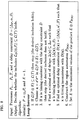
- Algorithm of Figure is used to test the consistency of ⁇ ' and ⁇ , and to compute the reduced graphs G *( ⁇ ') and G *( ⁇ ).
- Step 3 takes time Computing the set S inf at step 4 can be performed in time O ( m 3) as outlined earlier. Combining the two graphs G *( ⁇ ') and G *( ⁇ ⁇ ), and testing for negative cost cycles is easy. This gives the following theorem: Theorem 2 The problem of deciding whether a sequence ⁇ ' ⁇ ⁇ is timing consistent is solvable in time
- the next step is to find an "optimal" delay constraint, namely a delay constraint D ( x ) with P D ( x ) as small as possible, subject to:
- condition 2 ensures that to prove that the implementation augmented with P D satisfies the specification, it suffices to prove that the implementation augmented with P D ( x ) satisfies the specification.
- the second step is to find a minimal subset ⁇ ( x ) of ⁇ i ⁇ I ⁇ i preserving the timing-inconsistency of x . This is again done by an exhaustive search over all the subsets of ⁇ i ⁇ I ⁇ i .
- the set ⁇ ( x ) consists of only the delays corresponding to the edges involved in the negative cost cycle.
- the problem is to construct new lower and upper bound maps ⁇ ' and ⁇ ' from the delay constraint ( ⁇ ( x ), ⁇ , ⁇ ) by replacing, for each delay ⁇ ⁇ ⁇ ( x ) , its lower bound ⁇ ( ⁇ ) by ⁇ '( ⁇ ) ⁇ ⁇ ( ⁇ ) , and its upper bound ⁇ ( ⁇ ) by ⁇ '( ⁇ ) ⁇ ⁇ ( ⁇ ) , such that x is timing inconsistent with ( ⁇ ( x ), ⁇ ', ⁇ ') so as to minimize the magnitudes of constants after scaling (dividing by the greatest common divisor of all the bounds).
- the algorithm to test consistency of x reports that x is inconsistent when it finds a negative cost cycle in the associated weighted graph G ( x ).
- We adjust the delay bounds so that the negativeness of the cost of this cycle is preserved.
- all upper bounds appear as positive costs and all lower bounds appear as negative costs.
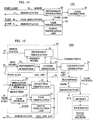
- FIG. 14 gives an overview of that implementation.
- FIG. 14 is based on FIG. 1 of the parent application.
- Analysis/development apparatus 1401 shown in FIG. 14 adds a new element, timing verification 1409, to task verification 20 of the apparatus of FIG. 1 and takes new inputs: in addition ot the set of processes P 1403 for which code is to be generated in box 30, the inputs at model 12 now include timing constraints ⁇ 1405 for the set of processes and the inputs at task 22 include temporal property T 1407 to be satisfied by the set of processes.
- Timing verification portion 1409 of task verification 20 employs P 1403, ⁇ 1405, and T 1407 in the manner discussed above to verify that P 1403's timing constraints 1405 permit property T to be satisfied. If they cannot be, error status 21 returns counter-example 1408 to the user of the system. If they can be, the set of processes P 1403 as modified by the timing verification becomes part of system definition 15 and is used in code generation 30.
- FIG. 15 shows the implementation in more detail.
- Fig. 15 is based on FIG. 2 of the parent patent application and shows analysis/development apparatus 1501. Inputs and outputs are the same as for apparatus 1401.
- the relationship between timing verification portion 1409 is the following: timing verification portion 1409 receives inputs P 1403, ⁇ 1405, and T 1407 from task verification 26 and performs the timing verification operation; if property T 1407 cannot be satisfied, counter-example x 1408 is returned to task storage 23, which in turn provides it to task verification 26 for output as an error message on error status 21.
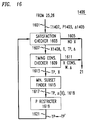
- FIG. 16 finally, provides an overview of the components of timing verification portion 1409 and their cooperation.
- Timing verification component 1409 receives T 1407, P 1403, and ⁇ 1405 from boxes 25 and 26 of FIG. 15 at 1601.
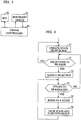
- the first component is satisfaction checker 1603, which determines whether a test set of processes TP 1621 with delay constraints ⁇ 1405 satisfies temporal property T. If it does, operation of timing verification portion 1409 ceases and no error status is returned from portion 1409 on 21.
- the first test set of processes 1621 is of course the set of processes P 1403.
- timing consistency checker 1609 determines whether counter-example 1408 is consistent with the delay constraints 1405. If it is, counter-example 1408 is returned at 1611 to error status 21 and operation of timing verification portion 1409 ceases. If counter-example 1408 is not consistent, counter-example 1408 and test set of processes 1621 are provided via 1613 to minimum subset finder 1615 which finds the minimum subset of delay constraints for which counter-example 1405 holds.
- Minimum subset ⁇ ( x ) appears at reference number 1618 in FIG. 16.
- Minimum subset 1618 and test processes 1621 are provided via 1617 to process restricter 1619, which restricts set of test processes 1621 as required by minimum subset 1618 to produce set of test processes TP'.
- Set of test processes 1621 is then set to TP', and new set of test processes 1621 are input to satisfaction checker 1603.
- the algorithms used in components 1603, 1609, 1615, and 1619 are all guaranteed to terminate, as is component 1409 itself, and consequently, the implementation is computationally tractable.
Landscapes
- Engineering & Computer Science (AREA)
- Theoretical Computer Science (AREA)
- Physics & Mathematics (AREA)
- Computer Hardware Design (AREA)
- General Physics & Mathematics (AREA)
- General Engineering & Computer Science (AREA)
- Evolutionary Computation (AREA)
- Geometry (AREA)
- Software Systems (AREA)
- Debugging And Monitoring (AREA)
- Devices For Executing Special Programs (AREA)
- Machine Translation (AREA)
- Tests Of Electronic Circuits (AREA)
- Test And Diagnosis Of Digital Computers (AREA)
- Information Retrieval, Db Structures And Fs Structures Therefor (AREA)
Applications Claiming Priority (2)
| Application Number | Priority Date | Filing Date | Title |
|---|---|---|---|
| US906082 | 1992-06-29 | ||
| US07/906,082 US5483470A (en) | 1990-03-06 | 1992-06-29 | Timing verification by successive approximation |
Publications (2)
| Publication Number | Publication Date |
|---|---|
| EP0577298A2 true EP0577298A2 (de) | 1994-01-05 |
| EP0577298A3 EP0577298A3 (en) | 1994-09-21 |
Family
ID=25421899
Family Applications (1)
| Application Number | Title | Priority Date | Filing Date |
|---|---|---|---|
| EP19930304718 Withdrawn EP0577298A3 (en) | 1992-06-29 | 1993-06-17 | Verification of systems subject to delay constraints |
Country Status (6)
| Country | Link |
|---|---|
| US (3) | US5483470A (de) |
| EP (1) | EP0577298A3 (de) |
| JP (1) | JP2862764B2 (de) |
| KR (1) | KR940000961A (de) |
| CA (1) | CA2097230C (de) |
| IL (1) | IL106139A (de) |
Cited By (2)
| Publication number | Priority date | Publication date | Assignee | Title |
|---|---|---|---|---|
| EP0806735A1 (de) * | 1996-05-06 | 1997-11-12 | Siemens Aktiengesellschaft | Verfahren zur Steuerung eines Prozessablaufs nach von einem Rechner spezifizierten Verhalten |
| EP0806734A1 (de) * | 1996-05-06 | 1997-11-12 | Siemens Aktiengesellschaft | Verfahren zur Modellierung eines Prozessablaufs nach Zeitzwangsbedingungen |
Families Citing this family (43)
| Publication number | Priority date | Publication date | Assignee | Title |
|---|---|---|---|---|
| US6185516B1 (en) * | 1990-03-06 | 2001-02-06 | Lucent Technologies Inc. | Automata-theoretic verification of systems |
| US5483470A (en) * | 1990-03-06 | 1996-01-09 | At&T Corp. | Timing verification by successive approximation |
| US5966516A (en) * | 1996-05-17 | 1999-10-12 | Lucent Technologies Inc. | Apparatus for defining properties in finite-state machines |
| US6487676B1 (en) * | 1996-07-19 | 2002-11-26 | Telefonaktiebolaget Lm Ericsson (Publ) | Validation of procedures |
| US5937181A (en) * | 1997-03-31 | 1999-08-10 | Lucent Technologies, Inc. | Simulation of a process of a concurrent system |
| US5901073A (en) * | 1997-06-06 | 1999-05-04 | Lucent Technologies Inc. | Method for detecting errors in models through restriction |
| US6295515B1 (en) * | 1997-11-03 | 2001-09-25 | Lucent Technologies Inc. | Static partial order reduction |
| US6813702B1 (en) * | 1998-06-29 | 2004-11-02 | Hewlett-Packard Development Company, L.P. | Methods and apparatus for generating effective test code for out of order super scalar microprocessors |
| US6624761B2 (en) * | 1998-12-11 | 2003-09-23 | Realtime Data, Llc | Content independent data compression method and system |
| US6311293B1 (en) * | 1998-12-14 | 2001-10-30 | Lucent Technologies Inc. | Detecting of model errors through simplification of model via state reachability analysis |
| US6601104B1 (en) | 1999-03-11 | 2003-07-29 | Realtime Data Llc | System and methods for accelerated data storage and retrieval |
| US6604158B1 (en) * | 1999-03-11 | 2003-08-05 | Realtime Data, Llc | System and methods for accelerated data storage and retrieval |
| DE19929166A1 (de) * | 1999-06-25 | 2001-03-22 | Tektronix Inc | Verfahren zum Erlernen von Protokollregeln aus beobachteten Kommunikationsabläufen |
| US6587844B1 (en) * | 2000-02-01 | 2003-07-01 | At&T Corp. | System and methods for optimizing networks of weighted unweighted directed graphs |
| US20030191876A1 (en) * | 2000-02-03 | 2003-10-09 | Fallon James J. | Data storewidth accelerator |
| US20010047473A1 (en) * | 2000-02-03 | 2001-11-29 | Realtime Data, Llc | Systems and methods for computer initialization |
| US6708143B1 (en) | 2000-05-22 | 2004-03-16 | Lucent Technologies Inc. | Verification coverage method |
| US20050192789A1 (en) * | 2000-06-30 | 2005-09-01 | Jin Yang | Methods for formal verification on a symbolic lattice domain |
| US6725431B1 (en) | 2000-06-30 | 2004-04-20 | Intel Corporation | Lazy symbolic model checking |
| US7031896B1 (en) | 2000-06-30 | 2006-04-18 | Intel Corporation | Methods for performing generalized trajectory evaluation |
| US6591400B1 (en) * | 2000-09-29 | 2003-07-08 | Intel Corporation | Symbolic variable reduction |
| US6643827B1 (en) * | 2000-09-30 | 2003-11-04 | Intel Corporation | Symbolic model checking with dynamic model pruning |
| US8692695B2 (en) * | 2000-10-03 | 2014-04-08 | Realtime Data, Llc | Methods for encoding and decoding data |
| US9143546B2 (en) | 2000-10-03 | 2015-09-22 | Realtime Data Llc | System and method for data feed acceleration and encryption |
| US7417568B2 (en) * | 2000-10-03 | 2008-08-26 | Realtime Data Llc | System and method for data feed acceleration and encryption |
| US7386046B2 (en) | 2001-02-13 | 2008-06-10 | Realtime Data Llc | Bandwidth sensitive data compression and decompression |
| US20030046583A1 (en) * | 2001-08-30 | 2003-03-06 | Honeywell International Inc. | Automated configuration of security software suites |
| US6957178B2 (en) * | 2001-10-29 | 2005-10-18 | Honeywell International Inc. | Incremental automata verification |
| US7136793B2 (en) * | 2003-01-14 | 2006-11-14 | Lockheed Martin Corporation | System and method for modeling a propagation and containment process |
| US7065726B1 (en) * | 2003-05-30 | 2006-06-20 | Jasper Design Automation, Inc. | System and method for guiding and optimizing formal verification for a circuit design |
| US6983435B2 (en) * | 2003-06-19 | 2006-01-03 | International Business Machines Corporation | Integrated design verification and design simplification system |
| US20050010907A1 (en) * | 2003-07-07 | 2005-01-13 | Namjoshi Kedar Sharadchandra | Method and apparatus for reducing a program size while maintaining branching time properties and automated checking of such reduced programs |
| GB0414742D0 (en) * | 2004-07-01 | 2004-08-04 | Hewlett Packard Development Co | Method and system for test case generation |
| EP1621945B1 (de) * | 2004-07-30 | 2017-03-29 | Siemens Aktiengesellschaft | Konsistenzsicherung in einem Automatisierungssystem |
| US20070005526A1 (en) * | 2005-06-21 | 2007-01-04 | Paul Whitney | Scenario representation manipulation methods, scenario analysis devices, articles of manufacture, and data signals |
| US20060287910A1 (en) * | 2005-06-21 | 2006-12-21 | Kuchar Olga A | Scenario analysis methods, scenario analysis devices, articles of manufacture, and data signals |
| US20080270213A1 (en) * | 2007-04-24 | 2008-10-30 | Athena Christodoulou | Process risk estimation indication |
| US9123020B2 (en) * | 2008-09-25 | 2015-09-01 | International Business Machines Corporation | Modeling, monitoring, and managing system dimensions for a service assurance system |
| US8407652B2 (en) | 2010-12-20 | 2013-03-26 | International Business Machines Corporation | Task-based multi-process design synthesis |
| US8392866B2 (en) * | 2010-12-20 | 2013-03-05 | International Business Machines Corporation | Task-based multi-process design synthesis with notification of transform signatures |
| US8341565B2 (en) | 2010-12-20 | 2012-12-25 | International Business Machines Corporation | Task-based multi-process design synthesis with reproducible transforms |
| US20120246612A1 (en) * | 2011-03-23 | 2012-09-27 | Siemens Corporation | System and method for verification and validation of redundancy software in plc systems |
| EP3265934A1 (de) * | 2015-03-05 | 2018-01-10 | The MathWorks, Inc. | Logik mit bedingungsbasierter dauer |
Family Cites Families (4)
| Publication number | Priority date | Publication date | Assignee | Title |
|---|---|---|---|---|
| US4587625A (en) * | 1983-07-05 | 1986-05-06 | Motorola Inc. | Processor for simulating digital structures |
| FR2643464B1 (fr) * | 1989-02-17 | 1991-06-14 | Thomson Csf | Procede pour augmenter la cadence image d'un sonar et sonar pour la mise en oeuvre de ce procede |
| US5483470A (en) * | 1990-03-06 | 1996-01-09 | At&T Corp. | Timing verification by successive approximation |
| US5163016A (en) * | 1990-03-06 | 1992-11-10 | At&T Bell Laboratories | Analytical development and verification of control-intensive systems |
-
1992
- 1992-06-29 US US07/906,082 patent/US5483470A/en not_active Expired - Fee Related
-
1993
- 1993-05-28 CA CA002097230A patent/CA2097230C/en not_active Expired - Fee Related
- 1993-06-17 EP EP19930304718 patent/EP0577298A3/en not_active Withdrawn
- 1993-06-24 KR KR1019930011562A patent/KR940000961A/ko not_active Ceased
- 1993-06-25 IL IL10613993A patent/IL106139A/en not_active IP Right Cessation
- 1993-06-28 JP JP5178636A patent/JP2862764B2/ja not_active Expired - Fee Related
-
1995
- 1995-02-03 US US08/383,341 patent/US5691925A/en not_active Expired - Lifetime
- 1995-02-06 US US08/384,100 patent/US5740084A/en not_active Expired - Lifetime
Cited By (2)
| Publication number | Priority date | Publication date | Assignee | Title |
|---|---|---|---|---|
| EP0806735A1 (de) * | 1996-05-06 | 1997-11-12 | Siemens Aktiengesellschaft | Verfahren zur Steuerung eines Prozessablaufs nach von einem Rechner spezifizierten Verhalten |
| EP0806734A1 (de) * | 1996-05-06 | 1997-11-12 | Siemens Aktiengesellschaft | Verfahren zur Modellierung eines Prozessablaufs nach Zeitzwangsbedingungen |
Also Published As
| Publication number | Publication date |
|---|---|
| CA2097230A1 (en) | 1993-12-30 |
| US5691925A (en) | 1997-11-25 |
| EP0577298A3 (en) | 1994-09-21 |
| JPH06119410A (ja) | 1994-04-28 |
| IL106139A (en) | 1996-09-12 |
| JP2862764B2 (ja) | 1999-03-03 |
| IL106139A0 (en) | 1993-10-20 |
| CA2097230C (en) | 1997-03-18 |
| US5483470A (en) | 1996-01-09 |
| US5740084A (en) | 1998-04-14 |
| KR940000961A (ko) | 1994-01-10 |
Similar Documents
| Publication | Publication Date | Title |
|---|---|---|
| EP0577298A2 (de) | Verifizierung von Systemen, die an Verzögerungs-Zwangsbedingungen unterworfen sind | |
| JP4028107B2 (ja) | 分解及び分割によるハードウェアの検証並びに表現方法 | |
| US6035107A (en) | Method for performing functional comparison of combinational circuits | |
| US6957404B2 (en) | Model checking with layered localization reduction | |
| JP3858000B2 (ja) | フィルタリング型アプローチを使用する組合せ回路の検証方法 | |
| Benedikt et al. | LTL model checking of interval Markov chains | |
| KR100237090B1 (ko) | 제어 집중 시스템 | |
| US5513122A (en) | Method and apparatus for determining the reachable states in a hybrid model state machine | |
| US7409377B2 (en) | Accelerated solution of constraint satisfaction problems by partitioning of the variable space | |
| US8271253B2 (en) | Symbolic depth-first searches using control flow information for improved reachability analysis | |
| Touati et al. | Testing language containment for ω-automata using BDDs | |
| JP2001022820A (ja) | 順序回路の検証方法 | |
| US7203631B2 (en) | System and method to analyze VLSI designs | |
| US5796621A (en) | Circuit delay abstraction tool | |
| US7159201B2 (en) | Method and apparatus for cut-point frontier selection and for counter-example generation in formal equivalence verification | |
| US7308657B2 (en) | Method for generating hints for program analysis | |
| Abdulla et al. | Forward reachability analysis of timed Petri nets | |
| Belluomini et al. | Efficient timing analysis algorithms for timed state space exploration | |
| US20090024557A1 (en) | Clause and Proof Tightening | |
| Bause et al. | Qualitative and quantitative analysis of timed SDL specifications | |
| Chatterjee et al. | Quantitative verification on product graphs of small treewidth | |
| JP3582849B2 (ja) | 論理型プログラム検証方法 | |
| Mishchenko et al. | FRAIGs: Functionally reduced AND-INV graphs | |
| Itai | Timing Verification by Successive Approximation | |
| Touati et al. | Testing language containment for u>-automata using BDD's |
Legal Events
| Date | Code | Title | Description |
|---|---|---|---|
| PUAI | Public reference made under article 153(3) epc to a published international application that has entered the european phase |
Free format text: ORIGINAL CODE: 0009012 |
|
| AK | Designated contracting states |
Kind code of ref document: A2 Designated state(s): DE FR GB |
|
| RAP3 | Party data changed (applicant data changed or rights of an application transferred) |
Owner name: AT&T CORP. |
|
| PUAL | Search report despatched |
Free format text: ORIGINAL CODE: 0009013 |
|
| AK | Designated contracting states |
Kind code of ref document: A3 Designated state(s): DE FR GB |
|
| 17P | Request for examination filed |
Effective date: 19950309 |
|
| 17Q | First examination report despatched |
Effective date: 19970107 |
|
| STAA | Information on the status of an ep patent application or granted ep patent |
Free format text: STATUS: THE APPLICATION IS DEEMED TO BE WITHDRAWN |
|
| 18D | Application deemed to be withdrawn |
Effective date: 19990615 |