EP0577324A2 - Prozessor zur Systemverwaltung - Google Patents
Prozessor zur Systemverwaltung Download PDFInfo
- Publication number
- EP0577324A2 EP0577324A2 EP93304914A EP93304914A EP0577324A2 EP 0577324 A2 EP0577324 A2 EP 0577324A2 EP 93304914 A EP93304914 A EP 93304914A EP 93304914 A EP93304914 A EP 93304914A EP 0577324 A2 EP0577324 A2 EP 0577324A2
- Authority
- EP
- European Patent Office
- Prior art keywords
- organization
- patterns
- activity
- activities
- work
- Prior art date
- Legal status (The legal status is an assumption and is not a legal conclusion. Google has not performed a legal analysis and makes no representation as to the accuracy of the status listed.)
- Withdrawn
Links
Images





Classifications
-
- G—PHYSICS
- G06—COMPUTING OR CALCULATING; COUNTING
- G06Q—INFORMATION AND COMMUNICATION TECHNOLOGY [ICT] SPECIALLY ADAPTED FOR ADMINISTRATIVE, COMMERCIAL, FINANCIAL, MANAGERIAL OR SUPERVISORY PURPOSES; SYSTEMS OR METHODS SPECIALLY ADAPTED FOR ADMINISTRATIVE, COMMERCIAL, FINANCIAL, MANAGERIAL OR SUPERVISORY PURPOSES, NOT OTHERWISE PROVIDED FOR
- G06Q10/00—Administration; Management
- G06Q10/06—Resources, workflows, human or project management; Enterprise or organisation planning; Enterprise or organisation modelling
Definitions
- the present invention is generally related to a data processing system and methodology for managing the activities of complex organizations. More particularly, the present invention is a computer system programmed to design and implement activity patterns associated with the functional aspects of the organization. The system also allows the management of an organization to simulate different situations in order to decide on a favorable course of action and to forecast future results.
- institutions forming the framework of our society present a myriad of organizational styles and levels of bureaucracy. Large institutions are often heavily ladened with layers of management controlling the underlying activities of those performing the tasks associated with the objectives of a given institution. Smaller institutions lack the complexity associated with layers of management and diverse goals, but share many other common attributes.
- institutions will encompass the commercial organizations that employ the majority of our population and engage in activities that create goods and services, irrespective of size.
- Each organization pursues its objectives through the activities of its employees that, taken together, form the work flow of the organization. Controlling the direction of this work flow is the responsibility of the management of the organization.
- the management of a typical organization has traditionally developed as an outcome of its growth from a small single task operation to the larger complex institution directed to many tasks necessary for the profitable creation and marketing of its output.
- the function of management is to effectively allocate the organization's scarce resources for the fulfillment of its mission.
- Organizational management is a much studied phenomena, and companies that become unprofitable invariably hire teams of consultants to reconfigure management activities.
- the objective addressed by the present invention is to create an environment wherein the intuition and experience of the organization do not solely reside in one or more key managers, but become part of the fabric of the working environment. This is accomplished by the program controlled data software described hereinbelow.
- an object of the present invention to provide an integrated data software for the enhanced management of an organization, including alternative subpatterns embodied in individual patterns to deal with varying situations without losing the identity of the original patterns.
- the management of these activity patterns is controlled through the use of the "management module".
- This module tracks all the various programmed patterns for the completion of the organization's objectives.
- the various resources are allocated to the activity patterns to generate "jobs", which consist of tasks and operations.
- the jobs are also represented by the system. Through the management module, every job is initiated and its completion is collated and monitored until the work cycle is complete.
- the system further provides the ability to collect and analyze past performance under a previously established set of activity patterns. As a generation of pattern completion is stored, it is also available as a database tool for forecasting future work, and planning for expansions, etc. In this manner, the system becomes a fluid collection of tasks and operations continually being updated and enhanced pursuant to the latest collected performance records. These records support the allocation of scarce resources to organization divisions offering the greatest returns of the organization's capital.
- the system maps the hardware to the response centers of the activity patterns to ensure the optimization of the hardware to serve the organization goals.
- the present invention is directed to the creation of a computer facilitated working environment based on a collection of pre-established activities of tasks and operations that are linked by input-output (phi) into patterns so that organization work cycles are efficiently pursued.
- the system uses historical pattern records to help modify the use of future patterns and also permit more accurate and broader scope forecasting of future work.
- ACM Activity Management Methodology
- This methodology is based primarily on the recognition that all the work undertaken by modern organizations can be universally represented by a set of parameters. These parameters take values which differ from one organization to another. Once these parameters are identified, they provide the building blocks to create the patterns of activity that collectively form the operative output of an organization. Although each respective organization will be characterized by a diverse set of patterns, these patterns can be universally expressed in terms of tasks, operations, agents, resources, work units and linking criteria. Implementation of the system can be on one of many available computer and network systems.
- the first module to the present invention is directed to the creation of the controlling activity patterns that, upon implementation, will direct the operation of the organization. This is accomplished by collecting the data from the practices of an existing operation and entering this data into a pre-established matrix.
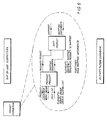
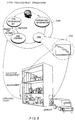
- This is exemplified in Figure 1.
- the typical organization 80 is shown as a tri-level hierarchy, with tasks and operations performed on the lowest work level, mid-management activities on the second level and executive management on the top (third) level.
- area 85 the system is programmed to store the characteristics of work units performed at the worker level and the attributes for the remainder of the organization, which are thereafter used to build activity patterns linking the different operations in the organization.
- the data collected on the present practices is organized into a database that is called the activity management information set (AMIS).
- AMIS activity management information set
- the AMIS is a continually changing set of data, reflecting adjustments made to work cycles.
- the AMIS establishes consistent internal variables, quantifying all the salient elements for a given organization.
- the AMIS is the compilation of activity patterns (90) depicted in 95 using the currently practiced organization parameters.
- These organization parameters include the name and title of the workers, the organization chart, system calendars, chart of accounts, financial value codes, and other defining terms.
- financial value codes would include the cost of goods sold and sales order value.
- the organization parameters include operation and tasks, inputs and outputs for these tasks, agents, resources, and common elements of delay.
- Table I A cross section of parameters is presented in Table I below:
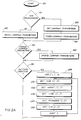
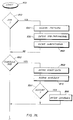
- test 110 determines whether entries are for a new organization or an existing file.
- a positive response to test 110 provides for the entry of a new AMIS file via blocks 120 and 130; otherwise an existing file is pulled from memory, block 140, for the construction of the controlling matrix of parameters.
- the file entries for AMIS can be modified.
- the parameters outlined above will have some overlap and interrelationship, optimally represented in partial matrix format. If selected, logic branches to block 160 and an update of the parameters is carried out.
- the selected parameters are then organized into patterns of activities through the for-next loop starting at block 200. More particularly, a positive response to test 190 branches logic to block 200 and the iterative process of entering the parameters associated with work units and linking these parameters via I/O connectors to other work unit parameters forming the designated activity pattern, Pat(J).
- the task is set at block 210, the agents needed for the work unit are entered at block 220, the time for completion is set at block 230, the resources for that activity are entered at block 240, and the I/O connection between each activity is set at block 250. This is repeated for each activity for the Jth pattern, block 260.
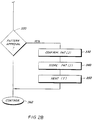
- logic proceeds to test 320 for pattern approval.
- a positive response to this test permits system confirmation of the salient pattern, block 330 and storage of the pattern within the system command matrix (control room), block 340. This is repeated for all Jth patterns to preset limit, M, via next command block 350, resulting in the control room matrix of activity patterns for that organization.
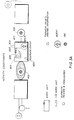
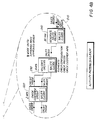
- FIG. 3A the elements forming a generic activity are graphically presented in Figure 3A.
- the activity is represented by an incoming phi (I/O) 400, a response center for that phi 410 and the outgoing phi 430.
- the phi values include the communications to the preceding and following tasks and the requisite inputs for completing the activity.
- the response center further comprises one or more agents 421, I/0 work units 422, policy statements 423, tasks 424, and financial posting information 425.
- the response center forms the operative environment for completing the tasks associated with the activity.
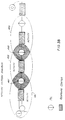
- the work cycle for sales order processing is depicted in block diagram form. As arranged therein, this work cycle corresponds to six concatenated activities in one pattern and delineated in the areas of sales, order processing, warehouse, shipping and accounting.
- the rectangular boxes represent the response center for each activity.
- the response centers may further comprise several distinct tasks for that activity. This is reflected in the exploded view of Sales Order Processing 510, which is further broken into tasks associated with checking customer credit 520, validate orders 530, and generate sales records 540.
- each task has its own I/O (phi) values which when combined form the aggregated phi for that activity.
- each task includes all the elements of the response center which may include work by one or more individuals, and involve output (and forming input) to succeeding tasks and activities.
- the system is not limited to a particular scope of activity and permits the use of nested subpatterns to be affiliated with a particular pattern.
- This is exemplified in Figures 5 and 6, wherein the response center for "Product Distribution" involves the ship by air subpattern made up of the operations of packaging the product 610 and product shipment 620. The operations for this subpattern are connected via the phi's indicated in Figure 5, e.g., customer work order, air freight documents, and shipping documents.
- the Product Distribution response center can direct the activity for ship by land. This arrangement of operations is depicted in Figure 6. In this process, separate and less complex phi's are involved; this may offer potential cost savings with this approach from an organizational perspective.
- pattern creation describes the full detail and process for building structured activity patterns, that is, patterns for work cycles that have a constant number of tasks and operations performed in a necessary sequence. These patterns are "structured" because they represent the structured policies and procedures of the organization.
- the system can also create semi-structured patterns. These are for work cycles that by nature do not consist of a constant number of operations done in a necessary sequence. Rather, some of their tasks or operations may have a place in a logical sequence, but others among their operations may be optional or may be performed more than once.
- An example is a sales cycle for a computer system (or some other technologically sophisticated, expensive product). Such a cycle might have, at least, two fixed operations. These are submitting a sales proposal and signing a contract, in this sequence.
- the system can create a semi-structured activity pattern for work cycles such as this one.
- These patterns contain all information relevant to each operation.
- These patterns like the structured patterns, are used to control actual work cycles during operations. They provide the employee with a guide to the work he should perform. They permit an employee to report on what work he has performed and his manager to monitor his performance (and to see what he has and has not done).
- An activity engineer may also create patterns to be used for planning alone. These patterns require less detail than those patterns used during operations. However, the planning patterns need to contain the information necessary for planning; standard durations, resource usage, and financial values. Activity patterns created for daily operations can also be used for planning.
- the second module of the present invention involves the management implementation of the patterned activities pursuant to the dictates of the work cycle of the organization.
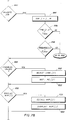
- the implementation of an activity pattern is called a "job" and is initiated by a manager through the subroutines delineated in Figure 7. It should be noted that the system will provide the manager with a menu of functions distinct from the menu of functions available to the workers.
- logic begins a start block 800 and continues to test 810 wherein a positive response branches logic to blocks 820-840.
- a pattern is accessed for characterizing the selected job, and parameters for that pattern are entered - if further definition is required, the job is also cast in subpatterns. Note that a subpattern can be included at different points of work progression.
- the start date is entered at block 860 and the work schedule delineated accordingly by the system, block 870. If this schedule has unanticipated conflicts, these are accounted for with test 880 and block 890.
- each job After completion of the pattern structure, each job must be validated in the context of the system operation. For example, some jobs may require the same resources causing a system conflict.
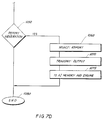
- the validation process is entered with a positive response to test 892, branching logic to the validation loop beginning at block 894. In this loop, a series of tests are performed on potentially conflicting parameters in a job. In this flowchart, two tests are exemplified; Time(J), test 896 and Resource(J) test 898. As depicted herein, these tests are only simple comparisons to preset maximums; more complex tests regarding personnel scheduling, computer time, warehouse availability, etc. may be implemented as needed.
- a validated job is then quantified by the manager in terms of financial impact, test 900.
- Each Task(J) in the pattern is given its financial code value, FC(J) at blocks 910 and 920.
- the manager may monitor the work in progress, WIP(J) via test 930 and blocks 940-950.
- An important element of system control resides in the requisite entry of authorization by levels of management. For example, the acceptance of a customer order in excess of $1000 may require a manager's approval. The present system identifies this approval as an I/0 or "phi" for the next step in processing; without receipt of this approval by the appropriate manager, progress on the job is stalled. This is presented in logic format via test 960. A positive response thereto initiates the authorization process, wherein the request is transmitted to the manager at the proper authorization level, blocks 970 and 980. If granted at test 990, logic proceeds in course; otherwise an alarm is triggered, block 1000, and work is halted.
- System delays are tracked via test 1010; identified delays from scheduled events shift the logic to block 1020. (Note that at any time work is delayed, the delay reasons are so recorded.) This permits management entry of adjustments to the schedule, block 1030 and the storage of delay reasons for future consideration, block 1040.
- the system permits the creation of reports on performance, costs, etc. This is done via a positive response to test 1050.
- the form of report is selected and the system then collects the salient data. Once reduced to the report form selected, the report is transmitted to the designated output device, block 1070.
- the various information about the behavior of the jobs is stored in the memory of an artificial intelligence engine (block 1075) to be used by the system in suggesting modifications to the jobs or to the patterns.
Landscapes
- Engineering & Computer Science (AREA)
- Business, Economics & Management (AREA)
- Human Resources & Organizations (AREA)
- Strategic Management (AREA)
- Economics (AREA)
- Entrepreneurship & Innovation (AREA)
- Educational Administration (AREA)
- Game Theory and Decision Science (AREA)
- Development Economics (AREA)
- Marketing (AREA)
- Operations Research (AREA)
- Quality & Reliability (AREA)
- Tourism & Hospitality (AREA)
- Physics & Mathematics (AREA)
- General Business, Economics & Management (AREA)
- General Physics & Mathematics (AREA)
- Theoretical Computer Science (AREA)
- Management, Administration, Business Operations System, And Electronic Commerce (AREA)
Applications Claiming Priority (2)
| Application Number | Priority Date | Filing Date | Title |
|---|---|---|---|
| US90573992A | 1992-06-29 | 1992-06-29 | |
| US905739 | 1992-06-29 |
Publications (2)
| Publication Number | Publication Date |
|---|---|
| EP0577324A2 true EP0577324A2 (de) | 1994-01-05 |
| EP0577324A3 EP0577324A3 (de) | 1995-06-14 |
Family
ID=25421384
Family Applications (1)
| Application Number | Title | Priority Date | Filing Date |
|---|---|---|---|
| EP93304914A Withdrawn EP0577324A3 (de) | 1992-06-29 | 1993-06-23 | Prozessor zur Systemverwaltung. |
Country Status (3)
| Country | Link |
|---|---|
| EP (1) | EP0577324A3 (de) |
| JP (1) | JPH0721275A (de) |
| AU (1) | AU4019493A (de) |
Cited By (1)
| Publication number | Priority date | Publication date | Assignee | Title |
|---|---|---|---|---|
| EP0684573A3 (de) * | 1994-05-26 | 1997-04-09 | Fuji Xerox Co Ltd | Informationsverarbeitungssystem und Verfahren für das Management des Arbeitsflusses. |
-
1993
- 1993-06-10 AU AU40194/93A patent/AU4019493A/en not_active Abandoned
- 1993-06-23 EP EP93304914A patent/EP0577324A3/de not_active Withdrawn
- 1993-06-29 JP JP15846493A patent/JPH0721275A/ja not_active Withdrawn
Non-Patent Citations (1)
| Title |
|---|
| No relevant documents disclosed * |
Cited By (2)
| Publication number | Priority date | Publication date | Assignee | Title |
|---|---|---|---|---|
| EP0684573A3 (de) * | 1994-05-26 | 1997-04-09 | Fuji Xerox Co Ltd | Informationsverarbeitungssystem und Verfahren für das Management des Arbeitsflusses. |
| US5710921A (en) * | 1994-05-26 | 1998-01-20 | Fuji Xerox Co., Ltd. | Information processing system and work flow management method therefor |
Also Published As
| Publication number | Publication date |
|---|---|
| JPH0721275A (ja) | 1995-01-24 |
| AU4019493A (en) | 1994-01-06 |
| EP0577324A3 (de) | 1995-06-14 |
Similar Documents
| Publication | Publication Date | Title |
|---|---|---|
| Petit | Project portfolios in dynamic environments: Organizing for uncertainty | |
| Badiru | Project management in manufacturing and high technology operations | |
| US5594639A (en) | Order processing control module | |
| De Boer | Resource-constrained multi-project management | |
| KR20010079838A (ko) | 컴퓨터로 구현된 제품 개발 설계 방법 | |
| JPWO2003081492A1 (ja) | 事業利益改善支援システム及び製品生産業務改革支援システム | |
| US20060080326A1 (en) | Method for reengineering of business processes | |
| KR20220075875A (ko) | 기업 프로젝트 관리시스템 | |
| Dodin et al. | Application of production scheduling methods to external and internal audit scheduling | |
| Gil-Goyzueta et al. | Process improvement proposal storage to increase the service level using lean warehousing in commerce companies | |
| US20040061891A1 (en) | Enterprise production management of a print shop | |
| EP0577324A2 (de) | Prozessor zur Systemverwaltung | |
| Halevi | Restructuring the manufacturing process applying the matrix method | |
| Golany et al. | Work breakdown structure | |
| Kang et al. | Discrete event simulation to reduce the effect of uncertainties on project planning | |
| Olford | Why is multiple-project management hard and how can we make it easier? | |
| Badiru et al. | Project management in computer-integrated manufacturing implementation | |
| Rezaeian et al. | The assignment of project managers to projects in an uncertain dynamic environment | |
| JP7742789B2 (ja) | 倉庫作業管理システム、倉庫作業管理方法及びプログラム | |
| JP7817363B2 (ja) | 倉庫作業管理システム、倉庫作業管理方法及びプログラム | |
| M. Miranda | Workforce scheduling in administrative operations: a case study in accounting | |
| Olson | Quantitative Tools of Project Management | |
| Stasiuk-Piekarska et al. | Organizational Risk in Custom Manufacturing of Complex Products | |
| Dur | Dynamic modelling for analysis and design of office systems | |
| Iureva et al. | Simulation of a Modern Assembly Plant |
Legal Events
| Date | Code | Title | Description |
|---|---|---|---|
| PUAI | Public reference made under article 153(3) epc to a published international application that has entered the european phase |
Free format text: ORIGINAL CODE: 0009012 |
|
| AK | Designated contracting states |
Kind code of ref document: A2 Designated state(s): AT BE CH DE DK ES FR GB GR IE IT LI LU MC NL PT SE |
|
| PUAL | Search report despatched |
Free format text: ORIGINAL CODE: 0009013 |
|
| AK | Designated contracting states |
Kind code of ref document: A3 Designated state(s): AT BE CH DE DK ES FR GB GR IE IT LI LU MC NL PT SE |
|
| STAA | Information on the status of an ep patent application or granted ep patent |
Free format text: STATUS: THE APPLICATION IS DEEMED TO BE WITHDRAWN |
|
| 18D | Application deemed to be withdrawn |
Effective date: 19951215 |