EP0577659B1 - Vernetzungsagentien - Google Patents
Vernetzungsagentien Download PDFInfo
- Publication number
- EP0577659B1 EP0577659B1 EP92907057A EP92907057A EP0577659B1 EP 0577659 B1 EP0577659 B1 EP 0577659B1 EP 92907057 A EP92907057 A EP 92907057A EP 92907057 A EP92907057 A EP 92907057A EP 0577659 B1 EP0577659 B1 EP 0577659B1
- Authority
- EP
- European Patent Office
- Prior art keywords
- groups
- formula
- mmol
- group
- crosslinking agent
- Prior art date
- Legal status (The legal status is an assumption and is not a legal conclusion. Google has not performed a legal analysis and makes no representation as to the accuracy of the status listed.)
- Expired - Lifetime
Links
Classifications
-
- C—CHEMISTRY; METALLURGY
- C07—ORGANIC CHEMISTRY
- C07C—ACYCLIC OR CARBOCYCLIC COMPOUNDS
- C07C69/00—Esters of carboxylic acids; Esters of carbonic or haloformic acids
- C07C69/96—Esters of carbonic or haloformic acids
-
- A—HUMAN NECESSITIES
- A61—MEDICAL OR VETERINARY SCIENCE; HYGIENE
- A61K—PREPARATIONS FOR MEDICAL, DENTAL OR TOILETRY PURPOSES
- A61K47/00—Medicinal preparations characterised by the non-active ingredients used, e.g. carriers or inert additives; Targeting or modifying agents chemically bound to the active ingredient
- A61K47/06—Organic compounds, e.g. natural or synthetic hydrocarbons, polyolefins, mineral oil, petrolatum or ozokerite
- A61K47/26—Carbohydrates, e.g. sugar alcohols, amino sugars, nucleic acids, mono-, di- or oligo-saccharides; Derivatives thereof, e.g. polysorbates, sorbitan fatty acid esters or glycyrrhizin
-
- A—HUMAN NECESSITIES
- A61—MEDICAL OR VETERINARY SCIENCE; HYGIENE
- A61K—PREPARATIONS FOR MEDICAL, DENTAL OR TOILETRY PURPOSES
- A61K47/00—Medicinal preparations characterised by the non-active ingredients used, e.g. carriers or inert additives; Targeting or modifying agents chemically bound to the active ingredient
- A61K47/30—Macromolecular organic or inorganic compounds, e.g. inorganic polyphosphates
- A61K47/32—Macromolecular compounds obtained by reactions only involving carbon-to-carbon unsaturated bonds, e.g. carbomers, poly(meth)acrylates, or polyvinyl pyrrolidone
-
- A—HUMAN NECESSITIES
- A61—MEDICAL OR VETERINARY SCIENCE; HYGIENE
- A61K—PREPARATIONS FOR MEDICAL, DENTAL OR TOILETRY PURPOSES
- A61K47/00—Medicinal preparations characterised by the non-active ingredients used, e.g. carriers or inert additives; Targeting or modifying agents chemically bound to the active ingredient
- A61K47/30—Macromolecular organic or inorganic compounds, e.g. inorganic polyphosphates
- A61K47/42—Proteins; Polypeptides; Degradation products thereof; Derivatives thereof, e.g. albumin, gelatin or zein
-
- A—HUMAN NECESSITIES
- A61—MEDICAL OR VETERINARY SCIENCE; HYGIENE
- A61K—PREPARATIONS FOR MEDICAL, DENTAL OR TOILETRY PURPOSES
- A61K49/00—Preparations for testing in vivo
- A61K49/22—Echographic preparations; Ultrasonic imaging preparations
- A61K49/222—Echographic preparations; Ultrasonic imaging preparations characterised by a special physical form, e.g. emulsions, liposomes
- A61K49/223—Microbubbles, hollow microspheres, free gas bubbles, gas microspheres
-
- A—HUMAN NECESSITIES
- A61—MEDICAL OR VETERINARY SCIENCE; HYGIENE
- A61L—METHODS OR APPARATUS FOR STERILISING MATERIALS OR OBJECTS IN GENERAL; DISINFECTION, STERILISATION OR DEODORISATION OF AIR; CHEMICAL ASPECTS OF BANDAGES, DRESSINGS, ABSORBENT PADS OR SURGICAL ARTICLES; MATERIALS FOR BANDAGES, DRESSINGS, ABSORBENT PADS OR SURGICAL ARTICLES
- A61L17/00—Materials for surgical sutures or for ligaturing blood vessels ; Materials for prostheses or catheters
- A61L17/06—At least partially resorbable materials
- A61L17/10—At least partially resorbable materials containing macromolecular materials
- A61L17/105—Polyesters not covered by A61L17/12
-
- A—HUMAN NECESSITIES
- A61—MEDICAL OR VETERINARY SCIENCE; HYGIENE
- A61L—METHODS OR APPARATUS FOR STERILISING MATERIALS OR OBJECTS IN GENERAL; DISINFECTION, STERILISATION OR DEODORISATION OF AIR; CHEMICAL ASPECTS OF BANDAGES, DRESSINGS, ABSORBENT PADS OR SURGICAL ARTICLES; MATERIALS FOR BANDAGES, DRESSINGS, ABSORBENT PADS OR SURGICAL ARTICLES
- A61L26/00—Chemical aspects of, or use of materials for, wound dressings or bandages in liquid, gel or powder form
- A61L26/0009—Chemical aspects of, or use of materials for, wound dressings or bandages in liquid, gel or powder form containing macromolecular materials
- A61L26/0019—Chemical aspects of, or use of materials for, wound dressings or bandages in liquid, gel or powder form containing macromolecular materials obtained otherwise than by reactions only involving carbon-to-carbon unsaturated bonds
-
- A—HUMAN NECESSITIES
- A61—MEDICAL OR VETERINARY SCIENCE; HYGIENE
- A61L—METHODS OR APPARATUS FOR STERILISING MATERIALS OR OBJECTS IN GENERAL; DISINFECTION, STERILISATION OR DEODORISATION OF AIR; CHEMICAL ASPECTS OF BANDAGES, DRESSINGS, ABSORBENT PADS OR SURGICAL ARTICLES; MATERIALS FOR BANDAGES, DRESSINGS, ABSORBENT PADS OR SURGICAL ARTICLES
- A61L26/00—Chemical aspects of, or use of materials for, wound dressings or bandages in liquid, gel or powder form
- A61L26/0061—Use of materials characterised by their function or physical properties
- A61L26/008—Hydrogels or hydrocolloids
-
- A—HUMAN NECESSITIES
- A61—MEDICAL OR VETERINARY SCIENCE; HYGIENE
- A61L—METHODS OR APPARATUS FOR STERILISING MATERIALS OR OBJECTS IN GENERAL; DISINFECTION, STERILISATION OR DEODORISATION OF AIR; CHEMICAL ASPECTS OF BANDAGES, DRESSINGS, ABSORBENT PADS OR SURGICAL ARTICLES; MATERIALS FOR BANDAGES, DRESSINGS, ABSORBENT PADS OR SURGICAL ARTICLES
- A61L26/00—Chemical aspects of, or use of materials for, wound dressings or bandages in liquid, gel or powder form
- A61L26/0061—Use of materials characterised by their function or physical properties
- A61L26/009—Materials resorbable by the body
-
- A—HUMAN NECESSITIES
- A61—MEDICAL OR VETERINARY SCIENCE; HYGIENE
- A61L—METHODS OR APPARATUS FOR STERILISING MATERIALS OR OBJECTS IN GENERAL; DISINFECTION, STERILISATION OR DEODORISATION OF AIR; CHEMICAL ASPECTS OF BANDAGES, DRESSINGS, ABSORBENT PADS OR SURGICAL ARTICLES; MATERIALS FOR BANDAGES, DRESSINGS, ABSORBENT PADS OR SURGICAL ARTICLES
- A61L27/00—Materials for grafts or prostheses or for coating grafts or prostheses
- A61L27/14—Macromolecular materials
- A61L27/18—Macromolecular materials obtained otherwise than by reactions only involving carbon-to-carbon unsaturated bonds
-
- A—HUMAN NECESSITIES
- A61—MEDICAL OR VETERINARY SCIENCE; HYGIENE
- A61L—METHODS OR APPARATUS FOR STERILISING MATERIALS OR OBJECTS IN GENERAL; DISINFECTION, STERILISATION OR DEODORISATION OF AIR; CHEMICAL ASPECTS OF BANDAGES, DRESSINGS, ABSORBENT PADS OR SURGICAL ARTICLES; MATERIALS FOR BANDAGES, DRESSINGS, ABSORBENT PADS OR SURGICAL ARTICLES
- A61L27/00—Materials for grafts or prostheses or for coating grafts or prostheses
- A61L27/50—Materials characterised by their function or physical properties, e.g. injectable or lubricating compositions, shape-memory materials, surface modified materials
- A61L27/58—Materials at least partially resorbable by the body
-
- A—HUMAN NECESSITIES
- A61—MEDICAL OR VETERINARY SCIENCE; HYGIENE
- A61L—METHODS OR APPARATUS FOR STERILISING MATERIALS OR OBJECTS IN GENERAL; DISINFECTION, STERILISATION OR DEODORISATION OF AIR; CHEMICAL ASPECTS OF BANDAGES, DRESSINGS, ABSORBENT PADS OR SURGICAL ARTICLES; MATERIALS FOR BANDAGES, DRESSINGS, ABSORBENT PADS OR SURGICAL ARTICLES
- A61L31/00—Materials for other surgical articles, e.g. stents, stent-grafts, shunts, surgical drapes, guide wires, materials for adhesion prevention, occluding devices, surgical gloves, tissue fixation devices
- A61L31/04—Macromolecular materials
- A61L31/06—Macromolecular materials obtained otherwise than by reactions only involving carbon-to-carbon unsaturated bonds
-
- A—HUMAN NECESSITIES
- A61—MEDICAL OR VETERINARY SCIENCE; HYGIENE
- A61L—METHODS OR APPARATUS FOR STERILISING MATERIALS OR OBJECTS IN GENERAL; DISINFECTION, STERILISATION OR DEODORISATION OF AIR; CHEMICAL ASPECTS OF BANDAGES, DRESSINGS, ABSORBENT PADS OR SURGICAL ARTICLES; MATERIALS FOR BANDAGES, DRESSINGS, ABSORBENT PADS OR SURGICAL ARTICLES
- A61L31/00—Materials for other surgical articles, e.g. stents, stent-grafts, shunts, surgical drapes, guide wires, materials for adhesion prevention, occluding devices, surgical gloves, tissue fixation devices
- A61L31/14—Materials characterised by their function or physical properties, e.g. injectable or lubricating compositions, shape-memory materials, surface modified materials
- A61L31/148—Materials at least partially resorbable by the body
Definitions
- This invention relates to novel crosslinking agents, more particularly to crosslinking agents capable of generating biodegradable crosslinking groups.
- crosslinking agents in fields such as protein and polymer chemistry is widespread and well known, e.g. for investigative or stability-enhancing purposes.
- biodegradable crosslinking groups have not hitherto been disclosed,, but has been found by us to possess a substantial number of utilities, for example in the preparation of biodegradable polymers (e.g. as described in our copending International Patent Application No. PCT/EP91/01751), in the attachment of drugs or agricultural chemicals to polymer systems (e.g. to provide delayed release delivery systems), and in the preparation of stabilised but biodegradable and therefore rapidly eliminable ultrasound contrast agents based on microbubbles encapsulated by crosslinked liposomes or crosslinked proteins (e.g.
- crosslinking agents of the invention are characterised in that they contain, or are capable of generating during crosslinking, methylene diester or diamide groups in which the ester or amide residues are derived from a range of carbon, sulphur and phosphorus acids. Such groups are particularly rapidly degraded by common esterase enzymes but are stable in the absence of enzymes.
- US-A-2341334 describes methylene dimethacrylate, ethylidene dimethacrylate and butylidene dimethacrylate as being copolymerisable with ethylenically unsaturated monomers such as vinyl acetate, methyl methacrylate or styrene;
- DD-A-95108 describes the preparation of benzylidene dimethacrylate and 2,2,2-trichloroethylidene dimethacrylate;
- US-A-2839572 describes the preparation of a number of alkenylidene crotonates such as allylidene dicrotonate, methallylidene dicrotonate and 2-chloroallylidene dicrotonate;
- US-A-2568501 describes the preparation of heptafluorobutylidene diacrylate;
- crosslinking methylene di(carboxylic ester) groups are invariably present as simple carbon-attached ester groups, as a consequence of their introduction by free radical propagated reactions of e.g. alkylidene diacrylates or dimethacrylates.
- novel compounds of the present invention may be regarded as crosslinking agents containing a group of formula [in which each X, which may be the same or different, is selected from -O-, -S- and -NR-, where R represents a hydrogen atom or an organic group; each Y, which may be the same or different, represents carbonyl, thiocarbonyl, sulphonyl or phosphoryl (i.e.
- R3 is a hydrogen atom or an organic group
- each Z which may be the same or different, is selected from -O-, -S- and -NR-, where R represents a hydrogen atom or an organic group
- m and n which may be the same or different, are each zero or 1
- R1 and R which may be the same or different, are each selected from hydrogen atoms, monovalent organic groups and groups of formula -X.Y.(Z) m - as hereinbefore defined, or R1 and R together form a divalent organic group] or containing a group adapted to generate a group of formula (I) upon reaction with a reagent or substrate containing a species H.X.Y.(Z) m - or a reactive derivative thereof.
- crosslinking denotes the introduction of any desired proportion of crosslinking groups and thus generally embraces the preparation of copolymers containing linkages of formula (I).
- Organic groups represented by R, R1, R and R3 may, for example, each be a hydrocarbyl or heterocyclic group, for example having 1-20 carbon atoms, e.g. an aliphatic group such as an alkyl or alkenyl group (preferably having up to 10 carbon atoms), a cycloalkyl group (preferably having up to 10 carbon atoms), an araliphatic group such as an aralkyl group (preferably having up to 20 carbon atoms), an aryl group (preferably having up to 20 carbon atoms) or a heterocyclic group having up to 20 carbon atoms and one or more heteroatoms selected from O,S and N; such a hydrocarbyl or heterocyclic grouping may carry one or more substituents such as halogen atoms or groups of the formulae -NR4R5, -CONR4R5,-OR6,-SR6 and -COOR7 (where R4 and R5, which may be the same or different, are hydrogen atoms, acyl groups or
- R1 and R represent a divalent grouping
- this may be an alkylene, alkenylene, alkylidene or alkenylidene group (preferably having up to 10 carbon atoms) which may carry one or more substituents as defined above.
- R,R1,R and R3 are preferably H or small groups such as C1 ⁇ 4 alkyl groups.
- Aliphatic groups R, R1, R and R3 may be straight or branched, saturated or unsaturated, and include, for example, alkyl and alkenyl groups such as methyl, ethyl, isopropyl, butyl and allyl.
- Araliphatic groups include (monocarbocyclic aryl) alkyl groups such as benzyl.
- Aryl groups include mono- and bi-cyclic groups such as phenyl, tolyl and naphthyl.
- Heterocyclic groups include 5- and 6-membered rings preferably containing a single heteroatom, such as furyl, thienyl and pyridyl.
- Possible substituents in hydrocarbyl groups R,R1,R and R3 include hydroxyl, etherified hydroxyl (e.g. C1 ⁇ 5 alkoxy such as methoxy), esterified hydroxyl (e.g. C1 ⁇ 6 acyloxy such as acetoxy), etherified thiol, N-(C1 ⁇ 6 alkyl)amino, N-(C1 ⁇ 6 acyl)amino, N-(C1 ⁇ 6 acyl)-N-(C1 ⁇ 6 alkyl)amino, carbamoyl, N-(C1 ⁇ 6 alkyl) carbamoyl and halogen.
- Aromatic rings may carry C1 ⁇ 6 alkyl groups, e.g. as in tolyl groups.
- Substituents may be present in combination and thus, for example, N-acyl and N-alkyl groups may carry hydroxyl or etherified or esterified hydroxyl groups.
- One preferred class of compounds according to the invention may be represented by the formula (wherein X,Y,Z, m and n are as hereinbefore defined; R 1a and R 2a are as defined for R1 and R except that they may represent groups -X.Y.(Z) m .R8.A or -X.Y.(Z) n .R9.B rather than groups -X.Y.(Z) m -; R8 and R9, which may be the same or different, represent divalent organic groups optionally interrupted by one or more heteroatoms and/or carrying one or more substituents containing heteroatoms; and A and B, which may be the same or different, optionally in conjunction with the groups R8 and R9 to which they are attached, represent functional groupings reactive with the species to be crosslinked; with the proviso that when both A.R8- and -R9.B represent optionally substituted lower alk-l-enyl groups, both of X represent -O- or -NR- and both of Y represent
- a second preferred class of compounds according to the invention may be represented by the formula (wherein X,Y,Z, m, R 1a , R 2a , R8 and A have the above-defined meanings and L is a leaving group). Such compounds may be reacted with compounds of the formula R10.(Z) n .Y.X.H (IV) (where X,Y,Z and n are as hereinbefore defined and R10 represents a hydrogen atom or an organic group), or appropriate reactive derivatives thereof (e.g. alkali metal salts of compounds of formula (IV) which are acids), to generate a biodegradable linkage of formula (I).
- R10 may represent an organic group such that, for example, the compound (III) reacts to form a compound of formula (II) or a precursor therefor.
- the group R10 may represent a substrate which is to be crosslinked; in addition to the -(Z) n .Y.X.H substituent or reactive derivative thereof such a substrate will also possess a functional grouping reactive with -A or -R8A in formula (III).
- the divalent organic groups R8 and R9 in the above formulae may, for example, be selected from alkylene and alkenylene groups (e.g. containing up to 30, more preferably up to 20, e.g. 1-10, carbon atoms), cycloalkylene groups (preferably having up to 10 carbon atoms), arylene groups (containing one or more aromatic rings and preferably having up to 20 carbon atoms), aralkylene groups (preferably having up to 20 carbon atoms and which may be bonded via the aryl and/or alkyl moieties - such aralkylene groups include, for example, two aryl groups joined by an alkylene chain), and heterocyclic groups (having one or more heteroatoms preferably selected from O, N and S and preferably having up to 20 carbon atoms).
- alkylene and alkenylene groups e.g. containing up to 30, more preferably up to 20, e.g. 1-10, carbon atoms
- cycloalkylene groups preferably having up to 10
- the groups may carry substituents, e.g. as set out above for R, R1, R and R3 and/or substituents such as oxo or thio groups.
- the carbon chains may be interrupted by heteroatoms such as O, N, S or P, e.g. in conjunction with oxo substituents, to form linkages such as ether, ester, thioester or amide groups.
- the presence of disulphide linkages may also be advantageous by virtue of their inherent biodegradability.
- groups R8 and/or R9 may be chosen so as to include one or more further groups of formula (I) and that the grouping - R8.A in formula (III) may be such that it terminates in a grouping (where X, Y, Z, m, R 1a , R 2a and L are as hereinbefore defined) capable of generating a biodegradable linkage of formula (I).
- hydroxyl groups in substrates such as carbohydrates may be reacted as described in "Advances in Carbohydrate Chemistry and Biochemistry” ed. by R. Stuart Tipson and D. Horton, 33 (1976), pp. 11-109.
- appropriate functional groups for reacting with such substrates include halogen atoms such as chlorine or bromine, e.g. in the form of acyl halides such as alkanoyl or sulphonyl halides; sulphonyloxy groups, e.g.
- alkanesulphonyloxy groups such as mesyloxy groups and arenesulphonyloxy groups such as tosyloxy groups; ⁇ -halomethyl ester and keto groups; activated carboxyl groups such as symmetrical or mixed anhydrides; activated hydroxyl groups; activated alkenes, e.g. ⁇ , ⁇ -unsaturated esters, amides and ketones; conjugated diyne and enyne systems; epoxy groups; and acetal-forming aldehyde and ketone groups and derivatives thereof such as enol ethers or acetal or ketal groups.
- Amino groups in substrates such as proteins may, for example, be reacted with functional groups such as activated carboxyl groups (e.g. N-hydroxysuccinimidyl derivatives, especially water solubility-enhanced sulphonated N-hydroxysuccinimidyl derivatives), imidoesters, nitroaryl halides, nitrene precursors (e.g. aryl azides such as phenylazido), carbene precursors (e.g. diazo compounds and diazirines), aldehydes, ketones, isocyanates, isothiocyanates, semicarbazides and thiosemicarbazides, epoxides, phenol esters (e.g.
- activated carboxyl groups e.g. N-hydroxysuccinimidyl derivatives, especially water solubility-enhanced sulphonated N-hydroxysuccinimidyl derivatives
- imidoesters e.g.
- acyl azides and hydrazines e.g. alkanoyl chlorides or sulphonyl chlorides such as mesyl or tosyl chloride.
- Carboxyl groups may, for example, be reacted with functional groups such as hydroxyl, mercapto, amino or diazo.
- Sulfhydryl groups may, for example, be reacted with functional groups such as maleimides, sulphonated maleimides, ⁇ -halomethyl carbonyl derivatives (e.g. esters, amides or ketones), alkyl or aralkyl halides, nitrosoureas, s-triazines, aziridines and pyridyl disulphides.
- functional groups such as maleimides, sulphonated maleimides, ⁇ -halomethyl carbonyl derivatives (e.g. esters, amides or ketones), alkyl or aralkyl halides, nitrosoureas, s-triazines, aziridines and pyridyl disulphides.
- Substrates containing ethylenically or acetylenically unsaturated carbon-carbon bonds may be copolymerised with compounds of formula (II) in which A and B comprise e.g.
- Leaving groups L in compounds of formula (III) include halogen atoms such as chlorine or bromine and sulphonyloxy groups such as mesyloxy or tosyloxy.
- Compounds in accordance with the present invention may be prepared by any convenient method.
- one or two equivalents of a compound of formula A.R8.(Z) m .Y.X.H (V) (where X, Y, Z, m, R8 and A are as hereinbefore defined, subject, if necessary and/or desired to A and any other reactive groups being protected), or a functional derivative thereof (e.g.
- a salt for example an alkali metal salt such as the potassium or cesium salt of a compound (V) which is an acid
- a compound of formula where R 1a , R 2a and L are as hereinbefore defined
- compounds of formula (III) and symmetrical compounds of formula (II) respectively may be reacted with one equivalent of a compound of formula (where R 1a , R 2a and L are as hereinbefore defined) to yield compounds of formula (III) and symmetrical compounds of formula (II) respectively.
- an unsymmetrical compound of formula (II) one may, for example, react equivalent quantities, of a compound of formula (V), or a functional derivative thereof, and a compound of formula (where X, Y, Z, n, R 1a , R 2a , R9, B and L are as hereinbefore defined, subject if necessary and/or desired to B and any other reactive groups being protected).
- Such reactions will normally be carried out in solution, for example in a polar solvent such as dimethylformamide.
- Symmetrical compounds of formula (II) in which R 2a represents a hydrogen atom, m and n are zero, each Y represents a carbonyl group and each X represents -O- may also be prepared by reacting a compound of formula A.R8.CO.OH (VIII) (where A and R8 are as hereinbefore defined, subject, if necessary and/or desired to A and any other reactive groups being protected) with an aldehyde of formula R 1a .CHO (IX) (where R 1a is as hereinbefore defined) in the presence of an acid catalyst such as hydrochloric acid; if desired water may be removed from the reaction mixture by azeotropic distillation.
- Compounds of formula (III) in which L is a halogen atom may also be prepared by reaction of a compound of formula (V) as hereinbefore defined, particularly such a compound in which Y represents a carbonyl group and X represents -O-, with an aryl thioether of formula (where R 1a and R 2a are as hereinbefore defined and R11 represents an aryl group such as phenyl), e.g. in a polar solvent such as dimethylformamide in the presence of a base such as pyridine, to yield a compound of formula (wherein all the symbols are as hereinbefore defined) and halogenating this thioether, e.g. by reaction with sulfuryl chloride in a solvent such as dichloromethane or with bromine in a solvent such as carbon tetrachloride, to yield a compound (III) in which L is chlorine or bromine respectively.
- a compound of formula (V) as hereinbefore defined particularly such a compound in which Y represents
- compounds of formula (III) may be prepared by reaction of a compound of formula (V), as hereinbefore defined, with a chlorosulphate of formula (wherein R 1a , R 2a , and L are as hereinbefore defined, L preferably being chlorine), e.g. using the method of Binderup et al. described in Synth. Comm. 14(9) (1984), pp. 857-864.
- Protecting groups used in connection with A and B and any other reactive groups present may, for example, be those conventional in the art.
- carboxyl groups may be protected using reductively cleavable ester groups such as benzyl, and hydroxyl groups may be protected using acid cleavable etherifying groups such as triphenylmethyl.
- compounds in which A and/or B represent epoxide groups may be prepared by oxidation of precursors containing appropriately positioned (e.g. terminal) ethylenically unsaturated bonds (e.g. using an oxidising agent such as metachloroperbenzoic acid), or by reacting compounds containing appropriately positioned hydroxyl groups (e.g.
- phenolic hydroxyl groups with reagents such as epichlorohydrin; compounds in which A.R8- and/or -R9.B represent enol ether groups may be prepared by, for example, acid-catalysed elimination from corresponding acetals or ketals.
- Hydroxyl group-containing precursors may also be activated by, for example, reaction with sulphonyl halides such as mesyl or tosyl chloride to generate reactive leaving groups such as mesylate or tosylate or with ⁇ , ⁇ -unsaturated alkenoyl halides such as acryloyl chloride to generate ⁇ , ⁇ -unsaturated esters.
- Compounds of formula (VII) in which L represents a halogen atom may, for example, be prepared by reacting compounds of formulae and Hal.Y.(Z) n .R9.B (XIV) (where Hal represents a halogen atom and the remaining symbols have the above-defined meanings), e.g. in the presence of a base such as pyridine.
- the invention embraces the use of all compounds containing a group of formula (I) or capable of reacting to generate such a group, including compounds of formula (II) subject to the aforegoing proviso regarding the definitions of X, Y, m, n, R8, R9, A and B, in the prepartion of substrates containing biodegradable crosslinking groups.
- Such uses include, for example, the previously mentioned covalent stabilisation of a range of ultrasound contrast agents, thereby enhancing the duration of attenuative activity of such agents in vivo while permitting their ready subsequent elimination from the body, and the preparation of polymers useful in the manufacture of, for example, surgical implants, soft tissue prostheses, sponges, films, wound dressings, flexible sheets, containers, plasticisers, delayed release formulations for drugs (e.g. steroids, contraceptives, antibacterials, narcotic antagonists and anti-tumour drugs) and agricultural chemicals (e.g. weed killers), and polymer particles incorporating diagnostic agents (e.g. X-ray contrast agents).
- drugs e.g. steroids, contraceptives, antibacterials, narcotic antagonists and anti-tumour drugs
- agricultural chemicals e.g. weed killers
- diagnostic agents e.g. X-ray contrast agents
- reaction conditions will be chosen so as to ensure biodegradability of the product, e.g. by using a non-free radical mechanism such as Michael addition of nucleophiles, for example with reactive substrate groups such as hydroxyl groups, or by effecting copolymerisation with substrates such as acrylonitrile which may polymerise by non-radical mechanisms.
- Free radical polymerisations should desirably be effected in such a way as to avoid formation of excessively long or tightly crosslinked carbon chains, e.g. so as to produce polymers having a molecular weight not exceeding 40,000.
- a solution of potassium hydroxide (1.00 M, 40.00 ml) is added to methacrylic acid (3.44 g, 40.00 mmol) at 0°C and the solution freeze dried for 16 hours.
- Dry dimethylformamide (230 ml) is added and the suspension heated to 60°C under a dry nitrogen atmosphere.
- Diiodomethane (1.61 ml, 20.00 mmol) is added in two portions during 10 min. and the reaction mixture left for 4 days at 60°C.
- the solvent is removed under reduced pressure (0.05 mm Hg), before diethyl ether (140 ml), saturated aqueous sodium hydrogen carbonate (50 ml) and water (50 ml) are added.
- a solution of potassium hydroxide (1.00 M, 40.00 ml) is added to acrylic acid (2.88 g, 40.00 mmol) at 0°C and the solution freeze dried for 16 hours.
- Dry dimethylformamide (200 ml) is added and the suspension heated to 60°C under a dry nitrogen atmosphere.
- Diiodomethane (1.61 ml, 20.00 mmol) is added in two portions during 10 min. and the reaction mixture left for 4 days at 60°C.
- the solvent is removed under reduced pressure (0.05 mm Hg), before diethyl ether (140 ml), saturated aqueous sodium hydrogen carbonate (50 ml) and water (50 ml) are added.
- a solution of potassium hydroxide (1.00 M, 5.00 ml) is added to methacrylic acid (0.43 g, 5.00 mmol) at 0°C and the solution freeze dried during 16 hours. Dry dimethylformamide (50 ml) is added and to the resulting suspension is added chloromethyl (2-methacryloyloxy)ethyl carbonate (1.11 g, 5.00 mmol). 18-Crown-6 (0.066 g, 0.25 mmol) is added as a catalyst and the reaction left under a dry nitrogen atmosphere. After 24 hours at 20°C and 6 days at 4°C the solvent is removed under reduced pressure (0.05 mm Hg) and diethyl ether (30 ml) and water (20 ml) added.
- 1-Chloroethyl 2-methacryloyloxyethyl carbonate (1.183g, 5.00 mmol) prepared as described in Example 7 is added to a suspension of freeze dried potassium methacrylate (0.683 g, 5.50 mmol) and 18-crown-6 (0.066 g, 0.25 mmol) in dimethylformamide (50 ml) under a dry N2 atmosphere. After 5 days at 20°C the solvent is removed under reduced pressure and the residue dissolved by adding dichloromethane (60 ml) and water (30 ml).
- Chloromethyl 4-acryloyloxybutyl carbonate (1.183g, 5.00 mmol) prepared as described in Example 8 is added to a suspension of freeze dried potassium acrylate (0.606 g, 5.50 mmol) and 18-crown-6 (0.066 g, 0.25 mmol) in dimethylformamide (50 ml) under a dry N2 atmosphere. After 5 days at 20°C the solvent is removed under reduced pressure and the residue dissolved by adding dichloromethane (60 ml) and water (30 ml). After separating the phases the aqueous layer is extracted with dichloromethane (3 x 30 ml) and the combined organic phase washed with saturated aqueous sodium hydrogen carbonate (50 ml).
- 1-Chloroethyl 4-acryloyloxybutyl carbonate (1.253g, 5.00 mmol) prepared as described in Example 9 is added to a suspension of freeze dried potassium acrylate (0.606 g, 5.50 mmol) and 18-crown-6 (0.066 g, 0.25 mmol) in dimethylformamide (50 ml) under a dry N2 atmosphere. After 5 days at 20°C the solvent is removed under reduced pressure and the residue dissolved by adding dichloromethane (60 ml) and water (30 ml). After separating the phases the aqueous layer is extracted with dichloromethane (3 x 30 ml) and the combined organic phase washed with saturated aqueous sodium hydrogen carbonate (50 ml).
- Diiodomethane (0.20 ml, 2.50 mmol) is added to a solution of freeze dried potassium p-vinylbenzoate (0.931 g, 5.00 mmol), 18-crown-6 (0.040 g, 0.25 mmol) and hydroquinone (0.011 g, 0.10 mmol) in dimethylformamide (35 ml) under a dry N2 atmosphere and the reaction mixture left for 2.5 days at 60°C. The solvent is removed under reduced pressure and the residue dissolved by adding diethyl ether (20 ml), saturated aqueous sodium hydrogen carbonate (5 ml) and water (10 ml).
- the aqueous layer is extracted with diethyl ether (6 x 10 ml) and the combined organic phase washed with water (5 x 10 ml). The organic phase is dried (MgSO4) and the solvent removed under reduced pressure to give 0.64g (83%) of the title product.
- Diiodomethane (0.60 ml, 7.50 mmol) is added to a solution of freeze dried potassium p-bromobenzoate (3.587 g, 15.00 mmol) and 18-crown-6 (0.198 g, 0.75 mmol) in dimethylformamide (100 ml) under a dry N2 atmosphere and the reaction mixture left for 4 days at 60°C.
- the solvent is removed under reduced pressure and the residue dissolved by adding dichloromethane (60 ml) and water (30 ml). After separating the phases the aqueous layer is extracted with dichloromethane (3 x 30 ml) and the combined organic phase washed with saturated aqueous sodium hydrogen carbonate (50 ml).
- Diiodomethane (0.40 ml, 5.00 mmol) is added to a solution of freeze dried potassium p-hydroxybenzoate (1.762 g, 10.00 mmol) in dimethylformamide (60 ml) under a dry N2 atmosphere and the reaction mixture left for 4 days at 60°C.
- the solvent is removed under reduced pressure and the residue dissolved by adding dichloromethane (60 ml) and water (30 ml). After separating the phases the aqueous layer is extracted with dichloromethane (3 x 30 ml) and the combined organic phase washed with brine (50 ml). The organic phase is dried (MgSO4) and the solvent removed under reduced pressure to give 0.94g (65%) of the title product .
- Bis (triphenylphosphine)palladium dichloride (17.0 mg, 0.02 mmol) and cuprous iodide (2.0 mg, 0.01mmol) are added to a suspension of methylene bis (p-bromobenzoate) (0.500 g, 1.21 mmol) prepared as described in Example 14 and propargyl alcohol (0.16 ml, 2.66 mmol) in triethylamine (10 ml) with good stirring, at 20°C, under a dry N2 atmosphere. After 10 days at 20°C, the triethylamine is removed under reduced pressure, water (20 ml) is added and the mixture is extracted with dichloromethane (3 x 15 ml).
- Anhydrous zinc chloride (10.0 mg, 0.07 mmol) is added to adipoyl chloride (2.92 ml, 20.00 mmol) at 20°C, under a dry N2 atmosphere.
- Acetaldehyde (2.26 g, 40.00 mmol) is added dropwise to the reaction mixture at -5°C.
- the reaction temperature is kept between -5°C and 0°C and dichloromethane (20 ml) is added.
- the zinc chloride catalyst is removed by passing the reaction mixture through a chromatography column containing aluminium oxide (Fluka 06290, type 5016 A basic, 20 g) at 5°C using dichloromethane as the solvent. The solvent is removed under reduced pressure to give 3.64 g (67%) of the crude product.
- Methylene bis(10-undecenoate) (8.8g, 25 mmol) prepared as described in Example 21 is added under an N2 atmosphere to methylene chloride and cooled to O°C.
- Metachloroperbenzoic acid 55% (15.75g, 50 mmol) is added to methylene chloride (150 ml) and the organic layer is separated and dried (MgSO4).
- the metachloroperbenzoic acid is then added dropwise to the diester. After completed addition the temperature is increased to 25°C. After 5 hours the reaction is complete.
- the mixture is washed with saturated aqueous sodium sulphite (75 ml) and saturated aqueous sodium hydrogen carbonate (2 x 75 ml).
- Benzyloxyacetic acid (49.8 g, 300 mmol) is dissolved in a 500 ml mixture of water and MeOH (60:40), and cesium carbonate (48.9 g, 150 mmol) is added to the solution. The solvent is evaporated under reduced pressure and residual water is removed azeotropically with benzene. The salt is dissolved in 1500 ml DMF and diiodomethane (40.2 g, 150 mmol) is added to the solution. The reaction mixture is stirred for 3 days at 60°C under an N2 atmosphere.
- Aqueous cesium carbonate (1M, 0.16 ml) is added dropwise to a solution of 16-triphenylmethoxyhexa-decanoic acid (0.16 g, 0.31 mmol) in tetrahydrofuran (10 ml) until the pH reaches approximately 8, whereupon the solvent is removed under reduced pressure and the residue dried under vacuum for 2 hours.
- the oily semicrystalline residue is dispersed in dry dimethylformamide (10 ml) and evaporated to dryness in vacuo . The crystalline product is used without further characterization.
- Diiodomethane (0.04 g, 0.16 mmol) is added to a suspension of 16-triphenylmethoxyhexadecanoic acid cesium salt (0.31 mmol) in dry dimethylformamide (10 ml).
- the reaction mixture is heated at 60 °C for 2 days under nitrogen.
- the solvent is removed in vacuo, and the product purified by flash chromatography on a 2 x 5 cm silica column with chloroform as eluant to yield the title compound as a brown oil (0.10 g).
- Toluene-4-sulfonic acid monohydrate (0.71 g, 3.72 mmol) is added to a suspension of azelaic acid (25.0 g, 132.82 mmol) in benzene (550 ml).
- the mixture is heated to 80°C, whereafter benzyl alcohol (14.36 g, 132.82 mmol) in benzene (50 ml) is added dropwise to the resulting solution.
- the reaction mixture is refluxed overnight and water is removed azeotropically with a Dean Stark trap.
- the reaction mixture is allowed to cool, the white precipitate which forms is removed by filtration and the filtrate is concentrated to a brownish oil under reduced pressure.
- Aqueous cesium carbonate (1M, 6.3 ml) is added dropwise to a solution of benzyl hydrogen azelate (3.00 g, 10.77 mmol) in 75 ml water/methanol (1:15) until the pH reaches approximately 7, whereupon the solvent is removed under reduced pressure and the residue dried under vacuum overnight.
- the oily, yellowish semicrystalline residue is dispersed in dry dimethylformamide (50 ml) and evaporated to dryness in vacuo . This procedure is repeated twice, yielding an off-white crystalline product. The product is used without further characterization.
- Toluene-4-sulfonic acid monohydrate (0.05 g, 0.28 mmol) is added to a suspension of tetracosanedioic acid (5.0 g, 80%, 10.03 mmol) in benzene (180 ml). The mixture is heated to 80°C, whereafter benzyl alcohol (1.08 g, 10.03 mmol) in benzene (10 ml) is added dropwise to the resulting solution. The reaction mixture is refluxed for 20 hours and water is removed azeotropically with a Dean Stark trap. The solvent is removed under reduced pressure and the residue washed with petroleum ether.
- Metachloroperbenzoic acid (15.68 g, 55%, 50 mmol) is dissolved in methylene chloride (200 ml). Water is separated and the organic layer is dried (MgSO4). The resulting metachloroperbenzoic acid solution is added dropwise to methylene bis(4-pentenoate) (4.10 g, 19 mmol) dissolved in methylene chloride (50 ml). The mixture is stirred at ambient temperature under nitrogen for 12 hrs, whereafter the reaction mixture is washed with saturated aqueous sodium bicarbonate solution (50 ml), water (50 ml), dried (MgSO4) and evaporated to give 3.61g (78%) of the title compound as a crystalline product.
- Triethylamine (0.29 g, 2.87 mmol) in dry toluene (2 ml) was added to a suspension of methylene bis(16-hydroxydecanoate) from Example 24 (0.20 g, 0.36 mmol) in dry toluene (5 ml).
- the mixture was heated to 50°C under nitrogen and acryloylchloride (0.26 g, 2.87 mmol) in dry toluene (3 ml) was then added dropwise. After 1 hour of stirring at 55°C the reaction mixture was cooled to room temperature, diluted with toluene (10 ml), washed with water (2x5 ml) and dried over MgSO4.
- N-Methylmorpholine-N-oxide (13.5 g, 11 mmol) and methylene bis(10-undecenoate) from Example 21 (19 g, 5 mmol) were dissolved in 400 ml of a mixture of tetrahydrofuran and water (3:1 v/v).
- a catalytic amount of osmium tetroxide was added, and the solution stired at ambient temperature for 20 hours. TLC indicated complete consumption of the starting material. Excess sodium hydrogen sulphite and sodium chloride were then added to the reaction mixture.
Landscapes
- Health & Medical Sciences (AREA)
- Chemical & Material Sciences (AREA)
- Life Sciences & Earth Sciences (AREA)
- Epidemiology (AREA)
- Animal Behavior & Ethology (AREA)
- General Health & Medical Sciences (AREA)
- Public Health (AREA)
- Veterinary Medicine (AREA)
- Medicinal Chemistry (AREA)
- Engineering & Computer Science (AREA)
- Chemical Kinetics & Catalysis (AREA)
- Materials Engineering (AREA)
- Vascular Medicine (AREA)
- Surgery (AREA)
- Organic Chemistry (AREA)
- Pharmacology & Pharmacy (AREA)
- Dermatology (AREA)
- Heart & Thoracic Surgery (AREA)
- Oral & Maxillofacial Surgery (AREA)
- Transplantation (AREA)
- Inorganic Chemistry (AREA)
- Radiology & Medical Imaging (AREA)
- Proteomics, Peptides & Aminoacids (AREA)
- Acoustics & Sound (AREA)
- Physics & Mathematics (AREA)
- Biochemistry (AREA)
- Molecular Biology (AREA)
- General Chemical & Material Sciences (AREA)
- Oil, Petroleum & Natural Gas (AREA)
- Dispersion Chemistry (AREA)
- Nuclear Medicine, Radiotherapy & Molecular Imaging (AREA)
- Organic Low-Molecular-Weight Compounds And Preparation Thereof (AREA)
- Semiconductor Lasers (AREA)
- Pharmaceuticals Containing Other Organic And Inorganic Compounds (AREA)
- Compositions Of Macromolecular Compounds (AREA)
- Computer And Data Communications (AREA)
- Treatment Of Liquids With Adsorbents In General (AREA)
- External Artificial Organs (AREA)
- Medicines Containing Antibodies Or Antigens For Use As Internal Diagnostic Agents (AREA)
- Materials For Medical Uses (AREA)
Claims (14)
- Vernetzungsmittel, enthaltend eine Gruppe der Formel (I)


- Vernetzungsmittel nach Anspruch 1 der Formel (II)

- Vernetzungsmittel nach Anspruch 1 oder Anspruch 2, worin jedes X für -O- und jedes Y für -CO- steht.
- Vernetzungsmittel nach einem der Ansprüche 1 bis 3, worin R, R¹, R und R³ jeweils ausgewählt sind unter Wasserstoffatomen und aliphatischen, Cycloalkyl-, araliphatischen, Aryl- und heterocyclischen Gruppen.
- Vernetzungsmittel nach einem der Ansprüche 1 bis 3, worin R, R¹, R und R³ ausgewählt sind unter Wasserstoffatomen und C₁₋₄-Alkylgruppen.
- Vernetzungsmittel nach einem der Ansprüche 2 bis 5, worin R⁸ und R⁹ (falls vorhanden) ausgewählt sind unter Alkylengruppen, Alkenylengruppen, Cycloalkylengruppen, Arylengruppen, Aralkylengruppen und heterocyclischen Gruppen, von denen jede durch Heteroatome substituiert und/oder unterbrochen sein kann.
- Vernetzungsmittel nach einem der Ansprüche 2 bis 6, worin R⁸ und R⁹ (falls vorhanden) jeweils ausgewählt sind unter gegebenenfalls durch ein oder mehrere Oxy-, Carbonyloxy-, oder Oxycarbonylgruppen unterbrochene C₁₋₃₀-Alkylengruppen; Phenylengruppen; Phenylenoxy- und Phenylenethinylgruppen.
- Vernetzungsmittel nach einem der Ansprüche 2 bis 7, worin A oder B (falls vorhanden) ausgewählt sind unter Halogenatomen, Arylhalogeniden, Sulfonyloxygruppen, α-Halomethylcarbonylgruppen, Carboxylgruppen, aktivierten Carboxylgruppen, Hydroxylgruppen, aktivierten Hydroxylgruppen, Mercaptogruppen, Alkengruppen, aktivierten Alkengruppen, konjugierten Diinsystemen, konjugierten Eninsystemen, Epoxygruppen, acetalbildenden Aldehyd- und Ketongruppen und Derivaten davon, Aminogruppen, Diazogruppen, Imidoestergruppen, Alkyl- und Aralkylhalogenidgruppen, Nitroarylhalogenidgruppen, Gruppen einer Nitrenvorstufe, Gruppen einer Carbenvorstufe, Aldehydgruppen, Ketongruppen, Isocyanatgruppen, Isothiocyanatgruppen, Semicarbazidgruppen, Thiosemicarbazidgruppen, Phenolestergruppen, Acylazidgruppen, Hydrazingruppen, Haloformiatgruppen, gegebenenfalls sulfonierten Maleimidgruppen, Nitrosoharnstoffgruppen, S-Triazingruppen, Aziridingruppen und Pyridyldisulfidgruppen.
- Vernetzungsmittel nach Anspruch 8, worin A und B (falls vorhanden) für O-verknüpfte sulfonierte N-Hydroxysuccinimidylreste stehen.
- Vernetzungsmittel nach Anspruch 2, worin L für eine Abgangsgruppe steht und -R⁸A in der Gruppierung

- Vernetzungsmittel nach einem der Ansprüche 2 bis 10, worin L für ein Halogenatom steht.
- Verfahren zur Herstellung eines Vernetzungsmittels nach Anspruch 2, wobei(A) entweder 1 oder 2 Äquivalente einer Verbindung der Formel (V)
A.R⁸.(Z)m.Y.X.H (V)
(worin X, Y, Z, m, R⁸ und A, erforderlichenfalls und/oder gewünschtenfalls in Abhängigkeit von reaktiven, zu schützenden Gruppen, wie in Anspruch 2 definiert sind) oder ein funktionelles Derivat davon, mit einem Äquivalent der Verbindung der Formel (VI)
zur Reaktion gebracht werden;(B) ein Äquivalent einer Verbindung der Formel (V), die oben unter (A) definiert ist, oder ein geschütztes und/oder funktionelles Derivat davon mit einem Äquivalent einer Verbindung der Formel (VII)
zur Reaktion gebracht wird;(C) zur Herstellung symmetrischer Verbindungen der Formel (II), worin R2a für Wasserstoff steht, m und n gleich 0 sind, jedes Y für eine Carbonylgruppe steht und jedes X für -O- steht, eine Verbindung der Formel (VIII)
A.R⁸.CO.OH (VIII)
(worin A und R⁸ wie oben unter (A), erforderlichenfalls und/oder gewünschtenfalls in Abhängigkeit von A und anderen reaktiven, zu schützenden Gruppen, definiert sind) mit einem Aldehyd der Formel (IX)
R1a.CHO (IX)
(worin R1a wie oben unter (A) definiert ist) in Anwesenheit eines sauren Katalysators zur Reaktion gebracht wird;(D) zur Herstellung von Verbindungen der Formel (II), worin L für ein Halogenatom steht, eine Verbindung der Formel (V), die wie oben unter (A) definiert ist, oder ein geschütztes und/oder funktionelles Derivat davon mit einem Arylthioether der Formel (X)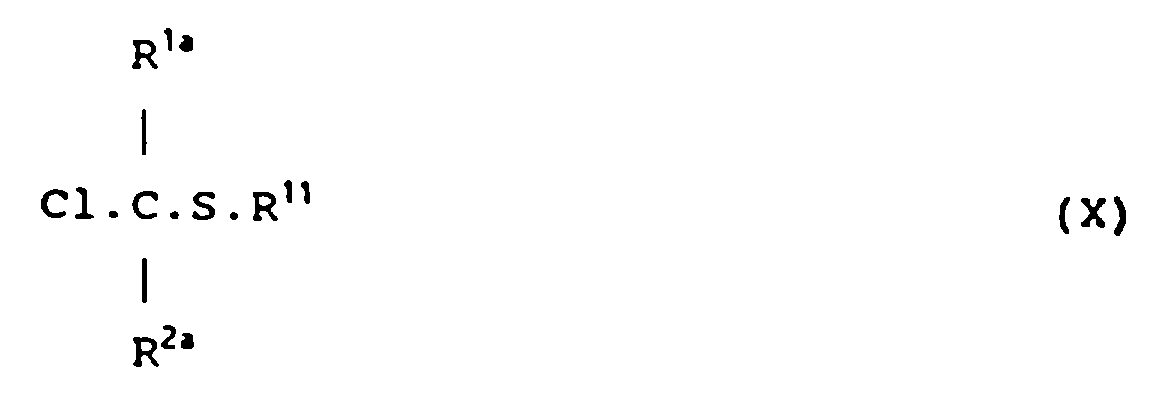
zur Reaktion gebracht wird, um eine Verbindung der Formel (XI) (E) zur Herstellung von Verbindungen der Formel (II), worin Q für eine Abgangsgruppe L steht, ein Chlorsulfat der Formel (XII)
 (F) zur Herstellung von Verbindungen der Formel (II), worin L für ein Halogenatom steht, eine Verbindung der Formel (XIII)
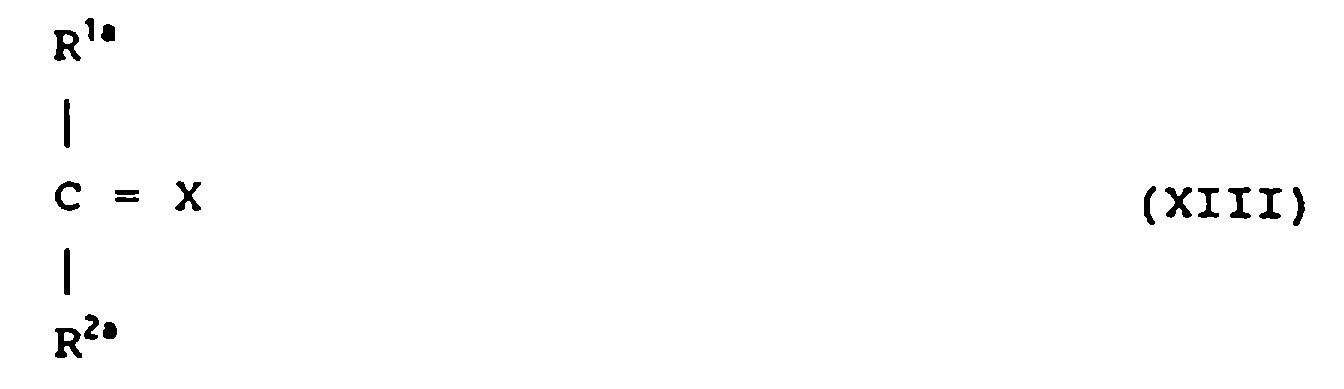
Hal.Y.(Z)n.R⁹.B (XIV)
(worin Hal für ein Halogenatom steht und Y, Z, n, R⁹ und B die oben in (A) genannten Bedeutungen besitzen) zur Reaktion gebracht wird;
und anschließend, falls erforderlich und/oder erwünscht, die Schutzgruppen entfernt werden und/oder die reaktiven Gruppierungen A und/oder B umgewandelt werden. - Verwendung eines Vernetzungsmittels nach einem der Ansprüche 1 bis 11, einschließlich der Vernetzungsmittel, die durch den Vorbehalt von Anspruch 1 ausgenommen sind, zur Herstellung von Substraten, die biologisch abbaubare Vernetzungen enthalten.
- Verwendung nach Anspruch 13, worin das Substrat ein Ultraschallkontrastmittel ist.
Applications Claiming Priority (7)
| Application Number | Priority Date | Filing Date | Title |
|---|---|---|---|
| GB919106686A GB9106686D0 (en) | 1991-03-28 | 1991-03-28 | Improvements in or relating to contrast agents |
| GB9106686 | 1991-03-28 | ||
| GB9114678 | 1991-07-08 | ||
| GB919114678A GB9114678D0 (en) | 1991-07-08 | 1991-07-08 | Chemical compounds |
| GB9200389 | 1992-01-09 | ||
| GB929200389A GB9200389D0 (en) | 1992-01-09 | 1992-01-09 | Chemical compounds |
| PCT/EP1992/000717 WO1992017436A1 (en) | 1991-03-28 | 1992-03-28 | Cross-linking agent |
Publications (2)
| Publication Number | Publication Date |
|---|---|
| EP0577659A1 EP0577659A1 (de) | 1994-01-12 |
| EP0577659B1 true EP0577659B1 (de) | 1996-01-17 |
Family
ID=27265576
Family Applications (1)
| Application Number | Title | Priority Date | Filing Date |
|---|---|---|---|
| EP92907057A Expired - Lifetime EP0577659B1 (de) | 1991-03-28 | 1992-03-28 | Vernetzungsagentien |
Country Status (12)
| Country | Link |
|---|---|
| EP (1) | EP0577659B1 (de) |
| JP (1) | JPH06508108A (de) |
| AT (1) | ATE133158T1 (de) |
| AU (1) | AU663866B2 (de) |
| CA (1) | CA2107106A1 (de) |
| DE (1) | DE69207758T2 (de) |
| ES (1) | ES2082459T3 (de) |
| FI (1) | FI934228A0 (de) |
| HK (1) | HK1003569A1 (de) |
| IE (1) | IE73259B1 (de) |
| NO (1) | NO301273B1 (de) |
| WO (1) | WO1992017436A1 (de) |
Families Citing this family (15)
| Publication number | Priority date | Publication date | Assignee | Title |
|---|---|---|---|---|
| US20020150539A1 (en) | 1989-12-22 | 2002-10-17 | Unger Evan C. | Ultrasound imaging and treatment |
| US5205290A (en) * | 1991-04-05 | 1993-04-27 | Unger Evan C | Low density microspheres and their use as contrast agents for computed tomography |
| US7083572B2 (en) | 1993-11-30 | 2006-08-01 | Bristol-Myers Squibb Medical Imaging, Inc. | Therapeutic delivery systems |
| US6521211B1 (en) | 1995-06-07 | 2003-02-18 | Bristol-Myers Squibb Medical Imaging, Inc. | Methods of imaging and treatment with targeted compositions |
| AU736301B2 (en) | 1996-05-01 | 2001-07-26 | Imarx Therapeutics, Inc. | Methods for delivering compounds into a cell |
| US5846517A (en) | 1996-09-11 | 1998-12-08 | Imarx Pharmaceutical Corp. | Methods for diagnostic imaging using a renal contrast agent and a vasodilator |
| US6537246B1 (en) | 1997-06-18 | 2003-03-25 | Imarx Therapeutics, Inc. | Oxygen delivery agents and uses for the same |
| US7452551B1 (en) | 2000-10-30 | 2008-11-18 | Imarx Therapeutics, Inc. | Targeted compositions for diagnostic and therapeutic use |
| US20010003580A1 (en) | 1998-01-14 | 2001-06-14 | Poh K. Hui | Preparation of a lipid blend and a phospholipid suspension containing the lipid blend |
| GB0128052D0 (en) | 2001-11-22 | 2002-01-16 | Drug Discovery Lab As | Compounds |
| KR101446238B1 (ko) | 2006-08-07 | 2014-10-01 | 프레지던트 앤드 펠로우즈 오브 하바드 칼리지 | 단백질 매트릭스 백신 및 그의 제조방법 및 백신 투여방법 |
| KR101753917B1 (ko) | 2009-03-02 | 2017-07-04 | 옥스포드 어드밴스드 서패이시즈 리미티드 | 공유결합 3차원 네트워크를 형성할 수 있는 화학제 |
| ES2728653T3 (es) | 2011-05-18 | 2019-10-28 | Matrivax Inc | Composiciones vacunales con una matriz proteica que incluye policationes |
| CN116768726B (zh) * | 2022-03-07 | 2025-10-10 | 上纬创新育成股份有限公司 | 含碳酸酯的不饱和化合物、其制备方法、其制备的固化物及降解固化物的方法 |
| WO2023168562A1 (zh) * | 2022-03-07 | 2023-09-14 | 上纬创新育成股份有限公司 | 含碳酸酯的不饱和化合物、其制备方法、其制备的固化物及降解固化物的方法 |
Family Cites Families (1)
| Publication number | Priority date | Publication date | Assignee | Title |
|---|---|---|---|---|
| EP0083185A1 (de) * | 1981-12-30 | 1983-07-06 | Mobil Oil Corporation | Carbonat-Polyacrylate, durch Strahlung härtbare Bekleidungskompositionen und Härtungsmethode |
-
1992
- 1992-03-28 EP EP92907057A patent/EP0577659B1/de not_active Expired - Lifetime
- 1992-03-28 DE DE69207758T patent/DE69207758T2/de not_active Expired - Fee Related
- 1992-03-28 ES ES92907057T patent/ES2082459T3/es not_active Expired - Lifetime
- 1992-03-28 JP JP4506727A patent/JPH06508108A/ja active Pending
- 1992-03-28 FI FI934228A patent/FI934228A0/fi not_active Application Discontinuation
- 1992-03-28 WO PCT/EP1992/000717 patent/WO1992017436A1/en not_active Ceased
- 1992-03-28 HK HK98102612A patent/HK1003569A1/en not_active IP Right Cessation
- 1992-03-28 CA CA002107106A patent/CA2107106A1/en not_active Abandoned
- 1992-03-28 AU AU14439/92A patent/AU663866B2/en not_active Ceased
- 1992-03-28 AT AT92907057T patent/ATE133158T1/de not_active IP Right Cessation
- 1992-03-30 IE IE921010A patent/IE73259B1/en not_active IP Right Cessation
-
1993
- 1993-09-27 NO NO933430A patent/NO301273B1/no unknown
Also Published As
| Publication number | Publication date |
|---|---|
| JPH06508108A (ja) | 1994-09-14 |
| CA2107106A1 (en) | 1992-09-29 |
| NO301273B1 (no) | 1997-10-06 |
| ES2082459T3 (es) | 1996-03-16 |
| DE69207758D1 (de) | 1996-02-29 |
| IE73259B1 (en) | 1997-05-21 |
| FI934228L (fi) | 1993-09-27 |
| NO933430D0 (no) | 1993-09-27 |
| WO1992017436A1 (en) | 1992-10-15 |
| FI934228A7 (fi) | 1993-09-27 |
| AU663866B2 (en) | 1995-10-26 |
| FI934228A0 (fi) | 1993-09-27 |
| IE921010A1 (en) | 1992-10-07 |
| NO933430L (no) | 1993-11-08 |
| ATE133158T1 (de) | 1996-02-15 |
| EP0577659A1 (de) | 1994-01-12 |
| DE69207758T2 (de) | 1996-06-20 |
| AU1443992A (en) | 1992-11-02 |
| HK1003569A1 (en) | 1998-10-30 |
Similar Documents
| Publication | Publication Date | Title |
|---|---|---|
| AU663866B2 (en) | Cross-linking agent | |
| HK1003569B (en) | Cross-linking agent | |
| RU2114865C1 (ru) | Биоразлагаемые несшитые полимеры | |
| RU2476437C2 (ru) | Декстран, функционализированный гидрофобными аминокислотами | |
| US5336782A (en) | Long chain carboxylic acid imide ester | |
| AU659299B2 (en) | Aspartic acid derivatives, their preparation and use | |
| KR20120022944A (ko) | 다당류 유도체 및 그 하이드로겔 | |
| EP3101064B1 (de) | Diaminvernetzungsmittel, saurer polysaccharid-vernetzter körper und medizinisches material | |
| US5919753A (en) | Cross-linking agent | |
| US8153759B2 (en) | Depsipeptide containing lactic acid residue | |
| WO2006043644A1 (ja) | 温度応答性デプシペプチドポリマー | |
| CN120393089A (zh) | 一种超快凝胶化、可喷涂、快速按需降解的聚乙二醇止血水凝胶及其制备方法以及应用 | |
| KR20150123228A (ko) | 화합물 1,4,5-삼치환된 1,2,3-트리아졸, 이를 얻기 위한 방법 및 이의 용도 | |
| JP2008515848A (ja) | コラーゲン上での疎水性物質の共有結合グラフト化 | |
| JP2006052158A (ja) | 生体低分子誘導体、架橋体及び生体内分解吸収性粘着性医用材料 | |
| JPS62263198A (ja) | 細胞保護作用を有する環状ペプチド |
Legal Events
| Date | Code | Title | Description |
|---|---|---|---|
| PUAI | Public reference made under article 153(3) epc to a published international application that has entered the european phase |
Free format text: ORIGINAL CODE: 0009012 |
|
| 17P | Request for examination filed |
Effective date: 19930921 |
|
| AK | Designated contracting states |
Kind code of ref document: A1 Designated state(s): AT BE CH DE DK ES FR GB GR IT LI LU MC NL SE |
|
| RAP1 | Party data changed (applicant data changed or rights of an application transferred) |
Owner name: NYCOMED IMAGING AS |
|
| 17Q | First examination report despatched |
Effective date: 19950203 |
|
| GRAA | (expected) grant |
Free format text: ORIGINAL CODE: 0009210 |
|
| AK | Designated contracting states |
Kind code of ref document: B1 Designated state(s): AT BE CH DE DK ES FR GB GR IT LI LU MC NL SE |
|
| PG25 | Lapsed in a contracting state [announced via postgrant information from national office to epo] |
Ref country code: GR Free format text: LAPSE BECAUSE OF FAILURE TO SUBMIT A TRANSLATION OF THE DESCRIPTION OR TO PAY THE FEE WITHIN THE PRESCRIBED TIME-LIMIT Effective date: 19960117 Ref country code: DK Effective date: 19960117 |
|
| REF | Corresponds to: |
Ref document number: 133158 Country of ref document: AT Date of ref document: 19960215 Kind code of ref document: T |
|
| RIN1 | Information on inventor provided before grant (corrected) |
Inventor name: STRANDE, PER Inventor name: RONGVED, P L Inventor name: KLAVENESS, JO |
|
| REF | Corresponds to: |
Ref document number: 69207758 Country of ref document: DE Date of ref document: 19960229 |
|
| ITF | It: translation for a ep patent filed | ||
| REG | Reference to a national code |
Ref country code: ES Ref legal event code: FG2A Ref document number: 2082459 Country of ref document: ES Kind code of ref document: T3 |
|
| REG | Reference to a national code |
Ref country code: CH Ref legal event code: NV Representative=s name: A. BRAUN, BRAUN, HERITIER, ESCHMANN AG PATENTANWAE |
|
| ET | Fr: translation filed | ||
| PG25 | Lapsed in a contracting state [announced via postgrant information from national office to epo] |
Ref country code: SE Effective date: 19960417 |
|
| PLBE | No opposition filed within time limit |
Free format text: ORIGINAL CODE: 0009261 |
|
| 26N | No opposition filed | ||
| PGFP | Annual fee paid to national office [announced via postgrant information from national office to epo] |
Ref country code: MC Payment date: 19980313 Year of fee payment: 7 |
|
| PGFP | Annual fee paid to national office [announced via postgrant information from national office to epo] |
Ref country code: CH Payment date: 19980324 Year of fee payment: 7 |
|
| PGFP | Annual fee paid to national office [announced via postgrant information from national office to epo] |
Ref country code: AT Payment date: 19980330 Year of fee payment: 7 |
|
| PGFP | Annual fee paid to national office [announced via postgrant information from national office to epo] |
Ref country code: NL Payment date: 19980331 Year of fee payment: 7 Ref country code: LU Payment date: 19980331 Year of fee payment: 7 |
|
| PGFP | Annual fee paid to national office [announced via postgrant information from national office to epo] |
Ref country code: BE Payment date: 19980402 Year of fee payment: 7 |
|
| PG25 | Lapsed in a contracting state [announced via postgrant information from national office to epo] |
Ref country code: LU Free format text: LAPSE BECAUSE OF NON-PAYMENT OF DUE FEES Effective date: 19990328 Ref country code: AT Free format text: LAPSE BECAUSE OF NON-PAYMENT OF DUE FEES Effective date: 19990328 |
|
| PG25 | Lapsed in a contracting state [announced via postgrant information from national office to epo] |
Ref country code: LI Free format text: LAPSE BECAUSE OF NON-PAYMENT OF DUE FEES Effective date: 19990331 Ref country code: CH Free format text: LAPSE BECAUSE OF NON-PAYMENT OF DUE FEES Effective date: 19990331 Ref country code: BE Free format text: LAPSE BECAUSE OF NON-PAYMENT OF DUE FEES Effective date: 19990331 |
|
| BERE | Be: lapsed |
Owner name: NYCOMED IMAGING A/S Effective date: 19990331 |
|
| PG25 | Lapsed in a contracting state [announced via postgrant information from national office to epo] |
Ref country code: MC Free format text: LAPSE BECAUSE OF NON-PAYMENT OF DUE FEES Effective date: 19990930 |
|
| PG25 | Lapsed in a contracting state [announced via postgrant information from national office to epo] |
Ref country code: NL Free format text: LAPSE BECAUSE OF NON-PAYMENT OF DUE FEES Effective date: 19991001 |
|
| REG | Reference to a national code |
Ref country code: CH Ref legal event code: PL |
|
| NLV4 | Nl: lapsed or anulled due to non-payment of the annual fee |
Effective date: 19991001 |
|
| PGFP | Annual fee paid to national office [announced via postgrant information from national office to epo] |
Ref country code: DE Payment date: 19991231 Year of fee payment: 9 |
|
| PGFP | Annual fee paid to national office [announced via postgrant information from national office to epo] |
Ref country code: FR Payment date: 20000310 Year of fee payment: 9 |
|
| PGFP | Annual fee paid to national office [announced via postgrant information from national office to epo] |
Ref country code: GB Payment date: 20000322 Year of fee payment: 9 |
|
| PGFP | Annual fee paid to national office [announced via postgrant information from national office to epo] |
Ref country code: ES Payment date: 20010228 Year of fee payment: 10 |
|
| PG25 | Lapsed in a contracting state [announced via postgrant information from national office to epo] |
Ref country code: GB Free format text: LAPSE BECAUSE OF NON-PAYMENT OF DUE FEES Effective date: 20010328 |
|
| GBPC | Gb: european patent ceased through non-payment of renewal fee |
Effective date: 20010328 |
|
| PG25 | Lapsed in a contracting state [announced via postgrant information from national office to epo] |
Ref country code: FR Free format text: LAPSE BECAUSE OF NON-PAYMENT OF DUE FEES Effective date: 20011130 |
|
| REG | Reference to a national code |
Ref country code: FR Ref legal event code: ST |
|
| PG25 | Lapsed in a contracting state [announced via postgrant information from national office to epo] |
Ref country code: DE Free format text: LAPSE BECAUSE OF NON-PAYMENT OF DUE FEES Effective date: 20020101 |
|
| PG25 | Lapsed in a contracting state [announced via postgrant information from national office to epo] |
Ref country code: ES Free format text: LAPSE BECAUSE OF NON-PAYMENT OF DUE FEES Effective date: 20020329 |
|
| REG | Reference to a national code |
Ref country code: ES Ref legal event code: FD2A Effective date: 20030410 |
|
| PG25 | Lapsed in a contracting state [announced via postgrant information from national office to epo] |
Ref country code: IT Free format text: LAPSE BECAUSE OF NON-PAYMENT OF DUE FEES;WARNING: LAPSES OF ITALIAN PATENTS WITH EFFECTIVE DATE BEFORE 2007 MAY HAVE OCCURRED AT ANY TIME BEFORE 2007. THE CORRECT EFFECTIVE DATE MAY BE DIFFERENT FROM THE ONE RECORDED. Effective date: 20050328 |