EP0577931A1 - Procédé pour la réduction ou la prédisposition complète de la production d eau pendant le forage pour la récupération d huile et/ou gaz d hydrocarbures - Google Patents
Procédé pour la réduction ou la prédisposition complète de la production d eau pendant le forage pour la récupération d huile et/ou gaz d hydrocarbures Download PDFInfo
- Publication number
- EP0577931A1 EP0577931A1 EP93105664A EP93105664A EP0577931A1 EP 0577931 A1 EP0577931 A1 EP 0577931A1 EP 93105664 A EP93105664 A EP 93105664A EP 93105664 A EP93105664 A EP 93105664A EP 0577931 A1 EP0577931 A1 EP 0577931A1
- Authority
- EP
- European Patent Office
- Prior art keywords
- weight
- structural units
- deposit
- water
- oil
- Prior art date
- Legal status (The legal status is an assumption and is not a legal conclusion. Google has not performed a legal analysis and makes no representation as to the accuracy of the status listed.)
- Granted
Links
Images

Classifications
-
- C—CHEMISTRY; METALLURGY
- C09—DYES; PAINTS; POLISHES; NATURAL RESINS; ADHESIVES; COMPOSITIONS NOT OTHERWISE PROVIDED FOR; APPLICATIONS OF MATERIALS NOT OTHERWISE PROVIDED FOR
- C09K—MATERIALS FOR MISCELLANEOUS APPLICATIONS, NOT PROVIDED FOR ELSEWHERE
- C09K8/00—Compositions for drilling of boreholes or wells; Compositions for treating boreholes or wells, e.g. for completion or for remedial operations
- C09K8/60—Compositions for stimulating production by acting on the underground formation
- C09K8/84—Compositions based on water or polar solvents
- C09K8/86—Compositions based on water or polar solvents containing organic compounds
- C09K8/88—Compositions based on water or polar solvents containing organic compounds macromolecular compounds
- C09K8/882—Compositions based on water or polar solvents containing organic compounds macromolecular compounds obtained by reactions only involving carbon-to-carbon unsaturated bonds
-
- C—CHEMISTRY; METALLURGY
- C09—DYES; PAINTS; POLISHES; NATURAL RESINS; ADHESIVES; COMPOSITIONS NOT OTHERWISE PROVIDED FOR; APPLICATIONS OF MATERIALS NOT OTHERWISE PROVIDED FOR
- C09K—MATERIALS FOR MISCELLANEOUS APPLICATIONS, NOT PROVIDED FOR ELSEWHERE
- C09K8/00—Compositions for drilling of boreholes or wells; Compositions for treating boreholes or wells, e.g. for completion or for remedial operations
- C09K8/50—Compositions for plastering borehole walls, i.e. compositions for temporary consolidation of borehole walls
- C09K8/504—Compositions based on water or polar solvents
- C09K8/506—Compositions based on water or polar solvents containing organic compounds
- C09K8/508—Compositions based on water or polar solvents containing organic compounds macromolecular compounds
- C09K8/5083—Compositions based on water or polar solvents containing organic compounds macromolecular compounds obtained by reactions only involving carbon-to-carbon unsaturated bonds
-
- C—CHEMISTRY; METALLURGY
- C09—DYES; PAINTS; POLISHES; NATURAL RESINS; ADHESIVES; COMPOSITIONS NOT OTHERWISE PROVIDED FOR; APPLICATIONS OF MATERIALS NOT OTHERWISE PROVIDED FOR
- C09K—MATERIALS FOR MISCELLANEOUS APPLICATIONS, NOT PROVIDED FOR ELSEWHERE
- C09K8/00—Compositions for drilling of boreholes or wells; Compositions for treating boreholes or wells, e.g. for completion or for remedial operations
- C09K8/56—Compositions for consolidating loose sand or the like around wells without excessively decreasing the permeability thereof
- C09K8/57—Compositions based on water or polar solvents
- C09K8/575—Compositions based on water or polar solvents containing organic compounds
- C09K8/5751—Macromolecular compounds
- C09K8/5753—Macromolecular compounds obtained by reactions only involving carbon-to-carbon unsaturated bonds
-
- E—FIXED CONSTRUCTIONS
- E21—EARTH OR ROCK DRILLING; MINING
- E21B—EARTH OR ROCK DRILLING; OBTAINING OIL, GAS, WATER, SOLUBLE OR MELTABLE MATERIALS OR A SLURRY OF MINERALS FROM WELLS
- E21B43/00—Methods or apparatus for obtaining oil, gas, water, soluble or meltable materials or a slurry of minerals from wells
- E21B43/32—Preventing gas- or water-coning phenomena, i.e. the formation of a conical column of gas or water around wells
Definitions
- the present invention relates to a method of reducing or completely ceasing water inflows to a production well in an underground formation containing hydrocarbons. With this method, water is shut off without reducing the passage of oil and / or hydrocarbon gas to the well.
- the extraction of oil or hydrocarbon gas therefore involves the extraction of water in such an amount that it poses considerable problems; it directly or indirectly deposits salts in the vicinity of the borehole or in the borehole itself, it considerably increases the corrosion of all metal parts underground or above ground, it uselessly increases the quantities of liquids pumped, transferred and stored and it creates emulsions with the oil that are difficult to break above ground and form blockages underground in the cavities of the formation.
- This method has disadvantages with regard to an additional workload due to the introduction of a further solution, as well as the problem of the accessibility of the injected polymer solution due to the replenishment of the basic solution and with regard to an increased susceptibility to corrosion of the devices used.
- the effectiveness of the polymer solution is only given when the reaction with the aqueous-basic solution has taken place, the degree of effectiveness being determined by the degree of conversion.
- the object of the invention is to provide a method for reducing the inflow of water in production wells without reducing the production of oil or hydrocarbon gas.
- water-soluble copolymers based on acrylamidoalkylene sulfonic acid, vinyl acetamide and optionally other monomers are notable for high adsorption on the rocks of the deposit, have an elastic expansion / compression behavior, show particular stability with respect to salts in reservoir water and over a wide temperature range , especially at higher temperatures.
- the process according to the invention must not be confused with the process for the tertiary extraction of oil, according to which a polymer solution, which generally has a low concentration (a few 100 ppm), is introduced through one or more injection bores, with a pressure sufficient to ensure that the Solution penetrates into the formation and replaces some of the oil from that formation, which is then extracted using another series of production wells.
- the quantities introduced are in the order of the volume of the formation. It is well known that polymer-containing water is much more effective for this recovery process because it is more viscous than the reservoir water.
- the method according to the invention should not be confused with the method which consists in adding a polymer to drilling fluids.
- the purpose of these fluids is to lubricate the drilling tool, to allow rock fragments to be discharged, to apply a back pressure which is noticeably equal to the formation pressure underground and to cause a slurry on the walls of the well. They circulate in a closed circuit between the soil and the surface, where they are filtered and their composition is readjusted. The amounts used are small, on the order of the volume of the well.
- the method according to the invention consists in introducing a quantity of a polymer solution into the deposit - starting from this well.
- Preferred water-soluble copolymers consist of 40-90% by weight of structural units of the formula (I), 10 - 60 wt .-% structural units of formula (II) and 0 - 40 wt .-% structural units of formula (III).
- Suitable copolymers contain the monomers 2-acrylamido-2-methyl-propanesulfonic acid (AMPS), diallyldimethylammonium chloride (DADMAC), N-vinyl-N-methylacetamide (VIMA), N-vinylpyrrolidone (VIPY), acrylamide (AM), vinylacetamide (VA) and vinyl formamide (VF).
- AMPS 2-acrylamido-2-methyl-propanesulfonic acid
- DMAC diallyldimethylammonium chloride
- VIMA N-vinyl-N-methylacetamide
- VPY N-vinylpyrrolidone
- AM acrylamide
- VA vinylacetamide
- VF vinyl formamide
- Examples are copolymers with 40-70% by weight of 2-acrylamido-2-methyl-propanesulfonic acid (3), 10-30% by weight of vinyl acetamide and 0-60% by weight of acrylamide or 5-60% by weight.
- 2-acrylamido-2-methyl-propanesulfonic acid or vinylsulfonic acid 2 - 20% by weight vinyl acetamide and 45 - 90% by weight acrylamide.
- the molecular weights of the copolymers used are 50,000 to 20 ⁇ 106.
- the molecular weights for low molecular weight copolymers are in the range between 50,000 and 3 ⁇ 106, preferably 200,000 - 1 ⁇ 106.
- High molecular weight copolymers have molecular weights in the range of more than 3 ⁇ 106 to 20 ⁇ 106.
- copolymers with a low molecular weight are advantageous for rocks with low permeability.
- Such copolymers are easy to inject and, in comparison to copolymers with a high molecular weight and the same viscosity, penetrate deeper into rocks with a small pore diameter, without the need for excessively high pressures.
- the concentration of the aqueous polymer solution can be chosen within a wide range and is preferably between 100 and 20,000 ppm by weight.
- the amount of copolymer that is placed in the production zone around the well depends on local conditions. In most cases it is 50 to 5000 kg and preferably 200 to 1000 kg per vertical meter of the treated area.
- the polymer solution can contain one or more salts of alkali or alkaline earth metals, in particular NaCl, KCl, MgCl2, MgSO4, CaCl2, Na2SO4, K2SO4 and / or NaNO3, and generally of chlorides, sulfates or nitrates of metals, e.g. Contain sodium, potassium, calcium or magnesium.
- Solutions which contain at least a large part of sodium chloride are preferred.
- the salts of the alkaline earth metals are less desirable, especially in larger amounts, since they can produce undesirable precipitates, e.g. if the environment contains carbonates or has a pH value equal to or higher than 9.
- the concentration of salts of the salt-containing polymer solution can be selected within a wide range. It depends on the nature and concentration of salt of the water in the reservoir and also on the nature of the salt present in the polymer solution, so that it is not possible to give a general range of values that can be used. A simple trial beforehand enables the best concentration of salt to be determined.
- the salts of the alkali metals must be used in a higher concentration than the salts of the alkaline earth metals. Relatively high concentrations are generally particularly favorable, for example in the case of sodium chloride at least 20 g / l and preferably at least 75 g salt / l water, in particular 100 to 200 g / l.
- Calcium chloride is usually used at a concentration of at least 5 g / l, preferably 10 to 20 g / l. There is no upper limit other than that which would prevent the polymer from being kept in solution. Generally, for a given salt, the viscosity of the polymer solution drops as the concentration of that salt increases. If the water in the deposit contains a large part of sodium chloride, it is therefore advantageously possible to use a polymer solution according to the present method, the salt content of sodium chloride of which is higher than the salt content of the water in the deposit.
- the effectiveness of the process can be increased if the formation of agglomerates is promoted, e.g. by dissolving the copolymer in the presence of formol and oxygen, or by applying mechanical shear to the interior of the solution with the aid of the velocity during the introduction.
- the water-soluble copolymers are preferably used to reduce or completely stop the water flow when drilling in sandstone, carbonate rock or silicate rock.
- the Absorbance of the polymer can be adapted to the existing rock type.
- the absorption of rocks containing carbonate can be improved by a so-called anionic modification of the polymers used.
- An anionic modification is usually achieved by an increased proportion of structural units of the formula I and in particular of the formula III in polymers.
- the absorption on silicate-containing rocks can be improved by a so-called cationic modification of the polymers used.
- Cationic modification is usually achieved by an increased proportion of structural units of the formula IV in polymers.
- An increased proportion lies in the range above 40% by weight, preferably 50-80% by weight, of the structural units of the formulas II, III and IV.
- the following investigations prove the effectiveness of the water-soluble copolymers on the flow resistance of salt water and gas in a porous medium.
- the gas used is nitrogen, which serves as a substitute for natural gas.
- An "aqueous solution with a salt content of 97.5 g NaCl and 2.5 g CaCl2 per 100 g water serves as" reservoir water "and at the same time as a solvent for the copolymers.
- ®Hostamer and ®Hostadrill manufactured as copolymers.
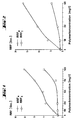
- Figures 3 and 4 show the results determined for ®Hostadrill in Vosges and Oberkirchner sandstone. It has been shown that a higher polymer concentration is required to achieve the same adsorption effect.
- the method according to the invention has been used with great success in field trials on the production well of a natural gas field in northern Germany.
- the injection was carried out in a gas well (temperature 130 ° C., salt content 300 g formation salts / l water, average permeability 10 mDarcy).
- 200 m3 ®Hostamer V 3212 (polymer concentration 1 g / l) were used, the salt content of the polymer solution was 180 g NaCl / l water.
- the polymer solution was injected at a constant injection rate under the fracture pressure of the deposit.
- the copolymer solution according to the invention the gas production which had come to a standstill could be increased to 100,000 m 3 / day, and the water production (condensed water) was 1 m 3 / day.
Landscapes
- Chemical & Material Sciences (AREA)
- Life Sciences & Earth Sciences (AREA)
- General Life Sciences & Earth Sciences (AREA)
- Engineering & Computer Science (AREA)
- Chemical Kinetics & Catalysis (AREA)
- Materials Engineering (AREA)
- Organic Chemistry (AREA)
- Geology (AREA)
- Mining & Mineral Resources (AREA)
- Environmental & Geological Engineering (AREA)
- Fluid Mechanics (AREA)
- Physics & Mathematics (AREA)
- Geochemistry & Mineralogy (AREA)
- Addition Polymer Or Copolymer, Post-Treatments, Or Chemical Modifications (AREA)
- Water Treatment By Sorption (AREA)
- Pipeline Systems (AREA)
Applications Claiming Priority (2)
| Application Number | Priority Date | Filing Date | Title |
|---|---|---|---|
| DE4212210 | 1992-04-10 | ||
| DE4212210 | 1992-04-10 |
Publications (2)
| Publication Number | Publication Date |
|---|---|
| EP0577931A1 true EP0577931A1 (fr) | 1994-01-12 |
| EP0577931B1 EP0577931B1 (fr) | 1998-06-24 |
Family
ID=6456628
Family Applications (1)
| Application Number | Title | Priority Date | Filing Date |
|---|---|---|---|
| EP93105664A Expired - Lifetime EP0577931B1 (fr) | 1992-04-10 | 1993-04-06 | Procédé pour la réduction ou la prédisposition complète de la production d'eau pendant le forage pour la récupération d'huile et/ou gaz d'hydrocarbures |
Country Status (8)
| Country | Link |
|---|---|
| US (1) | US5379841A (fr) |
| EP (1) | EP0577931B1 (fr) |
| BR (1) | BR9301516A (fr) |
| DE (1) | DE59308707D1 (fr) |
| DK (1) | DK0577931T3 (fr) |
| MX (1) | MX9302045A (fr) |
| NO (1) | NO303147B1 (fr) |
| RU (1) | RU2060358C1 (fr) |
Cited By (4)
| Publication number | Priority date | Publication date | Assignee | Title |
|---|---|---|---|---|
| EP0757998A3 (fr) * | 1995-08-08 | 1998-01-07 | Showa Denko Kabushiki Kaisha | Additive de béton à fluidité élevée et béton contenant cet additive |
| WO2001059254A1 (fr) * | 2000-02-11 | 2001-08-16 | Clariant International Ltd. | Solutions de copolymeres synthetiques reticules et injection directe dans des formations souterraines de gaz et de petrole |
| WO2002097236A1 (fr) * | 2001-05-25 | 2002-12-05 | Eni S.P.A. | Procede de reduction de la production d'eau dans des puits de petrole |
| US7150319B2 (en) | 2001-10-12 | 2006-12-19 | Clariant Uk Ltd. | Method for reducing or completely eliminating water influx in an underground formation, and crosslinkable copolymers for implementing said method |
Families Citing this family (56)
| Publication number | Priority date | Publication date | Assignee | Title |
|---|---|---|---|---|
| US5701956A (en) * | 1996-04-17 | 1997-12-30 | Halliburton Energy Services, Inc. | Methods and compositions for reducing water production from subterranean formations |
| US6169058B1 (en) | 1997-06-05 | 2001-01-02 | Bj Services Company | Compositions and methods for hydraulic fracturing |
| US6228812B1 (en) | 1998-12-10 | 2001-05-08 | Bj Services Company | Compositions and methods for selective modification of subterranean formation permeability |
| WO2000071635A1 (fr) | 1999-05-21 | 2000-11-30 | Cabot Corporation | Compositions polymeriques |
| US6423802B1 (en) | 1999-05-21 | 2002-07-23 | Cabot Corporation | Water soluble copolymers and polymer compositions comprising same and use thereof |
| DE19926355A1 (de) | 1999-06-10 | 2000-12-14 | Clariant Gmbh | Wasserlösliche Mischpolymere und ihre Verwendung für Exploration und Förderung von Erdöl und Erdgas |
| BR9904294B1 (pt) | 1999-09-22 | 2012-12-11 | processo para a redução seletiva e controlada da permeabilidade relativa à água em formações petrolìferas. | |
| EP1112982A1 (fr) * | 1999-12-27 | 2001-07-04 | Showa Denko Kabushiki Kaisha | Additif pour ciment et composition de ciment |
| US6476169B1 (en) * | 2000-09-28 | 2002-11-05 | Halliburton Energy Services, Inc. | Methods of reducing subterranean formation water permeability |
| DE10059828A1 (de) * | 2000-12-01 | 2002-06-13 | Clariant Gmbh | Kammförmige Copolymere auf Basis von Acryloyldimethyltaurinsäure |
| DE10059833A1 (de) * | 2000-12-01 | 2002-06-13 | Clariant Gmbh | Fluormodifizierte Kammpolymere auf Basis von Acryloyldimethylaurinsäure |
| US7741251B2 (en) * | 2002-09-06 | 2010-06-22 | Halliburton Energy Services, Inc. | Compositions and methods of stabilizing subterranean formations containing reactive shales |
| US7091159B2 (en) * | 2002-09-06 | 2006-08-15 | Halliburton Energy Services, Inc. | Compositions for and methods of stabilizing subterranean formations containing clays |
| US7220708B2 (en) * | 2003-02-27 | 2007-05-22 | Halliburton Energy Services, Inc. | Drilling fluid component |
| US20040177957A1 (en) * | 2003-03-10 | 2004-09-16 | Kalfayan Leonard J. | Organosilicon containing compositions for enhancing hydrocarbon production and method of using the same |
| US8091638B2 (en) * | 2003-05-16 | 2012-01-10 | Halliburton Energy Services, Inc. | Methods useful for controlling fluid loss in subterranean formations |
| US20040229756A1 (en) * | 2003-05-16 | 2004-11-18 | Eoff Larry S. | Method for stimulating hydrocarbon production and reducing the production of water from a subterranean formation |
| US8251141B2 (en) * | 2003-05-16 | 2012-08-28 | Halliburton Energy Services, Inc. | Methods useful for controlling fluid loss during sand control operations |
| US7759292B2 (en) * | 2003-05-16 | 2010-07-20 | Halliburton Energy Services, Inc. | Methods and compositions for reducing the production of water and stimulating hydrocarbon production from a subterranean formation |
| US8962535B2 (en) | 2003-05-16 | 2015-02-24 | Halliburton Energy Services, Inc. | Methods of diverting chelating agents in subterranean treatments |
| US7182136B2 (en) | 2003-07-02 | 2007-02-27 | Halliburton Energy Services, Inc. | Methods of reducing water permeability for acidizing a subterranean formation |
| US7117942B2 (en) * | 2004-06-29 | 2006-10-10 | Halliburton Energy Services, Inc. | Methods useful for controlling fluid loss during sand control operations |
| US8278250B2 (en) * | 2003-05-16 | 2012-10-02 | Halliburton Energy Services, Inc. | Methods useful for diverting aqueous fluids in subterranean operations |
| US8631869B2 (en) * | 2003-05-16 | 2014-01-21 | Leopoldo Sierra | Methods useful for controlling fluid loss in subterranean treatments |
| US8181703B2 (en) | 2003-05-16 | 2012-05-22 | Halliburton Energy Services, Inc. | Method useful for controlling fluid loss in subterranean formations |
| US7563750B2 (en) * | 2004-01-24 | 2009-07-21 | Halliburton Energy Services, Inc. | Methods and compositions for the diversion of aqueous injection fluids in injection operations |
| US7159656B2 (en) * | 2004-02-18 | 2007-01-09 | Halliburton Energy Services, Inc. | Methods of reducing the permeabilities of horizontal well bore sections |
| US7114568B2 (en) * | 2004-04-15 | 2006-10-03 | Halliburton Energy Services, Inc. | Hydrophobically modified polymers for a well completion spacer fluid |
| US7207387B2 (en) * | 2004-04-15 | 2007-04-24 | Halliburton Energy Services, Inc. | Methods and compositions for use with spacer fluids used in subterranean well bores |
| BRPI0512154B1 (pt) * | 2004-06-17 | 2016-07-05 | Statoil Asa | método de controlar água em uma formação subterrânea, uso de um agente de tratamento de controle de água, uso de um organossilano, método de tratamento de uma formação subterrânea produzindo água e hidrocarboneto, agente de tratamento de controle de água, e, método de vedar ou tamponar uma formação subterrânea rica em água |
| NO347192B1 (no) * | 2004-06-17 | 2023-06-26 | Equinor Energy As | Brønnbehandling |
| US7216707B2 (en) * | 2004-06-21 | 2007-05-15 | Halliburton Energy Services, Inc. | Cement compositions with improved fluid loss characteristics and methods of cementing using such cement compositions |
| DE102004035515A1 (de) | 2004-07-22 | 2006-02-16 | Clariant Gmbh | Thermostabiles, wasserlösliches, bei hohen Temperaturen vernetzbares Polymer |
| US20060065396A1 (en) * | 2004-08-13 | 2006-03-30 | Dawson Jeffrey C | Compositions containing water control treatments and formation damage control additives, and methods for their use |
| US7398825B2 (en) * | 2004-12-03 | 2008-07-15 | Halliburton Energy Services, Inc. | Methods of controlling sand and water production in subterranean zones |
| CA2604220A1 (fr) * | 2005-04-26 | 2006-11-02 | Rune Godoey | Procede de construction et de traitement de puits |
| US7493957B2 (en) | 2005-07-15 | 2009-02-24 | Halliburton Energy Services, Inc. | Methods for controlling water and sand production in subterranean wells |
| US20080110624A1 (en) * | 2005-07-15 | 2008-05-15 | Halliburton Energy Services, Inc. | Methods for controlling water and particulate production in subterranean wells |
| US20070039732A1 (en) * | 2005-08-18 | 2007-02-22 | Bj Services Company | Methods and compositions for improving hydrocarbon recovery by water flood intervention |
| US7441598B2 (en) * | 2005-11-22 | 2008-10-28 | Halliburton Energy Services, Inc. | Methods of stabilizing unconsolidated subterranean formations |
| US20070114032A1 (en) * | 2005-11-22 | 2007-05-24 | Stegent Neil A | Methods of consolidating unconsolidated particulates in subterranean formations |
| US7678743B2 (en) * | 2006-09-20 | 2010-03-16 | Halliburton Energy Services, Inc. | Drill-in fluids and associated methods |
| US7678742B2 (en) * | 2006-09-20 | 2010-03-16 | Halliburton Energy Services, Inc. | Drill-in fluids and associated methods |
| US7687438B2 (en) * | 2006-09-20 | 2010-03-30 | Halliburton Energy Services, Inc. | Drill-in fluids and associated methods |
| EP1923369A1 (fr) * | 2006-11-17 | 2008-05-21 | Elotex AG | Mélange sec pour la cimentation des puits de forage. |
| US7730950B2 (en) | 2007-01-19 | 2010-06-08 | Halliburton Energy Services, Inc. | Methods for treating intervals of a subterranean formation having variable permeability |
| US7934557B2 (en) * | 2007-02-15 | 2011-05-03 | Halliburton Energy Services, Inc. | Methods of completing wells for controlling water and particulate production |
| GB2450502B (en) * | 2007-06-26 | 2012-03-07 | Statoil Asa | Microbial enhanced oil recovery |
| US9458370B2 (en) * | 2007-10-03 | 2016-10-04 | Baker Hughes Incorporated | Methods for pre-emptively controlling undesirable water production from an oil or gas well |
| US7552771B2 (en) * | 2007-11-14 | 2009-06-30 | Halliburton Energy Services, Inc. | Methods to enhance gas production following a relative-permeability-modifier treatment |
| US20090253594A1 (en) * | 2008-04-04 | 2009-10-08 | Halliburton Energy Services, Inc. | Methods for placement of sealant in subterranean intervals |
| US7998910B2 (en) * | 2009-02-24 | 2011-08-16 | Halliburton Energy Services, Inc. | Treatment fluids comprising relative permeability modifiers and methods of use |
| US8420576B2 (en) * | 2009-08-10 | 2013-04-16 | Halliburton Energy Services, Inc. | Hydrophobically and cationically modified relative permeability modifiers and associated methods |
| EP3099759A1 (fr) * | 2014-01-30 | 2016-12-07 | TouGas Oilfield Solutions GmbH | Procédé pour augmenter la viscosité d'hydrogels par réticulation d'un copolymère en présence de sel dissous |
| US10399902B2 (en) | 2014-02-28 | 2019-09-03 | Tougas Oilfield Solutions Gmbh | Method to reduce the water loss in slurries or solutions used in oil field and gas field operations |
| US10273397B2 (en) * | 2014-10-01 | 2019-04-30 | Halliburton Energy Services, Inc. | Synthetic crosslinked polymer additive for use in subterranean treatment fluids |
Citations (5)
| Publication number | Priority date | Publication date | Assignee | Title |
|---|---|---|---|---|
| FR2224636A1 (en) * | 1973-04-05 | 1974-10-31 | Calgon Corp | Improved hydrocarbon-to-water ratios in oil and gas wells - by injection of aq acrylamide copolymer solns. |
| EP0023712A1 (fr) * | 1979-08-06 | 1981-02-11 | CASSELLA Aktiengesellschaft | Copolymère soluble dans l'eau, procédé pour sa production et son utilisation |
| EP0044508A2 (fr) * | 1980-07-19 | 1982-01-27 | CASSELLA Aktiengesellschaft | Copolymères de poids moléculaire élevé solubles dans l'eau, leur préparation et leur utilisation |
| EP0156031A1 (fr) * | 1981-12-15 | 1985-10-02 | Calgon Corporation | Procédé pour l'extraction de pétrole |
| US4842071A (en) * | 1987-03-06 | 1989-06-27 | Institut Francais Du Petrole | Process for the selective reduction of water inflows in oil or gas producing wells |
Family Cites Families (8)
| Publication number | Priority date | Publication date | Assignee | Title |
|---|---|---|---|---|
| US3820603A (en) * | 1972-11-06 | 1974-06-28 | Ici America Inc | Altering relative permeability in production wells |
| US3826311A (en) * | 1973-06-13 | 1974-07-30 | Calgon Corp | Producing well treatment |
| US4484631A (en) * | 1982-08-25 | 1984-11-27 | Calgon Corporation | Use of polyampholytes to enhance oil and/or gas recovery |
| US4455240A (en) * | 1981-12-15 | 1984-06-19 | Calgon Corporation | Ampholytic polymers for use as filtration control aids in drilling muds |
| US4460477A (en) * | 1982-08-25 | 1984-07-17 | Calgon Corporation | Use of a carboxylic functional polyampholyte to inhibit the precipitation and deposit of scale in aqueous systems |
| US4533708A (en) * | 1981-12-15 | 1985-08-06 | Calgon Corporation | Polyampholyte polymer |
| US4510059A (en) * | 1982-08-25 | 1985-04-09 | Calgon Corporation | Carboxylic functional polyampholytes as silica polymerization retardants and dispersants |
| US4951921A (en) * | 1983-01-28 | 1990-08-28 | Phillips Petroleum Company | Polymers useful in the recovery and processing of natural resources |
-
1993
- 1993-04-06 EP EP93105664A patent/EP0577931B1/fr not_active Expired - Lifetime
- 1993-04-06 DE DE59308707T patent/DE59308707D1/de not_active Expired - Lifetime
- 1993-04-06 DK DK93105664T patent/DK0577931T3/da active
- 1993-04-07 NO NO931335A patent/NO303147B1/no not_active IP Right Cessation
- 1993-04-07 MX MX9302045A patent/MX9302045A/es unknown
- 1993-04-09 RU RU9393004590A patent/RU2060358C1/ru active
- 1993-04-12 US US08/045,930 patent/US5379841A/en not_active Expired - Lifetime
- 1993-04-12 BR BR9301516A patent/BR9301516A/pt not_active Application Discontinuation
Patent Citations (5)
| Publication number | Priority date | Publication date | Assignee | Title |
|---|---|---|---|---|
| FR2224636A1 (en) * | 1973-04-05 | 1974-10-31 | Calgon Corp | Improved hydrocarbon-to-water ratios in oil and gas wells - by injection of aq acrylamide copolymer solns. |
| EP0023712A1 (fr) * | 1979-08-06 | 1981-02-11 | CASSELLA Aktiengesellschaft | Copolymère soluble dans l'eau, procédé pour sa production et son utilisation |
| EP0044508A2 (fr) * | 1980-07-19 | 1982-01-27 | CASSELLA Aktiengesellschaft | Copolymères de poids moléculaire élevé solubles dans l'eau, leur préparation et leur utilisation |
| EP0156031A1 (fr) * | 1981-12-15 | 1985-10-02 | Calgon Corporation | Procédé pour l'extraction de pétrole |
| US4842071A (en) * | 1987-03-06 | 1989-06-27 | Institut Francais Du Petrole | Process for the selective reduction of water inflows in oil or gas producing wells |
Cited By (10)
| Publication number | Priority date | Publication date | Assignee | Title |
|---|---|---|---|---|
| EP0757998A3 (fr) * | 1995-08-08 | 1998-01-07 | Showa Denko Kabushiki Kaisha | Additive de béton à fluidité élevée et béton contenant cet additive |
| US6090899A (en) * | 1995-08-08 | 2000-07-18 | Showa Denko K.K. | Terpolymers of unsaturated sulfonates, N-vinylamides and ethylenic monomers |
| WO2001059254A1 (fr) * | 2000-02-11 | 2001-08-16 | Clariant International Ltd. | Solutions de copolymeres synthetiques reticules et injection directe dans des formations souterraines de gaz et de petrole |
| US6465397B1 (en) | 2000-02-11 | 2002-10-15 | Clariant Finance (Bvi) Limited | Synthetic crosslinked copolymer solutions and direct injection to subterranean oil and gas formations |
| WO2002097236A1 (fr) * | 2001-05-25 | 2002-12-05 | Eni S.P.A. | Procede de reduction de la production d'eau dans des puits de petrole |
| GB2390865A (en) * | 2001-05-25 | 2004-01-21 | Eni Spa | Process for reducing the production of water in oil wells |
| GB2390865B (en) * | 2001-05-25 | 2005-01-12 | Eni Spa | Process for reducing the production of water in oil wells |
| US7004253B2 (en) | 2001-05-25 | 2006-02-28 | Eni S.P.A. | Process for reducing the production of water in oil wells |
| AU2002344258B2 (en) * | 2001-05-25 | 2007-09-13 | Eni S.P.A. | Process for reducing the production of water in oil wells |
| US7150319B2 (en) | 2001-10-12 | 2006-12-19 | Clariant Uk Ltd. | Method for reducing or completely eliminating water influx in an underground formation, and crosslinkable copolymers for implementing said method |
Also Published As
| Publication number | Publication date |
|---|---|
| DE59308707D1 (de) | 1998-07-30 |
| MX9302045A (es) | 1994-07-29 |
| NO931335L (no) | 1993-10-11 |
| NO931335D0 (no) | 1993-04-07 |
| BR9301516A (pt) | 1993-11-30 |
| US5379841A (en) | 1995-01-10 |
| RU2060358C1 (ru) | 1996-05-20 |
| EP0577931B1 (fr) | 1998-06-24 |
| NO303147B1 (no) | 1998-06-02 |
| DK0577931T3 (da) | 1999-02-01 |
Similar Documents
| Publication | Publication Date | Title |
|---|---|---|
| EP0577931B1 (fr) | Procédé pour la réduction ou la prédisposition complète de la production d'eau pendant le forage pour la récupération d'huile et/ou gaz d'hydrocarbures | |
| DE3486230T2 (de) | Polymere verwendbar in der Rückgewinnung und Verarbeitung von Bodenschätzen. | |
| DE3200022A1 (de) | Verfahren und zusammensetzung zur verstaerkten verdraengung von oel | |
| DE2533425A1 (de) | Verfahren zur verminderung der reibung beim stroemen fliessfaehiger medien durch leitungen | |
| EP1436484B1 (fr) | Procede pour diminuer ou stopper completement des arrivees d'eau dans une formation souterraine, et copolymeres reticulables pour realiser ce procede | |
| DE1956820B1 (de) | Verfahren,Saeureloesung,Loesungsmittel und OEl zur Steigerung der Permeabilitaet siliziumhaltiger Formationen | |
| DE2303654A1 (de) | Behandlungsfluessigkeit zur verwendung in bohrloechern durch unterirdische formationen | |
| DE19926355A1 (de) | Wasserlösliche Mischpolymere und ihre Verwendung für Exploration und Förderung von Erdöl und Erdgas | |
| DE3416388A1 (de) | Verfahren zur gewinnung von kohlenwasserstoffen aus einer unterirdischen gesteinsformation | |
| DE2642050A1 (de) | Verfahren zur verringerung des wasserzuflusses bei schaechten zur gewinnung von oel und/oder kohlenwasserstoffgas | |
| WO2014049021A1 (fr) | Procédé d'extraction de gaz naturel et de condensat de gaz naturel à partir de gisements de condensat de gaz souterrains, ainsi que compositions coulantes destinées à être utilisées dans ce procédé | |
| EP0565042A2 (fr) | Procédé pour la réduction ou la prédisposition complète de la production d'eau pendant le forage pour la récupération d'huile et/ou gaz d'hydrocarbures | |
| DE69112044T2 (de) | Verfahren zur reduzierung des permeabilitätsunterschieds zwischen zwei geologischen formationen und seine anwendung zur kohlenwasserstoffgewinnung. | |
| DE3539548C2 (de) | Verfahren zum Abbau einer viskosen mikrobiologischen Polysaccharid-Zubereitung | |
| DE3211168C1 (de) | Verfahren zur Gewinnung von Erdoel aus untertaegigen Lagerstaetten | |
| WO2008000362A1 (fr) | Utilisation de dérivés méthacrylates pour l'épaississement de milieux salins | |
| EP0272406A2 (fr) | Procédé pour améliorer la récupération de pétrole des formations souterraines par injection d'agents surfactifs | |
| DE69003519T2 (de) | Verfahren und Zusammensetzung für die selektive Wasser-Permeabilitätsreduktion in warmen und salzigen Kohlenwasserstoffreservoiren. | |
| WO2012107458A1 (fr) | Procédé en plusieurs étapes pour l'exploitation de pétrole à l'aide de microorganismes | |
| DE4330689C2 (de) | Polymerflutverfahren zur Gewinnung von Erdöl aus untertägigen Lagerstätten | |
| DE2231163A1 (de) | Verfahren zur herstellung von waessrigen gelen und ihre verwendung als hilfsmittel bei bohrungen in geologischen formationen | |
| DE2826070B2 (de) | Zusammensetzung aus Wasser, einem polymeren Andickungsmittel und einem Stabilisator für das Andickungsmittel sowie Verfahren zur ölgewinnung unter Verwendung einer solchen Zusammensetzung | |
| EP0088206A2 (fr) | Procédé pour l'extraction de pétrole d'un réservoir souterrain | |
| EP2559844A2 (fr) | Procédé de transport de pétrole visqueux à partir de stations de stockage souterraines | |
| EP0134021B1 (fr) | Procédé pour réduire la production d'eau dans les puits de pétrole |
Legal Events
| Date | Code | Title | Description |
|---|---|---|---|
| PUAI | Public reference made under article 153(3) epc to a published international application that has entered the european phase |
Free format text: ORIGINAL CODE: 0009012 |
|
| AK | Designated contracting states |
Kind code of ref document: A1 Designated state(s): DE DK GB NL |
|
| 17P | Request for examination filed |
Effective date: 19940324 |
|
| 17Q | First examination report despatched |
Effective date: 19960206 |
|
| GRAG | Despatch of communication of intention to grant |
Free format text: ORIGINAL CODE: EPIDOS AGRA |
|
| GRAG | Despatch of communication of intention to grant |
Free format text: ORIGINAL CODE: EPIDOS AGRA |
|
| GRAH | Despatch of communication of intention to grant a patent |
Free format text: ORIGINAL CODE: EPIDOS IGRA |
|
| RAP1 | Party data changed (applicant data changed or rights of an application transferred) |
Owner name: CLARIANT GMBH |
|
| GRAH | Despatch of communication of intention to grant a patent |
Free format text: ORIGINAL CODE: EPIDOS IGRA |
|
| GRAA | (expected) grant |
Free format text: ORIGINAL CODE: 0009210 |
|
| AK | Designated contracting states |
Kind code of ref document: B1 Designated state(s): DE DK GB NL |
|
| REF | Corresponds to: |
Ref document number: 59308707 Country of ref document: DE Date of ref document: 19980730 |
|
| GBT | Gb: translation of ep patent filed (gb section 77(6)(a)/1977) |
Effective date: 19980826 |
|
| REG | Reference to a national code |
Ref country code: DK Ref legal event code: T3 |
|
| PGFP | Annual fee paid to national office [announced via postgrant information from national office to epo] |
Ref country code: DK Payment date: 19990317 Year of fee payment: 7 |
|
| PLBE | No opposition filed within time limit |
Free format text: ORIGINAL CODE: 0009261 |
|
| 26N | No opposition filed | ||
| PG25 | Lapsed in a contracting state [announced via postgrant information from national office to epo] |
Ref country code: DK Free format text: LAPSE BECAUSE OF NON-PAYMENT OF DUE FEES Effective date: 20000406 |
|
| REG | Reference to a national code |
Ref country code: DK Ref legal event code: EBP |
|
| REG | Reference to a national code |
Ref country code: GB Ref legal event code: IF02 |
|
| PGFP | Annual fee paid to national office [announced via postgrant information from national office to epo] |
Ref country code: GB Payment date: 20120330 Year of fee payment: 20 |
|
| PGFP | Annual fee paid to national office [announced via postgrant information from national office to epo] |
Ref country code: NL Payment date: 20120224 Year of fee payment: 20 Ref country code: DE Payment date: 20120222 Year of fee payment: 20 |
|
| REG | Reference to a national code |
Ref country code: DE Ref legal event code: R071 Ref document number: 59308707 Country of ref document: DE |
|
| REG | Reference to a national code |
Ref country code: NL Ref legal event code: V4 Effective date: 20130406 |
|
| REG | Reference to a national code |
Ref country code: GB Ref legal event code: PE20 Expiry date: 20130405 |
|
| PG25 | Lapsed in a contracting state [announced via postgrant information from national office to epo] |
Ref country code: DE Free format text: LAPSE BECAUSE OF EXPIRATION OF PROTECTION Effective date: 20130409 Ref country code: GB Free format text: LAPSE BECAUSE OF EXPIRATION OF PROTECTION Effective date: 20130405 |