EP0578148A2 - Couches qui reconnaissent biologiquement sûr les phases solides et procédé pour la production - Google Patents
Couches qui reconnaissent biologiquement sûr les phases solides et procédé pour la production Download PDFInfo
- Publication number
- EP0578148A2 EP0578148A2 EP93110595A EP93110595A EP0578148A2 EP 0578148 A2 EP0578148 A2 EP 0578148A2 EP 93110595 A EP93110595 A EP 93110595A EP 93110595 A EP93110595 A EP 93110595A EP 0578148 A2 EP0578148 A2 EP 0578148A2
- Authority
- EP
- European Patent Office
- Prior art keywords
- recognizing
- biologically
- molecules
- analyte
- layers
- Prior art date
- Legal status (The legal status is an assumption and is not a legal conclusion. Google has not performed a legal analysis and makes no representation as to the accuracy of the status listed.)
- Granted
Links
- VULHYRAYXYTONQ-UHFFFAOYSA-N C=Nc1ccccc1 Chemical compound C=Nc1ccccc1 VULHYRAYXYTONQ-UHFFFAOYSA-N 0.000 description 1
Images

Classifications
-
- G—PHYSICS
- G01—MEASURING; TESTING
- G01N—INVESTIGATING OR ANALYSING MATERIALS BY DETERMINING THEIR CHEMICAL OR PHYSICAL PROPERTIES
- G01N33/00—Investigating or analysing materials by specific methods not covered by groups G01N1/00 - G01N31/00
- G01N33/48—Biological material, e.g. blood, urine; Haemocytometers
- G01N33/50—Chemical analysis of biological material, e.g. blood, urine; Testing involving biospecific ligand binding methods; Immunological testing
- G01N33/53—Immunoassay; Biospecific binding assay; Materials therefor
- G01N33/543—Immunoassay; Biospecific binding assay; Materials therefor with an insoluble carrier for immobilising immunochemicals
- G01N33/54366—Apparatus specially adapted for solid-phase testing
- G01N33/54373—Apparatus specially adapted for solid-phase testing involving physiochemical end-point determination, e.g. wave-guides, FETS, gratings
- G01N33/5438—Electrodes
-
- G—PHYSICS
- G01—MEASURING; TESTING
- G01N—INVESTIGATING OR ANALYSING MATERIALS BY DETERMINING THEIR CHEMICAL OR PHYSICAL PROPERTIES
- G01N33/00—Investigating or analysing materials by specific methods not covered by groups G01N1/00 - G01N31/00
- G01N33/48—Biological material, e.g. blood, urine; Haemocytometers
- G01N33/50—Chemical analysis of biological material, e.g. blood, urine; Testing involving biospecific ligand binding methods; Immunological testing
- G01N33/53—Immunoassay; Biospecific binding assay; Materials therefor
- G01N33/543—Immunoassay; Biospecific binding assay; Materials therefor with an insoluble carrier for immobilising immunochemicals
- G01N33/54353—Immunoassay; Biospecific binding assay; Materials therefor with an insoluble carrier for immobilising immunochemicals with ligand attached to the carrier via a chemical coupling agent
-
- Y—GENERAL TAGGING OF NEW TECHNOLOGICAL DEVELOPMENTS; GENERAL TAGGING OF CROSS-SECTIONAL TECHNOLOGIES SPANNING OVER SEVERAL SECTIONS OF THE IPC; TECHNICAL SUBJECTS COVERED BY FORMER USPC CROSS-REFERENCE ART COLLECTIONS [XRACs] AND DIGESTS
- Y10—TECHNICAL SUBJECTS COVERED BY FORMER USPC
- Y10S—TECHNICAL SUBJECTS COVERED BY FORMER USPC CROSS-REFERENCE ART COLLECTIONS [XRACs] AND DIGESTS
- Y10S436/00—Chemistry: analytical and immunological testing
- Y10S436/823—Immunogenic carrier or carrier per se
-
- Y—GENERAL TAGGING OF NEW TECHNOLOGICAL DEVELOPMENTS; GENERAL TAGGING OF CROSS-SECTIONAL TECHNOLOGIES SPANNING OVER SEVERAL SECTIONS OF THE IPC; TECHNICAL SUBJECTS COVERED BY FORMER USPC CROSS-REFERENCE ART COLLECTIONS [XRACs] AND DIGESTS
- Y10—TECHNICAL SUBJECTS COVERED BY FORMER USPC
- Y10S—TECHNICAL SUBJECTS COVERED BY FORMER USPC CROSS-REFERENCE ART COLLECTIONS [XRACs] AND DIGESTS
- Y10S436/00—Chemistry: analytical and immunological testing
- Y10S436/828—Protein A
-
- Y—GENERAL TAGGING OF NEW TECHNOLOGICAL DEVELOPMENTS; GENERAL TAGGING OF CROSS-SECTIONAL TECHNOLOGIES SPANNING OVER SEVERAL SECTIONS OF THE IPC; TECHNICAL SUBJECTS COVERED BY FORMER USPC CROSS-REFERENCE ART COLLECTIONS [XRACs] AND DIGESTS
- Y10—TECHNICAL SUBJECTS COVERED BY FORMER USPC
- Y10S—TECHNICAL SUBJECTS COVERED BY FORMER USPC CROSS-REFERENCE ART COLLECTIONS [XRACs] AND DIGESTS
- Y10S977/00—Nanotechnology
- Y10S977/70—Nanostructure
- Y10S977/701—Integrated with dissimilar structures on a common substrate
- Y10S977/712—Integrated with dissimilar structures on a common substrate formed from plural layers of nanosized material, e.g. stacked structures
- Y10S977/714—Containing protein
-
- Y—GENERAL TAGGING OF NEW TECHNOLOGICAL DEVELOPMENTS; GENERAL TAGGING OF CROSS-SECTIONAL TECHNOLOGIES SPANNING OVER SEVERAL SECTIONS OF THE IPC; TECHNICAL SUBJECTS COVERED BY FORMER USPC CROSS-REFERENCE ART COLLECTIONS [XRACs] AND DIGESTS
- Y10—TECHNICAL SUBJECTS COVERED BY FORMER USPC
- Y10S—TECHNICAL SUBJECTS COVERED BY FORMER USPC CROSS-REFERENCE ART COLLECTIONS [XRACs] AND DIGESTS
- Y10S977/00—Nanotechnology
- Y10S977/70—Nanostructure
- Y10S977/788—Of specified organic or carbon-based composition
- Y10S977/795—Composed of biological material
-
- Y—GENERAL TAGGING OF NEW TECHNOLOGICAL DEVELOPMENTS; GENERAL TAGGING OF CROSS-SECTIONAL TECHNOLOGIES SPANNING OVER SEVERAL SECTIONS OF THE IPC; TECHNICAL SUBJECTS COVERED BY FORMER USPC CROSS-REFERENCE ART COLLECTIONS [XRACs] AND DIGESTS
- Y10—TECHNICAL SUBJECTS COVERED BY FORMER USPC
- Y10S—TECHNICAL SUBJECTS COVERED BY FORMER USPC CROSS-REFERENCE ART COLLECTIONS [XRACs] AND DIGESTS
- Y10S977/00—Nanotechnology
- Y10S977/902—Specified use of nanostructure
- Y10S977/904—Specified use of nanostructure for medical, immunological, body treatment, or diagnosis
- Y10S977/92—Detection of biochemical
Definitions
- the present invention relates to biologically recognizing layers on solid phases, and to a method for producing these layers.
- Solid phases with biologically recognizable layers are used in bioanalytical processes, which can be summarized under the collective term assay technology. Examples of this are: enzyme immunoassays, fluorescence immunoassays, radio immunoassays, depending on the type of labeling of the molecules involved.
- affinity sensors are increasingly described for such detections, which, in contrast to the existing assay technology, allow direct detection without the use of a label and without washing and separation steps.
- Such affinity sensors generally consist of a physical transducer, especially e.g. from a piezoelectric transducer [Anal.Chem. 63 (1991) 393 A], from an optical converter [Sens. Actuators 4 (1983) 299; Thin Solid Films 126 (1985) 205; Biosensors and Biosensing 6 (1991) 215] or from an electrochemical converter [Biosensors & Bioelectronics 6 (1991) 55]), which is closely linked to the above-mentioned biologically recognizing layer.
- the known methods have the disadvantage that the chemical and / or biochemical modification of the biologically recognizing molecules entails a substantial loss of activity.
- the present invention is therefore based on the object of providing a directed, covalently immobilized layer of biologically recognizing, unmodified molecules with a high binding capacity for the molecule to be recognized on a solid phase.
- a high affinity and binding capacity requires a high density of active, specific binding sites.
- the directed, covalent immobilization of biologically recognizing molecules is achieved in that the molecule to be immobilized is adsorbed over the molecular regions not recognizing the analyte after suitable modification of the solid phase surface.
- the covalent binding step takes place over the areas not recognizing the analyte with the help of specific so-called crosslinking reagents which are particularly adapted to this immobilization process and which are introduced into the process via carrier molecules.
- the carrier molecules can be present before, simultaneously with or after the directed adsorption of the analyte-recognizing molecules on the Solid phase surface adsorbed or bound.
- the present invention thus describes a layer of recognizing molecules, as well as a method for producing this layer, according to which unmodified, recognizing biomolecules (e.g. antibodies, receptors, DNA molecules) are immobilized on the surface.
- unmodified, recognizing biomolecules e.g. antibodies, receptors, DNA molecules
- the method is fundamentally applicable to all recognizing molecules which have a first analyte-recognizing molecular region and a second molecular region which is spatially well separated from the first, via which the recognizing molecule can be adsorbed onto a suitably modified surface. It can be shown that these structural requirements are present in almost all recognizing biomolecules.
- Ligand-recognizing receptors of the cell membrane have e.g. via a hydrophilic part of the molecule which contains the ligand-recognizing region and a mostly hydrophobic transmembrane part. Such receptors are preferably physically adsorbed on hydrophobic surfaces via this transmembrane part.
- Antibodies have Fab parts with the antigen / hapten-recognizing areas and the Fc part which is not important for antigen / hapten detection.
- the surface of the solid phase can be designed in such a way that antibodies can be adsorbed onto the surface via the Fc part.
- Sequences e.g. 3-10 bases
- sequences which are not used on such a strand for the recognition of the complementary strand can be used for the directed adsorption if the corresponding short complementary section (e.g. 3-10 bases) on the Surface is immobilized.
- recognition biomolecules have recently been produced more and more biotechnologically. Genetic engineering processes can be used to change the microorganism used for the biotechnological production of the recognition molecule in such a way that additional areas that are suitable for adsorption onto a surface are synthesized at specific locations of this recognition molecule.
- the invention is explained in more detail using the example of a layer recognizing antigen / hapten, in which antibodies are covalently immobilized on the surface of a solid phase.
- the surface of a physical transducer is suitable as a solid phase.
- the directed adsorption of antibodies is achieved by first providing the surface of the solid phase with a monolayer of proteins which have a specific affinity for the Fc part of antibodies.
- Typical representatives of this class of proteins that are able to align antibodies on a surface due to their affinity for Fc parts of antibodies are e.g. Protein A, Protein G, Fc-part-recognizing antibodies or antibody fragments or receptors.
- proteins within this class which on the one hand have several binding sites for the Fc part of antibodies (e.g. protein A with four binding sites per molecule) and on the other hand have a much smaller space requirement (area requirement) than the antibodies subsequently to be immobilized (eg protein A with a globular structure with a diameter of approx. 5 nm in comparison to antibodies of the IgG type with a separation of the antigen-recognizing regions of approx. 17 nm).
- the surface of the solid phase is generally provided with a thin organic additional layer which has the functional groups (for example -COOH or -NH 2 ) suitable for protein immobilization in high density.
- a thin organic additional layer which has the functional groups (for example -COOH or -NH 2 ) suitable for protein immobilization in high density.
- Such an additional layer can be applied, for example, by the silanization processes known from chromatography and by the self-assembling processes described in the more recent literature from solution or by the processes which can be characterized by the collective terms chemical vapor deposition, plasma induced chemical vapor deposition, plasma induced polymerization done from the gas phase.
- the Fc part-recognizing proteins are covalently immobilized according to known methods from affinity chromatography, in which the functional groups on the surface are suitably activated and then reacted with functional groups (for example -NH 2 or -COOH) on the protein.
- Antibodies can now be anchored in a directional manner on such surfaces, the anchoring being based on the affinity of the immobilized protein for the Fc part of the antibodies.
- affinity constants for such complexes eg IgG protein A
- different antibody subclasses are only bound to these proteins via their Fc part under very special buffer conditions (e.g. high pH, high salt concentrations), and these antibodies quickly desorb again when the buffer is changed (e.g. under physiological conditions) .
- this directed adsorption has a second step in connecting the covalent immobilization of the aligned molecules. It is clear that this linking process must be carried out in such a way that it does not affect the antigen-binding areas and thus the activity of the antibodies.
- Conventional chemical methods for such a crosslinking generally have the disadvantage of a high degree of non-specificity, that is to say the crosslinking also takes place in the antigen / hapten-binding regions and thereby largely reduces the activity of the antibodies.
- A is a glycol or oligoethylene glycol substituent, a tert. or quaternary amino group such as pyridyl, dialkylamino or N-alkylpyridinium, trialkylammonium.
- Alkyl means a lower alkyl radical approx. Ci - C 4 .
- the group R is a functional group of the general formula: wherein X 2 represents a disulfide (-SS-) or methylene group (-CH 2 -).
- R 1 represents an amino (-NH-R 2 ) or carboxyl derivative (-CO-R 3 ).
- R 2 H or a derivatized carboxyalkanoyl group (-CO- (CH 2 ) nC0-R 3 ).
- CO-R 3 is an activated carboxyl group such as an acid halide, imidazolide, hydrazide, anhydride, a carboxyl group derivatized with a dithiopyridyl group (-NH- (CH 2 ) n "'- SS-pyridyl) or a reactive ester with eg hydroxysuccinimide, isourea , Hydroxysuccinimide sulfonic acid.
- n ', n ", n"' 1-6.
- R 3 may contain a disulfide group, where R 3 represents, for example, a cystamine derivative -NH- (CH 2 ) 2 -SS- (CH 2 ) 2 -NH-R 2 , in which R 2 has the meaning given above and the R 3 contained in R 2 does not contain a disulfide group.
- Y can also be X 1 -R if desired. (double anchoring)
- an isocyanate, isothiocyanate, vinylsulfonamide (-NH-S0 2 -CH CH 2 ), maleimide, halogen-substituted triazinamino, pyrimidinamino or
- R 1 pyridinium (N-CH 2 -CO-R 3 )
- CH 2 CH-SO 2 - NH - Maleimidyl -NH-CO-CH (CI) -alkyl NH-CO-alkylene-CO-CI -NH-CH 2 -Oxirane -NH-cyclohexenedione -NH-dichlorotriacinyl
- the method claimed here for directed immobilization using the heterobifunctional reagents specified above is based on surfaces on which Fc-part-recognizing proteins are covalently immobilized.
- the method according to the invention is characterized in that for the photolytically induced crosslinking neither this protein layer nor the antibodies subsequently bound to this layer via the Fc part are previously modified with the photolytically activatable crosslinking reagent.
- the modification of the protein layer with this reagent would namely drastically reduce the activity of this layer for binding the Fc part of the antibodies.
- the activity for the antigen / hapten recognition or by adding the Fc portion would be the recognition of this Fc portion the protein immobilized on the surface impaired.
- the chemical modification of the immobilized proteins or of the antibodies to be immobilized with the photolytically activatable crosslinking reagent is avoided by using a third type of molecule as carrier molecules (auxiliary molecules) for the photoreagent.
- carrier molecules which are specified further below, are reacted externally with the crosslinking reagent in such a way that subsequently several photoactivatable groups are covalently bound to a single carrier molecule.
- the carrier molecules are either immobilized on the transducer surface with the antibody-aligning proteins or coadsorbed onto the protein surface with the antibodies to be immobilized.
- both the co-immobilization of such carrier molecules with the aligning proteins and the coadsorption of such carrier molecules can be carried out in such a way that the adsorption of the antibodies onto the covalently immobilized protein layer is not disturbed.
- biomolecules such as e.g. Albumins, polysaccharides etc. or by water-soluble synthetic polymers.
- suitable biomolecules has the advantage that the surfaces become very insensitive to non-specific adsorption.
- efficient crosslinking only takes place if these carrier molecules contain several photoactivatable groups underscores the importance of the above-mentioned demand for water-soluble (hydrophilic), bifunctional reagents in which the photoactivatable part of the molecule is water-soluble. If this were not guaranteed, the modification would reduce the water solubility of the carrier molecules.
- aligning proteins e.g. protein A
- carrier molecules e.g. BSA
- the concentration ratio on the surface is adjusted by choosing a suitable concentration ratio of the two types of molecules in solution.
- the carrier molecules can be divided into two classes.
- a first class includes carrier molecules that adsorb nonspecifically on this surface (e.g. albumins, polysaccharides, water-soluble synthetic polymers) and mainly occupy those parts of the surface that are not covered by the proteins that recognize the Fc part.
- This class of carrier molecules is preferably adsorbed prior to the adsorption of the recognizing antibodies on the surface.
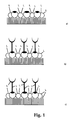
- FIG. 2 schematically shows the directed covalent immobilization of native antibodies in the case of non-specific adsorption of the carrier molecules onto free binding sites on the surface.
- Fig. 2a shows the covalently immobilized aligning proteins (e.g. protein A).
- 2b shows the non-specific adsorption of the carrier molecules (e.g. BSA) by circles marked with L, which are located in free spaces between the covalently immobilized aligning proteins.
- the antibodies are then adsorbed in a directed manner (FIG. 2c).
- the connecting lines again show the networking of the proteins with one another and with the surface (FIG. 2d).
- a second class comprises carrier molecules which specifically occupy Fc binding sites on the covalently immobilized protein layer.
- Typical representatives of this class are Fc fragments of antibodies.
- These carrier molecules can be adsorbed onto the surface simultaneously with the antibodies to be immobilized or only after their adsorption.
- the concentration ratio of carrier molecules (eg Fc fragment) and recognizing antibodies has to be optimized very precisely not too many binding sites are occupied by auxiliary proteins. Such coverage of the Fc binding sites on the surface with auxiliary proteins would lead to a reduction in the concentration of antigen-recognizing antibodies and thereby drastically reduce the sensitivity and the dynamic range of the sensor.
- carrier proteins eg the Fc fragment
- they primarily saturate binding sites which, for steric reasons, were not accessible to the larger antibody molecules.
- carrier proteins modified with crosslinking reagent also have the possibility of displacing adsorbed antigen-recognizing antibodies from the surface. Since this displacement is a slow process, it can be controlled very easily over the incubation period with auxiliary proteins.
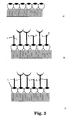
- FIG. 3 schematically shows the directed covalent immobilization of native antibodies with specific adsorption of the carrier molecules on binding sites of the targeting proteins.
- Fig. 3a also shows the covalently immobilized, aligning proteins (e.g. protein A).
- Fig. 3b the specific coadsorption of carrier molecules (e.g. Fc parts of antibodies) is represented by bars which are marked with L and adhere to the aligning proteins. At the same time, the antibodies are adsorbed.
- carrier molecules e.g. Fc parts of antibodies
- the proteins on the surface can be crosslinked to one another by irradiation.
- the photoactivatable part of the bifunctional crosslinking reagent is very water-soluble. This high water solubility is the only way to ensure that the activated group (nitrenes) protrudes into the solution, thereby favoring intermolecular (not intramolecular) crosslinking.
- the irradiation time should be kept as short as possible in order to minimize the destruction of the antibody activity by photolytically induced side reactions (e.g. photooxidation).
- the sensor surface is silanized in a manner known per se for 15 minutes in a dilute solution of octenyltrichlorosilane (0.5%) in hexadecane. Then the sensor surface is rinsed thoroughly in sequence with hexadecane, hexane and ethanol. The terminal double bonds on the silanized surface are oxidized to carboxylic acid groups in a solution of 2.5 mM potassium permanganate and 100 mM sodium periodate for at least 60 minutes. The reaction is stopped by immersing the sensor in a 100 mM sodium thiosulfite solution and then washing the sensor surface again thoroughly in water and ethanol. In this process, additional high quality monomolecular layers are obtained.
- the carboxylic acid groups on the sensor surface are first activated and then converted to N-hydroxysuccinimide ester.
- the activation takes place in a solution of 5% ethyl chloroformate and 4% pyridine in methylene chloride under protective gas for 1 hour.
- These activated carboxylic acid groups are converted to N-hydroxysuccinimide ester functions by incubating the sensor surface in a solution of 500 mM N-hydroxysuccinimide in pyridine. The sensor is then cleaned with ethanol and water and then dried.
- Protein A is immobilized on the sensor surface by incubating the support for 1 hour in a solution of this protein (0.1 mg / ml) in 100 mM sodium citrate buffer pH 4.8. Then it is rinsed with sodium citrate buffer and water.
- BSA In addition to the immobilized protein A, a certain amount of BSA can be adsorbed on such a prepared sensor surface.
- This BSA is previously modified with a photoactivatable reagent.
- 10 ml of a solution of BSA (10 mg / ml) in 1 M ammonium sulfate buffer pH 9.0 are introduced and with a solution of 7.5 mg 6- (p-azidobenzene-sulfonylamino) caproic acid-N-hydroxysuccini minimum in 100 ⁇ l DMSO.
- the modification reaction takes 15 minutes.
- the sensor surface is then brought into contact with this BSA solution for 30 minutes.
- the photoactivatable reagents are made as follows.
- HPLC were at a flow of 1 ml / min. executed and detected in the UV at 254nm.
- the starting material used was produced as follows:
- cystamine dihydrochloride 2.2 g were dissolved in 20 ml of water and adjusted to pH 10 with NaOH. 2.1 g of p-azidobenzenesulfochloride were suspended in this solution and stirred for 5 hours at room temperature. The precipitated N- (p-azidobenzenesulfonyl) cystamine was reacted with 2 g of succinic anhydride and stirred overnight. The resulting solution was acidified with HCI, then filtered and washed with water. The residue was dried at RT in RT and gave 1.53 g of N- (p-azidobenzenesulfonyl) -N '- (3-carboxypropionyl) cystamine.
- E - (p-azidobenzenesulfonyl) aminocaproic acid were stirred for 5 hours with 5 ml of thionyl chloride and then concentrated in the WSV.
- the crude acid chloride was dissolved in 5 ml of THF and 348 mg of N-hydroxysuccinimide was added as a solution in 5 ml of pyridine. The mixture was stirred for 2 hours and then concentrated in an HV. 1.09 mg of E - (p-azidobenzenesulfonylamino) caproic acid N-hydroxysuccinimide ester are obtained as the pyridinium salt.
- the starting material used was produced as follows:
- E- aminocaproic acid 4.57 g of E- aminocaproic acid were dissolved in a solution of 8.8 g of NaHCO 3 in 100 ml of water. 7.6 g of p-azidobenzenesulfonic acid chloride were suspended therein and stirred overnight. The resulting solution was precipitated with HCl, filtered and washed with water. After drying in a HV at RT, 4.56 g of E - (p-azidobenzenesulfonylamino) caproic acid were obtained.
- E - (p-Azidobenzenesulfonylamino) caproic acid produced in analogy showed the same running behavior in the TLC and an mp of 132-133 °. According to Example 6, it can be converted into E - (p-azidobenzenesulfonylamino) -caproic acid N-hydroxysuccinimide ester.
- the starting material used was produced according to Example 2.
- the yellowish residue was taken up with 2 ml of THF, the solution was mixed with 35 mg of N-hydroxysuccinimide in 1 ml of THF and, after the addition of 200 mg of finely powdered sodium hydrogen carbonate, stirred at RT for 24 hours. After the bottom body had been separated off, the yellowish solution was concentrated in a water jet vacuum at RT; by adding ethyl acetate, the product, 6- (3-azido-5-sulfobenzoylamino) hexanoic acid N-hydroxysuccinimide ester, was separated off as a yellow powder (approx. 70 mg) and dried at RT at RT.
- the starting material used was produced as follows:
- the starting material used was produced as follows:
- the starting material used was produced as follows:
- N- (3-Amino-5-sulfobenzoyl) -N '- (3-carboxypropionyl) ethylenediamine was dissolved in 12 ml of hydrochloric acid (37%) and 100 ml of water, sodium nitrite solution (4N) was added dropwise at 0 and the mixture was stirred at this temperature for 1 hour (showed reaction with KJ / starch and with alkaline 2-naphthol solution). Then 13 g of sodium azide were slowly added, the mixture was stirred at RT for 5 hours, then 20 g of NaCl were added, the mixture was stirred for 1 hour and filtered. The residue was washed with saturated sodium chloride solution and dried in an HV at RT.
- N- (Carboxymethyl) -2- (azidobenzoylaminomethyl) pyridine was obtained, which showed the following bands in the IR: 3427 + 3283 (amide-NH), 2121 (azide), 1633 + 15 6 5 (amide) 1499 + 1601 ( Aromat), 859 (p-disubst.Benzol) -, 710 + 763 (monosubst.Benzol).
- the starting material used was produced as follows:
- 5-Azido-isophthalic acid dichloride was freshly prepared from 2.5 g of 5-azido-isophthalic acid and reacted raw with a solution of 5.2 g of E- aminocaproic acid in 100 ml of water and 10 g of soda. After 5 hours of stirring, the resulting solution was acidified with HCl, then filtered and washed with water. The residue consisting of 3,5-di (6-capronylamino) azidobenzene was dried and characterized in the IR: 3460 (amide-NH), 2121 (azide), 1717 + 1559 (amide), 1599 + 1631 (aromatic). The carboxylic acid groups were activated according to Example 6.
Landscapes
- Health & Medical Sciences (AREA)
- Immunology (AREA)
- Life Sciences & Earth Sciences (AREA)
- Engineering & Computer Science (AREA)
- Molecular Biology (AREA)
- Biomedical Technology (AREA)
- Chemical & Material Sciences (AREA)
- Hematology (AREA)
- Urology & Nephrology (AREA)
- Biotechnology (AREA)
- Microbiology (AREA)
- Cell Biology (AREA)
- Food Science & Technology (AREA)
- Medicinal Chemistry (AREA)
- Physics & Mathematics (AREA)
- Analytical Chemistry (AREA)
- Biochemistry (AREA)
- General Health & Medical Sciences (AREA)
- General Physics & Mathematics (AREA)
- Pathology (AREA)
- Peptides Or Proteins (AREA)
- Immobilizing And Processing Of Enzymes And Microorganisms (AREA)
Applications Claiming Priority (3)
| Application Number | Priority Date | Filing Date | Title |
|---|---|---|---|
| CH2178/92 | 1992-07-10 | ||
| CH217892 | 1992-07-10 | ||
| CH217892 | 1992-07-10 |
Publications (3)
| Publication Number | Publication Date |
|---|---|
| EP0578148A2 true EP0578148A2 (fr) | 1994-01-12 |
| EP0578148A3 EP0578148A3 (en) | 1994-09-14 |
| EP0578148B1 EP0578148B1 (fr) | 2000-04-19 |
Family
ID=4227717
Family Applications (1)
| Application Number | Title | Priority Date | Filing Date |
|---|---|---|---|
| EP93110595A Expired - Lifetime EP0578148B1 (fr) | 1992-07-10 | 1993-07-02 | Couches qui reconnaissent biologiquement sûr les phases solides et procédé pour la production |
Country Status (6)
| Country | Link |
|---|---|
| US (1) | US5986066A (fr) |
| EP (1) | EP0578148B1 (fr) |
| JP (1) | JP3423032B2 (fr) |
| CA (1) | CA2098960C (fr) |
| DE (1) | DE59310012D1 (fr) |
| ES (1) | ES2146596T3 (fr) |
Cited By (5)
| Publication number | Priority date | Publication date | Assignee | Title |
|---|---|---|---|---|
| WO1995022056A1 (fr) * | 1994-02-11 | 1995-08-17 | Institut Pasteur | Surfaces hautement specifiques pour reactions biologiques, procede pour leur preparation et procede pour leur utilisation |
| FR2716206A1 (fr) * | 1994-02-11 | 1995-08-18 | Pasteur Institut | Surfaces hautement spécifiques pour réactions biologiques, procédé pour leur préparation et procédé de dosage d'une molécule utilisant ces surfaces. |
| WO1997043631A1 (fr) * | 1996-05-10 | 1997-11-20 | Forschungszentrum Karlsruhe Gmbh | Detecteur pour mettre en evidence la presence de proteines et procede permettant de le produire |
| US6248537B1 (en) | 1999-05-28 | 2001-06-19 | Institut Pasteur | Use of the combing process for the identification of DNA origins of replication |
| EP0843739A4 (fr) * | 1995-08-09 | 2003-05-28 | Adam J Simon | Procede moleculaire pour peigner des macromolecules par l'action d'un menisque sur des surfaces hautement specifiques |
Families Citing this family (12)
| Publication number | Priority date | Publication date | Assignee | Title |
|---|---|---|---|---|
| DE19818360C2 (de) * | 1998-04-24 | 2000-05-31 | Suisse Electronique Microtech | Dextranbeschichtete Oberfläche |
| US6346376B1 (en) * | 1998-06-03 | 2002-02-12 | Centre Suisse D'electronique Et De Mictotechnique Sa | Optical sensor unit and procedure for the ultrasensitive detection of chemical or biochemical analytes |
| EP1184349A1 (fr) * | 2000-09-01 | 2002-03-06 | A.S.B.L. Facultes Universitaires Notre-Dame De La Paix | Méthode d'obtention d'une activation de surface d'un support solide pour la formation de microarrangements biopuces |
| US6844028B2 (en) * | 2001-06-26 | 2005-01-18 | Accelr8 Technology Corporation | Functional surface coating |
| US7501157B2 (en) * | 2001-06-26 | 2009-03-10 | Accelr8 Technology Corporation | Hydroxyl functional surface coating |
| JP2004170195A (ja) * | 2002-11-19 | 2004-06-17 | Reverse Proteomics Research Institute Co Ltd | タンパク質の固定化方法 |
| US20040192842A1 (en) * | 2003-03-25 | 2004-09-30 | Council Of Scientific And Industrial Research | Method for preparing photoreactive polymers and immobilization of biomolecules onto these polymers |
| AU2003226633A1 (en) * | 2003-03-31 | 2004-10-25 | Council Of Scientific And Industrial Research | Method for preparing photoreactive polymers for immobilizing biomolecules thereon |
| JP4754352B2 (ja) * | 2003-08-29 | 2011-08-24 | 株式会社リバース・プロテオミクス研究所 | タンパク質の固定化方法 |
| WO2007086189A1 (fr) * | 2006-01-30 | 2007-08-02 | Konica Minolta Medical & Graphic, Inc. | Substance de marquage fluorescente de nanoparticules ou nanotiges |
| WO2016089703A1 (fr) * | 2014-12-01 | 2016-06-09 | Modoc Technologies, Llc | Détecteurs, systèmes et procédés de détection d'analytes les utilisant |
| US20210122926A1 (en) * | 2019-10-29 | 2021-04-29 | Nanoxcoatings Lc | Protection of surfaces by evaporated salt coatings |
Family Cites Families (10)
| Publication number | Priority date | Publication date | Assignee | Title |
|---|---|---|---|---|
| FR2567133A1 (fr) * | 1984-07-06 | 1986-01-10 | Inst Nat Sante Rech Med | Procede de fixation de molecules, notamment biologiques, sur un support et filtres obtenus |
| US4791069A (en) * | 1984-09-21 | 1988-12-13 | Ortho Diagnostic Systems Inc. | Methods for attaching ligands or anti-ligands to a solid phase |
| US4689310A (en) * | 1984-09-21 | 1987-08-25 | Ortho Diagnostic Systems Inc. | Methods for attaching ligands or anti-ligands to a solid phase |
| DE3435744C2 (de) * | 1984-09-28 | 1986-08-07 | Organogen Medizinisch-Molekularbiologische Forschungsgesellschaft mbH, 6900 Heidelberg | Trägermaterial zur Verwendung für Immunbestimmungen |
| IN169487B (fr) * | 1986-05-15 | 1991-10-26 | Ciba Geigy Ag | |
| US4879225A (en) * | 1986-06-20 | 1989-11-07 | Neorx Corporation | Enhanced production of antibodies utilizing insolubilized immune complexes |
| DE3923342A1 (de) * | 1989-07-14 | 1991-01-24 | Boehringer Mannheim Gmbh | Verfahren zur herstellung mit einer immunologisch aktiven substanz beschichteten festphasenmatrix |
| EP0416730B1 (fr) * | 1989-09-08 | 1996-05-22 | Hewlett-Packard Company | Préparation d'une phase solide liant spécifiquement des substances chimiques |
| AU7457791A (en) * | 1990-02-23 | 1991-09-18 | Bioquant, Inc. | Stereochemically controlled immobilization of active molecules |
| DE59106527D1 (de) * | 1990-11-14 | 1995-10-26 | Hoffmann La Roche | Immunsensorischer Wandler und Verfahren zu seiner Herstellung. |
-
1993
- 1993-06-22 CA CA002098960A patent/CA2098960C/fr not_active Expired - Fee Related
- 1993-07-02 DE DE59310012T patent/DE59310012D1/de not_active Expired - Lifetime
- 1993-07-02 EP EP93110595A patent/EP0578148B1/fr not_active Expired - Lifetime
- 1993-07-02 ES ES93110595T patent/ES2146596T3/es not_active Expired - Lifetime
- 1993-07-09 JP JP17041993A patent/JP3423032B2/ja not_active Expired - Fee Related
-
1997
- 1997-06-18 US US08/878,105 patent/US5986066A/en not_active Expired - Fee Related
Cited By (16)
| Publication number | Priority date | Publication date | Assignee | Title |
|---|---|---|---|---|
| US6054327A (en) * | 1994-02-11 | 2000-04-25 | Institut Pasteur | Process for aligning macromolecules on a surface by passage through a meniscus |
| US6294324B1 (en) | 1994-02-11 | 2001-09-25 | Institut Pasteur | Processing for attaching an end of a nucleic acid to a surface by utilizing pH |
| FR2716263A1 (fr) * | 1994-02-11 | 1995-08-18 | Pasteur Institut | Procédé d'alignement de macromolécules par passage d'un ménisque et applications dans un procédé de mise en évidence, séparation et/ou dosage d'une macromolécule dans un échantillon. |
| FR2716206A1 (fr) * | 1994-02-11 | 1995-08-18 | Pasteur Institut | Surfaces hautement spécifiques pour réactions biologiques, procédé pour leur préparation et procédé de dosage d'une molécule utilisant ces surfaces. |
| US5677126A (en) * | 1994-02-11 | 1997-10-14 | Institut Pasteur | Highly specific surface for biological reactions having an exposed ethylenic double bond, process of using the surface, and method for assaying for a molecule using the surface |
| US7754425B2 (en) | 1994-02-11 | 2010-07-13 | Institut Pasteur | Process for aligning macromolecules by passage of a meniscus and applications |
| WO1995021939A1 (fr) * | 1994-02-11 | 1995-08-17 | Institut Pasteur | Procede d'alignement de macromolecules par passage d'un menisque et applications |
| US7122647B2 (en) | 1994-02-11 | 2006-10-17 | Institut Pasteur | Process for aligning macromolecules by passage of a meniscus and applications |
| WO1995022056A1 (fr) * | 1994-02-11 | 1995-08-17 | Institut Pasteur | Surfaces hautement specifiques pour reactions biologiques, procede pour leur preparation et procede pour leur utilisation |
| US5846724A (en) * | 1994-02-11 | 1998-12-08 | Institut Pasteur | Highly specific surface for biological reactions having an exposed ethylenic double bond, process of using the surface, and method for assaying for a molecule using the surface |
| US5840862A (en) * | 1994-02-11 | 1998-11-24 | Institut Pasteur | Process for aligning, adhering and stretching nucleic acid strands on a support surface by passage through a meniscus |
| US6303296B1 (en) | 1994-02-11 | 2001-10-16 | Institut Pasteur Centre National De La Recherche Scientifique | Process for aligning macromolecules by passage of a meniscus and applications |
| US6548255B2 (en) | 1994-02-11 | 2003-04-15 | Institut Pasteur And Centre National De La Recherche Scientifique | Molecular combing process for detecting macromolecules |
| EP0843739A4 (fr) * | 1995-08-09 | 2003-05-28 | Adam J Simon | Procede moleculaire pour peigner des macromolecules par l'action d'un menisque sur des surfaces hautement specifiques |
| WO1997043631A1 (fr) * | 1996-05-10 | 1997-11-20 | Forschungszentrum Karlsruhe Gmbh | Detecteur pour mettre en evidence la presence de proteines et procede permettant de le produire |
| US6248537B1 (en) | 1999-05-28 | 2001-06-19 | Institut Pasteur | Use of the combing process for the identification of DNA origins of replication |
Also Published As
| Publication number | Publication date |
|---|---|
| DE59310012D1 (de) | 2000-05-25 |
| CA2098960A1 (fr) | 1994-01-11 |
| EP0578148B1 (fr) | 2000-04-19 |
| US5986066A (en) | 1999-11-16 |
| JP3423032B2 (ja) | 2003-07-07 |
| CA2098960C (fr) | 2004-11-02 |
| JPH06174722A (ja) | 1994-06-24 |
| ES2146596T3 (es) | 2000-08-16 |
| EP0578148A3 (en) | 1994-09-14 |
Similar Documents
| Publication | Publication Date | Title |
|---|---|---|
| EP0578148B1 (fr) | Couches qui reconnaissent biologiquement sûr les phases solides et procédé pour la production | |
| EP1386158B1 (fr) | Objet a surface hydrogel fonctionnalisee non chargee | |
| EP0618231B1 (fr) | Conjugués immunologiquement actifs et méthode pour la préparation des-dits | |
| DE3885908T2 (de) | Verfahren zur änderung der oberfläche eines polymers. | |
| DE60111628T2 (de) | Metallchelatisierende gemische | |
| DE2808515C2 (fr) | ||
| DE2808476A1 (de) | Reagens zur verwendung in immunochemischen untersuchungsmethoden | |
| EP0175973B1 (fr) | Support pour l'utilisation dans des immunoessais | |
| DE3856358T3 (de) | Für Tests verwendbare chemilumineszierende Ester, Thioester und Amide | |
| EP0451810B1 (fr) | Conjugés de hapten-biotin et leur usage | |
| DE19924606A1 (de) | Ligand-Anker-Konjugate | |
| CH622099A5 (fr) | ||
| EP0408078B1 (fr) | Procédé pour la préparation d'une phase solide, revêtue par une substance immunologiquement active | |
| DE4006923A1 (de) | Trennmaterialien fuer die chromatographie | |
| WO1990015798A1 (fr) | Aminoalkylmaleimides et derives haptenes et antigenes issus de ceux-ci et produits conjugues avec des peptides ou des proteines | |
| WO2008028206A2 (fr) | Procédé de production d'unités de couches monomoléculaires réactives | |
| DE3000879C2 (fr) | ||
| EP1073895B1 (fr) | Surface revetue de dextrane | |
| DE3629194A1 (de) | Biotinylierungsreagentien | |
| EP0485874B1 (fr) | Transducteur pour immunosenseur et méthode de sa production | |
| EP1005495A1 (fr) | Aminoalkyl trialkylsilylcelluloses et procede de revetement de surfaces | |
| DE19811196C2 (de) | Verwendung von Anti-Creatinin-Antikörpern oder anderen Creatinin bindenden Substanz en zur Bestimmung von Creatinin in physiologischen Flüssigkeiten und Verfahren zu ihrer Herstellung | |
| DE69130530T2 (de) | Methode zur bildung eines aminosäurehydantoinderivats unter verwendung eines n-substituierten ketenimins als aktivator | |
| DE60024432T2 (de) | Bindungspolymer für amin- ligand-verbindungen und seine verwendung | |
| DE19957018A1 (de) | Verfahren zum Aufbringen eines Polymers auf einen Träger |
Legal Events
| Date | Code | Title | Description |
|---|---|---|---|
| PUAI | Public reference made under article 153(3) epc to a published international application that has entered the european phase |
Free format text: ORIGINAL CODE: 0009012 |
|
| 17P | Request for examination filed |
Effective date: 19930702 |
|
| AK | Designated contracting states |
Kind code of ref document: A2 Designated state(s): BE CH DE DK ES FR GB GR IE IT LI LU NL PT |
|
| PUAL | Search report despatched |
Free format text: ORIGINAL CODE: 0009013 |
|
| AK | Designated contracting states |
Kind code of ref document: A3 Designated state(s): BE CH DE DK ES FR GB GR IE IT LI LU NL PT |
|
| 17Q | First examination report despatched |
Effective date: 19970603 |
|
| GRAG | Despatch of communication of intention to grant |
Free format text: ORIGINAL CODE: EPIDOS AGRA |
|
| GRAG | Despatch of communication of intention to grant |
Free format text: ORIGINAL CODE: EPIDOS AGRA |
|
| GRAH | Despatch of communication of intention to grant a patent |
Free format text: ORIGINAL CODE: EPIDOS IGRA |
|
| GRAH | Despatch of communication of intention to grant a patent |
Free format text: ORIGINAL CODE: EPIDOS IGRA |
|
| GRAA | (expected) grant |
Free format text: ORIGINAL CODE: 0009210 |
|
| AK | Designated contracting states |
Kind code of ref document: B1 Designated state(s): BE CH DE DK ES FR GB GR IE IT LI LU NL PT |
|
| PG25 | Lapsed in a contracting state [announced via postgrant information from national office to epo] |
Ref country code: GR Free format text: LAPSE BECAUSE OF NON-PAYMENT OF DUE FEES Effective date: 20000419 |
|
| REG | Reference to a national code |
Ref country code: CH Ref legal event code: EP |
|
| REF | Corresponds to: |
Ref document number: 59310012 Country of ref document: DE Date of ref document: 20000525 |
|
| REG | Reference to a national code |
Ref country code: IE Ref legal event code: FG4D Free format text: GERMAN |
|
| ITF | It: translation for a ep patent filed | ||
| PG25 | Lapsed in a contracting state [announced via postgrant information from national office to epo] |
Ref country code: LU Free format text: LAPSE BECAUSE OF NON-PAYMENT OF DUE FEES Effective date: 20000702 |
|
| GBT | Gb: translation of ep patent filed (gb section 77(6)(a)/1977) |
Effective date: 20000626 |
|
| PG25 | Lapsed in a contracting state [announced via postgrant information from national office to epo] |
Ref country code: PT Free format text: LAPSE BECAUSE OF FAILURE TO SUBMIT A TRANSLATION OF THE DESCRIPTION OR TO PAY THE FEE WITHIN THE PRESCRIBED TIME-LIMIT Effective date: 20000719 Ref country code: DK Free format text: LAPSE BECAUSE OF FAILURE TO SUBMIT A TRANSLATION OF THE DESCRIPTION OR TO PAY THE FEE WITHIN THE PRESCRIBED TIME-LIMIT Effective date: 20000719 |
|
| ET | Fr: translation filed | ||
| PG25 | Lapsed in a contracting state [announced via postgrant information from national office to epo] |
Ref country code: BE Free format text: LAPSE BECAUSE OF NON-PAYMENT OF DUE FEES Effective date: 20000731 |
|
| REG | Reference to a national code |
Ref country code: ES Ref legal event code: FG2A Ref document number: 2146596 Country of ref document: ES Kind code of ref document: T3 |
|
| BERE | Be: lapsed |
Owner name: F. HOFFMANN-LA ROCHE A.G. Effective date: 20000731 |
|
| PLBE | No opposition filed within time limit |
Free format text: ORIGINAL CODE: 0009261 |
|
| STAA | Information on the status of an ep patent application or granted ep patent |
Free format text: STATUS: NO OPPOSITION FILED WITHIN TIME LIMIT |
|
| REG | Reference to a national code |
Ref country code: IE Ref legal event code: FD4D |
|
| 26N | No opposition filed | ||
| REG | Reference to a national code |
Ref country code: GB Ref legal event code: IF02 |
|
| PGFP | Annual fee paid to national office [announced via postgrant information from national office to epo] |
Ref country code: ES Payment date: 20050712 Year of fee payment: 13 |
|
| REG | Reference to a national code |
Ref country code: CH Ref legal event code: PUE Owner name: MICRONAS GMBH Free format text: F. HOFFMANN-LA ROCHE AG#POSTFACH 3255#4002 BASEL (CH) -TRANSFER TO- MICRONAS GMBH#HANS-BUNTE-STRASSE 19#79108 FREIBURG (DE) Ref country code: CH Ref legal event code: NV Representative=s name: RITSCHER & PARTNER AG |
|
| NLS | Nl: assignments of ep-patents |
Owner name: MICRONAS GMBH Effective date: 20070201 |
|
| REG | Reference to a national code |
Ref country code: GB Ref legal event code: 732E |
|
| REG | Reference to a national code |
Ref country code: FR Ref legal event code: TP |
|
| REG | Reference to a national code |
Ref country code: CH Ref legal event code: PCAR Free format text: RITSCHER & PARTNER AG;RESIRAIN 1;8125 ZOLLIKERBERG (CH) |
|
| REG | Reference to a national code |
Ref country code: ES Ref legal event code: FD2A Effective date: 20070703 |
|
| PG25 | Lapsed in a contracting state [announced via postgrant information from national office to epo] |
Ref country code: ES Free format text: LAPSE BECAUSE OF NON-PAYMENT OF DUE FEES Effective date: 20070703 |
|
| PGFP | Annual fee paid to national office [announced via postgrant information from national office to epo] |
Ref country code: NL Payment date: 20100714 Year of fee payment: 18 Ref country code: CH Payment date: 20100726 Year of fee payment: 18 |
|
| PGFP | Annual fee paid to national office [announced via postgrant information from national office to epo] |
Ref country code: IT Payment date: 20100726 Year of fee payment: 18 Ref country code: FR Payment date: 20100805 Year of fee payment: 18 Ref country code: DE Payment date: 20100723 Year of fee payment: 18 |
|
| PGFP | Annual fee paid to national office [announced via postgrant information from national office to epo] |
Ref country code: GB Payment date: 20100722 Year of fee payment: 18 |
|
| REG | Reference to a national code |
Ref country code: NL Ref legal event code: V1 Effective date: 20120201 |
|
| REG | Reference to a national code |
Ref country code: CH Ref legal event code: PL |
|
| GBPC | Gb: european patent ceased through non-payment of renewal fee |
Effective date: 20110702 |
|
| REG | Reference to a national code |
Ref country code: FR Ref legal event code: ST Effective date: 20120330 |
|
| PG25 | Lapsed in a contracting state [announced via postgrant information from national office to epo] |
Ref country code: LI Free format text: LAPSE BECAUSE OF NON-PAYMENT OF DUE FEES Effective date: 20110731 Ref country code: CH Free format text: LAPSE BECAUSE OF NON-PAYMENT OF DUE FEES Effective date: 20110731 Ref country code: FR Free format text: LAPSE BECAUSE OF NON-PAYMENT OF DUE FEES Effective date: 20110801 Ref country code: DE Free format text: LAPSE BECAUSE OF NON-PAYMENT OF DUE FEES Effective date: 20120201 |
|
| REG | Reference to a national code |
Ref country code: DE Ref legal event code: R119 Ref document number: 59310012 Country of ref document: DE Effective date: 20120201 |
|
| PG25 | Lapsed in a contracting state [announced via postgrant information from national office to epo] |
Ref country code: IT Free format text: LAPSE BECAUSE OF NON-PAYMENT OF DUE FEES Effective date: 20110702 Ref country code: NL Free format text: LAPSE BECAUSE OF NON-PAYMENT OF DUE FEES Effective date: 20120201 |
|
| PG25 | Lapsed in a contracting state [announced via postgrant information from national office to epo] |
Ref country code: GB Free format text: LAPSE BECAUSE OF NON-PAYMENT OF DUE FEES Effective date: 20110702 |