EP0578558A1 - Verfahren zur Identifizierung von Objekten in einem Bild - Google Patents
Verfahren zur Identifizierung von Objekten in einem Bild Download PDFInfo
- Publication number
- EP0578558A1 EP0578558A1 EP19930401747 EP93401747A EP0578558A1 EP 0578558 A1 EP0578558 A1 EP 0578558A1 EP 19930401747 EP19930401747 EP 19930401747 EP 93401747 A EP93401747 A EP 93401747A EP 0578558 A1 EP0578558 A1 EP 0578558A1
- Authority
- EP
- European Patent Office
- Prior art keywords
- image
- neural network
- objects
- thumbnails
- learning
- Prior art date
- Legal status (The legal status is an assumption and is not a legal conclusion. Google has not performed a legal analysis and makes no representation as to the accuracy of the status listed.)
- Withdrawn
Links
Images
Classifications
-
- H—ELECTRICITY
- H04—ELECTRIC COMMUNICATION TECHNIQUE
- H04H—BROADCAST COMMUNICATION
- H04H60/00—Arrangements for broadcast applications with a direct linking to broadcast information or broadcast space-time; Broadcast-related systems
- H04H60/56—Arrangements characterised by components specially adapted for monitoring, identification or recognition covered by groups H04H60/29-H04H60/54
- H04H60/59—Arrangements characterised by components specially adapted for monitoring, identification or recognition covered by groups H04H60/29-H04H60/54 of video
-
- G—PHYSICS
- G06—COMPUTING OR CALCULATING; COUNTING
- G06T—IMAGE DATA PROCESSING OR GENERATION, IN GENERAL
- G06T7/00—Image analysis
- G06T7/70—Determining position or orientation of objects or cameras
-
- G—PHYSICS
- G06—COMPUTING OR CALCULATING; COUNTING
- G06V—IMAGE OR VIDEO RECOGNITION OR UNDERSTANDING
- G06V10/00—Arrangements for image or video recognition or understanding
- G06V10/20—Image preprocessing
- G06V10/24—Aligning, centring, orientation detection or correction of the image
-
- G—PHYSICS
- G06—COMPUTING OR CALCULATING; COUNTING
- G06V—IMAGE OR VIDEO RECOGNITION OR UNDERSTANDING
- G06V30/00—Character recognition; Recognising digital ink; Document-oriented image-based pattern recognition
- G06V30/10—Character recognition
- G06V30/19—Recognition using electronic means
- G06V30/192—Recognition using electronic means using simultaneous comparisons or correlations of the image signals with a plurality of references
- G06V30/194—References adjustable by an adaptive method, e.g. learning
-
- G—PHYSICS
- G06—COMPUTING OR CALCULATING; COUNTING
- G06V—IMAGE OR VIDEO RECOGNITION OR UNDERSTANDING
- G06V40/00—Recognition of biometric, human-related or animal-related patterns in image or video data
- G06V40/10—Human or animal bodies, e.g. vehicle occupants or pedestrians; Body parts, e.g. hands
- G06V40/16—Human faces, e.g. facial parts, sketches or expressions
- G06V40/161—Detection; Localisation; Normalisation
-
- H—ELECTRICITY
- H04—ELECTRIC COMMUNICATION TECHNIQUE
- H04H—BROADCAST COMMUNICATION
- H04H60/00—Arrangements for broadcast applications with a direct linking to broadcast information or broadcast space-time; Broadcast-related systems
- H04H60/35—Arrangements for identifying or recognising characteristics with a direct linkage to broadcast information or to broadcast space-time, e.g. for identifying broadcast stations or for identifying users
- H04H60/48—Arrangements for identifying or recognising characteristics with a direct linkage to broadcast information or to broadcast space-time, e.g. for identifying broadcast stations or for identifying users for recognising items expressed in broadcast information
-
- H—ELECTRICITY
- H04—ELECTRIC COMMUNICATION TECHNIQUE
- H04H—BROADCAST COMMUNICATION
- H04H60/00—Arrangements for broadcast applications with a direct linking to broadcast information or broadcast space-time; Broadcast-related systems
- H04H60/35—Arrangements for identifying or recognising characteristics with a direct linkage to broadcast information or to broadcast space-time, e.g. for identifying broadcast stations or for identifying users
- H04H60/45—Arrangements for identifying or recognising characteristics with a direct linkage to broadcast information or to broadcast space-time, e.g. for identifying broadcast stations or for identifying users for identifying users
Definitions
- the invention relates to a method for identifying objects in an image and more particularly to a method for recognizing and locating shapes of objects, such as faces, in an image which may represent something other than these objects.
- the general field is that of image analysis, and more particularly that of pattern recognition.
- image analysis and more particularly that of pattern recognition.
- the location and recognition must be invariant with respect to certain transformations (translation, rotation, scale, ).
- the information is contained in the intensity function.
- the analysis must therefore be performed on the entire shape and not on the single contour.
- the object of the invention is to obtain a simple method which provides a rapid response.
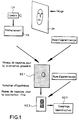
- FIG. 1 represents a general diagram of the method of the invention.
- An IM image is to be explored in order to detect in this image one or more objects such as faces.
- a device such as a camera CA records this image which is then subjected to a pretreatment PR to carry out a smoothing.
- the image is then explored by a neural network RZ1 which has undergone training using a base of reference thumbnails representing objects to be segmented relative to the background.
- This exploration makes it possible to identify areas providing a response greater than a determined threshold, that is to say the areas likely to contain an object to be identified.
- This exploration allows the formation of hypotheses and therefore constitutes a rough localization.
- We then proceed to a fine localization by exploring, with a second neural network RZ2, the hypotheses identified previously and we determine the maximum response of each zone. The exact position of the detected object is thus obtained.
- a third neural network RZ3 identifies the substantially exact representation of the object by superimposing on it this third neural network.
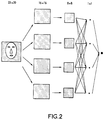
- FIG. 2 represents a neural network as used in the context of the invention. It is a weight sharing network that compresses information using three hidden layers.
- the output layer comprises a single neuron whose value is + 1.3 if a face is present at the considered point of the image and - 1.3 otherwise.
- C (l, m) The neural network works as follows. It is broken down into layers which we denote by C (l, m).
- C (0, 1) is the entry layer of size 20 x 20.
- C (4, 1) is the output layer which is formed by a single neuron.
- the coefficients W 0 (l, m) and W (x, y) (l, m) are the weights of the network.
- f is a non-linear function typically a sigmoid. For the structure of the network that we use there are 1157 different for example.
- 1st phase learning in order to achieve a rough localization.
- the images of the learning base are presented to the neural network either perfectly centered or with an offset.
- the desired response which is indicated to the neural network is 1.3.
- the response is less than 1.3 and corresponds to a decreasing exponential depending on the importance of off-center.
- the thumbnail corresponds to a background, the answer indicated is -1.3.
- the aim is to train the network to respond a little when it encounters a slightly off-center face and to respond as much as possible when it encounters a perfectly centered face. So when applying the neural network to an entire image, the response obtained will be progressive all around the face. The areas corresponding to faces will therefore be fairly easy to detect.
- the disadvantage is that the set of weights thus obtained cannot give the position of the center of the face precisely.
- the images of the learning base are presented to the neural network either perfectly centered and the desired response is 1.3, or more or less off-center and the desired response is -1.3.
- the background images are not shown.
- the weights thus obtained form a network capable of precisely locating a face when they observe faces that are more or less well centered. It is therefore the tool necessary to perform precise localization.
- thumbnails corresponding to rotations of normal thumbnails are also presented to the network.
- the aim is to make the network insensitive to the orientation of the face observed in the image.
- the network is used by applying it to an entire image or more precisely to all of the images that it is possible to form with the acquired image by subsampling it with ten factors. whole scale.
- a shared weight network is also used which compresses the information using several hidden layers.
- the output layer includes p neurons. p is the number of distinct people present in the database.
- the entry layer is formed by several thumbnails which correspond either to the whole face or to parts of the face.
- the learning phase is carried out using the same database as for localization.
- This database includes 28 different people for example.
- Image pre-processing includes the use of a smoothing filter and a normalization step which makes the observed image independent of the position and extent of the light sources.
- the neural network is applied to the areas of the image for which a face has been detected.
- the output neuron for which the response is maximum is declared to correspond to the recognized person.
- the invention then provides, when a face has been located, to apply to it a third network of neurons having undergone training with typed faces in order to identify this face.
- the image to be analyzed consists of pixels (image elements) or whether it is an analog image.
- the system is applicable to all types of images.
Landscapes
- Engineering & Computer Science (AREA)
- Multimedia (AREA)
- Physics & Mathematics (AREA)
- Theoretical Computer Science (AREA)
- General Physics & Mathematics (AREA)
- Signal Processing (AREA)
- Computer Vision & Pattern Recognition (AREA)
- Health & Medical Sciences (AREA)
- Human Computer Interaction (AREA)
- Oral & Maxillofacial Surgery (AREA)
- Databases & Information Systems (AREA)
- General Health & Medical Sciences (AREA)
- Image Analysis (AREA)
Applications Claiming Priority (2)
| Application Number | Priority Date | Filing Date | Title |
|---|---|---|---|
| FR9208385A FR2693615B1 (fr) | 1992-07-07 | 1992-07-07 | Procédé d'identification d'objets dans une image. |
| FR9208385 | 1992-07-07 |
Publications (1)
| Publication Number | Publication Date |
|---|---|
| EP0578558A1 true EP0578558A1 (de) | 1994-01-12 |
Family
ID=9431641
Family Applications (1)
| Application Number | Title | Priority Date | Filing Date |
|---|---|---|---|
| EP19930401747 Withdrawn EP0578558A1 (de) | 1992-07-07 | 1993-07-06 | Verfahren zur Identifizierung von Objekten in einem Bild |
Country Status (2)
| Country | Link |
|---|---|
| EP (1) | EP0578558A1 (de) |
| FR (1) | FR2693615B1 (de) |
Cited By (6)
| Publication number | Priority date | Publication date | Assignee | Title |
|---|---|---|---|---|
| WO1997004428A1 (de) * | 1995-07-20 | 1997-02-06 | Fraunhofer-Gesellschaft zur Förderung der angewandten Forschung e.V. | Interaktives überwachungssystem |
| EP0806739A3 (de) * | 1996-05-06 | 1999-01-20 | Lucent Technologies Inc. | Gesichtserkennung unter der Verwendung von dct-gestützten Merkmalsvektoren |
| WO2000073979A1 (de) * | 1999-05-26 | 2000-12-07 | Siemens Aktiengesellschaft | Mustersuche |
| WO2003043311A1 (en) * | 2001-11-13 | 2003-05-22 | Koninklijke Philips Electronics N.V. | Identification and evaluation of audience exposure to logos in a broadcast event |
| US6873710B1 (en) | 2000-06-27 | 2005-03-29 | Koninklijke Philips Electronics N.V. | Method and apparatus for tuning content of information presented to an audience |
| FR2877534A1 (fr) * | 2004-11-03 | 2006-05-05 | France Telecom | Configuration dynamique d'un systeme sonore |
Citations (1)
| Publication number | Priority date | Publication date | Assignee | Title |
|---|---|---|---|---|
| US4958939A (en) * | 1988-11-14 | 1990-09-25 | Honeywell Inc. | Centering scheme for pattern recognition |
-
1992
- 1992-07-07 FR FR9208385A patent/FR2693615B1/fr not_active Expired - Fee Related
-
1993
- 1993-07-06 EP EP19930401747 patent/EP0578558A1/de not_active Withdrawn
Patent Citations (1)
| Publication number | Priority date | Publication date | Assignee | Title |
|---|---|---|---|---|
| US4958939A (en) * | 1988-11-14 | 1990-09-25 | Honeywell Inc. | Centering scheme for pattern recognition |
Non-Patent Citations (1)
| Title |
|---|
| FIRST IEE INTERNATIONAL CONFERENCE ON ARTIFICIAL NEURAL NETWORKS ,16-18 OCTOBER 1989;IEE PRESS ;LONDON pages 201 - 205 R.A. HUTCHINSON ET AL. 'comparison of neural networks and conventional techniques for feature location in facial images' * |
Cited By (9)
| Publication number | Priority date | Publication date | Assignee | Title |
|---|---|---|---|---|
| WO1997004428A1 (de) * | 1995-07-20 | 1997-02-06 | Fraunhofer-Gesellschaft zur Förderung der angewandten Forschung e.V. | Interaktives überwachungssystem |
| EP0806739A3 (de) * | 1996-05-06 | 1999-01-20 | Lucent Technologies Inc. | Gesichtserkennung unter der Verwendung von dct-gestützten Merkmalsvektoren |
| WO2000073979A1 (de) * | 1999-05-26 | 2000-12-07 | Siemens Aktiengesellschaft | Mustersuche |
| US6980689B1 (en) | 1999-05-26 | 2005-12-27 | Siemens Aktiengesellschaft | Pattern recognition |
| US6873710B1 (en) | 2000-06-27 | 2005-03-29 | Koninklijke Philips Electronics N.V. | Method and apparatus for tuning content of information presented to an audience |
| WO2003043311A1 (en) * | 2001-11-13 | 2003-05-22 | Koninklijke Philips Electronics N.V. | Identification and evaluation of audience exposure to logos in a broadcast event |
| US7020336B2 (en) | 2001-11-13 | 2006-03-28 | Koninklijke Philips Electronics N.V. | Identification and evaluation of audience exposure to logos in a broadcast event |
| FR2877534A1 (fr) * | 2004-11-03 | 2006-05-05 | France Telecom | Configuration dynamique d'un systeme sonore |
| WO2006048537A1 (fr) * | 2004-11-03 | 2006-05-11 | France Telecom | Configuration dynamique d'un systeme sonore |
Also Published As
| Publication number | Publication date |
|---|---|
| FR2693615A1 (fr) | 1994-01-14 |
| FR2693615B1 (fr) | 1994-08-26 |
Similar Documents
| Publication | Publication Date | Title |
|---|---|---|
| EP3707676B1 (de) | Verfahren zur schätzung der installation einer kamera im referenzrahmen einer dreidimensionalen szene, vorrichtung, system mit erweiterter realität und zugehöriges computerprogramm | |
| EP3640843B1 (de) | Verfahren zur extraktion von merkmalen eines fingerabdrucks, der durch ein eingangsbild dargestellt wird | |
| JP4755202B2 (ja) | 顔特徴の検出方法 | |
| US20070122005A1 (en) | Image authentication apparatus | |
| CN119229107B (zh) | 一种图像分割方法及图像分割系统 | |
| EP0899680A2 (de) | Verfahren zur automatischen Detektion menschlicher Augen in digitalen Bildern | |
| FR3098328A1 (fr) | Procédé pour extraire automatiquement d’un document des informations d’un type prédéfini | |
| EP1866834A2 (de) | System und verfahren zum finden von interessierenden punkten in einem objektbild unter verwendung eines neuronalen netzwerks | |
| CN115795394A (zh) | 层级多模态和高级增量学习的生物特征融合身份识别方法 | |
| WO2020002810A1 (fr) | Détection de nerfs dans une série d'images échographiques par la détermination de régions d'intérêts définies par la détection d'artères | |
| EP3937071A1 (de) | Verfahren zur unterstützung der echtzeitverfolgung von mindestens einer person auf bildsequenzen | |
| EP1035493A1 (de) | Verfahren zur Mustererkennung | |
| EP0578558A1 (de) | Verfahren zur Identifizierung von Objekten in einem Bild | |
| EP3929809A1 (de) | Methode zur erkennung von mindestens einem sichtbaren biometrischen merkmal auf einem eingangsbild mittels eines konvolutionales neurales netzwerk | |
| EP1428170A1 (de) | Lokalisierung eines ringes | |
| CN117011612A (zh) | 一种中药材ai识别方法 | |
| Alharbi et al. | Spoofing Face Detection Using Novel Edge-Net Autoencoder for Security. | |
| Ijaz et al. | A survey on currency identification system for blind and visually impaired | |
| Solina et al. | 15 seconds of fame-an interactive, computer-vision based art installation | |
| WO2021123209A1 (fr) | Procédé de segmentation d'une image d'entrée représentant un document comportant des informations structurées | |
| CN114495198B (zh) | 图像处理方法、装置、计算机设备及存储介质 | |
| Adene et al. | Detection and Classification of Human Gender into Binary (Male and Female) Using Convolutional Neural Network (CNN) Model | |
| EP3491582B1 (de) | Verfahren zum vergleichen von objekten, die in der nähe voneinander positioniert sind, und zugehörige vorrichtung | |
| FR3112228A1 (fr) | Dispositif et procédé pour générer un masque de la silhouette du profil d’une structure | |
| EP0469986A1 (de) | Verfahren und Einrichtung zur Lokalisation und Echtzeitcharakterisierung von singulären Punkten eines digitalisierten Bildes, insbesondere zur Mustererkennung in einer Szeneanalyseverarbeitung |
Legal Events
| Date | Code | Title | Description |
|---|---|---|---|
| PUAI | Public reference made under article 153(3) epc to a published international application that has entered the european phase |
Free format text: ORIGINAL CODE: 0009012 |
|
| AK | Designated contracting states |
Kind code of ref document: A1 Designated state(s): DE GB IT |
|
| RAP3 | Party data changed (applicant data changed or rights of an application transferred) |
Owner name: THOMSON-CSF |
|
| STAA | Information on the status of an ep patent application or granted ep patent |
Free format text: STATUS: THE APPLICATION IS DEEMED TO BE WITHDRAWN |
|
| 18D | Application deemed to be withdrawn |
Effective date: 19940713 |