EP0579911A2 - Procédé de préparation de matériaux composités isotropes coulés en barbotine à base de cuivre à faible coefficient de dilatation thermique et conductivité électrique élevée ainsi que leur utilisation - Google Patents
Procédé de préparation de matériaux composités isotropes coulés en barbotine à base de cuivre à faible coefficient de dilatation thermique et conductivité électrique élevée ainsi que leur utilisation Download PDFInfo
- Publication number
- EP0579911A2 EP0579911A2 EP93107038A EP93107038A EP0579911A2 EP 0579911 A2 EP0579911 A2 EP 0579911A2 EP 93107038 A EP93107038 A EP 93107038A EP 93107038 A EP93107038 A EP 93107038A EP 0579911 A2 EP0579911 A2 EP 0579911A2
- Authority
- EP
- European Patent Office
- Prior art keywords
- slip
- thermal expansion
- powder
- mixed
- contained
- Prior art date
- Legal status (The legal status is an assumption and is not a legal conclusion. Google has not performed a legal analysis and makes no representation as to the accuracy of the status listed.)
- Withdrawn
Links
Images


Classifications
-
- C—CHEMISTRY; METALLURGY
- C22—METALLURGY; FERROUS OR NON-FERROUS ALLOYS; TREATMENT OF ALLOYS OR NON-FERROUS METALS
- C22C—ALLOYS
- C22C1/00—Making non-ferrous alloys
- C22C1/04—Making non-ferrous alloys by powder metallurgy
- C22C1/0425—Copper-based alloys
-
- B—PERFORMING OPERATIONS; TRANSPORTING
- B22—CASTING; POWDER METALLURGY
- B22F—WORKING METALLIC POWDER; MANUFACTURE OF ARTICLES FROM METALLIC POWDER; MAKING METALLIC POWDER; APPARATUS OR DEVICES SPECIALLY ADAPTED FOR METALLIC POWDER
- B22F1/00—Metallic powder; Treatment of metallic powder, e.g. to facilitate working or to improve properties
- B22F1/09—Mixtures of metallic powders
-
- B—PERFORMING OPERATIONS; TRANSPORTING
- B22—CASTING; POWDER METALLURGY
- B22F—WORKING METALLIC POWDER; MANUFACTURE OF ARTICLES FROM METALLIC POWDER; MAKING METALLIC POWDER; APPARATUS OR DEVICES SPECIALLY ADAPTED FOR METALLIC POWDER
- B22F3/00—Manufacture of workpieces or articles from metallic powder characterised by the manner of compacting or sintering; Apparatus specially adapted therefor ; Presses and furnaces
- B22F3/22—Manufacture of workpieces or articles from metallic powder characterised by the manner of compacting or sintering; Apparatus specially adapted therefor ; Presses and furnaces for producing castings from a slip
-
- B—PERFORMING OPERATIONS; TRANSPORTING
- B22—CASTING; POWDER METALLURGY
- B22F—WORKING METALLIC POWDER; MANUFACTURE OF ARTICLES FROM METALLIC POWDER; MAKING METALLIC POWDER; APPARATUS OR DEVICES SPECIALLY ADAPTED FOR METALLIC POWDER
- B22F5/00—Manufacture of workpieces or articles from metallic powder characterised by the special shape of the product
- B22F5/006—Manufacture of workpieces or articles from metallic powder characterised by the special shape of the product of flat products, e.g. sheets
-
- C—CHEMISTRY; METALLURGY
- C22—METALLURGY; FERROUS OR NON-FERROUS ALLOYS; TREATMENT OF ALLOYS OR NON-FERROUS METALS
- C22C—ALLOYS
- C22C33/00—Making ferrous alloys
- C22C33/02—Making ferrous alloys by powder metallurgy
-
- C—CHEMISTRY; METALLURGY
- C22—METALLURGY; FERROUS OR NON-FERROUS ALLOYS; TREATMENT OF ALLOYS OR NON-FERROUS METALS
- C22C—ALLOYS
- C22C9/00—Alloys based on copper
-
- H—ELECTRICITY
- H10—SEMICONDUCTOR DEVICES; ELECTRIC SOLID-STATE DEVICES NOT OTHERWISE PROVIDED FOR
- H10W—GENERIC PACKAGES, INTERCONNECTIONS, CONNECTORS OR OTHER CONSTRUCTIONAL DETAILS OF DEVICES COVERED BY CLASS H10
- H10W70/00—Package substrates; Interposers; Redistribution layers [RDL]
- H10W70/01—Manufacture or treatment
- H10W70/02—Manufacture or treatment of conductive package substrates serving as an interconnection, e.g. of metal plates
-
- H—ELECTRICITY
- H10—SEMICONDUCTOR DEVICES; ELECTRIC SOLID-STATE DEVICES NOT OTHERWISE PROVIDED FOR
- H10W—GENERIC PACKAGES, INTERCONNECTIONS, CONNECTORS OR OTHER CONSTRUCTIONAL DETAILS OF DEVICES COVERED BY CLASS H10
- H10W70/00—Package substrates; Interposers; Redistribution layers [RDL]
- H10W70/01—Manufacture or treatment
- H10W70/04—Manufacture or treatment of leadframes
-
- H—ELECTRICITY
- H10—SEMICONDUCTOR DEVICES; ELECTRIC SOLID-STATE DEVICES NOT OTHERWISE PROVIDED FOR
- H10W—GENERIC PACKAGES, INTERCONNECTIONS, CONNECTORS OR OTHER CONSTRUCTIONAL DETAILS OF DEVICES COVERED BY CLASS H10
- H10W70/00—Package substrates; Interposers; Redistribution layers [RDL]
- H10W70/40—Leadframes
- H10W70/456—Materials
Definitions
- the invention relates to a method for producing a band-shaped copper composite material from metal powders according to the preamble of claim 1.
- the linear thermal expansion coefficient of naturally hard and precipitation-forming copper alloys determined in the temperature interval between 20 and 300 ° C, is between 16 and 20x10 ⁇ 6 / K.
- the thermal expansion of ceramic components based on silicon is typically between 2.8 and 7.3x10 ⁇ 6 / K, depending on the level of impurities and the degree of doping. This significantly different expansion behavior leads to mismatches when the ceramic elements are mounted on a lead frame or can cause the component to fail prematurely at higher and cyclically fluctuating operating temperatures.
- the material FeNi42 (DIN 13917) is distinguished from the copper alloys by a significantly lower coefficient of thermal expansion of 4.5 to 5.5x10 ⁇ 6 / K.
- the US Pat. No. 4,158,719 describes a process for the production of powder metallurgical composite materials with a linear thermal expansion coefficient of approx. 12x10 ⁇ 6 / K.
- a mixture of a powder with a high thermal conductivity and a powder with a low thermal expansion is pressed into a green body, sintered and processed into a massive strip over several cold rolling and tempering steps.
- An FeNi alloy with additions of cobalt and possibly chromium is mentioned as a component with low thermal expansion.
- Iron, nickel and copper serve as components with high thermal conductivity.
- a major disadvantage of the process lies in the fact that the powders have to be pressed in batches under very high pressure and not even in small batches.
- EP patent 0.144.959 attempts to circumvent the aforementioned problem by completely dispensing with the implementation of a sintering treatment.
- a powder mixture of copper or elemental copper or bronze which has been strengthened with aluminum oxide, is filled into a cladding tube with a FeNi or FeNiCo alloy or elementary molybdenum or tungsten and hot-pressed into a rod.
- the pressing process itself takes place at temperatures of 450 to 510 ° C, but a preheating temperature of the pressing bolts of approx. 840 ° C and a preheating time of 45 min is recommended.
- this thermal treatment must be equated to a sintering process with regard to its effect on the conductivity properties of a composite containing Cu and Fe. Accordingly, the electrical conductivity determined on a wire of the composition Cu (FeNi36) 50 produced according to this method is also given as only 3.6 MS / m. The thermal expansion determined at 20 ° C is 13.9x10 ⁇ 6 / K. This makes it clear that these materials also do not meet the requirement for low thermal expansion and high conductivity at the same time. This method is also unsuitable for the production of broader band structures, since a welded press bolt is assumed in each case and only rods, wires or very narrow strips can be produced.
- EP-OS 0.437.656 describes a modified process for producing 3-layer composites with low thermal expansion.
- Two copper plates and one FeNi plate with a nickel content between 32 and 40% by weight are independently rolled into strips.
- the FeNi strip is then provided with a large number of through holes and placed between the two copper strips.
- the loose layers are sintered at temperatures between 750 and 850 ° C for 10 min and then hot or cold rolled.
- this composite structure has the favorable conductivity properties of copper on the surface, due to its FeNi core, despite the rolled-in copper pins, it has no isotropic volume properties.
- the anisotropy factor determined from measurements parallel and perpendicular to the band plane is given with values between 0.9 and 2. At the Cu / FeNi interfaces, the occurrence of pronounced stress conditions must also be expected in the case of cyclic thermal stress due to the different expansion behavior of the materials.
- the invention is therefore based on the object of designing a method of the type mentioned so that, in particular, homogeneous and isotropic copper composite materials are obtained which are distinguished both by their low thermal expansion and by a high electrical conductivity.
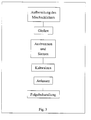
- the object is achieved in that it is assumed that a mixed slip containing the metal powder components, a solvent, a liquefier and possibly other system-related additives, that the mixed slip is cast as a green tape on a suitable substrate and that the green tape before Sintered in the dried state is burned out.
- Slip-cast composite structures have a homogeneous and isotropic structure. Any metal powder, regardless of its particle size, material density, geometric design and flowability, can be processed into a manageable green tape close to its final dimensions using a mixing slip. The sintering parameters can be set so that the resulting composite structures are characterized by low thermal expansion and high conductivity at the same time.
- a slurry is a colloidal chemical system, which in the simplest case consists of a powder, a liquid suspension medium (solvent) and another additive, the condenser.
- slip casting is an interesting alternative.
- a major difference lies in the pressure-free and direction-independent consolidation of the powder into manageable green compacts, which are further processed into high-density molded bodies or strips by suitable subsequent processes.
- segregation-free or at least low segregation as well as conventionally non-alloyable materials and material combinations can be produced.
- very fine grain sizes can be set in the structure by choosing suitable starting powders.
- Application-specific property combinations can be achieved by processing slurries with different compositions.
- the present invention is based on the idea of processing a so-called mixed slurry from two different metal powders and processing it into system-specific parameters to form a strip close to the final dimensions.
- One component is preferably elemental copper powder, which is distinguished by its high electrical and thermal conductivity of over 58 MS / m or approximately 400 W / mK.
- Particularly suitable as the second powder component are materials with a low coefficient of thermal expansion, such as molybdenum, tungsten and FeNi alloys, with preferred nickel contents between 32 and 46% by weight.
- the alloy FeNi42 known under the name Alloy 42 has a linear expansion coefficient of 4.5 to 5.5x10 ⁇ 6 / K in the temperature range between 20 and 300 ° C.
- the powder particles should preferably be spherical to spheroidal in shape and in diameter of less than 150 ⁇ m. It has been shown that the above-mentioned components can be processed particularly advantageously in a mixed slip with average particle sizes of approximately 20 ⁇ m. Depending on the composition of the slip system, the powder content can be between 70 and 95% by weight, the individual powder components being mutually completely substitutable.
- Organically constructed slurries contain solvents which can belong to the classes of hydrocarbons, alcohols, ketones and esters or which can be characterized if necessary by their nitrogen content.
- the solvents can also be present in mixtures and are added to the slip in contents of between 5 and 30% by weight.
- powder components can also be found in aqueous slurries, i.e. Prepare using distilled water as a solvent.
- Suitable plasticizers can belong to the classes of polyethers, polyesters, paraffins, polyols, polyamides, polyimides, polyamines, polycarbonates and polyelectrolytes or, if appropriate, also mixtures of these classes of substances.
- the liquefying substance is typically contained in the slip in amounts between 0.1 and 5% by weight.
- the individual slip components are matched to one another in such a way that the metal powders introduced neither float to the surface of the solvent nor sink or agglomerate to the bottom of the mixing vessel.
- a stable and homogeneous suspension is achieved over long periods, by attracting the slip for a few minutes using zirconia balls at room temperature.
- the slip poured into a casting container is poured evenly and without bubbles onto a circulating belt or another carrier and, after a short drying time of a few seconds to a few minutes, is wound up as a flexible green belt.
- the density, thickness and width of the resulting strip are determined by the composition of the slip and in particular by the casting parameters.
- the thickness of the strips is between 0.1 and 3 mm, but preferably 1 mm. Trimming the tape in the green state is advisable, since the edge waste can be ground up and reused in a new slip batch.
- the organic additives are removed from the green belt without leaving any residue.
- the burnout is preferably carried out at temperatures below 700 ° C. for a few minutes.
- the burnout parameters of the Cu / Mo and Cu / W tapes can be adapted to the thermal behavior of the respective condenser without any restrictions.
- the burned-out strip undergoes significant compaction due to solid-state diffusion processes.
- special attention must be paid to the temperature control, since it is well known that iron dissolves in copper at higher temperatures with the formation of a Cu / Fe mixed crystal and thus a significant drop in the electrical conductivity of the copper caused.
- a quickly controlled sintering temperature of 800 ° C and an immediate cooling at approx. 50 - 200 ° C / min are sufficient to consolidate the strip, on the one hand, and the conductivity of the material is not reduced too much on the other.
- sintering temperatures of up to 1000 ° C can be achieved without any problems, since these elements have no mutual solubility in the solid state.
- the holding time is typically between a few minutes and an hour.
- the resulting sintered strips can be wound up and adjusted to the desired properties and formats by subsequent processes such as cold rolling and tempering as well as longitudinal and / or transverse parts.
- subsequent processes such as cold rolling and tempering as well as longitudinal and / or transverse parts.
- slip-cast composite tapes with the compositions Cu (FeNi42) 30, Cu (FeNi42) 50 and Cu (FeNi42) 70 in different strength levels.
- slip-cast composite tapes with the compositions CuW40, CuW50 and CuW60 in different strength levels.
- slip-cast composite tapes with the compositions CuMo30, CuMo40 and CuMo50 in different strength levels Some properties of slip-cast composite tapes with the compositions CuMo30, CuMo40 and CuMo50 in different strength levels.
- Cu and FeNi42 powders produced by gas atomization were processed in a mixing ratio of 70% by weight Cu to 30% by weight FeNi42 in a mixed slip.
- the slip composition was determined as follows: 85.0% by weight of metal powder 13.5% by weight of solvent 1.5% by weight of condenser Ethanoic acid n-butyl ester was used as the solvent. An alkylene-polyether copolymer was added as a plasticizer.
- the slip which had been attractive for a few minutes, was cast into a 0.8 mm thick green tape, burned out and sintered at 800 ° C without a holding time under forming gas.
- the sintered strip was cold-rolled with a degree of deformation of 50% at a thickness of 0.4 mm, annealed and cold-rolled again with a degree of deformation of 30% at a thickness of 0.28 mm.
- the desired combinations of properties are set during a final tempering treatment.
- the properties determined on the strips in different strength levels are summarized in Table 1.
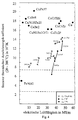
- the linear thermal expansion coefficient of the copper determined in the temperature range between 20 and 300 ° C, is reduced from 17.7 to approx. 10.0 to 12.8x10 ⁇ 6 / K.
- the electrical conductivity determined at 20 ° C is between 30 and 35 MS / m (52 to 60% IACS) and is isotropic in all spatial directions due to the homogeneous and fine-grained structure.
- the following slip was prepared and cast into a 1 mm thick green tape: 87.5% by weight metal powder; Cu / FeNi42 ratio: 50/50% by weight 10.5% by weight of solvent; Tetrahydrofuran 2.0% by weight of condenser; Polyalkylene glycol block copolymer.
- the green tape was burned out at 500 ° C and then sintered at 810 ° C without holding time, cold rolled with a degree of deformation of 50% to 0.5 mm, annealed and cold rolled again by 50% to 0.25 mm.
- the following slip was processed and cast into a 0.6 mm green tape: 82.0 wt% metal powder; Cu / FeNi42 ratio: 30/70% by weight 17.0% by weight of solvent; 1,4-dioxolane 1.0% by weight of condenser; Alkylene-polyether copolymer.
- the green tape was burned out and sintered at 800 ° C for 5 min under forming gas. After carrying out the manufacturing steps described above, strip sections with a thickness of 0.15 mm were present in different strength states.
- Table 1 shows the properties determined on the strips.
- the thermal expansion in the temperature range between 20 and 300 ° C or 20 and 450 ° C is 8.0 to 9.5 and 8.7 to 11.0x10 ⁇ 6 / K.
- the material shows an electrical conductivity of approx. 10 to 12 MS / m and thus corresponds to the alloy CuBe2 (DIN 17666) in the hardened state.
- slips were prepared and cast into green strips with a thickness of 1 mm each: 85.0 wt% metal powder; Cu and W 12.5% by weight of solvent, distilled water 1.5% by weight of condenser; [-CH2-CHX-] n polyvinyl X ... NR1R2 R1, R2 ... carbonyl 1.0% by weight plasticizer; glycerin Cu / W ratios of 60/40, 50/50 and 40/60% by weight were chosen.
- the green tapes were heated to 500 ° C and burned out without residue.
- the sintering process was carried out at 1000 ° C. for 1 h under a reducing atmosphere. After carrying out the manufacturing steps already described, strip sections with a thickness of 0.25 mm were available in various strengths.
- the Cu / W composites have linear expansion coefficients of approx. 10.0 - 14.7x10 ⁇ 6 / K in the temperature range between 20 and 300 ° C. In the temperature interval between 20 and 450 ° C there are almost identical values. Their electrical conductivity also varies depending on the tungsten content and the set strength level between 28 and 47 MS / m (48 to 81% IACS).
- slips were prepared and cast into green strips with a thickness of 0.8 mm each: 85.0 wt% metal powder; Cu and Mo 13.5% by weight of solvent; N-Butyl ethanoate 1.5% by weight of condenser; Polyalkylene glycol block copolymer Cu / Mo ratios of 70/30, 60/40 and 50/50% by weight were chosen.
- the green tapes were burned out in air, sintered for 1 h at 1000 ° C and rolled down to 0.2 mm.
- Table 3 shows that the CuMo30 composite with an electrical conductivity of up to 48 MS / m (83% IACS) has a thermal expansion coefficient of 11.6 to 14.6x10 ⁇ 6 / K.
- a tape made from a CuMo50 mixed slip has a conductivity that corresponds to that of the alloy CuFe2P (DIN 17666) and is also distinguished from this material, which is often used for lead frames, by a much lower thermal expansion of only 5.8 to 10.8x10 ⁇ 6 / K (20 to 450 ° C).
Landscapes
- Chemical & Material Sciences (AREA)
- Engineering & Computer Science (AREA)
- Mechanical Engineering (AREA)
- Materials Engineering (AREA)
- Metallurgy (AREA)
- Organic Chemistry (AREA)
- Manufacturing & Machinery (AREA)
- Powder Metallurgy (AREA)
Applications Claiming Priority (2)
| Application Number | Priority Date | Filing Date | Title |
|---|---|---|---|
| DE4217531 | 1992-05-27 | ||
| DE4217531A DE4217531C1 (de) | 1992-05-27 | 1992-05-27 | Verfahren zur Herstellung schlickergegossener isotroper Verbundwerkstoffe auf Kupferbasis mit geringem thermischem Ausdehnungskoeffizienten und hoher elektrischer Leitfähigkeit sowie deren Verwendung |
Publications (2)
| Publication Number | Publication Date |
|---|---|
| EP0579911A2 true EP0579911A2 (fr) | 1994-01-26 |
| EP0579911A3 EP0579911A3 (en) | 1994-06-01 |
Family
ID=6459836
Family Applications (1)
| Application Number | Title | Priority Date | Filing Date |
|---|---|---|---|
| EP19930107038 Withdrawn EP0579911A3 (en) | 1992-05-27 | 1993-04-30 | Process for preparing composite isotropic copper-based materials by slip casting, having a low thermal expansion coefficient and high electrical conductivity and their use |
Country Status (2)
| Country | Link |
|---|---|
| EP (1) | EP0579911A3 (fr) |
| DE (1) | DE4217531C1 (fr) |
Cited By (2)
| Publication number | Priority date | Publication date | Assignee | Title |
|---|---|---|---|---|
| WO2016015878A1 (fr) * | 2014-07-28 | 2016-02-04 | Heraeus Deutschland GmbH & Co. KG | Procédé pour assembler des composants par frittage sous pression |
| WO2016015880A1 (fr) * | 2014-07-28 | 2016-02-04 | Heraeus Deutschland GmbH & Co. KG | Procédé de production d'un agent de frittage d'argent présentant des surfaces d'oxyde d'argent et utilisation de cet agent dans des procédés pour assembler des composants par frittage sous pression |
Family Cites Families (11)
| Publication number | Priority date | Publication date | Assignee | Title |
|---|---|---|---|---|
| US3330654A (en) * | 1964-04-28 | 1967-07-11 | Kennecott Copper Corp | Continuous process for producing sheet metal and clad metal |
| DE1904238C3 (de) * | 1969-01-29 | 1973-09-13 | Union Carbide Corp., New York, N.Y. (V.St.A.) | Anwendung des Verfahrens zur Herstellung eines gesinterten porösen Metallbleches |
| US4158719A (en) * | 1977-06-09 | 1979-06-19 | Carpenter Technology Corporation | Low expansion low resistivity composite powder metallurgy member and method of making the same |
| US4283464A (en) * | 1979-05-08 | 1981-08-11 | Norman Hascoe | Prefabricated composite metallic heat-transmitting plate unit |
| US4491559A (en) * | 1979-12-31 | 1985-01-01 | Kennametal Inc. | Flowable composition adapted for sintering and method of making |
| US4752334A (en) * | 1983-12-13 | 1988-06-21 | Scm Metal Products Inc. | Dispersion strengthened metal composites |
| JPS62272558A (ja) * | 1986-05-20 | 1987-11-26 | Sumitomo Electric Ind Ltd | 半導体装置用基板の製造方法 |
| GB8612267D0 (en) * | 1986-05-20 | 1986-06-25 | Mixalloy Ltd | Flat products |
| JPS62284032A (ja) * | 1986-06-03 | 1987-12-09 | Nisshin Steel Co Ltd | 調整された熱膨張率と熱伝導度を有する複合金属材料 |
| DE3881030T2 (de) * | 1987-09-28 | 1993-12-02 | Witec Cayman Patents Ltd | Kupfer-wolfram-metallmischung sowie verfahren. |
| CA1316303C (fr) * | 1988-12-23 | 1993-04-20 | Thijs Eerkes | Structure composite |
-
1992
- 1992-05-27 DE DE4217531A patent/DE4217531C1/de not_active Expired - Fee Related
-
1993
- 1993-04-30 EP EP19930107038 patent/EP0579911A3/de not_active Withdrawn
Cited By (5)
| Publication number | Priority date | Publication date | Assignee | Title |
|---|---|---|---|---|
| WO2016015878A1 (fr) * | 2014-07-28 | 2016-02-04 | Heraeus Deutschland GmbH & Co. KG | Procédé pour assembler des composants par frittage sous pression |
| WO2016015880A1 (fr) * | 2014-07-28 | 2016-02-04 | Heraeus Deutschland GmbH & Co. KG | Procédé de production d'un agent de frittage d'argent présentant des surfaces d'oxyde d'argent et utilisation de cet agent dans des procédés pour assembler des composants par frittage sous pression |
| CN106536096A (zh) * | 2014-07-28 | 2017-03-22 | 贺利氏德国有限两合公司 | 通过压力烧结接合元件的方法 |
| CN106536096B (zh) * | 2014-07-28 | 2019-06-14 | 贺利氏德国有限两合公司 | 通过压力烧结接合元件的方法 |
| US10785877B2 (en) | 2014-07-28 | 2020-09-22 | Heraeus Deutschland GmbH & Co. KG | Method for producing a silver sintering agent having silver oxide surfaces and use of said agent in methods for joining components by pressure sintering |
Also Published As
| Publication number | Publication date |
|---|---|
| EP0579911A3 (en) | 1994-06-01 |
| DE4217531C1 (de) | 1993-12-16 |
Similar Documents
| Publication | Publication Date | Title |
|---|---|---|
| DE112015005685B4 (de) | Verfahren zum herstellen eines r-t-b dauermagneten und r-t-b dauermagnet | |
| DE60121242T2 (de) | Molybdän-Kupfer-Verbundpulver sowie dessen Herstellung und Verarbeitung zu einer Pseudolegierung | |
| DE69635911T2 (de) | Wolfram/Kupfer-Verbundpulver | |
| DE3781956T2 (de) | Verfahren zur herstellung eines ag-metalloxid-material fuer elektrische kontakte. | |
| DE60021579T2 (de) | Verfahren zur herstellung von feuerfestpulver mit niedrigen sauerstoffgehalt zur verwendung in der pulvermetallurgie | |
| EP1079950B1 (fr) | Poudres de metal et d'alliage pour le frittage, a utiliser dans la metallurgie des poudres, leur procede de production et leur utilisation | |
| EP0956173B1 (fr) | Granules de poudre metallique, leur procede de preparation et leur utilisation | |
| EP1313581B1 (fr) | Procede de production de pieces en materiau composite par moulage par injection de poudre | |
| EP2600996B1 (fr) | Procédé de fabrication selon la technique de la métallurgie des poudres d'un matériau cu-cr | |
| DE60131699T2 (de) | Dauermagnetmaterialien auf R-Fe-B-Basis | |
| DE60301069T2 (de) | Vorlegierte bindepulver | |
| DE2706214C2 (de) | Magnetlegierung auf Eisen-Chrom- Kobalt-Basis mit spinodaler Entmischung | |
| EP0183017B2 (fr) | Procédé de frittage de poudres de tungstène préalliées | |
| DE112011100369T5 (de) | Verfahren zur herstellung eines nanokompositmagneten | |
| DE102019132701A1 (de) | Verfahren zur herstellung eines r-t-b-permanentmagneten | |
| DE102014114830A1 (de) | Verfahren zum Herstellen eines thermoelektischen Gegenstands für eine thermoelektrische Umwandlungsvorrichtung | |
| DE3324181A1 (de) | Elektrisches kontaktmaterial | |
| DE112016001090B4 (de) | Verfahren zum Herstellen eines R-T-B-basierten Sintermagneten | |
| DE102004020833B4 (de) | Material mit niedriger Wärmeausdehnung und hoher Wärmeleitfähigkeit auf Kupferbasis sowie Verfahren zum Herstellen desselben | |
| DE60025117T2 (de) | Legierung für elektrische Kontakte und Elektroden und Verfahren seiner Herstellung | |
| DE112018007346T5 (de) | Legierungen, magnetische Materialien, Verbundmagnete und Verfahren zur Herstellung derselben | |
| DE4217531C1 (de) | Verfahren zur Herstellung schlickergegossener isotroper Verbundwerkstoffe auf Kupferbasis mit geringem thermischem Ausdehnungskoeffizienten und hoher elektrischer Leitfähigkeit sowie deren Verwendung | |
| DE2549298A1 (de) | Legierung und verbundwerkstoff sowie verfahren zu ihrer herstellung | |
| DE2705384C3 (de) | Dauermagnet-Legierung und Verfahren zur Wärmebehandlung gesinterter Dauermagnete | |
| EP1043409B1 (fr) | Matériau composite préparé par métallurgie des poudres |
Legal Events
| Date | Code | Title | Description |
|---|---|---|---|
| PUAI | Public reference made under article 153(3) epc to a published international application that has entered the european phase |
Free format text: ORIGINAL CODE: 0009012 |
|
| 17P | Request for examination filed |
Effective date: 19930430 |
|
| AK | Designated contracting states |
Kind code of ref document: A2 Designated state(s): DE FR GB IT |
|
| PUAL | Search report despatched |
Free format text: ORIGINAL CODE: 0009013 |
|
| AK | Designated contracting states |
Kind code of ref document: A3 Designated state(s): DE FR GB IT |
|
| 17Q | First examination report despatched |
Effective date: 19970515 |
|
| 18D | Application deemed to be withdrawn |
Effective date: 19970926 |