EP0580079B1 - Vernetzte, stickstoffhaltige Vinylcopolymere, Verfahren zu ihrer Herstellung sowie die Verwendung dieser Verbindungen - Google Patents
Vernetzte, stickstoffhaltige Vinylcopolymere, Verfahren zu ihrer Herstellung sowie die Verwendung dieser Verbindungen Download PDFInfo
- Publication number
- EP0580079B1 EP0580079B1 EP93111376A EP93111376A EP0580079B1 EP 0580079 B1 EP0580079 B1 EP 0580079B1 EP 93111376 A EP93111376 A EP 93111376A EP 93111376 A EP93111376 A EP 93111376A EP 0580079 B1 EP0580079 B1 EP 0580079B1
- Authority
- EP
- European Patent Office
- Prior art keywords
- formula
- radical
- compound
- carbon atoms
- integer
- Prior art date
- Legal status (The legal status is an assumption and is not a legal conclusion. Google has not performed a legal analysis and makes no representation as to the accuracy of the status listed.)
- Expired - Lifetime
Links
Classifications
-
- C—CHEMISTRY; METALLURGY
- C08—ORGANIC MACROMOLECULAR COMPOUNDS; THEIR PREPARATION OR CHEMICAL WORKING-UP; COMPOSITIONS BASED THEREON
- C08F—MACROMOLECULAR COMPOUNDS OBTAINED BY REACTIONS ONLY INVOLVING CARBON-TO-CARBON UNSATURATED BONDS
- C08F259/00—Macromolecular compounds obtained by polymerising monomers on to polymers of halogen containing monomers as defined in group C08F14/00
-
- C—CHEMISTRY; METALLURGY
- C08—ORGANIC MACROMOLECULAR COMPOUNDS; THEIR PREPARATION OR CHEMICAL WORKING-UP; COMPOSITIONS BASED THEREON
- C08F—MACROMOLECULAR COMPOUNDS OBTAINED BY REACTIONS ONLY INVOLVING CARBON-TO-CARBON UNSATURATED BONDS
- C08F8/00—Chemical modification by after-treatment
- C08F8/12—Hydrolysis
-
- A—HUMAN NECESSITIES
- A61—MEDICAL OR VETERINARY SCIENCE; HYGIENE
- A61P—SPECIFIC THERAPEUTIC ACTIVITY OF CHEMICAL COMPOUNDS OR MEDICINAL PREPARATIONS
- A61P3/00—Drugs for disorders of the metabolism
- A61P3/06—Antihyperlipidemics
-
- C—CHEMISTRY; METALLURGY
- C08—ORGANIC MACROMOLECULAR COMPOUNDS; THEIR PREPARATION OR CHEMICAL WORKING-UP; COMPOSITIONS BASED THEREON
- C08F—MACROMOLECULAR COMPOUNDS OBTAINED BY REACTIONS ONLY INVOLVING CARBON-TO-CARBON UNSATURATED BONDS
- C08F2810/00—Chemical modification of a polymer
- C08F2810/20—Chemical modification of a polymer leading to a crosslinking, either explicitly or inherently
Definitions
- the invention relates to crosslinked, nitrogen-containing vinyl copolymers and a process for their preparation. Because of their ability to adsorb bile acids, they are particularly suitable as medicinal products for lowering blood cholesterol levels. They are also suitable for use as an excipient, as a food additive and as a food additive. The invention therefore also relates to the use of the compounds and a process for their preparation.
- Bile acids have an important physiological function in fat digestion. As end products of cholesterol metabolism, they are synthesized in the liver, stored in the gallbladder and released into the intestine, where they exert their physiological effect. Most of the secreted bile acids are recovered via the enterohepatic cycle (approx. 20 - 25 g / day). Stopping this reabsorption reduces the bile acid pool in the liver and thus, in addition to stimulating the cholesterol's own synthesis, causes increased cholesterol absorption from the bloodstream. For this purpose, the number of hepatic LDL receptors on the membranes of the liver cells increases, so that the cholesterol-containing LDL particles are catabolized more quickly and the cholesterol content in the blood is reduced.
- bile acids can be bound to insoluble, basic, crosslinked polymers such as polyethyleneimines (cf. e.g. EP-A-0379 161) or polyvinylimidazoles (cf. EP-B-0162 388) and are therefore suitable for treatment diseases in which inhibition of bile acid reabsorption in the intestine, particularly in the small intestine, is desirable appears to be viewed. For example, the chologic diarrhea after ileum resection or increased cholesterol blood levels are treated in this way.
- polyethyleneimines cf. e.g. EP-A-0379 161
- polyvinylimidazoles cf. EP-B-0162 38
- lipid-lowering agents such as colestipol and colestyramine
- a very high daily dose must be observed in particular. It is e.g. for colestyramine 12 - 24 g, maximum 32 g, for colestipol 15 - 30 g.
- the object of the present invention was to provide compounds with new polymer structures which bind bile acids to a high degree depending on the concentration.
- these compounds should not have the existing disadvantages of the exchanger resins used hitherto, or should no longer have them to the known extent.
- Aryl for a mono- or polynuclear aromatic hydrocarbon radical having 6 to 14 carbon atoms in the case of the polynuclear radicals the aryl groups condense with one another, are connected to one another via CC bonds or via bridging elements such as -O-, -COO- or -CONH- .
- the term aryl also encompasses 5- to 14-membered heteroaryl having 1 hetero atom or 2 non-adjacent, identical or different heteroatoms, selected from the group consisting of oxygen and nitrogen.
- Aryl is especially phenyl, arylalkyl for benzyl and phenylethyl and Arylalkenyl for
- aromatic residues with 1 or 2 heteroatoms are residues of quinoline carbonic acid, benzimidazole carbon acid, furan carbon acid, nicotinic acid and coumaric acid.
- the cycloalkyl or cycloalkenyl radicals are optionally substituted one, two or three times with hydroxy, (C 1 -C 6 ) alkyl and / or (C 1 -C 6 ) alkoxy radicals, the substituents being the same or different in the case of multiple substitution are.
- the bridge member X means
- the spacer X has the formula in the case of 3-8 methylene groups, a middle CH 2 group can be replaced by oxygen.
- R 1 -X is, for example, a radical of the formula
- R in the meaning mentioned under R 3 1. is the rest of the formula
- a hydrophilic cyclic radical R according to R 3 3 is a cyclodextrin radical or a functionalized 7-18-membered C-containing azama macrocycle with 2 to 4 nitrogen atoms, and optionally 2, 3 or 4 oxygen atoms, which are separated by ethylene groups, such as, for example, 7-triazacyclononane, a cyclic or cyclam radical or 1,4-diaza-18 crown 6.
- the radical R 1 is preferably hydrophobic.
- the vinyl copolymers according to the invention with units of the formula I are branched and crosslinked. As is customary in polymer chemistry, the groups specified in formula I are randomly distributed over the entire polymer or arranged according to their copolymerization parameters.
- the invention further relates to a process for the preparation of vinyl copolymers having units of the formula I, which is characterized in that a compound of the formula II is obtained from vinylformamide by copolymerization produces, where A1, A2, x and y have the meanings given for formula I and u is 0.1-0.98, this to a compound of formula III wherein A1, A2, x and y have the meanings given for formula I and u have the meanings given for formula II, hydrolyzed and then, if appropriate, derivatized by customary methods to give a compound having units of the formula I or their physiologically tolerable salts.
- the crosslinked, nitrogen-containing copolymers are prepared by crosslinking copolymerization with the monomer portion A 2 or by polymer-analogous crosslinking (portion R 4 ) using crosslinking agents from the group of the dialkylants such as ⁇ , ⁇ -dibromoalkanes, ditosylates, diisocyanates or from the group of the diacids, the diacrylates and diacrylamides or the diepoxides.
- crosslinking agents from the group of the dialkylants such as ⁇ , ⁇ -dibromoalkanes, ditosylates, diisocyanates or from the group of the diacids, the diacrylates and diacrylamides or the diepoxides.
- u stands for the sum of w and z.
- z fractions are present as a derivative (R) and w fractions as free vinylamine units or as their physiologically compatible salts.
- the derivatization of the vinylamine components u is preferably carried out so that z is less than 0.6 times w.
- Vinyl copolymers in which R is R 1 -X, R 2 -X or R 3 and in which z is simultaneously 0.1 to 0.3 are preferred. If R is R 4 , z is preferably 0.0 to 0.1.
- the proportion of groups A1 is 0 to 80%, preferably 0 to 50%, in particular 10 to 30%.
- the proportion of groups A2 is 0 to 30%, preferably 2 to 20%, in particular 5 - 15%.
- the copolymers with units of the formula I can be used as pharmaceuticals, e.g. as a lipid-lowering agent, as a satiety promoter, as a food additive and food aid.
- the invention therefore also relates to these uses and medicaments based on the compounds having units of the formula I.
- the usual dosage of the bile acid adsorbers previously used for the treatment of hypercholesterolemia can be considerably reduced.
- the problem of dosage and compliance no longer arises.
- compliance is also improved by the fact that the compounds have a softgel character, are tasteless and odorless, so that no taste and odor compensators are required.
- the effectiveness of the active ingredients described can be increased by special microformulations.
- the compounds are converted into swellable microparticles using various techniques (eg mechanical micronization).
- Microparticles can also be obtained during the synthesis by carrying out the process, such as latex polymerization.
- the swellable microparticles are characterized in that the active ingredient is distributed over a very large, adsorptive surface, so that the bile acid binding sites are easily accessible.
- the tablets can be used to produce film tablets which have the same effectiveness in vitro as the compounds in powder form. They contain e.g. only 40 mg of customary pharmaceutical aids.
- the lowering of the serum cholesterol level to be achieved with the compounds can be further improved by simultaneous use of other non-systemic or systemic lipid-lowering agents (e.g. HMG-CoA reductase inhibitors) as part of a combination therapy.
- other non-systemic or systemic lipid-lowering agents e.g. HMG-CoA reductase inhibitors
- the compounds interrupt the enterohepatic cycle, they are also suitable for use in the case of oral poisoning.
- the compounds can be used as saturation promoters due to their water absorption capacity.
- the compounds according to the invention are readily swellable and bind acids, they can be used as an antacids for the treatment of excessive gastric acid production and can therefore be used as agents against gastritis and ulcer ventriculi or duodeni.
- the compounds Because of their interaction with cholesterol, the compounds are able to adsorb the cholesterol consumed with food. The amount of cholesterol in the diet is bound and not absorbed by the body.
- the compounds according to the invention are also suitable as food additives.
- cholesterol is adsorbed from milk or egg components.
- the resulting foods are characterized by a reduced cholesterol content.
- Compounds with units of the formula I are suitable as mucoadhesive transport systems for active substances. They form highly hydratable polymer matrices which have hydrogen-bond-forming and cationic groups, have a high flexibility of the polymer chain and can additionally be substituted with hydrophobic units. The compounds are therefore able to prolong the duration of time of a bound or adsorbed active substance in the stomach or small intestine. They are adsorbed onto the mucous layer of the gastrointestinal wall as active substance carriers, the positively charged groups of the copolymers interacting with the negatively charged groups of the terminal sialic acids of the mucin molecules, in order to delay the transport of the active substances through the gastrointestinal tract to effect. At the same time, the type of interaction improves drug absorption.
- the compounds are tested for their bile acid binding capacity in an in vitro test. 10 mg of polymer sample are dissolved in 18 ml of buffer (PBS, pH 7.4, 15 mM or 37 mM) and stirred for 1 hour at room temperature, mixed with 2 ml of Na taurocholate (37 mM) and incubated for 2 hours at room temperature. The solid polymer-taurocholate complexes are separated off by filtration. The proportion of unbound taurocholate is determined by HPLC (column: RP-8® LiChrosorb; eluent: methanol / citrate buffer pH 4 (Riedel de Haen) / water 6: 1: 1).
- 3 g of the compound from Example 1 are dispersed in 200 ml of H 2 O at pH 10 and mixed with 0.55 g of dimethylchlorethylamine hydrochloride and stirred at 80 ° C. for 8 h at the same pH.
- Example 5 Analogously to Example 5, 5 g of vinylformamide and 2.8 g of N-vinylimidazole are polymerized with 0.11 g of azocyanopentanoic acid in 50 ml of H 2 O at 70 ° C. for 7 hours. The basic hydrolysis then takes place. Degree of substitution according to NMR: 32% Yield: 4.4 g 1.5 g of the copolymer are crosslinked with 0.26 g dibromohexane and 84 mg NaOH in 15 ml H 2 O. Working up is carried out analogously to Example 5. Yield: 1.2 g.
- Example 5 Analogously to Example 5, 3.6 g of vinylformamide and 4.7 g of N-vinylimidazole are polymerized with 0.12 g of azocyanopentanoic acid in 52 ml of H 2 O at 70 ° C. for 7 hours. The basic hydrolysis is carried out with 1.4 g NaOH. Degree of substitution according to NMR: 53%. Yield: 4.8 g. 1.5 g of the copolymer are crosslinked with 0.24 g dibromohexane and 77 mg NaOH in 15 ml H 2 O. Working up is carried out analogously to Example 5. Yield: 0.9 g.
Landscapes
- Chemical & Material Sciences (AREA)
- Health & Medical Sciences (AREA)
- Chemical Kinetics & Catalysis (AREA)
- Medicinal Chemistry (AREA)
- Organic Chemistry (AREA)
- General Chemical & Material Sciences (AREA)
- Polymers & Plastics (AREA)
- Life Sciences & Earth Sciences (AREA)
- Veterinary Medicine (AREA)
- Diabetes (AREA)
- Hematology (AREA)
- Obesity (AREA)
- Nuclear Medicine, Radiotherapy & Molecular Imaging (AREA)
- Pharmacology & Pharmacy (AREA)
- Engineering & Computer Science (AREA)
- Animal Behavior & Ethology (AREA)
- General Health & Medical Sciences (AREA)
- Public Health (AREA)
- Bioinformatics & Cheminformatics (AREA)
- Addition Polymer Or Copolymer, Post-Treatments, Or Chemical Modifications (AREA)
- Pharmaceuticals Containing Other Organic And Inorganic Compounds (AREA)
- Cell Separators (AREA)
- Tires In General (AREA)
- Coloring Foods And Improving Nutritive Qualities (AREA)
- Organic Low-Molecular-Weight Compounds And Preparation Thereof (AREA)
- Peptides Or Proteins (AREA)
- Medicines That Contain Protein Lipid Enzymes And Other Medicines (AREA)
- Developing Agents For Electrophotography (AREA)
Description
- Vernetzte, stickstoffhaltige Vinylcopolymere, Verfahren zu ihrer Herstellung sowie die Verwendung dieser Verbindungen.
- Die Erfindung betrifft vernetzte, stickstoffhaltige Vinylcopolymere und ein Verfahren zu deren Herstellung. Aufgrund ihrer Fähigkeiten, Gallensäuren zu adsorbieren, eignen sie sich als Arzneimittel insbesondere zur Senkung des Cholesterinblutspiegels. Sie eignen sich ferner für die Verwendung als Wirkstoffträger, als Nahrungsmittelhilfsstoff und Nahrungsmittelzusatzstoff. Die Erfindung betrifft daher auch die Verwendung der Verbindungen sowie ein Verfahren zu ihrer Herstellung.
- Gallensäuren haben eine wichtige physiologische Funktion bei der Fettverdauung. Als Endprodukte des Cholesterinstoffwechsels werden sie in der Leber synthetisiert, in der Gallenblase gespeichert und in den Darm abgegeben, wo sie ihre physiologische Wirkung entfalten. Der größte Teil der sezernierten Gallensäuren wird über den enterohepatischen Kreislauf wieder zurückgewonnen (ca. 20 - 25 g/Tag). Eine Unterbindung dieser Rückresorption vermindert den Gallensäurepool in der Leber und bewirkt so neben einer Stimulierung der Cholesterineigensynthese eine verstärkte Cholesterinaufnahme aus dem Blutkreislauf. Hierzu erhöht sich die Zahl der hepatischen LDL-Rezeptoren auf den Membranen der Leberzellen, so daß die cholesterinhaltigen LDL-Partikel beschleunigt katabolisiert werden und es zu einer Herabsetzung des Cholesterinanteils im Blut kommt.
- Es ist bekannt, daß sich Gallensäuren an unlösliche, basische, vernetzte Polymere wie Polyethylenimine (vgl. z. B. EP-A-0379 161) oder Polyvinylimidazole (vgl. EP-B-0162 388) binden lassen und daher als geeignet zur Behandlung von Erkrankungen, bei denen eine Hemmung der Gallensäurerückresorption im Darm, insbesondere im Dünndarm, wünschenswert erscheint, angesehen werden. Beispielsweise werden die chologene Diarrhoe nach Ileumresektion oder auch erhöhte Cholesterin-Blutspiegel auf diese Weise behandelt.
- Für die als Lipidsenker in der Verwendung befindlichen Ionenaustauscherharze, wie Colestipol und Colestyramin, ist insbesondere eine sehr hohe Tagesdosis einzuhalten. Sie beträgt z.B. für Colestyramin 12 - 24 g, im Höchstfall 32 g, für Colestipol 15 - 30 g.
- Diese hohe Dosierung sowie unangenehmer Geruch, Geschmack und Konsistenz erschweren die Patienten-Compliance.
- Nebenwirkungen dieser Ionenaustauscherharze sind auch auf die mangelnde Selektivität (z.B. Avitaminosen) zurückzuführen. Für beide Präparate wurde eine therapeutische Bedeutung in Kombination mit anderen hypolipidämisch wirkenden Pharmaka wie Fibrate, HMG-CoA-Reduktase-Inhibitoren, Probucol (vgl. z.B. M.N. Cayen, Pharmac. Ther. 29, 187 (1985) und 8th International Symposium on Atherosclerosis, Rome, Oct. 9-13, 1988, Abstracts S. 544, 608, 710) beschrieben, wobei die erzielten Effekte auch die Therapie von schweren Hyperlipidämien ermöglichen. Deshalb erscheint es bedeutungsvoll, bei dem gegebenen Wirkprinzip geeignete Stoffe ohne die Nachteile der gegenwärtig verwendeten Präparate zu finden.
- Folgende Merkmale der genannten Präparate und insbesondere von Colestipol sind als verbesserungswürdig anzusehen:
- 1. Die hohen Tagesdosen, die auf eine geringe Bindungsrate in isotonischer Lösung und auf teilweise Wiederfreisetzung der adsorbierten Gallensäure zurückzuführen sind.
- 2. Die qualitative Verschiebung der Gallensäurezusammensetzung der Galle mit abnehmender Tendenz für Chenodesoxycholsäure und die damit verbundene zunehmende Gefahr der Cholelithiasis.
- 3. Das Fehlen einer dämpfenden Wirkung auf den Cholesterinstoffwechsel der Darmbakterien.
- 4. Die zu hohe Bindungsrate von Vitaminen und Pharmaka, die Substitutionsbedarf an diesen Stoffen und Butspiegelkontrollen eventuell erforderlich macht.
- 5. Nicht ausreichende Reinheit und Stabilität der Polymere (bei Colestyramin Gefahr der Abspaltung von Amino- und Ammonium-Gruppen).
- 6. Unzureichende Patienten-Compliance aufgrund a) der "sandigen" Konsistenz (Colestyramin = Hardgel-Polymer) und b) des unangenehmen Geruchs und Geschmacks.
- Variationen zu den bisher verwendeten Präparaten wie z.B. Einführung von Spacern zwischen Ammonium-Gruppen und Polymerhauptkette im Fall des Colestyramins (EP-A-0 404 062) führen zu keiner entscheidenden Verringerung der beschriebenen Nachteile.
- Aufgabe der vorliegenden Erfindung war es, Verbindungen mit neuen Polymerstrukturen bereitzustellen, die Gallensäuren konzentrationsabhängig in hohem Maße binden. Darüberhinaus sollten diese Verbindungen die bestehenden Nachteile der bisher verwendeten Austauscherharze nicht bzw. nicht mehr im bekannten Maße aufweisen.
- Mit den unlöslichen, wasserbindenden, stickstoffhaltigen Vinylcopolymeren der Formel I gelingt die Lösung der Aufgabe sowie eine Überwindung der beschriebenen Mängel.
- Die Erfindung betrifft daher vernetzte, stickstoffhaltige Vinylcopolymere mit Einheiten der Formel I
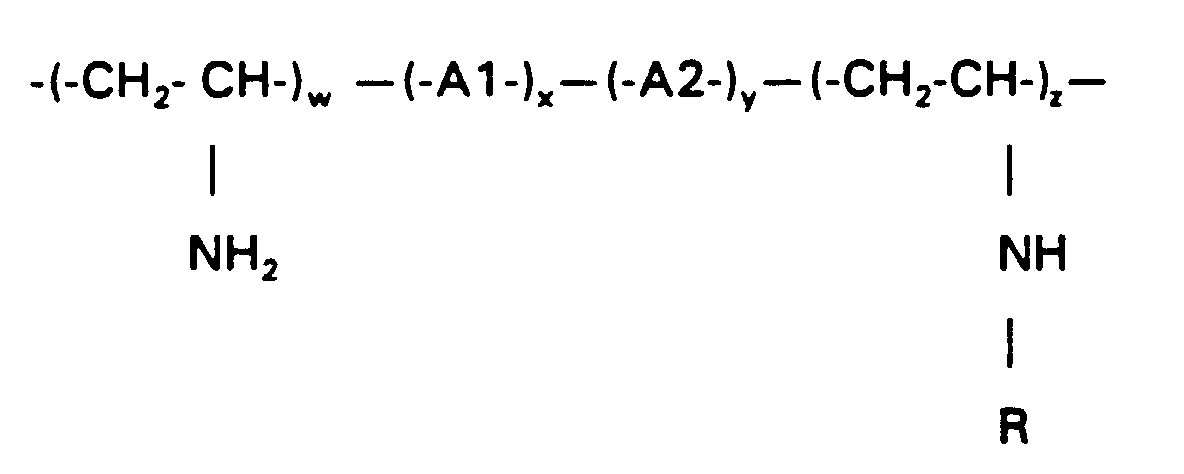
- w 0,1
- -0,98,
- x 0,0
- -0,8,
- y 0,0
- - 0,3 und
- z 0,0
- - 0,6 ist, wobei w + x + y + z gleich 1 ist, x = 0 nur falls y ≠ 0, y = 0 nur falls gleichzeitig x ≠ 0 und z ≠ 0 und R = R4 sind,
- A1
-
- 1. für einen hydrolysestabilen Rest der Formel

- 2. für einen hydrolysestabilen Rest der Formel

steht
- 1. für einen hydrolysestabilen Rest der Formel
- A2
-
- 1. für den Rest eines hydrolysestabilen Vernetzers der Formel
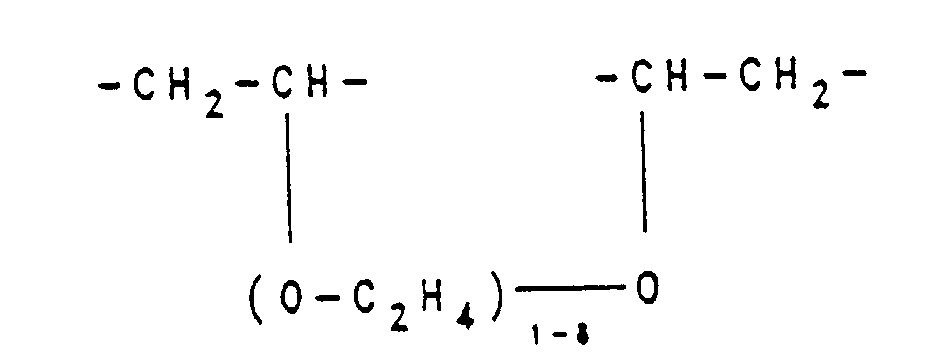
- 2. für einen Rest der Formel


- 1. für den Rest eines hydrolysestabilen Vernetzers der Formel
- R
- für R1-X, R2-X, R3 oder R4 steht, wobei
- R1
- einen Substitutenten bedeutet, ausgewählt aus der Gruppe bestehend aus:
- 1. -(CH2)n-CH3, wobei n eine ganze Zahl von 3 bis 21 ist, verzweigtes Alkyl mit 3 bis 21 Kohlenstoffatomen, geradkettiges oder verzweigtes Alkenyl mit bis zu 21 Kohlenstoffatomen,
- 2. Cycloalkyl, Cycloalkenyl mit jeweils 5-12 Kohlenstoffatomen, ein-, zwei- oder dreifach substituiertes Cycloalkyl oder Cycloalkenyl mit jeweils 5-12 Ringkohlenstoffatomen und
- 3. Aryl, Arylalkyl, Arylalkenyl, wobei die Arylreste ein- oder mehrkernig sind, ein- bis dreifach substituiert sein können und Heteroatome enthalten können und
- X
- eine Einfachbindung oder
eine Brückengruppe oder ein Spacer ist,
und - R2
- einen hydrophilen bzw. amphiphilen Substituenten bedeutet ausgewählt aus der Gruppe bestehend aus:
- 1.

- 2.

- 3.

- 4. -(CH2)c-B, wobei B einen über N gebundenen Pyrrolidinyl-, Piperidinyl- oder Morpholinyl-Rest bedeutet,
- 5. -(CH2)a-D⊕ A⊖, wobei D⊕ Pyridinium, Pyrimidinium oder Imidazolinium bedeutet, und
- 6.

- a eine ganze Zahl von 2 bis 16,
- b null, 1, 2 oder 3,
- c eine ganze Zahl von 2 bis 6,
- d eine ganze Zahl von 6 bis 17 und
- A ein physiologisch verträgliches Anion bedeuten,
- 1.
- R3
- für einen Rest steht ausgewählt aus der Gruppe bestehend aus
- 1. einer Cholsäure, die über die 3-α-OH- oder 24-COOH-Funktion direkt oder über einen Spacer gebunden ist,
- 2. einer Tauro- oder Glycocholsäure, die über die 3α-OH- oder Tauro- bzw. Glyco-Funktion direkt oder über einen Spacer gebunden ist, und
- 3. einen hydrophilen cyclischen Rest oder einen Glucopyranuronsäure-Rest, und
- R4
- für einen vernetzenden Rest steht ausgewählt aus der Gruppe bestehend aus:
- 1. W-(CH2)e,W und
- 2. W-(CH2-CH2O)f-CH2-CH2-W wobei W eine Einfachbindung,


- e eine ganze Zahl von 3 bis 12,
- f eine ganze Zahl von 1 bis 6
- In den vorstehenden und folgenden Ausführungen steht:
Aryl für einen ein- oder mehrkernigen aromatischen Kohlenwasserstoffrest mit 6 bis 14 C-Atomen, wobei im Falle der mehrkernigen Reste die Arylgruppen miteinander kondensiert, über C-C-Bindungen oder über Brückenglieder wie -O-, -COO- oder -CONH- miteinander verbunden sind.
Ferner umfaßt der Begriff Aryl auch 5- bis 14-gliedriges Heteroaryl mit 1 Heteroatom oder 2 nicht benachbarten, gleichen oder verschiedenen Heteroatomen, ausgewählt aus der Gruppe bestehend aus Sauerstoff und Stickstoff. - Aryl steht insbesondere für Phenyl, Arylalkyl für Benzyl und Phenylethyl und Arylalkenyl für

- Beispiele für aromatische Reste mit 1 oder 2 Heteroatomen sind Reste der Chinolincarbon-, Benzimidazolcarbon-, Furancarbon-, Nicotin- und Cumarilsäure.
- Die Cycloalkyl bzw. Cycloalkenylreste sind gegebenenfalls ein, zwei oder dreifach substituiert mit Hydroxy, (C1-C6)-Alkyl und/oder (C1 -C6)-Alkoxy-Resten, wobei im Falle der Mehrfachsubstitution die Substituenten gleich oder verschieden sind. Entsprechendes gilt auch für die Substituenten am Aryl; als Rest kommt z.B. ein Triethylbenzoesäurerest in Frage.
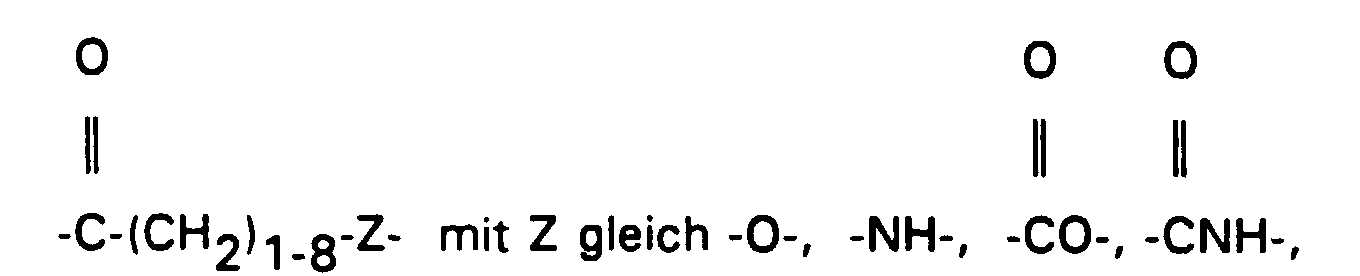
- Das Brückenglied X bedeutet

- Der Spacer X besitzt die Formel
- R1-X ist z.B. ein Rest der Formel

- Ein Beispiel für R in der unter R3 1. erwähnten Bedeutung ist der Rest der Formel

Der Rest R1 ist vorzugweise hydrophob. - Sofern b in einer Struktur mehrfach vorkommt, so ist b gleich oder verschieden, c ist in einer Struktur immer gleich, W ist immer gleich.
- Die erfindungsgemäßen Vinylcopolymere mit Einheiten der Formel I sind verzweigt und vernetzt. Wie in der Polymerchemie üblich sind die in Formel I angegebenen Gruppen über das Gesamtpolymer statistisch verteilt bzw. gemäß ihrer Copolymerisationsparameter angeordnet.
- Die Erfindung betrifft ferner ein Verfahren zur Herstellung von Vinylcopolymeren mit Einheiten der Formel I, welches dadurch gekennzeichnet ist, daß man aus Vinylformamid durch Copolymerisation eine Verbindung der Formel II


- Die vernetzten, stickstoffhaltige Copolymere werden hergestellt durch vernetzende Copolymerisation mit dem Monomeranteil A2 oder durch polymeranaloge Vernetzung (Anteil R4) unter Verwendung von Vernetzern aus der Gruppe der Dialkylantien wie α,ω-Dibromalkane, Ditosylate, Diisocyanate oder aus der Gruppe der Disäuren, der Diacrylate und Diacrylamide oder der Diepoxide.
- In Formel II steht u für die Summe aus w und z. In den erfindungsgemäßen Verbindungen liegen z Anteile als Derivat (R) und w Anteile als freie Vinylamineinheiten bzw. als deren physiologisch verträglich Salze vor. Die Derivatisierung der Vinylaminanteile u wird vorzugsweise so geführt, daß z kleiner als 0,6 mal w ist.
Bevorzugt sind Vinylcopolymere, bei denen R die Bedeutung R1-X, R2-X oder R3 hat und bei denen gleichzeitig z 0,1 bis 0,3 ist. Falls R gleich R4 ist, ist z vorzugsweise 0,0 bis 0,1.
Bei der Herstellung der Copolymerisate beträgt der Anteil an Gruppen A1 0 bis 80 %, vorzugsweise 0 bis 50 %, insbesondere 10 bis 30 %. Der Anteil an Gruppen A2 beträgt 0 bis 30 %, vorzugsweise 2 bis 20 %, insbesondere 5 - 15 %. - Das nachfolgende Reaktionsschema erläutert das Verfahren am Beispiel einer vernetzenden Copolymerisation, z. B. mit y mal Triethylenglykoldivinylether


- Aufgrund ihrer Eigenschaften können die Copolymere mit Einheiten der Formel I als Arzneimittel z.B. als Lipidsenker, als Sättigungsförderer, als Nahrungsmittelzusatz und Nahrungsmittelhilfsstoff verwendet werden. Die Erfindung betrifft daher auch diese Verwendungen und Arzneimittel auf Basis der Verbindungen mit Einheiten der Formel I.
- Durch den Einsatz der erfindungsgemäßen Verbindungen kann die übliche Dosierung der bisher verwendeten Gallensäureadsorber zur Behandlung der Hypercholesterinämie erheblich gesenkt werden. Dadurch stellt sich das Problem der Dosierung und der Compliance nicht mehr. Zusätzlich wird die Compliance auch dadurch verbessert, daß die Verbindungen Softgel-Charakter besitzen, geschmacks- und geruchsneutral sind, so daß keine Geschmacks- und Geruchskompensatoren benötigt werden.
- Die Effektivität der beschriebenen Wirkstoffe läßt sich durch spezielle Mikroformulierungen erhöhen. Hierzu werden die Verbindungen mittels verschiedener Techniken in quellbare Mikropartikel überführt (z.B. mechanische Mikronisierung). Mikropartikel lassen sich auch während der Synthese durch die Verfahrensführung, wie Latexpolymerisation, erhalten. Die quellbaren Mikropartikel zeichnen sich dadurch aus, daß der Wirkstoff auf einer sehr großen, adsorptiven Oberfläche verteilt ist, so daß die Gallensäure-Bindungsstellen gut zugänglich sind.
- Als Darreichungsform können aus den Verbindungen Filmtabletten hergestellt werden, die in vitro die gleiche Wirksamkeit aufweisen wie die Verbindungen in Pulverform. Pro 250 mg Wirkstoff enthalten sie z.B. nur 40 mg pharmazeutisch übliche Hilfsmittel.
- Die mit den Verbindungen zu erzielende Senkung des Serumcholesterinspiegels kann weiter verbessert werden durch gleichzeitige Verwendung von weiteren nicht systemisch wirkenden oder systemisch wirkenden Lipidsenkern (z.B. HMG-CoA-Reduktase-Inhibitoren) im Rahmen einer Kombinationstherapie.
- Da die Verbindungen den enterohepatischen Kreislauf unterbrechen, eignen sie sich auch zum Einsatz bei oralen Vergiftungen.
- Darüberhinaus können die Verbindungen aufgrund ihres Wasseraufnahmevermögens als Sättigungsförderer eingesetzt werden.
- Da die erfindungsgemäßen Verbindungen gut quellbar sind und Säuren binden, können sie als Antacida zur Behandlung einer übermäßen Magensäureproduktion eingesetzt werden und somit als Mittel gegen Gastritis und Ulcus ventriculi oder duodeni Verwendung finden.
- Aufgrund ihrer Wechselwirkung mit Cholesterin sind die Verbindungen in der Lage, das mit der Nahrung aufgenommene Cholesterin zu adsorbieren. Der Anteil des Cholesterins der Nahrung wird damit gebunden und nicht vom Körper resorbiert.
- Weiterhin eignen sich die erfindungsgemäßen Verbindungen auch als Nahrungsmittelhilfsstoffe. So wird beispielsweise aus Milch oder Eibestandteilen Cholesterin adsorbiert. Die daraus resultierende Nahrungsmittel zeichnen sich durch reduzierten Cholesterinanteil aus.
- Verbindungen mit Einheiten der Formel I sind als mucoadhäsive Transportsysteme für Wirkstoffe geeignet. Sie bilden stark hydratisierbare Polymermatrices, die Wasserstoffbrücken-bildende sowie kationische Gruppen besitzen, eine hohe Flexibilität der Polymerkette aufweisen und zusätzlich mit hydrophoben Einheiten substituiert sein können. Daher sind die Verbindungen in der Lage, die Verweildauer eines gebundenen oder adsorbierten Wirkstoffs im Magen oder Dünndarm zu verlängern. Sie werden als Wirkstoffträger an die Schleimschicht der Magen-Darm-Wand adsorbiert, wobei die positiv geladenen Gruppen der Copolymere mit den negativ geladenen Gruppen der endständigen Sialinsäuren der Mucinmoleküle in Wechselwirkung treten, um so einen verzögerten Transport der Wirkstoffe durch den Magen-Darm-Trakt zu bewirken. Gleichzeitig wird durch die Art der Wechselwirkung die Wirkstoffresorption verbessert.
- In einem in vitro Test werden die Verbindungen auf ihre Gallensäure-Bindungs-Kapazität geprüft.
10 mg Polymerprobe werden in 18 ml Puffer (PBS, pH 7,4, 15 mM oder 37 mM) gelöst und 1 Stunde bei Raumtemperatur gerührt, mit 2 ml Na-Taurocholat (37 mM) versetzt und 2 Stunden bei Raumtemperatur inkubiert. Die festen Polymer-Taurocholat-Komplexe werden durch Filtration abgetrennt. Die Bestimmung des Anteils an nicht gebundenem Taurocholat erfolgt mittels HPLC (Säule: RP-8® LiChrosorb; Eluent: Methanol/Citratpuffer pH 4 (Riedel de Haen)/Wasser 6:1:1). - Bei einem Mischungsverhältnis 1/4 (w/w) von Polymerprobe zu Natriumtaurocholat ergeben sich die folgenden Taurocholat-Adsorptionwerte im molaren Verhältnis:
- Verbindung Beispiel 1) : 17 mol %
- Verbindung Beispiel 2) : 25 mol %
- Verbindung Beispiel 3) : 24 mol %
- Verbindung Beispiel 5): 26 mol %
- Verbindung Beispiel 6): 29 mol %
- Verbindung Beispiel 7): 25 mol %
- 120 g Vinylformamid und 52 g Triethylenglykoldivinylether werden mit 1,4 g 4,4'-Azocyanopentansäure in Toluol gelost und mit N2 gespült. Es wird 30 min bei 60 °C und 6 h bei 70 °C gerührt. Das ausgefallene Polymer wird abgesaugt, mit Toluol gewaschen und getrocknet. Ausbeute: 161 g
152 g des Copolymers werden in 2.5 l halbkonz. HCl suspendiert und 2 h bei 80 °C gerührt. Nach Zugabe von 0.5 l konz. HCl wird weitere 6 h bei 80 °C gerührt. Das Produkt wird abgesaugt, zur Einstellung des Hydrochloridgehalts in H2O resuspendiert und auf pH = 4 titriert. Es wird erneut in Aceton gefällt und mehrfach mit Aceton ausgerührt, bevor es bei 50 °C im Vakuum getrocknet wird.
Ausbeute: 117 g - 60 g Vinylformamid, 8,6 g Triethylenglykoldivinylether und 0,6 g ACPS werden wie unter 1) beschrieben in 350 ml Toluol polymerisiert und anschließend hydrolysiert. Zur Hydrochloridgehalt-Einstellung wird in Ethanol/H2O 1:1 resuspendiert.
- 3 g Verbindung aus Beispiel 1 werden in 200 ml H2O bei pH 10 dispergiert und mit 0,55 g Dimethylchlorethylamin-Hydrochlorid versetzt und bei gleichem pH-Wert 8 h bei 80 °C gerührt. Das Polymer wird in Aceton gefällt, in H2O/Ethanol aufgenommen, auf pH = 4 titriert und erneut in Aceton gefällt und ausgerührt. Die Trocknung erfolgt bei 50 °C im Vakuum.
- 5 g Vinylformamid, 1,3 g Vinylimidazol, 1,4 g Triethylenglykoldivinylether und 0,07 g Azocyanopentansäure werden in 40 ml Wasser gegeben. Die Lösung wird mit N2 gespült und 6 h bei 60 °C gerührt. Nach Zugabe von 40 ml H2O und 60 ml halbkonzentrierter HCl wird 3 h bei 70 °C gerührt und nach Zugabe von 90 ml konz. HCl weiter 4h bei 70 °C. Der Ansatz wird mit Aceton versetzt, das Produkt abgesaugt, in H2O suspendiert und mit NaOH auf pH 4 eingestellt. Es wird erneut in Aceton ausgefällt und mehrfach mit Aceton ausgerührt bevor es bei 50 °C im Vakuum getrocknet wird.
- 5,7 g Vinylformamid, 1,9 g N-Vinylimidazol und 0,1 g Azocyanopentansäure werden in 47 ml H2O gegeben, mit N2 gespült und 7h bei 70°C gerührt. Das entstandene Copolymer wird in Aceton gefällt, zur Hydrolyse in H2O gelöst und mit 2 Mol NaOH pro Mol Formamid-Anteil 6h bei 70°C gerührt. Der Ansatz wird mit HCl auf pH 6 eingestellt, mit 1 Teil Methanol verdünnt und in Aceton gefällt. Substitutionsgrad laut NMR: 20 %.
Ausbeute: 5.0 g
2 g des Copolymers werden in 15 ml H2O mit NaOH auf pH 10 eingestellt, mit 0,36 g Dibromhexan (5 mol-%) und 120 mg NaOH versetzt und 6h bei 90°C gerührt. Nach 1/2 h setzt die Gelbildung ein.
Mit 1n HCl wird der pH-Wert auf 1 gestellt und durch Zugabe von Aceton invers gefällt. Bei pH 5 erfolgen 2 weitere Fällungen in Aceton.
Ausbeute: 2,1 g - Analog zu Beispiel 5 werden 5 g Vinylformamid und 2,8 g N-Vinylimidazol mit 0,11 g Azocyanopentansäure in 50 ml H2O 7h bei 70°C polymerisiert. Anschließend erfolgt die basische Hydrolyse.
Substitutionsgrad laut NMR: 32 %
Ausbeute: 4,4 g
1,5 g des Copolymers werden mit 0,26 g Dibromhexan und 84 mg NaOH in 15 ml H2O vernetzt. Die Aufarbeitung erfolgt analog Beispiel 5.
Ausbeute: 1,2 g. - Analog zu Beispiel 5 werden 3,6 g Vinylformamid und 4,7 g N-Vinylimidazol mit 0,12 g Azocyanopentansäure in 52 ml H2O 7h bei 70°C polymerisiert. Die basische Hydrolyse erfolgt mit 1,4 g NaOH.
Substitutionsgrad laut NMR: 53 %.
Ausbeute: 4,8 g.
1,5 g des Copolymers werden mit 0,24 g Dibromhexan und 77 mg NaOH in 15 ml H2O vernetzt. Die Aufarbeitung erfolgt analog Beispiel 5.
Ausbeute: 0,9 g.
Claims (11)
- Vernetzte, stickstoffhaltige Vinylcopolymere mit Einheiten der Formel I
 w 0,1 - 0,98,x 0,0 - 0,8,y 0,0 - 0,3 undz 0,0 - 0,6 ist, wobei w + x + y + z gleich 1 ist, x = 0 nur falls y ≠ 0, y = 0 nur falls gleichzeitig x ≠ 0 und z ≠ 0 und R = R4 sind,und worinA11. für einen hydrolysestabilen Rest der Formel
 2. für einen hydrolysestabilen Rest der Formelsteht
 A21. für den Rest eines hydrolysestabilen Vernetzers der Formel
 2. für einen Rest der Formel
 R für R1-X, R2-X, R3 oder R4 steht, wobeiR1 einen Substitutenten bedeutet, ausgewählt aus der Gruppe bestehend aus:1. -(CH2)n-CH3, wobei n eine ganze Zahl von 3 bis 21 ist, verzweigtes Alkyl mit 3 bis 21 Kohlenstoffatomen, geradkettiges oder verzweigtes Alkenyl mit bis zu 21 Kohlenstoffatomen,2. Cycloalkyl, Cycloalkenyl mit jeweils 5-12 Kohlenstoffatomen, ein-, zwei- oder dreifach substituiertes Cycloalkyl oder Cycloalkenyl mit jeweils 5-12 Ringkohlenstoffatomen und3. Aryl, Arylalkyl, Arylalkenyl, wobei die Arylreste ein- oder mehrkernig sind, ein- bis dreifach substituiert sein können und Heteroatome enthalten können undX eine Einfachbindung oder
eine Brückengruppe oder ein Spacer ist,
undR2 einen hydrophilen bzw. amphiphilen Substituenten bedeutet ausgewählt aus der Gruppe bestehend aus:1.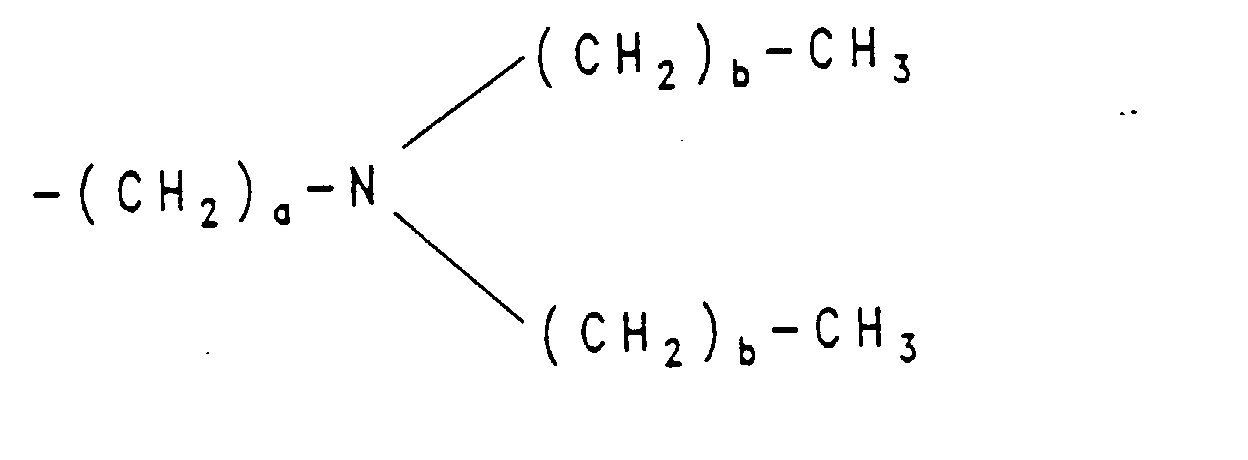 2.
2. 3.
3. 4. -(CH2)c-B, wobei B einen über N gebundenen Pyrrolidinyl-, Piperidinyl- oder Morpholinyl-Rest bedeutet,5. -(CH2)a-D⊕ A⊖, wobei D⊕ Pyridinium, Pyrimidinium oder Imidazolinium bedeutet,6.
 a eine ganze Zahl von 2 bis 16,b null, 1, 2 oder 3,c eine ganze Zahl von 2 bis 6,d eine ganze Zahl von 6 bis 17 undA ein physiologisch verträgliches Anion bedeuten oderR3 für einen Rest steht ausgewählt aus der Gruppe bestehend aus1. einer Cholsäure, die über die 3-α-OH- oder 24 COOH-Funktion direkt oder über einen Spacer gebunden ist, oder2. einer Tauro- oder Glycocholsäure, die über die 3α-OH- oder Tauro- bzw. Glyco-Funktion direkt oder über einen Spacer gebunden ist und3. einen hydrophilen cyclischen Rest oder einen Glucopyranuronsäure-Rest,R4 für einen vernetzenden Rest steht ausgewählt aus der Gruppe bestehend aus:1. W-(CH2)e-W und2. W-(CH2-CH2O)f-CH2-CH2-W wobei W eine Einfachbindung,
 e eine ganze Zahl von 3 bis 12,f eine ganze Zahl von 1 bis 6bedeutet.
 - Verfahren zur Herstellung der Vinylcopolymere gemäß Anspruch 1, dadurch gekennzeichnet, daß man aus Vinylformamid durch Copolymerisation eine Verbindung der Formel II


- Pharmazeutisches Präparat enthaltend eine Verbindung gemäß Anspruch 1.
- Verwendung einer Verbindung gemäß Anspruch 1 als Arzneimittel.
- Verwendung einer Verbindung gemäß Anspruch 1 als Hypolipidämikum.
- Verwendung einer Verbindung gemäß Anspruch 1 als Sättigungsförderer, Nahrungsmittelzusatz oder Nahrungsmittelhilfsstoff.
- Verwendung einer Verbindung gemäß Anspruch 1 zur Adsorption von Cholesterin.
- Verwendung einer Verbindung gemäß Anspruch 1 als Antidot oder Antacida.
- Verwendung einer Verbindung gemäß Anspruch 1 in Kombination mit systemisch oder nicht systemisch wirkenden Hypolipidämika.
- Mikropartikel erhalten durch Gefriertrocknung oder Mikronisierung von Polyvinylaminen gemäß Anspruch 1.
- Verwendung einer Verbindung gemäß Anspruch 1 als Wirkstoffträger.
Applications Claiming Priority (2)
| Application Number | Priority Date | Filing Date | Title |
|---|---|---|---|
| DE4224110 | 1992-07-22 | ||
| DE4224110 | 1992-07-22 |
Publications (2)
| Publication Number | Publication Date |
|---|---|
| EP0580079A1 EP0580079A1 (de) | 1994-01-26 |
| EP0580079B1 true EP0580079B1 (de) | 1996-12-11 |
Family
ID=6463789
Family Applications (1)
| Application Number | Title | Priority Date | Filing Date |
|---|---|---|---|
| EP93111376A Expired - Lifetime EP0580079B1 (de) | 1992-07-22 | 1993-07-15 | Vernetzte, stickstoffhaltige Vinylcopolymere, Verfahren zu ihrer Herstellung sowie die Verwendung dieser Verbindungen |
Country Status (16)
| Country | Link |
|---|---|
| US (2) | US5428112A (de) |
| EP (1) | EP0580079B1 (de) |
| JP (1) | JPH06157671A (de) |
| KR (1) | KR940005692A (de) |
| AT (1) | ATE146193T1 (de) |
| AU (1) | AU659562B2 (de) |
| CA (1) | CA2101010A1 (de) |
| DE (1) | DE59304725D1 (de) |
| DK (1) | DK0580079T3 (de) |
| ES (1) | ES2096150T3 (de) |
| FI (1) | FI933274A7 (de) |
| GR (1) | GR3022135T3 (de) |
| IL (1) | IL106421A (de) |
| NO (1) | NO301018B1 (de) |
| NZ (1) | NZ248193A (de) |
| ZA (1) | ZA935267B (de) |
Families Citing this family (32)
| Publication number | Priority date | Publication date | Assignee | Title |
|---|---|---|---|---|
| US6129910A (en) * | 1993-06-02 | 2000-10-10 | Geltex Pharmaceuticals, Inc. | Water-insoluble noncrosslinked bile acid sequestrants |
| US5618530A (en) * | 1994-06-10 | 1997-04-08 | Geltex Pharmaceuticals, Inc. | Hydrophobic amine polymer sequestrant and method of cholesterol depletion |
| US5900475A (en) * | 1994-06-10 | 1999-05-04 | Geltex Pharmaceuticals, Inc. | Hydrophobic sequestrant for cholesterol depletion |
| US5607669A (en) * | 1994-06-10 | 1997-03-04 | Geltex Pharmaceuticals, Inc. | Amine polymer sequestrant and method of cholesterol depletion |
| US5929184A (en) * | 1993-06-02 | 1999-07-27 | Geltex Pharmaceuticals, Inc. | Hydrophilic nonamine-containing and amine-containing copolymers and their use as bile acid sequestrants |
| US5667775A (en) | 1993-08-11 | 1997-09-16 | Geltex Pharmaceuticals, Inc. | Phosphate-binding polymers for oral administration |
| US5414068A (en) * | 1994-01-24 | 1995-05-09 | Rohm And Haas Company | Crosslinked anion exchange particles and method for producing the particles |
| TW474813B (en) * | 1994-06-10 | 2002-02-01 | Geltex Pharma Inc | Alkylated composition for removing bile salts from a patient |
| DE19520092A1 (de) * | 1995-06-01 | 1996-12-05 | Bayer Ag | Verfahren zur Papierveredlung unter Verwendung von Polyisocyanaten mit anionischen Gruppen |
| WO1997049387A1 (en) | 1996-06-27 | 1997-12-31 | G.D. Searle And Co. | Particles comprising amphiphilic copolymers, having a cross-linked shell domain and an interior core domain, useful for pharmaceutical and other applications |
| DE19633268A1 (de) * | 1996-08-19 | 1998-02-26 | Hoechst Ag | Polymere Gallensäure-Resorptionsinhibitoren mit gleichzeitiger Gallensäure-Adsorberwirkung |
| US6203785B1 (en) * | 1996-12-30 | 2001-03-20 | Geltex Pharmaceuticals, Inc. | Poly(diallylamine)-based bile acid sequestrants |
| DE19705992A1 (de) * | 1997-02-17 | 1998-08-20 | Basf Ag | Verfahren zur Herstellung von Carbamateinheiten enthaltenden Polymerisaten und ihre Verwendung |
| US5925379A (en) * | 1997-03-27 | 1999-07-20 | Geltex Pharmaceuticals, Inc. | Interpenetrating polymer networks for sequestration of bile acids |
| US6423754B1 (en) * | 1997-06-18 | 2002-07-23 | Geltex Pharmaceuticals, Inc. | Method for treating hypercholesterolemia with polyallylamine polymers |
| FR2766194A1 (fr) * | 1997-07-21 | 1999-01-22 | Transgene Sa | Polymeres cationiques, complexes associant lesdits polymeres cationiques et des substances therapeutiquement actives comprenant au moins une charge negative, notamment des acides nucleiques, et leur utilisation en therapie genique |
| FR2766195A1 (fr) * | 1997-07-21 | 1999-01-22 | Transgene Sa | Polymeres cationiques, complexes associant lesdits polymeres cationiques et des substances therapeutiquement actives comprenant au moins une charges negative, notamment des acides nucleiques, et leur utilisation en therapie genique |
| US6083497A (en) | 1997-11-05 | 2000-07-04 | Geltex Pharmaceuticals, Inc. | Method for treating hypercholesterolemia with unsubstituted polydiallylamine polymers |
| US6726905B1 (en) | 1997-11-05 | 2004-04-27 | Genzyme Corporation | Poly (diallylamines)-based phosphate binders |
| US6733780B1 (en) | 1999-10-19 | 2004-05-11 | Genzyme Corporation | Direct compression polymer tablet core |
| AT409630B (de) * | 2000-12-13 | 2002-09-25 | Dsm Fine Chem Austria Gmbh | Alkylierung von n-bzw. amino- oder ammoniumgruppen haltigen, vernetzten polymeren |
| DE60230674D1 (de) * | 2001-12-21 | 2009-02-12 | Ciba Holding Inc | Polyvinylalkohol-poly(n-vinylformamid) kopolymere |
| KR20040068328A (ko) * | 2001-12-21 | 2004-07-30 | 시바 스페셜티 케미칼스 홀딩 인크. | 작용성 잔기를 포함하는폴리(비닐알콜)-코-폴리(비닐아민) 중합체 |
| US7985418B2 (en) | 2004-11-01 | 2011-07-26 | Genzyme Corporation | Aliphatic amine polymer salts for tableting |
| WO2006072054A1 (en) * | 2004-12-30 | 2006-07-06 | Genzyme Corporation | Zinc-containing treatments for hyperphosphatemia |
| US8986669B2 (en) * | 2005-09-02 | 2015-03-24 | Genzyme Corporation | Method for removing phosphate and polymer used therefore |
| EP3000460A1 (de) * | 2005-09-15 | 2016-03-30 | Genzyme Corporation | Beutelformulierung für aminpolymere |
| EP1945196A2 (de) * | 2005-11-08 | 2008-07-23 | Genzyme Corporation | Magnesiumhaltige polymere für hyperphosphatämie |
| WO2008005217A2 (en) * | 2006-07-05 | 2008-01-10 | Genzyme Corporation | Iron(ii)-containing treatments for hyperphosphatemia |
| WO2011106542A2 (en) | 2010-02-24 | 2011-09-01 | Relypsa, Inc. | Crosslinked polyvrnylamine, poly all ylamine, and polyethyleneimine for use as bile acid sequestrants |
| DE112011100657T5 (de) | 2010-02-24 | 2013-02-28 | Relypsa, Inc. | Amin-polymere zur verwendung als gallensäuresequestriermittel |
| MA41202A (fr) | 2014-12-18 | 2017-10-24 | Genzyme Corp | Copolymères polydiallymine réticulé pour le traitement du diabète de type 2 |
Family Cites Families (11)
| Publication number | Priority date | Publication date | Assignee | Title |
|---|---|---|---|---|
| US3558581A (en) * | 1967-10-20 | 1971-01-26 | Hoechst Ag | Process for the manufacture of polyvinylmethylamines |
| US4238579A (en) * | 1979-05-18 | 1980-12-09 | Dynapol | Vinylamine aromatic copolymers and salts thereof |
| FI70230C (fi) * | 1981-07-18 | 1986-09-15 | Basf Ag | Rakkedjiga basiska polymerisat foerfarande foer deras framstaellning och deras anvaendning |
| DE3213873A1 (de) * | 1982-04-15 | 1983-10-27 | Basf Ag, 6700 Ludwigshafen | Flockungsmittel fuer schlaemme |
| DE3128478A1 (de) * | 1981-07-18 | 1983-02-03 | Basf Ag, 6700 Ludwigshafen | Verfahren zur herstellung von linearen, basischen polymerisaten |
| EP0162388B1 (de) * | 1984-05-11 | 1989-09-13 | Bristol-Myers Company | Galle-Komplexbildner-Harz und seine Verwendung |
| DE3534273A1 (de) * | 1985-09-26 | 1987-04-02 | Basf Ag | Verfahren zur herstellung von vinylamin-einheiten enthaltenden wasserloeslichen copolymerisaten und deren verwendung als nass- und trockenverfestigungsmittel fuer papier |
| NL8502882A (nl) * | 1985-10-22 | 1987-05-18 | Stork Friesland Bv | Werkwijze voor de bereiding van een n-vinyl-n-alkilamine (co) polymeer en samengesteld membraan vervaardigd onder toepassing van dit (co) polymeer. |
| CA1330684C (en) * | 1988-04-15 | 1994-07-12 | Robert Krantz Pinschmidt Jr. | Method for preparing poly(vinyl alcohol)- co-poly(vinylamine) via a two-phase process |
| DE3901527A1 (de) * | 1989-01-20 | 1990-07-26 | Hoechst Ag | Alkylierte polyethyleniminderivate, verfahren zu ihrer herstellung, ihre verwendung als arzneimittel sowie pharmazeutische praeparate |
| DE4007312C2 (de) * | 1990-03-08 | 2000-04-27 | Basf Ag | Verfahren zur Herstellung von feinteiligen, wasserlöslichen, Vinylamin-Einheiten enthaltenden Polymerisaten |
-
1993
- 1993-07-15 EP EP93111376A patent/EP0580079B1/de not_active Expired - Lifetime
- 1993-07-15 ES ES93111376T patent/ES2096150T3/es not_active Expired - Lifetime
- 1993-07-15 AT AT93111376T patent/ATE146193T1/de not_active IP Right Cessation
- 1993-07-15 DE DE59304725T patent/DE59304725D1/de not_active Expired - Fee Related
- 1993-07-15 DK DK93111376.5T patent/DK0580079T3/da active
- 1993-07-20 NZ NZ248193A patent/NZ248193A/en unknown
- 1993-07-20 IL IL10642193A patent/IL106421A/en not_active IP Right Cessation
- 1993-07-20 FI FI933274A patent/FI933274A7/fi unknown
- 1993-07-21 NO NO932635A patent/NO301018B1/no not_active IP Right Cessation
- 1993-07-21 AU AU42089/93A patent/AU659562B2/en not_active Ceased
- 1993-07-21 CA CA002101010A patent/CA2101010A1/en not_active Abandoned
- 1993-07-21 JP JP5179680A patent/JPH06157671A/ja active Pending
- 1993-07-21 US US08/095,624 patent/US5428112A/en not_active Expired - Lifetime
- 1993-07-21 ZA ZA935267A patent/ZA935267B/xx unknown
- 1993-07-21 KR KR1019930013756A patent/KR940005692A/ko not_active Ceased
-
1995
- 1995-05-30 US US08/452,797 patent/US5631326A/en not_active Expired - Lifetime
-
1996
- 1996-12-20 GR GR960403573T patent/GR3022135T3/el unknown
Also Published As
| Publication number | Publication date |
|---|---|
| EP0580079A1 (de) | 1994-01-26 |
| DK0580079T3 (da) | 1997-06-30 |
| NO301018B1 (no) | 1997-09-01 |
| FI933274L (fi) | 1994-01-23 |
| ZA935267B (en) | 1994-04-18 |
| AU659562B2 (en) | 1995-05-18 |
| FI933274A7 (fi) | 1994-01-23 |
| AU4208993A (en) | 1994-01-27 |
| GR3022135T3 (en) | 1997-03-31 |
| US5631326A (en) | 1997-05-20 |
| NO932635D0 (no) | 1993-07-21 |
| IL106421A (en) | 1996-11-14 |
| US5428112A (en) | 1995-06-27 |
| DE59304725D1 (de) | 1997-01-23 |
| NZ248193A (en) | 1995-04-27 |
| IL106421A0 (en) | 1993-11-15 |
| ATE146193T1 (de) | 1996-12-15 |
| ES2096150T3 (es) | 1997-03-01 |
| NO932635L (no) | 1994-01-24 |
| FI933274A0 (fi) | 1993-07-20 |
| KR940005692A (ko) | 1994-03-22 |
| CA2101010A1 (en) | 1994-01-23 |
| JPH06157671A (ja) | 1994-06-07 |
Similar Documents
| Publication | Publication Date | Title |
|---|---|---|
| EP0580079B1 (de) | Vernetzte, stickstoffhaltige Vinylcopolymere, Verfahren zu ihrer Herstellung sowie die Verwendung dieser Verbindungen | |
| EP0580078B1 (de) | Hydrophile Zentren aufweisende Polyvinylamin-Derivate, Verfahren zu ihrer Herstellung sowie die Verwendung der Verbindungen als Arzneimittel, Wirkstoffträger und Nahrungsmittelhilfsstoff | |
| EP0379161B1 (de) | Verwendung alkylierter Polyethylenimine als gallensäureadsorbierende Arzneimittel sowie pharmazeutische Präparate | |
| DE69828067T2 (de) | Kationische polymere zur bindung von toxinen | |
| DE69101710T2 (de) | Arzneimittel freisetzendes polymeres system. | |
| DE2835145A1 (de) | Substanz zum behandeln von nierensteinen | |
| DE69737232T2 (de) | Ionische polymere als anti-infektiöse mittel | |
| DE60224052T2 (de) | Aminpolymere zur behandlung von gicht und zur senkung des harnsäuregehaltes | |
| DE69812681T2 (de) | Unsubstituierte polydiallylaminen zur behandlung von hypercholesterolemia | |
| EP0012804B1 (de) | Salze eines zur dauernden Bindung an die Gallensäuren fähigen nicht toxischen aktivierten Anionenaustauscherharzes mit 2-(4'-(p-Chlorbenzoyl)-phenoxy)-2-(methyl)-propionsäure und diese Salze enthaltende Arzneimittel | |
| DE69328741T2 (de) | Unvernetztes Anion-Austauscherharz und diesen enthaltende pharmazeutische Zusammensetzung | |
| EP0563731B1 (de) | Arzneimittel aus Polyhydroxymethylenderivaten, Verfahren zu deren Herstellung und Verwendung | |
| DE2427924A1 (de) | Mittel zur herabsetzung des blutserumcholesterinspiegels | |
| EP0548794B1 (de) | Polyaspartamidderivate als Adsorptionsmittel für Gallensäuren, mit Gallensäuren beladene Polyaspartamidderivate und Verfahren zu deren Herstellung sowie deren Anwendung als Arzneimittel | |
| DE2723638A1 (de) | Anionisches mikroporoeses harz mit hypocholesterinaemischer wirkung | |
| DE68914810T2 (de) | Vinylpyridinium vernetztes Polymer. | |
| EP0534304A1 (de) | Cycloalkylierte Polyethyleniminderivate und ihre Verwendung als Hypolipidämika | |
| DE2812817A1 (de) | Polymer mit ph-abhaengiger loeslichkeit, verfahren zu dessen herstellung und dessen verwendung | |
| DE19705963A1 (de) | Vernetzte Vinylpolymere mit Gallensäure-Adsorberwirkung | |
| DE4136324A1 (de) | Dextranderivate als adsorptionsmittel fuer gallensaeuren, mit gallensaeuren beladene dextranderivate und verfahren zu deren herstellung sowie deren anwendung als arzneimittel | |
| DE68909982T2 (de) | Cholesterolvermindernde Wirkstoffe. | |
| EP0068453A2 (de) | Zusammensetzungen zur Behandlung von Nierensteinen | |
| DE69906928T2 (de) | Fettbindende polymere-lipasehemmer kombinationen zur behandlung von fettleibigkeit | |
| DE2461985C3 (de) | Pepsininhibierendes Arzneimittel | |
| DE2749745A1 (de) | Nitrofurantoin-retard-praeparat zur oralen verabfolgung und verfahren zu seiner herstellung |
Legal Events
| Date | Code | Title | Description |
|---|---|---|---|
| PUAI | Public reference made under article 153(3) epc to a published international application that has entered the european phase |
Free format text: ORIGINAL CODE: 0009012 |
|
| AK | Designated contracting states |
Kind code of ref document: A1 Designated state(s): AT BE CH DE DK ES FR GB GR IE IT LI LU MC NL PT SE |
|
| 17P | Request for examination filed |
Effective date: 19940530 |
|
| 17Q | First examination report despatched |
Effective date: 19951127 |
|
| GRAG | Despatch of communication of intention to grant |
Free format text: ORIGINAL CODE: EPIDOS AGRA |
|
| GRAH | Despatch of communication of intention to grant a patent |
Free format text: ORIGINAL CODE: EPIDOS IGRA |
|
| GRAH | Despatch of communication of intention to grant a patent |
Free format text: ORIGINAL CODE: EPIDOS IGRA |
|
| GRAA | (expected) grant |
Free format text: ORIGINAL CODE: 0009210 |
|
| AK | Designated contracting states |
Kind code of ref document: B1 Designated state(s): AT BE CH DE DK ES FR GB GR IE IT LI LU MC NL PT SE |
|
| REF | Corresponds to: |
Ref document number: 146193 Country of ref document: AT Date of ref document: 19961215 Kind code of ref document: T |
|
| REF | Corresponds to: |
Ref document number: 59304725 Country of ref document: DE Date of ref document: 19970123 |
|
| REG | Reference to a national code |
Ref country code: IE Ref legal event code: FG4D Free format text: 70946 |
|
| ET | Fr: translation filed | ||
| ITF | It: translation for a ep patent filed | ||
| REG | Reference to a national code |
Ref country code: GR Ref legal event code: FG4A Free format text: 3022135 |
|
| REG | Reference to a national code |
Ref country code: ES Ref legal event code: FG2A Ref document number: 2096150 Country of ref document: ES Kind code of ref document: T3 |
|
| GBT | Gb: translation of ep patent filed (gb section 77(6)(a)/1977) |
Effective date: 19970214 |
|
| REG | Reference to a national code |
Ref country code: DK Ref legal event code: T3 |
|
| PLBE | No opposition filed within time limit |
Free format text: ORIGINAL CODE: 0009261 |
|
| STAA | Information on the status of an ep patent application or granted ep patent |
Free format text: STATUS: NO OPPOSITION FILED WITHIN TIME LIMIT |
|
| 26N | No opposition filed | ||
| PGFP | Annual fee paid to national office [announced via postgrant information from national office to epo] |
Ref country code: DE Payment date: 19990611 Year of fee payment: 7 |
|
| PGFP | Annual fee paid to national office [announced via postgrant information from national office to epo] |
Ref country code: GB Payment date: 19990614 Year of fee payment: 7 |
|
| PGFP | Annual fee paid to national office [announced via postgrant information from national office to epo] |
Ref country code: FR Payment date: 19990616 Year of fee payment: 7 |
|
| PGFP | Annual fee paid to national office [announced via postgrant information from national office to epo] |
Ref country code: CH Payment date: 19990617 Year of fee payment: 7 |
|
| PGFP | Annual fee paid to national office [announced via postgrant information from national office to epo] |
Ref country code: MC Payment date: 19990618 Year of fee payment: 7 |
|
| PGFP | Annual fee paid to national office [announced via postgrant information from national office to epo] |
Ref country code: DK Payment date: 19990621 Year of fee payment: 7 |
|
| PGFP | Annual fee paid to national office [announced via postgrant information from national office to epo] |
Ref country code: SE Payment date: 19990622 Year of fee payment: 7 Ref country code: AT Payment date: 19990622 Year of fee payment: 7 |
|
| PGFP | Annual fee paid to national office [announced via postgrant information from national office to epo] |
Ref country code: PT Payment date: 19990624 Year of fee payment: 7 Ref country code: NL Payment date: 19990624 Year of fee payment: 7 |
|
| PGFP | Annual fee paid to national office [announced via postgrant information from national office to epo] |
Ref country code: IE Payment date: 19990625 Year of fee payment: 7 |
|
| PGFP | Annual fee paid to national office [announced via postgrant information from national office to epo] |
Ref country code: LU Payment date: 19990629 Year of fee payment: 7 |
|
| PGFP | Annual fee paid to national office [announced via postgrant information from national office to epo] |
Ref country code: BE Payment date: 19990706 Year of fee payment: 7 |
|
| PGFP | Annual fee paid to national office [announced via postgrant information from national office to epo] |
Ref country code: ES Payment date: 19990719 Year of fee payment: 7 |
|
| PGFP | Annual fee paid to national office [announced via postgrant information from national office to epo] |
Ref country code: GR Payment date: 19990728 Year of fee payment: 7 |
|
| PG25 | Lapsed in a contracting state [announced via postgrant information from national office to epo] |
Ref country code: LU Free format text: LAPSE BECAUSE OF NON-PAYMENT OF DUE FEES Effective date: 20000715 Ref country code: IE Free format text: LAPSE BECAUSE OF NON-PAYMENT OF DUE FEES Effective date: 20000715 Ref country code: GB Free format text: LAPSE BECAUSE OF NON-PAYMENT OF DUE FEES Effective date: 20000715 Ref country code: DK Free format text: LAPSE BECAUSE OF NON-PAYMENT OF DUE FEES Effective date: 20000715 Ref country code: AT Free format text: LAPSE BECAUSE OF NON-PAYMENT OF DUE FEES Effective date: 20000715 |
|
| PG25 | Lapsed in a contracting state [announced via postgrant information from national office to epo] |
Ref country code: SE Free format text: LAPSE BECAUSE OF NON-PAYMENT OF DUE FEES Effective date: 20000716 Ref country code: ES Free format text: LAPSE BECAUSE OF NON-PAYMENT OF DUE FEES Effective date: 20000716 |
|
| PG25 | Lapsed in a contracting state [announced via postgrant information from national office to epo] |
Ref country code: MC Free format text: THE PATENT HAS BEEN ANNULLED BY A DECISION OF A NATIONAL AUTHORITY Effective date: 20000731 Ref country code: LI Free format text: LAPSE BECAUSE OF NON-PAYMENT OF DUE FEES Effective date: 20000731 Ref country code: GR Free format text: LAPSE BECAUSE OF NON-PAYMENT OF DUE FEES Effective date: 20000731 Ref country code: CH Free format text: LAPSE BECAUSE OF NON-PAYMENT OF DUE FEES Effective date: 20000731 Ref country code: BE Free format text: LAPSE BECAUSE OF NON-PAYMENT OF DUE FEES Effective date: 20000731 |
|
| BERE | Be: lapsed |
Owner name: HOECHST A.G. Effective date: 20000731 |
|
| PG25 | Lapsed in a contracting state [announced via postgrant information from national office to epo] |
Ref country code: PT Free format text: LAPSE BECAUSE OF NON-PAYMENT OF DUE FEES Effective date: 20010131 |
|
| PG25 | Lapsed in a contracting state [announced via postgrant information from national office to epo] |
Ref country code: NL Free format text: LAPSE BECAUSE OF NON-PAYMENT OF DUE FEES Effective date: 20010201 |
|
| REG | Reference to a national code |
Ref country code: DK Ref legal event code: EBP |
|
| GBPC | Gb: european patent ceased through non-payment of renewal fee |
Effective date: 20000715 |
|
| REG | Reference to a national code |
Ref country code: CH Ref legal event code: PL |
|
| EUG | Se: european patent has lapsed |
Ref document number: 93111376.5 |
|
| PG25 | Lapsed in a contracting state [announced via postgrant information from national office to epo] |
Ref country code: FR Free format text: LAPSE BECAUSE OF NON-PAYMENT OF DUE FEES Effective date: 20010330 |
|
| NLV4 | Nl: lapsed or anulled due to non-payment of the annual fee |
Effective date: 20010201 |
|
| REG | Reference to a national code |
Ref country code: FR Ref legal event code: ST |
|
| PG25 | Lapsed in a contracting state [announced via postgrant information from national office to epo] |
Ref country code: DE Free format text: LAPSE BECAUSE OF NON-PAYMENT OF DUE FEES Effective date: 20010501 |
|
| REG | Reference to a national code |
Ref country code: IE Ref legal event code: MM4A |
|
| REG | Reference to a national code |
Ref country code: PT Ref legal event code: MM4A Free format text: LAPSE DUE TO NON-PAYMENT OF FEES Effective date: 20010131 |
|
| REG | Reference to a national code |
Ref country code: ES Ref legal event code: FD2A Effective date: 20010810 |
|
| PG25 | Lapsed in a contracting state [announced via postgrant information from national office to epo] |
Ref country code: IT Free format text: LAPSE BECAUSE OF NON-PAYMENT OF DUE FEES;WARNING: LAPSES OF ITALIAN PATENTS WITH EFFECTIVE DATE BEFORE 2007 MAY HAVE OCCURRED AT ANY TIME BEFORE 2007. THE CORRECT EFFECTIVE DATE MAY BE DIFFERENT FROM THE ONE RECORDED. Effective date: 20050715 |