EP0580285A2 - Auto-réenclencheurs - Google Patents
Auto-réenclencheurs Download PDFInfo
- Publication number
- EP0580285A2 EP0580285A2 EP93304614A EP93304614A EP0580285A2 EP 0580285 A2 EP0580285 A2 EP 0580285A2 EP 93304614 A EP93304614 A EP 93304614A EP 93304614 A EP93304614 A EP 93304614A EP 0580285 A2 EP0580285 A2 EP 0580285A2
- Authority
- EP
- European Patent Office
- Prior art keywords
- auto
- recloser
- armature
- actuator
- interrupters
- Prior art date
- Legal status (The legal status is an assumption and is not a legal conclusion. Google has not performed a legal analysis and makes no representation as to the accuracy of the status listed.)
- Withdrawn
Links
- GJCNZQUZWSHFHP-UHFFFAOYSA-N [Li].O=S=O Chemical compound [Li].O=S=O GJCNZQUZWSHFHP-UHFFFAOYSA-N 0.000 claims abstract description 14
- 230000007246 mechanism Effects 0.000 claims abstract description 10
- 230000004907 flux Effects 0.000 claims description 12
- 230000003068 static effect Effects 0.000 claims description 8
- 230000004044 response Effects 0.000 claims description 2
- 229920001971 elastomer Polymers 0.000 description 6
- 238000000034 method Methods 0.000 description 6
- 230000001965 increasing effect Effects 0.000 description 5
- 229920002943 EPDM rubber Polymers 0.000 description 3
- 230000009471 action Effects 0.000 description 2
- 230000001419 dependent effect Effects 0.000 description 2
- 230000000694 effects Effects 0.000 description 2
- 238000012423 maintenance Methods 0.000 description 2
- 230000001052 transient effect Effects 0.000 description 2
- 102100023667 Coiled-coil domain-containing protein 124 Human genes 0.000 description 1
- CWYNVVGOOAEACU-UHFFFAOYSA-N Fe2+ Chemical compound [Fe+2] CWYNVVGOOAEACU-UHFFFAOYSA-N 0.000 description 1
- 101000978248 Homo sapiens Coiled-coil domain-containing protein 124 Proteins 0.000 description 1
- WHXSMMKQMYFTQS-UHFFFAOYSA-N Lithium Chemical compound [Li] WHXSMMKQMYFTQS-UHFFFAOYSA-N 0.000 description 1
- QJVKUMXDEUEQLH-UHFFFAOYSA-N [B].[Fe].[Nd] Chemical compound [B].[Fe].[Nd] QJVKUMXDEUEQLH-UHFFFAOYSA-N 0.000 description 1
- 229910000828 alnico Inorganic materials 0.000 description 1
- 230000009286 beneficial effect Effects 0.000 description 1
- 230000008901 benefit Effects 0.000 description 1
- KPLQYGBQNPPQGA-UHFFFAOYSA-N cobalt samarium Chemical compound [Co].[Sm] KPLQYGBQNPPQGA-UHFFFAOYSA-N 0.000 description 1
- 238000010276 construction Methods 0.000 description 1
- 238000010586 diagram Methods 0.000 description 1
- 238000006073 displacement reaction Methods 0.000 description 1
- 238000005516 engineering process Methods 0.000 description 1
- 230000001939 inductive effect Effects 0.000 description 1
- 239000012212 insulator Substances 0.000 description 1
- 239000007788 liquid Substances 0.000 description 1
- 229910052744 lithium Inorganic materials 0.000 description 1
- 239000000696 magnetic material Substances 0.000 description 1
- 230000005389 magnetism Effects 0.000 description 1
- 239000000463 material Substances 0.000 description 1
- 230000002093 peripheral effect Effects 0.000 description 1
- 230000001681 protective effect Effects 0.000 description 1
- 229910052761 rare earth metal Inorganic materials 0.000 description 1
- 150000002910 rare earth metals Chemical class 0.000 description 1
- 230000009467 reduction Effects 0.000 description 1
- 239000002990 reinforced plastic Substances 0.000 description 1
- 229910000938 samarium–cobalt magnet Inorganic materials 0.000 description 1
- 238000007493 shaping process Methods 0.000 description 1
- 238000004804 winding Methods 0.000 description 1
Images




Classifications
-
- H—ELECTRICITY
- H01—ELECTRIC ELEMENTS
- H01H—ELECTRIC SWITCHES; RELAYS; SELECTORS; EMERGENCY PROTECTIVE DEVICES
- H01H51/00—Electromagnetic relays
- H01H51/22—Polarised relays
- H01H51/2209—Polarised relays with rectilinearly movable armature
-
- H—ELECTRICITY
- H01—ELECTRIC ELEMENTS
- H01F—MAGNETS; INDUCTANCES; TRANSFORMERS; SELECTION OF MATERIALS FOR THEIR MAGNETIC PROPERTIES
- H01F7/00—Magnets
- H01F7/06—Electromagnets; Actuators including electromagnets
- H01F7/08—Electromagnets; Actuators including electromagnets with armatures
- H01F7/16—Rectilinearly-movable armatures
- H01F7/1607—Armatures entering the winding
- H01F7/1615—Armatures or stationary parts of magnetic circuit having permanent magnet
-
- H—ELECTRICITY
- H01—ELECTRIC ELEMENTS
- H01H—ELECTRIC SWITCHES; RELAYS; SELECTORS; EMERGENCY PROTECTIVE DEVICES
- H01H33/00—High-tension or heavy-current switches with arc-extinguishing or arc-preventing means
- H01H33/60—Switches wherein the means for extinguishing or preventing the arc do not include separate means for obtaining or increasing flow of arc-extinguishing fluid
- H01H33/66—Vacuum switches
- H01H33/666—Operating arrangements
- H01H33/6662—Operating arrangements using bistable electromagnetic actuators, e.g. linear polarised electromagnetic actuators
-
- H—ELECTRICITY
- H02—GENERATION; CONVERSION OR DISTRIBUTION OF ELECTRIC POWER
- H02H—EMERGENCY PROTECTIVE CIRCUIT ARRANGEMENTS
- H02H1/00—Details of emergency protective circuit arrangements
- H02H1/06—Arrangements for supplying operative power
-
- H—ELECTRICITY
- H01—ELECTRIC ELEMENTS
- H01F—MAGNETS; INDUCTANCES; TRANSFORMERS; SELECTION OF MATERIALS FOR THEIR MAGNETIC PROPERTIES
- H01F7/00—Magnets
- H01F7/06—Electromagnets; Actuators including electromagnets
- H01F7/08—Electromagnets; Actuators including electromagnets with armatures
- H01F7/16—Rectilinearly-movable armatures
- H01F2007/1669—Armatures actuated by current pulse, e.g. bistable actuators
Definitions
- This invention relates to auto-reclosers.
- a pole mounted auto-recloser is a high voltage pole-top mounted reclosing circuit-breaker which is used to protect high voltage overhead electrical power distribution lines.
- the function of the recloser is to reduce system interruption to a minimum if a transient or permanent fault should occur on the sytem.
- the recloser senses fault current in the main HV circuit, that is in the three phase power line, and opens its three main contacts to interrupt the current. After a short period known as the dead-time the recloser will reclose. Most faults are transient in nature and will clear during the dead-time so that when the unit recloses the HV supply is restored. If the fault has not cleared the recloser senses the fault current and again opens to interrupt it. The recloser can attempt to reclose up to say three times. If the fault is permanent after a predetermined number of trips it will remain open thereby isolating the faulty section of line.
- pole mounted reclosers An inherent problem with pole mounted reclosers is that such equipment is typically situated in remote locations. For this reason they have to be very reliable with very long intervals between maintenance periods. Also there will be no local power supply for opening and closing the recloser main contacts or for supplying the elctronic protection and control unit part of the recloser.
- an auto-recloser circuit-breaker for use with a three phase high voltage electrical power distribution line, the auto-recloser including (a) three vacuum interrupters for connection one in each phase of the power line, (b) current transformer means for sensing current on the power line, (c) an electronic protection relay having inputs connected to said current transformer means and outputs for providing auto-reclose control pulses, (d) a first, comparatively low voltage, power supply connected for operating the protection relay, (e) operating means for opening and closing the interrupters responsive to the control pulses from the relay, the operating means including a single bistable magnetic actuator and a drive mechanism connected between the three interrupters and the magnetic actuator, the magnetic actuator having a reciprocable armature, two electromagnetic coils each for moving the armature to one of two positions, and a permanent magnet for holding the armature in either position, and (f) a second, comparatively high voltage, power supply for energising the magnetic actuator, this second power supply being connected to each magnetic actuator coil via a respective electronic
- the first and second power supplies may be provided each from a separate lithium sulphur dioxide battery.
- the drive mechanism may include three drive rods, one said rod for operating each interrupter, and with the three drive rods arranged to be driven together directly by said reciprocable armature of said magnetic actuator in line with the movement of said armature.
- the three drive rods maybe linked to the actuator by a single cross-beam, each rod being maintained in line by a spring in a pocket in the beam without contact between the rod and the beam.
- the magnetic circuit in the actuator due to the permanent magnet maybe arranged to provide a static force to hold the armature in its stable position corresponding to the interrupters being closed greater than the static force to hold the armature in the stable position corresponding to the interrupters being open.
- the armature and/or a pole piece in the actuator maybe shaped to modify the flux in an air gap between them so that in response to a control pulse to operate the actuator to the open position of the interrupters the armature is preferentially biased by the permanent magnet towards that open position.
- a parallel path circuit maybe provided for each actuator coil to circulate current due to emfs generated in the coils resulting from actuation, and with impedance provided in each said parallel path circuit to reduce opposition to movement of the armature due to such current.
- the protection relay may include wake-up and power-down circuit means to reduce consumption of battery energy.
- the wake-up circuit means may include a comparator and a latch in CMOS to minimise the battery energy which is continuously consumed by these components.
- the self powered recloser according to the invention has solved the following design problems:
- FIG. 1 there is shown a schematic diagram of an auto-recloser circuit breaker for use with a three phase high voltage electrical power distribution line.
- the three phase power line is shown extending through the auto-recloser from three supply side terminals to three corresponding load side terminals.
- the high voltage could typically be 15kV and the normal load current typically less than 1kA.
- Three vacuum interrupters are provided for connection one in each phase of the power line as shown.
- Three ring current transformers are provided for sensing current on the power line.
- An electronic protection relay has inputs connected to these current transformers and outputs for providing auto-reclose control pulses.
- a 12 volt Lithium Sulphur Dioxide battery provides a power supply connected for operating the protection relay.
- Operating means for opening and closing the vacuum interrupters responsive to the control pulses from the relay include a single bistable magnetic actuator and a drive mechanism (shown by the single dotted line) connected between the three interrupters and the magnetic actuator.
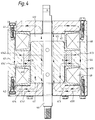
- the magnetic actuator (to be later described in detail with reference to Figures 4 and 5) has a reciprocable armature, two electromagnetic coils (shown as “open” and “close” in Figure 1) each for moving the armature to one of two positions, and a permanent magnet for holding the armature in either position.
- a 96 volt lithium sulphur dioxide battery is provided for energising the magnetic actuator, this battery being connected to each magnetic actuator coil via a respective electronic switch (output FET as shown) responsive to the auto-reclose control pulses from the relay.
- the recloser is powered solely by the two batteries and not by the high voltage power line.
- a microprocessor in the relay provides the control pulses to the output FETs to control the opening (tripping) and closing operations of the recloser.
- An auxiliary switch (shown in Figure 1) is connected to the recloser main drive shaft and signals the position of the recloser to the microprocessor which will terminate the trip or close signal accordingly.
- the close and trip current pulses are controlled to the minimum length necessary to ensure correct operation thereby minimising the amount of energy taken from the 96 volt battery.
- the current required to be supplied by this battery will be between approximately 25A and 30A, which comes as a requirement from the design of the magnetic actuator and the load on the actuator from the interrupter drive mechanism.
- the required voltage for this battery according to temperature conditions of use, could be between say 90-105V.
- FIG. 1 shows the configuration and operation of the electronic protection relay.
- the current transformers on the three phase power line will bring the normal load current down to below say approximately 100A at the inputs to the relay.
- the current transformers within the relay will further bring these currents down to below say approximately 100mA.
- Figure 2 shows four current transformers in the relay. The outputs of these four current transformers are each passed through a rectifier circuit to a burdens circuit.
- the burdens circuits as shown in Figure 2, can have switched in a selected parallel resistors to translate the rectified current at whatever protection level is required to a predetermined voltage output, for example a protection level of 100mA is translated to an output from the burdens circuits of 0.1 volts.
- the 12 volt lithium sulphur dioxide battery continuously supplies a wake-up circuit including a reference voltage circuit, four comparators, an OR gate and a latch. These circuit components are in CMOS and continuously take only a very small current (15 ⁇ A) from the 12 volt battery. This battery can sustain this load for greater than its expected life of 10 years.
- the reference voltage circuit consumes only say 1-1.5 ⁇ A from the 12V battery and supplies a reference voltage of say 0.1 volt to one input of each of the four comparators.
- the outputs from the burdens circuits are connected respectively to the other inputs of the comparators.
- the latch is set and provides a wake-up signal to power up the microprocessor and the A/D converter which is provided between the burdens circuit outputs and the microprocessor.
- the A/D converter is shown here separately it is in fact, together with a multiplexer for scanning all the burdens outputs, integrated with the microprocessor in a microcontroller.
- the value of the power line overload as outputs from the burdens circuits is measured by the A/D converter and determines the tripping time set by the microprocessor.
- a massive overload requires the lowest possible tripping time, i.e. the vacuum interrupters should be tripped open straight away.
- a certain length of tripping time is set; for example a 50% overload could provide a 1 1 2 second tripping time or a 10 times overload could provide a 350msec tripping time.
- the microprocessor provides a sequence of actuator opening and closing pulses to the output FETs.
- the microprocessor If the fault is temporary the primary currents drop below the minimum tripping current level to the normal load current level or if the fault is continuous the re-closer locks-out in the open position at the end of its sequence, this being a sequence of say three or four open and close operations. Whatever the conclusion the microprocessor resets the latch and the electronic protection resumes to its quiescent state drawing a few microamps (say 15 ⁇ A).
- a further feature of the particular microprocessor and immediate peripherals is that they were chosen for low power consumption and also because it is possible to put them in a very low power 'standby' mode during periods then the microprocessor is timing out an operation such as a dead time or tripping time.
- dead time is when the circuit breaker has been tripped and all that the microprocessor is doing is timing a certain programme time, say between 1 4 sec and 180 secs before a re-closing pulse is required. Just running the timer can be in this very low power 'standby' mode.
- Figure 3 shows the two actuator coils connected to the 96 volt Lithium sulphur dioxide battery via the FETs as has been shown in Figure 2 and a diode and resistor in series with each other and in parallel with each coil.
- the diodes are included to protect the FETs at turn-off.
- the two solenoid coils which are highly inductive produce a large back-emf when the FETs turn off (L di/dt ). Without the diodes this voltage would appear across the FETs. With the diodes in the circuit the voltage is limited to the battery voltage as the back emf causes current to flow around the local loop until the energy stored has exponentially decayed away.
- An actuator rod 46 is reciprocable with an armature 45 through openings in a pair of parallel end plates constituting pole pieces 41, 42, whose inner faces act as end stops for the armature 45.
- the pole pieces 41, 42 are connected by side plates 43, 44 which, with the pole pieces, support two fixed, annular, coaxial electromagnetic coils 48, 49 adjacent respective ends of the armature 45, and a fixed, centrally-disposed, coaxial, cylindrical permanent magnet 410.
- the permanent magnet 410 extends axially over a central region of the armature 45 at all positions of the armature, and it is radially polarised as shown (S-N; N-S).
- the magnet is of neodymium-boron-iron, although another rare-earth magnetic material such as samarium-cobalt could be used especially where high temperatures are likely to be encountered.
- the magnet has the approximate dimensions of 70mm long by 60mm internal diameter, and produces a flux density of around 0.7 Webers per square metre at the centre and 1.7 Webers per square metre at its ends. Similar field strengths could alternatively be obtained from an AlNiCo magnet, but the properties of such a material are less advantageous in this particular application.
- the armature In use, with the armature at one stable position, as shown in Figure 4, it is held there by the permanent magnet which generates a low reluctance magnetic circuit 413, 414.
- the electromagnet coil 48 On energising the electromagnet coil 48 nearer the other end of the armature to produce a magnetic field 4131, 4141 in the sense shown, the flux of the original, low reluctance magnetic circuit 413, 414 is diverted, or, in a sense, opposed and cancel led, so that the flux density at the interface 411 of the armature and its end strip is substantially reduced, destabilising the armature.
- the flux is increased across the air gap 412 (approximately 14mm in this example) between the armature and the other of its end stops 41, tending to attract the armature towards its opposite stable position.
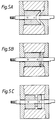
- the relatively small amount of magnetic flux 4132, 4142 generated by the electromagnet coil and passing through the permanent magnet is such as to maintain its magnetism, not to demagnetise the permanent magnet. More flux 4131, 4141 from the electromagnet coil 48 passes through the lower end plate 42 than through the relatively high-reluctance permanent magnet via path 4132, 4142.
- Movement of the armature from its other stable position is achieved by energising the other electromagnet coil 49 in the same sense, thus similarly avoiding demagnetisation of the permanent magnet 410.
- the configuration of the permanent magnet is cylindrical or annular in this example, other tubular configurations are feasible, including ones which are rotationally asymmetric about the longitudinal axis.
- the magnet should be tubular in the sense that it provides a longitudinal passage for the armature.
- the magnet could be formed as a unitary structure or segmented.
- the actuator efficiency and the way in which it is employed on the Auto recloser needs to be optimised.
- One or more of the following techniques may be used to tailor the basic actuator to the required application.
- the static force to hold the interrupters in the closed position may be 3 times greater than the static force to hold the interrupters in the open position.
- the armature 45 whilst in transit from one stable position to the other be preferentially biased in one direction due to the permanent magnet alone. This could be necessary to avoid a meta-stable position occurring at an undesirable point in the travel or to efficiently drive the armature over an increased distance with the required force/displacement.
- emfs may be produced by either transformer action as has been described above with reference to Figure 3 from the current in the opposing coil or be generated in both coils by the movement of the armature.
- the resultant current will circulate in any low impedance path in parallel with the coils, (e.g. free-wheeling diode as shown in Figure 3).
- the design incorporates a method of increasing the impedance of this path, thus significantly reducing the value of the current and associated field.
- An example is use of the resistors shown in Figure 3.
- a further advantage of this increased impedance is that the reduction of circulating current will reduce opposition to movement of the armature when the coils are not energised.
- an auto-recloser circuit breaker principally for outdoor use but optionally for indoor applications, comprises, for each of three phases, a vacuum interrupter 610 housed in an EPDM rubber body 611.
- a single kiosk 612 houses the bistable magnetic actuator 613 of the type described above with reference to Figures 4 and 5, which operates all three vacuum interrupters 610 by way of a cross beam 614.
- the kiosk may rest on the ground, or else it may be mounted on a plinth or on a pole 615 as shown.
- the interrupter contacts are maintained in either the closed or the open position by the magnetic actuator.
- the fixed contact is connected to an upper line terminal 616 integral with a support casing, and the movable contact to an axially reciprocable transfer contact 617 which slides within a ring-shaped fixed contact 618 connected to a side-mounted terminal 619.
- the side terminal 619 consists of a rod projecting transversely from an insulating bushing forming part of the rubber body 611.
- the body 611 has a number of rain sheds 612 moulded onto its outer surface to increase external creepage and flashover distances across the interrupter and from the interrupter 610 to the supporting kiosk 612 which is at earth potential.
- the inner surface of the EPDM rubber body 611 is lined by a reinforced plastics tube which provides mechanical strength and separates the EPDM rubber from a dielectric liquid or gaseous insulating medium 620 in which the internal parts are immersed.
- the medium 620 is SF6 gas, supplied through a filling valve.
- a protective current transformer core and toroidally wound secondary winding 621 surround the side-mounted line terminal 619, and are encapsulated in the bushing 622 integral with the rubber body 611.
- the output from the current transformer is connected by a line 623, encapsulated in the rubber body 611, to the actuator assembly 613.
- the single actuator 613 is in line with the three vacuum interrupters, which it drives by way of a purely mechanical, direct linkage.
- the linkage comprises an axial, insulating drive rod 624 for each interrupter connected at its upper end to the sliding contact 617 and at its lower end, via surrounding spring 625 in the cross beam 614, via a lost motion device to the actuator shaft.
- the rods extend axially through the base of the rubber body 611 and through the roof of the kiosk 612, which is sealed against the underside of the base of the rubber body 611.
- the space within the kiosk may communicate with that within the rubber body 611, avoiding the need for the potentially leaky mechanical gas seals.
- the electronic protection relay which is located with the two lithium sulphur dioxide batteries in a housing 626 responds to a signal from the current transformer 621 indicative of either an over-current condition, a short circuit or an earth fault, to send an appropriate short pulse to activate the actuator.
- the relay includes a sequence timer for the auto-reclose function, which causes the interrupter contacts to reclose after a predetermined interval following circuit interruption. If the fault is not cured and the circuit is interrupted a second time, the circuit recloses after a predetermined interval; and so on for the auto-reclose
- each interrupter moving contact is driven concentric with its body envelope.
- To achieve this bearings are required at each end of the insulator drive rod.
- a simple method of achieving low friction, jam free operation - without the need for a high precision mechanism is achieved as follows.
- the closing spring 625 is in a machined U-shape pocket on the beam 614 and the drive shaft 624 passes through a large clearance hole 627 in the beam.
- the drive rod is maintained concentric by the spring and its collar. There is no contact between the drive shaft and the beam which may jam or cause friction.
- the exemplary drive mechanism helps to achieve a low static loading on the actuator of about 60kg due to each interrupter, so that with safety margins the maximum toatl loading on the actuator is in the range 300kg to 350kg which can be accommodated by the 96V lithium sulphur dioxide battery as described above.
Landscapes
- Physics & Mathematics (AREA)
- Electromagnetism (AREA)
- Engineering & Computer Science (AREA)
- Power Engineering (AREA)
- Emergency Protection Circuit Devices (AREA)
- Electromagnets (AREA)
- Protection Of Static Devices (AREA)
Applications Claiming Priority (2)
| Application Number | Priority Date | Filing Date | Title |
|---|---|---|---|
| GB929215405A GB9215405D0 (en) | 1992-07-20 | 1992-07-20 | Auto-reclosers |
| GB9215405 | 1992-07-20 |
Publications (2)
| Publication Number | Publication Date |
|---|---|
| EP0580285A2 true EP0580285A2 (fr) | 1994-01-26 |
| EP0580285A3 EP0580285A3 (fr) | 1995-05-03 |
Family
ID=10719000
Family Applications (1)
| Application Number | Title | Priority Date | Filing Date |
|---|---|---|---|
| EP93304614A Withdrawn EP0580285A3 (fr) | 1992-07-20 | 1993-06-14 | Auto-réenclencheurs. |
Country Status (6)
| Country | Link |
|---|---|
| US (1) | US5452172A (fr) |
| EP (1) | EP0580285A3 (fr) |
| AU (1) | AU662824B2 (fr) |
| BR (1) | BR9302913A (fr) |
| GB (2) | GB9215405D0 (fr) |
| MX (1) | MX9304342A (fr) |
Cited By (17)
| Publication number | Priority date | Publication date | Assignee | Title |
|---|---|---|---|---|
| FR2720200A1 (fr) * | 1994-05-20 | 1995-11-24 | Gen Electric | Circuit de commande du déclenchement d'un interrupteur numérique de circuit par bobine en dérivation |
| US5585611A (en) * | 1994-03-31 | 1996-12-17 | Abb Power T&D Company Inc. | Interrupter assembly |
| US5912604A (en) * | 1997-02-04 | 1999-06-15 | Abb Power T&D Company, Inc. | Molded pole automatic circuit recloser with bistable electromagnetic actuator |
| WO2001065581A1 (fr) * | 2000-03-02 | 2001-09-07 | Cruise, Rupert, John | Commande magnétique |
| EP1132929A1 (fr) * | 2000-03-10 | 2001-09-12 | ABBPATENT GmbH | Entraínement à aimant permanent pour dispositif de commutation électrique |
| US6933827B2 (en) * | 2002-11-15 | 2005-08-23 | Mitsubishi Denki Kabushiki Kaisha | Actuator, method of manufacturing the actuator and circuit breaker provided with the actuator |
| EP1619769A4 (fr) * | 2003-03-11 | 2009-08-26 | Toshiba Kk | Systeme et commutateur d'alimentation electrique cc |
| WO2012096863A1 (fr) * | 2011-01-12 | 2012-07-19 | Schneider Electric USA, Inc. | Système et procédé de contrôle d'un courant consommé par une charge protégée dans un dispositif de protection électronique à alimentation autonome |
| WO2013169716A1 (fr) * | 2012-05-07 | 2013-11-14 | S&C Electric Company | Disjoncteur réenclencheur de relâchement |
| DE102014219772A1 (de) | 2014-09-30 | 2016-03-31 | Siemens Aktiengesellschaft | Vakuumschaltröhre |
| DE102015200135A1 (de) | 2015-01-08 | 2016-07-14 | Siemens Aktiengesellschaft | Kopplungsglied für ein elektrisches Schaltgerät,insbesondere eine Vakuumschaltröhre |
| DE102015200112A1 (de) | 2015-01-08 | 2016-07-14 | Siemens Aktiengesellschaft | Vakuumschaltröhre |
| EP3200300A4 (fr) * | 2014-09-26 | 2018-05-30 | Seari Electric Technology Co., Ltd. | Dispositif de protection d'unité de déclenchement électronique et procédé de protection |
| CN109690718A (zh) * | 2016-08-26 | 2019-04-26 | 三菱电机株式会社 | 电磁操作机构的驱动电路 |
| WO2019244034A1 (fr) * | 2018-06-20 | 2019-12-26 | Celsa S.A.S. | Dispositif pour l'interruption et la reconnexion automatique de circuits de moyenne tension pouvant être installé dans des bases interchangeables |
| US20220103010A1 (en) * | 2020-09-30 | 2022-03-31 | S&C Electric Company | Method for isolating a fault and restoring power in an underground radial loop network using fault interrupting switches |
| US11996687B2 (en) | 2020-01-24 | 2024-05-28 | Hubbell Incorporated | PWM control for power distribution circuit interrupting devices |
Families Citing this family (25)
| Publication number | Priority date | Publication date | Assignee | Title |
|---|---|---|---|---|
| GB2305557B (en) * | 1995-09-19 | 2000-02-23 | Gec Alsthom Ltd | Method for depassivating a lithium battery |
| MY119298A (en) * | 1996-09-13 | 2005-04-30 | Cooper Ind Inc | Encapsulated vacuum interrupter and method of making same |
| US6753493B2 (en) * | 2001-06-01 | 2004-06-22 | Hubbell Incorporated | Electrical circuit interrupting device |
| US6836121B2 (en) * | 2001-06-06 | 2004-12-28 | Abb Inc. | Apparatus for controlling a magnetically actuated power switching device and method of controlling the same |
| US7403130B2 (en) * | 2004-08-20 | 2008-07-22 | Cooper Technologies Company | Removing an automatic circuit recloser from service prior to battery failure |
| US7869170B2 (en) * | 2006-07-14 | 2011-01-11 | Susan Jean Walker Colsch | Method and system for time synchronized trip algorithms for breaker self protection |
| KR100780706B1 (ko) * | 2006-08-17 | 2007-11-30 | 엘에스산전 주식회사 | 복합형 초전도 한류기 |
| MX2013001068A (es) * | 2010-07-26 | 2013-03-18 | Tyco Electronics Corp | Circuito controlador que incluye un convertidor de energia de modo de conmutacion y un cierre automatico que usa el mismo. |
| KR101147202B1 (ko) * | 2010-10-13 | 2012-05-25 | 삼성에스디아이 주식회사 | 전력 저장 장치 |
| US8675325B2 (en) * | 2010-10-20 | 2014-03-18 | Schneider Electric USA, Inc. | Electronic circuit breaker with alternate mode of operation using auxiliary power source |
| US8497446B1 (en) | 2011-01-24 | 2013-07-30 | Michael David Glaser | Encapsulated vacuum interrupter with grounded end cup and drive rod |
| CN103325627A (zh) * | 2012-03-20 | 2013-09-25 | 深圳市金博联电力技术有限公司 | 一种10kv快速智能柱上断路器 |
| US9761394B2 (en) | 2013-02-08 | 2017-09-12 | Hubbell Incorporated | Current interrupter for high voltage switches |
| CN103123882B (zh) * | 2013-02-26 | 2015-02-11 | 滁州学院 | 双稳态永磁真空断路器智能控制器 |
| DE102013013585B4 (de) * | 2013-06-20 | 2020-09-17 | Rhefor Gbr | Selbsthaltemagnet mit besonders kleiner elektrischer Auslöseleistung |
| US9343216B2 (en) * | 2013-09-02 | 2016-05-17 | Glen A. Robertson | Energy efficient bi-stable permanent magnet actuation system |
| US9514872B2 (en) * | 2014-12-19 | 2016-12-06 | General Electric Company | Electromagnetic actuator and method of use |
| FR3069698B1 (fr) * | 2017-07-26 | 2019-08-16 | Schneider Electric Industries Sas | Appareil commandable de coupure d'un courant electrique et ensemble electrique comprenant cet appareil |
| US10297376B2 (en) * | 2017-09-25 | 2019-05-21 | The United States Of America As Represented By The Administrator Of Nasa | Bi-stable pin actuator |
| BR112021003349B1 (pt) * | 2019-01-31 | 2023-03-14 | S&C Electric Company | Método para separar contatos soldados em um conjunto de interruptor, e, interruptor para uso em uma rede de distribuição de energia de média tensão |
| AU2020396537B2 (en) * | 2019-12-05 | 2022-06-09 | S&C Electric Company | Switch assembly with energy harvesting |
| CA3159596C (fr) * | 2019-12-05 | 2023-01-03 | S&C Electric Company | Systeme et procede de test d'impulsions de reenclenchement a faible energie |
| EP4128303A4 (fr) | 2020-03-31 | 2024-04-17 | Hubbell Incorporated | Système et procédé de fonctionnement d'un commutateur électrique |
| WO2022072572A1 (fr) * | 2020-10-01 | 2022-04-07 | S&C Electric Company | Lectures de tension à l'aide d'une résistance haute tension à travers un interrupteur à vide |
| CA3203942A1 (fr) * | 2020-12-08 | 2022-06-16 | S&C Electric Company | Procede de detection rapide de courant de defaut de crete |
Family Cites Families (8)
| Publication number | Priority date | Publication date | Assignee | Title |
|---|---|---|---|---|
| US3662220A (en) * | 1959-03-19 | 1972-05-09 | Mc Graw Edison Co | Time delay device |
| GB1216339A (en) * | 1967-04-25 | 1970-12-16 | Ass Elect Ind | Improvements relating to circuits for controlling the tripping of a circuit breaker |
| US4184186A (en) * | 1977-09-06 | 1980-01-15 | General Electric Company | Current limiting device for an electric power system |
| US4931896A (en) * | 1985-03-14 | 1990-06-05 | Cooper Industries, Inc. | Distribution line switchgear control with isolated cascaded power supplies |
| US4751606A (en) * | 1987-02-20 | 1988-06-14 | Westinghouse Electric Corp. | Circuit interrupter apparatus with a battery backup and reset circuit |
| US4876521A (en) * | 1987-08-25 | 1989-10-24 | Siemens Energy & Automation, Inc. | Tripping coil with flux shifting coil and booster coil |
| GB8819166D0 (en) * | 1988-08-12 | 1988-09-14 | Ass Elect Ind | Magnetic actuator & permanent magnet |
| US5117325A (en) * | 1990-01-23 | 1992-05-26 | Cooper Industries, Inc. | Controllable recloser for power line |
-
1992
- 1992-07-19 MX MX9304342A patent/MX9304342A/es unknown
- 1992-07-20 GB GB929215405A patent/GB9215405D0/en active Pending
-
1993
- 1993-06-14 GB GB9312209A patent/GB2269063B/en not_active Revoked
- 1993-06-14 EP EP93304614A patent/EP0580285A3/fr not_active Withdrawn
- 1993-06-16 US US08/078,986 patent/US5452172A/en not_active Expired - Fee Related
- 1993-06-30 AU AU41663/93A patent/AU662824B2/en not_active Ceased
- 1993-07-19 BR BR9302913A patent/BR9302913A/pt not_active IP Right Cessation
Non-Patent Citations (4)
| Title |
|---|
| A.D.SHEPHARD, S.E.LANE & J.S.STEWART: "A New Microprocessor Relay for Overhead Line Scada Applications", ELECTRONIC AND POWER, June 1984 (1984-06-01) |
| A.MICHEL: "Electromagnetic Actuators and Their Possible Use in Pole Mounted Switchgear", THE ELECTRICITY COUNCIL, CHIEF ENGINEERS' CONFERENCE, 27 January 1980 (1980-01-27) |
| GEC ALSTHOM 'OXR Pole Mounting Automatic Recloser System Voltages up to 24kV' |
| HAWKER SIDDELEY SWITCHGEAR 'BRUSH PMR 3, SF6 Pole Mounted Auto Recloser' |
Cited By (30)
| Publication number | Priority date | Publication date | Assignee | Title |
|---|---|---|---|---|
| US5585611A (en) * | 1994-03-31 | 1996-12-17 | Abb Power T&D Company Inc. | Interrupter assembly |
| FR2720200A1 (fr) * | 1994-05-20 | 1995-11-24 | Gen Electric | Circuit de commande du déclenchement d'un interrupteur numérique de circuit par bobine en dérivation |
| US5912604A (en) * | 1997-02-04 | 1999-06-15 | Abb Power T&D Company, Inc. | Molded pole automatic circuit recloser with bistable electromagnetic actuator |
| WO2001065581A1 (fr) * | 2000-03-02 | 2001-09-07 | Cruise, Rupert, John | Commande magnétique |
| EP1132929A1 (fr) * | 2000-03-10 | 2001-09-12 | ABBPATENT GmbH | Entraínement à aimant permanent pour dispositif de commutation électrique |
| US6933827B2 (en) * | 2002-11-15 | 2005-08-23 | Mitsubishi Denki Kabushiki Kaisha | Actuator, method of manufacturing the actuator and circuit breaker provided with the actuator |
| EP1619769A4 (fr) * | 2003-03-11 | 2009-08-26 | Toshiba Kk | Systeme et commutateur d'alimentation electrique cc |
| US8854032B2 (en) | 2011-01-12 | 2014-10-07 | Schneider Electric USA, Inc. | System and method for monitoring current drawn by a protected load in a self-powered electronic protection device |
| WO2012096863A1 (fr) * | 2011-01-12 | 2012-07-19 | Schneider Electric USA, Inc. | Système et procédé de contrôle d'un courant consommé par une charge protégée dans un dispositif de protection électronique à alimentation autonome |
| WO2013169716A1 (fr) * | 2012-05-07 | 2013-11-14 | S&C Electric Company | Disjoncteur réenclencheur de relâchement |
| EP3032560A1 (fr) * | 2012-05-07 | 2016-06-15 | S & C Electric Co. | Dispositif actionneur bistable |
| US11916369B2 (en) | 2012-05-07 | 2024-02-27 | S&C Electric Company | Dropout recloser |
| AU2022203251B2 (en) * | 2012-05-07 | 2023-05-25 | S&C Electric Company | Dropout recloser |
| US11322927B2 (en) | 2012-05-07 | 2022-05-03 | S&C Electric Company | Dropout recloser |
| EP3200300A4 (fr) * | 2014-09-26 | 2018-05-30 | Seari Electric Technology Co., Ltd. | Dispositif de protection d'unité de déclenchement électronique et procédé de protection |
| DE102014219772A1 (de) | 2014-09-30 | 2016-03-31 | Siemens Aktiengesellschaft | Vakuumschaltröhre |
| WO2016050490A1 (fr) | 2014-09-30 | 2016-04-07 | Siemens Aktiengesellschaft | Ampoules interrupteurs à vide |
| WO2016110430A1 (fr) | 2015-01-08 | 2016-07-14 | Siemens Aktiengesellschaft | Élément de couplage pour commutateur électrique, en particulier tube commutateur à vide |
| US10032581B2 (en) | 2015-01-08 | 2018-07-24 | Siemens Aktiengesellschaft | Coupling element for an electric switching device |
| CN107112150B (zh) * | 2015-01-08 | 2019-03-22 | 西门子公司 | 用于电开关设备、尤其是真空开关管的耦接机构 |
| CN107112150A (zh) * | 2015-01-08 | 2017-08-29 | 西门子公司 | 用于电开关设备、尤其是真空开关管的耦接机构 |
| DE102015200112A1 (de) | 2015-01-08 | 2016-07-14 | Siemens Aktiengesellschaft | Vakuumschaltröhre |
| DE102015200135A1 (de) | 2015-01-08 | 2016-07-14 | Siemens Aktiengesellschaft | Kopplungsglied für ein elektrisches Schaltgerät,insbesondere eine Vakuumschaltröhre |
| CN109690718A (zh) * | 2016-08-26 | 2019-04-26 | 三菱电机株式会社 | 电磁操作机构的驱动电路 |
| EP3506330A4 (fr) * | 2016-08-26 | 2019-08-14 | Mitsubishi Electric Corporation | Circuit de commande de mécanisme d'actionnement électromagnétique |
| CN109690718B (zh) * | 2016-08-26 | 2020-04-24 | 三菱电机株式会社 | 电磁操作机构的驱动电路 |
| WO2019244034A1 (fr) * | 2018-06-20 | 2019-12-26 | Celsa S.A.S. | Dispositif pour l'interruption et la reconnexion automatique de circuits de moyenne tension pouvant être installé dans des bases interchangeables |
| US20200412122A1 (en) * | 2018-06-20 | 2020-12-31 | Celsa S.A.S. | Device for the automatic interruption and reconnection of medium-voltage circuits which can be installed in interchangeable bases |
| US11996687B2 (en) | 2020-01-24 | 2024-05-28 | Hubbell Incorporated | PWM control for power distribution circuit interrupting devices |
| US20220103010A1 (en) * | 2020-09-30 | 2022-03-31 | S&C Electric Company | Method for isolating a fault and restoring power in an underground radial loop network using fault interrupting switches |
Also Published As
| Publication number | Publication date |
|---|---|
| AU4166393A (en) | 1994-01-27 |
| MX9304342A (es) | 1994-04-29 |
| GB9215405D0 (en) | 1992-09-02 |
| US5452172A (en) | 1995-09-19 |
| GB9312209D0 (en) | 1993-07-28 |
| EP0580285A3 (fr) | 1995-05-03 |
| GB2269063A (en) | 1994-01-26 |
| BR9302913A (pt) | 1994-02-22 |
| GB2269063B (en) | 1995-07-19 |
| AU662824B2 (en) | 1995-09-14 |
Similar Documents
| Publication | Publication Date | Title |
|---|---|---|
| AU662824B2 (en) | Auto-reclosers | |
| EP0354803A1 (fr) | Actionneur bistable magnétique et disjoncteur | |
| EP3748662B1 (fr) | Actionneur cinétique pour interrupteur sous vide | |
| US6009615A (en) | Method of manufacturing a bistable magnetic actuator | |
| Dullni | A vacuum circuit-breaker with permanent magnetic actuator for frequent operations | |
| US5912604A (en) | Molded pole automatic circuit recloser with bistable electromagnetic actuator | |
| KR102316659B1 (ko) | 수동 폐쇄 보조 제어 메커니즘 | |
| KR102531873B1 (ko) | 다수의 해머 타격식 진공 인터럽터 용접 파괴 | |
| US5369542A (en) | Dual trip circuit for circuit breaker | |
| Dullni et al. | A vacuum circuit-breaker with permanent magnetic actuator and electronic control | |
| KR101884244B1 (ko) | 전자석 조작기 및 이를 포함하는 전력선로용 차단장치 | |
| US20140266520A1 (en) | Trip actuator for switch of electric power circuit | |
| CA1222537A (fr) | Contacteur a vide a electro-aimant a courant continu a rapport force/puissance ameliore | |
| EP4026155B1 (fr) | Ensemble commutateur avec collecteur d'énergie | |
| EP0782759B1 (fr) | Dispositif d'actionnement de sectionneurs de puissance | |
| CN202231403U (zh) | 一种永磁操动机构的合闸保护装置 | |
| CN116631806A (zh) | 一种深度融合磁控型柱上真空断路器 | |
| RU67772U1 (ru) | Электромагнитный привод выключателей | |
| GB2292249A (en) | A method of activating batteries subject to electrode passivation prior to connection to feed current to a primary load | |
| CN101702381B (zh) | 重合器的剩磁机构的设计方法以及剩磁机构 | |
| JPH019058Y2 (fr) | ||
| CN204857606U (zh) | 一种高压真空智能断路器 |
Legal Events
| Date | Code | Title | Description |
|---|---|---|---|
| PUAI | Public reference made under article 153(3) epc to a published international application that has entered the european phase |
Free format text: ORIGINAL CODE: 0009012 |
|
| AK | Designated contracting states |
Kind code of ref document: A2 Designated state(s): AT DE ES FR SE |
|
| PUAL | Search report despatched |
Free format text: ORIGINAL CODE: 0009013 |
|
| AK | Designated contracting states |
Kind code of ref document: A3 Designated state(s): AT DE ES FR SE |
|
| 17P | Request for examination filed |
Effective date: 19951101 |
|
| 17Q | First examination report despatched |
Effective date: 19970522 |
|
| STAA | Information on the status of an ep patent application or granted ep patent |
Free format text: STATUS: THE APPLICATION HAS BEEN WITHDRAWN |
|
| 18W | Application withdrawn |
Withdrawal date: 19970718 |