EP0580736B1 - Verfahren zur verbesserung der qualität von leichtfraktionen - Google Patents
Verfahren zur verbesserung der qualität von leichtfraktionen Download PDFInfo
- Publication number
- EP0580736B1 EP0580736B1 EP92910378A EP92910378A EP0580736B1 EP 0580736 B1 EP0580736 B1 EP 0580736B1 EP 92910378 A EP92910378 A EP 92910378A EP 92910378 A EP92910378 A EP 92910378A EP 0580736 B1 EP0580736 B1 EP 0580736B1
- Authority
- EP
- European Patent Office
- Prior art keywords
- impurities
- alumina
- range
- present
- modified alumina
- Prior art date
- Legal status (The legal status is an assumption and is not a legal conclusion. Google has not performed a legal analysis and makes no representation as to the accuracy of the status listed.)
- Expired - Lifetime
Links
- 238000000034 method Methods 0.000 title claims abstract description 45
- 239000012535 impurity Substances 0.000 claims abstract description 56
- 239000003463 adsorbent Substances 0.000 claims abstract description 53
- PNEYBMLMFCGWSK-UHFFFAOYSA-N aluminium oxide Inorganic materials [O-2].[O-2].[O-2].[Al+3].[Al+3] PNEYBMLMFCGWSK-UHFFFAOYSA-N 0.000 claims abstract description 52
- 229930195733 hydrocarbon Natural products 0.000 claims abstract description 40
- 239000004215 Carbon black (E152) Substances 0.000 claims abstract description 39
- 150000002430 hydrocarbons Chemical class 0.000 claims abstract description 38
- 239000000126 substance Substances 0.000 claims abstract description 36
- RBFQJDQYXXHULB-UHFFFAOYSA-N arsane Chemical compound [AsH3] RBFQJDQYXXHULB-UHFFFAOYSA-N 0.000 claims abstract description 17
- 229910000070 arsenic hydride Inorganic materials 0.000 claims abstract description 15
- 239000011148 porous material Substances 0.000 claims abstract description 13
- 239000007791 liquid phase Substances 0.000 claims abstract description 4
- 150000001336 alkenes Chemical class 0.000 claims description 21
- 241000711825 Viral hemorrhagic septicemia virus Species 0.000 claims description 9
- JRZJOMJEPLMPRA-UHFFFAOYSA-N olefin Natural products CCCCCCCC=C JRZJOMJEPLMPRA-UHFFFAOYSA-N 0.000 claims description 9
- 229930195734 saturated hydrocarbon Natural products 0.000 claims description 7
- 239000011734 sodium Substances 0.000 claims description 6
- OYPRJOBELJOOCE-UHFFFAOYSA-N Calcium Chemical compound [Ca] OYPRJOBELJOOCE-UHFFFAOYSA-N 0.000 claims description 4
- DGAQECJNVWCQMB-PUAWFVPOSA-M Ilexoside XXIX Chemical compound C[C@@H]1CC[C@@]2(CC[C@@]3(C(=CC[C@H]4[C@]3(CC[C@@H]5[C@@]4(CC[C@@H](C5(C)C)OS(=O)(=O)[O-])C)C)[C@@H]2[C@]1(C)O)C)C(=O)O[C@H]6[C@@H]([C@H]([C@@H]([C@H](O6)CO)O)O)O.[Na+] DGAQECJNVWCQMB-PUAWFVPOSA-M 0.000 claims description 4
- WHXSMMKQMYFTQS-UHFFFAOYSA-N Lithium Chemical compound [Li] WHXSMMKQMYFTQS-UHFFFAOYSA-N 0.000 claims description 4
- FYYHWMGAXLPEAU-UHFFFAOYSA-N Magnesium Chemical compound [Mg] FYYHWMGAXLPEAU-UHFFFAOYSA-N 0.000 claims description 4
- ZLMJMSJWJFRBEC-UHFFFAOYSA-N Potassium Chemical compound [K] ZLMJMSJWJFRBEC-UHFFFAOYSA-N 0.000 claims description 4
- DSAJWYNOEDNPEQ-UHFFFAOYSA-N barium atom Chemical compound [Ba] DSAJWYNOEDNPEQ-UHFFFAOYSA-N 0.000 claims description 4
- 229910052791 calcium Inorganic materials 0.000 claims description 4
- 239000011575 calcium Substances 0.000 claims description 4
- 229910052744 lithium Inorganic materials 0.000 claims description 4
- 229910052749 magnesium Inorganic materials 0.000 claims description 4
- 239000011777 magnesium Substances 0.000 claims description 4
- 229910052700 potassium Inorganic materials 0.000 claims description 4
- 239000011591 potassium Substances 0.000 claims description 4
- 229910052708 sodium Inorganic materials 0.000 claims description 4
- OKTJSMMVPCPJKN-UHFFFAOYSA-N Carbon Chemical compound [C] OKTJSMMVPCPJKN-UHFFFAOYSA-N 0.000 claims 1
- 229910052799 carbon Inorganic materials 0.000 claims 1
- 125000004805 propylene group Chemical group [H]C([H])([H])C([H])([*:1])C([H])([H])[*:2] 0.000 abstract description 38
- QQONPFPTGQHPMA-UHFFFAOYSA-N propylene Natural products CC=C QQONPFPTGQHPMA-UHFFFAOYSA-N 0.000 abstract description 37
- VGGSQFUCUMXWEO-UHFFFAOYSA-N Ethene Chemical compound C=C VGGSQFUCUMXWEO-UHFFFAOYSA-N 0.000 abstract description 6
- 239000005977 Ethylene Substances 0.000 abstract description 6
- 239000002253 acid Substances 0.000 abstract 1
- CURLTUGMZLYLDI-UHFFFAOYSA-N Carbon dioxide Chemical compound O=C=O CURLTUGMZLYLDI-UHFFFAOYSA-N 0.000 description 26
- 229910002092 carbon dioxide Inorganic materials 0.000 description 24
- 239000003054 catalyst Substances 0.000 description 17
- OKKJLVBELUTLKV-UHFFFAOYSA-N Methanol Chemical compound OC OKKJLVBELUTLKV-UHFFFAOYSA-N 0.000 description 12
- VEXZGXHMUGYJMC-UHFFFAOYSA-M Chloride anion Chemical compound [Cl-] VEXZGXHMUGYJMC-UHFFFAOYSA-M 0.000 description 10
- 239000007789 gas Substances 0.000 description 10
- XLYOFNOQVPJJNP-UHFFFAOYSA-N water Substances O XLYOFNOQVPJJNP-UHFFFAOYSA-N 0.000 description 10
- XYFCBTPGUUZFHI-UHFFFAOYSA-N Phosphine Chemical compound P XYFCBTPGUUZFHI-UHFFFAOYSA-N 0.000 description 9
- 238000010521 absorption reaction Methods 0.000 description 9
- 150000001805 chlorine compounds Chemical class 0.000 description 9
- -1 ethylene Chemical class 0.000 description 9
- 229910000073 phosphorus hydride Inorganic materials 0.000 description 8
- 239000001307 helium Substances 0.000 description 7
- 229910052734 helium Inorganic materials 0.000 description 7
- SWQJXJOGLNCZEY-UHFFFAOYSA-N helium atom Chemical compound [He] SWQJXJOGLNCZEY-UHFFFAOYSA-N 0.000 description 7
- 239000007788 liquid Substances 0.000 description 7
- 239000000047 product Substances 0.000 description 6
- 239000003153 chemical reaction reagent Substances 0.000 description 5
- 238000010586 diagram Methods 0.000 description 5
- 239000004743 Polypropylene Substances 0.000 description 4
- ATUOYWHBWRKTHZ-UHFFFAOYSA-N Propane Chemical compound CCC ATUOYWHBWRKTHZ-UHFFFAOYSA-N 0.000 description 4
- 230000000052 comparative effect Effects 0.000 description 4
- 238000002474 experimental method Methods 0.000 description 4
- 239000000203 mixture Substances 0.000 description 4
- 238000006116 polymerization reaction Methods 0.000 description 4
- 229920001155 polypropylene Polymers 0.000 description 4
- 239000007787 solid Substances 0.000 description 4
- CTQNGGLPUBDAKN-UHFFFAOYSA-N O-Xylene Chemical compound CC1=CC=CC=C1C CTQNGGLPUBDAKN-UHFFFAOYSA-N 0.000 description 3
- 229910052788 barium Inorganic materials 0.000 description 3
- 239000003518 caustics Substances 0.000 description 3
- 230000009849 deactivation Effects 0.000 description 3
- 238000011143 downstream manufacturing Methods 0.000 description 3
- 238000001035 drying Methods 0.000 description 3
- 238000004519 manufacturing process Methods 0.000 description 3
- MWUXSHHQAYIFBG-UHFFFAOYSA-N nitrogen oxide Inorganic materials O=[N] MWUXSHHQAYIFBG-UHFFFAOYSA-N 0.000 description 3
- 238000011144 upstream manufacturing Methods 0.000 description 3
- 239000008096 xylene Substances 0.000 description 3
- HZAXFHJVJLSVMW-UHFFFAOYSA-N 2-Aminoethan-1-ol Chemical compound NCCO HZAXFHJVJLSVMW-UHFFFAOYSA-N 0.000 description 2
- QGZKDVFQNNGYKY-UHFFFAOYSA-N Ammonia Chemical compound N QGZKDVFQNNGYKY-UHFFFAOYSA-N 0.000 description 2
- NLXLAEXVIDQMFP-UHFFFAOYSA-N Ammonia chloride Chemical compound [NH4+].[Cl-] NLXLAEXVIDQMFP-UHFFFAOYSA-N 0.000 description 2
- NINIDFKCEFEMDL-UHFFFAOYSA-N Sulfur Chemical compound [S] NINIDFKCEFEMDL-UHFFFAOYSA-N 0.000 description 2
- 239000002250 absorbent Substances 0.000 description 2
- 230000002745 absorbent Effects 0.000 description 2
- 230000002411 adverse Effects 0.000 description 2
- 239000003513 alkali Substances 0.000 description 2
- VSCWAEJMTAWNJL-UHFFFAOYSA-K aluminium trichloride Chemical compound Cl[Al](Cl)Cl VSCWAEJMTAWNJL-UHFFFAOYSA-K 0.000 description 2
- 238000001354 calcination Methods 0.000 description 2
- 239000001569 carbon dioxide Substances 0.000 description 2
- 239000007795 chemical reaction product Substances 0.000 description 2
- 238000005260 corrosion Methods 0.000 description 2
- 230000007797 corrosion Effects 0.000 description 2
- 238000006298 dechlorination reaction Methods 0.000 description 2
- 238000005695 dehalogenation reaction Methods 0.000 description 2
- 238000001514 detection method Methods 0.000 description 2
- 239000003085 diluting agent Substances 0.000 description 2
- 238000005984 hydrogenation reaction Methods 0.000 description 2
- 239000000463 material Substances 0.000 description 2
- 229910052751 metal Inorganic materials 0.000 description 2
- 239000002184 metal Substances 0.000 description 2
- 239000002808 molecular sieve Substances 0.000 description 2
- 239000003345 natural gas Substances 0.000 description 2
- 229920000642 polymer Polymers 0.000 description 2
- 239000000843 powder Substances 0.000 description 2
- 239000012716 precipitator Substances 0.000 description 2
- 239000001294 propane Substances 0.000 description 2
- NDVLTYZPCACLMA-UHFFFAOYSA-N silver oxide Chemical compound [O-2].[Ag+].[Ag+] NDVLTYZPCACLMA-UHFFFAOYSA-N 0.000 description 2
- URGAHOPLAPQHLN-UHFFFAOYSA-N sodium aluminosilicate Chemical compound [Na+].[Al+3].[O-][Si]([O-])=O.[O-][Si]([O-])=O URGAHOPLAPQHLN-UHFFFAOYSA-N 0.000 description 2
- 239000011593 sulfur Substances 0.000 description 2
- 229910052717 sulfur Inorganic materials 0.000 description 2
- BVKZGUZCCUSVTD-UHFFFAOYSA-L Carbonate Chemical compound [O-]C([O-])=O BVKZGUZCCUSVTD-UHFFFAOYSA-L 0.000 description 1
- RWSOTUBLDIXVET-UHFFFAOYSA-N Dihydrogen sulfide Chemical compound S RWSOTUBLDIXVET-UHFFFAOYSA-N 0.000 description 1
- OTMSDBZUPAUEDD-UHFFFAOYSA-N Ethane Chemical compound CC OTMSDBZUPAUEDD-UHFFFAOYSA-N 0.000 description 1
- LFQSCWFLJHTTHZ-UHFFFAOYSA-N Ethanol Chemical compound CCO LFQSCWFLJHTTHZ-UHFFFAOYSA-N 0.000 description 1
- VEXZGXHMUGYJMC-UHFFFAOYSA-N Hydrochloric acid Chemical compound Cl VEXZGXHMUGYJMC-UHFFFAOYSA-N 0.000 description 1
- KKCBUQHMOMHUOY-UHFFFAOYSA-N Na2O Inorganic materials [O-2].[Na+].[Na+] KKCBUQHMOMHUOY-UHFFFAOYSA-N 0.000 description 1
- CDBYLPFSWZWCQE-UHFFFAOYSA-L Sodium Carbonate Chemical compound [Na+].[Na+].[O-]C([O-])=O CDBYLPFSWZWCQE-UHFFFAOYSA-L 0.000 description 1
- 229910010062 TiCl3 Inorganic materials 0.000 description 1
- 150000001339 alkali metal compounds Chemical class 0.000 description 1
- 229910000272 alkali metal oxide Inorganic materials 0.000 description 1
- 150000001340 alkali metals Chemical class 0.000 description 1
- 229910000287 alkaline earth metal oxide Inorganic materials 0.000 description 1
- 229910052782 aluminium Inorganic materials 0.000 description 1
- XAGFODPZIPBFFR-UHFFFAOYSA-N aluminium Chemical compound [Al] XAGFODPZIPBFFR-UHFFFAOYSA-N 0.000 description 1
- 150000001412 amines Chemical class 0.000 description 1
- 229910021529 ammonia Inorganic materials 0.000 description 1
- 235000019270 ammonium chloride Nutrition 0.000 description 1
- 238000004458 analytical method Methods 0.000 description 1
- 235000013844 butane Nutrition 0.000 description 1
- BRPQOXSCLDDYGP-UHFFFAOYSA-N calcium oxide Chemical compound [O-2].[Ca+2] BRPQOXSCLDDYGP-UHFFFAOYSA-N 0.000 description 1
- ODINCKMPIJJUCX-UHFFFAOYSA-N calcium oxide Inorganic materials [Ca]=O ODINCKMPIJJUCX-UHFFFAOYSA-N 0.000 description 1
- 239000000292 calcium oxide Substances 0.000 description 1
- 150000004649 carbonic acid derivatives Chemical class 0.000 description 1
- 125000002915 carbonyl group Chemical group [*:2]C([*:1])=O 0.000 description 1
- 239000012159 carrier gas Substances 0.000 description 1
- 230000003197 catalytic effect Effects 0.000 description 1
- 238000001311 chemical methods and process Methods 0.000 description 1
- 238000006243 chemical reaction Methods 0.000 description 1
- 150000001875 compounds Chemical class 0.000 description 1
- 238000011109 contamination Methods 0.000 description 1
- 238000010924 continuous production Methods 0.000 description 1
- YNLAOSYQHBDIKW-UHFFFAOYSA-M diethylaluminium chloride Chemical compound CC[Al](Cl)CC YNLAOSYQHBDIKW-UHFFFAOYSA-M 0.000 description 1
- 125000002534 ethynyl group Chemical class [H]C#C* 0.000 description 1
- 230000001747 exhibiting effect Effects 0.000 description 1
- 239000012065 filter cake Substances 0.000 description 1
- 239000000706 filtrate Substances 0.000 description 1
- 239000012530 fluid Substances 0.000 description 1
- 238000005194 fractionation Methods 0.000 description 1
- 239000007792 gaseous phase Substances 0.000 description 1
- 230000003116 impacting effect Effects 0.000 description 1
- 229910052500 inorganic mineral Inorganic materials 0.000 description 1
- 238000009533 lab test Methods 0.000 description 1
- 150000002736 metal compounds Chemical class 0.000 description 1
- 239000007769 metal material Substances 0.000 description 1
- 150000002739 metals Chemical class 0.000 description 1
- 239000011707 mineral Substances 0.000 description 1
- IJDNQMDRQITEOD-UHFFFAOYSA-N n-butane Chemical class CCCC IJDNQMDRQITEOD-UHFFFAOYSA-N 0.000 description 1
- 238000006386 neutralization reaction Methods 0.000 description 1
- 230000003472 neutralizing effect Effects 0.000 description 1
- 150000002902 organometallic compounds Chemical class 0.000 description 1
- TWNQGVIAIRXVLR-UHFFFAOYSA-N oxo(oxoalumanyloxy)alumane Chemical compound O=[Al]O[Al]=O TWNQGVIAIRXVLR-UHFFFAOYSA-N 0.000 description 1
- 239000002245 particle Substances 0.000 description 1
- 150000002978 peroxides Chemical class 0.000 description 1
- 239000004033 plastic Substances 0.000 description 1
- 239000002574 poison Substances 0.000 description 1
- 231100000614 poison Toxicity 0.000 description 1
- 239000002685 polymerization catalyst Substances 0.000 description 1
- 238000000275 quality assurance Methods 0.000 description 1
- 150000003839 salts Chemical class 0.000 description 1
- 229920006395 saturated elastomer Polymers 0.000 description 1
- 229910001923 silver oxide Inorganic materials 0.000 description 1
- 239000000243 solution Substances 0.000 description 1
- 239000002904 solvent Substances 0.000 description 1
- 239000002594 sorbent Substances 0.000 description 1
- 238000001179 sorption measurement Methods 0.000 description 1
- XTQHKBHJIVJGKJ-UHFFFAOYSA-N sulfur monoxide Chemical class S=O XTQHKBHJIVJGKJ-UHFFFAOYSA-N 0.000 description 1
- 229910052815 sulfur oxide Inorganic materials 0.000 description 1
- 230000002195 synergetic effect Effects 0.000 description 1
- YONPGGFAJWQGJC-UHFFFAOYSA-K titanium(iii) chloride Chemical compound Cl[Ti](Cl)Cl YONPGGFAJWQGJC-UHFFFAOYSA-K 0.000 description 1
Images

Classifications
-
- C—CHEMISTRY; METALLURGY
- C07—ORGANIC CHEMISTRY
- C07C—ACYCLIC OR CARBOCYCLIC COMPOUNDS
- C07C7/00—Purification; Separation; Use of additives
- C07C7/148—Purification; Separation; Use of additives by treatment giving rise to a chemical modification of at least one compound
- C07C7/14833—Purification; Separation; Use of additives by treatment giving rise to a chemical modification of at least one compound with metals or their inorganic compounds
- C07C7/1485—Purification; Separation; Use of additives by treatment giving rise to a chemical modification of at least one compound with metals or their inorganic compounds oxides; hydroxides; salts
-
- C—CHEMISTRY; METALLURGY
- C08—ORGANIC MACROMOLECULAR COMPOUNDS; THEIR PREPARATION OR CHEMICAL WORKING-UP; COMPOSITIONS BASED THEREON
- C08F—MACROMOLECULAR COMPOUNDS OBTAINED BY REACTIONS ONLY INVOLVING CARBON-TO-CARBON UNSATURATED BONDS
- C08F10/00—Homopolymers and copolymers of unsaturated aliphatic hydrocarbons having only one carbon-to-carbon double bond
- C08F10/04—Monomers containing three or four carbon atoms
- C08F10/06—Propene
Definitions
- the present invention relates to processes for removing AsH 3 or PH 3 impurities from hydrocarbon streams. More particularly, the present invention is directed to removing AsH 3 or PH 3 impurities from hydrocarbon streams by contacting the hydrocarbon stream with a chemical absorbent including a modified alumina having a surface area within the range of about 10 m 2 /g to about 300 m 2 /g and a pore volume within the range of about 0.1 mL/g to about 1 mL/g so as to result in a purified hydrocarbon stream containing a reduced amount of the impurities.
- a chemical absorbent including a modified alumina having a surface area within the range of about 10 m 2 /g to about 300 m 2 /g and a pore volume within the range of about 0.1 mL/g to about 1 mL/g so as to result in a purified hydrocarbon stream containing a reduced amount of the impurities.
- the present invention is directed to removing AsH 3 or PH 3 impurities from light ends, such as propylene, by contacting the propylene containing an initial amount of such an impurity with a chemical absorbent comprising a modified alumina having a surface area within a range of about 10 m 2 /g to about 300 m 2 /g and a pore volume within the range of about 0.1 mL/g to about 1 mL/g under contacting conditions effective to result in a purified propylene stream containing a reduced amount of such impurities.
- a chemical absorbent comprising a modified alumina having a surface area within a range of about 10 m 2 /g to about 300 m 2 /g and a pore volume within the range of about 0.1 mL/g to about 1 mL/g under contacting conditions effective to result in a purified propylene stream containing a reduced amount of such impurities.
- U.S. Patent No. 3,141,729 discloses another approach which involves the use of solid adsorbent materials, such as molecular sieves, calcium oxide, finely-divided micro-porous silver oxide dispersed in an admixture with aluminum oxide, and supported cogels of divalent and trivalent metals for such purpose.
- solid adsorbent materials such as molecular sieves, calcium oxide, finely-divided micro-porous silver oxide dispersed in an admixture with aluminum oxide, and supported cogels of divalent and trivalent metals for such purpose.
- U.S. Patent No. 3,865,924 discloses the use of a synergistic mixture of carbonate and alumina for similar purposes, but requires the addition of water since the adsorption reaction is: K 2 CO 3 + CO 2 + H 2 O ⁇ 2KHCO 3 .
- U.S. Patent No. 4,433,981, SLAUGH at al. is directed to the removal of carbon dioxide from a gaseous stream by contacting the stream with an adsorbent prepared by impregnating a porous alumina with an alkali metal or alkaline earth metal oxide or salt decomposable upon calcination, and subsequently calcining the impregnated alumina at about 350°C - 700°C.
- alumina is a known adsorbent in many chemical processes, such as the polymerization of olefins, such as ethylene, for the removal of water and small concentrations of methanol, carbonyl-containing compounds and peroxides.
- olefins such as ethylene
- the use of alumina has certain disadvantages which adversely affect its use as an adsorbent.
- alumina is not always effective as an adsorbent for the removal of, for example, CO 2 , from gaseous olefin-containing streams which contain CO 2 at low level concentrations, for example, down to 1 ppm.
- Molecular sieves have been used as adsorbents for CO 2 , but in some instances have been found to be inefficient when used for the removal of CO 2 from a gaseous stream containing low molecular weight olefins, such as ethylene.
- U.S. Patent No. 4,493,715 is directed to a process for the removal of CO 2 from a gaseous stream containing at least one C 2 to C 4 olefin which involves contacting the stream with a regenerable calcined alkali metal compound-treated alumina.
- U.S. Patent 4,614,729, STAUFFER CHEMICAL COMPANY discloses the removal of catalyst poisons, such as CO 2 , CO, COS, H 2 O, H 2 S, O 2 , and acetylenes from hydrocarbon fluids, such as liquified C 2 - C 30 alkenes.
- the catalyst used for this purpose is alumina treated with an organometallic compounds from Groups II, III and IV.
- British Patent No. GB 1,383,611, FARBEWERKE HOECHST discloses the removal of impurities at levels below 10 ppm from propylene by treating compressed propylene with mineral adsorbents, such as alumina, which may also contain other oxides, such as Na 2 O.
- Belgium Patent No. BE 901,355, LABOFINA is directed to the removal of low level impurities by passing the propylene over alumina treated with trialkyl aluminum.
- the purified propylene is disclosed as containing less than 30 ppm COS.
- U. S. Patent No. 4,798,711, NOXSO CORP. describes a process for removing nitrogen oxides and/or sulfur oxides from a gas by using an alkali metal-alumina sorbent.
- Katalco 59-3 has been disclosed as a dechlorination catalyst which is specially formulated for the removal of chlorides in advertising publications, i.e., product bulletin KAT-59-3-1. As described Katalco 59-3 is to be used principally for the removal of reactive chlorides from natural gases and other hydrocarbon streams by absorption; for the removal of organic chlorides following hydrogenation over a hydro-treating catalyst; and the dehalogenation of combined chloride/fluoride hydrocarbon streams. Katalco 59-3 is disclosed as having a high chloride capacity, and reduces the chloride content of gas streams to below the normal detection level. It is also disclosed as being compatible with liquid hydrocarbons and operates over a wide range of process conditions.
- Katalco 59-3 is described as a solid chemical adsorbent for the removal of chlorides from gas streams. It is also disclosed as being useful to purify any dry process stream where there is a need to prevent corrosion or filing of downstream equipment or deactivation of process catalysts.
- catalysts used in the manufacture of polypropylene are extremely sensitive to impurities in the propylene feedstock such as CO 2 , COS, H 2 S, H 2 O, arsine, and phosphine.
- impurities in the propylene feedstock such as CO 2 , COS, H 2 S, H 2 O, arsine, and phosphine.
- the present invention is based on a process for removing A s H 3 or PH 3 , and optionally COS, H 2 O, CO 2 or H 2 S impurities, from hydrocarbon streams which comprises contacting a hydrocarbon stream containing an initial amount of A s H 3 or PH 3 impurity with a chemical adsorbent comprising a modified alumina having a surface area of from 10 to 300 m 2 /g and a pore volume of from 0.1 to 1 ml/g under contacting conditions effective to result in a purified hydrocarbon stream containing a reduced amount of impurities.
- the chemical adsorbent which is particularly suitable for purposes of the present invention preferably has a surface area of 60 m 2 /g and a pore volume of 0.3 mL/g, and more preferably also has a bulk density within the range of 640.6 to 960.9 Kg/m 3 (40 lb./ft 3 to about 60 lb./ft 3 ). More preferably, the chemical adsorbent in accordance with the present invention is spherical modified alumina having the previously-described characteristics, which preferably have a size within the range of 0.15875 cm (1/16") diameter to 0.47625 cm (3/16") diameter.
- the modified alumina chemical adsorbent preferred for purposes of the present invention is impregnated with a metallic substance selected from the group consisting of lithium, potassium, sodium, calcium, magnesium and barium; and the alumina is selected from the group of sources of alumina consisting of alpha alumina and gamma alumina.
- the chemical adsorbent is a modified alumina having a surface area of 60 m 2 /g, a pore volume of 0.3 mL/g and a bulk density of 880.8 Kg/m 3 (55 lb./ft. 3 ) in spherical form having a size within the range of 0.15875 cm (1/16") diameter to 0.47625 cm (3/16") diameter, and is commercially available from Katalco Corporation as Katalco 59-3.
- the impurities which may be removed include at least one selected from the group consisting of CO 2 , COS, H 2 S and H 2 O in addition to AsH 3 or PH 3 .
- CO 2 present in the hydrocarbon stream may be reduced to less than about 1.5% based on the initial amount of the impurity in the hydrocarbon feed stream.
- the chemical absorption process of the present invention is performed at contacting conditions which include temperatures within the range of -12.2 to 65.6°C (10°F to 150°F), and preferably within the range of -1.1 to 48.9°C (30°F to 120°F); and pressures within the range of 344.8 to 3447.5 KPag (50 psig to 500 psig), and preferably pressures within the range of 1034.25 to 3413.25 KPag (150 psig to 350 psig); and space velocities within the range of 0.1 VHSV to 25 VHSV, and preferably within the range of 0.5 VHSV to 1 VHSV.
- the process of the present invention is preferably performed to remove impurities from hydrocarbon streams in the liquid phase, preferably wherein the hydrocarbon streams include a member selected from the group consisting of olefins, saturated hydrocarbons and mixture thereof. More preferably the light end olefins may be selected from the group of C 2 olefins and saturated hydrocarbons, C 3 olefins and saturated hydrocarbons, C 4 olefins and saturated hydrocarbons, and mixtures of C 2 to C 4 olefins and saturated hydrocarbons. Most preferably, however, the light ends are selected from the group consisting of ethane, propane, butanes, ethylene, and propylene, and most preferably propylene.
- the modified alumina chemical adsorbent is loaded in adsorbent beds located downstream from conventional alumina driers or in lieu of such conventional alumina driers.
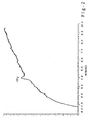
- Fig. 1 is a graph illustrating the experimental data generated in Example 1 (comparative example) discussed below.
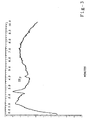
- Fig. 2 is another graph of experimental data generated in Example 1.
- Fig. 3 is another graph of experimental data generated in Example 1.
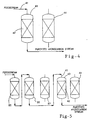
- Fig. 4 is a flow diagram of the process for upgrading the quality of light ends in accordance with the present invention.
- Fig. 5 is a flow diagram of the process of the present invention wherein the modified alumina adsorbent is loaded in adsorbent beds located downstream from alumina driers.
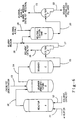
- Fig. 6 is a flow diagram of a propylene process, wherein propylene, treated in accordance with the present invention, is used as a feedstock.
- Impurities including AsH 3 or PH 3 , and optionally COS, H 2 O, CO 2 or H 2 S, are effectively removed from hydrocarbon streams, such as liquid olefin streams, using the chemical adsorbents in accordance with the present invention.
- certain chemical adsorbents have unexpectedly been discovered to be particular effective for the removal of impurities from liquid hydrocarbon streams, such as olefins, for example, propylenes, and are particularly effective for the removal of such impurities from propylene streams.
- the chemical adsorbent most preferred for purposes of the present invention is a modified alumina having a surface area within the range of 10 m 2 /g to 300 m 2 /g and a pore volume within the range of 0.1 mL/g to 1 mL/g, and more preferably also having a surface area within the range of 60 m 2 /g and a pore volume of 0.3 mL/g, as well as a bulk density within the range of 640.6 to 960.9 Kg/m 2 (40 lb./ft. 3 to 60 lb./ft. 3 ), most preferably wherein the bulk density is 880.8 Kg/m 3 (55 lb./ft.
- the modified alumina is spherical having a size within the range of 0.16 cm (1/16") diameter to 0.48 cm (3/16") diameter, and is prepared, for example, by impregnating or providing an alumina with a metal selected from the group consisting of lithium, potassium, calcium, magnesium, barium and sodium.
- the most preferred adsorbent for purpose of the present invention is a solid chemical adsorbent commercially marketed as Katalco 59-3 by Katalco, a business unit of ICI Americas, Inc.
- such chemical adsorbents have been found to be extremely effective in removing relatively small amounts of such impurities to produce a propylene stream which is essentially devoid of such impurities, i.e., which are present in the resultant purified hydrocarbon stream at less than 1.5%, and more preferably less than 10 ppb.
- Katalco 59-3 has been disclosed as a dechlorination catalyst which is specially formulated for the removal of chlorides in advertising publications.
- Katalco 59-3 has been described as being used principally for: the removal of reactive chlorides from natural gases and other hydrocarbon streams by absorption; for the removal of organic chlorides following hydrogenation over a hydro-treating catalyst; and the dehalogenation of combined chloride/fluoride hydrocarbon streams.
- Katalco 59-3 is disclosed as having a high chloride capacity, and reduces the chloride content of gas streams to below the normal detection level.
- Katalco 59-3 is further described as a solid chemical adsorbent for the removal of chlorides from gas streams.
- Katalco 59-3 has also been disclosed as being useful to purify catalytic reformer off-gases containing ammonium chloride and HCl so as to prevent fouling problems associated with these chlorides.
- Katalco 59-3 is described as a high capacity adsorbent exhibiting 5-6 times higher absorptive capacity than alternative products, such as activated alumina; in this regard, Katalco 59-3 is disclosed as absorbing up to 3.86 Kg (8.5 lb.) of chloride per 0.28 m 3 (ft. 3 ).
- Katalco 59-3 has been described as having a unique pore structure and chemically-active surface area which provides rapid chloride pickup, chloride absorption close to 100% theoretical in the saturated zone, and no chloride slip. Notwithstanding such disclosures, it is not believed that, prior to the present invention, KATALCO 59-3 was used in a manner disclosed and claimed herein for purposes of the present invention.
- Suitable impregnating metal compounds for purposes of the present invention include lithium, potassium, sodium, calcium, magnesium, and barium.
- the process for removing impurities from hydrocarbon streams using the chemical adsorbent in accordance with the present invention involves contacting the hydrocarbon stream 41 containing saturated hydrocarbons and/or olefins, including an initial amount of an impurity with the chemical adsorbent 42 under contacting conditions effective to result in a purified olefin stream containing a reduced amount of the impurity.
- the chemical adsorbent is preferably contained in an adsorbent bed 43, zone or other suitable vessel and the hydrocarbon stream, preferably containing olefins, is fed to the chemical adsorbent bed under conditions suitable for the adsorbent bed and process system.
- Suitable contacting conditions include a pressure within the range of 344.8 to 3447.5 kPag (50 to 500 psig), and preferably (1034.25 to 3413.25 kPa (150-350 psig); temperatures within the range of -12.2 to 65.6°C (10°F to 150°F), and preferably within the range of -1.1 to 18.9°C (30°F to 120°F); and a space velocity within the range of 0.1 to 25 VHSV and preferably within the range of 1 to 15 VHSV.
- the olefin stream is fed to the chemical adsorbent bed at 5 VHSV at a temperature of 15.5°C (60°C) under a pressure of 2068.5 KPag (300 psig).
- a process for removing impurities using the chemical adsorbent in accordance with the present invention is shown in a flow diagram which illustrates an embodiment where the modified alumina adsorbent 42 is loaded in adsorbent beds 43,44 located downstream from at least one alumina drier, but preferably two alumina driers 55, 56.
- a spare alumina drier 57 may be provided to alternate with either or both of alumina driers 55,56 if one or both is/are taken off-line.
- the examples have been conducted using the olefin in the gaseous phase, it is believed that the reagent would be equally or more effective, when the hydrocarbon stream is a liquid rather than a gas.
- the present invention has been described for treating an olefin stream, such as propylene, feeds such as ethylene may also be treated in accordance with the present invention, for the reason that, as shown in the examples, the reagent is effective in removing impurities from gaseous streams such as Helium and Propylene.
- the reagent is expected to be equally effective, if not more, for removal of these impurities from liquid hydrocarbon streams.
- the reagent therefore, is suitable for removing impurities from both liquid and gaseous hydrocarbon streams.
- the process of the present invention may be carried out at a temperature of -12.2 to 65.6°C (10°F to 150°F).
- the preferred temperatures which have been used for purposes of the present invention are within the range of -1.1 to 48.9°C (30°F to about 120°F).
- pressures under which the chemical absorption process of the present invention may be practiced will be from 344.8 to 3447.5 KPag (50 psig to 500 psig).
- the pressures which have been used and are preferred for purposes of the present invention fall within the range of 1034.25 to 3413.25 KPag (150 psig to 350 psig).
- the light ends stream processed was polymer grade propylene.
- the normal analysis of the stream is as follows: Propylene: >99.5 %; Propane: ⁇ 0.5 %; CO 2 : ⁇ 2 wppm; COS : ⁇ 1 wppm; AsH 3 : ⁇ 200 wppb; H 2 O: ⁇ 10 wppm.
- CO 2 and H 2 S in Helium carrier gas
- the Katalco reagent would almost quantitatively remove these impurities i.e. to below detectable levels using current measuring techniques.
- a significant amount of COS and AsH 3 are also removed by Katalco 59-3.
- the purified hydrocarbon stream i.e., light ends, and most preferably propylene, which has a substantially reduced amount of impurities may then be processed, for example, in polymerization processes to produce polypropylene wherein the polymerization catalysts, which are otherwise extremely sensitive to the impurities which would otherwise be present in the propylene feedstock, remain active for substantially longer periods of time than if the propylene stream was not treated in accordance with the present invention.
- FIG. 6 schematically illustrate a propylene process wherein propylene, purified in accordance with the present invention is used as a feedstock.
- the attached diagram are schematics of the representative processes which may be used for polypropylene manufacture.
- Fig. 6 a particular environment embodying the present invention is depicted.
- a continuous process is shown, although the present invention is equally applicable to batch type operations.
- a stream of high purity propylene is fed through line 11 into reactor A where it is agitated with a diluent, added through line 12, such as xylene with a Ziegler catalyst comprising 3/1 TiCl 3 /AlCl 3 and diethyl aluminum chloride in the diluent.
- the reaction product is carried to precipitator B via line 10 where a catalyst deactivator such as methanol is introduced through line 13 and agitated with reaction product to deactivate the catalyst.
- the mixture from precipitator B passes the deasher C via line 14 where the contacting is continued and hence to filter D through line 15.
- filter D the solvent and a substantial portion of the catalyst are removed through line 16 while the filter cake is taken through line 17 to be reslurried with xylene and passed by line 18 into the neutralization tank E.
- the neutralizing solution of the present invention i.e., the alcohol and alkali solution, methanol and Na methylate, enter tank E through line 19 and are agitated with the slurried polymer particles which then pass through line 20 to filter F.
- the xylene, methanol Na methylate and further catalyst residuals are removed as filtrate through line 21 and the deashed, neutralized polypropylene comes out as a moist powder through line 22, which powder may be water washed (not shown) and subsequent dried (not shown).
- a lab test was conducted to determine the efficiency of the chemical adsorbent of the present invention.
- Helium containing a 100 vppm CO 2 in helium, was passed through a cylindrical plastic tube, 125 mm in length and 17 mm in diameter with a bulbous end being 30 mm in diameter containing approximately 32 grams of Katalco 59-3 chemical adsorbent composed of a modified alumina, in spherical form, having a diameter within the range of 0.32 to 0.48 cm (1/8" to 3/16"), a surface area of 60 m 2 /g, a pore volume of 0.3 mL/g, and a bulk density of 880.8 Kg/m 3 (55 lb./ft. 3 ).
- the CO 2 content of the feed, i.e. helium, and the effluent was determined using a gas chromatographic analytical system that included a methanator followed by a Flame Ionization Detector commonly used in the industry. It was found that the effluent contained ca.1 vppm of CO 2 .
- the chemical adsorbent used in accordance with the present invention removed greater than 99.5% of the CO 2 in the He feed, wherein CO 2 in the feed was 145 mv signal; and the CO 2 in the effluent was 0.7 mv signal.
- the process for removing impurities from light ends using the chemical adsorbent in accordance with the present invention is valuable in basic as well as retrofit applications, particularly in high purity olefin manufacturing plants, such as propylene, ethylene and the like.
- Typical treatment techniques used for lowering impurity levels in propylene include absorption processes using an organic amine and/or caustic solutions followed by fractionation and drying using alumina driers.
- the impurities such as CO 2 , H 2 S, and the like, are not lowered to "undetectable" levels. Also, in case of upsets in the absorption processed upstream, the impurity levels increase substantially and are beyond the capacity of the downstream processes to handle, thereby throwing the propylene product quality "off-spec".
- Katalco 59-3 in an adsorbent bed either "downstream of” or “in lieu of” the alumina driers offers several advantages.
- such use of Katalco 59-3 has been discovered to improve propylene quality by reducing certain trace impurities, such as CO 2 and H 2 S, to extremely low levels.
- certain trace impurities such as CO 2 and H 2 S
- Katalco 59-3 has a significantly higher capacity to handle the higher impurity levels resulting from upsets in the upstream absorption processes, thereby contributing a significantly to the product quality assurance process.
- the chemical adsorbent can be loaded in adsorbent beds downstream from an alumina drier, or alternatively in lieu of them.
- a gas consisting of 9.2 vppm H 2 S in helium was passed through the same tube as in Example 1 containing a new charge of Katalco 59-3.
- the H 2 S content of the feed and effluent was measured using a Tracor-Atlas Total Sulfur Analyzer. No detectable H 2 S was found in the effluent, i.e., ⁇ 0.1 vppm.
Landscapes
- Chemical & Material Sciences (AREA)
- Organic Chemistry (AREA)
- Chemical Kinetics & Catalysis (AREA)
- Engineering & Computer Science (AREA)
- Medicinal Chemistry (AREA)
- Analytical Chemistry (AREA)
- Oil, Petroleum & Natural Gas (AREA)
- Water Supply & Treatment (AREA)
- Inorganic Chemistry (AREA)
- Health & Medical Sciences (AREA)
- General Chemical & Material Sciences (AREA)
- Polymers & Plastics (AREA)
- Solid-Sorbent Or Filter-Aiding Compositions (AREA)
- Organic Low-Molecular-Weight Compounds And Preparation Thereof (AREA)
- Treatment Of Liquids With Adsorbents In General (AREA)
- Led Devices (AREA)
- Production Of Liquid Hydrocarbon Mixture For Refining Petroleum (AREA)
Claims (13)
- Verfahren zur Entfernung von AsH3- oder PH3-Verunreinigungen aus Kohlenwasserstoffströmen, bei dem ein Kohlenwasserstoffstrom, der eine Anfangsmenge an AsH3- oder PH3-Verunreinigungen enthält, mit einem chemischen Adsorbens, das modifiziertes Aluminiumoxid mit einer Oberfläche von 10 bis 300 m2/g und einem Porenvolumen von 0,1 bis 1 ml/g umfaßt, unter Kontaktbedingungen in Kontakt gebracht wird, die wirksam sind, um zu einem gereinigten Kohlenwasserstoffstrom zu führen, der eine verringerte Menge Verunreinigungen enthält.
- Verfahren nach Anspruch 1, bei dem das modifizierte Aluminiumoxid eine Oberfläche von 60 m2/g und ein Porenvolumen von 0,3 ml/g aufweist.
- Verfahren nach einem der vorhergehenden Ansprüche, bei dem das modifizierte Aluminiumoxid eine Schüttdichte im Bereich von 640,6 bis 960,9 kg/m3 (40 bis 60 lb/ft3), vorzugsweise 880,8 kg/m3 (55 lb/ft3) aufweist.
- Verfahren nach einem der vorhergehenden Ansprüche, bei dem das modifizierte Aluminiumoxid kugelförmig ist und einen Durchmesser von 0,15875 cm (1/16 Inch) bis 0,47625 cm (3/8 Inch) aufweist.
- Verfahren nach einem der vorhergehenden Ansprüche, bei dem das modifizierte Aluminiumoxid mit Lithium-, Natrium-, Kalium-, Calcium-, Magnesium- oder Bariummetall imprägniert ist.
- Verfahren nach einem der vorhergehenden Ansprüche, bei dem das modifizierte Aluminiumoxid α-Aluminiumoxid oder γ-Aluminiumoxid umfaßt.
- Verfahren nach einem der vorhergehenden Ansprüche, bei dem die Kontaktbedingungen eine Temperatur von -12,2 bis 65,6 °C (10 bis 150 °F), vorzugsweise -1,1 bis 48,9 °C (30 bis 120 °F) umfassen.
- Verfahren nach einem der vorhergehenden Ansprüche, bei dem die Kontaktbedingungen einen Überdruck von 344,758 bis 3447,5 kPa (50 bis 500 psig), vorzugsweise 1034,25 bis 3413,25 kPa (150 bis 350 psig) umfassen.
- Verfahren nach einem der vorhergehenden Ansprüche, bei dem die Kontaktbedingungen eine Raumgeschwindigkeit von 0,1 bis 25 VHSV, vorzugsweise 0,5 bis 1 VHSV umfassen.
- Verfahren nach einem der vorhergehenden Ansprüche, bei dem der Kohlenwasserstoffstrom in der flüssigen Phase vorliegt.
- Verfahren nach einem der vorhergehenden Ansprüche, bei dem der Kohlenwasserstoffstrom ein Olefin oder einen gesättigten Kohlenwasserstoff, vorzugsweise mit einer Kohlenstoffzahl von 2, 3 oder 4 umfaßt.
- Verfahren nach einem der vorhergehenden Ansprüche, bei dem das modifizierte Aluminiumoxid in Adsorbensbetten stromabwärts von Aluminiumoxidtrocknern gefüllt ist.
- Verfahren nach einem der vorhergehenden Ansprüche, bei dem die Verunreinigungen außerdem COS, H2O, CO2 oder H2S umfassen.
Applications Claiming Priority (3)
| Application Number | Priority Date | Filing Date | Title |
|---|---|---|---|
| US68204091A | 1991-04-08 | 1991-04-08 | |
| US682040 | 1991-04-08 | ||
| PCT/US1992/002392 WO1992017428A2 (en) | 1991-04-08 | 1992-03-24 | Process for upgrading the quality of light ends |
Publications (2)
| Publication Number | Publication Date |
|---|---|
| EP0580736A1 EP0580736A1 (de) | 1994-02-02 |
| EP0580736B1 true EP0580736B1 (de) | 1997-04-09 |
Family
ID=24737946
Family Applications (1)
| Application Number | Title | Priority Date | Filing Date |
|---|---|---|---|
| EP92910378A Expired - Lifetime EP0580736B1 (de) | 1991-04-08 | 1992-03-24 | Verfahren zur verbesserung der qualität von leichtfraktionen |
Country Status (7)
| Country | Link |
|---|---|
| EP (1) | EP0580736B1 (de) |
| JP (1) | JP2640390B2 (de) |
| AU (1) | AU653600B2 (de) |
| CA (1) | CA2108021C (de) |
| DE (1) | DE69218929T2 (de) |
| ES (1) | ES2099825T3 (de) |
| WO (1) | WO1992017428A2 (de) |
Cited By (1)
| Publication number | Priority date | Publication date | Assignee | Title |
|---|---|---|---|---|
| US9394490B2 (en) | 2014-02-11 | 2016-07-19 | Uop Llc | Process for removing carbonyl sulfide from a hydrocarbon stream |
Families Citing this family (7)
| Publication number | Priority date | Publication date | Assignee | Title |
|---|---|---|---|---|
| US5371313A (en) * | 1993-11-24 | 1994-12-06 | Polysar Rubber Corporation | Purification of hydrocarbon streams |
| US6168769B1 (en) | 1993-12-06 | 2001-01-02 | Phillips Petroleum Company | Olefin purification |
| FR2758554B1 (fr) * | 1997-01-22 | 1999-04-16 | Rhodia Chimie Sa | Procede d'elimination d'inhibiteurs de polymerisation de melanges de monomeres a l'aide d'une alumine de forme optimisee |
| US5846295A (en) * | 1997-03-07 | 1998-12-08 | Air Products And Chemicals, Inc. | Temperature swing adsorption |
| US6124517A (en) * | 1997-03-10 | 2000-09-26 | Bp Amoco Corporation | Olefin purification by adsorption of acetylenics and regeneration of adsorbent |
| JP5119121B2 (ja) * | 2008-10-20 | 2013-01-16 | 三井化学株式会社 | 粗炭化水素からエーテル類を除去する方法および精製炭化水素の製造方法 |
| JP5119122B2 (ja) * | 2008-10-20 | 2013-01-16 | 三井化学株式会社 | 粗炭化水素から含酸素化合物を除去する方法および精製炭化水素の製造方法 |
Family Cites Families (9)
| Publication number | Priority date | Publication date | Assignee | Title |
|---|---|---|---|---|
| DE2135437A1 (de) * | 1971-07-15 | 1973-02-01 | Hoechst Ag | Verfahren zur reaktivfeinreinigung von propylen |
| IT1102409B (it) * | 1978-12-20 | 1985-10-07 | Montedison Spa | Processo per la purificazione di olefine |
| US4433981A (en) * | 1981-02-18 | 1984-02-28 | Shell Oil Company | CO2 Removal from gaseous streams |
| CA1208141A (en) * | 1982-12-20 | 1986-07-22 | John P. Hogan | Removal of carbon dioxide from olefin containing streams |
| BE901355A (fr) * | 1984-12-21 | 1985-06-21 | Labofina Sa | Procede de purification de charges d'hydrocarbures liquides. |
| US4835333A (en) * | 1987-07-01 | 1989-05-30 | Uop | Motor fuel alkylation process utilizing a surfactant containing catalyst to reduce hydrofluoric acid requirements |
| US4835338A (en) * | 1987-08-31 | 1989-05-30 | Aluminum Company Of America | Process for removal of carbonyl sulfide from organic liquid by adsorption using alumina adsorbent capable of regeneration |
| ES2038695T3 (es) * | 1987-09-24 | 1993-08-01 | Fina Research S.A. | Procedimiento para separar arsina de productos hidrocarburicos conteniendo olefina ligera. |
| FR2641711B1 (fr) * | 1989-01-18 | 1993-10-22 | Rhone Poulenc Chimie | Adsorbant pour purification de polyolefines et procede de fabrication de celui-ci |
-
1992
- 1992-03-24 CA CA 2108021 patent/CA2108021C/en not_active Expired - Fee Related
- 1992-03-24 JP JP4510614A patent/JP2640390B2/ja not_active Expired - Fee Related
- 1992-03-24 WO PCT/US1992/002392 patent/WO1992017428A2/en not_active Ceased
- 1992-03-24 ES ES92910378T patent/ES2099825T3/es not_active Expired - Lifetime
- 1992-03-24 EP EP92910378A patent/EP0580736B1/de not_active Expired - Lifetime
- 1992-03-24 DE DE69218929T patent/DE69218929T2/de not_active Expired - Fee Related
- 1992-03-24 AU AU17590/92A patent/AU653600B2/en not_active Ceased
Cited By (1)
| Publication number | Priority date | Publication date | Assignee | Title |
|---|---|---|---|---|
| US9394490B2 (en) | 2014-02-11 | 2016-07-19 | Uop Llc | Process for removing carbonyl sulfide from a hydrocarbon stream |
Also Published As
| Publication number | Publication date |
|---|---|
| CA2108021C (en) | 1997-11-25 |
| AU1759092A (en) | 1992-11-02 |
| JPH07500083A (ja) | 1995-01-05 |
| WO1992017428A2 (en) | 1992-10-15 |
| WO1992017428A3 (en) | 1993-02-18 |
| DE69218929D1 (de) | 1997-05-15 |
| EP0580736A1 (de) | 1994-02-02 |
| JP2640390B2 (ja) | 1997-08-13 |
| CA2108021A1 (en) | 1992-10-09 |
| ES2099825T3 (es) | 1997-06-01 |
| DE69218929T2 (de) | 1997-09-04 |
| AU653600B2 (en) | 1994-10-06 |
Similar Documents
| Publication | Publication Date | Title |
|---|---|---|
| US4493715A (en) | Removal of carbon dioxide from olefin containing streams | |
| CA1314689C (en) | Process for removing arsine from light olefin-containing hydrocarbon feedstocks | |
| KR101886908B1 (ko) | 정제 방법 | |
| US5463167A (en) | Mercury removal by dispersed-metal adsorbents | |
| US4888157A (en) | Sulphur compounds removal | |
| EP0111911B1 (de) | Verfahren zur Entfernung von Kohlendioxyd aus Olefinen enthaltenden Strömen | |
| US5064626A (en) | Trialkyl arsine sorbents | |
| US5024683A (en) | Sorption of trialkyl arsines | |
| KR20030061418A (ko) | 수소화물 가스, 불활성 가스 및 비-반응성 가스를정화하는 방법 및 물질 | |
| EP2158021A1 (de) | Verfahren zur reduktion von kohlenmonoxid in olefinhaltigen kohlenwasserstoffeinsätzen | |
| US5302771A (en) | Process for upgrading the quality of light ends | |
| US3789581A (en) | Process for initial removal of sulfur compounds from gaseous hydrocarbon feedstocks before removal of arsenic therefrom | |
| US4613724A (en) | Process for removing carbonyl-sulfide from liquid hydrocarbon feedstocks | |
| US3782076A (en) | Process for reducing the arsenic content of gaseous hydrocarbon streams by use of supported lead oxide | |
| AU653600B2 (en) | Process for upgrading the quality of light ends | |
| KR930011063B1 (ko) | 액체탄화수소 공급원료로부터 황화카르보닐의 제거방법 | |
| US4491516A (en) | Hydrolysis of carbonyl sulfide over alumina | |
| US4009009A (en) | Process for reducing the COS content of gaseous hydrocarbon streams by use of supported lead oxide | |
| US4442077A (en) | Method of removing hydrides of phosphorus, arsenic, antimony and bismuth from hydrocarbon and non-hydrocarbon streams | |
| CA2132383C (en) | Process for the removal of arsine and carbonyl sulphide from hydrocarbon feedstocks containing light olefins | |
| US4971608A (en) | Sorption and detection of trialkyl arsines | |
| US6168769B1 (en) | Olefin purification | |
| CA1247657A (en) | Process for removing carbonyl-sulfide from liquid hydrocarbon feedstocks | |
| US5972303A (en) | Olefin purification | |
| Chaudhuri et al. | Removal of carbonyl sulfide from a liquid hydrocarbon with activated alumina |
Legal Events
| Date | Code | Title | Description |
|---|---|---|---|
| PUAI | Public reference made under article 153(3) epc to a published international application that has entered the european phase |
Free format text: ORIGINAL CODE: 0009012 |
|
| 17P | Request for examination filed |
Effective date: 19931106 |
|
| AK | Designated contracting states |
Kind code of ref document: A1 Designated state(s): BE DE ES FR GB IT NL SE |
|
| 17Q | First examination report despatched |
Effective date: 19960304 |
|
| GRAG | Despatch of communication of intention to grant |
Free format text: ORIGINAL CODE: EPIDOS AGRA |
|
| GRAH | Despatch of communication of intention to grant a patent |
Free format text: ORIGINAL CODE: EPIDOS IGRA |
|
| GRAH | Despatch of communication of intention to grant a patent |
Free format text: ORIGINAL CODE: EPIDOS IGRA |
|
| GRAA | (expected) grant |
Free format text: ORIGINAL CODE: 0009210 |
|
| AK | Designated contracting states |
Kind code of ref document: B1 Designated state(s): BE DE ES FR GB IT NL SE |
|
| REF | Corresponds to: |
Ref document number: 69218929 Country of ref document: DE Date of ref document: 19970515 |
|
| REG | Reference to a national code |
Ref country code: ES Ref legal event code: FG2A Ref document number: 2099825 Country of ref document: ES Kind code of ref document: T3 |
|
| ET | Fr: translation filed | ||
| PLBE | No opposition filed within time limit |
Free format text: ORIGINAL CODE: 0009261 |
|
| STAA | Information on the status of an ep patent application or granted ep patent |
Free format text: STATUS: NO OPPOSITION FILED WITHIN TIME LIMIT |
|
| PG25 | Lapsed in a contracting state [announced via postgrant information from national office to epo] |
Ref country code: BE Free format text: LAPSE BECAUSE OF NON-PAYMENT OF DUE FEES Effective date: 19980331 |
|
| 26N | No opposition filed | ||
| BERE | Be: lapsed |
Owner name: EXXON CHEMICAL PATENTS INC. Effective date: 19980331 |
|
| REG | Reference to a national code |
Ref country code: GB Ref legal event code: IF02 |
|
| PGFP | Annual fee paid to national office [announced via postgrant information from national office to epo] |
Ref country code: IT Payment date: 20060331 Year of fee payment: 15 |
|
| PGFP | Annual fee paid to national office [announced via postgrant information from national office to epo] |
Ref country code: GB Payment date: 20070202 Year of fee payment: 16 |
|
| PGFP | Annual fee paid to national office [announced via postgrant information from national office to epo] |
Ref country code: NL Payment date: 20070214 Year of fee payment: 16 |
|
| PGFP | Annual fee paid to national office [announced via postgrant information from national office to epo] |
Ref country code: ES Payment date: 20070313 Year of fee payment: 16 |
|
| PG25 | Lapsed in a contracting state [announced via postgrant information from national office to epo] |
Ref country code: SE Free format text: LAPSE BECAUSE OF NON-PAYMENT OF DUE FEES Effective date: 20070325 |
|
| PGFP | Annual fee paid to national office [announced via postgrant information from national office to epo] |
Ref country code: DE Payment date: 20070330 Year of fee payment: 16 |
|
| EUG | Se: european patent has lapsed | ||
| PGFP | Annual fee paid to national office [announced via postgrant information from national office to epo] |
Ref country code: SE Payment date: 20060303 Year of fee payment: 15 |
|
| PGFP | Annual fee paid to national office [announced via postgrant information from national office to epo] |
Ref country code: FR Payment date: 20070301 Year of fee payment: 16 |
|
| GBPC | Gb: european patent ceased through non-payment of renewal fee |
Effective date: 20080324 |
|
| PG25 | Lapsed in a contracting state [announced via postgrant information from national office to epo] |
Ref country code: NL Free format text: LAPSE BECAUSE OF NON-PAYMENT OF DUE FEES Effective date: 20081001 |
|
| NLV4 | Nl: lapsed or anulled due to non-payment of the annual fee |
Effective date: 20081001 |
|
| REG | Reference to a national code |
Ref country code: FR Ref legal event code: ST Effective date: 20081125 |
|
| PG25 | Lapsed in a contracting state [announced via postgrant information from national office to epo] |
Ref country code: DE Free format text: LAPSE BECAUSE OF NON-PAYMENT OF DUE FEES Effective date: 20081001 |
|
| PG25 | Lapsed in a contracting state [announced via postgrant information from national office to epo] |
Ref country code: FR Free format text: LAPSE BECAUSE OF NON-PAYMENT OF DUE FEES Effective date: 20080331 |
|
| REG | Reference to a national code |
Ref country code: ES Ref legal event code: FD2A Effective date: 20080325 |
|
| PG25 | Lapsed in a contracting state [announced via postgrant information from national office to epo] |
Ref country code: GB Free format text: LAPSE BECAUSE OF NON-PAYMENT OF DUE FEES Effective date: 20080324 |
|
| PG25 | Lapsed in a contracting state [announced via postgrant information from national office to epo] |
Ref country code: ES Free format text: LAPSE BECAUSE OF NON-PAYMENT OF DUE FEES Effective date: 20080325 |
|
| PG25 | Lapsed in a contracting state [announced via postgrant information from national office to epo] |
Ref country code: IT Free format text: LAPSE BECAUSE OF NON-PAYMENT OF DUE FEES Effective date: 20070324 |