EP0581202A1 - Support de rail amortissant le bruit - Google Patents
Support de rail amortissant le bruit Download PDFInfo
- Publication number
- EP0581202A1 EP0581202A1 EP93111780A EP93111780A EP0581202A1 EP 0581202 A1 EP0581202 A1 EP 0581202A1 EP 93111780 A EP93111780 A EP 93111780A EP 93111780 A EP93111780 A EP 93111780A EP 0581202 A1 EP0581202 A1 EP 0581202A1
- Authority
- EP
- European Patent Office
- Prior art keywords
- rail
- bearing
- supports
- elements
- foot
- Prior art date
- Legal status (The legal status is an assumption and is not a legal conclusion. Google has not performed a legal analysis and makes no representation as to the accuracy of the status listed.)
- Withdrawn
Links
- 238000009413 insulation Methods 0.000 claims description 85
- 230000008878 coupling Effects 0.000 claims description 12
- 238000010168 coupling process Methods 0.000 claims description 12
- 238000005859 coupling reaction Methods 0.000 claims description 12
- 230000000694 effects Effects 0.000 claims description 10
- 239000004033 plastic Substances 0.000 claims description 9
- 229910000639 Spring steel Inorganic materials 0.000 claims description 6
- 230000005540 biological transmission Effects 0.000 description 4
- 230000015572 biosynthetic process Effects 0.000 description 4
- 239000003822 epoxy resin Substances 0.000 description 4
- 239000004570 mortar (masonry) Substances 0.000 description 4
- 229920000647 polyepoxide Polymers 0.000 description 4
- 238000003860 storage Methods 0.000 description 4
- 229910000746 Structural steel Inorganic materials 0.000 description 3
- 230000003247 decreasing effect Effects 0.000 description 3
- 239000011810 insulating material Substances 0.000 description 3
- 239000000463 material Substances 0.000 description 3
- 239000002184 metal Substances 0.000 description 3
- 229910052751 metal Inorganic materials 0.000 description 3
- 241001669679 Eleotris Species 0.000 description 2
- 238000010276 construction Methods 0.000 description 2
- 238000000034 method Methods 0.000 description 2
- 230000008569 process Effects 0.000 description 2
- 125000006850 spacer group Chemical group 0.000 description 2
- 230000006641 stabilisation Effects 0.000 description 2
- 238000011105 stabilization Methods 0.000 description 2
- 230000007704 transition Effects 0.000 description 2
- 230000008901 benefit Effects 0.000 description 1
- 230000007797 corrosion Effects 0.000 description 1
- 238000005260 corrosion Methods 0.000 description 1
- 238000005520 cutting process Methods 0.000 description 1
- 230000007423 decrease Effects 0.000 description 1
- 238000007688 edging Methods 0.000 description 1
- 239000013013 elastic material Substances 0.000 description 1
- 230000005484 gravity Effects 0.000 description 1
- 235000000396 iron Nutrition 0.000 description 1
- 238000004519 manufacturing process Methods 0.000 description 1
- 230000008092 positive effect Effects 0.000 description 1
- 230000009467 reduction Effects 0.000 description 1
- 230000001629 suppression Effects 0.000 description 1
Images





Classifications
-
- E—FIXED CONSTRUCTIONS
- E01—CONSTRUCTION OF ROADS, RAILWAYS, OR BRIDGES
- E01B—PERMANENT WAY; PERMANENT-WAY TOOLS; MACHINES FOR MAKING RAILWAYS OF ALL KINDS
- E01B9/00—Fastening rails on sleepers, or the like
- E01B9/60—Rail fastenings making use of clamps or braces supporting the side of the rail
-
- E—FIXED CONSTRUCTIONS
- E01—CONSTRUCTION OF ROADS, RAILWAYS, OR BRIDGES
- E01B—PERMANENT WAY; PERMANENT-WAY TOOLS; MACHINES FOR MAKING RAILWAYS OF ALL KINDS
- E01B19/00—Protection of permanent way against development of dust or against the effect of wind, sun, frost, or corrosion; Means to reduce development of noise
- E01B19/003—Means for reducing the development or propagation of noise
-
- E—FIXED CONSTRUCTIONS
- E01—CONSTRUCTION OF ROADS, RAILWAYS, OR BRIDGES
- E01B—PERMANENT WAY; PERMANENT-WAY TOOLS; MACHINES FOR MAKING RAILWAYS OF ALL KINDS
- E01B9/00—Fastening rails on sleepers, or the like
- E01B9/68—Pads or the like, e.g. of wood, rubber, placed under the rail, tie-plate, or chair
- E01B9/685—Pads or the like, e.g. of wood, rubber, placed under the rail, tie-plate, or chair characterised by their shape
- E01B9/688—Pads or the like, e.g. of wood, rubber, placed under the rail, tie-plate, or chair characterised by their shape with internal cavities
-
- E—FIXED CONSTRUCTIONS
- E01—CONSTRUCTION OF ROADS, RAILWAYS, OR BRIDGES
- E01B—PERMANENT WAY; PERMANENT-WAY TOOLS; MACHINES FOR MAKING RAILWAYS OF ALL KINDS
- E01B9/00—Fastening rails on sleepers, or the like
- E01B9/68—Pads or the like, e.g. of wood, rubber, placed under the rail, tie-plate, or chair
- E01B9/685—Pads or the like, e.g. of wood, rubber, placed under the rail, tie-plate, or chair characterised by their shape
Definitions
- the invention relates to a sound-absorbing rail bearing with the features of the preamble of claim 1.
- Sound-insulating rail bearings are used in particular for tracks on subways. This is intended to avoid the transmission of structure-borne noise to the ground and the development of airborne noise as much as possible.
- the structure-borne noise caused by subway trains becomes an extremely serious problem in that it has already led to extensive building damage in many places. The harassment of residents who are directly affected is also considerable in some cases.
- rail bearings can be divided into two categories, base bearings and continuous bearings.
- a Base bearing is used for the selective mounting of a rail, for example on a cross sleeper.
- a continuous warehouse extends along the rail without interruptions.
- a longitudinal threshold is required as a support.
- a continuous bearing for a standard rail according to the preamble of claim 1 is known from DE-OS 38 34 329, a first insulating element being arranged below the foot of the rail and supports being provided on both sides of the rail, inside and outside the track support the bridge to the side and the head downwards with additional insulation elements.
- the rail is completely surrounded in its lower area to the bottom of the head with insulating material of largely constant thickness.
- the entire rail bearing is symmetrical.
- the base of the rail and the first insulation element are supported by a metal frame. Angle irons are screwed onto the frame, which with their horizontal sections exert a prestress on the insulating material arranged above the foot of the rail and support the web of the rail laterally with their vertical sections.
- the upper end of the angle iron supports the head of the rail downwards.
- the vertical section of the angle iron is arranged completely below the head of the rail, ie it does not protrude laterally beyond the head.
- clamping screws are provided on the horizontal sections of the angle iron for setting a prestressing force acting on the insulating material from above on the foot of the rail.
- the first insulation element below the foot of the rail has cavities running in the main direction of extension of the rail. It is supported on a base plate of the frame, for which in turn a support is provided on a longitudinal threshold.
- the well-known continuous bearing allows the rail to deflect up to approx. 7 mm.
- the large-area support of the rail on its web and foot prevents undesired tilting of the rail to the side.
- a sound-absorbing continuous bearing for a special rail has a web that widens conically upwards.
- the rail bearing essentially consists of metallic support surfaces running parallel to the side surfaces of the web.
- the rail is supported on these by means of insulation elements.
- the angled shape of the support surfaces leads to both horizontal and vertical support of the rail.
- all forces acting on the rail are transmitted exclusively to the rail bearing via the side surfaces of the conically widening web. This already results in the need for continuous and therefore expensive storage of the rail.
- a further disadvantage is that the known continuous bearing is only suitable for special rails with a web that widens upwards.
- DE-OS 39 26 392 discloses a sound-absorbing rail bearing for a standard rail belonging to a track, in which an insulating element is in turn arranged directly below the foot.
- Support levers are pivotally mounted on a frame on both sides of the rail.
- the support levers are prestressed towards the foot of the rail and are supported on the rail with the interposition of insulating elements in the transition area between head and web on the one hand and in the transition area between web and foot of the rail on the other hand.
- the support levers prevent the rail from tipping sideways when the rail is deflected.
- the one with the support levers however, the effort involved must be described as extraordinarily large. This applies in particular in view of the necessarily play-free mounting of the support levers.
- a sound-absorbing base camp is known as a "Cologne egg”.
- This base bearing has an oval frame with a main extension extending transversely to the alignment of the rail.
- a rib plate is provided in the frame, the first insulating element being arranged between the rib plate and the frame.
- the rail is rigidly fixed to the rib plate by the foot of the rail from above clamping clamps.
- the lateral stability of the rail is identical to that of the ribbed plate. It essentially depends on the extension of the ribbed plate across the rail.
- the spring constant of the insulation element is included. The result of this is that with a sufficiently stable mounting of the rail, only a vertical spring travel of maximum 3.5 mm is possible. This is not sufficient for the greatest possible structure-borne noise insulation.
- Another known base bearing also has a frame and a rib plate made of metal and an insulating element arranged between them.
- the frame engages around the top of the ribbed plate in order to limit tilting movements.
- its deflection is limited to a few millimeters.
- the invention has for its object to provide a sound-absorbing rail bearing according to the preamble of claim 1, which safely prevents tilting of the rail despite low technical complexity in the manufacture and assembly and at the same time ensures a very good structure-borne sound insulation.
- the free spacing of the lateral supports across the rail can be greater than the width of the head of the rail.
- the free spacing of the supports across the rail can also be greater than the width of the entire rail. If the other insulation elements are accordingly thick, their shear stress when the rail is deflected is greatly reduced. This in turn guarantees that the other insulation elements are particularly resistant to wear. In addition, with a large free distance between the supports It is particularly easy to insert the rail into the base bearing.
- the head of the rail can rest on the further insulation elements, with bent elements running parallel to the rail being formed on the further insulation elements, around which the insulation elements buckle when the rail is deflected.
- the formation of an articulated joint is another way of preventing undesirable shear stress on the insulation elements.
- the location of the articulated joint is marked by opposite recesses in the insulation elements.
- the material of the insulation elements remaining between the recesses then has a hinge function.
- the articulated element is actuated by the underside of the head of the rail. With a corresponding geometrical arrangement, the buckling of the insulation elements causes an increase in the lateral support forces on the rail and thus the required centering effect.
- the supports can be inclined from the bottom upwards away from the rail. This leads to a pressure-push load on the other insulation elements when the rail compresses.
- hard coupling elements can be arranged between the further insulation elements and the rail, their connecting surfaces with the further insulation elements being oriented inclined from the bottom upwards away from the rail. This also results in a defined pressure-shear load on the other insulation elements when the rail's centering egg springs are used.
- the coupling elements can simply be pressed onto the rail in order to ensure the necessary coupling to it.
- the supports arranged outside the track can support the head of the rail to the side in addition to the web with the interposition of the further insulation elements.
- Many known rail bearings are essentially symmetrical.
- the lateral support of the rail in the region of its head is advantageously carried out with a particularly good leverage ratio. This advantage is so noticeable that the lateral deflection of the head of the rail can easily be limited to less than 2 mm, which means that local support of the rail with the new base bearing always corresponds to a known continuous bearing.
- the additional support of the head of the rail also prevents the formation of airborne noise by suppressing natural vibrations of the head of the rail.
- the base bearing can have a frame which laterally encloses the insulating element and forms the supports.
- a base plate embedded in epoxy resin mortar can serve as a support for the insulating element and the frame, but a base plate integrated in the frame can also be provided.
- These embodiments of the base bearing are particularly suitable when the first insulating element is not provided continuously.
- the frame surrounds the insulation element on all sides and thus defines its horizontal position below the rail. The vertical position is defined by the base plate.
- the support point bearing can alternatively each have a half frame arranged inside and outside the track, laterally delimiting the insulating element and forming the respective supports, the insulating element being provided continuously below the rail.
- the continuous insulation element allows a sensible edging only from the side. Accordingly, two half frames are to be provided instead of one frame.
- a base plate embedded in epoxy resin mortar can serve as a support for the half frame. If the first insulation element is continuous and for the insulation element between the individual A simple support is provided for base storage, a quasi-continuous storage of the rail is realized.
- the rail bearing can also have a base frame made of concrete, which receives the first insulating element and the foot of the rail under lateral support by known, so-called angle guide plates and on which the partial frames forming the lateral supports are adjustably mounted transversely to the direction of skin extension of the rail, the Support the tensioning elements on the angle guide plates on the bearing side. At the same time, the tensioning elements load the angle guide plates onto their supports.
- the construction of this embodiment of the new rail bearing corresponds in part to a known rail bearing, in which the rail rests on a longitudinal sleeper with the interposition of a comparatively hard buffer element, with lateral support of the rail foot by angle guide plates and is fixed by spring steel tension clamps acting on the foot of the rail.
- no lateral supports are provided and there is no centering effect on the deflecting rail. However, these are necessary prerequisites for long spring travel, ie good structure-borne sound insulation, while the rail position is stable at the same time.
- the frame and the base plate or the half frame and the base plate or the subframe and / or the angle guide plates can be formed from plastic. Surprisingly, the necessary stabilities of the support bearing can be achieved not only when using metal, but also when it is made of plastic. Plastic already has structure-borne noise-insulating properties and is not only inexpensive to process, but also advantageous in terms of its resistance to corrosion.
- the tensioning elements can be tension clamps made of spring steel, which in turn are advantageously supported on plastic, for example the frame or the angle guide plates. With clamps made of curved spring steel, comparatively high pretensioning forces can be applied to fix the rail in the base bearing. Such clamps have been used extensively in track construction for a long time.
- the spring steel tension clamps represent a transmission path for structure-borne noise from the rail to the rail bearing. However, this transmission path is largely interrupted at the crucial time, since the tension clamps are relieved when the rail is deflected and thus become soft. A precondition for this softening not leading to instability of the rail is its centering lateral support. In the vertical direction, the rail is adequately fixed by the load it causes. If soft-elastic buffer elements are arranged between the tension clamps and the foot, these further reduce the transmission of structure-borne noise via the tension clamps to the frame.
- Extensions encompassing the foot of the rail, which form the buffer elements, can be provided on the first insulating element.
- the extensions on the insulation element thus have a double function. On the one hand, they serve to attach the Insulating elements on the rail, which is particularly advantageous if the insulating element is designed continuously.
- the extensions have buffer elements that are arranged in a very stable position.
- the first insulation element can be designed asymmetrically to the longitudinal center plane of the rail, a local spring constant of the first insulation element growing into the track from the outside. In this way, a tilting movement of the rail to the outside is initiated, which, however, is absorbed to the side by the additional support of the head provided there.
- Cavities with a concentration decreasing from the outside into the track can be provided in the first insulating element.
- the local spring constant of the insulation element is particularly easy to set by the arrangement of cavities. Such cavities can be easily incorporated, for example, when the insulation element is extruded. With regard to the concentration of the cavities and the local spring constants of the insulation element, the proportionality is roughly reversed. As the proportion of voids in the total volume of the insulation element increases, the spring constant decreases accordingly. The decreasing concentration of the insulation elements in the track thus leads to an increasing spring constant in the same direction.
- All insulation elements are advantageously made of rubber. Due to the known properties of this material, rubber is particularly well suited for the formation of a base bearing with high sound insulation values.
- Carrier elements can be provided for attachment to the supports for the further insulation elements. For example, support elements vulcanized onto the insulation elements make it easier to assemble the base bearing when assembling the rail.
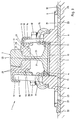
- the rail bearing shown in FIG. 1 is a base bearing 1. It serves for sound-absorbing mounting of a rail 2.
- the rail 2 is designed as a standard rail and consists of a head 3, a foot 4 and a web 5 connecting the head 3 to the foot 4.
- the foot 4 is approximately twice as wide as the head 2.
- the side surfaces 31 of the web 5 run approximately parallel.
- the base bearing 1 has a frame 6 formed here in one piece from plastic and a base plate 22 as a support for the frame 6.
- supports 8 and 9 arranged in pairs one behind the other are provided on both sides of the rail 2.
- the supports 8 are arranged within a track that the rail 2 is assigned, while the supports 9 are outside this track.
- the supports 8 and 9 are at a distance from one another and transversely to the rail 2, which distance is greater than the maximum width of the rail in the region of its base 4.
- a first insulation element 10 is provided in the base bearing.
- the insulation element 10 has extensions 11 which encompass the foot 4.
- the unloaded rail 2 is prestressed by clamping clamps 16 and 17 on the insulation element 10 and thereby fixed in the rail bearing 1.
- the tension clamps 16 and 17 are made of spring steel and act on the foot of the rail 2 from above.
- the extensions 11 of the insulating element 10 are arranged as buffer elements between the tensioning clamps 16 and 17 and the foot 4. For their part, the clamps 16 and 17 are acted upon by screws 18 and 19.
- the rail 2 is stabilized in its horizontal position by further insulation elements 12 and 13 in its correct position.
- the insulation elements 12 and 13 are vulcanized onto support elements 14 and 15, which in turn are supported on the supports 8 and 9.
- the insulation elements 12 rest on the rail 2 in the upper region of the web 15 and on the underside of the head 2.
- the insulation elements 13 additionally provide lateral support for the rail 2 in the region of its head 3.
- an articulated joint 28 is provided for the region of the insulation elements 12 and 13 arranged below the head 3 of the rail 2.
- the articulated joints 28 are each formed by the material of the insulating elements 12 and 13 remaining between two cutouts 29.
- the articulated joints 28 are also acted upon by the prestressing of the rail 2 downward from the tensioning clamps 16, 17.
- the insulating element 10 advantageously has one in the direction out of the track decreasing spring constant. This is effected here by cavities 27, which are provided in the insulating element 10 with a density growing out of the track.
- the base plate 22, which is made of plastic like the frame 6, has screw holes 23. These screw holes 23 correspond to elongated holes 21 in the frame 6. In this way, an adjustment of the frame 6 relative to the base plate 2 in the transverse direction is possible.
- the base plate 22 is in turn embedded in epoxy resin mortar 24 on a threshold, not shown here.
- the threshold can be designed as a transverse threshold. However, it is also sensible to design the threshold in which a simple, continuous support for the insulation element 10 is provided. This can then be provided with a great positive effect with regard to the suppression of natural vibrations of the rail continuously, ie without interruptions under the foot 4 of the rail 2.
- the large spacing of the supports 8 and 9 in the transverse direction is already noticeable.
- it also makes a comparatively large spring deflection of the rail 2 possible under loads, since no non-elastic material is arranged in the desired spring deflection.
- the rail 2 is deflected in the support bearing 1, the following processes are particularly worth mentioning.
- the centering effect of the lateral supports 8, 9 or the further insulation elements 12, 13 and the additional lateral support of the head 3 of the rail 2 by the insulation element 13 prevent the rail 2 from tilting sideways.
- the lateral deflection of the head 3 of the rail 2 is limited to a maximum of 2 mm.
- the insulating element can be designed to be particularly soft, ie with a low spring constant.
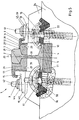
- the structure of the rail bearing according to FIG. 1 can also be seen from the top view according to FIG. 2.
- the stabilization of the rail 2 by the supports 8 and 9 with the interposition of the insulation elements 12 and 13 is discontinuous, ie it only takes place locally within the respective base bearing 1.
- the insulation element 10, of which only the extensions 11 are visible here ie be arranged without interruptions under the foot 4 of the rail 2.
- only a simple support along the rail 2 is required for the insulation element 10. Due to the high efficiency of the lateral stabilization, in particular also of the head 3 of the rail 2 by means of the support 8, 9, despite the discontinuous lateral support, the rail 2 is still very stable against tilting, even with very long spring travel. This is particularly noteworthy because the effort involved in installing the rail 2 below Use of the base camp 1 corresponds to the low cost for a conventional base camp.
- the embodiment of the rail bearing shown in FIG. 3 in the form of the base bearing 1 corresponds to that of FIG. 1 except for the design of the frame 6.
- the frame 1 has no base plate 7 here. Instead, the parts of the frame 6 are connected on both sides of the rail 2 by cross struts 30.
- the frame 6 encloses the insulation element 10 in all horizontal directions, while it rests vertically directly on the base plate 22. In this way, the position of the insulation element 10 is completely defined. This is of particular importance since the insulation element 10 is not continuously provided here.
- the base bearing 1 has two half frames 25 and 26.
- the half frame 25 is arranged inside the track and the half frame 26 outside the track.
- the half frame 25 forms the lateral supports 8, the frame 26 the lateral supports 9.
- the left half of FIG. 4 corresponds to a section plane lying further forward than the right half of FIG. 4.
- the front lateral support 9 is cut, while in the right half of FIG. 4 the middle region assigned to the tension clamp 16 of the half frame 25 is cut between the two lateral supports 8.
- the two half frames 25 and 26 can be screwed onto a base plate, not shown here.
- the essential difference from the previous embodiments is the design and arrangement of the insulation elements 12 and 13 see. These are not directly on the rail 2. Rather, there are 2 coupling elements 32, 33 between the insulation elements 12, 13 and the rail. The coupling elements 32, 33 are pressed laterally against the rail via the half frames 25, 26.
- the connecting surface of the coupling elements 32, 33 which are hard in comparison to the insulating elements 12, 13, with the insulating elements 12, 13 are inclined from the bottom 2 upward away from the rail 2. Parallel to this, the connecting surfaces of the carrier elements 14, 15 run with the insulating elements 12, 13.
- the tensioning clamps 16 and 17 are supported directly on the foot 4 of the rail 2, whereby no insulation effect of the extensions 11 is used, but these are not possibly excessively stressed.
- the two half frames 25 and 26, like the carrier elements 14, 15 and the coupling elements 32, 33, are made of plastic, the insulating elements 12, 13 being vulcanized onto both the insulating elements 14, 15 and the coupling elements 32, 33.
- the inclination of the connecting surfaces delimiting the insulating elements 12, 13 to the carrier elements 14, 15 and the coupling elements 32, 33 is 5 ° here. It is comparatively small in order to allow the rail 2 to deflect downwards and to support the rail 2 laterally during the deflection.
- the embodiment of the rail bearing according to FIG. 5 corresponds to that according to FIGS. 1 and 3 with regard to the insulation elements 12, 13.
- a base frame 34 made of concrete is provided.
- the base frame 34 accommodates the insulation element 10 and the foot 4 of the rail 2, the insulation element 10 with the foot 4 by means of angle guide plates 35, 36 known per se is supported laterally.
- the angle guide plates are provided in recesses 37, 38 tapering from top to bottom in the base frame 34. They are fixed in their position by the tension clamps 16, 17, which are supported on the bearing side on the angle guide plates 35, 36.
- the lateral supports 8, 9 for the rail 2 are provided on subframes 39, 40 which are mounted on the base frame 34 such that they can be displaced transversely to the main direction of extension of the rail 2 and are fixed by screws 41, 42.
- beveled intermediate pieces 43, 44 are provided between the partial frames 39, 40 and the screws 41, 42 in order to insert and determine a lateral pretensioning force of the partial frames 39, 40 on the rail 2.
- the base frame 34 can be provided continuously along the rail 2 or below the insulation element 10, the subframes 39, 40 as well as the angle guide plates 35, 36 being arranged at points. This arrangement can also be seen in FIG. 6, which shows the base bearing 1 according to FIG. 5 in a top view from above.
- FIG. 7 A further embodiment of the base bearing 1 with a base frame 34 can be seen in FIG. 7.
- separate lateral supports 8 and 9 are provided, which are supported by angle guide plates 45, 46 and tension clamps 47, 48.
- the tension clamps 47, 48 are acted upon by the screws 41, 42.
- On the bearing side they are supported on the angle guide plates 45, 46 and on the rail side they rest on the supports 8, 9.
- the lateral supports 8 are thus pressed towards the center of the rail and downwards, as a result of which the insulating elements 12 and 13 are prestressed on the rail in this direction.
- the supports 8, 9 are oriented inclined from the bottom upward away from the rail, as a result of which the centering effect is further enhanced when the loaded rail is deflected.
- the same inclinations have the guide surfaces on which the lateral supports 8, 9 are in turn laterally on the base frame Support 34, while they are acted on from above by the tension clamps 47, 48.
Landscapes
- Engineering & Computer Science (AREA)
- Architecture (AREA)
- Civil Engineering (AREA)
- Structural Engineering (AREA)
- Mechanical Engineering (AREA)
- Railway Tracks (AREA)
Applications Claiming Priority (2)
| Application Number | Priority Date | Filing Date | Title |
|---|---|---|---|
| DE19924224082 DE4224082C2 (de) | 1992-07-22 | 1992-07-22 | Schalldämmendes Stützpunktlager für eine Schiene |
| DE4224082 | 1992-07-22 |
Publications (1)
| Publication Number | Publication Date |
|---|---|
| EP0581202A1 true EP0581202A1 (fr) | 1994-02-02 |
Family
ID=6463778
Family Applications (1)
| Application Number | Title | Priority Date | Filing Date |
|---|---|---|---|
| EP93111780A Withdrawn EP0581202A1 (fr) | 1992-07-22 | 1993-07-22 | Support de rail amortissant le bruit |
Country Status (2)
| Country | Link |
|---|---|
| EP (1) | EP0581202A1 (fr) |
| DE (1) | DE4224082C2 (fr) |
Cited By (5)
| Publication number | Priority date | Publication date | Assignee | Title |
|---|---|---|---|---|
| WO1995030796A1 (fr) * | 1994-05-05 | 1995-11-16 | Phoenix Aktiengesellschaft | Systeme de rail |
| WO1998058126A1 (fr) * | 1997-06-19 | 1998-12-23 | Cito Trading Co. | Rail amortissant et isolant pour trafic ferroviaire |
| WO2002001002A1 (fr) * | 2000-06-27 | 2002-01-03 | Infraco Bcv Limited | Clavette de rail |
| CN108049260A (zh) * | 2017-12-15 | 2018-05-18 | 上海工程技术大学 | 一种充填式调节垫板 |
| CN116254725A (zh) * | 2023-05-15 | 2023-06-13 | 无锡市青山铁路器材有限公司 | 一种挡肩嵌入式压缩型铁路轨道减振扣件 |
Families Citing this family (7)
| Publication number | Priority date | Publication date | Assignee | Title |
|---|---|---|---|---|
| DE4411833A1 (de) * | 1993-03-31 | 1994-10-06 | Udo Wirthwein | Schallgedämpftes Straßenbahngleis |
| DE4406105B4 (de) * | 1994-02-25 | 2006-03-09 | Bwg Gmbh & Co. Kg | Befestigungsanordnung für eine Schiene |
| DE19516097C2 (de) * | 1995-05-03 | 1999-01-28 | Draebing Kg Wegu | Schienenlagerung für eine Schiene |
| ATE386843T1 (de) | 2000-05-03 | 2008-03-15 | Ihec Acquisition Corp | Schienenschutz |
| DE10100034A1 (de) * | 2001-01-03 | 2002-07-04 | Butzbacher Weichenbau Gmbh | Stützpunkt für eine Schiene |
| DE10100033A1 (de) * | 2001-01-03 | 2002-07-04 | Butzbacher Weichenbau Gmbh | Schiene |
| DE102012017897B4 (de) * | 2012-09-11 | 2015-12-31 | OSC-RAILTEC GmbH | Elastische Lagerung von Schienen |
Citations (3)
| Publication number | Priority date | Publication date | Assignee | Title |
|---|---|---|---|---|
| NL8502313A (nl) * | 1985-08-22 | 1987-03-16 | Hollandsche Betongroep Nv | Railbevestiging. |
| DE3834329A1 (de) * | 1987-10-10 | 1989-04-27 | Phoenix Ag | Schienenlager |
| DE3926392A1 (de) * | 1989-02-01 | 1990-08-02 | Studiengesellschaft Fuer Unter | Schalldaemmendes schienenlager |
Family Cites Families (1)
| Publication number | Priority date | Publication date | Assignee | Title |
|---|---|---|---|---|
| DE8807195U1 (de) * | 1988-06-01 | 1988-09-15 | Trelleborg Gummiwerke GmbH, 2351 Wasbek | Schiene für Schienenfahrzeuge |
-
1992
- 1992-07-22 DE DE19924224082 patent/DE4224082C2/de not_active Expired - Fee Related
-
1993
- 1993-07-22 EP EP93111780A patent/EP0581202A1/fr not_active Withdrawn
Patent Citations (3)
| Publication number | Priority date | Publication date | Assignee | Title |
|---|---|---|---|---|
| NL8502313A (nl) * | 1985-08-22 | 1987-03-16 | Hollandsche Betongroep Nv | Railbevestiging. |
| DE3834329A1 (de) * | 1987-10-10 | 1989-04-27 | Phoenix Ag | Schienenlager |
| DE3926392A1 (de) * | 1989-02-01 | 1990-08-02 | Studiengesellschaft Fuer Unter | Schalldaemmendes schienenlager |
Cited By (6)
| Publication number | Priority date | Publication date | Assignee | Title |
|---|---|---|---|---|
| WO1995030796A1 (fr) * | 1994-05-05 | 1995-11-16 | Phoenix Aktiengesellschaft | Systeme de rail |
| WO1998058126A1 (fr) * | 1997-06-19 | 1998-12-23 | Cito Trading Co. | Rail amortissant et isolant pour trafic ferroviaire |
| WO2002001002A1 (fr) * | 2000-06-27 | 2002-01-03 | Infraco Bcv Limited | Clavette de rail |
| CN108049260A (zh) * | 2017-12-15 | 2018-05-18 | 上海工程技术大学 | 一种充填式调节垫板 |
| CN108049260B (zh) * | 2017-12-15 | 2024-04-26 | 上海工程技术大学 | 一种充填式调节垫板 |
| CN116254725A (zh) * | 2023-05-15 | 2023-06-13 | 无锡市青山铁路器材有限公司 | 一种挡肩嵌入式压缩型铁路轨道减振扣件 |
Also Published As
| Publication number | Publication date |
|---|---|
| DE4224082C2 (de) | 1996-10-31 |
| DE4224082A1 (de) | 1994-01-27 |
Similar Documents
| Publication | Publication Date | Title |
|---|---|---|
| EP0420882B2 (fr) | Rail pour vehicules sur rails | |
| EP0249574B1 (fr) | Système de traverses en béton | |
| EP0222277A1 (fr) | Rail à supports élastiques pour véhicules de chemin de fer | |
| EP0581202A1 (fr) | Support de rail amortissant le bruit | |
| EP3044372B1 (fr) | Système ayant un systèm de fixation de rail et une voie ferrée sans ballast | |
| DE4427237A1 (de) | Unterbau für ein Gleis für Schienenfahrzeuge | |
| EP0856086B1 (fr) | Agencement de superstructure | |
| EP1203123B1 (fr) | Voie pour vehicule guide, en particulier pour train a sustentation magnetique | |
| EP1114221B1 (fr) | Structure de traverses destinee a une voie ferree destinee a des vehicules ferroviaires, notamment a une voie ballastee | |
| EP0198158B1 (fr) | Appui élastique d'un rail de chemin de fer | |
| DE19924891C1 (de) | Schalldämmendes Schienenlager | |
| DE19516097C2 (de) | Schienenlagerung für eine Schiene | |
| DE4441561C2 (de) | Schalldämmendes Schienenlager | |
| EP0739436B1 (fr) | Assiette de rail | |
| EP0012265B1 (fr) | Dispositif de fixation de rails | |
| DE69317025T2 (de) | Einbau einer beweglichen Herzstückspitze in einer Kreuzung langer geschweisster Eisenbahnschienen und Verfahren dazu | |
| EP1041200A2 (fr) | Structure de support pour section de voie ferrée | |
| EP3847310A2 (fr) | Ensemble d'aiguillage comprenant des plaques de support d'aiguillage montées de manière élastique | |
| DE29707405U1 (de) | Schalldämmendes Stützpunktlager | |
| EP3798360A1 (fr) | Aiguillage | |
| DE19842312C1 (de) | Schwellenrahmen für einen Schotteroberbau bei Eisenbahnen | |
| DE19920146B4 (de) | Lagerung einer Schiene für Schienenfahrzeuge | |
| DE4031540C2 (de) | Schienenlager | |
| DE19544055A1 (de) | Oberbaukonstruktion | |
| DE3022322A1 (de) | Profillagerstreifen aus elastomerem werkstoff fuern gleistoege |
Legal Events
| Date | Code | Title | Description |
|---|---|---|---|
| PUAI | Public reference made under article 153(3) epc to a published international application that has entered the european phase |
Free format text: ORIGINAL CODE: 0009012 |
|
| AK | Designated contracting states |
Kind code of ref document: A1 Designated state(s): AT DE FR GB IT |
|
| 17P | Request for examination filed |
Effective date: 19940204 |
|
| 17Q | First examination report despatched |
Effective date: 19940317 |
|
| STAA | Information on the status of an ep patent application or granted ep patent |
Free format text: STATUS: THE APPLICATION IS DEEMED TO BE WITHDRAWN |
|
| GRAH | Despatch of communication of intention to grant a patent |
Free format text: ORIGINAL CODE: EPIDOS IGRA |
|
| 18D | Application deemed to be withdrawn |
Effective date: 19960116 |