EP0583032B1 - Photographisches Entwicklungsgerät - Google Patents
Photographisches Entwicklungsgerät Download PDFInfo
- Publication number
- EP0583032B1 EP0583032B1 EP19930202300 EP93202300A EP0583032B1 EP 0583032 B1 EP0583032 B1 EP 0583032B1 EP 19930202300 EP19930202300 EP 19930202300 EP 93202300 A EP93202300 A EP 93202300A EP 0583032 B1 EP0583032 B1 EP 0583032B1
- Authority
- EP
- European Patent Office
- Prior art keywords
- dimension
- sheet
- sensor
- feed
- measured
- Prior art date
- Legal status (The legal status is an assumption and is not a legal conclusion. Google has not performed a legal analysis and makes no representation as to the accuracy of the status listed.)
- Expired - Lifetime
Links
Images
Classifications
-
- G—PHYSICS
- G03—PHOTOGRAPHY; CINEMATOGRAPHY; ANALOGOUS TECHNIQUES USING WAVES OTHER THAN OPTICAL WAVES; ELECTROGRAPHY; HOLOGRAPHY
- G03F—PHOTOMECHANICAL PRODUCTION OF TEXTURED OR PATTERNED SURFACES, e.g. FOR PRINTING, FOR PROCESSING OF SEMICONDUCTOR DEVICES; MATERIALS THEREFOR; ORIGINALS THEREFOR; APPARATUS SPECIALLY ADAPTED THEREFOR
- G03F7/00—Photomechanical, e.g. photolithographic, production of textured or patterned surfaces, e.g. printing surfaces; Materials therefor, e.g. comprising photoresists; Apparatus specially adapted therefor
- G03F7/26—Processing photosensitive materials; Apparatus therefor
- G03F7/30—Imagewise removal using liquid means
- G03F7/3042—Imagewise removal using liquid means from printing plates transported horizontally through the processing stations
- G03F7/3071—Process control means, e.g. for replenishing
Definitions
- This invention relates to apparatus for the development of exposed photographic material, and in particular to apparatus for developing lithographic offset printing plates.
- the exhaustion of the chemicals in the baths can normally be directly correlated with the amount of processed material passing through the apparatus. This in turn is directly related to the surface area of the material being processed.
- a known surface area detection means comprises one sensor for sensing the length of processed material, and an array of sensors to determine the width of the material.
- Such a system is relatively expensive since to measure random material widths with precision requires a large number of sensors.
- offset printing plates may vary in width from 225 mm to 800 mm and if it is necessary to measure all possible combinations of standard material widths from 200 mm upwards within a 10% accuracy band some 30 sensors are necessary, and within a 20% accuracy band some 16 sensors are necessary.
- JP-A-4 166 935 (Fuji Photo Film Co. Ltd.).
- This system likewise comprises one sensor for sensing the length of processed material.
- the width size of the material is determined on the basis of a previously set ratio length to width in the processing direction of the photosensitive material. It is clear that this system will work satisfactorily only if all the different sheet formats being processed have (nearly) the same ratio of length to width, and if all the sheets are being processed lengthwise. On the contrary, if a sheet is being processed widthwise, the length sensor will errorneously consider a smaller dimension, in accordance with the set ratio, as being the width belonging to the measured "length". Alos, the use of the ratio length to width for the control of the replenishment forms a serious limitation of the number of sheet formats that can be used in the apparatus.
- the present invention provides a simple means of calculating the surface area of the processed material which is suitable for a selection of sheets of multiple formats and which operates independently from whether the sheet is transported lengthwise or widthwise through a processor.
- the apparatus is for the processing of exposed aluminium lithographic offset printing plates.
- Offset printing plates are never supplied in exact standard A1, A2, A3, etc., formats having a constant ratio of length to width since the plate is always larger than the paper format in the length direction to enable the plate to be secured around a printing drum.
- the comparator means produces a signal indicative of the largest sheet format containing said dimension.
- the apparatus includes a sheet feed means, and a feed sensor which senses when the sheet is substantially centralised relative to the sheet feed means, the feed sensor being operable to prevent the operation of the feed sheet means if the presence of a sheet is not sensed.
- the apparatus includes a sheet feed means that is driven through a clutch means, the clutch means being controlled by at least one further sensor which senses a process parameter so that the feed means is operable only when a desired value of process parameter is reached.
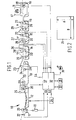
- FIG 1 With reference to figure 1 there is illustrated a longitudinal cross-section through an apparatus 10 for processing exposed photographic sheet material, in particular aluminium lithographic printing plates, of the type described in EP-A-410500.
- EP-A-410500 discloses an imaging element containing an aluminium support provided with in the order given an image receiving layer and a photosensitive layer containing a silver halide emulsion.
- a diffusion transfer reversal process for obtaining a lithographic printing plate in which said imaging element is image-wise exposed and subsequently developed using a developing liquid or activating liquid in the presence of a silver halide complexing agent.
- the imaging element is then guided through a diffusion transfer zone so that the silver halide complexes formed during the development step are allowed to diffuse into the image-receiving layer where they are converted to silver.
- the imaging element leaves the diffusion transfer zone a silver image is formed in the image receiving layer.
- the now useless photosensitive layer and optional other layers above the image receiving layer are then removed by rinsing the imaging element in a washing section.
- the element now carrying a silver image on its surface is treated with a finishing liquid that contains so called hydrophobizing agent for improving the hydrophobicity of the silver image.
- the apparatus 10 is mounted within a generally rectangular housing which may include a rectangular metal frame (not shown) for supporting the various parts of the apparatus.
- the apparatus comprises a sheet feed means 11, preferably a pair of rollers 20, a developing section 12, a diffusion transfer section 13, a wash section 14, a rinse section 15, a finishing section 16, a drier 17, and output rollers 18. All these sections are linked by a single drive screw so that all the sections' rollers 20 can operate simultaneously at the same speed.
- a typical aluminium sheet or plate 21 is shown in figure 2, and has basically a width A and a length B. These sizes A & B are loosely based on standard A1, A2, A3, etc., formats and will have maximum dimensions of about 80 cms width A, and 1.10 metre length B.
- the consumption of the chemicals in the various sections 12, 15, 16, directly relates to the area of the plate.
- the image on the plate generally involves about 10% - 25% of the area of the plate and therefore the correlation between chemical consumption and area of the plate 21 passing through the apparatus is good.
- a length sensor 31 is preferably arranged at a position where the velocity of the processed sheet through the apparatus is constant. A suitable position is at the output end of the apparatus between the drier 17 and the output rollers 18.
- the sensor 31 can be an optical sensor, a mechanical sensor, or any other suitable device which can determine the length of a passing sheet material.
- a signal S1 from the sensor 31 passes to a first controller 32 which can calculate the length of the sheet material from the process speed and the detection time, (i.e. the time the sensor 31 is operating).
- the controller 32 compares the dimension measured with preprogrammed dimensions for various formats of sheet material held in memory 33. In the event of the controller 32 matching the measured dimension and a stored dimension a signal S2 is sent to a replenishment means 34 where the signal S2 is utilised to provide automatic replenishment of the developing fluid in accordance with the signal S2.
- Aluminium printing plates are not exactly A1, A2, A3, etc., standard sizes and it is therefore unlikely that a given dimension will appear more than once in the memory. However in the event that the measured dimension occurs more than once in the memory, the controller 32 can provide a signal S2 corresponding to the largest plate format containing that dimension.
- the dimensions of given sheets of material to be processed could be stored directly into the memory 33, during manufacture, but preferably can be entered into the memory by a user operable unit means 35 such as a key board, or a bar code reader.
- the system gives an error signal through an alarm 36 such as a light emitting diode, and sends a signal S2 corresponding to a previous counted surface area of a plate format with a length dimension longer than the detected one, or sends a signal S2 corresponding to a surface are equal to the length measured multiplied by the maximum plate width.
- an alarm 36 such as a light emitting diode
- any plates 21 should be roughly centralised with respect to the longitudinal centre line of the apparatus.
- the plates 21 are fed into the apparatus 10 through a pair of rollers 11 which are driven by a clutch means 19.
- the clutch means 19 could be a mechanical clutch but is preferably an electromagnetic clutch operated by a clutch control means 37.
- the clutch control means 37 is connected to a feed sensor 22 which is located on the longitudinal centre line of the apparatus.
- the control means 37 operates to control the clutch for rotation of the feed rollers 11 only when the sensor 22 detects that the plate 21 is being fed roughly centrally into the apparatus and sends a signal S3 to the control 37. More positive guide means may also by necessary to centralise the plate.
- the clutch controller 37 may be programmed to operate a time delay after initial detection of a plate to allow for precise positioning of a plate 21 against static rollers 11.
- the apparatus 10 may include a rewash facility 23 for feeding already processed and reworked plates back into the wash section 14.
- a second feed sensor 24 is located on the rewash facility to sense the presence of plates thereon.
- a signal S4 will be sent to the clutch control 37 which will prevent the operation of the clutch means 19 thereby preventing the input of plates until the rewashed plate is processed.
- condition sensors 25, 26, 27, and 28 The process conditions within the developing section 12, wash section 14, rinse section 15, and finishing section 16 can be monitored by condition sensors 25, 26, 27, and 28 respectively.
- the invention is not limited to the embodiment disclosed hereinbefore.
- the apparatus according to the invention can be used for processing photographic materials other than aluminium lithograhic printing plates, such as printing plates with a polyethylene terephthalate support, and other conventional photographic materials requiring careful control of the replenishment of their processing baths.
- the use of the apparatus is not limited to the range of formats mentioned, and the length sensor 31 can be located at other suitable positions on the apparatus where the process velocity is constant e.g. the diffusion section.
Landscapes
- Engineering & Computer Science (AREA)
- Automation & Control Theory (AREA)
- Physics & Mathematics (AREA)
- General Physics & Mathematics (AREA)
- Photosensitive Polymer And Photoresist Processing (AREA)
Claims (7)
- Ein Gerät (10) zur Entwicklung von belichtetem fotografischem Bogenmaterial (21), wobei das Gerät einen die Länge des Materials ermittelnden Sensor (31) und ein Element (32, 33) zur Berechnung des Oberflächeninhalts von entsprechend der ermittelten Länge verarbeitetem rechteckigem fotografischem Bogenmaterial umfaßt, dadurch gekennzeichnet, daß das Gerät ein Speicherelement (33), das Information bezüglich der Breite und Länge von vorgegebenen Formaten von rechteckigen, im Gerät zu verarbeitenden Materialbogen speichert, und ein Steuerelement (32) umfaßt, das die gemessene Abmessung mit den gespeicherten Abmessungen vergleicht und ein einen Oberflächeninhalt darstellendes Signal (S2) erstellt, wenn es Übereinstimmung zwischen einer gespeicherten Abmessung und einer gemessenen Abmessung gibt und wenn Sensor (31) eine Abmessung mißt, die wesentlich dieselbe ist als eine in mehr als einer Formatgröße bestehende Abmessung, um ein das größtmögliche, die Abmessung umfassende Bogenformat darstellendes Signal zu erstellen.
- Gerät nach Anspruch 1, dadurch gekennzeichnet, daß falls es keine Übereinstimmung zwischen einer gespeicherten Abmessung und einer gemessenen Abmessung besteht, das Steuerelement die gemessene Länge mit der gespeicherten Höchstbreite multipliziert, um das Signal zu verschaffen.
- Gerät nach Anspruch 1 oder 2, dadurch gekennzeichnet, daß falls es keine Übereinstimmung zwischen einer gemessenen Abmessung und einer gespeicherten Abmessung besteht, das Steuerelement einen vorigen berechneten Oberflächeninhalt einer Platte mit einem Format, bei dem die Länge größer ist als die gemessene Länge, als Ausgangswert nimmt.
- Gerät nach irgendeinem der Ansprüche 1 bis 3, dadurch gekennzeichnet, daß der Sensor an einer Stelle auf dem Gerät, an der die Geschwindigkeit des verarbeiteten, durch das Gerät . beförderten Bogens konstant ist, angeordnet ist.
- Gerät nach irgendeinem der Ansprüche 1 bis 4, dadurch gekennzeichnet, daß das Gerät weiterhin ein Bogenzufuhrelement (11) und einen Zufuhrsensor (22) umfaßt, der nachweist, wenn sich der Bogen (21) wesentlich in der Mitte bezogen auf das Bogenzufuhrelement (11) befindet, wobei der Zufuhrsensor (22) das Bogenzufuhrelement ausschaltet, sobald kein Bogen mehr beobachtet wird.
- Gerät nach Anspruch 5, dadurch gekennzeichnet, daß das Gerät wenigstens einen weiteren, einen Prozeßparameter im Gerät (10) nachweisenden Sensor (24, 25, 26, 27, 28) umfaßt und das Bogenzufuhrelement (11) durch ein Kupplungselement (19), das nur eingeschaltet wird, wenn der nachgewiesene Prozeßparameter einen erwünschten Wert erreicht hat, angetrieben wird.
- Gerät nach irgendeinem der Ansprüche 1 bis 6 für die Entwicklung von lithografischen Aluminium-Offsetdruckplatten.
Priority Applications (1)
| Application Number | Priority Date | Filing Date | Title |
|---|---|---|---|
| EP19930202300 EP0583032B1 (de) | 1992-08-11 | 1993-08-04 | Photographisches Entwicklungsgerät |
Applications Claiming Priority (3)
| Application Number | Priority Date | Filing Date | Title |
|---|---|---|---|
| EP92202462 | 1992-08-11 | ||
| EP92202462 | 1992-08-11 | ||
| EP19930202300 EP0583032B1 (de) | 1992-08-11 | 1993-08-04 | Photographisches Entwicklungsgerät |
Publications (3)
| Publication Number | Publication Date |
|---|---|
| EP0583032A2 EP0583032A2 (de) | 1994-02-16 |
| EP0583032A3 EP0583032A3 (en) | 1995-09-13 |
| EP0583032B1 true EP0583032B1 (de) | 1998-01-21 |
Family
ID=26131625
Family Applications (1)
| Application Number | Title | Priority Date | Filing Date |
|---|---|---|---|
| EP19930202300 Expired - Lifetime EP0583032B1 (de) | 1992-08-11 | 1993-08-04 | Photographisches Entwicklungsgerät |
Country Status (1)
| Country | Link |
|---|---|
| EP (1) | EP0583032B1 (de) |
Families Citing this family (1)
| Publication number | Priority date | Publication date | Assignee | Title |
|---|---|---|---|---|
| EP2775351B1 (de) * | 2013-03-07 | 2017-02-22 | Agfa Graphics NV | Vorrichtung und Verfahren zur Verarbeitung einer Lithografiedruckplatte |
Family Cites Families (3)
| Publication number | Priority date | Publication date | Assignee | Title |
|---|---|---|---|---|
| JPS61123846A (ja) * | 1984-11-20 | 1986-06-11 | Konishiroku Photo Ind Co Ltd | 感光性平版印刷版の処理方法 |
| JPH03107167A (ja) * | 1989-09-20 | 1991-05-07 | Fuji Photo Film Co Ltd | 感光材料処理装置 |
| JP2692714B2 (ja) * | 1990-10-31 | 1997-12-17 | 富士写真フイルム株式会社 | 自動現像機の補充液補充装置 |
-
1993
- 1993-08-04 EP EP19930202300 patent/EP0583032B1/de not_active Expired - Lifetime
Also Published As
| Publication number | Publication date |
|---|---|
| EP0583032A2 (de) | 1994-02-16 |
| EP0583032A3 (en) | 1995-09-13 |
Similar Documents
| Publication | Publication Date | Title |
|---|---|---|
| US5583610A (en) | Print processing method, photographic printer, and print stacking device and method | |
| US4300828A (en) | Photosensitive sheet processor | |
| EP0583032B1 (de) | Photographisches Entwicklungsgerät | |
| US5448325A (en) | Photographic development apparatus | |
| EP0582751B1 (de) | Photographisches Entwicklungsgerät | |
| US20030152382A1 (en) | Photosensitive material processing apparatus and photosensitive material | |
| JP2708634B2 (ja) | 写真処理に関する改善 | |
| US4825257A (en) | Picture recording method | |
| JPH0553288A (ja) | 面種切替え機能付き写真作製装置 | |
| JP3396621B2 (ja) | シート材監視方法及び装置 | |
| JP2704668B2 (ja) | カラー印画紙の処理方法 | |
| EP0510051A1 (de) | Automatische entwicklungsmaschine für photographischen film. | |
| JPH0922073A (ja) | 写真フィルム及びプリント方法及び装置 | |
| JPH01267628A (ja) | コマの位置決め装置 | |
| JPS6337060A (ja) | 感光シ−ト残量検知手段を有する画像形成装置 | |
| JPS61219031A (ja) | 製版カメラ | |
| JPH04367843A (ja) | 写真処理システム用プリンタ | |
| JPH06230546A (ja) | 画像記録材料の搬送ガイド機構 | |
| JPH0696425B2 (ja) | 画像形成装置 | |
| JPH0789216B2 (ja) | 現像処理方法 | |
| JPS61162459A (ja) | 電子写真製版機のロ−ル給紙装置 | |
| JPH11258755A (ja) | 自動現像機 | |
| JPH07333816A (ja) | シート感光材料処理装置 | |
| JPH0122614B2 (de) | ||
| JPH04139448A (ja) | 現像液補充検知装置 |
Legal Events
| Date | Code | Title | Description |
|---|---|---|---|
| PUAI | Public reference made under article 153(3) epc to a published international application that has entered the european phase |
Free format text: ORIGINAL CODE: 0009012 |
|
| AK | Designated contracting states |
Kind code of ref document: A2 Designated state(s): BE DE FR GB NL |
|
| PUAL | Search report despatched |
Free format text: ORIGINAL CODE: 0009013 |
|
| AK | Designated contracting states |
Kind code of ref document: A3 Designated state(s): BE DE FR GB NL |
|
| 17P | Request for examination filed |
Effective date: 19960313 |
|
| 17Q | First examination report despatched |
Effective date: 19970428 |
|
| GRAG | Despatch of communication of intention to grant |
Free format text: ORIGINAL CODE: EPIDOS AGRA |
|
| GRAG | Despatch of communication of intention to grant |
Free format text: ORIGINAL CODE: EPIDOS AGRA |
|
| GRAH | Despatch of communication of intention to grant a patent |
Free format text: ORIGINAL CODE: EPIDOS IGRA |
|
| GRAH | Despatch of communication of intention to grant a patent |
Free format text: ORIGINAL CODE: EPIDOS IGRA |
|
| GRAA | (expected) grant |
Free format text: ORIGINAL CODE: 0009210 |
|
| AK | Designated contracting states |
Kind code of ref document: B1 Designated state(s): BE DE FR GB NL |
|
| REF | Corresponds to: |
Ref document number: 69316475 Country of ref document: DE Date of ref document: 19980226 |
|
| ET | Fr: translation filed | ||
| PGFP | Annual fee paid to national office [announced via postgrant information from national office to epo] |
Ref country code: BE Payment date: 19980625 Year of fee payment: 6 |
|
| PGFP | Annual fee paid to national office [announced via postgrant information from national office to epo] |
Ref country code: NL Payment date: 19980831 Year of fee payment: 6 |
|
| PLBE | No opposition filed within time limit |
Free format text: ORIGINAL CODE: 0009261 |
|
| 26N | No opposition filed | ||
| PG25 | Lapsed in a contracting state [announced via postgrant information from national office to epo] |
Ref country code: BE Free format text: LAPSE BECAUSE OF NON-PAYMENT OF DUE FEES Effective date: 19990831 |
|
| REG | Reference to a national code |
Ref country code: GB Ref legal event code: 746 Effective date: 19990812 |
|
| REG | Reference to a national code |
Ref country code: FR Ref legal event code: D6 |
|
| BERE | Be: lapsed |
Owner name: AGFA-GEVAERT N.V. Effective date: 19990831 |
|
| PG25 | Lapsed in a contracting state [announced via postgrant information from national office to epo] |
Ref country code: NL Free format text: LAPSE BECAUSE OF NON-PAYMENT OF DUE FEES Effective date: 20000301 |
|
| NLV4 | Nl: lapsed or anulled due to non-payment of the annual fee |
Effective date: 20000301 |
|
| REG | Reference to a national code |
Ref country code: GB Ref legal event code: IF02 |
|
| PGFP | Annual fee paid to national office [announced via postgrant information from national office to epo] |
Ref country code: FR Payment date: 20030619 Year of fee payment: 11 |
|
| PGFP | Annual fee paid to national office [announced via postgrant information from national office to epo] |
Ref country code: DE Payment date: 20030620 Year of fee payment: 11 |
|
| PG25 | Lapsed in a contracting state [announced via postgrant information from national office to epo] |
Ref country code: DE Free format text: LAPSE BECAUSE OF NON-PAYMENT OF DUE FEES Effective date: 20050301 |
|
| PG25 | Lapsed in a contracting state [announced via postgrant information from national office to epo] |
Ref country code: FR Free format text: LAPSE BECAUSE OF NON-PAYMENT OF DUE FEES Effective date: 20050429 |
|
| REG | Reference to a national code |
Ref country code: FR Ref legal event code: ST |
|
| REG | Reference to a national code |
Ref country code: GB Ref legal event code: 732E |
|
| PGFP | Annual fee paid to national office [announced via postgrant information from national office to epo] |
Ref country code: GB Payment date: 20070725 Year of fee payment: 15 |
|
| GBPC | Gb: european patent ceased through non-payment of renewal fee |
Effective date: 20080804 |
|
| PG25 | Lapsed in a contracting state [announced via postgrant information from national office to epo] |
Ref country code: GB Free format text: LAPSE BECAUSE OF NON-PAYMENT OF DUE FEES Effective date: 20080804 |