EP0583080A2 - Bildverarbeitung - Google Patents
Bildverarbeitung Download PDFInfo
- Publication number
- EP0583080A2 EP0583080A2 EP93305544A EP93305544A EP0583080A2 EP 0583080 A2 EP0583080 A2 EP 0583080A2 EP 93305544 A EP93305544 A EP 93305544A EP 93305544 A EP93305544 A EP 93305544A EP 0583080 A2 EP0583080 A2 EP 0583080A2
- Authority
- EP
- European Patent Office
- Prior art keywords
- pixels
- pixel
- label
- labels
- adjacent pixels
- Prior art date
- Legal status (The legal status is an assumption and is not a legal conclusion. Google has not performed a legal analysis and makes no representation as to the accuracy of the status listed.)
- Withdrawn
Links
Images

Classifications
-
- G—PHYSICS
- G06—COMPUTING OR CALCULATING; COUNTING
- G06T—IMAGE DATA PROCESSING OR GENERATION, IN GENERAL
- G06T5/00—Image enhancement or restoration
- G06T5/20—Image enhancement or restoration using local operators
-
- G—PHYSICS
- G06—COMPUTING OR CALCULATING; COUNTING
- G06V—IMAGE OR VIDEO RECOGNITION OR UNDERSTANDING
- G06V10/00—Arrangements for image or video recognition or understanding
- G06V10/40—Extraction of image or video features
- G06V10/44—Local feature extraction by analysis of parts of the pattern, e.g. by detecting edges, contours, loops, corners, strokes or intersections; Connectivity analysis, e.g. of connected components
- G06V10/457—Local feature extraction by analysis of parts of the pattern, e.g. by detecting edges, contours, loops, corners, strokes or intersections; Connectivity analysis, e.g. of connected components by analysing connectivity, e.g. edge linking, connected component analysis or slices
Definitions
- This invention relates to a method of image processing.
- the flagged pixel is given one of these labels and the fact that the two labels are associated parts of the same object is recorded.
- This invention was intended to produce an image processor overcoming this problem at least in part.
- This invehtion provides a method of image processing to identify which pixels having some pre-determined property in the image are associated together comprising the steps of:
- FIG. 1 an array of pixels 1 are shown arranged in rows 2 and columns 3 as is normal.
- the pixels shown as X's have been flagged by a previous data processing stage as having an associated value over a threshold while those shown as Y's have not, the edge of the array is indicated by a dashed line 4.
- the array is then scanned using a 3 x 3 window 5, shown in Figure 2 where the Y's are omitted forclar- ity.
- the window 5 is scanned across the array one row 2 at a time looking at the pixel 1 at the centre of the window 5.
- the window 5 When the window 5 reaches a point where the central pixel is an X it examines the eight adjacent pixels 1 to see whether any of them contains a label.
- the central pixel is assigned that label. If two or more of the eight adjacent pixels have been assigned different labels the central pixel is assigned the earliest of those labels.
- the window 5 then scans on to the next position and here also the central pixel is flagged.
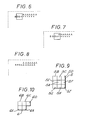
- One of the eight adjacent pixels has already been assigned the label A, so the central pixel is also assigned the label A, as shown in Figure 4. This process is repeated until all of the flagged pixels in this row have been assigned the label A.
- the window 5 continues to scan along this row, when each of the flagged pixels is examined in turn one of the eight adjacent pixels will have the label B, so each of the flagged pixels is also assigned the label B, as shown in Figure 6.
- the central pixel is flagged so the eight adjacent pixels are examined.
- One of the adjacent pixels has been assigned the label A and another has been assigned the label B so the central pixel is also assigned the label A and a note is made that the pixels assigned the labels Aand B are parts of the same object in the image.
- the window 5 then continues along the row, at each flagged pixel one of the eight adjacent pixels will have been assigned the label A, so all of the remaining flagged pixels are assigned the label A, as shown in Figure 8.
- the 3 x 3 window 5 is shown. This comprises a central pixel 5A and the eight adjacent pixels 5B to 51.
- An image processing method employs a five pixel window 6 comprising a pixel 6A which is checked to see if it is flagged and four adjacent pixels 6B to 6E. Pixels 6B to 6D are in the last line scanned, pixel 6C is adjacent the pixel 6A, while pixels 6D and 6D are adjacent the pixel 6B and are behind and in front of the pixel 6C in the row in the direction of scan of the window 6 respectively.
- Pixel 6E is in the same row as pixel 6Aand behind it as the window 6 scans across the image. Behind is used here to signify that the pixel 6E is in the position last occupied by the pixel 6A.
- the image processor employs the window 6 in the same manner as the prior art window 5, the window6 is scanned across the image one row 2ata a time so that each pixel 1 of the image in turn is covered by the pixel 6A.
- some or all of the window pixels 6B to 6E may correspond to areas outside the array, for example in the first, top row, of the image the pixels 6B to 6D will all correspond to positions outside the array, in these positions the pixels of the window lying outside the array are just ignored.
- the window 6 produces the same results as the window 5, but has four fewer pixels to check and so requires less comparisons and calculations to be carried out, as a result the image processing can be carried out faster or using less computing power.
- the amount of calculation required can be reduced still further by looking at the pixels 6B to 6E in order. If pixel 6A is flagged and pixel 6E is examined first and has an assigned label only pixel 6D need then be examined and the pixel 6A assigned the lowest label assigned to pixels 6E and 6D. In this case there is no need to examine pixels 6B or 6C.
- the window 6 was scanned across the image in the opposite sense, or scanned each column in turn instead of each row in turn the arrangement of pixels in the window 6 would of course have to be reoriented, but in all cases the four adjacent and already scanned pixels should make up the window.
Landscapes
- Engineering & Computer Science (AREA)
- Physics & Mathematics (AREA)
- General Physics & Mathematics (AREA)
- Theoretical Computer Science (AREA)
- Computer Vision & Pattern Recognition (AREA)
- Multimedia (AREA)
- Image Analysis (AREA)
Applications Claiming Priority (2)
| Application Number | Priority Date | Filing Date | Title |
|---|---|---|---|
| GB9217011A GB2269695A (en) | 1992-08-11 | 1992-08-11 | Image processing |
| GB9217011 | 1992-08-11 |
Publications (2)
| Publication Number | Publication Date |
|---|---|
| EP0583080A2 true EP0583080A2 (de) | 1994-02-16 |
| EP0583080A3 EP0583080A3 (de) | 1995-04-12 |
Family
ID=10720163
Family Applications (1)
| Application Number | Title | Priority Date | Filing Date |
|---|---|---|---|
| EP93305544A Withdrawn EP0583080A3 (de) | 1992-08-11 | 1993-07-15 | Bildverarbeitung. |
Country Status (2)
| Country | Link |
|---|---|
| EP (1) | EP0583080A3 (de) |
| GB (1) | GB2269695A (de) |
Cited By (2)
| Publication number | Priority date | Publication date | Assignee | Title |
|---|---|---|---|---|
| GB2310100A (en) * | 1996-02-07 | 1997-08-13 | Secr Defence | Labelling objects in image processing sysstems |
| GB2288940B (en) * | 1990-09-27 | 1998-02-11 | Loral Aerospace Corp | Clutter rejection using connectivity |
-
1992
- 1992-08-11 GB GB9217011A patent/GB2269695A/en not_active Withdrawn
-
1993
- 1993-07-15 EP EP93305544A patent/EP0583080A3/de not_active Withdrawn
Non-Patent Citations (2)
| Title |
|---|
| IBM TECHNICAL DISCLOSURE BULLETIN., vol.26, no.10B, March 1984, NEW YORK US pages 5481 - 5482 L. M. KI ET AL. 'SINGLE PASS METHOD FOR LABELING BLACK/WHITE IMAGE OBJECTS' * |
| PROC. OF THE 10TH INTERN. CONF. ON PATTERN RECOGNITION, June 1990, ATLANTIC CITY, NJ, US pages 494 - 496, XP000166722 T. HATTORI 'A High-Speed Pipeline Processor for Regional Labelling' * |
Cited By (2)
| Publication number | Priority date | Publication date | Assignee | Title |
|---|---|---|---|---|
| GB2288940B (en) * | 1990-09-27 | 1998-02-11 | Loral Aerospace Corp | Clutter rejection using connectivity |
| GB2310100A (en) * | 1996-02-07 | 1997-08-13 | Secr Defence | Labelling objects in image processing sysstems |
Also Published As
| Publication number | Publication date |
|---|---|
| EP0583080A3 (de) | 1995-04-12 |
| GB2269695A (en) | 1994-02-16 |
| GB9217011D0 (en) | 1992-09-23 |
Similar Documents
| Publication | Publication Date | Title |
|---|---|---|
| US4791676A (en) | Method and means for efficiently handling boundary conditions in connected component labeling | |
| US5590220A (en) | Bending point extraction method for optical character recognition system | |
| US4757551A (en) | Character recognition method and system capable of recognizing slant characters | |
| US3613080A (en) | Character recognition system utilizing feature extraction | |
| DE69523965T2 (de) | Erkennungsverfahren für eine zweidimensionale Kodierung | |
| US6151423A (en) | Character recognition with document orientation determination | |
| US8160365B2 (en) | Methods and systems for identifying digital image characteristics | |
| EP0164012B1 (de) | Gerät und Methode zum Lesen eines zweidimensionalen Strichkodes | |
| EP1182605A1 (de) | Interpretation von Farbdokumenten | |
| EP0176672B1 (de) | Verfahren und Anlage für den Linienverdünnungsvorgang mit variablen Abtastgebieten | |
| US5033098A (en) | Method of processing character blocks with optical character reader | |
| EP0689152A2 (de) | Eine zweidimensionale Kodierungsanordnung | |
| EP0177704B1 (de) | Glättungseinrichtung für eine Bildanzeigevorrichtung | |
| EP0643363B1 (de) | Verfahren zum Vergleichen von Mustern basierend auf der Verwendung von Bildelementmatritzen und Bildelementvektoren | |
| DE69131374T2 (de) | Gerät und Verfahren zur optischen Erkennung strichcodierter Zeichen | |
| US8000535B2 (en) | Methods and systems for refining text segmentation results | |
| EP0125266B1 (de) | Verfahren und vorrichtung zum identifizieren von gegenständen | |
| US6367698B1 (en) | Bar code reader for decoding a four state bar code | |
| US4831657A (en) | Method and apparatus for establishing pixel color probabilities for use in OCR logic | |
| EP0583080A2 (de) | Bildverarbeitung | |
| US6324302B1 (en) | Method and a system for substantially eliminating erroneously recognized non-solid lines | |
| US20030091238A1 (en) | Detection of a pattern in a digital image | |
| US6154565A (en) | Automatic retrieval process for machine-printed or handwritten text on a background, in a multilevel digital image | |
| KR890002473B1 (ko) | 문자인식방식 | |
| Arias et al. | Interpreting and representing tabular documents |
Legal Events
| Date | Code | Title | Description |
|---|---|---|---|
| PUAI | Public reference made under article 153(3) epc to a published international application that has entered the european phase |
Free format text: ORIGINAL CODE: 0009012 |
|
| AK | Designated contracting states |
Kind code of ref document: A2 Designated state(s): DE FR GB IT |
|
| PUAL | Search report despatched |
Free format text: ORIGINAL CODE: 0009013 |
|
| AK | Designated contracting states |
Kind code of ref document: A3 Designated state(s): DE FR GB IT |
|
| STAA | Information on the status of an ep patent application or granted ep patent |
Free format text: STATUS: THE APPLICATION IS DEEMED TO BE WITHDRAWN |
|
| 18D | Application deemed to be withdrawn |
Effective date: 19951013 |