EP0584237B1 - Dispositif de reglage de la longueur d'un cable - Google Patents
Dispositif de reglage de la longueur d'un cable Download PDFInfo
- Publication number
- EP0584237B1 EP0584237B1 EP92912510A EP92912510A EP0584237B1 EP 0584237 B1 EP0584237 B1 EP 0584237B1 EP 92912510 A EP92912510 A EP 92912510A EP 92912510 A EP92912510 A EP 92912510A EP 0584237 B1 EP0584237 B1 EP 0584237B1
- Authority
- EP
- European Patent Office
- Prior art keywords
- locking member
- elongated member
- adjustment device
- cable length
- length adjustment
- Prior art date
- Legal status (The legal status is an assumption and is not a legal conclusion. Google has not performed a legal analysis and makes no representation as to the accuracy of the status listed.)
- Expired - Lifetime
Links
- 230000033001 locomotion Effects 0.000 claims abstract description 29
- 239000002184 metal Substances 0.000 claims description 4
- 229910052751 metal Inorganic materials 0.000 claims description 4
- 229910000831 Steel Inorganic materials 0.000 claims description 3
- 239000000843 powder Substances 0.000 claims description 3
- 239000010959 steel Substances 0.000 claims description 3
- 210000003813 thumb Anatomy 0.000 claims description 2
- 230000005540 biological transmission Effects 0.000 description 19
- 238000004519 manufacturing process Methods 0.000 description 3
- 239000000463 material Substances 0.000 description 3
- 238000000034 method Methods 0.000 description 2
- 239000003779 heat-resistant material Substances 0.000 description 1
- 238000002347 injection Methods 0.000 description 1
- 239000007924 injection Substances 0.000 description 1
- 238000001746 injection moulding Methods 0.000 description 1
- 150000002739 metals Chemical class 0.000 description 1
- 238000000465 moulding Methods 0.000 description 1
Images


Classifications
-
- F—MECHANICAL ENGINEERING; LIGHTING; HEATING; WEAPONS; BLASTING
- F16—ENGINEERING ELEMENTS AND UNITS; GENERAL MEASURES FOR PRODUCING AND MAINTAINING EFFECTIVE FUNCTIONING OF MACHINES OR INSTALLATIONS; THERMAL INSULATION IN GENERAL
- F16C—SHAFTS; FLEXIBLE SHAFTS; ELEMENTS OR CRANKSHAFT MECHANISMS; ROTARY BODIES OTHER THAN GEARING ELEMENTS; BEARINGS
- F16C1/00—Flexible shafts; Mechanical means for transmitting movement in a flexible sheathing
- F16C1/10—Means for transmitting linear movement in a flexible sheathing, e.g. "Bowden-mechanisms"
- F16C1/22—Adjusting; Compensating length
- F16C1/223—Adjusting; Compensating length by adjusting the effective length of the flexible member
-
- F—MECHANICAL ENGINEERING; LIGHTING; HEATING; WEAPONS; BLASTING
- F16—ENGINEERING ELEMENTS AND UNITS; GENERAL MEASURES FOR PRODUCING AND MAINTAINING EFFECTIVE FUNCTIONING OF MACHINES OR INSTALLATIONS; THERMAL INSULATION IN GENERAL
- F16C—SHAFTS; FLEXIBLE SHAFTS; ELEMENTS OR CRANKSHAFT MECHANISMS; ROTARY BODIES OTHER THAN GEARING ELEMENTS; BEARINGS
- F16C1/00—Flexible shafts; Mechanical means for transmitting movement in a flexible sheathing
- F16C1/10—Means for transmitting linear movement in a flexible sheathing, e.g. "Bowden-mechanisms"
- F16C1/12—Arrangements for transmitting movement to or from the flexible member
- F16C1/14—Construction of the end-piece of the flexible member; Attachment thereof to the flexible member
-
- F—MECHANICAL ENGINEERING; LIGHTING; HEATING; WEAPONS; BLASTING
- F16—ENGINEERING ELEMENTS AND UNITS; GENERAL MEASURES FOR PRODUCING AND MAINTAINING EFFECTIVE FUNCTIONING OF MACHINES OR INSTALLATIONS; THERMAL INSULATION IN GENERAL
- F16C—SHAFTS; FLEXIBLE SHAFTS; ELEMENTS OR CRANKSHAFT MECHANISMS; ROTARY BODIES OTHER THAN GEARING ELEMENTS; BEARINGS
- F16C2361/00—Apparatus or articles in engineering in general
- F16C2361/65—Gear shifting, change speed gear, gear box
-
- Y—GENERAL TAGGING OF NEW TECHNOLOGICAL DEVELOPMENTS; GENERAL TAGGING OF CROSS-SECTIONAL TECHNOLOGIES SPANNING OVER SEVERAL SECTIONS OF THE IPC; TECHNICAL SUBJECTS COVERED BY FORMER USPC CROSS-REFERENCE ART COLLECTIONS [XRACs] AND DIGESTS
- Y10—TECHNICAL SUBJECTS COVERED BY FORMER USPC
- Y10T—TECHNICAL SUBJECTS COVERED BY FORMER US CLASSIFICATION
- Y10T403/00—Joints and connections
- Y10T403/32—Articulated members
- Y10T403/32254—Lockable at fixed position
- Y10T403/32426—Plural distinct positions
- Y10T403/32442—At least one discrete position
-
- Y—GENERAL TAGGING OF NEW TECHNOLOGICAL DEVELOPMENTS; GENERAL TAGGING OF CROSS-SECTIONAL TECHNOLOGIES SPANNING OVER SEVERAL SECTIONS OF THE IPC; TECHNICAL SUBJECTS COVERED BY FORMER USPC CROSS-REFERENCE ART COLLECTIONS [XRACs] AND DIGESTS
- Y10—TECHNICAL SUBJECTS COVERED BY FORMER USPC
- Y10T—TECHNICAL SUBJECTS COVERED BY FORMER US CLASSIFICATION
- Y10T74/00—Machine element or mechanism
- Y10T74/20—Control lever and linkage systems
- Y10T74/20396—Hand operated
- Y10T74/20402—Flexible transmitter [e.g., Bowden cable]
- Y10T74/20408—Constant tension sustaining
-
- Y—GENERAL TAGGING OF NEW TECHNOLOGICAL DEVELOPMENTS; GENERAL TAGGING OF CROSS-SECTIONAL TECHNOLOGIES SPANNING OVER SEVERAL SECTIONS OF THE IPC; TECHNICAL SUBJECTS COVERED BY FORMER USPC CROSS-REFERENCE ART COLLECTIONS [XRACs] AND DIGESTS
- Y10—TECHNICAL SUBJECTS COVERED BY FORMER USPC
- Y10T—TECHNICAL SUBJECTS COVERED BY FORMER US CLASSIFICATION
- Y10T74/00—Machine element or mechanism
- Y10T74/20—Control lever and linkage systems
- Y10T74/20396—Hand operated
- Y10T74/20402—Flexible transmitter [e.g., Bowden cable]
- Y10T74/20462—Specific cable connector or guide
Definitions
- the invention relates to a cable length adjustment device, and more particularly to a device suitable for length adjustment in an automatic transmission cable.
- a cable is utilized to connect a translatable gearshift mechanism to a set of transmission gears so that selection of a predetermined position of the gearshift mechanism corresponds to selecting a particular gear in the transmission.
- the correct transmission cable length is essential to the proper operation of an automatic transmission.
- a cable length adjuster generally comprises an elongated member attached at one end to the transmission cable and at the other end to the gearshift mechanism.
- a locking member is provided which is mounted on the elongated member in a manner which, when unlocked, allows for sliding movement between the elongated member and the locking member and when locked, prevents movement of the elongated member with respect to the locking member.
- Adjustment means are provided which allow the locking 5 member to engage the elongated member in predetermined increments along the elongated member. Examples of such adjusters include U.S. Patent Nos. 4,418,583, 3,710,645 and 3,572,159.
- U.S. Patent No. 4,418,583 discloses a locking device for a cable assembly in a vehicle.
- This cable assembly includes a conduit having a longitudinally extending bore for movably receiving a cable.
- a rigid extension is swaged to the conduit and considered to be a part thereof.
- the extension has three portions of teeth and flat surfaces separating the teeth portions.
- the end of the conduit connected to the shifter supports a locking device to fix the end of the conduit to a support.
- the locking device includes a first part and a second part.
- the first part is configured to move longitudinally on, but not rotationally, about an extension.
- the second part has three portions of teeth and three portions of smooth surfaces.
- the teeth on the second part mesh with the teeth on the extension, while the smooth surfaces permit the extension to freely rotate and slide within the second part.
- the second part is prevented from moving longitudinally relative to the extension, however, when the teeth on the extension are aligned with the smooth surfaces of the second part, the second part is free to move longitudinally on the extension. Any slight angular movement of the extension is accompanied by the same angular movement of the first and second parts. As the first part rotates with the extension, the second part will also rotate with the extension.
- U.S. Patent No. 3,572,159 discloses a control assembly whereby a locking mechanism moves in a direction transverse to the longitudinal axis of an adjustment member.
- the locking member includes two circular bores in partial overlap. In the unlocked position, the adjustment member sits in a larger bore and is allowed to move longitudinally with respect to the locking and support members. To lock the adjustment member, the locking mechanism is moved in a direction transverse to the longitudinal axis of the bores such that the adjustment member is contained in a smaller bore and is prevented from making longitudinal movement relative to the locking and support members.
- the above-described cable length adjusters generally do not provide a fine adjustment means suitable for the purpose. Specifically, access to the locking member is limited because of the design of the adjuster, and the adjustment increments are typically too large to accommodate the transmission cable length discrepancies. Further, the adjusters are constructed of a plastic material which does not meet new automobile engine design requirements of temperature and strength.
- the cable length adjustment device comprises a substantially cylindrical housing having a bore formed through its longitudinal axis. Apertures are formed through the diameter of the housing to define a cavity within the housing. Means are also provided for attaching the device to the appropriate part of the automobile. An elongated member is positioned in the bore of the housing so that it has translational motion with respect to the housing, but it is prevented from having rotational motion.
- a locking member is provided within the cavity formed in the housing.
- the locking member includes a bore formed to receive the elongated member and allow for rotation thereabout. Access to the locking member is obtained on either side of the housing via the aperture. Thus, the locking member can be rotated by an operator from either side of the housing. When rotated to a locking position, the locking member engages the elongated member so as to prevent translational motion of the elongated member with respect to the housing.
- the elongated member has exterior arcuate threads machined around its circumference which are formed to mate with corresponding interior arcuate threads machined in the bore in the locking member.
- the arcuate threads are separated circumferentially by wells in both the elongated member and the locking member.
- the advantages of the cable length adjustment device of the invention include the following.
- the arcuate threads formed on the exterior of the elongated member and the interior of the locking device are fine straight threads defining small adjustment increments.
- the device is constructed of strong, heat resistant materials capable of withstanding modern engine designs. Further, the device is easier to install because the locking member is accessible to an installer from two sides. Thus, when the device is placed in an automobile and is surrounded by other automobile parts, the installer can adjust the transmission cable length from the side providing him the most clearance space.
- the cable length adjustment device is connected at one end to a gearshift 12 of the automobile and at the other end to a transmission cable 14.
- the transmission cable is ultimately connected to the transmission 16 of the automobile.
- Translation of the gearshift 12 results in switching of gears located in the transmission 16.
- the transmission cable 14 is attached to the adjustment device 10 via a crimp ring 18.
- the adjustment device is connected to the gearshift 12 via a nut and bolt arrangement 20.
- the adjustment device comprises a housing 22, an elongated member 24 and a locking member 26.
- the housing 22 is formed of a plastic material which can be injection molded.
- the housing includes a central axial bore 28 formed to accommodate the elongated member 24. Additionally, an aperture 30 is provided through the diameter of the housing to define a cavity within the housing for positioning of the locking member 26. This aperture provides the operator access to either side of the locking member.
- a bore 32, formed through the housing, allows for connection to the gearshift 12 via the nut and bolt combination 20.
- the elongated member 24 is formed from a steel rod.
- Three sections of exterior arcuate threads 34 are evenly spaced around the circumference of the rod. Specifically, the threaded sections are spaced 120° ( ⁇ ) apart from the centerline 35 of one threaded section to the centerline of an adjacent threaded section.
- the threads comprise individual straight threads, not standard helical threads. These individual threads are axially spaced 0.51 mm (0.02 inches) apart, thus allowing for a fine adjustment in increments of 0.51 mm (0.02 inches).
- Unthreaded wells 36 which measure approximately the length of the threaded sections 34, are formed between the three threaded sections, thus forming a substantially triangular cross-sectional shape at this portion of the elongated member.
- the elongated member has reduced diameter portions at both its forward end portion 38 and its rearward end portion 40.
- the forward end portion 38 includes a small aperture 42 provided for attaching a spring thereto.
- the rearward end portion 40 includes a longitudinal slot 44 formed through its diameter.
- One method of manufacturing the elongated member is to machine a continuous circular threaded section on the steel rod and then machine wells 36 spaced 120° apart from the centerline of one well to the centerline of an adjacent well into the threads to form three distinct arcuate threaded sections. Finally, the forward end portion 38 and rearward end portion 40 are turned on a lathe to reduce the diameter, and the additional features are machined on the reduced portions.
- the locking member 26 is formed from powder metal which is compacted under pressure and then heated to produce the proper shape.
- the powder metal locking member has the properties of heat resistance and strength required of modern automobile parts.
- a bore 46 is formed through the longitudinal axis of the locking member to allow for positioning of the elongated member 24 within the locking member.
- Interior arcuate threads are formed in the bore of the locking member and comprise three threaded sections 48 spaced 120° ( ⁇ ) apart from the centerline 49 of one threaded section to the centerline of an adjacent threaded section and three well sections 50 positioned therebetween. Again, these threads comprise straight threads and not standard helical threads.
- threads are formed to mesh with the threads on the elongated member when the locking member is rotated to a locked position, thus preventing relative translational motion between the locking member and the elongated member.
- the locking member is in its unlocked position (i.e. the threads of the elongated member are not meshed with the threads of the locking member) there is sufficient clearance between the elongated member and the locking member to allow for relative translational motion.
- the exterior of the locking member comprises a shape which is the same on its diametrically opposing sides.
- the shape includes the following features.
- a thumb tab 52 provides a greater surface area for an installer to utilize when rotating the locking member.
- a ledge 54 positioned on the locking member cooperates with a hook-like securing means 56 formed integrally with the housing to secure the locking mechanism in a fully rotated locked position.
- the ledge 54 meets the hook-like securing means 56 in a snap-fit arrangement to ensure that the locking member will remain in a locked position.
- the "snap" signals the installer that the device is locked.
- a lip 58 is formed on the locking member to maintain the locking member in an unlocked position.
- the hook-like securing means 56 of the housing abuts lip 58 when the locking member is in an unlocked position, thereby preventing relative rotation between the locking member and the housing. This feature is especially useful during shipping for it ensures that the device will not inadvertently lock.
- a pin 60 is positioned through the housing and through the longitudinal slot 44 in the elongated member 24, thus securing the elongated member to the housing.
- This pin permits translational motion in the elongated member but prevents rotational motion with respect to the housing when the device is in an unlocked position. However, when the device is locked, the meshing of the straight threads acts to prevent rotation of the elongated member with respect to the housing.
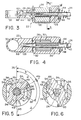
- Windows 62 are provided on the top and bottom surfaces of the housing in an axially staggered orientation, as illustrated in Fig. 3. These windows are formed to facilitate the molding process utilized to manufacture the housing. Specifically, they are formed with curved bottoms matching the circumferential curve of the bore 28. By thus forming windows 62, the axial bore 28 is effectively extended 14 mm into the housing beyond the aperture 30 to define a region for the elongated member to extend into beyond the aperture 30 when retracted. This eliminates the need for forming the bore completely in the interior of the housing. Thus, the mold used to manufacture the housing is simplified, making the injection molding process both easier and cheaper.
- a spring 64 is utilized to bias the elongated member axially outwardly through the bore 28 and away from the housing. As is shown in Figs. 3 and 4, one end of the spring engages against an end wall 66 of the housing while the other end is secured to the elongated member via aperture 42.
- the spring acts to push the elongated member toward a fully extended position with respect to the housing. However, the position of the elongated member is limited in both directions of translatory motion.
- the pin 60 in cooperation with the longitudinal slot 44 acts as a stop mechanism to limit the outward motion.
- the housing itself acts as a stop to limit the motion. Specifically, an interior wall 68 of one of the windows 62 meets the elongated member when the elongated member is in a fully retracted position.
- Figs. 5 and 6 show the relative rctational positions of the locking member 26 with respect to the elongated member 24.
- the exterior threads 34 of the elongated member align with the wells 50 of the locking member, and the interior threads 48 of the locking member align with the wells 36 of the elongated member.
- relative translational motion can be performed between the two members.
- the locking member is rotated 60° ( ⁇ ) to a locking position, as illustrated in Fig. 6, the exterior threads 34 of the elongated member mesh with the interior threads 48 of the locking mem-ber. In this case, translational motion is prevented between the two members and the device is locked.
- locking member 26 is inserted into the cavity defined by aperture 30.
- the longitudinal bore 46 of the locking member is axially aligned with the central axial bore 28 of the housing.
- the elongated member 24 is inserted into the housing and locking member combination so that the arcuate threads 34 of the elongated member align with the wells 50 of the locking member, and vice versa.
- Pin 60 is inserted through a hole in the housing which is aligned with longitudinal slot 44 of the elongated member.
- Spring 64 is fixed on one end in aperture 42 of the elongated member, and on the other end to housing wall 66.
- the device 10 is attached at its ends to the transmission cable and gearshift.
- the elongated member is translated axially inwardly of the housing in increments of 0.51 mm (0.02 inches).
- the locking member is rotated 60° ( ⁇ ) to lock the elongated member to the housing.
- arcuate threads 34 positioned on the exterior surface of elongated member mesh with arcuate threads 48 positioned on the interior surface of the locking member.
- the locking member is rotated 60° ( ⁇ ) in the other direction to an unlocked position to separate the arcuate threads.
- the elongated member is once again free to translate with respect to the housing.
- the cable can now be tightened again by the same process as described above.
Landscapes
- Engineering & Computer Science (AREA)
- General Engineering & Computer Science (AREA)
- Health & Medical Sciences (AREA)
- Oral & Maxillofacial Surgery (AREA)
- Mechanical Engineering (AREA)
- Flexible Shafts (AREA)
- Mechanical Control Devices (AREA)
- Control Of Motors That Do Not Use Commutators (AREA)
- Electric Cable Arrangement Between Relatively Moving Parts (AREA)
Claims (18)
- Dispositif de réglage de la longueur d'un câble comprenant :a. un élément allongé (24) ayant une première extrémité (40) et une deuxième extrémité (38) et comprenant plusieurs parties extérieures filetées espacées circonférentiellement (34) faites autour de sa première extrémité (40) et des parties non filetées (36) faites entre celles-ci,b. un corps (22) ayant un alésage longitudinal (28) destiné à recevoir et contenir la première extrémité (40) de l'élément allongé (24) pour un mouvement axial de translation de celui-ci dans cet alésage,c. un élément de blocage (26) monté tournant dans le corps (22) pour tourner entre une première position bloquée et une deuxième position débloquée, cet élément de blocage ayant :i) un alésage longitudinal (46) destiné à recevoir l'élément allongé (24) pour un mouvement sélectif de rotation et de translation de celui-ci par rapport à cet alésage,ii) plusieurs parties intérieures filetées espacées circonférentiellement (48) faites pour être en prise avec les parties extérieures filetées (34) de la première extrémité (40) de l'élément allongé (24) lorsque l'élément de blocage (26) est dans sa première position, pour empêcher un mouvement axial de translation de l'élément allongé (24) par rapport à l'élément de blocage, etiii) des parties non filetées (50) situées entre les parties filetées (48) et destinées à être alignées circonférentiellement avec les parties filetées (34) de l'élément allongé (24) lorsque l'élément de blocage (26) est dans sa deuxième position, pour permettre un mouvement axial de translation de l'élément allongé par rapport à l'élément de blocage, etd. dans des parois latérales opposées du corps (22) étant faites des ouvertures (30) qui forment dans le corps une cavité destinée à recevoir l'élément de blocage (26), ces ouvertures (30) donnant accès aux deux extrémités de l'élément de blocage (26).
- Dispositif de réglage de la longueur d'un câble selon la revendication 1, dans lequel :a. l'élément de blocage (26) comprend en outre un rebord (54), etb. le corps (22) comprend en outre un moyen de fixation du genre crochet (56) entrant dans la cavité du corps (22) en face circonférentiellement du rebord (54) et fait de façon à s'accoupler avec le rebord (54) pour maintenir par encliquetage l'élément de blocage (26) dans sa première position bloquée.
- Dispositif de réglage de la longueur d'un câble selon la revendication 2, dans lequel l'élément de blocage (26) comprend en outre une lèvre (58) faite pour coopérer avec le moyen de fixation du genre crochet (56) pour empêcher un mouvement de rotation de l'élément de blocage par rapport au corps (22) lorsque l'élément de blocage est dans sa deuxième position débloquée.
- Dispositif de réglage de la longueur d'un câble selon la revendication 1, dans lequel l'élément de blocage (26) est placé dans la cavité du corps (22) et l'élément allongé (24) est placé dans l'alésage longitudinal (28) du corps et dans l'alésage longitudinal (46) de l'élément de blocage.
- Dispositif de réglage de la longueur d'un câble selon la revendication 1, dans lequel l'élément de blocage (26) comprend en outre un poucier (52) fait pour donner à un monteur une plus grande surface pour faciliter le mouvement de rotation de l'élément de blocage par rapport à l'élément allongé (24).
- Dispositif de réglage de la longueur d'un câble selon la revendication 1, dans lequel l'élément allongé (24) comprend trois parties extérieures filetées arquées (34) faites pour venir en prise avec trois parties intérieures filetées arquées (48) de l'élément de blocage (26).
- Dispositif de réglage de la longueur d'un câble selon la revendication 6, dans lequel chacune des trois parties extérieures filetées arquées (34) de l'élément allongé (24) a un axe et les axes de ces parties filetées sont espacés de 120°, et chacune des trois parties intérieures filetées arquées (48) de l'élément de blocage (26) a un axe et les axes de ces parties filetées sont espacés de 120°.
- Dispositif de réglage de la longueur d'un câble selon la revendication 7, dans lequel les parties extérieures filetées (34) de l'élément allongé (24) viennent en prise avec les parties intérieures filetées (48) de l'élément de blocage (26) lorsqu'on tourne ce dernier de 60° d'une position débloquée à une position bloquée.
- Dispositif de réglage de la longueur d'un câble selon la revendication 1, dans lequel les parties filetées arquées (34) de l'élément allongé (24) sont composées des filets arqués espacés axialement de 0,51 mm (0,02 pouce) sur celui-ci.
- Dispositif de réglage de la longueur d'un câble selon la revendication 1, dans lequel les parties non filetées (36) de l'élément allongé (24) et les parties non filetées (50) de l'élément de blocage (26) comprennent des creux.
- Dispositif de réglage de la longueur d'un câble selon la revendication 1, comprenant en outre un ressort (64) destiné à pousser l'élément allongé (24) pour l'éloigner du corps (22).
- Dispositif de réglage de la longueur d'un câble selon la revendication 1, dans lequel le corps (22) comprend en outre plusieurs fenêtres (62) faites pour former une partie de l'alésage longitudinal (28) de celui-ci.
- Dispositif de réglage de la longueur d'un câble selon la revendication 1, comprenant en outre une goupille (60) faite pour coopérer avec l'élément allongé (24) et le corps (22) de façon à empêcher un mouvement relatif de rotation entre ceux-ci et limiter le mouvement relatif de translation entre ceux-ci.
- Dispositif de réglage de la longueur d'un câble selon la revendication 13, dans lequel l'élément allongé (24) comprend en outre une fente longitudinale (44) qui coopère avec la goupille (60).
- Dispositif de réglage de la longueur d'un câble selon la revendication 1, dans lequel l'élément allongé (24) est en acier.
- Dispositif de réglage de la longueur d'un câble selon la revendication 1, dans lequel l'élément de blocage (26) est en métal fritté.
- Dispositif de réglage de la longueur d'un câble selon la revendication 1, dans lequel le corps (22) est en plastique.
- Dispositif de réglage de la longueur d'un câble selon la revendication 1, dans lequel l'élément de blocage (26) est monté tournant dans l'alésage du corps (22).
Applications Claiming Priority (3)
| Application Number | Priority Date | Filing Date | Title |
|---|---|---|---|
| US703551 | 1991-05-21 | ||
| US07/703,551 US5156064A (en) | 1991-05-21 | 1991-05-21 | Cable length adjustment device |
| PCT/US1992/004308 WO1992020928A1 (fr) | 1991-05-21 | 1992-05-21 | Dispositif de reglage de la longueur d'un cable |
Publications (3)
| Publication Number | Publication Date |
|---|---|
| EP0584237A1 EP0584237A1 (fr) | 1994-03-02 |
| EP0584237A4 EP0584237A4 (en) | 1994-05-18 |
| EP0584237B1 true EP0584237B1 (fr) | 1996-10-16 |
Family
ID=24825833
Family Applications (1)
| Application Number | Title | Priority Date | Filing Date |
|---|---|---|---|
| EP92912510A Expired - Lifetime EP0584237B1 (fr) | 1991-05-21 | 1992-05-21 | Dispositif de reglage de la longueur d'un cable |
Country Status (9)
| Country | Link |
|---|---|
| US (1) | US5156064A (fr) |
| EP (1) | EP0584237B1 (fr) |
| JP (1) | JPH06507962A (fr) |
| AT (1) | ATE144309T1 (fr) |
| AU (1) | AU2150392A (fr) |
| CA (1) | CA2103157C (fr) |
| DE (1) | DE69214640T2 (fr) |
| ES (1) | ES2093262T3 (fr) |
| WO (1) | WO1992020928A1 (fr) |
Families Citing this family (31)
| Publication number | Priority date | Publication date | Assignee | Title |
|---|---|---|---|---|
| US5293785A (en) * | 1991-09-17 | 1994-03-15 | Nagle Industries, Inc. | Adjustable cable strand end fitting |
| US5243875A (en) * | 1991-11-08 | 1993-09-14 | Robertshaw Controls Company | Control device, parts therefor and methods of making the same |
| GB2265956B (en) * | 1992-04-06 | 1995-09-27 | Nhk Spring Co Ltd | An adjustable mounting for a control cable |
| DE9313484U1 (de) * | 1993-09-07 | 1993-11-04 | Vofa-Werk Xavier Vorbrüggen GmbH & Co KG, 40549 Düsseldorf | Betätigungszug für die Betätigung von Einrichtungen insbesondere in Fahrzeugen |
| US5435203A (en) * | 1993-09-16 | 1995-07-25 | Teleflex Incorporated | Manual shift twist adjustor |
| US5597007A (en) * | 1995-02-27 | 1997-01-28 | Baejin Corporation | Foldable tent frame |
| US5570612A (en) * | 1995-11-13 | 1996-11-05 | Teleflex, Inc. | Core adjust with sliding rear spring cover |
| US5724858A (en) * | 1996-05-30 | 1998-03-10 | Teleflex Incorporated | Infinite adjustment for motion transmitting remote control assembly |
| ES2128254B1 (es) * | 1997-03-25 | 1999-12-16 | Fico Cables Sa | Terminal con dispositivo de fijacion para cables de mando. |
| US5921143A (en) * | 1997-07-12 | 1999-07-13 | Honda Giken Kogyo Kabushiki Kaisha | Coupling device for a sheathed cable and methods of constructing and utilizing same |
| US5937705A (en) * | 1998-04-08 | 1999-08-17 | Flex Technologies, Inc. | Push-pull control cable assembly with quick-release terminal fittings therefor |
| US5953963A (en) * | 1998-07-06 | 1999-09-21 | General Motors Corporation | Cable-to-lever connection for motion-transmitting mechanism |
| US6193621B1 (en) | 1999-05-06 | 2001-02-27 | Fanuc Robotics North America, Inc. | Take-up device for tensioning motion transmitting control cables |
| US6324938B1 (en) * | 2000-02-28 | 2001-12-04 | Shimano, Inc. | Locking bicycle cable connecting apparatus |
| FR2821134B1 (fr) * | 2001-02-20 | 2003-04-11 | Sila Holding Ind | Dispositif semi-automatique de reglage de la longueur d'une gaine de protection d'un cable de commande |
| FR2821133A1 (fr) * | 2001-02-20 | 2002-08-23 | Europ De Fabrications Ind Sefi | Dispositif de reglage de la longueur d'une gaine de protection d'un cable de commande |
| FR2821132B1 (fr) * | 2001-02-20 | 2003-05-16 | Sila Holding Ind | Dispositif de manoeuvre d'un cable de commande a came helicoidale comprenant des moyens de reglage de la longueur de la gaine |
| US20050220569A1 (en) * | 2004-04-01 | 2005-10-06 | Joseph Dryer | Latching quick-connect connector |
| BRPI0403739A (pt) * | 2004-08-25 | 2006-05-02 | Paolo Paparoni | dispositivo de fixação de terminais de cabos de comando |
| US8215202B2 (en) | 2007-06-18 | 2012-07-10 | Grand Rapids Controls Company, Llc | Cable length adjustment mechanism |
| BRPI0822867B1 (pt) * | 2008-06-19 | 2019-10-22 | Kongsberg Actuation Systems Gmbh | sistema conector e método para conectar um corpo alongado a um corpo móvel |
| USD658480S1 (en) * | 2010-01-26 | 2012-05-01 | Railblaza Limited | Mounting adapter |
| DE102010036482A1 (de) * | 2010-07-19 | 2012-01-19 | Gustav Klauke Gmbh | Mutter und Kombination eines Bolzenteils mit einer Mutter |
| US9021917B2 (en) * | 2011-06-17 | 2015-05-05 | Kongsberg Driveline Systems I, Inc. | Motion transmitting remote control assembly having a terminal body with a transverse opening |
| US8850921B2 (en) | 2011-12-12 | 2014-10-07 | Chrysler Group Llc | Cable-length-adjustment device |
| US8784431B1 (en) * | 2012-06-11 | 2014-07-22 | Choice Spine, Lp | Medical screwdriver |
| CA2860821C (fr) | 2013-03-11 | 2018-03-06 | Schlage Lock Company Llc | Mecanisme de verrouillage pour dispositif de reglage de cable de commande |
| DE102013224429A1 (de) | 2013-11-28 | 2015-05-28 | Zf Friedrichshafen Ag | Seilzug, Getriebesystem und Verfahren zum Herstellen eines Seilzugs |
| EP3012472B1 (fr) * | 2014-10-22 | 2019-03-20 | Fico Cables Lda | Dispositif de réglage de longueur de conduit et procédés afférents |
| FI129426B (fi) * | 2017-04-24 | 2022-02-15 | Flaekt Woods Ab | Ilmanvaihtolaitteen säätölevyn säätö- ja lukituselin |
| US11959312B2 (en) | 2018-05-08 | 2024-04-16 | Magna Closures Inc. | Vehicular latch bushing with cable interface |
Family Cites Families (26)
| Publication number | Priority date | Publication date | Assignee | Title |
|---|---|---|---|---|
| US3572159A (en) * | 1969-06-12 | 1971-03-23 | Teleflex Inc | Motion transmitting remote control assembly |
| US3710645A (en) * | 1970-10-08 | 1973-01-16 | Teleflex Inc | Remote control assembly |
| US4141117A (en) * | 1977-06-09 | 1979-02-27 | Brammall, Inc. | Releasing tool for use with a releasable cone lock |
| US4177681A (en) * | 1978-04-06 | 1979-12-11 | The United States Of America As Represented By The Secretary Of The Air Force | Apparatus for adjusting and locking a linear actuator |
| US4294133A (en) * | 1979-09-24 | 1981-10-13 | Ford Motor Company | Bowden cable retainer and adjuster |
| US4418583A (en) * | 1981-07-06 | 1983-12-06 | The Bendix Corporation | Locking device |
| US4699330A (en) * | 1983-09-06 | 1987-10-13 | Mounque Barazone | Apparatus for laying paving fabric |
| US4696372A (en) * | 1984-07-02 | 1987-09-29 | Fields Tom R | Portable step and carrying device for stud walls |
| US4658668A (en) * | 1984-09-10 | 1987-04-21 | Ford Motor Company | Transmission kickdown cable adjuster |
| US4635498A (en) * | 1985-04-18 | 1987-01-13 | General Motors Corporation | Fastening device |
| US4833937A (en) * | 1985-04-22 | 1989-05-30 | Shimano Industrial Company Limited | Adjusting device for a control cable for a bicycle |
| US4676119A (en) * | 1985-09-13 | 1987-06-30 | Teleflex Incorporated | Remote control levered self adjust actuator |
| US4841806A (en) * | 1985-09-13 | 1989-06-27 | Teleflex Incorporated | Self-adjust mini increment |
| US4869123A (en) * | 1985-11-18 | 1989-09-26 | Ford Motor Company | Cable length self-locking adjustment device |
| US4799400A (en) * | 1986-02-21 | 1989-01-24 | Acco Babcock Inc. | Self-adjusting cable control device |
| US4854186A (en) * | 1987-12-02 | 1989-08-08 | Kuster & Co. Gmbh | Apparatus for adjusting the length of a bowden cable |
| US4852425A (en) * | 1987-12-28 | 1989-08-01 | Ford Motor Company | Variable length rod assembly having locking adjustment mechanism |
| US4841805A (en) * | 1988-03-14 | 1989-06-27 | Mpc Technologies Co. | Adjustable cable end coupling |
| US4850240A (en) * | 1988-04-04 | 1989-07-25 | Outboard Marine Corporation | Detented slide control assembly |
| JPH0262415A (ja) * | 1988-08-24 | 1990-03-02 | Nippon Cable Syst Inc | コントロールケーブルの取付位置調整装置 |
| US4854185A (en) * | 1988-10-17 | 1989-08-08 | Babcock Industries Inc. | Manually operated and locked conduit length adjuster system |
| US4958536A (en) * | 1989-03-22 | 1990-09-25 | Babcock Industries, Inc. | Cable control system |
| US4957017A (en) * | 1989-04-12 | 1990-09-18 | Flex Technologies, Inc. | Assembly and method for the adjustment of a cable casing |
| US4936161A (en) * | 1989-08-07 | 1990-06-26 | Vdoyazaki Corporation | Cable length adjuster with push and lock attachment |
| US5015023A (en) * | 1989-12-11 | 1991-05-14 | Hall Gaddis G | Automatic cable gripping device |
| US4987793A (en) * | 1990-01-04 | 1991-01-29 | Babcock Industries, Inc. | Cable control system with adjustment device |
-
1991
- 1991-05-21 US US07/703,551 patent/US5156064A/en not_active Expired - Fee Related
-
1992
- 1992-05-21 DE DE69214640T patent/DE69214640T2/de not_active Expired - Fee Related
- 1992-05-21 AT AT92912510T patent/ATE144309T1/de not_active IP Right Cessation
- 1992-05-21 WO PCT/US1992/004308 patent/WO1992020928A1/fr not_active Ceased
- 1992-05-21 ES ES92912510T patent/ES2093262T3/es not_active Expired - Lifetime
- 1992-05-21 EP EP92912510A patent/EP0584237B1/fr not_active Expired - Lifetime
- 1992-05-21 JP JP5500307A patent/JPH06507962A/ja active Pending
- 1992-05-21 CA CA002103157A patent/CA2103157C/fr not_active Expired - Fee Related
- 1992-05-21 AU AU21503/92A patent/AU2150392A/en not_active Abandoned
Also Published As
| Publication number | Publication date |
|---|---|
| US5156064A (en) | 1992-10-20 |
| EP0584237A4 (en) | 1994-05-18 |
| CA2103157C (fr) | 1998-11-24 |
| ATE144309T1 (de) | 1996-11-15 |
| JPH06507962A (ja) | 1994-09-08 |
| EP0584237A1 (fr) | 1994-03-02 |
| DE69214640D1 (de) | 1996-11-21 |
| AU2150392A (en) | 1992-12-30 |
| ES2093262T3 (es) | 1996-12-16 |
| WO1992020928A1 (fr) | 1992-11-26 |
| DE69214640T2 (de) | 1997-03-06 |
| CA2103157A1 (fr) | 1992-11-22 |
Similar Documents
| Publication | Publication Date | Title |
|---|---|---|
| EP0584237B1 (fr) | Dispositif de reglage de la longueur d'un cable | |
| EP0796780B1 (fr) | Dispositif de verrouillage pour crémaillères se faisant face dans une colonne de direction réglable | |
| US5079964A (en) | Actuator for door locking apparatus for vehicle | |
| CA1181665A (fr) | Dispositif de calage | |
| US12312013B2 (en) | Device for compensating for tolerances | |
| US5167166A (en) | Rack and roller core element adjust | |
| US8002655B2 (en) | Actuator device for a bicycle gearshift | |
| DK146347B (da) | Drejeindstillingsmotor med tandstangdrev | |
| US5833247A (en) | Drill chuck | |
| US8661931B2 (en) | Steering column assembly | |
| CA1264273A (fr) | Mecanisme de passage des vitesses pour transmission manuelle | |
| CN106661898A (zh) | 门或窗的把手 | |
| US5222411A (en) | Miniature core adjust device | |
| JPH05221261A (ja) | 乗物のヘッドランプの調節機構 | |
| GB2295208A (en) | Positioning pin for a vehicle transmission actuating mechanism | |
| EP1955922B1 (fr) | Ensemble de colonne de direction | |
| EP0373812A2 (fr) | Système de commande par câble à deux voies | |
| US6116103A (en) | Device for securing gear nut on actuator | |
| JPH02159408A (ja) | コントロールケーブルの取付位置調整装置 | |
| JP4201392B2 (ja) | コラムat用シフトレバー装置 | |
| US4463625A (en) | Telescopic steering apparatus for vehicles | |
| US20240026981A1 (en) | Spring return valve handle arrangements | |
| EP1136901A2 (fr) | Guide pour support ajustable sur bras de pédale | |
| DE19527163A1 (de) | Kraftfahrzeugscheinwerfer | |
| US7401535B2 (en) | Twist-grip bicycle shifter |
Legal Events
| Date | Code | Title | Description |
|---|---|---|---|
| PUAI | Public reference made under article 153(3) epc to a published international application that has entered the european phase |
Free format text: ORIGINAL CODE: 0009012 |
|
| 17P | Request for examination filed |
Effective date: 19931118 |
|
| AK | Designated contracting states |
Kind code of ref document: A1 Designated state(s): AT BE CH DE DK ES FR GB GR IT LI LU MC NL SE |
|
| A4 | Supplementary search report drawn up and despatched | ||
| AK | Designated contracting states |
Kind code of ref document: A4 Designated state(s): AT BE CH DE DK ES FR GB GR IT LI LU MC NL SE |
|
| 17Q | First examination report despatched |
Effective date: 19941111 |
|
| GRAH | Despatch of communication of intention to grant a patent |
Free format text: ORIGINAL CODE: EPIDOS IGRA |
|
| GRAA | (expected) grant |
Free format text: ORIGINAL CODE: 0009210 |
|
| RAP1 | Party data changed (applicant data changed or rights of an application transferred) |
Owner name: TELEFLEX INC |
|
| AK | Designated contracting states |
Kind code of ref document: B1 Designated state(s): AT BE CH DE DK ES FR GB GR IT LI LU MC NL SE |
|
| PG25 | Lapsed in a contracting state [announced via postgrant information from national office to epo] |
Ref country code: NL Free format text: LAPSE BECAUSE OF FAILURE TO SUBMIT A TRANSLATION OF THE DESCRIPTION OR TO PAY THE FEE WITHIN THE PRESCRIBED TIME-LIMIT Effective date: 19961016 Ref country code: LI Effective date: 19961016 Ref country code: GR Free format text: LAPSE BECAUSE OF FAILURE TO SUBMIT A TRANSLATION OF THE DESCRIPTION OR TO PAY THE FEE WITHIN THE PRESCRIBED TIME-LIMIT Effective date: 19961016 Ref country code: DK Effective date: 19961016 Ref country code: CH Effective date: 19961016 Ref country code: BE Effective date: 19961016 Ref country code: AT Effective date: 19961016 |
|
| REF | Corresponds to: |
Ref document number: 144309 Country of ref document: AT Date of ref document: 19961115 Kind code of ref document: T |
|
| REF | Corresponds to: |
Ref document number: 69214640 Country of ref document: DE Date of ref document: 19961121 |
|
| REG | Reference to a national code |
Ref country code: ES Ref legal event code: FG2A Ref document number: 2093262 Country of ref document: ES Kind code of ref document: T3 |
|
| ET | Fr: translation filed |
Free format text: CORRECTIONS |
|
| ITF | It: translation for a ep patent filed | ||
| PG25 | Lapsed in a contracting state [announced via postgrant information from national office to epo] |
Ref country code: SE Effective date: 19970116 |
|
| NLV1 | Nl: lapsed or annulled due to failure to fulfill the requirements of art. 29p and 29m of the patents act | ||
| REG | Reference to a national code |
Ref country code: CH Ref legal event code: PL |
|
| PG25 | Lapsed in a contracting state [announced via postgrant information from national office to epo] |
Ref country code: GB Effective date: 19970521 |
|
| PG25 | Lapsed in a contracting state [announced via postgrant information from national office to epo] |
Ref country code: ES Free format text: LAPSE BECAUSE OF NON-PAYMENT OF DUE FEES Effective date: 19970522 |
|
| PG25 | Lapsed in a contracting state [announced via postgrant information from national office to epo] |
Ref country code: LU Free format text: LAPSE BECAUSE OF NON-PAYMENT OF DUE FEES Effective date: 19970531 |
|
| PLBE | No opposition filed within time limit |
Free format text: ORIGINAL CODE: 0009261 |
|
| STAA | Information on the status of an ep patent application or granted ep patent |
Free format text: STATUS: NO OPPOSITION FILED WITHIN TIME LIMIT |
|
| 26N | No opposition filed | ||
| PG25 | Lapsed in a contracting state [announced via postgrant information from national office to epo] |
Ref country code: MC Effective date: 19971130 |
|
| GBPC | Gb: european patent ceased through non-payment of renewal fee |
Effective date: 19970521 |
|
| PG25 | Lapsed in a contracting state [announced via postgrant information from national office to epo] |
Ref country code: FR Free format text: LAPSE BECAUSE OF NON-PAYMENT OF DUE FEES Effective date: 19980130 |
|
| PG25 | Lapsed in a contracting state [announced via postgrant information from national office to epo] |
Ref country code: DE Free format text: LAPSE BECAUSE OF NON-PAYMENT OF DUE FEES Effective date: 19980203 |
|
| REG | Reference to a national code |
Ref country code: FR Ref legal event code: ST |
|
| REG | Reference to a national code |
Ref country code: ES Ref legal event code: FD2A Effective date: 19990503 |
|
| PG25 | Lapsed in a contracting state [announced via postgrant information from national office to epo] |
Ref country code: IT Free format text: LAPSE BECAUSE OF NON-PAYMENT OF DUE FEES;WARNING: LAPSES OF ITALIAN PATENTS WITH EFFECTIVE DATE BEFORE 2007 MAY HAVE OCCURRED AT ANY TIME BEFORE 2007. THE CORRECT EFFECTIVE DATE MAY BE DIFFERENT FROM THE ONE RECORDED. Effective date: 20050521 |