EP0584487A2 - Neue 4,5-Dihydro-4-oxo-pyrrolo (1,2-a) chinoxaline und entsprechende Aza-analoga und Verfahren zu deren Herstellung - Google Patents
Neue 4,5-Dihydro-4-oxo-pyrrolo (1,2-a) chinoxaline und entsprechende Aza-analoga und Verfahren zu deren Herstellung Download PDFInfo
- Publication number
- EP0584487A2 EP0584487A2 EP93110182A EP93110182A EP0584487A2 EP 0584487 A2 EP0584487 A2 EP 0584487A2 EP 93110182 A EP93110182 A EP 93110182A EP 93110182 A EP93110182 A EP 93110182A EP 0584487 A2 EP0584487 A2 EP 0584487A2
- Authority
- EP
- European Patent Office
- Prior art keywords
- alkyl
- phenyl
- pyrrolo
- dihydro
- hydrogen
- Prior art date
- Legal status (The legal status is an assumption and is not a legal conclusion. Google has not performed a legal analysis and makes no representation as to the accuracy of the status listed.)
- Withdrawn
Links
- 238000000034 method Methods 0.000 title claims abstract description 22
- 238000002360 preparation method Methods 0.000 title claims abstract description 13
- LINHQLFBBDHSEJ-UHFFFAOYSA-N 5h-pyrrolo[1,2-a]quinoxalin-4-one Chemical class O=C1NC2=CC=CC=C2N2C1=CC=C2 LINHQLFBBDHSEJ-UHFFFAOYSA-N 0.000 title description 3
- -1 benzoyloxy, morpholinocarbonyloxy Chemical group 0.000 claims abstract description 98
- 150000001875 compounds Chemical class 0.000 claims abstract description 63
- 239000001257 hydrogen Substances 0.000 claims abstract description 31
- 229910052739 hydrogen Inorganic materials 0.000 claims abstract description 31
- UFHFLCQGNIYNRP-UHFFFAOYSA-N Hydrogen Chemical compound [H][H] UFHFLCQGNIYNRP-UHFFFAOYSA-N 0.000 claims abstract description 20
- 125000001997 phenyl group Chemical group [H]C1=C([H])C([H])=C(*)C([H])=C1[H] 0.000 claims abstract description 18
- 125000002887 hydroxy group Chemical group [H]O* 0.000 claims abstract description 17
- 229910052757 nitrogen Inorganic materials 0.000 claims abstract description 12
- 150000003839 salts Chemical class 0.000 claims abstract description 11
- 125000004433 nitrogen atom Chemical group N* 0.000 claims abstract description 10
- 125000000882 C2-C6 alkenyl group Chemical group 0.000 claims abstract description 6
- 125000003601 C2-C6 alkynyl group Chemical group 0.000 claims abstract description 5
- 125000005913 (C3-C6) cycloalkyl group Chemical group 0.000 claims abstract 4
- 125000005982 diphenylmethyl group Chemical group [H]C1=C([H])C([H])=C(C([H])=C1[H])C([H])(*)C1=C([H])C([H])=C([H])C([H])=C1[H] 0.000 claims abstract 3
- 239000000126 substance Substances 0.000 claims description 39
- 238000006243 chemical reaction Methods 0.000 claims description 18
- 229910052736 halogen Inorganic materials 0.000 claims description 17
- 150000002367 halogens Chemical class 0.000 claims description 16
- 150000002431 hydrogen Chemical class 0.000 claims description 14
- 125000000719 pyrrolidinyl group Chemical group 0.000 claims description 12
- 239000002253 acid Substances 0.000 claims description 9
- 239000001301 oxygen Substances 0.000 claims description 9
- 229910052760 oxygen Inorganic materials 0.000 claims description 9
- 125000000753 cycloalkyl group Chemical group 0.000 claims description 8
- ZAMOUSCENKQFHK-UHFFFAOYSA-N Chlorine atom Chemical group [Cl] ZAMOUSCENKQFHK-UHFFFAOYSA-N 0.000 claims description 7
- QVGXLLKOCUKJST-UHFFFAOYSA-N atomic oxygen Chemical compound [O] QVGXLLKOCUKJST-UHFFFAOYSA-N 0.000 claims description 7
- 239000000460 chlorine Chemical group 0.000 claims description 7
- 229910052801 chlorine Inorganic materials 0.000 claims description 7
- 229910052740 iodine Chemical group 0.000 claims description 7
- 125000004093 cyano group Chemical group *C#N 0.000 claims description 6
- 239000003814 drug Substances 0.000 claims description 6
- WKBOTKDWSSQWDR-UHFFFAOYSA-N Bromine atom Chemical group [Br] WKBOTKDWSSQWDR-UHFFFAOYSA-N 0.000 claims description 5
- NINIDFKCEFEMDL-UHFFFAOYSA-N Sulfur Chemical compound [S] NINIDFKCEFEMDL-UHFFFAOYSA-N 0.000 claims description 5
- 125000000217 alkyl group Chemical group 0.000 claims description 5
- GDTBXPJZTBHREO-UHFFFAOYSA-N bromine Chemical group BrBr GDTBXPJZTBHREO-UHFFFAOYSA-N 0.000 claims description 5
- 229910052794 bromium Inorganic materials 0.000 claims description 5
- 238000004519 manufacturing process Methods 0.000 claims description 5
- 229910052717 sulfur Inorganic materials 0.000 claims description 5
- 239000011593 sulfur Substances 0.000 claims description 5
- 125000002023 trifluoromethyl group Chemical group FC(F)(F)* 0.000 claims description 5
- ZCYVEMRRCGMTRW-UHFFFAOYSA-N 7553-56-2 Chemical group [I] ZCYVEMRRCGMTRW-UHFFFAOYSA-N 0.000 claims description 4
- 229910052799 carbon Inorganic materials 0.000 claims description 4
- 229910052731 fluorine Inorganic materials 0.000 claims description 4
- 239000011737 fluorine Substances 0.000 claims description 4
- 239000011630 iodine Chemical group 0.000 claims description 4
- 125000000000 cycloalkoxy group Chemical group 0.000 claims description 3
- 125000002496 methyl group Chemical group [H]C([H])([H])* 0.000 claims description 3
- 239000000825 pharmaceutical preparation Substances 0.000 claims description 3
- 125000002924 primary amino group Chemical group [H]N([H])* 0.000 claims description 3
- 125000004191 (C1-C6) alkoxy group Chemical group 0.000 claims description 2
- 125000002883 imidazolyl group Chemical group 0.000 claims description 2
- 125000006203 morpholinoethyl group Chemical group [H]C([H])(*)C([H])([H])N1C([H])([H])C([H])([H])OC([H])([H])C1([H])[H] 0.000 claims 2
- 150000003242 quaternary ammonium salts Chemical class 0.000 claims 2
- 125000005011 alkyl ether group Chemical group 0.000 claims 1
- 150000007514 bases Chemical class 0.000 claims 1
- 239000012050 conventional carrier Substances 0.000 claims 1
- 239000003085 diluting agent Substances 0.000 claims 1
- 239000003937 drug carrier Substances 0.000 claims 1
- 125000001153 fluoro group Chemical group F* 0.000 claims 1
- 239000008024 pharmaceutical diluent Substances 0.000 claims 1
- 229940124597 therapeutic agent Drugs 0.000 claims 1
- 239000007858 starting material Substances 0.000 abstract description 9
- 125000004169 (C1-C6) alkyl group Chemical group 0.000 abstract description 3
- 125000001424 substituent group Chemical group 0.000 abstract description 3
- 125000004435 hydrogen atom Chemical group [H]* 0.000 abstract 1
- QSLLFYVBWXWUQT-UHFFFAOYSA-N 7-azaindolizine Natural products C1=NC=CN2C=CC=C21 QSLLFYVBWXWUQT-UHFFFAOYSA-N 0.000 description 123
- 239000013078 crystal Substances 0.000 description 62
- 239000000203 mixture Substances 0.000 description 50
- ZMXDDKWLCZADIW-UHFFFAOYSA-N N,N-Dimethylformamide Chemical compound CN(C)C=O ZMXDDKWLCZADIW-UHFFFAOYSA-N 0.000 description 48
- OKKJLVBELUTLKV-UHFFFAOYSA-N Methanol Chemical compound OC OKKJLVBELUTLKV-UHFFFAOYSA-N 0.000 description 42
- YMWUJEATGCHHMB-UHFFFAOYSA-N Dichloromethane Chemical compound ClCCl YMWUJEATGCHHMB-UHFFFAOYSA-N 0.000 description 33
- VEXZGXHMUGYJMC-UHFFFAOYSA-N Hydrochloric acid Chemical compound Cl VEXZGXHMUGYJMC-UHFFFAOYSA-N 0.000 description 31
- LFQSCWFLJHTTHZ-UHFFFAOYSA-N Ethanol Chemical compound CCO LFQSCWFLJHTTHZ-UHFFFAOYSA-N 0.000 description 22
- KYQCOXFCLRTKLS-UHFFFAOYSA-N Pyrazine Chemical compound C1=CN=CC=N1 KYQCOXFCLRTKLS-UHFFFAOYSA-N 0.000 description 21
- 239000000243 solution Substances 0.000 description 19
- YXFVVABEGXRONW-UHFFFAOYSA-N Toluene Chemical compound CC1=CC=CC=C1 YXFVVABEGXRONW-UHFFFAOYSA-N 0.000 description 18
- 238000003756 stirring Methods 0.000 description 18
- XLYOFNOQVPJJNP-UHFFFAOYSA-N water Substances O XLYOFNOQVPJJNP-UHFFFAOYSA-N 0.000 description 18
- 239000002904 solvent Substances 0.000 description 16
- UHOVQNZJYSORNB-UHFFFAOYSA-N Benzene Chemical compound C1=CC=CC=C1 UHOVQNZJYSORNB-UHFFFAOYSA-N 0.000 description 15
- WYURNTSHIVDZCO-UHFFFAOYSA-N Tetrahydrofuran Chemical compound C1CCOC1 WYURNTSHIVDZCO-UHFFFAOYSA-N 0.000 description 14
- KWYUFKZDYYNOTN-UHFFFAOYSA-M Potassium hydroxide Chemical compound [OH-].[K+] KWYUFKZDYYNOTN-UHFFFAOYSA-M 0.000 description 12
- ZMANZCXQSJIPKH-UHFFFAOYSA-N Triethylamine Chemical compound CCN(CC)CC ZMANZCXQSJIPKH-UHFFFAOYSA-N 0.000 description 12
- 125000004432 carbon atom Chemical group C* 0.000 description 11
- CSCPPACGZOOCGX-UHFFFAOYSA-N Acetone Chemical compound CC(C)=O CSCPPACGZOOCGX-UHFFFAOYSA-N 0.000 description 10
- IAZDPXIOMUYVGZ-UHFFFAOYSA-N Dimethylsulphoxide Chemical compound CS(C)=O IAZDPXIOMUYVGZ-UHFFFAOYSA-N 0.000 description 10
- KFZMGEQAYNKOFK-UHFFFAOYSA-N Isopropanol Chemical compound CC(C)O KFZMGEQAYNKOFK-UHFFFAOYSA-N 0.000 description 10
- 238000001816 cooling Methods 0.000 description 10
- WEVYAHXRMPXWCK-UHFFFAOYSA-N Acetonitrile Chemical compound CC#N WEVYAHXRMPXWCK-UHFFFAOYSA-N 0.000 description 9
- YNAVUWVOSKDBBP-UHFFFAOYSA-N Morpholine Chemical compound C1COCCN1 YNAVUWVOSKDBBP-UHFFFAOYSA-N 0.000 description 9
- NQRYJNQNLNOLGT-UHFFFAOYSA-N Piperidine Chemical compound C1CCNCC1 NQRYJNQNLNOLGT-UHFFFAOYSA-N 0.000 description 9
- 239000003513 alkali Substances 0.000 description 9
- WGQKYBSKWIADBV-UHFFFAOYSA-N benzylamine Chemical compound NCC1=CC=CC=C1 WGQKYBSKWIADBV-UHFFFAOYSA-N 0.000 description 9
- 239000007789 gas Substances 0.000 description 9
- 230000005764 inhibitory process Effects 0.000 description 9
- 238000002844 melting Methods 0.000 description 9
- 230000008018 melting Effects 0.000 description 9
- 230000001681 protective effect Effects 0.000 description 9
- JUJWROOIHBZHMG-UHFFFAOYSA-N Pyridine Chemical compound C1=CC=NC=C1 JUJWROOIHBZHMG-UHFFFAOYSA-N 0.000 description 8
- 239000012298 atmosphere Substances 0.000 description 8
- 239000000470 constituent Substances 0.000 description 8
- 125000002572 propoxy group Chemical group [*]OC([H])([H])C(C([H])([H])[H])([H])[H] 0.000 description 8
- GLUUGHFHXGJENI-UHFFFAOYSA-N Piperazine Chemical compound C1CNCCN1 GLUUGHFHXGJENI-UHFFFAOYSA-N 0.000 description 7
- 229910052783 alkali metal Inorganic materials 0.000 description 7
- 238000005804 alkylation reaction Methods 0.000 description 7
- 239000007795 chemical reaction product Substances 0.000 description 7
- 239000000725 suspension Substances 0.000 description 7
- YLQBMQCUIZJEEH-UHFFFAOYSA-N tetrahydrofuran Natural products C=1C=COC=1 YLQBMQCUIZJEEH-UHFFFAOYSA-N 0.000 description 7
- VNZLQLYBRIOLFZ-UHFFFAOYSA-N 1-(2-methoxyphenyl)piperazine Chemical compound COC1=CC=CC=C1N1CCNCC1 VNZLQLYBRIOLFZ-UHFFFAOYSA-N 0.000 description 6
- ZWEHNKRNPOVVGH-UHFFFAOYSA-N 2-Butanone Chemical compound CCC(C)=O ZWEHNKRNPOVVGH-UHFFFAOYSA-N 0.000 description 6
- QTBSBXVTEAMEQO-UHFFFAOYSA-N Acetic acid Chemical compound CC(O)=O QTBSBXVTEAMEQO-UHFFFAOYSA-N 0.000 description 6
- HEDRZPFGACZZDS-UHFFFAOYSA-N Chloroform Chemical compound ClC(Cl)Cl HEDRZPFGACZZDS-UHFFFAOYSA-N 0.000 description 6
- XTUVJUMINZSXGF-UHFFFAOYSA-N N-methylcyclohexylamine Chemical compound CNC1CCCCC1 XTUVJUMINZSXGF-UHFFFAOYSA-N 0.000 description 6
- HEMHJVSKTPXQMS-UHFFFAOYSA-M Sodium hydroxide Chemical compound [OH-].[Na+] HEMHJVSKTPXQMS-UHFFFAOYSA-M 0.000 description 6
- 238000005917 acylation reaction Methods 0.000 description 6
- 230000029936 alkylation Effects 0.000 description 6
- 150000004945 aromatic hydrocarbons Chemical class 0.000 description 6
- 208000006673 asthma Diseases 0.000 description 6
- MVPPADPHJFYWMZ-UHFFFAOYSA-N chlorobenzene Chemical compound ClC1=CC=CC=C1 MVPPADPHJFYWMZ-UHFFFAOYSA-N 0.000 description 6
- NWVNXDKZIQLBNM-UHFFFAOYSA-N diphenylmethylpiperazine Chemical compound C1CNCCN1C(C=1C=CC=CC=1)C1=CC=CC=C1 NWVNXDKZIQLBNM-UHFFFAOYSA-N 0.000 description 6
- 238000001035 drying Methods 0.000 description 6
- 239000003921 oil Substances 0.000 description 6
- 239000007787 solid Substances 0.000 description 6
- RYHBNJHYFVUHQT-UHFFFAOYSA-N 1,4-Dioxane Chemical compound C1COCCO1 RYHBNJHYFVUHQT-UHFFFAOYSA-N 0.000 description 5
- VTHBKINMCIZCLG-UHFFFAOYSA-N 5-(6-bromohexyl)pyrrolo[1,2-a]quinoxalin-4-one Chemical compound O=C1N(CCCCCCBr)C2=CC=CC=C2N2C1=CC=C2 VTHBKINMCIZCLG-UHFFFAOYSA-N 0.000 description 5
- NTYJJOPFIAHURM-UHFFFAOYSA-N Histamine Chemical compound NCCC1=CN=CN1 NTYJJOPFIAHURM-UHFFFAOYSA-N 0.000 description 5
- XEEYBQQBJWHFJM-UHFFFAOYSA-N Iron Chemical compound [Fe] XEEYBQQBJWHFJM-UHFFFAOYSA-N 0.000 description 5
- SECXISVLQFMRJM-UHFFFAOYSA-N N-Methylpyrrolidone Chemical compound CN1CCCC1=O SECXISVLQFMRJM-UHFFFAOYSA-N 0.000 description 5
- 230000010933 acylation Effects 0.000 description 5
- 125000003545 alkoxy group Chemical group 0.000 description 5
- 125000005843 halogen group Chemical group 0.000 description 5
- 125000000956 methoxy group Chemical group [H]C([H])([H])O* 0.000 description 5
- 125000000449 nitro group Chemical group [O-][N+](*)=O 0.000 description 5
- 239000012071 phase Substances 0.000 description 5
- 238000001953 recrystallisation Methods 0.000 description 5
- IIFVWLUQBAIPMJ-UHFFFAOYSA-N (4-fluorophenyl)methanamine Chemical compound NCC1=CC=C(F)C=C1 IIFVWLUQBAIPMJ-UHFFFAOYSA-N 0.000 description 4
- XKRFYHLGVUSROY-UHFFFAOYSA-N Argon Chemical compound [Ar] XKRFYHLGVUSROY-UHFFFAOYSA-N 0.000 description 4
- IJGRMHOSHXDMSA-UHFFFAOYSA-N Atomic nitrogen Chemical compound N#N IJGRMHOSHXDMSA-UHFFFAOYSA-N 0.000 description 4
- RTZKZFJDLAIYFH-UHFFFAOYSA-N Diethyl ether Chemical compound CCOCC RTZKZFJDLAIYFH-UHFFFAOYSA-N 0.000 description 4
- PXGOKWXKJXAPGV-UHFFFAOYSA-N Fluorine Chemical compound FF PXGOKWXKJXAPGV-UHFFFAOYSA-N 0.000 description 4
- PAMIQIKDUOTOBW-UHFFFAOYSA-N N-methylcyclohexylamine Natural products CN1CCCCC1 PAMIQIKDUOTOBW-UHFFFAOYSA-N 0.000 description 4
- KDLHZDBZIXYQEI-UHFFFAOYSA-N Palladium Chemical compound [Pd] KDLHZDBZIXYQEI-UHFFFAOYSA-N 0.000 description 4
- KEAYESYHFKHZAL-UHFFFAOYSA-N Sodium Chemical compound [Na] KEAYESYHFKHZAL-UHFFFAOYSA-N 0.000 description 4
- CDBYLPFSWZWCQE-UHFFFAOYSA-L Sodium Carbonate Chemical compound [Na+].[Na+].[O-]C([O-])=O CDBYLPFSWZWCQE-UHFFFAOYSA-L 0.000 description 4
- DKGAVHZHDRPRBM-UHFFFAOYSA-N Tert-Butanol Chemical compound CC(C)(C)O DKGAVHZHDRPRBM-UHFFFAOYSA-N 0.000 description 4
- 150000001340 alkali metals Chemical class 0.000 description 4
- 239000003795 chemical substances by application Substances 0.000 description 4
- 239000002270 dispersing agent Substances 0.000 description 4
- 125000001301 ethoxy group Chemical group [H]C([H])([H])C([H])([H])O* 0.000 description 4
- 239000000706 filtrate Substances 0.000 description 4
- 125000001188 haloalkyl group Chemical group 0.000 description 4
- BWHMMNNQKKPAPP-UHFFFAOYSA-L potassium carbonate Substances [K+].[K+].[O-]C([O-])=O BWHMMNNQKKPAPP-UHFFFAOYSA-L 0.000 description 4
- UMJSCPRVCHMLSP-UHFFFAOYSA-N pyridine Natural products COC1=CC=CN=C1 UMJSCPRVCHMLSP-UHFFFAOYSA-N 0.000 description 4
- 150000003254 radicals Chemical class 0.000 description 4
- 239000011541 reaction mixture Substances 0.000 description 4
- 238000010992 reflux Methods 0.000 description 4
- 239000011734 sodium Substances 0.000 description 4
- 229910052708 sodium Inorganic materials 0.000 description 4
- 239000012312 sodium hydride Substances 0.000 description 4
- 229910000104 sodium hydride Inorganic materials 0.000 description 4
- VZGDMQKNWNREIO-UHFFFAOYSA-N tetrachloromethane Chemical compound ClC(Cl)(Cl)Cl VZGDMQKNWNREIO-UHFFFAOYSA-N 0.000 description 4
- 239000008096 xylene Substances 0.000 description 4
- 0 CCCC(N(C)C*)=C(C(*=C)=CC(C)(C)C)N(*)[*@](*C)C=CC Chemical compound CCCC(N(C)C*)=C(C(*=C)=CC(C)(C)C)N(*)[*@](*C)C=CC 0.000 description 3
- XEKOWRVHYACXOJ-UHFFFAOYSA-N Ethyl acetate Chemical compound CCOC(C)=O XEKOWRVHYACXOJ-UHFFFAOYSA-N 0.000 description 3
- FXHOOIRPVKKKFG-UHFFFAOYSA-N N,N-Dimethylacetamide Chemical compound CN(C)C(C)=O FXHOOIRPVKKKFG-UHFFFAOYSA-N 0.000 description 3
- CTQNGGLPUBDAKN-UHFFFAOYSA-N O-Xylene Chemical compound CC1=CC=CC=C1C CTQNGGLPUBDAKN-UHFFFAOYSA-N 0.000 description 3
- PMZURENOXWZQFD-UHFFFAOYSA-L Sodium Sulfate Chemical compound [Na+].[Na+].[O-]S([O-])(=O)=O PMZURENOXWZQFD-UHFFFAOYSA-L 0.000 description 3
- 229960000583 acetic acid Drugs 0.000 description 3
- 150000007513 acids Chemical class 0.000 description 3
- 239000013543 active substance Substances 0.000 description 3
- 125000002252 acyl group Chemical group 0.000 description 3
- 239000000443 aerosol Substances 0.000 description 3
- 230000001476 alcoholic effect Effects 0.000 description 3
- 229910000102 alkali metal hydride Inorganic materials 0.000 description 3
- 150000008046 alkali metal hydrides Chemical class 0.000 description 3
- 150000008044 alkali metal hydroxides Chemical class 0.000 description 3
- 125000005236 alkanoylamino group Chemical group 0.000 description 3
- 150000001408 amides Chemical group 0.000 description 3
- 238000005576 amination reaction Methods 0.000 description 3
- 238000002474 experimental method Methods 0.000 description 3
- 239000012362 glacial acetic acid Substances 0.000 description 3
- GNOIPBMMFNIUFM-UHFFFAOYSA-N hexamethylphosphoric triamide Chemical compound CN(C)P(=O)(N(C)C)N(C)C GNOIPBMMFNIUFM-UHFFFAOYSA-N 0.000 description 3
- 239000012442 inert solvent Substances 0.000 description 3
- TUNQTZDLMCRIIZ-UHFFFAOYSA-N pyrrolo[1,2-a]pyrazine hydrochloride Chemical compound Cl.C1=NC=CN2C=CC=C21 TUNQTZDLMCRIIZ-UHFFFAOYSA-N 0.000 description 3
- 238000003786 synthesis reaction Methods 0.000 description 3
- 125000004178 (C1-C4) alkyl group Chemical group 0.000 description 2
- IQDFWSKNCYSDSK-UHFFFAOYSA-N 1-(2-chloroethyl)-4-(2-fluorophenyl)piperazine Chemical compound FC1=CC=CC=C1N1CCN(CCCl)CC1 IQDFWSKNCYSDSK-UHFFFAOYSA-N 0.000 description 2
- MUSOMUXTQGJZKD-UHFFFAOYSA-N 1-(2-chloroethyl)-4-(2-methoxyphenyl)piperazine Chemical compound COC1=CC=CC=C1N1CCN(CCCl)CC1 MUSOMUXTQGJZKD-UHFFFAOYSA-N 0.000 description 2
- HNUBULBQURTOIK-UHFFFAOYSA-N 1-(2-chloroethyl)-4-(2-nitrophenyl)piperazine Chemical compound [O-][N+](=O)C1=CC=CC=C1N1CCN(CCCl)CC1 HNUBULBQURTOIK-UHFFFAOYSA-N 0.000 description 2
- TYRHCJVEIFXKFC-UHFFFAOYSA-N 1-(2-chloroethyl)-4-(3-chlorophenyl)piperazine Chemical compound C1CN(CCCl)CCN1C1=CC=CC(Cl)=C1 TYRHCJVEIFXKFC-UHFFFAOYSA-N 0.000 description 2
- NTIAVUBMOJPJPM-UHFFFAOYSA-N 1-(2-chloroethyl)-4-phenylpiperazine Chemical compound C1CN(CCCl)CCN1C1=CC=CC=C1 NTIAVUBMOJPJPM-UHFFFAOYSA-N 0.000 description 2
- NDQKGEFMUGSRNS-UHFFFAOYSA-N 1-(3-chlorophenyl)-4-(3-chloropropyl)piperazine Chemical compound C1CN(CCCCl)CCN1C1=CC=CC(Cl)=C1 NDQKGEFMUGSRNS-UHFFFAOYSA-N 0.000 description 2
- OLNJXQVVSVZNHJ-UHFFFAOYSA-N 1-(3-chloropropyl)-4-(2-fluorophenyl)piperazine Chemical compound FC1=CC=CC=C1N1CCN(CCCCl)CC1 OLNJXQVVSVZNHJ-UHFFFAOYSA-N 0.000 description 2
- OIZBMQFOSPOOIS-UHFFFAOYSA-N 1-(3-chloropropyl)-4-(2-methoxyphenyl)piperazine Chemical compound COC1=CC=CC=C1N1CCN(CCCCl)CC1 OIZBMQFOSPOOIS-UHFFFAOYSA-N 0.000 description 2
- GGHVXDDWRVYHOD-UHFFFAOYSA-N 1-(4-benzhydrylpiperazin-1-yl)-3-chloropropan-2-ol Chemical compound C1CN(CC(CCl)O)CCN1C(C=1C=CC=CC=1)C1=CC=CC=C1 GGHVXDDWRVYHOD-UHFFFAOYSA-N 0.000 description 2
- GEYTUMGLEUDGAQ-UHFFFAOYSA-N 1-(4-benzylpiperazin-1-yl)-3-chloropropan-2-ol Chemical compound C1CN(CC(CCl)O)CCN1CC1=CC=CC=C1 GEYTUMGLEUDGAQ-UHFFFAOYSA-N 0.000 description 2
- XOSNEZPIANDZMR-UHFFFAOYSA-N 1-benzyl-4-(3-chloropropyl)piperazine Chemical compound C1CN(CCCCl)CCN1CC1=CC=CC=C1 XOSNEZPIANDZMR-UHFFFAOYSA-N 0.000 description 2
- GDTGVJNLZASWIB-UHFFFAOYSA-N 1-chloro-3-(4-phenylpiperidin-1-yl)propan-2-ol Chemical compound C1CN(CC(CCl)O)CCC1C1=CC=CC=C1 GDTGVJNLZASWIB-UHFFFAOYSA-N 0.000 description 2
- UPBAGRJAOOWISH-UHFFFAOYSA-N 1-chloro-3-[4-(2-methylphenyl)piperazin-1-yl]propan-2-ol Chemical compound CC1=CC=CC=C1N1CCN(CC(O)CCl)CC1 UPBAGRJAOOWISH-UHFFFAOYSA-N 0.000 description 2
- XCWGBYVTLYUXNX-UHFFFAOYSA-N 2-[4-(2-chloroethyl)piperazin-1-yl]aniline Chemical compound NC1=CC=CC=C1N1CCN(CCCl)CC1 XCWGBYVTLYUXNX-UHFFFAOYSA-N 0.000 description 2
- 125000001340 2-chloroethyl group Chemical group [H]C([H])(Cl)C([H])([H])* 0.000 description 2
- BMYNFMYTOJXKLE-UHFFFAOYSA-N 3-azaniumyl-2-hydroxypropanoate Chemical compound NCC(O)C(O)=O BMYNFMYTOJXKLE-UHFFFAOYSA-N 0.000 description 2
- JNDIOVKNZSFERP-UHFFFAOYSA-N 4-oxo-5h-pyrrolo[1,2-a]quinoxaline-7-carbonitrile Chemical compound O=C1NC2=CC(C#N)=CC=C2N2C1=CC=C2 JNDIOVKNZSFERP-UHFFFAOYSA-N 0.000 description 2
- XVCOEJNTZAEHRM-UHFFFAOYSA-N 7-(trifluoromethyl)-5h-pyrrolo[1,2-a]quinoxalin-4-one Chemical compound N1C(=O)C2=CC=CN2C2=CC=C(C(F)(F)F)C=C21 XVCOEJNTZAEHRM-UHFFFAOYSA-N 0.000 description 2
- IFIFQSYLTXLZKK-UHFFFAOYSA-N 7-fluoro-5h-pyrrolo[1,2-a]quinoxalin-4-one Chemical compound N1C(=O)C2=CC=CN2C2=CC=C(F)C=C21 IFIFQSYLTXLZKK-UHFFFAOYSA-N 0.000 description 2
- KJCSTUWISYAHNJ-UHFFFAOYSA-N 7-methyl-5h-pyrrolo[1,2-a]quinoxalin-4-one Chemical compound N1C(=O)C2=CC=CN2C2=CC=C(C)C=C21 KJCSTUWISYAHNJ-UHFFFAOYSA-N 0.000 description 2
- MSTMBSYDGRULNA-UHFFFAOYSA-N 8-fluoro-5h-pyrrolo[1,2-a]quinoxalin-4-one Chemical compound N1C(=O)C2=CC=CN2C2=CC(F)=CC=C21 MSTMBSYDGRULNA-UHFFFAOYSA-N 0.000 description 2
- HLLYPOZXERRROV-UHFFFAOYSA-N 8-methyl-5h-pyrrolo[1,2-a]quinoxalin-4-one Chemical compound N1C(=O)C2=CC=CN2C2=CC(C)=CC=C21 HLLYPOZXERRROV-UHFFFAOYSA-N 0.000 description 2
- WFLGOGAEBXXEJW-UHFFFAOYSA-N 9-chloro-5h-pyrrolo[1,2-a]quinoxalin-4-one Chemical compound N1C(=O)C2=CC=CN2C2=C1C=CC=C2Cl WFLGOGAEBXXEJW-UHFFFAOYSA-N 0.000 description 2
- QGZKDVFQNNGYKY-UHFFFAOYSA-N Ammonia Chemical compound N QGZKDVFQNNGYKY-UHFFFAOYSA-N 0.000 description 2
- NLXLAEXVIDQMFP-UHFFFAOYSA-N Ammonia chloride Chemical compound [NH4+].[Cl-] NLXLAEXVIDQMFP-UHFFFAOYSA-N 0.000 description 2
- 206010006482 Bronchospasm Diseases 0.000 description 2
- OKTJSMMVPCPJKN-UHFFFAOYSA-N Carbon Chemical compound [C] OKTJSMMVPCPJKN-UHFFFAOYSA-N 0.000 description 2
- 241000700198 Cavia Species 0.000 description 2
- DGAQECJNVWCQMB-PUAWFVPOSA-M Ilexoside XXIX Chemical compound C[C@@H]1CC[C@@]2(CC[C@@]3(C(=CC[C@H]4[C@]3(CC[C@@H]5[C@@]4(CC[C@@H](C5(C)C)OS(=O)(=O)[O-])C)C)[C@@H]2[C@]1(C)O)C)C(=O)O[C@H]6[C@@H]([C@H]([C@@H]([C@H](O6)CO)O)O)O.[Na+] DGAQECJNVWCQMB-PUAWFVPOSA-M 0.000 description 2
- CSNNHWWHGAXBCP-UHFFFAOYSA-L Magnesium sulfate Chemical compound [Mg+2].[O-][S+2]([O-])([O-])[O-] CSNNHWWHGAXBCP-UHFFFAOYSA-L 0.000 description 2
- 241001465754 Metazoa Species 0.000 description 2
- LRHPLDYGYMQRHN-UHFFFAOYSA-N N-Butanol Chemical compound CCCCO LRHPLDYGYMQRHN-UHFFFAOYSA-N 0.000 description 2
- MZRVEZGGRBJDDB-UHFFFAOYSA-N N-Butyllithium Chemical compound [Li]CCCC MZRVEZGGRBJDDB-UHFFFAOYSA-N 0.000 description 2
- AMQJEAYHLZJPGS-UHFFFAOYSA-N N-Pentanol Chemical compound CCCCCO AMQJEAYHLZJPGS-UHFFFAOYSA-N 0.000 description 2
- 102000004861 Phosphoric Diester Hydrolases Human genes 0.000 description 2
- 108090001050 Phosphoric Diester Hydrolases Proteins 0.000 description 2
- 201000004681 Psoriasis Diseases 0.000 description 2
- QAOWNCQODCNURD-UHFFFAOYSA-N Sulfuric acid Chemical compound OS(O)(=O)=O QAOWNCQODCNURD-UHFFFAOYSA-N 0.000 description 2
- HCHKCACWOHOZIP-UHFFFAOYSA-N Zinc Chemical compound [Zn] HCHKCACWOHOZIP-UHFFFAOYSA-N 0.000 description 2
- 125000004423 acyloxy group Chemical group 0.000 description 2
- 229910052784 alkaline earth metal Inorganic materials 0.000 description 2
- VSCWAEJMTAWNJL-UHFFFAOYSA-K aluminium trichloride Chemical compound Cl[Al](Cl)Cl VSCWAEJMTAWNJL-UHFFFAOYSA-K 0.000 description 2
- 125000003277 amino group Chemical group 0.000 description 2
- 230000003266 anti-allergic effect Effects 0.000 description 2
- 230000001088 anti-asthma Effects 0.000 description 2
- 239000000010 aprotic solvent Substances 0.000 description 2
- 239000008346 aqueous phase Substances 0.000 description 2
- 229910052786 argon Inorganic materials 0.000 description 2
- TZCXTZWJZNENPQ-UHFFFAOYSA-L barium sulfate Chemical compound [Ba+2].[O-]S([O-])(=O)=O TZCXTZWJZNENPQ-UHFFFAOYSA-L 0.000 description 2
- 239000002585 base Substances 0.000 description 2
- 125000003236 benzoyl group Chemical group [H]C1=C([H])C([H])=C(C([H])=C1[H])C(*)=O 0.000 description 2
- 239000011230 binding agent Substances 0.000 description 2
- 230000015572 biosynthetic process Effects 0.000 description 2
- ILAHWRKJUDSMFH-UHFFFAOYSA-N boron tribromide Chemical compound BrB(Br)Br ILAHWRKJUDSMFH-UHFFFAOYSA-N 0.000 description 2
- WTEOIRVLGSZEPR-UHFFFAOYSA-N boron trifluoride Chemical compound FB(F)F WTEOIRVLGSZEPR-UHFFFAOYSA-N 0.000 description 2
- 230000007885 bronchoconstriction Effects 0.000 description 2
- 125000004106 butoxy group Chemical group [*]OC([H])([H])C([H])([H])C(C([H])([H])[H])([H])[H] 0.000 description 2
- OSGAYBCDTDRGGQ-UHFFFAOYSA-L calcium sulfate Chemical compound [Ca+2].[O-]S([O-])(=O)=O OSGAYBCDTDRGGQ-UHFFFAOYSA-L 0.000 description 2
- 150000004649 carbonic acid derivatives Chemical class 0.000 description 2
- 239000003054 catalyst Substances 0.000 description 2
- 238000003776 cleavage reaction Methods 0.000 description 2
- 239000002131 composite material Substances 0.000 description 2
- 150000004292 cyclic ethers Chemical class 0.000 description 2
- 125000000113 cyclohexyl group Chemical group [H]C1([H])C([H])([H])C([H])([H])C([H])(*)C([H])([H])C1([H])[H] 0.000 description 2
- 125000001511 cyclopentyl group Chemical group [H]C1([H])C([H])([H])C([H])([H])C([H])(*)C1([H])[H] 0.000 description 2
- 238000005661 deetherification reaction Methods 0.000 description 2
- 230000000694 effects Effects 0.000 description 2
- HXQIFNMMGZKQQL-UHFFFAOYSA-N ethyl 4-hydroxy-1-pyridin-2-ylpyrrolidine-2-carboxylate Chemical class CCOC(=O)C1CC(O)CN1C1=CC=CC=N1 HXQIFNMMGZKQQL-UHFFFAOYSA-N 0.000 description 2
- 230000007717 exclusion Effects 0.000 description 2
- 230000002349 favourable effect Effects 0.000 description 2
- 150000004820 halides Chemical class 0.000 description 2
- 150000008282 halocarbons Chemical class 0.000 description 2
- 229960001340 histamine Drugs 0.000 description 2
- 238000000338 in vitro Methods 0.000 description 2
- 238000001727 in vivo Methods 0.000 description 2
- 229910052742 iron Inorganic materials 0.000 description 2
- 239000007788 liquid Substances 0.000 description 2
- 210000004072 lung Anatomy 0.000 description 2
- 230000007935 neutral effect Effects 0.000 description 2
- CTSLXHKWHWQRSH-UHFFFAOYSA-N oxalyl chloride Chemical compound ClC(=O)C(Cl)=O CTSLXHKWHWQRSH-UHFFFAOYSA-N 0.000 description 2
- 229910052763 palladium Inorganic materials 0.000 description 2
- 239000008194 pharmaceutical composition Substances 0.000 description 2
- 230000000144 pharmacologic effect Effects 0.000 description 2
- BASFCYQUMIYNBI-UHFFFAOYSA-N platinum Chemical compound [Pt] BASFCYQUMIYNBI-UHFFFAOYSA-N 0.000 description 2
- 229940072033 potash Drugs 0.000 description 2
- 229910052700 potassium Inorganic materials 0.000 description 2
- 235000015320 potassium carbonate Nutrition 0.000 description 2
- 239000000843 powder Substances 0.000 description 2
- 239000000047 product Substances 0.000 description 2
- 125000004368 propenyl group Chemical group C(=CC)* 0.000 description 2
- 238000000746 purification Methods 0.000 description 2
- AOJFQRQNPXYVLM-UHFFFAOYSA-N pyridin-1-ium;chloride Chemical compound [Cl-].C1=CC=[NH+]C=C1 AOJFQRQNPXYVLM-UHFFFAOYSA-N 0.000 description 2
- 230000002829 reductive effect Effects 0.000 description 2
- 230000007017 scission Effects 0.000 description 2
- 229910052938 sodium sulfate Inorganic materials 0.000 description 2
- 235000011152 sodium sulphate Nutrition 0.000 description 2
- 150000003462 sulfoxides Chemical class 0.000 description 2
- 239000000375 suspending agent Substances 0.000 description 2
- 230000000304 vasodilatating effect Effects 0.000 description 2
- QFLWZFQWSBQYPS-AWRAUJHKSA-N (3S)-3-[[(2S)-2-[[(2S)-2-[5-[(3aS,6aR)-2-oxo-1,3,3a,4,6,6a-hexahydrothieno[3,4-d]imidazol-4-yl]pentanoylamino]-3-methylbutanoyl]amino]-3-(4-hydroxyphenyl)propanoyl]amino]-4-[1-bis(4-chlorophenoxy)phosphorylbutylamino]-4-oxobutanoic acid Chemical compound CCCC(NC(=O)[C@H](CC(O)=O)NC(=O)[C@H](Cc1ccc(O)cc1)NC(=O)[C@@H](NC(=O)CCCCC1SC[C@@H]2NC(=O)N[C@H]12)C(C)C)P(=O)(Oc1ccc(Cl)cc1)Oc1ccc(Cl)cc1 QFLWZFQWSBQYPS-AWRAUJHKSA-N 0.000 description 1
- 125000004454 (C1-C6) alkoxycarbonyl group Chemical group 0.000 description 1
- 125000000171 (C1-C6) haloalkyl group Chemical group 0.000 description 1
- AVQQQNCBBIEMEU-UHFFFAOYSA-N 1,1,3,3-tetramethylurea Chemical compound CN(C)C(=O)N(C)C AVQQQNCBBIEMEU-UHFFFAOYSA-N 0.000 description 1
- WSLDOOZREJYCGB-UHFFFAOYSA-N 1,2-Dichloroethane Chemical compound ClCCCl WSLDOOZREJYCGB-UHFFFAOYSA-N 0.000 description 1
- IQXXEPZFOOTTBA-UHFFFAOYSA-N 1-benzylpiperazine Chemical compound C=1C=CC=CC=1CN1CCNCC1 IQXXEPZFOOTTBA-UHFFFAOYSA-N 0.000 description 1
- DURPTKYDGMDSBL-UHFFFAOYSA-N 1-butoxybutane Chemical compound CCCCOCCCC DURPTKYDGMDSBL-UHFFFAOYSA-N 0.000 description 1
- ZJJVMOCDIGKVAK-UHFFFAOYSA-N 1-chloro-3-[4-(2-methoxyphenyl)piperazin-1-yl]propan-2-ol Chemical compound COC1=CC=CC=C1N1CCN(CC(O)CCl)CC1 ZJJVMOCDIGKVAK-UHFFFAOYSA-N 0.000 description 1
- 238000005160 1H NMR spectroscopy Methods 0.000 description 1
- UVLIVNUYJGUIRS-UHFFFAOYSA-N 2,2-bis(4-fluorophenyl)-1-methylpiperazine Chemical compound CN1CCNCC1(C=1C=CC(F)=CC=1)C1=CC=C(F)C=C1 UVLIVNUYJGUIRS-UHFFFAOYSA-N 0.000 description 1
- OBTZDIRUQWFRFZ-UHFFFAOYSA-N 2-(5-methylfuran-2-yl)-n-(4-methylphenyl)quinoline-4-carboxamide Chemical compound O1C(C)=CC=C1C1=CC(C(=O)NC=2C=CC(C)=CC=2)=C(C=CC=C2)C2=N1 OBTZDIRUQWFRFZ-UHFFFAOYSA-N 0.000 description 1
- XNWFRZJHXBZDAG-UHFFFAOYSA-N 2-METHOXYETHANOL Chemical compound COCCO XNWFRZJHXBZDAG-UHFFFAOYSA-N 0.000 description 1
- 125000005999 2-bromoethyl group Chemical group 0.000 description 1
- UUOLETYDNTVQDY-UHFFFAOYSA-N 2-chloro-3-nitropyridine Chemical compound [O-][N+](=O)C1=CC=CN=C1Cl UUOLETYDNTVQDY-UHFFFAOYSA-N 0.000 description 1
- LFASPBCAVCUZES-UHFFFAOYSA-N 2h-pyrrolo[1,2-a]pyrazin-1-one Chemical class O=C1NC=CN2C=CC=C12 LFASPBCAVCUZES-UHFFFAOYSA-N 0.000 description 1
- VXEGSRKPIUDPQT-UHFFFAOYSA-N 4-[4-(4-methoxyphenyl)piperazin-1-yl]aniline Chemical compound C1=CC(OC)=CC=C1N1CCN(C=2C=CC(N)=CC=2)CC1 VXEGSRKPIUDPQT-UHFFFAOYSA-N 0.000 description 1
- QVTXNMKAFXVMBH-UHFFFAOYSA-N 4-hydroxy-1-pyridin-2-ylpyrrolidine-2-carboxylic acid Chemical class C1C(O)CC(C(O)=O)N1C1=CC=CC=N1 QVTXNMKAFXVMBH-UHFFFAOYSA-N 0.000 description 1
- AIMOMROPGYQBJJ-UHFFFAOYSA-N 5-(3-bromo-2-methylpropyl)pyrrolo[1,2-a]quinoxalin-4-one Chemical compound O=C1N(CC(CBr)C)C2=CC=CC=C2N2C1=CC=C2 AIMOMROPGYQBJJ-UHFFFAOYSA-N 0.000 description 1
- UPIDFAMJAWCCSN-UHFFFAOYSA-N 5-(3-bromopropyl)pyrrolo[1,2-a]quinoxalin-4-one Chemical compound O=C1N(CCCBr)C2=CC=CC=C2N2C1=CC=C2 UPIDFAMJAWCCSN-UHFFFAOYSA-N 0.000 description 1
- RXSVWSCDBFOALU-UHFFFAOYSA-N 5-(4-chlorobutyl)-8-methylpyrrolo[1,2-a]quinoxalin-4-one Chemical compound ClCCCCN1C(=O)C2=CC=CN2C2=CC(C)=CC=C21 RXSVWSCDBFOALU-UHFFFAOYSA-N 0.000 description 1
- QLKAWSGOOOENMU-UHFFFAOYSA-N 7-amino-5H-pyrrolo[1,2-a]quinoxalin-4-one hydrochloride Chemical compound Cl.N1C(=O)C2=CC=CN2C2=CC=C(N)C=C21 QLKAWSGOOOENMU-UHFFFAOYSA-N 0.000 description 1
- FJNCXZZQNBKEJT-UHFFFAOYSA-N 8beta-hydroxymarrubiin Natural products O1C(=O)C2(C)CCCC3(C)C2C1CC(C)(O)C3(O)CCC=1C=COC=1 FJNCXZZQNBKEJT-UHFFFAOYSA-N 0.000 description 1
- 102000001381 Arachidonate 5-Lipoxygenase Human genes 0.000 description 1
- 108010093579 Arachidonate 5-lipoxygenase Proteins 0.000 description 1
- 229910015900 BF3 Inorganic materials 0.000 description 1
- 206010066091 Bronchial Hyperreactivity Diseases 0.000 description 1
- IVAKKAAQDQXUFW-UHFFFAOYSA-N CN(c(cc1)c(-[n]2c3ccc2)nc1O)C3=O Chemical compound CN(c(cc1)c(-[n]2c3ccc2)nc1O)C3=O IVAKKAAQDQXUFW-UHFFFAOYSA-N 0.000 description 1
- UXVMQQNJUSDDNG-UHFFFAOYSA-L Calcium chloride Chemical compound [Cl-].[Cl-].[Ca+2] UXVMQQNJUSDDNG-UHFFFAOYSA-L 0.000 description 1
- KIHFFINCXFGABP-UHFFFAOYSA-N Cl.[I] Chemical compound Cl.[I] KIHFFINCXFGABP-UHFFFAOYSA-N 0.000 description 1
- 206010009900 Colitis ulcerative Diseases 0.000 description 1
- 208000011231 Crohn disease Diseases 0.000 description 1
- XDTMQSROBMDMFD-UHFFFAOYSA-N Cyclohexane Chemical compound C1CCCCC1 XDTMQSROBMDMFD-UHFFFAOYSA-N 0.000 description 1
- RWSOTUBLDIXVET-UHFFFAOYSA-N Dihydrogen sulfide Chemical compound S RWSOTUBLDIXVET-UHFFFAOYSA-N 0.000 description 1
- ZAFNJMIOTHYJRJ-UHFFFAOYSA-N Diisopropyl ether Chemical compound CC(C)OC(C)C ZAFNJMIOTHYJRJ-UHFFFAOYSA-N 0.000 description 1
- XTHFKEDIFFGKHM-UHFFFAOYSA-N Dimethoxyethane Chemical compound COCCOC XTHFKEDIFFGKHM-UHFFFAOYSA-N 0.000 description 1
- MYMOFIZGZYHOMD-UHFFFAOYSA-N Dioxygen Chemical compound O=O MYMOFIZGZYHOMD-UHFFFAOYSA-N 0.000 description 1
- 206010013786 Dry skin Diseases 0.000 description 1
- 206010014950 Eosinophilia Diseases 0.000 description 1
- YZCKVEUIGOORGS-UHFFFAOYSA-N Hydrogen atom Chemical compound [H] YZCKVEUIGOORGS-UHFFFAOYSA-N 0.000 description 1
- CPELXLSAUQHCOX-UHFFFAOYSA-N Hydrogen bromide Chemical compound Br CPELXLSAUQHCOX-UHFFFAOYSA-N 0.000 description 1
- PMMYEEVYMWASQN-DMTCNVIQSA-N Hydroxyproline Chemical compound O[C@H]1CN[C@H](C(O)=O)C1 PMMYEEVYMWASQN-DMTCNVIQSA-N 0.000 description 1
- 206010020751 Hypersensitivity Diseases 0.000 description 1
- MYRFPGYSGSGTPV-UHFFFAOYSA-N O.Cl.C=1C=2N(C=CN1)C=CC2 Chemical compound O.Cl.C=1C=2N(C=CN1)C=CC2 MYRFPGYSGSGTPV-UHFFFAOYSA-N 0.000 description 1
- 241000283973 Oryctolagus cuniculus Species 0.000 description 1
- 108010058846 Ovalbumin Proteins 0.000 description 1
- ZLMJMSJWJFRBEC-UHFFFAOYSA-N Potassium Chemical compound [K] ZLMJMSJWJFRBEC-UHFFFAOYSA-N 0.000 description 1
- 239000007868 Raney catalyst Substances 0.000 description 1
- 229910000564 Raney nickel Inorganic materials 0.000 description 1
- NPXOKRUENSOPAO-UHFFFAOYSA-N Raney nickel Chemical compound [Al].[Ni] NPXOKRUENSOPAO-UHFFFAOYSA-N 0.000 description 1
- 206010039085 Rhinitis allergic Diseases 0.000 description 1
- ATJFFYVFTNAWJD-UHFFFAOYSA-N Tin Chemical compound [Sn] ATJFFYVFTNAWJD-UHFFFAOYSA-N 0.000 description 1
- 201000006704 Ulcerative Colitis Diseases 0.000 description 1
- 150000001242 acetic acid derivatives Chemical class 0.000 description 1
- 230000007059 acute toxicity Effects 0.000 description 1
- 231100000403 acute toxicity Toxicity 0.000 description 1
- 150000001298 alcohols Chemical class 0.000 description 1
- 229910001854 alkali hydroxide Inorganic materials 0.000 description 1
- 229910000288 alkali metal carbonate Inorganic materials 0.000 description 1
- 150000008041 alkali metal carbonates Chemical class 0.000 description 1
- 150000001447 alkali salts Chemical class 0.000 description 1
- 125000003342 alkenyl group Chemical group 0.000 description 1
- 125000004466 alkoxycarbonylamino group Chemical group 0.000 description 1
- 125000003282 alkyl amino group Chemical group 0.000 description 1
- 150000005215 alkyl ethers Chemical class 0.000 description 1
- 150000001350 alkyl halides Chemical class 0.000 description 1
- 239000002168 alkylating agent Substances 0.000 description 1
- 229940100198 alkylating agent Drugs 0.000 description 1
- 230000002152 alkylating effect Effects 0.000 description 1
- 125000000304 alkynyl group Chemical group 0.000 description 1
- 208000026935 allergic disease Diseases 0.000 description 1
- 230000000172 allergic effect Effects 0.000 description 1
- 201000010105 allergic rhinitis Diseases 0.000 description 1
- 230000007815 allergy Effects 0.000 description 1
- AZDRQVAHHNSJOQ-UHFFFAOYSA-N alumane Chemical class [AlH3] AZDRQVAHHNSJOQ-UHFFFAOYSA-N 0.000 description 1
- PQLAYKMGZDUDLQ-UHFFFAOYSA-K aluminium bromide Chemical compound Br[Al](Br)Br PQLAYKMGZDUDLQ-UHFFFAOYSA-K 0.000 description 1
- 210000001132 alveolar macrophage Anatomy 0.000 description 1
- 150000001412 amines Chemical class 0.000 description 1
- 229910021529 ammonia Inorganic materials 0.000 description 1
- 235000019270 ammonium chloride Nutrition 0.000 description 1
- VZTDIZULWFCMLS-UHFFFAOYSA-N ammonium formate Chemical compound [NH4+].[O-]C=O VZTDIZULWFCMLS-UHFFFAOYSA-N 0.000 description 1
- 239000003708 ampul Substances 0.000 description 1
- 150000008064 anhydrides Chemical class 0.000 description 1
- 230000003110 anti-inflammatory effect Effects 0.000 description 1
- 239000000924 antiasthmatic agent Substances 0.000 description 1
- 230000000949 anxiolytic effect Effects 0.000 description 1
- 239000007864 aqueous solution Substances 0.000 description 1
- 239000007900 aqueous suspension Substances 0.000 description 1
- 208000010668 atopic eczema Diseases 0.000 description 1
- AGEZXYOZHKGVCM-UHFFFAOYSA-N benzyl bromide Chemical compound BrCC1=CC=CC=C1 AGEZXYOZHKGVCM-UHFFFAOYSA-N 0.000 description 1
- CODNYICXDISAEA-UHFFFAOYSA-N bromine monochloride Chemical compound BrCl CODNYICXDISAEA-UHFFFAOYSA-N 0.000 description 1
- 150000001649 bromium compounds Chemical class 0.000 description 1
- RDHPKYGYEGBMSE-UHFFFAOYSA-N bromoethane Chemical compound CCBr RDHPKYGYEGBMSE-UHFFFAOYSA-N 0.000 description 1
- 230000036427 bronchial hyperreactivity Effects 0.000 description 1
- 239000001110 calcium chloride Substances 0.000 description 1
- 229910001628 calcium chloride Inorganic materials 0.000 description 1
- 239000002775 capsule Substances 0.000 description 1
- 125000003178 carboxy group Chemical group [H]OC(*)=O 0.000 description 1
- 239000000969 carrier Substances 0.000 description 1
- 238000009903 catalytic hydrogenation reaction Methods 0.000 description 1
- 210000004027 cell Anatomy 0.000 description 1
- 239000003153 chemical reaction reagent Substances 0.000 description 1
- 150000001805 chlorine compounds Chemical class 0.000 description 1
- FOCAUTSVDIKZOP-UHFFFAOYSA-M chloroacetate Chemical compound [O-]C(=O)CCl FOCAUTSVDIKZOP-UHFFFAOYSA-M 0.000 description 1
- 229940089960 chloroacetate Drugs 0.000 description 1
- 239000003245 coal Substances 0.000 description 1
- 239000006071 cream Substances 0.000 description 1
- 238000002425 crystallisation Methods 0.000 description 1
- 230000008025 crystallization Effects 0.000 description 1
- 239000002274 desiccant Substances 0.000 description 1
- 125000004663 dialkyl amino group Chemical group 0.000 description 1
- 150000008050 dialkyl sulfates Chemical class 0.000 description 1
- 150000004816 dichlorobenzenes Chemical class 0.000 description 1
- 239000002027 dichloromethane extract Substances 0.000 description 1
- 239000002612 dispersion medium Substances 0.000 description 1
- 238000004821 distillation Methods 0.000 description 1
- 239000008298 dragée Substances 0.000 description 1
- 239000000428 dust Substances 0.000 description 1
- 238000010410 dusting Methods 0.000 description 1
- 239000000839 emulsion Substances 0.000 description 1
- 239000002158 endotoxin Substances 0.000 description 1
- 239000012259 ether extract Substances 0.000 description 1
- 125000001033 ether group Chemical group 0.000 description 1
- 238000006266 etherification reaction Methods 0.000 description 1
- 150000002170 ethers Chemical class 0.000 description 1
- JMHQESARJMGVCZ-RITPCOANSA-N ethyl (2s,4r)-4-hydroxypyrrolidine-2-carboxylate Chemical compound CCOC(=O)[C@@H]1C[C@@H](O)CN1 JMHQESARJMGVCZ-RITPCOANSA-N 0.000 description 1
- HHXSZDXMSRXWJV-IBTYICNHSA-N ethyl (2s,4r)-4-hydroxypyrrolidine-2-carboxylate;hydrochloride Chemical compound Cl.CCOC(=O)[C@@H]1C[C@@H](O)CN1 HHXSZDXMSRXWJV-IBTYICNHSA-N 0.000 description 1
- NLFBCYMMUAKCPC-KQQUZDAGSA-N ethyl (e)-3-[3-amino-2-cyano-1-[(e)-3-ethoxy-3-oxoprop-1-enyl]sulfanyl-3-oxoprop-1-enyl]sulfanylprop-2-enoate Chemical compound CCOC(=O)\C=C\SC(=C(C#N)C(N)=O)S\C=C\C(=O)OCC NLFBCYMMUAKCPC-KQQUZDAGSA-N 0.000 description 1
- XBPOBCXHALHJFP-UHFFFAOYSA-N ethyl 4-bromobutanoate Chemical compound CCOC(=O)CCCBr XBPOBCXHALHJFP-UHFFFAOYSA-N 0.000 description 1
- AFRWBGJRWRHQOV-UHFFFAOYSA-N ethyl 5-bromopentanoate Chemical compound CCOC(=O)CCCCBr AFRWBGJRWRHQOV-UHFFFAOYSA-N 0.000 description 1
- 239000000284 extract Substances 0.000 description 1
- 239000012065 filter cake Substances 0.000 description 1
- 238000001914 filtration Methods 0.000 description 1
- 239000012458 free base Substances 0.000 description 1
- 210000003630 histaminocyte Anatomy 0.000 description 1
- 229930195733 hydrocarbon Natural products 0.000 description 1
- 150000002430 hydrocarbons Chemical class 0.000 description 1
- 229910000037 hydrogen sulfide Inorganic materials 0.000 description 1
- 230000007062 hydrolysis Effects 0.000 description 1
- 238000006460 hydrolysis reaction Methods 0.000 description 1
- 125000005350 hydroxycycloalkyl group Chemical group 0.000 description 1
- 230000001077 hypotensive effect Effects 0.000 description 1
- 230000002401 inhibitory effect Effects 0.000 description 1
- 229910052500 inorganic mineral Inorganic materials 0.000 description 1
- 230000000297 inotrophic effect Effects 0.000 description 1
- 230000018276 interleukin-1 production Effects 0.000 description 1
- 238000010253 intravenous injection Methods 0.000 description 1
- PNDPGZBMCMUPRI-UHFFFAOYSA-N iodine Chemical compound II PNDPGZBMCMUPRI-UHFFFAOYSA-N 0.000 description 1
- 150000002500 ions Chemical class 0.000 description 1
- 238000002955 isolation Methods 0.000 description 1
- 235000015110 jellies Nutrition 0.000 description 1
- 150000002632 lipids Chemical class 0.000 description 1
- 229920006008 lipopolysaccharide Polymers 0.000 description 1
- 229910052744 lithium Inorganic materials 0.000 description 1
- 229910003002 lithium salt Inorganic materials 0.000 description 1
- 159000000002 lithium salts Chemical class 0.000 description 1
- 229910052943 magnesium sulfate Inorganic materials 0.000 description 1
- 235000019341 magnesium sulphate Nutrition 0.000 description 1
- VXWPONVCMVLXBW-UHFFFAOYSA-M magnesium;carbanide;iodide Chemical compound [CH3-].[Mg+2].[I-] VXWPONVCMVLXBW-UHFFFAOYSA-M 0.000 description 1
- 239000002609 medium Substances 0.000 description 1
- 239000000155 melt Substances 0.000 description 1
- AUHZEENZYGFFBQ-UHFFFAOYSA-N mesitylene Substances CC1=CC(C)=CC(C)=C1 AUHZEENZYGFFBQ-UHFFFAOYSA-N 0.000 description 1
- 125000001827 mesitylenyl group Chemical group [H]C1=C(C(*)=C(C([H])=C1C([H])([H])[H])C([H])([H])[H])C([H])([H])[H] 0.000 description 1
- 229910052751 metal Inorganic materials 0.000 description 1
- 239000002184 metal Substances 0.000 description 1
- TWXDDNPPQUTEOV-FVGYRXGTSA-N methamphetamine hydrochloride Chemical compound Cl.CN[C@@H](C)CC1=CC=CC=C1 TWXDDNPPQUTEOV-FVGYRXGTSA-N 0.000 description 1
- 239000011707 mineral Substances 0.000 description 1
- 235000010755 mineral Nutrition 0.000 description 1
- 150000007522 mineralic acids Chemical class 0.000 description 1
- 210000001616 monocyte Anatomy 0.000 description 1
- 125000006518 morpholino carbonyl group Chemical group [H]C1([H])OC([H])([H])C([H])([H])N(C(*)=O)C1([H])[H] 0.000 description 1
- OFCCYDUUBNUJIB-UHFFFAOYSA-N n,n-diethylcarbamoyl chloride Chemical compound CCN(CC)C(Cl)=O OFCCYDUUBNUJIB-UHFFFAOYSA-N 0.000 description 1
- LQNUZADURLCDLV-UHFFFAOYSA-N nitrobenzene Substances [O-][N+](=O)C1=CC=CC=C1 LQNUZADURLCDLV-UHFFFAOYSA-N 0.000 description 1
- 239000012299 nitrogen atmosphere Substances 0.000 description 1
- 229910000510 noble metal Inorganic materials 0.000 description 1
- 239000002674 ointment Substances 0.000 description 1
- 239000006186 oral dosage form Substances 0.000 description 1
- 150000007524 organic acids Chemical class 0.000 description 1
- 239000012074 organic phase Substances 0.000 description 1
- 229940092253 ovalbumin Drugs 0.000 description 1
- 230000003647 oxidation Effects 0.000 description 1
- 238000007254 oxidation reaction Methods 0.000 description 1
- JOXIMZWYDAKGHI-UHFFFAOYSA-N p-toluenesulfonic acid Substances CC1=CC=C(S(O)(=O)=O)C=C1 JOXIMZWYDAKGHI-UHFFFAOYSA-N 0.000 description 1
- 210000003024 peritoneal macrophage Anatomy 0.000 description 1
- 239000006187 pill Substances 0.000 description 1
- 229910052697 platinum Inorganic materials 0.000 description 1
- 230000009090 positive inotropic effect Effects 0.000 description 1
- 239000011591 potassium Substances 0.000 description 1
- 229910000027 potassium carbonate Inorganic materials 0.000 description 1
- 235000011181 potassium carbonates Nutrition 0.000 description 1
- 230000003389 potentiating effect Effects 0.000 description 1
- 239000002244 precipitate Substances 0.000 description 1
- 125000002568 propynyl group Chemical group [*]C#CC([H])([H])[H] 0.000 description 1
- 201000003068 rheumatic fever Diseases 0.000 description 1
- 238000007127 saponification reaction Methods 0.000 description 1
- UQDJGEHQDNVPGU-UHFFFAOYSA-N serine phosphoethanolamine Chemical compound [NH3+]CCOP([O-])(=O)OCC([NH3+])C([O-])=O UQDJGEHQDNVPGU-UHFFFAOYSA-N 0.000 description 1
- 239000005049 silicon tetrachloride Substances 0.000 description 1
- 229910000029 sodium carbonate Inorganic materials 0.000 description 1
- 150000003388 sodium compounds Chemical class 0.000 description 1
- 239000000829 suppository Substances 0.000 description 1
- 239000003826 tablet Substances 0.000 description 1
- 150000003510 tertiary aliphatic amines Chemical class 0.000 description 1
- 150000003511 tertiary amides Chemical class 0.000 description 1
- 150000003512 tertiary amines Chemical class 0.000 description 1
- 150000005621 tetraalkylammonium salts Chemical class 0.000 description 1
- HPGGPRDJHPYFRM-UHFFFAOYSA-J tin(iv) chloride Chemical compound Cl[Sn](Cl)(Cl)Cl HPGGPRDJHPYFRM-UHFFFAOYSA-J 0.000 description 1
- 150000003613 toluenes Chemical class 0.000 description 1
- 125000005270 trialkylamine group Chemical group 0.000 description 1
- 238000010626 work up procedure Methods 0.000 description 1
- 150000003738 xylenes Chemical class 0.000 description 1
- 229910052725 zinc Inorganic materials 0.000 description 1
- 239000011701 zinc Substances 0.000 description 1
Classifications
-
- C—CHEMISTRY; METALLURGY
- C07—ORGANIC CHEMISTRY
- C07D—HETEROCYCLIC COMPOUNDS
- C07D471/00—Heterocyclic compounds containing nitrogen atoms as the only ring hetero atoms in the condensed system, at least one ring being a six-membered ring with one nitrogen atom, not provided for by groups C07D451/00 - C07D463/00
- C07D471/02—Heterocyclic compounds containing nitrogen atoms as the only ring hetero atoms in the condensed system, at least one ring being a six-membered ring with one nitrogen atom, not provided for by groups C07D451/00 - C07D463/00 in which the condensed system contains two hetero rings
- C07D471/04—Ortho-condensed systems
-
- C—CHEMISTRY; METALLURGY
- C07—ORGANIC CHEMISTRY
- C07D—HETEROCYCLIC COMPOUNDS
- C07D471/00—Heterocyclic compounds containing nitrogen atoms as the only ring hetero atoms in the condensed system, at least one ring being a six-membered ring with one nitrogen atom, not provided for by groups C07D451/00 - C07D463/00
- C07D471/12—Heterocyclic compounds containing nitrogen atoms as the only ring hetero atoms in the condensed system, at least one ring being a six-membered ring with one nitrogen atom, not provided for by groups C07D451/00 - C07D463/00 in which the condensed system contains three hetero rings
- C07D471/14—Ortho-condensed systems
-
- A—HUMAN NECESSITIES
- A61—MEDICAL OR VETERINARY SCIENCE; HYGIENE
- A61P—SPECIFIC THERAPEUTIC ACTIVITY OF CHEMICAL COMPOUNDS OR MEDICINAL PREPARATIONS
- A61P11/00—Drugs for disorders of the respiratory system
-
- A—HUMAN NECESSITIES
- A61—MEDICAL OR VETERINARY SCIENCE; HYGIENE
- A61P—SPECIFIC THERAPEUTIC ACTIVITY OF CHEMICAL COMPOUNDS OR MEDICINAL PREPARATIONS
- A61P25/00—Drugs for disorders of the nervous system
- A61P25/20—Hypnotics; Sedatives
-
- A—HUMAN NECESSITIES
- A61—MEDICAL OR VETERINARY SCIENCE; HYGIENE
- A61P—SPECIFIC THERAPEUTIC ACTIVITY OF CHEMICAL COMPOUNDS OR MEDICINAL PREPARATIONS
- A61P37/00—Drugs for immunological or allergic disorders
- A61P37/08—Antiallergic agents
-
- A—HUMAN NECESSITIES
- A61—MEDICAL OR VETERINARY SCIENCE; HYGIENE
- A61P—SPECIFIC THERAPEUTIC ACTIVITY OF CHEMICAL COMPOUNDS OR MEDICINAL PREPARATIONS
- A61P9/00—Drugs for disorders of the cardiovascular system
- A61P9/08—Vasodilators for multiple indications
-
- A—HUMAN NECESSITIES
- A61—MEDICAL OR VETERINARY SCIENCE; HYGIENE
- A61P—SPECIFIC THERAPEUTIC ACTIVITY OF CHEMICAL COMPOUNDS OR MEDICINAL PREPARATIONS
- A61P9/00—Drugs for disorders of the cardiovascular system
- A61P9/12—Antihypertensives
-
- C—CHEMISTRY; METALLURGY
- C07—ORGANIC CHEMISTRY
- C07D—HETEROCYCLIC COMPOUNDS
- C07D487/00—Heterocyclic compounds containing nitrogen atoms as the only ring hetero atoms in the condensed system, not provided for by groups C07D451/00 - C07D477/00
- C07D487/02—Heterocyclic compounds containing nitrogen atoms as the only ring hetero atoms in the condensed system, not provided for by groups C07D451/00 - C07D477/00 in which the condensed system contains two hetero rings
- C07D487/04—Ortho-condensed systems
Definitions
- European patent application 400 583 relates to imidochioxalins and their aza analogs of the following general formula wherein A is a nitrogen atom or CH, B and D is a nitrogen atom or CH, B and D is a nitrogen atom or CH or a substituted carbon atom and the radicals R, R 1 and R 2 are hydrogen or various organic substituents.
- the invention relates to the objects specified by the claims.
- the new compounds according to the invention are pharmacologically active, in particular they have antiallergic and antiasthmatic effects, anxiolytic effects, hypotensive effects (for example selective a 2 blockade), vasodilating effects (inodilatory) and a positive inotropic effect (selective PDE-III inhibition).
- the invention has for its object to provide new compounds with favorable and improved pharmacological properties.
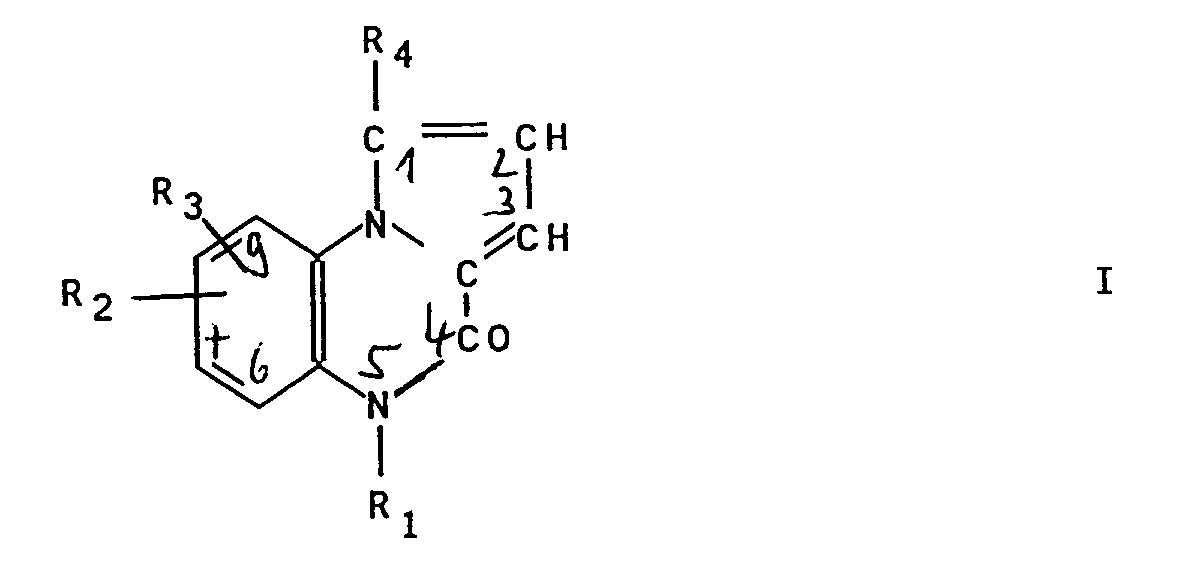
- the invention also relates to a new improved process for the preparation of starting materials of the formula I, in which R 1 and R 4 are hydrogen and the radicals R 2 and R 3 are identical or different and are hydrogen, halogen, C 1 -C 6 -alkyl, CF 3 , -CN, C 1 -C 6 alkoxy, amino, C 2 -C 6 alkanoylamino, -N0 2 , hydroxy, -SO 3 H, -C0 2 H, -COO-Ci-C 6 alkyl, CONH-Ci-C 6 alkyl, CON (C 1 -C 6 alkyl) 2 , -NHRs or NRs R6, where R 5 and R 6 have the meanings given in claim 1.
- the halogen atoms are chlorine, bromine or fluorine, especially chlorine and fluorine.
- the alkyl and alkoxy groups as such or as a constituent of other composite groups consist in particular of 1-4 C atoms, preferably 1 or 2 C atoms.
- Alkanoyl groups such as, for example, alkanoylamino groups or alkanoyloxy groups, consist in particular of 2-4, preferably 2-3, carbon atoms.
- Alk consists in particular of 1-4, preferably 2-3, carbon atoms.
- the end products of the formula I are obtained in free form or in the form of their salts.
- the salts of the end products can be converted back into the bases in a manner known per se, for example with alkali or ion exchangers. From the latter, salts can be obtained by reaction with organic or inorganic acids, in particular those which are suitable for forming therapeutically usable salts.
- the compounds according to the invention are suitable for the production of pharmaceutical compositions.
- the pharmaceutical compositions or medicaments can contain one or more of the compounds according to the invention.
- the usual carriers and auxiliaries can be used to produce the pharmaceutical preparations.
- the process can be carried out without a solvent or in a suitable solvent or dispersant.
- suitable solvents or dispersants are: aromatic hydrocarbons such as, for example, benzene, mesitylene, toluene, xylene; Pyridine; lower aliphatic ketones such as acetone, methyl ethyl ketone; halogenated hydrocarbons such as chloroform, 1,2-dichloroethane, carbon tetrachloride, chlorobenzene, methylene chloride; Ethers such as tetrahydrofuran, dioxane, diisopropyl ether; Sulfoxides such as dimethyl sulfoxide; tertiary acid amides such as, for example, dimethyl formamide, dimethylacetamide, hexamethylphosphoric triamide, tetramethyl urea, N-methylpyrrolidone; lower alcohols such as, for example, methanol, ethanol, isopropanol
- the reaction is advantageously carried out in the presence of acid-binding agents such as alkali carbonates (potash, soda), alkali acetates, alkali hydroxides or tertiary bases (triethylamine, pyridine).
- the starting compound 11 is preferably used in the form of its metal salt.
- the alkali salts Na, K, Li
- the alkali metal salts are prepared, for example, using the corresponding alkali metal hydrides, alkali metal amides, alkali metal alcoholates or also alkali metals in a solvent (lower alcohol, aromatic hydrocarbon) or with aqueous alkali (for example NaOH).
- the alkylation or acylation is carried out, for example, by reaction with compounds of the formula R-Hal, ArS0 2 0R and S0 2 (OR) 2 , where Hal is a halogen atom (in particular chlorine, bromine or iodine) and Ar is an aromatic radical (for example an optionally by one or more lower alkyl radicals is substituted phenyl or naphthyl radical and R is, for example, the radicals C1-C6-alkyl, C 2 -C 6 alkenyl, C 2 -C 6 alkynyl, C 2 -C 6 alkanoyl, benzoyl, morpholinocarbonyl, C 1 -C 6 -alkyloxycarbonyl, C 1 -C 6 -alkylaminocarbonyl
- alkylation and acylation reaction is optionally carried out with the addition of customary acid-binding agents, such as alkali metal hydroxides, alkali metal carbonates, alkali metal hydrocarbonates, alkali metal hydrogen carbonates, alkaline earth metal carbonates, alkaline earth metal acetates, tertiary amines (for example trialkylamine such as triethylamine), pyridine or even alkali metal hydrides at temperatures between 0 and 200 ° C. preferably 40 and 140 ° C in inert solvents or suspension agents.
- customary acid-binding agents such as alkali metal hydroxides, alkali metal carbonates, alkali metal hydrocarbonates, alkali metal hydrogen carbonates, alkaline earth metal carbonates, alkaline earth metal acetates, tertiary amines (for example trialkylamine such as triethylamine), pyridine or even alkali metal hydrides at temperatures between 0 and 200 ° C. preferably 40 and 140
- solvents or dispersants are: aromatic hydrocarbons such as, for example, benzene, toluene, xylene; aliphatic ketones such as acetone, methyl ethyl ketone; halogenated hydrocarbons such as chloroform, carbon tetrachloride, chlorobenzene, methylene chloride, aliphatic ethers such as butyl ether; cyclic ethers such as tetrahydrofuran, dioxane; Sulfoxides such as dimethyl sulfoxide; tertiary acid amides such as dimethylformamide, N-methylpyrrolidone, hexamethylphosphoric triamide; aliphatic alcohols such as methanol, ethanol, isopropanol, amyl alcohol, tert-butanol, cycloaliphatic hydrocarbons such as cyclohexane and the like.
- aromatic hydrocarbons such as, for example, benzene, to
- Aqueous mixtures of the solvents mentioned can also be used. One often works at the reflux temperature of the solvents or dispersants used.
- the alkylation reaction components are frequently used in excess.
- the alkylation can also be carried out in the presence of tetraalkylammonium salts (especially the halides) in combination with alkali metal hydroxides at temperatures between 0-100 ° C., preferably 20-80 ° C., in an aprotic solvent or in chloroform or methylene chloride.
- Suitable aprotic solvents are in particular: tertiary amides (dimethylformamide, N-methyl-pyrrolidone, hexamethylphosphoric acid triamide), dimethyl sulfoxide, acetonitrile, dimethoxyethane, acetone, tetrahydrofuran.
- the group -COD meanings of D as specified in the claim
- the group -CO-C 1 -C 6 -alkyl, benzoyl or the C 1 -C 6 -alkoxycarbonyl group are introduced in amino groups or hydroxyl groups.
- the procedure is known in a manner known per se, for example the appropriate ones are used Acid halides (chlorides, bromides) such as carb-C 1 -C 6 alkoxy halides or corresponding anhydrides).
- the reaction temperatures are preferably between 30 and 120 ° C.
- the alkylation and acylation can also be carried out by first preparing an alkali compound (sodium, potassium or lithium salt for example) from the compound to be alkylated or acylated, for example, by placing it in an inert solvent such as dioxane, dimethylformamide , Benzene or toluene with an alkali metal, alkali metal hydride or alkali amide (especially sodium or sodium compounds) or butyllithium at temperatures between 0 and 150 ° C and then the alkylating agent is added.
- an alkali compound sodium, potassium or lithium salt for example
- an inert solvent such as dioxane, dimethylformamide , Benzene or toluene with an alkali metal, alkali metal hydride or alkali amide (especially sodium or sodium compounds) or butyllithium at temperatures between 0 and 150 ° C and then the alkylating agent is added.
- alkylating and acylating agents instead of the alkylating and acylating agents mentioned, other chemically equivalent agents commonly used in chemistry can also be used (see, for example, also LF and Mary Fieser "Reagents for Organic Synthesis", John Wiley and Sons, Inc., New York, 1967, Vol . 1, pages 1303-4 and Vol. 2, page 471.
- acyl groups such as carb-Ci-C 6 -alkoxy groups, C 2 -C 6 -alkanoyl groups and similar groups can be split off solvolytically.
- This cleavage takes place in a known manner, for example by saponification with acids (mineral acids such as hydrochloric acid, sulfuric acid, in particular concentrated hydrohalic acids such as HBr / glacial acetic acid) or by means of basic substances (potash, soda, aqueous alkali solutions, alcoholic alkali solutions, aqueous NH 3 ) at temperatures between 10 and 150 ° C, especially 20 - 100 ° C.
- acids mineral acids such as hydrochloric acid, sulfuric acid, in particular concentrated hydrohalic acids such as HBr / glacial acetic acid
- basic substances potash, soda, aqueous alkali solutions, alcoholic alkali solutions, aqueous NH 3
- the amination is the reaction of a haloalkyl function (for example R 1 is Alk-A and / or R 2 , R 3 are G-AlkA, where A is a halogen atom such as chlorine, bromine or iodine) with -NHRs, - NR 5 R 6 , NR 5 R 6 R 7 , pyrdyilamino, imidazolyl, pyrrolidinyl, NC i -C 6 alkylpyrrolidinyl, piperidylamino, N- (phenyl-C 1 -C 4 alkyl) piperidylamino, where R 5 and R 6 are identical or different and are hydrogen, C i -C 6 alkyl, C 3 -C 7 cycloalkyl, C 3 -C 7 hydroxycycloalkyl, morpholino-C i -C 6 alkyl, phenyl, phenyl-C i -C 6 represent alkyl or
- Ether groups are split off, for example, without a solvent or in an inert solvent with boron tribromide, boron trifluoride, aluminum chloride, silicon tetrachloride, aluminum tribromide, sodium ethyl thiolate, (CH 3 ) 3 SiCl + NaJ at temperatures between -70 ° C. and 200 ° C.
- suitable solvents for this ether cleavage are: aliphatic halogenated hydrocarbons such as methylene chloride, aromatic hydrocarbons such as benzene, toluene, xylene, halogenated aromatic hydrocarbons such as chlorobenzene, dichlorobenzenes, dimethylformamide, acetonitrile.
- this ether cleavage can also be carried out using iodine-hydrochloric acid, hydrochloric acid (for example alcoholic HCl), pyridine hydrochloride, hydrobromic acid, methylmagnesium iodide with or without solvent at temperatures between 0 ° C. to 150 ° C.
- suitable solvents for the latter cleavage are: aliphatic ethers with alkyl radicals of 1 to 6 carbon atoms, water.
- reaction of a compound III with the compound IV takes place in a solvent or suspending agent (lower aliphatic alcohols, dimethyl sulfoxide, water and aqueous mixtures) at temperatures between 10 and 150 ° C., preferably 20-80 ° C. It is expedient to become more basic in the presence Substances such as alkali carbonates, tertiary aliphatic amines, pyridine worked.
- a solvent or suspending agent lower aliphatic alcohols, dimethyl sulfoxide, water and aqueous mixtures
- Catalytic hydrogenation has proven particularly suitable for this reduction.
- suitable catalysts are: Raney nickel, noble metals such as palladium and platinum and compounds thereof, with and without a carrier, such as coal, barium sulfate, calcium sulfate and so on. It is advisable to hydrogenate the nitro group at temperatures between 20 and 100 ° C and a pressure of approximately 1 to 70 bar in a solvent.
- suitable solvents are C1-C4-alkanols, C 2 -C 4 -diols and their lower alkyl ethers, cyclic ethers such as dioxane, tetrahydrofuran, methoxyethanol, water, aromatic hydrocarbons (benzene, toluenes, xylenes) and mixtures of these agents.
- drying agents such as anhydrous sodium or magnesium sulfate, are added to the mixture to be hydrogenated at the beginning.
- the reduction can also be carried out with nascent hydrogen, for example zinc / hydrochloric acid, tin / hydrochloric acid, iron / hydrochloric acid, iron / glacial acetic acid or with salts of the hydrogen sulfide in alcohol / water at about 70 to about 120 ° C or with activated aluminum in water-containing ether at 20 up to 40 ° C or with tin chloride / hydrochloric acid or with ammonium formate.
- nascent hydrogen for example zinc / hydrochloric acid, tin / hydrochloric acid, iron / hydrochloric acid, iron / glacial acetic acid or with salts of the hydrogen sulfide in alcohol / water at about 70 to about 120 ° C or with activated aluminum in water-containing ether at 20 up to 40 ° C or with tin chloride / hydrochloric acid or with ammonium formate.
- a solution of 0.5 mol of the corresponding o- [1- (2-ethoxycarbonyl-4-hydroxy) pyrrolidinyl] nitro aromatics or o- [1- (2-carboxy-4-hydroxy) pyrrolidinyl] nitro aromatics in 1.5 l of methanol is hydrogenated at about 60 ° C. in the presence of palladium on activated carbon under normal pressure.
- the solution is concentrated in vacuo to about 300 ml and allowed to crystallize overnight at 0-4 ° C.
- the precipitated crystals are filtered off, washed with 100 ml of methanol and dried in vacuo.
- the starting substances for the preparation of the compounds according to claim 1 are known or can be prepared by the process according to claim 3 and / or analogously to the following examples.
- the compounds according to the invention show a good antiallergic, antiasthmatic and antiinflammatory effect in vivo in various asthma models and in vitro in the inhibition of mediator release, as well as a good effect also for example in psoriasis and related properties.
- Indications for which the compounds according to the invention can be considered are: asthma, allergic rhinitis, rheumatic arthritis, psoriasis, Crohn's disease, ulcerative colitis.
- the pharmaceutical preparations generally contain between 0.01% to 10%, preferably 0.1% to 1%, of the active component (s) according to the invention.
- the administration can take place, for example, in the form of tablets, capsules, pills, dragees, suppositories, ointments, jellies, creams, powders, dusting powder, aerosols or in liquid form.
- Possible liquid application forms are, for example: oily or alcoholic or aqueous solutions as well as suspensions and emulsions.
- Preferred forms of use are solutions which contain between 0.01 and 10 percent by weight of active substance.
- 1 tablet containing 230 to 2400 mg of active substance 3 times a day or, for example in the case of intravenous injection, 1 ampoule of 1 to 5 ml content containing 7 to 70 mg of substance once a day are recommended.
- the minimum daily dose is, for example, 700 mg; the maximum daily dose for oral administration should not exceed 7 g.
- the acute toxicity of the compounds according to the invention on the mouse is above 1000, for example, when administered orally mg / kg.
- the compound with the name 4,5-dihydro-8-hydroxy-4-oxopyrido [3,2-e] pyrrolo [1,2-a] pyrazine shows an IC 50 of 32.2 when inhibiting phosphodiesterase ⁇ mol / I.
- the compound according to Example 98 shows an IC 50 of 15.1 ⁇ mol / l in the same experiment.
- the compound with the cipher D-20169 has an ICso value of 7.34 ⁇ mol / I in the inhibition of phosphodiesterase.
- a mixture of 9.5 g of the 3-ethoxycarbonyl compound thus obtained (30 mmol), 11.2 g (0.2 mmol) of potassium hydroxide and 250 ml of methanol / water mixture (4: 1) is refluxed with stirring for 16 hours. After cooling to room temperature, the mixture is acidified with concentrated hydrochloric acid while stirring, the precipitated solid is filtered off with suction and washed neutral with water. The product is then boiled out in acetone, suction filtered again after cooling and dried in vacuo.
- the resulting suspension is added dropwise with stirring and exclusion of moisture at 0-5 ° C. to a mixture of 5.6 g (50 mmol) of N-methylcyclohexylamine and 2.6 g (25 mmol) of sodium carbonate in 120 ml of tetrahydrofuran / water mixture ( 25: 1).
- the mixture is allowed to warm to room temperature with stirring and react further overnight.
- Insoluble constituents are filtered off, the filtrate in Concentrated vacuum and the residue recrystallized from 2-propanol.
- the mixture is stirred for 2 hours at room temperature and the reaction mixture is then added dropwise, with stirring and in a protective gas atmosphere, to a solution of 1-10 mol of the corresponding 1-bromo- ⁇ -chloroalkane or 1, ⁇ -dihaloalkane in which both halogen atoms are identical in dimethylformamide (or dimethylacetamide or N-methylpyrrolidone).
- the addition is complete, the mixture is stirred at room temperature for 3 hours and then insoluble constituents are filtered off.
- Example 7 (cipher RD 541 / UE 3)
- Example 8 (code RD 781 / MB8)
- Example 10 (cipher RD 790 / T7632).
- the dichloromethane phase is extracted once with 30 ml of 2N hydrochloric acid and 30 ml of 2N sodium hydroxide solution and then washed three times neutral with 40 ml of water. After drying with sodium sulfate, the dichloromethane phase is concentrated in vacuo, the residue is taken up in 80 ml of ethanol and crystallized by adding ethanolic hydrochloric acid. The crystals obtained are suction filtered, washed with methanol and dried in vacuo.
- Example 17 the starting components are a 1: 1 mixture of 5- (3-bromopropyl) - and 5- (3-chloropropyl) -8- [3- (N-cyclohexyl-N-methylcarbamoyl) propyloxy] -4 , 5-dihydro-4-oxopyrido [3,2-e] pyrrolo [-1,2a] pyrazine (Example 10) and 1- (2-methoxyphenyl) piperazine.
- 5-haloalkyl mixtures other than those given above or the pure 5-haloalkyl compounds can also be used.
Landscapes
- Chemical & Material Sciences (AREA)
- Organic Chemistry (AREA)
- Health & Medical Sciences (AREA)
- Engineering & Computer Science (AREA)
- Bioinformatics & Cheminformatics (AREA)
- Veterinary Medicine (AREA)
- Public Health (AREA)
- Chemical Kinetics & Catalysis (AREA)
- General Chemical & Material Sciences (AREA)
- Medicinal Chemistry (AREA)
- Nuclear Medicine, Radiotherapy & Molecular Imaging (AREA)
- Pharmacology & Pharmacy (AREA)
- Life Sciences & Earth Sciences (AREA)
- Animal Behavior & Ethology (AREA)
- General Health & Medical Sciences (AREA)
- Heart & Thoracic Surgery (AREA)
- Cardiology (AREA)
- Pulmonology (AREA)
- Immunology (AREA)
- Anesthesiology (AREA)
- Biomedical Technology (AREA)
- Neurology (AREA)
- Neurosurgery (AREA)
- Pharmaceuticals Containing Other Organic And Inorganic Compounds (AREA)
- Nitrogen Condensed Heterocyclic Rings (AREA)
Abstract
- C1 -C6-Alkyloxycarbonyloxy,
- C1 -C6 -Alkylaminocarbonyloxy,
- C1-C6-Dialkylaminocarbonyloxy oder die Gruppe -Alk-A ist, worin Alk: C1-C6-Alkyl,
- C2-C6-Hydroxy-alkyl oder C3-C6-Cycloalkyl bedeutet und das Symbol A Wasserstoff oder andere Substituenten darstellt.

Description
- Die Europa-Patentanmeldung 400 583 betrifft Imidochioxaline und deren Aza-Analoge der folgenden allgemeinen Formel

- Für diese Verbindungen wird eine positiv inotrope gefaßerweiternde Wirkung angegeben.
- Weiterhin wird in Indian Journal of Chemistry, Band 10, 1972, Seiten 344-350 unter anderem die Herstellung von Verbindungen der Formel

- Die Erfindung betrifft die durch die Patentansprüche angegebenen Gegenstände. Die erfindungsgemäßen neuen Verbindungen sind pharmakologisch wirksam insbesondere besitzen sie antiallergische und antiasthmatische Wirkungen, anxiolytische Wirkungen, hypotensive Wirkungen (zum Beispiel selektive a2-Blokade), vasodilatierende Wirkungen (inodilatorisch) sowie eine positiv inotrope Wirkung (selektive PDE-III-Hemmung).
- Der Erfindung liegt die Aufgabe zugrunde, neue Verbindungen mit günstigen und verbesserten pharmakologischen Eigenschaften zur Verfügung zu stellen.
- Die Erfindung betrifft darüberhinaus ein neues verbessertes Verfahren zur Herstellung von Ausgangsstoffen der Formel I, worin R1 und R4 Wasserstoff sind und die Reste R2 und R3 gleich oder verschieden sind und Wasserstoff, Halogen, C1-C6-Alkyl, -CF3, -CN, C1-C6-Alkoxy, Amino, C2-C6-Alkanoylamino, -N02, Hydroxy, -SO3H, -C02H, -COO-Ci-C6-Alkyl, CONH-Ci-C6-Alkyl, CON(C1-C6-Alkyl)2, -NHRs oder NRs R6 bedeuten, wobei R5 und R6 die im Anspruch 1 angegebenen Bedeutungen haben.
- Die folgenden Erläuterungen stellen wichtige beispielhafte Angaben dar:
- Die in der Formel I vorkommenden Alkylgruppen, Halogenalkylgruppen, Alkenylgruppen, Alkinylgruppen, Alkoxygruppen, Alkylaminogruppen, Alkanoylaminogruppen, Alkanoyloxygruppen beziehungsweise ganz allgemein Alkanoylgruppen können gerade oder verzweigt sein. Dasselbe gilt auch für Alkyl- und Alkyloxygruppen (= Alkoxygruppen), falls diese Bestandteil anderer zusammengesetzter Gruppen sind (zum Beispiel in Form einer Monoalkyl- oder Dialkylaminogruppe, Alkanoylaminogruppe, Alkoxycarbonylaminogruppe, Carbalkoxygruppe und analoge Gruppen.
- Bei der C3-C7-Cycloalkylgruppe handelt es sich vorzugsweise um Cyclopentyl oder Cyclohexyl. C2-C6-Alkenyl bedeutet vorzugsweise Propenyl. C2-C6-Alkinyl bedeutet vorzugsweise Propinyl.
- Bei den Halogenatomen handelt es sich um Chlor, Brom oder Fluor, Insbesondere Chlor und Fluor. Die Alkyl- und Alkoxygruppen als solche oder als Bestandteil von anderen zusammengesetzten Gruppen bestehen insbesondere aus 1-4 C-Atomen, vorzugsweise 1 oder 2 C-Atomen. Alkanoylgruppen, wie zum Beispiel Alkanoylaminogruppen oder Alkanoyloxygruppen bestehen insbesondere aus 2-4, vorzugsweise 2-3 C-Atomen. Alk besteht insbesondere aus 1-4, vorzugsweise 2-3 C-Atomen.
- Vorzugsweise handelt es sich bei den Verbindungen der Formel I um Verbindungen, wo die Reste Ri, R2, R3 und R4 die folgenden Bedeutungen haben:
- Ri: Wasserstoff, C1-C6-Alkyl oder die Gruppe

- R2: Wasserstoff, C1-C6-Alkoxy oder die Gruppe G-Alk-A, worin G Sauerstoff ist, Alk aus 2-4 C-Atomen besteht und A die Gruppe CO-NRs R6 ist mit R5 = C1-C4-Alkyl und R6 = C4-C7-Cycloalkyl. Der Rest R2 befindet sich vorzugsweise in 8-Stellung.
- R3 und R4: Wasserstoff
- D 21247 (Beispiel 1) , D 19897 (Beispiel 12),
- D 20971 (Beispiel 28), D 20467,
- D 20972 (Beispiel 29), D 20469,
- D 20896 (Beispiel 11), D 20354.
- D 20354 = 4,5-Dihydro-8-[2-hydroxy-3-(4-(2-methoxyphenyl)piperazin-1-yl)-propyloxyl-4-oxo-pyrido-[3,2-e]pyrrolo[1,2-a]pyrazinhydrochlorid
- D 20467 = 4,5-Dihydro-8-[2-hydroxy-3-(4-benzhydrylpiperazin-1-yl)-propyloxy]-4-oxo-pyrido-[3,2-e]-pyrrolo[1,2-a]pyrazin-dihydrochloridmonohydrat
- D 20469 = 4,5-Dihydro-8-[2-hydroxy-3-(4-phenylpiperidin-1 -yl)-propyloxy]-4-oxo-pyrido-[3,2-e]-pyrrolo[1,2-a]pyrazin-hydrochlorid
- Diejenigen Verbindungen der Formel I, die asymmetrische Kohlenstoffatome enthalten und in der Regel als Razemate anfallen, können in an sich bekannter Weise beispielsweise mit Hilfe einer optisch aktiven Säure in die optisch aktiven Isomeren gespalten werden. Es ist aber auch möglich, von vornherein eine optisch aktive Ausgangssubstanz einzusetzen, wobei dann als Endprodukt eine entsprechende optisch aktive beziehungsweise diastereomere Form erhalten wird. Die vorliegende Erfindung umfaßt also auch die D- und L-Form wie auch die DL-Mischung für den Fall, daß in der Verbindung der Formel I ein asymmetrisches C-Atom vorkommt und für den Fall von 2 und mehr asymmetrischen C-Atomen ebenso die entsprechenden diastereomeren Formen.
- Je nach den Verfahrensbedingungen und Ausgangsstoffen erhält man die Endstoffe der Formel I in freier Form oder in Form ihrer Salze. Die Salze der Endstoffe können in an sich bekannter Weise, beispielsweise mit Alkali oder lonenaustauschern wieder in die Basen übergeführt werden. Von den letzteren lassen sich durch Umsetzung mit organischen oder anorganischen Säuren, insbesondere solchen, die zur Bildung von therapeutisch verwendbaren Salzen geeignet sind, Salze gewinnen.
- Die erfindungsgemäßen Verbindungen sind zur Herstellung pharmazeutischer Zusammensetzungen geeignet. Die pharmazeutischen Zusammensetzungen beziehungsweise Medikamente können eine oder mehrere der erfindungsgemäßen Verbindungen enthalten. Zur Herstellung der pharmazeutischen Zubereitungen können die üblichen Träger- und Hilfsstoffe verwendet werden.
- Das Verfahren kann ohne Lösungsmittel oder in einem geeigneten Lösungs- oder Dispergiermittel durchgeführt werden. Als Lösungs- oder Dispergiermittel kommen zum Beispiel in Betracht: Aromatische Kohlenwasserstoffe wie zum Beispiel Benzol, Mesitylen, Toluol, Xylol; Pyridin; niedere aliphatische Ketone wie zum Beispiel Aceton, Methyläthylketon; halogenierte Kohlenwasserstoffe wie zum Beispiel Chloroform, 1,2-Dichlorethan, Tetrachlorkohlenstoff, Chlorbenzol, Methylenchlorid; Ether wie zum Beispiel Tetrahydrofuran, Dioxan, Diisopropylether; Sulfoxyde wie zum Beispiel Dimethylsulfoxid; tertiäre Säureamide wie zum Beispiel Diemthylformamid, Dimethylacetamid, Hexamethylphosphorsäuretriamid, Tetramethylharnstoff, N-Methylpyrrolidon; niedere Alkohole wie zum Beispiel Methanol, Äthanol, Isopropanol, Amylalkohol, Butanol, tert.-Butanol sowie Mischungen der genannten Mittel, gegebenenfalls auch mit Wasser. Es empfiehlt sich die Reaktion unter einer Schutzgasatmosphäre durchzuführen. Als Schutzgase kommen beispielsweise in Frage: Stickstoff, Argon.
- Die Reaktion wird beispielsweise bei Temperaturen zwischen 20 bis 200°C, vorzugsweise 40 bis 160°C oder auch 50 bis 120°C durchgeführt.
- Wird ein Lösungs- beziehungsweise Dispersionsmittel verwendet, arbeitet man häufig bei der Rückflußtemperatur dieses Mittels. Die Reaktion läuft häufig bereits auch schon bei Raumtemperatur ab, beziehungsweise bei einer Temperatur zwischen 40 bis 120°C.
- Bei der Ausgangskomponente R1 Hal bedeutet Hal vorzugsweise Chlor, Brom oder Jod. Dies gilt auch für die Ausgangskomponente Hal-Alk-A.
- Die Umsetzung wird vorteilhaft in Gegenwart von säurebindenden Mitteln wie Alkalicarbonaten (Pottasche, Soda), Alkaliacetaten, Alkalihydroxyden oder tertiären Basen (Triethylamin, Pyridin) durchgeführt. Vorzugsweise wird die Ausgangsverbindung 11 in Form ihres Metallsalzes eingesetzt. Insbesondere kommen hier die Alkalisalze (Na, K, Li) in Frage.
Die Herstellung der Alkalisalze erfolgt beispielsweise mittels den entsprechenden Alkalihydriden, Alkaliamiden, Alkalialkoholaten oder auch Alkalimetallen in einem Lösungsmittel (niederer Alkohol, aromatischer Kohlenwasserstoff) oder mit wäßrigem Alkali (zum Beispiel NaOH). - Insbesondere handelt es sich hier um die Acylierung oder Alkylierung von Aminogruppen und/oder Hydroxygruppen oder um den Ersatz eines Halogenatoms durch NH2 beziehungsweise alkylsubstituiertes Amino. Die Alkylierung beziehungsweise Acylierung erfolgt beispielsweise durch Umsetzung mit Verbindungen der Formel R-Hal, ArS020R und S02(OR)2, wobei Hal ein Halogenatom (insbesondere Chlor, Brom oder Jod) und Ar ein aromatischer Rest (zum Beispiel ein gegebenenfalls durch einen oder mehrere niedere Alkylreste substituierter Phenyl- oder Naphthylrest ist und R beispielsweise die Reste C1-C6-Alkyl, C2-C6-Alkenyl, C2-C6-Alkinyl , C2-C6-Alkanoyl, Benzoyl, Morpholinocarbonyl, C1-C6-Alkyloxycarbonyl, C1-C6-Alkylaminocarbonyl, C1-C6-Dialkylaminocarbonyl, die Gruppe COD (Bedeutungen von D wie im Patentanspruch angegeben) oder Ar-C1-C6-Alkyl bedeutet.
- Beispiele sind entsprechende p-Toluolsulfonsäure-alkylester, entsprechende Dialkylsulfate, entsprechende Alkylhalogenide und ähnliche. Die Alkylierungs-und Acylierungsreaktion wird gegebenenfalls unter Zusatz von üblichen säurebindenden Mitteln, wie Alkalihydroxiden, Alkalicarbonaten, Alkalihydrocarbonaten, Alkalihydrogencarbonaten, Erdalkalicarbonaten, Erdalkaliacetaten, tertiaren Aminen (zum Beispiel Trialkylamin wie Triethylamin), Pyridin oder auch Alkalihydriden bei Temperaturen zwischen 0 und 200°C, vorzugsweise 40 und 140°C in inerten Lösungsmitteln oder Suspensionmitteln durchgeführt. Als Lösungs- oder Dispergiermittel kommen beispielsweise in Betracht: aromatische Kohlenwasserstoffe wie zum Beispiel Benzol, Toluol, Xylol; aliphatische Ketone wie zum Beispiel Aceton, Methylethylketon; halogenierte Kohlenwasserstoffe wie zum Beispiel Chloroform, Tetrachlorkohlenstoff, Chlorbenzol, Methylenchlorid, aliphatische Ether wie zum Beispiel Butylether; cyclische Ether wie zum Beispiel Tetrahydrofuran, Dioxan; Sulfoxyde wie zum Beispiel Dimethylsulfoxid; tertiäre Säureamide wie zum Beispiel Dimethylformamid, N-Methylpyrrolidon, Hexamethylphosphorsäuretriamid; aliphatische Alkohole wie Methanol, Ethanol, Isopropanol, Amylalkohol, tert.-Butanol, cycloaliphatische Kohlenwasserstoffe wie Cyclohexan und ähnliche. Auch wässrige Mischungen der genannten Lösungsmittel können verwendet werden. Häufig arbeitet man bei der Rückflußtemperatur der verwendeten Lösungs- beziehungsweise Dispergiermittel. Häufig werden die Alkylierungsreaktionskomponenten im Überschuß eingesetzt. Die Alkylierung kann auch in Gegenwart von Tetraalkylammoniumsalzen (insbesondere der Halogenide) in Kombination mit Alkalihydroxiden bei Temperaturen zwischen 0 - 100°C, vorzugsweise 20 -80°C, in einem aprotischen Lösungsmittel oder auch in Chloroform oder Methylenchlorid vorgenommen werden. Als aprotische Lösungsmittel kommen insbesondere in Betracht: tertiäre Amide (Dimethylformamid, N-Methyl-Pyrrolidon, Hexamethylphosphorsäuretriamid), Dimethylsulfoxid, Acetonitril, Dimethoxyethan, Aceton, Tetrahydrofuran.
- Bei der Acylierung werden zum Beispiel in Aminogruppen oder Hydroxygruppen die Gruppe -COD (Bedeutungen von D wie im Anspruch angegeben), die Gruppe -CO-C1-C6-Alkyl, Benzoyl oder die C1-C6-Alkoxycarbonylgruppe eingeführt.
Man verfährt hierbei in an sich bekannter weise beispielsweise verwendet man die entsprechenden Säurehalogenide (Chloride, Bromide) wie zum Beispiel Carb-C1-C6-alkoxyhalogenide oder entsprechende Anhydride). Die Reaktionstemperaturen liegen vorzugsweise zwischen 30 und 120°C. - Gegebenenfalls kann man bei der Alkylierung und der Acylierung auch so vorgehen, daß man zuerst von der zu alkylierenden beziehungsweise acylierenden Verbindung eine Alkaliverbindung (Natrium-, Kalium- oder auch Lithiumsalz zum Beispiel) herstellt, indem man sie in einem inerten Lösungsmittel wie Dioxan, Dimethylformamid, Benzol oder Toluol mit einem Alkalimetall, Alkalihydrid oder Alkaliamiden (insbesondere Natrium oder Natriumverbindungen) oder Butyllithium bei Temperaturen zwischen 0 und 150°C umsetzt und dann das alkylierden Agens zufügt.
- Anstelle der angeführten Alkylierungs- und Acylierungsmittel können auch andere in der Chemie gebräuchliche chemisch-äquivalente Mittel verwendet werden (siehe zum Beispiel auch L.F. und Mary Fieser "Reagents for Organic Synthesis", John wiley and Sons, Inc., New York, 1967, Vol. 1, Seitten 1303-4 und Vol. 2, Seite 471.
- Vorhandene Acylgruppen wie zum Beispiel Carb-Ci-C6-alkoxygruppen, C2-C6-Alkanoylgruppen und ähnliche Gruppen können solvolytisch abgespalten werden. Diese Abspaltung erfolgt in bekannter weise beispielsweise durch Verseifung mit Säuren (Mineralsäuren wie Salzsäure, Schwefelsäure, insbesondere konzentrierten Halogenwasserstoffsäuren wie HBr/Eisessig) oder mittels basischer Substanzen (Pottasche, Soda, wässrige Alkalilösungen, alkoholische Alkalilösungen, wässriges NH3) bei Temperaturen zwischen 10 und 150°C, insbesondere 20 - 100°C.
- Bei der Aminierung handelt es sich um die Umsetzung einer Halogenalkylfunktion (zum Beispiel R1 ist Alk-A und/oder R2, R3 sind G-AlkA, wo A ein Halogenatom wie Chlor, Brom oder Jod ist) mit -NHRs, -NR5R6, NR5R6R7, Pyrdyilamino, Imidazolyl, Pyrrolidinyl, N-Ci-C6-Alkylpyrrolidinyl, Piperidylamino, N-(Phenyl-C1-C4-alkyl)-piperidylamino, wobei R5 und R6 gleich oder verschieden sind und Wasserstoff, Ci-C6-Alkyl, C3-C7-Cycloalkyl, C3-C7-Hydroxycycloalkyl, Morpholino-Ci-C6-Alkyl, Phenyl, Phenyl-Ci-C6-alkyl oder Phenyl-C2-C6-oxyalkyl darstellen, wobei die Phenylreste auch durch Halogen substituiert sein können und R7 wasserstoff oder C1-C6-Alkyl ist, oder um die Umsetzung einer solchen Halogenalkylfunktion mit Aminen der folgenden Formel

Diese Umsetzung erfolgt gemäß den Bedingungen, die für das Verfahren gemäß Patentanspruch 2 angegeben sind. - Die Abspaltung von Ethergruppen erfolgt beispielsweise ohne Lösungsmittel oder in einem inerten Lösungsmittel mit Bortribromid, Bortrifluorid, Aluminiumchlorid, Siliziumtetrachlorid, Aluminiumtribromid, Natriumethylthiolat, (CH3)3SiCI+NaJ bei Temperaturen Zwischen -70°C und 200°C. Als Lösungsmittel für diese Etherspaltung kommen beispielsweise in Frage: aliphatische Halogenkohlenwasserstoffe wie zum Beispiel Methylenchlorid, aromatische Kohlenwasserstoffe wie Benzol, Toluol, Xylol, halogenierte aromatische Kohlenwasserstoffe wie Chlorbenzol, Dichlorbenzole, Dimethylformamid, Acetonitril.
- Weiterhin kann diese Etherspaltung auch mittels Jod-Wasserstoffsäure, Chlorwasserstoffsäure (zum Beispiel alkoholische HCI), Pyridinhydrochlorid, Bromwasserstoffsaure, Methylmagnesiumjodid mit oder ohne Lösungsmittel bei Temperaturen zwischen 0°C bis 150°C erfolgen. Als Lösungsmittel für die zuletzt genannte Spaltung kommen beispielsweise in Betracht: aliphatische Ether mit Alkylresten aus 1 bis 6 C-Atomen, Wasser.
- Einzelheiten über die Reaktionsbedingungen und Reaktionskomponenten der vorstehend genannten Umsetzungen gehen auch aus der Herstellungsbeschreibung für die Ausgangsstoffe hervor.
- Die Umsetzung einer Verbindung III mit der Verbindung IV erfolgt in einem Lösungs- beziehungsweise Suspensionsmittel (niedere aliphatische Alkohole, Dimethylsulfoxid, Wasser und wässrige Gemische) bei Temperaturen zwischen 10 und 150°C, vorzugsweise 20 - 80°C. Zweckmäßig wird in Gegenwart basischer Stoffe wie Alkalikarbonaten, tertiären aliphatischen Aminen, Pyridin gearbeitet.
- Für diese Reduktion hat sich als besonders geeignet die katalytische Hydrierung erwiesen. Als Katalysatoren kommen zum Beispiel in Frage: Raney-Nickel, Edelmetalle wie Palladium und Platin sowie Verbindungen davon, mit und ohne Träger, wie beispielsweise Kohle, Bariumsulfat, Calciumsulfat und so weiter. Es empfiehlt sich, die Hydrierung der Nitrogruppe bei Temperaturen zwischen 20 und 100°C und einem Druck von ungefähr 1 bis 70 bar in einem Lösungsmittel vorzunehmen. Als Lösungsmittel eignen sich beispielsweise C1-C4-Alkanole, C2-C4-Diole und deren Niederalkylether, cyclische Ether wie Dioxan, Tetrahydrofuran, Methoxy-ethanol, Wasser, aromatische Kohlenwasserstoffe (Benzol, Toluole, Xylole) sowie Gemische dieser Mittel. Für die anschließende Isolierung der reduzierten Verbindungen kann es in manchen Fällen von Vorteil sein, wenn zu Beginn dem zu hydrierenden Gemisch Trockenmittel, wie wasserfreies Natrium- oder Magnesiumsulfat zugesetzt werden.
- Die Reduktion kann aber auch mit nascierendem Wasserstoff beispielsweise Zink/Salzsäure, Zinn/Salzsäure, Eisen/Salzsäure, Eisen/Eisessig oder mit Salzen des Schwefelwasserstoffs in Alkohol/Wasser bei etwa 70 bis etwa 120°C oder mit aktiviertem Aluminium in wasserhaltigem Äther bei 20 bis 40°C oder mit Zinnll-Chlorid/Salzsäure oder mit Ammoniumformiat durchgeführt werden.
- Eine Mischung aus 1 mol der entsprechenden o-Halogennitroaromaten, 234,8 g (1,2 mol) L-4-Hydrox- yprolinethylesterhydrochlorid und 414.6 g (3 mol) Kaliumcarbonat in 2 Liter Ethanol wird unter Rühren 20-120 h auf 50-60°C erwärmt. Nach Abkühlen auf Raumtemperatur filtriert man von unlöslichen Bestandteilen ab und engt das Reaktionsgemisch im Vakuum ein. Den verbleibenden öligen Rückstand nimmt man in 11 Dichlormethan auf und extrahiert je einmal mit 400 ml halbkonzentrierter Salzsäure und 200 ml Wasser. Die organische Phase wird mit Calciumchlorid getrocknet und anschließend im Vakuum eingeengt. Nach Trocknen im Vakuum erhält man in 65-95prozentiger Ausbeute die entsprechenden N-Aryl- oder N-Pyridyl-2-ethoxycarbonyl-4-hydroxypyrrolidine, die in der Regel ohne weitere Aufreinigung in die nächste Verfahrensstufe eingesetzt werden.
- Eine Mischung aus 1 mol der entsprechenden o-Halogennitroaromaten, 157,4 g (1,2 mol) L-4-Hydrox- yprolin und 202,4 g (2 mol) Triethylamin in 1,5 I Dimethylsulfoxid wird unter Rühren 20-120 h auf 50-70°C erwärmt. Nach Abkühlen auf Raumtemperatur wird das Reaktionsgemisch mit 4,5 I Wasser versetzt und die resultierende Lösung zweimal mit je 500 ml Ether extrahiert. Der Etherextrakt wird verworfen und die wässrige Phase mit konzentrierter Salzsäure auf pH = 2-3 eingestellt. Die wässrige Phase wird daraufhin viermal mit je 750 ml Dichlormethan extrahiert. Die vereinigten Dichlormethanextrakte werden mit Natriumsulfat getrocknet und anschließend im Vakuum eingeengt. Nach Trocknen im Vakuum erhält man in 65-95prozentiger Ausbeute die entsprechenden N-Aryl- oder N-Pyridyl-2-carboxy-4-hydroxypyrrolidine, die in der Regel ohne weitere Aufreinigung in die nächste Verfahrensstufe eingesetzt werden.
- Nach Variante A wurden beispielsweise hergestellt:
- 2-[1-(2-Ethoxycarbonyl-4-hydroxy)pyrrolidinyl]-6-methoxy-3-nitropyridin: orangegelbes Öl.
- 1-[1-(2-Ethoxycarbonyl-4-hydroxy)pyrrolidinyl]-2-nitrobenzol: orangegelbes Öl.
- Allgemeine Synthesevorschrift zur Herstellung annellierter Pyrrolo[1,2-a]-pyrazinone (Verbindungen der Formel VI) und deren Oxydation zu Verbindungen der Formel VII
- Eine Lösung aus 0,5 mol der entsprechenden o-[1-(2-Ethoxycarbonyl-4-hydroxy)-pyrrolidinyl]-nitroaro- maten beziehungsweise o-[1-(2-carboxy-4-hydroxy)-pyrrolidinyl]-nitroaromaten in 1,5 I Methanol wird in Gegenwart von Palladium auf Aktivkohle unter Normaldruck bei ca. 60°C hydriert. Nach beendeter Wasserstoffaufnahme filtriert man den Katalysator ab, verdünnt das Filtrat mit 3 I Methanol, säuert mit methanolischer Salzsäure an (pH = 1-2) und rührt die resultierende Lösung unter Durchleiten von Luft 1-5 Tage bei Raumtemperatur. Man engt die Lösung im Vakuum auf ca. 300 ml ein und läßt über Nacht bei 0-4°C kristalltsieren. Die ausgefallenen Kristalle werden abgesaugt, mit 100 ml Methanol nachgewaschen und im Vakuum getrocknet.
- Eine Lösung aus 0,5 mol der entsprechenden o-[1-(2-Ethoxycarbonyl-4-hydroxy)-pyrrolidinyl]-nitroaro- maten beziehungsweise o-[1-(2-carboxy-4-hydroxy)-pyrrolidinyl]-nitroaromaten in 1 I Eisessig wird unter Rühren und Stickstoffatmosphäre portionsweise mit 75 g Eisenpulver versetzt. Nach beendeter Zugabe erwärmt man das Reaktionsgemisch 3-5 h auf 60-70°C. Nach Abkühlen auf Raumtemperatur filtriert man von unlöslichen Bestandteilen ab und engt das Filtrat im Vakuum bis zur Trockene ein. Der verbleibende Rückstand wird erschöpfend mit Dichlormethan extrahiert. Die Methylenchloridphase wird im Vakuum eingeengt, der Rückstand in 3 I Methanol aufgenommen und die resultierende Lösung mit methanolischer Salzsäure angesäuert (pH = 1-2). Anschließend rührt man 1-5 Tage unter Durchleiten von Luft bei Raumtemperatur. Die Reaktionslösung wird auf ca. 300 ml eingeengt und über Nacht bei 0-4 °C zur Kristallisation gebracht. Die Kristalle werden abgesaugt, mit Methanol nachgewaschen und im Vakuum getrocknet.
- Nach Variante A wurden beispielsweise folgende Verbindungen erhalten:
- 4,5-Dihydro-8-methoxy-4-oxo-pyrido[3,2-e]pyrrolo[1,2-a]pyrazin (Chiffre D 17500).
- Farblose bis beige Kristalle, F. 274-276 ° C.
- 4,5-Dihydro-4-oxo-pyrrolo[1,2-a]chinoxalin (Chiffre D 18543).
- Farblose bis beige Kristalle, F. 271-273°C.
- 4,5-Dihydro-4-oxo-pyrido[3,2-e]pyrrolo[1,2-alpyrazin (Chiffre D 18367).
- Farblose bis beige Kristalle, F. 281-284°C.
- 8-Chlor-4,5-dihydro-4-oxo-pyrido[3,2-e]pyrrolo[1,2-a]pyrazin (Chiffre D 18370).
- Farblose bis beige Kristalle, F. 297-299°C.
- 4,5-Dihydro-8-methyl-4-oxo-pyrrolo[1,2-a]chinoxalin (Chiffre D 19786).
- Farblose bis beige Kristalle, F. 283-285°C.
- Nach Variante B wurden beispielsweise erhalten:
- 4,5-Dihydro-7-methyl-4-oxo-pyrrolo[1,2-a]chinoxalin (Chiffre D 19777).
- Farblose bis beige Kristalle, F. 258 °C.
- 7-Amino-4,5-dihydro-4-oxo-pyrrolo[1,2-a]chinoxalinhydrochlorid (Chiffre D 19457).
- Dunkelbeige Kristalle, F. 324-328°C.
- 4,5-Dihydro-7-trifluormethyl-4-oxo-pyrrolo[1,2-a]-chinoxalin (Chiffre D 19801).
- Farblose bis beige Kristalle, F. 240-241 °C
- 4,5-Dihydro-8-fluor-4-oxo-pyrrolo[1,2-a]chinoxalin (Chiffre D 19823).
- Farblose bis beige Kristalle, F. 318°C.
- 4,5-Dihydro-7-fluor-4-oxo-pyrrolo[1,2-a]chinoxalin (Chiffre D 19857).
- Farblose bis beige Kristalle, F. 281 ° C.
- 9-Chlor-4,5-dihydro-4-oxo-pyrrolo[1,2-a]chinoxalin (Chiffre D 19858).
- Farblose bis beige Kristalle, F. 309°C.
- 7-Cyano-4,5-dihydro-4-oxo-pyrrolo[1,2-a]chinoxalin (Chiffre D 20353)
- Farblose bis beige Kristalle, F. 312°C.
- Die Ausgangssubstanzen für die Herstellung der Verbindungen gemäß Anspruch 1 sind bekannt oder können nach dem Verfahren gemäß Anspruch 3 und/oder analog den folgenden Beispielen hergestellt werden.
- 4,5-Dihydro-8-hydroxy-4-oxo-pyrido[3,2-e]pyrrolo[1,2-alpyrazin (Chiffre D 19459). Eine Mischung aus 107,6 g (0,5 mol) 4,5-Dihydro-8-methoxy-4-oxo-pyrido[3,2-e]pyrrolo[1,2-a]pyrazin und 2 I 48prozentige wässrige Bromwasserstoffsäure wird unter Rühren und Schutzgasatmosphäre 5 h zum Rückfluß erhitzt. Nach Abkühlen auf Raumtemperatur saugt man das ausgefallene Produkt ab und wäscht mit 500 ml Wasser nach. Der Feststoff wird in 1000 ml Wasser aufgenommen und die resultierende Suspension unter Rühren mit konzentriertem Ammoniak alkalisch gestellt (pH 10). Das Lösungsmittel wird abfiltriert und der Filterkuchen in 1000 ml Ethanol unter Rühren 1 h zum Rückfluß erhitzt. Nach dem Erkalten saugt man den Feststoff ab, wäscht mit 200 ml Ethanol nach und trocknet im Vakkuum. Man erhält 87,9 g 4,5-Dihydro-8-hydroxy-4-oxo-pyrido[3,2-e]pyrrolo[1,2-a]pyrazin als beigefarbene Kristalle, F. 364-368°C.
- 4,5-Dihydro-8-[2-hydroxy-3-(4-(2-methoxyphenyl)-piperazin-1 -yl)-propyloxy]-4-oxo-pyrido[3,2-e]-pyrrolo-[1,2-a]pyrazin-hydrochlorid (Chiffre D 20354). Eine Suspension von 4,0 g (20 mmol) 4,5-Dihydro-8-hydroxy-4-oxo-pyrido[3,2-e]pyrrolo[1,2-a]pyrazin in 65 ml Dimethylformamid wird unter Rühren und Feuchtigkeitsausschluß portionsweise mit 0,8 g (20 mmol) 80prozentigem Natriumhydrid in Weißöl versetzt. Nach beendeter Zugabe rührt man 2 h bei Raumtemperatur nach und tropft anschließend unter Rühren und Schutzgasatmosphäre eine Lösung von 5,7 g (20 mmol) 1-(3-Chlor-2-hydroxypropyl)-4-(2-methoxyphenyl)-piperazin in 30 ml Dimethylformamid zu. Nach beendeter Zugabe erwärmt man allmählich auf ca. 100-110°C und läßt 3 h bei dieser Temperatur nachreagieren. Nach Abkühlen auf Raumtemperatur filtriert man von unlöslichen Bestandteilen ab und engt das Filtrat im Vakkuum bis zur Trockene ein. Der verbleibende Rückstand wird in Ethanol aufgenommen und die nach Filtration resultierende Lösung mit ethanolischer Salzsäure angesäuert (pH 2). Der ausgefallene Feststoff wird abgesaugt und aus Ethanol/Wasser-Gemisch umkristallisiert. Nach Trocknen im Vakuum erhält man 3,8 g der oben angegebenen Verbindung D 20354 als beigefarbene Kristalle, F. 251-255°C.
- Analog werden folgende Verbindungen erhalten:
- 4,5-Dihydro-8-[2-(4-(2-fluorphenylpiperazin-1-yl) ethoxy]-4-oxo-pyrido[3,2-e]pyrrolo[1,2-a]pyrazinhydrochlorid (Chiffre D 20366).
- 4,0 g (20 mmol) 4,5-Dihydro-8-hydroxy-4-oxo-pyrido[3,2-e]pyrrolo[1,2-a]pyrazin werden analog Beispiel 11 mit 4,6 g (20 mmol) 1-(2-Chlorethyl)-4-(2-fluorphenyl)piperazin umgesetzt und entsprechend aufgearbeitet. Man erhält 1,5 g der Substanz D 20366 als beigefarbene Kristalle, F. > 260°C.
- 8-[3-(4-(3-Chlorphenylpiperazin-1-yl)-propyloxy-4,5-dihydro-4-oxo-pyrido[3,2-e]pyrrolo[1,2-a]-pyrazinhydrochlorid (Chiffre D 20 367).
- 4,0 g (20 mmol) 4,5-Dihydro-8-hydroxy-4-oxo-pyrido[3,2-e]pyrrolo[1,2-a]pyrazin werden analog Beispiel 11 mit 5,5 g (20 mmol) 1-(3-Chlorpropyl)-4-(3-chlorphenyl)piperazin umgesetzt und entsprechend aufgearbeitet. Man erhält 4,1 g der Substanz D 20367 als beigefarbene Kristalle, F. > 260°C.
- 4,5-Dihydro-8-[3-(4-(2-fluorphenylpiperazin-1-yl)-propyloxy-4-oxo-pyrido-[3,2-e]pyrrolo[1,2-a]-pyrazinhydrochlorid (Chiffre D 20368).
- 4,0 g (20 mmol) 4,5-Dihydro-8-hydroxy-4-oxo-pyrido-[3,2-e]pyrrolo[1,2-a]pyrazin werden analog Beispiel II mit 5,1 g (20 mmol ) 1-(3-Chlorpropyl)-4-(2-fluorphenyl)piperazin umgesetzt und entsprechend aufgearbeitet. Man erhält 2,1 g der Substanz D 20368 als beigefarbene Kristalle, F > 260°C.
- 4,5-Dihydro-8-[2-(4-(2-nitrophenylpiperazin-1-yl)-ethoxy]-4-oxo-pyrido[3,2-e]pyrrolo[1,2-a]-pyrazinhydrochlorid (Chiffre D 20369).
- 4,0 g (20 mmol) 4,5-Dihydro-8-hydroxy-4-oxo-pyrido[3,2-e]pyrrolo[1,2-a]pyrazin werden analog Beispiel II mit 5,4 g (20 mmol) 1-(2-Chlorethyl)-4-(2-nitrophenyl)piperazin umgesetzt und entsprechend aufgearbeitet. Man erhält 2,4 g der Substanz D 20369 als beigefarbene Kristalle, F > 260°C.
- 4,5-Dihydro-8-[2-hydroxy-3-(4-phenylpiperazin-1-yl)-propyloxy]-4-oxo-pyrido[3,2-e]pyrrolo[1,2-a]-pyrazinhydrochlorid (Chiffre D 20381).
- 4,0 g (20 mmol) 4,5-Dihydro-8-hydroxy-4-oxo-pyrido[3,2-e]pyrrolo[1,2-a]pyrazin werden analog Beispiel II mit 5,1 g (20 mmol) 1-(2-Chlorethyl)-4-phenyl)piperazin umgesetzt und entsprechend aufgearbeitet. Man erhält 1,7 g der Substanz D 20381 als beigefarbene Kristalle, F > 260°C.
- 4,5-Dihydro-8-[2-(4-phenylpiperazin-1-yl)-ethoxy]-4-oxo-pyrido[3,2-e]pyrrolo[1,2-a]pyrazinhydrochlorid- monohydrat (Chiffre D 20391).
- 4,0 g (20 mmol 4,5-Dihydro-8-hydroxy-4-oxo-pyrido[3,2-e]pyrrolo[1,2-alpyrazin werden analog Beispiel II mit 4,5 g (20 mmol) 1-(2-Chlorethyl)-4-phenyl-piperazin umgesetzt und entsprechend aufgearbeitet. Man erhält 2,2 g der Substanz D 20391 als beigefarbene Kristalle, F > 260°C.
- 4,5-Dihydro-8-[2-(4-(3-chlorphenyl)piperazin-1-yl)-ethoxy[-4-oxo-pyrido[3,2-e]pyrrolo[1,2-a]-pyrazinhydrochlorid-monohydrat (Chiffre D 20408).
- 4,0 g (20 mmol) 4,5-Dihydro-8-hydroxy-4-oxo-pyrido[3,2-e]pyrrolo[1,2-a]pyrazin werden analog Beispiel II mit 4,9 g (20 mmol) 1-(2-Chlorethyl)-4-(3-Chlorphenyl)-piperazin umgesetzt und entsprechend aufgearbeitet. Man erhält 2,9 g der Substanz D 20408 als beigefarbene Kristalle, F > 260°C.
- 4,5-Dihydro-8-[2-(4-(2-aminophenyl)piperazin-1-yl)-ethoxy]-4-oxo-pyrido[3,2-e]pyrrolo[1,2-a]-pyrazindihydrochlorid-monohydrat (Chiffre D 20409).
- 4,0 g (20 mmol) 4,5-Dihydro-8-hydroxy-4-oxo-pyrido[3,2-e]pyrrolo[1,2-a]pyrazin werden analog Beispiel II mit 4,2 g (20 mmol) 1-(2-Chlorethyl)-4-(2-aminophenyl)-piperazin umgesetzt und entsprechend aufgearbeitet. Man erhält 1,5 g der Substanz D 20409 als beigefarbene Kristalle, F > 260°C.
- 4,5-Dihydro-8-[2-hydroxy-3-(4-(2-methylphenyl)-piperazin-1 -yl)-propyloxy]-4-oxo-pyrido[3,2-e]-pyrrolo-[1,2-a]-pyrazin-hydrochlorid (Chiffre D 20410).
- 4,0 g (20 mmol) 4,5-Dihydro-8-hydroxy-4-oxo-pyrido[3,2-e]pyrrolo[1,2-a]pyrazin werden analog Beispiel 11 mit 5,4 g (20 mmol) 1-(3-Chlor-2-hydroxypropyl)-4-(2-methylphenyl)-piperazin umgesetzt und entsprechend aufgearbeitet. Man erhält 1,7 g der Substanz D 20410 als beigefarbene Kristalle, F > 260°C.
- 4,5-Dihydro-8-[3-(4-benzylpiperazin-1-yl)-propyloxy]-4-oxo-pyrido[3,2-e]pyrrolo[1,2-a]pyrazinhydrochlorid (Chiffre D 20426).
- 4,0 g (20 mmol) 4,5-Dihydro-8-hydroxy-4-oxo-pyrido[3,2-e]pyrrolo[1,2-a]pyrazin werden analog Beispiel 11 mit 4,5 g (20 mmol) 1-(3-Chlorpropyl)-4-benzylpiperazin umgesetzt und entsprechend aufgearbeitet. Man erhält 2,3 g der Substanz D 20426 als beigefarbene Kristalle, F > 260°C.
- 4,5-Dihydro-8-[2-hydroxy-3-(4-benzhydrylpiperazin-1-yl)-propyloxy]-4-oxo-pyrido[3,2-e]pyrrolo[1,2-a]-pyrazin-dihydrochlorid-monohydrat (Chiffre D 20467).
- 4,0 g (20 mmol) 4,5-Dihydro-8-hydroxy-4-oxo-pyrido[3,2-e]pyrrolo[1,2-a]pyrazin werden analog Beispiel 11 mit 6,9 g (20 mmol) 4-Benzhydryl-1-(3-chlor-2-hydroxypropyl)-piperazin umgesetzt und entsprechend aufgearbeitet. Man erhält 3,8 g der Substanz D 20467 als beigefarbene Kristalle, F > 260°C.
- 4,5-Dihydro-8-[2-hydroxy-3-(4-benzylpiperazin-1-yl)-propyloxy]-4-oxo-pyrido[3,2-e]pyrrolo[1,2-a]-pyrazin- dihydrochlorid-monohydrat (Chiffre D 20468).
- 4,0 g (20 mmol) 4,5-Dihydro-8-hydroxy-4-oxo-pyrido[3,2-e]pyrrolo[1,2-a]pyrazin werden analog Beispiel II mit 4,8 g (20 mmol) 4-Benzyl-1-(3-chlor-2-hydroxypropyl)-piperazin umgesetzt und entsprechend aufgearbeitet. Man erhält 2,6 g der Substanz D 20468 als beigefarbene Kristalle, F > 260°C.
- 4,5-Dihydro-8-[2-hydroxy-3-(4-phenylpiperidin-1-yl)-propyloxy]-4-oxo-pyrido[3,2-e]pyrrolo[1,2-a]-pyrazinhydrochlorid (Chiffre D 20469).
- 4,0 g (20 mmol) 4,5-Dihydro-8-hydroxy-4-oxo-pyrido[3,2-e]-pyrrolo[1,2-a]pyrazin werden analog Beispiel II mit 5,1 g (20 mmol) 1-(3-Chlor-2-hydroxypropyl)-4-phenylpiperidin umgesetzt und entsprechend aufgearbeitet. Man erhält 3,0 g der Substanz D 20469 als beigefarbene Kristalle, F > 260°C.
- 4,5-Dihydro-8-[2-(4-(2-methoxyphenyl)piperazin-1-yl)-ethoxy]-4-oxo-pyrido[3,2-e]pyrrolo[1,2-a]-pyrazinhydrochlorid (Chiffre D 20214).
- 4,0 g (20 mmol) 4,5-Dihydro-8-hydroxy-4-oxo-pyrido[3,2-e]-pyrrolo[1,2-a]pyrazin werden analog Beispiel II mit 5,1 g (20 mmol) 1-(2-Chlorethyl)-4-(2-methoxyphenyl)-piperazin umgesetzt und entsprechend aufgearbeitet. Man erhält 3,2 g der Substanz D 20214 als beigefarbene Kristalle, F. 260-262 °C.
- 4,5-Dihydro-8-[3-(4-(2-methoxyphenyl)piperazin-1-yl)-propyloxy]-4-oxo-pyrido[3,2-e]pyrrolo[1,2-a]-pyrazinhydrochlorid (Chiffre D 20215).
- 4,0 g (20 mmol) 4,5-Dihydro-8-hydroxy-4-oxo-pyrido[3,2-e]-pyrrolo[1,2-a]pyrazin werden analog Beispiel 11 mit 5,4 g (20 mmol) 1-(3-Chlorpropyl)-4-(2-methoxyphenyl)-piperazin umgesetzt und entsprechend aufgearbeitet. Man erhält 4,1 g der Substanz D 20215 als beigefarbene Kristalle, F. 265-267 °C.
- 4,5-Dihydro-8-[ethoxycarbonyl-methoxy]-4-oxo-pyrido[3,2-e]pyrrolo[1,2-a]pyrazin (Chiffre D 19919).
- 4,0 g (20 mmol) 4,5-Dihydro-8-hydroxy-4-oxo-pyrido[3,2-e]-pyrrolo[1,2-a]pyrazin werden analog Beispiel II mit 2,5 g (20 mmol) Chloressigsäureethylester umgesetzt und entsprechend aufgearbeitet. Man erhält 1,8 g der Substanz D 19919 als farblose Kristalle, F. > 198-199 °C.
- 4,5-Dihydro-8-[3-ethoxycarbonyl-butyloxy]-4-oxo-pyrido[3,2-e]-pyrrolo[1,2-a]pyrazin (Chiffre D 19937). 4,0 g (20 mmol) 4,5-Dihydro-8-hydroxy-4-oxo-pyrido[3,2-e]-pyrrolo[1,2-a]pyrazin werden analog Beispiel II mit 3,9 g (20 mmol) 5-Bromvaleriansäureethylester umgesetzt und entsprechend aufgearbeitet. Man erhält 2,8 g der Substanz D 19937 als farblose Kristalle, F. > 147-149°C.
- Die erfindungsgemäßen Verbindungen zeigen in-vivo in verschiedenen Asthma-Modellen und in-vitro in der Inhibition von Mediatorfreisetzung eine gute antiallergische, antiasthmatische und antiinflammatorische Wirkung, sowie eine gute Wirkung auch beispielsweise bei Psoriasis und hiermit verwandten Eigenschaften.
- Die niedrigste, bereits wirksame Dosis in dem oben angegebenen Tierversuch ist beispielsweise
- 10 mg/kg oral
- 0,1 mg/kg intravenös
- 1 mg/ml inhalativ
- Als allgemeiner Dosisbereich für die
- Wirkung (Tierversuch wie oben) kommt beispielsweise in Frage:
- 10-100 mg/kg oral, insbesondere 20-50 mg/kg
- 0,1-10 mg/kg intravenös, insbesondere 0,3-0,5 mg/kg
- 1 - 30 mg/ml inhalativ, insbesondere 5-15 mg/ml
- Die Wirkungsrichtung der erfindungsgemäßen Verbindungen ist mit der Wirkung des bekannten Arzneimittelwirkstoffs DNCG vergleichbar, jedoch bestehen hierzu insbesondere folgende Unterschiede: potenter, es werden auch andere Mediatoren, nicht nur Histamin, inhibiert.
- Indikationen für die die erfindungsgemäßen Verbindungen in Betracht kommen können: Asthma, allergische Rhinitis, rheumatische Arthritis, Psoriasis, Morbus Crohn, Colitis ulcerosa.
- Die pharmazeutischen Zubereitungen enthalten im allgemeinen zwischen 0,01 % bis 10%, vorzugsweise 0,1% bis 1 % der erfindungsgemäßen aktiven Komponente(n).
- Die Verabreichung kann beispielsweise in Form von Tabletten, Kapseln, Pillen, Dragees, Zäpfchen, Salben, Gelees, Cremes, Puder, Stäubepulver, Aerosolen oder in flüssiger Form erfolgen. Als flüssige Anwendungsformen kommen zum Beispiel in Frage: Ölige oder alkoholische beziehungsweise wässrige Lösungen sowie Suspensionen und Emulsionen. Bevorzugte Anwendungsformen sind Lösungen, die zwischen 0,01 bis 10 Gewichtsprozent an aktiver Substanz enthalten.
- Die Einzeldosis der erfindungsgemäßen aktiven Komponenten kann beispielsweise liegen
- a) bei oralen Arzneiformen zwischen 10 - 100 mg/kg, vorzugsweise 20-50 mg/kg.
- b) bei parenteralen Arzneiformen (zum Beispiel intravenös, intramuskulär) zwischen 0,1 - 10 mg/kg, vorzugsweise 0,2-0,5 mg/kg.
- c) bei Arzneiformen zur Inhalation (Lösungen oder Aerosole) zwischen 1 mg/ml - 30 mg/ml, vorzugsweise 5-15 mg/ml.
- Beispielsweise können 3mal täglich 1 Tablette mit einem Gehalt von 230 bis 2400 mg wirksamer Substanz oder zum Beispiel bei intravenöser Injektion 1 mal täglich eine Ampulle von 1 bis 5 ml Inhalt mit 7 bis 70 mg Substanz empfohlen werden. Bei oraler Verabreichung ist die minimale tägliche Dosis beispielsweise 700 mg; die maximale tägliche Dosis bei oraler Verabreichung soll nicht über 7 g liegen.
- Die akute Toxizität der erfindungsgemäßen Verbindungen an der Maus (ausgedrückt durch die LD 50 mg/kg; Methode nach Miller und Tainter: Proc. Soc. Exper. Biol. a. Med. 57 (1944) 261) liegt beispielsweise bei oraler Applikation oberhalb 1000 mg/kg.
- Nähere Angaben zu den zuvor erwähnten Testmodellen. Die angegebenen Zahlenwerte beziehen sich auf die erfindungsgemäßen Verbindungen, insbesondere die Verbindungen gemäß Beispiel 1.
-
- 1. Ovalbumin-induzierte asthmatische Late-Phase Eosinophilie in der Lunge (Meerschweinchen) Lit.: Lung, 169, 1991, S. 227-240
- 5 mg/kg/i.p.: 67% Inhibition
- 10 mg/kg/i.p.: 98% Inhibition
- 2. Haus-Staubmilben-induziertes Asthma (Kaninchen) Lit.: J. Allergy Clin. Immunol. 87, 1991, S. 312
- Applikation/Dosierung: 10 mg/ml als Aerosol für 2 Minuten
- Bronchokonstriktion: 49%ige Inhibition
- asthmatische Late-Phase: 51%ige Inhibition
- Bronchiale Hyperreaktivität: 51%ige Inhibition
- 3. Allergische Bronchokonstriktion nach Konzett-Rößler (Ratte) Lit.: Naunyn-Schmiedeb. Arch. Exp. Pathol. Pharmakol. 195, 1940, S. 71-74 0,5 mg/kg i.v.: ED50
-
- 1. Allergisch induzierter Histamine-Release aus Mastzellen (Ratte) Lit.: J. Immunol. Meth. 30, 1979, S. 55-68 0,7 umol/l: IC50
- 2. Lipopolysaccharid-induzierte Interleukin1 ßProduktion von Monozyten (Mensch) Lit.: Cell. Immunol. 125, 1990, S. 142-150 4,5 umol/l: IC50
- 3. Platetlet-activating factor (Paf)-induzierte Sauerstoffradikal-Freisetzung aus Alveolarmakrophagen (Meerschweinchen) Lit.: J. Lipid Med. 5, 1991, S. 13-22 6,1 umol/l: IC50
- 4. 5-Lipoxygenase-Inhibition in Peritoneal-Makrophagen (Ratte) 12 umol/l: IC50
- Die Verbindung mit dem Namen 4,5-Dihydro-8-hydroxy-4-oxo-pyrido [3,2-e]-pyrrolo[1,2-a]pyrazin zeigt bei der Phosphordiesterase-Hemmung eine IC50 von 32,2 µmol/I. Die Verbindung gemäß Beispiel 98 zeigt im gleichen Versuch eine IC50 von 15,1 umol/l. Die Verbindung mit der Chiffre D-20169 weist in der Phosphordiesterase-Hemmung einen ICso-Wert von 7,34 µmol/I auf.
-

- Die Ausgangsverbindung (R1 = H) wird zum Beispiel wie folgt erhalten:
- 4,0 g (20 mmol)
- 4,5-Dihydro-8-hydroxy-4-oxo-pyrido [3,2-e]-pyrrolo[1,2-a]pyrazin werden mit 3,9 g (20 mmol) 4-Brombuttersäureethylester umgesetzt. Veretherung der 8-Hydroxy-gruppe analog der Arbeitsweise, die bei der Herstelung von Ausgangssubstanzen beschrieben wird.
- Man erhält 1,5 g 4,5-Dihydro-8-[3-ethoxycarbonylpropyloxy]-4-oxo-pyrido[3,2-e]pyrrolo[1,2-a]pyrazin als farblose Kristalle (F. 148-151 °C).
- Eine Mischung aus 9,5 g der so erhaltenen 3-Ethoxycarbonyl-Verbindung (30 mmol) 11,2 g (0,2 mmol) Kaliumhydroxid und 250 ml Methanol/Wassergemisch (4:1) wird unter Rühren 16 Stunden unter Rückfluß erhitzt. Nach Abkühlen auf Raumtemperatur säuert man unter Rühren mit konzentrierter Salzsäure an, saugt den ausgefallenen Feststoff ab und wäscht mit Wasser neutral. Anschließend wird das Produkt in Aceton ausgekocht, nach dem Abkühlen erneut abgesaugt und im Vakuum getrocknet. Man erhält 7,9 g 4,5 Dihydro-8-[3-carboxy-propyloxy]-4-oxo-pyrido[3,2-e]pyrrolo [1,2-a]pyrazin als farblose Kristalle (F. 268-272°C).
- Zu einer Mischung aus 5,8 g (20 mmol) der so erhaltenen 3-Carboxy-Verbindung, 0,5 ml Dimethylformamid und 300 ml Toluol tropft man unter Rühren und Feuchtigkeitsausschluß 3,2 g (25 mmol) Oxalylchlorid und rührt 2 Stunden bei 50 - 55 °C nach. Anschließend destilliert man das Toluol im Vakuum ab, nimmt den Rückstand in 50 ml Tetrahydrofuran auf und engt erneut im Vakuum bis zur Trockene ein. Der Destillationsrückstand wird in 100 ml Tetrahydrofuran aufgenommen.
- Die resultierende Suspension tropft man unter Rühren und Feuchtigkeitsausschluß bei 0-5 °C zu einem Gemisch aus 5,6 g (50 mmol) N-Methylcyclohexylamin und 2,6 g (25 mmol) Natriumcarbonat in 120 ml Tetrahydrofuran/-Wasser-Gemisch (25:1). Nach beendeter Zugabe läßt man unter Rühren auf Raumtemperatur erwärmen und über Nacht nachreagieren. Unlösliche Bestandteile werden abfiltriert, das Filtrat im Vakuum eingeengt und der Rückstand aus 2-Propanol umkristalltsiert. Man erhält 6,1 g 8-[3-(N-Cyclohexyl-N-methylcarbamoyl)-propyloxy] 4,5-dihydro-4-oxo-pyrido[3,2-e]pyrrolo[1,2-a]pyrazin als farblose Kristalle (F. 192-193 °C).
- Analog zu der vorstehend beschriebenen Abhydrolyse einer Alkoxygruppe (Ethoxygruppe) werden folgende Ausgangsverbindungen erhalten:
- 4,5-Dihydro-8-[4-carboxybutyloxy]-4-oxo-pyrido[3,2-e]-pyrrolo[1,2-a]pyrazin (Chiffre D 20098).
- Eine Mischung aus 9,9 g (30 mmol) 4,5-Dihyro-8-[4-ethoxycarbonylbutyloxy]-4-oxo-pyrido[3,2-e]pyrrolo-[1,2-a]pyrazin, 11,2 g (0,2 mol) Kaliumhydroxid und 250 ml Methanol/Wassergemisch (4:1) wird wie vorstehend beschrieben umgesetzt und aufgearbeitet. Nach Trocknen im Vakuum erhält man 8,5 g der Substanz D 20098 als farblose Kristalle, F. 229-233°C.
- 4,5-Dihydro-8-[carboxy-methoxy]-4-oxo-pyrido[3,2-e]-pyrrolo[1,2-a]pyrazin (Chiffre D 20097). Eine Mischung aus 8,6 g (30 mmol) 4,5-Dihyro-8-[ethoxycarbonylmethoxy]-4-oxo-pyrido[3,2-e]pyrrolo-[1,2-a]-pyrazin, 11,2 g (0,2 mol) Kaliumhydroxid und 250 ml Methanol/Wassergemisch (4:1) wird wie vorstehend beschrieben umgesetzt und aufgearbeitet. Nach Trocknen im Vakuum erhält man 7,3 g der Substanz D 20097 als farblose Kristalle, F. 296-298°C.
- Analog der vorstehend beschriebenen Aminierung (Überführung der Carboxylgruppe einer Carboxy-Verbindung in die Chlorcarbonylgruppe und anschließende Umsetzung mit N-Methyl-cyclohexylamin) werden beispielsweise folgende Ausgangsstoffe erhalten:
- 8-[3-(4-Morpholinylcarbonyl)-propyloxy]-4,5-dihydro-4-oxo-pyrido[3,2-e]-pyrrolo[1,2-a]pyrazin (Chiffre D 19897).
- Aus 5,8 g (20 mmol) 4,5-Dihyro-8-[3-carboxypropyloxyl-4-oxo-pyrido[3,2-e]pyrrolo[1,2-alpyrazin und 4,4 g (50 mol) Morpholin erhält man 5,4 g der Substanz D 19897 als farblose Kristalle, F. 205-207°C.
- 8-[3-(1-Piperidinylcarbonyl)-propyloxy]-4,5-dihydro4-oxo-pyrido[3,2-e]-pyrrolo[1,2-a]pyrazin (Chiffre D 19898).
- Aus 5,8 g (20 mmol) 4,5-Dihyro-8-[3-carboxypropyloxy]-4-oxo-pyrido[3,2-e]pyrrolo[1,2-a]pyrazin und 4,3 g (50 mol) Piperidin erhält man 5,5 g der Substanz D 19898 als farblose Kristalle, F. 190-192°C.
- 8-[3-(N-(4-Fluorbenzyl)-carbamoyl)-propyloxy]-4,5-dihydro-4-oxo-pyrido[3,2-e]-pyrrolo[1,2-a]pyrazin (Chiffre D 19899).
- Aus 5,8 g (20 mmol) 4,5-Dihyro-8-[3-carboxypropyloxy]-4-oxo-pyrido[3,2-e]pyrrolo[1,2-a]pyrazin und 6,3 g (50 mol) 4-Fluorbenzylamin erhält man 6,1 g der Substanz D 19899 als farblose Kristalle, F. 246-248°C.
- 8-[3-(N-Benzylcarbamoyl)-propyloxy]-4,5-dihydro-4-oxo-pyrido[3,2-e]-pyrrolo[l,2-a]pyrazin (Chiffre D 19918).
- Aus 5,8 g (20 mmol) 4,5-Dihyro-8-[3-carboxypropyloxy]-4-oxo-pyrido[3,2-e]pyrrolo[1,2-a]pyrazin und 5,6 g (50 mol) Benzylamin erhält man 5,5 g der Substanz D 19918 als farblose Kristalle, F. 232-234°C.
- 8-[2-(N-Cyclohexyl-N-methylcarbamoyl)-methoxy]-4,5-dihydro-4-oxo-pyrido[3,2-e]-pyrrolo[1,2-a]pyrazin (Chiffre D 20099).
- Aus 5,2 g (20 mmol) 4,5-Dihyro-8-[carboxy-methoxy]-4-oxo-pyrido[3,2-e]pyrrolo[1,2-a]pyrazin und 5,6 g (50 mol) N-Methylcyclohexylamin erhält man 5,1 g der Substanz D 20099 als farblose Kristalle, F. 208-209°C.
- 8-[(4-Morpholinylcarbonyl)-methoxy]-4,5-dihydro-4-oxo-pyrido[3,2-e]-pyrrolo[l,2-a]pyrazin (Chiffre D 20115).
- Aus 5,2 g (20 mmol) 4,5-Dihyro-8-[carboxy-methoxy]-4-oxo-pyrido[3,2-e]pyrrolo[1,2-a]pyrazin und 4,4 g (50 mol) Morpholin erhält man 5,0 g der Substanz D 20115 als farblose Kristalle, F. 263-264°C.
- 8-[(1-Piperidinylcarbonyl)-methoxy]-4,5-dihydro-4-oxo-pyrido[3,2-e]-pyrrolo[1,2-a]pyrazin (Chiffre D 20172).
- Aus 5,2 g (20 mmol) 4,5-Dihyro-8-[carboxymethoxyl-4-oxo-pyrido[3,2-e]pyrrolo[1,2-a]pyrazin und 4,3 g (50 mol) Piperidin erhält man 5,0 g der Substanz D 20172 als farblose Kristalle, F. 214-216°C.
- 8-[(N-Benzylcarbamoyl)-methoxy]-4,5-dihydro-4-oxo-pyrido[3,2-e]-pyrrolo[1,2-a]pyrazin (Chiffre D 20170).
- Aus 5,2 g (20 mmol) 4,5-Dihyro-8-[carboxymethoxy]-4-oxo-pyrido[3,2-e]pyrrolo[1,2-alpyrazin und 5,4 g (50 mol) Benzylamin erhält man 5,7 g der Substanz D 20170 als farblose Kristalle, F. 280-281 °C.
- 8-[(N-(4-Fluorbenzyl)-carbamoyl)-methoxy]-4,5-dihydro4-oxo-pyrido[3,2-e]-pyrrolo[1,2-a]pyrazin (Chiffre D 20173).
- Aus 5,2 g (20 mmol) 4,5-Dihyro-8-[carboxymethoxy]-4-oxo-pyrido[3,2-e]pyrrolo[1,2-a]pyrazin und 6,3 g (50 mol) 4-Fluorbenzylamin erhält man 5,9 g der Substanz D 20173 als farblose Kristalle, F. 301-304°C.
- 8-[4-(N-Cyclohexyl-N-methylcarbamoyl)-butyloxyl-4,5-dihydro-4-oxo-pyrido[3,2-e]-pyrrolo[1,2-a]pyrazin (Chiffre D 20169).
- Aus 6,0 g (20 mmol) 4,5-Dihyro-8-[4-carboxybutyloxy]-4-oxo-pyrido[3,2-e]pyrrolo[1,2-a]pyrazin und 5,6 g (50 mol) N-Methylcyclohexylamin erhält man 5,7 g der Substanz D 20169 als farblose Kristalle, F. 130-133°C.
- 8-[4-(N-Benzylcarbamoyl)-butyloxyl-4,5-dihydro-4-oxo-pyrido[3,2-e]-pyrrolo[1,2-a]pyrazin (Chiffre D 20171). Aus 6,0 9 (20 mmol) 4,5-Dihyro-8-[4-carboxybutyloxy]-4-oxo-pyrido[3,2-e]pyrrolo[1,2-a]pyrazin und 5,4 g (50 mol) Benzylamin erhält man 5,9 g der Substanz D 20171 als farblose Kristalle, F. 238-240°C.
- 8-[4-(4-Morpholinylcarbonyl)-butyloxy]-4,5-dihydro-4-oxo-pyrido[3,2-e]-pyrrolo[1,2-a]pyrazin (Chiffre D 20211).
- Aus 6,0 g (20 mmol) 4,5-Dihyro-8-[4-carboxybutyloxy]-4-oxo-pyrido[3,2-e]pyrrolo[1,2-a]pyrazin und 4,4 g (50 mol) Morpholin erhält man 5,5 g der Substanz D 20211 als farblose Kristalle, F. 199-202°C.
- 8-[4-(1-Piperidinylcarbonyl)-butyloxy]-4,5-dihydro-4-oxo-pyrido[3,2-e]-pyrrolo[1,2-a]pyrazin (Chiffre D 20212).
- Aus 6,0 g (20 mmol) 4,5-Dihyro-8-[4-carboxybutyloxy]-4-oxo-pyrido[3,2-e]pyrrolo[1,2-a]pyrazin und 4,3 g (50 mol) Piperidin erhalt man 5,5 g der Substanz D 20212 als farblose Kristalle, F. 191-193°C.
-

- Formel wie Beispiel 2a, jedoch ohne das Chlor in 1-Stellung.
- Herstellung: analog Beispiel 2a
- F.: 235 - 236°C
- Eine Suspension von 2,4 g (10 mmol 1-Chlor-5-hydroxy-4,5-dihydro-4-oxo-pyrido[3,2-e]pyrrolo[1,2- alpyrazin (Beispiel 2) in 50 ml Dimethylformamid wird unter Rühren und Schutzgasatmosphäre portionsweise mit 0,26 g (11 mmol 80-prozentigem Natriumhydrid in Weißöl versetzt. Nach beendeter Zugabe rührt man 2 Stunden bei Raumtemperatur nach und tropft anschließend unter Rühren und Schutzgasatmosphäre eine Lösung von 2,0 g (11 mmol) Benzylbromid in 5 ml Dimethylformamid zu. Nach beendeter Zugabe rührt man 2 Stunden bei 80 °C nach, läßt auf Raumemperatur abkühlen und filtriert daraufhin von unlöslichen Bestandteilen ab. Nach Einengen im Vakuum und Umkristallisation aus Aceton erhält man 1,9 (58 % der Theorie) des angegebenen Reaktionsproduktes als farblose Kristalle. F. 179-180 °C.
- Eine Suspension von 2,4 g (10 mmol) 1-Chlor-5-hydroxy-4,5-dihydro-4-oxo-pyrido[3,2-e]pyrrolo [1,2-a]-pyrazin (Beispiel 2) in 50 ml Dimethylformamid wird analog Beispiel 3 mit 1,5 9 (11 mmol) N,N-Diethylcarbamoylchlorid umgesetzt. Nach Umkristallisation aus Essigester erhält man 1,1 g (33 % der Theorie) des angegebenen Reaktionsproduktes als farblose Kristalle. F. 173-175 °C.
- F. 176-177°C.
- F. 163-165°C
- F. 210-211 °C
- F. 204-205°C
- F. 196-198°C
- F. 104-106°C
- F. 205-207°C
- Beispiele für Verbindungen der Formel worin R1 C1-C6-Halogenalkyl ist.
- Eine Suspension von 0,5 mol einer Verbindung der Formel I, worin R1 Wasserstoff ist, in 1000 ml Dimethylformamid (oder Dimetylacetamid oder N-Methylpyrrolidon) wird unter Rühren und Feuchtigkeitsausschluß portionsweise mit 16,5 bis 22,5 g (0,55-0,75 mol) 80-prozentigem Natriumhydrid in Weißöl versetzt. Nach beendeter Zugabe rührt man 2 Stunden bei Raumtemperatur nach und tropft das Reaktionsgemisch anschließend unter Rühren und Schutzgasatmosphäre zu einer Lösung von 1-10 mol des entsprechenden 1-Brom-ω-chloralkans bzw. 1,ω-Dihalogenalkans worin beide Halogenatome gleich sind in Dimethylformamid (oder Dimethylacetamid oder N-Methylpyrrolidon). Nach beendeter Zugabe rührt man 3 Stunden bei Raumtemperatur nach und filtriert daraufhin von unlöslichen Bestandteilen ab. Nach Einengen im Vakuum und Umkristallisation aus Acetonnitril erhält man je nach eingesetztem 1,ω-Dihalogenalkan die reinen w-Halogenalkylderivate oder Gemische der korrespondierenden m-Brom-beziehungsweise ω-Chloralkyl-Verbindungen, deren Verhältnis aus 1 H-NMR-Daten ermittelt werden kann. Für weitere Umsetzungen können diese Halogenalkyl-Verbindungen beziehunsweise die entsprechenden Gemische ohne weitere Aufarbeitung eingesetzt werden.
- 4:1-Gemisch aus 5-(2-Chlorethyl)- und 5-(2-Bromethyl)-4,5-dihydro-8-methoxy-4-oxo-pyrido[3,2-e]-pyrrolo [1,2-a]pyrazin:

- Farblose bis beige Kristalle. Das Gemisch schmilzt bei 172-173 °C.
- Ausbeute: 52 % der Theorie.
- 3:2-Gemisch aus 5-(3-Brompropyl)- und 5-(3-Chlorpropyl)-4,5-dihydro-8-methoxy-4-oxo-pyrido [3,2-e]-pyrrolo[1,2-alpyrazin.
- Farblose bis beige Kristalle. F.105-107 °C.
- Ausbeute 68 % der Theorie.
- 9:1-Gemisch aus 5-(3-Chlorpropyl)- und 5-(3-Brompropyl)4,5-dihydro-4-oxo-pyrido[3,2-e]pyrrolo [1,2-a]-pyrazin
- Farblose bis beige Kristalle. F. 144-145 °C.
- Ausbeute: 72 % der Theorie
-

- Farblose bis beige Kristalle. F. 83-85 °C.
- Ausbeute: 77 % der Theorie
- 3:2-Gemisch aus 5-(4-Brombutyl- und 5-(4-Chlorbutyl)--4,5-dihydro-8-methyl-4-oxo-pyrrolo [1,2-a]-chinoxalin
- Farblose bis beige Kristalle. F. 87-88 °C.
- Ausbeute: 49 % der Theorie
- 7:3-Gemisch aus 5-(3-chlor-2-methylpropyl)- und 5-(3-brom-2-methylpropyl)-4,5-dihydro-4-oxo-pyrrolo [1,2-a]chinoxalin
- Farblose bis beige Kristalle. F.122-124 °C.
- Ausbeute: 53 % der Theorie
- Die Verbindungen dieser Beispiele werden durch die folgende allgemeine Formel und die zugehörige Tabelle 1 dargestellt.


- Eine Lösung aus 2,7 g (10 mmol) eines 9:1-Gemisches aus 5-(3-Chlopropyl)- und 5-(3-Brompropyl)-4,5-dihydro-4-oxo-pyrido [3,2-e]pyrrolo[1,2-a]pyrazin (Beispiel 7) 2,6 g (10,5 mmol) 1-Diphenylmethylpiperazin und 1,1 g (11 mmol) Triethylamin in 50 ml Dimethylformamid wird unter Rühren und Schutzgasatmosphäre 3 Stunden auf 120-130 °C erhitzt. Nach Abkühlen auf Raumtemperatur wird das Reaktionsgemisch bis zur Trockene eingeengt und der Rückstand in 150 ml Dichlormethan aufgenommen. Die Dichlormethanphase wird je einmal mit 30 ml 2N Salzsäure und 30 ml 2N Natronlauge extrahiert und anschließend dreimal mit je 40 ml Wasser neutral gewaschen. Nach Trocknen mit Natriumsulfat engt man die Dichlormethanphase im Vakuum ein, nimmt den Rückstand in 80 ml Ethanol auf und bringt durch Zugabe von ethanolischer Salzsäure zur Kristallisation. Das erhaltene Kristallisat wird abgesaugt, mit Methanol nachgewaschen und im Vakuum getrocknet.
- Ausgangskomponenten für die Beispiele 13, 14 und 15 sind jeweils ein 2:1-Gemisch aus 5-(3-Brompropyl)- und 5-(3-Chlorpropyl)-8-[3-(N-Cyclohexyl-N-methylcarbamoyl)-propylo xy]-4,5-dihydro-4-oxo- pyrido[3,2-e]pyrrolo[1,2-a]pyrazin sowie 1 Benzyl-piperazin (Beispiel 13), 1-Diphenylmethylpiperazin (Beispiel 14) und 1 (2-Methoxy-phenyl-piperazin) (Beispiel 15). Bei Beispiel 17 sind die Ausgangskomponenten ein 1:1-Gemisch aus 5-(3-Brompropyl)- und 5-(3-Chlorpropyl)-8-[3-(N-Cyclohexyl-N-methylcarbamoyl )-propylo xy]-4,5-dihydro-4-oxo-pyrido[3,2-e]pyrrolo[-1,2a]pyrazin (Beispiel 10) und 1-(2-Methoxy-phenyl)-piperazin.
- Für die Beispiele 19 und 20 ist die eine Ausgangskomponente jeweils ein 4:1-Gemisch aus 5-(3-Chlorpropyl)- und 5-(3-Brompropyl)-4,5-dihydro-4-oxo-pyrrolo[1,2-a]chinoxalin und die andere 1-(2-Methoxy-phenyl)-piperazin (Beispiel 19) und 1-Diphenylmethylpiperazin (Beispiel 20).
- Für die Beispiele 21 und 22 ist die eine Ausgangskomponente jeweils ein 3:2-Gemisch aus 5-(6-Bromhexyl)-4,5-dihydro-4-oxo-pyrrolo[1,2-a]-chinoxalin (siehe Beispiel 9) und die andere 1-Diphenyl-methylpiperazin (Beispiel 21) beziehungsweise 1-(Di-(4-fluor-phenyl)-methyl-piperazin.
- Für die Beispiele 23 und 24 ist die eine Ausgangskomponente jeweils 5-(6-Bromhexyl)-4,5-dihydro-4-oxo- pyrrolo[1,2-a]-chinoxalin (siehe Beispiel 8) und die andere 1-(Di-C4-fluor-phenyl)-methyl)piperazin (Beispiel 23) beziehungsweise 1-(2-Methoxy-phenyl)-piperazin (Beispiel 24).
- Selbstverständlich können auch andere 5-Halogenalkyl-Gemische als die oben angegebenen beziehungsweise auch die reinen 5-Halogenalkylverbindungen eingesetzt werden.
Besonders günstige Eigenschaften haben beispielsweise folgende Verbindungen der Formel I:
Claims (9)

-Alk-A
worin Alk: C1-C6-Alkyl, C2-C6-Hydroxy-alkyl oder C3-C6-Cycloalkyl ist und das Symbol A bedeutet:
-CO-D
worin D Phenyl, C1-C6-Alkyl, C3-C7-Cycloalkyl, Hydroxy, C1-C6-Alkoxy, C3-C7-Cycloalky- loxy, Morpholino, Pyrrolidino, Piperidino, Homopiperidino, Piperazino, -NHRs oder -NRs R6 ist und R5 und R6 die angegebenen Bedeutungen haben.


dadurch gekennzeichnet,
daß eine Verbindung der allgemeinen Formel 1 mit gebräuchlichen pharmazeutischen Trägerstoffen und/oder Verdünnungsmitteln beziehungsweise sonstigen Hilfsstoffen zu pharmazeutischen Zubereitungen verarbeitet beziehungsweise in eine therapeutisch anwendbare Form gebracht wird.
Applications Claiming Priority (2)
| Application Number | Priority Date | Filing Date | Title |
|---|---|---|---|
| DE4228095 | 1992-08-24 | ||
| DE4228095A DE4228095A1 (de) | 1992-08-24 | 1992-08-24 | Neue 4,5-Dihydro-4-oxo-pyrrolo[1,2-a]chinoxaline und entsprechende Aza-analoga und Verfahren zu deren Herstellung |
Publications (2)
| Publication Number | Publication Date |
|---|---|
| EP0584487A2 true EP0584487A2 (de) | 1994-03-02 |
| EP0584487A3 EP0584487A3 (en) | 1994-07-06 |
Family
ID=6466304
Family Applications (1)
| Application Number | Title | Priority Date | Filing Date |
|---|---|---|---|
| EP19930110182 Withdrawn EP0584487A3 (en) | 1992-08-24 | 1993-06-25 | 4,5-dihydro-4-oxopyrrolo (1,2-a) quinoxalines and aza-analoges and process for their preparation |
Country Status (18)
| Country | Link |
|---|---|
| US (1) | US5405847A (de) |
| EP (1) | EP0584487A3 (de) |
| JP (1) | JPH06184155A (de) |
| KR (1) | KR940003957A (de) |
| CN (1) | CN1088928A (de) |
| AU (1) | AU661408B2 (de) |
| BR (1) | BR9303456A (de) |
| CA (1) | CA2104653A1 (de) |
| CZ (1) | CZ170693A3 (de) |
| DE (1) | DE4228095A1 (de) |
| FI (1) | FI933705A7 (de) |
| HU (1) | HUT70165A (de) |
| IL (1) | IL106761A0 (de) |
| MX (1) | MX9305092A (de) |
| NO (1) | NO932998L (de) |
| PH (1) | PH30110A (de) |
| SK (1) | SK89693A3 (de) |
| ZA (1) | ZA936169B (de) |
Cited By (6)
| Publication number | Priority date | Publication date | Assignee | Title |
|---|---|---|---|---|
| DE19510965A1 (de) * | 1995-03-24 | 1996-09-26 | Asta Medica Ag | Neue Pyrido/3,2-e/pyrazinone mit antiasthmatischer Wirksamkeit und Verfahren zu deren Herstellung |
| US7307075B2 (en) | 2001-12-28 | 2007-12-11 | Acadia Pharmaceuticals Inc. | Tetrahydroquinoline analogues as muscarinic agonists |
| US7550459B2 (en) | 2001-12-28 | 2009-06-23 | Acadia Pharmaceuticals, Inc. | Tetrahydroquinoline analogues as muscarinic agonists |
| EP2286813A2 (de) | 2006-01-31 | 2011-02-23 | Novartis AG | Verwendung von Naphthyridin-Derivaten als Heilmittel |
| WO2012078633A3 (en) * | 2010-12-07 | 2013-12-27 | Philadelphia Health And Education Corporation, d/b/a Drexel University College of Medicine | Methods of inhibiting metastasis from cancer |
| US11267817B2 (en) | 2017-05-02 | 2022-03-08 | Drexel University | Substituted pyrrolo[1,2-a]quinoxalin-4(5H)-ones as CX3CR1 antagonists |
Families Citing this family (11)
| Publication number | Priority date | Publication date | Assignee | Title |
|---|---|---|---|---|
| FR2704547B1 (fr) * | 1993-04-30 | 1995-06-09 | Adir | Nouveaux composés pyrrolopyraziniques, leurs procédés de préparation et les compositions pharmaceutiques qui les contiennent. |
| US6465465B1 (en) | 2000-03-14 | 2002-10-15 | Arzneimittelwerk Dresden Gmbh | Process for the treatment of erectile dysfunction and product therefor |
| DE10012373A1 (de) * | 2000-03-14 | 2001-09-20 | Dresden Arzneimittel | Verwendung von Pyrido[3,2-e]-pyrazinonen als Inhibitoren der Phosphodiesterase 5 zur Therapie von erektiler Dysfunktion |
| EP1312363A1 (de) * | 2001-09-28 | 2003-05-21 | Pfizer Products Inc. | Behandlungsverfahren und kits bestehend aus Wachstumshormonsekretionsförderern |
| US7342884B2 (en) * | 2002-03-13 | 2008-03-11 | Harmonic, Inc. | Method and apparatus for one directional communications in bidirectional communications channel |
| MX2009007053A (es) * | 2006-12-28 | 2009-07-09 | Abbott Lab | Inhibidores de poli (adp-ribosa) polimerasa. |
| EP2389379A1 (de) | 2009-01-23 | 2011-11-30 | Takeda Pharmaceutical Company Limited | Poly(adp-ribose)-polymerase (parp)-hemmer |
| US8541417B2 (en) | 2009-07-30 | 2013-09-24 | Takeda Pharmaceutical Company Limited | Poly (ADP-ribose) polymerase (PARP) inhibitors |
| WO2011081915A2 (en) * | 2009-12-15 | 2011-07-07 | Cebix Inc. | Methods for treating erectile dysfunction in patients with insulin-dependent diabetes |
| IL298941A (en) | 2020-06-11 | 2023-02-01 | Chdi Foundation Inc | Heterocyclic compounds and imaging agents for the imaging of huntingtin protein |
| CN114560862A (zh) * | 2022-03-08 | 2022-05-31 | 山东龙辰药业有限公司 | 一种吡咯并[1,2-a]喹喔啉-4(5h)-酮及其衍生物的合成方法 |
Family Cites Families (8)
| Publication number | Priority date | Publication date | Assignee | Title |
|---|---|---|---|---|
| GB1576077A (en) * | 1977-04-13 | 1980-10-01 | Roussel Lab Ltd | 4,5-dihydro-4-oxophyrrolo(1,2-)-quinoxaline-2-carboxylic acids and derivatives |
| GB2043637B (en) * | 1979-02-09 | 1983-03-16 | Roussel Lab Ltd | Heterotricyclic derivatives |
| US4440929A (en) * | 1981-07-16 | 1984-04-03 | Usv Pharmaceutical Corporation | Imidazoquinoxaline compounds |
| US4446323A (en) * | 1983-05-23 | 1984-05-01 | American Home Products Corporation | Tetra- and hexa-hydropyrrolo(1,2-a)quinoxaline and azaquinoxaline derivatives |
| IL90315A0 (en) * | 1988-06-01 | 1989-12-15 | Ferrosan As | Imidazoquinoxaline compounds,their preparation and pharmaceutical compositions containing them |
| DK626288D0 (da) * | 1988-11-10 | 1988-11-10 | Ferrosan As | Kemisk proces til fremstilling af imidazoquinoxaliner og mellemprodukter til brug i processen |
| US5055465A (en) * | 1989-05-31 | 1991-10-08 | Berlex Laboratories, Inc. | Imidazoquinoxalinones, their aza analogs and process for their preparation |
| US5306819A (en) * | 1992-08-27 | 1994-04-26 | Neurogen Corporation | Certain aryl a cycloalkyl fused imidazopyrazinols; and new class of GABA brain receptor ligands |
-
1992
- 1992-08-24 DE DE4228095A patent/DE4228095A1/de not_active Withdrawn
-
1993
- 1993-06-25 EP EP19930110182 patent/EP0584487A3/de not_active Withdrawn
- 1993-08-19 CZ CZ931706A patent/CZ170693A3/cs unknown
- 1993-08-19 JP JP5205046A patent/JPH06184155A/ja active Pending
- 1993-08-20 SK SK896-93A patent/SK89693A3/sk unknown
- 1993-08-23 BR BR9303456A patent/BR9303456A/pt not_active Application Discontinuation
- 1993-08-23 CA CA002104653A patent/CA2104653A1/en not_active Abandoned
- 1993-08-23 MX MX9305092A patent/MX9305092A/es unknown
- 1993-08-23 ZA ZA936169A patent/ZA936169B/xx unknown
- 1993-08-23 KR KR1019930016327A patent/KR940003957A/ko not_active Withdrawn
- 1993-08-23 FI FI933705A patent/FI933705A7/fi not_active Application Discontinuation
- 1993-08-23 CN CN93116797A patent/CN1088928A/zh active Pending
- 1993-08-23 HU HU9302397A patent/HUT70165A/hu unknown
- 1993-08-23 NO NO932998A patent/NO932998L/no unknown
- 1993-08-23 AU AU44833/93A patent/AU661408B2/en not_active Ceased
- 1993-08-23 IL IL106761A patent/IL106761A0/xx unknown
- 1993-08-23 PH PH46735A patent/PH30110A/en unknown
- 1993-08-24 US US08/110,957 patent/US5405847A/en not_active Expired - Fee Related
Cited By (19)
| Publication number | Priority date | Publication date | Assignee | Title |
|---|---|---|---|---|
| DE19510965A1 (de) * | 1995-03-24 | 1996-09-26 | Asta Medica Ag | Neue Pyrido/3,2-e/pyrazinone mit antiasthmatischer Wirksamkeit und Verfahren zu deren Herstellung |
| EP0736532A1 (de) * | 1995-03-24 | 1996-10-09 | ASTA Medica Aktiengesellschaft | Neue Pyrido(3,2-e)pyrazinone mit antiasthmatischer Wirksamkeit und Verfahren zu deren Herstellung |
| US5723463A (en) * | 1995-03-24 | 1998-03-03 | Asta Medica Aktiengesellschaft | Pyrido 3,2-E!pyrazinones with anti-asthmatic action and processes for their manufacture |
| RU2143433C1 (ru) * | 1995-03-24 | 1999-12-27 | Аста Медика Акциенгезельшафт | Пиридо[3,2-е]пиразиноны, способы их получения, препарат на их основе и способ получения препарата |
| CN1058968C (zh) * | 1995-03-24 | 2000-11-29 | Asta药物股份公司 | 新的有止喘作用的吡啶并[3,2-e]吡嗪酮及其制备方法 |
| US7576078B2 (en) | 2001-12-28 | 2009-08-18 | Acadia Pharmaceuticals, Inc. | Tetrahydroquinoline analogues as muscarinic agonists |
| US7550459B2 (en) | 2001-12-28 | 2009-06-23 | Acadia Pharmaceuticals, Inc. | Tetrahydroquinoline analogues as muscarinic agonists |
| US7576100B2 (en) | 2001-12-28 | 2009-08-18 | Acadia Pharmaceuticals, Inc. | Muscarinic agonists |
| US7307075B2 (en) | 2001-12-28 | 2007-12-11 | Acadia Pharmaceuticals Inc. | Tetrahydroquinoline analogues as muscarinic agonists |
| US9522906B2 (en) | 2001-12-28 | 2016-12-20 | Acadia Pharmaceuticals, Inc. | Tetrahydroquinoline analogues as muscarinic agonists |
| US8680115B2 (en) | 2001-12-28 | 2014-03-25 | Acadia Pharmaceuticals, Inc. | Tetrahydroquinoline analogues as muscarinic agonists |
| EP2286813A2 (de) | 2006-01-31 | 2011-02-23 | Novartis AG | Verwendung von Naphthyridin-Derivaten als Heilmittel |
| US9375474B2 (en) | 2010-12-07 | 2016-06-28 | Drexel University | Compounds useful for inhibiting metastasis from cancer and methods using same |
| WO2012078633A3 (en) * | 2010-12-07 | 2013-12-27 | Philadelphia Health And Education Corporation, d/b/a Drexel University College of Medicine | Methods of inhibiting metastasis from cancer |
| US9856260B2 (en) | 2010-12-07 | 2018-01-02 | Drexel University | Compounds useful for inhibiting metastasis from cancer and methods using same |
| US10414771B2 (en) | 2010-12-07 | 2019-09-17 | Drexel University | Compounds useful for inhibiting metastasis from cancer and methods using same |
| US11267817B2 (en) | 2017-05-02 | 2022-03-08 | Drexel University | Substituted pyrrolo[1,2-a]quinoxalin-4(5H)-ones as CX3CR1 antagonists |
| US12152036B2 (en) | 2017-05-02 | 2024-11-26 | Drexel University | Substituted pyrrolo[1,2-α]quinoxalin-4(5H)-ones as CX3CR1 antagonists |
| US12630555B2 (en) | 2017-05-02 | 2026-05-19 | Drexel University | Substituted pyrrolo[1,2-a]quinoxalin-4(5H)-ones as CX3CR1 antagonists |
Also Published As
| Publication number | Publication date |
|---|---|
| HUT70165A (en) | 1995-09-28 |
| NO932998L (no) | 1994-02-25 |
| HU9302397D0 (en) | 1993-11-29 |
| IL106761A0 (en) | 1993-12-08 |
| MX9305092A (es) | 1994-02-28 |
| ZA936169B (en) | 1994-03-17 |
| AU4483393A (en) | 1994-03-03 |
| FI933705A0 (fi) | 1993-08-23 |
| CN1088928A (zh) | 1994-07-06 |
| EP0584487A3 (en) | 1994-07-06 |
| KR940003957A (ko) | 1994-03-14 |
| FI933705A7 (fi) | 1994-02-25 |
| CZ170693A3 (en) | 1994-03-16 |
| BR9303456A (pt) | 1994-03-22 |
| AU661408B2 (en) | 1995-07-20 |
| US5405847A (en) | 1995-04-11 |
| DE4228095A1 (de) | 1994-03-03 |
| PH30110A (en) | 1996-12-27 |
| NO932998D0 (no) | 1993-08-23 |
| SK89693A3 (en) | 1994-03-09 |
| JPH06184155A (ja) | 1994-07-05 |
| CA2104653A1 (en) | 1994-02-25 |
Similar Documents
| Publication | Publication Date | Title |
|---|---|---|
| EP0129128B1 (de) | 2-Pyrimidinyl-l-piperazin-Derivate, Verfahren zu ihrer Herstellung und diese enthaltende Arzneimittel | |
| EP1427730A1 (de) | Neue dihydropteridinone, verfahren zu deren herstellung und deren verwendung als arzneimittel | |
| DE4228095A1 (de) | Neue 4,5-Dihydro-4-oxo-pyrrolo[1,2-a]chinoxaline und entsprechende Aza-analoga und Verfahren zu deren Herstellung | |
| EP0043535A1 (de) | Tricyclische Arylether, Verfahren zu ihrer Herstellung sowie diese Verbindungen enthaltende Arzneimittel | |
| DE2818676A1 (de) | Substituierte 5,6-dimethylpyrrolo 2,3-d pyrimidine, verfahren zu ihrer herstellung und ihre verwendung als arzneimittel | |
| EP0314154A2 (de) | Tetrahydro-furo- und -thieno[2,3-c]pyridine, ihre Verwendung als Arzneimittel und Verfahren zu ihrer Herstellung | |
| EP0287907A1 (de) | Pyrazolo[3,4-d]pyrimidine, Verfahren zu ihrer Herstellung und Verwendung als Arzneimittel | |
| DD224851A5 (de) | Verfahren zur herstellung von imidazolen | |
| EP1140096A1 (de) | Verwendung von pyrimidinderivaten zur prophylaxe und therapie der zerebralen ischämie | |
| DE69609192T2 (de) | Imidazo(1,2-a)quinoxalin-4-amine als adenosin-antagonisten, verfahren zu ihrer herstellung und sie enthaltende pharmazeutische zusammensetzungen | |
| EP0288431B1 (de) | 3H-1,2,3-Triazolo[4,5-d]pyrimidine | |
| DE4325900A1 (de) | Trisubstituierte Pyrimido [5,4-d] pyrimidine zur Modulation der Multidrugresistenz, diese Verbindungen enthaltende Arzneimittel und Verfahren zu ihrer Herstellung | |
| WO1998003511A1 (de) | Neue triazolopurine, verfahren zu ihrer herstellung und ihre verwendung als arzneimittel | |
| EP0552765B1 (de) | Benzimidazole, diese Verbindungen enthaltende Arzneimittel und Verfahren zu ihrer Herstellung | |
| WO1996002539A1 (de) | Substituierte triazolylmethylphenylnaphthyridone | |
| EP0190563B1 (de) | Neue 12-Amino-pyridazino[4',5':3,4]pyrrolo-[2,1-a]isochinoline, Verfahren zu ihrer Herstellung und ihre Verwendung | |
| DE3807084A1 (de) | Neue benzimidazo(1,2-c)chinazoline, ihre herstellung und verwendung | |
| EP0047412B1 (de) | Neue Pyrazine, deren Herstellung und diese enthaltende Arzneimittel | |
| EP0137993B1 (de) | Neue 11-Piperazinyl-5H-imidazo[2,1-c][1,4]benzodiazepine, Verfahren zu ihrer Herstellung und Zwischenprodukte und erstere enthaltende Arzneimittel | |
| EP0117467B1 (de) | Polyzyklische Bisamidine, Verfahren zu ihrer Herstellung und ihre Verwendung als Chemotherapeutika | |
| EP0599152A1 (de) | Triazinone une Triazinophthalazinone mit antiasthmatischer/antiallergischer, positiv inotroper und blutdrucksenkender Wirkung | |
| DE69431441T2 (de) | Trizyklische verbindungen mit affinität für den 5-ht1a rezeptor | |
| EP0000479A1 (de) | Substituierte 1-Piperazinyl-4H-s-triazolo (3,4-c)thieno(2,3-e)1,4-diazepine, Verfahren zu deren Herstellung und diese enthaltende Arzneimittel | |
| CH615435A5 (de) | ||
| DE2460776C2 (de) | 1-substituierte 6-Aryl-4H-s-triazolo-(3,4c)-thieno-(2,3e)-1,4-diazepine, Verfahren zu ihrer Herstellung, diese enthaltende pharmazeutische Präparate sowie Zwischenprodukte und Verfahren zur Herstellung dieser Zwischenprodukte |
Legal Events
| Date | Code | Title | Description |
|---|---|---|---|
| PUAI | Public reference made under article 153(3) epc to a published international application that has entered the european phase |
Free format text: ORIGINAL CODE: 0009012 |
|
| 17P | Request for examination filed |
Effective date: 19930625 |
|
| AK | Designated contracting states |
Kind code of ref document: A2 Designated state(s): AT BE CH DE DK ES FR GB GR IE IT LI LU MC NL PT SE |
|
| PUAL | Search report despatched |
Free format text: ORIGINAL CODE: 0009013 |
|
| AK | Designated contracting states |
Kind code of ref document: A3 Designated state(s): AT BE CH DE DK ES FR GB GR IE IT LI LU MC NL PT SE |
|
| 17Q | First examination report despatched |
Effective date: 19970409 |
|
| STAA | Information on the status of an ep patent application or granted ep patent |
Free format text: STATUS: THE APPLICATION IS DEEMED TO BE WITHDRAWN |
|
| 18D | Application deemed to be withdrawn |
Effective date: 19970820 |