EP0584644A2 - Emulsion photographique à l'halogénure d'argent - Google Patents
Emulsion photographique à l'halogénure d'argent Download PDFInfo
- Publication number
- EP0584644A2 EP0584644A2 EP93112823A EP93112823A EP0584644A2 EP 0584644 A2 EP0584644 A2 EP 0584644A2 EP 93112823 A EP93112823 A EP 93112823A EP 93112823 A EP93112823 A EP 93112823A EP 0584644 A2 EP0584644 A2 EP 0584644A2
- Authority
- EP
- European Patent Office
- Prior art keywords
- emulsion
- mol
- grains
- solution
- ripening
- Prior art date
- Legal status (The legal status is an assumption and is not a legal conclusion. Google has not performed a legal analysis and makes no representation as to the accuracy of the status listed.)
- Granted
Links
Images
Classifications
-
- G—PHYSICS
- G03—PHOTOGRAPHY; CINEMATOGRAPHY; ANALOGOUS TECHNIQUES USING WAVES OTHER THAN OPTICAL WAVES; ELECTROGRAPHY; HOLOGRAPHY
- G03C—PHOTOSENSITIVE MATERIALS FOR PHOTOGRAPHIC PURPOSES; PHOTOGRAPHIC PROCESSES, e.g. CINE, X-RAY, COLOUR, STEREO-PHOTOGRAPHIC PROCESSES; AUXILIARY PROCESSES IN PHOTOGRAPHY
- G03C1/00—Photosensitive materials
- G03C1/005—Silver halide emulsions; Preparation thereof; Physical treatment thereof; Incorporation of additives therein
- G03C1/0051—Tabular grain emulsions
-
- G—PHYSICS
- G03—PHOTOGRAPHY; CINEMATOGRAPHY; ANALOGOUS TECHNIQUES USING WAVES OTHER THAN OPTICAL WAVES; ELECTROGRAPHY; HOLOGRAPHY
- G03C—PHOTOSENSITIVE MATERIALS FOR PHOTOGRAPHIC PURPOSES; PHOTOGRAPHIC PROCESSES, e.g. CINE, X-RAY, COLOUR, STEREO-PHOTOGRAPHIC PROCESSES; AUXILIARY PROCESSES IN PHOTOGRAPHY
- G03C1/00—Photosensitive materials
- G03C1/005—Silver halide emulsions; Preparation thereof; Physical treatment thereof; Incorporation of additives therein
- G03C1/0051—Tabular grain emulsions
- G03C2001/0055—Aspect ratio of tabular grains in general; High aspect ratio; Intermediate aspect ratio; Low aspect ratio
-
- G—PHYSICS
- G03—PHOTOGRAPHY; CINEMATOGRAPHY; ANALOGOUS TECHNIQUES USING WAVES OTHER THAN OPTICAL WAVES; ELECTROGRAPHY; HOLOGRAPHY
- G03C—PHOTOSENSITIVE MATERIALS FOR PHOTOGRAPHIC PURPOSES; PHOTOGRAPHIC PROCESSES, e.g. CINE, X-RAY, COLOUR, STEREO-PHOTOGRAPHIC PROCESSES; AUXILIARY PROCESSES IN PHOTOGRAPHY
- G03C1/00—Photosensitive materials
- G03C1/005—Silver halide emulsions; Preparation thereof; Physical treatment thereof; Incorporation of additives therein
- G03C1/035—Silver halide emulsions; Preparation thereof; Physical treatment thereof; Incorporation of additives therein characterised by the crystal form or composition, e.g. mixed grain
- G03C2001/03517—Chloride content
-
- G—PHYSICS
- G03—PHOTOGRAPHY; CINEMATOGRAPHY; ANALOGOUS TECHNIQUES USING WAVES OTHER THAN OPTICAL WAVES; ELECTROGRAPHY; HOLOGRAPHY
- G03C—PHOTOSENSITIVE MATERIALS FOR PHOTOGRAPHIC PURPOSES; PHOTOGRAPHIC PROCESSES, e.g. CINE, X-RAY, COLOUR, STEREO-PHOTOGRAPHIC PROCESSES; AUXILIARY PROCESSES IN PHOTOGRAPHY
- G03C1/00—Photosensitive materials
- G03C1/005—Silver halide emulsions; Preparation thereof; Physical treatment thereof; Incorporation of additives therein
- G03C1/035—Silver halide emulsions; Preparation thereof; Physical treatment thereof; Incorporation of additives therein characterised by the crystal form or composition, e.g. mixed grain
- G03C2001/03535—Core-shell grains
-
- G—PHYSICS
- G03—PHOTOGRAPHY; CINEMATOGRAPHY; ANALOGOUS TECHNIQUES USING WAVES OTHER THAN OPTICAL WAVES; ELECTROGRAPHY; HOLOGRAPHY
- G03C—PHOTOSENSITIVE MATERIALS FOR PHOTOGRAPHIC PURPOSES; PHOTOGRAPHIC PROCESSES, e.g. CINE, X-RAY, COLOUR, STEREO-PHOTOGRAPHIC PROCESSES; AUXILIARY PROCESSES IN PHOTOGRAPHY
- G03C2200/00—Details
- G03C2200/01—100 crystal face
Definitions
- the present invention relates to a silver halide photographic emulsion (hereinafter referred to as "AgX" emulsion).
- U. S. Patent 4,386,156 discloses an AgX emulsion comprising tabular grains having an aspect ratio as high as 8 or more which has been ripened with no AgX solvent present in the system.
- tabular grains having an average aspect ratio of 8 or more are disadvantageous in that when incorporated in a photographic light-sensitive material, the resulting photographic light-sensitive material exhibits pressure characteristics poor enough to cause pressure fog. Accordingly, it has been desired to develop an AgX emulsion comprising tabular grains having an aspect ratio of less than 8 which is insusceptible to pressure fog and exhibits a low fog density.
- Such an AgX emulsion is unknown.
- Such tabular grains are characterized by a higher color-sensitizability than other AgX grains.
- the foregoing object of the present invention has been accomplished with a silver halide emulsion comprising silver halide grains 35% or more of the total projected area of which are tabular grains having a ⁇ 100 ⁇ plane as a main plane and an average aspect ratio of 1.3 to 7.9 which have been prepared via at least nucleation and ripening procedures, characterized in that said ripening procedure is conducted with substantially no NH3 present in the system.
- the foregoing object of the present invention has further been accomplished with a silver halide emulsion as defined above, wherein said nucleation is effected by the simultaneous addition of a silver salt and a halide solution to a dispersant solution, the resulting nuclei have a Br ⁇ content of 60 mol% or more, and Cl ⁇ is present in said dispersant solution in an amount of 10 ⁇ 5 mol/l or more before the simultaneous addition.
- the foregoing object of the present invention has furthermore been accomplished with a silver halide emulsion as defined above, wherein said tabular grains have screw dislocation defects, and said screw dislocation defects are formed by a lattice constant disorder in which a high AgCl phase containing 60 mol% or more of AgCl is joined with a high AgBr phase containing 60 mol% or more of AgBr.
- the AgX emulsion of the present invention 35% or more, preferably 60% or more, more preferably 80% or more of the total projected area of all AgX grains are tabular grains having a ⁇ 100 ⁇ plane as a main plane. These tabular grains exhibit an average aspect ratio of 1.3 to 7.9, preferably 2 to 7.6, more preferably 3 to 7.0, most preferably 3 to 6.3.
- the average Cl ⁇ content in the tabular grains is 0 to 100 mol%, preferably 0 to 49 mol%, more preferably 0 to 40 mol%, further preferably 0 to 20 mol%.
- the thickness of the tabular grains is preferably 0.8 ⁇ m or less, preferably 0.05 to 0.5 ⁇ m.
- the average projected grain diameter of these tabular grains is preferably in the range of 10 ⁇ m or less, more preferably 0.2 to 5 ⁇ m.
- the aspect ratio as defined herein is equal to the diameter/thickness ratio of a tabular grain.
- the diameter of a tabular grain as defined herein is equal to the diameter of the circle having the same area as the projected area of the tabular grains observed under a microscope.
- the thickness of a tabular grain as defined herein is equal to the distance between the main planes of the tabular grain.
- the average aspect ratio of tabular grains as defined herein is the average value of the aspect ratios of all the tabular grains.
- the average projected grain diameter as defined herein is the arithmetic mean of the diameter of all the tabular grains.
- the main plane of a tabular grain as defined herein comprises two parallel largest external surfaces of the tabular grain.
- the grain size distribution of the tabular grains is preferably monodisperse.
- the variation coefficient of the grain size of the tabular grains is preferably in the range of 40% or less, more preferably 0 to 30%.
- the emulsion of the present invention is prepared via at least nucleation and ripening procedures. Beginning with the nucleation procedure, these procedures will be further described below.
- An AgNO3 solution and a halide (hereinafter referred to as "X ⁇ salt”) solution are added to a dispersant solution containing at least a dispersant and water with stirring by a double jet process to cause nucleation.
- X ⁇ salt a halide
- the AgX nuclei formed during nucleation preferably exhibit a Br ⁇ content of 60 mol% or more, more preferably 80 mol% or more (hereinafter referred to as "Case (A)")
- the following nucleation conditions are preferred.
- the Br ⁇ concentration in the dispersant solution during nucleation is preferably in the range of 10 -2.3 mol/l or less, more preferably 10 -2.6 mol/l or less, further preferably 10 ⁇ 3 mol/l or less.
- the Ag+ concentration is preferably in the range of 10 ⁇ 4 to 10 -1.6 mol/l, more preferably in the range of 10 -3.5 to 10 ⁇ 2 mol/l.
- Cl ⁇ is incorporated in the dispersant solution in an amount of 10 ⁇ 5 mol/l or more, preferably 10 -4.5 to 10 -3.2 mol/l, more preferably 10 -4.2 to 10 -3.5 mol/l before the double jet process is carried out.
- the double jet process is preferably effected after the addition of an AgNO3 solution to a dispersant solution free of Cl ⁇ followed by the addition of Cl ⁇ salt.
- the dispersant solution free of Cl ⁇ preferably has a Cl ⁇ content of 103 ppm or less, more 102 ppm or less, further preferably 10 ppm or less.
- the amount of AgNO3 to be added is preferably in the range of 10 ⁇ 4 to 10 -1.6 mol/l, more preferably 10 -3.5 to 10 ⁇ 2 mol/l.
- the amount of Cl ⁇ to be subsequently added is preferably in the range of 10 ⁇ 5 mol/l or more, more preferably 10 -4.5 to 10 -3.2 mol/l, further preferably 10 -4.2 to 10 -3.5 mol/l.
- the temperature at which nucleation is effected is not limited but normally is preferably in the range of 10°C or higher, more preferably 20 to 75°C.
- the nucleation procedure is followed by a physical ripening procedure that causes the disappearance of nontabular grains and the growth of tabular grains. However, if the nucleation temperature is high, nucleation may be accompanied by ripening.
- the rate at which Ag+ salt is added to the system is preferably in the range of 2 to 30 g/min., more preferably 4 to 20 g/min. per l of solution in the container.
- the duration of nucleation is preferably in the range of 10 minutes or less, more preferably 5 seconds to 5 minutes, even more preferably 10 seconds to 3 minutes.
- the pH value of the solution in the container is not specifically limited but is normally in the range of 1 to 11, preferably 3 to 10. The most suitable pH value can be selected depending on factors such as excessive Ag+ concentration, temperature, etc.
- crystal defects such as screw dislocations
- the crystal defects are screw dislocations.
- the adjacent edge ratio as defined herein is equal to the ratio of longest edge/shortest edge in four edges forming one main plane.
- the x and y axes are on a plane parallel to the ⁇ 100 ⁇ plane of the grain, and the x axis extends perpendicular to the ⁇ 100 ⁇ plane. These axes form rectangular coordinates.
- AgCl nuclei or AgX nuclei having a high AgCl content are formed at first.
- an X ⁇ salt solution having a high Br ⁇ content (Br ⁇ content: 60 mol% or more, preferably 80 mol% or more) and an Ag+ salt solution to cause a layer having a high Br ⁇ content to deposit on the nuclei. It is believed that crystal defects are developed due to lattice constant disorder, halogen conversion, etc. during this procedure.
- the crystal defects are formed by the lattice constant disorder in which a phase having a high Cl ⁇ content (Cl ⁇ content: 60 mol% or more, preferably 80 mol% or more) is joined with a phase having a high Br ⁇ content.
- the Cl ⁇ content of the AgX nuclei formed during nucleation is preferably in the range of 50 mol% or more, more preferably 80 mol% or more, further preferably 90 mol% or more (hereinafter referred to as "Case (B)")
- the Cl ⁇ concentration in the dispersant solution during nucleation is preferably in the range of 10 -1.5 mol/l or less, and the Ag+ concentration thereof is preferably in the range of 10 ⁇ 2 mol/l or less.
- the pH value of the dispersant solution is preferably in the range of 2 or more, more preferably 5 to 10.
- the gelatin concentration of the dispersant solution is preferably in the range of 0.1 to 3% by weight, more preferably 0.2 to 2% by weight.
- the temperature in Case (B) is preferably in the range of 20°C or higher, more preferably 30 to 85°C.
- the I ⁇ content of the AgX nuclei formed during nucleation is preferably in the range of 10 mol% or less, more preferably 5 mol% or less in either Case A or Case B.
- the Cl ⁇ molar fraction is not specifically limited and may range from 0 to 100%.
- the ripening temperature is preferably 10°C higher, more preferably 20°C higher, than the nucleation temperature. It is normally in the range of 40°C or higher, more preferably 50 to 90°C, further preferably 55 to 80°C. If the ripening temperature is 90°C or higher, the ripening is preferably effected under a pressure of 1.2 or more times the atmospheric pressure. For the details of ripening under pressure, reference can be made to Japanese Patent Application No. 3-343180.
- the excessive Ag+ or Br ⁇ ion concentration during ripening is preferably in the range of 10 -2.3 mol/l or less, more preferably 10 -2.6 mol/l or less.
- the aspect ratio of the tabular grains obtained after ripening depends on the excessive Ag+ or Br ⁇ ion concentration during ripening. Accordingly, if it is desired to finish the emulsion of the present invention at the end of the ripening procedure, it is necessary that the excessive ion concentration be adjusted to an optimum value by trial and error so that the aspect ratio of the tabular grains thus obtained is not too high or low and thus falls within the above specified range.
- the optimum concentration varies with other ripening conditions (e.g., pH, temperature, gelatin concentration). Accordingly, it is preferably determined experimentally by trial and error depending on the conditions. Such a trial and error process can readily be carried out by persons skilled in the art without undue experimentation.
- the excessive Cl ⁇ concentration during ripening is preferably in the range of 10 -1.2 to 10 ⁇ 4 mol/l, more preferably 10 -1.5 to 10 ⁇ 3 mol/l.
- substantially no NH3 is present in the system during ripening.
- substantially no NH3 ⁇ as defined herein means that the NH3 concentration is less than 0.1 mol/l, preferably 0.05 mol/l or less, more preferably 10 ⁇ 2 mol/l or less.
- substantially no other AgX solvents be present in the system.
- substantially no other AgX solvents as defined herein means that the concentration Z0 of AgX solvents other than NH3 is preferably 0.5 mol/l or less, more preferably less than 0.1 mol/l, further preferably less than 0.02 mol/l. This is because the presence of any such solvents causes a rise in the fog density.
- the silver salt solution and the X ⁇ salt solution may be added to the system at a low rate under various necessary conditions.
- a "low rate” as defined herein preferably indicates 30% or less, more preferably 20% or less of the critical addition rate.
- the AgX emulsion of the present invention may be finished at the end of the ripening procedure, but a growth procedure is normally provided to satisfy the following requirements. These requirements are as follows: 1) to obtain emulsion grains having a desired grain size, 2) to increase the molar yield of AgX, and 3) to form, from these grains as core grains, a core/shell grain by depositing AgX layers having different halogen compositions or a multi-structure grain consisting of a core and two or more shell layers. If it is desired to finish the emulsion of the present invention at the end of the ripening procedure, it is necessary that the system be ripened until the total projected area of the tabular grains falls within the above specified range. If the ripening procedure is followed by a growth procedure, it is preferred that the total projected area of the tabular grains fall within the above specified range at the end of the ripening procedure.
- the pH value of the system during ripening is normally in the range of 1 to 12, preferably 2 to 8, more preferably 2 to 6.
- the ripening time is preferably in the range of 3 to 90 minutes, more preferably 5 to 50 minutes. Too short a ripening time means a rapid ripening, resulting in a poor reproducibility.
- the growth ratio in the thicknesswise direction increases while the main plane stays in the form of a rectangular parallelogram.
- the Br ⁇ concentration increases from the equivalent point and when the excessive Br ⁇ concentration ranges from 10 ⁇ 4 mol/l to 10 -2.3 mol/l, the growth ratio in the thicknesswise direction increases while the corners of the parallelogram are asymmetrically rounded.
- Examples of the method for the addition of solutes during crystal growth include 1) a method which comprises addition of a silver salt solution and an X ⁇ salt solution by a double jet process, 2) a method which comprises addition of a previously formed AgX fine grain emulsion, and 3) a method which combines Methods 1) and 2). Preferred among these methods is Method 2). This is because the supersaturation concentration during the grain growth is uniformly and closely controlled by the solubility of fine grains existing in the system. As in the case of parallel twining type tabular grains, in order to control x (where x is equal to rate of linear growth on main plane/rate of linear growth on edge) of the tabular grains, it is necessary that the supersaturation concentration be closely controlled. This coincides with the object of the present invention.
- the supersaturation concentration In general, as the supersaturation concentration increases, x increases, giving a tendency for higher monodispersibility. On the contrary, as the supersaturation concentration decreases, x decreases, giving a tendency for higher polydispersibility. Accordingly, it is necessary that the supersaturation concentration be optimally and uniformly adjusted not too high and low. This can be accomplished by the finely divided grain addition method. This improves the monodispersibility of the tabular grains as compared with the conventional method.
- the diameter of the fine grains is preferably in the range of 0.15 ⁇ m or less, more preferably 0.1 ⁇ m or less, further preferably 0.006 to 0.06 ⁇ m.
- the fine grains may be continuously or intermittently added to the system.
- the emulsion of fine grains may be continuously prepared by supplying an AgNO3 solution and an X ⁇ salt solution into a mixer provided in the vicinity of the reaction vessel, and then immediately charged continuously into the reaction vessel.
- the emulsion of fine grains may be batch-wise prepared in a separate vessel, and then continuously or intermittently charged into the reaction vessel.
- the emulsion of fine grains may be added to the system in the form of liquid or dried powder. It is preferred that the fine grains be substantially free of polytwinning grains.
- polytwinning grain as used herein means a grain having two or more twinning planes.
- substantially free of polytwinning grains as used herein means that the proportion of polytwinning grains by number is 5% or less, preferably 1% or less, more preferably 0 to 0.1%. It is further preferred that the fine grains be substantially free of monotwinning grains. It is still further preferred that the fine grains be substantially free of screw dislocations.
- substantially free of monotwinning grains and “substantially free of screw dislocations” as used herein indicate that the proportion of monotwining grains or proportion of screw dislocation by number is 5% or less, preferably 1% or less, more preferably 0 to 0.1%.
- the halogen composition of the fine grains is AgCl, AgBr, AgBrI (I ⁇ content is preferably in the range of 20 mol% or less, more preferably 10 mol% or less, further preferably 5 mol% or less) or mixed crystals of two or more of these halides.
- the double jet process may be effected with substantially no different halogen impurities being present in the system under these conditions.
- the term "different halogen impurities" as used herein means X ⁇ salts other than X ⁇ salts to be added. Specifically, if an Ag+ salt solution and a Br ⁇ salt solution are added, these different halogen impurities are Cl ⁇ and I ⁇ . If an Ag+ salt solution and a Cl ⁇ salt solution are added, these different halogen impurities are Br ⁇ and I ⁇ . In other words, it is necessary that AgX nuclei having a uniform composition be formed.
- the term "substantially no different halogen impurities" as used herein preferably indicates 10 ⁇ 3 mol/l or less, more preferably 10 ⁇ 4 mol/l or less, including the content of impurities X ⁇ in the dispersant
- the temperature at which the fine grains are formed is preferably in the range of 50°C or lower, more preferably 5 to 40°C, further preferably 10 to 30°C.
- the dispersant preferably comprises a low molecular gelatin preferably having a molecular weight of 2,000 to 6 ⁇ 104, more preferably 5,000 to 4 ⁇ 104 in an amount of 30% by weight or more, more preferably 60% by weight or more, further preferably 80% by weight or more.
- the dispersant concentration is preferably 0.2% by weight or more, more preferably 0.5 to 5% by weight.
- the grains which have grown through the fine grain addition method are excellent in sensitivity and graininess.
- the proportion of fine grains containing screw dislocations can be determined by allowing the fine grains to further grow with the same AgX composition in the vicinity of the same ion concentration of Ag+ and X ⁇ at a high supersaturation concentration without producing new nuclei. In other words, it can be obtained by determining [(number of tabular grains + abnormally grown grains)/total number of grains] on a replica of emulsion grains photographed under a transmission electron microscope. Alternately, it can be obtained by determining (average volume of fine grains before ripening)/(average volume of tabular grains and abnormally grown grains) wherein the fine grains are ripened under the foregoing ripening conditions until the fine grains almost disappear and only tabular grains and abnormally grown grains are left.
- an Ag+ salt solution and an X ⁇ salt solution are added to the system by a double jet process at such a rate that substantially no new nuclei are produced to allow the desired tabular grains to grow.
- substantially no new nuclei means that the projected area proportion of new nuclei is preferably in the range of 10% or less, more preferably 1% or less, further 0.1% or less.
- the growth ratio of a tabular grain in the thicknesswise direction and edgewise direction can be selected by properly selecting the pAg value, pH value, temperature, supersaturation concentration, etc. of the solution during the grain growth.
- the concentration is separated from the foregoing equivalent point, or as the concentration of AgX solvent existing in the system increases, the growth ratio in the thicknesswise direction increases.
- the crystal growth occurs at a low supersaturation degree in the vicinity of the foregoing equivalent point, the crystal grows preferentially in the edgewise direction.
- low supersaturation degree means the state of adding at a rate of 70% or less, preferably 5 to 50% of the critical adding rate.
- the critical adding rate as defined herein means the adding rate above which new nuclei begin to be produced.
- the adding rate of Ag+ salt and X ⁇ salt may be increased with respect to the duration of addition.
- JP-A-2-146033 JP-A-3-21339, JP-A-3-246534, JP-A-4-193336, and JP-A-4-330427
- JP-A as used herein means an "unexamined published Japanese patent application”
- a gelatin may be preferably used, more preferably an alkali-treated bone gelatin.
- a gelatin from which at least Cl ⁇ ions have been removed may be preferably used.
- an empty gelatin obtained by removing cations and anions from a gelatin may be used.
- an empty gelatin which has been subjected to oxidation treatment may be preferably used.
- JP-A-62-157024, and JP-A-2-111940 Research Disclosure , vol. 307, item 307105, November 1989, IX.
- Such an empty gelatin can be obtained by, e.g., subjecting a gelatin to ion exchange with a cation exchange resin and an anion exchange resin.
- the dispersant concentration in the dispersant solution during nucleation, ripening and growth is preferably in the range of 0.1% by weight or more, more preferably 0.2 to 10% by weight, further preferably 0.3 to 5% by weight.
- a gelatin may be incorporated in the Ag+ salt solution and/or X ⁇ salt solution to be added during nucleation, growth and formation of the foregoing fine grains.
- the gelatin concentration is preferably in the range of 0.1 to 5% by weight, more preferably 0.2 to 3% by weight.
- Such a gelatin may be advantageously added during nucleation to provide a more uniform nucleation.
- the concentration of such a gelatin is particularly preferably almost the same as that in the reaction vessel.
- the term "almost the same as that in the reaction vessel” as used herein means that (concentration difference/gelatin concentration in the reaction vessel) is preferably within 0.5, more preferably 0.25. This is because when the Ag+ salt solution and X ⁇ salt solution are charged into the vessel solution below the surface of the liquid, no disunifomity in the gelatin concentration is caused in the vicinity of the addition site.
- the AgX emulsion thus obtained may preferably be subjected to optimum chemical sensitization and spectral sensitization.
- sensitizing agents in chalcogenide sensitization, known sensitizing agents as well as compounds described in the following publications can be used alone or in combination of two or more: U.S. Patent 3,442,653, Canadian Patent 800958, JP-A-4-25832, JP-A-4-109240, JP-A-4-271341, JP-A-4-204640, JP-A-4-333043 and JP-A-4-271341, and Japanese Patent Application No. 3-82929.
- the amount of the chemical sensitizing agent is preferably in the range of 10 ⁇ 2 to 10 ⁇ 8 mol/mol AgX, more preferably in the range of 10 ⁇ 3 to 10 ⁇ 7 mol/mol AgX.
- Examples of the shape of the main plane of the tabular grains obtained according to the present invention include the following shapes: (1) Rectangular parallelogram having an adjacent side ratio of less than 1.2 and one having an adjacent side ratio of 1.2 or more (the adjacent side ratio is preferably 5 or less, more preferably 3 or less, further preferably 2 or less); (2) Rectangular parallelogram having four corners asymmetrically rounded (this indicates that four corners are not identical) (For details, reference can be made to Japanese Patent Application No. 4-145031); and (3) Rectangular parallelogram having four corners symmetrically rounded. Preferred among these shapes are (1) and (2).
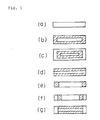
- Examples of the intragrain halogen structure in the tabular grains include those shown in Figure 1: (a) uniform halogen composition type, (b) double structure type in which the core and shell differ from each other in halogen composition, and (c) multi-structure type having a core layer and two or more shell layers.
- the I ⁇ content in the outermost layer may be either lower or higher than that in inner layers.
- the halogen composition change from layer to layer may be progressively increasing or decreasing or sharp depending on the purpose.
- the details of the halogen composition change from layer to layer reference can be made to JP-A-63-220238, JP-A-59-45438, JP-A-61-245151, JP-A-60-143331, and JP-A-63-92942.
- the I ⁇ content difference between layers is preferably in the range of 1 mol% or more, more preferably 2 to 10 mol%.
- the Cl ⁇ content difference between layers is preferably in the range of 1 mol% or more, more preferably 5 to 50 mol%.
- the thickness of the outermost layer and the interlayer each is preferably 3 lattice layers or more, more preferably 12 lattice layers to 0.5 ⁇ m.
- the thickness of core tabular grains in the innermost layer is preferably in the range of 0.04 ⁇ m or more, more preferably 0.06 to 0.6 ⁇ m.
- intragrain structure examples include (d) sandwich structure type having selectively different halogen composition layers laminated on the upper and lower main planes of a tabular grain, (e) and (f) structure type having different halogen composition layers laminated on a tabular grain only in the edgewise direction, and (g) combinations of two or more of (b) to (f).
- the production site and number per unit area (cm2) of chemically sensitized nuclei are preferably controlled.
- the grain according to the structure (2) has at least a ⁇ 100 ⁇ plane and a ⁇ 111 ⁇ plane.
- An embodiment of this structure has chemically sensitized nuclei formed preferentially on the ⁇ 111 ⁇ plane using the difference in crystal habit between the ⁇ 100 ⁇ plane and the ⁇ 111 ⁇ plane.
- substantially no NH3 is present in the system during ripening. It is also preferred that substantially no NH3 be present in the system during the nucleation procedure.
- the term "substantially no NH3" as used herein means that the NH3 concentration Z1 is preferably 0.5 mol/ or less, more preferably less than 0.1 mol/l, further preferably less than 0.02 mol/l. It is further preferred that substantially no NH3 be present in the system during the grain growth.
- substantially no NH3 indicates the above specified range of Z1. In addition to using substantially no NH3, it is preferred that substantially no other AgX solvents be present in the system during nucleation and grain growth.
- substantially no other AgX solvents indicates the above specified range of Z1.
- AgX solvents other than NH3 include fog inhibitors such as thioethers, thioureas, thiocyanic acids, organic amine compounds and tetrazaindene compounds.
- fog inhibitors such as thioethers, thioureas, thiocyanic acids, organic amine compounds and tetrazaindene compounds.
- thioethers, thioureas, and thiocyanic acids are preferred.
- the tabular grains of the present invention are prepared under such conditions that fogged nuclei can easily occur. Accordingly, the resulting emulsion may exhibit a high fog density. In general, the higher the temperature is, or the higher the pH value is, or the higher the Ag+ concentration is, the higher the fog will be.
- the fog developed in the procedure for the formation of tabular grains can be removed by oxidizing silver nuclei after each procedure or after all the procedures for the formation of grains. In other words, it can be accomplished by making the oxidation potential of the system higher than that of the silver nuclei. For details, reference can be made to Japanese Patent Application No. 4-145031.
- a thiosulfonic compound may be added to the system during and after the formation of grains.
- JP-A-4-156448 and EP 0435355A1, 0435270A1 and 0348934A2.
- Dislocation lines can be introduced into grains during the formation of grains by the halogen composition gap method, halogen conversion method, epitaxial growth method or combinations thereof. This advantageously further improves the pressure fog characteristics, reciprocity law characteristics, and color sensitizability.
- epitaxial grains may be formed.
- grains having dislocation lines thereinside may be formed.
- AgX layers having halogen compositions different from that of the substrates may be deposited to prepare grains having various known grain structures. For details, reference can be made to publications as described later.
- a shallow internal latent image emulsion may be formed.
- a core/shell type grain may be formed.
- An AgX emulsion prepared according to the process of the present invention may be blended with one or more other kinds of Agx emulsions. Alternately, two or more kinds of emulsion grains of the present invention having different grain diameters may be blended. The optimum blending proportion (mol of guest AgX emulsion/mol of AgX emulsion blended) may be properly selected between 0.01 and 0.99.
- the additives which can be added to these emulsions between the grain formation procedure and the coating procedure and the amount of these additives to be added are not specifically limited. All known photographic additives may be added to these emulsions in an optimum amount.
- additives examples include doping agents for Agx grains (e.g., compounds of the Group VIII metals, other metallic compounds, chalcogen compounds), dispersants, fog inhibitors, sensitizing dyes (for blue, green, red, infrared, panchromatic, orthochromatic, etc.), super-sensitizers, chemical sensitizers (sulfur, selenium, tellurium, gold compounds, compounds of the Group VIII noble metals, phosphor compounds, thiocyanates, reduction sensitizers, singly or in combination), fogging agents, emulsion precipitating agents, surface active agents, film hardeners, dyes, dye image forming agents, color photographic additives, soluble silver salts, latent image stabilizers, developers (e.g., hydroquinone compounds), pressure desensitization inhibitors, matting agents, antistatic agents, and dimensional stabilizers.
- doping agents for Agx grains e.g., compounds of the Group VIII metals, other metallic compounds, chalcogen compounds
- the AgX emulsion prepared according to the process of the present invention can be applied to any known photographic light-sensitive materials.
- photographic light-sensitive materials include black-and-white silver halide photographic materials [e.g., X-ray photographic material, printing photographic material, photographic paper, negative film, microfilm, direct positive photographic material, ultrafine-grain dry plate photographic material (for LSI photomask, shadow mask, liquid mask)], and color photographic light-sensitive materials (e.g., negative film, photographic paper, reversal film, direct positive color photographic light-sensitive material, photographic material for silver dye bleach process).
- black-and-white silver halide photographic materials e.g., X-ray photographic material, printing photographic material, photographic paper, negative film, microfilm, direct positive photographic material, ultrafine-grain dry plate photographic material (for LSI photomask, shadow mask, liquid mask)
- color photographic light-sensitive materials e.g., negative film, photographic paper, reversal film, direct positive color photographic light-sensitive material, photographic material for silver dye bleach
- photographic light-sensitive materials include diffusion transfer photographic light-sensitive materials (e.g., color diffusion transfer element, silver salt diffusion transfer element), heat-developable photographic light-sensitive materials (black-and-white, color), high density digital recording materials, and photographic light-sensitive materials for holography.
- the coated amount of silver may be 0.01 g/m2 or more.
- the process (grain formation, desilvering, chemical sensitization, spectral sensitization, addition of photographic additives, etc.) and apparatus for the preparation of AgX grains, the structure of AgX grains, the support, the undercoating layer, the surface protective layer, the constitution of the photographic light-sensitive material (e.g., layer configuration, silver/coloring material molar ratio, silver amount ratio between layers), the form of product, the storage of product, the emulsion dispersion of photographic additives, the exposure, the development, etc. are not specifically limited. All techniques and embodiments which are known or will be known can be employed. For details, reference can be made to the following publications: Research Disclosure , vol. 176 (Item 17643), (December 1978), vol.
- an aqueous solution of a gelatin [comprising 1,200 cc of H2O, 24 g of an empty gelatin and 5 cc of 1N KNO3; pH 8.0].
- a gelatin comprising 1,200 cc of H2O, 24 g of an empty gelatin and 5 cc of 1N KNO3; pH 8.0].
- 10 cc of an AgNO3 solution (containing 0.1 g/cc of AgNO3) with stirring at a temperature of 40°C.
- the empty gelatin had a Cl ⁇ content of 10 ppm or less.
- 16 cc of an NaCl solution (6.3 ⁇ 10 ⁇ 4 g/cc) was added to the material.
- Ag-1 solution AgNO3: 0.2 g/cc
- Br-1 solution KBr: 0.14 g/cc
- Ag-1 solution AgNO3: 0.2 g/cc
- Br-1 solution KBr: 0.14 g/cc
- Br-2 solution KBr: 0.035 g/cc
- the emulsion was then adjusted with 1N HNO3 to pH 5.2.
- the emulsion was then adjusted with an AgNO3 solution and a KBr solution to a silver potential of 165 mV (with respect to a room temperature-saturated calomel electrode).
- the emulsion was then heated to a temperature of 67°C while the pH value and silver potential were kept at 5.2 and 165 mv, respectively.
- the emulsion was then ripened for 10 minutes.
- Fine Emulsion-1 shown below was added to the emulsion in an amount of 0.06 mol as calculated in terms of AgX.
- the emulsion was then ripened for 10 minutes.
- Fine Emulsion-1 was further added to the emulsion in an amount of 0.1 mol as calculated in terms of AgX.
- the emulsion was then ripened for 10 minutes. This procedure was repeated three times.
- the emulsion was then ripened for 2 minutes.
- the emulsion was then cooled to a temperature of 45°C.
- Sensitizing Dye 1 shown below was then added to the emulsion in an amount of 65% of the saturated adsorption. The emulsion was then stirred for 10 minutes. To the emulsion was then added a precipitating agent. The emulsion was then cooled to a temperature of 27°C. The emulsion was then adjusted to a pH value of 4.0. The emulsion was then rinsed by an ordinary precipitation rinsing process. To the emulsion was then added an aqueous solution of a gelatin. The emulsion was then heated to a temperature of 40°C. The emulsion was then adjusted to pH 6.4 and pBr 2.8. A specimen was withdrawn from the emulsion.
- a gold sensitizer (1 : 50 (molar ratio) aqueous solution of chloroauric acid : NaSCN) was then added to the emulsion in an amount of 4 ⁇ 10 ⁇ 6 mol/mol AgX as calculated in terms of gold.
- the emulsion was then cooled to a temperature of 40°C.
- a fog inhibitor TAI (4-hydroxy-6-methyl-1,3,3a,7-tetrazaindene) in an amount of 10 ⁇ 3 mol/mol AgX.
- a thickening agent and a coating aid To the emulsion were then added a thickening agent and a coating aid. The emulsion was then coated on a TAC base together with a protective layer.
- aqueous solution of a gelatin comprising 1,200 cc of H2O, 24 g of a gelatin having an average molecular weight of 30,000 (M3) and 0.3 g of KBr; pH 7.0].
- Ag-1 solution comprising 0.2 g/cc of AgNO3, 0.01 g/cc of M3, and 0.25 cc/100 cc of a 1N HNO3 solution
- X-1 solution comprising 0.141 g/cc of KBr, 5.9 ⁇ 10 ⁇ 4 g/cc of KI, 0.01 g/cc of M3, and 0.25 cc/100 cc of a 1N KOH solution
- the emulsion was then stirred for 1 minute.
- the emulsion was then adjusted to a pH value of 5.2 and a silver potential of 160 mV. After being prepared, the emulsion was immediately used for the experiment.
- the fine emulsion had an average grain diameter of about 0.04 ⁇ m.
- Example 2 the procedure was effected in the same manner as in Example 1 until ripening.
- a KOH solution to adjust the emulsion to pH 7.0.
- an NH4NO3 solution (50% by weight) and an NH3 solution (7N) in equimolar amounts to adjust the NH3 concentration thereof to 0.3 N.
- the emulsion was then heated to a temperature of 50°C where it was ripened for 10 minutes.
- To the emulsion was then added an HNO3 solution to adjust the emulsion to pH 5.2.
- the emulsion was then heated to a temperature of 67°C.
- the emulsion was then adjusted to a silver potential of 165 mV.
- Example 1 To the emulsion were then added an AgNO3 solution and a KBr solution in equimolar amounts at a rate of 0.006 mol/min. for 10 minutes by a double jet process. These solutions were further added at a rate of 0.01 mol/min. in equimolecular amounts for 30 minutes. The emulsion was then ripened for 2 minutes. The emulsion was then cooled to a temperature of 45°C. Thereafter, the procedure was effected in the same manner as in Example 1. Specifically, Sensitizing Dye 1 shown in Example 1 was then added to the emulsion. The emulsion was then subjected to precipitation rinsing and redispersion. A specimen was then withdrawn from the emulsion.
- the emulsion was then heated to a temperature of 60°C.
- an aqueous solution of triethylthiourea in a proportion of 5 ⁇ 10 ⁇ 6 mol/mol AgX.
- the same gold sensitizer as used above in Example 1 was then added to the emulsion in an amount of 3 ⁇ 10 ⁇ 6 mol/mol AgX as calculated in terms of gold.
- the emulsion was then cooled to a temperature of 40°C.
- a fog inhibitor TAI in an amount of 10 ⁇ 3 mol/mol AgX.
- To the emulsion were then added a thickening agent and a coating aid.
- the emulsion was then coated on a TAC base together with a protective layer. The material was then dried to obtain a Coating Specimen B.
- aqueous solution of a gelatin [comprising 1,200 cc of H2O, 6 g of an empty gelatin and 0.5 g of NaCl; pH 9.0].
- Ag-1 solution 0.1 g/cc of AgNo3
- Cl-1 solution 0.0345 g/cc of NaCl
- a gelatin solution comprising 100 cc of H2O, 19 g of an empty gelatin and 1.3 g of NaCl).
- the emulsion was then adjusted with a 1N HNO3 solution to pH 4.0. The emulsion was then heated to a temperature of 70°C where it was ripened for 16 minutes. Fine Emulsion-2 described below was added to the emulsion in an amount of 0.1 mol as calculated in terms of AgX. The emulsion was then ripened for 15 minutes. Fine Emulsion-2 described below was then added to the emulsion in an amount of 0.15 mol as calculated in terms of AgX. The emulsion was then ripened for 15 minutes. This procedure was repeated twice. The emulsion was then ripened for 2 minutes. The emulsion was then cooled to a temperature of 45°C.
- the emulsion was then adjusted with NaOH solution to pH 5.2. Sensitizing Dye 1 shown in Example 1 was then added to the emulsion in an amount of 60% of the saturated adsorption. The emulsion was then stirred for 15 minutes. To the emulsion was then added a KBr solution (KBr: 1 g/100 cc) in an amount of 0.01 mol. The emulsion was then stirred for 5 minutes.
- the emulsion was then heated to a temperature of 55°C.
- the same gold sensitizer as used above in Example 1 was then added to the emulsion in an amount of 1 ⁇ 10 ⁇ 6 mol/mol AgX as calculated in terms of gold.
- the emulsion was then cooled to a temperature of 40°C.
- a fog inhibitor TAI in an amount of 2 ⁇ 10 ⁇ 3 mol/mol AgX.
- To the emulsion were then added a thickening agent and a coating aid. The emulsion was then coated on a TAC base together with a protective layer.
- an aqueous solution of a gelatin comprising 1,200 cc of H2O, 24 g of M3 and 10.5 g of NaCl; pH 3.0].
- Ag-1 solution comprising 0.2 g/cc of AgNO3, 0.01 g/cc of M3, and 0.25 cc/100 cc of a 1N HNO3 solution
- X-1 solution comprising 0.07 g/cc of NaCl, 0.01 g/cc of M3, and 0.25 cc/100 cc of a 1N KOH solution
- Example 2 the procedure was effected in the same manner as in Example 2 until ripening.
- To the emulsion was then added an NaOH solution to adjust the emulsion to pH 7.0.
- the emulsion was then heated to a temperature of 70°C.
- To the emulsion were then added an NH4NO3 solution (50% by weight) and an NH3 solution (7N) in equimolar amounts to adjust the NH3 concentration thereof to 0.2 N.
- the emulsion was then ripened for 10 minutes.
- To the emulsion was then added an AgNO3 solution and an NaCl solution at a rate of 0.01 mol/min. for 10 minutes in the equimolar amount by a double jet process.
- Example 1 To the emulsion was then further added an AgNO3 solution and an NaCl solution at a rate of 0.015 mol/min. for 20 minutes in the equimolar amount by a double jet process. The emulsion was then stirred for 2 minutes. To the emulsion was then added an HNO3 solution to adjust the pH value thereof to 5.2. The emulsion was then cooled to a temperature of 45°C. Sensitizing Dye 1 shown in Example 1 was then added to the emulsion in an amount of 60% of the saturated adsorption. Thereafter, the procedure was effected in the same manner as in Example 2. A TEM image of a replica of the emulsion grains thus obtained was then observed.
- the Coating Specimens A to D were subjected to minus blue exposure through a wedge for 1/100 seconds, and then developed.
- the development was effected with MAA-1 developer (see Journal of Photographic Science , vol. 23, pp. 249 - 256, 1975) at a temperature of 20°C for 10 minutes. These specimens were passed through a stop bath and a fixing bath, rinsed, and then dried.
- the Coating Specimen A exhibited a fog density of 0.15 while the Coating Specimen B exhibited a fog density of 0.30. Thus, it was confirmed that the Coating Specimen A exhibits a low fog density as compared with the Coating Specimen B.
- the development was effected with MAA-1 developer comprising KBr replaced by NaCl in the equimolar amount at a temperature of 20°C for 5 minutes. These specimens were passed through a stop bath and a fixing bath, rinsed, and then dried.
- the Coating Specimen C exhibited a fog density of 0.17 while the Coating Specimen D exhibited a fog density of 0.4. Thus, it was confirmed that the Coating Specimen C exhibits a low fog density as compared with the Coating Specimen D.
- Tabular AgBr grains were prepared in the same manner as in Example 3 of JP-B-64-8323 except that the initial dispersant solution comprised 60 g of an inactive gelatin and 3,000 ml of distilled water.
- the emulsion was processed in the same manner as in Example 1 of the present specification to prepare a Coating Specimen E.
- the tabular grains thus obtained exhibited an average aspect ratio of 12 and an average grain diameter of 1.2 ⁇ m.
- the Coating Specimens A and E were folded at a constant rate around a 6-mm diameter steel rod with their emulsion sides positioned inside. After 20 minutes of the folding test, these specimens were then subjected to blue exposure through a continuous wedge for 1/100 seconds. These specimens were developed with MAA-1 developer at a temperature of 20°C for 10 minutes, passed through a stop bath and a fixing bath, rinsed, and then dried. A comparison in fog density was made between unfolded specimens and folded specimens.
- the Coating Specimen A showed a fog density change from 0.15 to 0.17 while the Coating Specimen E showed a fog density change from 0.16 to 0.25. Thus, the Coating Specimen E showed a great pressure fog increase. Accordingly, it was confirmed that the tabular grains of the present invention exhibit a low pressure fog as compared with the tabular grains having an aspect ratio as high as 8 or more.
- Fine Emulsion-1 and Fine Emulsion-2 each exhibit a screw dislocation proportion of 0.01% or less by number of grains as determined by the foregoing ripening process.
- the AgX emulsion according to the present invention comprises AgX grains 35% or more by total projected area of which are tabular grains having a ⁇ 100 ⁇ plane as a main plane and an average aspect ratio of 1.3 to 7.9.
- a photographic light-sensitive material comprising an AgX emulsion according to the present invention exhibits a low fog density, a low pressure fog, a high color sensitizability, a high sensitivity, and an excellent graininess.
Landscapes
- Chemical & Material Sciences (AREA)
- Chemical Kinetics & Catalysis (AREA)
- Engineering & Computer Science (AREA)
- Materials Engineering (AREA)
- Physics & Mathematics (AREA)
- General Physics & Mathematics (AREA)
- Silver Salt Photography Or Processing Solution Therefor (AREA)
Applications Claiming Priority (3)
| Application Number | Priority Date | Filing Date | Title |
|---|---|---|---|
| JP4214109A JP3025585B2 (ja) | 1992-08-11 | 1992-08-11 | ハロゲン化銀乳剤 |
| JP214109/92 | 1992-08-11 | ||
| JP21410992 | 1992-08-11 |
Publications (3)
| Publication Number | Publication Date |
|---|---|
| EP0584644A2 true EP0584644A2 (fr) | 1994-03-02 |
| EP0584644A3 EP0584644A3 (en) | 1996-10-30 |
| EP0584644B1 EP0584644B1 (fr) | 2000-02-16 |
Family
ID=16650387
Family Applications (1)
| Application Number | Title | Priority Date | Filing Date |
|---|---|---|---|
| EP93112823A Expired - Lifetime EP0584644B1 (fr) | 1992-08-11 | 1993-08-10 | Emulsion photographique à l'halogénure d'argent |
Country Status (4)
| Country | Link |
|---|---|
| US (1) | US5652089A (fr) |
| EP (1) | EP0584644B1 (fr) |
| JP (1) | JP3025585B2 (fr) |
| DE (1) | DE69327862T2 (fr) |
Cited By (10)
| Publication number | Priority date | Publication date | Assignee | Title |
|---|---|---|---|---|
| EP0617321A1 (fr) * | 1993-03-22 | 1994-09-28 | Eastman Kodak Company | Emulsions à grains tabulaires ayant un facteur de forme moderé |
| EP0618482A1 (fr) * | 1993-03-22 | 1994-10-05 | Eastman Kodak Company | Emulsions à grains tabulaires ayant une haute teneur en chlorure et un facteur de forme moderé avec de faces de grain naturellement stable |
| EP0731379A1 (fr) * | 1995-02-27 | 1996-09-11 | Eastman Kodak Company | Emulsions photographiques contenant des grains tabulaires avec une structure de bande et une région centrale du grain avec une haute concentration de bromure |
| US5650264A (en) * | 1993-04-02 | 1997-07-22 | Fuji Photo Film Co., Ltd. | Method for forming an image on a silver halide color photographic material |
| US5665530A (en) * | 1994-08-30 | 1997-09-09 | Fuji Photo Film Co., Ltd. | Silver halide emulsion and photographic material using the same |
| US5707793A (en) * | 1995-04-19 | 1998-01-13 | Fuji Photo Film Co., Ltd. | Silver halide emulsion and silver halide photographic material using the same |
| US5723277A (en) * | 1995-05-17 | 1998-03-03 | Fuji Photo Film Co., Ltd. | Silver halide emulsion and silver halide color photographic material using the same |
| US5726006A (en) * | 1995-07-10 | 1998-03-10 | Eastman Kodak Company | Tabular grain silver halide emulsions, a method for their preparation and photographic products |
| FR2756941A1 (fr) * | 1996-12-09 | 1998-06-12 | Kodak Pathe | Procede pour preparer des emulsions photographiques a grains tabulaires de bromure d'argent a faces (100) |
| US5972588A (en) * | 1996-01-08 | 1999-10-26 | Fuji Photo Film Co., Ltd. | Silver halide photographic emulsion and method for producing the same |
Families Citing this family (6)
| Publication number | Priority date | Publication date | Assignee | Title |
|---|---|---|---|---|
| US5804361A (en) * | 1995-07-04 | 1998-09-08 | Konica Corporation | Silver halide photographic emulsion |
| US6228556B1 (en) * | 1996-03-28 | 2001-05-08 | Fuji Photo Film Co., Ltd. | Silver halide color photographic light-sensitive material and color image formation method using the same |
| JPH09281620A (ja) * | 1996-04-18 | 1997-10-31 | Fuji Photo Film Co Ltd | ハロゲン化銀乳剤及びそれを用いたハロゲン化銀写真感光材料 |
| JP3630262B2 (ja) * | 1997-04-18 | 2005-03-16 | 富士写真フイルム株式会社 | ハロゲン化銀平板粒子乳剤の製造方法 |
| US5908739A (en) * | 1997-11-21 | 1999-06-01 | Eastman Kodak Company | Simplified nucleation of high chloride <100> tabular grain emulsions |
| CN105093804A (zh) * | 2014-12-16 | 2015-11-25 | 铜陵翔宇商贸有限公司 | 胶片用停显液及其制备方法 |
Family Cites Families (7)
| Publication number | Priority date | Publication date | Assignee | Title |
|---|---|---|---|---|
| GB1507989A (en) * | 1974-12-19 | 1978-04-19 | Ciba Geigy Ag | Photographic emulsions |
| US4414304A (en) * | 1981-11-12 | 1983-11-08 | Eastman Kodak Company | Forehardened high aspect ratio silver halide photographic elements and processes for their use |
| JPH0789203B2 (ja) * | 1987-04-30 | 1995-09-27 | 富士写真フイルム株式会社 | ハロゲン化銀乳剤および写真感光材料 |
| JP2664272B2 (ja) * | 1990-06-06 | 1997-10-15 | 富士写真フイルム株式会社 | ハロゲン化銀写真乳剤の製造方法 |
| US5292632A (en) * | 1991-09-24 | 1994-03-08 | Eastman Kodak Company | High tabularity high chloride emulsions with inherently stable grain faces |
| US5320938A (en) * | 1992-01-27 | 1994-06-14 | Eastman Kodak Company | High chloride tabular grain emulsions and processes for their preparation |
| US5264337A (en) * | 1993-03-22 | 1993-11-23 | Eastman Kodak Company | Moderate aspect ratio tabular grain high chloride emulsions with inherently stable grain faces |
-
1992
- 1992-08-11 JP JP4214109A patent/JP3025585B2/ja not_active Expired - Fee Related
-
1993
- 1993-08-10 DE DE69327862T patent/DE69327862T2/de not_active Expired - Fee Related
- 1993-08-10 EP EP93112823A patent/EP0584644B1/fr not_active Expired - Lifetime
-
1995
- 1995-06-06 US US08/470,021 patent/US5652089A/en not_active Expired - Fee Related
Cited By (11)
| Publication number | Priority date | Publication date | Assignee | Title |
|---|---|---|---|---|
| EP0617321A1 (fr) * | 1993-03-22 | 1994-09-28 | Eastman Kodak Company | Emulsions à grains tabulaires ayant un facteur de forme moderé |
| EP0618482A1 (fr) * | 1993-03-22 | 1994-10-05 | Eastman Kodak Company | Emulsions à grains tabulaires ayant une haute teneur en chlorure et un facteur de forme moderé avec de faces de grain naturellement stable |
| US5650264A (en) * | 1993-04-02 | 1997-07-22 | Fuji Photo Film Co., Ltd. | Method for forming an image on a silver halide color photographic material |
| US5665530A (en) * | 1994-08-30 | 1997-09-09 | Fuji Photo Film Co., Ltd. | Silver halide emulsion and photographic material using the same |
| EP0731379A1 (fr) * | 1995-02-27 | 1996-09-11 | Eastman Kodak Company | Emulsions photographiques contenant des grains tabulaires avec une structure de bande et une région centrale du grain avec une haute concentration de bromure |
| US5707793A (en) * | 1995-04-19 | 1998-01-13 | Fuji Photo Film Co., Ltd. | Silver halide emulsion and silver halide photographic material using the same |
| US5723277A (en) * | 1995-05-17 | 1998-03-03 | Fuji Photo Film Co., Ltd. | Silver halide emulsion and silver halide color photographic material using the same |
| US5726006A (en) * | 1995-07-10 | 1998-03-10 | Eastman Kodak Company | Tabular grain silver halide emulsions, a method for their preparation and photographic products |
| US5972588A (en) * | 1996-01-08 | 1999-10-26 | Fuji Photo Film Co., Ltd. | Silver halide photographic emulsion and method for producing the same |
| FR2756941A1 (fr) * | 1996-12-09 | 1998-06-12 | Kodak Pathe | Procede pour preparer des emulsions photographiques a grains tabulaires de bromure d'argent a faces (100) |
| US5879873A (en) * | 1996-12-09 | 1999-03-09 | Eastman Kodak Company | Process of preparing high bromide (100) tabular grain emulsions |
Also Published As
| Publication number | Publication date |
|---|---|
| JPH0659360A (ja) | 1994-03-04 |
| EP0584644B1 (fr) | 2000-02-16 |
| EP0584644A3 (en) | 1996-10-30 |
| JP3025585B2 (ja) | 2000-03-27 |
| DE69327862D1 (de) | 2000-03-23 |
| US5652089A (en) | 1997-07-29 |
| DE69327862T2 (de) | 2000-06-29 |
Similar Documents
| Publication | Publication Date | Title |
|---|---|---|
| EP0584644B1 (fr) | Emulsion photographique à l'halogénure d'argent | |
| EP0326852B1 (fr) | Procédé pour préparer des granules à l'halogénure d'argent | |
| EP0534395A1 (fr) | Emulsions à haute teneur en chlorure et à haute tabularité de stabilité exceptionnelle | |
| US4835095A (en) | Photosensitive tabular core/shell silver halide emulsion | |
| JPH0833598B2 (ja) | 臭化物シエルを用いる修正された晶癖をもつ高塩化物結晶の安定化方法 | |
| EP0391560B1 (fr) | Procédé de préparation des émulsions photographiques à l'halogénure d'argent comprenant des granules tabulaires | |
| EP0725308A1 (fr) | Emulsion photographique à l'halogénure d'argent et matériau photographique à l'halogénure d'argent sensible à la lumière | |
| EP0492519A1 (fr) | Méthode pour produire une émulsion à halogénure d'argent | |
| EP0569971B1 (fr) | Emulsion à l'halogénure d'argent | |
| EP0645670B1 (fr) | Emulsion d'halogénure d'argent | |
| JP3383397B2 (ja) | ハロゲン化銀乳剤 | |
| EP0215612B1 (fr) | Emulsions photographiques à l'halogénure d'argent avec des grains à faces | |
| JP2840897B2 (ja) | ハロゲン化銀乳剤およびその製造方法 | |
| EP0174018B1 (fr) | Emulsions d'halogénure d'argent à distribution de grain uniforme préparées suivant la méthode à jet unique | |
| EP0462528B1 (fr) | Procédé pour préparer une émulsion à l'halogénure d'argent | |
| US5420005A (en) | Silver halide emulsion | |
| US5932408A (en) | Silver halide emulsion | |
| EP0645671A1 (fr) | Emulsion photographique à l'halogénure d'argent | |
| US5593821A (en) | Silver halide emulsion and photographic material having the same | |
| EP0430625A1 (fr) | Emulsion photographique à l'halogénure d'argent et matériaux sensibles à la lumière | |
| JP3325954B2 (ja) | ハロゲン化銀乳剤 | |
| JPH11249248A (ja) | ハロゲン化銀乳剤 | |
| US4678744A (en) | Splash-prepared silver halide emulsions with a uniform particle size distribution | |
| JP3388914B2 (ja) | ハロゲン化銀乳剤 | |
| EP0462543A1 (fr) | Emulsions à l'halogénure d'argent ayant une haute sensibilitÀ© et résistance à la pression |
Legal Events
| Date | Code | Title | Description |
|---|---|---|---|
| PUAI | Public reference made under article 153(3) epc to a published international application that has entered the european phase |
Free format text: ORIGINAL CODE: 0009012 |
|
| AK | Designated contracting states |
Kind code of ref document: A2 Designated state(s): DE FR GB NL |
|
| PUAL | Search report despatched |
Free format text: ORIGINAL CODE: 0009013 |
|
| AK | Designated contracting states |
Kind code of ref document: A3 Designated state(s): DE FR GB NL |
|
| 17P | Request for examination filed |
Effective date: 19961204 |
|
| 17Q | First examination report despatched |
Effective date: 19980629 |
|
| GRAG | Despatch of communication of intention to grant |
Free format text: ORIGINAL CODE: EPIDOS AGRA |
|
| GRAG | Despatch of communication of intention to grant |
Free format text: ORIGINAL CODE: EPIDOS AGRA |
|
| GRAH | Despatch of communication of intention to grant a patent |
Free format text: ORIGINAL CODE: EPIDOS IGRA |
|
| GRAH | Despatch of communication of intention to grant a patent |
Free format text: ORIGINAL CODE: EPIDOS IGRA |
|
| GRAA | (expected) grant |
Free format text: ORIGINAL CODE: 0009210 |
|
| AK | Designated contracting states |
Kind code of ref document: B1 Designated state(s): DE FR GB NL |
|
| PG25 | Lapsed in a contracting state [announced via postgrant information from national office to epo] |
Ref country code: NL Free format text: LAPSE BECAUSE OF FAILURE TO SUBMIT A TRANSLATION OF THE DESCRIPTION OR TO PAY THE FEE WITHIN THE PRESCRIBED TIME-LIMIT Effective date: 20000216 Ref country code: FR Free format text: LAPSE BECAUSE OF FAILURE TO SUBMIT A TRANSLATION OF THE DESCRIPTION OR TO PAY THE FEE WITHIN THE PRESCRIBED TIME-LIMIT Effective date: 20000216 |
|
| REF | Corresponds to: |
Ref document number: 69327862 Country of ref document: DE Date of ref document: 20000323 |
|
| EN | Fr: translation not filed | ||
| NLV1 | Nl: lapsed or annulled due to failure to fulfill the requirements of art. 29p and 29m of the patents act | ||
| PG25 | Lapsed in a contracting state [announced via postgrant information from national office to epo] |
Ref country code: GB Free format text: LAPSE BECAUSE OF NON-PAYMENT OF DUE FEES Effective date: 20000810 |
|
| PLBE | No opposition filed within time limit |
Free format text: ORIGINAL CODE: 0009261 |
|
| 26N | No opposition filed | ||
| GBPC | Gb: european patent ceased through non-payment of renewal fee |
Effective date: 20000810 |
|
| PGFP | Annual fee paid to national office [announced via postgrant information from national office to epo] |
Ref country code: DE Payment date: 20080821 Year of fee payment: 16 |
|
| PG25 | Lapsed in a contracting state [announced via postgrant information from national office to epo] |
Ref country code: DE Free format text: LAPSE BECAUSE OF NON-PAYMENT OF DUE FEES Effective date: 20100302 |