EP0585524A1 - Imprimante par pages avec compression des données pour minimaliser l'emploi de mémoire - Google Patents
Imprimante par pages avec compression des données pour minimaliser l'emploi de mémoire Download PDFInfo
- Publication number
- EP0585524A1 EP0585524A1 EP93106500A EP93106500A EP0585524A1 EP 0585524 A1 EP0585524 A1 EP 0585524A1 EP 93106500 A EP93106500 A EP 93106500A EP 93106500 A EP93106500 A EP 93106500A EP 0585524 A1 EP0585524 A1 EP 0585524A1
- Authority
- EP
- European Patent Office
- Prior art keywords
- data
- compression
- image
- raster
- page
- Prior art date
- Legal status (The legal status is an assumption and is not a legal conclusion. Google has not performed a legal analysis and makes no representation as to the accuracy of the status listed.)
- Granted
Links
Images





Classifications
-
- G—PHYSICS
- G06—COMPUTING OR CALCULATING; COUNTING
- G06T—IMAGE DATA PROCESSING OR GENERATION, IN GENERAL
- G06T9/00—Image coding
- G06T9/005—Statistical coding, e.g. Huffman, run length coding
-
- G—PHYSICS
- G06—COMPUTING OR CALCULATING; COUNTING
- G06K—GRAPHICAL DATA READING; PRESENTATION OF DATA; RECORD CARRIERS; HANDLING RECORD CARRIERS
- G06K15/00—Arrangements for producing a permanent visual presentation of the output data, e.g. computer output printers
-
- H—ELECTRICITY
- H03—ELECTRONIC CIRCUITRY
- H03M—CODING; DECODING; CODE CONVERSION IN GENERAL
- H03M7/00—Conversion of a code where information is represented by a given sequence or number of digits to a code where the same, similar or subset of information is represented by a different sequence or number of digits
- H03M7/30—Compression; Expansion; Suppression of unnecessary data, e.g. redundancy reduction
- H03M7/3084—Compression; Expansion; Suppression of unnecessary data, e.g. redundancy reduction using adaptive string matching, e.g. the Lempel-Ziv method
- H03M7/3088—Compression; Expansion; Suppression of unnecessary data, e.g. redundancy reduction using adaptive string matching, e.g. the Lempel-Ziv method employing the use of a dictionary, e.g. LZ78
-
- H—ELECTRICITY
- H03—ELECTRONIC CIRCUITRY
- H03M—CODING; DECODING; CODE CONVERSION IN GENERAL
- H03M7/00—Conversion of a code where information is represented by a given sequence or number of digits to a code where the same, similar or subset of information is represented by a different sequence or number of digits
- H03M7/30—Compression; Expansion; Suppression of unnecessary data, e.g. redundancy reduction
- H03M7/46—Conversion to or from run-length codes, i.e. by representing the number of consecutive digits, or groups of digits, of the same kind by a code word and a digit indicative of that kind
- H03M7/48—Conversion to or from run-length codes, i.e. by representing the number of consecutive digits, or groups of digits, of the same kind by a code word and a digit indicative of that kind alternating with other codes during the code conversion process, e.g. run-length coding being performed only as long as sufficientlylong runs of digits of the same kind are present
-
- G—PHYSICS
- G06—COMPUTING OR CALCULATING; COUNTING
- G06K—GRAPHICAL DATA READING; PRESENTATION OF DATA; RECORD CARRIERS; HANDLING RECORD CARRIERS
- G06K2215/00—Arrangements for producing a permanent visual presentation of the output data
- G06K2215/0002—Handling the output data
- G06K2215/002—Generic data access
- G06K2215/0028—Generic data access characterised by the format per se
- G06K2215/0031—Compressed bit maps
-
- G—PHYSICS
- G06—COMPUTING OR CALCULATING; COUNTING
- G06K—GRAPHICAL DATA READING; PRESENTATION OF DATA; RECORD CARRIERS; HANDLING RECORD CARRIERS
- G06K2215/00—Arrangements for producing a permanent visual presentation of the output data
- G06K2215/0002—Handling the output data
- G06K2215/0062—Handling the output data combining generic and host data, e.g. filling a raster
- G06K2215/0071—Post-treatment of the composed image, e.g. compression, rotation
Definitions
- This invention relates to page printers, and more particularly, to a page printer having data compression facilities to accommodate a buffer memory size that is less than that required for a full page of printer data.
- Prior art page printers typically capture an entire page before any image is placed on paper.
- formatting is either performed on the host computer (with large volumes of rasterized data being shipped to the printer), or on a formatter within the printer. Since a laser print "engine” operates at a constant speed, if new rasterized data is not available at a rate that keeps up with the engines's operation, a print "overrun"' occurs and the page is not printable.
- a variety of techniques are in use.
- a full raster bit map of an entire page is stored so that the print mechanism always has rasterized data awaiting action.
- this technique requires approximately a megabyte of raster memory for each page.
- 600 dots per inch four megabytes of memory are required.
- additional raster memory is needed to run the printer at its rated speed. Otherwise, composition of a following page cannot begin until a prior page has been ejected to the printer's output tray. To maintain the cost of laser printers at a low level, substantial efforts have been directed to reducing the amount of required raster memory.
- One technique for memory reduction involves the construction of a page description.
- the page description is built in two steps: during formatting, data received from a host computer is converted into a list of simple commands, called display commands, that describe what must be printed.
- the second step prepares the display command list for printing and entails a parsing of the display commands and a rendering of the described objects into a raster bit map. This procedure requires a full page raster bit map memory because the same memory is used for succeeding pages.
- the display command list procedure has been modified by sorting display commands according to their vertical position on a page.
- the page is then divided into sections called page strips or "page intermediate", and each page strip is passed, sequentially, to the print engine for printing.
- display commands within a page strip are rendered into rasterized data at a fast enough pace, the same memory used to store a first page strip can be reused for a subsequent page strip further down the page (once the first page strip has been transferred to paper).
- the Laser Jet III Laser Printer manufactured by the Assignee of this application, employs a display command list algorithm and utilizes three raster buffers.
- the first buffer is reused on the fourth strip of a page; the second buffer is reused on the fifth strip, etc.
- little time is left between the finishing of strip one and the time when strip four will be required by the print mechanism. If the strip is not delivered in time, a "print overrun" occurs and the page is incorrectly printed.
- An ordered dither image (also called “clustered”) is a half-tone image that includes half-tone grey representations throughout the page. Such images generally reflect substantial data redundancy and lend themselves to lossless techniques of data encoding (e.g. run length). Error diffused images (also called “dispersed”), by contrast, exhibit little redundancy in their data and require different methods of compression. As a result, the use of a single data compression scheme in a page printer no longer enables such a printer to handle image data - while still maintaining a minimal amount of on-board raster memory.
- LZW Lempel/Ziv/Welch
- Run length data compression on printer raster scan lines is described by Spivey in "Data Compression Technique for APA Printer (Change Block Skipping) "and “Hybrid Data Compression Technique for Change Block Skipping in an APA Printer", IBM Technical Disclosure Bulletin, vol. 23, No. 12, May 1981, pages 5464-5470.
- Spivey's procedure compares a current scan line to a corresponding scan line in a previous image and outputs codes in dependence upon the concurrence or lack of concurrence therebetween.
- Spivey also describes a hybrid technique which employs the aforesaid method in combination with run-length encoding.
- a peripheral unit converts an input data flow to page-arranged outputs and includes a random access memory capacity that is insufficient in size to accommodate an entire page of raster data.
- the peripheral unit also includes a processor and a control memory that holds a plurality of data compression procedures, each procedure exhibiting a different performance characteristic.
- the peripheral unit performs a method for compressing portions of the input data flow that includes the steps of: allocating the random access memory to portions of the input data flow; determining when an insufficient amount of random access memory is available for such allocation; employing a first data compression procedure on the input data flow portions to produce a compressed data portion; testing the compressed data portion to determine if a level of compression has been achieved that exceeds a threshold and, if not, employing succeeding data compression procedures and repeating the test for each procedure against a threshold, whereby the compression procedure that first enables a threshold level of compression to be achieved is the compression procedure employed to compress the data flow portion.
- Improved compression methods and techniques for handling input data flows with both integral and independent image descriptors are also described.
- Fig. 1 is a high level block diagram of a peripheral unit that is adapted to carry out the invention.
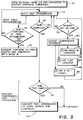
- Fig. 2 is a global flow diagram illustrating the overall procedure of the invention hereof.
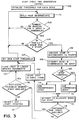
- Fig. 3 is a high level flow diagram illustrating the procedure for strip video pre-generation.
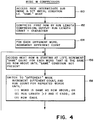
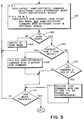
- Figs. 4 and 5 are a high level flow diagram of a high speed data compression technique, termed mode-m, that is employed herewith.
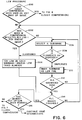
- Fig. 6 is a high level flow diagram illustrating the Lempel/Ziv/Welch data compression procedure.
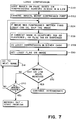
- Fig. 7 is a high level flow diagram illustrating a Lossy compression procedure.
- Fig. 8 is a high level flow diagram illustrating the procedure employed to determine whether an image is clustered or dispersed.
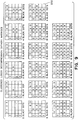
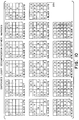
- Figs. 9 and 10 illustrate decompression matrices employed in accordance with findings of the procedure of Fig. 8.
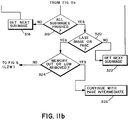
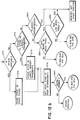
- Fig. 11 is a high level flow diagram illustrating the procedure following by the system of Fig. 1 in determining which compression procedure to employ in a memory out or low circumstance.
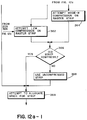
- Figs. 12a and 12b illustrate a high level flow diagram for the procedure followed when "page intermediate" actions have been completed and it is found that a page is too complex.
- Fig. 13 illustrates a descriptor that accompanies a bit map subimage in a second version of the invention.
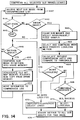
- Fig. 14 shows a flow diagram of the procedure followed by the second version of the invention in determining which compression procedure to employ.
- Fig. 15 is a diagram of a page that indicates where a "memory out" indication occurs in response to the printing of a large point size font.
- Fig. 16 is a flow diagram illustrating when compression is applied to a received-font.
- printer 10 includes a processor 12, print engine 14, and an input/output (I/O) port 16, all connected by a bus 18.
- Print engine 14 comprises a laser printer which, when operated, runs at a constant speed and must be provided with video raster print data at a rate that keeps up with its operation.
- a random access memory (RAM) 20 and a read only memory (ROM) 22 are also connected to bus 18 and contain all of the procedures necessary to assure that available RAM 20 is most efficiently used, and that print engine 14 has data awaiting printing - so as to avoid print overruns.
- Printer 10 in this example, is a page printer and receives image data from a host processor via I/O 16.
- the amount of memory in RAM 20 that is available to store the received image data is substantially less than that required to contain an entire video raster bit-map image of a page.
- the size of RAM 20 is constrained so as to enable printer 10 to be marketed at the lowest competitive price.
- Image data from the host processor is received via I/O module 16 and read into RAM 20.
- the image data may take one of several forms. It may include subimages wherein descriptors are contiguous with each subimage and are processed along with each subimage. When such image data is received, it is the image data itself that is examined to determine whether data compression is required or not.
- subimage descriptors are received separately from (but linked to) the actual subimage data.
- data within the descriptor and other image-specific data is employed to assist in determining which (if any) of a series of data compression techniques should be applied to the subimage data.
- printer 10 when printer 10 receives image data, it is parsed and commands and data are processed to derive raster graphics data that is stored in RAM 20. At such time, subimages are created. Next, the subimages contained in the raster graphics data base are linked into an intermediate page representation ("page intermediate").
- Page intermediate is a means of representing an entire page of information in a format that is easily convertible to video, while consuming as little memory as possible.
- Page intermediate actions essentially divide a page into a plurality of strips, each strip including a prescribed number of "instruction buckets". Each strip is allocated a height (e.g., 128 dots) and contains a pointer to a chain of instruction buckets (e.g. each bucket being 256 bytes in size), each "bucket" containing instructions which define how raster video should be created for the strip. Subimages (and other intermediate objects) that span more than one strip have an instruction for each strip in which they are resident.
- Mode-m is an extremely fast method of data compression (and decompression), but is not effective to compress certain types of image data.
- Modem is a "lossless" compression technique (no image data is lost during the compression technique that cannot be recovered upon decompression) .
- a further lossless compression technique which is slower in action than mode-m, but is more effective with certain types of image data is a modified Lempel/Ziv/Welch (LZW) procedure.
- LZW Lempel/Ziv/Welch
- a third "lossy" compression procedure is employed which typically guarantees a compression ratio of at least 4 : 1, but results in the loss of some image data that cannot be recovered upon decompression.
- RAM 20 includes a memory area 24 allocated for the user; an area 26 allocated to the storage of raster images; an area 28 for compressed images, an area 30 for page intermediate data storage, and an area 32 allocated to the storage of variables used with the procedures to be described hereinafter.
- ROM 22 contains subroutines that carry out LZW compression (34), mode M compression (36) and lossy compression (38). ROM 22 further also contains an area 40 storing a procedure for carrying out "strip video pre-generation” (SVPG); an area 42 with a procedure for carrying out “adaptive compressed page protection” (ACPP); an area 44 that contains lossy dither tables which enable, upon decompression, a lossy decompressed image to more effectively represent the original (notwithstanding a loss of data), and an area 46 which contains a procedure for performing data compression using one or more compression procedures found in areas 34, 36 and 38.
- SVPG strip video pre-generation
- ACPP adaptive compressed page protection
- an area 44 that contains lossy dither tables which enable, upon decompression, a lossy decompressed image to more effectively represent the original (notwithstanding a loss of data)
- an area 46 which contains a procedure for performing data compression using one or more compression procedures found in areas 34, 36 and 38.
- a plurality of counters 50, 52 and 54 are employed to enable tracking of certain compression counts. The operation of such counters will be considered below.
- a global flow diagram illustrates actions taken by printer 10 during the course of the generation of a page.
- data is received from a host processor (box 70) and is subjected to preprocessing to derive raster graphics subimages.
- the subimages are then employed to build the page intermediate strips of the image data (box 72).
- this procedure comprises the allocation of graphics subimages to page strips, each strip composed of instruction buckets, each of a predetermined size, and possibly containing sub-image instructions of a predetermined size.
- Printer 10 also preallocates area 30 of RAM 20 to hold the raster video bit maps that result from conversion of strips of page intermediate (generally three).
- RAM 20 is only capable of holding raster video bit maps which result from three strips of page intermediate.
- printer 10 converts instructions within each strip into raster video bit map data and stores the data in RAM area 26 which is subdivided (in this example) into three raster buffer areas.
- RAM area 26 which is subdivided (in this example) into three raster buffer areas.
- print engine 14 is started and raster video information stored therein is fed thereto under control of processor 12. While raster video data is being read into print engine 14, the process of converting page intermediate into strip buffer video continues, using buffer areas for which data transfer to print engine 14 has been completed.
- a lossy compression procedure (box 86) is tried and, again, the results are tested to determine if the memory out or low condition has been removed. If the memory out or low condition continues, the page cannot be printed. However, in most cases, the lossy compression technique will remove a memory out or low condition, as it usually achieves a 4:1 data compression.
- page intermediate strip processing is complete (decision box 90)
- the page intermediate data is parsed to estimate the time it will take to render it into video raster bit map data. If the estimated time is longer than print engine 14 allows, adaptive compressed page protection (ACPP) is implemented and a "page too complex" indication is issued (decision box 92). Under such a condition, strips of the page intermediate exhibiting a high level of complexity are processed in order down the page and are converted to raster and placed in a temporary buffer. Then, compression techniques are employed on the raster data strips in an attempt to remove the "page too complex" indication and to fit the converted strips in available RAM.
- ACPP adaptive compressed page protection
- a page intermediate size threshold for each strip is set (box 100).
- the threshold is set in units of buckets, with a bucket being the smallest allocated unit of page intermediate storage. In this example, it is assumed that a bucket is approximately 256 bytes long. Buckets are linked together, if needed, to store a strip's page intermediate data.
- the bucket threshold is calculated by dividing the amount of available printer memory by the product of the number of strips on a page times the number of bytes per bucket. Assuming an available memory of approximately 800,000 bytes, the threshold is set at approximately 125 buckets and each strip's threshold is initialized to that value.
- page intermediate processing commences (box 72) to create page intermediate data structures. If at any time during the process of converting raster graphics to page intermediate, it is determined that the number of instruction buckets for a strip exceeds the previously set threshold, that strip may need to be immediately converted to raster and compressed to conserve printer memory. Thus, decision box 102 provides a yes output when the threshold is exceeded. Then, it is determined if the remaining RAM for strip raster bit maps is less than the space required for two strips (decision box 104). If the answer is no, page intermediate construction continues. If however the answer is yes (insufficient RAM left to hold two strips), the strip that exceeds the threshold has its page intermediate data immediately converted to raster video data (box 106).
- condition indicated in decision box 104 avoids converting strips to raster video data when there is sufficient memory to store more page intermediate without the conversion. Thus, pages which do not need video pregeneration do not have to pay a time penalty just because a few strips upon the page are very large (and the rest are small).
- a new bucket threshold for the strip is established, based upon current memory conditions (box 124). This threshold is calculated similarly to the initial threshold, with the exception that the number of buckets that the just converted strip consumed is subtracted. Thus, the new threshold is equal to the old threshold value (adjusted for changes in amount of available RAM) less the size of the converted video raster strip, divided by the number of bytes per bucket. This adjustment of the threshold causes it to become smaller as strips are converted and less memory becomes available.
- the procedure shown in Fig. 3 occurs in advance of any indication of either a memory out or memory low. It acts to anticipate a memory constraint that arises as a result of the existence of complex strips of page intermediate data. It may, however, occur during the processing of page intermediate that a plurality of complex strips result in a memory out or memory low indication without any one strip causing the strip video pregeneration threshold to be exceeded. In such instance, the procedure moves to attempt to compress page intermediate raster graphics data by making a selection from amongst compression schemes that are available within printer 10.
- Mode-m compression considers a raster bit map block of page intermediate data and attempts to compress the block using run length encoding for each row and by encoding delta changes that occur from row to row within the block. It is to be understood that the term "row” as used herein refers to an arbitrary length of data that may or may not be equal in size to a raster scan row of the image.
- the mode-m procedure uses "same”, “difference” and “run” counters 50, 52 and 54 that are shown in Fig. 1.
- the mode-m compression procedure commences by accessing a page intermediate subimage block and setting one of two initial condition for the procedure i.e., "same” and "different".
- the "same" initial condition enables a count to be accumulated each time a word on a row of a block is the same as a vertically aligned word on a preceding row. This count is entered into "same” counter 50.
- difference counter 52 is incremented each time a word on one row is different from a vertically aligned word on a previous row.
- a third counter i.e., run counter 54, is employed to keep a count of a run length of identical words that occur in a row.
- each word in the first block row is "different" by definition (as there is no row above the initial row)
- the difference count is incremented in difference counter 52 and is reset at the end of the row (and at the end of each run within the first row).
- the next row is accessed and, starting at the left, each word is examined to determine if it is the same as the word that is vertically aligned in the immediately preceding row. For as long as the same condition is satisfied, "same" counter 50 is incremented until a word is encountered that is different from the vertically aligned word in the preceding row (box 156).
- a same/different command is issued that includes a same count, a "different” count and the "different” words that follow the same words.
- the different mode continues until (1) a word is encountered in the row that is the same as a vertically aligned word in the row above; or (2) a run length is encountered that is greater than two and it ends; or (3) the row ends (box 158).
- a condition switch back to "same” is made and a same/different command is output, as described above. If a run length of greater than two is encountered and it ends, a run command is outputted including a run count and the word that is run.
- a same/different command is also outputted with a difference count from difference counter 52 and the different words that were experienced (box 160). This difference count does not include a count of run data.
- the mode-m data compression, decompression procedures are extremely fast and can be employed on-the-fly by a laser printer. As such, it is generally the first compression technique chosen (with some exceptions). If after using mode-m, a memory out or low indication still is present, a second lossless technique is employed, e.g., LZW.
- LZW compresses and decompresses in a lossless mode, but at a slower rate than mode-m.
- LZW compresses and decompresses in a lossless mode, but at a slower rate than mode-m.
- LZW compresses and decompresses in a lossless mode, but at a slower rate than mode-m.
- LZW by constraining the length of the code that is output as a result of a match in an LZW table (e.g. to 3 codes per 32 bit word), its speeds of compression and decompression can be increased. LZW, however, cannot compress dispersed images (mode-m also cannot).
- a clustered image is one which exhibits regularly spaced dots and can be lossless compressed through use of mode-m, LZW or other techniques.
- a dispersed image is one wherein the dots have no regular recurring pattern and thus does not lend itself to a lossless compression method.
- An image or a subimage may be classified as either clustered or dispersed by comparing the image's binary values to entries in a "neighbor table" (shown below). For each byte of the image that matches an entry in the clustered portion of the neighbor table, a value of + 1 is assigned. For each byte that matches an entry in the "dispersed" portion of the neighbor table, a value of -1 is assigned.
- the first query is whether a lossy compression technique has been used on any part of the image. If so, the LZW procedure is aborted and lossy compression is continued with the portion of the image being examined. (Once lossy compression has been applied to a subimage, image esthetics are lost if lossless compression techniques are utilized on only a portion of the image.
- mode-m compression resulted in at least a 1.125:1 compression ratio for the entire image (box 202). If yes, it is assumed that the image is clustered and the procedure moves to box 204 where the LZW procedure is tried on each subimage, unless LZW was previously tried.
- a subimage from the image is selected (box 206) and a determination is made whether the subimage is clustered or dispersed - using the neighbor table in the manner described above. If the subimage is determined as clustered (decision box 208), then the procedure tries the LZW compression technique on the subimage. If however, the subimage is determined as dispersed, then it is known that LZW will not compress it and the subimage is marked as "LZW fail" (box 210).
- the Lossy compression procedure is used as a last resort because it results in lost data which cannot be recovered.
- the Lossy compression technique is mainly intended for use on images that cannot be compressed using lossless techniques. Images that generally fall into this category are images that have been half-toned using an error diffusion procedure (i.e., "dispersed").
- the Lossy compression technique commences by first sorting images on the page based upon levels of data compression achieved previously through the use of mode-m or LZW (box 220). Next, the worst-compressed image is examined first (box 222) and if the image was compressed better than Lossy can do, it is skipped (box 224). As an example, it will be assumed that 4 x 4 bit cells of raster video data are compressed to a four bit word. Thus a 4:1 compression is achieved through the use of Lossy. However, if greater than 4:1 compression was previously achieved by a lossless technique, no attempt is made to use Lossy. Recall, that each compression procedure is applied to an uncompressed version of the image or subimage and a compressed image or subimage is never further compressed unless it is first decompressed.
- the current image is examined and tagged to indicate if it is clustered or dispersed (box 226) and, in either case, Lossy compression is performed (box 228).
- the tag is used during decompression, as will become apparent.
- a lossy flag is set and associated with the image so that all subimages within the image can be lossy compressed (box 228). It is then determined whether the memory out or low indication has been removed (decision box 232). If no and all images are finished (decision box 240), printing action commences even though a memory out condition remains, otherwise a next image is accessed (box 241) and Lossy compression is performed on it. Once the memory out or low indication is removed (decision box 232), the procedure continues with page intermediate conversion.
- each byte in a subimage is examined and compared to the clustered/dispersed values in the neighbor table (box 242). Any byte matching a clustered entry is assigned a + 1 value; matching a dispersed entry is assigned a - 1 value; and if neither (don't know), is assigned a zero value (box 244). The assigned values are then summed (box 246) and stored in association with the subimage.
- each 4 x 4 bit cell of a subimage is represented by a 4 bit value and a further assigned value that indicates whether the subimage was clustered or dispersed.
- the 4 bit compressed values are used to represent the original black coverage of the original cells. Decompression will be able to maintain that coverage even though the black data will not necessarily be in the same positions.
- the Lossy compressed image is decompressed back to a 4 x 4 block, it is initially determined whether the block had a clustered or dispersed value assigned to it. If it was assigned a clustered value, a 4 x 4 matrix from Fig. 9 is chosen in accordance with the four bit value of the block. For instance, if the four bit value indicates that there were 11 "on" or black dots, then matrix 252 is the one chosen from those shown in Fig. 9. By contrast, if the block is indicated as dispersed, and the four bit value is again equal to 11, then matrix 254 of "on" dots in Fig. 10 is the one chosen.
- the clustered or dispersed indicator determines which group of matrices is employed to perform the decompression and the four bit value determines which matrix in the group of matrices is the one chosen.
- the patterns in the matrices of Figs. 9 and 10 are empirically derived and provide for recovery of some of the lost information that is not otherwise directly recoverable from the four bit compression value. These tables are representative of a general case. Tables may vary from device to device.
- Fig. 11 upon a memory out or low indication (decision box 300), it is first determined whether any part of the image has been previously subjected to Lossy compression (decision box 302). If yes, the procedure branches to perform Lossy compression on the image (as shown in Fig. 7). If no, the image is examined to determine if it has been previously subjected to a mode-m compression (decision box 304). If yes, there is no reason to again try mode-m compression and the procedure branches to attempt an LZW compression (Fig. 6). If the subimage has not been subjected, previously, to a mode-m compression, mode-m is tried (box 306).
- a subimage from the image is examined to determine what it's size would be if it were subjected to a Lossy compression.
- This value can be directly calculated based on the image's height and width (box 308).
- the calculated value is then used during Lossy compression (see box 224 in Fig. 7), wherein it is determined whether previously tried lossless compressions have achieved a better level of compression than can be attained through the use of Lossy compression.
- the procedure determines (decision box 310) whether mode-m compression resulted in a subimage compression of greater than 1 to 1. If yes, the compressed subimage is retained (box 312) and if no, the uncompressed subimage is retained and it is marked as having failed mode-m (box 314). The procedure then determines whether all subimages have been processed (decision box 316) and if not, obtains the next subimage (box 318) and recycles back to decision box 304 to repeat the compression actions. If all subimages have been processed, it is determined whether the last image on the page has been processed (decision box 320) and, if yes the procedure moves to determine whether the memory out or low condition has been removed (decision box 322). If no, the procedure branches to attempt an LZW compression on the page's subimages.
- a page complete indication (decision box 90) is issued.
- an empirically derived "complexity constant" for the instruction is accumulated to create a composite "complexity value" for the strip.
- Page complexity is an estimate of the time that it will take to render the page intermediate into video raster. If the estimated time (or a portion thereof) is longer than the print engine allows, page protection is employed and the actions shown in Fig. 12 are commenced. Page complexity time is estimated by reading each strip's page intermediate objects, including subimage objects (and instructions contained therein) and accumulating an estimated time based upon how long each object will take in the process of conversion to raster video. The estimates are made based upon the height and width of the image object and constants that indicate how long the image processing will take to render each instruction of the objects.
- Page complexity time can also be calculated by allowing the printer to convert a strip to raster and timing the process ( timed pre-rasterize).
- Page complexity time can be empirically measured by timing the strip preparation with a system timer. This technique can reduce the uncertainty associated with strip complexity calculations without slowing page processing. If a calculated strip complexity is below an ok-threshold, then it certainly will not cause a print overrun, and will not be pre-rasterized. Similarly, if the calculated strip complexity is above a will-print overrun-threshold, then the offending strip would definitely cause a print overrun, and must be pre-rasterized. When the strip complexity is between the ok-threshold and the will-print overrun-threshold, an empirical measurement reduces the uncertainty of print overrun substantially.
- the pre-rasterized data is discarded, and the strip is processed in the same manner as other non-print overrun strips. Otherwise, the pre-rasterized data is used and processing continues along the same path as for other print overrun strips.
- questionable strips would probably be pre-rasterized to err on the conservative side. With the empirical measurement, memory usage can be reduced without a noticeable time or processing penalty.
- Fig. 12a blocks 72 and 90 are repeated from Fig. 2.
- a page strip's complexity composite value is calculated as aforedescribed (box 350). If the complexity value shows that the page strips may be immediately printed, printing commences (decision box 352). By contrast, if the page is too complex, the first strip of page intermediate is accessed (box 354) and it is converted to raster video (box 356).
- each remaining page intermediate strip is examined to see if it will fit, in an uncompressed state (decision box 358), into the user RAM. If yes, the strip is flagged as uncompressed (box 359. If no, and LZW compression has previously been used on the page (decision box 360), LZW compression is tried on the raster video strip (box 362). By contrast, if LZW has not been used on the page, mode-m compression is tried (box 364). It is then determined whether the strip actually compressed (decision box 366) from either compression action and if no, the uncompressed strip is used (box 368) (to avoid using a possibly expanded strip).
- strips of page intermediate are converted to raster video and placed in a temporary buffer. If LZW compression has been used anywhere upon the page, LZW is attempted, otherwise mode-m is attempted. The reason for this is that if LZW has been previously used on the page enough to cause the page to need page protection (it is too complex), mode-m will probably not be able to better compress the page.
- An image descriptor may also be stored separately from a bit map subimage. Where the descriptor resides is an arbitrary means of distinguishing between two methods of implementing the invention hereof. Referring to Fig. 13, an exemplary image descriptor is shown.
- the descriptor includes a definition of an image's height, its width, an image identifier (e.g. serial no.) and a "class" notation.
- the image descriptor further indicates an address of its associated image bit map elsewhere in memory.
- the "class” notation in an image descriptor is an entry that indicates facts about the image that are employed during data compression and decompression. For instance, a "2" entry indicates that the image is “virgin” and has been subjected to no data compression actions. A “3" entry indicates that the image has been subjected to mode-m data compression. Entries of "8" or “9” indicate that the image is either clustered or dispersed, as the case may be. Other class notations will indicate data compression procedures that have been used on the image i.e. LZW, Lossy etc.
- This compression technique is initiated when a memory low condition is triggered by an unsuccessful memory allocation request. It involves a sampling of subimages within an image; an attempted compression of the sampled subimages; a prediction of expected overall image compression as derived from the sampled subimage compression experience; and an application of a successful compression technique to all subimages of an image.
- a predefined set of memory allocation operations, including compression are sequenced by priority and when attempted lossless methods do not provide the needed memory space, lossy methods are used.
- conversion from lossless to lossy compression may be performed on any lossless image that compressed less than the standard lossy ratio of 4x.
- the procedure is entitled "compress all selected subimages". Initially, all subimages within an image are allocated to either an uncompressed list or a compressed list, as the case may be. Thus, at the commencement of the procedure, all subimages are listed in the uncompressed list as they have not yet been subjected to compression. The procedure commences by accessing a next subimage from the uncompressed list (box 442). It is then determined whether all subimages in the list have been completed (decision box 444) and if so, the procedure exits (box 445).
- a check of the subimage's descriptor is made to determine if the image to which the subimage belongs is of "virgin" status, i.e., uncompressed, (decision box 446). If the image is not virgin, the subimage is processed as shown down the left side of Fig. 14. That procedure will be described below.
- the image proceeds through a classification procedure illustrated on the right side of Fig. 14 that involves assigning a compression method to be used on all subimages belonging to the image.
- the procedure commences as shown in box 460 by counting all subimages within the image and selecting an appropriate sized sample of the subimages. The size of the sampled subset varies with the available number of subimages. If the number of subimages is less than 16, than all subimages are used. If a greater number of subimages is present, then a fraction of the total number is used, with the fraction growing smaller as the number of subimages increases. Preferably, the subset is never less than 1 out of every 6 subimages.
- the above numbers and ratio are given as a preferred example, and those skilled in the art will realize that the numbers and ratio values can be varied in accordance with specific circumstances.
- Each of the selected subimages is then compressed with a "next" priority lossless method.
- mode M is used as it is the fastest in compression and decompression.
- an average compression ratio (box 464) is calculated and compared to a predetermined compression threshold. If the compression method is found to result in a compression ratio that exceeds the threshold, then that method is immediately selected as shown in decision boxes 466 and 472. Once the method is selected, it is assigned to all subimages for the image (box 474) and the procedure moves to the left side of Fig. 14.
- the procedure recycles back to box 462 and attempts the next lower priority lossless method. If decision box 468 indicates that there are no more lossless methods available, then a lossy technique is employed and the image is determined to either be dispersed or clustered (box 470). Again, the lossy method is assigned to all subimages of the image and the procedure moves to decision box 448.
- decision box 448 checks if the current subimage belongs to an image whose assigned compression method matches that presently being employed in the compression routine "compress all selected subimages". If there is no match, then a next subimage in the uncompressed list in box 442 is accessed and the procedure repeats. If there is a match and the proper compression routine is being performed, compression is immediately performed on the respective subimages and the results are stored in spare memory, as shown in box 450. Once subimage compression is finished, the old bit map memory is deallocated. Next, the descriptor for the compressed image is moved to the compressed list (box 454) and the procedure recycles to access a next subimage.
- fonts In high speed laser printers, fonts have generally not been subject to compression routines. Certain printer control languages, however, require that font bit maps be contiguous within the printer's memory (e.g. PCL). This is not a problem for smaller fonts because the associated bit maps are small and do not occupy substantial memory regions.
- large fonts create memory-out problems as the block size needed to store such a font grows as the square of the font "point" size. Large numbers of contiguous blocks may not be available in the printer when such a large font is received. Furthermore, reserving huge contiguous blocks of memory is wasteful and is to be avoided if possible. Also, given a large font size, (such as shown in Fig. 15) printed on page 430, an out of memory condition occurs well before the entire page has been printed with the desired font. To avoid such a situation, data compression is applied to received fonts.
- the font compression procedure first identifies the character font size (box 432). If the font size is greater than a predetermined threshold (decision box 433), the font is immediately compressed using mode-m (box 434). By contrast, if the character font size is less than the threshold, no immediate compression action occurs, with the compression action being reserved (box 436) until a memory out or low indication results.
Landscapes
- Engineering & Computer Science (AREA)
- Theoretical Computer Science (AREA)
- Physics & Mathematics (AREA)
- General Physics & Mathematics (AREA)
- General Engineering & Computer Science (AREA)
- Multimedia (AREA)
- Compression Of Band Width Or Redundancy In Fax (AREA)
- Record Information Processing For Printing (AREA)
- Image Processing (AREA)
- Dot-Matrix Printers And Others (AREA)
- Storing Facsimile Image Data (AREA)
Applications Claiming Priority (2)
| Application Number | Priority Date | Filing Date | Title |
|---|---|---|---|
| US07/940,111 US5479587A (en) | 1992-09-03 | 1992-09-03 | Page printer having adaptive data compression for memory minimization |
| US940111 | 1992-09-03 |
Publications (2)
| Publication Number | Publication Date |
|---|---|
| EP0585524A1 true EP0585524A1 (fr) | 1994-03-09 |
| EP0585524B1 EP0585524B1 (fr) | 1998-11-11 |
Family
ID=25474251
Family Applications (1)
| Application Number | Title | Priority Date | Filing Date |
|---|---|---|---|
| EP93106500A Expired - Lifetime EP0585524B1 (fr) | 1992-09-03 | 1993-04-21 | Méthodes à compression des données pour minimaliser l'emploi de mémoire |
Country Status (4)
| Country | Link |
|---|---|
| US (1) | US5479587A (fr) |
| EP (1) | EP0585524B1 (fr) |
| JP (3) | JP3566973B2 (fr) |
| DE (1) | DE69322023T2 (fr) |
Cited By (9)
| Publication number | Priority date | Publication date | Assignee | Title |
|---|---|---|---|---|
| EP0717555A3 (fr) * | 1994-12-14 | 1997-08-20 | Management Graphics Inc | Compression itérative d'images numériques |
| US5710909A (en) * | 1996-01-23 | 1998-01-20 | International Business Machines Corporation | Data compression utilization method and apparatus for computer main store |
| GB2339490A (en) * | 1998-07-13 | 2000-01-26 | Hewlett Packard Co | Printer memory conservation using compression |
| WO2000022568A1 (fr) * | 1998-10-15 | 2000-04-20 | Electronics For Imaging, Inc. | Commande pour imprimante basse memoire |
| EP1152595A1 (fr) * | 2000-05-01 | 2001-11-07 | Xerox Corporation | Procédé pour la compression des documents numériques avec contrôle de qualité d'image et de taux de compression |
| EP0817111A3 (fr) * | 1996-07-05 | 2002-10-09 | Canon Kabushiki Kaisha | Méthode et appareil de formation d'images |
| EP0921493A3 (fr) * | 1997-12-05 | 2003-12-10 | Hewlett-Packard Company, A Delaware Corporation | Division de ligne de balayage dans un pipe-line multi-étapes de traitement d'image |
| EP1395035A1 (fr) * | 2002-08-20 | 2004-03-03 | Ricoh Company, Ltd. | Gestion de mémoire pour des données d'image comprimées |
| US8085426B2 (en) | 2006-11-22 | 2011-12-27 | Sharp Laboratories Of America, Inc. | Intelligent page buffer allocation |
Families Citing this family (122)
| Publication number | Priority date | Publication date | Assignee | Title |
|---|---|---|---|---|
| US5436981A (en) * | 1992-06-24 | 1995-07-25 | Canon Kabushiki Kaisha | Image processing method, and apparatus therefor |
| US5602976A (en) * | 1993-02-23 | 1997-02-11 | Adobe Systems Incorporated | Method and apparatus for saving printer memory |
| JPH07205496A (ja) * | 1994-01-14 | 1995-08-08 | Oki Electric Ind Co Ltd | ページプリンタ及びデータ圧縮方法 |
| EP0672982B1 (fr) * | 1994-03-18 | 2002-07-31 | Hewlett-Packard Company, A Delaware Corporation | Système d'imprimante avec procédure de police de caractères comprimées permettant d'épargner de la mémoire |
| US6009242A (en) * | 1994-06-30 | 1999-12-28 | Canon Kabushiki Kaisha | Print controller, printer, data transfer method, and printing condition setting method |
| US5615314A (en) * | 1994-08-30 | 1997-03-25 | Management Graphics, Inc. | Interface for providing rasterized data to an imaging device |
| US6002411A (en) | 1994-11-16 | 1999-12-14 | Interactive Silicon, Inc. | Integrated video and memory controller with data processing and graphical processing capabilities |
| US7190284B1 (en) * | 1994-11-16 | 2007-03-13 | Dye Thomas A | Selective lossless, lossy, or no compression of data based on address range, data type, and/or requesting agent |
| US6170047B1 (en) * | 1994-11-16 | 2001-01-02 | Interactive Silicon, Inc. | System and method for managing system memory and/or non-volatile memory using a memory controller with integrated compression and decompression capabilities |
| US5627534A (en) * | 1995-03-23 | 1997-05-06 | International Business Machines Corporation | Dual stage compression of bit mapped image data using refined run length and LZ compression |
| US6650761B1 (en) * | 1999-05-19 | 2003-11-18 | Digimarc Corporation | Watermarked business cards and methods |
| US5729668A (en) * | 1995-09-15 | 1998-03-17 | Hewlett-Packard Company | Optimized hardware compression and decompression architecture for use by an image processor in a laser printer |
| US6137589A (en) * | 1995-09-20 | 2000-10-24 | Hewlett-Packard Company | Efficient storage of dithered raster image data in a printer or the like |
| US5825991A (en) * | 1995-10-30 | 1998-10-20 | Xerox Corporation | System for balancing CPU demands in a high-volume print server |
| US6266449B1 (en) * | 1995-11-22 | 2001-07-24 | Canon Kabushiki Kaisha | Information processing apparatus and method which selectively controls data encoding by monitoring amount of encoded data |
| US5797689A (en) * | 1996-01-24 | 1998-08-25 | Hewlett-Packard Company | Avoiding memory fragmentation in printers |
| US5793937A (en) * | 1996-03-29 | 1998-08-11 | Peerless Systems Corporation | Fallback processing for page generation using memory reduction techniques |
| US5852711A (en) | 1996-04-24 | 1998-12-22 | Hewlett-Packard Company | Efficient pattern use in printers |
| US5765157A (en) * | 1996-06-05 | 1998-06-09 | Sun Microsystems, Inc. | Computer system and method for executing threads of execution with reduced run-time memory space requirements |
| JPH1051642A (ja) * | 1996-07-31 | 1998-02-20 | Fuji Xerox Co Ltd | 画像処理装置 |
| US6269190B1 (en) * | 1996-09-24 | 2001-07-31 | Electronics For Imaging, Inc. | Computer system for processing images using a virtual frame buffer |
| US5995724A (en) * | 1996-11-01 | 1999-11-30 | Mikkelsen; Carl | Image process system and process using personalization techniques |
| US5867632A (en) * | 1996-11-07 | 1999-02-02 | Xionics Document Technologies, Inc. | System and method for providing glossy compression and contone/bitonal image conversion |
| JP3762496B2 (ja) * | 1996-11-11 | 2006-04-05 | 株式会社沖データ | ファクシミリ装置 |
| US6330362B1 (en) * | 1996-11-12 | 2001-12-11 | Texas Instruments Incorporated | Compression for multi-level screened images |
| JPH10147018A (ja) * | 1996-11-18 | 1998-06-02 | Canon Inc | 印刷装置及びメモリ管理方式 |
| US5982937A (en) | 1996-12-24 | 1999-11-09 | Electronics For Imaging, Inc. | Apparatus and method for hybrid compression of raster data |
| JPH10202962A (ja) * | 1997-01-22 | 1998-08-04 | Brother Ind Ltd | 印字データ処理装置及び入力データ作成装置 |
| US5971518A (en) * | 1997-01-28 | 1999-10-26 | Lexmark International, Inc. | Method of printing with an ink jet printer to inhibit the formation of a print artifact |
| US5930466A (en) * | 1997-03-11 | 1999-07-27 | Lexmark International Inc | Method and apparatus for data compression of bitmaps using rows and columns of bit-mapped printer data divided into vertical slices |
| JP3580982B2 (ja) * | 1997-04-30 | 2004-10-27 | パイオニア株式会社 | 情報記録方法及び装置 |
| US5999710A (en) * | 1997-06-17 | 1999-12-07 | Hewlett-Packard Company | Merge plane generation for a data processing pipeline |
| US6879266B1 (en) | 1997-08-08 | 2005-04-12 | Quickshift, Inc. | Memory module including scalable embedded parallel data compression and decompression engines |
| US6038033A (en) * | 1997-08-20 | 2000-03-14 | Lexmark International, Inc. | Method and apparatus for compressing and decompressing print data in the background operations of a printer |
| US6130759A (en) * | 1997-08-26 | 2000-10-10 | Hewlett-Packard Company | Reducing memory fragmentation by coalescing and redistributing previously distributed page strips |
| US6031624A (en) * | 1997-09-08 | 2000-02-29 | Lexmark International, Inc. | Method and apparatus for adaptive data buffering in a parallelized printing system |
| US5970221A (en) * | 1997-10-02 | 1999-10-19 | Lexmark International, Inc. | Printer with reduced memory |
| US6298173B1 (en) * | 1997-10-03 | 2001-10-02 | Matsushita Electric Corporation Of America | Storage management system for document image database |
| US6040917A (en) * | 1997-10-27 | 2000-03-21 | Hewlett-Packard Company | Memory partitioning for multi-resolution pauseless page printing |
| US6151131A (en) * | 1997-11-03 | 2000-11-21 | Xerox Corporation | Print system with deferred job assembly feature |
| US6337747B1 (en) | 1998-01-29 | 2002-01-08 | Canon Kabushiki Kaisha | System to adaptively compress raster image data |
| US6115135A (en) * | 1998-04-22 | 2000-09-05 | Hewlett-Packard Company | Freeing memory in a page printer during duplex processing |
| US6166827A (en) * | 1998-04-22 | 2000-12-26 | Hewlett-Packard Company | Freeing memory in a page printer during punt protection |
| US6018400A (en) * | 1998-05-05 | 2000-01-25 | Hewlett-Packard Company | Laser printer employing overlapped color plane processing |
| US20020063894A1 (en) * | 1998-08-28 | 2002-05-30 | Russell Campbell | Conservation of printer memory on the composition page |
| US6556309B1 (en) | 1998-08-28 | 2003-04-29 | Hewlett-Packard Company | Conservation of printer memory on the composition page in response to page pipe feedback |
| US5999272A (en) * | 1998-10-20 | 1999-12-07 | Hewlett-Packard Company | Balancing compressed storage requirements with decompression times during punt protection processing in a page printer |
| US6192157B1 (en) | 1998-10-27 | 2001-02-20 | Hewlett-Packard Company | Modifications of postscript adaptive data compression (ADC) for 3 plane, 8 bit color images, JPEG lossy compression, and variable Q factors |
| US6624761B2 (en) | 1998-12-11 | 2003-09-23 | Realtime Data, Llc | Content independent data compression method and system |
| US6195024B1 (en) | 1998-12-11 | 2001-02-27 | Realtime Data, Llc | Content independent data compression method and system |
| US6822589B1 (en) | 1999-01-29 | 2004-11-23 | Quickshift, Inc. | System and method for performing scalable embedded parallel data decompression |
| US7129860B2 (en) * | 1999-01-29 | 2006-10-31 | Quickshift, Inc. | System and method for performing scalable embedded parallel data decompression |
| US6583887B1 (en) * | 1999-02-26 | 2003-06-24 | Hewlett-Packard Development Company, L.P. | Method and apparatus for data compression |
| US6601104B1 (en) | 1999-03-11 | 2003-07-29 | Realtime Data Llc | System and methods for accelerated data storage and retrieval |
| US6604158B1 (en) | 1999-03-11 | 2003-08-05 | Realtime Data, Llc | System and methods for accelerated data storage and retrieval |
| US6738150B1 (en) * | 1999-04-14 | 2004-05-18 | Hewlett-Packard Development Company, L.P. | Methods and systems for processing image data |
| US6594029B1 (en) | 1999-04-19 | 2003-07-15 | Hewlett-Packard Company | Guard-banding methods, dynamic guard-banding methods, and related apparatus for real time image-data processing |
| US6832187B1 (en) * | 1999-05-10 | 2004-12-14 | Hewlett-Packard Development Company, L.P. | Methods of providing page protection in a digital printing system having multiple output devices |
| JP2001030552A (ja) * | 1999-07-26 | 2001-02-06 | Canon Inc | データ転送方法およびデータ転送装置ならびに記録装置 |
| US6188333B1 (en) * | 1999-08-12 | 2001-02-13 | Unisys Corporation | LZW data compression apparatus and method using look-ahead mathematical run processing |
| JP2001199135A (ja) * | 2000-01-20 | 2001-07-24 | Canon Inc | 印刷制御装置および印刷制御方法および記憶媒体 |
| US20010047473A1 (en) | 2000-02-03 | 2001-11-29 | Realtime Data, Llc | Systems and methods for computer initialization |
| US20030191876A1 (en) | 2000-02-03 | 2003-10-09 | Fallon James J. | Data storewidth accelerator |
| US7076016B1 (en) * | 2000-02-28 | 2006-07-11 | Advanced Micro Devices, Inc. | Method and apparatus for buffering data samples in a software based ADSL modem |
| US6804401B2 (en) | 2000-05-12 | 2004-10-12 | Xerox Corporation | Method for compressing digital documents with control of image quality subject to multiple compression rate constraints |
| US7417568B2 (en) | 2000-10-03 | 2008-08-26 | Realtime Data Llc | System and method for data feed acceleration and encryption |
| US8692695B2 (en) | 2000-10-03 | 2014-04-08 | Realtime Data, Llc | Methods for encoding and decoding data |
| US9143546B2 (en) | 2000-10-03 | 2015-09-22 | Realtime Data Llc | System and method for data feed acceleration and encryption |
| US7386046B2 (en) | 2001-02-13 | 2008-06-10 | Realtime Data Llc | Bandwidth sensitive data compression and decompression |
| US7162080B2 (en) * | 2001-02-23 | 2007-01-09 | Zoran Corporation | Graphic image re-encoding and distribution system and method |
| US6701020B2 (en) * | 2001-03-15 | 2004-03-02 | Hewlett-Packard Development Company, L.P. | JADE-JPEG based adaptive document compression engine |
| US6516397B2 (en) * | 2001-04-09 | 2003-02-04 | Hewlett-Packard Company | Virtual memory system utilizing data compression implemented through a device |
| US7164369B2 (en) | 2001-06-19 | 2007-01-16 | Sharp Laboratories Of America, Inc. | System for improving storage efficiency of digital files |
| JP3736394B2 (ja) * | 2001-07-10 | 2006-01-18 | 松下電器産業株式会社 | 画像圧縮装置 |
| WO2003081898A1 (fr) * | 2002-03-22 | 2003-10-02 | Sipec Corporation | Dispositif et procede de compression de donnees image, support d'enregistrement et programme associe |
| US20030202209A1 (en) * | 2002-04-30 | 2003-10-30 | Mellor Douglas J. | System and method for optimizing memory resources in printing devices |
| US7564861B1 (en) * | 2002-08-22 | 2009-07-21 | 3Com Corporation | Systems and methods for compressing data |
| US7715640B2 (en) * | 2002-11-05 | 2010-05-11 | Konica Minolta Business Technologies, Inc. | Image processing device, image processing method, image processing program and computer-readable recording medium on which the program is recorded |
| US7170628B2 (en) * | 2002-12-20 | 2007-01-30 | Texas Instruments Incorporated | Efficient processing of images in printers |
| US20040125385A1 (en) * | 2002-12-30 | 2004-07-01 | Mellor Douglas J. | Estimating a guarantee time |
| US7663772B2 (en) * | 2003-01-24 | 2010-02-16 | Infoprint Solutions Company, Llc | Dynamic early preparation of presentation objects for efficient printing |
| US7305490B2 (en) * | 2003-07-29 | 2007-12-04 | Hewlett-Packard Development Company, L.P. | Preparing electronic data for transmission |
| JP4136825B2 (ja) * | 2003-08-08 | 2008-08-20 | キヤノン株式会社 | 画像処理装置および画像処理方法およびコンピュータが読み取り可能なプログラムを格納した記憶媒体およびプログラム |
| US9614772B1 (en) | 2003-10-20 | 2017-04-04 | F5 Networks, Inc. | System and method for directing network traffic in tunneling applications |
| US7098822B2 (en) * | 2003-12-29 | 2006-08-29 | International Business Machines Corporation | Method for handling data |
| US7580564B2 (en) * | 2004-05-13 | 2009-08-25 | Lexmark International, Inc. | Method of an image processor for transforming a n-bit data packet to a m-bit data packet using a lookup table |
| JP4328689B2 (ja) * | 2004-08-06 | 2009-09-09 | キヤノン株式会社 | 画像処理装置および画像処理装置の制御方法 |
| US8024483B1 (en) | 2004-10-01 | 2011-09-20 | F5 Networks, Inc. | Selective compression for network connections |
| US7675646B2 (en) * | 2005-05-31 | 2010-03-09 | Xerox Corporation | Flexible print data compression |
| US8184691B1 (en) * | 2005-08-01 | 2012-05-22 | Kevin Martin Henson | Managing telemetry bandwidth and security |
| US7783781B1 (en) | 2005-08-05 | 2010-08-24 | F5 Networks, Inc. | Adaptive compression |
| US8533308B1 (en) | 2005-08-12 | 2013-09-10 | F5 Networks, Inc. | Network traffic management through protocol-configurable transaction processing |
| US8275909B1 (en) | 2005-12-07 | 2012-09-25 | F5 Networks, Inc. | Adaptive compression |
| US7882084B1 (en) | 2005-12-30 | 2011-02-01 | F5 Networks, Inc. | Compression of data transmitted over a network |
| US8565088B1 (en) | 2006-02-01 | 2013-10-22 | F5 Networks, Inc. | Selectively enabling packet concatenation based on a transaction boundary |
| US7873065B1 (en) | 2006-02-01 | 2011-01-18 | F5 Networks, Inc. | Selectively enabling network packet concatenation based on metrics |
| US20070216696A1 (en) * | 2006-03-16 | 2007-09-20 | Toshiba (Australia) Pty. Limited | System and method for document rendering employing bit-band instructions |
| US7849241B2 (en) * | 2006-03-23 | 2010-12-07 | International Business Machines Corporation | Memory compression method and apparatus for heterogeneous processor architectures in an information handling system |
| US8526049B2 (en) * | 2006-03-31 | 2013-09-03 | Konica Minolta Laboratory U.S.A., Inc. | Systems and methods for display list management |
| US9356824B1 (en) | 2006-09-29 | 2016-05-31 | F5 Networks, Inc. | Transparently cached network resources |
| DE102007040675A1 (de) * | 2006-11-13 | 2008-05-15 | Abb Technology Ag | System und Verfahren zur verlustfreien Verarbeitung von Prozesswerten einer technischen Anlage oder eines technischen Prozesses |
| US8417833B1 (en) | 2006-11-29 | 2013-04-09 | F5 Networks, Inc. | Metacodec for optimizing network data compression based on comparison of write and read rates |
| US8314961B1 (en) * | 2007-01-18 | 2012-11-20 | Marvell International Ltd. | Method and apparatus for printing raster page |
| US9106606B1 (en) | 2007-02-05 | 2015-08-11 | F5 Networks, Inc. | Method, intermediate device and computer program code for maintaining persistency |
| JP4953905B2 (ja) * | 2007-04-27 | 2012-06-13 | キヤノン株式会社 | 画像処理装置、画像処理方法及びプログラム |
| US8593654B2 (en) * | 2007-10-03 | 2013-11-26 | Hewlett-Packard Development Company, L.P. | Setting a partition size for a print job |
| US8228555B2 (en) * | 2008-03-31 | 2012-07-24 | Konica Minolta Laboratory U.S.A., Inc. | Systems and methods for parallel display list rasterization |
| US8782371B2 (en) * | 2008-03-31 | 2014-07-15 | Konica Minolta Laboratory U.S.A., Inc. | Systems and methods for memory management for rasterization |
| US8817032B2 (en) | 2008-08-29 | 2014-08-26 | Konica Minolta Laboratory U.S.A., Inc. | Systems and methods for framebuffer management |
| US8854680B2 (en) * | 2008-09-11 | 2014-10-07 | Konica Minolta Laboratory U.S.A., Inc. | Systems and methods for optimal memory allocation units |
| US8861014B2 (en) * | 2008-09-30 | 2014-10-14 | Konica Minolta Laboratory U.S.A., Inc. | Systems and methods for optimized printer throughput in a multi-core environment |
| JP4868016B2 (ja) * | 2009-03-26 | 2012-02-01 | 富士ゼロックス株式会社 | 画像処理装置、画像形成装置及びプログラム |
| AU2009233627B2 (en) * | 2009-10-30 | 2012-03-29 | Canon Kabushiki Kaisha | Compression method selection for digital images |
| US9639792B2 (en) * | 2011-07-18 | 2017-05-02 | Ricoh Company, Ltd. | Resolution of out of memory conditions for shared memory in a print controller |
| JP6056468B2 (ja) * | 2012-12-27 | 2017-01-11 | ブラザー工業株式会社 | 画像処理装置およびコンピュータプログラム |
| US9235612B1 (en) * | 2013-04-03 | 2016-01-12 | Time Warner Cable Enterprises Llc | Management of event data |
| AU2013211450A1 (en) | 2013-07-30 | 2015-02-19 | Canon Kabushiki Kaisha | Fixed memory rendering |
| US10594890B2 (en) * | 2016-02-11 | 2020-03-17 | Hewlett-Packard Development Company, L.P. | Compressing each object in an electronic document |
| WO2019190498A1 (fr) | 2018-03-28 | 2019-10-03 | Hewlett-Packard Development Company, L.P. | Retraitement de bandes de page en réponse à une condition de mémoire faible |
| US20220166855A1 (en) * | 2020-11-25 | 2022-05-26 | Generalplus Technology Inc. | System for development interface and data transmission method for development interface |
| US12051114B2 (en) | 2021-04-01 | 2024-07-30 | Allstate Insurance Company | Computer vision methods for loss prediction and asset evaluation based on aerial images |
| US12106462B2 (en) * | 2021-04-01 | 2024-10-01 | Allstate Insurance Company | Computer vision methods for loss prediction and asset evaluation based on aerial images |
Citations (3)
| Publication number | Priority date | Publication date | Assignee | Title |
|---|---|---|---|---|
| DE3520028A1 (de) * | 1984-06-05 | 1985-12-05 | Canon K.K., Tokio/Tokyo | Einrichtung zum komprimieren von bilddaten |
| US5058187A (en) * | 1988-03-29 | 1991-10-15 | Goldstar Co., Ltd. | Method for compressing character image data |
| EP0465943A2 (fr) * | 1990-07-06 | 1992-01-15 | Hitachi, Ltd. | Dispositif de traitement d'information de texte pourvu d'une imprimante, et générateur de signaux d'impression de points à cet effet |
Family Cites Families (7)
| Publication number | Priority date | Publication date | Assignee | Title |
|---|---|---|---|---|
| US4325085A (en) * | 1980-06-09 | 1982-04-13 | Digital Communications Corporation | Method and apparatus for adaptive facsimile compression using a two dimensional maximum likelihood predictor |
| US4558302A (en) * | 1983-06-20 | 1985-12-10 | Sperry Corporation | High speed data compression and decompression apparatus and method |
| EP0478304B1 (fr) * | 1990-09-25 | 1996-08-14 | Brother Kogyo Kabushiki Kaisha | Dispositif de sortie de caractères |
| US5129049A (en) * | 1991-05-16 | 1992-07-07 | Hewlett-Packard Company | Method and apparatus for preventing print overruns |
| US5179378A (en) * | 1991-07-30 | 1993-01-12 | University Of South Florida | Method and apparatus for the compression and decompression of data using Lempel-Ziv based techniques |
| US5260693A (en) * | 1991-10-11 | 1993-11-09 | Spacelabs Medical, Inc. | Method and system for lossless and adaptive data compression and decompression |
| US5150454A (en) * | 1991-10-16 | 1992-09-22 | Patrick Wood | Printing system and method |
-
1992
- 1992-09-03 US US07/940,111 patent/US5479587A/en not_active Expired - Lifetime
-
1993
- 1993-04-21 DE DE69322023T patent/DE69322023T2/de not_active Expired - Fee Related
- 1993-04-21 EP EP93106500A patent/EP0585524B1/fr not_active Expired - Lifetime
- 1993-09-03 JP JP22028793A patent/JP3566973B2/ja not_active Expired - Fee Related
-
2003
- 2003-02-21 JP JP2003043602A patent/JP2003309729A/ja active Pending
-
2004
- 2004-03-22 JP JP2004082496A patent/JP2004274776A/ja active Pending
Patent Citations (3)
| Publication number | Priority date | Publication date | Assignee | Title |
|---|---|---|---|---|
| DE3520028A1 (de) * | 1984-06-05 | 1985-12-05 | Canon K.K., Tokio/Tokyo | Einrichtung zum komprimieren von bilddaten |
| US5058187A (en) * | 1988-03-29 | 1991-10-15 | Goldstar Co., Ltd. | Method for compressing character image data |
| EP0465943A2 (fr) * | 1990-07-06 | 1992-01-15 | Hitachi, Ltd. | Dispositif de traitement d'information de texte pourvu d'une imprimante, et générateur de signaux d'impression de points à cet effet |
Cited By (12)
| Publication number | Priority date | Publication date | Assignee | Title |
|---|---|---|---|---|
| EP0717555A3 (fr) * | 1994-12-14 | 1997-08-20 | Management Graphics Inc | Compression itérative d'images numériques |
| US5710909A (en) * | 1996-01-23 | 1998-01-20 | International Business Machines Corporation | Data compression utilization method and apparatus for computer main store |
| EP0817111A3 (fr) * | 1996-07-05 | 2002-10-09 | Canon Kabushiki Kaisha | Méthode et appareil de formation d'images |
| EP0921493A3 (fr) * | 1997-12-05 | 2003-12-10 | Hewlett-Packard Company, A Delaware Corporation | Division de ligne de balayage dans un pipe-line multi-étapes de traitement d'image |
| GB2339490A (en) * | 1998-07-13 | 2000-01-26 | Hewlett Packard Co | Printer memory conservation using compression |
| WO2000022568A1 (fr) * | 1998-10-15 | 2000-04-20 | Electronics For Imaging, Inc. | Commande pour imprimante basse memoire |
| US6429949B1 (en) | 1998-10-15 | 2002-08-06 | Electronics For Imaging, Inc. | Low memory printer controller |
| EP1152595A1 (fr) * | 2000-05-01 | 2001-11-07 | Xerox Corporation | Procédé pour la compression des documents numériques avec contrôle de qualité d'image et de taux de compression |
| US6731814B2 (en) | 2000-05-01 | 2004-05-04 | Xerox Corporation | Method for compressing digital documents with control of image quality and compression rate |
| EP1395035A1 (fr) * | 2002-08-20 | 2004-03-03 | Ricoh Company, Ltd. | Gestion de mémoire pour des données d'image comprimées |
| US7477788B2 (en) | 2002-08-20 | 2009-01-13 | Ricoh Company, Ltd. | Image processing apparatus, image reading apparatus and image forming apparatus |
| US8085426B2 (en) | 2006-11-22 | 2011-12-27 | Sharp Laboratories Of America, Inc. | Intelligent page buffer allocation |
Also Published As
| Publication number | Publication date |
|---|---|
| US5479587A (en) | 1995-12-26 |
| DE69322023D1 (de) | 1998-12-17 |
| JPH06233141A (ja) | 1994-08-19 |
| DE69322023T2 (de) | 1999-06-10 |
| JP2004274776A (ja) | 2004-09-30 |
| JP3566973B2 (ja) | 2004-09-15 |
| EP0585524B1 (fr) | 1998-11-11 |
| JP2003309729A (ja) | 2003-10-31 |
Similar Documents
| Publication | Publication Date | Title |
|---|---|---|
| US5479587A (en) | Page printer having adaptive data compression for memory minimization | |
| US5483622A (en) | Page printer having automatic font compression | |
| EP0613102B1 (fr) | Méthode et appareil pour économiser de la mémoire d'imprimante | |
| US6577254B2 (en) | Data compression/decompression system | |
| EP0948862B1 (fr) | Dispositif et procede pour la compression hybride de donnees analysees par trame | |
| US7221483B2 (en) | Image encoding method and apparatus, image decoding method and apparatus, image processing apparatus, image formation apparatus, and computer-executable programs | |
| USRE36947E (en) | Printing system and method | |
| EP0093244A2 (fr) | Appareil et procédé pour la transmission de données comprimées | |
| EP0593968B1 (fr) | Compression/décompression des données à antémémoires | |
| US6583887B1 (en) | Method and apparatus for data compression | |
| US5535311A (en) | Method and apparatus for image-type determination to enable choice of an optimum data compression procedure | |
| EP0410739A2 (fr) | Procédé et appareil pour la compression de données d'images demi-teintes | |
| US6137589A (en) | Efficient storage of dithered raster image data in a printer or the like | |
| EP0817111B1 (fr) | Méthode et appareil de formation d'images | |
| JPH10147018A (ja) | 印刷装置及びメモリ管理方式 | |
| EP0712095B1 (fr) | Procédé et appareil destinés à la compression de données d'image | |
| US5729668A (en) | Optimized hardware compression and decompression architecture for use by an image processor in a laser printer | |
| JPH10147017A (ja) | 印刷装置及びデータ制御方法 | |
| EP0902398A2 (fr) | Appareil pour la compression des données d'images tremblotées | |
| US6658156B1 (en) | Information processing apparatus and method | |
| US20030123087A1 (en) | Image compression method, decompression method thereof and program therefor | |
| JP3433276B2 (ja) | 画像信号圧縮方法及び装置,画像信号復元方法及び装置,画像信号圧縮・復元方法及び装置,並びにプリンタ装置 | |
| US5903675A (en) | System and method for compressing data using a dynamically changing compression window | |
| USRE38732E1 (en) | Printing system and method | |
| EP0896295A2 (fr) | Méthode et système pour la reconnaissance de caractères |
Legal Events
| Date | Code | Title | Description |
|---|---|---|---|
| PUAI | Public reference made under article 153(3) epc to a published international application that has entered the european phase |
Free format text: ORIGINAL CODE: 0009012 |
|
| AK | Designated contracting states |
Kind code of ref document: A1 Designated state(s): DE FR GB IT |
|
| 17P | Request for examination filed |
Effective date: 19940225 |
|
| 17Q | First examination report despatched |
Effective date: 19970718 |
|
| GRAG | Despatch of communication of intention to grant |
Free format text: ORIGINAL CODE: EPIDOS AGRA |
|
| GRAG | Despatch of communication of intention to grant |
Free format text: ORIGINAL CODE: EPIDOS AGRA |
|
| GRAH | Despatch of communication of intention to grant a patent |
Free format text: ORIGINAL CODE: EPIDOS IGRA |
|
| GRAH | Despatch of communication of intention to grant a patent |
Free format text: ORIGINAL CODE: EPIDOS IGRA |
|
| GRAA | (expected) grant |
Free format text: ORIGINAL CODE: 0009210 |
|
| AK | Designated contracting states |
Kind code of ref document: B1 Designated state(s): DE FR GB IT |
|
| REF | Corresponds to: |
Ref document number: 69322023 Country of ref document: DE Date of ref document: 19981217 |
|
| ET | Fr: translation filed | ||
| PLBE | No opposition filed within time limit |
Free format text: ORIGINAL CODE: 0009261 |
|
| 26N | No opposition filed | ||
| REG | Reference to a national code |
Ref country code: GB Ref legal event code: 732E |
|
| REG | Reference to a national code |
Ref country code: FR Ref legal event code: TP |
|
| REG | Reference to a national code |
Ref country code: GB Ref legal event code: IF02 |
|
| PGFP | Annual fee paid to national office [announced via postgrant information from national office to epo] |
Ref country code: GB Payment date: 20050413 Year of fee payment: 13 |
|
| PGFP | Annual fee paid to national office [announced via postgrant information from national office to epo] |
Ref country code: FR Payment date: 20050418 Year of fee payment: 13 |
|
| PG25 | Lapsed in a contracting state [announced via postgrant information from national office to epo] |
Ref country code: GB Free format text: LAPSE BECAUSE OF NON-PAYMENT OF DUE FEES Effective date: 20060421 |
|
| PGFP | Annual fee paid to national office [announced via postgrant information from national office to epo] |
Ref country code: IT Payment date: 20060430 Year of fee payment: 14 |
|
| GBPC | Gb: european patent ceased through non-payment of renewal fee |
Effective date: 20060421 |
|
| REG | Reference to a national code |
Ref country code: FR Ref legal event code: ST Effective date: 20061230 |
|
| PGFP | Annual fee paid to national office [announced via postgrant information from national office to epo] |
Ref country code: DE Payment date: 20070531 Year of fee payment: 15 |
|
| PG25 | Lapsed in a contracting state [announced via postgrant information from national office to epo] |
Ref country code: FR Free format text: LAPSE BECAUSE OF NON-PAYMENT OF DUE FEES Effective date: 20060502 |
|
| PG25 | Lapsed in a contracting state [announced via postgrant information from national office to epo] |
Ref country code: DE Free format text: LAPSE BECAUSE OF NON-PAYMENT OF DUE FEES Effective date: 20081101 |
|
| PG25 | Lapsed in a contracting state [announced via postgrant information from national office to epo] |
Ref country code: IT Free format text: LAPSE BECAUSE OF NON-PAYMENT OF DUE FEES Effective date: 20070421 |