EP0585805A1 - Vorrichtung zur Übertragung von Videosignalen und Audiosignalen über ein diensteintegrierendes Nachrichtennetz - Google Patents
Vorrichtung zur Übertragung von Videosignalen und Audiosignalen über ein diensteintegrierendes Nachrichtennetz Download PDFInfo
- Publication number
- EP0585805A1 EP0585805A1 EP93113624A EP93113624A EP0585805A1 EP 0585805 A1 EP0585805 A1 EP 0585805A1 EP 93113624 A EP93113624 A EP 93113624A EP 93113624 A EP93113624 A EP 93113624A EP 0585805 A1 EP0585805 A1 EP 0585805A1
- Authority
- EP
- European Patent Office
- Prior art keywords
- terminal adapter
- isdn
- network
- video
- module
- Prior art date
- Legal status (The legal status is an assumption and is not a legal conclusion. Google has not performed a legal analysis and makes no representation as to the accuracy of the status listed.)
- Granted
Links
Images
Classifications
-
- H—ELECTRICITY
- H04—ELECTRIC COMMUNICATION TECHNIQUE
- H04N—PICTORIAL COMMUNICATION, e.g. TELEVISION
- H04N7/00—Television systems
- H04N7/10—Adaptations for transmission by electrical cable
-
- H—ELECTRICITY
- H04—ELECTRIC COMMUNICATION TECHNIQUE
- H04N—PICTORIAL COMMUNICATION, e.g. TELEVISION
- H04N7/00—Television systems
- H04N7/14—Systems for two-way working
- H04N7/141—Systems for two-way working between two video terminals, e.g. videophone
- H04N7/148—Interfacing a video terminal to a particular transmission medium, e.g. ISDN
-
- H—ELECTRICITY
- H04—ELECTRIC COMMUNICATION TECHNIQUE
- H04Q—SELECTING
- H04Q11/00—Selecting arrangements for multiplex systems
- H04Q11/04—Selecting arrangements for multiplex systems for time-division multiplexing
- H04Q11/0428—Integrated services digital network, i.e. systems for transmission of different types of digitised signals, e.g. speech, data, telecentral, television signals
- H04Q11/0435—Details
- H04Q11/0471—Terminal access circuits
-
- H—ELECTRICITY
- H04—ELECTRIC COMMUNICATION TECHNIQUE
- H04Q—SELECTING
- H04Q2213/00—Indexing scheme relating to selecting arrangements in general and for multiplex systems
- H04Q2213/003—Constructional details
-
- H—ELECTRICITY
- H04—ELECTRIC COMMUNICATION TECHNIQUE
- H04Q—SELECTING
- H04Q2213/00—Indexing scheme relating to selecting arrangements in general and for multiplex systems
- H04Q2213/034—Codec; PCM compression
-
- H—ELECTRICITY
- H04—ELECTRIC COMMUNICATION TECHNIQUE
- H04Q—SELECTING
- H04Q2213/00—Indexing scheme relating to selecting arrangements in general and for multiplex systems
- H04Q2213/096—Digital subscriber terminal
-
- H—ELECTRICITY
- H04—ELECTRIC COMMUNICATION TECHNIQUE
- H04Q—SELECTING
- H04Q2213/00—Indexing scheme relating to selecting arrangements in general and for multiplex systems
- H04Q2213/337—Picturephone
Definitions
- the invention relates to a device and a terminal adapter for the transmission of video and audio signals over an integrated service message network.
- a previously known possibility for the transmission of video signals and audio signals via communication networks is the transmission by means of videophones.
- the image recording device as well as the image reproduction device, the sound recording device and the sound reproduction device are integrated in a terminal ("face to face telephoning"; communication technology from SEL; SEL Alcatel Group; pp. 1-8). Accordingly, any devices that may already be in use cannot be used, but all devices must be completely rebuilt.
- a videophone is a very complex and cost-intensive form of video transmission (Electricl Communication, "End User Premises Equipment and Terminals for Broadband Applications "; J. Huélamo, H.-J. Mosel, C. Ravelli, M. Weiss, Volume 64, Number 2/3; 1990, Pages 205 to 217).
- Multimedia terminals are another known device for transmitting video signals and audio signals. Multimedia functions can only be started at special terminals, namely those that connect broadband communication with existing "workstations", personal computers or video technologies. But this is also a more complex solution than the inventive device, because even in this case, in addition to a terminal adapter with a broadband ATM (Analogous Tranfer Mode) -Multiplex adapter a special multimedia communication processing and presentation (Missedia- C ommunication- P rocessing and R ePresentation [MCP R]) used (Electricl Communication, "End User Premises equipment and terminals for Broadband Applications"; J. Huélamo, H.-J. Mosel, C. Ravelli, M. Weiss, Volume 64, Number 2/3 ; 1990, pages 205 to 217).
- a broadband ATM Analogous Tranfer Mode
- MCP R Multimedia communication processing and presentation
- the invention is based on the object of developing a device and a terminal adapter which carries out a transmission of video signals and audio signals via an integrated service message network.
- An advantage of the invention is that conventional picture and sound reproduction devices and picture and sound recording devices can be used for connection to the terminal adapter. Instead of a completely new transmission unit being used, the picture and sound reproduction devices and picture and sound recording devices which are present in almost every household can be supplemented by an additional terminal adapter and are then connected to a communication network and are therefore able to transmit video and audio signals.
- the solution to the problem according to the invention thus represents a very cost-effective way of transmission.
- Another advantage of the invention should the device be used, for example, as a monitoring system, is that flexible and rapid use is possible at almost any location.
- a monitoring system can be set up and put into operation quickly and easily.
- subclaim 3 it is explained that in the event that the picture and sound reproduction device is connected via a SCART connection to the terminal adapter, a remote control belonging to the picture and sound reproduction device can make the subscriber selection. This again represents a simplification of the device, since a device that may already be present can now be used even for subscriber selection.
- an interface e.g. V.24, added to the terminal adapter of the device.
- subscriber selection after requesting access authorization, can also take place via the integrated service message network, for example the ISDN network.
- the integrated service message network for example the ISDN network.
- the device used for subscriber selection can also be used for setting transmission and / or reception parameters.
- the parameters such as brightness, volume, etc. can thus be set individually.
- Adaptation using the first module 1 should be suitable for either an ISDN network or a broadband ISDN network.
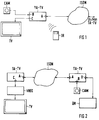
- At least one image and sound recording device CAM is connected via a line and a first device socket B to a terminal adapter TA-TV. Furthermore, at least one picture and sound reproduction device TV, VREC is connected via a line and a second device socket C to the terminal adapter TA-TV.
- the terminal adapter is in turn connected via a network socket A and a line to an integrated service communications network ISDN. Any number of connections to terminal adapters TA-TV can be connected from the integrated service network.
- the image and sound recording device CAM either current images and current sound, such as on a camcorder, or pictures and sound already recorded, such as passed on to the terminal adapter TA-TV with a recorder.
- the pictures and the sound are processed in the event that a subscriber dialing, that is to say a transfer of a subscriber number and a connection set-up via the communications network ISDN to another subscriber, is processed and transmitted to the subscriber who is equipped with the same device.
- the pictures and the sound arrive at the participant, are processed by the terminal adapter and are sent via the second device socket C and a line to a picture and sound reproduction device TV, VREC, e.g. passed on a television and broadcast it there.
- One possibility is, as described in subclaim 2, to provide a means which enables a subscriber to be selected via the terminal adapter. This can be done either with a keyboard built into the terminal adapter or with an IR remote control acting on the terminal adapter, e.g. an infrared remote control. This means that subscriber selection is also possible via the terminal adapter.
- a subscriber number can be sent using a remote control IR, for example an infrared remote control which belongs to the image and sound reproduction devices.
- a remote control IR for example an infrared remote control which belongs to the image and sound reproduction devices.
- the device sockets B and C are antenna plugs, the aforementioned form of subscriber selection applies.
- a data processing device for example a personal computer, can be connected via this interface. This personal computer in turn can be used to select participants as well as to carry out various calculation procedures, e.g. a comparison of different still images. In addition, several numbers can be stored in the data processing device.
- the device used for subscriber selection can be used for setting transmission and / or reception parameters.
- the parameters such as brightness, volume, etc. can thus be set individually.
- the network socket A can either be an S O , an interface specially designed for short connecting lines, or a U PO , an interface specifically defined for end devices in telecommunications systems.
- the previously listed device can be used as a kind of videophone or as an inexpensive videophone in the event that current images and current sound are transmitted, and in the event that both picture and sound recording device and picture and sound reproduction devices are connected to each participant special embodiment.
- the exemplary embodiment represents a monitoring system.
- An image and sound recording device CAM for example a video camera, is connected to a terminal adapter TA-TV via a first device socket B and a line.
- the video camera serves as a surveillance camera and records and outputs current images and sound forward them via the terminal adapter TA-TV to an integrated service communication network ISDN, for example an ISDN network.
- ISDN integrated service communication network
- the images and the sound are sent over the ISDN network to another subscriber, for example a security and locking company.
- the incoming signals are in turn processed by a terminal adapter TA-TV and passed on to a picture and sound reproduction device TV, VREC via a second device socket C and a line.
- the image and sound reproduction device can be, for example, a video recorder for recording with a television set connected to it. Accordingly, the current images and the corresponding sound can be recorded and / or viewed directly.
- monitoring and listening can be carried out to determine whether something is moving in a room or building to be observed, or whether sounds can be heard.
- a monitoring computer ÜR For a computer-controlled comparison of individual images, a monitoring computer ÜR must also be connected via an interface D to the terminal adapter TA-TV on the image and sound recording side. Single images are permanently sent to the monitoring computer ÜR. If the video camera CAM is a permanently installed camera, the surveillance computer ÜR would have to be sent the same images constantly. Only in the event that, for example, an intruder is in a room to be monitored, is there a change between successive images. The monitoring computer notices this change and can pass on this information and thus trigger an alarm.
- This system can also be thought of as the form of the surveillance camera in which, in the event of a match between a current image and an image in the memory of the surveillance computer, a specific one Subsequent action is triggered, for example, the correspondence between a current image of a license plate and the license plate of a car authorized for, for example, a garage, whereupon a garage door opens.
- the monitoring computer ÜR can be connected to the terminal adapter, for example, via a V.24 interface.
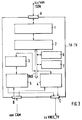
- terminal adapter according to the invention is explained in more detail with reference to FIG. 3.
- a terminal adapter TA-TV consists of a network socket A for establishing a plug connection to an integrated service communications network ISDN. From the network socket A there is a connection to a first module 1, which enables access to the ISDN message network, for example an ISDN network. From there, there is a further connection to a second module 2 for ISDN B-channel and ISDN D-channel protocols.
- the ISDN B-channel and ISDN D-channel protocols are used to define standardized procedures for the exchange of information, i.e. for signal transmission.
- the second module 2 is connected to a serial bus BUS.
- Both a microprocessor unit 7 and an optional module 6 are connected to the serial bus BUS.
- the microprocessor unit also contains memory modules, such as RAMs or ROMs or EEPROMs, for example for storing subscriber numbers.
- the protocol data are processed with H.221, for example according to the CCITT standard. Functions such as automatic subscriber selection, access control, etc. can be carried out using the optional module 6.
- serial bus BUS is connected to a means 3 for compressing block-wise signal data to be transmitted.
- the block-by-block video data to be transmitted are compressed or compressed in the means 3, so the amount of data is reduced with the aid of this means 3.
- a possible compression method is JPEG, or according to the CCITT standard H.261.
- video signals can also be transmitted in the uncompressed state via the means 3. This is required in the case that still images are transmitted with high resolution.
- the means 3 for block compression is connected to a video module 5. Both incoming and outgoing video signals are processed and adapted in the video module 5. Incoming and outgoing audio signals are processed and adapted in the audio module 4.
- Both the audio module 4 and the video module 5 are each connected to at least one second device socket C via an outgoing connection.
- the second device socket C is used to connect a picture and sound reproduction device VREC, TV to the terminal adapter TA-TV.
- Both the audio module 4 and the video module 5 are connected to at least one first device socket B by an incident connection.
- This first device socket B is used to connect an image and sound recording device CAM.
- the video signals and also audio signals are passed on to the video module 5 and to the audio module 4 via the first device socket B. These are processed and adapted for transmission.
- the video signals processed in this way are then passed to the means 3 for compressing block-wise signal data to be transmitted. There the video signal data is compressed and forwarded with a serial bus BUS.
- the audio signal data is also bridged on the bus BUS.
- the signal data are passed on to the second module 2 and then to the first module 1 via the bus BUS and then transmitted via the network socket A to the integrated service communications network ISDN.
Landscapes
- Engineering & Computer Science (AREA)
- Multimedia (AREA)
- Signal Processing (AREA)
- Computer Networks & Wireless Communication (AREA)
- Data Exchanges In Wide-Area Networks (AREA)
- Telephonic Communication Services (AREA)
- Input Circuits Of Receivers And Coupling Of Receivers And Audio Equipment (AREA)
- Two-Way Televisions, Distribution Of Moving Picture Or The Like (AREA)
- Communication Control (AREA)
- Television Signal Processing For Recording (AREA)
Abstract
Description
- Die Erfindung betrifft eine Vorrichtung und einen Terminaladapter zur Übertragung von Video- und Audiosignalen über ein diensteintegrierendes Nachrichtennetz.
- Eine bisher bekannte Möglichkeit zur Übertragung von Videosignalen und Audiosignalen über Nachrichtennetze ist die Übertragung mittels Videophone. Dabei befinden sich Bildaufnahmegerät sowie Bildwiedergabegerät, Tonaufnahmegerät sowie Tonwiedergabegerät integriert in einem Terminal ("Telefonieren von Angesicht zu Angesicht"; Kommunkationstechnik von SEL; SEL Alcatel Gruppe; S. 1-8). Demnach können aber nicht beliebige, eventuell bereits vorhandene Geräte benutzt werden, sondern alle Geräte müssen vollständig neu erstanden werden.
- Zusätzlich ist zur Verbindungsherstellung und zur Teilnehmerwahl ein zusätzliches Gerät mit Telefonfunktionsmerkmalen nötig. Ebenso ist ein analoges Interface im Benutzerbereich und ein digitales Interface im Netzwerkbereich nötig. Demnach stellt ein Videophone eine recht aufwendige und kostenintensive Form der Videoübertragung dar (Electricl Communication, "End User Premises Equipment and Terminals for Broadband Applications"; J. Huélamo, H.-J. Mosel, C. Ravelli, M. Weiss, Volume 64, Number 2/3; 1990, Pages 205 to 217).
- Eine ebenfalls bekannte Vorrichtung zur Übertragung von Videosignalen und Audiosignalen sind Multimedia-Terminals. Multimedia-Funktionen können nur an speziellen Terminals gestartet werden und zwar an solchen, die Breitbandkommunikation mit existierenden "Workstations", Personalcomputer oder Videotechnologien verbinden. Dies ist aber ebenfalls eine aufwendigere Lösung als die erfindungsgemäße Vorrichtung, denn auch in diesem Fall wird neben einem Terminaladapter mit einem Breitband-ATM (Analogous Tranfer Mode)-Multiplex-Adapter eine spezielle Multimedia Kommunikationsverarbeitung und Darstellung (Multimedia-Communication-Processing and Representation [MCPR]) verwendet (Electricl Communication, "End User Premises Equipment and Terminals for Broadband Applications"; J. Huélamo, H.-J. Mosel, C. Ravelli, M. Weiss, Volume 64, Number 2/3; 1990, Pages 205 to 217).
- Der Erfindung liegt die Aufgabe zugrunde eine Vorrichtung und einen Terminaladapter zu entwickeln welche bzw. welcher eine Übertragung von Videosignalen und Audiosignalen über ein diensteintegrierendes Nachrichtennetz vornimmt.
- Die Aufgabe wird erfindungsgemäß gelöst durch die Lehre des ersten Patentanspruchs und durch die Lehre des neunten Patentanspruchs.
- Ein Vorteil der Erfindung ist, daß übliche Bild- und Tonwiedergabegeräte und Bild- und Tonaufnahmegeräte zum Anschluß an den Terminaladapter verwendet werden können. Anstelle, daß eine vollständig neue Übertragungseinheit eingesetzt wird, können die in fast jedem Haushalt vorhandene Bild- und Tonwiedergabegeräte und Bild- und Tonaufnahmegeräte um einen zusätzlichen Terminaladapter ergänzt werden, werden dann an ein Nachrichtennetz angeschlossen und sind somit in der Lage Video- und Audiosignale zu übertragen. Somit stellt die erfindungsgemäße Lösung der Aufgabe einen sehr kostengünstigen Weg der Übertragung dar.
- Ein weiterer Vorteil der Erfindung liegt, sollte die Vorrichtung beispielsweise als Überwachungsanlage verwendet werden, darin, daß ein flexibler und schneller Einsatz an nahezu jedem Ort zu ermöglichen ist. Eine Überwachungsanlage kann schnell und unkompliziert aufgebaut und in Betrieb genommen werden.
- Vorteilhafte Weiterentwicklungen der Vorrichtung und des Terminaladapters der Erfindung sind den Unteransprüchen 2 bis 8 und 10 zu entnehmen.
- Nach Unteranspruch 2 wird zusätzlich zu der in Anspruch 1 beanspruchten Vorrichtung erläutert, daß ein Mittel vorhanden ist, das es ermöglicht eine Teilnehmerwahl über den Terminaladapter vorzunehmen.
- Nach Unteranspruch 3 wird erläutert, daß für den Fall, daß das Bild- und Tonwiedergabegeräte über eine SCART-Anschluß mit dem Terminaladapter verbunden ist, eine dem Bild- und Tonwiedergabegeräte zugehörende Fernbedienung die Teilnehmerwahl vornehmen kann. Dies stellt ebenfalls wieder eine Vereinfachung der Vorrichtung dar, da nun selbst zur Teilnehmerwahl ein möglicherweise bereits vorhandenes Gerät herangezogen werden kann.
- Nach Unteranspruch 4 wird zusätzlich zu Anspruch 1 eine Schnittstelle, z.B. V.24, an den Terminaladapter der Vorrichtung hinzugefügt.
- Nach Unteranspruch 5 kann eine Teilnehmerwahl, nach Abfrage einer Zugangsberechtigung, ebenfalls über das diensteintegrierende Nachrichtennetz, z.B. das ISDN-Netz, erfolgen. Dies bietet z.B. die Möglichkeit einer ferngesteuerten Überwachungsanlage.
- In Unteranspruch 6 wird erläutert, daß die verwendete Vorrichtung zur Teilnehmerwahl ebenfalls zur Einstellung von Sende- und/oder Empfangsparametern verwendet werden kann. Die Parameter wie Helligkeit, Lautstärke usw. können somit individuell eingestellt werden.
- In Unteranspruch 10 werden die für diesen Fall vorgesehenen verschiedenen diensteintegrierendes Nachrichtennetze aufgeführt. Eine Anpassung mit Hilfe des ersten Moduls 1 sollte entweder für ein ISDN-Netz oder ein Breitband-ISDN-Netz geeignet sein.
- Zwei Ausführungsbeispiele und ein möglicher Aufbau des Terminaladapters werden anhand der folgenden Figuren erläutert. Folgende Figuren zeigen:
- Fig. 1
- Blockschaltbild der erfindungsgemäßen Vorrichtung,
- Fig. 2
- Blockschaltbild eines speziellen Ausführungsbeispiels der erfindungsgemäßen Vorrichtung,
- Fig. 3
- Blockschaltbild des erfindungsgemäßen Terminaladapters.
- Im folgenden Teil wird die erfindungsgemäße Vorrichtung zur Übertragung von Video- und Audiosignalen anhand von Figur 1 erläutert.
- Mindestens ein Bild- und Tonaufnahmegeräte CAM ist über eine Leitung und eine erste Gerätebuchse B mit einem Terminaladapter TA-TV verbunden. Weiterhin ist mindestens ein Bild- und Tonwiedergabegeräte TV, VREC über eine Leitung und eine zweite Gerätebuchse C mit dem Terminaladapter TA-TV verbunden. Der Terminaladapter ist wiederum über eine Netzbuchse A und eine Leitung mit einem diensteintegrierenden Nachrichtennetz ISDN verbunden. Von dem diensteintegrierenden Nachrichtennetz aus können beliebig viele Verbindungen zu Terminaladaptern TA-TV angeschlossen sein.
- Mit Hilfe des Bild- und Tonaufnahmegeräte CAM werden entweder aktuelle Bilder und aktueller Ton, wie z.B. bei einem Camcorder, oder bereits aufgezeichnete Bilder und bereits aufgezeichneter Ton, wie z.B. bei einem Recorder an den Terminaladapter TA-TV weitergegeben. Dort werden die Bilder und der Ton für den Fall, daß eine Teilnehmerwahl, also ein Absetzen einer Teilnehmerrufnummer und ein Verbindungsaufbau über das Nachrichtennetz ISDN zu einem anderen Teilnehmer stattgefunden hat, verarbeitet und zu dem Teilnehmer übertragen, der mit der gleichen Vorrichtung ausgestattet ist. Bei dem Teilnehmer treffen die Bilder und der Ton ein, werden von dem Terminaladapter wiederum verarbeitet und werden über die zweite Gerätebuchse C und eine Leitung an ein Bild- und Tonwiedergabegeräte TV, VREC, z.B. einen Fernsehapparat weitergegeben und dort ausgestrahlt.
- Zur Ermöglichung einer Teilnehmerwahl können verschiedene Möglichkeiten in Betracht gezogen werden.
- Eine Möglichkeit ist, wie in Unteranspruch 2 beschrieben, ein Mittel zur Verfügung zu stellen, das es ermöglicht eine Teilnehmerwahl über den Terminaladapter vorzunehmen. Dies kann entweder durch eine in den Terminaladapter eingebaute Tastatur oder über eine auf den Terminaladapter wirkende Fernbedienung IR, z.B. eine Infrarot-Fernbedienung, erfolgen. Somit ist auch die Teilnehmerwahl über den Terminaladapter möglich.
- Eine weitere Möglichkeit ergibt sich für den Fall, daß die Gerätebuchsen B und C SCART-Anschlüsse sind. Für diesen Fall von kann das Absetzen einer Teilnehmerrufnummer mit Hilfe einer Fernbedienung IR, z.B. einer Infrarot-Fernbedienung die zu dem Bild- und Tonwiedergabegeräte gehört, erfolgen. Für den Fall, daß die Gerätebuchsen B und C Antennenstecker sind gilt die vorher genannte Form der Teilnehmerwahl.
- Eine weitere Möglichkeit existiert für den Fall, daß gemäß Unteranspruch 4 zusätzlich eine Schnittstelle, z.B. V.24, an den Terminaladapter TA-TV hinzugefügt wird. Über diese Schnittstelle kann ein Datenverarbeitungsgerät, beispielsweise ein Personal Computer, angeschlossen werden. Über diesen Personal Computer wiederum können sowohl die Teilnehmerwahl als auch die Ausführungen verschiedener Rechenprozeduren durchgeführt werden, z.B. ein Vergleich verschiedener Standbilder. Zusätzlich können in dem Datenverarbeitungsgerät mehrere Rufnummern gespeichert werden.
- Weiterhin kann die verwendete Vorrichtung zur Teilnehmerwahl gemäß Unteranspruch 6 zur Einstellung von Sende- und/oder Empfangsparametern verwendet werden. Die Parameter wie Helligkeit, Lautstärke usw. können somit individuell eingestellt werden.
- Die Netzbuchse A kann entweder eine SO, eine speziell für kurze Anschlußleitungen konzipierte Schnittstelle, oder eine UPO, eine speziell für Endgeräte an Telekommunikationsanlagen festgelegte Schnittstelle sein. Die bisher aufgeführte Vorrichtung kann für den Fall, daß aktuelle Bilder und aktueller Ton übertragen werden, und für den Fall, daß bei jedem Teilnehmer sowohl Bild- und Tonaufnahmegerät als auch Bild- und Tonwiedergabegeräte angeschlossen sind als eine Art Bildtelefon oder aber als kostengünstiges Videophone einer speziellen Ausführungsform bezeichnet werden.
- Im folgenden Teil wird ein spezielles Ausführungsbeispiel anhand von Figur 2 erläutert. Das Ausführungsbeispiel stellt eine Überwachungsanlage dar.
- An einen Terminaladapter TA-TV ist ein Bild- und Tonaufnahmegeräte CAM, beispielsweise eine Videokamera, über eine erste Gerätebuchse B und eine Leitung angeschlossen. Die Videokamera dient als Überwachungskamera und nimmt aktuelle Bilder und Ton auf und gibt sie über den Terminaladapter TA-TV an ein diensteintegrierendes Nachrichtennetz ISDN, z.B. ein ISDN-Netz weiter.
- Die Bilder und der Ton werden über da ISDN-Netz zu einem weiteren Teilnehmer, beispielsweise einer Wach- und Schließgesellschaft gesendet. Dort werden die eintreffenden Signale wiederum von einem Terminaladapter TA-TV verarbeitet und über eine zweite Gerätebuchse C und eine Leitung an ein Bild- und Tonwiedergabegeräte TV, VREC weitergegeben. Das Bild- und Tonwiedergabegeräte kann beispielsweise eine Videorecorder zur Aufzeichnung mit daran angeschlossenem Fernsehapparat sein. Demnach können die aktuellen Bilder und der entsprechende Ton aufgezeichnet und/oder direkt angesehen werden.
- Somit kann für den Fall einer Überwachungsanlage beobachten und abgehört werden, ob sich in einem zu beobachtenden Raum oder Gebäude etwas bewegt, oder ob Töne zu hören sind.
- Für einen rechnergesteuerten Einzelbildvergleich muß auf der bild- und tonaufnehmenden Seite zusätzlich ein Überwachungsrecher ÜR über eine Schnittstelle D an den Terminaladapter TA-TV angeschlossen sein. Dem Überwachungsrechner ÜR werden permanent Einzelbilder gesendet. Falls die Videokamera CAM eine fest installierte Kamera ist, müßten dem Überwachungsrechner ÜR ständig gleiche Bilder übertragen werden. Lediglich für den Fall, daß sich beispielsweise ein Eindringling in einem zu überwachenden Raum befindet, erfolgt eine Änderung zwischen aufeinanderfolgenden Bildern. Der Überwachungsrechner bemerkt diese Änderung und kann diese Information weitergeben und somit Alarm auslösen.
- Diese Anlage kann man sich aber auch als diejenige Form der Überwachungskamera denken, bei der für den Fall einer Übereinstimmung eines aktuellen Bildes mit einem im Speicher des Überwachungsrechner befindlichen Bildes, eine bestimmte Folgehandlung ausgelöst wird, z.B. die Übereinstimmung eines aktuellen Bildes eines Nummernschildes mit dem Nummernschild eines für beispielsweise eine Garage zugangsberechtigten Wagens, woraufhin sich ein Garagentor öffnet.
- Der Anschluß des Überwachungsrechners ÜR an den Terminaladapter kann beispielsweise über eine V.24 Schnittstelle erfolgen.
- Im folgenden Teil wird der erfindungsgemäße Terminaladapter anhand von Figur 3 näher erläutert.
- Ein Terminaladapter TA-TV besteht aus einer Netzbuchse A zur Herstellung einer Steckverbindung zu einem diensteintegrierenden Nachrichtennetz ISDN. Von der Netzbuchse A aus besteht eine Verbindung zu einem ersten Modul 1, welches einen Zugriff auf das Nachrichtennetz ISDN, beispielsweise einem ISDN-Netz ermöglicht. Von dort aus besteht eine weitere Verbindung zu einem zweiten Modul 2 für ISDN-B-Kanal- und ISDN-D-Kanalprotokolle. Mit den ISDN-B-Kanal- und ISDN-D-Kanalprotokollen werden standardisierte Prozeduren für den Informationsaustausch, also für die Signalübertragung, festgelegt.
- Das zweite Modul 2 ist mit einem seriellen Bus BUS verbunden.
- An den seriellen Bus BUS sind sowohl eine Mikroprozessoreinheit 7, als auch ein optionales Modul 6 angeschlossen. In der Mikroprozessoreinheit befinden sich neben einem Mikroprozessor ebenfalls auch Speicherbausteine, wie RAM's oder ROM's oder EEPROM's, zum Beispiel zur Speicherung von Teilnehmerrufnummern. Die Protokolldaten werden z.B. nach CCITT-Norm mit H.221 verarbeitet. Mittels des optionalen Moduls 6 können Funktionen wie z.B. automatische Teilnehmerwahl, Zugangskontrolle, usw. ausgeführt werden.
- Desweiteren ist der serielle Bus BUS mit einem Mittel 3 zur Verdichtung von zu übertragenden blockweisen Signaldaten verbunden.
- In dem Mittel 3 werden die zu übertragenden blockweisen Videodaten verdichtet oder komprimiert, also wird mit Hilfe dieses Mittels 3 die Datenmenge reduziert. Ein mögliches Komprimierungsverfahren ist JPEG, oder nch CCITT-Norm H.261.
- Neben dem, daß mit dem Mittel 3 Signaldaten komprimiert werden können, können über das Mittel 3 ebenfalls Videosignale in nicht komprimiertem Zustand übertragen werden. Dies wird für den Fall benötigt, daß Standbilder mit hoher Auflösung übertragen werden.
- Das Mittel 3 zur Blockverdichtung ist mit einem Videomodul 5 verbunden. In dem Videomodul 5 werden sowohl ankommende als auch abgehende Videosignale verarbeitet und angepaßt. In dem Audiomodul 4 werden ankommende und abgehende Audiosignale verarbeitet und angepaßt.
- Sowohl das Audiomodul 4 als auch das Videomodul 5 sind jeweils über eine abgehende Verbindung mit mindestens einer zweiten Gerätebuchse C verbunden. Die zweite Gerätebuchse C dient zum Anschluß eines Bild- und Tonwiedergabegerätes VREC, TV an den Terminaladapter TA-TV.
- Sowohl das Audiomodul 4 als auch das Videomodul 5 sind durch eine auftreffende Verbindung mit mindestens einer ersten Gerätebuchse B verbunden. Diese erste Gerätebuchse B dient zum Anschluß eines Bild- und Tonaufnahmegerätes CAM.
- Für den dargestellten Fall, daß jeweils ein Bild- und Tonaufnahmegerät CAM und ein Bild- und Tonwiedergabegerät VREC, TV angeschlossen sind und für den Fall, daß Video- und Audiosignale aufgenommen und übertragen werden sollen, finden folgende Abläufe statt. Die Videosignale und auch Tonsignale werden über die erste Gerätebuchse B jeweils an das Videomodul 5 und an das Audiomodul 4 weitergegeben. Diese werden verarbeitet und für die Übertragung angepaßt. Darauf werden die so verarbeiteten Videosignale an das Mittel 3 zur Verdichtung von zu übertragenden blockweisen Signaldaten gegeben. Dort werden die Videosignaldaten verdichtet und mit einem seriellen Bus BUS weitergeleitet. Die Audiosignaldaten werden ebenfalls auf dem Bus BUS gebrcht. Über den Bus BUS werden die Signaldaten an das zweite Modul 2 und dann an das erste Modul 1 weitergegeben und dann über die Netzbuchse A zu dem diensteintegrierten Nachrichtennetz ISDN übertragen.
- Im gegenteiligen Fall, daß Video- und Audiosignal von dem diensteintegrierenden Nachrichtennetz ISDN aus übertragen und wiedergegeben werden sollen, findet der genau entgegengesetzte Verlauf statt. Jedoch werden für diesen Fall von dem Audiomodul 4 und dem Videomodul 5 aus die entsprechenden Signale auf die zweite Gerätebuchse C gegeben, da diese zu dem Bild- und Tonwiedergabegerät VREC, TV führt.
Claims (10)
- Vorrichtung zur Übertragung von Videosignalen und von Audiosignalen über ein diensteintegrierendes Nachrichtennetz (ISDN), bestehend aus mindestens einem Bild- und Tonwiedergabegerät (TV, VREC) und/oder mindestens einem Bild- und Tonaufnahmegerät (CAM), bei der das jeweilige Gerät über eine entsprechende Leitung mit einer ersten Gerätebuchse (B) oder mit einer zweiten Gerätebuchse (C) an einen Terminaladapter (TA-TV) angeschlossen ist, und bei der der Terminaladapter (TA-TV) mit einer Netzbuchse (A) über eine entsprechende Leitung mit dem diensteintegrierenden Nachrichtennetz (ISDN) verbunden ist, und bei der der Terminaladapter (TA-TV) eine Anpassung der Videosignale und der Audiosignale und eine Übertragung an das diensteintegrierende Nachrichtennetz (ISDN) vornimmt.
- Vorrichtung nach Anspruch 1, bei der in den Terminaladapter (TA-TV) eine Tastatur eingebaut ist oder bei der auf den Terminaladapter eine Fernbedienung (IR) wirkt, zur Durchführung einer Teilnehmerwahl.
- Vorrichtung nach Anspruch 1, bei der für den Fall, daß das Bild- und Tonwiedergabegerät (TV, VREC) mit einem SCART-Anschluß über eine Leitung mit dem Terminaladapter (TA-TV) verbunden ist und über eine Fernbedienung (IR) bedient werden kann, zur Teilnehmerwahl die Fernbedienung des Bild- und Tonwiedergabegerätes (TV, VREC) benutzt wird.
- Vorrichtung nach Anspruch 1, bei der zusätzlich ein Datenverarbeitungsgerät über eine Schnittstelle (D) mit dem Terminaladapter (TA-TV) verbunden ist, und eine Teilnehmerwahl mittels Eingabe einer Teilnehmernummer in das Datenverarbeitungsgerät erfolgt oder bei der eine Teilnehmernummer mit dem Datenverarbeitunggerät in den Terminaladapter (TA-TV) programmiert wird, oder bei der das Datenverarbeitungsgerät zur Ausführung von Rechenprozeduren mit Daten von Videosignalen zur Verfügung steht.
- Vorrichtung nach Anspruch 1, bei der eine Teilnehmerwahl über das diensteintegrierende Nachrichtennetz (ISDN) erfolgt, und in einem angewählten Terminaladapter (TA-TV), nach einer Zugangskontrolle mittels einer Abfrage eines Paßwortes, eine Teilnehmernummer abgesetzt werden kann.
- Vorrichtung nach Anspruch 2, bei der die Tastatur ebenfalls zur Einstellung von Sende- und/oder Empfangsparametern verwendet wird.
- Vorrichtung nach Anspruch 3, bei der die Fernbedienung ebenfalls zur Einstellung von Sende- und/oder Empfangsparametern verwendet wird.
- Vorrichtung nach Anspruch 4, bei der eine Vorrichtung zur Teilnehmerwahl ebenfalls zur Einstellung von Sende- und/oder Empfangsparametern verwendet wird.
- Terminaladapter (TA-TV) zur Übertragung von Videosignalen und von Audiosignalen über ein diensteintegrierendes Nachrichtennetz (ISDN), bestehend aus- einer Netzbuchse (A) zum Herstellen einer Steckverbindung zu dem diensteintegrierenden Nachrichtennetz (ISDN),- einem daran angeschlossenen ersten Modul (1) zum Zugriff auf das diensteintegrierende Nachrichtennetz (ISDN),- einem daran angeschlossenen zweiten Modul (2) für ISDN-B-Kanal- und ISDN-D-Kanalprotokolle, zur Festlegung standardisierter Prozeduren,- einem darauf zugreifenden und abgreifenden seriellen Bus (BUS),- einem mit dem seriellen Bus (BUS) verbundenen Mittel (3) zur Verdichtung oder Kompression von zu übertragenden blockweisen Signaldaten,- einem mit dem Mittel (3) verbundenen Videomodul (5) zur Verarbeitung der Videosignale,- einem mit dem seriellen Bus (BUS) verbundenen Audiomodul (4) zur Verarbeitung der Audiosignale,- einem mit dem seriellen Bus (BUS) verbundenen optionalen Modul (6), mit welchem verschiedene Funktionen ausgeführt werden können,- einer mit dem seriellen Bus (BUS) verbundenen Mikroprozessoreinheit (7) mit Speicherbausteinen,- mindestens einer ersten Gerätebuchse (B) zum Anschluß eines Bild- und Tonaufnahmegerätes (CAM), die sowohl mit dem Audiomodul (4), als auch mit dem Videomodul (5) verbunden ist,- mindestens einer zweiten Gerätebuchse (C) zum Anschluß eines Bild- und Tonwiedergabegerätes (VREC, TV), die sowohl mit dem Audiomodul (4), als auch mit dem Videomodul (5) verbunden ist.
- Terminaladapter (TA-TV) nach Anspruch 9, bei dem das Modul (1) zur Anpassung an ein ISDN-Netz oder ein Breitband-ISDN-Netz ausgebildet ist.
Applications Claiming Priority (2)
| Application Number | Priority Date | Filing Date | Title |
|---|---|---|---|
| DE4229151 | 1992-09-01 | ||
| DE4229151A DE4229151A1 (de) | 1992-09-01 | 1992-09-01 | Vorrichtung zur Übertragung von Videosignalen und Audiosignalen über ein diensteintegrierendes Nachrichtennetz |
Publications (2)
| Publication Number | Publication Date |
|---|---|
| EP0585805A1 true EP0585805A1 (de) | 1994-03-09 |
| EP0585805B1 EP0585805B1 (de) | 1999-05-12 |
Family
ID=6466967
Family Applications (1)
| Application Number | Title | Priority Date | Filing Date |
|---|---|---|---|
| EP93113624A Expired - Lifetime EP0585805B1 (de) | 1992-09-01 | 1993-08-26 | Vorrichtung zur Übertragung von Videosignalen und Audiosignalen über ein diensteintegrierendes Nachrichtennetz |
Country Status (5)
| Country | Link |
|---|---|
| US (1) | US5541982A (de) |
| EP (1) | EP0585805B1 (de) |
| AT (1) | ATE180131T1 (de) |
| DE (2) | DE4229151A1 (de) |
| ES (1) | ES2131546T3 (de) |
Cited By (2)
| Publication number | Priority date | Publication date | Assignee | Title |
|---|---|---|---|---|
| US5892537A (en) * | 1996-01-16 | 1999-04-06 | France Telecom | Audio-visual telecommunications unit designed to form a videophone terminal |
| DE19523325B4 (de) * | 1994-07-05 | 2006-10-05 | France Telecom | Audiovisuelles Telekommunikationsterminal des Bildtelefontyps |
Families Citing this family (27)
| Publication number | Priority date | Publication date | Assignee | Title |
|---|---|---|---|---|
| US6121998A (en) * | 1992-02-19 | 2000-09-19 | 8×8, Inc. | Apparatus and method for videocommunicating having programmable architecture permitting data revisions |
| DE4425567A1 (de) * | 1994-07-20 | 1996-02-01 | Gunnar Dr Talman | Verfahren zur interaktiven Informationsübertragung |
| US5793961A (en) * | 1994-11-18 | 1998-08-11 | Intel Corporation | Computer system with data conference capability |
| JPH08195944A (ja) * | 1994-11-18 | 1996-07-30 | Casio Comput Co Ltd | テレビ電話装置 |
| US5675375A (en) * | 1994-12-15 | 1997-10-07 | Harris Corporation | Home videoconferencing system (HVS) |
| DE19512959A1 (de) * | 1995-04-10 | 1996-10-17 | Sel Alcatel Ag | Fernüberwachungsvorrichtung |
| DE19609843C1 (de) * | 1996-03-13 | 1997-05-28 | Loh Kg Ritto Werk | ISDN-TK-Anlage |
| DE19610010A1 (de) * | 1996-03-14 | 1997-09-18 | Sel Alcatel Ag | Einrichtung und Dienst zur Übertragung von Videobilddaten sowie Einrichtung zur Übertragung von Anforderungssignalen |
| DE19634778A1 (de) * | 1996-08-28 | 1998-03-05 | Sel Alcatel Ag | Einrichtung zur Anbindung einer Türsprechanlage mit Videokamera an ein diensteintegrierendes digitales Netz |
| US6049598A (en) * | 1996-04-03 | 2000-04-11 | Alcatel | Facility for tying a door intercommunication system with a video camera to an integrated services digital network |
| DE19630047C1 (de) * | 1996-07-25 | 1997-07-31 | Siemens Ag | Erweiterungsmodul für Bildtelefone |
| AU4894297A (en) * | 1996-10-03 | 1998-04-24 | Motorola, Inc. | Apparatus, method and system for wireline audio and video conferencing and telephony |
| EP0836324B1 (de) * | 1996-10-09 | 2004-12-08 | Polycom, Inc. | Integrierte tragbare Videokonferenzvorrichtung |
| US6654414B1 (en) * | 1996-11-12 | 2003-11-25 | Ibm Corporation | Video conferencing using camera environment panoramas |
| US7031391B1 (en) | 1997-02-18 | 2006-04-18 | Harris Corporation | Narrowband video codec |
| US6191822B1 (en) | 1997-06-20 | 2001-02-20 | Sony Corporation | Method of and apparatus for separating audio and video data from a combined audio/video stream of data |
| DE19744294C2 (de) * | 1997-10-07 | 1999-07-29 | Videocon Ag | Verfahren und Vorrichtung zum Überwachen eines Zielbereichs von einem entfernten Standort aus |
| DE19800615A1 (de) * | 1998-01-12 | 1999-07-22 | Schmid Johannes | Steuerungseinrichtung in einer Sprechanlage |
| DE19818707A1 (de) * | 1998-04-21 | 1999-10-28 | Holger Gumprecht | Vorrichtung und Verfahren als Zubehör für Bild- und Tonübertragungssysteme zum herstellerunabhängigen, ferngessteuerten Umschalten von Video- und Audioquellen und zum Fernsteuern von weiteren Geräten |
| DE19826087C2 (de) * | 1998-06-12 | 2000-08-17 | Alcatel Sa | Einrichtung einer Endstelle eines Telekommunikationsnetzes |
| WO1999066716A1 (en) | 1998-06-18 | 1999-12-23 | Sony Electronics Inc. | A method of and apparatus for partitioning, scaling and displaying video and/or graphics across several display devices |
| DE19845531A1 (de) * | 1998-10-02 | 2000-04-06 | Iws Elektronik Und Information | Verfahren und System zur Steuerung einer Kamera |
| US6415188B1 (en) * | 1998-12-23 | 2002-07-02 | Dennis Sunga Fernandez | Method and apparatus for multi-sensor processing |
| DE10025153A1 (de) * | 2000-05-23 | 2001-11-29 | Olaf Zachert | Verfahren zum Erstellen von sendefähigem Fertigmaterial für einen Fernsehsender |
| DE10240651A1 (de) * | 2002-09-03 | 2004-03-11 | Siemens Ag | Anordnung zur Sprach-und Datenkommunikation über eine gemeinsame Teilnehmeranschlussleitung |
| US7573500B2 (en) * | 2003-03-24 | 2009-08-11 | Sensormatic Electronics Corporation | System and method for communicating data in a video system |
| DE102011056373A1 (de) * | 2011-12-13 | 2013-06-13 | Schneider Electric Industries Sas | Telekommunikationsadapter |
Family Cites Families (9)
| Publication number | Priority date | Publication date | Assignee | Title |
|---|---|---|---|---|
| US5136411A (en) * | 1987-12-11 | 1992-08-04 | General Instrument Corporation | Dynamically responsive CATV system with shared fiber optic link |
| GB2242335B (en) * | 1990-03-19 | 1994-03-16 | Sony Corp | Videophones |
| JP3347336B2 (ja) * | 1990-12-26 | 2002-11-20 | キヤノン株式会社 | マルチメディア通信装置 |
| US5236199A (en) * | 1991-06-13 | 1993-08-17 | Thompson Jr John W | Interactive media system and telecomputing method using telephone keypad signalling |
| JPH0549024A (ja) * | 1991-08-09 | 1993-02-26 | Fujitsu Ltd | パソコン連携式テレビ電話装置 |
| JPH0528190U (ja) * | 1991-09-19 | 1993-04-09 | コステム株式会社 | 外部遠隔操作対応型画像提供装置 |
| US5247347A (en) * | 1991-09-27 | 1993-09-21 | Bell Atlantic Network Services, Inc. | Pstn architecture for video-on-demand services |
| FR2687884B1 (fr) * | 1992-02-24 | 1994-04-08 | Alcatel Cit | Codec videc, notamment visiophonique. |
| US5329308A (en) * | 1992-07-29 | 1994-07-12 | At&T Bell Laboratories | Bidirectional video telephony between cable television and switched telephone systems |
-
1992
- 1992-09-01 DE DE4229151A patent/DE4229151A1/de not_active Withdrawn
-
1993
- 1993-08-26 ES ES93113624T patent/ES2131546T3/es not_active Expired - Lifetime
- 1993-08-26 AT AT93113624T patent/ATE180131T1/de not_active IP Right Cessation
- 1993-08-26 DE DE59309572T patent/DE59309572D1/de not_active Expired - Lifetime
- 1993-08-26 EP EP93113624A patent/EP0585805B1/de not_active Expired - Lifetime
-
1995
- 1995-10-25 US US08/547,850 patent/US5541982A/en not_active Expired - Lifetime
Non-Patent Citations (6)
| Title |
|---|
| ANT NACHRICHTENTECHNISCHE BERICHTE Bd. 1, Mai 1984, BACKNANG, DE Seiten 13 - 20 W. SCHMIDT 'DAS REALISIERTE BIGFON-SYSTEM' * |
| ARNOLD R., GROTZ K., KRULL K.: "CODIERUNG DER TONRUNDFUNK- UND FARBFERNSEHSIGNALE.", NACHRICHTENTECHNISCHE BERICHTE., ANT NACHRICHTENTECHNIK GMB. BACKNANG., DE, no. 01., 1 May 1984 (1984-05-01), DE, pages 39 - 45., XP000308679 * |
| BLITZ A. E., LITTMANN J., NIEMEIER H.: "DER PC ALS ENDGERAET FUER DIE VIDEOKOMMUNIKATION.", NTZ (NACHRICHTENTECHNISCHE ZEITSCHRIFT), VDE VERLAG GMBH, DE, vol. 44., no. 06., 1 June 1991 (1991-06-01), DE, pages 394 - 397 + 400., XP000240836, ISSN: 0948-728X * |
| FROHBERG W.: "OBJEKT IM NETZ.", NACHRICHTEN ELEKTRONIK UND TELEMATIK., VERLAG DR. HUETHIG. HEIDELBERG., DE, vol. 45., no. 05., 1 May 1991 (1991-05-01), DE, pages 211 - 213., XP000230084, ISSN: 0177-5499 * |
| SAMMARTINO F., BLACKKETTER D.: "DESKTOP MULTIMEDIA COMMUNICATIONS - BREAKING THE CHAINS.", COMMUNICATIONS - RISING TO THE HEIGHTS. DENVER, JUNE 23 - 26, 1991., NEW YORK, IEEE., US, vol. 01 OF 03., 23 June 1991 (1991-06-23), US, pages 73 - 77., XP000269382, ISBN: 978-0-7803-0006-4, DOI: 10.1109/ICC.1991.162338 * |
| SCHAAS G.: "EINE SYMBIOSE GEWINNT KONTUREN.", FUNKSCHAU., WEKA FACHZEITSCHRIFTEN VERLAG, POING., DE, vol. 63., no. 12., 31 May 1991 (1991-05-31), DE, pages 28 + 30 - 32 (SPEZIA, XP000231535, ISSN: 0016-2841 * |
Cited By (2)
| Publication number | Priority date | Publication date | Assignee | Title |
|---|---|---|---|---|
| DE19523325B4 (de) * | 1994-07-05 | 2006-10-05 | France Telecom | Audiovisuelles Telekommunikationsterminal des Bildtelefontyps |
| US5892537A (en) * | 1996-01-16 | 1999-04-06 | France Telecom | Audio-visual telecommunications unit designed to form a videophone terminal |
Also Published As
| Publication number | Publication date |
|---|---|
| ES2131546T3 (es) | 1999-08-01 |
| ATE180131T1 (de) | 1999-05-15 |
| EP0585805B1 (de) | 1999-05-12 |
| DE4229151A1 (de) | 1994-03-03 |
| US5541982A (en) | 1996-07-30 |
| DE59309572D1 (de) | 1999-06-17 |
Similar Documents
| Publication | Publication Date | Title |
|---|---|---|
| EP0585805A1 (de) | Vorrichtung zur Übertragung von Videosignalen und Audiosignalen über ein diensteintegrierendes Nachrichtennetz | |
| DE3853713T2 (de) | Verfahren zur Übertragung und Anzeige eines Standbildes in einem Standbild-Videotelefon. | |
| DE68918368T2 (de) | Veränderbares Vielpunkthauskabelnetz für simultane und/oder alternative Verteilung mehrerer Signaltypen, insbesondere Basisband-Bildsignale, und Verfahren zur Wiederanordnung eines solchen Netzes. | |
| EP0832542B1 (de) | Verfahren und vorrichtung zur authentisierung von teilnehmern gegenüber digitalen vermittlungsstellen | |
| DE4002862A1 (de) | Breitbandnebenstellenanlage | |
| DE69124089T2 (de) | Breitbandkonferenzsystem | |
| EP0392141A2 (de) | Digitale Fernmeldevermittlungsanlage | |
| EP0731619A2 (de) | Breitbandkommunikationssystem und Verfahren dazu | |
| EP0501324B1 (de) | Einrichtung und Verfahren zur D-Kanal-Paketvermittlung | |
| EP1530861A1 (de) | Verfahren zur video-objekt berwachung unter verwendung eines mobilkommunikationssystems | |
| DE19720719C2 (de) | Verbindungsaufbau-Überwachungsvorrichtung | |
| DE3309403A1 (de) | Integriertes nachrichtensystem und verfahren zum aufbauen von bildfernsprechverbindungen in einem solchen nachrichtensystem | |
| DE3510567A1 (de) | Verteileinrichtung fuer digitalisierte fernsehsignale | |
| EP0811294A1 (de) | Set-top-box | |
| DE19531948C1 (de) | Verfahren zur Informationsübertragung zwischen Endgeräten eines ISDN-Telekommunikationsanschlusses | |
| DE3420874A1 (de) | Verfahren und anordnung zur kontrolle des netzzugangs in fernmeldenetzen | |
| DE29811851U1 (de) | Endgeräteadapter für bidirektionale Kabelfernsehnetze | |
| EP0440062A2 (de) | Verbindungszustandserkennung in einer Breitbandnebenstellenanlage | |
| EP0641128A1 (de) | Kommunikationssystem für die Übertragung von Bild- und Tonsignalen | |
| DE19741770C1 (de) | Kommunikationssystem und entsprechendes Verfahren | |
| EP1432276B1 (de) | Mobiles Scramblermodul | |
| DE4018685A1 (de) | Teilnehmeranschlusseinrichtung fuer ein breitband-kommunikationsnetz | |
| DE69115656T2 (de) | Digitale Fernsprechnebenstellenanlage mit direkter interner Vermittlung | |
| DE3210874A1 (de) | Verfahren und schaltungsanordnung fuer den mehrfachanschluss von teilnehmerendeinrichtungen an eine digitale teilnehmeranschlussleitung | |
| DE3329571A1 (de) | Verfahren zum betreiben von bildschirmtextanschluessen |
Legal Events
| Date | Code | Title | Description |
|---|---|---|---|
| PUAI | Public reference made under article 153(3) epc to a published international application that has entered the european phase |
Free format text: ORIGINAL CODE: 0009012 |
|
| AK | Designated contracting states |
Kind code of ref document: A1 Designated state(s): AT BE CH DE ES FR GB IT LI NL PT SE |
|
| 17P | Request for examination filed |
Effective date: 19940414 |
|
| 17Q | First examination report despatched |
Effective date: 19960805 |
|
| GRAG | Despatch of communication of intention to grant |
Free format text: ORIGINAL CODE: EPIDOS AGRA |
|
| GRAG | Despatch of communication of intention to grant |
Free format text: ORIGINAL CODE: EPIDOS AGRA |
|
| GRAH | Despatch of communication of intention to grant a patent |
Free format text: ORIGINAL CODE: EPIDOS IGRA |
|
| GRAH | Despatch of communication of intention to grant a patent |
Free format text: ORIGINAL CODE: EPIDOS IGRA |
|
| GRAA | (expected) grant |
Free format text: ORIGINAL CODE: 0009210 |
|
| RAP1 | Party data changed (applicant data changed or rights of an application transferred) |
Owner name: ALCATEL |
|
| AK | Designated contracting states |
Kind code of ref document: B1 Designated state(s): AT BE CH DE ES FR GB IT LI NL PT SE |
|
| REF | Corresponds to: |
Ref document number: 180131 Country of ref document: AT Date of ref document: 19990515 Kind code of ref document: T |
|
| REG | Reference to a national code |
Ref country code: CH Ref legal event code: EP |
|
| REG | Reference to a national code |
Ref country code: CH Ref legal event code: NV Representative=s name: CABINET ROLAND NITHARDT CONSEILS EN PROPRIETE INDU |
|
| REF | Corresponds to: |
Ref document number: 59309572 Country of ref document: DE Date of ref document: 19990617 |
|
| GBT | Gb: translation of ep patent filed (gb section 77(6)(a)/1977) |
Effective date: 19990602 |
|
| REG | Reference to a national code |
Ref country code: ES Ref legal event code: FG2A Ref document number: 2131546 Country of ref document: ES Kind code of ref document: T3 |
|
| ET | Fr: translation filed | ||
| REG | Reference to a national code |
Ref country code: PT Ref legal event code: SC4A Free format text: AVAILABILITY OF NATIONAL TRANSLATION Effective date: 19990727 |
|
| PLBE | No opposition filed within time limit |
Free format text: ORIGINAL CODE: 0009261 |
|
| 26N | No opposition filed | ||
| PGFP | Annual fee paid to national office [announced via postgrant information from national office to epo] |
Ref country code: CH Payment date: 20010716 Year of fee payment: 9 |
|
| PGFP | Annual fee paid to national office [announced via postgrant information from national office to epo] |
Ref country code: NL Payment date: 20010724 Year of fee payment: 9 |
|
| PGFP | Annual fee paid to national office [announced via postgrant information from national office to epo] |
Ref country code: PT Payment date: 20010725 Year of fee payment: 9 Ref country code: AT Payment date: 20010725 Year of fee payment: 9 |
|
| PGFP | Annual fee paid to national office [announced via postgrant information from national office to epo] |
Ref country code: SE Payment date: 20010802 Year of fee payment: 9 |
|
| REG | Reference to a national code |
Ref country code: GB Ref legal event code: IF02 |
|
| PGFP | Annual fee paid to national office [announced via postgrant information from national office to epo] |
Ref country code: BE Payment date: 20020726 Year of fee payment: 10 |
|
| PG25 | Lapsed in a contracting state [announced via postgrant information from national office to epo] |
Ref country code: AT Free format text: LAPSE BECAUSE OF NON-PAYMENT OF DUE FEES Effective date: 20020826 |
|
| PG25 | Lapsed in a contracting state [announced via postgrant information from national office to epo] |
Ref country code: SE Free format text: LAPSE BECAUSE OF NON-PAYMENT OF DUE FEES Effective date: 20020827 |
|
| PG25 | Lapsed in a contracting state [announced via postgrant information from national office to epo] |
Ref country code: LI Free format text: LAPSE BECAUSE OF NON-PAYMENT OF DUE FEES Effective date: 20020831 Ref country code: CH Free format text: LAPSE BECAUSE OF NON-PAYMENT OF DUE FEES Effective date: 20020831 |
|
| PG25 | Lapsed in a contracting state [announced via postgrant information from national office to epo] |
Ref country code: PT Free format text: LAPSE BECAUSE OF NON-PAYMENT OF DUE FEES Effective date: 20030228 |
|
| PG25 | Lapsed in a contracting state [announced via postgrant information from national office to epo] |
Ref country code: NL Free format text: LAPSE BECAUSE OF NON-PAYMENT OF DUE FEES Effective date: 20030301 |
|
| EUG | Se: european patent has lapsed | ||
| REG | Reference to a national code |
Ref country code: CH Ref legal event code: PL |
|
| NLV4 | Nl: lapsed or anulled due to non-payment of the annual fee |
Effective date: 20030301 |
|
| PG25 | Lapsed in a contracting state [announced via postgrant information from national office to epo] |
Ref country code: BE Free format text: LAPSE BECAUSE OF NON-PAYMENT OF DUE FEES Effective date: 20030831 |
|
| BERE | Be: lapsed |
Owner name: *ALCATEL Effective date: 20030831 |
|
| PGFP | Annual fee paid to national office [announced via postgrant information from national office to epo] |
Ref country code: GB Payment date: 20120821 Year of fee payment: 20 |
|
| PGFP | Annual fee paid to national office [announced via postgrant information from national office to epo] |
Ref country code: DE Payment date: 20120822 Year of fee payment: 20 Ref country code: ES Payment date: 20120828 Year of fee payment: 20 Ref country code: FR Payment date: 20120906 Year of fee payment: 20 Ref country code: IT Payment date: 20120822 Year of fee payment: 20 |
|
| REG | Reference to a national code |
Ref country code: DE Ref legal event code: R071 Ref document number: 59309572 Country of ref document: DE |
|
| REG | Reference to a national code |
Ref country code: GB Ref legal event code: PE20 Expiry date: 20130825 |
|
| PG25 | Lapsed in a contracting state [announced via postgrant information from national office to epo] |
Ref country code: DE Free format text: LAPSE BECAUSE OF EXPIRATION OF PROTECTION Effective date: 20130827 |
|
| PG25 | Lapsed in a contracting state [announced via postgrant information from national office to epo] |
Ref country code: GB Free format text: LAPSE BECAUSE OF EXPIRATION OF PROTECTION Effective date: 20130825 |
|
| REG | Reference to a national code |
Ref country code: GB Ref legal event code: 732E Free format text: REGISTERED BETWEEN 20131114 AND 20131120 |
|
| REG | Reference to a national code |
Ref country code: FR Ref legal event code: GC Effective date: 20140717 |
|
| REG | Reference to a national code |
Ref country code: ES Ref legal event code: FD2A Effective date: 20140925 |
|
| PG25 | Lapsed in a contracting state [announced via postgrant information from national office to epo] |
Ref country code: ES Free format text: LAPSE BECAUSE OF EXPIRATION OF PROTECTION Effective date: 20130827 |
|
| REG | Reference to a national code |
Ref country code: FR Ref legal event code: RG Effective date: 20141016 |