EP0586111A2 - Ensemble de pulvérisation - Google Patents
Ensemble de pulvérisation Download PDFInfo
- Publication number
- EP0586111A2 EP0586111A2 EP93306295A EP93306295A EP0586111A2 EP 0586111 A2 EP0586111 A2 EP 0586111A2 EP 93306295 A EP93306295 A EP 93306295A EP 93306295 A EP93306295 A EP 93306295A EP 0586111 A2 EP0586111 A2 EP 0586111A2
- Authority
- EP
- European Patent Office
- Prior art keywords
- fluid
- passage
- spray assembly
- set forth
- port
- Prior art date
- Legal status (The legal status is an assumption and is not a legal conclusion. Google has not performed a legal analysis and makes no representation as to the accuracy of the status listed.)
- Withdrawn
Links
Images


Classifications
-
- B—PERFORMING OPERATIONS; TRANSPORTING
- B05—SPRAYING OR ATOMISING IN GENERAL; APPLYING FLUENT MATERIALS TO SURFACES, IN GENERAL
- B05B—SPRAYING APPARATUS; ATOMISING APPARATUS; NOZZLES
- B05B7/00—Spraying apparatus for discharge of liquids or other fluent materials from two or more sources, e.g. of liquid and air, of powder and gas
- B05B7/02—Spray pistols; Apparatus for discharge
- B05B7/12—Spray pistols; Apparatus for discharge designed to control volume of flow, e.g. with adjustable passages
- B05B7/1254—Spray pistols; Apparatus for discharge designed to control volume of flow, e.g. with adjustable passages the controlling means being fluid actuated
- B05B7/1263—Spray pistols; Apparatus for discharge designed to control volume of flow, e.g. with adjustable passages the controlling means being fluid actuated pneumatically actuated
Definitions
- the present invention relates generally to spray assemblies and control valves associated therewith and more particularly to such spray assemblies and control valves which are particularly designed for heavy industrial use in cleaning and applying liquids to the working surfaces of molds and dies between operation thereof.
- spray assemblies which have the capability to apply relatively large volumes of fluid in a short period of time so as to enable the forming apparatus to be rapidly cycled. Accordingly, such spray assemblies should have rapidly actuable valve assemblies w provide a relatively unobstructed flow path for the liquid applied. Additionally, in order to minimize the r equipment surrounding the forming apparatus, it is desirable to provide such spray assemblies with the capability of applying both blow air to working surfaces so as to remove debris, scale, etc., as well as the desired liquids.
- the spray assembly be "self-cleaning", meaning a complete discharge of the material being sprayed. This is particularly important given the nature of the materials being sprayed and the deleterious effect they could have if allowed to remain, even in small quantities; in the spray assembly between applications.
- the cqmplete discharge of the material being sprayed reduces the maintenance and cleaning of the spray assembly.
- the complete discharge of material also assures the accuracy and consistency of the measurement of material being sprayed. A given flow of material for a fixed time will yield the same amount of material sprayed to a high degree of accuracy.
- the present invention provides a self-cleaning spray assembly with a high degree of consistency and accuracy in measuring the amount of material sprayed.
- the particular improvement of the present invention relates to the device's ability to accurately regulate the flow of discharged material at low volumes.
- a spray assembly is most useful if it can be used to spray a wide range of volumes.
- certain spray assemblies similar in operation to the present invention are difficult to adjust to spray at a fine volume, the nature of the control valve requires a minimum volume to be in an "on" position, or in a just-operate position.
- the present invention further provides an improved spray assembly having a minimal number of moving parts and which provides dual capability of applying either blow air alone or atomized liquids to the working surfaces of such forming apparatus.
- the valve structure of the present invention is designed to be actuated by a separate supply of control air and provides a relatively large surface area against which the air operates, extremely rapid on/off cycling thereof is obtained whereby repeatable liquid flow is obtained almost instantaneously.
- the valve chamber is also provided with a stainless steel liner so as to provide long wear even when relatively abrasive liquids are being applied.
- the spray assembly of the present invention may be easily and rapidly manufactured at relatively low cost while also providing a strong durable long lasting compact spray assembly which provides good atomization of the liquid yet may also be utilized to apply only blow air for cleaning and/or cooling of the working surfaces.
- a device capable of providing a spray at low volume and a linear control at low volumes is disclosed in U.S. Patent No. 4,714,199, issued on December 22, 1987 and assigned to the same assignee as the present invention, the disclosure of which is incorporated by reference. While this nozzle assembly provides a similar control mechanism as the present invention, it requires an angular passageway between the source of the material and the spray orifice, which increases the length of the passageway.
- the '199 patent refers to an advantage of using an elliptical orifice, but notes the elliptical bores are difficult to form and that the elliptical orifice was achieved by boring round holes intersected at an acute angle.
- This device is more effective at low spray volumes and has an additional passageway for pressurized blow air leading into the angular passageway.
- the device disclosed in the '199 patent does not provide the same type of self-cleaning action and does not achieve the low-volume control in the same manner.
- FIGS. 1 and 2 show two types of spray assemblies, chiefly differing in that the assembly shown in FIG. 2 can mix and discharge two or more distinct materials.
- the type of spray assembly of FIG. 1 is disclosed in U.S. Patent No. 4,365,754, issued December 28, 1982 and assigned to the same assignee as the present invention, the disclosure of which is incorporated by reference.
- the type of spray assembly of FIG. 2 is disclosed in U.S. Patent No. 4,567,912, issued February 4, 1986 and assigned to the same assignee as the present invention, the disclosure of which is incorporated by reference.
- the two embodiments are similar, and the embodiment of Figure 2 illustrates how a plurality of fluids of varying volumes may be sprayed simultaneously or separately from the same device.
- the two figures will be discussed simultaneously, and like components bear similar numbers.
- Spray assembly 10 is designed specifically for heavy industrial use in applying both blow air and atomized liquids to the working surfaces of various types of molds and dies and may be used in conjunction with various types of equipment which are adapted to automatically reciprocate a head having a plurality of such spray assemblies secured thereto into and out of an open die or mold.
- a device of this type is disclosed in U.S. Patent No. 4,041,899 issued August 16, 1977 and assigned to the same assignee as the present invention, the disclosure of which is hereby incorporated by reference thereto.
- spray assembly 10 may be secured in a stationary position adjacent the die or mold and positioned so as to be able to apply such fluids thereto.
- Spray assembly 10 comprises a main body housing 12 of generally elongated rectangular shape which is preferably fabricated from aluminum material and has an inlet plate 14 and outlet plate 16 secured to opposite ends 24 and 30 thereof by means of a plurality of suitable fasteners extending therethrough. Suitable gasket means 21 and 23 are positioned between respective inlet and outlet plates 14 and 16 and opposite ends 24 and 30 so as to create a sealing relationship therebetween. A liquid supply valving assembly 19 is also provided being disposed within housing 12.
- Main body housing 12 has a relatively large main fluid passage 20 of substantially constant diameter extending longitudinally therethrough adjacent one side.
- a second generally centrally disposed longitudinal fluid passage 22 extends inwardly in substantially parallel spaced relationship to passage 20 from one end 24 of main body housing and has an inner end 26 which opens into a substantially larger diameter bore 28 extending inwardly from the opposite end 30 of main body housing 12.
- a tubular insert 32 preferably of a relatively strong abrasive resistant material such as stainless steel is press fitted within passage 22 and has a length substantially coextensive therewith.
- a third longitudinally extending passage 34 also extends inwardly from end 24 of main body housing in substantially parallel spaced relationship to passages 20 and 22 and opens into an annular recess 36 provided at the inner end 38 of bore 28.
- bore 28 and passage 22 are positioned in substantially coaxial relationship.
- a transversely extending passage 40 is also provided in main body housing 12 extending laterally generally perpendicular to the axis of, and substantially radially into, both passages 20 and 22. As shown in Figure 2, there will be a passage 40 to connect each fluid passage 22 to the main fluid passage 20.
- passage 40 may be provided in housing 12 by drilling inwardly from the outer sidewall 42 and then inserting a suitable plug 44 in the outer portion of the drilled hole.
- Liquid supply valving assembly 19 comprises a moveable valve member 46 which includes a relatively large diameter piston 48 at one end thereof which is movably disposed within bore 28 and a generally cylindrically shaped plunger portion 50 integrally formed therewith and extending axially movably into tubular insert 32.
- Valve member 46 has a length such that when the inner radially extending surface 52 of piston portion 48 engages the inner end wall 38 of bore 28, the terminal end portion 54 of plunger portion 50 will extend beyond the laterally extending passage 40.
- Suitable biasing means 56 in the form of a helical coil spring is also provided within bore 28 being operative to bias valve member 46 into a closed position as shown.
- Piston portion 48 of valve member 46 may also be provided with a pair of axially spaced annular grooves 58 and 60 within which suitable sealing means 62 such as a pair of 0-rings maybe provided as shown or a single groove/O-ring assembly may be used to sealingly engage the sidewalls of bore 28.
- plunger portion 50 of valve member 46 also has a pair of axially spaced annular grooves 64 and 66 provided thereon within which suitable sealing means 68 such as 0-rings or the like are provided which sealingly engage the inner sidewalls of insert 32 and operate to prevent axial leakage of fluids thereacross.
- the outer end portion 70 of insert 32 is also provided with a relatively small annular recess 72 within which an annular seal 74 is fitted which is adapted to sealingly engage the terminal end of portion 54 of plunger 50 when valve member 46 is in a fully closed position as shown so as to prevent fluid flow into insert 32 thereby effectively sealing off passage 40.
- plunger portion 50 will have a diameter slightly less than the inside diameter of insert 32.
- outlet plate 16 is proyided with a threaded opening 76 through which an elongated stop member 78 extends.
- a jam nut 80 is also provided on stop member 78 so as to enable it to be locked in position.
- Outlet plate 16 is also provided with another opening 82 aligned with passage 20 which is adapted to receive a suitable spray head or extension tube 84.
- a vent passage 86 is also provided in outlet plate 16 adjacent opening 76 which communicated with bore 28 and enables air contained therein to be vented to atmosphere upon actuation of valve member 46 thereby facilitating rapid movement thereof.
- Inlet plate 14 is generally rectangular in shape and has three openings 88, 90 and 92 extending therethrough which are positioned in alignment with respective passages 20, 22 and 34 provided in main body housing. Opening 88 is adapted to have a suitable compressed air supply line 94 connected thereto whereas opening 90 will have a fluid or liquid supply line 96 connected thereto. A control air supply line 98 is connected to opening 92 and is used to control operation of valve member 46.
- a source of compressed air controlled by remote valve means not shown will be supplied to passage 20 via supply line 94.
- a source of pressurized liquid such as a die lubricant, release agent or the like which is desired to apply to the working surfaces of the forming apparatus is supplied to passage 22 via supply line 96.
- a source of control air is also supplied to spray assembly via supply line 98 connected in fluid communication with passage 34.
- remotely located valving means will be actuated so as to allow a flow of compressed air to flow through passage 20.
- This air may initially be used to clean scale, sediment or other debris from the die working surfaces if desired prior to application of the liquid.
- control air the supply of which is also controlled by remote valving, will be supplied to passage 34 and flow therethrough into annular recess 36 thereby causing piston 48 of valve member 46 to move rapidly axially upward as shown in the drawings.
- valve member 46 This rapid axial movement of valve member 46 will operate to move plunger portion 50 axially upwardly and outwardly of passage 22 thereby enabling the liquid which will be sprayed to flow longitudinally through passage 22 and transverse passage 40 into the flowing air stream in passage 20 where it will be atomized and carried out through the tube or nozzle assembly 84 secured to the outlet plate 16 and onto the working surfaces of the die.
- valve member 46 Because of the provision of the annual recess 36 within bore 28 which enables the control air to act on a relatively large surface area of piston 48 and the fact that the area of bore 28 located above piston 48 as shown in the drawings is vented to atmosphere via passage 86, the valve member 46 will be moved into a fully open position very rapidly thereby providing what may be referred to as a "hydraulic jump" in which substantially full pressurized liquid flow is obtained almost immediately and the liquid is allowed to "explode” into the air flow through passage 20 thereby enabling relatively large volumes of liquid to be applied very rapidly.
- biasing spring 56 When the control air pressure is released, which may be accomplished by remote valving, biasing spring 56 will operate to rapidly move valve member 46 axially downwardly into a closed position. Again, passage 86 will allow atmospheric air to flow inwardly as valve member 46 moves axially downwardly thereby enabling rapid interruption of liquid flow through spray assembly 10.
- valve member 46 when valve member 46 is in a fully open position, plunger portion 50 will be located axially above transverse passage 40 thereby allowing substantially unobstructed fluid flow through passage 22.
- the stop member 78 may be adjusted axially inwardly so as to limit the axial upward movement of valve member 46 whereby plunger 50 only partially uncovers passage 40 thereby allowing only a reduced volume of fluid flow therethrough.
- the liquids with which such spray devices are to be used may contain some relatively abrasive particles, the provision of a stainless steel insert within passage 22 will greatly increase the life of the spray assembly by reducing the wear resulting from the fluid flow therethrough.
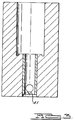
- the improvement in the spray assembly lies in the cross-section of the inlet 41 of the passageway 40, as best illustrated in FIG. 3.
- an additional shape is formed in the entrance of the passageway 40. This is preferably a 1/8" cylindrical milling formed at a 30° angle from the axis of the cylindrical passageway 40. This results in a preferred 1/4" inch elliptical shape for the affected lower portion of the inlet 41.
- the tapered portion of the inlet affects the flow characteristics of the fluid through the inlet 96, passageways 22, 40 and 20, and the control of that flow.
- the terminal end 54 of the plunger 50 As the terminal end 54 of the plunger 50 is moved from the closed position past the inlet 41, the cross section of the inlet 41 thusly uncovered determines the flow into the passageway 40.
- the cross-sectional area uncovered is more directly affected by any change in the height of the plunger.
- the length b is less than the radius r of the cylindrical passageway 40 at the tapered or elliptical portion of the inlet 41.
- the modified cross-section of the inlet provides a greater range of control at low volumes and a more linear response to the volume control (i.e. a 15° rotation of the stop member 78 generates half the volume change of a 30° rotation).
- This control system also generates repeatable control settings, wherein a given setting on the stop member 78 will hold the plunger at the same position and generate the same volume of flow each time the spray assembly is operated.
- Other cross-sections for the inlet 41 could be provided to achieve similar results.
- the modification to the cross-section will also alter the non-laminar flow characteristics and the energy flow. This appears to have a favorable effect upon the mixing of the source fluid with the carrier air flow.
- the pressurized liquid such as a lubricant or the like
- the pressurized liquid will be atomized when released into the transverse passageway 40 and then into the flow of pressurized air in the passage 22.
- Internal atomization provides uniformly spaced particles of liquid (spheres) in an air stream (fog), said particles, preferably being of uniform size. This allows the fog to be transmitted through suitable conduits for long distances while maintaining its uniformity. It also allows the fog to be sprayed into the atmosphere and travel an additional 10-15 feet and still maintain its uniformity. This results in a smooth, contour-following lubricant film coating on dies or similar objects.
- the present invention provides an improved spray assembly which is relatively inexpensive to manufacture yet provides an extremely reliable fast-acting multiple purpose valving whereby both air only or air and liquids may be rapidly applied to the working surfaces of forming apparatus such as dies and molds.
Landscapes
- Nozzles (AREA)
Applications Claiming Priority (2)
| Application Number | Priority Date | Filing Date | Title |
|---|---|---|---|
| US93889592A | 1992-08-31 | 1992-08-31 | |
| US938895 | 1997-09-26 |
Publications (2)
| Publication Number | Publication Date |
|---|---|
| EP0586111A2 true EP0586111A2 (fr) | 1994-03-09 |
| EP0586111A3 EP0586111A3 (en) | 1994-05-18 |
Family
ID=25472158
Family Applications (1)
| Application Number | Title | Priority Date | Filing Date |
|---|---|---|---|
| EP19930306295 Withdrawn EP0586111A3 (en) | 1992-08-31 | 1993-08-10 | Spray assembly construction |
Country Status (1)
| Country | Link |
|---|---|
| EP (1) | EP0586111A3 (fr) |
Family Cites Families (3)
| Publication number | Priority date | Publication date | Assignee | Title |
|---|---|---|---|---|
| DE2944670C2 (de) * | 1979-11-06 | 1982-11-25 | Industrie- und Pipeline-Service Gerhard Kopp GmbH, 4450 Lingen | Hochdruck-Absperrventil |
| US4365754A (en) * | 1980-06-19 | 1982-12-28 | Acheson Industries, Inc. | Spray assembly construction |
| US4714199A (en) * | 1986-05-09 | 1987-12-22 | Heath Allan B | Liquid atomizing nozzle for spray apparatus |
-
1993
- 1993-08-10 EP EP19930306295 patent/EP0586111A3/en not_active Withdrawn
Also Published As
| Publication number | Publication date |
|---|---|
| EP0586111A3 (en) | 1994-05-18 |
Similar Documents
| Publication | Publication Date | Title |
|---|---|---|
| US4852773A (en) | Adjustable flow applicator for a positive displacement constant flow-rate dispenser | |
| US5618001A (en) | Spray gun for aggregates | |
| EP0600202B1 (fr) | Dispositif de commande de valve | |
| US5270013A (en) | Reactive fluid mixing head | |
| US4365754A (en) | Spray assembly construction | |
| US3394888A (en) | Dispensing gun | |
| US5090814A (en) | Dispenser for reactive chemicals | |
| US4714199A (en) | Liquid atomizing nozzle for spray apparatus | |
| DE2610356A1 (de) | Pneumatisch betriebener zerstaeuber z.b. fuer schmiermittel | |
| US4821927A (en) | Liquid dispensing gun | |
| US5458275A (en) | Positive-displacement dispensing device | |
| US5253984A (en) | Apparatus for dispensing a liquid on a remote object | |
| US20030226598A1 (en) | Dispensing tool for evacuating and charging a fluid system | |
| US5350084A (en) | Mixing, metering and dispensing device | |
| US2804343A (en) | Spray and blow gun | |
| US4567912A (en) | Multiple spray nozzles | |
| GB1499201A (en) | Atomizer | |
| US4099673A (en) | Spray gun device | |
| US4650099A (en) | Liquid dispensing gun | |
| US4893738A (en) | Self-aligning positive displacement dispenser | |
| US5984652A (en) | Single-piece piston with central bore for use in a pneumatically-activated pump | |
| US6071097A (en) | Single-piece piston for use in a pneumatically-activated pump | |
| US20090108103A1 (en) | Needle Valve Assembly for Spray System | |
| US7118352B2 (en) | Hydraulic metering device | |
| US6250569B1 (en) | Adjustable spraying head |
Legal Events
| Date | Code | Title | Description |
|---|---|---|---|
| PUAI | Public reference made under article 153(3) epc to a published international application that has entered the european phase |
Free format text: ORIGINAL CODE: 0009012 |
|
| AK | Designated contracting states |
Kind code of ref document: A2 Designated state(s): CH DE FR IT LI NL |
|
| PUAL | Search report despatched |
Free format text: ORIGINAL CODE: 0009013 |
|
| AK | Designated contracting states |
Kind code of ref document: A3 Designated state(s): CH DE FR IT LI NL |
|
| 17P | Request for examination filed |
Effective date: 19940801 |
|
| STAA | Information on the status of an ep patent application or granted ep patent |
Free format text: STATUS: THE APPLICATION HAS BEEN WITHDRAWN |
|
| 18W | Application withdrawn |
Withdrawal date: 19960105 |