EP0586259B1 - System und Verfahren zum Lernen der Zeichensprache - Google Patents
System und Verfahren zum Lernen der Zeichensprache Download PDFInfo
- Publication number
- EP0586259B1 EP0586259B1 EP93306994A EP93306994A EP0586259B1 EP 0586259 B1 EP0586259 B1 EP 0586259B1 EP 93306994 A EP93306994 A EP 93306994A EP 93306994 A EP93306994 A EP 93306994A EP 0586259 B1 EP0586259 B1 EP 0586259B1
- Authority
- EP
- European Patent Office
- Prior art keywords
- language
- sign
- data
- dictionary
- spoken
- Prior art date
- Legal status (The legal status is an assumption and is not a legal conclusion. Google has not performed a legal analysis and makes no representation as to the accuracy of the status listed.)
- Expired - Lifetime
Links
- 238000000034 method Methods 0.000 title claims description 51
- 230000033001 locomotion Effects 0.000 claims description 19
- 230000014509 gene expression Effects 0.000 claims description 12
- 238000004321 preservation Methods 0.000 claims description 9
- 230000002194 synthesizing effect Effects 0.000 claims description 9
- 230000008921 facial expression Effects 0.000 description 18
- 206010011878 Deafness Diseases 0.000 description 8
- 238000013519 translation Methods 0.000 description 7
- 230000015572 biosynthetic process Effects 0.000 description 4
- 238000003786 synthesis reaction Methods 0.000 description 4
- 239000000470 constituent Substances 0.000 description 3
- 230000006870 function Effects 0.000 description 3
- 230000006854 communication Effects 0.000 description 2
- 238000004891 communication Methods 0.000 description 2
- 230000000694 effects Effects 0.000 description 2
- 230000010365 information processing Effects 0.000 description 2
- 238000012360 testing method Methods 0.000 description 2
- 238000013528 artificial neural network Methods 0.000 description 1
- 238000005452 bending Methods 0.000 description 1
- 230000007175 bidirectional communication Effects 0.000 description 1
- 238000006243 chemical reaction Methods 0.000 description 1
- 230000006835 compression Effects 0.000 description 1
- 238000007906 compression Methods 0.000 description 1
- 238000010276 construction Methods 0.000 description 1
- 238000010586 diagram Methods 0.000 description 1
- 238000006073 displacement reaction Methods 0.000 description 1
- 238000010606 normalization Methods 0.000 description 1
- 238000003909 pattern recognition Methods 0.000 description 1
- 238000012545 processing Methods 0.000 description 1
- 238000005070 sampling Methods 0.000 description 1
Images



Classifications
-
- G—PHYSICS
- G09—EDUCATION; CRYPTOGRAPHY; DISPLAY; ADVERTISING; SEALS
- G09B—EDUCATIONAL OR DEMONSTRATION APPLIANCES; APPLIANCES FOR TEACHING, OR COMMUNICATING WITH, THE BLIND, DEAF OR MUTE; MODELS; PLANETARIA; GLOBES; MAPS; DIAGRAMS
- G09B21/00—Teaching, or communicating with, the blind, deaf or mute
- G09B21/009—Teaching or communicating with deaf persons
Definitions
- the present invention relates to a sign-language learning system and method which store, search and output information used in learning of a sign-language and efficiently perform learning of the sign-language.
- a sign-language is a gesture language with an independent system which has been developed as communication means of deaf people.
- the inventors have proposed a sign-language translation system which uses a glove with a special sensor to convert motion of parts of the hands into electrical signals and translates the electrical signals into a spoken language (EP patent application serial No 93301810.3 filed 10 March 1993), and entitled "SIGN-LANGUAGE TRANSLATION SYSTEM AND METHOD").
- the inventors have proposed a continuous sign-language recognition system in which, in order to perform normalization of a pattern of a sign-language in consideration of nonlinear expansion and compression of the pattern of the sign-language, correspondence between samples for a standard pattern is obtained by means of the DP collation and an average between correspondence points is calculated to prepare a standard pattern for the sign-language (U.S. patent application serial No. 93306674.8 , filed August 23, 1993, claiming the priority based on Japanese patent applications Nos. 04-247285 and 04-235633, and entitled "SIGN RECOGNITION APPARATUS AND METHOD AND SIGN TRANSLATION SYSTEM USING SAME".
- An image recording media such as the video tapes can accurately express a series of motions but cannot make display in the form satisfying the requirement of a learner in such a way as to quickly search desired data, to change a viewpoint in various directions, to replace an operation by a reverse operation for the left-handed, and so forth.
- a sign-language learning system comprising: first input means for inputting sign data;
- a sign-language learning method comprising the steps of:
- the present invention permits an efficient sign-language learning system and method to be provided which is capable of offering data of a sign-language required by a learner (mainly hearing people) quickly, accurately and moreover, in the form satisfying the requirement of an individual learner.
- the present invention also permits a sign-language learning system and method to be provided which has high extensibility which enables an individual learner to easily add and register data by himself.
- the means for outputting the sign-language data in accordance with the requirement of the learner can produce a laterally inverted object when the motion of the sign-language is displayed.
- the speed of outputting the motion of the sign-language can be also changed.
- the searched result can be converted into the sign-language of the designated kind and then outputted.
- a function of examining whether the learner can understood or not can be also provided.
- the sign-language learning system of the present invention can preserve the sign-language data, can search the sign-language data desired to be referred to by comparison with entry words or contents of the spoken language, can change a viewpoint according to a learner's requirement, can change personnel, can change the direction for right-handed people to the direction for left-handed people and vice versa, can add facial expression, and can change a display speed. Accordingly, the learner can know quickly and correctly the desired data.
- the sign-language data can be divided into morphemes and words to be preserved in the morpheme dictionary for the sign-language and the word dictionary for the spoken language, so that a registration procedure can be carried out easily and a storage space can be utilized efficiently. Since the sign-language data are divided into a common dictionary and an individual dictionary and are thus preserved, the system can be easily adapted to characteristics of each user. Furthermore, when the learning system includes input/output means by speech, learning efficiency and effects can be improved.
- Fig. 1 is a system structural diagram showing an embodiment of the present invention.
- Numeral 1 denotes a sign-language dictionary for storing sign-language data
- 2 dictionary search unit for searching sign-language data from the sign-language dictionary 1
- 3 dictionary registration unit for registering the sign-language data in the sign-language dictionary 1
- 4 a character input device such as a keyboard, 5 a speech input device for inputting data by speech recognition, 6a sign-language input device for inputting the sign-language data (as time sequential data), 7 a facial expression input device for recognizing the facial expression and inputting it, 8 a display output device for displaying the input and results of the search and registration, and 9 a speech output device for outputting the input and results of the search and registration by speech synthesis.
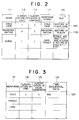
- Fig. 2 is a table showing the structure of a word dictionary 11 for the spoken language as one of the constituent elements of the sign-language dictionary 1 and its definite example.
- Numeral 111 denotes an entry of the word of the spoken language, 112 a classification expressing the kind of fields in which the word is used, 113 a classification of language expressing to which kind of sign-language of which country the sign-language data corresponding to the word of the spoken language belongs, 114 a morpheme string indicative of combined expression of the word of the spoken language and the morphemes of the sign-language, and 115 a text for storing auxiliary data such as etymology of the sign-language, remarks and so forth.
- Fig. 3 is a table representing the structure of the morpheme dictionary 12 of the sign-language as one of the constituent elements of the sign-language dictionary 1 and its definite example.
- Numeral 121 denotes an entry of the morpheme constituting a minimum constituent unit of the sign-language, 122 a classification of kinds expressing the features of time sequential data of the motion of the hands of the sign-language constituting the sign-language data, 123 a classification of facial expression for classifying the feature of the facial expressions when the operation of the sign-language is made, and 124 time sequential data of the motion of the hands of the sign-language constituting the sign-language data.
- the two dictionaries are provided, while three dictionaries including the word dictionary of the spoken language, the word dictionary of the sign-language (morpheme dictionary) and a dictionary indicative of the correspondence between both the dictionaries for the spoken language and the sign-language may be provided.
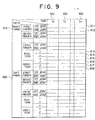
- Fig. 9 is a table showing in detail the data structure of the sign-language data (time sequential data) inputted from the sign-language input device 6. It is a table for storing the history of the data 610 relating to the condition of the right hand and of the data 620 relating to the condition of the left hand at every predetermined time interval.
- the sign-language data input device 6 includes a sensor 61 for measuring the bending state of each finger of the hands, and the positions and directions of the hands, and an interface 62 for converting them to electric signals, and such an input device 6 is well known.
- Reference numerals 601, 602 and 603 denote the storage positions of the right hand data 610 and the left hand data 620 at the sampling time T0, T1 and Tn, respectively.
- Reference numeral 611 denotes data expressing the angle of the first joint of the first finger of the right hand, 612 data expressing the angle of the second joint of the first finger of the right hand; 613 data expressing the position of the x coordinates of the right hand, 614 data expressing the position of the y coordinates of the right hand, 615 data expressing the position of the z coordinates of the right hand, 616 data expressing the angle of the direction of the right hand to the x axis, 617 data expressing the angle of the direction of the right hand to the y axis, and 618 data expressing the angle of the direction of the right hand to the z axis.
- Fig. 7 shows a definite example of the screen displayed on the display 83 of the display output device 8 during the search.
- Reference numerals 701 to 721 denote input/output areas for displaying the data of the instructions or result of the search;
- 701 is an input/output area of the classification of languages 113;
- 702 is an input/output area of classification of fields 112;
- 703 is an input/output area of words 111 of the spoken language;
- 704 is an input/output area of morpheme string 114 of the sign-language;
- 705 is an input/output area for designating which of the character input device 4, the speech input device 5 and the sign-language input device 6 should be used as the input device for search;
- 706 is an input/output area for designating whether a word having whole matching should be searched or a word containing a designated morpheme at a part thereof should be searched, as the condition of the search;
- Reference numerals 712 to 721 denote input/output areas for controlling the display method of the inputted image data, wherein reference numeral 712 denotes an input/output area for displaying the controlling the position, with time, of a presently displayed point with respect to the length of the data to be displayed; 713 is an input/output area for designating the start of display; 714 is an input/output area for designating the stop of display; 715 is an input/output area for designating repetition of display; 716 is an input/output area for designating retardation of a display speed; 717 is an input/output area for designating and switching whether a front view or a back view should be displayed of a person performing the sign-language motion when the sign-language operation is displayed; 718 is an input/output area for designating the change of height of the viewpoint in a vertical direction when the sign-language motion is displayed; 719 is an input/output area for designating similarly the change in a lateral direction; 720 is an input/output area
- Fig. 4 is a flow chart showing the operation of the search control part 21 of the embodiment. The operation is started when the search is designated in the input/output area 707.
- step 2101. An input method of the input/output area 705 is judged in step 2101. If it is the speech input, the flow proceeds to step 2102 and if it is the character input, the flow proceeds to step 2103. If it is the sign-language input, the flow proceeds to step 2104.
- the data necessary for the search is inputted from the speech input device 5 through speech recognition in step 2102, and is set to the input/output areas 703 and 704.
- a default value is set to the input/output areas 701 and 702, but it is reset when a user instructs re-writing.
- step 2103 the data necessary for the search (entry words or contents of the spoken language relative to the sign-language) is similarly inputted from the character input device 4, and is set to the input/output areas 703 and 704.
- step 2104 the time sequential data constituting the sign-language data is inputted from the sign-language input device 6 if necessary. This operation is generally used when the learner performs the sign-language actually to learn it after a sample relative to the sign-language has been displayed in the display output device 8 or the like.
- step 2105 the time sequential data is classified into patterns using a classifier 23 of the dictionary search unit 2 to obtain the classification of kinds.
- a classifier 23 of the dictionary search unit 2 it is possible to employ various other methods such as a method using statistical means and a method using a neural network. Accordingly, the present invention is not limited by a specific pattern classification method.
- step 2106 the classification of kinds 122 of the morpheme dictionary 12 of the sign-language dictionary 1 is compared by the comparator 22 of the dictionary search unit 2 using the classification of kinds obtained in step 2105 as a key so as to search the morpheme 121 falling within the same classification of kinds.
- the morpheme thus searched is set to the input/ output areas 703 and 704.
- step 2107 the search condition of the input/output area 706 is judged, and the flow proceeds to step 2108 in the case of whole matching and to step 2109 in the case of partial matching.
- step 2108 the words 111 of the word dictionary 11 of the sign-language dictionary 1 are compared by the comparator 22 of the dictionary search unit 2 using the word of the input/output area 703 as the key so as to find out the word having the same entry.
- the message of the result of this search is set to the output area 709.
- step 2109 the morpheme strings 114 of the word dictionary 11 of the sign-language dictionary 1 are compared by the comparator 22 of the dictionary search unit 2 using each morpheme of the input/output area 704 as the key so as to find out the word containing the morpheme of the input/output area 704 at its part.
- the message of the result of this search is set to the output area 709.
- the speech data from the speech input device 5, the text data from the character input device 4 or the sign-language data from the sign-language input device 6 is inputted in the unit of "word” and is compared with the contents of the word dictionary 11 of the sign-language dictionary 1 to take out the corresponding sign-language data (morpheme data) from the morpheme dictionary 12 and output it, so that learning of the sign-language is performed.
- the learning of the sign-language is not limited to the unit of "word” and it can be made in the unit of "sentence".
- sign-language specifically, Japanese sign-language
- sign-languages there are three kinds of sign-languages including (1) the "traditional sign-language” which has been traditionally used by deaf people, (2) the “simultaneous sign-language” in which the meaning of the word of the sign-language is coincident with the Japanese language, and (3) the "intermediate type sign-language” in which the words are arranged in the same order as that of the spoken language and attached words such as post-positional words are omitted.
- the mainstream of the sign-language in English is the "traditional sign-language” and the ASL (American Sign Language) is mainly used.
- the display control part 81 of the display output device 8 is activated, and the display process shown in Fig. 6 is started.
- this display process will be explained with reference to Fig. 6.
- step 8101 parameters for image synthesis such as selection of front/back view, designation of a person and selection of right-/left-hander are prepared in accordance with the contents of the input/output areas 717 to 721 which control the display method of the image data.
- step 8102 the input/output area 713 is monitored, and the designation of the start is awaited.
- the flow proceeds to step 8103.
- step 8103 the word entry searched of the input/output area 703 and the data of the text of the output area 710 are sent to the speech output device 9 and the speech is outputted.
- the speech "child care” and the speech "gesture of child care” are outputted (in this case, the text data 1101 of the word dictionary 11 is used).
- the data of the first morpheme in the input/output area 704 is taken out from the morpheme dictionary 12.
- the entry 121 of the data relative to the morpheme is sent to the speech output device 9 and the speech is outputted.
- the speech "child” is outputted.
- step 8104 the image of the sign-language of one frame is generated by the image synthesis part 82 in accordance with the parameters prepared in step 8101 from the classification of facial expression 123 of the data relative to the morpheme and the time sequential data 124 constituting the sign-language data, and the image is displayed and outputted to the output area 711.
- a method which has already been known well in the field of computer graphics is used for the processing in the image synthesis part 82 of the display output device 8.
- IPSJ Information Processing Society in Japan
- Vol. 90, No. 66 90-CG-46
- 46-6 September 17 to 18, 1990
- pp. 37 - 42 describes the generation of the shapes of the hands of the sign-language.
- models of the hands are defined by a frame which combines neighboring joints and by a polyhedron which accompanies a frame, and the shape of the hand corresponding to the change of the angle of joints can be generated by causing the polyhedron, which accompanies each frame, to follow up the motion of the frame.
- a more realistic shape can be generated by executing the process which controls the connection planes of the polyhedron and the interval of the connection planes in accordance with the moving process of the hand.
- the image of the sign-language can be generated by combining the body components generated in the way described above.
- step 8105 the input/output area 714 is examined. If the stop is designated, the flow proceeds to step 8106 and stops there temporarily, and if the stop is not designated, the flow proceeds immediately to step 8107.
- step 8106 the input/output area 713 is monitored, and the designation of re-start is awaited.
- step 8107 whether or not all the time sequential data 124 of the morpheme data have been outputted is judged. If any data remains, the flow proceeds to step 8108, and if no data remains, the flow proceeds to step 8110.
- step 8108 the input/output area 716 is examined to judge whether or not the slow display is designated. If the slow display is designated, the flow spends a predetermined time in step 8109 and then proceeds to the display operation of the frame of the next screen. If the display is not the slow display but is the display of the ordinary speed, the flow proceeds immediately to the display operation of the next frame.
- step 8110 whether or not all the morphemes in the input/output area 704 have been outputted is judged. If this output operation is not completed, the flow proceeds to step 8111 and if it is completed, the flow proceeds to step 8112.
- step 8111 the data relative to the next morpheme in the input/output area 704 is taken out from the morpheme dictionary 12.
- step 8111 the entry 121 of the data of the morpheme is sent to the speech output device 9 and the speech output is made.
- step 8104 the output of the data of the morpheme is started.
- step 8112 the input/output area 715 is examined to judge whether or not the repeated display is designated. If the repeated display is designated, the flow returns to step 8103. If it is not, the display process is completed.
- Fig. 8 shows a definite example of the screen displayed on the display 83 of the display output device 8 at the time of registration.
- Reference numerals 801 to 821 denote input/output areas for displaying data of designation or result of the registration, wherein reference numeral 801 is an input/output area of the classification of languages 113; 802 is an input/output area of the classification of fields 112; 803 is an input/output area of the words 111; 804 is an input/output area of the morpheme strings 114; 805 is an input/output area for designating the dictionary as the object of registration; 806 is an input/output area of the classification of facial expressions 123 to be registered; 807 is an input/output area for expressing the designation of the search process; 808 is an input/output area for expressing the designation of the register process; 809 is an output area for expressing the report of the registration result; 810 is an input/output area for expressing the text 115; 811 is an output area for
- Fig. 5 shows the operation of the registration control part 31 of the dictionary registration unit 3 in the embodiment. The operation is activated when the search is designated in the input/output area 807.
- step 3101 whether the registration is the registration of only the morpheme dictionary 12 in the sign-language dictionary 1 or the registration of both the word dictionary 11 and the morpheme dictionary 12 in the sign-language dictionary 1 is judged from the input/output area 805. If it is the registration of only the morpheme dictionary 12, the registration of the word dictionary 11 is skipped, and the flow proceeds to step 3105.
- step 3102 the data to be registered to the word dictionary 11 of the sign-language dictionary 1, that is, the input/output areas 801 to 804 and 810, are inputted from the character input device 4, the new entry words 11 are generated in the word dictionary 11, and the classification of the fields 112, the classification of languages 113, the morpheme strings 114 and the text 115 are stored.
- step 3103 whether or not all the morphemes designated by the input/output area 804 exist in the morpheme dictionary 12 of the sign-language dictionary 1 is examined by the comparator 32. If all of them exist, the registration process is completed and if not, the flow proceeds to step 3105 and the registration to the morpheme dictionary 12 is carried out.
- step 3105 the motion of the hands for the non-registered morphemes is inputted to the morpheme dictionary 12 of the sign-language dictionary 1 by the sign-language input device 6, and is stored as the sign-language data (time sequential data) 124.
- step 3106 the classification of kinds 122 of the sign-language data (time sequential data) 124 of the morpheme is determined by the classifier 33 of the dictionary registration unit 3 and is stored in the morpheme dictionary 12 of the sign-language dictionary 1.
- the operation of this classifier 33 is the same as that of the classifier 23 of the dictionary search means 2 described already.
- step 3107 the facial expression inputted from the camera 71 of the facial expression input device 7 is recognized by the facial expression recognition part 72, and the result is stored in the classification of facial expression 123 of the morpheme dictionary 12 of the sign-language dictionary 1.
- the sign-language learning system can be also configured as a system which performs only the search process by storing the previously registered sign-language dictionary within the system or externally.
- the embodiment makes it possible to search, register and display the sign-language data.
- the embodiment uses the sensor 61 for the sign-language input device 6, the data can be inputted from the image using a camera.
- the sign-language dictionary 1 may includes a basic dictionary used in common by learners and an individual dictionary specific to each learner.
- the words for the classification of the fields designated by the input/output area 702 can be searched and displayed at random by performing searching without designating the input/output areas 703 and 704.
- the display in the input/output areas 703 and 704 can be retarded by a predetermined time by designating "?" to the input/output areas 703 and 704.
- a device such as a printer capable of producing a hard copy and a device such as a VTR capable of recording pictures and sound can be also connected.
- the present invention it is possible to acquire quickly and accurately the data of sign-language desired by a learner and moreover, in the form matching the requirement of individual learner. At the same time, since the individual learners can easily make additional registration, the effect of learning can be improved remarkably.
Landscapes
- Engineering & Computer Science (AREA)
- Educational Administration (AREA)
- General Health & Medical Sciences (AREA)
- Business, Economics & Management (AREA)
- Physics & Mathematics (AREA)
- Audiology, Speech & Language Pathology (AREA)
- Health & Medical Sciences (AREA)
- Educational Technology (AREA)
- General Physics & Mathematics (AREA)
- Theoretical Computer Science (AREA)
- Machine Translation (AREA)
- Electrically Operated Instructional Devices (AREA)
- Management, Administration, Business Operations System, And Electronic Commerce (AREA)
Claims (13)
- Zeichensprachen-Lernsystem, umfassend:dadurch gekennzeichnet, daß:erste Eingabeeinrichtungen (6) zum Eingeben von Zeichendaten;Speichereinrichtungen (1) zum Speichern von Zeichensprachendaten für jedes Morphem, das eine Minimumseinheit einer Zeichensprache in einem ersten Wörterbuch (12) aufbewahrt;Registriereinrichtungen (3) zum Registrieren der Zeichensprachendaten, die von den ersten Eingabeeinrichtungen in die Speichereinrichtungen eingegeben werden;zweite Eingabeeinrichtungen (5, 6) zum Eingeben von Wortdaten der gesprochenen Sprache durch Schriftzeichen oder Gesprochenes;wobei das System weiter einschließt:die Speichereinrichtungen zum Speichern von Wortdaten einer gesprochenen Sprache und von Informationen ausgelegt sind, die für den kombinierten Ausdruck von Wörtern der gesprochenen Sprache und Morphemen der Zeichensprache in einem zweiten Wörterbuch (11) kennzeichnend sind; undSucheinrichtungen (2) zum Vergleichen der von den zweiten Eingabeeinrichtungen eingegebenen Wortdaten der gesprochenen Sprache mit den Wortdaten der gesprochenen Sprache, die in dem zweiten Wörterbuch aufbewahrt werden, und im Falle, daß die Wortdaten der gesprochenen Sprache den durch die zweiten Eingabeeinrichtungen eingegebenen entsprechen, Entnehmen relevanter Daten aus den Zeichensprachendaten für jedes in dem ersten Wörterbuch gespeicherte Morphem auf der Basis der Informationen, die für den kombinierten Ausdruck der Morpheme der Zeichensprache in dem zweiten Wörterbuch kennzeichnend sind; undEinrichtungen (8) zum Synthetisieren und Ausgeben eines Zeichensprachenbildes aus den Zeichensprachendaten, die von den Sucheinrichtungen entnommen worden sind.
- Zeichensprachen-Lernsystem nach Anspruch 1, bei dem das zweite Wörterbuch Informationen speichert, die für das Lernen der Zeichensprache gemäß jeden Feldes der Wörter der von einem Lernenden gesprochenen Sprache verwendet werden.
- Zeichensprachen-Lernsystem nach Anspruch 1, bei dem das erste Wörterbuch Zeichensprachendaten gemäß jeden Feldes von Morphemen gespeichert wird, das von einem Lernenden klassifiziert worden ist.
- Zeichensprachen-Lernsystem nach Anspruch 1, bei dem die Speichereinrichtungen Speichermittel, die Benutzern geläufig sind, und Speichermittel für jeden individuellen Benutzer einschließen.
- Zeichensprachen-Lernsystem nach Anspruch 1, bei dem die Suchmittel ein relevantes Zeichensprachendatum unter der Bedingung suchen, daß das Zeichensprachendatum mit den Morphemen der Zeichensprache koinzidiert, die den Gesamtbestand der Wortdaten der gesprochenen Sprache oder einen Teil der Wortdaten der gesprochenen Sprache bilden.
- Zeichensprachen-Lernsystem nach Anspruch 1, bei dem die Synthetisier- und Ausgabeeinrichtungen so ausgelegt sind, daß sie eine Bewegung der Zeichensprache gemäß der Blickrichtung, die für den Lernenden einer Zeichensprache erforderlich ist, ausgeben.
- Zeichensprachen-Lernsystem nach Anspruch 1, bei dem die Synthetisier- und Ausgabeeinrichtungen so ausgelegt sind, daß die Bewegungsgeschwindigkeit der Zeichensprache gemäß der Anforderung eines Lernenden geändert wird.
- Zeichensprachen-Lernsystem nach Anspruch 1, bei dem die Synthetisier- und Ausgabeeinrichtungen so ausgelegt sind, daß ein seiteninvertiertes Objekt beim Zeichensprachenvorgang gemäß der Anforderung eines Lernenden erzeugt wird.
- Zeichensprachen-Lernsystem nach Anspruch 1, bei dem die Synthetisier- und Ausgabeeinrichtungen so ausgelegt sind, daß die Zeichensprache in einer von einem Lernenden benötigten Sprache ausgegeben wird.
- Zeichensprachen-Lernsystem nach Anspruch 1, bei dem die Synthetisier- und Ausgabeeinrichtungen so ausgelegt sind, daß die Ausgabe des Bildes um eine vorbestimmte Zeitdauer gemäß der Anforderung eines Lernenden verzögert wird.
- Zeichensprachen-Lernsystem nach Anspruch 1, bei dem die Ausgabeeinrichtungen etymologische Angaben gemäß der Anforderung eines Lernenden ausgeben.
- Zeichensprachen-Lernsystem nach Anspruch 1, bei dem die ersten Eingabeeinrichtungen zum Eingeben der Zeichensprachendaten benutzt werden, um es einem Lernenden zu ermöglichen, eine Überprüfung vorzunehmen.
- Zeichensprachen-Lernverfahren, das folgende Schritte aufweist:gekennzeichnet durch:Eingeben erster Zeichensprachendaten zur Zeit der Registrierung;Speichern der Zeichensprachendaten für jedes Morphem, das eine Minimumseinheit einer Zeichensprache bildet, in einem ersten Wörterbuch (12);Registrieren der ersten eingegebenen Zeichensprachendaten; undEingeben der Wortdaten der gesprochenen Sprache durch Schriftzeichen oder Gesprochenes;wobei das Verfahren weiter einschließt:Speichern der Wortdaten einer gesprochenen Sprache und der Informationen, die für kombinierte Ausdrücke der Wörter der gesprochenen Sprache und der Morpheme der Zeichensprache kennzeichnend sind, in einem zweiten Wörterbuch (11);Vergleichen der eingegebenen Wortdaten der gesprochenen Sprache mit den Wortdaten der gesprochenen Daten, die im zweiten Wörterbuch gespeichert sind, und falls die Wortdaten der gesprochenen Sprache mit den eingegebenen Wortdaten übereinstimmen, Entnehmen der relevanten Daten unter den Zeichensprachendaten für jedes Morphem, das in dem ersten Wörterbuch gespeichert ist, basierend auf den Informationen, die für den kombinierten Ausdruck der Morpheme der Zeichensprache in dem zweiten Wörterbuch kennzeichnend sind; undSynthetisieren und Ausgeben eines Zeichensprachenbildes aus den entnommenen Zeichensprachendaten.
Applications Claiming Priority (3)
| Application Number | Priority Date | Filing Date | Title |
|---|---|---|---|
| JP235627/92 | 1992-09-03 | ||
| JP23562792A JP3435175B2 (ja) | 1992-09-03 | 1992-09-03 | 手話学習装置 |
| JP23562792 | 1992-09-03 |
Publications (3)
| Publication Number | Publication Date |
|---|---|
| EP0586259A2 EP0586259A2 (de) | 1994-03-09 |
| EP0586259A3 EP0586259A3 (en) | 1996-04-10 |
| EP0586259B1 true EP0586259B1 (de) | 1999-07-14 |
Family
ID=16988817
Family Applications (1)
| Application Number | Title | Priority Date | Filing Date |
|---|---|---|---|
| EP93306994A Expired - Lifetime EP0586259B1 (de) | 1992-09-03 | 1993-09-03 | System und Verfahren zum Lernen der Zeichensprache |
Country Status (4)
| Country | Link |
|---|---|
| US (1) | US5544050A (de) |
| EP (1) | EP0586259B1 (de) |
| JP (1) | JP3435175B2 (de) |
| DE (1) | DE69325620T2 (de) |
Families Citing this family (89)
| Publication number | Priority date | Publication date | Assignee | Title |
|---|---|---|---|---|
| US5887069A (en) * | 1992-03-10 | 1999-03-23 | Hitachi, Ltd. | Sign recognition apparatus and method and sign translation system using same |
| JP3338992B2 (ja) * | 1992-10-29 | 2002-10-28 | 株式会社日立製作所 | 手話/単語変換システム |
| US5659764A (en) * | 1993-02-25 | 1997-08-19 | Hitachi, Ltd. | Sign language generation apparatus and sign language translation apparatus |
| US5734923A (en) * | 1993-09-22 | 1998-03-31 | Hitachi, Ltd. | Apparatus for interactively editing and outputting sign language information using graphical user interface |
| JPH07168851A (ja) * | 1993-12-16 | 1995-07-04 | Canon Inc | 画像表示方法及び装置 |
| US5777614A (en) * | 1994-10-14 | 1998-07-07 | Hitachi, Ltd. | Editing support system including an interactive interface |
| JPH08115408A (ja) * | 1994-10-19 | 1996-05-07 | Hitachi Ltd | 手話認識装置 |
| US5982853A (en) | 1995-03-01 | 1999-11-09 | Liebermann; Raanan | Telephone for the deaf and method of using same |
| US5689585A (en) * | 1995-04-28 | 1997-11-18 | Xerox Corporation | Method for aligning a text image to a transcription of the image |
| JPH08315185A (ja) * | 1995-05-18 | 1996-11-29 | Hitachi Ltd | 手話編集装置 |
| US5890120A (en) * | 1997-05-20 | 1999-03-30 | At&T Corp | Matching, synchronization, and superposition on orginal speaking subject images of modified signs from sign language database corresponding to recognized speech segments |
| US6116907A (en) * | 1998-01-13 | 2000-09-12 | Sorenson Vision, Inc. | System and method for encoding and retrieving visual signals |
| WO1999046762A1 (en) * | 1998-03-09 | 1999-09-16 | Kelvin Lp | Automatic speech translator |
| US6950534B2 (en) * | 1998-08-10 | 2005-09-27 | Cybernet Systems Corporation | Gesture-controlled interfaces for self-service machines and other applications |
| US7036094B1 (en) | 1998-08-10 | 2006-04-25 | Cybernet Systems Corporation | Behavior recognition system |
| US20010008561A1 (en) * | 1999-08-10 | 2001-07-19 | Paul George V. | Real-time object tracking system |
| US6681031B2 (en) | 1998-08-10 | 2004-01-20 | Cybernet Systems Corporation | Gesture-controlled interfaces for self-service machines and other applications |
| US6594632B1 (en) | 1998-11-02 | 2003-07-15 | Ncr Corporation | Methods and apparatus for hands-free operation of a voice recognition system |
| AU2571900A (en) * | 1999-02-16 | 2000-09-04 | Yugen Kaisha Gm&M | Speech converting device and method |
| US7286984B1 (en) | 1999-11-05 | 2007-10-23 | At&T Corp. | Method and system for automatically detecting morphemes in a task classification system using lattices |
| US8392188B1 (en) | 1999-11-05 | 2013-03-05 | At&T Intellectual Property Ii, L.P. | Method and system for building a phonotactic model for domain independent speech recognition |
| US7085720B1 (en) * | 1999-11-05 | 2006-08-01 | At & T Corp. | Method for task classification using morphemes |
| US20030191625A1 (en) * | 1999-11-05 | 2003-10-09 | Gorin Allen Louis | Method and system for creating a named entity language model |
| US6377925B1 (en) | 1999-12-16 | 2002-04-23 | Interactive Solutions, Inc. | Electronic translator for assisting communications |
| JP3662519B2 (ja) * | 2000-07-13 | 2005-06-22 | シャープ株式会社 | 光ピックアップ |
| US20020111791A1 (en) * | 2001-02-15 | 2002-08-15 | Sony Corporation And Sony Electronics Inc. | Method and apparatus for communicating with people who speak a foreign language |
| JP3906729B2 (ja) * | 2002-04-05 | 2007-04-18 | 株式会社日立製作所 | 手話教育用システム及び該システムを実現するためのプログラム |
| US20040012643A1 (en) * | 2002-07-18 | 2004-01-22 | August Katherine G. | Systems and methods for visually communicating the meaning of information to the hearing impaired |
| US7277858B1 (en) * | 2002-12-20 | 2007-10-02 | Sprint Spectrum L.P. | Client/server rendering of network transcoded sign language content |
| CN100343894C (zh) * | 2004-03-15 | 2007-10-17 | 财团法人信谊基金会 | 语音学习系统和方法 |
| CN100592749C (zh) * | 2004-05-12 | 2010-02-24 | 吉峰贵司 | 会话支持系统与会话支持方法 |
| US20060134585A1 (en) * | 2004-09-01 | 2006-06-22 | Nicoletta Adamo-Villani | Interactive animation system for sign language |
| US20080195373A1 (en) * | 2007-02-13 | 2008-08-14 | Barbara Ander | Digital Sign Language Translator |
| US8566077B2 (en) * | 2007-02-13 | 2013-10-22 | Barbara Ander | Sign language translator |
| US20080249412A1 (en) * | 2007-04-02 | 2008-10-09 | Doheny Eye Institute | Preoperative and Intra-Operative Lens Hardness Measurement by Ultrasound |
| US9282377B2 (en) | 2007-05-31 | 2016-03-08 | iCommunicator LLC | Apparatuses, methods and systems to provide translations of information into sign language or other formats |
| US8566075B1 (en) * | 2007-05-31 | 2013-10-22 | PPR Direct | Apparatuses, methods and systems for a text-to-sign language translation platform |
| US8303309B2 (en) | 2007-07-13 | 2012-11-06 | Measured Progress, Inc. | Integrated interoperable tools system and method for test delivery |
| US8280732B2 (en) * | 2008-03-27 | 2012-10-02 | Wolfgang Richter | System and method for multidimensional gesture analysis |
| US20100142683A1 (en) * | 2008-12-09 | 2010-06-10 | Stuart Owen Goldman | Method and apparatus for providing video relay service assisted calls with reduced bandwidth |
| US9417700B2 (en) | 2009-05-21 | 2016-08-16 | Edge3 Technologies | Gesture recognition systems and related methods |
| US20100316978A1 (en) * | 2009-06-09 | 2010-12-16 | James David Goode | Mobile, wireless, hands-free visual/verbal trans-language communication system (acronym:V2V XLC System) |
| US8396252B2 (en) | 2010-05-20 | 2013-03-12 | Edge 3 Technologies | Systems and related methods for three dimensional gesture recognition in vehicles |
| WO2012030872A1 (en) | 2010-09-02 | 2012-03-08 | Edge3 Technologies Inc. | Method and apparatus for confusion learning |
| US8582866B2 (en) | 2011-02-10 | 2013-11-12 | Edge 3 Technologies, Inc. | Method and apparatus for disparity computation in stereo images |
| US8666144B2 (en) | 2010-09-02 | 2014-03-04 | Edge 3 Technologies, Inc. | Method and apparatus for determining disparity of texture |
| US8655093B2 (en) | 2010-09-02 | 2014-02-18 | Edge 3 Technologies, Inc. | Method and apparatus for performing segmentation of an image |
| US9015093B1 (en) | 2010-10-26 | 2015-04-21 | Michael Lamport Commons | Intelligent control with hierarchical stacked neural networks |
| US8775341B1 (en) | 2010-10-26 | 2014-07-08 | Michael Lamport Commons | Intelligent control with hierarchical stacked neural networks |
| US8970589B2 (en) | 2011-02-10 | 2015-03-03 | Edge 3 Technologies, Inc. | Near-touch interaction with a stereo camera grid structured tessellations |
| US20130106683A1 (en) * | 2011-10-31 | 2013-05-02 | Elwha LLC, a limited liability company of the State of Delaware | Context-sensitive query enrichment |
| US9569439B2 (en) | 2011-10-31 | 2017-02-14 | Elwha Llc | Context-sensitive query enrichment |
| US8793118B2 (en) | 2011-11-01 | 2014-07-29 | PES School of Engineering | Adaptive multimodal communication assist system |
| US9672609B1 (en) | 2011-11-11 | 2017-06-06 | Edge 3 Technologies, Inc. | Method and apparatus for improved depth-map estimation |
| US10721448B2 (en) | 2013-03-15 | 2020-07-21 | Edge 3 Technologies, Inc. | Method and apparatus for adaptive exposure bracketing, segmentation and scene organization |
| US9915545B2 (en) | 2014-01-14 | 2018-03-13 | Toyota Motor Engineering & Manufacturing North America, Inc. | Smart necklace with stereo vision and onboard processing |
| US9578307B2 (en) | 2014-01-14 | 2017-02-21 | Toyota Motor Engineering & Manufacturing North America, Inc. | Smart necklace with stereo vision and onboard processing |
| US9629774B2 (en) | 2014-01-14 | 2017-04-25 | Toyota Motor Engineering & Manufacturing North America, Inc. | Smart necklace with stereo vision and onboard processing |
| US10024679B2 (en) | 2014-01-14 | 2018-07-17 | Toyota Motor Engineering & Manufacturing North America, Inc. | Smart necklace with stereo vision and onboard processing |
| US10248856B2 (en) | 2014-01-14 | 2019-04-02 | Toyota Motor Engineering & Manufacturing North America, Inc. | Smart necklace with stereo vision and onboard processing |
| US10360907B2 (en) | 2014-01-14 | 2019-07-23 | Toyota Motor Engineering & Manufacturing North America, Inc. | Smart necklace with stereo vision and onboard processing |
| CN106233283A (zh) | 2014-04-15 | 2016-12-14 | 奥林巴斯株式会社 | 图像处理装置、通信系统以及通信方法和摄像装置 |
| US10024667B2 (en) | 2014-08-01 | 2018-07-17 | Toyota Motor Engineering & Manufacturing North America, Inc. | Wearable earpiece for providing social and environmental awareness |
| US9922236B2 (en) | 2014-09-17 | 2018-03-20 | Toyota Motor Engineering & Manufacturing North America, Inc. | Wearable eyeglasses for providing social and environmental awareness |
| US10024678B2 (en) | 2014-09-17 | 2018-07-17 | Toyota Motor Engineering & Manufacturing North America, Inc. | Wearable clip for providing social and environmental awareness |
| US9576460B2 (en) | 2015-01-21 | 2017-02-21 | Toyota Motor Engineering & Manufacturing North America, Inc. | Wearable smart device for hazard detection and warning based on image and audio data |
| US10490102B2 (en) | 2015-02-10 | 2019-11-26 | Toyota Motor Engineering & Manufacturing North America, Inc. | System and method for braille assistance |
| US9586318B2 (en) | 2015-02-27 | 2017-03-07 | Toyota Motor Engineering & Manufacturing North America, Inc. | Modular robot with smart device |
| US9677901B2 (en) | 2015-03-10 | 2017-06-13 | Toyota Motor Engineering & Manufacturing North America, Inc. | System and method for providing navigation instructions at optimal times |
| US9811752B2 (en) | 2015-03-10 | 2017-11-07 | Toyota Motor Engineering & Manufacturing North America, Inc. | Wearable smart device and method for redundant object identification |
| US9972216B2 (en) | 2015-03-20 | 2018-05-15 | Toyota Motor Engineering & Manufacturing North America, Inc. | System and method for storing and playback of information for blind users |
| US10395555B2 (en) * | 2015-03-30 | 2019-08-27 | Toyota Motor Engineering & Manufacturing North America, Inc. | System and method for providing optimal braille output based on spoken and sign language |
| US9898039B2 (en) | 2015-08-03 | 2018-02-20 | Toyota Motor Engineering & Manufacturing North America, Inc. | Modular smart necklace |
| GR1008903B (el) * | 2015-12-31 | 2016-12-05 | ΑΘΗΝΑ-ΕΡΕΥΝΗΤΙΚΟ ΚΕΝΤΡΟ ΚΑΙΝΟΤΟΜΙΑΣ ΣΤΙΣ ΤΕΧΝΟΛΟΓΙΕΣ ΤΗΣ ΠΛΗΡΟΦΟΡΙΑΣ, ΤΩΝ ΕΠΙΚΟΙΝΩΝΙΩΝ ΚΑΙ ΤΗΣ ΓΝΩΣΗΣ με δ.τ. "ΑΘΗΝΑ" | Μεθοδολογια δυναμικης επικοινωνιας σε νοηματικη γλωσσα |
| US10024680B2 (en) | 2016-03-11 | 2018-07-17 | Toyota Motor Engineering & Manufacturing North America, Inc. | Step based guidance system |
| US9958275B2 (en) | 2016-05-31 | 2018-05-01 | Toyota Motor Engineering & Manufacturing North America, Inc. | System and method for wearable smart device communications |
| US10561519B2 (en) | 2016-07-20 | 2020-02-18 | Toyota Motor Engineering & Manufacturing North America, Inc. | Wearable computing device having a curved back to reduce pressure on vertebrae |
| US10432851B2 (en) | 2016-10-28 | 2019-10-01 | Toyota Motor Engineering & Manufacturing North America, Inc. | Wearable computing device for detecting photography |
| US10012505B2 (en) | 2016-11-11 | 2018-07-03 | Toyota Motor Engineering & Manufacturing North America, Inc. | Wearable system for providing walking directions |
| US10521669B2 (en) | 2016-11-14 | 2019-12-31 | Toyota Motor Engineering & Manufacturing North America, Inc. | System and method for providing guidance or feedback to a user |
| US10172760B2 (en) | 2017-01-19 | 2019-01-08 | Jennifer Hendrix | Responsive route guidance and identification system |
| US10902743B2 (en) * | 2017-04-14 | 2021-01-26 | Arizona Board Of Regents On Behalf Of Arizona State University | Gesture recognition and communication |
| US10304208B1 (en) | 2018-02-12 | 2019-05-28 | Avodah Labs, Inc. | Automated gesture identification using neural networks |
| WO2019157344A1 (en) | 2018-02-12 | 2019-08-15 | Avodah Labs, Inc. | Real-time gesture recognition method and apparatus |
| US10346198B1 (en) | 2018-02-12 | 2019-07-09 | Avodah Labs, Inc. | Data processing architecture for improved data flow |
| US10489639B2 (en) | 2018-02-12 | 2019-11-26 | Avodah Labs, Inc. | Automated sign language translation and communication using multiple input and output modalities |
| US10289903B1 (en) * | 2018-02-12 | 2019-05-14 | Avodah Labs, Inc. | Visual sign language translation training device and method |
| USD912139S1 (en) | 2019-01-28 | 2021-03-02 | Avodah, Inc. | Integrated dual display sensor |
| CA3167329A1 (en) * | 2020-02-14 | 2021-08-19 | Victoria Catherine Maude FORREST | Instruction of a sign language |
Family Cites Families (8)
| Publication number | Priority date | Publication date | Assignee | Title |
|---|---|---|---|---|
| US4307266A (en) * | 1978-08-14 | 1981-12-22 | Messina John D | Communication apparatus for the handicapped |
| US4368459A (en) * | 1980-12-16 | 1983-01-11 | Robert Sapora | Educational apparatus and method for control of deaf individuals in a mixed teaching environment |
| US4414537A (en) * | 1981-09-15 | 1983-11-08 | Bell Telephone Laboratories, Incorporated | Digital data entry glove interface device |
| FR2529044B1 (fr) * | 1982-06-18 | 1986-06-20 | Inst Nat Rech Inf Automat | Procedes et dispositifs de telecommunications visuelles, notamment a l'usage des sourds |
| US4878843A (en) * | 1988-06-08 | 1989-11-07 | Kuch Nina J | Process and apparatus for conveying information through motion sequences |
| US5047952A (en) * | 1988-10-14 | 1991-09-10 | The Board Of Trustee Of The Leland Stanford Junior University | Communication system for deaf, deaf-blind, or non-vocal individuals using instrumented glove |
| JP2779448B2 (ja) * | 1988-11-25 | 1998-07-23 | 株式会社エイ・ティ・アール通信システム研究所 | 手話言語変換装置 |
| JPH03288276A (ja) * | 1990-04-04 | 1991-12-18 | Canon Inc | データ入力装置 |
-
1992
- 1992-09-03 JP JP23562792A patent/JP3435175B2/ja not_active Expired - Fee Related
-
1993
- 1993-08-31 US US08/114,083 patent/US5544050A/en not_active Expired - Fee Related
- 1993-09-03 EP EP93306994A patent/EP0586259B1/de not_active Expired - Lifetime
- 1993-09-03 DE DE69325620T patent/DE69325620T2/de not_active Expired - Fee Related
Also Published As
| Publication number | Publication date |
|---|---|
| DE69325620D1 (de) | 1999-08-19 |
| EP0586259A2 (de) | 1994-03-09 |
| JPH0683264A (ja) | 1994-03-25 |
| JP3435175B2 (ja) | 2003-08-11 |
| US5544050A (en) | 1996-08-06 |
| EP0586259A3 (en) | 1996-04-10 |
| DE69325620T2 (de) | 1999-12-09 |
Similar Documents
| Publication | Publication Date | Title |
|---|---|---|
| EP0586259B1 (de) | System und Verfahren zum Lernen der Zeichensprache | |
| US5659764A (en) | Sign language generation apparatus and sign language translation apparatus | |
| CN117055724B (zh) | 虚拟教学场景中生成式教学资源系统的工作方法 | |
| US6377925B1 (en) | Electronic translator for assisting communications | |
| Oliveira et al. | Automatic sign language translation to improve communication | |
| CN109065055A (zh) | 基于声音生成ar内容的方法、存储介质和装置 | |
| Sonawane et al. | Speech to Indian sign language (ISL) translation system | |
| JP2001014306A (ja) | 電子文書処理方法及び電子文書処理装置並びに電子文書処理プログラムが記録された記録媒体 | |
| US10650089B1 (en) | Sentence parsing correction system | |
| Gibet | Building french sign language motion capture corpora for signing avatars | |
| US6140913A (en) | Apparatus and method of assisting visually impaired persons to generate graphical data in a computer | |
| KR100348823B1 (ko) | 수화 번역 장치 | |
| Sagawa et al. | Pattern recognition and synthesis for a sign language translation system | |
| KR20050092293A (ko) | 장애인용 보완대체 의사 소통 단말기 | |
| Abadiano et al. | Lip-Reading for Philippine Regional Language Classification of Cebuano and Ilocano | |
| WO2025003989A1 (en) | Method and system for the automatic translation of sign language into a different idiom | |
| CN119131900A (zh) | 一种基于大语言模型的汉语手语翻译方法及系统 | |
| Lee et al. | Computer animated visual translation from natural language to sign language | |
| KR100443365B1 (ko) | 티브이 자막 신호에 기반한 3차원 수화 애니메이션 발생시스템 | |
| McDonald et al. | Multilingual synthesis of depictions through structured descriptions of sign: An initial case study | |
| Fabian et al. | Synthesis and presentation of the Polish sign language gestures | |
| RU2836110C1 (ru) | Способ генерации и распознавания жестов жестового языка и устройство для его реализации | |
| CN114510926B (zh) | 文本纠错方法、文本纠错装置和电子设备 | |
| JP2009151630A (ja) | 情報処理装置、情報処理方法、及びプログラム | |
| JPH06337628A (ja) | 手話翻訳確認装置 |
Legal Events
| Date | Code | Title | Description |
|---|---|---|---|
| PUAI | Public reference made under article 153(3) epc to a published international application that has entered the european phase |
Free format text: ORIGINAL CODE: 0009012 |
|
| AK | Designated contracting states |
Kind code of ref document: A2 Designated state(s): DE FR GB |
|
| 17P | Request for examination filed |
Effective date: 19940718 |
|
| PUAL | Search report despatched |
Free format text: ORIGINAL CODE: 0009013 |
|
| AK | Designated contracting states |
Kind code of ref document: A3 Designated state(s): DE FR GB |
|
| 17Q | First examination report despatched |
Effective date: 19970619 |
|
| GRAG | Despatch of communication of intention to grant |
Free format text: ORIGINAL CODE: EPIDOS AGRA |
|
| GRAG | Despatch of communication of intention to grant |
Free format text: ORIGINAL CODE: EPIDOS AGRA |
|
| GRAG | Despatch of communication of intention to grant |
Free format text: ORIGINAL CODE: EPIDOS AGRA |
|
| GRAH | Despatch of communication of intention to grant a patent |
Free format text: ORIGINAL CODE: EPIDOS IGRA |
|
| GRAH | Despatch of communication of intention to grant a patent |
Free format text: ORIGINAL CODE: EPIDOS IGRA |
|
| GRAA | (expected) grant |
Free format text: ORIGINAL CODE: 0009210 |
|
| AK | Designated contracting states |
Kind code of ref document: B1 Designated state(s): DE FR GB |
|
| REF | Corresponds to: |
Ref document number: 69325620 Country of ref document: DE Date of ref document: 19990819 |
|
| ET | Fr: translation filed | ||
| PLBE | No opposition filed within time limit |
Free format text: ORIGINAL CODE: 0009261 |
|
| STAA | Information on the status of an ep patent application or granted ep patent |
Free format text: STATUS: NO OPPOSITION FILED WITHIN TIME LIMIT |
|
| 26N | No opposition filed | ||
| PGFP | Annual fee paid to national office [announced via postgrant information from national office to epo] |
Ref country code: FR Payment date: 20010823 Year of fee payment: 9 |
|
| PGFP | Annual fee paid to national office [announced via postgrant information from national office to epo] |
Ref country code: GB Payment date: 20010828 Year of fee payment: 9 |
|
| PGFP | Annual fee paid to national office [announced via postgrant information from national office to epo] |
Ref country code: DE Payment date: 20010928 Year of fee payment: 9 |
|
| REG | Reference to a national code |
Ref country code: GB Ref legal event code: IF02 |
|
| PG25 | Lapsed in a contracting state [announced via postgrant information from national office to epo] |
Ref country code: GB Free format text: LAPSE BECAUSE OF NON-PAYMENT OF DUE FEES Effective date: 20020903 |
|
| PG25 | Lapsed in a contracting state [announced via postgrant information from national office to epo] |
Ref country code: DE Free format text: LAPSE BECAUSE OF NON-PAYMENT OF DUE FEES Effective date: 20030401 |
|
| GBPC | Gb: european patent ceased through non-payment of renewal fee |
Effective date: 20020903 |
|
| PG25 | Lapsed in a contracting state [announced via postgrant information from national office to epo] |
Ref country code: FR Free format text: LAPSE BECAUSE OF NON-PAYMENT OF DUE FEES Effective date: 20030603 |
|
| REG | Reference to a national code |
Ref country code: FR Ref legal event code: ST |