EP0586332A1 - Kontaktlinsen aus lipophilisierten Cyclodextrinen - Google Patents
Kontaktlinsen aus lipophilisierten Cyclodextrinen Download PDFInfo
- Publication number
- EP0586332A1 EP0586332A1 EP93810539A EP93810539A EP0586332A1 EP 0586332 A1 EP0586332 A1 EP 0586332A1 EP 93810539 A EP93810539 A EP 93810539A EP 93810539 A EP93810539 A EP 93810539A EP 0586332 A1 EP0586332 A1 EP 0586332A1
- Authority
- EP
- European Patent Office
- Prior art keywords
- radicals
- formula
- alkyl
- hydrogen
- alkylene
- Prior art date
- Legal status (The legal status is an assumption and is not a legal conclusion. Google has not performed a legal analysis and makes no representation as to the accuracy of the status listed.)
- Granted
Links
- 0 CCC(CC)(*C)N Chemical compound CCC(CC)(*C)N 0.000 description 3
- XXFRKOZUPHPYAD-UHFFFAOYSA-N CCC(C)NC(CC)(CC)[O](C)C Chemical compound CCC(C)NC(CC)(CC)[O](C)C XXFRKOZUPHPYAD-UHFFFAOYSA-N 0.000 description 1
Classifications
-
- G—PHYSICS
- G02—OPTICS
- G02B—OPTICAL ELEMENTS, SYSTEMS OR APPARATUS
- G02B1/00—Optical elements characterised by the material of which they are made; Optical coatings for optical elements
- G02B1/04—Optical elements characterised by the material of which they are made; Optical coatings for optical elements made of organic materials, e.g. plastics
- G02B1/041—Lenses
- G02B1/043—Contact lenses
-
- C—CHEMISTRY; METALLURGY
- C08—ORGANIC MACROMOLECULAR COMPOUNDS; THEIR PREPARATION OR CHEMICAL WORKING-UP; COMPOSITIONS BASED THEREON
- C08B—POLYSACCHARIDES; DERIVATIVES THEREOF
- C08B37/00—Preparation of polysaccharides not provided for in groups C08B1/00 - C08B35/00; Derivatives thereof
- C08B37/0006—Homoglycans, i.e. polysaccharides having a main chain consisting of one single sugar, e.g. colominic acid
- C08B37/0009—Homoglycans, i.e. polysaccharides having a main chain consisting of one single sugar, e.g. colominic acid alpha-D-Glucans, e.g. polydextrose, alternan, glycogen; (alpha-1,4)(alpha-1,6)-D-Glucans; (alpha-1,3)(alpha-1,4)-D-Glucans, e.g. isolichenan or nigeran; (alpha-1,4)-D-Glucans; (alpha-1,3)-D-Glucans, e.g. pseudonigeran; Derivatives thereof
- C08B37/0012—Cyclodextrin [CD], e.g. cycle with 6 units (alpha), with 7 units (beta) and with 8 units (gamma), large-ring cyclodextrin or cycloamylose with 9 units or more; Derivatives thereof
-
- C—CHEMISTRY; METALLURGY
- C08—ORGANIC MACROMOLECULAR COMPOUNDS; THEIR PREPARATION OR CHEMICAL WORKING-UP; COMPOSITIONS BASED THEREON
- C08G—MACROMOLECULAR COMPOUNDS OBTAINED OTHERWISE THAN BY REACTIONS ONLY INVOLVING UNSATURATED CARBON-TO-CARBON BONDS
- C08G77/00—Macromolecular compounds obtained by reactions forming a linkage containing silicon with or without sulfur, nitrogen, oxygen or carbon in the main chain of the macromolecule
- C08G77/42—Block-or graft-polymers containing polysiloxane sequences
Definitions
- the present invention relates to contact lenses containing specially modified cyclodextrins, the production of these contact lenses and the use of the specially modified cyclodextrins for the production of contact lenses.
- Cyclodextrins are known. These are cycloamyloses that occur naturally. One knows in particular ⁇ -cyclodextrin, which consists of six units, ⁇ -cyclodextrin, which consists of seven units and ⁇ -cyclodextrin, which consists of eight units. In this context, a unit of the formula A Roger that. Each six, seven or eight rings of formula A form a self-contained cycle with ⁇ - (1-4) -linked glucopyranose units, depending on whether it is ⁇ -cyclodextrin which contains six rings of formula A, ⁇ -Cyclodextrin, which contains seven rings of formula A, or ⁇ -cyclodextrin, which contains 8 rings of formula A. Each cyclodextrin molecule thus represents a macromolecule with a cavity. Cyclodextrins containing more than 8 units of the formula A are also known. These are usually obtained as mixtures, but can be separated if necessary.
- the cyclodextrins used according to the invention are modified in such a way that they no longer contain exclusively free hydroxyl groups. Instead, there are some Hydroxyl groups or all hydroxyl groups etherified. In addition, some of the etherified groups, or at least one of them, are functionalized to the extent that they can be reacted with hydrogen-polysiloxanes, for example with ⁇ , ⁇ -dihydrogen-polysiloxanes. This implementation not only leads to a further functionalization of a single cyclodextrin molecule, but because of the multi- or bifunctionality of, for example, the ⁇ , ⁇ -dihydrogen polysiloxanes, cross-linking of different cyclodextrin molecules with one another. In this way, a material can be produced which comprises polymeric cyclodextrin which, inter alia, has more or less pronounced lipophilic properties due to the presence of siloxane bridges.
- this material has proven to be extremely suitable for the production of contact lenses.
- the hydrophilicity or lipophilicity of the material can be adjusted by varying the chain length of the siloxane bridges.
- the contact lenses available from the material mentioned are colorless, transparent, have good mechanical stability and meet the high requirements placed on contact lenses, for example also with regard to their contact angle.
- the contact lenses according to the invention are particularly attractive because of their oxygen permeability. This lies at Dk values of around 100 to 200 for most cases and up to 500 as a peak value.
- the present invention therefore relates to a contact lens which is characterized in that it contains a crosslinked lipophilized cyclodextrin derivative which results from the reaction of a compound of the formula I. is obtainable with a compound of formula II, where n is a number from 6 to 15, each of the radicals R1 independently represents hydrogen, R2 or R3, where of the (3 times n) radicals R1 at least one radical R1 has the meaning of R3 and the remaining radicals R1 is hydrogen stand or have the meaning of R2, in which R2 represents unsubstituted or halogen-substituted alkyl or aryl substituted by alkyl, and in which R3 represents unsubstituted or halogen-substituted alkenyl, wherein further x is a number from 1 to 10,000, R4, R5 and R6 independently of one another are hydrogen, alkyl, phenyl or hydroxy, with the proviso that in a compound of the formula II at least two of the radicals R4, R5
- radicals R4, R5 and R6 are hydrogen.
- Alkyl in particular represents unbranched or branched alkyl having up to 12 carbon atoms, preferably lower alkyl, and means e.g. Methyl, ethyl, propyl, 2-propyl, butyl, tert-butyl, pentyl, hexyl, octyl or decyl.
- Halogen stands for fluorine, chlorine or bromine, can also stand for iodine and, according to the invention, preferably means fluorine.
- Aryl stands in particular for an aromatic hydrocarbon radical and preferably means naphthyl and phenyl.
- Alkenyl stands in particular for unbranched or branched alkenyl having up to 12 carbon atoms, preferably for lower alkenyl, and means e.g. Ethenyl, propenyl, butenyl, pentenyl, hexenyl, octenyl or decenyl.
- Alkenyl can also mean polyunsaturated residues, e.g. Lower alk-dien-yl such as hexadienyl or pentadienyl, e.g. Hexa-2,5-dien-1-yl.
- the carbon-carbon double bond present in the alkenyl radicals can be terminal or in the chain. In the case of polyunsaturated radicals, at least one carbon-carbon double bond can be terminal.
- Halogen substituted alkyl is especially fluorine substituted alkyl such as fluoro lower alkyl e.g. Trifluoromethyl, trifluoroethyl, pentafluoroethyl, heptafluorobutyl or nonafluorobutyl.
- fluoro lower alkyl e.g. Trifluoromethyl, trifluoroethyl, pentafluoroethyl, heptafluorobutyl or nonafluorobutyl.
- Aryl which is substituted by alkyl is in particular phenyl which is mono- to trisubstituted by lower alkyl, e.g. Tolyl, ethylphenyl, xylyl, butylphenyl or pentylphenyl.
- Halogen substituted alkenyl is especially fluorine substituted alkenyl such as fluoronower alkenyl e.g. Trifluoroethenyl, pentafluoropropenyl, heptafluorobutenyl or nonafluorhexenyl.
- Halogen-substituted alkenyl can also have one or more carbon-carbon double bonds, and this bond can also be terminal or in the chain. In the case of polyunsaturated radicals, at least one carbon-carbon double bond can be terminal.
- the index n stands for a number from 6 to 15, in particular for a number from 6 to 10, preferably for the numbers 6, 7 or 8.
- the index n means the number 7, ie the cyclodextrins used are based on ⁇ -cyclodextrin produced. Mixtures of cyclodextrins with different numbers of ⁇ - (1-4) linked glucopyranose units can also be used, i.e. the index n in a polymeric cyclodextrin which is used according to the invention for contact lenses can have various values which are between 6 and 15.
- R1 is preferably R2 or R3.
- n residues R1 eg the 18 residues R1 for the case that n means 6, the 21 residues R1 for the case that n means 7 or the 24 residues R1 for the case that n means 8) preferably 50% to 100% of a third of these radicals have the meaning of R3, while the other radicals R1 have the meaning of R2.
- the existing R3 residues are usually even the rings of formula I distributed. They are also preferably in the 3 position.
- an ⁇ -cyclodextrin type is given below as formula IA, in which 100% of a third of the R1 radicals, namely in the 3-position, have the meaning R3, while 100% of the other two thirds of the R1 radicals are R2 have the following meanings:
- the radicals R 2 are preferably alkyl, in particular lower alkyl and particularly preferably lower alkyl having 4 to 7 carbon atoms, such as butyl, pentyl or hexyl.
- the R3 radicals are preferably alkenyl, in particular lower alkenyl and particularly preferably lower alkenyl having 3 to 6 carbon atoms, such as allyl, pentenyl or hexenyl.
- the index x means 1 to 10000, preferably 1 to 1000, in particular 1 to 500 all 1 to 200 or 1 to 100 and particularly preferably 2 to 85.
- radicals R4, R5 and R6 In connection with the radicals R4, R5 and R6, the condition must be fulfilled that at least two of them, but preferably not more than about 50% of all radicals R4, R5 and R6, are hydrogen. It is particularly preferred that not more than about 25% of all R4, R5 and R6 are hydrogen. It is particularly preferred that exactly two of the radicals R4, R5 and R6 are hydrogen. These are preferably the two radicals R6.
- the radicals R4 and R5 are preferably alkyl or phenyl, especially lower alkyl, such as methyl or ethyl, or phenyl. Particularly preferred for the radicals R4 and R5 is lower alkyl with up to 4 carbon atoms, such as methyl.
- the radicals R6 are hydrogen. Compounds of formula II in which the radicals R4, R5 and R6 have these meanings are ⁇ , ⁇ -dihydrogen polysiloxanes.
- radicals R4, R5 and R6 are hydrogen, alkyl or phenyl, in particular hydrogen, lower alkyl, such as methyl or ethyl, or phenyl, with the proviso that at least two of the radicals R4, R5 and R6 and preferably at most 50% of the radicals R4, R5 and R6 are hydrogen.
- the present invention therefore relates in particular to a contact lens which is characterized in that it contains a crosslinked lipophilized cyclodextrin derivative which can be obtained from the reaction of a compound of the formula I with a compound of the formula II, in which n is a number from 6 to 15 means each of the radicals R1 independently of one another represents hydrogen, R2 or R3, where of the (3 times n) radicals R1 at least one radical R1 has the meaning of R3 and the remaining radicals R1 represent hydrogen or have the meaning of R2, in which R2 is unsubstituted alkyl, in which R3 is unsubstituted alkenyl, in which x is a number from 1 to 1000 and R4, R5 and R6 independently of one another are hydrogen, alkyl or phenyl, with at least two of the radicals R4, R5 and R6 Mean hydrogen.
- a contact lens which is characterized in that it contains a crosslinked lipophilized cyclodextrin derivative which can be obtained from the reaction of a compound of the formula I with a compound of the formula II, in which n denotes a number from 6 to 15, which R1 radicals in the 2-position and 6-position are unsubstituted alkyl, the radicals R1 in the 3-position are unsubstituted alkenyl, where x is a number from 1 to 1000 and R4, R5 and R6 independently of one another are hydrogen, alkyl or phenyl , wherein at least two of the radicals R4, R5 and R6 are hydrogen.
- a contact lens which is characterized in that it contains a crosslinked lipophilized cyclodextrin derivative which can be obtained from the reaction of a compound of the formula I with a compound of the formula II in which n is a number from 6 to 15, the residues R1 in the 2-position and in the 6-position represent unsubstituted alkyl and the residues R1 in the 3-position mean at least 50% unsubstituted alkenyl, while the remaining percentage means residues R1 in the 3-position unsubstituted alkyl, where x represents a number is from 1 to 1000 and R4, R5 and R6 are independently hydrogen, alkyl or phenyl, with at least two of the radicals R4, R5 and R6 being hydrogen.
- a contact lens is furthermore preferred which is characterized in that it contains a crosslinked lipophilized cyclodextrin derivative which can be obtained from the reaction of a compound of the formula I with a compound of the formula II in which n is a number from 6 to 15, the radicals R1 in the 2-position and in the 6-position are unsubstituted alkenyl, the radicals R1 in the 3-position are hydrogen, where x is a number from 1 to 1000 and R4, R5 and R6 independently of one another are hydrogen, alkyl or phenyl , wherein at least two of the radicals R4, R5 and R6 are hydrogen.
- the present invention particularly preferably relates to a contact lens which is characterized in that it contains a crosslinked lipophilized cyclodextrin derivative which can be obtained from the reaction of a compound of the formula I with a compound of the formula II, in which n is a number from 6 to 15 means, each of the radicals R1 independently represents hydrogen, R2 or R3, where of the (3 times n) radicals R1 50% to 100% of a third of these radicals have the meaning of R3, while the other R1 radicals have the meaning of hydrogen or have R2, in which R2 is unsubstituted alkyl, in which R3 is unsubstituted alkenyl, in which x is a number from 1 to 500 and R4, R5 and R6 independently of one another are hydrogen, alkyl or phenyl, with at least two of the radicals R4, R5 and R6 being hydrogen mean.
- the present invention therefore relates in particular to a contact lens which is characterized in that it contains a crosslinked lipophilized cyclodextrin derivative which results from the reaction of a compound of the formula III with a compound of formula IV is available in which n is a number from 6 to 15, in which R2 is unsubstituted alkyl, in which R3 is unsubstituted alkenyl, in which x is a number from 1 to 500 and R4 and R5 independently of one another are alkyl or phenyl.
- the index n preferably denotes 6, 7 or 8 in a compound of the formula III.
- the present invention also relates to a contact lens which is characterized in that it contains a crosslinked lipophilized cyclodextrin derivative which can be obtained from the reaction of a compound of the formula III, as defined above, with a compound of the formula II, in which x is is a number from 1 to 500 and wherein the radicals R4, R5 and R6 are hydrogen, alkyl or phenyl, with the Provided that at least two of the radicals R4, R5 and R6 and a maximum of about 25% of the radicals R4, R5 and R6 are hydrogen.
- the present invention relates to a contact lens which is characterized in that it contains a crosslinked lipophilized cyclodextrin derivative which can be obtained from the reaction of a compound of the formula III with a compound of the formula IV, in which n is one of the numbers 6, 7 or 8 means where R2 is lower alkyl having 4 to 7 carbon atoms, where R3 is lower alkenyl having 3 to 6 carbon atoms, where x is a number from 1 to 200 and R4 and R5 independently of one another are lower alkyl or phenyl.
- the present invention also relates to a contact lens which contains a crosslinked lipophilized cyclodextrin derivative which is characterized by repeating subunits of the formula V, wherein n is a number from 6 to 15, each of the radicals R1 independently represents hydrogen, R2 or R7, where of the (3 times n) radicals R1 at least one radical R1 has the meaning of R7 and the remaining radicals R1 is hydrogen stand or have the meaning of R2, wherein R2 is unsubstituted or halogen-substituted alkyl or aryl substituted by alkyl, and wherein R7 represents a divalent or polyvalent radical of the formula VI wherein x represents a number from 1 to 10,000, R4, R5 and R8 independently of one another are hydrogen, alkyl, unsubstituted or halogen-substituted alkylene or alkenylene, phenyl or hydroxy, with the proviso that at least two of the radicals in a radical of the formula VI R4, R
- radicals R4, R5 and R8 are hydrogen.
- the valence of the radical of formula VI depends on the number of substituents R4, R5 and R8, which are unsubstituted or halogen-substituted alkylene or alkenylene.
- the rest of the formula VI is at least divalent, preferably divalent to pentavalent and particularly preferably divalent.
- Alkylene is in particular unbranched or branched alkylene having up to 12 carbon atoms, preferably lower alkylene, and means e.g. Ethylene, propylene, butylene, pentylene, hexylene, octylene or decylene.
- Alkenylene stands in particular for unbranched or branched alkenylene with up to 12 carbon atoms, preferably for lower alkenylene, and means e.g. Butenylene, pentenylene, hexenylene, octenylene or decenylene.
- Halogen substituted alkylene is especially fluorine substituted alkylene such as fluorinated lower alkylene e.g. Difluoroethylene, tetrafluoroethylene, hexafluorobutylene or octafluorobutylene.
- fluorinated lower alkylene e.g. Difluoroethylene, tetrafluoroethylene, hexafluorobutylene or octafluorobutylene.
- Halogen substituted alkenylene is especially fluorine substituted alkenylene such as fluorinated lower alkenylene e.g. Hexafluorobutenylene or octafluorohexenylene.
- a carbon-carbon double bond present in the alkenylene radicals or in the halogen-substituted alkenylene radicals can be terminal or in the chain.
- the index n stands for a number from 6 to 15, in particular for a number from 6 to 10, preferably for the numbers 6, 7 or 8.
- the index n means the number 7, ie the Cyclodextrins used are made from ⁇ -cyclodextrin. Mixtures of cyclodextrins with different numbers of ⁇ - (1-4) -linked glucopyranose units can also be used, ie the index n can have different values in a polymeric cyclodextrin which is used according to the invention for contact lenses, between 6 and 15 lie, have.
- R1 is preferably R2 or R7.
- n residues R1 eg the 18 residues R1 for the case that n means 6, the 21 residues R1 for the case that n means 7 or the 24 residues R1 for the case that n means 8) preferably 50% to 100% of a third of these radicals have the meaning of R7, while the other radicals R1 have the meaning of R2.
- the existing R7 are usually evenly distributed on the rings of formula V. They are also preferably in the 3 position.
- the radicals R 2 are preferably alkyl, in particular lower alkyl and particularly preferably lower alkyl having 4 to 7 carbon atoms, such as butyl, pentyl or hexyl.
- the radicals R4, R5 and R8 are preferably alkylene, in particular lower alkylene and particularly preferably lower alkylene with 3 to 6 carbon atoms, such as 1,3-propylene, 1,2-propylene, 1,5-pentylene or 1,6-hexylene.
- the index x means 1 to 10000, preferably 1 to 1000, in particular 1 to 500, especially 1 to 200 or 1 to 100 and particularly preferably 2 to 85.
- the condition for the radicals R4, R5 and R8 must be fulfilled that at least two of them are unsubstituted or halogen-substituted alkylene or alkenylene. Furthermore, preferably not more than about 50% of all radicals R4, R5 and R8 are hydrogen. It is particularly preferred that not more than about 25% of all R4, R5 and R8 are hydrogen. It is particularly preferred that none of the radicals R4, R5 and R8 is hydrogen. It is also particularly preferred that exactly two of the radicals R4, R5 and R8 are unsubstituted or halogen-substituted alkylene or alkenylene. These are preferably the two radicals R8.
- the radicals R4 and R5 are preferably alkyl or phenyl, especially lower alkyl, such as methyl or ethyl, or phenyl. Particularly preferred for the radicals R4 and R5 is lower alkyl with up to 4 carbon atoms, such as methyl.
- the radicals R8 are alkylene, especially lower alkylene. Residues of formula VI, in which the radicals R4, R5 and R8 have these meanings, are derived from ⁇ , ⁇ -dihydrogen-polysiloxanes.
- the radicals R4, R5 and R8 are hydrogen, alkyl, alkylene or phenyl, in particular hydrogen, lower alkyl, such as methyl or ethyl, lower alkylene, such as pentylene, or phenyl, with the proviso that at least two of the radicals R4, R5 and R8 are alkylene , in particular lower alkylene, and preferably a maximum of 50% of the radicals R4, R5 and R8 are hydrogen.
- the present invention therefore relates in particular to a contact lens which contains a crosslinked lipophilized cyclodextrin derivative which is characterized by repeating subunits of the formula V, in which n is a number from 6 to 15, each of the radicals R 1 independently of one another for hydrogen, R 2 or R7 is where (of the 3 times n) radicals R1 at least one R1 is R7 and the remaining R1 are hydrogen or R2, where R2 is unsubstituted alkyl, where R worin is a two- or a polyvalent radical of the formula VI in which x is a number from 1 to 1000 and R4, R5 and R8 independently of one another are hydrogen, alkyl, alkylene or phenyl, where at least two of the radicals R4, R5 and R8 are alkylene.
- a contact lens which contains a crosslinked lipophilized cyclodextrin derivative which is characterized by repeating subunits of the formula V, in which n is a number from 6 to 15, the radicals R 1 in the 2-position and unsubstituted alkyl in the 6-position mean, the radicals R1 in the 3-position have the meaning of R7, where x is a number from 1 to 1000 and R4, R5 and R8 independently of one another are hydrogen, alkyl, alkylene or phenyl, with at least two of the radicals R4, R5 and R8 are alkylene.
- a contact lens which contains a crosslinked lipophilized cyclodextrin derivative which is characterized by repeating subunits of the formula V, in which n denotes a number from 6 to 15, the radicals R 1 in the 2-position and in the 6-position unsubstituted Mean alkyl and the radicals R1 in the 3-position have at least 50% the meaning of R7, while the remaining percentage of the radicals R1 in the 3-position means unsubstituted alkyl, where x is a number from 1 to 1000 and R4, R5 and R8 independently of one another are hydrogen, alkyl, alkylene or phenyl, where at least two of the radicals R4, R5 and R8 are alkylene.
- a contact lens which has a cross-linked lipophilized Contains cyclodextrin derivative, which is characterized by repeating subunits of the formula V, wherein n is a number from 6 to 15, the radicals R1 in the 3-position are hydrogen, the radicals R1 in the 2-position and in the 6-position the meaning of R7, where x is a number from 1 to 1000 and R4, R5 and R8 independently of one another are hydrogen, alkyl, alkylene or phenyl, with at least two of the radicals R4, R5 and R8 being alkylene.
- cyclodextrin derivative which is characterized by repeating subunits of the formula V, wherein n is a number from 6 to 15, the radicals R1 in the 3-position are hydrogen, the radicals R1 in the 2-position and in the 6-position the meaning of R7, where x is a number from 1 to 1000 and R4, R5 and R8 independently of one another are hydrogen, alkyl, alkylene or phenyl, with at least
- the present invention particularly preferably relates to a contact lens which contains a crosslinked lipophilized cyclodextrin derivative which is characterized by repeating subunits of the formula V, in which n is a number from 6 to 15, each of the radicals R 1 independently of one another for hydrogen, R 2 or R7 is, of the (3 times n) radicals R1 50% to 100% of a third of these radicals have the meaning of R7, while the other radicals R1 have the meaning of hydrogen or R2, where R2 is unsubstituted alkyl, R7 is is a divalent or polyvalent radical of the formula VI, where x is a number from 1 to 500 and R4, R5 and R8 independently of one another are hydrogen, alkyl, alkylene or phenyl, where at least two of the radicals R4, R5 and R8 are alkylene .
- the present invention therefore particularly relates to a contact lens which contains a crosslinked lipophilized cyclodextrin derivative which is characterized by repeating subunits of the formula VII, wherein n is a number from 6 to 15, in which R2 is unsubstituted alkyl, and in which R7 is a divalent radical of the formula VIII, where x is a number from 1 to 500, R4 and R5 independently of one another are alkyl or phenyl and R8 is alkylene.
- the index n in a compound of the formula VII preferably denotes 6, 7 or 8.
- the present invention also relates to a contact lens which contains a crosslinked lipophilized cyclodextrin derivative which is characterized by repeating subunits of the formula VII, as defined above, in which R7 is a divalent or polyvalent radical of the formula VI, as further above defines, where x is a number from 1 to 500, in which the radicals R4, R5 and R8 are hydrogen, alkyl, alkylene or phenyl, with the proviso that at least two of the radicals R4, R5 and R8 are alkylene and a maximum of about 25 % of the radicals R4, R5 and R8 are hydrogen.
- the present invention relates to a contact lens which contains a crosslinked lipophilized cyclodextrin derivative which is characterized by repeating subunits of the formula VII, in which R7 represents a divalent radical of the formula VIII, in which n is one of the numbers 6, 7 or 8 , where R2 is lower alkyl having 4 to 7 carbon atoms, where x is a number from 1 to 200, R4 and R5 independently of one another are lower alkyl or phenyl and where R8 is lower alkylene with 3 to 6 carbon atoms.
- the cyclodextrins are commercially available, as are the hydrogen polysiloxanes of the formula II or IV.
- the compounds of the formula II or IV if not commercially available, can be prepared in a manner known per se .
- crosslinked lipophilized cyclodextrin derivatives from which the contact lenses according to the invention can be produced can be obtained, for example, as follows:
- the R2 and R3 radicals are suitably introduced into a cyclodextrin by alk (en) ylation. This can be done simultaneously with a mixture of alkylating agent and Alkenylating agents happen or sequentially with an alkylating agent and with an alkenylating agent.
- a cyclodextrin can first be converted into a compound of the formula I in which two thirds of the R 1 radicals are alkyl and the remaining third of the R 1 radicals are hydrogen. This can be followed by reaction with an alkenylating agent to convert the radicals R1, which are hydrogen, into the radicals R3.
- a cyclodextrin can first be converted into a compound of the formula I in which two thirds of the radicals R 1 are alkyl and the remaining third of the radicals R 1 are hydrogen. This can be followed by reaction with a mixture of an alkylating agent and an alkenylating agent to convert the radicals R1, which are hydrogen, into the radicals R2 or R3.
- Alkylating agents or alkenylating agents are understood as meaning reactive esters of the respective alkyl or alkenyl compounds, e.g. Sulfonic acid esters or hydrohalic acid esters, such as alkyl or alkenyl sulfonates or bromides, especially e.g. Lower alkyl bromides such as 1-bromo-n-pentane or 1-bromo-n-pentene.
- the alkylation or alkenylation takes place under conditions typical of this and familiar to those skilled in the art, for example in an inert solvent such as an ether, e.g. Tetrahydrofuran, at a temperature between 0 ° C and the boiling point of the solvent used and optionally under a protective gas, such as a nitrogen atmosphere.
- an inert solvent such as an ether, e.g. Tetrahydrofuran
- a protective gas such as a nitrogen atmosphere.
- a cyclodextrin derivative is obtained in this way which has at least one carbon-carbon double bond per macromolecule, preferably 6, 7 or 8 such double bonds per macromolecule, i.e. as many as it corresponds to the preferred meaning of the index n in formula I.
- the cycledextrin derivatives of the formula I thus obtained are then reacted with a compound of the formula II. Either approximately equimolar amounts are used for this, based on the number of carbon-carbon double bonds in the compounds of the formula I and the number of silicon-hydrogen bonds in compounds of the formula II, or a molar excess of one or the other component.
- An Si-H bond can add to a CC double bond. In this way, the cyclodextrin derivatives of the formula I are over Networked siloxane bridges.
- This reaction also takes place in a manner known per se, for example according to JL Speier, Adv. Organomet. Chem. 17 , 407 (1979).
- an inert solvent such as a hydrocarbon, for example toluene
- protective gas such as a nitrogen atmosphere.
- This reaction is usually carried out in the presence of a catalyst.
- catalysts are platinum, platinum compounds or platinum complexes, such as, for example, cis-bis (styrolo) dichloro-platinum.
- reaction time of this reaction is, depending on the circumstances, within a period of a few minutes to a few days, e.g. between 2 minutes and 5 days.
- the hydrosilation reaction leading to polymerization can be carried out, for example, on a rotating plate which is heated to a temperature of up to about 100 ° C.
- films of different thicknesses can be obtained that represent a lipophilized cyclodextrin-polysiloxane network.
- This network is the crosslinked lipophilized cyclodextrin derivative obtainable from the compounds of the formulas I and II, from which the contact lenses according to the invention can be produced.
- fillers can be added to the networks, and thus also to the contact lenses according to the invention, for example amorphous quartz powder, such as Aerosil, for example with a grain size of 10 to 100 nm, or titanium dioxide.
- the networks can also be polymerized in a manner known per se, for example in the form of a cylinder, for example by subjecting them to a temperature program in closed cylindrical shapes (tubes) in which the temperature is gradually increased from 30 ° C. to approximately 100 ° C.
- the temperature levels can be, for example, between 5 and 10 ° C, with a residence time of 1 to 12 hours per temperature. Intervals of two or five hours are common, but individual temperatures can also be maintained for up to 20 hours. Usually, the temperature is between 1 and 15 hours at temperatures between 80 and 130 ° C.
- the contact lenses according to the invention can also be produced in a manner known per se.
- the compounds of the formulas I and II are polymerized in a cylindrical form, and the bars obtainable after removal from the mold are divided into disks or buttons which can be further machined, in particular by turning processes.
- the lenses according to the invention can also be produced by other methods known per se, such as casting in static molds, rotational molding, pressing, deep drawing, thermoforming, turning or laser processing. These process steps are known per se and therefore require no detailed explanation for the person skilled in the art.
- the preparation is preferably, but not necessarily, under an inert atmosphere when carried out in open molds.
- the molds advantageously consist of inert materials with low oxygen permeability and with non-adhesive properties.
- suitable molding materials are polytetrafluoroethylene such as Teflon®, silicone rubber, polyethylene, polypropylene and polyesters such as Mylar®. If a suitable mold release agent is used, molds made of glass and metal can also be used.
- contact lenses can be produced by polymerizing the compounds of the formula I and II in suitable forms directly ("full mold” process) or with only one finished surface (“semi mold” process).
- Rotational casting can also be used according to the invention by introducing a solution of the compounds of the formula I and II into a mold for rotary casting, whereupon the mold is set in rotation.
- the solvent evaporates.
- the finished contact lens the dimensions of which can be controlled by the dimensions of the mold, the speed of rotation and the viscosity of the solution introduced, remains in the mold.
- pressing takes place, for example, by compression molding a film from the network.
- a film from the network can be as described above or in a manner known per se, for example by pouring a solution of the compounds of the formula I and II are produced.
- a film produced as mentioned above can also be produced in a manner known per se by deep drawing or thermoforming.
- blank contact lens covers buttons or semi-mold products, such as Internal curve blanks.
- Typical blanks have thicknesses of 4 or 6 mm and diameters of 10 to 17, e.g. 12 or 14 mm.
- Laser processing can also be used according to the invention, starting from blanks or contact lenses produced by one of the other methods, provided the latter still require additional surface finishing.
- Contact angles are determined using the following procedure: The contact lens is cleaned with acetone. A drop of distilled water is placed on the surface of the contact lens in the measuring chamber of the contact angle measuring microscope. The drop that forms is measured against the surface of the contact lens.
- Oxygen permeabilities are given in the unit “[cm3O2 ⁇ cm2 / cm2 ⁇ sec ⁇ mmHg]", oxygen transmissivities in the unit “[mlO2 ⁇ cm / ml ⁇ sec ⁇ mmHg]”.
- Example 1 Heptakis (2,6-di-on-pentyl) - ⁇ -cyclodextrin is prepared from ⁇ -cyclodextrin in a manner known per se (for example according to Carbohydrate Research 214 , 257 (1991)). This compound is made under nitrogen for 4 days in tetrahydrofuran with sodium hydride and 1-bromopent-4-ene heated under reflux.
- the 7 carbon-carbon double bonds per ⁇ -cyclodextrin are cross-linked.
- heptakis (2,6-di-on-pentyl-3-O- ( ⁇ -pentenyl)) - ⁇ -cyclodextrin with an equivalent amount of ⁇ , ⁇ -dihydrogen-polydimethylsiloxane, degree of polymerization 20, prepared according to SW Kantor et al., J. Am. Chem. Soc. 76 , 5190 (1954), dissolved in a small amount of toluene under nitrogen. 1 ⁇ 10 ⁇ 4 mole percent cis-bis (styrolo) dichloro-platinum, prepared according to A.
- Example 2 Hexakis (2,6-di-on-pentyl) -a-cyclodextrin is prepared from ⁇ -cyclodextrin in a manner known per se. A mixture of this compound with sodium hydride in tetrahydrofuran and a 1: 5 mixture (mol / mol) of 1-bromo-n-pent-4-ene and 1-bromo-n-pentane is heated under reflux for 4 days.
- the main product is hexakis (2,6-di-one) in 74% yield, after working up and column chromatography, using Merck Si-60 silica gel and petroleum ether / tert-butyl methyl ether (90:10 v / v) -pentyl) -3A-O- ( ⁇ -pentenyl) -3B, 3C, 3D, 3E, 3F-penta-on-pentyl- ⁇ -cyclodextrin.
- the 1 H NMR data support the proposed configuration.
- a linear statistical co- (dimethylsiloxane) - (hydromethylsiloxane) polymer PS 123.5 from Petrarch
- contains 9.8 mol% of hydromethylsiloxane units referred to as "Sample 1" in the table below.
- the siloxane is reacted with the monofunctionalized ⁇ -cyclodextrin in the presence of cis-bis (styrolo) dichloroplatinum as a catalyst.
- the composition of the copolymers is determined by means of 1 H-NMR spectroscopy.
- the molecular weight of the polymers was measured by GPC in toluene using a PDMS calibration (polydimethylsiloxane calibration).
- Example 3 A contact lens is produced from the modified cyclodextrin obtainable according to Example 1 as follows: The solution described, which is stable at 20 ° C. for 7 days, is brought into a geometry-stable shape (mold). The mold is closed and heated. The heating can be done by heat radiation (infrared), in a water bath, or done inductively with metal molds. As far as the molding materials permit, the crosslinking can also take place under pressure.
- Example 4 Analogously to Example 3, contact lenses are produced from a cyclodextrin-siloxane network which was obtained from the reaction of compounds of the formula m with compounds of the formula IV, in which the variables of the formula III have the following meanings: n denotes 7, the two radicals R2 are pentyl and R3 are allyl, and in which the variables of the formula IV have the following meanings: R4 and R5 are methyl, and x represents the numbers 5, 11, 17, 37, 41, 82 or 100. Below the following parameters are specified for the contact lenses manufactured:
- Example 5 Analogously to Example 3, contact lenses are produced from a cyclodextrin-siloxane network which was obtained from the reaction of compounds of the formula III with compounds of the formula II, in which the variables of the formula III have the meanings as in example 4.
- Linear compound co- (phenylmethylsiloxane) - (hydromethylsiloxane) polymer 50:50, M n 1146, (PS 129.5 from Petrarch), which contains about 50 mol% of hydromethylsiloxane units, is used as the compound of the formula II.
- Example 7 Analogously to Example 3, contact lenses are produced from a cyclodextrin-siloxane network which was obtained from the reaction of compounds of the formula III with compounds of the formula II, in which the variables of the formula III have the meanings as in example 6.
- Linear compound co- (phenylmethylsiloxane) - (hydromethylsiloxane) polymer 50:50, M n 1146, (PS 129.5 from Petrarch), which contains about 50 mol% of hydromethylsiloxane units, is used as the compound of the formula II.
- EXAMPLE 9 Analogously to Example 3, contact lenses are produced from a cyclodextrin-siloxane network which was obtained from the reaction of compounds of the formula I with compounds of the formula II, in which the variables of the formula I have the meanings as in example 8.
- Linear compound co- (phenylmethylsiloxane) - (hydromethylsiloxane) polymer 50:50, M n 1146, (PS 129.5 from Petrarch), which contains about 50 mol% of hydromethylsiloxane units, is used as the compound of the formula II.
- Example 11 Analogously to Example 3, contact lenses are produced from a cyclodextrin-siloxane network which was obtained from the reaction of compounds of the formula I with compounds of the formula II, in which the variables of the formula I have the meanings as in example 10.
- Linear compound co- (phenylmethylsiloxane) - (hydromethylsiloxane) polymer 50:50, M n 1146, (PS 129.5 from Petrarch), which contains about 50 mol% of hydromethylsiloxane units, is used as the compound of the formula II.
Landscapes
- Chemical & Material Sciences (AREA)
- Health & Medical Sciences (AREA)
- Organic Chemistry (AREA)
- Physics & Mathematics (AREA)
- Life Sciences & Earth Sciences (AREA)
- Chemical Kinetics & Catalysis (AREA)
- Medicinal Chemistry (AREA)
- Polymers & Plastics (AREA)
- General Health & Medical Sciences (AREA)
- Optics & Photonics (AREA)
- General Physics & Mathematics (AREA)
- Molecular Biology (AREA)
- Engineering & Computer Science (AREA)
- Biochemistry (AREA)
- Materials Engineering (AREA)
- Polysaccharides And Polysaccharide Derivatives (AREA)
- Eyeglasses (AREA)
- Macromonomer-Based Addition Polymer (AREA)
- Organic Low-Molecular-Weight Compounds And Preparation Thereof (AREA)
- Addition Polymer Or Copolymer, Post-Treatments, Or Chemical Modifications (AREA)
- Compositions Of Macromolecular Compounds (AREA)
Abstract
Description
- Die vorliegende Erfindung betrifft Kontaktlinsen enthaltend speziell modifizierte Cyclodextrine, die Herstellung dieser Kontaktlinsen und die Verwendung der speziell modifizierten Cyclodextrine zur Herstellung von Kontaktlinsen.
- Cyclodextrine sind bekannt. Es handelt sich um Cycloamylosen, die in der Natur vorkommen. Man kennt insbesondere α-Cyclodextrin, das aus sechs Einheiten besteht, β-Cyclodextrin, das aus sieben Einheiten besteht und γ-Cyclodextrin, das aus acht Einheiten besteht. Unter Einheit wird in diesem Zusammenhang jeweils ein Ring der Formel A

verstanden. Jeweils sechs, sieben oder acht Ringe der Formel A bilden einen in sich geschlossenen Cyclus mit α-(1-4)-verbundenen Glucopyranose-Einheiten, jenachdem ob es sich um α-Cyclodextrin handelt, das sechs Ringe der Formel A enthält, um β-Cyclodextrin, das sieben Ringe der Formel A enthält, oder um γ-Cyclodextrin, das 8 Ringe der Formel A enthält. Jedes Cyclodextrin-Molekül stellt also ein Makromolekül mit einem Hohlraum dar. Es sind auch Cyclodextrine enthaltend mehr als 8 Einheiten der Formel A bekannt. Diese fallen üblicherweise als Gemische an, die sich jedoch bei Bedarf auftrennen lassen. - Die erfindungsgemäss verwendeten Cyclodextrine sind dahingehend modifiziert, dass sie nicht mehr ausschliesslich freie Hydroxyl-Gruppen enthalten. Stattdessen sind einige Hydroxylgruppen oder alle Hydroxylgruppen verethert. Zusätzlich sind einige der veretherten Gruppen, mindestens jedoch eine davon, dahingehend funktionalisiert, dass sie mit Hydrogen-polysiloxanen, beispielsweise mit α,ω-Dihydrogen-polysiloxanen umgesetzt werden können. Diese Umsetzung führt nicht allein zu einer weiteren Funktionalisierung eines einzelnen Cyclodextrin-Moleküls, sondern wegen der Multi- bzw. Bifunktionalität beispielsweise der α,ω-Dihydrogen-polysiloxane zu einer Vernetzung von verschiedenen Cyclodextrin-Molekülen untereinander. Auf diese Weise lässt sich ein Material herstellen, das polymeres Cyclodextrin umfasst, welches unter anderem durch die Anwesenheit von Siloxanbrücken mehr oder minder stark ausgeprägte lipophile Eigenschaften aufweist.
- Dieses Material hat sich überraschenderweise als ausserordentlich geeignet für die Herstellung von Kontaktlinsen erwiesen. Zum Beispiel kann durch Variation der Kettenlänge der Siloxanbrücken die Hydrophilie bzw. Lipophilie des Materials eingestellt werden. Darüberhinaus gibt es weitere Parameter, die eine Optimierung der für den jeweiligen Zweck gewünschten Eigenschaften erlauben. Hierzu gehören Art und Anzahl der Ethergruppen. Die aus dem genannten Material erhältlichen Kontaktlinsen sind farblos, transparent, weisen eine gute mechanische Stabilität auf und erfüllen die hohen Anforderungen, die an Kontaktlinsen gestellt werden, beispielsweise auch im Hinblick auf ihre Kontaktwinkel. In besonderer Weise attraktiv sind die erfindungsgemässen Kontaktlinsen jedoch wegen ihrer Sauerstoffdurchlässigkeit. Diese liegt bei Dk-Werten von etwa 100 bis 200 für die meisten Fälle und von bis zu 500 als Spitzenwert.
- Die vorliegende Erfindung betrifft daher eine Kontaktlinse, die dadurch gekennzeichnet ist, dass sie ein vernetztes lipophilisiertes Cyclodextrin-Derivat enthält, das aus der Umsetzung einer Verbindung der Formel I

mit einer Verbindung der Formel II erhältlich ist,
worin n eine Zahl von 6 bis 15 bedeutet, jeder der Reste R¹ unabhängig voneinander für Wasserstoff, R² oder R³ steht, wobei von den (3 mal n) Resten R¹ mindestens ein Rest R¹ die Bedeutung von R³ hat und die verbleibenden Reste R¹ für Wasserstoff stehen oder die Bedeutung von R² haben,
worin R² für unsubstituiertes oder durch Halogen substituiertes Alkyl oder für durch Alkyl substituiertes Aryl steht, und worin R³ für unsubstituiertes oder durch Halogen substituiertes Alkenyl steht,
worin ferner x für eine Zahl von 1 bis 10000 steht, R⁴, R⁵ und R⁶ unabhängig voneinander Wasserstoff, Alkyl, Phenyl oder Hydroxy bedeuten, mit der Massgabe dass in einer Verbindung der Formel II mindestens zwei der Reste R⁴, R⁵ und R⁶ Wasserstoff bedeuten. - Vorzugsweise bedeuten in einer Verbindung der Formel II höchstens etwa 50 % der Reste R⁴, R⁵ und R⁶ Wasserstoff.
- Reste und Gruppen, die mit "Nieder" bezeichnet sind, wie Niederalkyl, Niederalkenyl etc., bedeuten Reste und Gruppen mit bis zu 7 Kohlenstoffatomen, bevorzugt mit bis zu 4 Kohlenstoffatomen. Reste wie Alkyl, Alkenyl, Alkylen oder dergleichen stehen für unverzweigte oder verzweigte Reste dieser Art.
- Alkyl steht insbesondere für unverzweigtes oder verzweigtes Alkyl mit bis zu 12 Kohlenstoffatomen, bevorzugt für Niederalkyl, und bedeutet z.B. Methyl, Ethyl, Propyl, 2-Propyl, Butyl, tert.-Butyl, Pentyl, Hexyl, Octyl oder Decyl.
- Halogen steht für Fluor, Chlor oder Brom, kann auch für Iod stehen und bedeutet erfindungsgemäss bevorzugt Fluor.
- Aryl steht insbesondere für einen aromatischen Kohlenwasserstoffrest und bedeutet bevorzugt Naphthyl und Phenyl.
- Alkenyl steht insbesondere für unverzweigtes oder verzweigtes Alkenyl mit bis zu 12 Kohlenstoffatomen, bevorzugt für Niederalkenyl, und bedeutet z.B. Ethenyl, Propenyl, Butenyl, Pentenyl, Hexenyl, Octenyl oder Decenyl. Alkenyl kann auch mehrfach ungesättigte Reste bedeuten, also z.B. Niederalk-dien-yl, wie Hexadienyl oder Pentadienyl, z.B. Hexa-2,5-dien-1-yl. Die in den Alkenylresten vorhandene Kohlenstoff-Kohlenstoff-Doppelbindung kann endständig sein oder in der Kette vorliegen. Im Falle mehrfach ungesättigter Reste kann zumindest eine Kohlenstoff-Kohlenstoff-Doppelbindung endständig sein.
- Durch Halogen substituiertes Alkyl ist insbesondere durch Fluor substituiertes Alkyl, wie Fluorniederalkyl, z.B. Trifluormethyl, Trifluorethyl, Pentafluorethyl, Heptafluorbutyl oder Nonafluorbutyl.
- Durch Alkyl substituiertes Aryl ist insbesondere ein- bis dreifach durch Niederalkyl substituiertes Phenyl, wie z.B. Tolyl, Ethylphenyl, Xylyl, Butylphenyl oder Pentylphenyl.
- Durch Halogen substituiertes Alkenyl ist insbesondere durch Fluor substituiertes Alkenyl, wie Fluorniederalkenyl, z.B. Trifluorethenyl, Pentafluorpropenyl, Heptafluorbutenyl oder Nonafluorhexenyl. Auch durch Halogen substituiertes Alkenyl kann eine oder mehrere Kohlenstoff-Kohlenstoff-Doppelbindungen aufweisen, ferner kann diese Bindung endständig sein oder in der Kette vorliegen. Im Falle mehrfach ungesättigter Reste kann zumindest eine Kohlenstoff-Kohlenstoff-Doppelbindung endständig sein.
- Der Index n steht für eine Zahl von 6 bis 15, insbesondere für eine Zahl von 6 bis 10, bevorzugt für die Zahlen 6, 7 oder 8. Insbesondere bedeutet der Index n die Zahl 7, d.h die verwendeten Cyclodextrine werden ausgehend von β-Cyclodextrin hergestellt. Es können auch Gemische von Cyclodextrinen mit unterschiedlicher Anzahl von α-(1-4)-verbundenen Glucopyranose-Einheiten verwendet werden, d.h. der Index n kann in einem polymeren Cyclodextrin, das erfindungsgemäss für Kontaktlinsen verwendet wird, verschiedene Werte, die zwischen 6 und 15 liegen, aufweisen.
- R¹ steht vorzugsweise für R² oder R³. Von den (3 mal n) Resten R¹ (z.B. den 18 Resten R¹ für den Fall, dass n 6 bedeutet, den 21 Resten R¹ für den Fall, dass n 7 bedeutet oder den 24 Resten R¹ für den Fall, dass n 8 bedeutet) haben bevorzugtermassen 50 % bis 100 % eines Drittels dieser Reste die Bedeutung von R³, während die anderen Reste R¹ die Bedeutung von R² haben. Die vorhandenen Reste R³ sind in der Regel gleichmässig auf die Ringe der Formel I verteilt. Sie befinden sich darüberhinaus vorzugweise in der 3-Position. Zur Veranschaulichung wird nachfolgend als Formel IA ein α-Cyclodextrin-Typus wiedergegeben, in dem 100 % eines Drittels der Reste R¹, und zwar einheitlich in der 3-Position, die Bedeutung R³ haben, während 100 % der beiden anderen Drittel der Reste R¹ die Bedeutung von R² haben:

- Demgegenüber wäre ein α-Cyclodextrin-Typus, in dem nur 50 % eines Drittels der Reste R¹ die Bedeutung R³ haben, durch eine Formel IA entsprechende Formel darzustellen, in der allerdings nicht alle 6 Ringe des Cyclodextrins einen Rest R³ aufweisen, sondern nur jeder zweite Ring, während alle anderen Reste R¹, im vorliegenden Fall also 15 Reste R¹, die Bedeutung von R² haben.
- Besonders bevorzugt ist, dass 100 % eines Drittels der Reste R¹, gleichmässig auf die Ringe der Formel I verteilt, die Bedeutung R³ haben, während die beiden anderen Drittel der Reste R¹ die Bedeutung von R² haben. Speziell bevorzugt ist, dass die Reste R³ sich einheitlich in der 3-Position befinden. Diese Anordnung ist, beispielhaft für den Fall, dass der Index n für sechs steht, in Formel IA wiedergegeben.
- Die Reste R² bedeuten vorzugsweise Alkyl, insbesondere Niederalkyl und besonders bevorzugt Niederalkyl mit 4 bis 7 Kohlenstoffatomen, wie Butyl, Pentyl oder Hexyl.
- Die Reste R³ bedeuten vorzugsweise Alkenyl, insbesondere Niederalkenyl und besonders bevorzugt Niederalkenyl mit 3 bis 6 Kohlenstoffatomen, wie Allyl, Pentenyl oder Hexenyl.
- Der Index x bedeutet 1 bis 10000, vorzugsweise 1 bis 1000, insbesondere 1 bis 500, vor allem 1 bis 200 oder 1 bis 100 und besonders bevorzugt 2 bis 85.
- Im Zusammenhang mit den Resten R⁴, R⁵ und R⁶ muss die Bedingung erfüllt sein, dass mindestens zwei von ihnen, aber vorzugsweise nicht mehr als etwa 50 % aller Reste R⁴, R⁵ und R⁶, Wasserstoff bedeuten. Besonders bevorzugt ist, dass nicht mehr als etwa 25 % aller Reste R⁴, R⁵ und R⁶ Wasserstoff bedeuten. Speziell bevorzugt ist, dass genau zwei der Reste R⁴, R⁵ und R⁶ Wasserstoff bedeuten. Dies sind bevorzugtermassen die beiden Reste R⁶.
- Eine bevorzugte Kombination von Bedeutungen, bei der zwei Silicium-Wasserstoff-Bindungen endständig angeordnet sind, ist die folgende:
- Die Reste R⁴ und R⁵ bedeuten vorzugsweise Alkyl oder Phenyl, insbesondere Niederalkyl, wie Methyl oder Ethyl, oder Phenyl. Besonders bevorzugt ist für die Reste R⁴ und R⁵ die Bedeutung Niederalkyl mit bis zu 4 Kohlenstoffatomen, wie Methyl. Die Reste R⁶ bedeuten Wasserstoff. Verbindungen der Formel II, bei denen die Reste R⁴, R⁵ und R⁶ diese Bedeutungen aufweisen, sind α,ω-Dihydrogen-polysiloxane.
- Eine andere bevorzugte Kombination von Bedeutungen, bei der Silicium-Wasserstoff-Bindungen nicht notwendigerweise endständig angeordnet sind, ist die folgende:
- Die Reste R⁴, R⁵ und R⁶ bedeuten Wasserstoff, Alkyl oder Phenyl, insbesondere Wasserstoff, Niederalkyl, wie Methyl oder Ethyl, oder Phenyl, mit der Massgabe, dass mindestens zwei der Reste R⁴, R⁵ und R⁶ und vorzugsweise maximal 50 % der Reste R⁴, R⁵ und R⁶ Wasserstoff bedeuten.
- Die vorliegende Erfindung betrifft daher insbesondere eine Kontaktlinse, die dadurch gekennzeichnet ist, dass sie ein vernetztes lipophilisiertes Cyclodextrin-Derivat enthält, das aus der Umsetzung einer Verbindung der Formel I mit einer Verbindung der Formel II erhältlich ist, worin n eine Zahl von 6 bis 15 bedeutet, jeder der Reste R¹ unabhängig voneinander für Wasserstoff, R² oder R³ steht, wobei von den (3 mal n) Resten R¹ mindestens ein Rest R¹ die Bedeutung von R³ hat und die verbleibenden Reste R¹ für Wasserstoff stehen oder die Bedeutung von R² haben, worin R² für unsubstituiertes Alkyl steht, worin R³ für unsubstituiertes Alkenyl steht, worin x für eine Zahl von 1 bis 1000 steht und R⁴, R⁵ und R⁶ unabhängig voneinander Wasserstoff, Alkyl oder Phenyl bedeuten, wobei mindestens zwei der Reste R⁴, R⁵ und R⁶ Wasserstoff bedeuten.
- Hierunter ist eine Kontaktlinse bevorzugt, die dadurch gekennzeichnet ist, dass sie ein vernetztes lipophilisiertes Cyclodextrin-Derivat enthält, das aus der Umsetzung einer Verbindung der Formel I mit einer Verbindung der Formel II erhältlich ist, worin n eine Zahl von 6 bis 15 bedeutet, die Reste R¹ in 2-Position und in 6-Position unsubstituiertes Alkyl bedeuten, die Reste R¹ in 3-Position unsubstituiertes Alkenyl bedeuten, worin x für eine Zahl von 1 bis 1000 steht und R⁴, R⁵ und R⁶ unabhängig voneinander Wasserstoff, Alkyl oder Phenyl bedeuten, wobei mindestens zwei der Reste R⁴, R⁵ und R⁶ Wasserstoff bedeuten.
- Hierunter ist ebenfalls eine Kontaktlinse bevorzugt, die dadurch gekennzeichnet ist, dass sie ein vernetztes lipophilisiertes Cyclodextrin-Derivat enthält, das aus der Umsetzung einer Verbindung der Formel I mit einer Verbindung der Formel II erhältlich ist, worin n eine Zahl von 6 bis 15 bedeutet, die Reste R¹ in 2-Position und in 6-Position unsubstituiertes Alkyl bedeuten und die Reste R¹ in 3-Position zu mindestens 50 % unsubstituiertes Alkenyl bedeuten, während der verbleibende Prozentsatz Reste R¹ in 3-Position unsubstituiertes Alkyl bdeutet, worin x für eine Zahl von 1 bis 1000 steht und R⁴, R⁵ und R⁶ unabhängig voneinander Wasserstoff, Alkyl oder Phenyl bedeuten, wobei mindestens zwei der Reste R⁴, R⁵ und R⁶ Wasserstoff bedeuten.
- Hierunter ist ferner eine Kontaktlinse bevorzugt, die dadurch gekennzeichnet ist, dass sie ein vernetztes lipophilisiertes Cyclodextrin-Derivat enthält, das aus der Umsetzung einer Verbindung der Formel I mit einer Verbindung der Formel II erhältlich ist, worin n eine Zahl von 6 bis 15 bedeutet, die Reste R¹ in 2-Position und in 6-Position unsubstituiertes Alkenyl bedeuten, die Reste R¹ in 3-Position Wasserstoff bedeuten, worin x für eine Zahl von 1 bis 1000 steht und R⁴, R⁵ und R⁶ unabhängig voneinander Wasserstoff, Alkyl oder Phenyl bedeuten, wobei mindestens zwei der Reste R⁴, R⁵ und R⁶ Wasserstoff bedeuten.
- Die vorliegende Erfindung betrifft besonders bevorzugt eine Kontaktlinse, die dadurch gekennzeichnet ist, dass sie ein vernetztes lipophilisiertes Cyclodextrin-Derivat enthält, das aus der Umsetzung einer Verbindung der Formel I mit einer Verbindung der Formel II erhältlich ist, worin n eine Zahl von 6 bis 15 bedeutet, jeder der Reste R¹ unabhängig voneinander für Wasserstoff, R² oder R³ steht, wobei von den (3 mal n) Resten R¹ 50 % bis 100 % eines Drittels dieser Reste die Bedeutung von R³ haben, während die anderen Reste R¹ die Bedeutung von Wasserstoff oder R² haben,
worin R² für unsubstituiertes Alkyl steht, worin R³ für unsubstituiertes Alkenyl steht, worin x für eine Zahl von 1 bis 500 steht und R⁴, R⁵ und R⁶ unabhängig voneinander Wasserstoff, Alkyl oder Phenyl bedeuten, wobei mindestens zwei der Reste R⁴, R⁵ und R⁶ Wasserstoff bedeuten. - Die vorliegende Erfindung betrifft daher in ganz besonderem Masse eine Kontaktlinse, die dadurch gekennzeichnet ist, dass sie ein vernetztes lipophilisiertes Cyclodextrin-Derivat enthält, das aus der Umsetzung einer Verbindung der Formel III

mit einer Verbindung der Formel IV
erhältlich ist, worin n eine Zahl von 6 bis 15 bedeutet,
worin R² für unsubstituiertes Alkyl steht, worin R³ für unsubstituiertes Alkenyl steht, worin x für eine Zahl von 1 bis 500 steht und R⁴ und R⁵ unabhängig voneinander Alkyl oder Phenyl bedeuten. Der Index n bedeutet in einer Verbindung der Formel III vorzugsweise 6, 7 oder 8. - Gleichermassen betrifft die vorliegende Erfindung auch eine Kontaktlinse, die dadurch gekennzeichnet ist, dass sie ein vernetztes lipophilisiertes Cyclodextrin-Derivat enthält, das aus der Umsetzung einer Verbindung der Formel III, wie vorstehend definiert, mit einer Verbindung der Formel II erhältlich ist, worin x für eine Zahl von 1 bis 500 steht und worin die Reste R⁴, R⁵ und R⁶ Wasserstoff, Alkyl oder Phenyl bedeuten, mit der Massgabe, dass mindestens zwei der Reste R⁴, R⁵ und R⁶ und maximal etwa 25 % der Reste R⁴, R⁵ und R⁶ Wasserstoff bedeuten.
- Insbesondere betrifft die vorliegende Erfindung eine Kontaktlinse, die dadurch gekennzeichnet ist, dass sie ein vernetztes lipophilisiertes Cyclodextrin-Derivat enthält, das aus der Umsetzung einer Verbindung der Formel III mit einer Verbindung der Formel IV erhältlich ist, worin n eine der Zahlen 6, 7 oder 8 bedeutet,
worin R² für Niederalkyl mit 4 bis 7 Kohlenstoffatomen steht,
worin R³ für Niederalkenyl mit 3 bis 6 Kohlenstoffatomen steht,
worin x für eine Zahl von 1 bis 200 steht und R⁴ und R⁵ unabhängig voneinander Niederalkyl oder Phenyl bedeuten. - Die vorliegende Erfindung betrifft ebenfalls eine Kontaktlinse, die ein vernetztes lipophilisiertes Cyclodextrin-Derivat enthält, welches gekennzeichnet ist durch sich wiederholende Untereinheiten der Formel V,

worin n eine Zahl von 6 bis 15 bedeutet, jeder der Reste R¹ unabhängig voneinander für Wasserstoff, R² oder R⁷ steht, wobei von den (3 mal n) Resten R¹ mindestens ein Rest R¹ die Bedeutung von R⁷ hat und die verbleibenden Reste R¹ für Wasserstoff stehen oder die Bedeutung von R² haben,
worin R² für unsubstituiertes oder durch Halogen substituiertes Alkyl oder für durch Alkyl substituiertes Aryl steht, und worin R⁷ für einen zwei- oder mehrwertigen Rest der Formel VI steht
worin x für eine Zahl von 1 bis 10000 steht, R⁴, R⁵ und R⁸ unabhängig voneinander Wasserstoff, Alkyl, unsubstituiertes oder durch Halogen substituiertes Alkylen oder Alkenylen, Phenyl oder Hydroxy bedeuten, mit der Massgabe dass in einem Rest der Formel VI mindestens zwei der Reste R⁴, R⁵ und R⁸ unsubstituiertes oder durch Halogen substituiertes Alkylen oder Alkenylen bedeuten. - Vorzugsweise bedeuten in einem Rest der Formel VI höchstens etwa 50 % der Reste R⁴, R⁵ und R⁸ Wasserstoff. Die Wertigkeit des Restes der Formel VI hängt von der Anzahl der Substituenten R⁴, R⁵ und R⁸ ab, die unsubstituiertes oder durch Halogen substituiertes Alkylen oder Alkenylen bedeuten. Der Rest der Formel VI ist mindestens zweiwertig, bevorzugt zwei- bis fünfwertig und besonders bevorzugt zweiwertig.
- Alkylen steht insbesondere für unverzweigtes oder verzweigtes Alkylen mit bis zu 12 Kohlenstoffatomen, bevorzugt für Niederalkylen, und bedeutet z.B. Ethylen, Propylen, Butylen, Pentylen, Hexylen, Octylen oder Decylen.
- Alkenylen steht insbesondere für unverzweigtes oder verzweigtes Alkenylen mit bis zu 12 Kohlenstoffatomen, bevorzugt für Niederalkenylen, und bedeutet z.B. Butenylen, Pentenylen, Hexenylen, Octenylen oder Decenylen.
- Durch Halogen substituiertes Alkylen ist insbesondere durch Fluor substituiertes Alkylen, wie Fluorniederalkylen, z.B. Difluorethylen, Tetrafluorethylen, Hexafluorbutylen oder Octafluorbutylen.
- Durch Halogen substituiertes Alkenylen ist insbesondere durch Fluor substituiertes Alkenylen, wie Fluorniederalkenylen, z.B. Hexafluorbutenylen oder Octafluorhexenylen. Eine in den Alkenylenresten oder in den durch Halogen substituierten Alkenylenresten vorhandene Kohlenstoff-Kohlenstoff-Doppelbindungen kann endständig sein oder in der Kette vorliegen.
- Der Index n steht für eine Zahl von 6 bis 15, insbesondere für eine Zahl von 6 bis 10, bevorzugt für die Zahlen 6, 7 oder 8. Insbesondere bedeutet der Index n die Zahl 7, d.h die verwendeten Cyclodextrine werden ausgehend von β-Cyclodextrin hergestellt. Es können auch Gemische von Cyclodextrinen mit unterschiedlicher Anzahl von α-(1-4)-verbundenen Glucopyranose-Einheiten verwendet werden, d.h. der Index n kann in einem polymeren Cyclodextrin, das erfindungsgemäss für Kontaktlinsen verwendet wird, verschiedene Werte, die zwischen 6 und 15 liegen, aufweisen.
- R¹ steht vorzugsweise für R² oder R⁷. Von den (3 mal n) Resten R¹ (z.B. den 18 Resten R¹ für den Fall, dass n 6 bedeutet, den 21 Resten R¹ für den Fall, dass n 7 bedeutet oder den 24 Resten R¹ für den Fall, dass n 8 bedeutet) haben bevorzugtermassen 50 % bis 100 % eines Drittels dieser Reste die Bedeutung von R⁷, während die anderen Reste R¹ die Bedeutung von R² haben. Die vorhandenen Reste R⁷ sind in der Regel gleichmässig auf die Ringe der Formel V verteilt. Sie befinden sich darüberhinaus vorzugweise in der 3-Position. Zur Veranschaulichung wird nachfolgend als Formel VA ein α-Cyclodextrin-Typus wiedergegeben, in dem 100 % eines Drittels der Reste R¹, und zwar einheitlich in der 3-Position, die Bedeutung R⁷ haben, während 100 % der beiden anderen Drittel der Reste R¹ die Bedeutung von R² haben:

- Demgegenüber wäre ein α-Cyclodextrin-Typus, in dem nur 50 % eines Drittels der Reste R¹ die Bedeutung R⁷ haben, durch eine Formel VA entsprechende Formel darzustellen, in der allerdings nicht alle 6 Ringe des Cyclodextrins einen Rest R⁷ aufweisen, sondern nur jeder zweite Ring, während alle anderen Reste R¹, im vorliegenden Fall also 15 Reste R¹, die Bedeutung von R² haben.
- Besonders bevorzugt ist, dass 100 % eines Drittels der Reste R¹, gleichmässig auf die Ringe der Formel I verteilt, die Bedeutung R⁷ haben, während die beiden anderen Drittel der Reste R¹ die Bedeutung von R² haben. Speziell bevorzugt ist, dass die Reste R⁷ sich einheitlich in der 3-Position befinden. Diese Anordnung ist, beispielhaft für den Fall, dass der Index n für sechs steht, in Formel VA wiedergegeben.
- Die Reste R² bedeuten vorzugsweise Alkyl, insbesondere Niederalkyl und besonders bevorzugt Niederalkyl mit 4 bis 7 Kohlenstoffatomen, wie Butyl, Pentyl oder Hexyl.
- Die Reste R⁴, R⁵ und R⁸ bedeuten vorzugsweise Alkylen, insbesondere Niederalkylen und besonders bevorzugt Niederalkylen mit 3 bis 6 Kohlenstoffatomen, wie 1,3-Propylen, 1,2-Propylen, 1,5-Pentylen oder 1,6-Hexylen.
- Der Index x bedeutet 1 bis 10000, vorzugsweise 1 bis 1000, insbesondere 1 bis 500, vor allem 1 bis 200 oder 1 bis 100 und besonders bevorzugt 2 bis 85.
- Im Zusammenhang mit den Untereinheiten der Formel V muss für die Reste R⁴, R⁵ und R⁸ die Bedingung erfüllt sein, dass mindestens zwei von ihnen unsubstituiertes oder durch Halogen substituiertes Alkylen oder Alkenylen bedeuten. Ferner stehen vorzugsweise nicht mehr als etwa 50 % aller Reste R⁴, R⁵ und R⁸ für Wasserstoff. Besonders bevorzugt ist, dass nicht mehr als etwa 25 % aller Reste R⁴, R⁵ und R⁸ Wasserstoff bedeuten. Speziell bevorzugt ist, dass keiner der Reste R⁴, R⁵ und R⁸ Wasserstoff bedeutet. Speziell bevorzugt ist ferner, dass genau zwei der Reste R⁴, R⁵ und R⁸ unsubstituiertes oder durch Halogen substituiertes Alkylen oder Alkenylen bedeuten. Dies sind bevorzugtermassen die beiden Reste R⁸.
- Eine bevorzugte Kombination von Bedeutungen für die Untereinheiten der Formel V ist die folgende:
- Die Reste R⁴ und R⁵ bedeuten vorzugsweise Alkyl oder Phenyl, insbesondere Niederalkyl, wie Methyl oder Ethyl, oder Phenyl. Besonders bevorzugt ist für die Reste R⁴ und R⁵ die Bedeutung Niederalkyl mit bis zu 4 Kohlenstoffatomen, wie Methyl. Die Reste R⁸ bedeuten Alkylen, insbesondere Niederalkylen. Reste der Formel VI, bei denen die Reste R⁴, R⁵ und R⁸ diese Bedeutungen aufweisen, sind von α,ω-Dihydrogen-polysiloxanen abgeleitet.
- Eine andere bevorzugte Kombination von Bedeutungen für die Untereinheiten der Formel V ist die folgende:
- Die Reste R⁴, R⁵ und R⁸ bedeuten Wasserstoff, Alkyl, Alkylen oder Phenyl, insbesondere Wasserstoff, Niederalkyl, wie Methyl oder Ethyl, Niederalkylen, wie Pentylen, oder Phenyl, mit der Massgabe, dass mindestens zwei der Reste R⁴, R⁵ und R⁸ Alkylen bedeuten, insbesondere Niederalkylen, und vorzugsweise maximal 50 % der Reste R⁴, R⁵ und R⁸ Wasserstoff bedeuten.
- Die vorliegende Erfindung betrifft daher insbesondere eine Kontaktlinse, die ein vernetztes lipophilisiertes Cyclodextrin-Derivat enthält, welches gekennzeichnet ist durch sich wiederholende Untereinheiten der Formel V, worin n eine Zahl von 6 bis 15 bedeutet, jeder der Reste R¹ unabhängig voneinander für Wasserstoff, R² oder R⁷ steht, wobei von den (3 mal n) Resten R¹ mindestens ein Rest R¹ die Bedeutung von R⁷ hat und die verbleibenden Reste R¹ für Wasserstoff stehen oder die Bedeutung von R² haben, worin R² für unsubstituiertes Alkyl steht, worin R⁷ für einen zwei- oder mehrwertigen Rest der Formel VI steht, worin x für eine Zahl von 1 bis 1000 steht und R⁴, R⁵ und R⁸ unabhängig voneinander Wasserstoff, Alkyl, Alkylen oder Phenyl bedeuten, wobei mindestens zwei der Reste R⁴, R⁵ und R⁸ Alkylen bedeuten.
- Hierunter ist eine Kontaktlinse bevorzugt, die ein vernetztes lipophilisiertes Cyclodextrin-Derivat enthält, welches gekennzeichnet ist durch sich wiederholende Untereinheiten der Formel V, worin n eine Zahl von 6 bis 15 bedeutet, die Reste R¹ in 2-Position und in 6-Position unsubstituiertes Alkyl bedeuten, die Reste R¹ in 3-Position die Bedeutung von R⁷ haben, worin x für eine Zahl von 1 bis 1000 steht und R⁴, R⁵ und R⁸ unabhängig voneinander Wasserstoff, Alkyl, Alkylen oder Phenyl bedeuten, wobei mindestens zwei der Reste R⁴, R⁵ und R⁸ Alkylen bedeuten.
- Hierunter ist ebenfalls eine Kontaktlinse bevorzugt, die ein vernetztes lipophilisiertes Cyclodextrin-Derivat enthält, welches gekennzeichnet ist durch sich wiederholende Untereinheiten der Formel V, worin n eine Zahl von 6 bis 15 bedeutet, die Reste R¹ in 2-Position und in 6-Position unsubstituiertes Alkyl bedeuten und die Reste R¹ in 3-Position zu mindestens 50 % die Bedeutung von R⁷ haben, während der verbleibende Prozentsatz Reste R¹ in 3-Position unsubstituiertes Alkyl bdeutet, worin x für eine Zahl von 1 bis 1000 steht und R⁴, R⁵ und R⁸ unabhängig voneinander Wasserstoff, Alkyl, Alkylen oder Phenyl bedeuten, wobei mindestens zwei der Reste R⁴, R⁵ und R⁸ Alkylen bedeuten.
- Hierunter ist ferner eine Kontaktlinse bevorzugt, die ein vernetztes lipophilisiertes Cyclodextrin-Derivat enthält, welches gekennzeichnet ist durch sich wiederholende Untereinheiten der Formel V, worin n eine Zahl von 6 bis 15 bedeutet, die Reste R¹ in 3-Position Wasserstoff bedeuten, die Reste R¹ in 2-Position und in 6-Position die Bedeutung von R⁷ haben, worin x für eine Zahl von 1 bis 1000 steht und R⁴, R⁵ und R⁸ unabhängig voneinander Wasserstoff, Alkyl, Alkylen oder Phenyl bedeuten, wobei mindestens zwei der Reste R⁴, R⁵ und R⁸ Alkylen bedeuten.
- Die vorliegende Erfindung betrifft besonders bevorzugt eine Kontaktlinse, die ein vernetztes lipophilisiertes Cyclodextrin-Derivat enthält, welches gekennzeichnet ist durch sich wiederholende Untereinheiten der Formel V, worin n eine Zahl von 6 bis 15 bedeutet, jeder der Reste R¹ unabhängig voneinander für Wasserstoff, R² oder R⁷ steht, wobei von den (3 mal n) Resten R¹ 50 % bis 100 % eines Drittels dieser Reste die Bedeutung von R⁷ haben, während die anderen Reste R¹ die Bedeutung von Wasserstoff oder R² haben, worin R² für unsubstituiertes Alkyl steht, R⁷ für einen zwei- oder mehrwertigen Rest der Formel VI steht, worin x für eine Zahl von 1 bis 500 steht und R⁴, R⁵ und R⁸ unabhängig voneinander Wasserstoff, Alkyl, Alkylen oder Phenyl bedeuten, wobei mindestens zwei der Reste R⁴, R⁵ und R⁸ Alkylen bedeuten.
- Die vorliegende Erfindung betrifft daher in ganz besonderem Masse eine Kontaktlinse, die ein vernetztes lipophilisiertes Cyclodextrin-Derivat enthält, welches gekennzeichnet ist durch sich wiederholende Untereinheiten der Formel VII,

worin n eine Zahl von 6 bis 15 bedeutet, worin R² für unsubstituiertes Alkyl steht, und worin R⁷ für einen zweiwertigen Rest der Formel VIII steht,
worin x für eine Zahl von 1 bis 500 steht, R⁴ und R⁵ unabhängig voneinander Alkyl oder Phenyl bedeuten und R⁸ für Alkylen steht. Der Index n bedeutet in einer Verbindung der Formel VII vorzugsweise 6, 7 oder 8. - Gleichermassen betrifft die vorliegende Erfindung auch eine Kontaktlinse, die ein vernetztes lipophilisiertes Cyclodextrin-Derivat enthält, welches gekennzeichnet ist durch sich wiederholende Untereinheiten der Formel VII, wie vorstehend definiert, worin R⁷ für einen zwei- oder mehrwertigen Rest der Formel VI steht, wie weiter vorstehend definiert, worin x für eine Zahl von 1 bis 500 steht, worin die Reste R⁴, R⁵ und R⁸ Wasserstoff, Alkyl, Alkylen oder Phenyl bedeuten, mit der Massgabe, dass mindestens zwei der Reste R⁴, R⁵ und R⁸ Alkylen bedeuten und maximal etwa 25 % der Reste R⁴, R⁵ und R⁸ Wasserstoff bedeuten.
- Insbesondere betrifft die vorliegende Erfindung eine Kontaktlinse, die ein vernetztes lipophilisiertes Cyclodextrin-Derivat enthält, welches gekennzeichnet ist durch sich wiederholende Untereinheiten der Formel VII, worin R⁷ für einen zweiwertigen Rest der Formel VIII steht, worin n eine der Zahlen 6, 7 oder 8 bedeutet,
worin R² für Niederalkyl mit 4 bis 7 Kohlenstoffatomen steht,
worin x für eine Zahl von 1 bis 200 steht, R⁴ und R⁵ unabhängig voneinander Niederalkyl oder Phenyl bedeuten und worin R⁸ für Niederalkylen mit 3 bis 6 Kohlenstoffatomen steht. - Die Cyclodextrine, von denen eine Teilformel in der Formel A dargestellt ist, sind käuflich, ebenso die Hydrogen-Polysiloxane der Formel II bzw. IV. Die Verbindungen der Formel II bzw. IV, soweit nicht käuflich, können auf an sich bekannte Weise hergestellt werden.
- Die vernetzten lipophilisierten Cyclodextrin-Derivate, aus denen die erfindungsgemässen Kontaktlinsen herstellt werden können, lassen sich beispielsweise wie folgt erhalten:
- Die Reste R² und R³ werden in ein Cyclodextrin geeigneterweise durch Alk(en)ylierung eingeführt. Dies kann gleichzeitig mit einem Gemisch von Alkylierungsmittel und Alkenylierungsmittel geschehen oder sequentiell mit einem Alkylierungsmittel und mit einem Alkenylierungsmittel. Beispielsweise kann ein Cyclodextrin zuerst in eine Verbindung der Formel I übergeführt werden, worin zwei Drittel der Reste R¹ Alkyl bedeuten und das verbleibende Drittel der Reste R¹ Wasserstoff bedeutet. Daran kann sich durch Umsetzung mit einem Alkenylierungsmittel die Ueberführung der Reste R¹, die Wasserstoff bedeuten, in Reste R³ anschliessen.
- Alternativ kann ein Cyclodextrin zuerst in eine Verbindung der Formel I übergeführt werden, worin zwei Drittel der Reste R¹ Alkyl bedeuten und das verbleibende Drittel der Reste R¹ Wasserstoff bedeutet. Daran kann sich durch Umsetzung mit einem Gemisch eines Alkylierungsmittels und eines Alkenylierungsmittels die Ueberführung der Reste R¹, die Wasserstoff bedeuten, in Reste R² oder R³ anschliessen.
- Unter Alkylierungsmitteln respektive Alkenylierungsmitteln werden reaktionsfähige Ester der jeweiligen Alkyl- bzw. Alkenylverbindungen verstanden, z.B. Sulfonsäureester oder Halogenwasserstoffsäureester, wie Alkyl- bzw. Alkenylsulfonate oder -bromide, insbesondere z.B. Niederalkylbromide wie 1-Brom-n-pentan oder 1-Brom-n-penten.
- Die Alkylierung oder Alkenylierung erfolgt unter hierfür typischen und dem Fachmann vertrauten Bedingungen, beispielsweise in einem inerten Lösungsmittel, wie einem Ether, z.B. Tetrahydrofuran, bei einer Temperatur zwischen 0°C und der Siedetemperatur des verwendeten Lösungsmittels und gegebenenfalls unter Schutzgas, wie Stickstoffatmosphäre.
- Im Ergebnis wird auf diese Weise ein Cyclodextrin-Derivat erhalten, das pro Makromolekül mindestens eine Kohlenstoff-Kohlenstoff-Doppelbindung aufweist, bevorzugterweise pro Makromolekül 6, 7 oder 8 derartige Doppelbindungen, d.h. gleich viele wie es der bevorzugten Bedeutung des Index n in Formel I entspricht.
- Die so erhaltenen Cycledextrin-Derivate der Formel I werden anschliessend mit einer Verbindung der Formel II umgesetzt. Hierzu werden entweder etwa äquimolare Mengen verwendet, bezogen auf die Anzahl von Kohlenstoff-Kohlenstoff-Doppelbindungen in den Verbindungen der Formel I und die Anzahl von Silicium-Wasserstoff-Bindungen in Verbindungen der Formel II, oder ein molarer Ueberschuss der einen oder der anderen Komponente. Hierbei kann sich jeweils eine Si-H-Bindung an eine C-C-Doppelbindung addieren. Auf diese Weise werden die Cyclodextrin-Derivate der Formel I über Siloxanbrücken miteinander vernetzt.
- Auch diese Reaktion findet auf an sich bekannte Weise statt, z.B. gemäss J.L. Speier, Adv. Organomet. Chem. 17, 407 (1979). So verwendet man vorzugsweise ein inertes Lösungsmittel, wie einen Kohlenwasserstoff, z.B. Toluol, bei einer Temperatur zwischen 0°C und der Siedetemperatur des verwendeten Lösungsmittels und gegebenenfalls Schutzgas, wie eine Stickstoffatmosphäre. Ueblicherweise wird diese Reaktion in Gegenwart eines Katalysators durchgeführt. Besonders geeignete Katalysatoren sind Platin, Platinverbindungen oder Platinkomplexe, wie z.B. cis-bis-(Styrolo)-dichloro-Platin.
- Die Reaktionsdauer dieser Umsetzung liegt, je nach den Umständen, innerhalb einer Zeitspanne von wenigen Minuten bis zu einigen Tagen, z.B. zwischen 2 Minuten und 5 Tagen.
- Die Hydrosilierungsreaktion, die zu einer Polymerisation führt, kann beispielsweise auf einer rotierenden Platte, die auf eine Temperatur von bis zu etwa 100°C erhitzt wird, durchgeführt werden. Auf diese Weise lassen sich Filme von unterschiedlicher Dicke erhalten, die ein lipophilisiertes Cyclodextrin-Polysiloxan-Netzwerk darstellen. Bei diesem Netzwerk handelt es sich um das aus den Verbindungen der Formel I und II erhältliche vernetzte lipophilisierte Cyclodextrin-Derivat, aus dem die erfindungsgemässen Kontaktlinsen hergestellt werden können.
- Zur Verbesserung der mechanischen Eigenschaften können den Netzwerken, und damit auch den erfindungsgemässen Kontaktlinsen, Füllstoffe zugesetzt werden, beispielsweise amorphes Quartzpulver, wie Aerosil, beispielsweise mit einer Korngrösse von 10 bis 100 nm, oder Titandioxid.
- Die Netzwerke können auch auf andere an sich bekannte Weise, beispielsweise in Zylinderform, polymerisiert werden, beispielsweise indem man sie in geschlossenen zylindrischen Formen (Rohren) einem Temperaturprogramm unterwirft, bei dem die Temperatur von 30°C stufenweise bis etwa 100°C erhöht wird. Die Temperaturstufen können z.B. zwischen 5 und 10°C betragen, mit einer Verweildauer von 1 bis 12 Stunden pro Temperatur. Üblich sind zwei- oder fünfstündige Intervalle, es können einzelne Temperaturen jedoch auch bis zu 20 Stunden gehalten werden. Üblicherweise wird am Ende 1 bis 15 Stunden bei Temperaturen zwischen 80 und 130°C getempert.
- Auch die Herstellung von erfindungsgemässen Kontaktlinsen kann auf an sich bekannte Weise erfolgen. Dazu werden z.B. die Verbindungen der Formel I und II in zylindrischer Form polymerisiert, und die erhältlichen Stäbe nach Entformung in Scheiben oder Knöpfe zerteilt, die weiter mechanisch bearbeitet werden können, insbesondere durch Drehverfahren. Darüberhinaus können die erfindungsgemässen Linsen auch nach anderen an sich bekannten Verfahren wie Giessen in statischen Formen, Rotationsgiessen, Verpressen, Tiefziehen, Warmformen, Drehen oder Laserbearbeitung hergestellt werden. Diese Verfahrensschritte sind an sich bekannt und bedürfen daher für den Fachmann keiner detaillierten Erläuterung.
- Die Herstellung erfolgt vorzugsweise aber nicht notwendigerweise unter einer inerten Atmosphäre, wenn sie in offenen Formen durchgeführt wird. Werden geschlossene Formen zur Bildung des Polymerisats verwendet, so bestehen die Formen vorteilhafterweise aus inerten Materialien mit niedriger Sauerstoffdurchlässigkeit und mit nicht-klebenden Eigenschaften. Beispiele für geeignete Formmaterialien sind Polytetrafluorethylen, wie Teflon®, Silikonkautschuk, Polyethylen, Polypropylen und Polyester wie Mylar®. Bei Einsatz eines geeigneten Entformungsmittels sind auch Formen aus Glas und Metall verwendbar.
- Giessen in statischen Formen kann beispielsweise, wenn Formen mit Innenkurve und Aussenkurve verwendet werden, unmittelbar zu Kontaktlinsen führen. So können Kontaktlinsen durch Polymerisation der Verbindungen der Formel I und II in geeigneten Formen direkt ("full mold"-Verfahren) oder mit nur einer fertigen Fläche ("semi mold"-Verfahren) hergestellt werden.
- Rotationsgiessen (spin casting) lässt sich erfindungsgemäss ebenfalls anwenden, indem eine Lösung der Verbindungen der Formel I und II in eine Form für Rotationsguss eingebracht wird, worauf die Form in Rotation versetzt wird. Dabei verdampft das Lösungsmittel. Die fertige Kontaktlinse, deren Abmessungen sich durch die Abmessungen der Form, die Rotationsgeschwindigkeit und die Viskosität der eingebrachten Lösung steuern lassen, bleibt in der Form zurück.
- Verpressen geschieht erfindungsgemäss z.B. durch Formpressen einer Folie aus dem Netzwerk. Eine Folie aus dem Netzwerk kann wie vorstehend beschrieben oder auf an sich bekannte Weise beispielsweise durch Giessen einer Lösung der Verbindungen der Formel I und II hergestellt werden.
- Aus einer z.B. wie vorstehend erwähnt hergestellten Folie kann eine Kontaktlinse auch auf an sich bekannte Weise durch Tiefziehen oder Warmformen hergestellt werden.
- Drehen bietet sich als letzter Verfahrensschritt zur Herstellung von erfindungsgemässen Kontaktlinsen ebenfalls an. Dies gilt immer dann, wenn ein z.B. nach einem der vorstehend genannten Verfahren erhältlicher Rohling noch weiterer Bearbeitung bedarf. Unter Drehen wird das an sich bekannte spanabhebende Bearbeitungsverfahren von Kontaktlinsen-Rohlingen verstanden. Entsprechende Rohlinge lassen sich z.B. durch Extrusion von Rundstäben und deren Zerteilen oder Giessen aus einer Lösung herstellen. Unter den Begriff Kontaktlinsen-Rohling fallen in diesem Zusammenhang Knöpfe (buttons) oder semi-mold-Produkte, wie z.B. Innenkurvenrohlinge. Typische Rohlinge weisen Dicken von 4 oder 6 mm und Durchmesser von 10 bis 17, z.B. 12 oder 14 mm auf.
- Auch die Laserbearbeitung lässt sich erfindungsgemäss anwenden, wobei man von Rohlingen oder nach einem der anderen Verfahren hergestellten Kontaktlinsen ausgeht, sofern letztere noch einer zusätzlichen Feinbearbeitung ihrer Oberfläche bedürfen.
- Die nachfolgenden Beispiele erläutern den Gegenstand der Erfindung, ohne ihn jedoch, etwa auf den Umfang der Beispiele, zu beschränken. Prozente bei Mengenangaben sind Gewichtsprozente soweit nicht ausdrücklich anders angegeben. Temperaturen werden in Grad Celsius angegeben.
- Kontaktwinkel werden nach dem folgenden Verfahren bestimmt: Die Kontaktlinse wird mit Aceton gereinigt. In der Messkammer des Kontaktwinkel-Messmikroskops wird ein Tropfen destilliertes Wasser auf die Oberfläche der Kontaktlinse gebracht. Der sich ausbildende Tropfen wird gegen die Oberfläche der Kontaktlinse vermessen.
- Sauerstoffdurchlässigkeiten (Dk-Werte) werden in der Einheit "[cm³O₂·cm²/cm²·sec·mmHg]" angegeben, Sauerstofftransmissibilitäten in der Einheit "[mlO₂·cm/ml·sec·mmHg]".
- Beispiel 1: Heptakis-(2,6-di-O-n-pentyl)-β-cyclodextrin wird aus β-Cyclodextrin auf an sich bekannte Weise hergestellt (z.B. gemäss Carbohydrate Research 214, 257 (1991)). Diese Verbindung wird unter Stickstoff während 4 Tagen in Tetrahydrofuran mit Natriumhydrid und 1-Brompent-4-en unter Rückfluss erhitzt. Das Reaktionsprodukt, Heptakis-(2,6-di-O-n-pentyl-3-O-(ω-pentenyl))-β-cyclodextrin, wird nach Aufarbeitung und Säulenchromatographie, bei der Silicagel Merck Si-60 und Petrolether / tert.-Butyl-methylether (88:12 v/v) verwendet wird, in einer Ausbeute von 68 % erhalten. Die ¹H-NMR-Daten stützen die vorgeschlagene Konfiguration.
- Im folgenden Schritt werden die 7 Kohlenstoff-Kohlenstoff-Doppelbindungen pro β-Cyclodextrin vernetzt. Dazu wird Heptakis-(2,6-di-O-n-pentyl-3-O-(ω-pentenyl))-β-cyclodextrin mit einer äquivalenten Menge α,ω-Dihydrogen-polydimethylsiloxan, Polymerisierungsgrad = 20, hergestellt gemäss S.W. Kantor et al., J. Am. Chem. Soc. 76, 5190 (1954), in einer kleinen Menge Toluol unter Stickstoff gelöst. 1 ·10⁻⁴ Molprozent cis-bis-(Styrolo)-dichloro-platin, hergestellt gemäss A. Albinati et al., Organo Metallics 6, 788 (1987) werden als Katalysator zugesetzt. Diese Lösung ist bei 20°C 7 Tage stabil. Zum Einleiten der Hydrosilylierungsreaktion wird diese Lösung auf eine heisse rotierende Scheibe gegossen. Bei einer Temperatur von 60°C ist die Reaktion nach 2 Minuten abgeschlossen. Ein farbloser, tranparenter, gummiartiger Film des lipophilisierten Cyclodextrin-Siloxan-Netzwerks wird erhalten. Der Film hat eine Dicke von 50 bis 200 µm und enthält bis zu 15 % β-Cyclodextrin.
- Beispiel 2: Hexakis-(2,6-di-O-n-pentyl)-a-cyclodextrin wird aus α-Cyclodextrin auf an sich bekannte Weise hergestellt. Ein Gemisch dieser Verbindung mit Natriumhydrid in Tetrahydrofuran und einer 1:5-Mischung (mol/mol) von 1-Brom-n-pent-4-en und 1-Brom-n-pentan wird 4 Tage unter Rückfluss erhitzt. Als Hauptprodukt wird in 74 % Ausbeute, nach Aufarbeitung und Säulenchromatographie, bei der Silicagel Merck Si-60 und Petrolether / tert.-Butyl-methylether (90:10 v/v) verwendet wird, Hexakis-(2,6-di-O-n-pentyl)-3A-O-(ω-pentenyl)-3B,3C,3D,3E,3F-penta-O-n-pentyl-α-cyclodextrin erhalten. Die ¹H-NMR-Daten stützen die vorgeschlagene Konfiguration.
- Für die Hydrosilylierungsreaktion wird ein lineares statistisches co-(Dimethylsiloxan)-(Hydromethylsiloxan)-Polymer (PS 123.5 von Petrarch) verwendet, das 9,8 Mol% Hydromethylsiloxan-Einheiten enthält (In der nachfolgenden Tabelle als "Probe 1" bezeichnet). Analog zu Beispiel 1 wird das Siloxan, in Gegenwart von cis-bis-(Styrolo)-dichloro-platin als Katalysator, mit dem monofunktionalisierten α-Cyclodextrin umgesetzt.
- In einem ersten Experiment werden 1 Aequivalent Si-H-Gruppen des Siloxans bei 60°C in Toluol mit 0,5 Aequivalenten C-C-Doppelbindungen des funktionalisierten α-Cyclodextrins behandelt. Das aus diesem Experiment erhaltene Produkt wird in der nachfolgenden Tabelle als "Probe 2" bezeichnet. In einem zweiten Experiment werden die Verbindungen in einem Verhältnis von 1 : 1,1 angewendet. Das aus diesem Experiment erhaltene Produkt wird in der nachfolgenden Tabelle als "Probe 3" bezeichnet. Die Umsetzungen sind nach 5 Tagen nahezu abgeschlossen. Die Reaktionsgemische werden mit Wasser gewaschen. Unter Verwendung von präparativer Gelpermeationschromatographie (GPC) mit einer Styragel HPLC-Säule und Tetrahydrofuran werden die Produkte aus den beiden Experimenten isoliert. Die Zusammensetzung der Copolymere wird mittels ¹H-NMR-Spektroskopie ermittelt. Dabei werden die Integrale der Signale bei δ = 4,67 ppm (CH₃Si-H), bei δ = 0,49 ppm (CH₃Si-(CH₂)-) und δ = 0,06 ppm (CH₃Si) ausgewertet, um den Gehalt an nicht abreagierten Hydromethyl-Siloxan-Einheiten, Einheiten mit gebundenen Cyclodextrinen und Dimethylsiloxan-Einheiten zu ermitteln, siehe Tabelle zu diesem Beispiel. Das Molekulargewicht der Polymere wurde durch GPC in Toluol gemessen, wobei eine PDMS-Kalibrierung (Polydimethylsiloxan-Kalibrierung) verwendet wurde.
- Zusammensetzung und Molekulargewicht der Polymere Proben 1 bis 3

- Beispiel 3: Aus dem gemäss Beispiel 1 erhältlichen modifizierten Cyclodextrin wird wie folgt eine Kontaktlinse hergestellt: Die beschriebene Lösung, die bei 20°C 7 Tage stabil ist, wird in eine geometriestabile Form (Mold) gebracht. Die Form wird verschlossen und erwärmt. Die Erwärmung kann durch Wärmestrahlung (Infrarot), in einem Wasserbad, oder bei Metallformen in induktiver Weise erfolgen. Soweit es die Moldmaterialien gestatten, kann die Vernetzung auch unter Druck erfolgen.
- Die Reaktion ist bei den nachstehend angegebenen Temperaturen nach folgenden Zeiten abgeschlossen:
Temperatur (°C) 30 40 50 60 80 100 Zeit(h) 48 6 1 0.5 0.25 0.1 - Beispiel 4: Analog zu Beispiel 3 werden Kontaktlinsen aus einem Cyclodextrin-Siloxan-Netzwerk hergestellt, das aus der Umsetzung von Verbindungen der Formel m mit Verbindungen der Formel IV erhalten wurde, worin die Variablen der Formel III die folgenden Bedeutungen aufweisen: n bedeutet 7, die beiden Reste R² bedeuten Pentyl und R³ bedeutet Allyl, und worin die Variablen der Formel IV die folgenden Bedeutungen aufweisen: R⁴ und R⁵ bedeuten Methyl, und x steht für die Zahlen 5, 11, 17, 37, 41, 82 oder 100. Nachstehend werden für die jeweiligen hergestellten Kontaktlinsen die folgenden Parameter angegeben:
- Wert des Index x, Verhältnis von eingesetzten Si-H-Bindungen zu C-C-Doppelbindungen (nachfolgend stets als "SiH/CC" bezeichnet), Gewichtsanteil der Cyclodextrin-Verbindungen der Formel III (nachfolgend stets als "% CDX" bezeichnet), Gewichtsanteil der Polydimethylsiloxan-Verbindung der Formel IV (nachfolgend stets als "% PDMS" bezeichnet). Ferner werden, soweit sie ermittelt wurden, der Kontaktwinkel, der Dk-Wert und der Dk/L-Wert angegeben.
- a) x = 5, SiH/CC = 1,94, % CDX = 47 %, % PDMS = 53 %:
Kontaktwinkel 85°, Dk-Wert 200, Dk/L-Wert 126. - b) x = 5, SiH/CC = 0,96, % CDX = 64 %, % PDMS=36 %:
Kontaktwinkel 95°, Dk-Wert 78, Dk/L-Wert 56. - c) x = 11, SiH/CC = 1, 26, % CDX = 38 %, % PDMS = 62 %:
Kontaktwinkel 80°, Dk-Wert 163, Dk/L-Wert 115. - d) x = 17, SiH/CC= 1,00, % CDX = 33 %, % PDMS = 67 %:
Kontaktwinkel 80°, Dk-Wert 236, Dk/L-Wert 130. - e) x = 37, SiH/CC = 0,53, % CDX = 32 %, % PDMS = 68 %:
Kontaktwinkel 950, Dk-Wert 326, Dk/L-Wert 113. - f) x = 41, SiH/CC = 1,07, % CDX = 17 %, % PDMS = 83%:
Kontaktwinkel 96°. - g) x = 82, SiHCC = 1,02, % CDX = 10 %, % PDMS = 90 %:
Kontaktwinkel 97° - h) x = 100, SiH/CC = 0,97, % CDX = 9 %, % PDMS = 91 %.
- Beispiel 5: Analog zu Beispiel 3 werden Kontaktlinsen aus einem Cyclodextrin-Siloxan-Netzwerk hergestellt, das aus der Umsetzung von Verbindungen der Formel III mit Verbindungen der Formel II erhalten wurde, worin die Variablen der Formel III die Bedeutungen wie in Beispiel 4 aufweisen. Als Verbindung der Formel II wird lineares statistisches co-(Phenylmethylsiloxan)-(Hydromethylsiloxan)-Polymer 50:50, Mn = 1146, (PS 129.5 von Petrarch) verwendet, das etwa 50 Mol% Hydromethylsiloxan-Einheiten enthält. Nachstehend werden analog zu Beispiel 4 die weiteren Parameter angegeben:
SiH/CC = 1,05, % CDX = 46 %, % PDMS = 54 %:
Kontaktwinkel 94°. - Beispiel 6: Analog zu Beispiel 3 werden Kontaktlinsen aus einem Cyclodextrin-Siloxan-Netzwerk hergestellt, das aus der Umsetzung von Verbindungen der Formel III mit Verbindungen der Formel II erhalten wurde, worin die Variablen der Formel III die folgenden Bedeutungen aufweisen: n bedeutet 7, die beiden Reste R² bedeuten Pentyl und R³ bedeutet Pentenyl, und worin die Variablen der Formel II die folgenden Bedeutungen aufweisen: R⁶ bedeutet Wasserstoff, R⁴ bedeutet Wasserstoff oder Methyl nd R⁵ bedeutet Methyl, x steht für die Zahlen 5, 11, 17 oder 37. Nachstehend werden, wie bei Beispiel 4, die für die jeweiligen hergestellten Kontaktlinsen weiteren Parameter angegeben:
- a) x = 5, SiH/CC = 1,01, % CDX = 65 %, % PDMS = 35 %:
Kontaktwinkel 90°, Dk-Wert 158, Dk/L-Wert 116. - b) x = 11, SiH/CC= 1,29, % CDX = 40 %, % PDMS = 60 %:
Kontaktwinkel 87°. - c) x = 17, SiH/CC = 0,52, % CDX = 50 %, % PDMS = 50 %:
Dk-Wert 215, Dk/L-Wert 127. - d) x = 17, SiH/CC = 1,01, % CDX = 34 %, % PDMS = 66 %:
Kontaktwinkel 100°, Dk-Wert 362, Dk/L-Wert 143. - e) x = 37, SiH/CC = 0,55, % CDX = 32 %, % PDMS = 68 %:
Kontaktwinkel 100°, Dk-Wert 476, Dk/L-Wert 149. - f) x = 37, SiH/CC = 0,50, % CDX = 35 %, % PDMS = 65 %:
Dk-Wert 425, Dk/L-Wert 160. - Beispiel 7: Analog zu Beispiel 3 werden Kontaktlinsen aus einem Cyclodextrin-Siloxan-Netzwerk hergestellt, das aus der Umsetzung von Verbindungen der Formel III mit Verbindungen der Formel II erhalten wurde, worin die Variablen der Formel III die Bedeutungen wie in Beispiel 6 aufweisen. Als Verbindung der Formel II wird lineares statistisches co-(Phenylmethylsiloxan)-(Hydromethylsiloxan)-Polymer 50:50, Mn = 1146, (PS 129.5 von Petrarch) verwendet, das etwa 50 Mol% Hydromethylsiloxan-Einheiten enthält. Nachstehend werden analog zu Beispiel 4 die weiteren Parameter angegeben:
SiH/CC= 1,05, % CDX = 48 %, % PDMS = 52 %. - Beispiel 8: Analog zu Beispiel 3 werden Kontaktlinsen aus einem Cyclodextrin-Siloxan-Netzwerk hergestellt, das aus der Umsetzung von Verbindungen der Formel I mit Verbindungen der Formel IV erhalten wurde, worin die Variablen der Formel I die folgenden Bedeutungen aufweisen: n bedeutet 7, die beiden Reste R¹ in Position 2 und 6 bedeuten Pentyl, 40 % der Reste R¹ in Position 3 bedeuten Pentyl und 60 % der Reste R¹ in Position 3 bedeuten Pentenyl, und worin die Variablen der Formel IV die folgenden Bedeutungen aufweisen: R⁴ und R⁵ bedeuten Methyl, und x steht für die Zahlen 5, 11, 17, 37, 82 oder 100. Nachstehend werden, wie bei Beispiel 4, die für die jeweiligen hergestellten Kontaktlinsen weiteren Parameter angegeben:
- a) x = 5, SiH/CC = 1,05, % CDX = 75 %, % PDMS = 25 %:
Kontaktwinkel 95°. - b) x = 11, SiH/CC = 1,27, % CDX = 53 %, % PDMS = 47 %:
Kontaktwinkel 79°. - c) x = 17, SiH/CC = 0,97, % CDX = 47 %, % PDMS = 53 %.
- d) x = 37, SiH/CC = 0,91, % CDX = 33 %, % PDMS = 67 %.
- e) x = 82, SiH/CC = 1,01, % CDX = 17 %, % PDMS = 83 %:
Kontaktwinkel 100°. - f) x = 100, SiH/CC = 0,99, % CDX = 14 %, % PDMS = 86 %:
Kontaktwinkel 100°. - Beispiel 9: Analog zu Beispiel 3 werden Kontaktlinsen aus einem Cyclodextrin-Siloxan-Netzwerk hergestellt, das aus der Umsetzung von Verbindungen der Formel I mit Verbindungen der Formel II erhalten wurde, worin die Variablen der Formel I die Bedeutungen wie in Beispiel 8 aufweisen. Als Verbindung der Formel II wird lineares statistisches co-(Phenylmethylsiloxan)-(Hydromethylsiloxan)-Polymer 50:50, Mn= 1146, (PS 129.5 von Petrarch) verwendet, das etwa 50 Mol% Hydromethylsiloxan-Einheiten enthält. Nachstehend werden analog zu Beispiel 4 die weiteren Parameter angegeben:
SiH/CC = 2,11, % CDX = 43 %, % PDMS = 57 %:
Kontaktwinkel 90°. - Beispiel 10: Analog zu Beispiel 3 werden Kontaktlinsen aus einem Cyclodextrin-Siloxan-Netzwerk hergestellt, das aus der Umsetzung von Verbindungen der Formel I mit Verbindungen der Formel IV erhalten wurde, worin die Variablen der Formel I die folgenden Bedeutungen aufweisen: n bedeutet 7, zwei von den drei Resten R¹ bedeuten Pentenyl und die verbleibenden Reste R¹ bedeuten Wasserstoff, und worin die Variablen der Formel IV die folgenden Bedeutungen aufweisen: R⁴ und R⁵ bedeuten Methyl, und x steht für die Zahlen 2, 5, 11, 82 oder 100. Nachstehend werden, wie bei Beispiel 4, die für die jeweiligen hergestellten Kontaktlinsen weiteren Parameter angegeben:
- a) x = 2, SiH/CC = 0,98, % CDX = 69 %, % PDMS = 31 %:
Dk-Wert 20, Dk/L-Wert 30. - b) x = 5, SiH/CC = 1,28, % CDX = 37 %, % PDMS = 63 %:
Kontaktwinkel 93°. - c) x = 11, SiH/CC = 1,04, % CDX = 25 %, % PDMS = 75 %.
- d) x = 82, SIH/CC = 1,05, % CDX = 4 %, % PDMS = 96 %:
Kontaktwinkel 96°. - e)x= 100, SiH/CC = 0,25, % CDX = 14 %, % PDMS =86 %.
- f) x = 100, SiH/CC = 0,59, % CDX = 6 %, % PDMS = 94 %.
- Beispiel 11: Analog zu Beispiel 3 werden Kontaktlinsen aus einem Cyclodextrin-Siloxan-Netzwerk hergestellt, das aus der Umsetzung von Verbindungen der Formel I mit Verbindungen der Formel II erhalten wurde, worin die Variablen der Formel I die Bedeutungen wie in Beispiel 10 aufweisen. Als Verbindung der Formel II wird lineares statistisches co-(Phenylmethylsiloxan)-(Hydromethylsiloxan)-Polymer 50:50, Mn = 1146, (PS 129.5 von Petrarch) verwendet, das etwa 50 Mol% Hydromethylsiloxan-Einheiten enthält. Nachstehend werden analog zu Beispiel 4 die weiteren Parameter angegeben:
SiH/CC = 0,21, % CDX = 65 %, % PDMS = 35 %:
Kontaktwinkel 86°.
Claims (12)
- Eine Kontaktlinse, die ein vernetztes lipophilisiertes Cyclodextrin-Derivat enthält, welches gekennzeichnet ist durch sich wiederholende Untereinheiten der Formel V,

worin R² für unsubstituiertes oder durch Halogen substituiertes Alkyl oder für durch Alkyl substituiertes Aryl steht, und worin R⁷ für einen zwei- oder mehrwertigen Rest der Formel VI steht
- Eine Kontaktlinse gemäss Anspruch 1, die ein vernetztes lipophilisiertes Cyclodextrin-Derivat enthält, welches gekennzeichnet ist durch sich wiederholende Untereinheiten der Formel V, worin n eine Zahl von 6 bis 15 bedeutet, jeder der Reste R¹ unabhängig voneinander für Wasserstoff, R² oder R⁷ steht, wobei von den (3 mal n) Resten R¹ mindestens ein Rest R¹ die Bedeutung von R⁷ hat und die verbleibenden Reste R¹ für Wasserstoff stehen oder die Bedeutung von R² haben,
worin R² für unsubstituiertes Alkyl steht, worin R⁷ für einen zwei- oder mehrwertigen Rest der Formel VI steht, worin x für eine Zahl von 1 bis 1000 steht und R⁴, R⁵ und R⁸ unabhängig voneinander Wasserstoff, Alkyl, Alkylen oder Phenyl bedeuten, wobei mindestens zwei der Reste R⁴, R⁵ und R⁸ Alkylen bedeuten. - Eine Kontaktlinse gemäss Anspruch 1, die ein vernetztes lipophilisiertes Cyclodextrin-Derivat enthält, welches gekennzeichnet ist durch sich wiederholende Untereinheiten der Formel V, worin n eine Zahl von 6 bis 15 bedeutet, die Reste R¹ in 2-Position und in 6-Position unsubstituiertes Alkyl bedeuten, die Reste R¹ in 3-Position die Bedeutung von R⁷ haben, worin x für eine Zahl von 1 bis 1000 steht und R⁴, R⁵ und R⁸ unabhängig voneinander Wasserstoff, Alkyl, Alkylen oder Phenyl bedeuten, wobei mindestens zwei der Reste R⁴, R⁵ und R⁸ Alkylen bedeuten.
- Eine Kontaktlinse gemäss Anspruch 1, die ein vernetztes lipophilisiertes Cyclodextrin-Derivat enthält, welches gekennzeichnet ist durch sich wiederholende Untereinheiten der Formel V, worin n eine Zahl von 6 bis 15 bedeutet, die Reste R¹ in 2-Position und in 6-Position unsubstituiertes Alkyl bedeuten und die Reste R¹ in 3-Position zu mindestens 50 % die Bedeutung von R⁷ haben, während der verbleibende Prozentsatz Reste R¹ in 3-Position unsubstituiertes Alkyl bdeutet, worin x für eine Zahl von 1 bis 1000 steht und R⁴, R⁵ und R⁸ unabhängig voneinander Wasserstoff, Alkyl, Alkylen oder Phenyl bedeuten, wobei mindestens zwei der Reste R⁴, R⁵ und R⁸ Alkylen bedeuten.
- Eine Kontaktlinse gemäss Anspruch 1, die ein vernetztes lipophilisiertes Cyclodextrin-Derivat enthält, welches gekennzeichnet ist durch sich wiederholende Untereinheiten der Formel V, worin n eine Zahl von 6 bis 15 bedeutet, die Reste R¹ in 3-Position Wasserstoff bedeuten, die Reste R¹ in 2-Position und in 6-Position die Bedeutung von R⁷ haben, worin x für eine Zahl von 1 bis 1000 steht und R⁴, R⁵ und R⁸ unabhängig voneinander Wasserstoff, Alkyl, Alkylen oder Phenyl bedeuten, wobei mindestens zwei der Reste R⁴, R⁵ und R⁸ Alkylen bedeuten.
- Eine Kontaktlinse gemäss Anspruch 1, die ein vernetztes lipophilisiertes Cyclodextrin-Derivat enthält, welches gekennzeichnet ist durch sich wiederholende Untereinheiten der Formel V, worin n eine Zahl von 6 bis 15 bedeutet, jeder der Reste R¹ unabhängig voneinander für Wasserstoff, R² oder R⁷ steht, wobei von den (3 mal n) Resten R¹ 50 % bis 100 % eines Drittels dieser Reste die Bedeutung von R⁷ haben, während die anderen Reste R¹ die Bedeutung von Wasserstoff oder R² haben, worin R² für unsubstituiertes Alkyl steht, R⁷ für einen zwei- oder mehrwertigen Rest der Formel VI steht, worin x für eine Zahl von 1 bis 500 steht und R⁴, R⁵ und R⁸ unabhängig voneinander Wasserstoff, Alkyl, Alkylen oder Phenyl bedeuten, wobei mindestens zwei der Reste R⁴, R⁵ und R⁸ Alkylen bedeuten.
- Eine Kontaktlinse gemäss Anspruch 1, die ein vernetztes lipophilisiertes Cyclodextrin-Derivat enthält, welches gekennzeichnet ist durch sich wiederholende Untereinheiten der Formel VII,


- Eine Kontaktlinse gemäss Anspruch 1, die ein vernetztes lipophilisiertes Cyclodextrin-Derivat enthält, welches gekennzeichnet ist durch sich wiederholende Untereinheiten der Formel VII, wie in Anspruch 7 definiert, worin R⁷ für einen zwei- oder mehrwertigen Rest der Formel VI steht, wie in Anspruch 1 definiert, worin x für eine Zahl von 1 bis 500 steht, worin die Reste R⁴, R⁵ und R⁸ Wasserstoff, Alkyl, Alkylen oder Phenyl bedeuten, mit der Massgabe, dass mindestens zwei der Reste R⁴, R⁵ und R⁸ Alkylen bedeuten und maximal etwa 25 % der Reste R⁴, R⁵ und R⁸ Wasserstoff bedeuten.
- Kontaktlinse gemäss Anspruch 7, die ein vernetztes lipophilisiertes Cyclodextrin-Derivat enthält, welches gekennzeichnet ist durch sich wiederholende Untereinheiten der Formel VII, worin R⁷ für einen zweiwertigen Rest der Formel VIII steht, worin n eine der Zahlen 6, 7 oder 8 bedeutet,
worin R² für Niederalkyl mit 4 bis 7 Kohlenstoffatomen steht,
worin x für eine Zahl von 1 bis 200 steht, R⁴ und R⁵ unabhängig voneinander Niederalkyl oder Phenyl bedeuten und worin R⁸ für Niederalkylen mit 3 bis 6 Kohlenstoffatomen steht. - Verfahren zur Herstellung einer Kontaktlinse gemäss Anspruch 1, dadurch gekennzeichnet, dass ein vernetztes lipophilisiertes Cyclodextrin-Derivat, welches gekennzeichnet ist durch sich wiederholende Untereinheiten der Formel V,

worin R² für unsubstituiertes oder durch Halogen substituiertes Alkyl oder für durch Alkyl substituiertes Aryl steht, und worin R⁷ für einen zwei- oder mehrwertigen Rest der Formel VI steht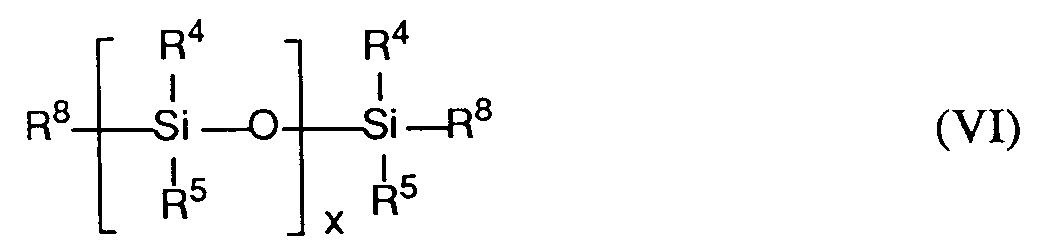
auf an sich bekannte Weise zu einer Kontaktlinse verarbeitet wird. - Verwendung eines vernetzten lipophilisierten Cyclodextrin-Derivates, welches gekennzeichnet ist durch sich wiederholende Untereinheiten der Formel V,

worin R² für unsubstituiertes oder durch Halogen substituiertes Alkyl oder für durch Alkyl substituiertes Aryl steht, und worin R⁷ für einen zwei- oder mehrwertigen Rest der Formel VI steht
zur Herstellung einer Kontaktlinse. - Eine Kontaktlinse, die dadurch gekennzeichnet ist, dass sie ein vernetztes lipophilisiertes Cyclodextrin-Derivat enthält, das aus der Umsetzung einer Verbindung der Formel I


worin R² für unsubstituiertes oder durch Halogen substituiertes Alkyl oder für durch Alkyl substituiertes Aryl steht, und worin R³ für unsubstituiertes oder durch Halogen substituiertes Alkenyl steht,
worin ferner x für eine Zahl von 1 bis 10000 steht, R⁴, R⁵ und R⁶ unabhängig voneinander Wasserstoff, Alkyl, Phenyl oder Hydroxy bedeuten, mit der Massgabe dass in einer Verbindung der Formel II mindestens zwei der Reste R⁴, R⁵ und R⁶ Wasserstoff bedeuten.
Priority Applications (1)
| Application Number | Priority Date | Filing Date | Title |
|---|---|---|---|
| EP93810539A EP0586332B1 (de) | 1992-08-05 | 1993-07-27 | Kontaktlinsen aus lipophilisierten Cyclodextrinen |
Applications Claiming Priority (3)
| Application Number | Priority Date | Filing Date | Title |
|---|---|---|---|
| EP92810599 | 1992-08-05 | ||
| EP92810599 | 1992-08-05 | ||
| EP93810539A EP0586332B1 (de) | 1992-08-05 | 1993-07-27 | Kontaktlinsen aus lipophilisierten Cyclodextrinen |
Publications (2)
| Publication Number | Publication Date |
|---|---|
| EP0586332A1 true EP0586332A1 (de) | 1994-03-09 |
| EP0586332B1 EP0586332B1 (de) | 1997-02-05 |
Family
ID=8211961
Family Applications (1)
| Application Number | Title | Priority Date | Filing Date |
|---|---|---|---|
| EP93810539A Expired - Lifetime EP0586332B1 (de) | 1992-08-05 | 1993-07-27 | Kontaktlinsen aus lipophilisierten Cyclodextrinen |
Country Status (16)
| Country | Link |
|---|---|
| US (1) | US5391592A (de) |
| EP (1) | EP0586332B1 (de) |
| JP (1) | JPH06186511A (de) |
| AT (1) | ATE148714T1 (de) |
| AU (1) | AU668737B2 (de) |
| CA (1) | CA2101791A1 (de) |
| DE (1) | DE59305382D1 (de) |
| DK (1) | DK0586332T3 (de) |
| ES (1) | ES2097482T3 (de) |
| FI (1) | FI933435A7 (de) |
| GR (1) | GR3022975T3 (de) |
| IL (1) | IL106533A0 (de) |
| MX (1) | MX9304749A (de) |
| NO (1) | NO932787L (de) |
| NZ (1) | NZ248318A (de) |
| ZA (1) | ZA935641B (de) |
Cited By (5)
| Publication number | Priority date | Publication date | Assignee | Title |
|---|---|---|---|---|
| WO1996031540A1 (de) * | 1995-04-03 | 1996-10-10 | Wacker-Chemie Gmbh | Organopolysiloxan/cyclodextrin-komplexe, deren herstellung sowie deren verwendung als additive in beschichtungsmassen |
| WO1996036890A1 (en) * | 1995-05-19 | 1996-11-21 | Novartis Ag | Polysiloxane-polyol macromers, their preparation and their use |
| WO1997023532A1 (en) * | 1995-12-22 | 1997-07-03 | Novartis Ag | Polyurethanes made from polysiloxane/polyol macromers |
| EP0745871A3 (de) * | 1995-06-01 | 1997-10-01 | Johnson & Johnson Vision Prod | Aus hochdurchlässigem Polysiloxanpolyol hergestellte Kontaktlinse |
| WO2010018293A1 (es) | 2008-08-06 | 2010-02-18 | Universidade De Santiago De Compostela | Hidrogeles acrílicos con ciclodextrinas colgantes, su preparación y su aplicación como sistemas de liberación y componentes de lentes de contacto |
Families Citing this family (9)
| Publication number | Priority date | Publication date | Assignee | Title |
|---|---|---|---|---|
| TW328535B (en) * | 1993-07-02 | 1998-03-21 | Novartis Ag | Functional photoinitiators and their manufacture |
| FR2767834B1 (fr) * | 1997-08-29 | 1999-12-03 | Inst Francais Du Petrole | Mono et di-derives de cyclodextrines, leurs synthese et purification et leur utilisation en support |
| US7622527B2 (en) | 2004-03-31 | 2009-11-24 | The University Of Tokyo | Polymeric material having polyrotaxane and process for producing the same |
| WO2020139404A1 (en) | 2018-12-29 | 2020-07-02 | Wacker Chemie Ag | Cyclodextrin modified silicone composition |
| WO2020139403A1 (en) | 2018-12-29 | 2020-07-02 | Wacker Chemie Ag | Hydrophilic cyclodextrin-containing silicone gels |
| WO2020153938A1 (en) | 2019-01-22 | 2020-07-30 | Wacker Chemie Ag | Hydrocarbon-containing organopolysiloxane gel |
| JP7605038B2 (ja) * | 2021-06-18 | 2024-12-24 | 信越化学工業株式会社 | オルガノポリシロキサン変性シクロデキストリン化合物を含有する化粧料 |
| WO2023003043A1 (ja) * | 2021-07-21 | 2023-01-26 | 国立大学法人大阪大学 | シリコーン系高分子化合物及びシリコーン系高分子材料 |
| CN119072531A (zh) | 2022-04-25 | 2024-12-03 | 瓦克化学股份公司 | 环糊精结合的硅酮材料及其作为活性物的载体的用途 |
Citations (3)
| Publication number | Priority date | Publication date | Assignee | Title |
|---|---|---|---|---|
| EP0317377A1 (de) * | 1987-10-23 | 1989-05-24 | ESSILOR INTERNATIONAL (Compagnie Générale d'Optique) | Benetzungsfähige Silikonelastomere für die Herstellung von Kontaktlinsen |
| FR2646672A1 (fr) * | 1989-04-21 | 1990-11-09 | Essilor Int | Elastomere de silicones mouillable convenant a la fabrication de lentilles de contact |
| WO1992007056A1 (en) * | 1990-10-22 | 1992-04-30 | Bausch & Lomb Incorporated | Method and composition for cleaning contact lenses |
Family Cites Families (1)
| Publication number | Priority date | Publication date | Assignee | Title |
|---|---|---|---|---|
| US4973680A (en) * | 1989-03-03 | 1990-11-27 | National Starch And Chemical Investment Holding Corporation | Organosiloxane-containing polysaccharides |
-
1993
- 1993-07-27 DK DK93810539.2T patent/DK0586332T3/da active
- 1993-07-27 ES ES93810539T patent/ES2097482T3/es not_active Expired - Lifetime
- 1993-07-27 EP EP93810539A patent/EP0586332B1/de not_active Expired - Lifetime
- 1993-07-27 DE DE59305382T patent/DE59305382D1/de not_active Expired - Fee Related
- 1993-07-27 AT AT93810539T patent/ATE148714T1/de not_active IP Right Cessation
- 1993-07-29 IL IL106533A patent/IL106533A0/xx unknown
- 1993-07-30 AU AU44349/93A patent/AU668737B2/en not_active Ceased
- 1993-08-02 FI FI933435A patent/FI933435A7/fi unknown
- 1993-08-03 CA CA002101791A patent/CA2101791A1/en not_active Abandoned
- 1993-08-03 US US08/101,221 patent/US5391592A/en not_active Expired - Fee Related
- 1993-08-03 NZ NZ248318A patent/NZ248318A/en unknown
- 1993-08-04 NO NO932787A patent/NO932787L/no unknown
- 1993-08-04 ZA ZA935641A patent/ZA935641B/xx unknown
- 1993-08-05 JP JP5194460A patent/JPH06186511A/ja active Pending
- 1993-08-05 MX MX9304749A patent/MX9304749A/es not_active IP Right Cessation
-
1997
- 1997-03-31 GR GR970400651T patent/GR3022975T3/el unknown
Patent Citations (3)
| Publication number | Priority date | Publication date | Assignee | Title |
|---|---|---|---|---|
| EP0317377A1 (de) * | 1987-10-23 | 1989-05-24 | ESSILOR INTERNATIONAL (Compagnie Générale d'Optique) | Benetzungsfähige Silikonelastomere für die Herstellung von Kontaktlinsen |
| FR2646672A1 (fr) * | 1989-04-21 | 1990-11-09 | Essilor Int | Elastomere de silicones mouillable convenant a la fabrication de lentilles de contact |
| WO1992007056A1 (en) * | 1990-10-22 | 1992-04-30 | Bausch & Lomb Incorporated | Method and composition for cleaning contact lenses |
Non-Patent Citations (3)
| Title |
|---|
| CHEMICAL ABSTRACTS, vol. 116, no. 18, 4 May 1992, Columbus, Ohio, US; abstract no. 174900x, VON DER BEY E.: "Synthesis and characterization of immobilized lipophilic cyclodextrins" page 9; * |
| CHEMICAL ABSTRACTS, vol. 95, no. 8, 24 August 1981, Columbus, Ohio, US; abstract no. 62402c, MACIEJEWSKI M.: "Adducts of cyclodextrins with siloxane oligomers" page 741; * |
| MINUTES INT. SYMP. CYCLODEXTRINS 5TH, 1990, pages 643 - 646 * |
Cited By (7)
| Publication number | Priority date | Publication date | Assignee | Title |
|---|---|---|---|---|
| WO1996031540A1 (de) * | 1995-04-03 | 1996-10-10 | Wacker-Chemie Gmbh | Organopolysiloxan/cyclodextrin-komplexe, deren herstellung sowie deren verwendung als additive in beschichtungsmassen |
| WO1996036890A1 (en) * | 1995-05-19 | 1996-11-21 | Novartis Ag | Polysiloxane-polyol macromers, their preparation and their use |
| EP0745871A3 (de) * | 1995-06-01 | 1997-10-01 | Johnson & Johnson Vision Prod | Aus hochdurchlässigem Polysiloxanpolyol hergestellte Kontaktlinse |
| CN1070509C (zh) * | 1995-06-01 | 2001-09-05 | 庄臣及庄臣视力产品有限公司 | 由高渗透性硅氧烷多元醇材料制成的接触镜片 |
| WO1997023532A1 (en) * | 1995-12-22 | 1997-07-03 | Novartis Ag | Polyurethanes made from polysiloxane/polyol macromers |
| US6271332B1 (en) | 1995-12-22 | 2001-08-07 | Novartis Ag | Polyurethanes made from polysiloxane/polyol macromers |
| WO2010018293A1 (es) | 2008-08-06 | 2010-02-18 | Universidade De Santiago De Compostela | Hidrogeles acrílicos con ciclodextrinas colgantes, su preparación y su aplicación como sistemas de liberación y componentes de lentes de contacto |
Also Published As
| Publication number | Publication date |
|---|---|
| FI933435A7 (fi) | 1994-02-06 |
| NO932787D0 (no) | 1993-08-04 |
| FI933435A0 (fi) | 1993-08-02 |
| CA2101791A1 (en) | 1994-02-06 |
| ATE148714T1 (de) | 1997-02-15 |
| ES2097482T3 (es) | 1997-04-01 |
| AU4434993A (en) | 1994-02-10 |
| NZ248318A (en) | 1995-11-27 |
| MX9304749A (es) | 1994-02-28 |
| JPH06186511A (ja) | 1994-07-08 |
| IL106533A0 (en) | 1993-11-15 |
| ZA935641B (en) | 1994-02-07 |
| EP0586332B1 (de) | 1997-02-05 |
| US5391592A (en) | 1995-02-21 |
| DE59305382D1 (de) | 1997-03-20 |
| DK0586332T3 (da) | 1997-04-14 |
| GR3022975T3 (en) | 1997-06-30 |
| NO932787L (no) | 1994-02-07 |
| AU668737B2 (en) | 1996-05-16 |
Similar Documents
| Publication | Publication Date | Title |
|---|---|---|
| EP0586332B1 (de) | Kontaktlinsen aus lipophilisierten Cyclodextrinen | |
| DE69220950T2 (de) | Siloxanzusammensetzung mit hohem brechungsindex | |
| DE69403166T2 (de) | Hydrophiles, durchsichtiges Material mit hoher Sauerstoffdurchlässigkeit auf der Basis von interpenetrierenden Polymernetzwerken, Verfahren zur Herstellung und Herstellung von weichen hochsauerstoffdurchlässigen Kontaktlinsen | |
| DE60004854T2 (de) | Kontaktlinsenmaterial | |
| DE69523533T2 (de) | Für Vernetzungsreaktionen geeignete kationische Initiatoren, diese Initiatore enthaltende, vernetzbare organofunktionelle Gruppen enthaltend Polysiloxanzusammensetzungen und deren Anwendung zur Trennmittelbeschichtungen | |
| DE3888048T4 (de) | Verfahren zur Herstellung von durchsichtigen Polysiloxanelastomeren. | |
| US5902863A (en) | Dendrimer-based networks containing lyophilic organosilicon and hydrophilic polyamidoamine nanoscopic domains | |
| DE69322428T2 (de) | Verfahren zur Herstellung Alkoxy-Endgruppen aufweisender Organosiloxanflüssigkeiten unter Verwendung von Organolithiumreagenzien | |
| DE69426930T2 (de) | Verbesserung der hydrophilen eigenschaften von polysiloxanen | |
| DE102005001039B4 (de) | Verfahren zur Herstellung von Äquilibrierungsprodukten von Organosiloxanen und die so erhältlichen Organopolysiloxane | |
| DE3888536T2 (de) | Polyanhydride mit verbesserten hydrolytischen degradierungseigenschaften. | |
| DE2918313C2 (de) | Verfahren zur Herstellung von Polysiloxanelastomeren hoher Festigkeit | |
| EP1553127A1 (de) | Verwendung blockweise aufgebauter Polyethersiloxane als Stabilisatoren in Polyurethanschäumen | |
| DE3881647T2 (de) | Benetzungsfähige Silikonelastomere für die Herstellung von Kontaktlinsen. | |
| DE69231535T2 (de) | Ultraviolettes licht absorbierende verbindungen und silikonhaltige zusammensetzungen | |
| DE69930540T2 (de) | Verfahren zur herstellung von silalkylen-siloxancopolymeren | |
| EP2676986A1 (de) | Siliconpolyether und Verfahren zu deren Herstellung aus Methylidengruppen tragenden Polyethern | |
| DE4010281A1 (de) | Abdruckzusammensetzung | |
| DE4406963A1 (de) | Metallocenkomplexe mit heterofunktionellen Gruppen am Cyclopentadienylsystem | |
| DE60000881T2 (de) | Katalysatorsystem, Verfahren und Polysiloxanzusammensetzung | |
| DE69800264T2 (de) | Alkenylfunktionelles silyliertes Polymethylsilsesquioxane und Verfahren zu seiner Herstellung | |
| EP0744432A1 (de) | Monodisperse lösliche Organopolysiloxanpartikel | |
| DE4317655A1 (de) | Mehrphasige Blockcopolymerisate des Propylens | |
| DE2350369A1 (de) | Verfahren zur herstellung von diorganopolysiloxanen | |
| DE69611879T2 (de) | Polysiloxanharze die Zusätze mit optischer Funktion enthalten und transparente Gegenstände mit optischer Funktion |
Legal Events
| Date | Code | Title | Description |
|---|---|---|---|
| PUAI | Public reference made under article 153(3) epc to a published international application that has entered the european phase |
Free format text: ORIGINAL CODE: 0009012 |
|
| AK | Designated contracting states |
Kind code of ref document: A1 Designated state(s): AT BE CH DE DK ES FR GB GR IE IT LI LU NL PT SE |
|
| 17P | Request for examination filed |
Effective date: 19940903 |
|
| GRAG | Despatch of communication of intention to grant |
Free format text: ORIGINAL CODE: EPIDOS AGRA |
|
| 17Q | First examination report despatched |
Effective date: 19960404 |
|
| GRAH | Despatch of communication of intention to grant a patent |
Free format text: ORIGINAL CODE: EPIDOS IGRA |
|
| GRAH | Despatch of communication of intention to grant a patent |
Free format text: ORIGINAL CODE: EPIDOS IGRA |
|
| RAP1 | Party data changed (applicant data changed or rights of an application transferred) |
Owner name: MAX-PLANCK-GESELLSCHAFT ZUR FOERDERUNG DER WISSEN Owner name: CIBA-GEIGY AG |
|
| GRAA | (expected) grant |
Free format text: ORIGINAL CODE: 0009210 |
|
| AK | Designated contracting states |
Kind code of ref document: B1 Designated state(s): AT BE CH DE DK ES FR GB GR IE IT LI LU NL PT SE |
|
| REF | Corresponds to: |
Ref document number: 148714 Country of ref document: AT Date of ref document: 19970215 Kind code of ref document: T |
|
| REG | Reference to a national code |
Ref country code: CH Ref legal event code: NV Representative=s name: CIBA-GEIGY AG PATENTABTEILUNG Ref country code: CH Ref legal event code: EP |
|
| REG | Reference to a national code |
Ref country code: IE Ref legal event code: FG4D Free format text: 71965 |
|
| REF | Corresponds to: |
Ref document number: 59305382 Country of ref document: DE Date of ref document: 19970320 |
|
| ITF | It: translation for a ep patent filed | ||
| REG | Reference to a national code |
Ref country code: ES Ref legal event code: FG2A Ref document number: 2097482 Country of ref document: ES Kind code of ref document: T3 |
|
| PGFP | Annual fee paid to national office [announced via postgrant information from national office to epo] |
Ref country code: FR Payment date: 19970409 Year of fee payment: 5 |
|
| ET | Fr: translation filed | ||
| REG | Reference to a national code |
Ref country code: DK Ref legal event code: T3 |
|
| PGFP | Annual fee paid to national office [announced via postgrant information from national office to epo] |
Ref country code: DE Payment date: 19970416 Year of fee payment: 5 |
|
| PGFP | Annual fee paid to national office [announced via postgrant information from national office to epo] |
Ref country code: SE Payment date: 19970417 Year of fee payment: 5 Ref country code: GR Payment date: 19970417 Year of fee payment: 5 |
|
| PGFP | Annual fee paid to national office [announced via postgrant information from national office to epo] |
Ref country code: DK Payment date: 19970421 Year of fee payment: 5 |
|
| PGFP | Annual fee paid to national office [announced via postgrant information from national office to epo] |
Ref country code: PT Payment date: 19970506 Year of fee payment: 5 |
|
| GBT | Gb: translation of ep patent filed (gb section 77(6)(a)/1977) |
Effective date: 19970416 |
|
| PGFP | Annual fee paid to national office [announced via postgrant information from national office to epo] |
Ref country code: IE Payment date: 19970509 Year of fee payment: 5 |
|
| REG | Reference to a national code |
Ref country code: GB Ref legal event code: 732E |
|
| REG | Reference to a national code |
Ref country code: GR Ref legal event code: FG4A Free format text: 3022975 |
|
| NLS | Nl: assignments of ep-patents |
Owner name: NOVARTIS AG;MAX-PLANCK-GESELLSCHAFT ZUR FOERDERUNG |
|
| PGFP | Annual fee paid to national office [announced via postgrant information from national office to epo] |
Ref country code: GB Payment date: 19970606 Year of fee payment: 5 |
|
| PGFP | Annual fee paid to national office [announced via postgrant information from national office to epo] |
Ref country code: CH Payment date: 19970617 Year of fee payment: 5 |
|
| REG | Reference to a national code |
Ref country code: PT Ref legal event code: SC4A Free format text: AVAILABILITY OF NATIONAL TRANSLATION Effective date: 19970325 |
|
| PGFP | Annual fee paid to national office [announced via postgrant information from national office to epo] |
Ref country code: ES Payment date: 19970710 Year of fee payment: 5 |
|
| PGFP | Annual fee paid to national office [announced via postgrant information from national office to epo] |
Ref country code: AT Payment date: 19970714 Year of fee payment: 5 |
|
| REG | Reference to a national code |
Ref country code: ES Ref legal event code: PC2A |
|
| PGFP | Annual fee paid to national office [announced via postgrant information from national office to epo] |
Ref country code: NL Payment date: 19970717 Year of fee payment: 5 |
|
| REG | Reference to a national code |
Ref country code: PT Ref legal event code: PC4A Free format text: NOVARTIS AG CH Effective date: 19970410 |
|
| PGFP | Annual fee paid to national office [announced via postgrant information from national office to epo] |
Ref country code: LU Payment date: 19970807 Year of fee payment: 5 |
|
| PGFP | Annual fee paid to national office [announced via postgrant information from national office to epo] |
Ref country code: BE Payment date: 19970905 Year of fee payment: 5 |
|
| REG | Reference to a national code |
Ref country code: FR Ref legal event code: TP |
|
| PLBE | No opposition filed within time limit |
Free format text: ORIGINAL CODE: 0009261 |
|
| STAA | Information on the status of an ep patent application or granted ep patent |
Free format text: STATUS: NO OPPOSITION FILED WITHIN TIME LIMIT |
|
| BECA | Be: change of holder's address |
Free format text: 970205 *NOVARTIS A.G.;*MAX-PLANCK-GESELLSCHAFT ZUR FORDERUNG DER WISSENSCHAFTEN E.V. BERLIN:SCHWARZWALDALLEE 215,4058 BASEL;HOFGARTENSTRASSE 2, 80539 MUENCHEN (DE) |
|
| BECH | Be: change of holder |
Free format text: 970205 *NOVARTIS A.G.;*MAX-PLANCK-GESELLSCHAFT ZUR FORDERUNG DER WISSENSCHAFTEN E.V. BERLIN |
|
| 26N | No opposition filed | ||
| PG25 | Lapsed in a contracting state [announced via postgrant information from national office to epo] |
Ref country code: LU Free format text: LAPSE BECAUSE OF NON-PAYMENT OF DUE FEES Effective date: 19980727 Ref country code: IE Free format text: LAPSE BECAUSE OF NON-PAYMENT OF DUE FEES Effective date: 19980727 Ref country code: GB Free format text: LAPSE BECAUSE OF NON-PAYMENT OF DUE FEES Effective date: 19980727 Ref country code: AT Free format text: LAPSE BECAUSE OF NON-PAYMENT OF DUE FEES Effective date: 19980727 |
|
| PG25 | Lapsed in a contracting state [announced via postgrant information from national office to epo] |
Ref country code: SE Free format text: LAPSE BECAUSE OF NON-PAYMENT OF DUE FEES Effective date: 19980728 Ref country code: ES Free format text: LAPSE BECAUSE OF NON-PAYMENT OF DUE FEES Effective date: 19980728 |
|
| PG25 | Lapsed in a contracting state [announced via postgrant information from national office to epo] |
Ref country code: LI Free format text: LAPSE BECAUSE OF NON-PAYMENT OF DUE FEES Effective date: 19980731 Ref country code: GR Free format text: LAPSE BECAUSE OF NON-PAYMENT OF DUE FEES Effective date: 19980731 Ref country code: DK Free format text: LAPSE BECAUSE OF NON-PAYMENT OF DUE FEES Effective date: 19980731 Ref country code: CH Free format text: LAPSE BECAUSE OF NON-PAYMENT OF DUE FEES Effective date: 19980731 Ref country code: BE Free format text: LAPSE BECAUSE OF NON-PAYMENT OF DUE FEES Effective date: 19980731 |
|
| BERE | Be: lapsed |
Owner name: MAX-PLANCK-GESELLSCHAFT ZUR FORDERUNG DER WISSENS Effective date: 19980731 Owner name: NOVARTIS A.G. Effective date: 19980731 |
|
| PG25 | Lapsed in a contracting state [announced via postgrant information from national office to epo] |
Ref country code: PT Free format text: LAPSE BECAUSE OF NON-PAYMENT OF DUE FEES Effective date: 19990131 |
|
| PG25 | Lapsed in a contracting state [announced via postgrant information from national office to epo] |
Ref country code: NL Free format text: LAPSE BECAUSE OF NON-PAYMENT OF DUE FEES Effective date: 19990201 |
|
| REG | Reference to a national code |
Ref country code: CH Ref legal event code: PL |
|
| GBPC | Gb: european patent ceased through non-payment of renewal fee |
Effective date: 19980727 |
|
| EUG | Se: european patent has lapsed |
Ref document number: 93810539.2 |
|
| PG25 | Lapsed in a contracting state [announced via postgrant information from national office to epo] |
Ref country code: FR Free format text: LAPSE BECAUSE OF NON-PAYMENT OF DUE FEES Effective date: 19990331 |
|
| NLV4 | Nl: lapsed or anulled due to non-payment of the annual fee |
Effective date: 19990201 |
|
| PG25 | Lapsed in a contracting state [announced via postgrant information from national office to epo] |
Ref country code: DE Free format text: LAPSE BECAUSE OF NON-PAYMENT OF DUE FEES Effective date: 19990501 |
|
| REG | Reference to a national code |
Ref country code: FR Ref legal event code: ST |
|
| REG | Reference to a national code |
Ref country code: PT Ref legal event code: MM4A Free format text: LAPSE DUE TO NON-PAYMENT OF FEES Effective date: 19990131 |
|
| REG | Reference to a national code |
Ref country code: DK Ref legal event code: EBP |
|
| REG | Reference to a national code |
Ref country code: ES Ref legal event code: FD2A Effective date: 20020603 |
|
| PG25 | Lapsed in a contracting state [announced via postgrant information from national office to epo] |
Ref country code: IT Free format text: LAPSE BECAUSE OF NON-PAYMENT OF DUE FEES;WARNING: LAPSES OF ITALIAN PATENTS WITH EFFECTIVE DATE BEFORE 2007 MAY HAVE OCCURRED AT ANY TIME BEFORE 2007. THE CORRECT EFFECTIVE DATE MAY BE DIFFERENT FROM THE ONE RECORDED. Effective date: 20050727 |