EP0586883A2 - Aktive Kastensortierung von Poststücken mit zurückgestellter optischer Zeichenerkennung - Google Patents
Aktive Kastensortierung von Poststücken mit zurückgestellter optischer Zeichenerkennung Download PDFInfo
- Publication number
- EP0586883A2 EP0586883A2 EP93112568A EP93112568A EP0586883A2 EP 0586883 A2 EP0586883 A2 EP 0586883A2 EP 93112568 A EP93112568 A EP 93112568A EP 93112568 A EP93112568 A EP 93112568A EP 0586883 A2 EP0586883 A2 EP 0586883A2
- Authority
- EP
- European Patent Office
- Prior art keywords
- sorting
- pigeon
- pigeon hole
- mail piece
- Prior art date
- Legal status (The legal status is an assumption and is not a legal conclusion. Google has not performed a legal analysis and makes no representation as to the accuracy of the status listed.)
- Withdrawn
Links
Images



Classifications
-
- B—PERFORMING OPERATIONS; TRANSPORTING
- B07—SEPARATING SOLIDS FROM SOLIDS; SORTING
- B07C—POSTAL SORTING; SORTING INDIVIDUAL ARTICLES, OR BULK MATERIAL FIT TO BE SORTED PIECE-MEAL, e.g. BY PICKING
- B07C7/00—Sorting by hand only e.g. of mail
- B07C7/005—Computer assisted manual sorting, e.g. for mail
-
- B—PERFORMING OPERATIONS; TRANSPORTING
- B07—SEPARATING SOLIDS FROM SOLIDS; SORTING
- B07C—POSTAL SORTING; SORTING INDIVIDUAL ARTICLES, OR BULK MATERIAL FIT TO BE SORTED PIECE-MEAL, e.g. BY PICKING
- B07C3/00—Sorting according to destination
-
- Y—GENERAL TAGGING OF NEW TECHNOLOGICAL DEVELOPMENTS; GENERAL TAGGING OF CROSS-SECTIONAL TECHNOLOGIES SPANNING OVER SEVERAL SECTIONS OF THE IPC; TECHNICAL SUBJECTS COVERED BY FORMER USPC CROSS-REFERENCE ART COLLECTIONS [XRACs] AND DIGESTS
- Y10—TECHNICAL SUBJECTS COVERED BY FORMER USPC
- Y10S—TECHNICAL SUBJECTS COVERED BY FORMER USPC CROSS-REFERENCE ART COLLECTIONS [XRACs] AND DIGESTS
- Y10S209/00—Classifying, separating, and assorting solids
- Y10S209/90—Sorting flat-type mail
Definitions
- the invention disclosed broadly relates to automated mail processing and more particularly relates to a method and apparatus for low-cost, flexible sorting of mail pieces, flats and parcels to meet any sort scheme in particular postman delivery walk sequencing.
- the invention provides greatly improved operational efficiency, while reducing cost and error rate.
- APH sorting In Active Pigeon Hole (APH) sorting a standard "carrier case” referred to as pigeon holes is modified to completely automate the process of reading address data and mapping each envelope into its correct pigeon hole. The physical manipulation of the mail pieces into the slots is left to the human operator. In net, APH sortation productivity is increased by a nominal factor of four by eliminating almost all operator think time.
- the APH process to be described is analogous to the successful automation of "supermarket check-out" using UPC bar code scanning.
- APH as shown in Fig. 5, is accomplished by giving each mail sorting operator a bar code reader/stacker at their desk. As each letter is removed from the stacker, its bar coded ID is read. A light is flashed under the appropriate pigeon hole (right side of of Fig. 3). The operator does not look at or read any address data.
- the bar coded ID previously assigned by DOCR provides the link to the envelope's address data.
- the optimal pigeon hole to delivery stop assignment which for example would delete addresses with no mail being delivered that day, is computed during the DOCR travel time between sort center and delivery post office.
- the pigeon hole assignment can be ordered to allow delivery sorting where the juxtaposition of delivery stops does not follow the street number order such as is common in Europe where odd and even addresses may be blocks apart. Similar, non-contiguous assignment of pigeon holes would accommodate the occurrence of a cul-de-sac of a street.
- APH is applicable to any of the sortation steps for which pigeon holes are normally used. However, in particular, its automation value is most pronounced when applied to the postman's delivery sequence sort step. This step tends to be most time consuming and error prone. It requires the greatest level of training and cognition. Using analysis performed by the Danish Post Office, about 25% of sorting costs are incurred in manually performing the postman delivery walk sequencing operation. In any of the other postal sortation steps, APH also provides productivity gains by allowing use of minimally untrained, low cost labor. Alternatively APH insulates the level of customer service from absenteeism.
- Active Pigeon Holes use human dexterity for handling small non-uniform shaped objects (letter/flats/small parcels) and defers to the computer the repetitive, memory intensive step of reading (and rereading) addresses and then mentally mapping the address data to the correct slot/bin.
- the cost/benefits relationship underlying the APH sorting solution is one way of balancing new postal realities with the goals of managing cost and improving service.
- Fig. 3 On the right-hand side of Fig. 3 is an even less expensive APH embodiment driven by simply displaying on a CRT the pigeon hole number for the mail piece currently being sorted.
- each carrier case that we call a pigeon hole has 32 pockets which have been historically determined by ergonomics, how far a person can reach their arm without straining themselves. That means that to cover 320 locations with a carrier case with 32 pigeon holes, requires 10 passes over the pigeon holes. Operationally this is done by first dividing the mail into 10 separate bundles and then the bundles themselves are distributed into the pigeon holes in 10 separate passes. Each of these passes is called “spreading the mail" over the pigeon hole case. Nominally, one-third of the people receive no mail each day.
- the first pass through pigeon holes breaks the mail into bundles that are "spread over" a pigeon hole, which means that we segment the clients or end points that a carrier services, into groupings of 32. Then we have to divide the mail in a macro sense to those groupings of 32 and then in a micro sense, we then go back and "spread it" in the micro sense into individually assigned pigeon holes.
- a pile of mail for the entire city of Copenhagen sits before a reading device so that as each piece of mail is sequentially pulled from the pile, it is passed by the reading device where the deferred optical character recognition (DOCR) bar code number is read, or alternately, where a local sorting bar code number is read.
- DIR deferred optical character recognition
- a first pass partition definition is loaded into the system which defines the 10 partitions for Copenhagen delivery post office 1.
- the system accesses the corresponding electronic mail piece folder, using the DOCR number.
- the mail piece is assigned to one of 10 pigeon hole locations.
- the next step is to assign one of the partitions to the mail piece.
- the next step is to light a light or highlight a display, that is to display a prompt to the operator indicating which of several bins or pigeon holes this particular mail piece is to be manually sorted to. These bins are holding bins for the next level of sorting.
- Each level of sorting has a greater definition to it leading to a final mapping to the end point which is for example carrier walk sequence.
- the next step is that the operator manually puts the mail piece into the particular bin or pigeon hole whose indicator light is illuminated. Then the steps loop back to drawing another mail piece from the pile and reading the DOCR ID bar code on the envelope.
- the next pass in this example is performed. As many additional passes are done until the sorting level is down to individual delivery locations.
- a part of this invention is the elimination of those recipients in a geographic area who are not receiving mail on a particular day. There will be no pigeon hole box designated for a recipient that is not receiving mail on a particular day. This information will be known after a first pass. In fact, this information is known from the DOCR statistics which are accumulated prior to the time that the physical mail pieces arrive by truck to the destination post office.
- Part of the partitioning can include a recognition of non-contiguous geographic recipients having numbers which are close together.
- An alternate way of saying this is contiguous postal recipients who have numbers that are not numerically close together.
- this level of partition is accomplished at a late pass where a pass perhaps to a particular geographic block is performed.
- Postal recipients can be geographically adjacent to one another but have numerically diverse widely separated addresses. This for example may be for a street whose name changes at an intersection so that persons on the first side of the intersection have a first street name and a series of street numbers, and persons on the opposite side of the intersection of the same physical street have a different street name and still a different set of street numbers.
- the system will have stored the recognition that the mail partition at the carrier walk sequence includes this change in street name and change in numbering.
- the pigeon holes can be allocated for the carrier walk sequence of recipients receiving mail that day, notwithstanding the fact that the address is completely different for geographically adjacent recipients.
- Another example is the European circumstance where address odd numbers and even numbers are not necessarily immediately across the street from one another. Part of what is stored in the system is a mapping of the carrier walk sequence as a geographic sequence, notwithstanding the actual address number or street name.
- Another example which illustrates this is walking into a cul-de-sac where a carrier will be walking down a main street having a first name, he will turn into a cul-de-sac having a second name and will continue walking and delivering mail and then will walk back out on the first street and resume where he left off in the numbering on the main street.
- This can be handled by the storage of the geographic juxtaposition of addresses in the serial sequence for the carrier walk which will be mapped in the last pass pigeon holes which are located in a 32 pigeon hole box for those recipients who are receiving mail on that day.
- Fig. 1 is an overall system block diagram of the data processing system 102 at the receiving post office 100, to process mail pieces in a optimized manner down to carrier walk sequence.
- System 102 has the CPU 104 connected by means of the bus 103 to the bar code reader 112, the communications adapter 110, the mass store 108, the bar code reader 118, the sorter apparatus 124, the memory 106, and the workstations 126 and 132.
- the bar code reader 134 atop stacker 135 is connected to workstation 132 and the bar code reader 130 atop stacker 131 is connected to the workstation 126.
- the sorting case 128 is connected by connection 125 to the workstation 126.
- the communications adapter 115 is connected to a data processing network to receive electronic mail piece folders 136 from sending post office 160, 162 and 164, as is shown in Fig. 2.
- the tray 116 on conveyor 114 passes its bar code 117 by the bar code reader 112.
- the bar code reader 112 reads the bar code reader 112 reads the bar code 117 on a mail tray 116 carrying mail pieces arriving from destination post offices. Among those mail pieces is the letter 122 which has a bar code 123 which is read by the bar code reader 118 when it passes on the conveyor 112.
- the sorting apparatus 124 includes the sorting pockets 01' through 07' which serve to receive letters in the mail packets a1 through a7, shown in Fig. 1.
- the memory 106 includes a partition for storing received electronic folders 136, another partition to store the sorting program.
- the memory 106 also includes a partition for storing the operating system 142 and a partition 144 for storing the carrier routes and sequence tables.
- Fig. 2 is a system block diagram of a carrier's workstation 126.
- the workstation includes a bus 352 which interconnects the memory 350 with the CPU 352, an optional co-processor 356, a DASD 358, a keyboard and display adapter 360, a local area network interface 367 which connects the workstation to the bus 103, a bar code wand adapter 368 which is connected to the wand 130, and a sorting case adapter 369 which is connected to the sorting case 128.
- the memory 350 is partitioned into a table buffer 362 which stores Tables 1, 2 and 3. Another partition in the memory 350 is the display buffer 364 which stores the image 480 of the sorting case 128 with a particular pigeon hole shown highlighted.
- This image can be displayed on the workstation or it can also be highlighted with appropriate indicators mounted on the sorting box 128, as is shown in Fig. 3.
- Another partition in the memory 350 stores the operating system program 336.
- Program 500 is executed by the CPU 352 in the workstation 126.
- Fig. 3 shows another view of the sorting case 128 and of the connection 125 to the workstation 126.
- Each carrier sorts his packets by route segment and he will use the sorting case 128 with its pigeon holes to sort the packets in each route segment.
- the pigeon holes are identified by x coordinates, x(1) through x(4), and by y coordinates, y(1) to y(2).
- the wires x(1)' through x(4)' and y(1)' to y(2)' provide a Cartesian coordinate signaling system to enable the illumination of a signal light in any pigeon hole of the sorting case 128 corresponding to a highlighted pigeon hole shown in the image 480 in the display buffer 364 of the workstation 126.
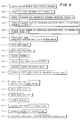
- Fig. 4 shows a flow diagram of the sequence of operational steps which are carried out in the CPU 104 of the system of Fig. 1 and in the CPU 352 in the workstation of Fig. 2.
- Step 500 begins the active pigeon hole sorting program 500 in Fig. 4.
- Step 502 inputs the delivery sequence data which is represented by the example in Table 1.
- Table 1 is a delivery sequence data for the carrier route shown in Fig. 5.
- Main Street has 24 postal recipient addresses. Also situated along Main Street are seven cul-de-sacs respectively named, Alpha, Bravo, Charlie, Delta, Foxtrot, Golf and Hotel. Each cul-de-sac has seven postal recipients on it. For example, Alpha Street has house numbers 1-7.
- the delivery sequence file of Table 1 establishes the carrier walk sequence for the postal carrier delivering mail to each respective house along his route which includes Main Street, and Alpha, Bravo, Charlie, Delta, Foxtrot, Golf and Hotel Streets.
- step 504 inputs the addresses for the electronic folders received at the destination post office.
- This data set is shown in Table 2.
- Table 2 shows that not all of the postal recipients on the carrier route shown in Fig. 5, have received mail on this particular day. This is typical for residential postal activity, typically one-third of the postal recipients do not receive mail on any particular day.
- Table 2 lists those postal recipients along the carrier route of Fig. 5, who have received mail on this particular day.
- step 506 compiles an ordered list of addressees receiving mail, in delivery sequence. This is Table 3. Referring to Table 3, it can be seen that the postal recipient addresses are ordered in the order of the carrier route sequence of Table 1, but only those postal recipients receiving mail on this day are included in Table 3.
- step 508 divides the total number of addressees receiving mail along this carrier route, by the number of pigeon holes in the sorting box shown in Fig. 3.
- the sorting box of Fig. 3 is to have 16 pigeon holes. Since an inspection of either Table 2 or Table 3 shows that there are out of the total number of 73 postal recipient addresses on the carrier route of Fig. 5, only 52 of those postal recipients are receiving mail on this example day. Thus 52 divided by the number of pigeon holes are 16 is equal to three and three-sixteenths. This value is rounded up to the next higher integer or four. This value is set equal to the variable N.
- step 510 of Fig. 4 a first pass sorting partition is assigned to the sorting box of Fig. 3, to divide the box into N equals four bins. This will enable a first pass sorting of mail pieces.
- steps 512-522 are steps 512-522.
- Step 512 picks a mail piece. This typically would be done by the operator picking any one of the mail pieces for the carrier route of Fig. 5.
- step 514 reads the deferred OCR (DOCR) bar code off the front of the mail piece. Instead of the DOCR bar code, there may be a translated local bar code for sorting, occasionally used where convenient.
- DOCR deferred OCR
- the reading of the bar code can be done by merely passing the mail piece by a stationary bar code reader near or embedded in the stacker holding the pile of mail pieces to be sorted.
- a bar code wand such as the wand 130 in Fig. 1 can be used by the operator to read the bar code where flats or parcels are then sorted into pigeon holes.
- step 516 of Fig. 4 accesses the address corresponding to the DOCR bar code, from the address mail piece electronic folder which is in partition 136 of memory 106 of Fig. 1. Then in step 518, the mail piece is assigned to one of the four bins in accordance with the ordered list of Table 3, which is an ordered list of addressees receiving mail, in the delivery sequence.
- the corresponding pigeon hole for the box 128 is highlighted either by illuminating the box with a light adjacent to the box, or alternately by highlighting a display of the box on the workstation 126, as shown in Fig. 2.
- the light or highlighting prompts the operator who then in step 522 of Fig. 4, sorts the mail piece to the appropriate and indicated pigeon hole in the box 128.
- step 522 loops back to step 512 so that all of the mail pieces which are to be received by postal recipients along the carrier walk sequence of Fig. 5, are sorted into four different bins.
- second pass sorting, third pass sorting, etc. can be carried out until a last pass sorting stage is achieved, where the mail pieces are sorted by individual postal recipients in the carrier delivery sequence of Fig. 5.
- Step 530 of Fig. 4 is the last pass sort of the mail pieces to all 16 pigeon holes in the sorting case 128. Since there are 16 pigeon holes, and since, for the example shown in Tables 1, 2 and 3 there are four groups of sorted mail, the last pass sorting operation 530 will be conducted four times.
- the last pass sorting operation 530 of Fig. 4 includes steps 532-542.
- Step 532-542 are similar to steps 512-522, respectively.
- Figs. 6A, 6B, 6C and 6D illustrate how this is achieved.
- Fig. 6A shows the first 16 postal recipients receiving mail on that day, are each allocated one pigeon hole in the box 128.
- Fig. 6B shows that the next 16 postal recipients are each assigned a pigeon hole and there are no unassigned pigeon holes.
- Fig. 6C shows the third group of 16 postal recipients receiving mail on this day are each assigned a pigeon hole and there are no unassigned pigeon holes. It should be noted that by the third sorting in Fig. 6C, a total of 69 houses along the postal route will have been services, some of those houses not receiving mail.
- the invention enables a more efficient use of postal personnel by removing the necessity for the postal operator to read each letter before selecting a pigeon hole in the sorting case 128.
- the pigeon hole is automatically selected by the system of the invention.
- the number of "spreads" of mail into the sorting case 128 is reduced because the invention also eliminates from the sorting case all postal recipients who are not receiving mail on a particular day.
Landscapes
- Engineering & Computer Science (AREA)
- General Engineering & Computer Science (AREA)
- Sorting Of Articles (AREA)
Applications Claiming Priority (2)
| Application Number | Priority Date | Filing Date | Title |
|---|---|---|---|
| US944559 | 1992-09-11 | ||
| US07/944,559 US5311597A (en) | 1992-09-11 | 1992-09-11 | Deferred optical character recognition active pigeon hole sorting of mail pieces |
Publications (2)
| Publication Number | Publication Date |
|---|---|
| EP0586883A2 true EP0586883A2 (de) | 1994-03-16 |
| EP0586883A3 EP0586883A3 (de) | 1995-02-15 |
Family
ID=25481637
Family Applications (1)
| Application Number | Title | Priority Date | Filing Date |
|---|---|---|---|
| EP93112568A Withdrawn EP0586883A3 (de) | 1992-09-11 | 1993-08-05 | Aktive Kastensortierung von Poststücken mit zurückgestellter optischer Zeichenerkennung. |
Country Status (2)
| Country | Link |
|---|---|
| US (1) | US5311597A (de) |
| EP (1) | EP0586883A3 (de) |
Cited By (9)
| Publication number | Priority date | Publication date | Assignee | Title |
|---|---|---|---|---|
| WO1996039262A3 (de) * | 1995-06-06 | 1997-02-06 | Licentia Gmbh | Verfahren und vorrichtung zur verteilung von briefsendungen |
| EP0827786A1 (de) * | 1996-09-09 | 1998-03-11 | Grapha-Holding Ag | Verfahren und Einrichtung zum Steuern einer Vorrichtung zum Verteilen von Sortiergutstücken auf physikalische Zielstellen |
| WO1998024564A1 (de) * | 1996-12-07 | 1998-06-11 | Siemens Aktiengesellschaft | Verfahren zur sortierung von sendungen |
| EP0928641A1 (de) * | 1998-01-12 | 1999-07-14 | Neopost Industrie | Vorrichtung zur Unterstützung der Handsortierung von Postartikeln |
| GB2370823A (en) * | 2001-01-09 | 2002-07-10 | Post Office | Mail sorting method and apparatus |
| WO2006008087A1 (de) * | 2004-07-21 | 2006-01-26 | Deutsche Post Ag | Verfahren und vorrichtung zum sortieren von postsendungen |
| US7518080B2 (en) * | 2000-12-15 | 2009-04-14 | United States Postal Service | Just-in-time sort plan creation |
| EP3276530A1 (de) | 2016-07-29 | 2018-01-31 | Neopost Technologies | Unterstütztes manuelles postsortiersystem und verfahren |
| CN108657815B (zh) * | 2018-05-25 | 2023-11-07 | 江西理工大学 | 一种快递包裹分拣机 |
Families Citing this family (10)
| Publication number | Priority date | Publication date | Assignee | Title |
|---|---|---|---|---|
| US5862243A (en) * | 1996-03-06 | 1999-01-19 | Baker; Christopher A. | System for evaluating bar code quality on mail pieces |
| US5881890A (en) * | 1996-06-21 | 1999-03-16 | Wiley; Ken | Mail sorting system and process |
| US5841905A (en) * | 1996-10-25 | 1998-11-24 | Eastman Kodak Company | Business form image identification using projected profiles of graphical lines and text string lines |
| DE19648005C1 (de) * | 1996-11-20 | 1997-11-13 | Aeg Electrocom Gmbh | Verfahren zur Kodierung von Sendungen |
| US6316741B1 (en) | 1999-06-04 | 2001-11-13 | Lockheed Martin Corporation | Object sortation for delivery sequencing |
| US6816602B2 (en) | 2001-03-01 | 2004-11-09 | Lockheed Martin Corporation | System and method of deferred postal address processing |
| WO2002077874A1 (en) * | 2001-03-22 | 2002-10-03 | United States Postal Service | System and method for standardizing a mailing address |
| US20080110810A1 (en) * | 2006-11-01 | 2008-05-15 | Raf Technology, Inc. | Mailpiece reject processing and labeling |
| US8489231B2 (en) * | 2009-09-18 | 2013-07-16 | Raf Technology, Inc. | Loop mail processing |
| US9878825B1 (en) | 2015-06-02 | 2018-01-30 | Ecoenvelopes, Llc | Reusable top flap envelope with dual opposing seal flaps |
Family Cites Families (9)
| Publication number | Priority date | Publication date | Assignee | Title |
|---|---|---|---|---|
| US4965829A (en) * | 1967-09-05 | 1990-10-23 | Lemelson Jerome H | Apparatus and method for coding and reading codes |
| US4181948A (en) * | 1977-06-06 | 1980-01-01 | Electronic Data Systems Corporation | Computer directed manual sorting aid |
| US4641347A (en) * | 1983-07-18 | 1987-02-03 | Pitney Bowes Inc. | System for printing encrypted messages with a character generator and bar-code representation |
| JPS60137476A (ja) * | 1983-12-26 | 1985-07-22 | 株式会社東芝 | 郵便物区分装置 |
| JPS60147887A (ja) * | 1984-01-12 | 1985-08-03 | Toshiba Corp | 郵便物区分装置 |
| JP3038344B2 (ja) * | 1987-02-24 | 2000-05-08 | 株式会社東芝 | 郵便物読取処理装置 |
| JP2713911B2 (ja) * | 1987-07-08 | 1998-02-16 | 株式会社東芝 | 郵便物処理装置 |
| US5031223A (en) * | 1989-10-24 | 1991-07-09 | International Business Machines Corporation | System and method for deferred processing of OCR scanned mail |
| US5042667A (en) * | 1989-11-13 | 1991-08-27 | Pitney Bowes Inc. | Sorting system for organizing in one pass randomly order route grouped mail in delivery order |
-
1992
- 1992-09-11 US US07/944,559 patent/US5311597A/en not_active Expired - Fee Related
-
1993
- 1993-08-05 EP EP93112568A patent/EP0586883A3/de not_active Withdrawn
Cited By (20)
| Publication number | Priority date | Publication date | Assignee | Title |
|---|---|---|---|---|
| WO1996039262A3 (de) * | 1995-06-06 | 1997-02-06 | Licentia Gmbh | Verfahren und vorrichtung zur verteilung von briefsendungen |
| CN1071151C (zh) * | 1995-06-06 | 2001-09-19 | 西门子公司 | 用于分发信件的方法和装置 |
| US5957296A (en) * | 1995-06-06 | 1999-09-28 | Licentia Patent - Verwaltungs Gmbh | Method and device for distributing letter-post items |
| EP0827786A1 (de) * | 1996-09-09 | 1998-03-11 | Grapha-Holding Ag | Verfahren und Einrichtung zum Steuern einer Vorrichtung zum Verteilen von Sortiergutstücken auf physikalische Zielstellen |
| US6079570A (en) * | 1996-09-09 | 2000-06-27 | Grapha-Holding Ag | Method and device for controlling an arrangement to distribute articles to be sorted to physical target locations |
| US6239397B1 (en) | 1996-12-07 | 2001-05-29 | Siemens Aktiengesellschaft | Process for sorting mailings |
| WO1998024564A1 (de) * | 1996-12-07 | 1998-06-11 | Siemens Aktiengesellschaft | Verfahren zur sortierung von sendungen |
| AU709639B2 (en) * | 1996-12-07 | 1999-09-02 | Siemens Aktiengesellschaft | Process for sorting mailings |
| US6370446B1 (en) | 1998-01-12 | 2002-04-09 | Neopost Industrie | Apparatus for assisting manual sorting of mail articles |
| FR2773503A1 (fr) * | 1998-01-12 | 1999-07-16 | Neopost Ind | Dispositif d'assistance au tri manuel d'articles de courrier |
| EP0928641A1 (de) * | 1998-01-12 | 1999-07-14 | Neopost Industrie | Vorrichtung zur Unterstützung der Handsortierung von Postartikeln |
| US7518080B2 (en) * | 2000-12-15 | 2009-04-14 | United States Postal Service | Just-in-time sort plan creation |
| GB2370823A (en) * | 2001-01-09 | 2002-07-10 | Post Office | Mail sorting method and apparatus |
| GB2370823B (en) * | 2001-01-09 | 2004-09-22 | Post Office | An improved sorting system |
| WO2006008087A1 (de) * | 2004-07-21 | 2006-01-26 | Deutsche Post Ag | Verfahren und vorrichtung zum sortieren von postsendungen |
| EP2298459A3 (de) * | 2004-07-21 | 2011-06-29 | Deutsche Post AG | Verfahren und Vorrichtung zum Sortieren von Postsendungen |
| EP2298458A3 (de) * | 2004-07-21 | 2011-06-29 | Deutsche Post AG | Verfahren und Vorrichtung zum Sortieren von Postsendungen |
| EP3276530A1 (de) | 2016-07-29 | 2018-01-31 | Neopost Technologies | Unterstütztes manuelles postsortiersystem und verfahren |
| US10369597B2 (en) | 2016-07-29 | 2019-08-06 | Neopost Technologies | Assisted manual mail sorting system |
| CN108657815B (zh) * | 2018-05-25 | 2023-11-07 | 江西理工大学 | 一种快递包裹分拣机 |
Also Published As
| Publication number | Publication date |
|---|---|
| EP0586883A3 (de) | 1995-02-15 |
| US5311597A (en) | 1994-05-10 |
Similar Documents
| Publication | Publication Date | Title |
|---|---|---|
| US5311597A (en) | Deferred optical character recognition active pigeon hole sorting of mail pieces | |
| US5287271A (en) | Data processing system for optimized mail piece sorting and mapping to carrier walk sequence using real time statistical data | |
| US5009321A (en) | Sorting system for organizing randomly ordered route grouped mail in delivery order sequence | |
| US5042667A (en) | Sorting system for organizing in one pass randomly order route grouped mail in delivery order | |
| US6259964B1 (en) | Computerized manual mail distribution method and apparatus | |
| US7518080B2 (en) | Just-in-time sort plan creation | |
| US6829369B2 (en) | Coding depth file and method of postal address processing using a coding depth file | |
| US6822182B2 (en) | Method of sorting mail for carriers using separators | |
| AU751530B2 (en) | Sorting system | |
| US6316741B1 (en) | Object sortation for delivery sequencing | |
| US7820932B2 (en) | Mail sorter, method, and software product for a two-step and one-pass sorting algorithm | |
| US20030155282A1 (en) | Method and apparatus for sorting and bundling mail | |
| RU2298830C2 (ru) | Способ доставки почтовых отправлений | |
| EP0812629A1 (de) | Verfahren zum Sortieren von Postgut in Abgabereihenfolge | |
| GB1281963A (en) | Article sorting system | |
| US20050143856A1 (en) | Flats sequencing system and method of use | |
| US11833548B2 (en) | Item sorting with delivery point compression | |
| US20050218046A1 (en) | System and method for sequencing mail in delivery point order | |
| US20080041770A1 (en) | System and method for sequencing mail in delivery point order | |
| AU2012261487B2 (en) | A method of processing mailpieces, the method including aggregating the batches of mailpieces | |
| JPWO1997007902A1 (ja) | 紙葉類区分装置及び紙葉類区分方法 | |
| US20050149765A1 (en) | Default address matching system | |
| JP2000118692A (ja) | 仕分け方法 | |
| JP2785256B2 (ja) | 紙葉類配達区分システム | |
| EP1066886A2 (de) | Postsortiersystem |
Legal Events
| Date | Code | Title | Description |
|---|---|---|---|
| PUAI | Public reference made under article 153(3) epc to a published international application that has entered the european phase |
Free format text: ORIGINAL CODE: 0009012 |
|
| AK | Designated contracting states |
Kind code of ref document: A2 Designated state(s): AT BE CH DE ES FR GB IT LI NL SE |
|
| 17P | Request for examination filed |
Effective date: 19940718 |
|
| PUAL | Search report despatched |
Free format text: ORIGINAL CODE: 0009013 |
|
| AK | Designated contracting states |
Kind code of ref document: A3 Designated state(s): AT BE CH DE ES FR GB IT LI NL SE |
|
| 18W | Application withdrawn |
Withdrawal date: 19960820 |