EP0586932A2 - Casque muni d'une garniture intérieure adaptée à la morphologie de la tête et son procédé de fabrication - Google Patents
Casque muni d'une garniture intérieure adaptée à la morphologie de la tête et son procédé de fabrication Download PDFInfo
- Publication number
- EP0586932A2 EP0586932A2 EP93113144A EP93113144A EP0586932A2 EP 0586932 A2 EP0586932 A2 EP 0586932A2 EP 93113144 A EP93113144 A EP 93113144A EP 93113144 A EP93113144 A EP 93113144A EP 0586932 A2 EP0586932 A2 EP 0586932A2
- Authority
- EP
- European Patent Office
- Prior art keywords
- lining
- helmet
- shell
- adapter
- hood
- Prior art date
- Legal status (The legal status is an assumption and is not a legal conclusion. Google has not performed a legal analysis and makes no representation as to the accuracy of the status listed.)
- Granted
Links
Images




Classifications
-
- A—HUMAN NECESSITIES
- A42—HEADWEAR
- A42B—HATS; HEAD COVERINGS
- A42B3/00—Helmets; Helmet covers ; Other protective head coverings
- A42B3/04—Parts, details or accessories of helmets
- A42B3/10—Linings
- A42B3/12—Cushioning devices
- A42B3/124—Cushioning devices with at least one corrugated or ribbed layer
-
- A—HUMAN NECESSITIES
- A42—HEADWEAR
- A42B—HATS; HEAD COVERINGS
- A42B3/00—Helmets; Helmet covers ; Other protective head coverings
- A42B3/04—Parts, details or accessories of helmets
- A42B3/10—Linings
- A42B3/12—Cushioning devices
- A42B3/125—Cushioning devices with a padded structure, e.g. foam
-
- A—HUMAN NECESSITIES
- A42—HEADWEAR
- A42B—HATS; HEAD COVERINGS
- A42B3/00—Helmets; Helmet covers ; Other protective head coverings
- A42B3/04—Parts, details or accessories of helmets
- A42B3/28—Ventilating arrangements
-
- A—HUMAN NECESSITIES
- A42—HEADWEAR
- A42B—HATS; HEAD COVERINGS
- A42B3/00—Helmets; Helmet covers ; Other protective head coverings
- A42B3/04—Parts, details or accessories of helmets
- A42B3/28—Ventilating arrangements
- A42B3/281—Air ducting systems
-
- A—HUMAN NECESSITIES
- A42—HEADWEAR
- A42C—MANUFACTURING OR TRIMMING HEAD COVERINGS, e.g. HATS
- A42C2/00—Manufacturing helmets by processes not otherwise provided for
- A42C2/007—Manufacturing custom-sized helmets
Definitions
- the invention relates to padding, for example for crash helmets, car seats or the like, which are in direct contact with human limbs or parts of the body over long periods of time.
- upholstery is preferably used as a resilient interior for items of clothing made of hard materials in order to achieve a body-side surface which is adapted as possible to the anatomy of the respective body part for comfortable wearing of the item of clothing.
- these upholsteries are also useful for lining conventional seats and couches, but also for medical devices that are used, for example, to support and support the human skeleton and therefore have to be in constant contact with the body.
- shock-absorbing or impact-absorbing property of padding materials already known from the prior art makes particular use of the professional world to improve the protective effect and the wearing comfort of protective equipment such as crash helmets.
- a helmet lining of this type is shown for example in DE-OS 3 540 883.
- This known helmet lining of an integral helmet has a dimensionally stable, shock-absorbing outer lining in the form of a shell and an inner soft, air-permeable lining which is arranged on the inside of the outer lining.
- the inner lining together with the outer lining, forms a network of ventilation channels, which are formed by intersecting radial depressions in both the inner and the outer lining at the respective contact surfaces.
- this integral helmet has two air catchers arranged on both sides in the lower side area, which enable an air supply to the ventilation network via connecting channels.
- a ventilation opening connected to the ventilation system is accordingly provided, so that an air circulation takes place while driving, with air exchange of the fresh air in the ducts with the moist air in the helmet inner region via the open-pore inner lining.
- the soft upholstery of the head shape is pressed together to different extents, so that the ventilation ducts can become blocked by the soft upholstery that is pressed in in highly stressed areas.
- the result of this is that in these areas there is no longer any ventilation of the inner helmet inner area, while in the remaining channels larger flow velocities can be generated in the remaining channels, which lead to an uncomfortable feeling for the wearer.
- the relatively thin inner padding on the highly stressed areas is quickly pushed down to the outer, dimensionally stable padding, which can cause uncomfortable and painful pressure points on the relevant part of the body at these sections.
- the hood as provided in claim 2, is provided on the outside with a number of projections, these projections which extend in the longitudinal direction are arranged in accordance with the different deformation of the covering in such a way that the relative distances between two adjacent projections are particularly pronounced expand deformed or stretched areas accordingly, creating a larger contact area for the inner padding on the dimensionally stable lining without the flow cross-section being reduced from the sum of all channels as a whole.
- the course of the flow channels can be maintained without any substantial change even after the lining adapter has been inserted further as a result of the device according to the invention, which is designed according to claim 1.
- the device according to the invention can provide an upholstery whose surface contour on the body side corresponds exactly to that of the body part to be covered, and in the case of the development according to claim 9, the later internal flow channels in the lining or in the lining adapter essentially bypassing the highly stressed areas Force lines follow the expected surface force distribution.
- the subsequent surface loading of the upholstery during wear can be made uniform, so that no pressure points can arise.
- a further development of the device according to the invention provides for a load on the still plastically deformable padding material for the lining or the lining adapter during the shaping to suit the body, which essentially corresponds to the later real pressure load. This can further improve the simulation of the real wearing or loading condition of the upholstery.
- the simulation of the real load condition is advantageously realized by applying the hard object to be adapted during the hardening phase of the applied or filled up padding material for the lining or the lining adapter under essentially real conditions until there is sufficient dimensional stability of the padding material allows removal of the adapted object from the body part.
- This measure also has the advantage that additional machining of the side of the lining facing away from the body to adapt to the corresponding contour of the object to be cushioned can be omitted.
- the design of the projections as separate components has the further advantage that any flow channel pattern with different channel cross sections can be produced with little effort.
- each liner shell being made for itself and then pushed into one another.
- This measure according to the invention makes it possible to manufacture the helmet in a predetermined oversize of the outer lining shell, in order to subsequently individually use the inner lining shell which acts as an adapter, without any subsequent change in the helmet and adapter geometry or the flow channels incorporated into the inner lining shell to adapt to the respective head shape of the wearer according to claim 7.
- the additional arrangement of ribs on the outside of the hood can be dispensed with. In this case there is also no need to pull the covering off the hardened shock-absorbing material, which ensures a smooth surface of the adapter.
- the helmet can be brought into any position relative to the inner lining shell according to the needs of the wearer and then fixed to the inside of the outer lining shell with the outside of the inner lining shell.
- a Velcro or adhesive connection can be provided instead of the holding device in the form of interlocking projections and recesses on the contact surfaces of the lining shells.
- the helmet can also be fixed to the inner lining shell simply by means of a press fit.
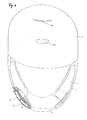
- FIG. 1 shows a first exemplary embodiment of the device according to the invention for producing a body-appropriate upholstery, in which a covering is provided which is in the form of a hood 50 for adapting a lining 8 to a head shape.
- the hood 50 consists of an elastically deformable material, preferably of a rubber material, which is shaped according to a helmet upper part 1 of an integral helmet according to FIG. 3 or 6 into a shell with a standard head size, the edge contour of which in the side view essentially follows that of the helmet upper part 1.
- the outer edges of the elastic hood 50 are bent into a semicircular channel 51 which surrounds the hood 50 as a closed circular ring.
- the outside of the hood 50 has a number of essentially equally spaced projections 52, each of which extends from a front or face-facing shell edge over the outside of the hood 50 in the direction of the rear or neck-facing shell edge.
- the projections 52 are integrally formed with the hood 50 made of the same hood material.
- the projections 52 are also possible to manufacture separately from an elastic material, for example from rubber, and to install them on the outside of the hood 50 in any orientation as required.
- a plug connection according to the rivet-eye principle or a simple Velcro connection can be provided as a suitable fastening option for the projections 52.
- other fastening variants such as gluing or welding can also be used.
- Each projection 52 has a trapezoidal cross-sectional area with a height of approximately 2 to 4 mm and an average width of approximately 10 mm.
- a further projection 53 is formed in the rear section of the hood 50, which cuts the evenly spaced projections 52 at right angles to form a segment of a circle on the cup-shaped hood 50.
- the hood 50 has between two adjacent projections 52 a wall thickness which corresponds essentially to the cross-sectional thickness of an inner, soft padding 9 of the integral helmet to be lined.
- the device according to the invention according to the first exemplary embodiment is further supplemented by a sleeve 60 made of an elastic material such as rubber, which is placed on the side of the hood 50 facing away from the body. 2a to 2c, this sheath 60 is a type of second hood which, together with the hood 50, forms an interior or cavity and is already preformed in accordance with a standard head or the dome of the helmet to be adapted.
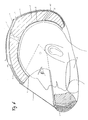
- a shock-absorbing lining 8 made of a dimensionally stable material, for example a foamed synthetic resin, on the inside of which there is in turn a soft padding 9 made of an open-pore synthetic resin foam or an air and moisture permeable textile, for example Goretex.
- An inner channel system for ventilation of the helmet interior is arranged between the soft padding 9 and the dimensionally stable lining 8, which in connection with the air and moisture permeable padding 9 enables air circulation.
- the inner channel system is formed by a multiplicity of inner flow channels 4 formed in the dimensionally stable liner and distributed substantially over the entire circumference of the liner, some of which open at the front edge of the helmet upper part 1 into a helmet interior between the front half of the face and a visor device 3 and extend substantially parallel to a rear area of the helmet upper part 1, bypassing heavily loaded or deformed areas.
- the inner flow channels 4 are delimited by a collecting channel 5 which intersects the inner flow channels 4 at right angles to form a segment in the form of a segment of a circle.
- the collecting duct 5 has in each case a duct connection with at least one air inlet opening 105 which is arranged in the neck region of the helmet upper part 1 and which enables ventilation of the back of the head region within the helmet upper part 1.
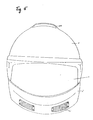
- an outer channel system is provided in the front section of the full-face helmet, which is formed by a number of longitudinally extending, substantially uniformly spaced outer flow channels 6, which become the Open the part on the front edge of the upper helmet part 1 also into the interior between the front half of the face and the visor device 3.
- the outer flow channels 6 open into an upper area of the helmet upper part 1 into a main air channel 7, which is formed in one piece with the outer partial shell 1 with an air inlet opening 107 oriented towards the front of the full-face helmet and in the mouth area of the outer flow channels 6 between the two partial shells 1 a, 1 b is continued.
- the lining 8 of the helmet upper part 1 is also provided in the mouth region of the outer flow channels 6 with a number of transverse channels 11, which establish a connection between the inner flow channels 4 and the main air channel 7.
- the main air duct 7 ends in at least one air outlet opening 207, which is arranged in the rear region of the helmet upper part 1.
- the air outlet opening 207 which is preferably arranged in a turbulent area of the helmet upper part 1, has a larger overall flow cross section than the air inlet opening 107 of the main air duct 7, which has a cross-sectional constriction in the entire mouth region of the outer flow ducts 6 and the transverse ducts 11.
- the cross-sectional ratios over the length of the main air duct 7 depend essentially on the total flow cross section of the outer flow ducts 6 and the transverse ducts 11 and can be determined in such a way that a reduction in the dynamic pressure down to a negative pressure region is achieved by increasing the flow velocity in the narrowed mouth region.
- the at least one rear air inlet opening 105 is provided for the collecting duct 5, via which a possible pressure increase within the helmet upper part 1 can be relaxed.
- the helmet lower part 2 of the integral helmet is also provided on the inside with a padding 10 which almost seals the helmet interior in the neck and neck area. Furthermore, the lower helmet part 2 is formed in one piece with a chin guard, in which a controllable ventilation device 40 is provided.
- the ventilation device 40 is formed by a plurality of ventilation slots in the chin guard, which generate a laminar air flow for ventilation and dehumidification of the visor device. The air that has flowed in is then drawn off, as already described, via the outer and inner duct system in the lining 8 of the helmet upper part 1.
- the ventilation device 40 there is also a microfilter 42 for cleaning and dehumidifying the inflowing air, which is accommodated in an air passage 41 in the front chin guard half.
- FIG. 6 shows a further embodiment of an integral helmet in which the padding according to the invention can be provided.
- the at least one outlet opening 207 is integrated in a tear-off edge 16, which is formed over the substantially entire radius of the helmet upper part 1 and generates an artificial flow break to form a turbulent flow zone.
- the outside of the hood 50 is covered with a foamed synthetic resin, which is modulated in accordance with the shell shape of the helmet upper part 1.
- the sleeve 60 which is now provided on the inside with projections aligned in accordance with the outer channel system described above, is then drawn onto the still deformable synthetic resin.
- this second sleeve 60 therefore corresponds to the inverted first hood 50, the channel surrounding the sleeve 60 also being able to be aligned accordingly on the inside of the inverted hood 50. I.e.
- the ring channels of the hood 50 and the casing 60 can be brought into contact with one another to form a tight seal, so that a lateral escape of the foamed synthetic resin can be prevented. It is of course also possible to design the hood and cover in one piece in their manufacture. In order to achieve an even better fit, the hard outer shell of the helmet upper part 1 is finally pressed onto the outer shell 60 and held there.
- the helmet upper part 1 is removed and the two hoods 50, 60 are pulled off the finished lining 8.
- depressions correspond to the projections 50 on the outer or body-facing hood side or, if appropriate, on the inner shell side, depressions have formed on the surface of the lining 8, which are now connected to one another by means of a plurality of through holes corresponding to the cross-channels 11 already mentioned.
- the hood 50 and / or the shell 60 in two layers, only the outer hood and / or shell layer being removed, while the inner hood and / or shell layer leads to the foamed synthetic resin.
- the ribs are only formed on the position of the hood 50 and / or casing 60 to be removed.
- the covering 50, 60 is only made of a relatively thin rubber material or that manufacturing costs are to be saved, this can remain on the foamed synthetic resin.
- the lining 8 is fitted into the outer shell of the helmet upper part 1 and provided with the soft padding 9 on the inside.
- the method of manufacturing the upholstery according to a second exemplary embodiment according to FIG. 7 corresponds essentially to the manufacturing process explained above.
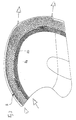
- the dimensionally stable lining 8 consists of an outer lining shell 8a and an inner lining shell 8b which are pushed into one another to form the entire lining 8.
- the outer lining shell 8a is made with a predetermined oversize with respect to the ball radius of its inside and thus enables the adaptation of the finished helmet to the head shape of a wearer by arranging an adapter.
- this adapter is represented by the inner lining shell 8b, which is preferably produced by the device described above.
- the inner lining shell 8b is formed on its outside with a number of transverse projections or ribs, which are preferably arranged in a front and rear area of the helmet shell.
- a number of depressions or recesses are incorporated on the inside of the outer lining shell 8a, into which the projections are positively locked in the pushed-together state of both lining shells.
- a larger number of recesses are provided as projections so that the outer shell of the helmet can be individually fixed in a certain sitting position with respect to the inner lining shell 8b and thus the head of the wearer to improve the wearing comfort.
- This exemplary embodiment accordingly enables the seat position to be set in a grid pattern depending on the size of the projections or recesses.
- the protrusions and recesses can be replaced by a Velcro connection, for example.
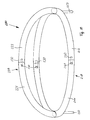
- the device for the production of an adapter for adapting a commercially available, oversized helmet has a covering, in the form of a hood 50, which together with an outer cover 60 forms, among other things, an annular tube 54 made of an elastic material, preferably rubber, in one piece the at least one further piece of hose 55 is integrally attached to a diagonal of the hose ring 54 is closed.
- the interior of the annular tube 54 is in fluid communication with the interior of the tube piece 55.
- the length of the tube piece 55 formed in one piece by the hood 50 and the sleeve 60 is further selected so that it experiences a bulging between the connection points on the annular tube 54, as a result of which a spherical or shell-like shape is formed, which essentially corresponds to one Standard head or the inner sphere radius of the already existing lining of the helmet to be adapted.
- the inner air channels are already formed by the gaps or spaces between the annular tube 54 and the diagonally extending tube piece 55, i.e. that in the broadest sense the ribs are formed by the individual spaced apart hose walls of the hood 50 and the sheath 60, so that the additional formation of the hood 50 with outer ribs, as is provided according to the first embodiment for a closed hood and sheath, in this Embodiment can optionally be provided as a supplementary measure or can also be omitted.
- the tubular covering 50, 60 is pulled directly over the head of the future helmet wearer, as in the first exemplary embodiment, and the helmet to be fitted is put on.
- the still flowable foamed synthetic resin is then pressed into the cavity of the covering 50, 60 until the individual distances between the existing helmet lining and the head are balanced.
- the helmet can then be removed and the inner lining can be glued into the helmet either after the covering 50, 60 has been removed or simply together with the covering 50, 60.
- the adaptation of a helmet can always be carried out as often as desired with the same adapter, without the geometry having to be changed significantly or having to be repeatedly adapted to the head shape of the same carrier. Minor deviations in the geometry of different helmets can therefore be compensated for by selecting a suitable adapter material with a corresponding elasticity without reworking the adapter without changing the contour of the inside of the adapter.
- FIGS. 9 and 10 show templates or models which can be used to produce the deformable covering or the elastic hood and cover according to the first, second and third exemplary embodiment of the invention.
- the model for producing the covering 50 consisting of hood 50 and sleeve 60 consists of a shell 100 essentially in the contour of the inner lining of the helmet or adapter to be produced later, preferably of a pure or alloyed aluminum.
- the shell is divided into two shell elements 110, 120, the division plane running essentially vertically through the center of the helmet cap and in the direction of view of the wearer.
- a recess 130 in the form of notches on the opposite side edges is machined on both shell elements 110, 120, which result in an elongated hole when the shell elements 110, 120 are assembled.
- An H-shaped bracket 140 can be inserted into this elongated hole, which also has notches at two end sections. These notches, together with the notches in the shell elements, each form an elongated hole. On one side edge of the clamp 140 there are further projections 141, 142 which engage in correspondingly designed recesses 111, 121 on the shell elements 110, 120 and thus clamp the elements together.
- the two elongated holes are either covered on both sides by means of a thin plate, not shown, or a pin is inserted into each, the length of which is slightly greater than the thickness of the model.
- the shell has a continuous recess into which a socket element 150, which is preferably hollow for reasons of weight, is inserted, which protrudes beyond the outside of the shell.
- the base element 150 is formed with two lateral projections 151, 152, which engage in corresponding notches on the shell elements 110, 120 and thereby hold the shell elements 110, 120 together like a clamp on the top.
- dowel pins on the contact surface of the one element 110, which can be fitted into bores on the contact surface of the opposite shell element 120.
- the model described above is immersed in a liquid rubber solution or a similar substance and the rubber-coated model is dried.
- the rubber covering is then cut open around the base element 150, so that an opening is created from which the front-side clamp 140, the base element 150 itself and the individual shell elements 110, 120 which are now opened can be removed individually.
- the excess rubber at the edge of this opening then serves to close the opening, while the hose stubs formed by the pins are provided for introducing the foamed synthetic resin. If 130 pins were inserted into the front elongated holes, corresponding through-openings formed in the covering after removal, which later serve as air inlet openings for the internal ventilation system of the helmet.
- FIG. 10 shows a model for producing the adapter according to the third exemplary embodiment.
- This model 200 has a tire or ring 210, preferably made of aluminum, which is divided at opposite locations. At least one further sickle-shaped or arc-shaped rod is connected in one piece to the ring and connects the two ring parts 211, 212 to one another to form a kind of shell. The rod is also divided into two at such a point that the plane spanned by all the parts runs vertically through the theoretical center of the shell and transversely to the direction of view of the later helmet. At the respective ends of the two rod halves 221, 222 and the two ring parts 211, 212, dowel pins 230 or bores 240 are provided, so that an exact positioning of the individual halves and parts is possible. Furthermore, as in the model according to FIG. 10, a number of additional pins 250 are provided on the ring parts 211, 212, which later form the hose connectors for filling synthetic resin.
- the model 200 is immersed in a solution made of rubber or a comparable material, as already described above. After the coating has dried out, it is partially cut open at the edge of the aluminum ring 210 and the two model parts are individually removed from the rubber coating. Finally, the interfaces on the cover are welded or glued again.
- the invention according to claims 1 to 4 can under no circumstances be used only for producing the inner lining of a helmet. Rather, all types of upholstery in which anatomical adaptation to a body section to be upholstered is advantageous can be formed by the device according to the invention. Seats in motor vehicles e.g. can be improved in this way by a corresponding additional upholstery manufactured as explained above in their seat quality. In this case, the upholstery produced according to the invention would then correspond to a type of seat cushion adapter which is simply placed on the already existing vehicle seat. Of course, it is also possible to manufacture the actual seat upholstery in the manner described above. There is also the possibility of the device according to the invention according to claims 1 to 4 in the shaping of wheelchair seats and other med. To use auxiliary equipment.
- the invention accordingly relates to body-appropriate padding with a pad adapter and device for its production, in particular for a helmet, the adapter having a ventilation system.
- an elastic covering consisting of a hood and a casing is provided, which form an interior for receiving an impact and / or shock-absorbing material.
- the covering is approximated to the contour of the protective object to be cushioned or adapted and of the body part to be protected, so that the adapter can be inserted or removed again and again from the protective object without changing the contour of the side which is exactly matched to the body part.
Landscapes
- Engineering & Computer Science (AREA)
- Manufacturing & Machinery (AREA)
- Helmets And Other Head Coverings (AREA)
Applications Claiming Priority (2)
| Application Number | Priority Date | Filing Date | Title |
|---|---|---|---|
| DE9212247U | 1992-09-11 | ||
| DE9212247U DE9212247U1 (de) | 1992-09-11 | 1992-09-11 | Sturzhelm mit einer körpergerechten Polsterung und Vorrichtung zu deren Herstellung |
Publications (3)
| Publication Number | Publication Date |
|---|---|
| EP0586932A2 true EP0586932A2 (fr) | 1994-03-16 |
| EP0586932A3 EP0586932A3 (en) | 1996-05-22 |
| EP0586932B1 EP0586932B1 (fr) | 1999-11-10 |
Family
ID=6883657
Family Applications (1)
| Application Number | Title | Priority Date | Filing Date |
|---|---|---|---|
| EP93113144A Expired - Lifetime EP0586932B1 (fr) | 1992-09-11 | 1993-08-17 | Casque de protection muni d'une garniture intérieure adaptée à la morphologie de la tête et son procédé de fabrication |
Country Status (3)
| Country | Link |
|---|---|
| US (1) | US5937446A (fr) |
| EP (1) | EP0586932B1 (fr) |
| DE (2) | DE9212247U1 (fr) |
Cited By (4)
| Publication number | Priority date | Publication date | Assignee | Title |
|---|---|---|---|---|
| EP0686358A1 (fr) * | 1994-06-07 | 1995-12-13 | E.D.C. Sa | Casque de protection pour motocyclistes et similaires muni de dispositifs d'aération réglables |
| AT406727B (de) * | 1999-02-02 | 2000-08-25 | Astron Elastomerprodukte Ges M | Einrichtung zum schutz von körperteilen oder gegenständen vor mechanischen schlägen oder stössen |
| US6247186B1 (en) * | 1999-12-21 | 2001-06-19 | I-Chuan Huang | Helmet with ventilation arrangement |
| CN110381763A (zh) * | 2017-01-26 | 2019-10-25 | 贝尔运动股份有限公司 | 具有分段式外壳的头盔 |
Families Citing this family (34)
| Publication number | Priority date | Publication date | Assignee | Title |
|---|---|---|---|---|
| EP0770338B1 (fr) * | 1995-10-23 | 2002-09-25 | Honda Access Corp. | Corps coiffant de casque |
| US5774900A (en) * | 1996-06-24 | 1998-07-07 | Institute Of Occupational Safety And Health, Council Of Labor Affairs | Industrial safety helmet |
| AU5191598A (en) * | 1996-11-30 | 1998-06-22 | Sea Raise Corporation Co., Ltd. | Safety cap |
| WO1999002054A1 (fr) * | 1997-07-09 | 1999-01-21 | Taexpa, S.A. | Systeme d'amortissement d'impacts s'adaptant a des casques protegeant la tete |
| US6425141B1 (en) * | 1998-07-30 | 2002-07-30 | Cerebrix | Protective helmet |
| JP3046820B1 (ja) * | 1999-05-25 | 2000-05-29 | オージーケー販売株式会社 | 換気機能を有するヘルメット及び換気用シャッター装置 |
| US6178560B1 (en) | 1999-06-04 | 2001-01-30 | Southern Impact Research Center, Llc | Helmet fitting system |
| WO2002100204A1 (fr) * | 2001-06-12 | 2002-12-19 | Shoei Co., Ltd. | Casque |
| US6709062B2 (en) * | 2001-09-27 | 2004-03-23 | Mrugesh K. Shah | Head restraint for a passenger of a vehicle |
| US6766537B1 (en) * | 2002-12-26 | 2004-07-27 | Polaris Industries Inc. | Protective helmet with detachable shell piece |
| NZ525927A (en) * | 2003-05-16 | 2005-12-23 | Protective Sports Apparel Ltd | Headgear |
| WO2005055752A1 (fr) * | 2003-12-05 | 2005-06-23 | K-2 Corporation | Casque comportant deux coques dures: l'une integree au moulage et l'autre rapportee |
| GB2448264B (en) * | 2004-01-12 | 2009-01-14 | Helmet Integrated Syst Ltd | Headgear |
| US20060031978A1 (en) * | 2004-08-10 | 2006-02-16 | Pierce Brendan E | Ventilated helmet system |
| US20060075543A1 (en) * | 2004-10-08 | 2006-04-13 | Shelia Shaver | Helmet with rearward access aperture |
| US7802319B2 (en) * | 2006-07-26 | 2010-09-28 | Sheila Shaver | Helmet with rearward access aperture |
| SE530903C2 (sv) * | 2007-01-09 | 2008-10-14 | Poc Sweden Ab | Multisporthjälm |
| US7987525B2 (en) * | 2007-04-13 | 2011-08-02 | Klim | Helmet |
| US8661572B2 (en) * | 2007-09-06 | 2014-03-04 | Artisent, Llc | Helmet edge band |
| USD607629S1 (en) | 2009-05-04 | 2010-01-12 | Dolawat Puangprasert | Ventilated hat |
| FR2955808B1 (fr) * | 2010-01-29 | 2015-06-26 | Airbus Operations Sas | Appui-tete de siege de passager d'aeronef |
| US20110203038A1 (en) * | 2010-02-19 | 2011-08-25 | Jones Jr James Donald | Custom fit helmet and its method of making |
| FR2959120B1 (fr) * | 2010-04-22 | 2012-06-01 | Salomon Sas | Masque de protection pour la pratique de sports de plein air |
| KR101152722B1 (ko) * | 2010-04-26 | 2012-07-03 | 백종태 | 비상시 공기를 공급하는 헬멧형의 개인용 재난구제기 및 접이식의 개인용 재난구제기 |
| US9713355B2 (en) | 2011-06-01 | 2017-07-25 | Xenith, Llc | Mechanical fasteners for shock-absorbing helmets |
| ITMI20111487A1 (it) * | 2011-08-03 | 2013-02-04 | Opticos Srl | Casco di protezione dotato di mezzi di ventilazione |
| US20150074875A1 (en) * | 2011-12-19 | 2015-03-19 | Oliver Schimpf | Protective helmet; method for reducing or preventing a head injury |
| JP6163366B2 (ja) * | 2013-06-27 | 2017-07-12 | 株式会社Shoei | ヘルメット |
| US20160256763A1 (en) * | 2015-03-06 | 2016-09-08 | Michael Henry McGee | Compositions for preventing head injuries in team sports |
| JP2018510271A (ja) * | 2015-03-30 | 2018-04-12 | ダイネーゼ ソシエタ ペル アチオーニ | 保護ヘルメット |
| US20170055622A1 (en) * | 2015-09-02 | 2017-03-02 | Austin Albert Walsh | High visibility, high ventilation bicycle helmet with minimally sized face protection |
| JP6755170B2 (ja) * | 2016-01-07 | 2020-09-16 | 博史 黒川 | 帽子 |
| US11363851B2 (en) * | 2017-06-30 | 2022-06-21 | Brian Goldwitz | Helmet cooling apparatus, helmets including a cooling apparatus, and methods of making the same |
| EP4451990B1 (fr) | 2023-03-10 | 2025-01-15 | George TFE SCP | Casque |
Family Cites Families (20)
| Publication number | Priority date | Publication date | Assignee | Title |
|---|---|---|---|---|
| US3344433A (en) * | 1965-08-30 | 1967-10-03 | Sierra Eng Co | Crash helmet |
| US3478365A (en) * | 1967-08-21 | 1969-11-18 | Tibor Joseph Varga | Protective helmet for babies |
| US3729744A (en) * | 1971-04-01 | 1973-05-01 | Cougac Inc | Protective helmet for football or the like |
| AT322230B (de) * | 1971-07-16 | 1975-05-12 | Smolka & Co Wiener Metall | Vorrichtung zur herstellung von schutzhelmen |
| FR2243064A1 (en) * | 1973-09-06 | 1975-04-04 | Cretin Billet Et Fils Ets | Protective garments fitted by injecting foam into pockets - while worn and allowing gas to escape through walls of pockets |
| US4044399A (en) * | 1975-04-23 | 1977-08-30 | Morton William G | Safety helmet with individualized head-contoured inter-liner |
| US4115874A (en) * | 1977-02-21 | 1978-09-26 | Masahiro Hasegawa | Helmet for use in riding vehicles |
| US4133055A (en) * | 1977-08-03 | 1979-01-09 | Energy Systems Corporation | Protective helmet with thermal liner |
| DE2941019A1 (de) * | 1979-10-10 | 1981-04-23 | Uvex Winter Optik GmbH, 8510 Fürth | Schutzhelm mit daempfend wirkender auskleidung |
| IT8223145V0 (it) * | 1982-10-11 | 1982-10-11 | Nolan Spa | Struttura di imbottitura protettiva per caschi sportivi. |
| US4558470A (en) * | 1982-10-26 | 1985-12-17 | Figgie International Inc. | Shock attenuation system |
| US4555816A (en) * | 1984-01-23 | 1985-12-03 | Bell Helmets Inc. | Ventilated helmet |
| CH669716A5 (fr) * | 1986-10-30 | 1989-04-14 | Kiwi Sa | |
| IT1223434B (it) * | 1987-12-15 | 1990-09-19 | Nolan Spa | Casco protettivo per motociclisti e simili provvisto di mezzi di ventilazione, regolabili manualmente |
| JPH026606A (ja) * | 1988-06-14 | 1990-01-10 | Michio Arai | フルフェース型ヘルメット |
| EP0423711B1 (fr) * | 1989-10-20 | 1994-06-01 | Yamaha Hatsudoki Kabushiki Kaisha | Casque |
| GB9016106D0 (en) * | 1990-07-23 | 1990-09-05 | Helmets Ltd | Helmet liner |
| IT220163Z2 (it) * | 1990-09-19 | 1993-06-24 | Nava Pierluigi | Casco integrale per motocicletta provvisto di mezzi per impedire l'appannamento della visiera dello stesso. |
| DE4133222C1 (en) * | 1991-10-07 | 1992-10-15 | F. M. Fallert Motor Gmbh & Co, Motorrad-Sport Kg, 7590 Achern, De | Mfg. body fitting crash helmet cushion - applies deformable lining along cushioned body part, with external, longitudinal protrusions |
| AU661758B2 (en) * | 1992-05-20 | 1995-08-03 | Shoei Kako Kabushiki Kaisha | Vehicle helmet |
-
1992
- 1992-09-11 DE DE9212247U patent/DE9212247U1/de not_active Expired - Lifetime
-
1993
- 1993-08-17 DE DE59309866T patent/DE59309866D1/de not_active Expired - Fee Related
- 1993-08-17 EP EP93113144A patent/EP0586932B1/fr not_active Expired - Lifetime
-
1997
- 1997-02-10 US US08/797,043 patent/US5937446A/en not_active Expired - Fee Related
Cited By (4)
| Publication number | Priority date | Publication date | Assignee | Title |
|---|---|---|---|---|
| EP0686358A1 (fr) * | 1994-06-07 | 1995-12-13 | E.D.C. Sa | Casque de protection pour motocyclistes et similaires muni de dispositifs d'aération réglables |
| AT406727B (de) * | 1999-02-02 | 2000-08-25 | Astron Elastomerprodukte Ges M | Einrichtung zum schutz von körperteilen oder gegenständen vor mechanischen schlägen oder stössen |
| US6247186B1 (en) * | 1999-12-21 | 2001-06-19 | I-Chuan Huang | Helmet with ventilation arrangement |
| CN110381763A (zh) * | 2017-01-26 | 2019-10-25 | 贝尔运动股份有限公司 | 具有分段式外壳的头盔 |
Also Published As
| Publication number | Publication date |
|---|---|
| DE59309866D1 (de) | 1999-12-16 |
| US5937446A (en) | 1999-08-17 |
| EP0586932B1 (fr) | 1999-11-10 |
| EP0586932A3 (en) | 1996-05-22 |
| DE9212247U1 (de) | 1993-04-08 |
Similar Documents
| Publication | Publication Date | Title |
|---|---|---|
| EP0586932A2 (fr) | Casque muni d'une garniture intérieure adaptée à la morphologie de la tête et son procédé de fabrication | |
| EP0751721B1 (fr) | Casque de protection | |
| DE2625251C2 (de) | Schutzhelm | |
| EP1948474B1 (fr) | Dispositif d'absorption d'énergie | |
| DE3821513C1 (fr) | ||
| DE3322554A1 (de) | Schutzhelmauskleidung | |
| EP1056500A1 (fr) | Masque respiratoire | |
| DE102021110199B4 (de) | Schutzhelm mit einer federnd befestigten Dämpfungsschale und Verfahren zu seiner Herstellung | |
| DE102011122796A1 (de) | Schutzhelm, insbesondere für Fahrradfahrer | |
| DE19745960A1 (de) | Schutzhelm mit einer formstabilen Helmschale | |
| DE102021110197A1 (de) | Schutzhelm mit einem Zwischenstück zur Veränderung des Schwerpunkts und Anordnungen umfassend einen solchen Schutzhelm und zwei alternative Zwischenstücke | |
| DE102010000762A1 (de) | Passiv klimatisierter Kraftfahrzeugsitz | |
| DE3337599A1 (de) | Anpassbarer schutzhelm mit belueftungseinrichtung | |
| DE10057814B4 (de) | Vorrichtung zur Halterung eines Helms | |
| DE2726141A1 (de) | Schaumpolsterkoerper, insbesondere kopfpolster fuer kraftfahrzeug-kopfstuetzen sowie vorrichtung zur herstellung desselben | |
| DE202020105945U1 (de) | Für geeignetes Tragen anpassbare Kopfbedeckung des Innenfutters eines Schutzhelms | |
| DE202007012115U1 (de) | Helm mit mehrteiliger Dekorschale | |
| DE7835372U1 (de) | Rueckenlehne mit einem beluefteten rueckenpolster fuer autositze | |
| DE4133222C1 (en) | Mfg. body fitting crash helmet cushion - applies deformable lining along cushioned body part, with external, longitudinal protrusions | |
| DE3221638A1 (de) | Verfahren zum herstellen von schutzhelmen | |
| DE2108161B2 (de) | Schutzhelm | |
| DE3037659A1 (de) | Aufblasbares kissen | |
| DE3434357A1 (de) | Partikel filtrierende halbmaske | |
| DE29716525U1 (de) | Kopfstütze sowie Polster- oder Kissenelement dafür | |
| DE3239348C2 (de) | Futter für eine Fechtmaske |
Legal Events
| Date | Code | Title | Description |
|---|---|---|---|
| PUAI | Public reference made under article 153(3) epc to a published international application that has entered the european phase |
Free format text: ORIGINAL CODE: 0009012 |
|
| 17P | Request for examination filed |
Effective date: 19930817 |
|
| AK | Designated contracting states |
Kind code of ref document: A2 Designated state(s): BE DE ES FR GB IT PT |
|
| PUAL | Search report despatched |
Free format text: ORIGINAL CODE: 0009013 |
|
| AK | Designated contracting states |
Kind code of ref document: A3 Designated state(s): BE DE ES FR GB IT PT |
|
| 17Q | First examination report despatched |
Effective date: 19970616 |
|
| GRAG | Despatch of communication of intention to grant |
Free format text: ORIGINAL CODE: EPIDOS AGRA |
|
| GRAG | Despatch of communication of intention to grant |
Free format text: ORIGINAL CODE: EPIDOS AGRA |
|
| GRAH | Despatch of communication of intention to grant a patent |
Free format text: ORIGINAL CODE: EPIDOS IGRA |
|
| GRAH | Despatch of communication of intention to grant a patent |
Free format text: ORIGINAL CODE: EPIDOS IGRA |
|
| GRAA | (expected) grant |
Free format text: ORIGINAL CODE: 0009210 |
|
| RIN1 | Information on inventor provided before grant (corrected) |
Inventor name: FALLERT, WERNER |
|
| AK | Designated contracting states |
Kind code of ref document: B1 Designated state(s): BE DE ES FR GB IT PT |
|
| PG25 | Lapsed in a contracting state [announced via postgrant information from national office to epo] |
Ref country code: IT Free format text: LAPSE BECAUSE OF FAILURE TO SUBMIT A TRANSLATION OF THE DESCRIPTION OR TO PAY THE FEE WITHIN THE PRE;WARNING: LAPSES OF ITALIAN PATENTS WITH EFFECTIVE DATE BEFORE 2007 MAY HAVE OCCURRED AT ANY TIME BEFORE 2007. THE CORRECT EFFECTIVE DATE MAY BE DIFFERENT FROM THE ONE RECORDED.SCRIBED TIME-LIMIT Effective date: 19991110 Ref country code: ES Free format text: THE PATENT HAS BEEN ANNULLED BY A DECISION OF A NATIONAL AUTHORITY Effective date: 19991110 |
|
| GBT | Gb: translation of ep patent filed (gb section 77(6)(a)/1977) |
Effective date: 19991110 |
|
| REF | Corresponds to: |
Ref document number: 59309866 Country of ref document: DE Date of ref document: 19991216 |
|
| PG25 | Lapsed in a contracting state [announced via postgrant information from national office to epo] |
Ref country code: PT Free format text: LAPSE BECAUSE OF FAILURE TO SUBMIT A TRANSLATION OF THE DESCRIPTION OR TO PAY THE FEE WITHIN THE PRESCRIBED TIME-LIMIT Effective date: 20000210 |
|
| ET | Fr: translation filed | ||
| PGFP | Annual fee paid to national office [announced via postgrant information from national office to epo] |
Ref country code: GB Payment date: 20000727 Year of fee payment: 8 |
|
| PGFP | Annual fee paid to national office [announced via postgrant information from national office to epo] |
Ref country code: FR Payment date: 20000817 Year of fee payment: 8 |
|
| PGFP | Annual fee paid to national office [announced via postgrant information from national office to epo] |
Ref country code: BE Payment date: 20000824 Year of fee payment: 8 |
|
| PLBE | No opposition filed within time limit |
Free format text: ORIGINAL CODE: 0009261 |
|
| 26N | No opposition filed | ||
| PG25 | Lapsed in a contracting state [announced via postgrant information from national office to epo] |
Ref country code: GB Free format text: LAPSE BECAUSE OF NON-PAYMENT OF DUE FEES Effective date: 20010817 |
|
| PG25 | Lapsed in a contracting state [announced via postgrant information from national office to epo] |
Ref country code: BE Free format text: LAPSE BECAUSE OF NON-PAYMENT OF DUE FEES Effective date: 20010831 |
|
| BERE | Be: lapsed |
Owner name: F.M. FALLERT MOTOR G.M.B.H. & CO. MOTORRADSPORT K Effective date: 20010831 |
|
| GBPC | Gb: european patent ceased through non-payment of renewal fee |
Effective date: 20010817 |
|
| PG25 | Lapsed in a contracting state [announced via postgrant information from national office to epo] |
Ref country code: FR Free format text: LAPSE BECAUSE OF NON-PAYMENT OF DUE FEES Effective date: 20020430 |
|
| REG | Reference to a national code |
Ref country code: FR Ref legal event code: ST |
|
| PGFP | Annual fee paid to national office [announced via postgrant information from national office to epo] |
Ref country code: DE Payment date: 20080201 Year of fee payment: 15 |
|
| PG25 | Lapsed in a contracting state [announced via postgrant information from national office to epo] |
Ref country code: DE Free format text: LAPSE BECAUSE OF NON-PAYMENT OF DUE FEES Effective date: 20090303 |