EP0587045A2 - Procédé pour l'utilisation de déchets en plastique - Google Patents
Procédé pour l'utilisation de déchets en plastique Download PDFInfo
- Publication number
- EP0587045A2 EP0587045A2 EP93114034A EP93114034A EP0587045A2 EP 0587045 A2 EP0587045 A2 EP 0587045A2 EP 93114034 A EP93114034 A EP 93114034A EP 93114034 A EP93114034 A EP 93114034A EP 0587045 A2 EP0587045 A2 EP 0587045A2
- Authority
- EP
- European Patent Office
- Prior art keywords
- plastic
- sludge
- filtration
- ashes
- und
- Prior art date
- Legal status (The legal status is an assumption and is not a legal conclusion. Google has not performed a legal analysis and makes no representation as to the accuracy of the status listed.)
- Granted
Links
Images
Classifications
-
- C—CHEMISTRY; METALLURGY
- C02—TREATMENT OF WATER, WASTE WATER, SEWAGE, OR SLUDGE
- C02F—TREATMENT OF WATER, WASTE WATER, SEWAGE, OR SLUDGE
- C02F11/00—Treatment of sludge; Devices therefor
- C02F11/12—Treatment of sludge; Devices therefor by de-watering, drying or thickening
- C02F11/121—Treatment of sludge; Devices therefor by de-watering, drying or thickening by mechanical de-watering
- C02F11/122—Treatment of sludge; Devices therefor by de-watering, drying or thickening by mechanical de-watering using filter presses
-
- C—CHEMISTRY; METALLURGY
- C02—TREATMENT OF WATER, WASTE WATER, SEWAGE, OR SLUDGE
- C02F—TREATMENT OF WATER, WASTE WATER, SEWAGE, OR SLUDGE
- C02F11/00—Treatment of sludge; Devices therefor
- C02F11/12—Treatment of sludge; Devices therefor by de-watering, drying or thickening
- C02F11/121—Treatment of sludge; Devices therefor by de-watering, drying or thickening by mechanical de-watering
- C02F11/123—Treatment of sludge; Devices therefor by de-watering, drying or thickening by mechanical de-watering using belt or band filters
-
- Y—GENERAL TAGGING OF NEW TECHNOLOGICAL DEVELOPMENTS; GENERAL TAGGING OF CROSS-SECTIONAL TECHNOLOGIES SPANNING OVER SEVERAL SECTIONS OF THE IPC; TECHNICAL SUBJECTS COVERED BY FORMER USPC CROSS-REFERENCE ART COLLECTIONS [XRACs] AND DIGESTS
- Y02—TECHNOLOGIES OR APPLICATIONS FOR MITIGATION OR ADAPTATION AGAINST CLIMATE CHANGE
- Y02W—CLIMATE CHANGE MITIGATION TECHNOLOGIES RELATED TO WASTEWATER TREATMENT OR WASTE MANAGEMENT
- Y02W10/00—Technologies for wastewater treatment
- Y02W10/40—Valorisation of by-products of wastewater, sewage or sludge processing
-
- Y—GENERAL TAGGING OF NEW TECHNOLOGICAL DEVELOPMENTS; GENERAL TAGGING OF CROSS-SECTIONAL TECHNOLOGIES SPANNING OVER SEVERAL SECTIONS OF THE IPC; TECHNICAL SUBJECTS COVERED BY FORMER USPC CROSS-REFERENCE ART COLLECTIONS [XRACs] AND DIGESTS
- Y10—TECHNICAL SUBJECTS COVERED BY FORMER USPC
- Y10S—TECHNICAL SUBJECTS COVERED BY FORMER USPC CROSS-REFERENCE ART COLLECTIONS [XRACs] AND DIGESTS
- Y10S241/00—Solid material comminution or disintegration
- Y10S241/38—Solid waste disposal
Definitions
- the present invention relates to a process for the recycling of plastic waste which is produced in the production, further processing or after use of plastic.
- the plastic is in granulate form. If it comes from production waste, the plastic is in granulate form. If it comes from waste, it can be in any form, e.g. B. arise as films or hollow bodies.
- Plastics are generally characterized by macromolecules, e.g. B. from carbon, hydrogen, oxygen, nitrogen, chlorine, fluorine and sulfur or silicon. They are usually characterized by high calorific values.
- the object of the invention was therefore to develop a method in which the residual quantity to be deposited is greatly reduced, the plastics are recycled, the calorific value of the plastic waste is used and the overall disposal costs are reduced.
- Process steps 1 and 2 can in principle be carried out according to the processes described in European Patent Specifications 53250 and 53251 for dewatering sewage sludge on filter presses.
- sewage sludge is mixed with additives, such as finely divided coals or ashes or their mixtures, in an amount of 0.5 to 1.5 parts by weight per part by weight of sludge solids, with organic flocculants in an amount of 1 to 7 or 2 up to 8 kg per tonne of sludge solids and finally dewatered further by pressure filtration on filter presses.
- filter cakes are obtained which can be burned independently in fluidized bed ovens or deck ovens. It is not necessary to dry the sewage sludge filter cake in an energy-consuming manner or to add further quantities of finely divided coals and / or heating oil in order to be able to burn the filter cake.
- the processes therefore work with the minimum amount of coal that is required to achieve independent combustion of the sewage sludge filter cake.
- An object of the present invention is to use the calorific value of the plastic waste. This is achieved by adding the plastic waste sewage sludge before or after the filtration, for example according to the procedures of the European patent specifications 53 250 or 53 251 are to be dewatered and then burned.
- the plastic portion can be used to improve the filtration properties by reducing the filter resistance, in that the sludge to be filtered with a plastic additive shows better dewatering on filtration systems than when dewatering without addition of plastic. Furthermore, this procedure can optionally be used on other filter aids such as. B. ashes can be dispensed with, which in some cases reduces the amount of filter cake, but in particular the separated portion of sludge dry substance in the filter cake is increased.
- Sewage sludge is to be understood as primary sludge, which is obtained in the pre-clarification stage of a sewage treatment plant by sedimentation of the sludge solids, activated sludge, which is continuously discharged as excess sludge from biological sewage treatment plants, mixed sludge, which is produced by mixing activated sludge and primary sludge, and digested sludge.
- activated sludge which is continuously discharged as excess sludge from biological sewage treatment plants
- mixed sludge which is produced by mixing activated sludge and primary sludge, and digested sludge.
- These sludges can be of municipal, industrial or mixed origin.
- the solids content of such sludges is generally 0.5-5.0% by weight.
- the sludge solids contents are higher.
- Organic flocculants are used to improve the dewaterability of the sewage sludge to which plastic waste has been added.
- Commercial flocculant brands can be used. These are water-soluble, macromolecular compounds which have been modified by polymerization or by copolymerization of acrylamide, acrylic acid and / or their salts or esters of acrylic acid or methacrylic acid, which have been specially modified via their alcohol component.
- the flocculants also differ in their different electrical charges (cationic, anionic or electroneutral) and their degree of polymerization.
- the flocculants are used in the form of their 0.05 to 0.2% aqueous solutions.
- Such diluted flocculant solutions are prepared from the solid and liquid commercial products by known methods in commercially available devices.
- the required amounts of flocculant are in the range of 1 to 8 kg flocculant / t sludge solids.
- the dosage depends on the type of sludge and the solids concentration.
- the preselection of the organic flocculants that are to be used for improving the drainage behavior of the sludge mixtures according to the invention can already be carried out on a laboratory scale, e.g. B. according to the methods described in European Patent 8425.
- KTS dry coal
- STS dry sludge
- fine coals which are obtained by separating fine coal and gait (mountains) by flotation and subsequent dewatering.
- Coal sludges which arise during wet treatment processes, are also suitable.
- Sieve fractions of power station coal or green coke from refineries up to a grain size of 1 mm can also be used.
- soot can also B. from synthesis gas production, as described in European Patent 441 209, can be used.
- ash and possibly also carbon additive can be dispensed with.
- the function of both aggregates can be replaced by ground plastic with the corresponding calorific value.
- ashes that occur when the sewage sludge is incinerated at the same location can be considered. Ashes can also be used, which are produced when coal is burned in power plants.
- the plastic waste shredded to sizes from 0.3 to 2 mm and the additives that may be required are homogeneously distributed in the sewage sludge with the help of mixing units. These can be operated batchwise or continuously. Double-shaft mixers, stirred tanks or cylinder stirrers are particularly suitable.
- Cutting mills or hammer mills are particularly suitable for comminuting the plastic waste, and pre-comminution can be preceded by a cutting crusher or cutting comminutor. It is possible to carry out the crushing using refrigerants such as liquid nitrogen.
- Flocculant solutions are added either in these mixers or before or after the feed pump for the downstream filter presses.
- the surface of the plastic particles can be modified before filtration. As a result of this surface modification, the generally hydrophobic plastic particles are rewetted. If polymer dispersions are used, the specific surface area of hydrophilic plastic particles is also increased and the connection with the sewage sludge is additionally improved.
- Polymer dispersions such as styrene-butadiene dispersions are suitable as wetting agents, but also surfactants, defoamers or the like surface-active substances such as B. polyethylene or polypropylene glycols.
- Chamber filter presses, frame filter presses or membrane filter presses come into consideration as filter presses. These filter presses work discontinuously in larger layer thicknesses in the range from 20 to 40 mm.
- the filtering times range from 90 to 180 minutes. Pressures up to 15 bar are used. If the measures according to the invention are adhered to, the filter cakes detach perfectly from the filter beads, so that they can be automatically discharged.
- the solids content achieved in the filter cake can range from 35 to 55%, depending on the dewaterability of the sewage sludge and the level of the plastic content.
- the calorific values of the filter cake can request 4,600 to 6,300 kJ / kg (1,100 to 1,500 kcal / kg).
- the filter cakes can be burned independently.
- the method according to the invention can also be used on continuously operating drainage machines, such as. B. belt filter presses or vacuum belt filters. In these cases, pure coal conditioning brings good results.
- the layer thickness of the filter cake is generally 3 to 15 mm. Additional use of ashes is therefore not necessary.
- the solids contents and the calorific values of the filter cakes are at the same level as in the case of the filter presses mentioned, in particular when dewatering on belt filter presses.
- Another way of incinerating plastic waste with sewage sludge is to add the plastic waste to the filter cake that has already been made.
- the admixture can either be done in an external mixer before being placed in the oven done, or it is done by placing the plastic waste separately in the furnace
- the dry matter fraction and the calorific value of the filter cake can be significantly increased with an additional dewatering step.
- Carrier chain conveyors, twin paddle screws and twin screws have proven particularly suitable for mixing the plastic waste with the sewage sludge filter cake that has already been dewatered.
- the filter cake is produced as already described above.
- the proportions of dry carbon (KTS): dry sludge (STS) are in the range 0.1: 1 to 2.0: 1.
- the amount of coal required is strongly dependent on the dewatering behavior of the respective sewage sludge.
- the need for dry coal can be completely or partially replaced by the later addition of plastic waste.
- the sewage sludge can then be dewatered with the aid of the ashes defined in more detail above, or is carried out without ashes when suitable plastic aggregates are used according to the invention.
- the plastic waste is mixed with the already dewatered sewage sludge filter cake in the oven in a mixer or in the oven by a separate feed point, it is not absolutely necessary to shred the plastics to a grain size of 0.3 to 2 mm.
- the size of the plastic waste used can range from 0.3 mm to 30 cm.
- the particular advantages of the method according to the invention are that the calorific value of the plastic waste is used and that the plastic ground material significantly improves the filtration properties of sewage sludge without additional additives.
- a mixed sludge from a mechanical-biological wastewater treatment plant which consists of approx. 90% excess sludge and approx. 10% primary sludge and whose organic proportion in the sludge dry substance (STS) is between 55 and 65%.
- the average calorific value of the dry sludge is 14,600 kJ / kg (3,500 kcal / kg).
- the ash used was the fly ash from the combustion of the mixed sludge conditioned and dewatered with flotation coal.
- plastic waste Both plastic that was previously used in agriculture and hollow body goods were used as plastic waste. They consisted of polyethylene, polypropylene, polystyrene and PVC as well as regrind from the auto parts production. These were used individually or mixed.
- the average calorific value of the polypropylene / polyethylene plastic waste is 45,000 kJ / kg on average, 40,000 kJ / kg for polystyrene and 18,500 kJ / kg for PVC.
- 1,000 g of mixed sludge with an STS content of 4.8% were first mixed with 4.8 g of plastic granules made of polyethylene with an average grain size of less than 1 mm.
- a blade stirrer, edge length 70 x 70 mm, with 4 square recesses of 1 cm2 each was used as the stirring element.
- the stirring number was 300 min ⁇ 1; the total stirring time was 15 min.
- the mixing ratio of the components KGTS plastic granulate drying agent: KTS (carbon drying agent): ATS (ash drying agent): STS (sludge drying agent) was 0.1: 0.4: 4.0; 8.1.
- the aggregate fuel quantity consisted of 20% of plastic granulate.
- the mixture was mixed with 168 ml of a 0.2% aqueous solution of an organic flocculant with 60% cationic modification and stirred at 200 min ⁇ 1 for 30 seconds.
- the filter cake was burnable independently.
- a mixture was prepared as described in Example 1, but without the addition of plastic granules.
- the addition of water-moist coal was increased to 30.7 g.
- the mixing ratio of the dry substances KGTS: ATS: STS was 0.5: 0.8.1.
- the filter cake could be burned independently.
- a mixture of mixed sludge, polyethylene granules, coal and ash was produced and processed as described in Example 1.
- Half of the aggregate fuel consisted of plastic granules.
- the filter cake from the stamp press had the following data: Total solids content: 52.1% STS content: 22.7% Calorific value Hu: 5,963 kJ / kg (1,425 kcal / kg)
- the filter cake could be burned independently.
- a mixture of mixed sludge, polyethylene granulate and ash (without added coal) was produced and processed as described in Example 1.
- the mixing ratio KGTS: ATS: STS was 0.5: 0.8: 1.
- the aggregate fuel consisted of 100% plastic granules.
- the filter cake from the stamp press showed the following data: Total solids content: 53.7% STS content: 23.3% Calorific value Hu: 6 339 kJ / kg (1 515 kcal / kg)
- the filter cake was burnable independently.
- a mixture of mixed sludge, polyethylene granulate and coal (without added ash) was prepared and treated as described in Example 1.
- the mixing ratio KGTS: KTS: STS was set to 0.65: 0.65: 1. 50% by weight of the aggregate fuel consisted of plastic granules.
- the filter cake burned independently.
- the mixing ratio KGTS: ATS: STS was 0.5: 0.5: 1.
- the mixture was pumped into a pilot chamber filter press, 450 x 450 mm, with 4 chambers, chamber depth 30 mm, for dewatering.
- a pilot chamber filter press 450 x 450 mm, with 4 chambers, chamber depth 30 mm, for dewatering.
- 0.18 l of a 0.2% solution of an organic flocculant with 60% cationic modification were continuously metered in per 1 kg of mixture.
- the filter cake could be burned in a fluidized bed furnace without additional fuels.
- a mixture of mixed sludge and ash (without the addition of plastic) was prepared and treated as described in Example 5.
- the mixing ratio ATS: STS was set to 1: 1.
- the mixture was flocculated as described in Example 5 and dewatered on a pilot chamber filter press.
- the filter cake could be burned by separately feeding 86 g of polyethylene waste per kg of filter cake in a fluidized bed furnace.
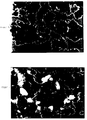
- the added plastic particles are integrated into the sewage sludge flakes in all cases, as shown in Fig. 1 and 2.
- Fig. 1 shows plastic particles with surface modification. This shows that the surface modification causes sewage sludge particles to adhere to the plastic surface can accumulate and allow integration of the ground plastic in the filter cake.
- Fig. 2 there are plastic particles without surface modification. This shows that the surface of the plastic particles is not wetted by sewage sludge and no sewage sludge is deposited.
- the mixture was then placed in a membrane filter press (filter area 40 cm x 40 cm, chamber depth 32 mm, polypropylene filter cloths) for 15 minutes at max. 4 bar filled and pressed for 80 minutes to 15 bar. This resulted in 10.1 kg of filter cake with an average dry matter of 40.45% or an STS content of 36.8%.
- the average calorific value was 4 602 kJ / kg ( ⁇ 1 101 kcal / kg).
Landscapes
- Engineering & Computer Science (AREA)
- Mechanical Engineering (AREA)
- Life Sciences & Earth Sciences (AREA)
- Hydrology & Water Resources (AREA)
- Environmental & Geological Engineering (AREA)
- Water Supply & Treatment (AREA)
- Chemical & Material Sciences (AREA)
- Organic Chemistry (AREA)
- Treatment Of Sludge (AREA)
- Processing And Handling Of Plastics And Other Materials For Molding In General (AREA)
Applications Claiming Priority (2)
| Application Number | Priority Date | Filing Date | Title |
|---|---|---|---|
| DE19924230400 DE4230400A1 (de) | 1992-09-11 | 1992-09-11 | Verfahren zur Verwertung von Kunststoffabfällen |
| DE4230400 | 1992-09-11 |
Publications (3)
| Publication Number | Publication Date |
|---|---|
| EP0587045A2 true EP0587045A2 (fr) | 1994-03-16 |
| EP0587045A3 EP0587045A3 (fr) | 1995-02-15 |
| EP0587045B1 EP0587045B1 (fr) | 1997-02-26 |
Family
ID=6467729
Family Applications (1)
| Application Number | Title | Priority Date | Filing Date |
|---|---|---|---|
| EP19930114034 Expired - Lifetime EP0587045B1 (fr) | 1992-09-11 | 1993-09-02 | Procédé pour l'utilisation de déchets en plastique |
Country Status (4)
| Country | Link |
|---|---|
| US (1) | US5402946A (fr) |
| EP (1) | EP0587045B1 (fr) |
| AT (1) | ATE149150T1 (fr) |
| DE (2) | DE4230400A1 (fr) |
Cited By (3)
| Publication number | Priority date | Publication date | Assignee | Title |
|---|---|---|---|---|
| WO2003018488A3 (fr) * | 2001-08-22 | 2003-07-03 | Emschergenossenschaft | Procede de traitement de boues |
| CN103553293A (zh) * | 2013-11-07 | 2014-02-05 | 上海环保工程成套有限公司 | 一种利用填埋场稳定化污泥焚烧残渣固化新鲜污泥的深度脱水方法 |
| CN104761111A (zh) * | 2015-04-14 | 2015-07-08 | 湖南大学 | 一种稻壳粉调理污泥焚烧渣制备及其调理城市污泥的方法 |
Families Citing this family (4)
| Publication number | Priority date | Publication date | Assignee | Title |
|---|---|---|---|---|
| KR100491329B1 (ko) * | 2003-05-20 | 2005-05-25 | 한국에너지기술연구원 | 슬러지-석탄-기름 공동응집법에 의한 하수 슬러지 처리 방법 |
| US20110084029A1 (en) * | 2009-10-08 | 2011-04-14 | Dominick O' Reilly | Waste treatment system |
| US20110089097A1 (en) * | 2009-10-19 | 2011-04-21 | O'reilly Dominick | Attachment and system for dewatering material |
| US20120261351A1 (en) * | 2011-04-13 | 2012-10-18 | Dominic O Rathallaigh | System and method for treating waste |
Family Cites Families (6)
| Publication number | Priority date | Publication date | Assignee | Title |
|---|---|---|---|---|
| US3579320A (en) * | 1969-08-18 | 1971-05-18 | Gen Ecological Systems Inc | Process for producing and recovering valuable materials from municipal waste |
| US3736223A (en) * | 1970-12-01 | 1973-05-29 | Black Clawson Co | Waste treatment and fiber reclamation system |
| US3910775A (en) * | 1974-02-22 | 1975-10-07 | Fox John M | Method and apparatus for processing refuse, sewage and/or waste material into a source of energy |
| DE2616664A1 (de) * | 1976-04-15 | 1977-10-27 | Lothar Schaedel | Verfahren zum aufbereiten von faekalschlamm |
| US4586659A (en) * | 1981-04-06 | 1986-05-06 | Easter Ii James M | Systemitized waste product separation and total utilization |
| CH660588A5 (de) * | 1982-10-26 | 1987-05-15 | Sulzer Ag | Verfahren zum entfernen von farbstoffen, pigmenten und/oder optischen aufhellern aus abwaessern. |
-
1992
- 1992-09-11 DE DE19924230400 patent/DE4230400A1/de not_active Withdrawn
-
1993
- 1993-09-02 DE DE59305523T patent/DE59305523D1/de not_active Expired - Lifetime
- 1993-09-02 AT AT93114034T patent/ATE149150T1/de not_active IP Right Cessation
- 1993-09-02 EP EP19930114034 patent/EP0587045B1/fr not_active Expired - Lifetime
- 1993-09-07 US US08/116,954 patent/US5402946A/en not_active Expired - Fee Related
Cited By (5)
| Publication number | Priority date | Publication date | Assignee | Title |
|---|---|---|---|---|
| WO2003018488A3 (fr) * | 2001-08-22 | 2003-07-03 | Emschergenossenschaft | Procede de traitement de boues |
| CN103553293A (zh) * | 2013-11-07 | 2014-02-05 | 上海环保工程成套有限公司 | 一种利用填埋场稳定化污泥焚烧残渣固化新鲜污泥的深度脱水方法 |
| CN103553293B (zh) * | 2013-11-07 | 2014-12-24 | 上海环保工程成套有限公司 | 一种利用填埋场稳定化污泥焚烧残渣固化新鲜污泥的深度脱水方法 |
| CN104761111A (zh) * | 2015-04-14 | 2015-07-08 | 湖南大学 | 一种稻壳粉调理污泥焚烧渣制备及其调理城市污泥的方法 |
| CN104761111B (zh) * | 2015-04-14 | 2016-06-08 | 湖南大学 | 一种稻壳粉调理污泥焚烧渣制备及其调理城市污泥的方法 |
Also Published As
| Publication number | Publication date |
|---|---|
| ATE149150T1 (de) | 1997-03-15 |
| DE59305523D1 (de) | 1997-04-03 |
| US5402946A (en) | 1995-04-04 |
| EP0587045A3 (fr) | 1995-02-15 |
| DE4230400A1 (de) | 1994-03-17 |
| EP0587045B1 (fr) | 1997-02-26 |
Similar Documents
| Publication | Publication Date | Title |
|---|---|---|
| EP0056090B1 (fr) | Procédé de déshydrater des boues contenant de l'huile minérale en récupérant la portion d'huile | |
| DE19900187C1 (de) | Verfahren zur Entwässerung von Klärschlämmen mit Plattenfiltern (Filterpressen) | |
| EP0019176B1 (fr) | Procédé pour la déshydratation de boues d'eaux résiduaires sur les filtres-presses | |
| DE3217041A1 (de) | Verfahren zum verbessern der schlammvolumenkennzahl eines fluessigkeitsgemisches in einem belueftungsbecken | |
| EP0110208A2 (fr) | Procédé pour l'utilisation des boues d'égouts | |
| WO2008037588A1 (fr) | Procédé de séparation de la suie d'un courant d'eaux usées | |
| EP0587045B1 (fr) | Procédé pour l'utilisation de déchets en plastique | |
| DE19508785A1 (de) | Verfahren und Anlage zur Behandlung von Restmüll | |
| EP0053250B1 (fr) | Procédé pour la déshydratation de boues des eaux d'égout dans des filtres-presses | |
| EP0441209B1 (fr) | Procédé pour l'utilisation de suie provenant de la production de gaz de synthèse | |
| EP1687093A1 (fr) | Procede et dispositif de traitement par voie humide et mecanique d'un melange de substances, en particulier de dechets de tous types | |
| EP0053251B1 (fr) | Procédé pour la déshydratation de boues des eaux d'égout dans des filtres-presses | |
| EP0481397B1 (fr) | Procédé pour la déshydratation de suspensions ou de mélanges boueux similaires | |
| DE2410394A1 (de) | Verfahren zum entwaessern eines waessrigen schlamms dispergierten, fein zerkleinerten feststoffes | |
| DE2653823A1 (de) | Verfahren zum verbrennen von abwasser- bzw. klaerschlamm | |
| EP0271628B1 (fr) | Procédé de fabrication d'un produit amélioré à partir des boues résiduaires | |
| EP0226787A2 (fr) | Procédé de traitement de boues contenant des métaux lourds | |
| DE3606704C2 (de) | Verfahren zur Herstellung hochkalorischer industrieller Billigbrennstoffe unter gleichzeitiger Entsorgung industrieller und/oder kommunaler Klärschlämme und Verwendung der entstehenden Suspension | |
| DE3015246C2 (fr) | ||
| EP0690026A2 (fr) | Procédé pour la filtration et déshydratation des boues des eaux d'égout | |
| EP0473943B1 (fr) | Procédé et installation pour le traitement des boues d'épuration pour leur décharge | |
| DE2258341A1 (de) | Nebenprodukt staedtischen abfalls | |
| AT388724B (de) | Verfahren zur herstellung eines veredelungsproduktes aus klaerschlaemmen | |
| AT405827B (de) | Verfahren und anlage zur behandlung von restmüll | |
| DE19638414A1 (de) | Verfahren und Vorrichtung zur Reinigung von kommunalen bzw. häuslichen Abwässern |
Legal Events
| Date | Code | Title | Description |
|---|---|---|---|
| PUAI | Public reference made under article 153(3) epc to a published international application that has entered the european phase |
Free format text: ORIGINAL CODE: 0009012 |
|
| AK | Designated contracting states |
Kind code of ref document: A2 Designated state(s): AT BE CH DE FR GB IT LI NL |
|
| PUAL | Search report despatched |
Free format text: ORIGINAL CODE: 0009013 |
|
| AK | Designated contracting states |
Kind code of ref document: A3 Designated state(s): AT BE CH DE FR GB IT LI NL |
|
| 17P | Request for examination filed |
Effective date: 19950123 |
|
| GRAG | Despatch of communication of intention to grant |
Free format text: ORIGINAL CODE: EPIDOS AGRA |
|
| 17Q | First examination report despatched |
Effective date: 19960628 |
|
| GRAH | Despatch of communication of intention to grant a patent |
Free format text: ORIGINAL CODE: EPIDOS IGRA |
|
| GRAH | Despatch of communication of intention to grant a patent |
Free format text: ORIGINAL CODE: EPIDOS IGRA |
|
| GRAA | (expected) grant |
Free format text: ORIGINAL CODE: 0009210 |
|
| AK | Designated contracting states |
Kind code of ref document: B1 Designated state(s): AT BE CH DE FR GB IT LI NL |
|
| REF | Corresponds to: |
Ref document number: 149150 Country of ref document: AT Date of ref document: 19970315 Kind code of ref document: T |
|
| REG | Reference to a national code |
Ref country code: CH Ref legal event code: EP |
|
| REF | Corresponds to: |
Ref document number: 59305523 Country of ref document: DE Date of ref document: 19970403 |
|
| GBT | Gb: translation of ep patent filed (gb section 77(6)(a)/1977) |
Effective date: 19970314 |
|
| ITF | It: translation for a ep patent filed | ||
| ET | Fr: translation filed | ||
| PLBE | No opposition filed within time limit |
Free format text: ORIGINAL CODE: 0009261 |
|
| 26N | No opposition filed | ||
| PGFP | Annual fee paid to national office [announced via postgrant information from national office to epo] |
Ref country code: FR Payment date: 19980824 Year of fee payment: 6 |
|
| PGFP | Annual fee paid to national office [announced via postgrant information from national office to epo] |
Ref country code: NL Payment date: 19980831 Year of fee payment: 6 |
|
| PGFP | Annual fee paid to national office [announced via postgrant information from national office to epo] |
Ref country code: GB Payment date: 19980901 Year of fee payment: 6 |
|
| PGFP | Annual fee paid to national office [announced via postgrant information from national office to epo] |
Ref country code: AT Payment date: 19980903 Year of fee payment: 6 |
|
| PGFP | Annual fee paid to national office [announced via postgrant information from national office to epo] |
Ref country code: CH Payment date: 19980907 Year of fee payment: 6 |
|
| PGFP | Annual fee paid to national office [announced via postgrant information from national office to epo] |
Ref country code: BE Payment date: 19980908 Year of fee payment: 6 |
|
| PGFP | Annual fee paid to national office [announced via postgrant information from national office to epo] |
Ref country code: DE Payment date: 19980922 Year of fee payment: 6 |
|
| PG25 | Lapsed in a contracting state [announced via postgrant information from national office to epo] |
Ref country code: GB Free format text: LAPSE BECAUSE OF NON-PAYMENT OF DUE FEES Effective date: 19990902 Ref country code: AT Free format text: LAPSE BECAUSE OF NON-PAYMENT OF DUE FEES Effective date: 19990902 |
|
| PG25 | Lapsed in a contracting state [announced via postgrant information from national office to epo] |
Ref country code: DE Free format text: LAPSE BECAUSE OF THE APPLICANT RENOUNCES Effective date: 19990928 |
|
| PG25 | Lapsed in a contracting state [announced via postgrant information from national office to epo] |
Ref country code: LI Free format text: LAPSE BECAUSE OF NON-PAYMENT OF DUE FEES Effective date: 19990930 Ref country code: CH Free format text: LAPSE BECAUSE OF NON-PAYMENT OF DUE FEES Effective date: 19990930 Ref country code: BE Free format text: LAPSE BECAUSE OF NON-PAYMENT OF DUE FEES Effective date: 19990930 |
|
| BERE | Be: lapsed |
Owner name: BASF A.G. Effective date: 19990930 |
|
| PG25 | Lapsed in a contracting state [announced via postgrant information from national office to epo] |
Ref country code: NL Free format text: LAPSE BECAUSE OF NON-PAYMENT OF DUE FEES Effective date: 20000401 |
|
| GBPC | Gb: european patent ceased through non-payment of renewal fee |
Effective date: 19990902 |
|
| REG | Reference to a national code |
Ref country code: CH Ref legal event code: PL |
|
| PG25 | Lapsed in a contracting state [announced via postgrant information from national office to epo] |
Ref country code: FR Free format text: LAPSE BECAUSE OF NON-PAYMENT OF DUE FEES Effective date: 20000531 |
|
| NLV4 | Nl: lapsed or anulled due to non-payment of the annual fee |
Effective date: 20000401 |
|
| REG | Reference to a national code |
Ref country code: FR Ref legal event code: ST |
|
| PG25 | Lapsed in a contracting state [announced via postgrant information from national office to epo] |
Ref country code: IT Free format text: LAPSE BECAUSE OF NON-PAYMENT OF DUE FEES;WARNING: LAPSES OF ITALIAN PATENTS WITH EFFECTIVE DATE BEFORE 2007 MAY HAVE OCCURRED AT ANY TIME BEFORE 2007. THE CORRECT EFFECTIVE DATE MAY BE DIFFERENT FROM THE ONE RECORDED. Effective date: 20050902 |