EP0587242A2 - Dispositif de renseignement - Google Patents
Dispositif de renseignement Download PDFInfo
- Publication number
- EP0587242A2 EP0587242A2 EP93202582A EP93202582A EP0587242A2 EP 0587242 A2 EP0587242 A2 EP 0587242A2 EP 93202582 A EP93202582 A EP 93202582A EP 93202582 A EP93202582 A EP 93202582A EP 0587242 A2 EP0587242 A2 EP 0587242A2
- Authority
- EP
- European Patent Office
- Prior art keywords
- announcement
- information
- control circuit
- sequence
- circuit
- Prior art date
- Legal status (The legal status is an assumption and is not a legal conclusion. Google has not performed a legal analysis and makes no representation as to the accuracy of the status listed.)
- Withdrawn
Links
Images
Classifications
-
- H—ELECTRICITY
- H04—ELECTRIC COMMUNICATION TECHNIQUE
- H04M—TELEPHONIC COMMUNICATION
- H04M3/00—Automatic or semi-automatic exchanges
- H04M3/42—Systems providing special services or facilities to subscribers
- H04M3/50—Centralised arrangements for answering calls; Centralised arrangements for recording messages for absent or busy subscribers ; Centralised arrangements for recording messages
- H04M3/51—Centralised call answering arrangements requiring operator intervention, e.g. call or contact centers for telemarketing
-
- G—PHYSICS
- G10—MUSICAL INSTRUMENTS; ACOUSTICS
- G10L—SPEECH ANALYSIS TECHNIQUES OR SPEECH SYNTHESIS; SPEECH RECOGNITION; SPEECH OR VOICE PROCESSING TECHNIQUES; SPEECH OR AUDIO CODING OR DECODING
- G10L13/00—Speech synthesis; Text to speech systems
- G10L13/02—Methods for producing synthetic speech; Speech synthesisers
-
- H—ELECTRICITY
- H04—ELECTRIC COMMUNICATION TECHNIQUE
- H04M—TELEPHONIC COMMUNICATION
- H04M3/00—Automatic or semi-automatic exchanges
- H04M3/42—Systems providing special services or facilities to subscribers
- H04M3/487—Arrangements for providing information services, e.g. recorded voice services or time announcements
- H04M3/493—Interactive information services, e.g. directory enquiries ; Arrangements therefor, e.g. interactive voice response [IVR] systems or voice portals
-
- H—ELECTRICITY
- H04—ELECTRIC COMMUNICATION TECHNIQUE
- H04M—TELEPHONIC COMMUNICATION
- H04M3/00—Automatic or semi-automatic exchanges
- H04M3/42—Systems providing special services or facilities to subscribers
- H04M3/487—Arrangements for providing information services, e.g. recorded voice services or time announcements
- H04M3/493—Interactive information services, e.g. directory enquiries ; Arrangements therefor, e.g. interactive voice response [IVR] systems or voice portals
- H04M3/4931—Directory assistance systems
Definitions
- Such an information device with an exchange and an information processing circuit is known from the essay "Place control technology for telephone information points" by Joachim Göldenitz, instruction sheets F, vol. 42/1989, No. 9, pages 287 to 295.
- the exchange establishes a coupling with subscriber terminals from subscribers looking for information and subscriber terminals from inquiry stations via a communications network.
- the information processing circuit determines the sought number (announcement information) from its memory (database) and supplies it to a voice output circuit.
- the information processing circuit also gives the control instruction via a control connection to the exchange that the voice output circuit is coupled to the subscriber terminal.
- the voice signal output by the voice output circuit is fed to the exchange.
- the speech output module is therefore controlled by the information processing circuit. Furthermore, the possibility is known from the article (page 290, chapter 5.2) of supplying the telephone number via the control connection to the switching center and letting the switching center carry out the voice output. How the voice output is carried out is not described.
- the invention has for its object to provide an information device of the type mentioned, which performs a flexible and easily changeable voice output with less hardware effort.
- the information processing circuit is provided for inserting an announcement identifier and / or parameters into a message block
- the exchange is provided after evaluating a message block on the basis of the announcement identifier and / or the parameters for forming an announcement sequence and for supplying the announcement sequence to the voice output circuit contained in the exchange and that the speech output circuit is provided for assembling speech fragments into a speech signal according to the instruction in the announcement sequence.
- the voice output circuit is part of the exchange.
- Control information and also announcement information are transmitted between the switching center and the information processing circuit via the control connection. Because of the control information also provided via the control connection, the announcement information must be from the Information processing circuit are appropriately transmitted and labeled.
- a message block is used for this.
- An announcement identifier and, if necessary, parameters are transmitted with the message block.
- Such an announcement identifier identifies types of announcement texts.
- An announcement sequence which contains announcement sequence parts, is formed in the exchange from the announcement identifier.
- a parameter identifies a variable announcement sequence part, ie variable numbers, letters and / or text parts.
- the fixed announcement sequence parts identify speech fragments or text parts that are put together in a speech output circuit to form a speech signal. For example, if the information processing circuit could not determine the number sought, the announcement identifier may be "00".
- the switching center uses the announcement identifier to assemble an announcement sequence from several announcement sequence parts. With an announcement identifier "00", for example, the announcement sequence parts "KE" and "WA” are included in the announcement sequence.
- the text parts "There is unfortunately no entry for the subscriber concerned" and "If you want further information, please stay on the phone” are formed in the speech output module.
- the announcement identifier therefore specifies the type of an announcement sequence.
- the voice signal that can be fed to the subscriber terminal is thus formed in the voice output circuit from the announcement sequence.
- Codewords for voice fragments for the digits of the call number may also be present in the announcement sequence. For example, the code word "160" can be included for the number 1 in the announcement sequence.
- the information processing circuit contains a first control circuit which is provided for taking parameters from a memory and for forming a message block. Parameters can only be fetched from the memory if they are stored there. In addition to the announcement identifier and the parameter, such a message block can also contain the destination of the message block and the type of message (e.g. call number transmission).
- a second control circuit which is used to evaluate the message block received by the information processing circuit, to form an announcement sequence with at least one fixed and / or variable announcement sequence part containing numbers, letters and text parts and to supply the announcement sequence to the speech output circuit.
- an announcement sequence is formed in the second control circuit.
- This announcement sequence contains fixed announcement sequence parts and variable announcement sequence parts.
- the fixed announcement sequence parts contain announcement sequence parts which, for example, code the text "I repeat". For example, digits of a telephone number are contained in the variable announcement sequence part.
- a voice signal is formed from the announcement sequence parts in the voice output circuit.
- the fixed and variable announcement sequence parts formed in the second control circuit can occur multiple times and in any order.
- the speech output circuit inserts emphasized digits in the voice signal.
- the second control circuit is therefore provided for determining the positions of at least the numbers and / or letters of the parameters and for forming the variable announcement sequence part with additional information about the emphasis to be made depending on the position of a number.
- a number should have an emphasis that depends on the position, for example in the phone number. The emphasis of a number at the beginning of a number can differ from the number at the end of a number.
- Message blocks with control information are also transmitted via the control connection. If e.g. If the speech output circuit in the switching technology has failed, that is to say is no longer available, or is of limited use, this availability information can be transmitted from the switching technology to the information processing circuit.
- the second control circuit is therefore provided by means of a message block for reporting to the first control circuit about the usage restriction or the availability of the voice output.
- the first control circuit is used to evaluate the message block and to report the restriction of use or the availability of the speech output to connected information input and output devices. Likewise, for example, the availability of the information processing circuit can be reported to the information input and output devices.
- a coupling field in the exchange serves to carry out the coupling between a subscriber terminal connected via a network and the information terminals or the voice output circuit.
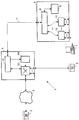
- An information device 1 (telephone information center), which is connected to at least one subscriber terminal 3 via a communications network 2, contains a switching center 4 and an information processing circuit 5.
- a number of information terminal devices 6 are connected to the switching center 4. For simplification, only a single information terminal is shown in the figure.
- Each information terminal 6 is assigned an information and output device 7, which is connected to the information processing circuit 5. For simplification, only one information input and output device 7 is also shown.
- the information processing circuit 5 contains a first control circuit 8, a memory 9 (database) and a plurality of interface circuits 10.
- the information input and output devices 7 are coupled to the interface circuits 10.
- the first control circuit 8 is also connected to the interface circuits 10 and to the memory 9. Messages or data between the information processing circuit 5 and the switching center 4 are transmitted via a control connection 11.
- the switching center 4 contains a second control circuit 12, a switching matrix 13 and a voice output circuit 14.
- the switching matrix 13 is coupled to the information terminals 6, to the voice output circuit 14 and to the communications network 2.
- the switching matrix 13 and the speech output circuit 14 are controlled by the second control circuit 12.
- the coupling field 13 establishes a coupling between a subscriber terminal 3 and an information terminal 6.
- the participant could also request information about lottery numbers, weather reports, sporting events, etc.
- An information worker inputs data into the information input and output device 7, which are fed to the first control circuit 8 via an interface circuit 10.
- the first control circuit 8 determines the assigned call number from the memory 9. This call number is transmitted to the second control circuit 12 by means of a message block via the control connection 11.
- the second control circuit 12 sends to the speech output circuit 14 an announcement sequence, which is converted into a speech signal.
- the second control circuit 12 controls the switching matrix 13 so that it carries out a connection between the subscriber terminal 3 and the voice output circuit 14.
- the speech signal can then be fed from the speech output circuit 14 to the subscriber to his subscriber terminal 3.
- the information processing circuit 5 can convey to the switching center 4, by means of the message blocks, the information as to whether there is an entry in the memory 9 or the subscriber's telephone number with the area code.
- a fax number, the associated area code and / or the device class of the fax device can also be transmitted.
- the transmission of further information is conceivable.
- Is in the message block contain at least the type of message (here: caller ID), the destination of the message block (here: exchange 4), an announcement ID and the phone number, for example, with the area code (parameters).
- the announcement identifier indicates the type of an announcement and thus identifies an announcement structure.
- the announcement identifier can consist of two binary characters or digits.
- the announcement identifier "00" could be assigned.
- the announcement identifier "01" can be selected for the announcement of a number with the area code of a telephone connection.
- the call number of a fax connection with the local area code and the device class of the fax machine can have the announcement identifier "03".
- the announcement identifier is therefore transmitted to the exchange 4 with several parameters (telephone number, area code, etc.).
- the message blocks received by the information processing circuit 5 are evaluated in the second control circuit 12.
- a certain announcement sequence is stored in the second control circuit 12 for each announcement identifier.
- This announcement sequence consists of fixed and variable announcement sequence parts.
- An announcement sequence for the announcement of a phone number with a local area code can be composed of announcement sequence parts as follows: "RN - R - WH - R - OK - O - RN - R - OK - O - WA".
- the announcement sequence can have the following structure: "KE - WA”.
- the announcement sequence parts can also be composed differently in the second control circuit 12 and also changed without the message block having to be changed.
- the announcement sequence is fed to the speech output circuit 14, which forms a speech signal therefrom.
- speech fragments i.e. recorded language, saved.
- recorded digits, letters and parts of text are stored as speech fragments in the speech output circuit 14. These speech fragments are put together in the speech output circuit 14 to form a speech signal.
- variable announcement sequence parts contain codings over the speech pauses between the numbers and the letters. Furthermore, the variable announcement sequence parts can each contain a coding by emphasizing the numbers and letters. The emphasis of the digits and letters depends on their position in the phone number or the area code. This position is determined the control circuit 12. In the speech output circuit 14, several speech fragments for the same numbers and letters are stored, each with a different emphasis. If there are three emphasis variants for a number and a letter, each letter and each number can be coded by three code words in a variable announcement sequence part. For example, the digits 0 to 9 can be encoded by the code words "159" to "188". A first emphasis of the digits is given by the code words "159" to "168", a second emphasis by the code words "169" to "178” and a third emphasis by the code words "179" to "188".
- the speech output in the switching center 4 is restricted in its usability (malfunction)
- this is communicated to the information processing circuit 5 via a message block generated by the second control circuit 12.
- This message block also has at least the destination of the message block (information processing circuit 5), the message type (fault message) and the information that a fault is present, and possibly the information about the type and location of the fault.
- the message block thus indicates that the speech output is either restricted or not available.
- the received message block is evaluated in the first control circuit 8 and the unavailability of the speech output is reported to the information input and output devices 7.
Landscapes
- Engineering & Computer Science (AREA)
- Signal Processing (AREA)
- Business, Economics & Management (AREA)
- Marketing (AREA)
- Computational Linguistics (AREA)
- Health & Medical Sciences (AREA)
- Audiology, Speech & Language Pathology (AREA)
- Human Computer Interaction (AREA)
- Physics & Mathematics (AREA)
- Acoustics & Sound (AREA)
- Multimedia (AREA)
- Telephonic Communication Services (AREA)
Applications Claiming Priority (2)
| Application Number | Priority Date | Filing Date | Title |
|---|---|---|---|
| DE19924230277 DE4230277A1 (de) | 1992-09-10 | 1992-09-10 | Auskunftsvorrichtung |
| DE4230277 | 1992-09-10 |
Publications (2)
| Publication Number | Publication Date |
|---|---|
| EP0587242A2 true EP0587242A2 (fr) | 1994-03-16 |
| EP0587242A3 EP0587242A3 (fr) | 1994-10-12 |
Family
ID=6467670
Family Applications (1)
| Application Number | Title | Priority Date | Filing Date |
|---|---|---|---|
| EP19930202582 Withdrawn EP0587242A3 (fr) | 1992-09-10 | 1993-09-03 | Dispositif de renseignement. |
Country Status (3)
| Country | Link |
|---|---|
| EP (1) | EP0587242A3 (fr) |
| JP (1) | JPH07297927A (fr) |
| DE (1) | DE4230277A1 (fr) |
Families Citing this family (1)
| Publication number | Priority date | Publication date | Assignee | Title |
|---|---|---|---|---|
| DE10034938A1 (de) * | 2000-07-12 | 2002-01-24 | Deutsche Telekom Ag | Mobilfunksystem und Verfahren zur Realisierung eines Mobilfunknetzes unter Verwendung dieses Mobilfunksystems |
Family Cites Families (4)
| Publication number | Priority date | Publication date | Assignee | Title |
|---|---|---|---|---|
| JPS61201549A (ja) * | 1985-03-04 | 1986-09-06 | Toshiba Corp | 電話端末メツセ−ジ通信方式 |
| DE3632341C2 (de) * | 1986-09-24 | 1996-11-14 | Sel Alcatel Ag | Sprachausgabeeinheit |
| WO1989000793A1 (fr) * | 1987-07-10 | 1989-01-26 | American Telephone & Telegraph Company | Systemes d'assistance pour recherche de numero dans l'annuaire telephonique |
| WO1989012938A1 (fr) * | 1988-06-14 | 1989-12-28 | Fujitsu Limited | Systeme de commande de reponse |
-
1992
- 1992-09-10 DE DE19924230277 patent/DE4230277A1/de not_active Ceased
-
1993
- 1993-09-03 EP EP19930202582 patent/EP0587242A3/fr not_active Withdrawn
- 1993-09-08 JP JP22316193A patent/JPH07297927A/ja active Pending
Also Published As
| Publication number | Publication date |
|---|---|
| DE4230277A1 (de) | 1994-03-17 |
| JPH07297927A (ja) | 1995-11-10 |
| EP0587242A3 (fr) | 1994-10-12 |
Similar Documents
| Publication | Publication Date | Title |
|---|---|---|
| DE19818354B4 (de) | Verfahren und Vorrichtung zum Darstellen von Nummern in einem Fernmeldenetz | |
| DE1263069B (de) | Verfahren zum Verbinden eines Datenverarbeitungssystems mit entfernt angeordneten wählbaren Teilnehmerstationen über Telefonleitungen | |
| EP0589526A2 (fr) | Réseau Numérique à Intégration des Services (RNIS) et terminal RNI | |
| EP0655870B1 (fr) | Exécution de services dans un système de communications | |
| DE19630456B4 (de) | ISDN-Telefon | |
| EP0587242A2 (fr) | Dispositif de renseignement | |
| DE2347378C2 (de) | Nachrichtenvermittlung mit digitalcodierten Informationen | |
| DE3542969C2 (fr) | ||
| EP0616457A1 (fr) | Procédé et dispositif pour étendre la zone d'utilisation des combinés en téléphonie sans fil | |
| EP0460403B1 (fr) | Procédé pour la transmission de signaux de données dans des centraux de communication | |
| EP0242770B1 (fr) | Méthode pour réaliser différents processus dans un terminal numérique de télécommunication adapté pour la transmission de paroles et de données | |
| DE19752607A1 (de) | Verfahren und Vorrichtung zum Austausch anwendungsspezifischer Daten zwischen einem Intelligenten Netz und datenfähigen Endgeräten | |
| EP0197290B1 (fr) | Agencement pour centraux de télécommunications, en particulier pour centraux téléphoniques dans lesquels une information de type précède les informations à transmettre | |
| DE2929433C2 (de) | Schaltungsanordnung für die Durchwahl von öffentlichen Selbstwählanlagen zu Nebenstellenanlagen | |
| EP0163095A2 (fr) | Système de recherche de personne par radio | |
| DE2744692C3 (de) | Schaltungsanordnung für eine Fernmelde-, insbesondere Betriebsfernsprechanlage mit mindestens einem Bedienungsplatz | |
| DE3137094C2 (fr) | ||
| EP0010264A1 (fr) | Commutateur télégraphique privé | |
| DE10138102A1 (de) | Telefonkonferenzsystem und Verfahren zum Durchführen einer Telefonkonferenz | |
| DE3525106C2 (fr) | ||
| EP0905955A2 (fr) | Méthode pour fournir des fonctions à un terminal pour un réseau de télécommunication ainsi qu'un terminal et un dispositif de mise à disposition de données pour celui-ci | |
| DE3415008A1 (de) | Systemanordnung fuer die elektrische signaluebertragung und signalverarbeitung | |
| DE10013902A1 (de) | Verfahren zur Übertragung von Teilnehmeridentifikationsdaten, Telekommunikationsgerät und Austauscheinheit | |
| DE1100710B (de) | Schaltungsanordnung fuer in beiden Richtungen brauchbare Fern- oder Verbindungsleitungen in Fernsprechanlagen | |
| EP0185929A2 (fr) | Montage pour centraux de télécommunication, en particulier centraux téléphoniques dans lesquels des sous-centraux sont connectés aux centraux par des faisceaux de lignes |
Legal Events
| Date | Code | Title | Description |
|---|---|---|---|
| PUAI | Public reference made under article 153(3) epc to a published international application that has entered the european phase |
Free format text: ORIGINAL CODE: 0009012 |
|
| AK | Designated contracting states |
Kind code of ref document: A2 Designated state(s): DE FR GB IT |
|
| RIN1 | Information on inventor provided before grant (corrected) |
Inventor name: HAEUSSLER, ROLF C/O PHILIPS PATENTVERWALTUNG GMBH Inventor name: EHRLINGER, DAGMAR C/O PHILIPS Inventor name: KRATSCHMEYER, GUENTHER C/O PHILIPS Inventor name: DANZER, WERNER C/O PHILIPS PATENTVERWALTUNG GMBH Inventor name: GANTNER, LOTHAR, C/O PHILIPS PATENTVERWALTUNG GMBH |
|
| RAP1 | Party data changed (applicant data changed or rights of an application transferred) |
Owner name: N.V. PHILIPS' GLOEILAMPENFABRIEKEN Owner name: PHILIPS PATENTVERWALTUNG GMBH |
|
| PUAL | Search report despatched |
Free format text: ORIGINAL CODE: 0009013 |
|
| AK | Designated contracting states |
Kind code of ref document: A3 Designated state(s): DE FR GB IT |
|
| K1C1 | Correction of patent application (title page) published |
Effective date: 19940316 |
|
| 18D | Application deemed to be withdrawn |
Effective date: 19950413 |