EP0587361A2 - Schützende Kopfbedeckung - Google Patents
Schützende Kopfbedeckung Download PDFInfo
- Publication number
- EP0587361A2 EP0587361A2 EP93306840A EP93306840A EP0587361A2 EP 0587361 A2 EP0587361 A2 EP 0587361A2 EP 93306840 A EP93306840 A EP 93306840A EP 93306840 A EP93306840 A EP 93306840A EP 0587361 A2 EP0587361 A2 EP 0587361A2
- Authority
- EP
- European Patent Office
- Prior art keywords
- hair net
- web
- hair
- metal
- metallic
- Prior art date
- Legal status (The legal status is an assumption and is not a legal conclusion. Google has not performed a legal analysis and makes no representation as to the accuracy of the status listed.)
- Withdrawn
Links
Images


Classifications
-
- D—TEXTILES; PAPER
- D06—TREATMENT OF TEXTILES OR THE LIKE; LAUNDERING; FLEXIBLE MATERIALS NOT OTHERWISE PROVIDED FOR
- D06H—MARKING, INSPECTING, SEAMING OR SEVERING TEXTILE MATERIALS
- D06H1/00—Marking textile materials; Marking in combination with metering or inspecting
-
- A—HUMAN NECESSITIES
- A42—HEADWEAR
- A42B—HATS; HEAD COVERINGS
- A42B1/00—Hats; Caps; Hoods
- A42B1/012—Sanitary or disposable, e.g. for use in hospitals or food industry
-
- D—TEXTILES; PAPER
- D04—BRAIDING; LACE-MAKING; KNITTING; TRIMMINGS; NON-WOVEN FABRICS
- D04B—KNITTING
- D04B21/00—Warp knitting processes for the production of fabrics or articles not dependent on the use of particular machines; Fabrics or articles defined by such processes
- D04B21/20—Warp knitting processes for the production of fabrics or articles not dependent on the use of particular machines; Fabrics or articles defined by such processes specially adapted for knitting articles of particular configuration
- D04B21/207—Wearing apparel or garment blanks
-
- D—TEXTILES; PAPER
- D10—INDEXING SCHEME ASSOCIATED WITH SUBLASSES OF SECTION D, RELATING TO TEXTILES
- D10B—INDEXING SCHEME ASSOCIATED WITH SUBLASSES OF SECTION D, RELATING TO TEXTILES
- D10B2501/00—Wearing apparel
- D10B2501/04—Outerwear; Protective garments
- D10B2501/042—Headwear
Definitions
- the present invention relates to protective headwear for use in food manufacturing, processing and preparation industries, and in particular to headwear incorporating features allowing for the detection thereof by means of metal detection systems.
- hair nets and other similar head coverings are used in order to prevent hair and other contaminants from so contaminating the food products.
- hair net also encompasses all other forms of such protective headwear.
- the automatic metal detection systems are, for example, designed to be able to detect metal objects passing thereby within food ingredients in powder, liquid and solid form at various stages of the manufacturing process, as well as within final packaged products.
- hair nets manufactured without the use of metal staples are disadvantageous, at least in that they may well remain largely undetected, and will certainly not be detectable with the metal detection systems now commonly installed in food processing plants.
- a hair net formed from a woven or knitted fabric, and including one or more metallic fibres incorporated within said hair net in sufficient quantity to render said hair net metal detectable.
- a method of manufacturing a plurality of hair nets by knitting two continuous webs of material in overlying relationship, the webs of material including one or more metallic fibres and the webs being joined during the knitting process:
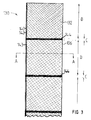
- a long, continuous web of net material 5 incorporates a net portion including web fibres 12 and two elasticated hems 10 which terminate the lateral edges of the web.
- the two elasticated hems 10 are brought together at binding portions 14, where two metal staples 16,18 may be applied around the binding portion 14 in order to bind the two elasticated hems 10 and all of the web fibres 12 in the net portion together.
- the web is then severed between the staples 16,18. Repetition of this operation further down the length of the web results in formation of a hair net 20.
- the presence of the metal staples 16,18 is undesirable in the food manufacturing environment in that staples may become dislodged and accidentally or maliciously enter the food product.
- Exemplary prior art techniques for providing the binding function without using metal staples include the use of two knots in the web 5 in place of the staples, fabric ties or, in the case of plastic based webbing material, heat welding the elasticated hems 10 and individual web fibres 12 together. As has been described, this results in the hair net being rendered non-detectable by metal detectors commonly installed in food manufacturing production lines.
- a long, continuous web of net material 30 incorporates a net portion including web fibres 12 and two elasticated hems 10 which terminate the lateral edges of the web in similar manner to that of figure 1.
- the two elasticated hems 10 are brought together at binding portions 14, where the elasticated hems 10 and web fibres 12 are bound without using metal staples, for example by knots 32, or other suitable technique as already described with reference to figure 1.
- the web is severed between knots 32, resulting in formation of hair net 40.
- the web fibres 12 are typically monofilament plastic threads such as nylon or polyester. Elasticated threads are inserted to create the elasticated hems 10.
- the web of net material incorporates at regular intervals metallic fibres 34 which, for clarity, are shown in the drawing thicker than the plastic web fibres 12.
- the metallic fibre 34 is, however, any suitable gauge fibre.
- the metallic fibre 34 may be a textile yarn containing a certain percentage of stainless steel fibre or other suitable metallic compound, and such yarns are readily available in various types to suit incorporation with the web fibres 12. Alternatively, 100% metal filaments may be used as the metallic fibre.
- Such filaments or fibres are readily available for use in the manufacture of carpets having antistatic properties, and examples are Bekitex yarn types H54, BK50, or Bekinox VN continuous filament yarns (Bekitex and Bekinox are Registered Trade Marks).
- the spacing of the metallic fibres 34 in the web material is arranged such that sufficient metal is incorporated within a single hair net 40 to be detectable by a metal detection system as commonly installed in a food production line.
- the exact spacing of fibres will therefore depend upon a number of factors including: a) the quantity of web material 30 used to make a single hair net 40; b) the quantity of metal in each metallic fibre 34; and c) the sensitivity of the individual metal detection systems being used to the particular metallic fibre being incorporated into the hair net.
- Metal detection systems depend upon the type and size of product. They are designed to detect over certain distances. Thus for larger objects, such as loaves of bread, more metal may be required to compensate for the distance or cross-sectional area over which the detection system must operate. For smaller objects, such as chocolate bars, the detector can operate over much smaller distances, or cross-sectional areas, and thus smaller quantities of metal area required.
- the quantity of metallic fibre which must be woven into the hair net is determined empirically with regard to the sensitivity of the detector, and the distance over which it must operate. Allowance must also be made for the likelihood that a hair net will be fragmented by the processing equipment through which it has travelled.
- the quantity of metallic fibre used should also reflect the extent to which this fragmentation is likely to occur and its effect upon the detectability.
- the present invention may also be applied to head wear having a close mesh fabric in place of the net material, such as uni-caps or mob-caps.
- the continuous web of knitted net material 5 as described with reference to figure 1 is typically manufactured using a warp knitting Raschel machine with a single needle bar in conjunction with two or more guide bars.
- FIG. 3 there is shown a continuous web 30 for the manufacture of a hair net.
- a warp knitting machine such as a Raschel machine, is used with a two needle bar rather than the single needle bar machine used in the manufacture of the prior art hair nets described with reference to figure 1.
- a single web 5 of, for example, thirty centimetres width being knitted
- two webs 132,134 of, for example, approximately fifteen centimetres width are knitted simultaneously using the two needle bar facility. It will be understood that the width of the knitted fabric will be adjustable to suit the particular application.
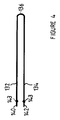
- the mechanism of the machine is set such that the two webs 132,134 are knitted together at one longitudinal edge 136 to form a join connecting the two webs 132,134 thereby forming the single web 130.
- the other two longitudinal edges 140,142 of the webs 132,134 have thin covered rubber or elastic threads 143 of known type included within the webs.
- the longitudinal edges 140,142 are not mutually joined unlike the edge 136.
- the knitted webs 132,134 include, at appropriate intervals, metallic fibres (not shown in figure 3).
- the metallic fibres may be a textile yarn containing a certain percentage of stainless steel fibre or other suitable metallic compound, or 100% metallic filaments, both of which have been previously described with reference to figure 2.
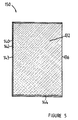
- the mechanism of the machine is so set as to form a lateral closure in the manner described below.
- the two longitudinal edges 140,142 containing the elastic threads are thus enclosed in the dense knitted course.
- the dense knitted course forms a lateral closure construction 144 which continues down the length of the webs 132,134 for a distance "C" of, for example, five to seven millimetres, thereby firmly anchoring the elastic threads within the lateral closure construction.
- the web is then cut laterally along the knitted lateral closure construction 144 (ie. across the web within the length defined as "C"). No tying, knotting, stapling or other form of closure of the lateral edges produced by the lateral cutting operation is necessary.
- the net may be likened to an envelope-type structure with the an opening in the left hand side formed by the two elasticated edges 140,142.
- the hair net may incorporate an elastane fibre yarn such as "Lycra" (a DuPont trade mark). Such a yarn may form part of the knitted construction at the longitudinal edges 140,142, replacing the thin covered rubber threads.
Landscapes
- Engineering & Computer Science (AREA)
- Textile Engineering (AREA)
- Chemical & Material Sciences (AREA)
- Materials Engineering (AREA)
- Health & Medical Sciences (AREA)
- Epidemiology (AREA)
- Food Science & Technology (AREA)
- General Health & Medical Sciences (AREA)
- Public Health (AREA)
- Knitting Of Fabric (AREA)
- Braiding, Manufacturing Of Bobbin-Net Or Lace, And Manufacturing Of Nets By Knotting (AREA)
Applications Claiming Priority (4)
| Application Number | Priority Date | Filing Date | Title |
|---|---|---|---|
| GB9218726 | 1992-09-04 | ||
| GB929218726A GB9218726D0 (en) | 1992-09-04 | 1992-09-04 | Protective headwear |
| GB9305774 | 1993-03-19 | ||
| GB939305774A GB9305774D0 (en) | 1993-03-19 | 1993-03-19 | Improvements in and relating to hairnet manufacture |
Publications (2)
| Publication Number | Publication Date |
|---|---|
| EP0587361A2 true EP0587361A2 (de) | 1994-03-16 |
| EP0587361A3 EP0587361A3 (en) | 1996-01-03 |
Family
ID=26301542
Family Applications (1)
| Application Number | Title | Priority Date | Filing Date |
|---|---|---|---|
| EP93306840A Withdrawn EP0587361A3 (en) | 1992-09-04 | 1993-08-27 | Protective headwear |
Country Status (1)
| Country | Link |
|---|---|
| EP (1) | EP0587361A3 (de) |
Cited By (5)
| Publication number | Priority date | Publication date | Assignee | Title |
|---|---|---|---|---|
| WO2010106010A1 (de) | 2009-03-17 | 2010-09-23 | Solida Textil- Und Netzwaren-Manufaktur Gmbh & Co. Kg | Verfahren zum herstellen von kopfhauben und anordnung aus einer vielzahl von kopfhauben |
| WO2013156762A1 (en) * | 2012-04-16 | 2013-10-24 | Aburnet Limited | Knitted hairnet |
| WO2014111729A1 (en) * | 2013-01-17 | 2014-07-24 | Aburnet Limited | Hair retention bonnet |
| US9392856B2 (en) | 2013-09-04 | 2016-07-19 | Aburnet Limited | Hairnet |
| GB2566089B (en) * | 2017-09-04 | 2023-04-19 | Oceans Of Notions Ltd | Packaging for plants, fruit or vegetables |
Family Cites Families (6)
| Publication number | Priority date | Publication date | Assignee | Title |
|---|---|---|---|---|
| GB698436A (en) * | 1951-02-22 | 1953-10-14 | Aura Nets Ltd | An improved machine for use in the manufacture of hair nets |
| DE1457412A1 (de) * | 1963-07-08 | 1969-01-30 | Rudolf Horn Fa | Haarnetz mit elastischem Rand und Verfahren zu seiner Herstellung |
| FR2275359A1 (fr) * | 1974-06-19 | 1976-01-16 | Greze Andre | Voile ayant un pouvoir reflecteur aux ondes radar |
| DE2900280A1 (de) * | 1979-01-05 | 1980-07-17 | Weisert Loser & Sohn | Vorrichtung zum feststellen von metall in einem bewegten strang |
| FR2408814A1 (fr) * | 1977-11-14 | 1979-06-08 | Bekaert Sa Nv | Procede et appareil pour le reperage et la detection de la position d'un objet |
| US4551860A (en) * | 1982-03-01 | 1985-11-12 | Smit Helen E | Metal mesh head covering |
-
1993
- 1993-08-27 EP EP93306840A patent/EP0587361A3/en not_active Withdrawn
Cited By (9)
| Publication number | Priority date | Publication date | Assignee | Title |
|---|---|---|---|---|
| WO2010106010A1 (de) | 2009-03-17 | 2010-09-23 | Solida Textil- Und Netzwaren-Manufaktur Gmbh & Co. Kg | Verfahren zum herstellen von kopfhauben und anordnung aus einer vielzahl von kopfhauben |
| CN102341013A (zh) * | 2009-03-17 | 2012-02-01 | 索利达纺织及网络制造厂有限责任两合公司 | 制造头套的方法和包括多个头套的组件 |
| US8881747B2 (en) | 2009-03-17 | 2014-11-11 | Solida Ag | Method for producing hoods and arrangement of a plurality of hoods |
| CN102341013B (zh) * | 2009-03-17 | 2015-07-29 | 索利达股份公司 | 制造头套的方法和包括多个头套的组件 |
| US9820546B2 (en) | 2009-03-17 | 2017-11-21 | Solida Ag | Method for producing hoods and arrangement of a plurality of hoods |
| WO2013156762A1 (en) * | 2012-04-16 | 2013-10-24 | Aburnet Limited | Knitted hairnet |
| WO2014111729A1 (en) * | 2013-01-17 | 2014-07-24 | Aburnet Limited | Hair retention bonnet |
| US9392856B2 (en) | 2013-09-04 | 2016-07-19 | Aburnet Limited | Hairnet |
| GB2566089B (en) * | 2017-09-04 | 2023-04-19 | Oceans Of Notions Ltd | Packaging for plants, fruit or vegetables |
Also Published As
| Publication number | Publication date |
|---|---|
| EP0587361A3 (en) | 1996-01-03 |
Similar Documents
| Publication | Publication Date | Title |
|---|---|---|
| US4818316A (en) | Method of forming a ravel resistant warp knit elastic tape | |
| US6351932B1 (en) | Cut-resistant antimicrobial yarn and article of wearing apparel made therefrom | |
| US6367290B2 (en) | Knit article having ravel-resistant edge portion and composite yarn for making ravel-resistant knit article | |
| US8671462B2 (en) | Stab resistant knit fabric having ballistic resistance made with layered modified knit structure and soft body armor construction containing the same | |
| CA2874039C (en) | Netting with elongation indicator and method of determining the elongation of a netting | |
| EP2176619B1 (de) | Leichtgewichtige formgestrickte kleidung aus einem schnitt-, spalt- und/oder abriebfesten schutzstoff | |
| JP2007514060A (ja) | 合成糸および合成糸から作られている製品 | |
| KR20010098718A (ko) | 다중요소 얀 및 이와 유사한 것을 제조하는 방법 | |
| RU2696502C1 (ru) | Пластиковая сетка с двойными цепочками | |
| WO2007140145A2 (en) | Cut, slash and/or abrasion resistant protective fabric and lightweight protective garment made therefrom | |
| US4733545A (en) | Ravel resistant warp knit elastic tape and method | |
| EP0802269A1 (de) | Schlaugartiges Gewebe und Verfahren zu dessen Herstellung | |
| GB1586840A (en) | Panty hose | |
| GB1586890A (en) | Material and yarn for making same | |
| EP0587361A2 (de) | Schützende Kopfbedeckung | |
| US9027367B2 (en) | Knitted velcro sleeve | |
| CA2489115A1 (en) | Size identification system for bed sheets and the like | |
| CA2154618C (en) | Improved grasscatcher bag fabric | |
| US8021994B2 (en) | Textile fabric and protective clothing containing the fabric | |
| NO150664B (no) | Fremgangsmaate for festing av en glidelaas til en strikket gjenstand. | |
| HUP9900199A2 (hu) | Textília inggallérjának és hasonló ruharészeknek a megerősítésére | |
| US7024893B2 (en) | Durable knitted net | |
| HRP950216A2 (en) | Knitted fabric and method of producing | |
| KR100752857B1 (ko) | 내부 연결 요소를 갖는 블리스터 천 | |
| SU745988A1 (ru) | Лента-носитель дл обработки и упаковки высокораст жимых чулочных изделий |
Legal Events
| Date | Code | Title | Description |
|---|---|---|---|
| PUAI | Public reference made under article 153(3) epc to a published international application that has entered the european phase |
Free format text: ORIGINAL CODE: 0009012 |
|
| AK | Designated contracting states |
Kind code of ref document: A2 Designated state(s): BE DE DK FR GB IT NL |
|
| PUAL | Search report despatched |
Free format text: ORIGINAL CODE: 0009013 |
|
| AK | Designated contracting states |
Kind code of ref document: A3 Designated state(s): BE DE DK FR GB IT NL |
|
| STAA | Information on the status of an ep patent application or granted ep patent |
Free format text: STATUS: THE APPLICATION IS DEEMED TO BE WITHDRAWN |
|
| 18D | Application deemed to be withdrawn |
Effective date: 19960301 |