EP0587533A2 - Verfahren zur Herstellung von alpha-Aminoketonsalzen - Google Patents
Verfahren zur Herstellung von alpha-Aminoketonsalzen Download PDFInfo
- Publication number
- EP0587533A2 EP0587533A2 EP93810624A EP93810624A EP0587533A2 EP 0587533 A2 EP0587533 A2 EP 0587533A2 EP 93810624 A EP93810624 A EP 93810624A EP 93810624 A EP93810624 A EP 93810624A EP 0587533 A2 EP0587533 A2 EP 0587533A2
- Authority
- EP
- European Patent Office
- Prior art keywords
- alkyl
- formula
- phenylalkyl
- acid
- phenyl
- Prior art date
- Legal status (The legal status is an assumption and is not a legal conclusion. Google has not performed a legal analysis and makes no representation as to the accuracy of the status listed.)
- Granted
Links
- 0 CC(*)[N+](**)[O-] Chemical compound CC(*)[N+](**)[O-] 0.000 description 1
Classifications
-
- C—CHEMISTRY; METALLURGY
- C07—ORGANIC CHEMISTRY
- C07C—ACYCLIC OR CARBOCYCLIC COMPOUNDS
- C07C233/00—Carboxylic acid amides
- C07C233/01—Carboxylic acid amides having carbon atoms of carboxamide groups bound to hydrogen atoms or to acyclic carbon atoms
- C07C233/45—Carboxylic acid amides having carbon atoms of carboxamide groups bound to hydrogen atoms or to acyclic carbon atoms having the nitrogen atom of at least one of the carboxamide groups bound to a carbon atom of a hydrocarbon radical substituted by carboxyl groups
- C07C233/46—Carboxylic acid amides having carbon atoms of carboxamide groups bound to hydrogen atoms or to acyclic carbon atoms having the nitrogen atom of at least one of the carboxamide groups bound to a carbon atom of a hydrocarbon radical substituted by carboxyl groups with the substituted hydrocarbon radical bound to the nitrogen atom of the carboxamide group by an acyclic carbon atom
- C07C233/47—Carboxylic acid amides having carbon atoms of carboxamide groups bound to hydrogen atoms or to acyclic carbon atoms having the nitrogen atom of at least one of the carboxamide groups bound to a carbon atom of a hydrocarbon radical substituted by carboxyl groups with the substituted hydrocarbon radical bound to the nitrogen atom of the carboxamide group by an acyclic carbon atom having the carbon atom of the carboxamide group bound to a hydrogen atom or to a carbon atom of an acyclic saturated carbon skeleton
-
- C—CHEMISTRY; METALLURGY
- C07—ORGANIC CHEMISTRY
- C07C—ACYCLIC OR CARBOCYCLIC COMPOUNDS
- C07C221/00—Preparation of compounds containing amino groups and doubly-bound oxygen atoms bound to the same carbon skeleton
-
- C—CHEMISTRY; METALLURGY
- C07—ORGANIC CHEMISTRY
- C07C—ACYCLIC OR CARBOCYCLIC COMPOUNDS
- C07C225/00—Compounds containing amino groups and doubly—bound oxygen atoms bound to the same carbon skeleton, at least one of the doubly—bound oxygen atoms not being part of a —CHO group, e.g. amino ketones
- C07C225/02—Compounds containing amino groups and doubly—bound oxygen atoms bound to the same carbon skeleton, at least one of the doubly—bound oxygen atoms not being part of a —CHO group, e.g. amino ketones having amino groups bound to acyclic carbon atoms of the carbon skeleton
- C07C225/04—Compounds containing amino groups and doubly—bound oxygen atoms bound to the same carbon skeleton, at least one of the doubly—bound oxygen atoms not being part of a —CHO group, e.g. amino ketones having amino groups bound to acyclic carbon atoms of the carbon skeleton the carbon skeleton being saturated
- C07C225/06—Compounds containing amino groups and doubly—bound oxygen atoms bound to the same carbon skeleton, at least one of the doubly—bound oxygen atoms not being part of a —CHO group, e.g. amino ketones having amino groups bound to acyclic carbon atoms of the carbon skeleton the carbon skeleton being saturated and acyclic
-
- C—CHEMISTRY; METALLURGY
- C07—ORGANIC CHEMISTRY
- C07C—ACYCLIC OR CARBOCYCLIC COMPOUNDS
- C07C231/00—Preparation of carboxylic acid amides
- C07C231/10—Preparation of carboxylic acid amides from compounds not provided for in groups C07C231/02 - C07C231/08
Definitions
- the present invention relates to a process for the preparation of alpha-amino ketone salts.
- Alpha aminoketone salts especially phenacylamine hydrochloride, find e.g. used as starting materials for the synthesis of heterocycles.
- Stabilizers for PVC pyrrole compounds can be prepared, for example, with the aid of alpha-aminoketone salts of the formula I, it being possible to proceed according to the known Knorr pyrrole synthesis [L. Knorr, H. Lange Ber. 35, 2998 (1902)].
- alpha-aminoketone salts can be prepared by a simple process which can expediently also be carried out without isolating the intermediates.
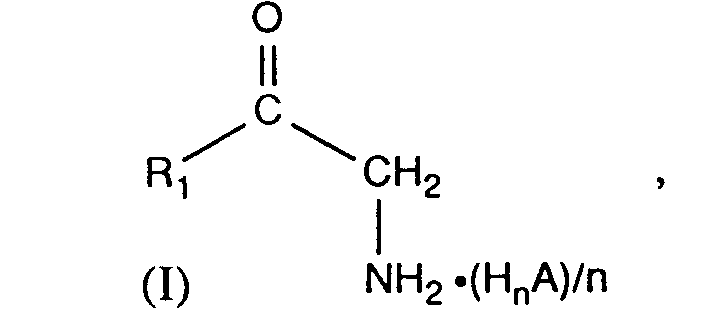
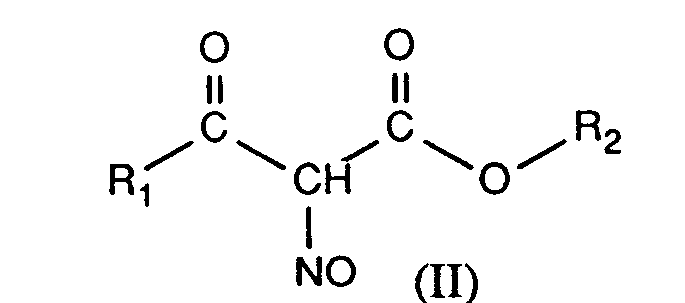
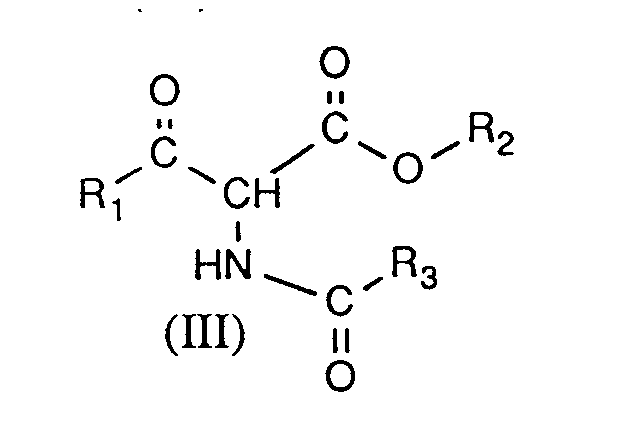
- the invention thus relates to a process for the preparation of alpha-amino ketone salts of the formula characterized in that a nitrosated ketoester of the formula II is reacted with a carboxylic anhydride IV under catalytic hydrogenation conditions to give an amide of the formula III, which is then used in the presence of an acid H n A Salt I is hydrolyzed, where R 1 is C 1 -C 6 -alkyl, phenoxy-C 1 -C 4 -alkyl, phenyl, C 7 -C 9 -phenylalkyl or with halogen, C 1 -C 6 -alkyl or -alkoxy, Is hydroxy or cyano substituted phenyl or C 7 -Cg phenylalkyl, R 2 is C 1 -C 4 alkyl or cyclohexyl, R 3 is C 1 -C 4 alkyl, A is the residue of a mineral or organic, protonic acid and n 1 to
- R 1 as C 1 -C 6 alkyl means, for example, methyl, ethyl, propyl, isopropyl, n-butyl, isobutyl, t-butyl, pentyl, isopentyl, hexyl, 2-ethylbutyl, 1-methylpentyl or 1,3-dimethylbutyl.
- R 2 and R 3 as C 1 -C 4 alkyl have, for example, the first seven of the abovementioned meanings.
- C 7 -C 9 phenylalkyl means, for example, benzyl, phenethyl, a-methylbenzyl or a, a-dimethylbenzyl.
- C 1 -C 6 alkoxy means, for example, methoxy, ethoxy, isopropoxy or hexoxy, preferably methoxy or ethoxy.
- Phenoxy-C 1 -C 4 alkyl means, for example, phenoxymethyl, phenoxyethyl or phenoxypropyl.
- Substituted phenyl or phenylalkyl may have one or more, the same or different substituents, e.g. 1 to 3, preferably one or two.
- carboxylic anhydrides of the formula IV are in question: acetic anhydride, propionic anhydride, and butter or isobutyric anhydride. Acetic anhydride is preferred.
- the first stage of the process can be catalyzed homogeneously or heterogeneously.
- Possible catalysts are: Heterogeneous: Raney nickel or Raney cobalt and, preferably, supported noble metal catalysts, as are usually used for catalytic hydrogenations, in particular Pd / C, Pt / C, Ru / C, Pd-Pt / C mixed catalysts, Rh on A1 2 0 3 ; homogeneous: [PdCl 2 (CNPh) 2 ], (NH 4 ) 2 (IrCl 6 ) / chloranilic acid.
- Heterogeneous catalysis on palladium in particular on palladium applied to carbon supports, is particularly preferred.
- the dosage of the catalyst is advantageously 0.05 to 0.5% by weight of noble metal, based on the compounds of the formula II, preferably 0.1 to 0.5%.
- the ratio of precious metal: carrier is usually between 1 and 10%.
- the reactants of the formulas II and IV and the hydrogen are expediently used in approximately equimolar amounts.
- the hydrogenation preferably takes place under normal pressure and at temperatures of, for example, 0-100 ° C., preferably 40-80 ° C.
- Working at elevated pressure for example between 0 and 50 bar, preferably 0 and 10 bar, can be expedient.
- Reactant IV is preferably used as the solvent.
- the saponification in the process according to the invention (2nd stage) takes place, for example, at 50 to 120 ° C., preferably at 60 to 100 ° C.
- Water or the dilute acid, alcohols such as ethanol, propanol, isopropanol, ethylene glycol, ethylene glycol ether or ethers such as ethylene glycol diethyl ether, dioxane, tetrahydrofuran are used as solvents.
- the process has the advantage that isolation of the intermediate products is not necessary.
- the heterogeneously catalyzed hydrogenation is advantageous for this embodiment.
- R 1 is C 1 -C 4 -alkyl, phenyl, C 7 -C 9 -phenylalkyl or phenyl- or C 7 -C 9 substituted with C 1 -C 4 -alkyl -Phenylalkyl, and those in which R 2 is methyl or ethyl and R 3 is methyl.
- the acid HA can be a mineral or organic protonic acid.
- examples are HBr, HCl, H 2 S0 4 , H 3 P0 4 and HCOOH, preference is given to hydrochloric or dilute sulfuric acid.
- the process is particularly preferably used to prepare phenacylamine hydrochloride and phenacylamine sulfate, ie HA in the formula is HCl or 1/2 H 2 SO 4 and R 1 is phenyl.
- the process according to the invention comprises the preparation of both isomers, although for the sake of simplicity the formula only shows the keto form.
- the starting materials of the formula II can be prepared from commercially available acylacetic acid esters by processes which are known per se by the likewise known reaction with NaNO 2 in acetic acid:
- a mixture of 221 g of 2-oximino-benzoylacetic acid ethyl ester (2-oximino-3-oxo-3-phenylpropionic acid ethyl ester), 500 g of acetic anhydride, 50 g of glacial acetic acid and 20 g of a Pd / C catalyst (EF 101 R / W 51% H 2 0 from Degussa) is hydrogenated under normal pressure at 60 ° C. within 4 hours with stirring. The hydrogen uptake is 40 I.
- the reaction vessel is then rendered inert with N 2 , flushed with nitrogen and the catalyst is filtered off. The filtrate is then concentrated under reduced pressure on a rotary evaporator to a residue (the residue is 259.3 g) and recrystallized from 200 ml of isopropanol / 500 ml of petroleum ether.
- the 259.3 g of the crude product from Example 1 are mixed with 375 g of concentrated hydrochloric acid and 1000 ml of water water heated under reflux with stirring for 3 hours. When the evolution of gas has ended, the mixture is cooled, the turbidity is filtered off and the filtrate is concentrated to a residue on a rotavapor. The residue is stirred with 250 ml of isopropanol / 250 ml of tert-butyl methyl ether, cooled to 10 ° C., the precipitate is filtered off with suction, washed with tert-butyl methyl ether and dried.
- Example 2 If, instead of the crude product, the recrystallized ethyl 2-acetamido-3-oxo-3-phenylpropionate from Example 1 is used and reacted analogously to Example 2, the yield is 92.8% of theory, mp 189-91 ° C. (decomposition).
Landscapes
- Chemical & Material Sciences (AREA)
- Organic Chemistry (AREA)
- Organic Low-Molecular-Weight Compounds And Preparation Thereof (AREA)
Abstract

Description
- Die vorliegende Erfindung betrifft ein Verfahren zur Herstellung von alpha-Aminoketonsalzen.
- Alpha-Aminoketonsalze, insbesondere Phenacylaminhydrochlorid, finden z.B. als Edukte zur Synthese von Heterozyklen Verwendung. Als Stabilisatoren für PVC dienende Pyrrolverbindungen können beispielsweise mit Hilfe von Alpha-Aminoketonsalzen der Formel I hergestellt werden, wobei nach der bekannten Knorr'schen Pyrrol-Synthese vorgegangen werden kann [L. Knorr, H. Lange Ber. 35, 2998 (1902)].
- Verschiedene Verfahren zur Herstellung von alpha-Aminoketonsalzen sind bekannt [s. z.B. M. Suzuki et al., Synth. Comm. 1972, 237; S. Maeda et al., Chem. Pharm. Bull. 32, 2536 (1984) C. Mannich, F. Hahn, Ber. 44,1542(1911)]. Sie sind z.T. sehr umständlich (z.B. das Urotropin-Verfahren); erfordern Ausgangsmaterialien, die nicht kommerziell erhältlich sind oder sind technisch sehr aufwendig durchzuführen und damit wirtschaftlich wenig interessant.
- Daher besteht weiterhin ein Bedarf nach einfachen und kostengünstigen Verfahren zur Herstellung dieser Produkte.
- Es wurde nun gefunden, daß sich alpha-Aminoketonsalze nach einem einfachen Verfahren herstellen lassen, das zweckmäßig auch ohne Isolierung der Zwischenprodukte durchgeführt werden kann.
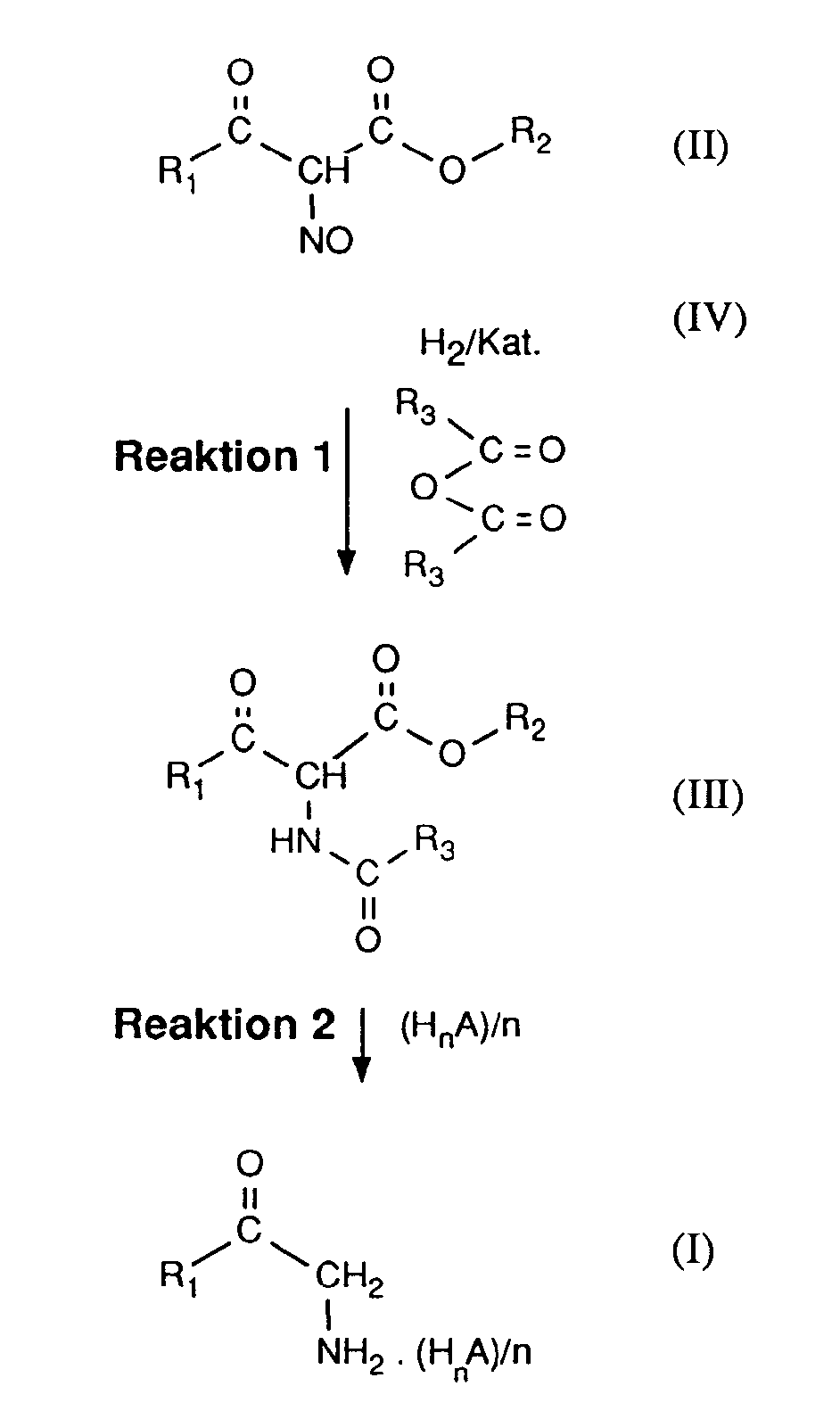
- Die Erfindung betrifft somit ein Verfahren zur Herstellung von alpha-Aminoketonsalzen der Formel dadurch gekennzeichnet, daß ein nitrosierter Ketoester der Formel II mit einem Carbonsäureanhydrid IV unter katalytischen Hydrierungsbedingungen zu einem Amid der Formel III umgesetzt wird, welches dann in Gegenwart einer Säure HnA zum Salz I hydrolysiert wird, wobei R1 C1-C6-Alkyl, Phenoxy-C1-C4-alkyl, Phenyl, C7-C9-Phenylalkyl oder mit Halogen, C1-C6-Alkyl oder -Alkoxy, Hydroxy oder Cyano substituiertes Phenyl oder C7-Cg-Phenylalkyl ist, R2 C1-C4-Alkyl oder Cyclohexyl darstellt, R3 C1-C4-Alkyl ist, A den Rest einer mineralischen oder organischen, Protonensäure darstellt und n 1 bis 3 bedeutet..
- R1 als C1-C6-Alkyl bedeutet z.B. Methyl, Ethyl, Propyl, Isopropyl, n-Butyl, Isobutyl, t-Butyl, Pentyl, Isopentyl, Hexyl, 2-Ethylbutyl, 1-Methylpentyl oder 1,3-Dimethylbutyl.
- R2 und R3 als C1-C4-Alkyl haben z.B. die ersten sieben der o.g. Bedeutungen.
- Unter C7-C9-Phenylalkyl ist z.B. Benzyl, Phenethyl, a-Methylbenzyl oder a,a-Dimethylbenzyl zu verstehen.
- C1-C6-Alkoxy bedeutet z.B. Methoxy, Ethoxy, Isopropoxy oder Hexoxy, bevorzugt Methoxy oder Ethoxy.
- Phenoxy-C1-C4-alkyl bedeutet z.B. Phenoxymethyl, Phenoxyethyl oder Phenoxypropyl.
- Substituiertes Phenyl oder Phenylalkyl kann einen oder mehrere, gleiche oder verschiedenen Substituenten tragen, z.B. 1 bis 3, bevorzugt einen oder zwei.
- Als Carbonsäureanhydride der Formel IV kommen z.B. in Frage: Acetanhydrid, Propionsäureanhydrid, und Butter- oder Isobuttersäureanhydrid. Bevorzugt ist Acetanhydrid.
- Die erste Stufe des Verfahrens kann homogen oder heterogen katalysiert werden.
- Denkbare Katalysatoren sind z.B.:
Heterogen: Raney Nickel oder Raney Kobalt sowie bevorzugt Edelmetallkatalysatoren auf Trägern, wie sie üblicherweise für katalytische Hydrierungen verwendetwerden, insbesondere Pd/C, Pt/C, Ru/C, Pd-Pt/C-Mischkatalysatoren, Rh auf A1203; homogen: [PdCl2(CNPh)2], (NH4)2(IrCl6)/Chloranilsäure. -
Besonders bevorzugt ist die heterogene Katalyse an Palladium, insbesondere an auf Kohlenstoffträger aufgebrachtem Palladium. - Die Dosierung des Katalysators liegt zweckmäßig bei 0.05 bis 0.5 Gew% Edelmetall bezogen auf die Verbindungen der Formel II, bevorzugt bei 0.1 bis 0.5%. Das Verhältnis Edelmetall : Träger liegt für gewöhnlich zwischen 1 und 10%.
- Die Reaktanden der Formeln II und IV sowie der Wasserstoff werden zweckmäßig in ungefähr aequimolaren Mengen eingesetzt.
- Die Hydrierung findet vorzugsweise unter Normaldruck und bei Temperaturen von beispielsweise 0 - 100°C, vorzugsweise 40 - 80°C, statt. Das Arbeiten bei erhöhtem Druck, beispielsweise zwischen 0 und 50 bar, vorzugsweise 0 und 10 bar, kann zweckmäßig sein.
- Übliche Lösungsmittel wie z.B. Tetrahydrofuran, Diethylenglykoldimethylether, Essigsäureethylester oder Eisessig, vorzugsweise aber Eisessig, können bei der Hydrierung zugesetzt werden. Vorzugsweise wird der Reaktand IV als Lösungsmittel verwendet.
- Es wurde überraschenderweise festgestellt, daß bei der sauren Verseifung des Amides der Formel III eine Verseifung der Estergruppe mit anschließender Decarboxylierung zum alpha-Aminoketon stattfindet. Die erwartete Reaktion zum Aminosäureester V

tritt nicht ein. - Die Verseifung im erfindungsgemäßen Verfahren (2. Stufe) erfolgt beispielsweise bei 50 bis 120°C, vorzugsweise bei 60 bis 100°C. Als Lösungsmittel dienen etwa Wasser bzw. die verdünnte Säure, Alkohole wie Ethanol, Propanol, Isopropanol, Ethylenglykol, Ethylenglykolether oder Ether wie Ethylenglykoldiethylether, Dioxan, Tetrahydrofuran.
- Das Verfahren hat den Vorteil, daß eine Isolierung der Zwischenprodukte nicht erforderlich ist. Vorteilhaft für diese Ausführungsart ist die heterogen katalysierte Hydrierung.
- Bevorzugt werden mit dem erfindungsgemäßen Verfahren Verbindungen der Formel I hergestellt, worin R1 C1-C4-Alkyl, Phenyl, C7-C9-Phenylalkyl oder mit C1-C4-Alkyl substituiertes Phenyl- oder C7-C9-Phenylalkyl bedeutet, sowie solche, worin R2 Methyl oder Ethyl und R3 Methyl bedeuten.
- Die Säure HA kann eine Mineral- oder organische Protonensäure sein. Beispiele sind HBr, HCI, H2S04, H3P04 und HCOOH, bevorzugt ist Salz- oderverdünnte Schwefelsäure. Entsprechend dient das Verfahren besonders bevorzugt der Herstellung von Phenacylaminhydrochlorid und Phenacylaminsulfat, d.h. HA steht in Formel für HCI bzw. 1/2 H2S04 und R1 für Phenyl.
- Die Verbindungen der Formel sind bekannt und können, wie eingangs erwähnt [vgl. auch A. Alberola et al. Heterocycles 29, 1973 (1989)], zu heterozyklischen Verbindungen für eine Reihe von Anwendungen, beispielsweise zu Pyrrolen, wie sie in EP-A-0 390 739 und 0 465 405 beschrieben sind, umgesetzt werden. Ebenfalls bekannt ist, daß die Verbindungen der Formel der Keto-Enol Tautomerie unterliegen:

- Das erfindungsgemäße Verfahren umfaßt die Herstellung beider Isomere, wenn auch der Einfachheit halber die Formel nur die Ketoform zeigt.
- Die Ausgangsstoffe der Formel II können aus kommerziell oder nach an sich bekannten Verfahren erhältlichen Acylessigsäureestern durch die ebenfalls bekannte Umsetzung mit NaN02 in Essigsäure hergestellt werden:

- Die Vorstufe (Formel V, R1 = Phenyl, R2 = Ethyl) des in Beispiel 1 eingesetzten 2-Oximino-benzoylessigsäureethylesters ist kommerziell erhältlich.
Die folgenden Beispiele erläutern die Erfindung näher, ohne sie jedoch zu beschränken.
Teile- und Prozentangaben beziehen sich, sofern nicht anders angegeben, auf das Gewicht. -

- Ein Gemisch aus 221 g 2-Oximino-benzoylessigsäureethylester (2-Oximino-3-oxo-3-phenylpropionsäure- ethylester), 500 g Essigsäureanhydrid, 50 g Eisessig und 20 g eines Pd/C Katalysators (EF 101 R/W 51 % H20 der Firma Degussa) wird unter Normaldruck bei 60°C innerhalb 4 Stunden unter Rühren hydriert. Die Wasserstoffaufnahme beträgt 40 I. Anschließend wird das Reaktionsgefäß mit N2 inertisiert, mit Stickstoff gespült und der Katalysator abfiltriert. Das Filtrat wird anschließend unter vermindertem Druck am Rotavapor auf Rückstand eingeengt (der Rückstand beträgt 259.3 g) und aus 200 ml Isopropanol/500 ml Petrolether umkristallisiert.
- Ausbeute 175.4 g (70.4% d.Th.) weiße Kristalle, Smp. 81-82°C. Durch Abkühlen der Mutterlauge werden weitere 34.5 g (13.8%d.Th. Smp: 63-64°C; laut 1H-NMR Gemisch aus Keto- und Enolform) isoliert.
- Gesamtausbeute: 84.2%.
-

- Die 259.3 g des Rohproduktes aus Beispiel 1 werden mit 375 g konzentrierter Salzsäure und 1000 ml Wasser 3 Stunden unter Rühren am Rückfluß erwärmt. Nach beendeter Gasentwicklung wird das Gemisch abgekühlt, die Trübung abfiltriert und das Filtrat am Rotavapor auf Rückstand eingeengt. Der Rückstand wird mit 250 ml Isopropanol/250 ml tert-Butyl-methylether aufgerührt, auf 10°C abgekühlt, der Niederschlag abgesaugt, mit tert-Butyl-methylether gewaschen und getrocknet.
- Ausbeute: 132.7 g (77.5% d.Th.), berechnet pro in Beispiel 1 eingesetztem 2-Oximino-benzoylessigsäureethylester, weiße Kristalle, Smp: 187-88°C (Zersetzung).
-

- Wird statt des Rohprodukts der umkristallisierte 2-Acetamido-3-oxo-3-phenylpropionsäureethylester aus Beispiel 1 eingesetzt und in Analogie zu Beispiel 2 umgesetzt, so beträgt die Ausbeute 92.8% d.Th., Smp 189-91°C (Zersetzung).
-

- 24.9 g 2-Acetamido-3-oxo-3-phenylpropionsäureethylester, 7.2 g Schwefelsäure (96 %ig) und 50 ml Wasser werden 10 Stunden unter Rühren am Rückfluß erwärmt. Nach dem Abkühlen wird das Reaktionsgemisch filtriert und das Filtrat am Rotavapor auf Rückstand eingeengt. Anschließend wird der kristalline Rückstand mit 50 ml Isopropanol angeteigt, die Kristalle abgesaugt, mit Petrolether (50-70°C) gewaschen und getrocknet.
- Ausbeute: 12g (65% d.Th.), weiße Kristalle, Smp. 152-155°C (Zersetzung)
-

- 54 g 2-Acetamido-3-oxo-5-phenylvaleriansäuremethylester (60%ig), hergestellt analog Beispiel 1 aus 2-Oximino-3-oxo-5-phenylvaleriansäuremethylester, 79 g Salzsäure (32%ig) und 200 ml Wasser werden 2 h am Rückfluß gerührt. Anschließend wird das 2-phasige Reaktionsgemisch am Rotavapor auf Rückstand eingeengt. Der zum Teil kristalline Rückstand wird in 100 ml Isopropanol warm gelöst, mit 30 ml tert-Butyl-methylether versetzt, abgekühlt, und die ausgefallenen Kristalle werden isoliert.
- Ausbeute 16.8 g (68% d.Th., ber. auf 100%igen 2-Acetamido-3-oxo-5-phenyl-valeriansäuremethylester) weiße Kristalle aus i-Propanol, Smp. 152°C (Zersetzung)
- Beispiel 6: Aminoaceton Hydrochlorid: CH3-CO-CH2-NH2-HCI
- 35 g 2-Acetamido-3-oxo-buttersäureethylester, hergestellt analog Beispiel 1 aus 2-Oximino-3-oxo-butter- säureethylester, 68 g Salzsäure (32%ig) und 180 ml Wasser werden 3 h bei 60 bis 70 °C gerührt. Nach beendeter C02-Entwicklung wird das Reaktionsgemisch auf Rückstand eingeengt. Ausbeute: 20.3 g einer rotbraunen, viskosen Flüssigkeit, nD 30: 1.488
Claims (11)


Applications Claiming Priority (2)
| Application Number | Priority Date | Filing Date | Title |
|---|---|---|---|
| CH284892 | 1992-09-10 | ||
| CH2848/92 | 1992-09-10 |
Publications (3)
| Publication Number | Publication Date |
|---|---|
| EP0587533A2 true EP0587533A2 (de) | 1994-03-16 |
| EP0587533A3 EP0587533A3 (de) | 1995-01-04 |
| EP0587533B1 EP0587533B1 (de) | 1997-03-12 |
Family
ID=4242945
Family Applications (1)
| Application Number | Title | Priority Date | Filing Date |
|---|---|---|---|
| EP93810624A Expired - Lifetime EP0587533B1 (de) | 1992-09-10 | 1993-08-31 | Verfahren zur Herstellung von alpha-Aminoketonsalzen |
Country Status (4)
| Country | Link |
|---|---|
| US (1) | US5322964A (de) |
| EP (1) | EP0587533B1 (de) |
| JP (1) | JPH06228064A (de) |
| DE (1) | DE59305720D1 (de) |
Families Citing this family (1)
| Publication number | Priority date | Publication date | Assignee | Title |
|---|---|---|---|---|
| AU4143700A (en) * | 1999-04-28 | 2000-11-17 | Ihara Chemical Industry Co. Ltd. | Process for the preparation of amides |
Family Cites Families (2)
| Publication number | Priority date | Publication date | Assignee | Title |
|---|---|---|---|---|
| JPS5798245A (en) * | 1980-12-11 | 1982-06-18 | Fujirebio Inc | Preparation of p-acetamidothymol |
| US5220063A (en) * | 1991-05-10 | 1993-06-15 | Hoechst Celanese Corporation | Method for the preparation of arylalkanolacylamides |
-
1993
- 1993-08-31 EP EP93810624A patent/EP0587533B1/de not_active Expired - Lifetime
- 1993-08-31 DE DE59305720T patent/DE59305720D1/de not_active Expired - Fee Related
- 1993-09-08 US US08/118,107 patent/US5322964A/en not_active Expired - Fee Related
- 1993-09-10 JP JP5250205A patent/JPH06228064A/ja active Pending
Also Published As
| Publication number | Publication date |
|---|---|
| JPH06228064A (ja) | 1994-08-16 |
| US5322964A (en) | 1994-06-21 |
| EP0587533A3 (de) | 1995-01-04 |
| EP0587533B1 (de) | 1997-03-12 |
| DE59305720D1 (de) | 1997-04-17 |
Similar Documents
| Publication | Publication Date | Title |
|---|---|---|
| EP0342616A2 (de) | Verfahren zur Herstellung von Aminocyanacetamid | |
| EP0380712B1 (de) | Verfahren zur Herstellung von 2,6-Dichlordiphenylaminessigsäurederivaten | |
| DE102005061472A1 (de) | Verfahren zur Herstellung von enantiomerenangereicherten 2-Alkoxy-3-phenylpropionsäuren | |
| EP0847990A1 (de) | 4-(C1-C4)-Alkoxy-3-pyrrolin-2-on-1-yl-essigsäuren, deren Herstellung und Verwendung zur Synthese von 4-Hydroxy-2-oxo-pyrrolidin-1-yl-acetamid | |
| DE69901130T2 (de) | Verfahren zur Herstellung von Pyridindicarboxylatderivaten | |
| EP0678502A1 (de) | Verfahren zur Herstellung von Glykoloylaniliden | |
| DD215529A5 (de) | Verfahren zur herstellung von cyclohexandionderivaten | |
| DE69305491T2 (de) | Verfahren zur herstellung von zimtsaeurederivaten | |
| EP0587533B1 (de) | Verfahren zur Herstellung von alpha-Aminoketonsalzen | |
| DE69608862T2 (de) | Verfahren zur Herstellung einer optisch aktiven 2-Hydroxy-4-Arylbuttersäure oder deren Ester und Zwischenprodukt dafür | |
| AT401513B (de) | Verfahren zur herstellung von 2-hydroxy-4-phenylbuttersäure | |
| DE69526173T2 (de) | Verfahren zur Herstellung von Oxyindolen | |
| EP1127050B1 (de) | Verfahren zur herstellung von 1-substituierten 5-hydroxypyrazolen | |
| WO2001056973A1 (de) | Verfahren zur herstellung von acetoacetylierten aromatischen aminen | |
| EP0649831B1 (de) | Verfahren zur Herstellung von 3-(p-Fluorphenyl)-2-methylpropionsäure und 3-(p-Fluorphenyl)-2-methylpropionsäurederivaten | |
| AT267527B (de) | Verfahren zur Herstellung neuer substituierter Aminopyridine, von deren Salzen und optisch aktiven Isomeren | |
| DE963776C (de) | Verfahren zur Herstellung von antiphlogistisch wirksamen ª‡-Amino-ª‰-oxycarbonsaeureaniliden | |
| DE19858352A1 (de) | Verfahren zum Herstellen von 2,4-Dimethyl-3,5-bis-alkoxycarbonyl-pyrrol | |
| EP2554539B1 (de) | Verfahren zur Herstellung von gamma-Spirolactamen aus zyklischen ungesättigten Carbonsäuren | |
| DE2503315C3 (de) | Verfahren zur Herstellung von Tyramin und dessen Säureadditionssalzen | |
| DE1420080C (de) | N-Benzyl-beta-(isonicotinoylhydrazin)propionsäureamid und Verfahren zu seiner Herstellung | |
| CH655930A5 (de) | Verfahren zur herstellung von 3-hydroxybenzdiazepinonen. | |
| WO2001036366A1 (de) | Verfahren zur herstellung von phenylessigsäureestern | |
| DE3904327A1 (de) | Verfahren zur herstellung von trans-1,3-substituierten cyclobutanderivaten | |
| DE2454405A1 (de) | Verfahren zur herstellung von dimethylaminobenzolverbindungen |
Legal Events
| Date | Code | Title | Description |
|---|---|---|---|
| PUAI | Public reference made under article 153(3) epc to a published international application that has entered the european phase |
Free format text: ORIGINAL CODE: 0009012 |
|
| AK | Designated contracting states |
Kind code of ref document: A2 Designated state(s): CH DE FR GB IT LI |
|
| PUAL | Search report despatched |
Free format text: ORIGINAL CODE: 0009013 |
|
| AK | Designated contracting states |
Kind code of ref document: A3 Designated state(s): CH DE FR GB IT LI |
|
| 17P | Request for examination filed |
Effective date: 19950620 |
|
| 17Q | First examination report despatched |
Effective date: 19951229 |
|
| GRAG | Despatch of communication of intention to grant |
Free format text: ORIGINAL CODE: EPIDOS AGRA |
|
| GRAH | Despatch of communication of intention to grant a patent |
Free format text: ORIGINAL CODE: EPIDOS IGRA |
|
| GRAH | Despatch of communication of intention to grant a patent |
Free format text: ORIGINAL CODE: EPIDOS IGRA |
|
| RAP1 | Party data changed (applicant data changed or rights of an application transferred) |
Owner name: CIBA SC HOLDING AG |
|
| GRAA | (expected) grant |
Free format text: ORIGINAL CODE: 0009210 |
|
| AK | Designated contracting states |
Kind code of ref document: B1 Designated state(s): CH DE FR GB IT LI |
|
| RAP3 | Party data changed (applicant data changed or rights of an application transferred) |
Owner name: CIBA SPECIALTY CHEMICALS HOLDING INC. |
|
| REG | Reference to a national code |
Ref country code: CH Ref legal event code: EP |
|
| REF | Corresponds to: |
Ref document number: 59305720 Country of ref document: DE Date of ref document: 19970417 |
|
| ITF | It: translation for a ep patent filed | ||
| REG | Reference to a national code |
Ref country code: CH Ref legal event code: PFA Free format text: CIBA SPECIALTY CHEMICALS HOLDING INC. TRANSFER- CIBA SPECIALTY CHEMICALS HOLDING INC. |
|
| GBT | Gb: translation of ep patent filed (gb section 77(6)(a)/1977) |
Effective date: 19970502 |
|
| ET | Fr: translation filed | ||
| PLBE | No opposition filed within time limit |
Free format text: ORIGINAL CODE: 0009261 |
|
| STAA | Information on the status of an ep patent application or granted ep patent |
Free format text: STATUS: NO OPPOSITION FILED WITHIN TIME LIMIT |
|
| 26N | No opposition filed | ||
| PGFP | Annual fee paid to national office [announced via postgrant information from national office to epo] |
Ref country code: FR Payment date: 19980626 Year of fee payment: 6 |
|
| PGFP | Annual fee paid to national office [announced via postgrant information from national office to epo] |
Ref country code: DE Payment date: 19980703 Year of fee payment: 6 |
|
| PGFP | Annual fee paid to national office [announced via postgrant information from national office to epo] |
Ref country code: GB Payment date: 19980713 Year of fee payment: 6 |
|
| PGFP | Annual fee paid to national office [announced via postgrant information from national office to epo] |
Ref country code: CH Payment date: 19980716 Year of fee payment: 6 |
|
| PG25 | Lapsed in a contracting state [announced via postgrant information from national office to epo] |
Ref country code: LI Free format text: LAPSE BECAUSE OF NON-PAYMENT OF DUE FEES Effective date: 19990831 Ref country code: GB Free format text: LAPSE BECAUSE OF NON-PAYMENT OF DUE FEES Effective date: 19990831 Ref country code: CH Free format text: LAPSE BECAUSE OF NON-PAYMENT OF DUE FEES Effective date: 19990831 |
|
| REG | Reference to a national code |
Ref country code: CH Ref legal event code: PL |
|
| GBPC | Gb: european patent ceased through non-payment of renewal fee |
Effective date: 19990831 |
|
| PG25 | Lapsed in a contracting state [announced via postgrant information from national office to epo] |
Ref country code: FR Free format text: LAPSE BECAUSE OF NON-PAYMENT OF DUE FEES Effective date: 20000428 |
|
| PG25 | Lapsed in a contracting state [announced via postgrant information from national office to epo] |
Ref country code: DE Free format text: LAPSE BECAUSE OF NON-PAYMENT OF DUE FEES Effective date: 20000601 |
|
| REG | Reference to a national code |
Ref country code: FR Ref legal event code: ST |
|
| PG25 | Lapsed in a contracting state [announced via postgrant information from national office to epo] |
Ref country code: IT Free format text: LAPSE BECAUSE OF NON-PAYMENT OF DUE FEES;WARNING: LAPSES OF ITALIAN PATENTS WITH EFFECTIVE DATE BEFORE 2007 MAY HAVE OCCURRED AT ANY TIME BEFORE 2007. THE CORRECT EFFECTIVE DATE MAY BE DIFFERENT FROM THE ONE RECORDED. Effective date: 20050831 |