EP0587975A2 - Diversity Funkempfänger - Google Patents
Diversity Funkempfänger Download PDFInfo
- Publication number
- EP0587975A2 EP0587975A2 EP93101584A EP93101584A EP0587975A2 EP 0587975 A2 EP0587975 A2 EP 0587975A2 EP 93101584 A EP93101584 A EP 93101584A EP 93101584 A EP93101584 A EP 93101584A EP 0587975 A2 EP0587975 A2 EP 0587975A2
- Authority
- EP
- European Patent Office
- Prior art keywords
- signal
- signals
- delayed
- frequency
- digital modulated
- Prior art date
- Legal status (The legal status is an assumption and is not a legal conclusion. Google has not performed a legal analysis and makes no representation as to the accuracy of the status listed.)
- Withdrawn
Links
Images



Classifications
-
- H—ELECTRICITY
- H04—ELECTRIC COMMUNICATION TECHNIQUE
- H04B—TRANSMISSION
- H04B7/00—Radio transmission systems, i.e. using radiation field
- H04B7/02—Diversity systems; Multi-antenna system, i.e. transmission or reception using multiple antennas
- H04B7/04—Diversity systems; Multi-antenna system, i.e. transmission or reception using multiple antennas using two or more spaced independent antennas
- H04B7/08—Diversity systems; Multi-antenna system, i.e. transmission or reception using multiple antennas using two or more spaced independent antennas at the receiving station
- H04B7/0837—Diversity systems; Multi-antenna system, i.e. transmission or reception using multiple antennas using two or more spaced independent antennas at the receiving station using pre-detection combining
- H04B7/084—Equal gain combining, only phase adjustments
-
- H—ELECTRICITY
- H04—ELECTRIC COMMUNICATION TECHNIQUE
- H04L—TRANSMISSION OF DIGITAL INFORMATION, e.g. TELEGRAPHIC COMMUNICATION
- H04L1/00—Arrangements for detecting or preventing errors in the information received
- H04L1/02—Arrangements for detecting or preventing errors in the information received by diversity reception
- H04L1/06—Arrangements for detecting or preventing errors in the information received by diversity reception using space diversity
Definitions
- the present invention relates to a diversity radio receiver and, more particularly, to a reception local oscillator offset diversity radio receiver in a digital radio communication system.
- a plurality of antennas spaced apart from each other so as to decrease the spatial correlation of the reception levels are used to perform reception by switching the reception antenna to an antenna having a higher level, or space diversity for synchronizing the frequencies and phases of input RF signals, or IF frequencies.
- offset transmission diversity for modulating carrier frequencies having a predetermined difference from two or more transmission base stations with the same baseband signal, simultaneously transmitting the modulated signals, and causing one antenna at the reception unit to receive the modulated signals.
- the predetermined frequency difference between the plurality of base stations spaced apart from each other must be assured, and a circuit for minimizing a time lag between the modulation baseband signals of the respective stations is required.
- this scheme requires an implementation of circuit arrangements in both the transmission and reception units. Two or more electric waves are required in principle, thereby wasting the electric waves.
- an object of the present invention to provide a new and improved diversity radio receiver in which the plurality of electric waves which have been conventionally used need not be used, and a portable radio reception system capable of obtaining a diversity effect without requiring complicated phase control between a plurality of antennas can be realized.
- a diversity radio receiver for receiving and demodulating digital modulated signals with delayed and differential detection, the receiver comprising: a plurality of reception branch means for respectively receiving the digital modulated signals and converting received digital modulated signals into intermediate frequency signals having frequency differences having a predetermined relationship with modulation baseband signal; adding means for adding the intermediate frequency signals converted by the plurality of reception branch means; delayed and differential detection means for delaying and differentially detecting a sum signal from the adding means; and post detection filter means for filtering a signal delayed and differentially detected by the delayed and differential detection means, using a bandwidth of not less than a Nyquist frequency of the received digital modulated signals, thereby outputting demodulated signals of the received digital modulated signals.
- a diversity radio receiver for receiving and demodulating digital modulated signals with delayed and differential detection, the receiver comprising: a plurality of reception branch means for respectively receiving the digital modulated signals and converting received digital modulated signals into intermediate frequency signals having frequency differences having a predetermined relationship with a modulation baseband signal; adding means for adding the intermediate frequency signals converted by the plurality of reception branch means; delayed and differential detection means comprising a delay device for delaying a sum signal from the adding means by a predetermined time, a fist mixer for mixing the sum signal from the adding means with a signal delayed by the delay device; a phase shifter for phase-shifting the sum signal from the adding means or a delayed signal from the delay device by a predetermined phase-shifting amount; and a second mixer for mixing the sum signal from the adding means with a signal phase-shifted by the phase shifter; first and second post detection filter means for filtering signals from the first and second mixers in the delayed and differential detection means at predetermined bandwidths, respectively;
- a diversity radio receiver for receiving and demodulating digital modulated signals with delayed and differential detection, the receiver comprising: a plurality of reception branch means for respectively receiving the digital modulated signals and converting received digital modulated signals into intermediate frequency signals having frequency differences having a predetermined relationship with a modulation baseband signal; adding means for adding the intermediate frequency signals converted by the plurality of reception branch means; frequency converting means for mixing a sum signal from the adding means with a signal having a frequency equal to a nominal center frequency of the intermediate frequency signal, thereby converting the sum signal into a low-frequency band signal; baseband delayed and differential detection means for performing differential logic processing of the low-frequency band signal converted by the frequency converting means to perform baseband delayed and differential detection; and post detection filter means for filtering a signal parasychronously detected by the baseband delayed and differential detection means, at a predetermined bandwidth, thereby outputting a demodulated signal of the received digital modulated signals.
- the diversity scheme is based on the following the first principle.
- Input signals from a plurality of reception branches are converted into IF signals having frequency differences having a predetermined relationship with a modulation baseband signal, and these signals are simply added to each other.
- the resultant sum signal is delayed and differentially detected through an IF filter.
- the filtered signal passes through an appropriate bandpass filter to obtain demodulated signals.
- Fig. 1 is a block diagram of an arrangement obtained when two-branch space diversity is employed as diversity based on the first principle of the present invention.
- reference numeral 1 denotes a reception antenna in a reception branch B1; 2, a mixer for frequency conversion; 3, a reception local oscillator; 4, a bandpass filter for extracting a desired IF (intermediate frequency) signal; 5, a reception antenna in a reception branch B2; 6, a mixer for frequency conversion; 7, a reception local oscillator; 8, a bandpass filter for extracting a desired IF signal; 9, an adder for synthesizing signals from the reception branches B1 and B2; 10, an IF filter for limiting the main band; and 11, a delay device; 12, a multiplier; 13, a post detection filter; 14, a detected/reproduced signal output terminal.
- R1(t) and ⁇ 1(t) are parameters representing the fading characteristics of a radio transmission path on the reception antenna 1 side.
- the parameters R1(t) and ⁇ 1(t) are generally random variables representing a Rayleigh distribution and a uniform distribution of 0 to 2 ⁇ , respectively. These random variations cause degradation of the quality of the digital modulated signal received by the reception antenna 1.
- the above parameters are given under the assumption that no variations occur at about a modulation baud rate, i.e., the input waves are metastationary waves.
- a signal received by the reception branch B1 is converted into an IF band signal by the local oscillator 3, the mixer 2, and the bandpass filter 4.
- the nominal IF frequency of the received digital modulated signal is defined as fi
- the baud rate of the modulation baseband signal is defined as fB
- a delayed baud rate in delayed detection is defined as d
- Equation (11) The two signals represented by equations (8) and (10) are multiplied with each other by the mixer 12, and only a low-frequency component is extracted by the post detection filter 13.
- equation (11) can be generally established. That is, in this case, since m - n ⁇ d/2 is established, each of the frequencies of the third and fourth terms in equation (11) is given as (m - n)/d ⁇ fb ⁇ fB/2 where fB/2 is the Nyquist frequency of the received digital modulated signal. If the band of the post detection filter 13 has a frequency higher than the Nyquist frequency, the third and fourth terms can be eliminated, so that only the first and second terms are left.
- Equation (13) represents an equi-gain diversity output upon delayed and differential detection.
- Delayed and differential detection can be achieved with delay of a plurality of bauds and sine detection and cosine detection as detection directions.
- GMSK Gausian Filtered Minimum Shift Keying
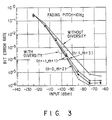
- a receiver (first embodiment) arranged based on the principle of the present invention apparently obtains a diversity effect (i.e., a bit error rate can be reduced to about 1/10 to 1/100).
- a bandpass filter which covers the band of a composite signal obtained by adding the two reception branch signals is used as the main band limit IF filter 10.
- Fig. 4 shows a circuit arrangement of a route roll-off filter type bandpass filter arranged in each of reception branches B1 and B2 which receive ⁇ /4-shifted QPSK (Quadrature Phase Shift Keying) signal according to the second embodiment.
- QPSK Quadrature Phase Shift Keying
- reference numerals 25 and 26 denote route roll-off type bandpass filters each having an offset IF frequency as its center frequency; 15, a 1-baud delay device; 16, a ⁇ /2 phase shifter; 17, a cosine detection mixer; 18, a sine detection mixer; 19 and 20, post detection filters; 21 and 22, detected signal identification determination circuits; 23, a detection signal parallel/serial converter; and 24, a reproduced signal output terminal.
- 1-baud delayed detection is generally employed for the ⁇ /4-shifted QPSK signal. Both sine detection and cosine detection are required.
- an output from the delay device 15 is equal to the value obtained from equation (10), and an output from the adder 9 is equal to the value obtained from equation (8).
- the low-frequency component of an output from the mixer 17 is equal to the value obtained from equation (11).
- the third and fourth terms of equation (11) are AC signals of (m - n)/d ⁇ fB, and the first and second terms are baseband signals.
- the frequency of the post detection filter 19 is set the Nyquist frequency fB/2 or more, and the AC signal frequency satisfies the following condition: so that the post detection filter 19 cuts off the AC components of the third and fourth terms of equation (11), but filters the baseband signals of the first and second terms therethrough.
- An output from the post detection filter 19 is the value from equation (13).
- the present invention has the second principle that input signals from a plurality of reception branches are converted into IF signals having frequency differences having a predetermined relationship with a modulation baseband signal, these signals are simply added to each other, the resultant sum signal is delayed and differentially detected through an IF filter, and the filtered signal passes through an appropriate bandpass filter to obtain demodulated signals.
- Fig. 5 is a block diagram showing an arrangement when 2-branch space diversity is employed as diversity on the basis of the second principle of the present invention.
- Reference numeral 1 denotes an antenna of a branch B1; 2, a frequency conversion mixer; 3, a reception local oscillator; 4, a bandpass filter for extracting a desired IF frequency; 5, an antenna of a branch B2; 6, a frequency conversion mixer; 7, a reception local oscillator; 8, a bandpass filter for extracting a desired IF frequency; 9, an adder for synthesizing signals from the branches B1 and B2; 110, a frequency converter for baseband differential detection; 111, a local oscillator for baseband differential detection; 112, a baseband delay logic circuit (see Fig. 6 of the fourth embodiment for further details); 113, a post detection filter; 114, a decision circuit.
- the parameters R1(t) and ⁇ 1(t) are generally random variables representing a Rayleigh distribution and a uniform distribution of 0 to 2 ⁇ , respectively. As described above these parameters represent change in rate which is not almost changed at about a modulation baud rate of the transmission signal.
- a signal received by the reception branch B1 is converted into an IF band signal by the local oscillator 3, the mixer 2, and the bandpass filter 4. Assume that the nominal IF frequency is defined as fi, and that an offset amount of the local oscillation frequency from the nominal frequency is defined as ⁇ f1.
- r i2 (t) R2(t)/2 ⁇ cos ⁇ 2 ⁇ (f i + ⁇ f2)+ ⁇ (t)+ ⁇ 2(t) ⁇ (29)
- the adder 9 simply adds the values obtained from equations (28) and (29) to produce a composite signal ri(t) as follows:
- the nominal center frequency of the IF band is fi.
- Equation (45) represents an equi-gain diversity output upon delayed cosine detection
- equation (46) represents an equi-gain diversity output upon delayed sine detection.
- Fig. 6 shows a circuit arrangement when the present invention is applied to a multivalue modulated signal such as a QPSK signal or a ⁇ /4-shifted QPSK signal.
- Reference numeral 115 denotes a ⁇ /2 phase shifter; 116, a mixer for performing frequency conversion along the cosine axis as one of the two orthogonal directions; 117, an image cutoff filter; 118, a mixer for performing frequency conversion along the sine axis as the other one of the two orthogonal directions; 119, an image cut-off filter; 120 and 121, delay devices for a delay logic circuit 112; 122, 123, 124, and 125, multipliers for performing multiplications; 126, a adder; 127, a post detection filter; 128, a decision circuit 129, a cosine detection output terminal; 130, an adder for adding inputs after the polarity of one of the inputs is inverted; 131, a post detection filter; 132, a decision circuit; and 133
- the delay times of the delay devices 120 and 121 are set at predetermined values, and an output signal from the output terminal 129 or 133 is used as a modulated signal in correspondence with the detection axis.
- reception quality can be improved by a diversity effect without modifying the transmission unit, without using a plurality of electric waves, and without using a complicated phase control synchronization technique.
- a diversity radio receiver for receiving a digital modulated signal and demodulating the modulated signal in accordance with delayed and differential detection, wherein input signals from a plurality of reception branches are converted into IF signals having frequency differences having a predetermined relationship with a modulation baseband signal, the IF signals are added to each other, a sum signal is delayed and differentially detected through an IF filter, and a demodulated signal is obtained through a filter having a predetermined bandwidth.
- a diversity radio receiver for receiving a digital modulated signal and demodulating the modulated signal in accordance with delayed and differential detection, wherein integers are assigned to a plurality of reception branches so that differences between the integers are equal to or larger than a value obtained by dividing a delay baud count in delayed detection by 2, the baud rates of the modulation baseband signals are multiplied with amounts divided by the delay baud count in the delayed and differential detection, frequencies obtained by adding these products to the nominal IF frequencies are defined as IF frequency bands of the plurality of branches, signals converted to these IF frequency bands are added, delay operations are performed by predetermined times and phase amounts so as to perform the delayed and differential detection, and a demodulated signal is obtained through a post detection filter having a bandwidth of at least the Nyquist frequency or more.
- reception quality can be improved by a diversity effect without modifying the transmission unit, without using a plurality of electric waves, and without using a complicated phase control synchronizing technique.
- the diversity circuit can be easily formed into an IC or LSI.
- a diversity radio receiver for transmitting or receiving a digital signal to perform delayed and differential detection, wherein when signals from a plurality of reception branches are to be converted into IF band signals, the input signals are converted into the IF band signals such that differences as amounts of an integer multiple of a value obtained by dividing the modulation baud rate of the transmission digital signal by the delay baud count are obtained, and the differences are the Nyquist frequency or more, the converted IF band signals are filtered through a proper bandpass filter, the filtered signals are added to each other to obtain a sum, the sum is frequency-converted into a low-frequency signal by using a local oscillation signal having a nominal center frequency of the IF band as the signal frequency, thereby performing so-called baseband delayed and differential detection for performing differential logic processing in this band, and then the detected signal is filtered through a proper baseband filter having at least the Nyquist bandwidth, thereby reproducing the transmitted signal.
Landscapes
- Engineering & Computer Science (AREA)
- Computer Networks & Wireless Communication (AREA)
- Signal Processing (AREA)
- Radio Transmission System (AREA)
- Digital Transmission Methods That Use Modulated Carrier Waves (AREA)
Applications Claiming Priority (2)
| Application Number | Priority Date | Filing Date | Title |
|---|---|---|---|
| JP240856/92 | 1992-09-09 | ||
| JP4240856A JPH0690225A (ja) | 1992-09-09 | 1992-09-09 | ダイバーシティ無線受信機 |
Publications (2)
| Publication Number | Publication Date |
|---|---|
| EP0587975A2 true EP0587975A2 (de) | 1994-03-23 |
| EP0587975A3 EP0587975A3 (en) | 1995-11-02 |
Family
ID=17065732
Family Applications (1)
| Application Number | Title | Priority Date | Filing Date |
|---|---|---|---|
| EP93101584A Withdrawn EP0587975A3 (en) | 1992-09-09 | 1993-02-02 | Diversity radio receiver |
Country Status (3)
| Country | Link |
|---|---|
| US (1) | US5448602A (de) |
| EP (1) | EP0587975A3 (de) |
| JP (1) | JPH0690225A (de) |
Cited By (1)
| Publication number | Priority date | Publication date | Assignee | Title |
|---|---|---|---|---|
| AU759599B2 (en) * | 1998-09-25 | 2003-04-17 | Nec Corporation | Radio receiver |
Families Citing this family (53)
| Publication number | Priority date | Publication date | Assignee | Title |
|---|---|---|---|---|
| EP0739117A4 (de) * | 1993-06-21 | 1997-11-19 | Toshiba Kk | Digitales funkübertragungssystem |
| US5684836A (en) | 1994-12-22 | 1997-11-04 | Mitsubishi Denki Kabushiki Kaisha | Receiver with automatic frequency control |
| US5918154A (en) * | 1995-08-23 | 1999-06-29 | Pcs Wireless, Inc. | Communications systems employing antenna diversity |
| JP3451178B2 (ja) * | 1997-05-19 | 2003-09-29 | 富士通株式会社 | スペースダイバーシティ受信装置 |
| US6317466B1 (en) * | 1998-04-15 | 2001-11-13 | Lucent Technologies Inc. | Wireless communications system having a space-time architecture employing multi-element antennas at both the transmitter and receiver |
| US6694128B1 (en) | 1998-08-18 | 2004-02-17 | Parkervision, Inc. | Frequency synthesizer using universal frequency translation technology |
| US7515896B1 (en) | 1998-10-21 | 2009-04-07 | Parkervision, Inc. | Method and system for down-converting an electromagnetic signal, and transforms for same, and aperture relationships |
| US6061551A (en) | 1998-10-21 | 2000-05-09 | Parkervision, Inc. | Method and system for down-converting electromagnetic signals |
| US6091940A (en) | 1998-10-21 | 2000-07-18 | Parkervision, Inc. | Method and system for frequency up-conversion |
| US6813485B2 (en) | 1998-10-21 | 2004-11-02 | Parkervision, Inc. | Method and system for down-converting and up-converting an electromagnetic signal, and transforms for same |
| US7027786B1 (en) | 1998-10-21 | 2006-04-11 | Parkervision, Inc. | Carrier and clock recovery using universal frequency translation |
| US6542722B1 (en) | 1998-10-21 | 2003-04-01 | Parkervision, Inc. | Method and system for frequency up-conversion with variety of transmitter configurations |
| US6560301B1 (en) | 1998-10-21 | 2003-05-06 | Parkervision, Inc. | Integrated frequency translation and selectivity with a variety of filter embodiments |
| US6061555A (en) | 1998-10-21 | 2000-05-09 | Parkervision, Inc. | Method and system for ensuring reception of a communications signal |
| US7236754B2 (en) | 1999-08-23 | 2007-06-26 | Parkervision, Inc. | Method and system for frequency up-conversion |
| US6049706A (en) | 1998-10-21 | 2000-04-11 | Parkervision, Inc. | Integrated frequency translation and selectivity |
| US7295826B1 (en) | 1998-10-21 | 2007-11-13 | Parkervision, Inc. | Integrated frequency translation and selectivity with gain control functionality, and applications thereof |
| US7039372B1 (en) | 1998-10-21 | 2006-05-02 | Parkervision, Inc. | Method and system for frequency up-conversion with modulation embodiments |
| US6370371B1 (en) | 1998-10-21 | 2002-04-09 | Parkervision, Inc. | Applications of universal frequency translation |
| US6704549B1 (en) | 1999-03-03 | 2004-03-09 | Parkvision, Inc. | Multi-mode, multi-band communication system |
| US7006805B1 (en) | 1999-01-22 | 2006-02-28 | Parker Vision, Inc. | Aliasing communication system with multi-mode and multi-band functionality and embodiments thereof, such as the family radio service |
| US6704558B1 (en) | 1999-01-22 | 2004-03-09 | Parkervision, Inc. | Image-reject down-converter and embodiments thereof, such as the family radio service |
| US6853690B1 (en) | 1999-04-16 | 2005-02-08 | Parkervision, Inc. | Method, system and apparatus for balanced frequency up-conversion of a baseband signal and 4-phase receiver and transceiver embodiments |
| US6879817B1 (en) | 1999-04-16 | 2005-04-12 | Parkervision, Inc. | DC offset, re-radiation, and I/Q solutions using universal frequency translation technology |
| US6873836B1 (en) | 1999-03-03 | 2005-03-29 | Parkervision, Inc. | Universal platform module and methods and apparatuses relating thereto enabled by universal frequency translation technology |
| US7110435B1 (en) | 1999-03-15 | 2006-09-19 | Parkervision, Inc. | Spread spectrum applications of universal frequency translation |
| US7952511B1 (en) | 1999-04-07 | 2011-05-31 | Geer James L | Method and apparatus for the detection of objects using electromagnetic wave attenuation patterns |
| US7110444B1 (en) | 1999-08-04 | 2006-09-19 | Parkervision, Inc. | Wireless local area network (WLAN) using universal frequency translation technology including multi-phase embodiments and circuit implementations |
| US7693230B2 (en) | 1999-04-16 | 2010-04-06 | Parkervision, Inc. | Apparatus and method of differential IQ frequency up-conversion |
| US7065162B1 (en) | 1999-04-16 | 2006-06-20 | Parkervision, Inc. | Method and system for down-converting an electromagnetic signal, and transforms for same |
| US7054296B1 (en) | 1999-08-04 | 2006-05-30 | Parkervision, Inc. | Wireless local area network (WLAN) technology and applications including techniques of universal frequency translation |
| US7072390B1 (en) | 1999-08-04 | 2006-07-04 | Parkervision, Inc. | Wireless local area network (WLAN) using universal frequency translation technology including multi-phase embodiments |
| US8295406B1 (en) | 1999-08-04 | 2012-10-23 | Parkervision, Inc. | Universal platform module for a plurality of communication protocols |
| DE19942944A1 (de) * | 1999-09-08 | 2001-03-22 | Infineon Technologies Ag | Kommunikationssystem und entsprechender Empfänger |
| US7082171B1 (en) | 1999-11-24 | 2006-07-25 | Parkervision, Inc. | Phase shifting applications of universal frequency translation |
| US6963734B2 (en) | 1999-12-22 | 2005-11-08 | Parkervision, Inc. | Differential frequency down-conversion using techniques of universal frequency translation technology |
| US7292835B2 (en) | 2000-01-28 | 2007-11-06 | Parkervision, Inc. | Wireless and wired cable modem applications of universal frequency translation technology |
| US7010286B2 (en) | 2000-04-14 | 2006-03-07 | Parkervision, Inc. | Apparatus, system, and method for down-converting and up-converting electromagnetic signals |
| US7554508B2 (en) | 2000-06-09 | 2009-06-30 | Parker Vision, Inc. | Phased array antenna applications on universal frequency translation |
| US7454453B2 (en) | 2000-11-14 | 2008-11-18 | Parkervision, Inc. | Methods, systems, and computer program products for parallel correlation and applications thereof |
| US7010559B2 (en) | 2000-11-14 | 2006-03-07 | Parkervision, Inc. | Method and apparatus for a parallel correlator and applications thereof |
| US7085335B2 (en) | 2001-11-09 | 2006-08-01 | Parkervision, Inc. | Method and apparatus for reducing DC offsets in a communication system |
| US7072427B2 (en) | 2001-11-09 | 2006-07-04 | Parkervision, Inc. | Method and apparatus for reducing DC offsets in a communication system |
| US6985698B2 (en) * | 2001-11-14 | 2006-01-10 | Koninklijke Philips Electronics N.V. | Impedeance matching circuit for a multi-band radio frequency device |
| US6975848B2 (en) | 2002-06-04 | 2005-12-13 | Parkervision, Inc. | Method and apparatus for DC offset removal in a radio frequency communication channel |
| US7321640B2 (en) | 2002-06-07 | 2008-01-22 | Parkervision, Inc. | Active polyphase inverter filter for quadrature signal generation |
| US7460584B2 (en) | 2002-07-18 | 2008-12-02 | Parkervision, Inc. | Networking methods and systems |
| US7379883B2 (en) | 2002-07-18 | 2008-05-27 | Parkervision, Inc. | Networking methods and systems |
| US7327994B2 (en) * | 2004-11-04 | 2008-02-05 | Hamid Rafati | Architecture for multiple-antenna systems |
| CN2749181Y (zh) * | 2004-12-28 | 2005-12-28 | 精恒科技集团有限公司 | 多天线接收输出处理装置 |
| US8548407B2 (en) * | 2011-08-15 | 2013-10-01 | Delphi Technologies, Inc. | Apparatus to communicate multiple signals from multiple antennas on a single cable |
| MY182777A (en) * | 2014-10-31 | 2021-02-05 | Ericsson Telefon Ab L M | Radio receiver, method of detecting an obtruding signal in the radio receiver, and computer program |
| CN111313942A (zh) * | 2020-02-12 | 2020-06-19 | 惠州Tcl移动通信有限公司 | Mimo系统,mimo系统区分信号的方法及其移动终端 |
Family Cites Families (2)
| Publication number | Priority date | Publication date | Assignee | Title |
|---|---|---|---|---|
| US3743941A (en) * | 1971-10-28 | 1973-07-03 | Bell Telephone Labor Inc | Diversity receiver suitable for large scale integration |
| US4715048A (en) * | 1986-05-02 | 1987-12-22 | Canadian Patents And Development Limited | Frequency offset diversity receiving system |
-
1992
- 1992-09-09 JP JP4240856A patent/JPH0690225A/ja active Pending
-
1993
- 1993-01-29 US US08/010,886 patent/US5448602A/en not_active Expired - Fee Related
- 1993-02-02 EP EP93101584A patent/EP0587975A3/en not_active Withdrawn
Cited By (1)
| Publication number | Priority date | Publication date | Assignee | Title |
|---|---|---|---|---|
| AU759599B2 (en) * | 1998-09-25 | 2003-04-17 | Nec Corporation | Radio receiver |
Also Published As
| Publication number | Publication date |
|---|---|
| JPH0690225A (ja) | 1994-03-29 |
| EP0587975A3 (en) | 1995-11-02 |
| US5448602A (en) | 1995-09-05 |
Similar Documents
| Publication | Publication Date | Title |
|---|---|---|
| EP0587975A2 (de) | Diversity Funkempfänger | |
| KR960002933B1 (ko) | 디지탈 변조파용 복조장치 | |
| US5787123A (en) | Receiver for orthogonal frequency division multiplexed signals | |
| KR960003786B1 (ko) | 디지탈 기술을 이용한 기저대 위상 변조기 장치 | |
| JP2643792B2 (ja) | 復調装置 | |
| US9473236B2 (en) | Relay apparatus, relay satellite, and satellite communication system | |
| JPH0951296A (ja) | 交差偏波間補償方法及び交差偏波間補償装置 | |
| EP0807344B1 (de) | Verfahren und anordnung zum erzeugen von mehreren quadraturmodulierten trägern | |
| US7551666B2 (en) | Wireless communications system and wireless digital receiver for use therein | |
| US4493099A (en) | FM Broadcasting system with transmitter identification | |
| JPH08316873A (ja) | 時分割多重fdd無線機および時分割多重fdd/tddデュアルモード無線機 | |
| EP0099113B2 (de) | Raumdiversity-System mit Störungsauslöschung | |
| JP3350068B2 (ja) | デジタル変調波の復調装置 | |
| JP3383318B2 (ja) | デジタル変調波の復調装置 | |
| JP2004241886A (ja) | 周波数制御回路、及びそれを用いた無線送受信装置とその周波数制御方法 | |
| US5592507A (en) | Intermediate relay station of a digital microwave communication system using service channel for monitoring and controlling space and/or time diversity, heterodyne relay, phase control, frequency control, with phase shift keying modulation | |
| US20080212706A1 (en) | Transmission Method and Transmission System | |
| JPH09130440A (ja) | 検波回路装置 | |
| JPH066397A (ja) | 遅延検波器 | |
| JPH07183831A (ja) | ディジタル通信方法およびディジタル通信装置 | |
| JPH0767091B2 (ja) | ダイバ―シティ無線受信機 | |
| JPH08139691A (ja) | 周波数分割多重変調方式送信機および受信機 | |
| KR860000232B1 (ko) | 양립식 am스테레오 방송 시스템 | |
| JP3287721B2 (ja) | 通信装置 | |
| KR19990004246A (ko) | 파이/4 qpsk 디지털 복조 방법 및 장치 |
Legal Events
| Date | Code | Title | Description |
|---|---|---|---|
| PUAI | Public reference made under article 153(3) epc to a published international application that has entered the european phase |
Free format text: ORIGINAL CODE: 0009012 |
|
| 17P | Request for examination filed |
Effective date: 19930202 |
|
| AK | Designated contracting states |
Kind code of ref document: A2 Designated state(s): DE FR GB |
|
| PUAL | Search report despatched |
Free format text: ORIGINAL CODE: 0009013 |
|
| AK | Designated contracting states |
Kind code of ref document: A3 Designated state(s): DE FR GB |
|
| 17Q | First examination report despatched |
Effective date: 19990916 |
|
| STAA | Information on the status of an ep patent application or granted ep patent |
Free format text: STATUS: THE APPLICATION IS DEEMED TO BE WITHDRAWN |
|
| 18D | Application deemed to be withdrawn |
Effective date: 20000127 |