EP0588074A2 - Zeichenerkennungsverfahren und -vorrichtung mit überwachter Ausbildung - Google Patents
Zeichenerkennungsverfahren und -vorrichtung mit überwachter Ausbildung Download PDFInfo
- Publication number
- EP0588074A2 EP0588074A2 EP93113093A EP93113093A EP0588074A2 EP 0588074 A2 EP0588074 A2 EP 0588074A2 EP 93113093 A EP93113093 A EP 93113093A EP 93113093 A EP93113093 A EP 93113093A EP 0588074 A2 EP0588074 A2 EP 0588074A2
- Authority
- EP
- European Patent Office
- Prior art keywords
- character
- characters
- weight matrix
- training
- classification
- Prior art date
- Legal status (The legal status is an assumption and is not a legal conclusion. Google has not performed a legal analysis and makes no representation as to the accuracy of the status listed.)
- Withdrawn
Links
Images

Classifications
-
- G—PHYSICS
- G06—COMPUTING OR CALCULATING; COUNTING
- G06V—IMAGE OR VIDEO RECOGNITION OR UNDERSTANDING
- G06V30/00—Character recognition; Recognising digital ink; Document-oriented image-based pattern recognition
- G06V30/10—Character recognition
- G06V30/19—Recognition using electronic means
- G06V30/191—Design or setup of recognition systems or techniques; Extraction of features in feature space; Clustering techniques; Blind source separation
- G06V30/19147—Obtaining sets of training patterns; Bootstrap methods, e.g. bagging or boosting
-
- G—PHYSICS
- G06—COMPUTING OR CALCULATING; COUNTING
- G06F—ELECTRIC DIGITAL DATA PROCESSING
- G06F18/00—Pattern recognition
- G06F18/20—Analysing
- G06F18/21—Design or setup of recognition systems or techniques; Extraction of features in feature space; Blind source separation
- G06F18/214—Generating training patterns; Bootstrap methods, e.g. bagging or boosting
-
- G—PHYSICS
- G06—COMPUTING OR CALCULATING; COUNTING
- G06F—ELECTRIC DIGITAL DATA PROCESSING
- G06F18/00—Pattern recognition
- G06F18/20—Analysing
- G06F18/21—Design or setup of recognition systems or techniques; Extraction of features in feature space; Blind source separation
- G06F18/217—Validation; Performance evaluation; Active pattern learning techniques
-
- G—PHYSICS
- G06—COMPUTING OR CALCULATING; COUNTING
- G06V—IMAGE OR VIDEO RECOGNITION OR UNDERSTANDING
- G06V30/00—Character recognition; Recognising digital ink; Document-oriented image-based pattern recognition
- G06V30/10—Character recognition
Definitions
- the present invention is directed to a method and apparatus for characterizing or recognizing alphanumeric text characters particularly hand printed text characters and, more particularly, to an automated system in which a least squares pattern recognition method is iterated to produce a classification weight matrix using error correction feedback in which recognition test results are used to replicate (or increase the training weight of) poorly classified characters and to provide negative feedback for incorrect classifications, and where the resulting weight matrix is then used in automated identification processing of hand printed forms or characters or the on-line identification of characters entered on pen-based computers.
- Neural network based systems are characterized by plural nonlinear transfer functions which vary in accordance with some learning method, such as back propagation.
- the neural networks typically evolve discrimination criteria through error feedback and self organization. Because plural transfer functions are used in the educated recognition system, neural networks are not very well suited for implementation on general purpose computers and generally need dedicated special purpose processors or dedicated node hardware in which each of the transfer functions is implemented.
- Statistical classifiers are more suited for implementation on general purpose computers.
- Statistical classifiers can be implemented using a number of different statistical algorithms. These algorithms generally deal with selected features of the characters and analytically determine whether the features belong to or are members of clusters of features which clusters define characteristics of the characters being recognized. In other words, if the features of an unlabeled character fall within the boundaries of a cluster of features which characterize a particular text character, then the probability is high that the character to be labeled corresponds to the character of the cluster.
- One approach to identifying whether an unlabeled character falls within a cluster boundary is to compute the Hamming distance between an unlabeled character pixel array and the arrays of possible matching text characters.
- Another approach is to use a polynomial least mean square classifier with a quadratic discriminant function, such as described in Umashrinivasan, "Polynomial Discriminant Method For Hand Written Digit Recognition", State University of New York at Buffalo, Technical Report, December 14, 1989, incorporated by reference herein.
- the Shrinivasan classifier works as follows. A database of labeled, hand written alphanumeric characters (digits, upper case alphabetics, or the combination of the two) are converted to feature vectors, v ⁇ , and are associated with target vectors. The components of the feature vectors are F quadratic polynomials (features) formed from the character's pixel array to provide evidences of lines through the image.
- the target vector for each character is a standard unit vector e ⁇ k( v ⁇ ) with the k( v ⁇ ) th component equal to 1 and all other components equal to zero, where k( v ⁇ ) is the externally provided classification for the character, for example 0,1,2,...,9 or A,B,...,Z or a combination.
- Standard numerical techniques are used to determine an FxK floating point weight matrix A to minimize the squared errors, ⁇ v ⁇ (A v ⁇ - e ⁇ k( v ⁇ ) )2, where the sum runs over all feature vectors and K is the number of classes, for example 10 digits or 26 alphamerics.
- the weights matrix, A is then used to classify unlabeled characters by determining the largest component in the product A w ⁇ , where w ⁇ is the unknown character's feature vector. Additional details of this method can be found in the above-identified paper which includes source code implementing the method.
- the above described system along with other statistically based systems, such as described in U.S. Patent 5,060,279, are one shot learning systems, that is, the weight matrix or equivalent database is created in a single pass over the set of labeled characters used to produce the matrix or database.
- Such statistically based classifiers provide a reasonably good classification system but generally do not have the accuracy of neural network systems.
- the more accurate neural network based systems are slower to learn, slower to identify characters and require more memory and computing hardware than the statistical classifiers. What is needed is a system which combines the advantageous accuracy of the neural network based systems with the speed and efficiency of the statistically based systems and which may be based on simple integer or bit arithmetic.
- It is an additional object of the present invention is to provide a system that trains faster than a neural network based classifier.
- the above objects can be attained by a system that creates a classification matrix which classifies or identifies hand printed or machine printed alphanumeric characters.
- the matrix is created using an iterated least squares polynomial discriminant method.
- the classification weight matrix to be subsequently used for identification, is modified by determining which characters are incorrectly classified, or classified with too small a confidence, and replicating those characters during training to strengthen the correct classification.
- the correct classification is also strengthened by using negative feedback, or subtracting out of the misclassified target vectors, to inhibit an incorrect classification.
- the speed of the learning process is enhanced by subsampling the training data during feature vector extraction, supersampling the training set and stepwise increasing the amount of the training set used, maintaining intermediate matrices and step wise increasing the amount of each feature vector used during training.
- Classification accuracy is enhanced by using features of at least two types, both based on quadratic monomials of the pixels called King and Knight features (so called because they resemble the squares in a chess board the respective piece moves to and from).
- the memory efficiency utilization is enhanced by modifying the existing weight matrix and compressing the sparse binary features vectors.
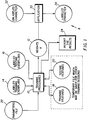
- the system 8 of the present invention includes two programs or procedures, the first being the training procedure 10 which creates a weights matrix 12 from labeled training characters (exemplars) 14 and labeled testing characters 16. It is preferred that the training set 14 include at least 1000 different versions of each character to be identified or classified. These alphanumeric characters are conventionally captured, digitized and stored as pixel array images of preferably 20 by 30 bits. The capture process uses conventional optical scanners and processes capable of capturing characters printed on a substrate, such as paper, or entered on a digitizing tablet.
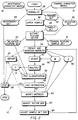
- the training procedure 10 which will be discussed in more detail with respect to Figure 2, creates and uses training and testing feature vectors 18 and 20 created from the conventionally captured training and testing character sets 14 and 16.
- the training procedure also uses, as an input, parameters 22 which govern and control the training iterations.
- the training procedure 10 produces a results report parts of which are used to control training procedure iteration.
- the second procedure of the present invention is an application procedure 30 which uses the weights matrix 12 to convert an unlabeled, conventionally captured character 32 into the labeled character 34.
- the application procedure 30 will be discussed in more detail with respect to Figure 4.
- the present invention preferably is implemented on a computer, such as a Sun WorkStation computer system, in a general purpose language, such as C. Pseudocode for the procedure 10 and application 30 is included herewith as an Appendix.
- the training character images 14 are normalized 38 and used to create a validation image set 40 and a training image set 42.
- the training character images 14 are images of alphanumeric characters which typically would be found or are judged by the system developer to represent the range of characters which will be found in the target real world application. For example, if the application is to recognize hand written digits on mail, such as zip codes, the training character images would be a representative sample of the types of digits found on pieces of mail.
- the validation set 40 is typically 20% of the character images 14 while the training set 42 is the remainder. Although, a completely independent set of images can be used for the validation set.
- the normalization operation 38 involves conventional operations of reducing strokes in the image of the character to a single pixel in width or to 2-4 pixels in width, so that all strokes of each character are the same width.
- the normalization also includes conventionally dilating the image of the character until the exterior pixels of the character fill one or more of the pixels on the edge of the character matrix which is typically an array or matrix 20 bits (pixels) wide and 30 bits (pixels) tall (a 20 x 30 bit array).
- the independent character images 16, supplied by the user to be used for later testing must also be normalized, as discussed above, and used to create an independent image character set 44.
- the independent character images 16 would typically be the images that the ultimate user of the system has selected as representative of the types of characters which will be encountered in the real world application, such as reading zip codes.
- the training set 42 is then super-sampled 46 to create a sample set 48 which will be used to extract features of each of the characters in the sample set.
- the super-sampling operation 46 merely replicates each character image eight times to create nine images from each single image in the training set 42. For example, if 1000 different versions of a character are provided in the set 14, 9000 will be stored in set 48.
- the eight added images are created by shifting each image by what is called a kings move in chess. For example, to create one of the images the original image is shifted up by one pixel, to create the second image the original image is diagonally shifted in the right upward direction by one pixel, to create the third image the original image is shifted right by one pixel, etc.
- nine training images or exemplars are created for every original image in the training set 42 which is called super-sampling.
- the super-sampling operation is described in more detail on page 1 of the Appendix.
- the system extracts feature vectors to create 50 the validation feature set 20 and the training feature sample set 18.
- the feature extraction operation conventionally uses quadratic polynomials to form a binary feature vector. Each character is represented by a 20 X 30 array of bits, with value 1 indicating a black pixel and 0 indicating a white pixel.
- the present invention uses two types of quadratic features: a King, as illustrated in Fig. 3A, and a Big Knight, as illustrated in Fig. 3b.
- a king feature is the product of two pixels that are a dilation of a king's move apart on a chess board (a "king's move", undilated, is two pixels whose x coordinate and y coordinate both differ by 0 or 1).
- the feature center 52 can participate in up to four King features AE, BF, CG and DH.
- a Big Knight feature is illustrated in Fig. 3b and is the product of two pixels that are a Big Knight's move apart on a chess board, that is, two pixels whose x coordinates differ by 4 and whose y coordinates differ by 2 or vice versa.
- the feature center pixel 53 can be the center of up to four Big Knight features IM, JN, KO and LP.
- the features of each character in the sample set are subsampled during extraction in a predetermined order. That is, all features are not extracted from each exemplar in the super-sampled training sample set 48.
- the numbers 19 and 28 replace 20 and 30 for the feature centers, since centers very near the edges are of little use and these chosen parameters (28x19) work well in getting equidistributed feature centers.
- k be set at a value of at least 250, so that 250 features are used to create a 250 bit feature vector.
- the subsampling results in an equidistributed subsample of the features of each character. The feature vector extraction and subsampling is described in more detail on pages 2, 3 and 10-13 of the Appendix.
- the present invention creates 56 and maintains two intermediate matrices 58 and 60 and outputs the matrices to report storage 24.
- the matrix 58 is inverted 62 and the results are multiplied 64 by the matrix 60 to obtain the weight matrix 12 which will be used for feature classification.
- the steps 56-60 execute the operations necessary to perform the mathematical operation of equation 1.
- A YX T ( XX T ) ⁇ 1 (1)
- the steps necessary to execute equation 1 are all performed in theshrinivasan method set forth in the report previously mentioned and are described in detail therein. However, the Shrinivasan method does not create and maintain the matrices 58 and 60 but rather destroys those matrices during the creation of the weight matrix 12.
- the steps 56, 62 and 64 are described in more detail in the Appendix on pages 2, 3, 5, 6 and 9.
- the ability of that weight matrix to classify characters is tested 66.
- This test involves multiplying the weight matrix 12 times the feature vector for each image in the validation feature set 20 to produce a list of classification strengths for each character class which indicates the classification of the particular image feature vector. For example, if the weight matrix 12 is designed to classify the digits 0-9 the classification strengths list, as a result of the multiplication, will include ten items where the value in each item indicates the system's belief or probability that the character image corresponds to that digit. The item in the classification matrix with the highest such belief strength is the digit which the classification operation indicates corresponds to the image.
- the test classification operation 66 in addition to creating the classification matrix for each of the images in the validation feature set 20, compares the classification with the actual identified character and indicates whether the character is correctly classified or misclassified in a report 24 or database used to indicate how well the weight matrix A is classifying the characters. This indication is performed by creating a comparison matrix whose (i,j) entry gives the percent of the characters of class i that were classified as class j. The testing and determinations as to misclassification is described in more detail on pages 3 and 8 of the Appendix.
- the iteration on the weight matrix 12 creation operation can be performed until all of the characters in the feature validation set are recognized with some efficiency such as 98%.
- experimentation has indicated that iterating for 20-50 cycles will result in the classification accuracy equal to or exceeding a multi node neural network. For example, 20 iterations will result in a weight matrix with a performance exceeding 97% on digits only, 95.5% on upper case alphabetics, and 88% on mixed upper and lower case alphabetics.
- the present invention iterates on the weight matrix creation operation by increasing the representation of incorrectly classified exemplars and exemplars classified with low confidence (called together poorly classified or hard to train exemplars) in the training set.
- the weight matrix 12 is determined in accordance with equation 1 and as previously discussed the intermediate matrices 58 and 60 are separately maintained as illustrated in equations 2 and 3 below where n is the number of training exemplars. In these equations all vectors are treated as column vectors, so the products are outer products, not inner or scalar products.
- e k is the target vector and x i is the feature vector.
- the hard to train exemplars are used to modify 80 the matrices 58 and 60 by repeating the hard to train exemplars and providing a negative classification weight to the classification that was ill-classified.
- the hard to train exemplars are repeated to increase the multiplicity m k (which corresponds to the epoch or iteration) such that: where Z as defined above is the matrix comprising the sum of the outer products of feature vectors and their classifications and W is the matrix comprising the sums of outer product squares of feature vectors where the vectors are column vectors, so their transposes are row vectors.
- ⁇ is a confidence threshold which essentially measures how close the probabilities of the classifications are to each other. Based on the confidence being below the threshold the j th activation for x ⁇ is lowered by specifying, on at least one epoch or iteration, that a negative j th classification weight is to be used for this exemplar.
- Such a character could produce a classification strength list such as: Class 0 1 2 3 4 5 6 7 8 9 0 0 0 .9 0 0 0 0 .7 0 If the confidence threshold indicates that .7 is too close to .9, the system would retrain the character by modifying its target from: (0, 0, 0, 1, 0, 0, 0, 0, 0) to: (0, 0, 0, 10, 0, 0, 0, -5, 0) The above target would be used in the 10th pass (epoch). The -5 helps the system to separate the classification of 3's that look like 8's away from the classification of 8's.
- the confidence threshold, ⁇ is raised or lowered from one epoch to the next to try to keep the number of ill-classified exemplars near a specified fraction of the training set. Retraining of 20% of the training exemplars works well. Retraining a larger fraction causes large oscillations; e.g., the conflicting classification between the character classes "3" and "8" will cause almost all of both characters to flip between all one or the other. With the 20% retraining fraction, a reasonable boundary between the two classes is determined quickly.
- the operation of modifying the matrices and adjusting the confidence level are described in more detail on page 3 of the Appendix.
- the largest size feature vector that is appropriate is chosen (feature vectors of 1250 features for digits and 1600 features for alphanumerics are an acceptable size although larger vectors will provide enhanced classification accuracy, however, feature vectors of 1500 features are typical for general recognition problems in the English language), vectors of the chosen size are created for every character to be processed, either in training or testing.
- the system then maintains weight matrices that use only a prefix of that vector, and testing ignores a feature vector's postfix. For a character used in training, if that character fails to be classified properly by the current weight matrix, its full feature vector is used to update Z and W.
- an epoch or iteration consists of a (possibly subsampled and/or supersampled) pass over the training data.
- a larger and larger submatrix of Z and W is chosen to compute the new weight matrix. For example, assume that each feature vector includes 4800 features or bits. If the first iteration uses a prefix of 1000 features and the size of the feature vector is increased by 200 features on each iteration the 20th iteration will use all 4800 features. Starting with at least 100 bits of each of the features vectors and increasing by an equal amount for each iteration until the last iteration equals the total number of features is an appropriate approach to increasing the size of the feature vector used. Although a minimum increase of 100 bits is recommended on each iteration.
- the sample set size used in the operation is adjusted 84 in accordance with 2K/E where K is the number of the current iteration and E is the total number of iterations which will be performed.
- the training set size becomes 100% in the middle epoch and stays at 100% during the remainder of the iterations. For example, if the set 18 includes 1000 feature vectors and 20 iterations are to be performed, the first iteration uses the first 100 feature vectors of the set 18 and the last iteration uses all of the feature vectors of the set 18. In this way the system linearly ramps up in the amount of the sample set which is actually used during classification matrix creation. Additional details of the sample set size adjustment are provided on page 2 of the Appendix.
- equation 1 The computation involving equation 1 appears to require that several arrays be built, multiplied, and inverted. Some of these matrices are very large. For example, when the system is dealing with N training patterns or characters and F features, and K character classifications, the matrices have the following dimensions: array dimensions A (K,F) Y (K,N) X (K,F) However, because of the simple nature of these matrices and the contexts in which they are used, some of them do not need to be explicitly stored in the manner referred to in equation 1.
- the present invention avoids storing the two matrices X and Y (recall that the K th column of Y is a unit vector giving the classification of the K th training pattern; the K th column of X is the binary feature vector of the K th training pattern).
- the system initializes Z to zero and for each training pattern, if its classification is j, the system adds its feature vector to the j th column of Z.
- the system initializes W to zero and for each training exemplar's feature vector, x ⁇ , the system adds its outer product square, xx ⁇ T , to W. That is, add x i x j to W ij for every subscript pair, ij. Since an outer product square is symmetrical, W is symmetrical, and we only have to accumulate on the lower triangle. Since the feature vector is a sparse binary vector, we only have to add it to selected rows of W. An important consequence of the elimination of X and Y is that there is no storage penalty for a large training set.
- the feature vectors are preferably compressed using a conventional compression technique which substitutes subscript differences for the non-zero elements of the feature vector.
- the application procedure 30 which uses the resulting weight matrix 12 to classify unlabeled characters, as illustrated in Figure 4, starts by normalizing 100, as previously discussed, an unlabeled character which has been previously captured and digitized as a 20x30 bit array.
- the features of the unlabeled character are extracted 102 using the extraction method previously discussed and the feature vector is multiplied 104 times the weight matrix 12 to produce the classification matrix or list of classification probabilities.
- the largest probability corresponds to the classification of the character and is used 106 to label the character 34.
- step 106 can include a comparison of the classification using the confidence factor previously mentioned to reject characters that can then be classified by a human. This operation 104 is illustrated on pages 7 and 8 of the Appendix.
- the present invention could be implemented using a technique in which the weight matrix is used in the real world application, such as mail sorting, and misclassified mail that was sorted to the wrong end point is used as part of the training exemplars for another run. However, the end user generally prefers that an item be rejected so that it can be classified by a human rather than allowing misclassification to occur.
- the present invention provides for increasing the representation of poorly classified characters and negative feedback of misclassified characters.
- the increase in the representation corresponds to the iteration while the negative feedback is fixed. It is possible to provide a different multiplicity for poorly classified characters and increase the negative feedback for misclassified characters. However, experiments indicate that adjusting the values to larger than the ones discussed herein can lead to oscillating rather than smoothly converging behavior. Especially, when the negative feedback is as large as the positive feedback, the system may be unable to converge to a well-behaved classifier
- the invention has also been described with respect to a feature vector prefix that grows to the full vector by the last iteration. It is possible to stop the growth at some point such that the prefix in the last iteration is not the full feature vector. This will enhance processing speed, but there may be some loss of classification accuracy.
- the invention may be summarized as providing a method of character classification, comprising the steps of:
Landscapes
- Engineering & Computer Science (AREA)
- Theoretical Computer Science (AREA)
- Data Mining & Analysis (AREA)
- General Physics & Mathematics (AREA)
- Physics & Mathematics (AREA)
- Computer Vision & Pattern Recognition (AREA)
- Life Sciences & Earth Sciences (AREA)
- Artificial Intelligence (AREA)
- Bioinformatics & Cheminformatics (AREA)
- Bioinformatics & Computational Biology (AREA)
- Evolutionary Biology (AREA)
- Evolutionary Computation (AREA)
- General Engineering & Computer Science (AREA)
- Multimedia (AREA)
- Character Discrimination (AREA)
Applications Claiming Priority (2)
| Application Number | Priority Date | Filing Date | Title |
|---|---|---|---|
| US931741 | 1978-08-07 | ||
| US07/931,741 US5555317A (en) | 1992-08-18 | 1992-08-18 | Supervised training augmented polynomial method and apparatus for character recognition |
Publications (2)
| Publication Number | Publication Date |
|---|---|
| EP0588074A2 true EP0588074A2 (de) | 1994-03-23 |
| EP0588074A3 EP0588074A3 (en) | 1994-07-20 |
Family
ID=25461279
Family Applications (1)
| Application Number | Title | Priority Date | Filing Date |
|---|---|---|---|
| EP19930113093 Withdrawn EP0588074A3 (en) | 1992-08-18 | 1993-08-16 | Method and apparatus for character recognition with supervised training |
Country Status (3)
| Country | Link |
|---|---|
| US (1) | US5555317A (de) |
| EP (1) | EP0588074A3 (de) |
| JP (1) | JPH06176202A (de) |
Cited By (4)
| Publication number | Priority date | Publication date | Assignee | Title |
|---|---|---|---|---|
| CN1123844C (zh) * | 1995-06-20 | 2003-10-08 | 索尼公司 | 识别手写字符的装置和方法 |
| CN105320957A (zh) * | 2014-07-10 | 2016-02-10 | 腾讯科技(深圳)有限公司 | 分类器训练方法和装置 |
| CN112733726A (zh) * | 2021-01-12 | 2021-04-30 | 海尔数字科技(青岛)有限公司 | 票据样本的扩容方法、装置、电子设备、及存储介质 |
| WO2022205554A1 (zh) * | 2021-03-31 | 2022-10-06 | 电子科技大学中山学院 | 一种面向目标识别的多阶段训练方法 |
Families Citing this family (38)
| Publication number | Priority date | Publication date | Assignee | Title |
|---|---|---|---|---|
| AU7311994A (en) * | 1993-05-21 | 1994-12-20 | Arris Pharmaceutical Corporation | A machine-learning approach to modeling biological activity for molecular design and to modeling other characteristics |
| US5805730A (en) * | 1995-08-08 | 1998-09-08 | Apple Computer, Inc. | Method for training an adaptive statistical classifier with improved learning of difficult samples |
| US5768422A (en) * | 1995-08-08 | 1998-06-16 | Apple Computer, Inc. | Method for training an adaptive statistical classifier to discriminate against inproper patterns |
| US5805731A (en) * | 1995-08-08 | 1998-09-08 | Apple Computer, Inc. | Adaptive statistical classifier which provides reliable estimates or output classes having low probabilities |
| US5764824A (en) * | 1995-08-25 | 1998-06-09 | International Business Machines Corporation | Clustering mechanism for identifying and grouping of classes in manufacturing process behavior |
| US5940535A (en) * | 1996-10-31 | 1999-08-17 | Industrial Technology Research Institute | Method and apparatus for designing a highly reliable pattern recognition system |
| US6298351B1 (en) * | 1997-04-11 | 2001-10-02 | International Business Machines Corporation | Modifying an unreliable training set for supervised classification |
| DE19723293A1 (de) * | 1997-06-04 | 1998-12-10 | Siemens Ag | Mustererkennungsverfahren |
| US6259814B1 (en) | 1997-10-17 | 2001-07-10 | Canon Kabushiki Kaisha | Image recognition through localized interpretation |
| US6167411A (en) * | 1998-06-22 | 2000-12-26 | Lucent Technologies Inc. | User interface for entering and editing data in data entry fields |
| US7016539B1 (en) | 1998-07-13 | 2006-03-21 | Cognex Corporation | Method for fast, robust, multi-dimensional pattern recognition |
| US6473524B1 (en) | 1999-04-14 | 2002-10-29 | Videk, Inc. | Optical object recognition method and system |
| US6951707B2 (en) * | 2001-03-08 | 2005-10-04 | Ppg Industries Ohio, Inc. | Process for creating vias for circuit assemblies |
| US7088854B2 (en) * | 2001-04-25 | 2006-08-08 | Cotman Carl W | Method and apparatus for generating special-purpose image analysis algorithms |
| US7249116B2 (en) * | 2002-04-08 | 2007-07-24 | Fiske Software, Llc | Machine learning |
| US6970877B2 (en) | 2002-06-28 | 2005-11-29 | Microsoft Corporation | Reducing and controlling sizes of prototype-based recognizers |
| US6988107B2 (en) * | 2002-06-28 | 2006-01-17 | Microsoft Corporation | Reducing and controlling sizes of model-based recognizers |
| US20040186815A1 (en) * | 2002-12-20 | 2004-09-23 | Stockfisch Thomas P. | Method for accommodating missing descriptor and property data while training neural network models |
| US8081820B2 (en) | 2003-07-22 | 2011-12-20 | Cognex Technology And Investment Corporation | Method for partitioning a pattern into optimized sub-patterns |
| US7190834B2 (en) | 2003-07-22 | 2007-03-13 | Cognex Technology And Investment Corporation | Methods for finding and characterizing a deformed pattern in an image |
| US8437502B1 (en) | 2004-09-25 | 2013-05-07 | Cognex Technology And Investment Corporation | General pose refinement and tracking tool |
| US7860344B1 (en) * | 2005-05-06 | 2010-12-28 | Stochastech Corporation | Tracking apparatus and methods using image processing noise reduction |
| US7881534B2 (en) | 2006-06-19 | 2011-02-01 | Microsoft Corporation | Collecting and utilizing user correction feedback to improve handwriting recognition |
| US8103085B1 (en) | 2007-09-25 | 2012-01-24 | Cognex Corporation | System and method for detecting flaws in objects using machine vision |
| US8200489B1 (en) * | 2009-01-29 | 2012-06-12 | The United States Of America As Represented By The Secretary Of The Navy | Multi-resolution hidden markov model using class specific features |
| CN104246746A (zh) * | 2012-07-30 | 2014-12-24 | 惠普发展公司,有限责任合伙企业 | 生成和划分多项式 |
| US8924316B2 (en) | 2012-07-31 | 2014-12-30 | Hewlett-Packard Development Company, L.P. | Multiclass classification of points |
| US9679224B2 (en) | 2013-06-28 | 2017-06-13 | Cognex Corporation | Semi-supervised method for training multiple pattern recognition and registration tool models |
| US11200466B2 (en) | 2015-10-28 | 2021-12-14 | Hewlett-Packard Development Company, L.P. | Machine learning classifiers |
| US10878286B2 (en) * | 2016-02-24 | 2020-12-29 | Nec Corporation | Learning device, learning method, and recording medium |
| CN108304761A (zh) * | 2017-09-25 | 2018-07-20 | 腾讯科技(深圳)有限公司 | 文本检测方法、装置、存储介质和计算机设备 |
| US10402691B1 (en) * | 2018-10-04 | 2019-09-03 | Capital One Services, Llc | Adjusting training set combination based on classification accuracy |
| US10698704B1 (en) | 2019-06-10 | 2020-06-30 | Captial One Services, Llc | User interface common components and scalable integrable reusable isolated user interface |
| US10846436B1 (en) | 2019-11-19 | 2020-11-24 | Capital One Services, Llc | Swappable double layer barcode |
| CN113392210B (zh) * | 2020-11-30 | 2025-03-14 | 腾讯科技(深圳)有限公司 | 文本分类方法、装置、电子设备及存储介质 |
| CN112597753A (zh) * | 2020-12-22 | 2021-04-02 | 北京百度网讯科技有限公司 | 文本纠错处理方法、装置、电子设备和存储介质 |
| CN113592045B (zh) * | 2021-09-30 | 2022-02-08 | 杭州一知智能科技有限公司 | 从印刷体到手写体的模型自适应文本识别方法和系统 |
| US11715317B1 (en) | 2021-12-27 | 2023-08-01 | Konica Minolta Business Solutions U.S.A., Inc. | Automatic generation of training data for hand-printed text recognition |
Family Cites Families (9)
| Publication number | Priority date | Publication date | Assignee | Title |
|---|---|---|---|---|
| US5060279A (en) * | 1986-04-10 | 1991-10-22 | Hewlett-Packard Company | Expert system using pattern recognition techniques |
| US5063601A (en) * | 1988-09-02 | 1991-11-05 | John Hayduk | Fast-learning neural network system for adaptive pattern recognition apparatus |
| US5003490A (en) * | 1988-10-07 | 1991-03-26 | Hughes Aircraft Company | Neural network signal processor |
| US4941122A (en) * | 1989-01-12 | 1990-07-10 | Recognition Equipment Incorp. | Neural network image processing system |
| GB2231460B (en) * | 1989-05-04 | 1993-06-30 | Sony Corp | Spatial interpolation of digital video signals |
| JP2940933B2 (ja) * | 1989-05-20 | 1999-08-25 | 株式会社リコー | パターン認識方式 |
| US5058180A (en) * | 1990-04-30 | 1991-10-15 | National Semiconductor Corporation | Neural network apparatus and method for pattern recognition |
| US5161204A (en) * | 1990-06-04 | 1992-11-03 | Neuristics, Inc. | Apparatus for generating a feature matrix based on normalized out-class and in-class variation matrices |
| US5159644A (en) * | 1991-08-30 | 1992-10-27 | Eastman Kodak Company | Character recognition method using statistically weighted correlation |
-
1992
- 1992-08-18 US US07/931,741 patent/US5555317A/en not_active Expired - Lifetime
-
1993
- 1993-08-16 EP EP19930113093 patent/EP0588074A3/en not_active Withdrawn
- 1993-08-18 JP JP5203941A patent/JPH06176202A/ja active Pending
Non-Patent Citations (2)
| Title |
|---|
| WISSENSCHAFTLICHE BERICHTE AEG TELEFUNKEN vol. 45, no. 1/2 , 1972 , BERLIN DE pages 97 - 105 D. BECKER ET J. SCH]RMANN 'Zur verst{rkten Ber}cksichtigung schlecht erkennbarer Zeichen in der Lernstichprobe' * |
| WISSENSCHAFTLICHE BERICHTE AEG TELEFUNKEN vol. 52, no. 1/2 , 1 February 1979 , BERLIN DE pages 31 - 8 J. SCH]RMANN 'Zur Zeichen- und Worterkennung beim automatischen Anscriftlesen (I)' * |
Cited By (5)
| Publication number | Priority date | Publication date | Assignee | Title |
|---|---|---|---|---|
| CN1123844C (zh) * | 1995-06-20 | 2003-10-08 | 索尼公司 | 识别手写字符的装置和方法 |
| CN105320957A (zh) * | 2014-07-10 | 2016-02-10 | 腾讯科技(深圳)有限公司 | 分类器训练方法和装置 |
| CN105320957B (zh) * | 2014-07-10 | 2022-02-15 | 腾讯科技(深圳)有限公司 | 分类器训练方法和装置 |
| CN112733726A (zh) * | 2021-01-12 | 2021-04-30 | 海尔数字科技(青岛)有限公司 | 票据样本的扩容方法、装置、电子设备、及存储介质 |
| WO2022205554A1 (zh) * | 2021-03-31 | 2022-10-06 | 电子科技大学中山学院 | 一种面向目标识别的多阶段训练方法 |
Also Published As
| Publication number | Publication date |
|---|---|
| JPH06176202A (ja) | 1994-06-24 |
| EP0588074A3 (en) | 1994-07-20 |
| US5555317A (en) | 1996-09-10 |
Similar Documents
| Publication | Publication Date | Title |
|---|---|---|
| EP0588074A2 (de) | Zeichenerkennungsverfahren und -vorrichtung mit überwachter Ausbildung | |
| Le Cun et al. | Handwritten zip code recognition with multilayer networks | |
| US5479523A (en) | Constructing classification weights matrices for pattern recognition systems using reduced element feature subsets | |
| Suen et al. | Building a new generation of handwriting recognition systems | |
| US7031530B2 (en) | Compound classifier for pattern recognition applications | |
| EP0464327A2 (de) | Neuronales Netzwerk und Mustererkennungsverfahren | |
| CN110110845B (zh) | 一种基于并行多级宽度神经网络的学习方法 | |
| Lin et al. | Determination of the varieties of rice kernels based on machine vision and deep learning technology | |
| Shirali-Shahreza et al. | Recognition of handwritten Persian/Arabic numerals by shadow coding and an edited probabilistic neural network | |
| Zhang et al. | Consecutive convolutional activations for scene character recognition | |
| Gillies et al. | Arabic text recognition system | |
| Mahmoud et al. | Automatic recognition of off-line handwritten Arabic (Indian) numerals using support vector and extreme learning machines | |
| Gil et al. | Handwritten digit recognition using SVM binary classifiers and unbalanced decision trees | |
| Arora et al. | Application of statistical features in handwritten devnagari character recognition | |
| Weideman et al. | Comparisons of a neural network and a nearest-neighbor classifier via the numeric handprint recognition problem | |
| Fieres et al. | Training convolutional networks of threshold neurons suited for low-power hardware implementation | |
| Boulid et al. | Spatial and textural aspects for Arabic handwritten characters recognition | |
| Bagde et al. | A handwritten recognition for free style Marathi script using genetic algorithm | |
| Meng et al. | Khmer character recognition using artificial neural network | |
| Alexiou et al. | An evaluation of table detection methods in document images | |
| Khotanzad et al. | Hand written digit recognition using BKS combination of neural network classifiers | |
| Mozaffari et al. | A Hybrid Structural/Statistical Classifier for Handwritten Farsi/Arabic Numeral Recognition. | |
| Das et al. | Evaluation of neural based feature extraction methods for printed Telugu OCR system | |
| Chaudhari et al. | Gujarati Handwritten Conjunct Consonant Recognition Using Deep | |
| Sarhan et al. | Recognition of Printed Assyrian Character Based on Neocognitron Artificial Neural Network. |
Legal Events
| Date | Code | Title | Description |
|---|---|---|---|
| PUAI | Public reference made under article 153(3) epc to a published international application that has entered the european phase |
Free format text: ORIGINAL CODE: 0009012 |
|
| AK | Designated contracting states |
Kind code of ref document: A2 Designated state(s): DE FR GB |
|
| PUAL | Search report despatched |
Free format text: ORIGINAL CODE: 0009013 |
|
| AK | Designated contracting states |
Kind code of ref document: A3 Designated state(s): DE FR GB |
|
| 17P | Request for examination filed |
Effective date: 19950119 |
|
| 17Q | First examination report despatched |
Effective date: 19980805 |
|
| 18W | Application withdrawn |
Withdrawal date: 19980911 |