EP0589140A2 - Bitzuordnungsverfahren in Teilbandkodierung - Google Patents
Bitzuordnungsverfahren in Teilbandkodierung Download PDFInfo
- Publication number
- EP0589140A2 EP0589140A2 EP93106842A EP93106842A EP0589140A2 EP 0589140 A2 EP0589140 A2 EP 0589140A2 EP 93106842 A EP93106842 A EP 93106842A EP 93106842 A EP93106842 A EP 93106842A EP 0589140 A2 EP0589140 A2 EP 0589140A2
- Authority
- EP
- European Patent Office
- Prior art keywords
- bits
- allocated
- subband
- value obtained
- total number
- Prior art date
- Legal status (The legal status is an assumption and is not a legal conclusion. Google has not performed a legal analysis and makes no representation as to the accuracy of the status listed.)
- Granted
Links
Images

Classifications
-
- H—ELECTRICITY
- H03—ELECTRONIC CIRCUITRY
- H03M—CODING; DECODING; CODE CONVERSION IN GENERAL
- H03M7/00—Conversion of a code where information is represented by a given sequence or number of digits to a code where the same, similar or subset of information is represented by a different sequence or number of digits
- H03M7/30—Compression; Expansion; Suppression of unnecessary data, e.g. redundancy reduction
-
- G—PHYSICS
- G10—MUSICAL INSTRUMENTS; ACOUSTICS
- G10L—SPEECH ANALYSIS TECHNIQUES OR SPEECH SYNTHESIS; SPEECH RECOGNITION; SPEECH OR VOICE PROCESSING TECHNIQUES; SPEECH OR AUDIO CODING OR DECODING
- G10L19/00—Speech or audio signals analysis-synthesis techniques for redundancy reduction, e.g. in vocoders; Coding or decoding of speech or audio signals, using source filter models or psychoacoustic analysis
- G10L19/02—Speech or audio signals analysis-synthesis techniques for redundancy reduction, e.g. in vocoders; Coding or decoding of speech or audio signals, using source filter models or psychoacoustic analysis using spectral analysis, e.g. transform vocoders or subband vocoders
- G10L19/0204—Speech or audio signals analysis-synthesis techniques for redundancy reduction, e.g. in vocoders; Coding or decoding of speech or audio signals, using source filter models or psychoacoustic analysis using spectral analysis, e.g. transform vocoders or subband vocoders using subband decomposition
-
- G—PHYSICS
- G10—MUSICAL INSTRUMENTS; ACOUSTICS
- G10L—SPEECH ANALYSIS TECHNIQUES OR SPEECH SYNTHESIS; SPEECH RECOGNITION; SPEECH OR VOICE PROCESSING TECHNIQUES; SPEECH OR AUDIO CODING OR DECODING
- G10L19/00—Speech or audio signals analysis-synthesis techniques for redundancy reduction, e.g. in vocoders; Coding or decoding of speech or audio signals, using source filter models or psychoacoustic analysis
- G10L19/002—Dynamic bit allocation
-
- H—ELECTRICITY
- H04—ELECTRIC COMMUNICATION TECHNIQUE
- H04B—TRANSMISSION
- H04B1/00—Details of transmission systems, not covered by a single one of groups H04B3/00 - H04B13/00; Details of transmission systems not characterised by the medium used for transmission
- H04B1/66—Details of transmission systems, not covered by a single one of groups H04B3/00 - H04B13/00; Details of transmission systems not characterised by the medium used for transmission for reducing bandwidth of signals; for improving efficiency of transmission
- H04B1/667—Details of transmission systems, not covered by a single one of groups H04B3/00 - H04B13/00; Details of transmission systems not characterised by the medium used for transmission for reducing bandwidth of signals; for improving efficiency of transmission using a division in frequency subbands
Definitions
- the present invention relates to subband coding of an audio signal, and more particularly to a bit allocation method for enhancing coding efficiency by decreasing each value of an initial bit allocation with respect to corresponding blocks of subbands.
- the audio coding method includes a waveform coding method for coding the instantaneous amplitude of audio signals; an analysis-synthesis coding method wherein an audio generating apparatus is approximated to a model in compliance with an audio source and vocal path characteristic, and audio is displayed by a parameter of the approximation; and a high-efficiency transmission method by multiplexing wherein the existence of an audio signal on time axis is detected, and a silent section is compressed to realize the high-efficiency transmission.
- Subband coding is a kind of the waveform coding method, wherein an audio signal is split into a plurality of frequency bands, the signal of each band is down-sampled at the nyquist rate to thereby be converted into a low-band signal, and then adaptive pulse code modulation is performed.
- overall audio quality can be enhanced by allocating more quantization bits to a band in which aural energy is concentrated. Also, quantization noise affects only a split band without affecting other bands.
- the Comotti Consultatif International Télégraphique et Téléphonique specifies a subband coding and adaptive differential PCM (SBC-ADPCM) system which codes an audio signal of a 7KHz broad band into 64Kbits as a recommendation (see G722).
- SBC-ADPCM subband coding and adaptive differential PCM
- an audio signal is split into subbands having a plurality of successive frequency bands via an analysis filter.
- Each subband signal SB m is quantized block-by-block via a quantizer.
- the quantized subband signal QSB m consists of a plurality of successive signal blocks, and each signal block has a q-numbered samples. Respective samples in the signal block is quantized with an allocated number of bits ab[m].
- index m is an integer from 1 to M.
- the quantizer includes a bit-need determiner for determining a needed number of bits bf[m] for a certain signal block in the respectively corresponding signal blocks in the subband signal SB m .
- the needed number of bits bf[m] is related to the number of bits which represents the samples of each signal block.
- the quantizer includes a bit allocator for allocating an allocable number of bits TB in order to obtain allocated number of bits ab[m] in response to the needed number of bits of the corresponding signal blocks in the subband signals.
- the bit reallocator eliminates components which are below a threshold Wm in accordance with a noise-masking curve of the human auditory system.
- the quantized signal blocks are temporally divided and multiplexed, and then transmitted.
- needed number of bits bf[m] required for the quantization of each block signal is determined.
- needed number of bits bf[m] is determined by a signal power pwr_m and a threshold Wm in each signal block of a subband signal.
- Signal power pwr_m can be produced by the following equation: where S i represents the amplitude of the ith signal in a block having q-sample blocks in subband signal SB m . All signal powers pwr_m with respect to the corresponding blocks of subband signals from SB1 to SB M are determined in accordance with the foregoing equation.
- the signal powers can be given by a vector group ⁇ pwr ⁇ .
- a vector group ⁇ W ⁇ [D] ⁇ pwr ⁇ + ⁇ Wr ⁇
- [D] is a matrix of constants, whose coefficient d ij is multiplied by signal power pwr_j of the q-sample blocks of a subband signal SBj in order to calculate the threshold of a subband signal SBi induced by the q-sample blocks of subband signal SB j
- ⁇ Wr ⁇ represents the threshold of subband signal SB i .
- bf[m] K1 log2 (SFm2/3Wm) 1/2
- K1 is a constant having a value of 1
- SF m is the largest sample value among the q-sample blocks of subband signal SB m .
- allocated number of bits ab[m] allocated to each subband is determined according to needed number of bits bf[m].
- a subband jm which requires the largest number of bits among bf[m], that is, bf[1], bf[2],... bf[M] is selected. Then, it is determined whether allocated number of bits ab[jm] of the selected subband is zero.
- the sample values of the q-sample blocks in the subband signal have sign bits. Accordingly, at least two bits (the sign bit and an effective bit) are required for quantizing the sample values. Allocated number of bits ab[m] is provided to quantize the q-sample blocks of each subband in such a manner that b1-bit (e.g., two bits) is allocated for a first allocation, and b2-bit (e.g., one bit) is allocated for a second allocation.
- b1-bit e.g., two bits
- b2-bit e.g., one bit
- the initially allocated number of bits b1 is different from reallocated number of bits b2, which requires a separate algorithm and apparatus to thereby complicate the system.
- a bit allocation method in a subband coding method including the steps of dividing digital data with a sampling frequency into a plurality of subband signals having successive frequency bands, dividing each subband signal into a plurality of blocks having q samples, and allocating ab[m], that is, ab[1], ab[2],...., ab[M] to each block for quantizing each sample, said bit allocation method comprising: a first step of calculating a needed number of bits bf[m] required for quantization for each block having q samples of each subband signal; a second step of allocating one bit to every subband whose power is greater than a threshold; a third step of selecting a subband jm whose needed number of bits bf[m] is the largest, replacing a needed number of bits bf[jm] with a value obtained by subtracting one from the needed number of bits bf[jm], replacing an allocated number of bits ab[jm] with a value obtained by adding one to the
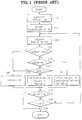
- an allocated number of bits ab[m] which represents the number of bits allocated to the block of each subband signal is cleared (step 112).
- An initially allocated number of bits b1 is allocated to allocated number of bits ab[m] of a block of a subband signal SB m whose signal power pwr_m is greater than a threshold Wm among respective blocks in the subbands.
- initially allocated number of bits b1 is an integer having a value, e.g., 2 (step 114).
- bf[jm] is a needed number of bits bf[m] of a subband which has the largest needed number of bits (step 120).
- step 122 it is determined whether the allocated number of bits ab[jm] of subband jm is greater than the maximum allocated number of bits a_max. If allocated number of bits ab[jm] is greater than maximum allocated number of bits a_max, the program branches to step 138 since more bits cannot be allocated to the searched block (step 122).
- allocated number of bits ab[jm] is smaller than maximum allocated number of bits a_max, it is checked whether allocated number of bits ab[jm] equals zero.
- allocated number of bits ab[jm] is not zero, the program branches to step 136 (step 130).
- allocated number of bits ab[jm] equals zero, it is checked whether available total number of bits TB is greater than or equal to initially allocated number of bits b1. If available total number of bits TB is smaller than initially allocated number of bits b1, the program branches to step 138 (step 132).
- step 134 If available total number of bits TB is greater than or equal to initially allocated number of bits b1, then, the following operations are executed: needed number of bits bf[jm] is replaced with a value obtained by subtracting initially allocated number of bits b1 from bf[jm]; allocated number of bits ab[jm] is replaced with initially allocated number of bits b1; available total number of bits TB is replaced with a value obtained by subtracting b1 from TB; and the program proceeds to step 140 (step 134).
- step 136 needed number of bits bf[jm] is replaced with a value obtained by subtracting b2 from bf[jm]; allocated number of bits ab[jm] is replaced with a value obtained by add b2 to ab[jm]; TB is replaced with a value obtained by subtracting b2 from available total number of bits TB; and the program proceeds to step 140 (step 136).
- step 138 needed number of bits bf[jm] is changed into - ⁇ , and then the program proceeds to step 140.
- bit reallocating program is finished (step 140).
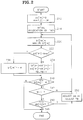
- FIG. 2 is a flowchart for showing a bit allocation method according to the present invention.
- an allocated number of bits ab[m] which represents the number of bits allocated to the block of each subband signal is cleared (step 212).
- One is allocated to allocated number of bits ab[m] of a block of a subband whose signal power pwr_m is greater than a threshold Wm among respective blocks in the subbands (step 214).
- bf[jm] is a needed number of bits bf[m] of a subband which has the largest needed number of bits (step 220).
- step 222 it is determined whether the allocated number of bits ab[jm] of subband jm is greater than or equal to the maximum allocated number of bits a_max. If allocated number of bits ab[jm] is greater than or equal to maximum allocated number of bits a_max, the program branches to step 238 since no more bits can be allocated to the searched block (step 222).
- step 240 step 234. Thereafter, in step 238, needed number of bits bf[jm] is changed into - ⁇ , and then the program proceeds to step 240.
- bits bf[m] are checked whether they are - ⁇ or not.
- the bit reallocating program is finished (step 240).
- step 242 If there is a needed number of bits bf[m] which is not - ⁇ , it is checked whether or not available total number of bits TB is smaller than "one.” When TB is not smaller than "one,” the program returns to step 220 (step 242).
- FIG. 3 is a block diagram showing an apparatus for performing the bit allocation program according to the flowchart shown in FIG. 2.
- the bit allocation apparatus shown in FIG. 3 has a first memory 310 which stores available total number of bits TB. Available total number of bits TB is decrement-counted one-by-one via an operation path consisting of first memory 310, first subtractor 312 and a first switch S1. Also, number K of the subband whose allocated number of bits ab[m] is "one" in step 252 is increment-counted via first memory 310, a first adder 314 and first switch S1.
- a first comparator 342 detects the result whether or not available total number of bits TB stored in first memory is smaller than "one,” and the result is supplied to an OR operator 344.
- a second memory 320 stores allocated number of bits ab[m]. Allocated number of bits ab[m] is increment-counted one-by-one via an operation path consisting of second memory 320, a second adder 324 and a third switch S3. The replacement of allocated number of bits ab[m] with "zero" in step 252 of FIG. 2, is executed via an operation path consisting of a third memory 328, a second switch S2 and second memory 320.
- a third comparator 340 receives both allocated number of bits ab[jm] of subband SB jm whose needed number of bits occupies the largest number among the bf[m], and stored in second memory 320, and maximum allocated number of bits a_max stored in seventh memory 326, and checks whether the condition (i.e., ab[jm] ⁇ a_max) is satisfied. Then, the result is supplied to OR operator 344.
- a fifth memory 330 stores needed number of bits bf[m] of each subband. Needed number of bits bf[m] is decrement-counted one-by-one via an operational path consisting of fifth memory 330, a second subtractor 334 and a fourth switch S4. Fourth switch S4 is driven by means of an output signal of OR operator 344, and allows - ⁇ in a sixth memory 336 to be supplied to needed number of bits bf[jm] when allocated number of bits ab[jm] is more than or equal to maximum allocated number of bits a_max or available total number of bits TB is below "one.”
- a fourth comparator 332 detects index jm of the subband having the largest value among needed number of bits bf[m] stored in fifth memory 330, and supplies the detected value to second memory 320 and fifth memory 330.
- the bits allocated to the subband is consecutively increased one-by-one, so that the bit difference between subbands can be decreased.
- bit-utilization ratio can be increased.
- bit allocation is incremented by one, which simplifies the hardware.
Landscapes
- Engineering & Computer Science (AREA)
- Physics & Mathematics (AREA)
- Signal Processing (AREA)
- Health & Medical Sciences (AREA)
- Computational Linguistics (AREA)
- Audiology, Speech & Language Pathology (AREA)
- Human Computer Interaction (AREA)
- Acoustics & Sound (AREA)
- Multimedia (AREA)
- Spectroscopy & Molecular Physics (AREA)
- Computer Networks & Wireless Communication (AREA)
- Theoretical Computer Science (AREA)
- Compression, Expansion, Code Conversion, And Decoders (AREA)
- Transmission Systems Not Characterized By The Medium Used For Transmission (AREA)
Applications Claiming Priority (2)
| Application Number | Priority Date | Filing Date | Title |
|---|---|---|---|
| KR1019920017188A KR100188912B1 (ko) | 1992-09-21 | 1992-09-21 | 서브밴드코딩의 비트재할당 방법 |
| KR1718892 | 1992-09-21 |
Publications (3)
| Publication Number | Publication Date |
|---|---|
| EP0589140A2 true EP0589140A2 (de) | 1994-03-30 |
| EP0589140A3 EP0589140A3 (en) | 1994-05-25 |
| EP0589140B1 EP0589140B1 (de) | 1999-08-04 |
Family
ID=19339869
Family Applications (1)
| Application Number | Title | Priority Date | Filing Date |
|---|---|---|---|
| EP93106842A Expired - Lifetime EP0589140B1 (de) | 1992-09-21 | 1993-04-27 | Bitzuordnungsverfahren in Teilbandkodierung |
Country Status (5)
| Country | Link |
|---|---|
| US (1) | US5479561A (de) |
| EP (1) | EP0589140B1 (de) |
| JP (1) | JP3121708B2 (de) |
| KR (1) | KR100188912B1 (de) |
| DE (1) | DE69325865T2 (de) |
Cited By (1)
| Publication number | Priority date | Publication date | Assignee | Title |
|---|---|---|---|---|
| EP0968497A4 (de) * | 1996-10-07 | 2000-02-23 | Picturetel Corp | Audio-kopierverfahren mit veränderlicher kodelänge unter verwendung einer mehrzahl von teilband-bitverteilungsmoden |
Families Citing this family (7)
| Publication number | Priority date | Publication date | Assignee | Title |
|---|---|---|---|---|
| US5664057A (en) * | 1993-07-07 | 1997-09-02 | Picturetel Corporation | Fixed bit rate speech encoder/decoder |
| KR100378790B1 (ko) * | 1996-04-23 | 2003-05-01 | 엘지전자 주식회사 | 서브밴드양자화레벨디코딩장치 |
| US8924222B2 (en) * | 2010-07-30 | 2014-12-30 | Qualcomm Incorporated | Systems, methods, apparatus, and computer-readable media for coding of harmonic signals |
| US9208792B2 (en) | 2010-08-17 | 2015-12-08 | Qualcomm Incorporated | Systems, methods, apparatus, and computer-readable media for noise injection |
| CN104282312B (zh) * | 2013-07-01 | 2018-02-23 | 华为技术有限公司 | 信号编码和解码方法以及设备 |
| US20150025894A1 (en) * | 2013-07-16 | 2015-01-22 | Electronics And Telecommunications Research Institute | Method for encoding and decoding of multi channel audio signal, encoder and decoder |
| CN105096957B (zh) * | 2014-04-29 | 2016-09-14 | 华为技术有限公司 | 处理信号的方法及设备 |
Family Cites Families (6)
| Publication number | Priority date | Publication date | Assignee | Title |
|---|---|---|---|---|
| US4516258A (en) * | 1982-06-30 | 1985-05-07 | At&T Bell Laboratories | Bit allocation generator for adaptive transform coder |
| NL8700985A (nl) * | 1987-04-27 | 1988-11-16 | Philips Nv | Systeem voor sub-band codering van een digitaal audiosignaal. |
| JPH03181232A (ja) * | 1989-12-11 | 1991-08-07 | Toshiba Corp | 可変レート符号化方式 |
| US5367608A (en) * | 1990-05-14 | 1994-11-22 | U.S. Philips Corporation | Transmitter, encoding system and method employing use of a bit allocation unit for subband coding a digital signal |
| NL9001127A (nl) * | 1990-05-14 | 1991-12-02 | Philips Nv | Kodeerinrichting bevattende een subbandkoder, en een zender voorzien van de kodeerinrichting. |
| US5365553A (en) * | 1990-11-30 | 1994-11-15 | U.S. Philips Corporation | Transmitter, encoding system and method employing use of a bit need determiner for subband coding a digital signal |
-
1992
- 1992-09-21 KR KR1019920017188A patent/KR100188912B1/ko not_active Expired - Fee Related
-
1993
- 1993-04-27 EP EP93106842A patent/EP0589140B1/de not_active Expired - Lifetime
- 1993-04-27 DE DE69325865T patent/DE69325865T2/de not_active Expired - Fee Related
- 1993-04-30 US US08/054,211 patent/US5479561A/en not_active Expired - Lifetime
- 1993-04-30 JP JP05104738A patent/JP3121708B2/ja not_active Expired - Fee Related
Cited By (1)
| Publication number | Priority date | Publication date | Assignee | Title |
|---|---|---|---|---|
| EP0968497A4 (de) * | 1996-10-07 | 2000-02-23 | Picturetel Corp | Audio-kopierverfahren mit veränderlicher kodelänge unter verwendung einer mehrzahl von teilband-bitverteilungsmoden |
Also Published As
| Publication number | Publication date |
|---|---|
| JPH06216861A (ja) | 1994-08-05 |
| DE69325865D1 (de) | 1999-09-09 |
| US5479561A (en) | 1995-12-26 |
| DE69325865T2 (de) | 1999-11-25 |
| JP3121708B2 (ja) | 2001-01-09 |
| EP0589140A3 (en) | 1994-05-25 |
| KR100188912B1 (ko) | 1999-06-01 |
| EP0589140B1 (de) | 1999-08-04 |
| KR940008279A (ko) | 1994-04-29 |
Similar Documents
| Publication | Publication Date | Title |
|---|---|---|
| EP0279451B1 (de) | Codierungseinrichtung zur Sprachübertragung | |
| US6308150B1 (en) | Dynamic bit allocation apparatus and method for audio coding | |
| JP3134455B2 (ja) | 高能率符号化装置及び方法 | |
| JP2906646B2 (ja) | 音声帯域分割符号化装置 | |
| US5613035A (en) | Apparatus for adaptively encoding input digital audio signals from a plurality of channels | |
| US5732391A (en) | Method and apparatus of reducing processing steps in an audio compression system using psychoacoustic parameters | |
| EP1396841B1 (de) | Codierungsvorrichtung und -verfahren, decodierungsvorrichtung und -verfahren und programm | |
| KR100397690B1 (ko) | 데이터부호화장치및그방법 | |
| US6353808B1 (en) | Apparatus and method for encoding a signal as well as apparatus and method for decoding a signal | |
| KR100273071B1 (ko) | 신호 코딩 방법 및 아날로그 신호 변조 방법 | |
| EP0345608A2 (de) | Verfahren und System für Datenkomprimierung mit Puffersteuerung | |
| JP3186292B2 (ja) | 高能率符号化方法及び装置 | |
| EP0702368A2 (de) | Verfahren zur Aufnahme und Wiedergabe digitaler Audiosignale und Apparat dafür | |
| EP0720316A1 (de) | Adaptive Kodiervorrichtung für Digitaltonsignale und Bitverteilungsverfahren dafür | |
| EP0560413A2 (de) | Adaptiv Bitzuordnung für Audio-Koder und Dekoder | |
| ATE188305T1 (de) | Gerät, verfahren und system zur komprimierung eines digitalen eingangssignals in mehr als einem kompressionsmodus | |
| EP0717392A1 (de) | Verfahren und vorrichtung zur kodierung, dekodierung und kodierung-dekodierung | |
| EP0703677B1 (de) | Perzeptueller Teilbandkodierer | |
| US5491773A (en) | Encoding system comprising a subband coder for subband coding of a wideband digital signal constituted by first and second signal components | |
| EP0721257A1 (de) | Bitverteilung für Mehrkanal-Audiokodierer auf Grund von wahrnehmungsgebundener Entropie | |
| US5864802A (en) | Digital audio encoding method utilizing look-up table and device thereof | |
| US6466912B1 (en) | Perceptual coding of audio signals employing envelope uncertainty | |
| US6141637A (en) | Speech signal encoding and decoding system, speech encoding apparatus, speech decoding apparatus, speech encoding and decoding method, and storage medium storing a program for carrying out the method | |
| EP0589140B1 (de) | Bitzuordnungsverfahren in Teilbandkodierung | |
| EP0376553B1 (de) | Kodierung von Audiosignalen unter Berücksichtigung der Wahrnehmbarkeit |
Legal Events
| Date | Code | Title | Description |
|---|---|---|---|
| PUAI | Public reference made under article 153(3) epc to a published international application that has entered the european phase |
Free format text: ORIGINAL CODE: 0009012 |
|
| AK | Designated contracting states |
Kind code of ref document: A2 Designated state(s): DE FR GB |
|
| PUAL | Search report despatched |
Free format text: ORIGINAL CODE: 0009013 |
|
| AK | Designated contracting states |
Kind code of ref document: A3 Designated state(s): DE FR GB |
|
| 17P | Request for examination filed |
Effective date: 19941109 |
|
| 17Q | First examination report despatched |
Effective date: 19971219 |
|
| GRAG | Despatch of communication of intention to grant |
Free format text: ORIGINAL CODE: EPIDOS AGRA |
|
| GRAG | Despatch of communication of intention to grant |
Free format text: ORIGINAL CODE: EPIDOS AGRA |
|
| GRAH | Despatch of communication of intention to grant a patent |
Free format text: ORIGINAL CODE: EPIDOS IGRA |
|
| GRAH | Despatch of communication of intention to grant a patent |
Free format text: ORIGINAL CODE: EPIDOS IGRA |
|
| GRAA | (expected) grant |
Free format text: ORIGINAL CODE: 0009210 |
|
| AK | Designated contracting states |
Kind code of ref document: B1 Designated state(s): DE FR GB |
|
| REF | Corresponds to: |
Ref document number: 69325865 Country of ref document: DE Date of ref document: 19990909 |
|
| ET | Fr: translation filed | ||
| PLBE | No opposition filed within time limit |
Free format text: ORIGINAL CODE: 0009261 |
|
| 26N | No opposition filed | ||
| REG | Reference to a national code |
Ref country code: GB Ref legal event code: IF02 |
|
| PG25 | Lapsed in a contracting state [announced via postgrant information from national office to epo] |
Ref country code: FR Free format text: LAPSE BECAUSE OF NON-PAYMENT OF DUE FEES Effective date: 20070430 |
|
| PGFP | Annual fee paid to national office [announced via postgrant information from national office to epo] |
Ref country code: DE Payment date: 20080502 Year of fee payment: 16 |
|
| PGFP | Annual fee paid to national office [announced via postgrant information from national office to epo] |
Ref country code: GB Payment date: 20080430 Year of fee payment: 16 |
|
| GBPC | Gb: european patent ceased through non-payment of renewal fee |
Effective date: 20090427 |
|
| PG25 | Lapsed in a contracting state [announced via postgrant information from national office to epo] |
Ref country code: DE Free format text: LAPSE BECAUSE OF NON-PAYMENT OF DUE FEES Effective date: 20091103 |
|
| PG25 | Lapsed in a contracting state [announced via postgrant information from national office to epo] |
Ref country code: GB Free format text: LAPSE BECAUSE OF NON-PAYMENT OF DUE FEES Effective date: 20090427 |
|
| REG | Reference to a national code |
Ref country code: FR Ref legal event code: RN Effective date: 20121114 |
|
| REG | Reference to a national code |
Ref country code: FR Ref legal event code: D3 Effective date: 20130123 |
|
| PGFP | Annual fee paid to national office [announced via postgrant information from national office to epo] |
Ref country code: FR Payment date: 20121201 Year of fee payment: 16 |
|
| REG | Reference to a national code |
Ref country code: FR Ref legal event code: ST Effective date: 20130204 |
|
| PGRI | Patent reinstated in contracting state [announced from national office to epo] |
Ref country code: FR Effective date: 20130123 |
|
| PG25 | Lapsed in a contracting state [announced via postgrant information from national office to epo] |
Ref country code: FR Free format text: LAPSE BECAUSE OF NON-PAYMENT OF DUE FEES Effective date: 20090430 |
|
| PGRI | Patent reinstated in contracting state [announced from national office to epo] |
Ref country code: FR Effective date: 20130123 |