EP0590670A1 - Article abrasif en feuille résistant au déchirement - Google Patents
Article abrasif en feuille résistant au déchirement Download PDFInfo
- Publication number
- EP0590670A1 EP0590670A1 EP19930115828 EP93115828A EP0590670A1 EP 0590670 A1 EP0590670 A1 EP 0590670A1 EP 19930115828 EP19930115828 EP 19930115828 EP 93115828 A EP93115828 A EP 93115828A EP 0590670 A1 EP0590670 A1 EP 0590670A1
- Authority
- EP
- European Patent Office
- Prior art keywords
- coated abrasive
- abrasive article
- layers
- tear resistant
- resistant coated
- Prior art date
- Legal status (The legal status is an assumption and is not a legal conclusion. Google has not performed a legal analysis and makes no representation as to the accuracy of the status listed.)
- Ceased
Links
- 239000000463 material Substances 0.000 claims abstract description 118
- 229920001634 Copolyester Polymers 0.000 claims abstract description 31
- 229920000728 polyester Polymers 0.000 claims abstract description 30
- 239000010410 layer Substances 0.000 claims description 152
- LYCAIKOWRPUZTN-UHFFFAOYSA-N Ethylene glycol Chemical compound OCCO LYCAIKOWRPUZTN-UHFFFAOYSA-N 0.000 claims description 40
- 239000002245 particle Substances 0.000 claims description 34
- -1 polytetramethylene Polymers 0.000 claims description 32
- 239000011230 binding agent Substances 0.000 claims description 24
- 238000012360 testing method Methods 0.000 claims description 15
- KKEYFWRCBNTPAC-UHFFFAOYSA-N Terephthalic acid Chemical compound OC(=O)C1=CC=C(C(O)=O)C=C1 KKEYFWRCBNTPAC-UHFFFAOYSA-N 0.000 claims description 13
- 150000002009 diols Chemical class 0.000 claims description 13
- WERYXYBDKMZEQL-UHFFFAOYSA-N butane-1,4-diol Chemical compound OCCCCO WERYXYBDKMZEQL-UHFFFAOYSA-N 0.000 claims description 10
- WGCNASOHLSPBMP-UHFFFAOYSA-N hydroxyacetaldehyde Natural products OCC=O WGCNASOHLSPBMP-UHFFFAOYSA-N 0.000 claims description 10
- 229920000098 polyolefin Polymers 0.000 claims description 10
- OFOBLEOULBTSOW-UHFFFAOYSA-N Malonic acid Chemical compound OC(=O)CC(O)=O OFOBLEOULBTSOW-UHFFFAOYSA-N 0.000 claims description 9
- 239000004952 Polyamide Substances 0.000 claims description 8
- 239000007795 chemical reaction product Substances 0.000 claims description 8
- 229920002647 polyamide Polymers 0.000 claims description 8
- 150000002148 esters Chemical class 0.000 claims description 7
- 239000004820 Pressure-sensitive adhesive Substances 0.000 claims description 5
- QYQADNCHXSEGJT-UHFFFAOYSA-N cyclohexane-1,1-dicarboxylate;hydron Chemical compound OC(=O)C1(C(O)=O)CCCCC1 QYQADNCHXSEGJT-UHFFFAOYSA-N 0.000 claims description 5
- 229920001038 ethylene copolymer Polymers 0.000 claims description 5
- KYTZHLUVELPASH-UHFFFAOYSA-N naphthalene-1,2-dicarboxylic acid Chemical compound C1=CC=CC2=C(C(O)=O)C(C(=O)O)=CC=C21 KYTZHLUVELPASH-UHFFFAOYSA-N 0.000 claims description 5
- VEIOBOXBGYWJIT-UHFFFAOYSA-N cyclohexane;methanol Chemical compound OC.OC.C1CCCCC1 VEIOBOXBGYWJIT-UHFFFAOYSA-N 0.000 claims description 4
- 239000004814 polyurethane Substances 0.000 claims description 4
- 229920002635 polyurethane Polymers 0.000 claims description 4
- 230000000052 comparative effect Effects 0.000 description 25
- 238000000034 method Methods 0.000 description 25
- VGGSQFUCUMXWEO-UHFFFAOYSA-N Ethene Chemical compound C=C VGGSQFUCUMXWEO-UHFFFAOYSA-N 0.000 description 20
- 239000005977 Ethylene Substances 0.000 description 20
- 238000000576 coating method Methods 0.000 description 19
- 239000011248 coating agent Substances 0.000 description 18
- 239000000203 mixture Substances 0.000 description 14
- 230000000153 supplemental effect Effects 0.000 description 14
- 239000000853 adhesive Substances 0.000 description 11
- 230000001070 adhesive effect Effects 0.000 description 11
- 229920001577 copolymer Polymers 0.000 description 11
- TWNQGVIAIRXVLR-UHFFFAOYSA-N oxo(oxoalumanyloxy)alumane Chemical compound O=[Al]O[Al]=O TWNQGVIAIRXVLR-UHFFFAOYSA-N 0.000 description 11
- 229920000139 polyethylene terephthalate Polymers 0.000 description 10
- 239000005020 polyethylene terephthalate Substances 0.000 description 10
- XTXRWKRVRITETP-UHFFFAOYSA-N Vinyl acetate Chemical compound CC(=O)OC=C XTXRWKRVRITETP-UHFFFAOYSA-N 0.000 description 9
- 239000004744 fabric Substances 0.000 description 8
- 239000007787 solid Substances 0.000 description 8
- 239000000835 fiber Substances 0.000 description 7
- 239000000126 substance Substances 0.000 description 7
- MTHSVFCYNBDYFN-UHFFFAOYSA-N diethylene glycol Chemical compound OCCOCCO MTHSVFCYNBDYFN-UHFFFAOYSA-N 0.000 description 6
- ZFSLODLOARCGLH-UHFFFAOYSA-N isocyanuric acid Chemical compound OC1=NC(O)=NC(O)=N1 ZFSLODLOARCGLH-UHFFFAOYSA-N 0.000 description 6
- 238000004519 manufacturing process Methods 0.000 description 6
- 229920006267 polyester film Polymers 0.000 description 6
- 229920005989 resin Polymers 0.000 description 6
- 239000011347 resin Substances 0.000 description 6
- CXMXRPHRNRROMY-UHFFFAOYSA-N sebacic acid Chemical compound OC(=O)CCCCCCCCC(O)=O CXMXRPHRNRROMY-UHFFFAOYSA-N 0.000 description 6
- 238000010998 test method Methods 0.000 description 6
- 239000004593 Epoxy Substances 0.000 description 5
- JOYRKODLDBILNP-UHFFFAOYSA-N Ethyl urethane Chemical compound CCOC(N)=O JOYRKODLDBILNP-UHFFFAOYSA-N 0.000 description 5
- 229920001807 Urea-formaldehyde Polymers 0.000 description 5
- 238000013459 approach Methods 0.000 description 5
- 238000010276 construction Methods 0.000 description 5
- 239000011229 interlayer Substances 0.000 description 5
- 229920000642 polymer Polymers 0.000 description 5
- 230000005855 radiation Effects 0.000 description 5
- NIXOWILDQLNWCW-UHFFFAOYSA-N 2-Propenoic acid Natural products OC(=O)C=C NIXOWILDQLNWCW-UHFFFAOYSA-N 0.000 description 4
- KXGFMDJXCMQABM-UHFFFAOYSA-N 2-methoxy-6-methylphenol Chemical compound [CH]OC1=CC=CC([CH])=C1O KXGFMDJXCMQABM-UHFFFAOYSA-N 0.000 description 4
- BAPJBEWLBFYGME-UHFFFAOYSA-N Methyl acrylate Chemical compound COC(=O)C=C BAPJBEWLBFYGME-UHFFFAOYSA-N 0.000 description 4
- 239000000919 ceramic Substances 0.000 description 4
- 230000009969 flowable effect Effects 0.000 description 4
- 125000000524 functional group Chemical group 0.000 description 4
- 238000002844 melting Methods 0.000 description 4
- 230000008018 melting Effects 0.000 description 4
- ISWSIDIOOBJBQZ-UHFFFAOYSA-N phenol group Chemical group C1(=CC=CC=C1)O ISWSIDIOOBJBQZ-UHFFFAOYSA-N 0.000 description 4
- 229920001568 phenolic resin Polymers 0.000 description 4
- 239000004014 plasticizer Substances 0.000 description 4
- 239000000047 product Substances 0.000 description 4
- XLYOFNOQVPJJNP-UHFFFAOYSA-N water Substances O XLYOFNOQVPJJNP-UHFFFAOYSA-N 0.000 description 4
- SMZOUWXMTYCWNB-UHFFFAOYSA-N 2-(2-methoxy-5-methylphenyl)ethanamine Chemical compound COC1=CC=C(C)C=C1CCN SMZOUWXMTYCWNB-UHFFFAOYSA-N 0.000 description 3
- ZNQVEEAIQZEUHB-UHFFFAOYSA-N 2-ethoxyethanol Chemical compound CCOCCO ZNQVEEAIQZEUHB-UHFFFAOYSA-N 0.000 description 3
- NOWKCMXCCJGMRR-UHFFFAOYSA-N Aziridine Chemical compound C1CN1 NOWKCMXCCJGMRR-UHFFFAOYSA-N 0.000 description 3
- UFHFLCQGNIYNRP-UHFFFAOYSA-N Hydrogen Chemical compound [H][H] UFHFLCQGNIYNRP-UHFFFAOYSA-N 0.000 description 3
- CERQOIWHTDAKMF-UHFFFAOYSA-N Methacrylic acid Chemical compound CC(=C)C(O)=O CERQOIWHTDAKMF-UHFFFAOYSA-N 0.000 description 3
- 238000009825 accumulation Methods 0.000 description 3
- 229920003180 amino resin Polymers 0.000 description 3
- 125000005442 diisocyanate group Chemical group 0.000 description 3
- 238000010894 electron beam technology Methods 0.000 description 3
- 238000007765 extrusion coating Methods 0.000 description 3
- 239000000945 filler Substances 0.000 description 3
- 239000003292 glue Substances 0.000 description 3
- 238000000227 grinding Methods 0.000 description 3
- LNEPOXFFQSENCJ-UHFFFAOYSA-N haloperidol Chemical class C1CC(O)(C=2C=CC(Cl)=CC=2)CCN1CCCC(=O)C1=CC=C(F)C=C1 LNEPOXFFQSENCJ-UHFFFAOYSA-N 0.000 description 3
- 238000010438 heat treatment Methods 0.000 description 3
- 239000001257 hydrogen Substances 0.000 description 3
- 229910052739 hydrogen Inorganic materials 0.000 description 3
- 239000000155 melt Substances 0.000 description 3
- 238000002156 mixing Methods 0.000 description 3
- BDJRBEYXGGNYIS-UHFFFAOYSA-N nonanedioic acid Chemical compound OC(=O)CCCCCCCC(O)=O BDJRBEYXGGNYIS-UHFFFAOYSA-N 0.000 description 3
- ODGAOXROABLFNM-UHFFFAOYSA-N polynoxylin Chemical compound O=C.NC(N)=O ODGAOXROABLFNM-UHFFFAOYSA-N 0.000 description 3
- 230000008569 process Effects 0.000 description 3
- 238000010791 quenching Methods 0.000 description 3
- 230000000171 quenching effect Effects 0.000 description 3
- HBMJWWWQQXIZIP-UHFFFAOYSA-N silicon carbide Chemical compound [Si+]#[C-] HBMJWWWQQXIZIP-UHFFFAOYSA-N 0.000 description 3
- 229910010271 silicon carbide Inorganic materials 0.000 description 3
- 238000005507 spraying Methods 0.000 description 3
- 239000004094 surface-active agent Substances 0.000 description 3
- 229920001169 thermoplastic Polymers 0.000 description 3
- 239000004416 thermosoftening plastic Substances 0.000 description 3
- 229920002554 vinyl polymer Polymers 0.000 description 3
- XQUPVDVFXZDTLT-UHFFFAOYSA-N 1-[4-[[4-(2,5-dioxopyrrol-1-yl)phenyl]methyl]phenyl]pyrrole-2,5-dione Chemical compound O=C1C=CC(=O)N1C(C=C1)=CC=C1CC1=CC=C(N2C(C=CC2=O)=O)C=C1 XQUPVDVFXZDTLT-UHFFFAOYSA-N 0.000 description 2
- ARXJGSRGQADJSQ-UHFFFAOYSA-N 1-methoxypropan-2-ol Chemical compound COCC(C)O ARXJGSRGQADJSQ-UHFFFAOYSA-N 0.000 description 2
- 229910052582 BN Inorganic materials 0.000 description 2
- PZNSFCLAULLKQX-UHFFFAOYSA-N Boron nitride Chemical compound N#B PZNSFCLAULLKQX-UHFFFAOYSA-N 0.000 description 2
- VTYYLEPIZMXCLO-UHFFFAOYSA-L Calcium carbonate Chemical compound [Ca+2].[O-]C([O-])=O VTYYLEPIZMXCLO-UHFFFAOYSA-L 0.000 description 2
- 229920003345 Elvax® Polymers 0.000 description 2
- 239000004716 Ethylene/acrylic acid copolymer Substances 0.000 description 2
- VVQNEPGJFQJSBK-UHFFFAOYSA-N Methyl methacrylate Chemical compound COC(=O)C(C)=C VVQNEPGJFQJSBK-UHFFFAOYSA-N 0.000 description 2
- 239000002202 Polyethylene glycol Substances 0.000 description 2
- VYPSYNLAJGMNEJ-UHFFFAOYSA-N Silicium dioxide Chemical compound O=[Si]=O VYPSYNLAJGMNEJ-UHFFFAOYSA-N 0.000 description 2
- MCMNRKCIXSYSNV-UHFFFAOYSA-N ZrO2 Inorganic materials O=[Zr]=O MCMNRKCIXSYSNV-UHFFFAOYSA-N 0.000 description 2
- 239000003082 abrasive agent Substances 0.000 description 2
- 239000000654 additive Substances 0.000 description 2
- WNLRTRBMVRJNCN-UHFFFAOYSA-N adipic acid Chemical compound OC(=O)CCCCC(O)=O WNLRTRBMVRJNCN-UHFFFAOYSA-N 0.000 description 2
- VSCWAEJMTAWNJL-UHFFFAOYSA-K aluminium trichloride Chemical compound Cl[Al](Cl)Cl VSCWAEJMTAWNJL-UHFFFAOYSA-K 0.000 description 2
- 239000002518 antifoaming agent Substances 0.000 description 2
- 239000007864 aqueous solution Substances 0.000 description 2
- IISBACLAFKSPIT-UHFFFAOYSA-N bisphenol A Chemical compound C=1C=C(O)C=CC=1C(C)(C)C1=CC=C(O)C=C1 IISBACLAFKSPIT-UHFFFAOYSA-N 0.000 description 2
- 239000003054 catalyst Substances 0.000 description 2
- CETPSERCERDGAM-UHFFFAOYSA-N ceric oxide Chemical compound O=[Ce]=O CETPSERCERDGAM-UHFFFAOYSA-N 0.000 description 2
- 229910000422 cerium(IV) oxide Inorganic materials 0.000 description 2
- 239000002131 composite material Substances 0.000 description 2
- 239000004020 conductor Substances 0.000 description 2
- 229910001610 cryolite Inorganic materials 0.000 description 2
- 229910003460 diamond Inorganic materials 0.000 description 2
- 239000010432 diamond Substances 0.000 description 2
- 235000014113 dietary fatty acids Nutrition 0.000 description 2
- 238000003618 dip coating Methods 0.000 description 2
- GNTDGMZSJNCJKK-UHFFFAOYSA-N divanadium pentaoxide Chemical compound O=[V](=O)O[V](=O)=O GNTDGMZSJNCJKK-UHFFFAOYSA-N 0.000 description 2
- 239000000975 dye Substances 0.000 description 2
- 229920001971 elastomer Polymers 0.000 description 2
- 239000003822 epoxy resin Substances 0.000 description 2
- CGPRUXZTHGTMKW-UHFFFAOYSA-N ethene;ethyl prop-2-enoate Chemical compound C=C.CCOC(=O)C=C CGPRUXZTHGTMKW-UHFFFAOYSA-N 0.000 description 2
- QHZOMAXECYYXGP-UHFFFAOYSA-N ethene;prop-2-enoic acid Chemical compound C=C.OC(=O)C=C QHZOMAXECYYXGP-UHFFFAOYSA-N 0.000 description 2
- SUPCQIBBMFXVTL-UHFFFAOYSA-N ethyl 2-methylprop-2-enoate Chemical compound CCOC(=O)C(C)=C SUPCQIBBMFXVTL-UHFFFAOYSA-N 0.000 description 2
- 239000000194 fatty acid Substances 0.000 description 2
- 229930195729 fatty acid Natural products 0.000 description 2
- 150000004665 fatty acids Chemical class 0.000 description 2
- 239000006260 foam Substances 0.000 description 2
- 239000002223 garnet Substances 0.000 description 2
- 230000006872 improvement Effects 0.000 description 2
- 229920000554 ionomer Polymers 0.000 description 2
- QQVIHTHCMHWDBS-UHFFFAOYSA-N isophthalic acid Chemical compound OC(=O)C1=CC=CC(C(O)=O)=C1 QQVIHTHCMHWDBS-UHFFFAOYSA-N 0.000 description 2
- 239000012939 laminating adhesive Substances 0.000 description 2
- 238000003475 lamination Methods 0.000 description 2
- 239000004816 latex Substances 0.000 description 2
- 229920000126 latex Polymers 0.000 description 2
- 239000007788 liquid Substances 0.000 description 2
- FPYJFEHAWHCUMM-UHFFFAOYSA-N maleic anhydride Chemical compound O=C1OC(=O)C=C1 FPYJFEHAWHCUMM-UHFFFAOYSA-N 0.000 description 2
- 229910044991 metal oxide Inorganic materials 0.000 description 2
- 150000004706 metal oxides Chemical class 0.000 description 2
- PZRHRDRVRGEVNW-UHFFFAOYSA-N milrinone Chemical compound N1C(=O)C(C#N)=CC(C=2C=CN=CC=2)=C1C PZRHRDRVRGEVNW-UHFFFAOYSA-N 0.000 description 2
- 229960003574 milrinone Drugs 0.000 description 2
- 238000005065 mining Methods 0.000 description 2
- 238000012986 modification Methods 0.000 description 2
- 230000004048 modification Effects 0.000 description 2
- 239000003607 modifier Substances 0.000 description 2
- SLCVBVWXLSEKPL-UHFFFAOYSA-N neopentyl glycol Chemical compound OCC(C)(C)CO SLCVBVWXLSEKPL-UHFFFAOYSA-N 0.000 description 2
- 229920003207 poly(ethylene-2,6-naphthalate) Polymers 0.000 description 2
- 229920000058 polyacrylate Polymers 0.000 description 2
- 229920000647 polyepoxide Polymers 0.000 description 2
- 229920001223 polyethylene glycol Polymers 0.000 description 2
- 239000011112 polyethylene naphthalate Substances 0.000 description 2
- ULWHHBHJGPPBCO-UHFFFAOYSA-N propane-1,1-diol Chemical compound CCC(O)O ULWHHBHJGPPBCO-UHFFFAOYSA-N 0.000 description 2
- 239000005060 rubber Substances 0.000 description 2
- 238000000926 separation method Methods 0.000 description 2
- 238000009864 tensile test Methods 0.000 description 2
- XOOUIPVCVHRTMJ-UHFFFAOYSA-L zinc stearate Chemical compound [Zn+2].CCCCCCCCCCCCCCCCCC([O-])=O.CCCCCCCCCCCCCCCCCC([O-])=O XOOUIPVCVHRTMJ-UHFFFAOYSA-L 0.000 description 2
- PZWQOGNTADJZGH-SNAWJCMRSA-N (2e)-2-methylpenta-2,4-dienoic acid Chemical compound OC(=O)C(/C)=C/C=C PZWQOGNTADJZGH-SNAWJCMRSA-N 0.000 description 1
- AZYRZNIYJDKRHO-UHFFFAOYSA-N 1,3-bis(2-isocyanatopropan-2-yl)benzene Chemical compound O=C=NC(C)(C)C1=CC=CC(C(C)(C)N=C=O)=C1 AZYRZNIYJDKRHO-UHFFFAOYSA-N 0.000 description 1
- VGHSXKTVMPXHNG-UHFFFAOYSA-N 1,3-diisocyanatobenzene Chemical compound O=C=NC1=CC=CC(N=C=O)=C1 VGHSXKTVMPXHNG-UHFFFAOYSA-N 0.000 description 1
- BNIWTJAVDJYTIJ-UHFFFAOYSA-N 1,3-dimethylnaphthalene-2,6-dicarboxylic acid Chemical compound OC(=O)C1=CC=C2C(C)=C(C(O)=O)C(C)=CC2=C1 BNIWTJAVDJYTIJ-UHFFFAOYSA-N 0.000 description 1
- PXGZQGDTEZPERC-UHFFFAOYSA-N 1,4-cyclohexanedicarboxylic acid Chemical compound OC(=O)C1CCC(C(O)=O)CC1 PXGZQGDTEZPERC-UHFFFAOYSA-N 0.000 description 1
- OCJBOOLMMGQPQU-UHFFFAOYSA-N 1,4-dichlorobenzene Chemical compound ClC1=CC=C(Cl)C=C1 OCJBOOLMMGQPQU-UHFFFAOYSA-N 0.000 description 1
- ALQLPWJFHRMHIU-UHFFFAOYSA-N 1,4-diisocyanatobenzene Chemical compound O=C=NC1=CC=C(N=C=O)C=C1 ALQLPWJFHRMHIU-UHFFFAOYSA-N 0.000 description 1
- CDMDQYCEEKCBGR-UHFFFAOYSA-N 1,4-diisocyanatocyclohexane Chemical compound O=C=NC1CCC(N=C=O)CC1 CDMDQYCEEKCBGR-UHFFFAOYSA-N 0.000 description 1
- SBJCUZQNHOLYMD-UHFFFAOYSA-N 1,5-Naphthalene diisocyanate Chemical compound C1=CC=C2C(N=C=O)=CC=CC2=C1N=C=O SBJCUZQNHOLYMD-UHFFFAOYSA-N 0.000 description 1
- QGLRLXLDMZCFBP-UHFFFAOYSA-N 1,6-diisocyanato-2,4,4-trimethylhexane Chemical compound O=C=NCC(C)CC(C)(C)CCN=C=O QGLRLXLDMZCFBP-UHFFFAOYSA-N 0.000 description 1
- ZVEMLYIXBCTVOF-UHFFFAOYSA-N 1-(2-isocyanatopropan-2-yl)-3-prop-1-en-2-ylbenzene Chemical compound CC(=C)C1=CC=CC(C(C)(C)N=C=O)=C1 ZVEMLYIXBCTVOF-UHFFFAOYSA-N 0.000 description 1
- DURPTKYDGMDSBL-UHFFFAOYSA-N 1-butoxybutane Chemical compound CCCCOCCCC DURPTKYDGMDSBL-UHFFFAOYSA-N 0.000 description 1
- LFSYUSUFCBOHGU-UHFFFAOYSA-N 1-isocyanato-2-[(4-isocyanatophenyl)methyl]benzene Chemical compound C1=CC(N=C=O)=CC=C1CC1=CC=CC=C1N=C=O LFSYUSUFCBOHGU-UHFFFAOYSA-N 0.000 description 1
- BXGYYDRIMBPOMN-UHFFFAOYSA-N 2-(hydroxymethoxy)ethoxymethanol Chemical compound OCOCCOCO BXGYYDRIMBPOMN-UHFFFAOYSA-N 0.000 description 1
- IMSODMZESSGVBE-UHFFFAOYSA-N 2-Oxazoline Chemical compound C1CN=CO1 IMSODMZESSGVBE-UHFFFAOYSA-N 0.000 description 1
- KGIGUEBEKRSTEW-UHFFFAOYSA-N 2-vinylpyridine Chemical compound C=CC1=CC=CC=N1 KGIGUEBEKRSTEW-UHFFFAOYSA-N 0.000 description 1
- UPMLOUAZCHDJJD-UHFFFAOYSA-N 4,4'-Diphenylmethane Diisocyanate Chemical compound C1=CC(N=C=O)=CC=C1CC1=CC=C(N=C=O)C=C1 UPMLOUAZCHDJJD-UHFFFAOYSA-N 0.000 description 1
- DXPPIEDUBFUSEZ-UHFFFAOYSA-N 6-methylheptyl prop-2-enoate Chemical compound CC(C)CCCCCOC(=O)C=C DXPPIEDUBFUSEZ-UHFFFAOYSA-N 0.000 description 1
- RSWGJHLUYNHPMX-UHFFFAOYSA-N Abietic-Saeure Natural products C12CCC(C(C)C)=CC2=CCC2C1(C)CCCC2(C)C(O)=O RSWGJHLUYNHPMX-UHFFFAOYSA-N 0.000 description 1
- QGZKDVFQNNGYKY-UHFFFAOYSA-O Ammonium Chemical compound [NH4+] QGZKDVFQNNGYKY-UHFFFAOYSA-O 0.000 description 1
- 229920002799 BoPET Polymers 0.000 description 1
- OKTJSMMVPCPJKN-UHFFFAOYSA-N Carbon Chemical compound [C] OKTJSMMVPCPJKN-UHFFFAOYSA-N 0.000 description 1
- 239000004215 Carbon black (E152) Substances 0.000 description 1
- 229920002134 Carboxymethyl cellulose Polymers 0.000 description 1
- 229910000968 Chilled casting Inorganic materials 0.000 description 1
- 229920000742 Cotton Polymers 0.000 description 1
- 229920000089 Cyclic olefin copolymer Polymers 0.000 description 1
- XDTMQSROBMDMFD-UHFFFAOYSA-N Cyclohexane Chemical compound C1CCCCC1 XDTMQSROBMDMFD-UHFFFAOYSA-N 0.000 description 1
- 239000004606 Fillers/Extenders Substances 0.000 description 1
- 244000043261 Hevea brasiliensis Species 0.000 description 1
- 239000005057 Hexamethylene diisocyanate Substances 0.000 description 1
- 229920013646 Hycar Polymers 0.000 description 1
- 239000005058 Isophorone diisocyanate Substances 0.000 description 1
- 229920003354 Modic® Polymers 0.000 description 1
- 229920003298 Nucrel® Polymers 0.000 description 1
- 239000004677 Nylon Substances 0.000 description 1
- 229920003300 Plexar® Polymers 0.000 description 1
- 229920002614 Polyether block amide Polymers 0.000 description 1
- 239000004698 Polyethylene Substances 0.000 description 1
- 229920000265 Polyparaphenylene Polymers 0.000 description 1
- 239000004721 Polyphenylene oxide Substances 0.000 description 1
- 239000004743 Polypropylene Substances 0.000 description 1
- 229920000297 Rayon Polymers 0.000 description 1
- KHPCPRHQVVSZAH-HUOMCSJISA-N Rosin Natural products O(C/C=C/c1ccccc1)[C@H]1[C@H](O)[C@@H](O)[C@@H](O)[C@@H](CO)O1 KHPCPRHQVVSZAH-HUOMCSJISA-N 0.000 description 1
- RYYWUUFWQRZTIU-UHFFFAOYSA-N Thiophosphoric acid Chemical compound OP(O)(S)=O RYYWUUFWQRZTIU-UHFFFAOYSA-N 0.000 description 1
- 239000007983 Tris buffer Substances 0.000 description 1
- 229920003351 Ultrathene® Polymers 0.000 description 1
- QYKIQEUNHZKYBP-UHFFFAOYSA-N Vinyl ether Chemical class C=COC=C QYKIQEUNHZKYBP-UHFFFAOYSA-N 0.000 description 1
- KAPCRJOPWXUMSQ-UHFFFAOYSA-N [2,2-bis[3-(aziridin-1-yl)propanoyloxymethyl]-3-hydroxypropyl] 3-(aziridin-1-yl)propanoate Chemical compound C1CN1CCC(=O)OCC(COC(=O)CCN1CC1)(CO)COC(=O)CCN1CC1 KAPCRJOPWXUMSQ-UHFFFAOYSA-N 0.000 description 1
- YIMQCDZDWXUDCA-UHFFFAOYSA-N [4-(hydroxymethyl)cyclohexyl]methanol Chemical compound OCC1CCC(CO)CC1 YIMQCDZDWXUDCA-UHFFFAOYSA-N 0.000 description 1
- 239000008186 active pharmaceutical agent Substances 0.000 description 1
- 239000012790 adhesive layer Substances 0.000 description 1
- 235000011037 adipic acid Nutrition 0.000 description 1
- 239000001361 adipic acid Substances 0.000 description 1
- 239000002671 adjuvant Substances 0.000 description 1
- 230000002411 adverse Effects 0.000 description 1
- GZCGUPFRVQAUEE-SLPGGIOYSA-N aldehydo-D-glucose Chemical compound OC[C@@H](O)[C@@H](O)[C@H](O)[C@@H](O)C=O GZCGUPFRVQAUEE-SLPGGIOYSA-N 0.000 description 1
- 229920003232 aliphatic polyester Polymers 0.000 description 1
- 150000001336 alkenes Chemical class 0.000 description 1
- 229920000180 alkyd Polymers 0.000 description 1
- 239000003963 antioxidant agent Substances 0.000 description 1
- 229920006187 aquazol Polymers 0.000 description 1
- 238000005452 bending Methods 0.000 description 1
- CDQSJQSWAWPGKG-UHFFFAOYSA-N butane-1,1-diol Chemical compound CCCC(O)O CDQSJQSWAWPGKG-UHFFFAOYSA-N 0.000 description 1
- CQEYYJKEWSMYFG-UHFFFAOYSA-N butyl acrylate Chemical compound CCCCOC(=O)C=C CQEYYJKEWSMYFG-UHFFFAOYSA-N 0.000 description 1
- 229910000019 calcium carbonate Inorganic materials 0.000 description 1
- 229910052918 calcium silicate Inorganic materials 0.000 description 1
- 235000012241 calcium silicate Nutrition 0.000 description 1
- OYACROKNLOSFPA-UHFFFAOYSA-N calcium;dioxido(oxo)silane Chemical compound [Ca+2].[O-][Si]([O-])=O OYACROKNLOSFPA-UHFFFAOYSA-N 0.000 description 1
- 125000004432 carbon atom Chemical group C* 0.000 description 1
- 239000006229 carbon black Substances 0.000 description 1
- 239000001768 carboxy methyl cellulose Substances 0.000 description 1
- 235000010948 carboxy methyl cellulose Nutrition 0.000 description 1
- 239000004359 castor oil Substances 0.000 description 1
- 235000019438 castor oil Nutrition 0.000 description 1
- 229920006217 cellulose acetate butyrate Polymers 0.000 description 1
- 230000008859 change Effects 0.000 description 1
- 239000003795 chemical substances by application Substances 0.000 description 1
- 238000001246 colloidal dispersion Methods 0.000 description 1
- 239000012612 commercial material Substances 0.000 description 1
- 150000001875 compounds Chemical class 0.000 description 1
- 230000006835 compression Effects 0.000 description 1
- 238000007906 compression Methods 0.000 description 1
- 238000007796 conventional method Methods 0.000 description 1
- 239000007822 coupling agent Substances 0.000 description 1
- 238000005336 cracking Methods 0.000 description 1
- 238000007766 curtain coating Methods 0.000 description 1
- 238000005520 cutting process Methods 0.000 description 1
- XXKOQQBKBHUATC-UHFFFAOYSA-N cyclohexylmethylcyclohexane Chemical compound C1CCCCC1CC1CCCCC1 XXKOQQBKBHUATC-UHFFFAOYSA-N 0.000 description 1
- 230000003247 decreasing effect Effects 0.000 description 1
- 239000013530 defoamer Substances 0.000 description 1
- 230000000593 degrading effect Effects 0.000 description 1
- 150000004985 diamines Chemical class 0.000 description 1
- 150000001991 dicarboxylic acids Chemical class 0.000 description 1
- 229940117389 dichlorobenzene Drugs 0.000 description 1
- 238000000113 differential scanning calorimetry Methods 0.000 description 1
- 235000019329 dioctyl sodium sulphosuccinate Nutrition 0.000 description 1
- AOMZHDJXSYHPKS-UHFFFAOYSA-L disodium 4-amino-5-hydroxy-3-[(4-nitrophenyl)diazenyl]-6-phenyldiazenylnaphthalene-2,7-disulfonate Chemical compound [Na+].[Na+].[O-]S(=O)(=O)C1=CC2=CC(S([O-])(=O)=O)=C(N=NC=3C=CC=CC=3)C(O)=C2C(N)=C1N=NC1=CC=C([N+]([O-])=O)C=C1 AOMZHDJXSYHPKS-UHFFFAOYSA-L 0.000 description 1
- YHAIUSTWZPMYGG-UHFFFAOYSA-L disodium;2,2-dioctyl-3-sulfobutanedioate Chemical compound [Na+].[Na+].CCCCCCCCC(C([O-])=O)(C(C([O-])=O)S(O)(=O)=O)CCCCCCCC YHAIUSTWZPMYGG-UHFFFAOYSA-L 0.000 description 1
- 239000006185 dispersion Substances 0.000 description 1
- 238000001035 drying Methods 0.000 description 1
- 238000009503 electrostatic coating Methods 0.000 description 1
- 239000000839 emulsion Substances 0.000 description 1
- 239000002657 fibrous material Substances 0.000 description 1
- NBVXSUQYWXRMNV-UHFFFAOYSA-N fluoromethane Chemical compound FC NBVXSUQYWXRMNV-UHFFFAOYSA-N 0.000 description 1
- 239000007789 gas Substances 0.000 description 1
- 230000009477 glass transition Effects 0.000 description 1
- ZEMPKEQAKRGZGQ-XOQCFJPHSA-N glycerol triricinoleate Natural products CCCCCC[C@@H](O)CC=CCCCCCCCC(=O)OC[C@@H](COC(=O)CCCCCCCC=CC[C@@H](O)CCCCCC)OC(=O)CCCCCCCC=CC[C@H](O)CCCCCC ZEMPKEQAKRGZGQ-XOQCFJPHSA-N 0.000 description 1
- 229910002804 graphite Inorganic materials 0.000 description 1
- 239000010439 graphite Substances 0.000 description 1
- 238000007646 gravure printing Methods 0.000 description 1
- 238000009998 heat setting Methods 0.000 description 1
- RRAMGCGOFNQTLD-UHFFFAOYSA-N hexamethylene diisocyanate Chemical compound O=C=NCCCCCCN=C=O RRAMGCGOFNQTLD-UHFFFAOYSA-N 0.000 description 1
- XXMIOPMDWAUFGU-UHFFFAOYSA-N hexane-1,6-diol Chemical compound OCCCCCCO XXMIOPMDWAUFGU-UHFFFAOYSA-N 0.000 description 1
- 229930195733 hydrocarbon Natural products 0.000 description 1
- 150000002430 hydrocarbons Chemical class 0.000 description 1
- 230000008676 import Effects 0.000 description 1
- NIMLQBUJDJZYEJ-UHFFFAOYSA-N isophorone diisocyanate Chemical compound CC1(C)CC(N=C=O)CC(C)(CN=C=O)C1 NIMLQBUJDJZYEJ-UHFFFAOYSA-N 0.000 description 1
- 238000010030 laminating Methods 0.000 description 1
- 239000002346 layers by function Substances 0.000 description 1
- 239000004611 light stabiliser Substances 0.000 description 1
- 238000011068 loading method Methods 0.000 description 1
- 239000000314 lubricant Substances 0.000 description 1
- 229910052751 metal Inorganic materials 0.000 description 1
- 239000002184 metal Substances 0.000 description 1
- RBQRWNWVPQDTJJ-UHFFFAOYSA-N methacryloyloxyethyl isocyanate Chemical compound CC(=C)C(=O)OCCN=C=O RBQRWNWVPQDTJJ-UHFFFAOYSA-N 0.000 description 1
- 229920000609 methyl cellulose Polymers 0.000 description 1
- 239000001923 methylcellulose Substances 0.000 description 1
- 235000010981 methylcellulose Nutrition 0.000 description 1
- 239000002480 mineral oil Chemical class 0.000 description 1
- 239000000178 monomer Substances 0.000 description 1
- 229920003052 natural elastomer Polymers 0.000 description 1
- 229920001194 natural rubber Polymers 0.000 description 1
- 229920001778 nylon Polymers 0.000 description 1
- 239000003921 oil Substances 0.000 description 1
- JRZJOMJEPLMPRA-UHFFFAOYSA-N olefin Natural products CCCCCCCC=C JRZJOMJEPLMPRA-UHFFFAOYSA-N 0.000 description 1
- 239000000049 pigment Substances 0.000 description 1
- 239000002985 plastic film Substances 0.000 description 1
- 229920001485 poly(butyl acrylate) polymer Polymers 0.000 description 1
- 229920003229 poly(methyl methacrylate) Polymers 0.000 description 1
- 229920001707 polybutylene terephthalate Polymers 0.000 description 1
- 229920001610 polycaprolactone Polymers 0.000 description 1
- 229920005906 polyester polyol Polymers 0.000 description 1
- 229920000570 polyether Polymers 0.000 description 1
- 229920000573 polyethylene Polymers 0.000 description 1
- 239000005056 polyisocyanate Substances 0.000 description 1
- 229920001228 polyisocyanate Polymers 0.000 description 1
- 229920006254 polymer film Polymers 0.000 description 1
- 238000006116 polymerization reaction Methods 0.000 description 1
- 229920005862 polyol Polymers 0.000 description 1
- 150000003077 polyols Chemical class 0.000 description 1
- 229920001155 polypropylene Polymers 0.000 description 1
- 229920001296 polysiloxane Polymers 0.000 description 1
- 229920000909 polytetrahydrofuran Polymers 0.000 description 1
- 239000002243 precursor Substances 0.000 description 1
- 150000003141 primary amines Chemical class 0.000 description 1
- 238000007639 printing Methods 0.000 description 1
- 238000012545 processing Methods 0.000 description 1
- 239000002964 rayon Substances 0.000 description 1
- 230000003014 reinforcing effect Effects 0.000 description 1
- 150000003839 salts Chemical class 0.000 description 1
- 238000007650 screen-printing Methods 0.000 description 1
- 150000003335 secondary amines Chemical class 0.000 description 1
- 150000004756 silanes Chemical class 0.000 description 1
- 150000004760 silicates Chemical class 0.000 description 1
- 239000000377 silicon dioxide Substances 0.000 description 1
- 239000002356 single layer Substances 0.000 description 1
- 239000012748 slip agent Substances 0.000 description 1
- 239000002002 slurry Substances 0.000 description 1
- 238000007655 standard test method Methods 0.000 description 1
- 150000003467 sulfuric acid derivatives Chemical class 0.000 description 1
- 239000000375 suspending agent Substances 0.000 description 1
- 229920003051 synthetic elastomer Polymers 0.000 description 1
- 239000012209 synthetic fiber Substances 0.000 description 1
- 229920002994 synthetic fiber Polymers 0.000 description 1
- 239000005061 synthetic rubber Substances 0.000 description 1
- 238000010345 tape casting Methods 0.000 description 1
- KKEYFWRCBNTPAC-UHFFFAOYSA-L terephthalate(2-) Chemical compound [O-]C(=O)C1=CC=C(C([O-])=O)C=C1 KKEYFWRCBNTPAC-UHFFFAOYSA-L 0.000 description 1
- 239000003017 thermal stabilizer Substances 0.000 description 1
- 229920005992 thermoplastic resin Polymers 0.000 description 1
- 229920001187 thermosetting polymer Polymers 0.000 description 1
- DVKJHBMWWAPEIU-UHFFFAOYSA-N toluene 2,4-diisocyanate Chemical compound CC1=CC=C(N=C=O)C=C1N=C=O DVKJHBMWWAPEIU-UHFFFAOYSA-N 0.000 description 1
- RUELTTOHQODFPA-UHFFFAOYSA-N toluene 2,6-diisocyanate Chemical compound CC1=C(N=C=O)C=CC=C1N=C=O RUELTTOHQODFPA-UHFFFAOYSA-N 0.000 description 1
- KHPCPRHQVVSZAH-UHFFFAOYSA-N trans-cinnamyl beta-D-glucopyranoside Natural products OC1C(O)C(O)C(CO)OC1OCC=CC1=CC=CC=C1 KHPCPRHQVVSZAH-UHFFFAOYSA-N 0.000 description 1
- 238000012546 transfer Methods 0.000 description 1
- AAAQKTZKLRYKHR-UHFFFAOYSA-N triphenylmethane Chemical compound C1=CC=CC=C1C(C=1C=CC=CC=1)C1=CC=CC=C1 AAAQKTZKLRYKHR-UHFFFAOYSA-N 0.000 description 1
- GPRLSGONYQIRFK-MNYXATJNSA-N triton Chemical compound [3H+] GPRLSGONYQIRFK-MNYXATJNSA-N 0.000 description 1
- 239000001993 wax Chemical class 0.000 description 1
- 239000000080 wetting agent Substances 0.000 description 1
- 230000002087 whitening effect Effects 0.000 description 1
- 239000004711 α-olefin Substances 0.000 description 1
Images
Classifications
-
- B—PERFORMING OPERATIONS; TRANSPORTING
- B24—GRINDING; POLISHING
- B24D—TOOLS FOR GRINDING, BUFFING OR SHARPENING
- B24D11/00—Constructional features of flexible abrasive materials; Special features in the manufacture of such materials
- B24D11/02—Backings, e.g. foils, webs, mesh fabrics
-
- B—PERFORMING OPERATIONS; TRANSPORTING
- B32—LAYERED PRODUCTS
- B32B—LAYERED PRODUCTS, i.e. PRODUCTS BUILT-UP OF STRATA OF FLAT OR NON-FLAT, e.g. CELLULAR OR HONEYCOMB, FORM
- B32B27/00—Layered products comprising a layer of synthetic resin
- B32B27/06—Layered products comprising a layer of synthetic resin as the main or only constituent of a layer, which is next to another layer of the same or of a different material
-
- B—PERFORMING OPERATIONS; TRANSPORTING
- B32—LAYERED PRODUCTS
- B32B—LAYERED PRODUCTS, i.e. PRODUCTS BUILT-UP OF STRATA OF FLAT OR NON-FLAT, e.g. CELLULAR OR HONEYCOMB, FORM
- B32B27/00—Layered products comprising a layer of synthetic resin
- B32B27/36—Layered products comprising a layer of synthetic resin comprising polyesters
-
- Y—GENERAL TAGGING OF NEW TECHNOLOGICAL DEVELOPMENTS; GENERAL TAGGING OF CROSS-SECTIONAL TECHNOLOGIES SPANNING OVER SEVERAL SECTIONS OF THE IPC; TECHNICAL SUBJECTS COVERED BY FORMER USPC CROSS-REFERENCE ART COLLECTIONS [XRACs] AND DIGESTS
- Y10—TECHNICAL SUBJECTS COVERED BY FORMER USPC
- Y10T—TECHNICAL SUBJECTS COVERED BY FORMER US CLASSIFICATION
- Y10T428/00—Stock material or miscellaneous articles
- Y10T428/31504—Composite [nonstructural laminate]
- Y10T428/31786—Of polyester [e.g., alkyd, etc.]
Definitions
- This invention relates to coated abrasive articles and, more particularly, to such articles which are rendered tear resistant by the use of a multilayer polymer film backing.
- Coated abrasive articles generally comprise a backing layer to which a multiplicity of abrasive particles are bonded.
- the abrasive particles are bonded to the backing by a first binder, commonly referred to as a make coat.
- a second binder commonly called a size coat, is then applied over the make coat and the abrasive particles to reinforce the particles.
- the abrasive particles are dispersed in a binder to provide an abrasive composite and the composite is bonded to the backing by the binder.
- a wide variety of backings for coated abrasive articles are known including paper, nonwoven webs, cloth, vulcanized fibers, polymeric films and combinations thereof.
- U.S. Patent No. 3,607,354, "Method of Delustering Polyethylene Terephthalate Film,” issued September 21, 1971 to L. Krogh et al. discloses a biaxially oriented polyethylene terephthalate film for coated abrasives.
- British Patent Specification No. 1,451,331 "Abrasive Sheet Material," published September 29, 1976 discloses an abrasive sheet backing comprising a laminate of at least one fibrous material (i.e., paper) and a dimensionally stable, preformed plastic sheet (e.g., polyester).
- Patent No. 4,011,358 "Article Having a Coextruded Polyester Support Film,” issued July 23, 1974 to G. Roelofs discloses a backing for an abrasive sheet material.
- the backing comprises a biaxially oriented polyester base layer (e.g., polyethylene terephthalate, polycyclohexanedimethyl terephthalate or polyethylene naphthalate) and a thin layer of a thermoplastic, adhesion-promoting polyester.
- Polyester films have found wide commercial success as backings, especially in fine grade abrasive articles (i.e., articles having fine size abrasive particles), because the flat, smooth films provide a higher cut rate and a smoother surface finish on the workpiece being abraded.
- those polyester films which are presently known have limited tear resistance.
- the abrasive article is a belt or disk which rotates or vibrates at high speed during use, edges of the backing may become nicked, cut or torn thereby destroying the utility of the article.
- the object of the present invention is the provision of a coated abrasive article having backings with good tear resistance.
- the tear resistant coated abrasive article comprising a backing which includes a multilayer polymeric film, and an abrasive layer on a surface of the backing.
- the multilayer film enhances the tear resistance of the coated abrasive article.
- the film comprises at least five layers situated one on the other in a parallel array, the layers occurring essentially randomly in the array.
- the layers are individually selected from a stiff polyester or copolyester and a ductile polymeric material.
- the stiff polyester/copolyester layers are oriented in at least one direction, more preferably biaxially oriented.
- Multilayer films according to the invention typically have a nominal thickness of from about 7 to 500 ⁇ m, more preferably, from about 15 to 185 ⁇ m.
- the individual layers of stiff polyester or copolyester typically have an average nominal thickness of at least about 0.5 ⁇ m, more preferably from greater than 0.5 ⁇ m to 75 ⁇ m, and most preferably from about 1 to 25 ⁇ m. It is preferred that the ductile material layers be thinner than the stiff polyester/copolyester layers.
- the ductile material layers may range in average nominal thickness from greater than about 0.01 ⁇ m to less than about 5 ⁇ m, more preferably from about 0.2 to 3 ⁇ m.
- the exact order of the individual layers is not critical.
- the total number of layers may also vary substantially.
- the film comprises at least 5 layers, more preferably from greater than 5 layers to 35 layers, and most preferably 13 layers.
- Stiff polyesters and copolyesters according to the invention are typically high tensile modulus materials, preferably materials having a tensile modulus, at the temperature of interest, greater than 200 kpsi (1,380 MPa), and most preferably greater than 400 kpsi (2,760 MPa).
- Particularly preferred stiff polyesters and copolyesters for use in multilayer film backings according to the invention comprise the reaction product of a dicarboxylic acid component selected from the group consisting of terephthalic acid, naphthalene dicarboxylic acid and ester derivatives thereof, and a diol component selected from the group consisting of ethylene glycol and 1,4-butanediol.
- Ductile materials useful in the practice of the invention generally have a tensile modulus of less than 200 kpsi (1,380 MPa) and a tensile elongation, (as defined below) at the temperature of interest, of greater than 50%, preferably greater than 150%.
- the ductile polymer may be selected from, for example, ethylene copolymers, polyesters, copolyesters, polyolefins, polyamides and polyurethanes.
- a preferred ductile polymer is a copolyester comprising the reaction product of cyclohexane dicarboxylic acid (or an ester derivative thereof), cyclohexane dimethanol and polytetramethylene glycol.
- the backing may further include a supplemental layer comprising a material selected from the group consisting of cloth, vulcanised fibers, paper, nonwoven goods, polymeric films and combinations thereof.
- coated abrasive articles according to the invention preferably demonstrate an Elmendorf tear test value of at least about 200 grams, more preferably at least about 250 grams in one direction of the article.
- the abrasive layer typically comprises a first binder over the backing and a multiplicity of abrasive particles in the first binder.
- the first binder is a glue or a resinous adhesive.
- the resinous adhesive may be selected from phenolic, aminoplast, urethane, acrylated urethane, epoxy, acrylated epoxy, isocyanurate, acrylated isocyanurate, ethylenically unsaturated, urea-formaldehyde, bis-maleimide, and fluorine-modified epoxy resins.
- the abrasive layer may further comprise a second binder over the first binder.
- the second binder may also be a glue or a resinous adhesive, the resinous adhesive being selected from the same group of materials from which the first binder may be selected.
- the abrasive layer may also include a third binder over the second binder to assist, for example, in reducing the accumulation of swarf.
- a supersize coating on the first binder and a backsize layer such as a pressure sensitive adhesive or an electrically conductive material over the backing are also possible.
- Abrasive particles for the abrasive layer may be selected from any of a variety of materials including fused aluminum oxide, ceramic aluminum oxide, aluminum oxide-based ceramics (which may include one or more metal oxide modifiers), heat treated aluminum oxide, silicon carbide, cofused alumina-zirconia, diamond, ceria, cubic boron nitride, and garnet as well as blends thereof.
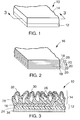
- FIG. 1 illustrates a coated abrasive article 10 according to the invention comprising a backing 12 and an abrasive layer 14 bonded thereto.
- Backing 12 includes a multilayer film 16 which enhances the tear resistance of coated abrasive article 10.
- Multilayer film 16 comprises interdigitated layers of at least one ductile material, at least one stiff material and, optionally, at least one intermediate material.
- the exact order of the individual layers is not critical provided that at least one layer of a stiff material and at least one layer of a ductile material are present.
- Examples of some multilayer film structures within the scope of the invention include: S(DS) x D(SD) x D(ISID) y S(IDIS) y wherein S is the stiff material, D is the ductile material, I is the optional intermediate material, x is a whole number of at least 2 (preferably at least 4 and more preferably about 6), and y is a whole number of at least 1 (preferably at least 2 and more preferably about 3).
- Other layer arrangements in which the order is essentially random are also possible.
- the two outer layers may be the same or may be different.
- the individual stiff layers may be comprised of the same or different materials so long as the materials are stiff.
- the individual ductile layers may be comprised of the same or different materials.
- each stiff layer is provided by the same material and each ductile layer is the same so as to facilitate film production.
- Multilayer film 16 includes 9 alternating layers of ductile material 18, intermediate material 20, and stiff material 22.
- the two outer layers are formed of ductile material 18.
- the structure of FIG. 2 could be such that either stiff material 22 or intermediate material 20 provides the outer layers.
- the film comprises at least 5 layers, more preferably from more than 5 layers (e.g., 9 layers) to 35 layers, and most preferably about 13 layers, although as many layers as desired (e.g., 61 layers) may be employed.
- each layer and the total thickness of the film may be varied over wide limits within the scope of the invention.
- the practical thickness of the film is limited only by the handling characteristics desired.
- the lower useful practical limit is that at which the film becomes too flimsy to be readily handled or is no longer sufficiently tear resistant while the upper useful limit is that at which the film becomes overly rigid and too difficult to process.
- films according to the invention typically have a nominal thickness in the range of from about 7 to 500 microns (i.e., micrometers) ( ⁇ m) and, more preferably, from about 15 to 185 ⁇ m.
- the thickness of the individual layers may also vary over a wide range so long as the film enhances the tear resistance of coated abrasive articles made therewith, it being understood that as the number of layers increases at a constant or decreasing film thickness, the thickness of each layer declines.
- the individual layers of stiff material typically have an average nominal thickness of at least about 0.5 ⁇ m, more preferably from 0.5 ⁇ m to 75 ⁇ m, and most preferably from about 1 to 25 ⁇ m. Although the thickness of each layer may be the same, it is preferred that the ductile material layers be thinner than the stiff material layers.
- the ductile material layers may range in average nominal thickness from greater than about 0.01 ⁇ m to less than about 5 ⁇ m, more preferably, from about 0.2 to 3 ⁇ m. All film and layer thickness stated herein are nominal thicknesses which may be measured according to the procedure set forth in ASTM Test Method D 1004.
- Stiff materials useful in the practice of the invention comprise polyesters which are the reaction product of dicarboxylic acid (or ester derivatives thereof) and diol components.
- the dicarboxylic acid component is either terephthalic acid or naphthalene dicarboxylic acid (such as dimethyl 2,6-naphthalene dicarboxylic acid), and the diol component is either ethylene glycol or 1,4-butanediol.
- preferred polyesters for use as the stiff material include polyethylene terephthalate, polyethylene naphthalate, polybutylene terephthalate, and polybutylene naphthalate, as well as blends thereof.
- Additional stiff copolyesters based on these materials may be made by copolymerizing the terephthalic and/or naphthalene dicarboxylic acid component(s) with one or more other diacids, including adipic, azelaic, sebacic, isophthalic, dibenzoic and cyclohexane dicarboxylic acids.
- various stiff copolyesters may be formed by copolymerizing the ethylene glycol and/or 1,4-butanediol component(s) with one or more other diols such as diethylene glycol, propanediol, polyethyelene glycol, polytetramethylene glycol, neopentyl glycol, cylcohexane dimethanol, 4-hydroxy diphenol, bisphenol A, and 1,8-dihydroxy biphenyl.
- Useful stiff materials may also be provided by incorporating one or more other diacids and/or one or more other diols into the polymerisation mixture. The amount of such other materials may be varied over wide limits so long as the resulting polymer is stiff.
- Tensile modulus of the stiff material is determined according to ASTM Test Method D 822-88 using a 4 inch (10.2 centimeters (cm)) gauge length and a separation rate of 2 inches/minute (5 cm/min).
- the "temperature of interest” means the average temperature at which the coated abrasive article is intended to be used.
- ASTM D 882-88 specifies a test temperature of 23 °C ⁇ 2 °C. If the temperature of interest for the coated abrasive article which incorporates the multilayer film is within this range, the ASTM test procedure is followed as published. If, however, the temperature of interest is outside this range, then the test procedure is followed with the exception that the test is performed at the temperature of interest.
- Ductile materials useful in the invention generally have a tensile modulus of less than 200 psi (1,380 MPa) and a tensile elongation, at the temperature of interest as defined above, of greater than 50%, preferably greater than 150%.
- Tensile modulus and tensile elongation of the ductile material are measured in accordance with ASTM Test Method D 882-88, a tensile test, using a 4 inch (10.2 cm) gauge length and a separation rate of 5 inches/minute (12.7 cm/min).
- "Tensile elongation,” as used herein, refers to the elongation at break of the ductile material as measured during the referenced tensile test procedure.
- Suitable ductile materials include ethylene copolymers such as ethylene/vinyl acetate, ethylene/acrylic acid, ethylene/methyl acrylate, ethylene/methacrylic acid, ethylene/methyl methacrylate, ethylene/ethyl acrylate, ethylene/ethyl methacrylate and blends and ionomers thereof.
- Ethylene/olefin copolymers in which the olefin component is provided by propylene, butylene or other higher order alpha-olefins may also be used.
- the nonethylene portion of the copolymer comprises from 5% to 30% by weight of the copolymer.
- ethylene/vinyl acetate copolymers having at least 6 mole % vinyl acetate.
- suitable commercial materials include the ELVAX series of ethylene/vinyl acetate copolymers (E.I. duPont de Nemours) and the ULTRATHENE series of ethylene/vinyl acetates (Quantum Chemical Corp.).
- Suitable ductile materials also include a wide variety of polyesters and copolyesters which comprise the reaction product of dicarboxylic acid (including ester derivatives thereof) and diol components.
- dicarboxylic acids include terephthalic acid, isophthalic acid, naphthalene dicarboxylic acid, adipic acid, azelaic acid, sebacic acid, and cyclohexane dicarboxylic acid.
- Diols with which these diacids may be polymerized include ethylene glycol, diethylene glycol, propanediol, butanediol, neopentyl glycol, polyethylene glycol, polytetramethylene glycol, poly ⁇ -caprolactone, polyester glycol and cyclohexane dimethanol.
- the relative amounts of the diacid and diol components may be varied over wide limits so long as the resulting polyester/copolyester remains ductile.
- a particularly preferred ductile copolyester comprises 60 mole equivalents of terephthalic acid and 40 mole equivalents of sebacic acid to provide the dicarboxylic acid component, and 100 mole equivalents of ethylene glycol for the diol component.
- Another preferred copolyester comprises 100 mole equivalents cyclohexane dicarboxylic acid for the dicarboxylic acid component, and 91 mole equivalents cyclohexane dimethanol and 9 mole equivalents polytetramethylene glycol for the diol component.
- Examples of commercially available copolyester resins which may be used to provide the ductile material include ECDEL-9965, ECDEL-9966 and ECDEL-9967 (Eastman Chemical Products, Inc.).
- Suitable ductile materials further include polyolefins such as polyethylene, polypropylene and other higher order polyolefins.
- polyamides in which the dicarboxylic acid component and the diamine component (of which the polyamides are the reaction product) each individually have from 2 to 12 carbon atoms.
- the polyamides may be copolymerized with various long chain aliphatic glycols such as polytetramethylene glycol or polyethylene glycol.
- the glycol may comprise up to about 25% by weight of the polyamide.
- Useful polyamides include the PEBAX family of resins commercially available from Atochem.
- Polyurethanes comprising the reaction product of various diioscyanates or triisocyanates and active hydrogen containing compounds may also be successfully employed as ductile materials.
- Useful diisocyanates and triisocyanates include hexamethylene diisocyanate, trans-cyclohexane 1,4-diisocyanate, isophorone diisocyanate, 2,2,4- and 2,4,4-trimethylhexamethylene diisocyanate, m-tetramethylxylene diisocyanate, p-tetramethylxylene diisocyanate, dicyclohexylmethane 4,4-diisocyanate, dimethyl diisocyanate, m-phenylene diisocyanate, p-phenylene diisocyanate, toluene 2,4-diisocyanate, toluene 2,6 diisocyanate, naphthalene 1,5-diisocyanate, diphenylmethane 2,4'
- Useful active hydrogen containing materials include diols (e.g., 1,4-butanediol, 1,6-hexanediol, castor oil), polyester polyols, polyether polyols, and polyfunctional primary or secondary amines.
- diols e.g., 1,4-butanediol, 1,6-hexanediol, castor oil
- polyester polyols e.g., 1,4-butanediol, 1,6-hexanediol, castor oil
- polyether polyols e.g., 1,6-hexanediol, castor oil
- polyfunctional primary or secondary amines e.g., 1,4-butanediol, 1,6-hexanediol, castor oil
- the equivalent ratio of diisocyanate to active hydrogen is about 1:1.
- films according to the invention have an interlayer adhesion of at least 1 piw (180 grams/centimeter), more preferably at least 3 piw (540 grams/centimeter).
- films of the invention comprise a number of interleaved layers of different materials, it is sometimes necessary to provide a means for increasing the interfacial adhesion between adjacent layers to achieve the desired interlayer adhesion.
- a low concentration e.g. about 0.01 to 10%
- a component which contains an appropriate functional group may be incorporated into either or both of the ductile and stiff materials to promote interlayer adhesion. This may be accomplished by, for example, reacting or blending the functional group-containing component with the ductile or stiff material or by copolymerizing or blending it with the monomers used to provide the ductile or stiff material.
- useful adhesion-promoting, functional group-containing components include for example acrylic acid, methacrylic acid, maleic anhydride, vinyl pyridine, or oxazoline-containing materials (such as polyethyl oxazoline).
- a layer of an appropriate intermediate material may be utilized as a tie layer between the layers of stiff and ductile materials.
- the intermediate layer may comprise a ductile material, a stiff material, or a rubbery material.
- the intermediate layer could also comprise a blend of stiff and ductile materials. Ductile and stiff materials are described above. Rubbery materials manifest no significant yield point, but typically display a sigmoidal rise in elongation with applied load until rupture occurs at high strain. Whatever the precise nature of the intermediate material, if it is being used as a tie layer, it must enhance the adhesion between the stiff and ductile materials. Combinations of these approaches, or even other approaches may also be used.
- ethylene/vinyl acetate copolymers preferably containing at least about 10% by weight vinyl acetate and a melt index of about 10, e.g., the ELVAX series of materials (duPont); carboxylated ethylene/vinyl acetate copolymers, e.g., CXA 3101 (duPont); copolymers of ethylene and methyl acrylate, e.g., POLY-ETH 2205 EMA (available from Gulf Oil and Chemicals Co.), and ethylene methacrylic acid ionomers e.g., SURYLN (duPont); ethylene/acrylic acid copolymers; and maleic anhydride modified polyolefins and copolymers of polyolefins, e.g., MODIC resins (available from Mitsubishi Chemical Company).
- ELVAX series of materials duePont
- CXA 3101 duePont
- copolymers of ethylene and methyl acrylate e.g., PO
- Other materials useful as the intermediate layer include polyolefins containing homogeneously dispersed vinyl polymers such as the VMX resins available from Mitsubishi (e.g., FN70, an ethylene/vinyl acetate-based product having a total vinyl acetate content of 50% and JN-70, an ethylene/vinyl acetate-based product containing 23% vinyl acetate and 23% dispersed poly(methyl methacrylate)), POLYBOND (believed to be a polyolefin grafted with acrylic acid) available from Reichold Chemicals Inc., and PLEXAR (believed to be a polyolefin grafted with polar functional groups) available from Chemplex Company.
- VMX resins available from Mitsubishi (e.g., FN70, an ethylene/vinyl acetate-based product having a total vinyl acetate content of 50% and JN-70, an ethylene/vinyl acetate-based product containing 23% vinyl acetate and 23% disper
- copolymers of ethylene and methacrylic acid such as the PRIMACOR family available from Dow Chemical Co. and NUCREL available from duPont.
- Other ethylene copolymers such as ethylene/methyl methacrylate, ethylene/ethyl acrylate, ethylene/ethyl methacrylate and ethylene/n-butyl acrylate may be used.
- polyesters and copolyesters described above as being suitable ductile materials may also function as an intermediate layer.
- the intermediate layer preferably comprises from about 1 to 30 (most preferably from about 2 to 10) weight % of the film.
- the nominal thickness of the intermediate layer can vary over a wide range depending on the number of layers in the multilayer film and the overall thickness of the film, but preferably is from about 0.01 ⁇ m to less than about 5 ⁇ m, more preferably from about 0.2 to 3 ⁇ m.
- adjacent layers of stiff and ductile materials may be treated with radiation, such as ultraviolet, electron beam, infrared or microwave radiation, to improve adhesion.
- radiation such as ultraviolet, electron beam, infrared or microwave radiation
- Each of the stiff, ductile and intermediate layer materials may further include or be supplemented with various adjuvants, additives, extenders, antioxidants, thermal stabilizers, ultraviolet light stabilizers, plasticizers, slip agents, etc. that are conventionally and customarily used in the manufacture of such materials or films made therewith.
- These supplemental materials may comprise up to about 5 weight % of the total weight of the layers into which they are incorporated so long as the tear resistance of the film and the coated abrasive article is not significantly adversely affected.
- Backing 12 may comprise a laminate of multilayer film 16 and a supplemental layer 24 (see FIG. 3) such as, for example, cloth, vulcanized fibers, paper, nonwoven materials, other polymeric films and combinations thereof.
- Cloth supplemental layers are preferably treated with a resinous adhesive to protect the cloth fibers and to seal the cloth backing.
- the cloth may be woven or stitch bonded and may comprise fibers or yarns of cotton, polyester, rayon, silk, nylon or blends thereof.
- Nonwoven supplemental layers may comprise cellulosic fibers, synthetic fibers or blends thereof.
- Multilayer film 16 and supplemental layer 24 may be laminated together using techniques well known in the industry such as passing them between a pair of heated nip rollers or compressing them in a heated press.
- a bonding layer such as a laminating adhesive may be disposed between the multilayer film and the supplemental layer to promote adhesion between the two materials.
- Useful laminating adhesives include thermoplastic resins based on polyamides, polyesters, polyurethanes and blends thereof. Thermosetting resins may also be used.
- Suitable examples include phenolic, aminoplast, urethane, epoxy, ethylenically unsaturated, isocyanurate, urea-formaldehyde, acrylated isocyanurate and acrylated epoxy resins as well as combinations thereof.
- the particular supplemental layer and bonding layer will be selected depending on the qualities which are to be imparted to the finished coated abrasive article such as strength, heat resistance, additional tear resistance or flexibility.
- the multilayer film and the supplemental layer may provide different properties.
- a cloth supplemental layer may offer additional bulk or stiffness while the multilayer film provides a smooth, flat uniform surface for the abrasive layer.
- Coated abrasive article 10 is shown in further detail in FIG. 3.
- Abrasive layer 14 comprises a multiplicity of abrasive particles 26 which are bonded to a major surface of backing 12 by a first binder or make coat 28.
- a second binder or size coat 30 is applied over the abrasive particles and the make coat to reinforce the particles.
- the abrasive particles typically have a size of about 0.1 to 1500 ⁇ m, more preferably from about 1 to 1300 ⁇ m.
- the abrasive particles have a MOH hardness of at least about 8, more preferably greater than 9.
- abrasive particles examples include fused aluminum oxide, ceramic aluminum oxide, aluminum oxide basec ceramics (which may include one or more metal oxide modifiers), heat treated aluminum oxide, silicon carbide, cofused alumina-zirconia, diamond, ceria, cubic boron nitride, garnet and blends thereof.
- Abrasive particles also include abrasive agglomerates such as disclosed in U.S. Patent No. 4,652,275 and U.S. Patent No. 4,799,939, which patents are hereby incorporated by reference.
- Make coat 28 and size coat 30 each comprise a glue or a resinous adhesive.
- suitable resinous adhesives include phenolic, aminoplast, urethane, acrylated urethane, epoxy, acrylated epoxy, isocyanurate, acrylated isocyanurate, ethylenically unsaturated, urea-formaldehyde, bis-maleimide and fluorine-modified epoxy resins as well as mixtures thereof.
- Precursors for the make and size coats may further include catalysts and/or curing agents to initiate and/or accelerate the polymerization process described hereinbelow. The make and size coats are selected based on the characteristics of the finished coated abrasive article.
- the make and size coats may further comprise various optional additives such as fillers, grinding aids, fibers, lubricants, wetting agents, surfactants, pigments, antifoaming agents, dyes, coupling agents, plasticizers and suspending agents.
- fillers include calcium carbonate, calcium metasilicate, silica, silicates, sulfate salts and combinations thereof.
- Grinding aids useful in the practice of the invention include cryolite, ammonium cryolite and potassium tetrafluoroborate.
- Abrasive layer 14 may further comprise a third binder or super size coating 32.
- One useful super size coating comprises a grinding aid, such as potassium tetrafluoroborate, and an adhesive, such as an epoxy resin.
- Super size coating 32 may be included to prevent or reduce the accumulation of swarf (the material abraded from a workpiece) between abrasive particles which can dramatically reduce the cutting ability of the abrasive article.
- Materials useful in preventing swarf accumulation include metal salts of fatty acids (e.g., zinc stearate), urea-formaldehydes, waxes, mineral oils, crosslinked silanes, crosslinked silicones, fluorochemicals and combinations thereof.
- An optional back size coating 34 such as an antislip layer comprising a resinous adhesive having filler particles dispersed therein or a pressure sensitive adhesive for bonding the coated abrasive article to a support pad may be provided on backing 12.
- suitable pressure sensitive adhesives include latex, crepe, rosin, acrylate polymers (e.g., polybutyl acrylate and polyacrylate esters), acrylate copolymers (e.g., isooctylacrylate/acrylic acid), vinyl ethers (e.g., polyvinyl n-butyl ether), alkyd adhesives, rubber adhesives (e.g., natural rubbers, synthetic rubbers and cholorinated rubbers), and mixtures thereof.
- the back size coating may also be an electrically conductive material such as vanadium pentoxide (in, for example, a sulfonated polyester), or carbon black or graphite in a binder.
- electrically conductive material such as vanadium pentoxide (in, for example, a sulfonated polyester), or carbon black or graphite in a binder. Examples of useful conductive back size coatings are disclosed in U.S. Patent No. 5,108,463 and U.S. Patent No. 5,137,452, which patents are incorporated herein by reference.
- supplemental layer 24 (if such be provided), and/or back size coating 34 (if such be included), it may be necessary to modify or prime the surface to which these layers are applied.
- Appropriate surface modifications include corona discharge, ultraviolet light exposure, electron beam exposure, flame discharge and scuffing.
- Useful primers include, ethylene/acrylic acid copolymers such as disclosed in U.S. Patent No. 3,188,265, colloidal dispersions such as taught in U.S. Patent No. 4,906,523, aziridine-based materials such as disclosed in U.S. Patent No. 4,749,617, and radiation grafted primers such as described in U.S. Patent Nos. 4,563,388 and 4,933,234.
- abrasive layer 14 may comprise a multiplicity of abrasive particles which are dispersed in a make coat. Such structures may further comprise an optional super size coating, such as described above, over the make coat. Both the construction illustrated in FIG. 3 and one in which the abrasive particles are dispersed in a make coat are considered exemplary of abrasive layers comprising abrasive particles in a make coat or a first binder.
- Coated abrasive articles according to the invention may be made by applying abrasive layer 14 to a preformed backing 12.
- Multilayer films 16 useful in backing 12 may be readily made using multilayer film manufacturing techniques known in the art. One such technique is disclosed in U.S. Patent No. 3,565,985 (Schrenk et al.).
- melt coextrusion by either the multimanifold die or the feedblock method in which individual layers meet under laminar flow conditions to provide an integral multilayer film may be used. More specifically, separate streams of the ductile, stiff and, optionally, intermediate materials in a flowable state are each split into a predetermined number of smaller or sub-streams.
- These smaller streams are then combined in a predetermined pattern of layers of stiff, ductile and, optionally, intermediate materials to form an array of layers of these materials in a flowable state.
- the layers are in intimate contact with adjacent layers in the array.
- This array generally comprises a tall stack of layers which is then compressed to reduce its height.
- the film width remains constant during compression of the stack while the width is expanded in the feedblock approach. In either case, a comparatively thin, wide film results.
- Layer multipliers in which the resulting film is split into a plurality of individual subfilms which are then stacked one upon another to increase the number of layers in the ultimate film may also be used.
- the materials may be fed such that any one of the three constitutes the outer layer.
- the two outer layers often comprise the same material.
- the materials comprising the various layers are processable at the same temperature and have similar melt viscosities so as to avoid degrading a lower melting material. Accordingly, residence time and processing temperatures may have to be adjusted depending on the characteristics of the materials of each layer.
- lamination the various layers of the film are brought together under temperature and/or pressure (e.g., using heated laminating rollers or a heated press) to adhere adjacent layers to each other.
- extrusion coating a first layer is extruded onto either a cast web, a monoaxially oriented film or a biaxially oriented film and subsequent layers are sequentially coated onto the previously provided layers. Exemplary of this method is U.S. Patent No. 3,741,253. Extrusion coating may be preferred over the melt coextrusion process described above where it is desirable to pretreat selected layers of the multilayer film or where the materials are not readily coextrudable.
- the layers of the stiff material be oriented, either uniaxially or biaxially, at a temperature above their glass transition temperature so as to enhance the stiffness, modulus and creep resistance of the film.
- Orientation of the ductile and intermediate layer materials is optional. Orientation may be accomplished by conventional methods typically used in the art such as mechanical stretching (drawing) or tubular expansion with heated air or gas. Typical draw ratios are in the range of 2.5 to 6 times in either or both of the machine and transverse directions. Greater draw ratios (for example, up to about 8 times) may be used if the film is oriented in only one direction. The film need not be stretched equally in the machine and transverse directions although this is preferred if balanced properties are desired.
- the films may also be heat set by exposing the film to a temperature of about 10° to 150°C below the melting temperature of the stiff component for about 4 to 15 seconds so as to increase the crystallinity, stiffness, modulus and creep resistance of the film while reducing its tendency to shrink.
- the film may be heat set at relatively low temperatures or not at all.
- the tear resistance of the film may change.
- the actual heat set temperature and time will vary depending on the composition of the film but should not be selected so as to substantially degrade the tear resistant properties of the film. Within these constraints, a heat set temperature of about 135° to 205°C is generally desirable.
- Supplemental layer 24 may be laminated to film 16 as described above.
- make coat 28 is applied to a major surface thereof as a flowable liquid.
- a multiplicity of abrasive particles are projected into the make coat, preferably by electrostatic coating, and the resulting construction is at least partially cured.
- Size coat 30 may be applied as a flowable liquid over the abrasive particles and the make coat.
- the size coat is then fully cured along with, if necessary, the make coat.
- the make and size coats may be applied by a variety of techniques such as roll coating, spray coating or curtain coating and can be cured by drying, heating, or with electron beam or ultraviolet light radiation. The particular curing approach may vary depending on the chemistries of the make and size coats.
- Optional super size coating 32 may be applied and cured in a similar manner.
- the abrasive layer comprises a dispersion of abrasive particles in a make coat
- an abrasive slurry comprising the particles and the make coat is prepared and coated onto the backing for example by spraying, roll coating, dip coating, or knife coating.
- the make coat may then be cured by any of the processes described above.
- Optional back size coating 34 may be applied to backing 12 or supplemental layer 24 using any of a variety of conventional coating techniques such as dip coating, roll coating, spraying, Meyer bar, doctor blade, gravure printing, thermomass transfer, flexographic printing or screen printing.
- Coated abrasive articles according to the invention are tear resistant.
- tear resistant it is meant that, in comparison to conventional coated abrasive articles employing paper or polyester film backings, coated abrasive articles according to the invention are less likely to become nicked or torn during routine intended use.
- the properties of the multilayer film which comprise the backing are such that further advancement of the already formed tear is usefully resisted.
- the coated abrasive articles of the invention are also flexible, an important consideration when the article is used to abrade a contoured workpiece.
- the coated abrasive article should have sufficient flexibility to permit it to conform to the contours of the workpiece.
- coated abrasive articles were evaluated by an Elmendorf tear test according to the procedure set forth in ASTM D 689-79, Standard Test Method for Internal Tear Resistance of Paper. The data are reported in grams (g), higher values indicating greater tear resistance. Data were recorded in both the machine direction (MD) (the direction in which multilayer film 16 was extruded or the vertical direction) and the transverse direction (TD) (orthogonal to the machine direction).
- MD machine direction
- TD transverse direction
- coated abrasive articles according to the invention demonstrate an Elmendorf tear test value of at least about 200 g, more preferably at least about 250 g in one direction of the article.
- Examples 1 to 5 and comparative examples (C.E.) 1 to 7 assess the tear resistance of uncoated multilayer backings suitable for use in coated abrasive articles according to the invention and several presently known, commercially available backings, following the procedures described more fully above. The results of these tests are shown below in Table 3.
- a multilayer film useful as a backing for a tear resistant coated abrasive article and comprising 13 alternating layers of a stiff material and a ductile material was formed by coextruding polyethylene terephthalate (PET) (differential scanning calorimetry (DSC) melting point of 256°C; intrinsic viscosity of 0.60 deciliters per gram (dl/g) as measured in 60% phenol and 40% dichlorobenzene at 110°C) as the stiff material with 7 wt. % of a copolyester as the ductile material.
- PET polyethylene terephthalate
- DSC differential scanning calorimetry
- the copolyester comprised 40 mole % (or mole equivalents herein as the reactive systems are basd on 100 equivalents) sebacic acid and 60 mole % terephthalic acid as the dicarboxylic acid components, and 100 mole % ethylene glycol as the diol component.
- the copolyester had an intrinsic viscosity in the range of 0.9 to 1.05 dl/g when measured in the same fashion as the PET.
- the ductile copolyester also displayed a tensile modulus of 14 kpsi (97 MPa) and a tensile elongation of 355% when tested as described above.
- the multilayer film was coextruded onto a chilled casting wheel and subsequently sequentially oriented 2.6 times in the machine direction at 80°C and 4.2 times in the transverse direction at 99°C. The film was then heat set at 149°C. The film had a nominal thickness of about 51 ⁇ m.
- ECDEL 9966 apparently a copolyester based on 1,4-cyclohexane dicarboxylic acid, 1,4-cyclohexane dimethanol, and polytetramethylene ether glycol
- the film was subsequently simultaneously oriented 3.3 times in both the machine and transverse directions at 99°C and heat set at 135°C.
- the nominal thickness of the film was about 51 ⁇ m.
- the multilayer film backing of this example displayed poor interlayer adhesion which it is believed can be remedied through the inclusion of an appropriate tie layer such as discussed more fully hereinabove. However, as shown in Table 2, the multilayer film of this example had excellent tear resistance.
- the multilayer film backing of example 4 was prepared according to the procedure described in conjunction with example 1 except that the nominal film thickness was 63.5 ⁇ m and one surface of the film was provided with a 20.3 ⁇ m thick ethylene/acrylic acid primer layer (PRIMACOR 3330, commercially available from Dow Chemical Co.) extruded onto the film at 138°C and cured with ultraviolet (UV) light energy.
- PRIMACOR 3330 commercially available from Dow Chemical Co.
- the multilayer film backing of example 5 was prepared according to the procedure of example 2 except that the nominal film thickness was about 63.5 ⁇ m and the film included the primer layer of example 4.
- the multilayer film backing of this example displayed poor interlayer adhesion which it is believed can be remedied through the inclusion of an appropriate tie layer such as discussed more fully hereinabove. However, as shown in Table 2, the multilayer film of this example had excellent tear resistance.
- each film comprised a single layer of polyethylene terephthalate, the thickness of which varied according to Table 2.
- Comparative examples 5 and 6 further included a primer layer (prepared according to example 4) on one surface thereof.
- Table 2 Example Film Thickness ( ⁇ m) C. E. 4 63.5 C. E. 5 76 C. E. 6 127
- the data of Table 3 illustrate the substantially superior tear resistance of uncoated abrasive article backings based on multilayer films useful in the invention as compared to some presently known backings. Moreover, the backings of the invention were observed to be generally at least as flexible as, if not more flexible than, the same presently known backings.
- an abrasive layer or a supplemental layer on the backing may decrease the tear resistance of the coated abrasive article (relative to the backing alone), it will also be appreciated that backings with enhanced tear resistance improve the tear resistance of coated abrasive articles made therewith relative to less tear resistant backings.
- a series of coated abrasive articles was prepared or provided as described below in example 6 and comparative examples 8 to 11.
- the resulting articles were tested for tear resistance using the procedure described above. Flexibility was measured in the Taber Flex Test described above. The results of these tests are reported below in Table 4.
- the coated abrasive article of example 6 comprised a backing which included a multilayer film such as described hereinabove and an abrasive layer on one surface thereof. More specifically, the film comprised a total of 13 alternating layers of the stiff PET of example 1 coextruded with 5 weight % of the ductile material of the same example. The film was cast onto a chilled quenching wheel, sequentially oriented 2.6 times in the machine direction at 86°C and 4.5 times in the transverse direction at 103°C, and heat set at 149°C. The film was about 51 ⁇ m thick and included an aziridine-based primer layer on both surfaces. The primer comprised 50 g of A.Q.
- the multilayer film backing was then provided with an abrasive layer prepared according to the following procedure.
- a make coat was prepared comprising a 48% solids ethylene/vinyl acetate emulsion (S-6005, commercially available from H.B. Fuller Company).
- the make coat was roll coated onto the backing at a wet weight of 42 g/m2.
- about 48 g/m2 of grade 180 silicon carbide was electrostatically projected into the make coat.
- the resulting construction was heated for 20 minutes at 71°C.
- a size coat was prepared comprising 86.6 parts of a urea formaldehyde resin (commercially available from Borden Chemical under the trade designation AL8405), 1.75 parts of AlCl3 catalyst, and 11.65 parts of an acrylic latex resin (commercially available from B. F. Goodrich under the trade designation HYCAR 2679).
- the size coat was roll coated over the abrasive particles/make coat with a wet weight of 50 g/m2. The resulting construction was heated for 15 minutes at 49°C and then for 45 minutes at 82°C.
- a supersize coating was prepared by mixing: 74.5 parts water; 5.0 parts ethylene glycol monoethyl ether; 17.0 parts zinc stearate (average particle size of 12 ⁇ m); 0.62 part sodium dioctyl sulfosuccinate; 0.50 part DEFOAMER 1512, hydrocarbon antifoaming agent (commercially available from Hercules, Inc.); 1.60 parts methyl cellulose (A15-LV, commercially available from Dow Chemical Co.); and 0.70 part cellulose gum (AQUALON CMC-7-M, commercially available from Aqualox).
- the supersize coating was applied over the size coat at a wet weight of 59 g/m2.
- the resulting construction was dried for 24 hours at room temperature to form the coated abrasive article.
- the article was then flexed over a 2.54 cm diameter rod to improve the flexibility of the article as is conventional in the industry.
- Comparative examples 8 and 9 were prepared by applying the abrasive layer of example 6 to the backings of, respectively, comparative examples 2 and 3, following the procedure of example 6.
- Comparative examples 10 and 11 were commercially available coated abrasive articles.
- the coated abrasive article of comparative example 10 was grade 180 415 N TRI-M-ITE FRE-CUT using a paper backing and commercially available from Minnesota Mining and Manufacturing Company.
- Comparative example 11 was a 30 ⁇ m A245 A217 coated abrasive article using a polyester film backing commercially available from Norton Co.
- example 6 and comparative examples 8 to 10 were also evaluated for their ability to abrade a workpiece with the results shown in Table 4. More specifically, the coated abrasive articles from these examples were die cut to provide 10.2 cm diameter discs that were bonded to a foam back-up pad with a pressure sensitive adhesive. The coated abrasive disc and foam back-up pad were mounted in a Schiefer testing apparatus to abrade a cellulose acetate butyrate polymer workpiece for 500 revolutions under a 4.5 kg load. The workpiece was a disk having an opening through a central portion thereof. The outside diameter of the disk was 10.2 cm and the inside diameter was 5.1 cm. The amount of abraded polymer was weighed.
- Table 4 show the significant improvement in tear resistance coupled with enhanced flexibility achieved by coated abrasive articles according to the invention as compared to some presently known coated abrasive articles.
- Table 4 further shows that the coated abrasive article of example 6 had a higher cut rate (i.e., more material was abraded) than the coated abrasive articles of comparative examples 8 to 10 but with a slightly rougher finish.
- a tear resistant multilayer film coated abrasive article backing was prepared by coextruding the stiff PET of example 1 with 5.6 wt. % of the ductile copolyester of the same example into a 13 layer film about 51 ⁇ m thick. The film was subsequently sequentially oriented 3.3 times in both the machine and transverse directions at 99°C and beat set at 191°C. The backing was pretreated to improve adhesion to the subsequently applied make coat by exposing the backing to approximately 350 millijoules/square centimeter of UV light radiation at a rate of about 30.5 meters/minute.
- a make coat similar to that described in conjunction with example 6 was roll coated onto the backing at a wet weight of about 25 g/m2.
- Grade P220 aluminum oxide abrasive particles were electrostatically coated into the make coat at a weight of 55 g/m2.
- the make coat was cured in a 85°C tunnel oven for approximately 1 minute.
- a size coat prepared as in example 6 was applied over the abrasive particles/make coat at a wet weight of 46 g/m2 and cured in the same manner as example 6. This was followed by the application of a supersize coating prepared as in example 6 and roll coated at a wet weight of 42 g/m2.
- a coated abrasive article comprising an abrasive layer on a tear resistant multilayer film backing prepared according to example 4.
- the abrasive layer included a 48% solids make coat comprising 62.53 parts phenol-formaldehyde resin, 0.47 part INTERWET 2323 (a glycol ester of a fatty acid commercially available from AKZO America), and 36.97 parts ethylene glycol monoethyl ether.
- 50 g/m2 of grade P320 aluminum oxide abrasive particles were electrostatically projected into the make coat which was subsequently applied to the backing at a wet weight of 10 g/m2.
- the make coat was cured by heating at 68°C for 40 minutes followed by heating at 102°C for 45 minutes.
- a 56% solids size coat comprising 72.54 parts phenol-formaldehyde resin, 4.34 parts NIGROSINE JET BLACK dye (commercially available from Keystone Imports, 20% solids), and 23.11 parts ethylene glycol monoethyl ether was coated onto the abrasive particles/make coat at a wet weight of 42 g/m2. The size coat was subsequently cured for 30 minutes at 88°C, then 30 minutes at 102°C, and then 2.5 hours at 110°C.
- the resulting coated abrasive article was flexed over a 2.54 cm diameter rod.
- a coated abrasive article comprising the multilayer film backing of example 4 and an abrasive layer was prepared.
- the abrasive layer included a 44% solids make coat based on 43.36 parts phenol-formaldehyde resin, 15.62 parts of a nonreactive aliphatic polyester plasticizer, 0.42 part of a fluorocarbon surfactant (FC-430, commercially available from Minnesota Mining and Manufacturing Co.), and 40.59 parts propylene glycol monomethyl ether.
- FC-430 fluorocarbon surfactant
- FC-430 fluorocarbon surfactant
- a 58% solids size coat was then prepared comprising 67.12 parts phenol-formaldehyde resin, 7.54 parts of the above plasticizer, 0.85 part INTERWET 2323, 14.68 parts propylene glycol monomethyl ether, and 9.79 parts water.
- the size coat was roll coated over the abrasive particles/make coat at a wet weight of 46 g/m2 and cured as described in example 8.
- the resulting coated abrasive article was flexed over a 2.54 diameter rod.
- a coated abrasive article comprising the abrasive layer of example 8 on the backing of comparative example 5 was prepared following the procedure of example 8.
- a coated abrasive article comprising the abrasive layer of example 9 on the backing of comparative example 7 was prepared following the procedure of example 9.
- coated abrasive articles comprising a multilayer film backing such as described above are substantially more tear resistant than coated abrasive articles incorporating presently available backings as well as being more flexible. Furthermore, the coated abrasive articles of the invention yielded a comparable cut rate and surface finish.
- Comparing example 8 with comparative example 12 and example 9 with comparative example 13 illustrates the improvement in tear resistance that can be achieved by substituting a backing which includes a multilayer film for a presently available backing.
Landscapes
- Engineering & Computer Science (AREA)
- Mechanical Engineering (AREA)
- Polishing Bodies And Polishing Tools (AREA)
- Laminated Bodies (AREA)
Applications Claiming Priority (2)
| Application Number | Priority Date | Filing Date | Title |
|---|---|---|---|
| US07/955,046 US5355636A (en) | 1992-10-01 | 1992-10-01 | Tear resistant coated abrasive article |
| US955046 | 1992-10-01 |
Publications (1)
| Publication Number | Publication Date |
|---|---|
| EP0590670A1 true EP0590670A1 (fr) | 1994-04-06 |
Family
ID=25496302
Family Applications (1)
| Application Number | Title | Priority Date | Filing Date |
|---|---|---|---|
| EP19930115828 Ceased EP0590670A1 (fr) | 1992-10-01 | 1993-09-30 | Article abrasif en feuille résistant au déchirement |
Country Status (5)
| Country | Link |
|---|---|
| US (1) | US5355636A (fr) |
| EP (1) | EP0590670A1 (fr) |
| JP (1) | JPH06190734A (fr) |
| KR (1) | KR940008880A (fr) |
| CA (1) | CA2106605A1 (fr) |
Cited By (4)
| Publication number | Priority date | Publication date | Assignee | Title |
|---|---|---|---|---|
| WO2002032626A1 (fr) * | 2000-10-13 | 2002-04-25 | 3M Innovative Properties Company | Abrasif applique pourvu d'un materiau support stratifie et procede de fabrication associe |
| WO2009020870A1 (fr) * | 2007-08-03 | 2009-02-12 | Saint-Gobain Abrasives, Inc | Article abrasif comprenant une couche favorisant l'adhérence |
| US8883288B2 (en) | 2007-08-03 | 2014-11-11 | Saint-Gobain Abrasives, Inc. | Abrasive article with adhesion promoting layer |
| CN105579197A (zh) * | 2014-05-01 | 2016-05-11 | 3M创新有限公司 | 柔性磨料制品及其使用方法 |
Families Citing this family (23)
| Publication number | Priority date | Publication date | Assignee | Title |
|---|---|---|---|---|
| US5604042A (en) * | 1991-12-23 | 1997-02-18 | Mobil Oil Corporation | Cellulose material containing barrier film structures |
| CA2106262C (fr) * | 1992-10-01 | 2003-11-18 | Ralph H. Bland | Films multicouches resistants au dechirement et articles incorporant de tels films |
| US5578095A (en) * | 1994-11-21 | 1996-11-26 | Minnesota Mining And Manufacturing Company | Coated abrasive article |
| US6007591A (en) * | 1995-03-07 | 1999-12-28 | Nihon Micro Coating Co., Ltd. | Abrasive sheet and method for producing same |
| US6183346B1 (en) * | 1998-08-05 | 2001-02-06 | 3M Innovative Properties Company | Abrasive article with embossed isolation layer and methods of making and using |
| US6299508B1 (en) * | 1998-08-05 | 2001-10-09 | 3M Innovative Properties Company | Abrasive article with integrally molded front surface protrusions containing a grinding aid and methods of making and using |
| US6186866B1 (en) * | 1998-08-05 | 2001-02-13 | 3M Innovative Properties Company | Abrasive article with separately formed front surface protrusions containing a grinding aid and methods of making and using |
| US6672952B1 (en) | 1998-12-23 | 2004-01-06 | 3M Innovative Properties Company | Tearable abrasive article |
| ATE316448T1 (de) * | 2000-04-18 | 2006-02-15 | 3M Innovative Properties Co | Verfahren zum anbringen eines befestigungselements auf einem oberflächenbehandelungsgegenstand und damit hergestellter gegenstand |
| US6408678B1 (en) | 2000-10-13 | 2002-06-25 | International Business Machines Corporation | Burnishing tape testing method and device |
| US7241485B2 (en) * | 2001-11-09 | 2007-07-10 | Toray Industries, Inc. | Protective film for glass |
| US7294048B2 (en) * | 2004-06-18 | 2007-11-13 | 3M Innovative Properties Company | Abrasive article |
| KR100719026B1 (ko) | 2005-11-10 | 2007-05-16 | 주식회사 광명연마 | 화이버 디스크 및 그 제조방법 |
| US20080102720A1 (en) * | 2006-10-30 | 2008-05-01 | 3M Innovative Properties Company | Abrasive article and method of making and using the same |
| EP2111326A4 (fr) * | 2006-12-20 | 2013-01-16 | 3M Innovative Properties Co | Disque abrasif enduit et son procede de fabrication |
| BR102012032157A2 (pt) * | 2012-12-17 | 2015-07-07 | Ct De Tecnologia Mineral Cetem | Processo para obtenção de material compósito constituído por polímeros de origem vegetal, carga mineral e material abrasivo e uso da composição obtida para o polimento de rochas |
| MX2015013566A (es) | 2013-03-29 | 2016-02-05 | 3M Innovative Properties Co | Articulos abrasivos no tejidos y metodos para la elaboracion de los mismos. |
| WO2016089672A1 (fr) * | 2014-12-01 | 2016-06-09 | 3M Innovative Properties Company | Meule abrasive non tissée à couche barrière contre l'humidité |
| EP3478447A4 (fr) * | 2016-06-29 | 2020-03-11 | Saint-Gobain Abrasives, Inc. | Outils abrasifs et leurs procédés de formation |
| CN112512748A (zh) | 2018-07-23 | 2021-03-16 | 3M创新有限公司 | 包括聚酯背衬和底漆层的制品及相关方法 |
| US12459081B2 (en) | 2018-10-09 | 2025-11-04 | 3M Innovative Properties Company | Treated backing and coated abrasive article including the same |
| WO2020142277A1 (fr) | 2018-12-31 | 2020-07-09 | Saint-Gobain Abrasives, Inc. | Bande de film abrasif revêtue |
| WO2021116882A1 (fr) | 2019-12-09 | 2021-06-17 | 3M Innovative Properties Company | Article abrasif |
Citations (3)
| Publication number | Priority date | Publication date | Assignee | Title |
|---|---|---|---|---|
| US4091150A (en) * | 1974-07-23 | 1978-05-23 | Minnesota Mining And Manufacturing Company | Coextruded polyester splicing tape |
| US4867760A (en) * | 1980-07-31 | 1989-09-19 | Norton Company | Coated abrasive |
| US4908278A (en) * | 1986-10-31 | 1990-03-13 | Minnesota Mining And Manufacturing Company | Severable multilayer thermoplastic film |
Family Cites Families (57)
| Publication number | Priority date | Publication date | Assignee | Title |
|---|---|---|---|---|
| US3188265A (en) * | 1957-11-12 | 1965-06-08 | Minnesota Mining & Mfg | Packaging films |
| US3485912A (en) * | 1965-02-09 | 1969-12-23 | Dow Chemical Co | Composite article formation |
| US3487505A (en) * | 1967-08-21 | 1970-01-06 | Dow Chemical Co | Laminates |
| US3565985A (en) * | 1969-04-10 | 1971-02-23 | Dow Chemical Co | Method of preparing multilayer plastic articles |
| US3759647A (en) * | 1969-04-10 | 1973-09-18 | Turner Alfrey Us | Apparatus for the preparation of multilayer plastic articles |
| US3647612A (en) * | 1969-06-06 | 1972-03-07 | Dow Chemical Co | Multilayer plastic articles |
| US3607354A (en) * | 1969-11-14 | 1971-09-21 | Minnesota Mining & Mfg | Method of delustering polyethylene terephthalate film |
| US3711176A (en) * | 1971-01-14 | 1973-01-16 | Dow Chemical Co | Highly reflective thermoplastic bodies for infrared, visible or ultraviolet light |
| US3775226A (en) * | 1971-02-08 | 1973-11-27 | Material Distributors Corp | Solar control film |
| US3891486A (en) * | 1971-02-08 | 1975-06-24 | Material Distributors Corp | Process for producing solar control window |
| US3899621A (en) * | 1971-02-08 | 1975-08-12 | Material Distributors Corp | Security film for shatter-proofing windows |
| US3741253A (en) * | 1971-03-30 | 1973-06-26 | Grace W R & Co | Laminates of ethylene vinyl acetate polymers and polymers of vinylidene chloride |
| US4163647A (en) * | 1971-06-23 | 1979-08-07 | Norton Company | Method for producing coated abrasives |
| CA1005944A (en) * | 1972-07-31 | 1977-02-22 | Eastman Kodak Company | Blends of polyester and poly(ether-ester) elastomers |
| GB1451331A (en) * | 1973-08-24 | 1976-09-29 | Minnesota Mining Mfg Uk | Abrasive sheet material |
| US3907926A (en) * | 1973-12-19 | 1975-09-23 | Du Pont | Blends of thermoplastic copolyetherester with poly-butylene terephthalate |
| IT1027377B (it) * | 1974-04-01 | 1978-11-20 | Ppg Industries Inc | Parabrezza laminato per aerei |
| ZA771270B (en) * | 1977-03-03 | 1978-07-26 | De Beers Ind Diamond | Abrasive bodies |
| FR2496089A1 (fr) * | 1980-12-11 | 1982-06-18 | Saint Gobain Vitrage | Vitrage feuillete de securite |
| US4349469A (en) * | 1981-02-17 | 1982-09-14 | Eastman Kodak Company | Copolyesterethers |
| DE3201849A1 (de) * | 1982-01-22 | 1983-08-04 | Vereinigte Glaswerke Gmbh, 5100 Aachen | Flexible sichtscheibe aus kunststoff, insbesondere faltbare heckscheibe fuer ein faltbares kabrio-verdeck |
| JPS5989149A (ja) * | 1982-11-15 | 1984-05-23 | 三井化学株式会社 | 多層容器 |
| US4563388A (en) * | 1983-03-28 | 1986-01-07 | Minnesota Mining And Manufacturing Company | Polyolefin substrate coated with acrylic-type normally tacky and pressure-sensitive adhesive and a method of making same |
| US4540623A (en) * | 1983-10-14 | 1985-09-10 | The Dow Chemical Company | Coextruded multi-layered articles |
| US4643943A (en) * | 1984-05-30 | 1987-02-17 | W. R. Grace & Co., Cryovac Div. | Multi-layer polyolefin shrink film |
| US4657441A (en) * | 1984-10-15 | 1987-04-14 | Hsa, Inc. | Penetration conductor pipe drive shoe |
| US4729927A (en) * | 1984-11-22 | 1988-03-08 | Teijin Limited | Polyester packaging material |
| DE3521532A1 (de) * | 1985-06-15 | 1986-12-18 | Hoechst Ag, 6230 Frankfurt | Beschriftbares und kopierbares polyolefin-klebeband und verfahren zu seiner herstellung |
| US4976898A (en) * | 1985-06-17 | 1990-12-11 | Viskase Corporation | Process for making puncture resistant, heat-shrinkable films containing very low density polyethylene |
| US4652275A (en) * | 1985-08-07 | 1987-03-24 | Minnesota Mining And Manufacturing Company | Erodable agglomerates and abrasive products containing the same |
| US4652274A (en) * | 1985-08-07 | 1987-03-24 | Minnesota Mining And Manufacturing Company | Coated abrasive product having radiation curable binder |
| US4965108A (en) * | 1985-09-11 | 1990-10-23 | First Brands Corporation | Low temperature impact and puncture resistant thermoplastic films and bags therefrom |
| US4636442A (en) * | 1985-10-11 | 1987-01-13 | Eastman Kodak Company | Laminated structures of polyethylene terephthalate and elastomeric copolyesterethers |
| US4773920B1 (en) * | 1985-12-16 | 1995-05-02 | Minnesota Mining & Mfg | Coated abrasive suitable for use as a lapping material. |
| US4705707A (en) * | 1985-12-17 | 1987-11-10 | Presto Products, Incorporated | Polyethylene/polyester nonoriented heat sealable moisture barrier film and bag |
| US4749617A (en) * | 1985-12-18 | 1988-06-07 | Minnesota Mining And Manufacturing Company | Composite article containing rigid layers |
| US4751138A (en) * | 1986-08-11 | 1988-06-14 | Minnesota Mining And Manufacturing Company | Coated abrasive having radiation curable binder |
| US4836832A (en) * | 1986-08-11 | 1989-06-06 | Minnesota Mining And Manufacturing Company | Method of preparing coated abrasive having radiation curable binder |
| JPS6353943A (ja) * | 1986-08-22 | 1988-03-08 | Nec Kyushu Ltd | 半導体製造装置 |
| EP0258063B1 (fr) * | 1986-08-28 | 1993-07-14 | Bridgestone Corporation | Unités de vitrage résistantes aux impacts et aux lacérations |
| US4799939A (en) * | 1987-02-26 | 1989-01-24 | Minnesota Mining And Manufacturing Company | Erodable agglomerates and abrasive products containing the same |
| US4933234A (en) * | 1987-08-13 | 1990-06-12 | Minnesota Mining And Manufacturing Company | Primed polymeric surfaces for cyanoacrylate adhesives |
| US4911963A (en) * | 1987-08-31 | 1990-03-27 | Viskase Corporation | Multilayer film containing amorphous nylon |
| US4906523A (en) * | 1987-09-24 | 1990-03-06 | Minnesota Mining And Manufacturing Company | Primer for surfaces containing inorganic oxide |
| US4939009A (en) * | 1988-03-17 | 1990-07-03 | Eastman Kodak Company | Multilayered sheets having excellent adhesion |
| JP2629851B2 (ja) * | 1988-07-04 | 1997-07-16 | 東洋紡績株式会社 | ポリエステル系樹脂積層フィルム |
| US5024680A (en) * | 1988-11-07 | 1991-06-18 | Norton Company | Multiple metal coated superabrasive grit and methods for their manufacture |
| JP2808302B2 (ja) * | 1989-04-13 | 1998-10-08 | ユニチカ株式会社 | ガスバリヤー性多層プラスチックシート |
| JP2730197B2 (ja) * | 1989-07-14 | 1998-03-25 | ダイアホイルヘキスト株式会社 | 易ヒートシール性積層ポリエステルフィルム |
| US5108463B1 (en) * | 1989-08-21 | 1996-08-13 | Minnesota Mining & Mfg | Conductive coated abrasives |
| US5089318A (en) * | 1989-10-31 | 1992-02-18 | The Mearl Corporation | Iridescent film with thermoplastic elastomeric components |
| US5034263A (en) * | 1989-11-27 | 1991-07-23 | Eastman Kodak Company | Film laminate |
| US5049164A (en) * | 1990-01-05 | 1991-09-17 | Norton Company | Multilayer coated abrasive element for bonding to a backing |
| GB9001265D0 (en) * | 1990-01-19 | 1990-03-21 | Ici Plc | Polymeric film |
| JP2944703B2 (ja) * | 1990-03-26 | 1999-09-06 | 株式会社細川洋行 | 包装用袋 |
| US5024895A (en) * | 1990-06-18 | 1991-06-18 | Monsanto Company | Laminate for a safety glazing |
| US5137452A (en) * | 1990-07-09 | 1992-08-11 | Clyde Pollock | Base--ten blocks employing single, attachable blocks of one color row of ten blocks of different color |
-
1992
- 1992-10-01 US US07/955,046 patent/US5355636A/en not_active Expired - Lifetime
-
1993
- 1993-09-21 CA CA 2106605 patent/CA2106605A1/fr not_active Abandoned
- 1993-09-28 KR KR1019930020221A patent/KR940008880A/ko not_active Withdrawn
- 1993-09-30 EP EP19930115828 patent/EP0590670A1/fr not_active Ceased
- 1993-10-01 JP JP24671593A patent/JPH06190734A/ja active Pending
Patent Citations (4)
| Publication number | Priority date | Publication date | Assignee | Title |
|---|---|---|---|---|
| US4091150A (en) * | 1974-07-23 | 1978-05-23 | Minnesota Mining And Manufacturing Company | Coextruded polyester splicing tape |
| US4867760A (en) * | 1980-07-31 | 1989-09-19 | Norton Company | Coated abrasive |
| US4867760B1 (fr) * | 1980-07-31 | 1991-12-17 | Norton Co | |
| US4908278A (en) * | 1986-10-31 | 1990-03-13 | Minnesota Mining And Manufacturing Company | Severable multilayer thermoplastic film |
Non-Patent Citations (1)
| Title |
|---|
| DATABASE WPI Week 7828, Derwent World Patents Index; AN 78-51586 * |
Cited By (8)
| Publication number | Priority date | Publication date | Assignee | Title |
|---|---|---|---|---|
| WO2002032626A1 (fr) * | 2000-10-13 | 2002-04-25 | 3M Innovative Properties Company | Abrasif applique pourvu d'un materiau support stratifie et procede de fabrication associe |
| US6638601B1 (en) | 2000-10-13 | 2003-10-28 | Robert A. Follensbee | Coated abrasive having laminate backing material and method of making the same |
| US6776868B2 (en) | 2000-10-13 | 2004-08-17 | 3M Innovative Properties Company | Coated abrasive having laminate backing material and method of making the same |
| WO2009020870A1 (fr) * | 2007-08-03 | 2009-02-12 | Saint-Gobain Abrasives, Inc | Article abrasif comprenant une couche favorisant l'adhérence |
| CN101808781B (zh) * | 2007-08-03 | 2014-10-22 | 圣戈班磨料磨具有限公司 | 具有助黏附层的磨料物品 |
| US8883288B2 (en) | 2007-08-03 | 2014-11-11 | Saint-Gobain Abrasives, Inc. | Abrasive article with adhesion promoting layer |
| CN105579197A (zh) * | 2014-05-01 | 2016-05-11 | 3M创新有限公司 | 柔性磨料制品及其使用方法 |
| EP3043960A4 (fr) * | 2014-05-01 | 2017-05-31 | 3M Innovative Properties Company | Article abrasif souple et son procédé d'utilisation |
Also Published As
| Publication number | Publication date |
|---|---|
| KR940008880A (ko) | 1994-05-16 |
| JPH06190734A (ja) | 1994-07-12 |
| CA2106605A1 (fr) | 1994-04-02 |
| US5355636A (en) | 1994-10-18 |
Similar Documents
| Publication | Publication Date | Title |
|---|---|---|
| US5355636A (en) | Tear resistant coated abrasive article | |
| US5304224A (en) | Coated abrasive article having a tear resistant backing | |
| US5604019A (en) | Tear resistant multilayer films and articles incorporating such films | |
| US5578095A (en) | Coated abrasive article | |
| US4011358A (en) | Article having a coextruded polyester support film | |
| EP0494658B1 (fr) | Feuille à surface antidérapant, avec couche de support polymérique et méthode pour sa fabrication | |
| EP0591055B1 (fr) | Films multicouches résistants à la déchirure à base de copolyesters d'acide sébacique et articles incorporant de tels films | |
| US5490878A (en) | Coated abrasive article and a method of making same | |
| US5840141A (en) | Splice means, a method of splicing an abrasive article with same and the spliced abrasive article formed thereby | |
| US5286541A (en) | Coated abrasive having combination backing member | |
| KR101464800B1 (ko) | 코팅된 연마 라미네이트 디스크 및 그의 제조 방법 | |
| WO1995011111A1 (fr) | Articles abrasifs comprenant une couche d'egalisation transferee par stratification | |
| US3014795A (en) | Coated abrasive products | |
| US20090280734A1 (en) | Coated Abrasive Disk Comprising A Loop Fabric Layer and Preparation Thereof | |
| WO1986002306A1 (fr) | Materiau en feuilles a revetement abrasif et pourvu d'un support ameliore | |
| US5433979A (en) | Method of producing a non-slip sheet | |
| HK1012612A (en) | Tear resistant multilayer films and articles incorporating such films | |
| HK1012613B (en) | Tear resistant multilayer films based on sebacic acid copolyesters and articles incorporating such films |
Legal Events
| Date | Code | Title | Description |
|---|---|---|---|
| PUAI | Public reference made under article 153(3) epc to a published international application that has entered the european phase |
Free format text: ORIGINAL CODE: 0009012 |
|
| AK | Designated contracting states |
Kind code of ref document: A1 Designated state(s): DE ES FR GB IT |
|
| 17P | Request for examination filed |
Effective date: 19941005 |
|
| 17Q | First examination report despatched |
Effective date: 19961007 |
|
| GRAG | Despatch of communication of intention to grant |
Free format text: ORIGINAL CODE: EPIDOS AGRA |
|
| STAA | Information on the status of an ep patent application or granted ep patent |
Free format text: STATUS: THE APPLICATION HAS BEEN REFUSED |
|
| 18R | Application refused |
Effective date: 19990618 |