EP0590744B1 - Méthode pour régénérer un adsorbant d'ammoniac - Google Patents
Méthode pour régénérer un adsorbant d'ammoniac Download PDFInfo
- Publication number
- EP0590744B1 EP0590744B1 EP93250257A EP93250257A EP0590744B1 EP 0590744 B1 EP0590744 B1 EP 0590744B1 EP 93250257 A EP93250257 A EP 93250257A EP 93250257 A EP93250257 A EP 93250257A EP 0590744 B1 EP0590744 B1 EP 0590744B1
- Authority
- EP
- European Patent Office
- Prior art keywords
- ammonia
- exhaust gas
- adsorbent
- ppm
- recovery
- Prior art date
- Legal status (The legal status is an assumption and is not a legal conclusion. Google has not performed a legal analysis and makes no representation as to the accuracy of the status listed.)
- Expired - Lifetime
Links
Images
Classifications
-
- B—PERFORMING OPERATIONS; TRANSPORTING
- B01—PHYSICAL OR CHEMICAL PROCESSES OR APPARATUS IN GENERAL
- B01D—SEPARATION
- B01D53/00—Separation of gases or vapours; Recovering vapours of volatile solvents from gases; Chemical or biological purification of waste gases, e.g. engine exhaust gases, smoke, fumes, flue gases, aerosols
- B01D53/34—Chemical or biological purification of waste gases
- B01D53/74—General processes for purification of waste gases; Apparatus or devices specially adapted therefor
- B01D53/86—Catalytic processes
- B01D53/8621—Removing nitrogen compounds
- B01D53/8625—Nitrogen oxides
-
- B—PERFORMING OPERATIONS; TRANSPORTING
- B01—PHYSICAL OR CHEMICAL PROCESSES OR APPARATUS IN GENERAL
- B01J—CHEMICAL OR PHYSICAL PROCESSES, e.g. CATALYSIS OR COLLOID CHEMISTRY; THEIR RELEVANT APPARATUS
- B01J20/00—Solid sorbent compositions or filter aid compositions; Sorbents for chromatography; Processes for preparing, regenerating or reactivating thereof
- B01J20/02—Solid sorbent compositions or filter aid compositions; Sorbents for chromatography; Processes for preparing, regenerating or reactivating thereof comprising inorganic material
- B01J20/06—Solid sorbent compositions or filter aid compositions; Sorbents for chromatography; Processes for preparing, regenerating or reactivating thereof comprising inorganic material comprising oxides or hydroxides of metals not provided for in group B01J20/04
-
- B—PERFORMING OPERATIONS; TRANSPORTING
- B01—PHYSICAL OR CHEMICAL PROCESSES OR APPARATUS IN GENERAL
- B01J—CHEMICAL OR PHYSICAL PROCESSES, e.g. CATALYSIS OR COLLOID CHEMISTRY; THEIR RELEVANT APPARATUS
- B01J20/00—Solid sorbent compositions or filter aid compositions; Sorbents for chromatography; Processes for preparing, regenerating or reactivating thereof
- B01J20/02—Solid sorbent compositions or filter aid compositions; Sorbents for chromatography; Processes for preparing, regenerating or reactivating thereof comprising inorganic material
- B01J20/06—Solid sorbent compositions or filter aid compositions; Sorbents for chromatography; Processes for preparing, regenerating or reactivating thereof comprising inorganic material comprising oxides or hydroxides of metals not provided for in group B01J20/04
- B01J20/08—Solid sorbent compositions or filter aid compositions; Sorbents for chromatography; Processes for preparing, regenerating or reactivating thereof comprising inorganic material comprising oxides or hydroxides of metals not provided for in group B01J20/04 comprising aluminium oxide or hydroxide; comprising bauxite
-
- B—PERFORMING OPERATIONS; TRANSPORTING
- B01—PHYSICAL OR CHEMICAL PROCESSES OR APPARATUS IN GENERAL
- B01J—CHEMICAL OR PHYSICAL PROCESSES, e.g. CATALYSIS OR COLLOID CHEMISTRY; THEIR RELEVANT APPARATUS
- B01J20/00—Solid sorbent compositions or filter aid compositions; Sorbents for chromatography; Processes for preparing, regenerating or reactivating thereof
- B01J20/02—Solid sorbent compositions or filter aid compositions; Sorbents for chromatography; Processes for preparing, regenerating or reactivating thereof comprising inorganic material
- B01J20/10—Solid sorbent compositions or filter aid compositions; Sorbents for chromatography; Processes for preparing, regenerating or reactivating thereof comprising inorganic material comprising silica or silicate
- B01J20/16—Alumino-silicates
- B01J20/18—Synthetic zeolitic molecular sieves
-
- B—PERFORMING OPERATIONS; TRANSPORTING
- B01—PHYSICAL OR CHEMICAL PROCESSES OR APPARATUS IN GENERAL
- B01J—CHEMICAL OR PHYSICAL PROCESSES, e.g. CATALYSIS OR COLLOID CHEMISTRY; THEIR RELEVANT APPARATUS
- B01J20/00—Solid sorbent compositions or filter aid compositions; Sorbents for chromatography; Processes for preparing, regenerating or reactivating thereof
- B01J20/30—Processes for preparing, regenerating, or reactivating
- B01J20/34—Regenerating or reactivating
- B01J20/3408—Regenerating or reactivating of aluminosilicate molecular sieves
-
- B—PERFORMING OPERATIONS; TRANSPORTING
- B01—PHYSICAL OR CHEMICAL PROCESSES OR APPARATUS IN GENERAL
- B01J—CHEMICAL OR PHYSICAL PROCESSES, e.g. CATALYSIS OR COLLOID CHEMISTRY; THEIR RELEVANT APPARATUS
- B01J20/00—Solid sorbent compositions or filter aid compositions; Sorbents for chromatography; Processes for preparing, regenerating or reactivating thereof
- B01J20/30—Processes for preparing, regenerating, or reactivating
- B01J20/34—Regenerating or reactivating
- B01J20/3433—Regenerating or reactivating of sorbents or filter aids other than those covered by B01J20/3408 - B01J20/3425
-
- B—PERFORMING OPERATIONS; TRANSPORTING
- B01—PHYSICAL OR CHEMICAL PROCESSES OR APPARATUS IN GENERAL
- B01J—CHEMICAL OR PHYSICAL PROCESSES, e.g. CATALYSIS OR COLLOID CHEMISTRY; THEIR RELEVANT APPARATUS
- B01J20/00—Solid sorbent compositions or filter aid compositions; Sorbents for chromatography; Processes for preparing, regenerating or reactivating thereof
- B01J20/30—Processes for preparing, regenerating, or reactivating
- B01J20/34—Regenerating or reactivating
- B01J20/345—Regenerating or reactivating using a particular desorbing compound or mixture
- B01J20/3458—Regenerating or reactivating using a particular desorbing compound or mixture in the gas phase
-
- B—PERFORMING OPERATIONS; TRANSPORTING
- B01—PHYSICAL OR CHEMICAL PROCESSES OR APPARATUS IN GENERAL
- B01J—CHEMICAL OR PHYSICAL PROCESSES, e.g. CATALYSIS OR COLLOID CHEMISTRY; THEIR RELEVANT APPARATUS
- B01J20/00—Solid sorbent compositions or filter aid compositions; Sorbents for chromatography; Processes for preparing, regenerating or reactivating thereof
- B01J20/30—Processes for preparing, regenerating, or reactivating
- B01J20/34—Regenerating or reactivating
- B01J20/3483—Regenerating or reactivating by thermal treatment not covered by groups B01J20/3441 - B01J20/3475, e.g. by heating or cooling
Definitions
- the present invention relates to a method for recovering an ammonia adsorbent.
- the present invention relates to a method for recovering an ammonia adsorbent disposed on the downstream side of a dry exhaust gas denitrating device using ammonia as a reducing agent.
- This ammonia adsorbent is preferably disposed in a temperature region of 200°C or less on the above-mentioned downstream side.
- this adsorbent is recovered, when the ammonia adsorbent adsorbs remaining ammonia in the above-mentioned dry exhaust gas denitrating device and it is saturated with ammonia.
- Ammonia remaining in the exhaust gas from the dry exhaust gas denitrating device utilizing ammonia as a reducing agent is adsorbed by the adsorbent, but the amount of adsorbed ammonia is limited and therefore in order to use the adsorbent repeatedly, a suitable adsorbent recovery treatment is necessary.
- an adsorbent recovery means there have been known a method in which temperature is elevated for desorbing ammonia, and another method in which pressure is lowered to a level in the vicinity of vacuum so that ammonia can be desorbed.
- the dry exhaust gas denitrating device in which the adsorption technique can be utilized using the ammonia adsorbent can be applied to many fields, and the energy saving of the whole apparatus can be expected.
- an object of the present invention is to provide a method for recovering an ammonia adsorbent in response to the above-mentioned technical demand.
- the gist of the present invention resides in a method for recovering an ammonia adsorbent which comprises the steps of adsorbing remaining ammonia in an exhaust gas by an ammonia adsorbent layer disposed on the downstream side of a dry exhaust gas denitrating device into which ammonia is injected as a reducing agent, to saturate the adsorbent layer with ammonia, and then introducing and streaming an NO x -containing exhaust gas at 300-600°C drawn from an upstream side of the dry exhaust gas denitrating device.
- an NO x -containing exhaust gas at 300-600°C or an NO x -containing hot air at 300-600°C is used as a heat source required for the recovery of the ammonia adsorbent.
- the heat source does not include NO x
- the desorption of ammonia from the ammonia adsorbent is carried out only by the effect of an elevated temperature, and therefore a long time is taken to achieve desorption and recovery.
- NO x when NO x is added, NO x itself reacts rapidly with adsorbed ammonia as shown by the following formula, whereby the ammonia adsorbent can be promptly recovered: 4NO + 4NH 3 + O 2 ⁇ 4N 2 + 6H 2 O
- the removal of ammonia by the reaction of NO x and ammonia and the desorption of ammonia by the effect of high temperature are simultaneously carried out to remove ammonia promptly and efficiently from the ammonia adsorbent, whereby the ammonia adsorbent can be recovered.
- the temperature of the exhaust gas or air containing NO x should be in the range of from 300 to 600°C.
- ammonia adsorbent which can be used in the present invention is an adsorbent comprising 75% of titania, 5% of vanadium pentoxide and a molding auxiliary agent which will be described in the undermentioned embodiment, and other usable examples of the ammonia adsorbent include alumina, zeolite, silica ⁇ alumina, molecular sieve and titania.
- a gas released from an ammonia adsorbent layer at the time of the recovery of the ammonia adsorbent is preferably circulated through a position on the upstream side in the exhaust gas flow of the dry exhaust gas denitrating device and on the downstream side of a dividing/drawing portion of the NO x -containing exhaust gas for the recovery.
- a plurality of systems of the ammonia adsorbent layers are formed and the adsorption of ammonia and the recovery of the ammonia adsorbent are mutually alternated on each ammonia adsorbent layer.
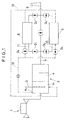
- Fig. 1 is a schematic view illustrating an embodiment of a method for recovering an ammonia adsorbent regarding the present invention.
- FIG. 1 A gas duct 7 extending from the downstream side of the denitrating device 4 is divided into a duct 10 extending to an ammonia adsorbing tower 5 and a duct 11 extending to another ammonia adsorbing tower 6, and the exhaust gases coming from the ammonia adsorbing towers 5, 6 join into the gas duct 7 again and the joined gas is then discharged into the atmosphere through a chimney 9.
- the system of the present invention is provided with an NO x -containing gas duct 12 and a recovery gas duct 13.
- This NO x -containing gas duct 12 divides and draws the exhaust gas on the upstream side of the ammonia injector 3 of the exhaust gas boiler 2 and then introduces this NO x -containing exhaust gas into the ammonia adsorbing towers 5, 6.
- the above-mentioned recovery gas duct 13 introduces the recovery gases coming from the ammonia adsorbing towers 5, 6 into a position on the upstream side of the denitrating device 4 of the exhaust gas boiler 2 and on the downstream side of the above-mentioned exhaust gas dividing/drawing position.
- the exhaust gas of the thus constituted gas turbine 1 is heat-exchanged in the exhaust gas boiler 2, so that the temperature of the exhaust gas lowers, and ammonia is injected through the ammonia injector 3 and the exhaust gas is then denitrated by the denitrating device 4. However, in the thus treated exhaust gas, ammonia is kept remaining.
- This exhaust gas containing ammonia is introduced into the ammonia adsorbing tower 6, in which ammonia is adsorbed, and the exhaust gas is introduced into the gas duct 7 again and then discharged through the chimney 9. At this time, dampers D 1 , D 2 of the duct 11 are opened.
- dampers D 3 , D 4 of the duct 10 extending to the ammonia adsorbing tower 5 in another system are closed, but-the NO x -containing exhaust gas at a high temperature (300-600°C) forwarded through NO x -containing gas duct 12 is introduced into the ammonia adsorbing tower 5 via a damper D 5 .
- this ammonia adsorbing tower 5 ammonia adsorbed by the ammonia adsorbent is desorbed and then returned to an upstream side of the denitrating device 4 of the exhaust gas boiler 2 through the recovery gas duct 13.
- the dampers D 1 to D 6 are switched suitably in accordance with the adsorbing state of ammonia or when a certain time has passed, so that these ammonia adsorbing towers 5, 6 are alternated to adsorb or desorb ammonia.
- ammonia adsorbent comprising 75% of titania, 5% of vanadium pentoxide and a molding auxiliary agent was molded into pellets having a diameter of 3 mm, and a combustion exhaust gas containing 20 ppm of ammonia at a gas temperature of 100°C was then introduced into the pellets to adsorb ammonia sufficiently.
- ammonia is rapidly desorbed at a temperature of 300°C or more. Moreover, the ammonia adsorbents after a passage of 120 minutes were ground and then analyzed to inspect ammonia concentrations, and as a result, it was confirmed that in the cases of 100°C and 200°C, ammonia remained at high concentrations in the ammonia adsorbents. In the case of 300°C, it was confirmed that a small amount of ammonia remained in the ammonia adsorbent and most of ammonia was desorbed.
- Example 2 Example in accordance with the present invention.
- Example 2 The same ammonia adsorbents as in Example 1 were used, and ammonia was adsorbed by the same treatment as in Example 1. Afterward, hot air to which NO x was added at a concentration of 30 ppm and which was adjusted to 300°C was introduced, and an ammonia concentration at an outlet was measured. The results are shown in Table 2. Table 2 Gas Temp. Ammonia Concentrations at Outlet of Adsorbent after 10 min after 20 min after 30 min after 60 min after 120 min 300°C 20 ppm 30 ppm 10 ppm ⁇ 1 ppm ⁇ 1 ppm
- Example 2 it can be understood from Table 2 that in Example 2 regarding the present invention, the ammonia concentration at the outlet lowers more rapidly as compared with Example 1.
- the ammonia adsorbents 60 minutes or 120 minutes had passed were ground and then analyzed to inspect ammonia concentrations in the ammonia adsorbents, and as a result, any ammonia was not detected.
- Example 2 the results in the case of using the hot air containing NO x are exhibited, but also with the use of an exhaust gas containing NO x , about the same results have been obtained.
- an ammonia adsorbent on which ammonia is adsorbed can be rapidly recovered, and in a dry exhaust gas denitration using ammonia as a reducing agent, the present invention can be advantageously applied to a process in which ammonia remaining in a denitrated exhaust gas is desorbed and removed.
- ammonia in the exhaust gas can be continuously treated.
Landscapes
- Chemical & Material Sciences (AREA)
- Analytical Chemistry (AREA)
- Chemical Kinetics & Catalysis (AREA)
- Organic Chemistry (AREA)
- Engineering & Computer Science (AREA)
- Inorganic Chemistry (AREA)
- Environmental & Geological Engineering (AREA)
- Thermal Sciences (AREA)
- Physics & Mathematics (AREA)
- Health & Medical Sciences (AREA)
- Biomedical Technology (AREA)
- General Chemical & Material Sciences (AREA)
- Oil, Petroleum & Natural Gas (AREA)
- Treating Waste Gases (AREA)
- Solid-Sorbent Or Filter-Aiding Compositions (AREA)
Claims (2)
- Procédé pour récupérer un adsorbant d'ammoniac, qui comprend les étapes d'adsorber l'ammoniac restant dans un gaz d'échappement par une couche d'adsorbant d'ammoniac disposée sur le côté aval d'un dispositif de dénitrification du gaz d'échappement sec dans lequel l'ammoniac est injecté comme agent réducteur, pour saturer la couche d'adsorbant en ammoniac, et, ensuite, d'introduire et de faire s'écouler un gaz d'échappement contenant NOx à 300-600°C, aspiré à partir du côté amont du dispositif de dénitrification du gaz d'échappement sec.
- Procédé pour récupérer un adsorbant d'ammoniac selon la revendication 1, dans lequel un gaz libéré de la couche d'adsorbant d'ammoniac au moment de la récupération de l'adsorbant d'ammoniac est circulé à travers une position sur le côté amont du dispositif de dénitrification du gaz d'échappement sec et sur le côté aval d'une partie de division/aspiration du gaz d'échappement contenant NOx pour la récupération.
Applications Claiming Priority (2)
| Application Number | Priority Date | Filing Date | Title |
|---|---|---|---|
| JP258054/92 | 1992-09-28 | ||
| JP25805492A JP3197072B2 (ja) | 1992-09-28 | 1992-09-28 | アンモニア吸着剤の再生方法 |
Publications (2)
| Publication Number | Publication Date |
|---|---|
| EP0590744A1 EP0590744A1 (fr) | 1994-04-06 |
| EP0590744B1 true EP0590744B1 (fr) | 1997-07-30 |
Family
ID=17314901
Family Applications (1)
| Application Number | Title | Priority Date | Filing Date |
|---|---|---|---|
| EP93250257A Expired - Lifetime EP0590744B1 (fr) | 1992-09-28 | 1993-09-21 | Méthode pour régénérer un adsorbant d'ammoniac |
Country Status (4)
| Country | Link |
|---|---|
| US (1) | US5679314A (fr) |
| EP (1) | EP0590744B1 (fr) |
| JP (1) | JP3197072B2 (fr) |
| DE (1) | DE69312616T2 (fr) |
Families Citing this family (6)
| Publication number | Priority date | Publication date | Assignee | Title |
|---|---|---|---|---|
| JP3416202B2 (ja) * | 1993-06-24 | 2003-06-16 | 三菱重工業株式会社 | アンモニア還元脱硝装置からのアンモニアの回収方法 |
| ATE211406T1 (de) * | 1994-10-20 | 2002-01-15 | Mitsubishi Heavy Ind Ltd | Verfahren zur adsorption von ammoniak |
| US5770163A (en) * | 1994-12-21 | 1998-06-23 | Mitsubishi Jukogyo Kabushiki Kaisha | System for the recovery of ammonia escaping from an ammonia reduction denitrator |
| FR2903677A1 (fr) * | 2006-07-12 | 2008-01-18 | Inergy Automotive Systems Res | Systeme de stockage pour precurseur d'ammoniac |
| EP2047076A1 (fr) * | 2006-07-13 | 2009-04-15 | Inergy Automotive Systems Research (Société A.) | Système et procédé permettant de stocker un additif et de l'injecter dans les gaz d'échappement d'un moteur |
| WO2010020017A1 (fr) * | 2008-08-22 | 2010-02-25 | Commonwealth Scientific And Industrial Research Organisation | Traitement de gaz effluents appauvris en co<sb>2</sb> |
Family Cites Families (7)
| Publication number | Priority date | Publication date | Assignee | Title |
|---|---|---|---|---|
| JPS6054881B2 (ja) * | 1978-08-07 | 1985-12-02 | 大同特殊鋼株式会社 | アンモニア分解ガス発生装置及びその装置における再生排ガスの活用方法 |
| JPS58186421A (ja) * | 1982-04-26 | 1983-10-31 | Sumitomo Heavy Ind Ltd | 燃焼排ガスの脱硝、脱硫法 |
| DE3526756A1 (de) * | 1985-07-26 | 1987-01-29 | Babcock Anlagen Ag | Verfahren zum abtrennen von ammoniak-resten aus flugasche und dampferzeugungsanlage mit behandlungsgefaess zur durchfuehrung des verfahrens |
| JPH0226618A (ja) * | 1988-07-14 | 1990-01-29 | Sumitomo Heavy Ind Ltd | 改良された排煙脱硫脱硝法 |
| JPH03207430A (ja) * | 1989-12-29 | 1991-09-10 | Ishikawajima Harima Heavy Ind Co Ltd | 同時脱硫脱硝装置 |
| DE4000795A1 (de) * | 1990-01-12 | 1991-07-18 | Krupp Polysius Ag | Verfahren zur reinigung der abgase von anlagen zur herstellung von zementklinker |
| DE4110333A1 (de) * | 1991-03-28 | 1991-09-19 | Siemens Ag | Verfahren und einrichtung zur katalytischen reduktion |
-
1992
- 1992-09-28 JP JP25805492A patent/JP3197072B2/ja not_active Expired - Fee Related
-
1993
- 1993-09-21 EP EP93250257A patent/EP0590744B1/fr not_active Expired - Lifetime
- 1993-09-21 DE DE69312616T patent/DE69312616T2/de not_active Expired - Fee Related
-
1995
- 1995-07-10 US US08/500,234 patent/US5679314A/en not_active Expired - Fee Related
Also Published As
| Publication number | Publication date |
|---|---|
| US5679314A (en) | 1997-10-21 |
| JPH06106058A (ja) | 1994-04-19 |
| JP3197072B2 (ja) | 2001-08-13 |
| EP0590744A1 (fr) | 1994-04-06 |
| DE69312616T2 (de) | 1997-12-11 |
| DE69312616D1 (de) | 1997-09-04 |
Similar Documents
| Publication | Publication Date | Title |
|---|---|---|
| US11577199B2 (en) | Method for desulphurizating and denitrating flue gas in integrated manner based on low-temperature adsorption | |
| JP3241400U (ja) | 排煙の低温吸着脱硝システム | |
| CN1113680C (zh) | 变温吸附 | |
| US7655204B2 (en) | Heat-treated active carbons for use in denitration, processes for producing same, denitration method using same, and denitration system using same | |
| CN107551757A (zh) | 一种烟气脱硫脱硝方法和装置 | |
| JPS63501549A (ja) | アンモニア処理法及び装置 | |
| TW201241366A (en) | Apparatus and system for NOx reduction in wet flue gas | |
| JPS5843224A (ja) | 乾式排煙脱硫脱硝方法 | |
| EP3406318A1 (fr) | Dispositif de séparation/récupération de dioxyde de carbone, système de combustion l'utilisant, système de génération de poudre thermique l'utilisant, et procédé de de séparation et de récupération de dioxyde de carbone | |
| TW200306881A (en) | Gas purification method and apparatus thereof | |
| CN103492048B (zh) | 用于干燥剂的低nox排放再生的系统和方法 | |
| EP0590744B1 (fr) | Méthode pour régénérer un adsorbant d'ammoniac | |
| CN118512876A (zh) | 烟气低温吸附与碳捕集耦合系统 | |
| CN116099339B (zh) | 一种含氮氧化物烟气吸附脱除装置及脱除方法 | |
| JP3014725B2 (ja) | 排ガスの浄化方法及び装置 | |
| TWI843430B (zh) | 用於含氨廢氣的廢氣處理系統 | |
| JP3206871B2 (ja) | 溶剤ガス処理装置及び溶剤ガス処理方法 | |
| JPH04250822A (ja) | 窒素酸化物の除去方法 | |
| JP3083915B2 (ja) | 低濃度窒素酸化物の除去方法 | |
| CN109876595A (zh) | 一种辅床回热变温吸附系统及工艺 | |
| KR20250091483A (ko) | VOCs및 NOx를 제거할 수 있는 배기가스 정화 장치 및 이를 이용한 배기가스 정화 방법 | |
| JPH06262025A (ja) | 一酸化窒素の濃縮法 | |
| JP2001332498A (ja) | ガス除害システム及び方法 | |
| CN121402060A (zh) | 一种氮氧化物吸附剂的解吸方法 | |
| KR20240137010A (ko) | 공급 가스 유동에 포함된 co2를 회수하기 위한 설비 |
Legal Events
| Date | Code | Title | Description |
|---|---|---|---|
| PUAI | Public reference made under article 153(3) epc to a published international application that has entered the european phase |
Free format text: ORIGINAL CODE: 0009012 |
|
| AK | Designated contracting states |
Kind code of ref document: A1 Designated state(s): DE GB IT |
|
| 17P | Request for examination filed |
Effective date: 19940725 |
|
| 17Q | First examination report despatched |
Effective date: 19960227 |
|
| GRAG | Despatch of communication of intention to grant |
Free format text: ORIGINAL CODE: EPIDOS AGRA |
|
| GRAH | Despatch of communication of intention to grant a patent |
Free format text: ORIGINAL CODE: EPIDOS IGRA |
|
| GRAH | Despatch of communication of intention to grant a patent |
Free format text: ORIGINAL CODE: EPIDOS IGRA |
|
| GRAA | (expected) grant |
Free format text: ORIGINAL CODE: 0009210 |
|
| AK | Designated contracting states |
Kind code of ref document: B1 Designated state(s): DE GB IT |
|
| REF | Corresponds to: |
Ref document number: 69312616 Country of ref document: DE Date of ref document: 19970904 |
|
| PLBE | No opposition filed within time limit |
Free format text: ORIGINAL CODE: 0009261 |
|
| 26N | No opposition filed | ||
| REG | Reference to a national code |
Ref country code: GB Ref legal event code: IF02 |
|
| PGFP | Annual fee paid to national office [announced via postgrant information from national office to epo] |
Ref country code: GB Payment date: 20030917 Year of fee payment: 11 |
|
| PGFP | Annual fee paid to national office [announced via postgrant information from national office to epo] |
Ref country code: DE Payment date: 20031002 Year of fee payment: 11 |
|
| PG25 | Lapsed in a contracting state [announced via postgrant information from national office to epo] |
Ref country code: GB Free format text: LAPSE BECAUSE OF NON-PAYMENT OF DUE FEES Effective date: 20040921 |
|
| PG25 | Lapsed in a contracting state [announced via postgrant information from national office to epo] |
Ref country code: DE Free format text: LAPSE BECAUSE OF NON-PAYMENT OF DUE FEES Effective date: 20050401 |
|
| GBPC | Gb: european patent ceased through non-payment of renewal fee |
Effective date: 20040921 |
|
| PG25 | Lapsed in a contracting state [announced via postgrant information from national office to epo] |
Ref country code: IT Free format text: LAPSE BECAUSE OF NON-PAYMENT OF DUE FEES;WARNING: LAPSES OF ITALIAN PATENTS WITH EFFECTIVE DATE BEFORE 2007 MAY HAVE OCCURRED AT ANY TIME BEFORE 2007. THE CORRECT EFFECTIVE DATE MAY BE DIFFERENT FROM THE ONE RECORDED. Effective date: 20050921 |