EP0591202B1 - Procede pour fabriquer du charbon actif a partir de matiere cellulosique - Google Patents
Procede pour fabriquer du charbon actif a partir de matiere cellulosique Download PDFInfo
- Publication number
- EP0591202B1 EP0591202B1 EP91917776A EP91917776A EP0591202B1 EP 0591202 B1 EP0591202 B1 EP 0591202B1 EP 91917776 A EP91917776 A EP 91917776A EP 91917776 A EP91917776 A EP 91917776A EP 0591202 B1 EP0591202 B1 EP 0591202B1
- Authority
- EP
- European Patent Office
- Prior art keywords
- carbon dioxide
- temperature
- activation
- pyrolysis
- stage
- Prior art date
- Legal status (The legal status is an assumption and is not a legal conclusion. Google has not performed a legal analysis and makes no representation as to the accuracy of the status listed.)
- Expired - Lifetime
Links
Images








Classifications
-
- D—TEXTILES; PAPER
- D01—NATURAL OR MAN-MADE THREADS OR FIBRES; SPINNING
- D01F—CHEMICAL FEATURES IN THE MANUFACTURE OF ARTIFICIAL FILAMENTS, THREADS, FIBRES, BRISTLES OR RIBBONS; APPARATUS SPECIALLY ADAPTED FOR THE MANUFACTURE OF CARBON FILAMENTS
- D01F9/00—Artificial filaments or the like of other substances; Manufacture thereof; Apparatus specially adapted for the manufacture of carbon filaments
- D01F9/08—Artificial filaments or the like of other substances; Manufacture thereof; Apparatus specially adapted for the manufacture of carbon filaments of inorganic material
- D01F9/12—Carbon filaments; Apparatus specially adapted for the manufacture thereof
- D01F9/14—Carbon filaments; Apparatus specially adapted for the manufacture thereof by decomposition of organic filaments
- D01F9/16—Carbon filaments; Apparatus specially adapted for the manufacture thereof by decomposition of organic filaments from products of vegetable origin or derivatives thereof, e.g. from cellulose acetate
-
- C—CHEMISTRY; METALLURGY
- C01—INORGANIC CHEMISTRY
- C01B—NON-METALLIC ELEMENTS; COMPOUNDS THEREOF; METALLOIDS OR COMPOUNDS THEREOF NOT COVERED BY SUBCLASS C01C
- C01B32/00—Carbon; Compounds thereof
- C01B32/30—Active carbon
- C01B32/312—Preparation
- C01B32/336—Preparation characterised by gaseous activating agents
-
- C—CHEMISTRY; METALLURGY
- C01—INORGANIC CHEMISTRY
- C01B—NON-METALLIC ELEMENTS; COMPOUNDS THEREOF; METALLOIDS OR COMPOUNDS THEREOF NOT COVERED BY SUBCLASS C01C
- C01B32/00—Carbon; Compounds thereof
- C01B32/30—Active carbon
- C01B32/354—After-treatment
- C01B32/382—Making shaped products, e.g. fibres, spheres, membranes or foam
Definitions
- the invention relates to a method for manufacturing activated carbon from cellulosic material which method comprises treatment of the material with a diammonium or triammonium phosphate solution with a pH in the alkaline range, which forms an ester with cellulose, and subsequent pyrolysis and activation in a suitable atmosphere and using a suitable temperature-time program.
- activated carbon from cellulosic fibrous material by performing pyrolysis and activation of the fibres in a suitable atmosphere by raising the temperature according to a suitable program up to about 500 - 1000 °C.
- a certain weight loss takes place in this heat treatment due to pyrolysis and, at the same time, microporosity typical of activated carbon is generated.
- Efforts have been made to control these phenomena by performing the fibrous material, which is used as starting material, a pretreatment wherein it is impregnated with a suitable solution.
- a solution containing Lewis acid like e.g. a solution of aluminum chloride, zinc chloride or calcium chloride or a solution of their mixture. In this way, attempts have been made to reduce weight losses at later stages of the heat treatment in order to improve the strength of the final product.
- the purpose is to use very strong regenerated fibres as the starting material, whereby the phosphoric compound is purposed to help in maintaining the strength during the heat treatment and to contribute to the evaporation of phosphorous during the activation stage for increasing the adsorption efficiency. Furthermore it has been stated that use of phosphoric compounds significantly increases the rate of activation by water vapor thus reducing the processing time.
- the object of the invention is to obtain a method by which active carbon can be manufactured, using materials pretreated with a phosphate compound, from cellulosic materials whose initial strength is not of the same order as presented in the above mentioned patent publication but, however, the obtainable active carbon products showing good strength and adsorption properties.
- the method according to the invention is primarily characterized in that the cellulosic material is high tenacity viscose fibre having tensile strength of about 2.9-3.2 cN/dtex and the activation is performed in a carbon dioxide atmosphere containing other activating gases in an amount of less than 10% by volume of the amount of carbon dioxide by means of a carbon dioxide reduction, carbon dioxide gas flowing past the material to be treated.
- phosphoric compounds catalyse splitting of water molecules from cellulose molecules by chemically bonding the C-6 carbons of the cellulose molecule, which would, if they were free, cause the formation of different kinds of heterocyclic compounds separating from the material i.e. so-called tars. For this reason, yield is improved.
- Subsequent activation is performed in a carbon dioxide atmosphere where activation process is controlled by the pressure and the flow rate of the carbon dioxide gas where pore structure is generated by reduction of carbon dioxide whereby carbon is released from the material in the form of carbon monoxide.
- the method has some additional advantageous alternative embodiments concerning applied temperatures and rates at which temperature is raised.
- Treatment is performed with a, triammonium phosphate or diammonium hydrogenphosphate. Treatment is then performed by impregnating the material used as the starting material with a solution containing these phosphates, concentration of the solution being 1-10 % by weight.
- Composition of the carbon dioxide atmosphere is such that there are no other activating gases or their concentration is less than 10 % by volume of the amount of carbon dioxide.
- Carbon dioxide is preferably used as the atmospheric gas also at the pyrolysis stage whereby pyrolysis and the successive activation can be performed without changing the gas. Also at stages other than activation (at temperatures appr. below 700°C) nitrogen can be used.
- the successive stages of pyrolysis and activation are performed by means of a temperature-time program which is characterized by the relatively slow raise of temperature to 340°C, a more gentle raise of temperature between 340°C and 500°C or a constant temperature for a specific period of time, and a relatively slow raise of temperature to the activation stage at over 850°C.
- Activation stage is continued at over 850°C until yield is below 25% of the original, preferably below 22%.
- nitrogenous phosphoric compounds like ammonium phosphates in the treatment it is possible to obtain P-N-compounds which induce cross linkages in the carbonised material, which fact strengthens the structure of the product.
- Influence of the phosphate compound has turned out to be favorable at a surprisingly small concentration of phosphorus.
- the analyzed phosphoric content of the material treated with diammonium hydrogenphosphate, before the heat treatment is 0,7% by weight calculated as phosphorus atoms which corresponds to only about 4% of the phosphoric compound chemically bound to cellulose.
- the analyzed nitrogen content of the material is 0,38% by weight when diammonium hydrogenphosphate is used. Effect of phosphorus at this low concentrations is probably due to the ability of the phosphate group to influence also on other anhydroglucose units of cellulose than the one it is bound to.
- the product manufactured according to the method contains, even after activation, over 1% phosphorus by weight and over 0,4% nitrogen by weight, which in the case of diammonium hydrogenphosphate at a yield of 20-25% corresponds for the part of phosphorus to the residual phosphorus content of up to and over 25% of the original amount and for the part of nitrogen up to and over 20% of the original amount.
- diammonium hydrogenphosphate at a yield of 20-25% corresponds for the part of phosphorus to the residual phosphorus content of up to and over 25% of the original amount and for the part of nitrogen up to and over 20% of the original amount.
- Table 1 there are given phosphorus and nitrogen contents of some samples manufactured by the method according to the invention.
- a cellulosic material is used as a starting material in the method and it can be e.g. in the form of cloth.
- the starting material is viscose fibres with their natural high strength and porosity of a certain degree.
- a suitable material is the high-tenacity viscose fibre of 1,0 - 1,3 dtex manufactured by the applicant having a tensile strength of about 2,9 - 3,2 cN/dtex.
- the initial porosity of the fibres is within the range 100 - 500 ⁇ l/g measured by a mercury porosimeter.
- the solution was allowed to soak into the cloth altogether for 3 min at room temperature and the excess solution was removed after the treatment first mechanically putting the piece five times in succession through press rolls applying a suitable line pressure, which is most preferably about 180 N/cm, after which the piece of cloth was dried at 110°-120°C for 2 - 5 min. After drying, the piece of cloth was still softened mechanically putting it three times in succession through the press rolls applying the above mentioned line pressure.
- a suitable line pressure which is most preferably about 180 N/cm
- the following table 2 shows the measured DP values for cloths pretreated in solutions of different concentrations using different impregnating times and temperatures. It can be seen from the table that treatment does not have any influence on the important properties of the fibres. DP values for MS cloths treated with different solutions and for different times.
- the MS-cloth was pretreated with (NH 4 ) 3 PO 4 (2,5%).
- the impregnating times of the samples at room temperature (22-25°C) were 15 min (runs A and B) and 13 min (run C).
- Fibre samples were performed carbonisation/activation tests using pure CO 2 as the gas in a thermobalance. The CO 2 gas flowed past the sample in excess relative to the corresponding stoichiometric proportion. These tests were purposed to determine the effect of impregnating time and the temperature-time program on the obtained final product.
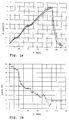
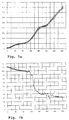
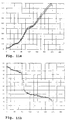
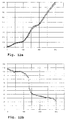
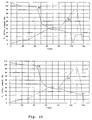
- Figure 18 shows the weight loss and temperature curves (weight loss curves are calculated relative to the dry weight). Yields and specific surface areas, obtained from the nitrogen adsorption isotherms using several points of the isotherms (BET values), of the corresponding runs are presented in table 3.
- the sample suspender was connected to an electronic balance so that sample mass and, therefore, also the proceeding of carbonisation/activation could be followed during the test. Carbonisation/activation tests were terminated on basis of the balance reading.
- the test was terminated by lifting the whole steel reactor out of the furnace and cooling the outside of the reactor with pressurized air. During the whole cooling period, excluding the above mentioned run 17, a CO 2 flow was led into the reactor. The reactor was not opened until temperature was below 100°C. When the reactor was lifted out of the furnace and cooled by pressurized air its temperature decreased from about 900°C to the temperature of 500°C in 3-5 minutes. Temperature reached 100°C in 15-20 minutes.
- a repetition test which corresponded, as to the flow rate of carbon dioxide and the temperature profile, to run 16 a surface area of about 1100 m 2 /g was obtained when the yield was 19,9%.
- the BET values of runs 16 and 17 can be estimated at about 1000-1200 m 2 /g.
- a test for toluene adsorption was performed to samples from runs 6, 9, and 11 by placing 9 sample pieces having a diameter of 20 mm (area weight 100-106 g/m 2 ) in a flow tube on top of each other. Air with a toluene content of 0,96 g/m 3 and relative humidity of 80% were let to flow through the stack of samples at room temperature at a velocity of 13,3 m/s which corresponds to about 2,5 l/min. The elapsed time before toluene could be observed by a gas analyzer on the other side of the sample stack was measured. Results compared to the same amount of active carbon cloth (cc) available in the market and used in NBC protective clothing are presented in the following table 6.
- cc active carbon cloth
- the change in sample weight is greater than that of toluene adsorption calculated on basis of time. This is due to the high relative humidity of air whereby humidity was also adsorbed on the cloth.
Landscapes
- Chemical & Material Sciences (AREA)
- Organic Chemistry (AREA)
- Inorganic Chemistry (AREA)
- Chemical Kinetics & Catalysis (AREA)
- General Chemical & Material Sciences (AREA)
- Engineering & Computer Science (AREA)
- Textile Engineering (AREA)
- Carbon And Carbon Compounds (AREA)
- Solid-Sorbent Or Filter-Aiding Compositions (AREA)
- Materials For Medical Uses (AREA)
- Investigating Or Analysing Biological Materials (AREA)
- Medicines Containing Material From Animals Or Micro-Organisms (AREA)
Claims (11)
- Procédé pour fabriquer du charbon actif à partir de matière cellulosique, le procédé comportant le traitement de la matière par une solution de phosphate diammonique ou triammonique ayant un pH alcalin et formant un ester avec la cellulose, suivi d'une pyrolyse et d'une activation dans une atmosphère convenable, en employant un programme de temps / température adéquat, la matière cellulosique étant la fibre de viscose à haute ténacité présentant une résistance à la traction d'environ 2,9 à 3,2 cN/dtex et l'activation étant réalisée dans une atmosphère de dioxyde de carbon qui contient d'autres gaz activants en une quantité inférieure à 10 % en volume par rapport à la quantité du dioxyde de carbon, au moyen de réduction du dioxyde de carbon dans un courant de dioxyde de carbon passant la matière à traiter.
- Procédé selon la revendication 1, caractérisé en ce que la pyrolyse est aussi réalisée dans une atmosphère de dioxyde de carbon dans le courant du gaz de dioxyde de carbon passant la matière à traiter pour détacher de l'eau de la matière.
- Procédé selon la revendication 1 ou 2, caractérisé en ce que la température de la matière est élevée de 120°C à 500°C en 60 à 150 minutes dans l'étape de pyrolyse.
- Procédé selon l'une quelconque des revendications 1 à 3 ci-dessus, caractérisé en ce que dans l'étape de pyrolyse le diagramme température / temps comprend une partie entre les températures de 340°C et 500°C dans laquelle la vitesse moyenne de l'élévation de température est inférieure à 1,5°C pendant au moins 5 minutes, de préférence pendant au moins 20 minutes.
- Procédé selon la revendication 4, caractérisé en ce que ladite partie se trouve entre les températures de 400°C et 500°C.
- Procédé selon l'une quelconque des revendications 3 à 5 ci-dessus, caractérisé en ce que dans l'étape d'activation la température est élevée de 500°C à 850°C en 15 à 100 minutes.
- Procédé selon la revendication 6, caractérisé en ce que la température est élevée de 500°C à 850°C en 50 à 100 minutes.
- Procédé selon l'une quelconque des revendications 3 à 7 ci-dessus, caractérisé en ce que l'étape d'activation est poursuivie à une température supérieure à 850°C jusqu'à ce que la masse de la matière soit inférieure à 25 % (rendement) de la matière sèche initiale, après quoi la matière est refroidie.
- Procédé selon la revendication 8, caractérisé en ce que l'étape d'activation est poursuivie à une température supérieure à 850°C jusqu'à ce que le rendement reste dans l'intervalle de 14 à 25 %, de préférence dans l'intervalle de 14 à 22 %.
- Procédé selon l'une quelconque des revendications ci-dessus, caractérisé en ce que la matière est sous forme de tissu.
- Procédé selon la revendication 10, caractérisé en ce que le tissu peut changer sa forme librement pendant le traitement.
Applications Claiming Priority (3)
| Application Number | Priority Date | Filing Date | Title |
|---|---|---|---|
| FI905205 | 1990-10-23 | ||
| FI905205A FI86403C (fi) | 1990-10-23 | 1990-10-23 | Foerfarande foer framstaellning av aktivkol fraon cellulosahaltigt material. |
| PCT/FI1991/000318 WO1992006919A1 (fr) | 1990-10-23 | 1991-10-23 | Procede pour fabriquer du charbon actif a partir de matiere cellulosique |
Publications (2)
| Publication Number | Publication Date |
|---|---|
| EP0591202A1 EP0591202A1 (fr) | 1994-04-13 |
| EP0591202B1 true EP0591202B1 (fr) | 2000-04-19 |
Family
ID=8531285
Family Applications (1)
| Application Number | Title | Priority Date | Filing Date |
|---|---|---|---|
| EP91917776A Expired - Lifetime EP0591202B1 (fr) | 1990-10-23 | 1991-10-23 | Procede pour fabriquer du charbon actif a partir de matiere cellulosique |
Country Status (7)
| Country | Link |
|---|---|
| EP (1) | EP0591202B1 (fr) |
| JP (1) | JP3406973B2 (fr) |
| AT (1) | ATE191899T1 (fr) |
| AU (1) | AU8714191A (fr) |
| DE (1) | DE69132125T2 (fr) |
| FI (1) | FI86403C (fr) |
| WO (1) | WO1992006919A1 (fr) |
Families Citing this family (8)
| Publication number | Priority date | Publication date | Assignee | Title |
|---|---|---|---|---|
| WO2004099073A2 (fr) * | 2003-05-09 | 2004-11-18 | Mcgill University | Procede de production de charbon actif |
| US20070178310A1 (en) | 2006-01-31 | 2007-08-02 | Rudyard Istvan | Non-woven fibrous materials and electrodes therefrom |
| RU2472702C2 (ru) | 2007-02-14 | 2013-01-20 | Университи оф Кентукки Ресеарч Фоундатион Инк. | Способы формирования активированного углерода |
| JP5985027B2 (ja) * | 2010-10-12 | 2016-09-06 | フタムラ化学株式会社 | 経口投与用医薬用吸着剤の製造方法 |
| JP5984352B2 (ja) * | 2010-10-12 | 2016-09-06 | フタムラ化学株式会社 | 経口投与用医薬用吸着剤の製造方法 |
| US9108186B2 (en) * | 2013-01-25 | 2015-08-18 | Cabot Corporation | Phosphoric acid treatment of carbonaceous material prior to activation |
| JP7107801B2 (ja) * | 2018-09-27 | 2022-07-27 | 日本製紙株式会社 | 活性炭素繊維材料の製造方法 |
| CN113151936B (zh) * | 2021-03-24 | 2023-07-25 | 湖北文理学院 | 一种表面呈均匀球凸的碳纤维及其制备方法 |
Family Cites Families (3)
| Publication number | Priority date | Publication date | Assignee | Title |
|---|---|---|---|---|
| GB1455531A (en) | 1975-01-02 | 1976-11-10 | Toyo Boseki | Process for preparing active carbon fibres machine for attaching components to a printed circuit board |
| FI60402C (fi) * | 1978-11-28 | 1982-01-11 | Outokumpu Oy | Foerfarande och anordning foer framstaellning av koks eller aktivt kol fraon fuktig organisk substans |
| GB8822518D0 (en) * | 1988-09-26 | 1988-11-02 | Cybertronics Ltd | Improvements in & relating to fibrous activated carbons |
-
1990
- 1990-10-23 FI FI905205A patent/FI86403C/fi not_active IP Right Cessation
-
1991
- 1991-10-23 EP EP91917776A patent/EP0591202B1/fr not_active Expired - Lifetime
- 1991-10-23 AU AU87141/91A patent/AU8714191A/en not_active Abandoned
- 1991-10-23 DE DE69132125T patent/DE69132125T2/de not_active Expired - Fee Related
- 1991-10-23 AT AT91917776T patent/ATE191899T1/de active
- 1991-10-23 JP JP51641991A patent/JP3406973B2/ja not_active Expired - Fee Related
- 1991-10-23 WO PCT/FI1991/000318 patent/WO1992006919A1/fr not_active Ceased
Also Published As
| Publication number | Publication date |
|---|---|
| FI86403B (fi) | 1992-05-15 |
| FI905205A7 (fi) | 1992-04-24 |
| WO1992006919A1 (fr) | 1992-04-30 |
| JP3406973B2 (ja) | 2003-05-19 |
| JPH06501910A (ja) | 1994-03-03 |
| DE69132125T2 (de) | 2000-11-23 |
| ATE191899T1 (de) | 2000-05-15 |
| AU8714191A (en) | 1992-05-20 |
| FI905205A0 (fi) | 1990-10-23 |
| DE69132125D1 (de) | 2000-05-25 |
| EP0591202A1 (fr) | 1994-04-13 |
| FI86403C (fi) | 1992-08-25 |
Similar Documents
| Publication | Publication Date | Title |
|---|---|---|
| US3969268A (en) | Process for preparing active carbon fibers | |
| AU638148B2 (en) | Process for producing high surface area acrivated carbons | |
| US5417752A (en) | Product containing silicon dioxide and a method for its preparation | |
| DE69500407T2 (de) | Verfahren zur Herstellung von Siliciumcarbidmaterial | |
| JP3357080B2 (ja) | 炭素繊維製活性布帛の製造法 | |
| CA1159810A (fr) | Methode de production de charbon active fibreux | |
| US5202302A (en) | Preparation of activated carbons by impregnation with a boron compound and a phosphorus compound | |
| EP1918431A1 (fr) | Fibre de rayonne ininflammable et procede pour la production de celle-ci | |
| WO1992006919A1 (fr) | Procede pour fabriquer du charbon actif a partir de matiere cellulosique | |
| GB2168966A (en) | High-strength carbonaceous fiber | |
| US4412937A (en) | Method for manufacture of activated carbon fiber | |
| RU2016146C1 (ru) | Способ получения углеродного волокнистого материала | |
| US4714649A (en) | Carbonizable fabrics of activated, carbonized fibers and differently activated or unactivated fibers | |
| EP0489133B1 (fr) | Procede de fabrication de charbon actif a partir d'un materiau cellulosique | |
| CN117715875A (zh) | 净水用成型体 | |
| DE2500307C3 (de) | Verfahren zur Herstellung von Aktivkohlefasern | |
| JPS5813722A (ja) | 活性炭素繊維の製法 | |
| JPH0112852B2 (fr) | ||
| JPS6025528B2 (ja) | 活性炭素繊維 | |
| JPS6142016B2 (fr) | ||
| US3759027A (en) | Extruded asbestos yarn for paper dryer felts | |
| KR20240103521A (ko) | 고품위 라이오셀계 활성탄소섬유(acf) 및 이의 제조방법 | |
| JPS584899A (ja) | 活性化された炭素を含有する難燃性繊維ウエブ材 | |
| JPS627812B2 (fr) | ||
| JPS6242048B2 (fr) |
Legal Events
| Date | Code | Title | Description |
|---|---|---|---|
| PUAI | Public reference made under article 153(3) epc to a published international application that has entered the european phase |
Free format text: ORIGINAL CODE: 0009012 |
|
| 17P | Request for examination filed |
Effective date: 19930420 |
|
| AK | Designated contracting states |
Kind code of ref document: A1 Designated state(s): AT BE CH DE DK ES FR GB IT LI NL SE |
|
| RAP1 | Party data changed (applicant data changed or rights of an application transferred) |
Owner name: KEMIRA OY SAETERI |
|
| 17Q | First examination report despatched |
Effective date: 19950524 |
|
| RAP1 | Party data changed (applicant data changed or rights of an application transferred) |
Owner name: KURARAY CHEMICAL CO., LTD. |
|
| GRAG | Despatch of communication of intention to grant |
Free format text: ORIGINAL CODE: EPIDOS AGRA |
|
| GRAG | Despatch of communication of intention to grant |
Free format text: ORIGINAL CODE: EPIDOS AGRA |
|
| GRAH | Despatch of communication of intention to grant a patent |
Free format text: ORIGINAL CODE: EPIDOS IGRA |
|
| GRAH | Despatch of communication of intention to grant a patent |
Free format text: ORIGINAL CODE: EPIDOS IGRA |
|
| GRAA | (expected) grant |
Free format text: ORIGINAL CODE: 0009210 |
|
| AK | Designated contracting states |
Kind code of ref document: B1 Designated state(s): AT BE CH DE DK ES FR GB IT LI NL SE |
|
| PG25 | Lapsed in a contracting state [announced via postgrant information from national office to epo] |
Ref country code: IT Free format text: LAPSE BECAUSE OF FAILURE TO SUBMIT A TRANSLATION OF THE DESCRIPTION OR TO PAY THE FEE WITHIN THE PRE;WARNING: LAPSES OF ITALIAN PATENTS WITH EFFECTIVE DATE BEFORE 2007 MAY HAVE OCCURRED AT ANY TIME BEFORE 2007. THE CORRECT EFFECTIVE DATE MAY BE DIFFERENT FROM THE ONE RECORDED.SCRIBED TIME-LIMIT Effective date: 20000419 Ref country code: NL Free format text: LAPSE BECAUSE OF FAILURE TO SUBMIT A TRANSLATION OF THE DESCRIPTION OR TO PAY THE FEE WITHIN THE PRESCRIBED TIME-LIMIT Effective date: 20000419 Ref country code: AT Free format text: LAPSE BECAUSE OF FAILURE TO SUBMIT A TRANSLATION OF THE DESCRIPTION OR TO PAY THE FEE WITHIN THE PRESCRIBED TIME-LIMIT Effective date: 20000419 Ref country code: ES Free format text: THE PATENT HAS BEEN ANNULLED BY A DECISION OF A NATIONAL AUTHORITY Effective date: 20000419 |
|
| REF | Corresponds to: |
Ref document number: 191899 Country of ref document: AT Date of ref document: 20000515 Kind code of ref document: T |
|
| REG | Reference to a national code |
Ref country code: CH Ref legal event code: EP |
|
| REF | Corresponds to: |
Ref document number: 69132125 Country of ref document: DE Date of ref document: 20000525 |
|
| REG | Reference to a national code |
Ref country code: CH Ref legal event code: NV Representative=s name: PATENTANWALTSBUERO FELDMANN AG |
|
| PG25 | Lapsed in a contracting state [announced via postgrant information from national office to epo] |
Ref country code: SE Free format text: LAPSE BECAUSE OF FAILURE TO SUBMIT A TRANSLATION OF THE DESCRIPTION OR TO PAY THE FEE WITHIN THE PRESCRIBED TIME-LIMIT Effective date: 20000719 Ref country code: DK Free format text: LAPSE BECAUSE OF FAILURE TO SUBMIT A TRANSLATION OF THE DESCRIPTION OR TO PAY THE FEE WITHIN THE PRESCRIBED TIME-LIMIT Effective date: 20000719 |
|
| ET | Fr: translation filed | ||
| NLV1 | Nl: lapsed or annulled due to failure to fulfill the requirements of art. 29p and 29m of the patents act | ||
| PLBE | No opposition filed within time limit |
Free format text: ORIGINAL CODE: 0009261 |
|
| STAA | Information on the status of an ep patent application or granted ep patent |
Free format text: STATUS: NO OPPOSITION FILED WITHIN TIME LIMIT |
|
| 26N | No opposition filed | ||
| REG | Reference to a national code |
Ref country code: GB Ref legal event code: IF02 |
|
| PGFP | Annual fee paid to national office [announced via postgrant information from national office to epo] |
Ref country code: GB Payment date: 20020918 Year of fee payment: 12 |
|
| PGFP | Annual fee paid to national office [announced via postgrant information from national office to epo] |
Ref country code: FR Payment date: 20021011 Year of fee payment: 12 |
|
| PGFP | Annual fee paid to national office [announced via postgrant information from national office to epo] |
Ref country code: BE Payment date: 20021018 Year of fee payment: 12 |
|
| PGFP | Annual fee paid to national office [announced via postgrant information from national office to epo] |
Ref country code: DE Payment date: 20021102 Year of fee payment: 12 |
|
| PGFP | Annual fee paid to national office [announced via postgrant information from national office to epo] |
Ref country code: CH Payment date: 20030127 Year of fee payment: 12 |
|
| PG25 | Lapsed in a contracting state [announced via postgrant information from national office to epo] |
Ref country code: GB Free format text: LAPSE BECAUSE OF NON-PAYMENT OF DUE FEES Effective date: 20031023 |
|
| PG25 | Lapsed in a contracting state [announced via postgrant information from national office to epo] |
Ref country code: CH Free format text: LAPSE BECAUSE OF NON-PAYMENT OF DUE FEES Effective date: 20031031 Ref country code: BE Free format text: LAPSE BECAUSE OF NON-PAYMENT OF DUE FEES Effective date: 20031031 Ref country code: LI Free format text: LAPSE BECAUSE OF NON-PAYMENT OF DUE FEES Effective date: 20031031 |
|
| BERE | Be: lapsed |
Owner name: *KURARAY CHEMICAL CO. LTD Effective date: 20031031 |
|
| PG25 | Lapsed in a contracting state [announced via postgrant information from national office to epo] |
Ref country code: DE Free format text: LAPSE BECAUSE OF NON-PAYMENT OF DUE FEES Effective date: 20040501 |
|
| REG | Reference to a national code |
Ref country code: CH Ref legal event code: PL |
|
| GBPC | Gb: european patent ceased through non-payment of renewal fee |
Effective date: 20031023 |
|
| PG25 | Lapsed in a contracting state [announced via postgrant information from national office to epo] |
Ref country code: FR Free format text: LAPSE BECAUSE OF NON-PAYMENT OF DUE FEES Effective date: 20040630 |
|
| REG | Reference to a national code |
Ref country code: FR Ref legal event code: ST |