EP0591216B1 - Method of balancing a vehicle wheel assembly - Google Patents
Method of balancing a vehicle wheel assembly Download PDFInfo
- Publication number
- EP0591216B1 EP0591216B1 EP91920936A EP91920936A EP0591216B1 EP 0591216 B1 EP0591216 B1 EP 0591216B1 EP 91920936 A EP91920936 A EP 91920936A EP 91920936 A EP91920936 A EP 91920936A EP 0591216 B1 EP0591216 B1 EP 0591216B1
- Authority
- EP
- European Patent Office
- Prior art keywords
- tire
- pulverulent material
- wheel assembly
- pulverulent
- interior
- Prior art date
- Legal status (The legal status is an assumption and is not a legal conclusion. Google has not performed a legal analysis and makes no representation as to the accuracy of the status listed.)
- Expired - Lifetime
Links
- 238000000034 method Methods 0.000 title claims abstract description 25
- 239000000463 material Substances 0.000 claims abstract description 80
- 229920001577 copolymer Polymers 0.000 claims abstract description 11
- 239000002245 particle Substances 0.000 claims description 7
- 239000007788 liquid Substances 0.000 claims description 4
- 230000004044 response Effects 0.000 claims description 4
- 229920003002 synthetic resin Polymers 0.000 claims description 3
- UFHFLCQGNIYNRP-UHFFFAOYSA-N Hydrogen Chemical compound [H][H] UFHFLCQGNIYNRP-UHFFFAOYSA-N 0.000 claims description 2
- XSQUKJJJFZCRTK-UHFFFAOYSA-N Urea Chemical compound NC(N)=O XSQUKJJJFZCRTK-UHFFFAOYSA-N 0.000 claims description 2
- 229920001807 Urea-formaldehyde Polymers 0.000 claims description 2
- 238000010521 absorption reaction Methods 0.000 claims description 2
- 239000000654 additive Substances 0.000 claims description 2
- 239000004202 carbamide Substances 0.000 claims description 2
- 150000001875 compounds Chemical class 0.000 claims description 2
- 239000000945 filler Substances 0.000 claims description 2
- 230000005484 gravity Effects 0.000 claims description 2
- 238000000465 moulding Methods 0.000 claims description 2
- 239000000049 pigment Substances 0.000 claims description 2
- 239000002952 polymeric resin Substances 0.000 claims description 2
- ODGAOXROABLFNM-UHFFFAOYSA-N polynoxylin Chemical compound O=C.NC(N)=O ODGAOXROABLFNM-UHFFFAOYSA-N 0.000 claims description 2
- 239000004634 thermosetting polymer Substances 0.000 claims description 2
- XLYOFNOQVPJJNP-UHFFFAOYSA-N water Substances O XLYOFNOQVPJJNP-UHFFFAOYSA-N 0.000 claims description 2
- 230000009969 flowable effect Effects 0.000 claims 2
- 229920001187 thermosetting polymer Polymers 0.000 claims 1
- 239000004033 plastic Substances 0.000 abstract description 2
- 229920003023 plastic Polymers 0.000 abstract description 2
- 238000012360 testing method Methods 0.000 description 44
- 239000008187 granular material Substances 0.000 description 6
- 230000000712 assembly Effects 0.000 description 5
- 238000000429 assembly Methods 0.000 description 5
- 230000000694 effects Effects 0.000 description 5
- 208000035155 Mitochondrial DNA-associated Leigh syndrome Diseases 0.000 description 4
- 208000003531 maternally-inherited Leigh syndrome Diseases 0.000 description 4
- 239000000843 powder Substances 0.000 description 4
- 229910000831 Steel Inorganic materials 0.000 description 3
- 239000000428 dust Substances 0.000 description 3
- 238000002347 injection Methods 0.000 description 3
- 239000007924 injection Substances 0.000 description 3
- 239000000203 mixture Substances 0.000 description 3
- 230000009467 reduction Effects 0.000 description 3
- 239000000565 sealant Substances 0.000 description 3
- 239000010959 steel Substances 0.000 description 3
- 239000006096 absorbing agent Substances 0.000 description 2
- 230000008859 change Effects 0.000 description 2
- 230000007246 mechanism Effects 0.000 description 2
- 230000002829 reductive effect Effects 0.000 description 2
- 230000000284 resting effect Effects 0.000 description 2
- 238000005096 rolling process Methods 0.000 description 2
- 230000035939 shock Effects 0.000 description 2
- 230000003595 spectral effect Effects 0.000 description 2
- 238000001228 spectrum Methods 0.000 description 2
- 229920000426 Microplastic Polymers 0.000 description 1
- 230000002411 adverse Effects 0.000 description 1
- 239000011324 bead Substances 0.000 description 1
- 239000006229 carbon black Substances 0.000 description 1
- 230000015556 catabolic process Effects 0.000 description 1
- 238000004891 communication Methods 0.000 description 1
- 238000007796 conventional method Methods 0.000 description 1
- 238000005336 cracking Methods 0.000 description 1
- 238000002788 crimping Methods 0.000 description 1
- 230000007423 decrease Effects 0.000 description 1
- 238000006731 degradation reaction Methods 0.000 description 1
- 238000013461 design Methods 0.000 description 1
- 238000006073 displacement reaction Methods 0.000 description 1
- 238000005516 engineering process Methods 0.000 description 1
- 231100001261 hazardous Toxicity 0.000 description 1
- 238000003780 insertion Methods 0.000 description 1
- 230000037431 insertion Effects 0.000 description 1
- 239000002184 metal Substances 0.000 description 1
- 230000009972 noncorrosive effect Effects 0.000 description 1
- 231100000252 nontoxic Toxicity 0.000 description 1
- 230000003000 nontoxic effect Effects 0.000 description 1
- 239000004014 plasticizer Substances 0.000 description 1
- 230000008569 process Effects 0.000 description 1
- 230000001105 regulatory effect Effects 0.000 description 1
- 229920005989 resin Polymers 0.000 description 1
- 239000011347 resin Substances 0.000 description 1
- 230000000717 retained effect Effects 0.000 description 1
- 230000003068 static effect Effects 0.000 description 1
- 239000000126 substance Substances 0.000 description 1
- 229920002994 synthetic fiber Polymers 0.000 description 1
- 239000000057 synthetic resin Substances 0.000 description 1
- 238000005979 thermal decomposition reaction Methods 0.000 description 1
Images



Classifications
-
- G—PHYSICS
- G01—MEASURING; TESTING
- G01M—TESTING STATIC OR DYNAMIC BALANCE OF MACHINES OR STRUCTURES; TESTING OF STRUCTURES OR APPARATUS, NOT OTHERWISE PROVIDED FOR
- G01M1/00—Testing static or dynamic balance of machines or structures
- G01M1/30—Compensating imbalance
- G01M1/32—Compensating imbalance by adding material to the body to be tested, e.g. by correcting-weights
- G01M1/326—Compensating imbalance by adding material to the body to be tested, e.g. by correcting-weights the body being a vehicle wheel
-
- B—PERFORMING OPERATIONS; TRANSPORTING
- B60—VEHICLES IN GENERAL
- B60C—VEHICLE TYRES; TYRE INFLATION; TYRE CHANGING; CONNECTING VALVES TO INFLATABLE ELASTIC BODIES IN GENERAL; DEVICES OR ARRANGEMENTS RELATED TO TYRES
- B60C19/00—Tyre parts or constructions not otherwise provided for
- B60C19/003—Balancing means attached to the tyre
-
- F—MECHANICAL ENGINEERING; LIGHTING; HEATING; WEAPONS; BLASTING
- F16—ENGINEERING ELEMENTS AND UNITS; GENERAL MEASURES FOR PRODUCING AND MAINTAINING EFFECTIVE FUNCTIONING OF MACHINES OR INSTALLATIONS; THERMAL INSULATION IN GENERAL
- F16F—SPRINGS; SHOCK-ABSORBERS; MEANS FOR DAMPING VIBRATION
- F16F15/00—Suppression of vibrations in systems; Means or arrangements for avoiding or reducing out-of-balance forces, e.g. due to motion
- F16F15/32—Correcting- or balancing-weights or equivalent means for balancing rotating bodies, e.g. vehicle wheels
- F16F15/36—Correcting- or balancing-weights or equivalent means for balancing rotating bodies, e.g. vehicle wheels operating automatically, i.e. where, for a given amount of imbalance, there is movement of masses until balance is achieved
- F16F15/366—Correcting- or balancing-weights or equivalent means for balancing rotating bodies, e.g. vehicle wheels operating automatically, i.e. where, for a given amount of imbalance, there is movement of masses until balance is achieved using fluid or powder means, i.e. non-discrete material
Definitions
- the invention is directed to a method of balancing a vehicle wheel assembly, such as wheel assemblies of passenger and truck vehicles and aircraft.
- This method is said to avoid the conventional method of balancing wheels of motor vehicles by crimping lead weights on the edges of the rims of the wheels, and through proper balancing, vibration of the vehicle is lessened and so too should be uneven wear on the tires, excessive wear on the bearings, the shock absorbers, the steering mechanism and other parts of the vehicle.
- the size, shape and design of the globular weights are not specified in this patent other than the obviously globular configuration best illustrated in Figure 3.
- a wheel is balanced by forming an annular channel in a rim into which a liquid is inserted along with globular weights.
- These globular weights are described in this patent as lead or steel shot. Accordingly, the patents collectively utilize globular weights of lead or steel shot per se or in conjunction with the liquid for balancing biased tires under the centrifugal force created during in use tire rotation.
- CA-A-649 236 relates to puncture sealant composition capable of matting together under moderate heat and pressure to retard the escape of air through a puncture into the tire.
- the puncture sealant composition mainly consists of dry rubber material and carbon black.
- US-A-4 588 758 discloses a liquid tire sealant composition for injection into tires which serves to seal the tire around the wheel rim and particularly in the tread area against punctures and also assists in balancing the wheel and tire.
- the Derwent abstract 85-054060/09 of JP-119541 (01.07.83), which forms the basis for the precharacterizing part of claim 1, discloses the insertion of a powdery rubber balance weight or plastics through a valve hole in a tire to control the balance of a tire.
- the aforesaid balancing is achieved instantaneously because the polymeric/copolymeric pulverulent material is relatively light and thus "moves" rapidly under constant variable load forces. Furthermore, the resin of the polymeric/copolymeric pulverulent material is compatible with the tire innerliners to lubricate and thereby maintain or add resiliency to the innerliners. Normally, plasticizers within the innerliners tend to migrate out of the innerliners through the body of the tire causing degradation of the rubber resulting in increased inner- liner porosity and tire sidewall cracking.
- the polymeric/copolymeric synthetic pulverulent material not only allow instant response to load force variation and impact force because of the light weight thereof, but long innerliner life and thus long tire life is also assured because of the lubricity characteristics of the polymeric resin pulverulent material.
- FIGURE 1 is a fragmentary side elevational view of a conventional wheel assembly including a tire carried by a rim, and illustrates a lower portion or "footprint" of the tire tread resting upon and bearing against an associated supporting surface, such as a road.
- FIGURE 2 is an axial vertical cross sectional view through the wheel assembly of Figure 1 and additionally illustrates the lateral extent of the footprint when the tire rests under load upon the road surface.
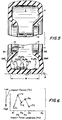
- FIGURE 3 is an enlarged cross sectional view identical to Figure 2, and illustrates the manner in which polymeric/ copolymeric synthetic resin pulverulent material are deposited within an interior of a tire through an associated tire valve.
- FIGURE 4 is a fragmentary cross sectional view of an apparatus for injecting the pulverulent material into the tire of Figure 3, and illustrates a valve core removed from the tire valve incident to the injection of the pulverulent material into the tire through the air valve.
- FIGURE 5 is a cross sectional view of the wheel assembly of Figure 3 during rotation, and illustrates a plurality of radial load forces of different variations or magnitudes reacting between the tire and the road surface as the tire rotates, and the manner in which the polymeric pulverulent material are forced from the position shown in Figure 3 in proportion to the variable radial impact forces.
- FIGURE 6 is a graph, and illustrates the relationship of the impact forces to the location of the pulverulent material relative to the tire when under rolling/ running conditions during balancing in accordance with Figure 5.
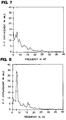
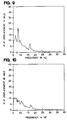
- FIGURES 7 - 10 are graphs illustrative of the amplitude of wheel vibration detected during the testing of a test vehicle under four different test conditions.
- FIGURES 11 and 12 are graphs which illustrate amplitude of vibration of a test vehicle and vehicle cab vibration, respectively.
- Figures 1 and 2 of the drawings illustrate a conventional wheel assembly generally designated by the reference numeral 10 defined by a tire 11 and a metal rim 12 carrying a tire valve or air valve 13 which includes a stem 14 having an internal thread 15 ( Figure 4) to which is normally screw threaded an externally threaded conventional valve core 16 which is illustrated removed from the stem 14 in Figure 4.
- the valve core 16 is threaded by means of the thread 15 into the stem 14 of the tire valve 13.
- the valve stem 14 also includes a conventional external thread 18.
- the tire 10 is a radial tire.
- a biased tire essentially does not flex radially whereas a radial tire tends to flex radially, and in use the latter can be evidenced by sidewalls SW1, SW2 ( Figures 1, 2, 3 and 5) which tend to bulge outwardly under load when resting or running upon a surface, such as a road R.
- the amount of flex will vary depending upon such things as the total load of the vehicle, the speed of the vehicle, etc. and the load force can vary from wheel assembly to wheel assembly both in smaller passenger vehicles and larger vehicles, such as tractor trailers. For example, a fully loaded tractor trailer traveling at sixty miles an hour carrying heavy steel has a greater radial load force and therefore greater tire flex than the same tractor trailer traveling unloaded, as occurs quite often in the hauling industry.
- the radial tire 11 includes a lower tire portion or a footprint B defined by a length L and a lateral breadth or width W which collectively define the instantaneous cross sectional area of the tire lower portion B in engagement with the supporting surface or road R when the wheel assembly 10 is stationary or is rotating.
- the tire T includes a conventional external tire tread T and beads B1, B2 of the respective sidewalls SW1, SW2 which engage the rim 12 in a conventional manner.
- the "perfect" balanced condition of the wheel assembly 10 is far less than perfect. Accordingly, not only must the wheel assembly 10 be balanced, but the balanced condition must be retained or must change to stay in balance in response to variations in road conditions, load forces, changes in speed, etc., as might occur in conventional utilization as, for example, in the case of a loaded versus an unloaded tractor trailer.
- the wheel assembly 10 is balanced and maintained in balance by utilizing within an interior I of the tire 11 of the wheel assembly 10, granules and/or powder and/or dust (pulverulent material) 20 of polymeric/ copolymeric synthetic material, such as POLYPLUS manufactured by U.S. Technology Corporation of 79 Connecticut Mills Avenue, Danielson, CT 06239.
- the pulverulent material 20 is polymerized urea formaldehyde thermoset resin which is available in the following size ranges: TABLE A Screen Size (U.S.
- Standard Mesh) Millimeters Inches 8 - 12 2.13 - 1.68 .0937 - .0661 12 - 16 1.68 - 1.19 .0661 - .0469 12 - 20 1.68 - .841 .0661 - .0331 16 - 20 1.19 - .841 .0469 - .0331 20 - 30 .841 - .595 .0331 - .0234 20 - 40 .841 - .420 .0331 - .0165 30 - 40 .595 - .420 .0234 - .0165 40 - 60 .420 - .250 .0165 - .0098 60 - 80 .250 - .177 .0098 - .0070
- the pulverulent material 20 is non-volatile, nontoxic, noncorrosive and include the following characteristics: TABLE B (Physical Characteristics of Pulverulent material 20) Hardness (Barcol) 64 to 62 (MOHS Scale) 3.5 Specific Gravity g/cm 3 1.47-1.52 Bulk Density 929,1-961,1 kg/m 3 (58 - 60 lbs./cu.ft) Maximum Operating Temperature 150°C (300°F) Chemical Nature Inert
- the pulverulent material 20 is composed of polymerized urea molding compound (70% by weight), alpha cellulose filler (28% by weight) and pigments and additives (2% by weight).
- This range of particle size is considered “dust,” and within the screen size range specified (40 - 200) approximately 60% of the particles are in the 50 - 100 screen size range, namely, approximately 60% are between .0117 - .0059 inch or .300 - .150 mm.
- Other characteristics of the pulverulent material 20 of TABLE C includes: TABLE D Hardness (Barcol) 54 to 62 (Rockwell) M110-120 (MOHS Scale) 3.5 Density At 20°C, 1.5 g/cm 3 pH value At 250 g/1 H 2 Ignition Temperature 530°C Thermal Decomposition 450°C Izod Impact ASTM D256A - 0.25 -0.40 Water Absorption ASTM D570 - 24 hr. - 0.4%-0.8% MIL-A-85891A - Max 10%
- a predetermined amount/weight of the pulverulent material 20 can be placed in the interior I of the tire 11 prior to the tire 11 being mounted upon the rim 12. However, it is highly desirable to inject the pulverulent material 20 into the tire interior I after the tire 11 has been mounted on the rim 12 and to do so through the tire valve or air valve 13.
- an apparatus 30 Figure 4) is provided which includes a highly pressurized source 31 housing the pulverulent material 20, such as a pressurized tank of the pulverulent material 20 which can be filled in a conventional manner and pressurized in a conventional fashion.
- the pulverulent material 20 can be introduced into the tank 31 through a line 32 and a line 33 is connected to a high pressure air source or pump P.
- a line 34 includes a valve 35 which can be selectively manually opened and closed.
- the line 34 is connected to a threaded inlet port 36 of a nozzle 37 having an axial bore 38 and a counterbore 40 carrying an O-ring seal 41 and threads 42 which mate with external threads 18 of the valve stem 14.
- a handle 43 includes a rod 44 slidable and rotatable relative to the bore 38 and sealed relative thereto by another O-ring seal 45 carried by the nozzle 37.
- a lower end portion 46 of the rod 44 is bifurcated and mates with conventional slots (unnumbered) of the valve core 16. Suitable means (not shown) are provided to prevent the handle 43 and rod 44 from being retracted (upwardly) beyond the position illustrated in Figure 4.
- valve core 16 is threaded in the stem 14 by virtue of the threaded engagement between the threads 19 of the valve core 16 and the threads 15 of the stem 14, the handle 43 can be rotated clockwise to unthread the valve core 16.
- the threads 15, 19 are totally disengaged, air pressure within the tire interior I will push the valve core 16 and the handle 43 to the maximum outward position thereof shown in Figure 4 which places the inlet port 36 in free communication with the bore 38 and, of course, with the interior I of the tire 11 through the stem 14.
- the valve 35 is opened and since the pressure within the tank or source 31 is greater than that in the tire interior I (which can be as low as zero), the pulverulent material 20 will flow through the conduit 34, the inlet port 36, the bore 38 and the stem 14 into the tire interior I and will deposit therein a pile or mound M ( Figure 3).
- the precise amount/weight of the powder deposited in the tire interior I can be regulated quite readily and simply as, for example, by first determining the pressure within the tire interior I, increasing the pressure over the line 33 a substantial amount beyond that in the interior I, and opening the valve 35 for a predetermined time period such that the over pressure in the tank 31 injects the precise weight of granules 20 considered appropriate to balance the particular size tire 11 involved.
- Figures 5 and 6 illustrate the innumerable radial impact forces (Fn) which continuously react between the road R and the tread T at the lower portion or footprint B during wheel assembly rotation.
- Fn innumerable radial impact forces
- Pn locations across the lateral width W and the length L of the footprint B
- Figures 5 and 6 diagrammatically illustrate five such impact forces F1-F5 at respective locations P1-P5.
- the forces F1-F5 are different each from each other because of such factors as tire wear at the specific impact force location, the road condition at each impact force location, the load upon each wheel assembly, etc.
- these forces F1-F5 are merely exemplary of innumerable/infinite forces laterally across the tire 11 between the sidewalls SW1 and SW2 and circumferentially along the tire interior which are obviously created continuously and which vary as the wheel assembly 10 rotates.
- the pulverulent material 20 relocates from the mound M ( Figure 3) in dependency upon the location and the severity of the impact forces Fn. The relocation of the pulverulent material through movement of the individual granules, powder and dust 20 is also inversely related to the magnitude of the impact forces.
- the greatest force F1 ( Figure 6) is at position P1, and due to these greater forces F1, the pulverulent material 20 is forced away from the point P1 and the least amount of the pulverulent material remains at the point P1 because the load force thereat is the highest.
- the impact force F2 is the lowest at the impact force location point P2 and therefor more of the pulverulent material 20 will remain thereat ( Figure 5).
- the quantity of the pulverulent material 20 is the least, whereas at points of minimum force impact (point P2 in the example), the quantity of pulverulent material 20 is proportionately increased creating lift therefore equalizing the radial force variations.
- the vibrations or impact forces Fn force the pulverulent material 20 to continuously move away from the higher or excessive impact areas F1 or areas of maximum imbalance F1 and toward the areas of minimum impact forces or imbalance F2.
- the pulverulent material 20 is moved by these impact forces Fn both laterally and circumferentially, but if a single force and a single granule of the pulverulent material 20 could be isolated, so to speak, from the standpoint of cause and effect, a single granule located at a point of maximum impact force Fn would be theoretically moved 180° therefrom.
- variable forces Fn create through the impact thereof a lifting effect within the tire interior I which equalizes the radial force varia9tion applied against the footprint until there is a total balance circumferentially and laterally of the complete wheel assembly 11.
- the rolling forces created by the rotation of the tire assembly 10 in effect create the energy or force Fn which is utilized to locate the pulverulent material 20 to achieve lift and balance and assure a smooth ride.
- road resonance is absorbed as the wheel assemblies 10 rotate.
- the effectiveness of the present invention and the utilization of the pulverulent material 20 to balance wheel assemblies was tested utilizing a GMC Series 7000 stake body truck with a load of nine tons.
- the body truck was fitted with a vibration transducer on the right front axle and vibration data was taken using a CSI Spectrum Analyzer.
- the front tires were Firestone 11 R22.5, the tire pressure was 620 KN/m 2 (90 psi) and 680 g (24 oz.) of the pulverulent material 20 in the 20-40 Screen Size Range (TABLE A) were placed in the tire interior I.
- the vibration readings for each of the test runs were: TEST RUNS AMPLITUDE TEST RUN 1 - AS RECEIVED 0,44 mm (17.57 MILS) TEST RUN 2 - 680g (24 OZ.) ADDED RT.FRT. 0,84 mm (32.90 MILS) TEST RUN 3 - PUL.MAT. ADDED 0,49 mm (19.16 MILS) TEST RUN 4 - 680g (24 OZ.) REMOVED 0,18 mm (6.93 MILS)
- test track of the Transportation Research Center was a seven mile track which made it possible to maintain constant speed and to take the data for each test run over exactly the same stretch of roadway.
- a vibration transducer was attached to the right front axle of each of the vehicles and vibration data was taken and averaged over the same five mile track length.
- Each of the test vehicles was accelerated to 104,6 Km/h (65 mph), unless otherwise noted hereinafter, and vibration data was recorded for five minutes starting at the same location of the test track.
- the data was stored in a Teac MR 30 FM Data Recorder and then analyzed and averaged using a CSI Spectrum Analyzer.
- the average vibration over the 8 Km (five miles) for each of the test vehicles and for each of the test conditions/runs per vehicle is as follows: VEHICLE 1 LOADED TRACTOR-TRAILER TEST RUN 1 AS RECEIVED 0,52 mm (20.8) TEST RUN 2 680g (24 OZ.) LEAD WT ADDED 1,42 mm (55.9) TEST RUN 3 680g (24 OZ.) LEAD WT + 227g (8 OZ.) 20-40 PUL.MAT. 20 0,81 mm (31.8) TEST RUN 4 680g (24 OZ.) LEAD WT + 340g (12 OZ.) 20-40 PUL.MAT.
- Figure 11 is a spectral plot illustrating the difference between the vibration at wheel frequency with 680g (24 oz) of lead added to the front wheel of the tractor-trailer and with and without the pulverulent material 20.
- the 0,61 mm (24 mil) reduction in vibration due to the addition of the pulverulent material 20 is clearly evident.
- applicant has provided a novel method of internally equalizing radial and lateral load force variations of a complete wheel assembly through utilizing the unequal amplitude generated internally of the tire across the footprint of the tread area thereof to force pulverulent material of a predetermined size, weight and volume which will respond instantaneously to these forces.
- This will create a lift at a 180° area from the increased amplitudes of the wheel assembly which will totally equalize the force variation of the entire wheel assembly. Consequently, 360° of the wheel assembly as well as the footprint tread area will all meet the road surface equally, hence, creating a totally smooth vibration-free ride.
Landscapes
- Engineering & Computer Science (AREA)
- General Engineering & Computer Science (AREA)
- Mechanical Engineering (AREA)
- Physics & Mathematics (AREA)
- General Physics & Mathematics (AREA)
- Aviation & Aerospace Engineering (AREA)
- Acoustics & Sound (AREA)
- Testing Of Balance (AREA)
- Tires In General (AREA)
- Turbine Rotor Nozzle Sealing (AREA)
- Control Of Multiple Motors (AREA)
- Arrangement And Driving Of Transmission Devices (AREA)
- Automobile Manufacture Line, Endless Track Vehicle, Trailer (AREA)
Applications Claiming Priority (3)
| Application Number | Priority Date | Filing Date | Title |
|---|---|---|---|
| US07/599,776 US5073217A (en) | 1990-10-17 | 1990-10-17 | Method of balancing a vehicle wheel assembly |
| US599776 | 1990-10-17 | ||
| PCT/US1991/007442 WO1992006857A1 (en) | 1990-10-17 | 1991-10-16 | Method of balancing a vehicle wheel assembly |
Publications (3)
| Publication Number | Publication Date |
|---|---|
| EP0591216A4 EP0591216A4 (en) | 1993-06-17 |
| EP0591216A1 EP0591216A1 (en) | 1994-04-13 |
| EP0591216B1 true EP0591216B1 (en) | 1996-09-11 |
Family
ID=24401042
Family Applications (1)
| Application Number | Title | Priority Date | Filing Date |
|---|---|---|---|
| EP91920936A Expired - Lifetime EP0591216B1 (en) | 1990-10-17 | 1991-10-16 | Method of balancing a vehicle wheel assembly |
Country Status (11)
| Country | Link |
|---|---|
| US (1) | US5073217A (da) |
| EP (1) | EP0591216B1 (da) |
| JP (1) | JP3305713B2 (da) |
| AT (1) | ATE142567T1 (da) |
| AU (1) | AU660159B2 (da) |
| BR (1) | BR9106930A (da) |
| CA (1) | CA2094260C (da) |
| DE (1) | DE69122129T2 (da) |
| DK (1) | DK0591216T3 (da) |
| NO (1) | NO303002B1 (da) |
| WO (1) | WO1992006857A1 (da) |
Families Citing this family (30)
| Publication number | Priority date | Publication date | Assignee | Title |
|---|---|---|---|---|
| US20030041946A1 (en) * | 1990-10-17 | 2003-03-06 | Fogal Robert D. | Method of balancing a vehicle wheel assembly |
| US5466049A (en) * | 1992-01-27 | 1995-11-14 | Harmsen; Arlyn | Balancing ring |
| US5386857A (en) * | 1993-03-30 | 1995-02-07 | International Marketing, Inc. | Method of and apparatus for introducing pulverulent material into a tire |
| AU716263B2 (en) * | 1993-06-17 | 2000-02-24 | M & R Tire Products Inc. | Tire balancing |
| CA2098643C (en) * | 1993-06-17 | 2002-01-29 | Michael Heffernan | Tire balancing |
| US6129797A (en) * | 1994-05-31 | 2000-10-10 | M&R Tire Products Inc. | Tire balancing |
| US5766501A (en) * | 1994-05-31 | 1998-06-16 | M & R Tire Products Inc. | Tire balancing |
| US5479975A (en) * | 1994-11-23 | 1996-01-02 | International Marketing, Inc. | Tire valve stem |
| CA2189290A1 (en) * | 1996-10-31 | 1998-04-30 | Ian Savidge | Apparatus and method of introducing a free-flowing balancing material within a tire |
| EP0941436A4 (en) | 1996-12-09 | 2004-04-07 | Int Marketing Inc | METHOD AND SHUT-OFF VALVE FOR CONTROLLING A CURRENT FLOWING THROUGH A CHANNEL |
| US5803108A (en) * | 1996-12-09 | 1998-09-08 | International Marketing, Inc. | Tool and method for inserting a filter element into the valve stem of a wheel assembly |
| US6128952A (en) * | 1997-09-30 | 2000-10-10 | Leblanc; Roger | Tire balancing using glass beads |
| US6249971B1 (en) * | 1998-05-12 | 2001-06-26 | Robert D. Fogal, Sr. | Method and system for tire/wheel disturbance compensation |
| WO2000068002A1 (en) * | 1999-05-12 | 2000-11-16 | International Marketing, Inc. | Composition for equalizing radial and lateral force variations at the tire/road footprint of a pneumatic tire |
| WO2000068658A1 (en) * | 1999-05-12 | 2000-11-16 | International Marketing, Inc. | Equalizing tire radial and lateral force variations |
| EP1063106A1 (en) * | 1999-06-24 | 2000-12-27 | Carnehammar Lars Bertil | Tyre balancing compositions |
| US20030155055A1 (en) * | 2000-03-13 | 2003-08-21 | Leblanc Roger | Tire balancing using coated beads |
| US6412524B1 (en) | 2000-11-17 | 2002-07-02 | International Marketing, Inc. | Apparatus for introducing flowable force compensating material into a tire |
| US6581444B2 (en) | 2001-06-21 | 2003-06-24 | Superior Industries International, Inc. | Wheel balancing method |
| US7712840B2 (en) * | 2003-07-18 | 2010-05-11 | Fogal Sr Robert D | Uniformity and stabilizing system for a tire/wheel assembly |
| US20060226696A1 (en) * | 2005-03-30 | 2006-10-12 | Jones Gordon B | Self-balancing wheel |
| US7270007B2 (en) * | 2005-06-03 | 2007-09-18 | Serrano Norman S | Apparatus and method for reducing vibration |
| US20080196496A1 (en) * | 2007-02-20 | 2008-08-21 | Gm Global Technology Operations, Inc. | Wheel Balancing Method and Apparatus |
| US7881879B2 (en) * | 2007-05-17 | 2011-02-01 | Hunter Engineering Company | Methods and systems for wheel balancer matching and flat spot correction |
| MX2011004429A (es) * | 2008-10-29 | 2011-09-27 | Int Marketing Inc | Composicion que corrige variaciones de fuerza y vibraciones de montaje de neumatico-rueda. |
| US20100175798A1 (en) * | 2008-10-29 | 2010-07-15 | International Marketing, Inc. | Composition for correcting tire-wheel imbalances, force variations, and vibrations |
| WO2010055097A2 (en) | 2008-11-12 | 2010-05-20 | Carnehammar, Lars Bertil | Tyre balancing compositions |
| BR112012008447B1 (pt) | 2009-10-10 | 2020-11-03 | Lars Bertil Carnehammar | composição, método e sistema para equilibrío de um sistema rotativo |
| US8922946B1 (en) * | 2012-05-21 | 2014-12-30 | Western Digital Technologies, Inc. | Disk drive with balance plug having thermally deformable portion |
| EP3419818B1 (en) | 2016-02-26 | 2022-05-18 | International Marketing, Inc. | Composition and method for reducing tire-wheel assembly imbalances, force variations, and/or vibrations |
Family Cites Families (10)
| Publication number | Priority date | Publication date | Assignee | Title |
|---|---|---|---|---|
| CA649236A (en) * | 1962-09-25 | E. Reinowski Leonard | Puncture-sealant composition and tubeless pneumatic tire containing same | |
| US2909389A (en) * | 1954-11-18 | 1959-10-20 | John C Wilborn | Automatic wheel balancer |
| US3230999A (en) * | 1963-11-22 | 1966-01-25 | William L Hicks | Ballasted vehicle tires |
| US3463551A (en) * | 1968-06-10 | 1969-08-26 | Sunland Refining Corp | Liquid wheel balancing system |
| GB1359462A (en) * | 1970-06-20 | 1974-07-10 | Dunlop Holdings Ltd | Method of treating a deflated tyre and wheel assembly to permit the assembly to be run deflated |
| GB1440186A (en) * | 1972-07-29 | 1976-06-23 | Dunlop Ltd | Pneumatic tyres and wheel assemblies |
| FR2308517A2 (fr) * | 1975-04-22 | 1976-11-19 | Michelin & Cie | Perfectionnements aux enveloppes de pneumatiques |
| US4588758A (en) * | 1985-03-13 | 1986-05-13 | Jaspon Lawrence E | Tire sealant composition |
| DK60087D0 (da) * | 1987-02-05 | 1987-02-05 | Alron Chemical Co Ab | Daekbalanceringskomposition |
| US4776888A (en) * | 1987-08-28 | 1988-10-11 | Morrow Raymond V | Sealing composition for inflatable articles containing gas under pressure |
-
1990
- 1990-10-17 US US07/599,776 patent/US5073217A/en not_active Expired - Lifetime
-
1991
- 1991-10-16 BR BR919106930A patent/BR9106930A/pt not_active IP Right Cessation
- 1991-10-16 AT AT91920936T patent/ATE142567T1/de not_active IP Right Cessation
- 1991-10-16 JP JP50068392A patent/JP3305713B2/ja not_active Expired - Fee Related
- 1991-10-16 DE DE69122129T patent/DE69122129T2/de not_active Expired - Fee Related
- 1991-10-16 DK DK91920936.1T patent/DK0591216T3/da active
- 1991-10-16 CA CA002094260A patent/CA2094260C/en not_active Expired - Fee Related
- 1991-10-16 EP EP91920936A patent/EP0591216B1/en not_active Expired - Lifetime
- 1991-10-16 WO PCT/US1991/007442 patent/WO1992006857A1/en not_active Ceased
- 1991-10-16 AU AU90194/91A patent/AU660159B2/en not_active Ceased
-
1993
- 1993-04-16 NO NO931411A patent/NO303002B1/no unknown
Also Published As
| Publication number | Publication date |
|---|---|
| US5073217A (en) | 1991-12-17 |
| JP3305713B2 (ja) | 2002-07-24 |
| CA2094260A1 (en) | 1992-04-18 |
| EP0591216A4 (en) | 1993-06-17 |
| WO1992006857A1 (en) | 1992-04-30 |
| AU660159B2 (en) | 1995-06-15 |
| EP0591216A1 (en) | 1994-04-13 |
| NO931411D0 (no) | 1993-04-16 |
| ATE142567T1 (de) | 1996-09-15 |
| DE69122129T2 (de) | 1997-04-03 |
| DK0591216T3 (da) | 1997-02-24 |
| BR9106930A (pt) | 1993-07-20 |
| NO931411L (no) | 1993-06-15 |
| CA2094260C (en) | 1999-07-13 |
| DE69122129D1 (de) | 1996-10-17 |
| NO303002B1 (no) | 1998-05-18 |
| AU9019491A (en) | 1992-05-20 |
| JPH06510716A (ja) | 1994-12-01 |
Similar Documents
| Publication | Publication Date | Title |
|---|---|---|
| US5073217A (en) | Method of balancing a vehicle wheel assembly | |
| US4350196A (en) | Non-pneumatic structurally resilient integrated wheel-tire | |
| EP1914268A1 (en) | Tire-rim assembly | |
| EP1181154B1 (en) | Method and system for tire/wheel disturbance compensation | |
| EP0407126A1 (en) | In-tire filter for central inflation system | |
| US20020000275A1 (en) | Method for equalizing radial and lateral force variations at the tire/road footprint of a pneumatic tire | |
| US20030041946A1 (en) | Method of balancing a vehicle wheel assembly | |
| US7022753B2 (en) | Composition for equalizing radial and lateral force variations at the tire/road footprint of a pneumatic tire | |
| WO2010051371A1 (en) | Composition for correcting force variations and vibrations of a tire-wheel assembly | |
| MX2011007237A (es) | Composicion para corregir los desbalanceos, variaciones de fuerza y vibraciones de montaje de llanta-rueda. | |
| US20100175798A1 (en) | Composition for correcting tire-wheel imbalances, force variations, and vibrations | |
| US12151446B2 (en) | Composition for reducing tire-wheel assembly imbalances, force variations, and/or vibrations | |
| Hawkes | Foam-Inflated Tires | |
| WO2024144654A1 (en) | Airless wheel | |
| WO2016002091A1 (en) | A tire improved in noise |
Legal Events
| Date | Code | Title | Description |
|---|---|---|---|
| PUAI | Public reference made under article 153(3) epc to a published international application that has entered the european phase |
Free format text: ORIGINAL CODE: 0009012 |
|
| 17P | Request for examination filed |
Effective date: 19930415 |
|
| AK | Designated contracting states |
Kind code of ref document: A1 Designated state(s): AT BE DE DK FR GB IT LU NL SE |
|
| 17Q | First examination report despatched |
Effective date: 19950331 |
|
| GRAH | Despatch of communication of intention to grant a patent |
Free format text: ORIGINAL CODE: EPIDOS IGRA |
|
| GRAH | Despatch of communication of intention to grant a patent |
Free format text: ORIGINAL CODE: EPIDOS IGRA |
|
| GRAA | (expected) grant |
Free format text: ORIGINAL CODE: 0009210 |
|
| AK | Designated contracting states |
Kind code of ref document: B1 Designated state(s): AT BE DE DK FR GB IT LU NL SE |
|
| RAP1 | Party data changed (applicant data changed or rights of an application transferred) |
Owner name: INTERNATIONAL MARKETING INCORPORATED |
|
| REF | Corresponds to: |
Ref document number: 142567 Country of ref document: AT Date of ref document: 19960915 Kind code of ref document: T |
|
| ITF | It: translation for a ep patent filed | ||
| ET | Fr: translation filed | ||
| REF | Corresponds to: |
Ref document number: 69122129 Country of ref document: DE Date of ref document: 19961017 |
|
| REG | Reference to a national code |
Ref country code: DK Ref legal event code: T3 |
|
| PLBE | No opposition filed within time limit |
Free format text: ORIGINAL CODE: 0009261 |
|
| STAA | Information on the status of an ep patent application or granted ep patent |
Free format text: STATUS: NO OPPOSITION FILED WITHIN TIME LIMIT |
|
| 26N | No opposition filed | ||
| REG | Reference to a national code |
Ref country code: GB Ref legal event code: IF02 |
|
| PGFP | Annual fee paid to national office [announced via postgrant information from national office to epo] |
Ref country code: GB Payment date: 20051018 Year of fee payment: 15 |
|
| PGFP | Annual fee paid to national office [announced via postgrant information from national office to epo] |
Ref country code: FR Payment date: 20051024 Year of fee payment: 15 Ref country code: LU Payment date: 20051024 Year of fee payment: 15 Ref country code: SE Payment date: 20051024 Year of fee payment: 15 Ref country code: AT Payment date: 20051024 Year of fee payment: 15 |
|
| PGFP | Annual fee paid to national office [announced via postgrant information from national office to epo] |
Ref country code: BE Payment date: 20051025 Year of fee payment: 15 |
|
| PGFP | Annual fee paid to national office [announced via postgrant information from national office to epo] |
Ref country code: DK Payment date: 20051026 Year of fee payment: 15 |
|
| PGFP | Annual fee paid to national office [announced via postgrant information from national office to epo] |
Ref country code: NL Payment date: 20051028 Year of fee payment: 15 Ref country code: DE Payment date: 20051028 Year of fee payment: 15 |
|
| PG25 | Lapsed in a contracting state [announced via postgrant information from national office to epo] |
Ref country code: AT Free format text: LAPSE BECAUSE OF NON-PAYMENT OF DUE FEES Effective date: 20061016 |
|
| PG25 | Lapsed in a contracting state [announced via postgrant information from national office to epo] |
Ref country code: SE Free format text: LAPSE BECAUSE OF NON-PAYMENT OF DUE FEES Effective date: 20061017 |
|
| PG25 | Lapsed in a contracting state [announced via postgrant information from national office to epo] |
Ref country code: DK Free format text: LAPSE BECAUSE OF NON-PAYMENT OF DUE FEES Effective date: 20061031 |
|
| PG25 | Lapsed in a contracting state [announced via postgrant information from national office to epo] |
Ref country code: DE Free format text: LAPSE BECAUSE OF NON-PAYMENT OF DUE FEES Effective date: 20070501 Ref country code: NL Free format text: LAPSE BECAUSE OF NON-PAYMENT OF DUE FEES Effective date: 20070501 |
|
| EUG | Se: european patent has lapsed | ||
| GBPC | Gb: european patent ceased through non-payment of renewal fee |
Effective date: 20061016 |
|
| NLV4 | Nl: lapsed or anulled due to non-payment of the annual fee |
Effective date: 20070501 |
|
| REG | Reference to a national code |
Ref country code: FR Ref legal event code: ST Effective date: 20070629 |
|
| PG25 | Lapsed in a contracting state [announced via postgrant information from national office to epo] |
Ref country code: GB Free format text: LAPSE BECAUSE OF NON-PAYMENT OF DUE FEES Effective date: 20061016 |
|
| BERE | Be: lapsed |
Owner name: *INTERNATIONAL MARKETING INC. Effective date: 20061031 |
|
| PGFP | Annual fee paid to national office [announced via postgrant information from national office to epo] |
Ref country code: IT Payment date: 20071004 Year of fee payment: 17 |
|
| PG25 | Lapsed in a contracting state [announced via postgrant information from national office to epo] |
Ref country code: FR Free format text: LAPSE BECAUSE OF NON-PAYMENT OF DUE FEES Effective date: 20061031 |
|
| PG25 | Lapsed in a contracting state [announced via postgrant information from national office to epo] |
Ref country code: LU Free format text: LAPSE BECAUSE OF NON-PAYMENT OF DUE FEES Effective date: 20061016 |
|
| PG25 | Lapsed in a contracting state [announced via postgrant information from national office to epo] |
Ref country code: BE Free format text: LAPSE BECAUSE OF FAILURE TO SUBMIT A TRANSLATION OF THE DESCRIPTION OR TO PAY THE FEE WITHIN THE PRESCRIBED TIME-LIMIT Effective date: 20061031 Ref country code: IT Free format text: LAPSE BECAUSE OF NON-PAYMENT OF DUE FEES Effective date: 20081016 |