EP0591475B1 - Verfahren und vorrichtung zum behandeln von abfallpapier - Google Patents
Verfahren und vorrichtung zum behandeln von abfallpapier Download PDFInfo
- Publication number
- EP0591475B1 EP0591475B1 EP19920924474 EP92924474A EP0591475B1 EP 0591475 B1 EP0591475 B1 EP 0591475B1 EP 19920924474 EP19920924474 EP 19920924474 EP 92924474 A EP92924474 A EP 92924474A EP 0591475 B1 EP0591475 B1 EP 0591475B1
- Authority
- EP
- European Patent Office
- Prior art keywords
- drum
- recited
- pulper
- defibrizing
- comminuting
- Prior art date
- Legal status (The legal status is an assumption and is not a legal conclusion. Google has not performed a legal analysis and makes no representation as to the accuracy of the status listed.)
- Expired - Lifetime
Links
Images

Classifications
-
- D—TEXTILES; PAPER
- D21—PAPER-MAKING; PRODUCTION OF CELLULOSE
- D21B—FIBROUS RAW MATERIALS OR THEIR MECHANICAL TREATMENT
- D21B1/00—Fibrous raw materials or their mechanical treatment
- D21B1/04—Fibrous raw materials or their mechanical treatment by dividing raw materials into small particles, e.g. fibres
- D21B1/12—Fibrous raw materials or their mechanical treatment by dividing raw materials into small particles, e.g. fibres by wet methods, by the use of steam
- D21B1/30—Defibrating by other means
- D21B1/32—Defibrating by other means of waste paper
- D21B1/322—Defibrating by other means of waste paper coated with synthetic materials
-
- D—TEXTILES; PAPER
- D21—PAPER-MAKING; PRODUCTION OF CELLULOSE
- D21B—FIBROUS RAW MATERIALS OR THEIR MECHANICAL TREATMENT
- D21B1/00—Fibrous raw materials or their mechanical treatment
- D21B1/04—Fibrous raw materials or their mechanical treatment by dividing raw materials into small particles, e.g. fibres
- D21B1/12—Fibrous raw materials or their mechanical treatment by dividing raw materials into small particles, e.g. fibres by wet methods, by the use of steam
- D21B1/30—Defibrating by other means
- D21B1/32—Defibrating by other means of waste paper
-
- Y—GENERAL TAGGING OF NEW TECHNOLOGICAL DEVELOPMENTS; GENERAL TAGGING OF CROSS-SECTIONAL TECHNOLOGIES SPANNING OVER SEVERAL SECTIONS OF THE IPC; TECHNICAL SUBJECTS COVERED BY FORMER USPC CROSS-REFERENCE ART COLLECTIONS [XRACs] AND DIGESTS
- Y02—TECHNOLOGIES OR APPLICATIONS FOR MITIGATION OR ADAPTATION AGAINST CLIMATE CHANGE
- Y02W—CLIMATE CHANGE MITIGATION TECHNOLOGIES RELATED TO WASTEWATER TREATMENT OR WASTE MANAGEMENT
- Y02W30/00—Technologies for solid waste management
- Y02W30/50—Reuse, recycling or recovery technologies
- Y02W30/64—Paper recycling
Definitions
- the ribs are to lift the material to be defibrized upwards and then to allow the material to fall down against the bottom of the drum, the impact comminuting the waste paper into fiber flocks.
- the flocculated fiber pulp is then led through an opening in the partition wall to the second, perforated, portion of the drum, where the accepted pulp particles are screened through the openings and the reject, such as pieces of plastic, thread, wire etc. are directed to a discharge via an outlet at the end of the drum.
- a characteristic feature of a drum such as this is that the more difficult the material is to defibrize, the longer it will be allowed to be tumbled in the drum.
- Another characteristic feature of a drum such as this is that difficult materials cannot be treated, as the operation of the drum is very gentle, which as itself saves the fibres.
- DE patent publication 32 25 538 discloses an apparatus for treating waste paper or the like, in which apparatus a drum-like screening device is in communication with a high consistency pulper comprising a cylindrical vessel and a high speed rotor arranged at the bottom thereof, the rotor subjecting the pulp to strong shearing forces and naturally, to some extent, also physically cutting the pieces on its way, thus also physically cutting the fibres.
- pulp initially comminuted in a batch-type pulper is discharged at a consistency of a little over 10% to an intermediate or buffer vessel arranged on a horizontal axis, the wall of the vessel being provided with a screw feeding the pulp towards a coaxial screen drum.
- the consistency of the pulp in the intermediate vessel is, as mentioned, about 10%, from which value the consistency is diluted to about 4-5% while the pulp is being conducted towards the screen drum.
- the screen drum comprises two zones, a first, very short, non-perforated portion, into which the liquid needed for diluting the pulp is directed via a concentric duct, and a second, long, conventional screening portion provided with relatively large (15 mm) perforations, in which portion the fibrous material is separated from the material to be rejected.
- both the FibreflowTM-drums and the defibrizer according to the EP specification have the disadvantage that they are hardly or not at all suitable for treating difficultly comminutable materials.
- the temperature of the treated suspension has to be as high as 90°C and chemicals have to be fed into the suspension so as to make the suspension heavily alkaline. Nevertheless, because of both the temperature and the alkalinity of the suspension the reject is also comminuted, dissolved or melted into the suspension, thus leaving the result far from optimal. In addition to this, treatment times are long and energy consumption accordingly high.
- HC-pulper high consistency pulper and a screen drum as described in the above DE publication
- the motors used in HC-pulpers are of the order of 1000 kW, and in this case all the energy consumption of the waste paper treatment process can be considered to be due to the HC-pulper.
- a typical treatment time in a batch pulper is about 15-30 minutes, and thus the energy consumption is about 250-350 kWh/batch.
- the object of the method and apparatus according to the invention is to optimize the treatment of waste paper, the optimal treatment including
- a dilution liquid inlet 18 for controlling the consistency of the material to be treated further is arranged to communicate with either the outlet 14 or the first end of the defibrizing drum 6.
- the inlet 18 can be replaced by a plurality of inlet nozzles connected to an annular dilution liquid inlet duct, the nozzles being arranged around the outlet and possibly slanted to the direction of the flow of pulp.
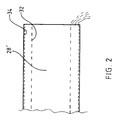
- a two-stage screening portion 28' consisting of two perforated drums 32 and 34, one within the other, the inner drum 32 of which is provided with larger openings (7-10 mm) for separating the largest contaminant particles, whereas the outer drum 34 is provided with the actual screening openings (4-6 mm) for withdrawing the accept.
- the accepted pulp is discharged through the perforated drum to a vessel 40 preferably having a mixer 42 for keeping the pulp moving and preventing the pulp from settling down on the bottom of the vessel.
- Dilution liquid can additionally be mixed into the pulp with the mixer, if needed.
- the pulp is discharged from the vessel by a pump 44, preferably a degassing centrifugal pump. Connecting such a pump to the process according to the invention will further optimize the above-described process and contribute to the total economy thereof. At least some gas will in any case be mixed with the pulp during the repulping, while it is known that gas is disadvantageous to subsequent pulp treatment stages.
- An apparatus operates so that the secondary material to be defibrized is firstly conveyed to the pulper vessel 8 by conveyor 2, the pulper vessel being separated from the defibrizing drum 6 by a valve 16.
- the consistency of the material is adjusted to the desired level, e.g. 12-18%, by feeding dilution liquid into the pulper via duct 12.
- the material is comminuted in the pulper by rotor 10.
- the rotor is rotated for, e.g., 8-15 minutes at 140-160 rpm, depending on the material to be defibrized.
- the material initially comminuted by the HC-pulper is periodically discharged unscreened to the defibrizing drum 6 by opening the valve 16, thus enabling the material to flow under gravity to the further comminuting/homogenizing portion 22. It is also possible, if the operation and the construction of the HC-pulper are optimized to the limit, to continuously discharge the HC-pulper by keeping the valve fully open or partly throttled. Liquid is introduced either into outlet 14 or to the further comminuting zone of the defibrizing drum for diluting the consistency of the initially comminuted material to about 8-12% prior to further treatment, a consistency suitable for the screening portion.
- the material is treated in the further comminuting zone of the drum as long as necessary to achieve the desired defibrizing efficiency.
- the pulp is thereafter allowed to be discharged into the screening portion, where the pulp is further diluted.
- the accepts fraction is separated from the pulp through the drum openings at a consistency of about 3-4%, while the rest of the material is discharged through the second end of the drum.
- the accepts fraction is withdrawn for further processing by a degassing centrifugal pump, thus eliminating the disadvantages caused by gas in further processing.
Landscapes
- Engineering & Computer Science (AREA)
- Life Sciences & Earth Sciences (AREA)
- Wood Science & Technology (AREA)
- Mechanical Engineering (AREA)
- Paper (AREA)
Claims (15)
- Verfahren zur Behandlung von Altpapier und -pappe, insbesondere von Material das schwer zu zerkleinern ist, wie verschiedenen Verpackungen und Umschlägen, Wellpappen, polyäthylenbeschichteten Fabriksumschlägen, anderen kunststoffbeschichteten Pappen, Tetrapak-Verpackungen und anderen schwer zu behandelnden mehrlagigen Papieren, durch Vorzerkleinerung des zu behandelnden Materials auf solche Weise, daß das Fasermaterial von den Kunststoffen, Metallfolienpapieren und anderem Spuckstoff abgeschieden wird, welches Verfahren ferner durch die folgenden Schritte gekennzeichnet ist:- Weiterzerkleinerung des Materials auf solche Weise, daß das faserhaltige Material in solchem Maße zerfasert wird, daß es sortiert werden kann, und- Sortieren des Materials.
- Verfahren gemäß Anspruch 1, gekennzeichnet durch die folgenden Behandlungsschritte- Einführung des zu zerfasernden Materials in einen HC-Pulper,- Einführung von Verdünnungsflüssigkeit in den Pulper,- Durchführung der Vorzerkleinerung im HC-Pulper,- Ableitung des unsortierten vorzerkleinerten Materials für Weiterbehandlung in die Zerfaserungstrommel,- Verdünnung der Konsistenz des Materials so, daß sie für die Weiterzerkleinerung geeignet ist,- Weiterzerkleinerung des Materials in einer weiteren Zerkleinerungszone der Zerfaserungstrommel,- Homogenisierung der Konsistenz des Materials in der Weiterzerkleinerungszone,- Ableitung des Materials in die Siebzone,- Abscheidung des akzeptierten Fasermaterials zum Gutstoff, und- Austragung des Spuckstoffs aus der Zerfaserungstrommel.
- Verfahren gemäß Anspruch 2, gekennzeichnet durch den Schritt der Abscheidung von Gas aus dem Gutstoff mit einer entgasenden Pumpe.
- Verfahren gemäß Anspruch 2, gekennzeichnet durch den Schritt der Verdünnung des Materials im HC-Pulper auf eine Konsistenz von 12 bis 18 %.
- Verfahren gemäß Anspruch 2, gekennzeichnet durch den Schritt der Verdünnung des Materials in der Zerfaserungstrommel auf eine Konsistenz zwischen 8 und 12 %.
- Verfahren gemäß Anspruch 2, dadurch gekennzeichnet, daß die Dauer der Vorzerkleinerung ungefähr 8 bis 15 Minuten ist.
- Verfahren gemäß Anspruch 2, gekennzeichnet durch den Schritt der Durchführung der Sortierung in zwei Stufen.
- Verfahren gemäß Anspruch 2, gekennzeichnet durch den Schritt der Abführung des vorzerkleinerten Materials als kontinuierlicher Strom in die Zerfaserungstrommel.
- Vorrichtung zur Behandlung von Altpapier und -pappe, insbesondere schwer zu zerfaserndem Material, wie Tetrapak oder ähnlichen polyäthylenbeschichteten Umschlagspapieren, welche Vorrichtung einen Vorzerkleinerer (4) oder einen sog. HC-Pulper, Material-Eingabemittel (2) in den HC-Pulper, und Material-Austragsmittel (14) aus dem HC-Pulper umfaßt, und ferner dadurch gekennzeichnet ist, daß sie- eine Zerfaserungstrommel (6) mit einem Weiterzerkleinerungsabschnitt (22) und einem darin angeordneten getrennten Siebabschnitt (28, 28'), und- Austragsmittel (40, 44) für Gut- und Spuckstoff umfaßt.
- Vorrichtung gemäß Anspruch 9, dadurch gekennzeichnet, daß es sich bei den Material-Austragsmitteln (14) um ein mit einem Winkel von 35 bis 60° angeordneten Rohr mit einem daran angeordneten Ventil (16) handelt.
- Vorrichtung gemäß Anspruch 9, dadurch gekennzeichnet, daß der Weiterzerkleinerungsabschnitt (22) der Zerfaserungstrommel (6) nichtperforiert und zur Verbesserung der Homogenisierung der Pulpe mit hauptsächlich axialen Rippen (24) und Prallblechen (30) versehen ist, welche Rippen und Prallbleche sich beide auf der Innenseite der Trommel (6) befinden.
- Vorrichtung gemäß Anspruch 9, dadurch gekennzeichnet, daß die Länge der Weiterzerkleinerungszone (22) der Zerfaserungstrommel (6) zumindest dem Durchmesser der Trommel (6) entspricht.
- Vorrichtung gemäß Anspruch 9, dadurch gekennzeichnet, daß der Siebabschnitt (28') der Trommel zwei ineinander angeordnete perforierte Trommeln (32, 34) aufweist.
- Vorrichtung gemäß Anspruch 9, dadurch gekennzeichnet, daß es innerhalb der Trommel (6) eine Trennwand (20) gibt, die zwischen Weiterzerkleinerungszone (22) und Siebabschnitt (28, 28') angeordnet ist, welche Trennwand mit einer Öffnung (26 und einer Förderschaufel oder dergleichen versehen ist zur Austragung des Materials aus der Weiterzerkleinerungszone (22) zum Siebabschnitt (28, 28').
- Vorrichtung gemäß Anspruch 9, dadurch gekennzeichnet, daß es sich bei den Gutstoff-Austragsmitteln um einen unterhalb des Siebabschnitts (28, 28') angeordneten Behälter (40) mit einer damit verbundenen entgasenden Kreiselpumpe (44) handelt.
Applications Claiming Priority (3)
| Application Number | Priority Date | Filing Date | Title |
|---|---|---|---|
| FI912745A FI92338C (fi) | 1991-06-07 | 1991-06-07 | Menetelmä ja laitteisto keräyspaperin käsittelemiseksi |
| FI912745 | 1991-06-07 | ||
| PCT/FI1992/000172 WO1992021812A1 (en) | 1991-06-07 | 1992-06-01 | A method of and an apparatus for treating waste paper |
Publications (2)
| Publication Number | Publication Date |
|---|---|
| EP0591475A1 EP0591475A1 (de) | 1994-04-13 |
| EP0591475B1 true EP0591475B1 (de) | 1995-12-20 |
Family
ID=8532664
Family Applications (1)
| Application Number | Title | Priority Date | Filing Date |
|---|---|---|---|
| EP19920924474 Expired - Lifetime EP0591475B1 (de) | 1991-06-07 | 1992-06-01 | Verfahren und vorrichtung zum behandeln von abfallpapier |
Country Status (9)
| Country | Link |
|---|---|
| EP (1) | EP0591475B1 (de) |
| AT (1) | ATE131885T1 (de) |
| AU (1) | AU1878992A (de) |
| CA (1) | CA2112806A1 (de) |
| DE (1) | DE69206990T2 (de) |
| FI (1) | FI92338C (de) |
| MX (1) | MX9202671A (de) |
| WO (1) | WO1992021812A1 (de) |
| ZA (1) | ZA923740B (de) |
Families Citing this family (4)
| Publication number | Priority date | Publication date | Assignee | Title |
|---|---|---|---|---|
| AT512395B1 (de) * | 2012-04-24 | 2013-08-15 | Andritz Ag Maschf | Verfahren zur Auflösung von Faserstoffen |
| CN103510415B (zh) * | 2012-06-20 | 2018-02-16 | 安德里特斯公开股份有限公司 | 用于分解纤维材料的方法 |
| FI126609B (en) * | 2013-11-15 | 2017-03-15 | Valmet Technologies Inc | Drum Drum Powder and Drum Powder |
| CN113249998B (zh) * | 2021-06-04 | 2023-06-16 | 安德里茨(中国)有限公司 | 废纸制浆系统 |
Family Cites Families (2)
| Publication number | Priority date | Publication date | Assignee | Title |
|---|---|---|---|---|
| DE2941898A1 (de) * | 1979-10-17 | 1981-04-30 | Hermann Finckh, Maschinenfabrik GmbH & Co, 7417 Pfullingen | Verfahren und einrichtung zum aufbereiten von altpapier |
| DE3225538C1 (de) * | 1982-07-08 | 1983-12-22 | J.M. Voith Gmbh, 7920 Heidenheim | Pufferbehälter für die Altpapieraufbereitung |
-
1991
- 1991-06-07 FI FI912745A patent/FI92338C/fi not_active IP Right Cessation
-
1992
- 1992-05-22 ZA ZA923740A patent/ZA923740B/xx unknown
- 1992-06-01 WO PCT/FI1992/000172 patent/WO1992021812A1/en not_active Ceased
- 1992-06-01 EP EP19920924474 patent/EP0591475B1/de not_active Expired - Lifetime
- 1992-06-01 AT AT92924474T patent/ATE131885T1/de not_active IP Right Cessation
- 1992-06-01 CA CA 2112806 patent/CA2112806A1/en not_active Abandoned
- 1992-06-01 DE DE69206990T patent/DE69206990T2/de not_active Expired - Fee Related
- 1992-06-01 AU AU18789/92A patent/AU1878992A/en not_active Abandoned
- 1992-06-04 MX MX9202671A patent/MX9202671A/es not_active IP Right Cessation
Also Published As
| Publication number | Publication date |
|---|---|
| WO1992021812A1 (en) | 1992-12-10 |
| MX9202671A (es) | 1993-02-01 |
| EP0591475A1 (de) | 1994-04-13 |
| FI92338C (fi) | 1994-10-25 |
| ZA923740B (en) | 1993-01-27 |
| DE69206990D1 (de) | 1996-02-01 |
| DE69206990T2 (de) | 1996-05-30 |
| FI92338B (fi) | 1994-07-15 |
| ATE131885T1 (de) | 1996-01-15 |
| FI912745A0 (fi) | 1991-06-07 |
| FI912745A7 (fi) | 1992-12-08 |
| CA2112806A1 (en) | 1992-12-10 |
| AU1878992A (en) | 1993-01-08 |
Similar Documents
| Publication | Publication Date | Title |
|---|---|---|
| US6458240B1 (en) | Method for removing contaminants from fibers in recycle fiber pulping | |
| FI105112B (fi) | Menetelmä ja laite kuitupitoisen materiaalin kuiduttamiseksi | |
| KR100244421B1 (ko) | 티슈-급 종이 섬유를 만드는 폐지의 일관 펄프화 방법 | |
| US5334285A (en) | Process for the treatment of wastepaper using drum soaker | |
| US5324389A (en) | Waste paper disintegration, classification and pulping system | |
| US6120648A (en) | Apparatus for pulping and deinking | |
| US4619736A (en) | Apparatus for defiberizing, screening and pumping cellulose pulp or recycled paper | |
| JPH11222789A (ja) | 古紙パルプの選別方法及び装置 | |
| EP0591475B1 (de) | Verfahren und vorrichtung zum behandeln von abfallpapier | |
| EP1101858B1 (de) | Stoffauflöser für eine Stoffaufbereitungsanlage und Verfahren zur Stoffauflösung | |
| US6083350A (en) | System for treatment of waste paper having a pulping drum and a perforated sorting area | |
| US6391151B2 (en) | Process for dissolving used paper | |
| CN1289752C (zh) | 从回收纤维材料中分离着色剂的方法 | |
| US6544385B2 (en) | Channel pulper | |
| US7163604B2 (en) | Production of fiber suspension from waste paper | |
| US5227021A (en) | Method for producing pulp using medium consistency mixer for defiberizing pulp | |
| CN107787384B (zh) | 对纤维材料进行分离纤维的方法和布置结构及分离纤维滚筒的用途 | |
| Holik et al. | Stock preparation | |
| JPH04163385A (ja) | ラミネート故紙処理方法 | |
| WO1996016222A1 (en) | Methods for pulping and deinking | |
| JPH0143439Y2 (de) | ||
| JPH06192982A (ja) | 製紙用離解兼除塵装置 |
Legal Events
| Date | Code | Title | Description |
|---|---|---|---|
| PUAI | Public reference made under article 153(3) epc to a published international application that has entered the european phase |
Free format text: ORIGINAL CODE: 0009012 |
|
| 17P | Request for examination filed |
Effective date: 19931210 |
|
| AK | Designated contracting states |
Kind code of ref document: A1 Designated state(s): AT DE FR SE |
|
| 17Q | First examination report despatched |
Effective date: 19950210 |
|
| GRAA | (expected) grant |
Free format text: ORIGINAL CODE: 0009210 |
|
| AK | Designated contracting states |
Kind code of ref document: B1 Designated state(s): AT DE FR SE |
|
| REF | Corresponds to: |
Ref document number: 131885 Country of ref document: AT Date of ref document: 19960115 Kind code of ref document: T |
|
| REF | Corresponds to: |
Ref document number: 69206990 Country of ref document: DE Date of ref document: 19960201 |
|
| ET | Fr: translation filed | ||
| PLBE | No opposition filed within time limit |
Free format text: ORIGINAL CODE: 0009261 |
|
| STAA | Information on the status of an ep patent application or granted ep patent |
Free format text: STATUS: NO OPPOSITION FILED WITHIN TIME LIMIT |
|
| 26N | No opposition filed | ||
| PGFP | Annual fee paid to national office [announced via postgrant information from national office to epo] |
Ref country code: AT Payment date: 20010510 Year of fee payment: 10 |
|
| PGFP | Annual fee paid to national office [announced via postgrant information from national office to epo] |
Ref country code: SE Payment date: 20010517 Year of fee payment: 10 |
|
| PG25 | Lapsed in a contracting state [announced via postgrant information from national office to epo] |
Ref country code: AT Free format text: LAPSE BECAUSE OF NON-PAYMENT OF DUE FEES Effective date: 20020601 |
|
| PG25 | Lapsed in a contracting state [announced via postgrant information from national office to epo] |
Ref country code: SE Free format text: LAPSE BECAUSE OF NON-PAYMENT OF DUE FEES Effective date: 20020602 |
|
| EUG | Se: european patent has lapsed | ||
| PGFP | Annual fee paid to national office [announced via postgrant information from national office to epo] |
Ref country code: FR Payment date: 20050512 Year of fee payment: 14 |
|
| PGFP | Annual fee paid to national office [announced via postgrant information from national office to epo] |
Ref country code: DE Payment date: 20050520 Year of fee payment: 14 |
|
| PG25 | Lapsed in a contracting state [announced via postgrant information from national office to epo] |
Ref country code: DE Free format text: LAPSE BECAUSE OF NON-PAYMENT OF DUE FEES Effective date: 20070103 |
|
| REG | Reference to a national code |
Ref country code: FR Ref legal event code: ST Effective date: 20070228 |
|
| PG25 | Lapsed in a contracting state [announced via postgrant information from national office to epo] |
Ref country code: FR Free format text: LAPSE BECAUSE OF NON-PAYMENT OF DUE FEES Effective date: 20060630 |