EP0591608A2 - Production method of T-shaped gate electrode in semiconductor device - Google Patents
Production method of T-shaped gate electrode in semiconductor device Download PDFInfo
- Publication number
- EP0591608A2 EP0591608A2 EP93104467A EP93104467A EP0591608A2 EP 0591608 A2 EP0591608 A2 EP 0591608A2 EP 93104467 A EP93104467 A EP 93104467A EP 93104467 A EP93104467 A EP 93104467A EP 0591608 A2 EP0591608 A2 EP 0591608A2
- Authority
- EP
- European Patent Office
- Prior art keywords
- film
- photoresist
- gate electrode
- aperture
- shaped gate
- Prior art date
- Legal status (The legal status is an assumption and is not a legal conclusion. Google has not performed a legal analysis and makes no representation as to the accuracy of the status listed.)
- Withdrawn
Links
Images
Classifications
-
- H—ELECTRICITY
- H10—SEMICONDUCTOR DEVICES; ELECTRIC SOLID-STATE DEVICES NOT OTHERWISE PROVIDED FOR
- H10D—INORGANIC ELECTRIC SEMICONDUCTOR DEVICES
- H10D30/00—Field-effect transistors [FET]
- H10D30/01—Manufacture or treatment
- H10D30/061—Manufacture or treatment of FETs having Schottky gates
- H10D30/0612—Manufacture or treatment of FETs having Schottky gates of lateral single-gate Schottky FETs
-
- H—ELECTRICITY
- H10—SEMICONDUCTOR DEVICES; ELECTRIC SOLID-STATE DEVICES NOT OTHERWISE PROVIDED FOR
- H10D—INORGANIC ELECTRIC SEMICONDUCTOR DEVICES
- H10D64/00—Electrodes of devices having potential barriers
- H10D64/01—Manufacture or treatment
- H10D64/012—Manufacture or treatment of electrodes comprising a Schottky barrier to a semiconductor
- H10D64/0124—Manufacture or treatment of electrodes comprising a Schottky barrier to a semiconductor to Group III-V semiconductors
- H10D64/0125—Manufacture or treatment of electrodes comprising a Schottky barrier to a semiconductor to Group III-V semiconductors characterised by the sectional shape, e.g. T or inverted T
-
- H—ELECTRICITY
- H10—SEMICONDUCTOR DEVICES; ELECTRIC SOLID-STATE DEVICES NOT OTHERWISE PROVIDED FOR
- H10D—INORGANIC ELECTRIC SEMICONDUCTOR DEVICES
- H10D64/00—Electrodes of devices having potential barriers
- H10D64/01—Manufacture or treatment
- H10D64/012—Manufacture or treatment of electrodes comprising a Schottky barrier to a semiconductor
- H10D64/0124—Manufacture or treatment of electrodes comprising a Schottky barrier to a semiconductor to Group III-V semiconductors
- H10D64/0125—Manufacture or treatment of electrodes comprising a Schottky barrier to a semiconductor to Group III-V semiconductors characterised by the sectional shape, e.g. T or inverted T
- H10D64/0126—Manufacture or treatment of electrodes comprising a Schottky barrier to a semiconductor to Group III-V semiconductors characterised by the sectional shape, e.g. T or inverted T the sectional shape being asymmetrical
-
- Y—GENERAL TAGGING OF NEW TECHNOLOGICAL DEVELOPMENTS; GENERAL TAGGING OF CROSS-SECTIONAL TECHNOLOGIES SPANNING OVER SEVERAL SECTIONS OF THE IPC; TECHNICAL SUBJECTS COVERED BY FORMER USPC CROSS-REFERENCE ART COLLECTIONS [XRACs] AND DIGESTS
- Y10—TECHNICAL SUBJECTS COVERED BY FORMER USPC
- Y10S—TECHNICAL SUBJECTS COVERED BY FORMER USPC CROSS-REFERENCE ART COLLECTIONS [XRACs] AND DIGESTS
- Y10S438/00—Semiconductor device manufacturing: process
- Y10S438/942—Masking
- Y10S438/948—Radiation resist
- Y10S438/95—Multilayer mask including nonradiation sensitive layer
-
- Y—GENERAL TAGGING OF NEW TECHNOLOGICAL DEVELOPMENTS; GENERAL TAGGING OF CROSS-SECTIONAL TECHNOLOGIES SPANNING OVER SEVERAL SECTIONS OF THE IPC; TECHNICAL SUBJECTS COVERED BY FORMER USPC CROSS-REFERENCE ART COLLECTIONS [XRACs] AND DIGESTS
- Y10—TECHNICAL SUBJECTS COVERED BY FORMER USPC
- Y10S—TECHNICAL SUBJECTS COVERED BY FORMER USPC CROSS-REFERENCE ART COLLECTIONS [XRACs] AND DIGESTS
- Y10S438/00—Semiconductor device manufacturing: process
- Y10S438/942—Masking
- Y10S438/948—Radiation resist
- Y10S438/951—Lift-off
Definitions
- the present invention relates to a production method of a T-shaped gate electrode in a semiconductor device of which gate length is shortened.
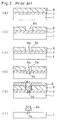
- Figures 2(a) to 2(f) are cross sections illustrating process steps in a method of a T-shaped gate electrode of a prior art semiconductor device.
- reference numeral 1 designates a compound semiconductor substrate
- numeral 1a designates a recess
- numeral 2 designates an insulating film
- numeral 6 designates a gate metal
- numeral 6a designates a T-shaped gate electrode
- numeral 7 designates a photoresist film for electron beam exposure
- numeral 8 designates a photoresist film for optical exposure
- numerals 7a and 8a designate apertures.
- a photoresist for electron beam exposure 7 is successively deposited on a photoresist for optical exposure 8.
- the photoresist for electron beam exposure and the photoresist for optical exposure must not be mixed with each other, namely, resin of the electron beam photoresist must not be dissolved by solvent of the optical photoresist. Therefore, photoresists comprising resin and solvent satisfying the above-described condition, are selected as the electron beam photoresist and the optical photoresist.
- a first aperture 8a of a relatively large width is formed in the optical photoresist film 8.
- a second aperture 7a of a relatively small width is formed.
- a recess 1a is formed by etching the compound semiconductor substrate 1.
- a gate metal 6 is deposited on the whole surface of the substrate and lift off is conducted to form a T-shaped gate electrode 6a as illustrated in Figure 2(f).
- the photoresist aperture pattern for prescribing lower part electrode width of the T-shape gate electrode is produced.
- this pattern exposure method employing electron beam irradiation in drawing patterns, it is difficult to enhance throughput in manufacturing semiconductor devices.
- the photoresist aperture pattern for prescribing an upper part electrode width of the T-shaped gate electrode is produced, namely, when the optical photoresist film 8 is developed, it is necessary that the electron beam photoresist film 7 below the photoresist film 8 is not developed by the developer of the film 8.
- the photoresist film 8 is deposited on the photoresist film 7, these films are required not to mix with each other. Therefore, the degree of freedom in selecting materials of photoresist is unfavorably restricted to a great extent.
- the resolution limit is at most 0.2 to 0.25 microns and the gate length is not shortened below such length.
- a gate length is controlled just by adjusting the thickness of the metal film in depositing the metal film, resulting in shortening the gate length easily and efficiently.
- the metal film is easily formed so that its thickness is below 0.2 microns, the gate length is shortened to below 0.2 microns.
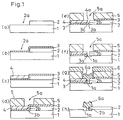
- Figures 1(a) to 1(h) are cross sections illustrating process steps in a method for producing a T-shaped gate electrode in accordance with an embodiment of the present invention.
- Figures 2(a) to 2(f) are cross sections illustrating process steps in a method for producing a prior art T-shaped gate electrode.
- Figures 1(a) to 1(h) are cross sections illustrating process steps in a method for producing a T-shaped gate electrode in accordance with an embodiment of the present invention.
- the same reference numerals as those of Figures 2(a) to 2(f) designate the same or corresponding parts.
- Reference numeral 2 designates an insulating film
- numeral 2a designates an aperture
- numeral 2b designates a sidewall of the insulating film
- numeral 3 designates a WSi (tungsten silicide) film
- numeral 3a designates an aperture
- numeral 3b a WSi film formed along the sidewall 2b of the insulating film
- numeral 3c designates a sidewall of the WSi film 3
- numeral 4 designates a photoresist film
- numeral 4a designates a sidewall of the photoresist film
- numeral 5 designates a photoresist aperture pattern
- numeral 5a designates an aperture.
- an insulating film 2 for example, comprising SiO2 about 5000 ⁇ thick is deposited on the compound semiconductor substrate 1 comprising GaAs or InP with plasma CVD method or the like. And, by etching a prescribed portion of the insulating film 2, an aperture 2a is produced so that its end is disposed in a region where the gate electrode would be produced.
- a WSi film 3 is deposited on the entire surface of the wafer by spattering or CVD method so that its thickness is a little under 0.2 microns.
- a photoresist aperture pattern 5 providing an aperture 5a of a thickness of approximately 1 micron is produced so that a central portion of the aperture 5a for prescribing an upper electrode width of the T-shaped gate electrode which would be formed in a later process, is disposed on a WSi film 3b formed on the sidewall of the aperture 2a, namely, a sidewall 2b of the insulating film 2.
- the recess 1a is formed.
- a gate metal 6 formed by laminating a gold layer on a titanium layer or the like, on the entire surface of the wafer, a T-shaped gate electrode 6a is formed on the bottom surface of the recess 1a. Then, the unnecessary gate metal 6, the photoresist aperture pattern 5 and the photoresist film 4 is removed by lift off.
- the width of the aperture 3a of a mask prescribing the gate length depends on the thickness of the WSi film 3 disposed along the sidewall 2a of the insulating film 2 on the compound semiconductor substrate 1, which becomes a sidewall of the aperture 3a of the mask. Therefore, when the WSi film 3 is deposited on the entire surface of the wafer, just controlling its thickness enables the gate length to be shortened easily. In addition, since the thickness of the WSi film 3 obtained by deposition is reduced to below 0.2 microns, the gate length is shortened to under 0.2 microns.
- the photoresist aperture pattern 5 is formed in a conventional photolithography technique, namely, a photolithography technique including pattern exposure process employing an optical exposure apparatus, and the photoresist film 4 is just employed for a mask in etching the WSi film 3, even if photoresists comprising materials which causes mixing with each other are employed as the photoresists constituting the photoresist film 4 and the photoresist aperture pattern 5, these photoresists do not give bad influences to controllability of forming the electrode. As a result, the degree of freedom in selecting materials of photoresist is enhanced and process steps of producing a gate electrode having little restriction of selection of materials are obtained.
- WSi film 3 is deposited as a metal film, a film comprising other refractory metal can be employed with the same effects as described above.
Landscapes
- Junction Field-Effect Transistors (AREA)
- Electrodes Of Semiconductors (AREA)
Abstract
A method for producing a T-shaped gate electrode of a semiconductor device includes, forming an insulating film (2) on a semiconductor substrate (1) and forming an aperture (2a), depositing a metal thin film (3), forming a first photoresist film on the entire surface of a wafer and removing a portion of the photoresist film excepting the other portion of photoresist film (4) which remains in the aperture (2a) by etchback, forming a second photoresist film on the entire surface of the wafer, patterning the second photoresist film and forming a photoresist aperture pattern (5) of which central portion of an aperture (5a) is disposed on a metal film (3b) formed along a sidewall (2b) of the insulating film (2), etching away a portion of the metal film (3) over an end of the insulating film (2), using the photoresist film (4) and the photoresist aperture pattern (5) as a mask, depositing a gate metal (6) on the entire surface of the wafer and removing the first photoresist film (4), the photoresist aperture pattern (5) and the gate metal (6) deposited on the photoresist aperture pattern (5) by lift off, and forming a T-shaped gate electrode (6a) by etching away metal films (3) remaining on the semiconductor substrate (1) and the insulating film (2). Therefore, the T-shaped gate electrode of which gate length is shortened is produced.
Description
- The present invention relates to a production method of a T-shaped gate electrode in a semiconductor device of which gate length is shortened.
- Figures 2(a) to 2(f) are cross sections illustrating process steps in a method of a T-shaped gate electrode of a prior art semiconductor device. In the figures,
reference numeral 1 designates a compound semiconductor substrate,numeral 1a designates a recess,numeral 2 designates an insulating film,numeral 6 designates a gate metal,numeral 6a designates a T-shaped gate electrode,numeral 7 designates a photoresist film for electron beam exposure,numeral 8 designates a photoresist film for optical exposure andnumerals - A description is given of process steps of a T-shaped gate electrode with reference to Figures 2(a) to 2(f).
- First, as illustrated in Figure 2(a), a photoresist for
electron beam exposure 7 is successively deposited on a photoresist foroptical exposure 8. During the deposition, the photoresist for electron beam exposure and the photoresist for optical exposure must not be mixed with each other, namely, resin of the electron beam photoresist must not be dissolved by solvent of the optical photoresist. Therefore, photoresists comprising resin and solvent satisfying the above-described condition, are selected as the electron beam photoresist and the optical photoresist. Secondly, by projecting a predetermined exposure pattern on thephotoresist film 8 from an optical exposure apparatus and developing the film by a prescribed developer, as illustrated in Figure 2(b), afirst aperture 8a of a relatively large width is formed in the opticalphotoresist film 8. Thirdly, by irradiating electron beam to a prescribed portion of the electronbeam photoresist film 7 from an electron beam exposure apparatus through thisfirst aperture 8a, and developing the film by a prescribed developer, as illustrated in Figure 2(c), asecond aperture 7a of a relatively small width is formed. Next, as illustrated in Figure 2(d), using thephotoresist films first aperture 8a and thesecond aperture 7a are respectively formed as a mask, arecess 1a is formed by etching thecompound semiconductor substrate 1. Then, as illustrated in Figure 2(e), agate metal 6 is deposited on the whole surface of the substrate and lift off is conducted to form a T-shaped gate electrode 6a as illustrated in Figure 2(f). - As described above, in process steps in a method of the prior art T-shaped gate electrode, by irradiating electron beam to the electron
beam photoresist film 7 from the electron beam exposure apparatus, and developing the film, the photoresist aperture pattern for prescribing lower part electrode width of the T-shape gate electrode (gate length) is produced. In this pattern exposure method employing electron beam irradiation, in drawing patterns, it is difficult to enhance throughput in manufacturing semiconductor devices. - Further, in the prior art process, in order to produce the T-shaped gate electrode with improved precision and stability, when the photoresist aperture pattern for prescribing an upper part electrode width of the T-shaped gate electrode is produced, namely, when the optical
photoresist film 8 is developed, it is necessary that the electronbeam photoresist film 7 below thephotoresist film 8 is not developed by the developer of thefilm 8. In addition, as described above, when thephotoresist film 8 is deposited on thephotoresist film 7, these films are required not to mix with each other. Therefore, the degree of freedom in selecting materials of photoresist is unfavorably restricted to a great extent. - In addition, in the pattern exposure method with electron beam irradiation, i.e., direct drawing method, at present, the resolution limit is at most 0.2 to 0.25 microns and the gate length is not shortened below such length.
- It is an object of the present invention to provide a production method of a T-shaped gate electrode in which its gate length is shortened efficiently without employing a direct drawing method such as electron beam exposure and the degree of freedom in selecting materials of photoresist is increased.
- It is another object of the present invention to provide a production method that can produces efficiently a T-shaped gate electrode which gate length is shortened to below 0.2 microns.
- Other objects and advantages of the present invention will become apparent from the detailed description given hereinafter; it should be understood, however, that the detailed description and specific embodiment are given by way of illustration only, since various changes and modifications within the spirit and scope of the invention will become apparent to the those skilled in the art from this detailed description.
- In a method producing a T-shaped gate electrode of semiconductor device in accordance with the present invention, after forming an insulating film of which sidewall becomes a sidewall of an aperture of a mask prescribing a lower part electrode width of the T-shaped gate electrode (gate length) when a gate metal is deposited, and depositing a metal film along the sidewall of the insulating film, an aperture of the mask is obtained by etching away this metal film. Therefore, a gate length is controlled just by adjusting the thickness of the metal film in depositing the metal film, resulting in shortening the gate length easily and efficiently. In addition, since the metal film is easily formed so that its thickness is below 0.2 microns, the gate length is shortened to below 0.2 microns. Further, since pattern production by electron beam irradiation is not required dissimilarly to the prior art device, throughput in manufacturing semiconductor devices is enhanced. Since there is no necessity to laminate an electron beam photoresist and an optical photoresist, the degree of freedom in selecting materials of photoresist is increased.
- Figures 1(a) to 1(h) are cross sections illustrating process steps in a method for producing a T-shaped gate electrode in accordance with an embodiment of the present invention.
- Figures 2(a) to 2(f) are cross sections illustrating process steps in a method for producing a prior art T-shaped gate electrode.
- An embodiment of the present invention will be described in detail with reference to the drawing.
- Figures 1(a) to 1(h) are cross sections illustrating process steps in a method for producing a T-shaped gate electrode in accordance with an embodiment of the present invention. In the figures, the same reference numerals as those of Figures 2(a) to 2(f) designate the same or corresponding parts.
Reference numeral 2 designates an insulating film,numeral 2a designates an aperture,numeral 2b designates a sidewall of theinsulating film 2,numeral 3 designates a WSi (tungsten silicide) film,numeral 3a designates an aperture,numeral 3b a WSi film formed along thesidewall 2b of theinsulating film 2,numeral 3c designates a sidewall of theWSi film 3,numeral 4 designates a photoresist film,numeral 4a designates a sidewall of thephotoresist film 4,numeral 5 designates a photoresist aperture pattern andnumeral 5a designates an aperture. - A description is given of process steps of a T-shaped gate electrode with reference to Figures 1(a) to 1(h).
- First, as illustrated in Figure 1(a), an
insulating film 2, for example, comprising SiO₂ about 5000Å thick is deposited on thecompound semiconductor substrate 1 comprising GaAs or InP with plasma CVD method or the like. And, by etching a prescribed portion of theinsulating film 2, anaperture 2a is produced so that its end is disposed in a region where the gate electrode would be produced. Secondly, as illustrate in Figure 1(b), aWSi film 3 is deposited on the entire surface of the wafer by spattering or CVD method so that its thickness is a little under 0.2 microns. Thirdly, after forming a photoresist film with theaperture 2a buried by applying photoresist on the entire surface of the wafer, as illustrate in Figure 1(c), only aphotoresist film 4 buried in theaperture 2a remains by etchback with employing O₂ plasma reactive ion etching. Next, as illustrated in Figure 1(d), by a conventional photolithography technique, namely, a photolithography technique including pattern exposure process employing an optical exposure apparatus, aphotoresist aperture pattern 5 providing anaperture 5a of a thickness of approximately 1 micron is produced so that a central portion of theaperture 5a for prescribing an upper electrode width of the T-shaped gate electrode which would be formed in a later process, is disposed on aWSi film 3b formed on the sidewall of theaperture 2a, namely, asidewall 2b of theinsulating film 2. Then, as illustrated in Figure 1(e), with using thephotoresist aperture pattern 5 and thephotoresist film 4 as a mask, etching away the WSi film 3 (3b) until the surface of thecompound semiconductor substrate 1 is exposed, by plasma etching employing mixed gas of CF₄ (tetrafluoromethane) and O₂, anaperture 3a is produced, which prescribes a lower electrode width of the T-shaped gate electrode formed in a later process, namely, a gate length, by thesidewall 2b of theinsulating film 2, asidewall 4a of thephotoresist film 4 and asidewall 3c of theWSi film 3 which remains under thephotoresist film 4, not being etched. Further, as illustrated in Figure 1(f), by recess-etching thecompound semiconductor substrate 1 using thephotoresist film 4 and theinsulating film 2 exposed in the above-described process as a mask, therecess 1a is formed. Next, as illustrated in Figure 1(g), by depositing agate metal 6 formed by laminating a gold layer on a titanium layer or the like, on the entire surface of the wafer, a T-shaped gate electrode 6a is formed on the bottom surface of therecess 1a. Then, theunnecessary gate metal 6, thephotoresist aperture pattern 5 and thephotoresist film 4 is removed by lift off. Next, by removing theremaining WSi film 3 by reactive ion etching employing mixed gas of CF₄ and O₂ or mixed gas of CH₂F₂ (difluoromethane) and SF₆ (hexafluorosulfur), as illustrated in Figure 1(g), a gate electrode structure is obtained where the T-shaped gate electrode 6a of which gate length is shortened below 0.2 microns is formed on therecess 1a of thecompound semiconductor substrate 1. - In this process steps of the embodiment, when forming the T-
shaped gate electrode 6a by depositing thegate metal 6, the width of theaperture 3a of a mask prescribing the gate length depends on the thickness of theWSi film 3 disposed along thesidewall 2a of theinsulating film 2 on thecompound semiconductor substrate 1, which becomes a sidewall of theaperture 3a of the mask. Therefore, when theWSi film 3 is deposited on the entire surface of the wafer, just controlling its thickness enables the gate length to be shortened easily. In addition, since the thickness of theWSi film 3 obtained by deposition is reduced to below 0.2 microns, the gate length is shortened to under 0.2 microns. Further, in this process, since such pattern exposure process with electron beam irradiation is not required dissimilarly to the prior art device, throughput in manufacturing semiconductor devices is enhanced in comparison with the prior art device. Further, in this process, since thephotoresist aperture pattern 5 is formed in a conventional photolithography technique, namely, a photolithography technique including pattern exposure process employing an optical exposure apparatus, and thephotoresist film 4 is just employed for a mask in etching theWSi film 3, even if photoresists comprising materials which causes mixing with each other are employed as the photoresists constituting thephotoresist film 4 and thephotoresist aperture pattern 5, these photoresists do not give bad influences to controllability of forming the electrode. As a result, the degree of freedom in selecting materials of photoresist is enhanced and process steps of producing a gate electrode having little restriction of selection of materials are obtained. - While WSi
film 3 is deposited as a metal film, a film comprising other refractory metal can be employed with the same effects as described above.
Claims (6)
- A method for producing a T-shaped gate electrode of a semiconductor device comprising:
forming an insulating film (2) on a semiconductor substrate (1) and forming an aperture (2a) by etching away a prescribed region of said insulating film (2);
depositing a metal thin film (3) having a prescribed thickness on the whole surface of said semiconductor substrate (1);
forming a first photoresist film on the entire surface of a wafer and removing a portion of said photoresist film excepting the other portion of photoresist film (4) which remains in said aperture (2a) by etchback;
forming a second photoresist film on the entire surface of the wafer, patterning said second photoresist film and forming a photoresist aperture pattern (5) of which central portion of an aperture (5a) is disposed on a metal film (3b) formed along a sidewall (2b) of said insulating film (2);
etching away a portion of said metal film (3) over an end of said insulating film (2), using said photoresist film (4) and said photoresist aperture pattern (5) as a mask;
depositing a gate metal (6) on the entire surface of the wafer and removing said first photoresist film (4), said photoresist aperture pattern (5) and said gate metal (6) deposited on said photoresist aperture pattern (5) by lift off; and
forming a T-shaped gate electrode (6a) by etching away metal films (3) remaining on said semiconductor substrate (1) and said insulating film (2). - The method for producing the T-shaped gate electrode of the semiconductor device of Claim 1, wherein said metal thin film (3) has a thickness below 0.2 microns.
- The method for producing the T-shaped gate electrode of the semiconductor device of Claim 1, wherein said metal thin film (3) is a WSi (tungsten silicide) film deposited by spattering or CVD method.
- The method for producing the T-shaped gate electrode of the semiconductor device of Claim 2, wherein said metal thin film (3) is a WSi (tungsten silicide) film deposited by spattering or CVD method.
- The method for producing the T-shaped gate electrode of the semiconductor device of Claim 3, wherein said metal thin film (3) comprising WSi film is etched away by plasma etching with employing mixed gas of CF₄ (tetrafluoromethane) and O₂.
- The method for producing the T-shaped gate electrode of the semiconductor device of Claim 4, wherein said metal thin film (3) comprising WSi film is etched away by plasma etching with employing mixed gas of CF₄ (tetrafluoromethane) and O₂.
Applications Claiming Priority (2)
| Application Number | Priority Date | Filing Date | Title |
|---|---|---|---|
| JP28500692 | 1992-09-29 | ||
| JP285006/92 | 1992-09-29 |
Publications (2)
| Publication Number | Publication Date |
|---|---|
| EP0591608A2 true EP0591608A2 (en) | 1994-04-13 |
| EP0591608A3 EP0591608A3 (en) | 1995-01-25 |
Family
ID=17685932
Family Applications (1)
| Application Number | Title | Priority Date | Filing Date |
|---|---|---|---|
| EP93104467A Withdrawn EP0591608A3 (en) | 1992-09-29 | 1993-03-18 | Method of manufacturing a T-shaped door electrode in a semiconductor device. |
Country Status (2)
| Country | Link |
|---|---|
| US (1) | US5304511A (en) |
| EP (1) | EP0591608A3 (en) |
Cited By (3)
| Publication number | Priority date | Publication date | Assignee | Title |
|---|---|---|---|---|
| WO2002063671A3 (en) * | 2001-01-17 | 2002-10-10 | United Monolithic Semiconduct | Method for producing a semiconductor component comprising a t-shaped contact electrode |
| WO2003096399A1 (en) * | 2002-05-11 | 2003-11-20 | United Monolithic Semiconductors Gmbh | Method for producing a semiconductor component, and semiconductor component produced by the same |
| RU2390875C1 (en) * | 2009-04-13 | 2010-05-27 | Федеральное государственное унитарное предприятие "Научно-производственное предприятие "Исток" (ФГУП НПП "Исток") | Manufacturing method of microwave transistor with control electrode of t-shaped configuration of submicron length |
Families Citing this family (15)
| Publication number | Priority date | Publication date | Assignee | Title |
|---|---|---|---|---|
| JP2560993B2 (en) * | 1993-09-07 | 1996-12-04 | 日本電気株式会社 | Method for manufacturing compound semiconductor device |
| JP2565119B2 (en) * | 1993-11-30 | 1996-12-18 | 日本電気株式会社 | Pattern formation method |
| US5486483A (en) * | 1994-09-27 | 1996-01-23 | Trw Inc. | Method of forming closely spaced metal electrodes in a semiconductor device |
| EP0708481A3 (en) * | 1994-10-20 | 1997-04-02 | Hughes Aircraft Co | Improved thermal bumps for high power monolithic integrated circuits of the flip chip type and manufacturing process |
| DE19509231C2 (en) * | 1995-03-17 | 2000-02-17 | Ibm | Method of applying a metallization to an insulator and opening through holes in it |
| KR100228385B1 (en) * | 1996-12-21 | 1999-11-01 | 정선종 | Method for manufacturing gate electrode of semiconductor device |
| US6051454A (en) * | 1997-09-11 | 2000-04-18 | Matsushita Electric Industrial Co., Ltd. | Semiconductor device and method for fabricating the same |
| US5940697A (en) * | 1997-09-30 | 1999-08-17 | Samsung Electronics Co., Ltd. | T-gate MESFET process using dielectric film lift-off technique |
| KR100262940B1 (en) * | 1998-05-29 | 2000-09-01 | 이계철 | Method for fabricating compound semiconductor device using lift-off of insulator |
| US6596598B1 (en) | 2000-02-23 | 2003-07-22 | Advanced Micro Devices, Inc. | T-shaped gate device and method for making |
| CN100336426C (en) * | 2000-02-25 | 2007-09-05 | 揖斐电株式会社 | Multilayer printed circuit board and method for manufacturing multilayer printed circuit board |
| CN1278413C (en) * | 2000-09-25 | 2006-10-04 | 揖斐电株式会社 | Semiconductor element and manufacturing method thereof, multilayer printed wiring board and manufacturing method thereof |
| US20070134943A2 (en) * | 2006-04-02 | 2007-06-14 | Dunnrowicz Clarence J | Subtractive - Additive Edge Defined Lithography |
| US9728444B2 (en) * | 2015-12-31 | 2017-08-08 | International Business Machines Corporation | Reactive ion etching assisted lift-off processes for fabricating thick metallization patterns with tight pitch |
| CN109728086A (en) * | 2017-10-31 | 2019-05-07 | 中国工程物理研究院电子工程研究所 | The preparation method of side wall grid high mobility transistor |
Family Cites Families (8)
| Publication number | Priority date | Publication date | Assignee | Title |
|---|---|---|---|---|
| JPS6182482A (en) * | 1984-09-29 | 1986-04-26 | Toshiba Corp | Manufacture of gaas field effect transistor |
| JPH01243476A (en) * | 1988-03-25 | 1989-09-28 | Nec Corp | Formation of electrode |
| JPH02138750A (en) * | 1988-08-24 | 1990-05-28 | Mitsubishi Electric Corp | Manufacturing method of semiconductor device |
| JPH0279437A (en) * | 1988-09-14 | 1990-03-20 | Mitsubishi Electric Corp | Manufacture of semiconductor device |
| JPH0355852A (en) * | 1989-07-25 | 1991-03-11 | Sony Corp | Manufacture of semiconductor device |
| JPH03278543A (en) * | 1990-03-28 | 1991-12-10 | Nec Corp | Manufacture of field-effect transistor |
| JPH03289142A (en) * | 1990-04-06 | 1991-12-19 | Sumitomo Electric Ind Ltd | Manufacture of compound semiconductor device |
| US5240878A (en) * | 1991-04-26 | 1993-08-31 | International Business Machines Corporation | Method for forming patterned films on a substrate |
-
1993
- 1993-03-09 US US08/028,115 patent/US5304511A/en not_active Expired - Fee Related
- 1993-03-18 EP EP93104467A patent/EP0591608A3/en not_active Withdrawn
Cited By (6)
| Publication number | Priority date | Publication date | Assignee | Title |
|---|---|---|---|---|
| WO2002063671A3 (en) * | 2001-01-17 | 2002-10-10 | United Monolithic Semiconduct | Method for producing a semiconductor component comprising a t-shaped contact electrode |
| US6790717B2 (en) | 2001-01-17 | 2004-09-14 | United Monolithic Semiconductors Gmbh | Method for producing a semiconductor component comprising a t-shaped contact electrode |
| WO2003096399A1 (en) * | 2002-05-11 | 2003-11-20 | United Monolithic Semiconductors Gmbh | Method for producing a semiconductor component, and semiconductor component produced by the same |
| US7041541B2 (en) | 2002-05-11 | 2006-05-09 | United Monolithic Semiconductors Gmbh | Method for producing a semiconductor component, and semiconductor component produced by the same |
| US7432563B2 (en) | 2002-05-11 | 2008-10-07 | United Monolithic Semiconductors Gmbh | Method for producing a semiconductor component and semiconductor component produced by the same |
| RU2390875C1 (en) * | 2009-04-13 | 2010-05-27 | Федеральное государственное унитарное предприятие "Научно-производственное предприятие "Исток" (ФГУП НПП "Исток") | Manufacturing method of microwave transistor with control electrode of t-shaped configuration of submicron length |
Also Published As
| Publication number | Publication date |
|---|---|
| EP0591608A3 (en) | 1995-01-25 |
| US5304511A (en) | 1994-04-19 |
Similar Documents
| Publication | Publication Date | Title |
|---|---|---|
| EP0591608A2 (en) | Production method of T-shaped gate electrode in semiconductor device | |
| US5503962A (en) | Chemical-mechanical alignment mark and method of fabrication | |
| US5641610A (en) | Method for producing a multi-step structure in a substrate | |
| US5023203A (en) | Method of patterning fine line width semiconductor topology using a spacer | |
| EP0238690B1 (en) | Process for forming sidewalls | |
| EP0470707B1 (en) | Method of patterning a layer | |
| US4871630A (en) | Mask using lithographic image size reduction | |
| US5147740A (en) | Structure and process for fabricating conductive patterns having sub-half micron dimensions | |
| US5670298A (en) | Method of forming a metal pattern in manufacturing a semiconductor device | |
| US6136723A (en) | Dry etching process and a fabrication process of a semiconductor device using such a dry etching process | |
| US5326727A (en) | Method for integrated circuit fabrication including linewidth control during etching | |
| US5041362A (en) | Dry developable resist etch chemistry | |
| US4973544A (en) | Method for reversing tone or polarity of pattern on integrated circuit substrate utilizing reverse casting by planarization | |
| EP0178654A2 (en) | Method of manufacturing a semiconductor device comprising a method of patterning an organic material | |
| WO1983003485A1 (en) | Electron beam-optical hybrid lithographic resist process | |
| US5736276A (en) | Method for fabricating phase inverted mask | |
| CA1260627A (en) | Lithographic image size reduction photomask | |
| KR950004974B1 (en) | Fine pattern formation method | |
| KR910001193B1 (en) | Semiconductor device | |
| KR100278742B1 (en) | Method of forming fine pattern of highly reflective material | |
| JP3271185B2 (en) | Manufacturing method of antireflection film | |
| Nagarajan et al. | Sub-Half Micrometer Gate Lift-Off By Three Layer Resist Process Via Electron Beam Lithography For Gallium Arsenide Monolithic Microwave Integrated Circuits (MIMICs) | |
| KR100248345B1 (en) | Metal wiring formation method of semiconductor device | |
| KR950009293B1 (en) | Single layer resist pattern formation method with improved etching selectivity | |
| KR0137573B1 (en) | Gate fabrication method of mosfet |
Legal Events
| Date | Code | Title | Description |
|---|---|---|---|
| PUAI | Public reference made under article 153(3) epc to a published international application that has entered the european phase |
Free format text: ORIGINAL CODE: 0009012 |
|
| AK | Designated contracting states |
Kind code of ref document: A2 Designated state(s): DE FR GB |
|
| PUAL | Search report despatched |
Free format text: ORIGINAL CODE: 0009013 |
|
| AK | Designated contracting states |
Kind code of ref document: A3 Designated state(s): DE FR GB |
|
| 17P | Request for examination filed |
Effective date: 19950216 |
|
| 17Q | First examination report despatched |
Effective date: 19951219 |
|
| 18D | Application deemed to be withdrawn |
Effective date: 19960430 |