EP0591644A2 - Toit de véhicule avec suite à lamelles - Google Patents
Toit de véhicule avec suite à lamelles Download PDFInfo
- Publication number
- EP0591644A2 EP0591644A2 EP93112739A EP93112739A EP0591644A2 EP 0591644 A2 EP0591644 A2 EP 0591644A2 EP 93112739 A EP93112739 A EP 93112739A EP 93112739 A EP93112739 A EP 93112739A EP 0591644 A2 EP0591644 A2 EP 0591644A2
- Authority
- EP
- European Patent Office
- Prior art keywords
- roof
- slats
- slat
- lamella
- vehicle
- Prior art date
- Legal status (The legal status is an assumption and is not a legal conclusion. Google has not performed a legal analysis and makes no representation as to the accuracy of the status listed.)
- Granted
Links
Images


Classifications
-
- B—PERFORMING OPERATIONS; TRANSPORTING
- B60—VEHICLES IN GENERAL
- B60J—WINDOWS, WINDSCREENS, NON-FIXED ROOFS, DOORS, OR SIMILAR DEVICES FOR VEHICLES; REMOVABLE EXTERNAL PROTECTIVE COVERINGS SPECIALLY ADAPTED FOR VEHICLES
- B60J7/00—Non-fixed roofs; Roofs with movable panels, e.g. rotary sunroofs
- B60J7/02—Non-fixed roofs; Roofs with movable panels, e.g. rotary sunroofs of sliding type, e.g. comprising guide shoes
- B60J7/04—Non-fixed roofs; Roofs with movable panels, e.g. rotary sunroofs of sliding type, e.g. comprising guide shoes with rigid plate-like element or elements, e.g. open roofs with harmonica-type folding rigid panels
-
- B—PERFORMING OPERATIONS; TRANSPORTING
- B60—VEHICLES IN GENERAL
- B60J—WINDOWS, WINDSCREENS, NON-FIXED ROOFS, DOORS, OR SIMILAR DEVICES FOR VEHICLES; REMOVABLE EXTERNAL PROTECTIVE COVERINGS SPECIALLY ADAPTED FOR VEHICLES
- B60J10/00—Sealing arrangements
- B60J10/20—Sealing arrangements characterised by the shape
- B60J10/24—Sealing arrangements characterised by the shape having tubular parts
- B60J10/244—Sealing arrangements characterised by the shape having tubular parts inflatable or deflatable
-
- B—PERFORMING OPERATIONS; TRANSPORTING
- B60—VEHICLES IN GENERAL
- B60J—WINDOWS, WINDSCREENS, NON-FIXED ROOFS, DOORS, OR SIMILAR DEVICES FOR VEHICLES; REMOVABLE EXTERNAL PROTECTIVE COVERINGS SPECIALLY ADAPTED FOR VEHICLES
- B60J7/00—Non-fixed roofs; Roofs with movable panels, e.g. rotary sunroofs
- B60J7/02—Non-fixed roofs; Roofs with movable panels, e.g. rotary sunroofs of sliding type, e.g. comprising guide shoes
- B60J7/04—Non-fixed roofs; Roofs with movable panels, e.g. rotary sunroofs of sliding type, e.g. comprising guide shoes with rigid plate-like element or elements, e.g. open roofs with harmonica-type folding rigid panels
- B60J7/047—Non-fixed roofs; Roofs with movable panels, e.g. rotary sunroofs of sliding type, e.g. comprising guide shoes with rigid plate-like element or elements, e.g. open roofs with harmonica-type folding rigid panels movable to overlapping or nested relationship
Definitions
- the invention relates to a vehicle roof with a sequence of slats for optionally closing or at least partially releasing a roof opening in a fixed roof surface, the slats abutting against one another in the closed position and forming a flat slat assembly, within which each slat on two sides in the direction of displacement in Guide points located at a distance from one another are guided along roof-fixed guides in such a way that when the slats are adjusted, the flat slat composite executes a translational movement, in the course of which the composite is released at its rear end slat for slat when the roof is opened or restored when the roof is closed, and wherein at least the front guide points of the slats interact with a guide track that is jointly assigned to the slats.
- the two guide points of each lamella are formed by pins which each project laterally from a guide cheek attached to the underside of the lamella in question.
- the two pins are at different heights and engage in parallel guideways of a roof-mounted guide rail that are spaced apart from one another.
- a slat vehicle roof is also known (DE 35 32 150 C1), in which the slats for opening the previously closed roof are first pivoted together into a raised position and then afterwards via a spindle drive be pushed together at the back.
- the flat lamella composite as a whole is immediately dissolved when the roof is to be opened. This is aerodynamically unfavorable. Annoying wind noise can occur even at a relatively low driving speed.
- a series of slats is provided, to which longitudinal guideways at different heights are assigned, along which the slats are guided so as to be displaceable via articulated parallelograms.
- the slats can be brought to different heights and then pushed together.
- the slats are not intended to be adjusted.
- at least a part of the roof opening corresponding to the width of a slat remains closed.
- each of the slats is guided on both sides in its own guideway.
- the guideways have different lengths depending on the displacement of the individual slats; they lie one above the other and rise in a ramp shape from the back to the front.
- the slats are connected to one another via scissor arms so that when they are adjusted they simultaneously change their relative position to the adjacent slat.
- the invention has for its object to provide a vehicle roof that is characterized in all roof positions by high stability and secure mounting of the slats and that has an aerodynamically favorable behavior even at relatively high speeds, without having to do without exposing a significant part of the roof opening must become.
- the vehicle roof should also be designed to be particularly aesthetically pleasing.
- this object is achieved in that both guide points of the slats are held in engagement with the roof-mounted guides in the entire slat adjustment range, and that the roof-mounted guides are designed in this way and with reference are arranged on the fixed roof surface so that the slats dip under the fixed roof part adjoining the roof opening when the roof is opened.
- This design ensures a particularly stable mounting of the slats in all operating positions of the roof. Even when the roof is partially or fully open, the sliding slats do not protrude beyond the outline of the roof. This is particularly favorable in terms of the aerodynamic behavior and the external appearance of the vehicle.
- the roof-mounted guides are expediently designed in such a way that the slats lie in at least approximately parallel planes when the roof is open.
- the adjustment mechanism can be kept particularly simple if the arrangement is such that, when the roof is open, the rearmost slat in the roof closed position is at the bottom and the frontmost slat is in the roof closed position.
- the slats are preferably offset from one another in the direction of travel such that the rearmost slat in the roof closed position is furthest back and the front slat in the roof closed position is furthest forward.
- Such a design ensures that when the roof is open, the slats assume positions in which they interfere particularly little with the use of the vehicle interior.
- the adjustment mechanism can be designed so that at least a part of the slats can be automatically coupled with a roof drive depending on the slat position or can be automatically uncoupled from the roof drive, as explained in detail in DE patent application P 41 23 229.1. In such a case, the slats can be stacked into a package of relatively low height with the roof open.
- the adjustment mechanism can be kept particularly simple if it is ensured that the slats are in constant connection with the adjustment mechanism (the roof drive).
- the slats are preferably arranged with the roof open at a mutual height spacing like a blind in front of the rear window.
- a transparent partition can be placed in front of the pike disc be provided which, together with the rear window, delimits a space within which the slats are when the roof is open.
- the rear guide points at least of the slats lying in front of the rearmost slat when the roof is closed can also interact with a guide track which is jointly assigned to these slats.
- the front guide points of the slats and the associated roof-mounted guides are expediently lower than the rear guide points of the slats and the roof-mounted guides assigned to them.
- At least the rearmost lamella is pivotably mounted about its front guide point in order to dissolve and restore the flat lamella composite.
- the arrangement is advantageously made such that when the roof is opened, the rearmost slat is pivotable, starting from a position that is at least approximately flush with the fixed roof surface adjacent to the rear, with its rear region below the level of the fixed roof surface, and then the slat composite and the rearmost Slat can be moved backwards.
- the remaining flat lamella composite can first of all be displaced backwards into a gap-free intermediate position in which the last lamella of the composite lies at least approximately flush with the fixed roof surface adjacent to the rear, with the remaining flat before being pushed backwards Slat composite, the last slat is initially pivotable with its rear area below the level of the fixed roof surface.
- the flat lamella composite can be brought into intermediate positions in which a gap in the area of the rear edge of the roof opening is avoided.
- these gap-free intermediate positions can be controlled via a detent. If a motorized roof drive is provided, the gap-free intermediate positions can be appropriately accessed via a pre-selection control.
- a sealing arrangement preferably equipped with an expandable sealing bellows, can be provided for sealing the gap between the fixed roof surface and the top of the slats when the roof is open and in intermediate positions of the roof between the closed and open positions.
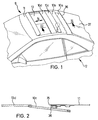
- the vehicle roof 9 to be referred to as a slat roof has a sequence of sliding slats 10a to 10d. These slats are used for the optional closing or at least partial release of a roof opening 13 which is formed in a fixed roof surface 11 of a motor vehicle 12.
- the slats 10a to 10d can be moved parallel to the longitudinal axis of the vehicle, as indicated by the double arrow 14 in FIG. 1 is.
- the lamellae 10a to 10d sealingly abut one another with their longitudinal edges running transversely to the direction of displacement 14. They form a flat lamella composite, as is indicated in FIG. 1 for the two front lamellae 10c and 10d.
- front and “rear” used here refer to the normal direction of travel of the vehicle 12.
- An adjustment mechanism not explained in detail here which can be constructed in the manner described in DE patent application P 41 23 229.1, coordinates the adjustment movements of the individual lamellae 10a to 10d in such a way that when the sliding lamellae are adjusted, the two-dimensional lamellar assembly translates in the direction of displacement 14 executes, in the course of which the composite is released at its rear end lamella for lamella when the roof is opened or restored when the roof is closed.
- the rearmost lamella 10a is pivoted so that its rear edge clears the rear edge of the roof opening 13.
- the lamella 10a can then be shifted backwards starting in this inclined position together with the other lamellae 10b to 10d remaining in the flat lamella composite, ie not swung out, the lamella 10a being immersed under the fixed roof part adjoining the roof opening 13 to the rear. While the rearmost lamella 10a moves in the direction of its rear end position indicated in FIG. 1, the next lamella 10b is released from the lamella composite in a corresponding manner in order likewise to dip back under the fixed roof surface 11. As soon as the slat in question has reached its rear end position, it is uncoupled from the roof drive. This process is repeated lamella after lamella until the state illustrated in FIG. 4 is finally reached.
- All slats 10a to 10d are stacked into a package of relatively low height under the rear part of the fixed roof surface.
- the roof opening 13 is completely exposed.
- the slats are successively coupled to the roof drive again.
- a corresponding sequence of movements is then forced in succession for the following slats 10c to 10a until the slats are in a flat connection in their front end position and close the roof opening 13.
- an extendable, lamellar wind deflector 16 is seated in the region of the front end of the roof opening 13 and, when the opening process is initiated, is pivoted about a real or virtual pivot axis running transversely to the longitudinal axis of the vehicle into a position that rises obliquely to the rear.
- the wind deflector 16 lies in the closed position of the roof 9 with its rear edge sealingly against the front edge of the sliding lamella 10d in the front end position. It closes the foremost part of the roof opening 13.
- the design can also be such that the flat connection of the slats 10a to 10d in the closed position extends from the front edge to the rear edge of the roof opening 13 and thus only assumes the closing function.
- a wind deflector can be provided in a manner known per se for sunroofs (DE-OS 23 25 594, DE-OS 34 26 998 and DE-PS 39 16 906) which disappears under the fixed roof area when the roof is closed and which automatically moves in a working position passes when the roof is opened.
- Figs. 1 and 4 a vehicle roof is shown with four sliding slats 10a to 10d.
- the number of sliding slats can in principle be chosen as desired depending on the particular circumstances, for example the length of the roof opening 13.
- the vehicle roof 9 has guide rails 18 which extend on both sides of the roof opening 13 and extend under the part of the fixed roof surface 11 which adjoins the roof opening to the rear.
- the formation on both sides of the roof 9 is substantially mirror-symmetrical to a longitudinal center line, so that the illustrations and explanations for one roof side also apply analogously to the other roof side.
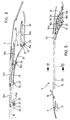
- the guide rail 18 has an upper guide track 19 and a lower guide track 20. Both guideways 19 and 20 run in the longitudinal direction of the vehicle, and they extend at least approximately parallel to one another in the region of the side edges of the roof opening 13, as can be seen in particular from FIG. 5.
- a downwardly projecting link 21 is attached on both sides at the front, from which a link pin 22 projects laterally outwards.
- Each of the link pins 22 engages in a front guide bearing 23 assigned to it.
- the front guide bearings 23 of the lamellae 10a to 10d are slidably guided along the lower guide track 20 of the guide rail 18.
- the handlebar bolts aligned transversely to the direction of displacement 14 22 determine the pivot axes 15a to 15d of the slats 10a to 10d.
- a guide pin 24 projects on both sides.
- the guide bolts 24 of the slats 10b to 10d are slidably guided over rear guide bearings 25 along the upper guide track 19 of the guide rail 18.
- the guide pin 24 of the rearmost lamella 10a interacts with an additional guide track 26 of the guide rail 18 via a rear guide bearing 25.
- the guideway 26 runs as shown in FIGS. 3 and 5, at a substantially constant distance above the rear part of the upper guideway 19.
- the guide bolts 24 of all the slats 10a to 10d also allow a transverse movement of the associated slat with respect to the guide rail 18 about a one determined by the respective guide bolt 24 axis extending to the direction of displacement 14.
- the front guide points of the slats formed by the link pins 22 are lower than the rear guide points of the slats formed by the guide pins 24, and the front guide points are offset from the front edge of the slats in question by a predetermined distance while the rear ones Guide points are arranged offset from the rear edge of the associated lamella by a predetermined distance.
- the front guide bearing 23 of the foremost sliding lamella 10d has a longitudinal opening 27 through which one end of a drive cable 28 is inserted.
- An end cap 29 is placed on the end of the drive cable 28 which projects rearward beyond the guide bearing 23.
- the drive cable 28 and the front guide bearing 23 of the foremost lamella 10d are connected to one another for entrainment in the lamella displacement direction.
- the drive cable 28 is displaceably guided at least in the region of the relevant side edge of the roof opening 13 in a cable guide channel 30 of the guide rail 18 (FIG. 6).
- the drive cable 28, which is preferably in the form of a threaded cable, extends through the cable routing channel 30 and, if appropriate, an adjoining guide tube to a drive unit 31, which in the exemplary embodiment according to FIG. 5 is located in front of the roof opening 13 under the fixed roof surface 11.
- the drive unit 31 can have an electric motor and a reduction gear in a manner known for sunroofs.
- a pinion connected to the output of the reduction gear can engage the drive cable 31 and a corresponding drive cable for the other roof side.
- a manual drive for example via a hand crank, can also be provided.
- the front guide bearings 23 of the plates 10a to 10d are releasably connected to one another via flexible connecting rods 32, only one of which is shown in FIG. 3. This connection is established, for example, using locking blocks 33, one of which can be seen in FIG. 6.
- the design is such that when the roof 9 is closed, the front guide bearings 23 are positively connected to one another via the connecting rods 32 and the associated block couplings and that when the roof is opened, the couplings disengage automatically starting with the pair of plates 10a, 10b lying in the opening direction or when closing the roof, these clutches engage automatically starting with the pair of plates 10c, 10d lying in the closing direction.
- non-illustrated roof-mounted stops can be provided, on which the connecting rods 32 hit one after the other when the roof is opened.
- the Riegelstein clutches and their interaction with the connecting rods 32 can, for example, be designed or constructed as described in detail in DE patent application P 21 23 229.1.
- the coupling of the slats to the common drive (drive cable 28) and, if necessary, the disconnection of the slats from this drive can also take place in any other way, for example via electromagnetically switchable couplings.
- the design is such that when the roof is open, the rearmost slat 10a in the roof closing position is at the bottom and the frontmost slat 10d is in the roof closing position.
- the slats 10a to 10d are offset from one another in the direction of travel so as to overlap each other when the roof is open, such that the rearmost slat 10a in the roof closed position is furthest to the rear and the front slat in the roof closed position is furthest forward.
- the lamellae 10a to 10d are stacked to form a package of relatively low height which can be accommodated in a space 34 which is located between the rear edge 35 of the roof opening 13 and the upper edge 36 of the rear window 37 (FIG. 4).
- a sealing bellows 38 can be provided in the area of the rear edge 35 of the roof opening 13, which also in all intermediate positions of the roof at maximum roof opening seals the gap between the underside of the fixed roof surface 11 and the slats 10a to 10d standing in this area. This prevents an air flow from entering through this gap in an undesirable manner.
- the sealing bellows 38 can optionally be actuated mechanically, pneumatically or hydraulically in order to ensure the desired sealing effect.
- a sealing lip or the like attached to the underside of the fixed roof surface 11 can also be provided.
- a guideway 40 which is assigned to all the lamellas 10a to 10d and which is shown in broken lines in FIG. 5 can also be provided.
- the remaining flat lamella composite can first be shifted backwards into a gap-free intermediate position in which the last lamella of the composite lies at least approximately flush with the fixed roof surface adjacent to the rear, as shown in FIGS. 7 and 8 is illustrated.
- the sealing function is therefore maintained in these gap-free intermediate positions.
- the last lamella is first pivoted with its rear region below the level of the fixed roof surface 31.
- Figs. 9 to 12 illustrate a further embodiment of the vehicle roof 9, in which the five sliding lamellae 10a to 10e in the area in this case their two guide points formed by the link pins 22 and the guide pins 24 are guided displaceably along guide tracks 42 and 43.
- These guideways 42 and 43 not only extend along the sides of the roof opening 13 and under the region of the fixed roof surface 11 adjoining it to the rear, but they continue in a region lying laterally from the rear window 37.
- the front guide bearings 23 of all the slats 10a to 10e are in a fixed drive connection to the drive cable 28.
- the guideway section 44 causes the lamella 10a to pivot about the pivot axis 15a determined by the link pin 22 such that the rear region of this lamella is pivoted from a position at least approximately flush with the fixed roof surface below the level of the fixed roof surface the slat 10a in this way to allow immersion under the fixed roof part.
- the rearmost slat 10a is pivoted back into the position in which the slat lies flush with the roof section which adjoins the roof opening 13 towards the rear.
- the slats 10a to 10e are arranged like a blind in front of the rear window 37 with the roof open and at a mutual height spacing.
- a transparent partition 45 can be provided.
- the partition 45 is located in front of the rear window 37 and, together with the rear window, defines a space 46 within which the slats 10a to 10e are received when the roof is open.
- the partition wall 45 prevents reaching into the spaces between the lowered slats.
- the transparent partition 45 can be, for example, a glass pane.
Landscapes
- Engineering & Computer Science (AREA)
- Mechanical Engineering (AREA)
- Lock And Its Accessories (AREA)
- Body Structure For Vehicles (AREA)
- Fittings On The Vehicle Exterior For Carrying Loads, And Devices For Holding Or Mounting Articles (AREA)
Applications Claiming Priority (2)
| Application Number | Priority Date | Filing Date | Title |
|---|---|---|---|
| DE4233507 | 1992-10-06 | ||
| DE4233507A DE4233507C1 (de) | 1992-10-06 | 1992-10-06 | Fahrzeugdach mit einer Folge von Lamellen |
Publications (3)
| Publication Number | Publication Date |
|---|---|
| EP0591644A2 true EP0591644A2 (fr) | 1994-04-13 |
| EP0591644A3 EP0591644A3 (fr) | 1995-02-01 |
| EP0591644B1 EP0591644B1 (fr) | 1997-04-16 |
Family
ID=6469709
Family Applications (1)
| Application Number | Title | Priority Date | Filing Date |
|---|---|---|---|
| EP93112739A Expired - Lifetime EP0591644B1 (fr) | 1992-10-06 | 1993-08-09 | Toit de véhicule avec suite à lamelles |
Country Status (4)
| Country | Link |
|---|---|
| US (1) | US5421635A (fr) |
| EP (1) | EP0591644B1 (fr) |
| JP (1) | JPH06179323A (fr) |
| DE (1) | DE4233507C1 (fr) |
Cited By (7)
| Publication number | Priority date | Publication date | Assignee | Title |
|---|---|---|---|---|
| US6474731B2 (en) | 2000-05-04 | 2002-11-05 | Webaston Vehicle Systems International Gmbh | Motor vehicle with an openable vehicle roof |
| DE10137947A1 (de) * | 2001-08-07 | 2003-03-06 | Webasto Vehicle Sys Int Gmbh | Öffnungsfähiges Fahrzeugdach mit mehreren Verschlusselementen |
| US6672658B2 (en) | 2000-05-23 | 2004-01-06 | Webasto Vehicle Systems International Gmbh | Vehicle with a vehicle roof that can be opened |
| EP1688288A1 (fr) | 2005-02-07 | 2006-08-09 | Inalfa Roof Systems Group B.V. | Ensemble de mouvement et ensemble d'un toit ouvrant pourvu d'un tel ensemble |
| WO2007093155A1 (fr) * | 2006-02-17 | 2007-08-23 | Webasto Ag | Toit de véhicule |
| DE102007050462A1 (de) | 2007-10-19 | 2009-04-23 | Bayer Materialscience Ag | Führungsschiene |
| US7922243B2 (en) | 2007-10-19 | 2011-04-12 | Bayer Materialscience Ag | Vehicle roof having high inherent stiffness |
Families Citing this family (24)
| Publication number | Priority date | Publication date | Assignee | Title |
|---|---|---|---|---|
| DE9412811U1 (de) * | 1994-08-09 | 1995-12-07 | Westmont Technik GmbH & Co. KG, 40474 Düsseldorf | Sonnenschutzvorrichtung, insbesondere für lichtdurchlässige Sonnendächer |
| DE4443526C1 (de) * | 1994-12-07 | 1995-12-21 | Daimler Benz Ag | Lamellendach für ein Kraftfahrzeug |
| FR2744957B1 (fr) * | 1996-02-19 | 1998-03-20 | Renault | Agencement d'un toit de vehicule automobile a ouverture integrale |
| DE19634325C2 (de) * | 1996-08-24 | 1999-08-19 | Webasto Karosseriesysteme | Dichtungsanordnung für ein Fahrzeugdach mit einer Folge von Schiebelamellen |
| DE29811016U1 (de) | 1998-06-19 | 1999-10-28 | Meritor Automotive GmbH, 60314 Frankfurt | Verstellvorrichtung für ein Sonnendach eines Fahrzeuges |
| DE19836849C1 (de) * | 1998-08-14 | 2000-03-09 | Daimler Chrysler Ag | Dachanordnung |
| DE29815104U1 (de) | 1998-08-22 | 1999-12-30 | Meritor Automotive GmbH, 60314 Frankfurt | Führungsmechanik für ein aus mindestens zwei Lamellen bestehendes Fahrzeugschiebedach |
| DE29820613U1 (de) * | 1998-11-18 | 2000-03-30 | Meritor Automotive GmbH, 60314 Frankfurt | Schiebedach für Fahrzeuge |
| DE19937642C1 (de) | 1999-08-12 | 2001-03-22 | Cts Fahrzeug Dachsysteme Gmbh | Dichtungselement, insbesondere in einer Seiten- oder Dachöffnung eines Kraftfahrzeugs |
| DE10015061B4 (de) * | 1999-11-26 | 2004-07-22 | Cts Fahrzeug-Dachsysteme Gmbh | Verdeck für ein Fahrzeug |
| DE10138370C2 (de) * | 2001-08-04 | 2003-10-16 | Daimler Chrysler Ag | Kraftwagen mit einem Dach mit Schiebeverdeck |
| DE10139977C2 (de) | 2001-08-21 | 2003-07-03 | Webasto Vehicle Sys Int Gmbh | Fahrzeug mit einer verschließbaren Dachöffnung |
| DE20204110U1 (de) * | 2002-03-14 | 2002-09-12 | Inalfa Industries B.V., Venray | Fahrzeug mit einer Dachanordnung; und eine solche Dachanordnung |
| FR2841186B1 (fr) * | 2002-06-21 | 2005-01-14 | Webasto Systemes Carrosserie | Dispositif d'occulation pour un pavillon en verre de vehicule automobile |
| US20070035161A1 (en) * | 2002-08-27 | 2007-02-15 | Johnson Controls Technology Company | Overhead system for a vehicle |
| DE10320538A1 (de) * | 2003-05-07 | 2004-12-09 | Webasto Vehicle Systems International Gmbh | Fahrzeug mit einer schließbaren Dachöffnung |
| US7472949B2 (en) * | 2004-03-01 | 2009-01-06 | Inalfa Roof Systems Group B.V. | Open roof construction for a vehicle and method for opening it |
| DE602004003216T2 (de) * | 2004-03-01 | 2007-09-27 | Inalfa Roof Systems Group B.V. | Öffnungsfähige Dachkonstruktion für ein Fahrzeug und Öffnungsverfahren |
| DE502006007439D1 (de) * | 2006-09-25 | 2010-08-26 | Arvinmeritor Gmbh | Schiebedachsystem |
| JP5029111B2 (ja) | 2007-04-13 | 2012-09-19 | トヨタ紡織株式会社 | 車両ルーフ構造 |
| US20080272627A1 (en) * | 2007-05-03 | 2008-11-06 | Jacob Jurgen Joab | Adjustable enclosure for use on vehicles |
| WO2009052944A2 (fr) * | 2007-10-19 | 2009-04-30 | Bayer Materialscience Ag | Toit à lamelles |
| US8439434B2 (en) | 2011-07-18 | 2013-05-14 | Honda Motor Co., Ltd. | Roof panels for an automotive vehicle |
| NL2008118C2 (nl) * | 2012-01-13 | 2013-07-16 | Verachtert | Cabrioletvoertuig voor personenvervoer. |
Family Cites Families (19)
| Publication number | Priority date | Publication date | Assignee | Title |
|---|---|---|---|---|
| US1839727A (en) * | 1927-05-07 | 1932-01-05 | Dwight E Austin | Vehicle top inclosure means |
| US2263216A (en) * | 1939-05-19 | 1941-11-18 | Latchford John Henry | Motor car body |
| US2348579A (en) * | 1941-09-29 | 1944-05-09 | Solis Faustino Jose Fernandez | Detachable cover for vehicles and the like |
| GB573355A (en) * | 1943-12-10 | 1945-11-16 | Edgar Walter Neale | Improvements relating to slidable roofs for motor vehicle saloon bodies |
| DE1811690U (de) * | 1959-09-07 | 1960-05-19 | Helmut Mosaner | Schiebedach. |
| FR1512575A (fr) * | 1966-12-30 | 1968-02-09 | Renault | Toit ouvrant de véhicule automobile |
| DE1811690A1 (de) * | 1968-11-29 | 1970-07-02 | Krauss Maffei Ag | Kalanderwalze mit Heizkanaelen |
| US3713689A (en) * | 1971-09-14 | 1973-01-30 | Gen Motors Corp | Vehicle body retractable top |
| US3720440A (en) * | 1971-11-26 | 1973-03-13 | Gen Motors Corp | Vehicle body retractable top |
| DE2325594A1 (de) * | 1973-05-19 | 1974-12-05 | Webasto Werk Baier Kg W | Windabweiser fuer fahrzeuge |
| DE2403739A1 (de) * | 1974-01-26 | 1975-07-31 | Daimler Benz Ag | Dach fuer ein kraftfahrzeug |
| DE3202646C2 (de) * | 1982-01-28 | 1986-08-21 | Ford-Werke AG, 5000 Köln | Ausstell-Schiebedach für Kraftfahrzeuge |
| EP0101322A3 (fr) * | 1982-08-17 | 1984-04-18 | Mga Developments Limited | Véhicule à système de toit coulissant |
| DE3426998A1 (de) * | 1984-07-21 | 1986-01-30 | Webasto-Werk W. Baier GmbH & Co, 8035 Gauting | Fahrzeugdach |
| DE3532150C1 (de) * | 1985-09-10 | 1986-10-23 | Ford-Werke AG, 5000 Köln | Ausstell-Schiebedach fuer Kraftfahrzeuge |
| FR2620760B1 (fr) * | 1987-09-18 | 1990-11-30 | Farnier & Penin | Dispositif de guidage et d'etancheite d'un panneau coulissant d'obturation d'une ouverture menagee dans une paroi horizontale |
| DE3916906C1 (fr) * | 1989-05-24 | 1990-06-28 | Webasto Ag Fahrzeugtechnik, 8035 Stockdorf, De | |
| DE4123229C2 (de) * | 1991-07-13 | 1994-02-24 | Webasto Ag Fahrzeugtechnik | Fahrzeugdach mit einer Folge von Schiebelamellen |
| DE4127624C1 (fr) * | 1991-08-21 | 1992-09-24 | Webasto Ag Fahrzeugtechnik, 8035 Stockdorf, De |
-
1992
- 1992-10-06 DE DE4233507A patent/DE4233507C1/de not_active Expired - Fee Related
-
1993
- 1993-07-08 JP JP5169211A patent/JPH06179323A/ja active Pending
- 1993-08-09 EP EP93112739A patent/EP0591644B1/fr not_active Expired - Lifetime
- 1993-10-06 US US08/132,183 patent/US5421635A/en not_active Expired - Fee Related
Cited By (11)
| Publication number | Priority date | Publication date | Assignee | Title |
|---|---|---|---|---|
| US6474731B2 (en) | 2000-05-04 | 2002-11-05 | Webaston Vehicle Systems International Gmbh | Motor vehicle with an openable vehicle roof |
| US6672658B2 (en) | 2000-05-23 | 2004-01-06 | Webasto Vehicle Systems International Gmbh | Vehicle with a vehicle roof that can be opened |
| DE10137947A1 (de) * | 2001-08-07 | 2003-03-06 | Webasto Vehicle Sys Int Gmbh | Öffnungsfähiges Fahrzeugdach mit mehreren Verschlusselementen |
| DE10137947C2 (de) * | 2001-08-07 | 2003-06-18 | Webasto Vehicle Sys Int Gmbh | Öffnungsfähiges Fahrzeugdach mit mehreren Verschlusselementen |
| EP1688288A1 (fr) | 2005-02-07 | 2006-08-09 | Inalfa Roof Systems Group B.V. | Ensemble de mouvement et ensemble d'un toit ouvrant pourvu d'un tel ensemble |
| US7267399B2 (en) | 2005-02-07 | 2007-09-11 | Inalfa Roof Systems Group B.V. | Motion assembly and open roof assembly provided therewith |
| WO2007093155A1 (fr) * | 2006-02-17 | 2007-08-23 | Webasto Ag | Toit de véhicule |
| US7896430B2 (en) | 2006-02-17 | 2011-03-01 | Webasto Ag | Vehicle roof |
| DE102007050462A1 (de) | 2007-10-19 | 2009-04-23 | Bayer Materialscience Ag | Führungsschiene |
| US7922240B2 (en) | 2007-10-19 | 2011-04-12 | Bayer Materialscience Ag | Slatted roof for a motor vehicle |
| US7922243B2 (en) | 2007-10-19 | 2011-04-12 | Bayer Materialscience Ag | Vehicle roof having high inherent stiffness |
Also Published As
| Publication number | Publication date |
|---|---|
| US5421635A (en) | 1995-06-06 |
| DE4233507C1 (de) | 1993-11-11 |
| EP0591644B1 (fr) | 1997-04-16 |
| EP0591644A3 (fr) | 1995-02-01 |
| JPH06179323A (ja) | 1994-06-28 |
Similar Documents
| Publication | Publication Date | Title |
|---|---|---|
| EP0591644B1 (fr) | Toit de véhicule avec suite à lamelles | |
| EP1080963B1 (fr) | Toit coulissant en plusieurs parties | |
| DE4129860C1 (fr) | ||
| DE3733892C2 (fr) | ||
| DE4407286C1 (de) | Fahrzeugdach mit einer Folge von Lamellen | |
| DE4123229C2 (de) | Fahrzeugdach mit einer Folge von Schiebelamellen | |
| DE4127624C1 (fr) | ||
| EP0638452B1 (fr) | Système de fermeture ou d'ouverture au moins partielle d'un couvercle pour toit basculant-coulissant | |
| DE19700165C2 (de) | Schiebehebedach | |
| EP0978400A2 (fr) | Toit de véhicule | |
| WO2020070056A1 (fr) | Toit de véhicule comprenant un système d'ouverture de toit et dispositif d'entraînement pour des unités cinématiques | |
| EP0720927B1 (fr) | Toit de véhicule pourvu d'une ouverture pivotante du panneau de toit | |
| DE3316739C2 (fr) | ||
| WO2021130001A1 (fr) | Toit de véhicule comprenant un système d'ouverture de toit doté de deux unités cinématiques | |
| DE3532150C1 (de) | Ausstell-Schiebedach fuer Kraftfahrzeuge | |
| DE19542884C1 (de) | Fahrzeugdach mit einer Folge von ausstellbaren Lamellen | |
| DE19927654C1 (de) | Lamellendach für eine Dachöffnung eines Kraftfahrzeugs | |
| DE4329580C1 (de) | Fahrzeugdach mit einer Folge von Lamellen | |
| DE3524840C2 (fr) | ||
| DE19654558C2 (de) | Schiebedach | |
| EP1071572B1 (fr) | Dispositif d'ajustage pour toit a ailerons multiples de vehicule | |
| DE19856873C1 (de) | Lamellendach für eine Dachöffnung eines Kraftfahrzeugs | |
| DE10203882B4 (de) | Mehrteiliges Schiebedach | |
| DE3211467C2 (de) | Öffnungssystem für Schiebedach, insbesondere für Kraftfahrzeuge | |
| DE102019101032B3 (de) | Fahrzeugdach mit einer Abstützkulisse für ein verfahrbares Deckelelement |
Legal Events
| Date | Code | Title | Description |
|---|---|---|---|
| PUAI | Public reference made under article 153(3) epc to a published international application that has entered the european phase |
Free format text: ORIGINAL CODE: 0009012 |
|
| AK | Designated contracting states |
Kind code of ref document: A2 Designated state(s): FR GB NL |
|
| PUAL | Search report despatched |
Free format text: ORIGINAL CODE: 0009013 |
|
| AK | Designated contracting states |
Kind code of ref document: A3 Designated state(s): FR GB NL |
|
| 17P | Request for examination filed |
Effective date: 19950711 |
|
| GRAG | Despatch of communication of intention to grant |
Free format text: ORIGINAL CODE: EPIDOS AGRA |
|
| GRAH | Despatch of communication of intention to grant a patent |
Free format text: ORIGINAL CODE: EPIDOS IGRA |
|
| 17Q | First examination report despatched |
Effective date: 19961004 |
|
| GRAH | Despatch of communication of intention to grant a patent |
Free format text: ORIGINAL CODE: EPIDOS IGRA |
|
| GRAA | (expected) grant |
Free format text: ORIGINAL CODE: 0009210 |
|
| AK | Designated contracting states |
Kind code of ref document: B1 Designated state(s): FR GB NL |
|
| GBT | Gb: translation of ep patent filed (gb section 77(6)(a)/1977) |
Effective date: 19970416 |
|
| ET | Fr: translation filed | ||
| PLBE | No opposition filed within time limit |
Free format text: ORIGINAL CODE: 0009261 |
|
| 26N | No opposition filed | ||
| REG | Reference to a national code |
Ref country code: GB Ref legal event code: IF02 |
|
| PGFP | Annual fee paid to national office [announced via postgrant information from national office to epo] |
Ref country code: GB Payment date: 20020716 Year of fee payment: 10 |
|
| PGFP | Annual fee paid to national office [announced via postgrant information from national office to epo] |
Ref country code: NL Payment date: 20020819 Year of fee payment: 10 Ref country code: FR Payment date: 20020819 Year of fee payment: 10 |
|
| PG25 | Lapsed in a contracting state [announced via postgrant information from national office to epo] |
Ref country code: GB Free format text: LAPSE BECAUSE OF NON-PAYMENT OF DUE FEES Effective date: 20030809 |
|
| PG25 | Lapsed in a contracting state [announced via postgrant information from national office to epo] |
Ref country code: NL Free format text: LAPSE BECAUSE OF NON-PAYMENT OF DUE FEES Effective date: 20040301 |
|
| GBPC | Gb: european patent ceased through non-payment of renewal fee |
Effective date: 20030809 |
|
| PG25 | Lapsed in a contracting state [announced via postgrant information from national office to epo] |
Ref country code: FR Free format text: LAPSE BECAUSE OF NON-PAYMENT OF DUE FEES Effective date: 20040430 |
|
| NLV4 | Nl: lapsed or anulled due to non-payment of the annual fee |
Effective date: 20040301 |
|
| REG | Reference to a national code |
Ref country code: FR Ref legal event code: ST |