EP0591709A2 - Méthode et système pour commander l'accès aux objets dans un système hiérarchique orienté objet - Google Patents
Méthode et système pour commander l'accès aux objets dans un système hiérarchique orienté objet Download PDFInfo
- Publication number
- EP0591709A2 EP0591709A2 EP93114659A EP93114659A EP0591709A2 EP 0591709 A2 EP0591709 A2 EP 0591709A2 EP 93114659 A EP93114659 A EP 93114659A EP 93114659 A EP93114659 A EP 93114659A EP 0591709 A2 EP0591709 A2 EP 0591709A2
- Authority
- EP
- European Patent Office
- Prior art keywords
- dependent
- objects
- locally available
- external unit
- access
- Prior art date
- Legal status (The legal status is an assumption and is not a legal conclusion. Google has not performed a legal analysis and makes no representation as to the accuracy of the status listed.)
- Withdrawn
Links
Images



Classifications
-
- G—PHYSICS
- G06—COMPUTING OR CALCULATING; COUNTING
- G06F—ELECTRIC DIGITAL DATA PROCESSING
- G06F9/00—Arrangements for program control, e.g. control units
- G06F9/06—Arrangements for program control, e.g. control units using stored programs, i.e. using an internal store of processing equipment to receive or retain programs
- G06F9/44—Arrangements for executing specific programs
- G06F9/448—Execution paradigms, e.g. implementations of programming paradigms
- G06F9/4488—Object-oriented
Definitions
- the present invention relates in general to object oriented data processing applications and in particular to a method and system for controlling the access to such objects in this applications.
- the present invention relates to a method and system for increasing the throughput during the access to the objects in such applications where said objects are hierarchically structured and each of said objects may be both available locally and retrievable from an external unit.
- Object oriented data processing applications are known in the art. Such objects can be arranged according to a predefined hierarchy.
- Some applications particularly those running cooperatively, typically process both locally available objects and objects that must be retrieved from an external unit, for instance a remote computer system.
- the user is kept informed about the process through message windows or status line information.
- Every object must have at least one dependent object locally defined in association thereto before it accepts open/expand commands; so, if none of the dependent objects is already retrieved from the external unit, the selected object can not be opened.
- the whole application is locked until the retrieve operation of the dependent objects from the external unit is completed; for instance, in a typical window oriented application, the whole process controlling the window is put in a locked status.
- a method and system for controlling the access to objects in an object oriented data processing application capable of exchanging data with an external unit, said objects being hierarchically structured and each one of said objects being either locally available or retrievable from an external unit
- said method and system comprising the steps of or means for: associating to each object a counter indicating whether there are objects dependent on said object, associating a dummy dependent object to each locally available object with at least one dependent object and with at least one non-locally available dependent object, selecting an object, making available for each command involving any object dependent on a selected object the locally available objects dependent on said object and locking the access to the objects dependent on said object which are to be retrieved from the external unit, unlocking the access to a object dependent on said selected object when all information related to said dependent object has been retrieved from the external unit.
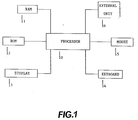
- processor 10
- RAM Random Access Memory
- ROM Read Only Memory
- display monitor 13
- keyboard 14
- pointing device such as a mouse (15) may be attached to the processor (10) as well.
- One or more external units (16) are connected to the processor (10); they consist of both remote units, such as a host computer linked by network, Local Area Network (LAN) servers, and I/O devices, such as a local hard disk.
- remote units such as a host computer linked by network, Local Area Network (LAN) servers, and I/O devices, such as a local hard disk.
- LAN Local Area Network
- I/O devices such as a local hard disk.
- the processor (10) may be a microprocessor such as is found in the IBM Personal System PS/2. Data currently being processed are stored in the RAM (11).
- the objects handled by the present inventions may be either locally available in the RAM (11) or to be required from an external unit (16).
- they may be stored in remote units, such as a host computer linked by network, in Local Area Network (LAN) servers, or in I/O devices, such as a local hard disk.
- LAN Local Area Network
- Figure 2 shows the representation in RAM (11) of the object structure in the data processing system according to the described embodiment of the present invention.
- the objects are stored in a tree-like structure, where the different objects are represented by control blocks (21) in RAM (11) linked by pointers (22), to the parent objects, to the dependent objects and to the sibling objects.
- the dependent object counter holds in each object the numbers of dependent objects associated to said object.
- This counter may also be a simple flag indicating the existence of at least one dependent object associated to said object.
- the objects are retrieved from the external unit (16) a set a time, each set including the objects of a given hierarchical level; at each request, said external unit (16) sends back the next level objects in the hierarchy without giving the possibly existing dependent objects of the level itself.
- Any object contains the information about the existence of dependent objects associated thereto. This information is held in said dependent object counter and it must be included in any response of the retrieve process from the external unit (16).
- the program may determine if any locally available object has a dependent object. If so, the program appends to said object a dummy dependent object if at least one related dependent object is non-locally available.
- the dummy object is not visible and it is always transformed in a different object type when the actual data is retrieved.
- the dummy object is used mainly to indicate to the program controlling the graphical representation of the objects that said object has at least one dependent object.
- this dummy object enables the object expansion even if the dependent objects of the selected object are not yet locally available in the RAM (11).
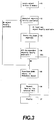
- the program determines the address of the selected object in the tree in RAM (11).
- Block 32 depicts a determination of whether or not there is at least one locally available object dependent on the selected object.
- the process passes to block 35. If at least one object is locally available, the process passes at block 33, where the program creates an instance of all the locally available objects dependent on the selected object.
- the process depicts a determination of whether or not all the objects dependent on the selected object are locally available.
- the process passes to block 35, where the dummy object appended to the selected object is transformed in an object indicating the non availability of the objects dependent on the selected object, such as a hourglass.
- This hourglass object has no function available; hence, the access to this hourglass object is locked.
- the dependent object counter indicates the number of objects dependent on said object, it is also possible to substitute the dummy object with as many hourglasses as the number of dependent objects that are still to be retrieved from the external unit (16).
- the user may be advised that the process of retrieving said dependent objects from the external unit (16) is still in progress.
- the user can operate on the other objects already present locally, without waiting for the reception of all data.
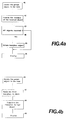
- this component When the component managing the communication with the external unit (16) notifies that one of the requested objects is arrived, this component sends a message to the application that starts one of the methods illustrated in figures 4a and 4b.
- Figure 4a depicts the case where there is only a hourglass for all the not locally available dependent objects; the figure 4b depicts the case where there are one hourglass for each not locally available dependent objects.
- step 41 the address of the memory representation of the selected object in the tree is passed back, and the program determines the address of said object in the tree in RAM (11).
- the process passes to block 42, where the program creates an instance of the retrieved dependent object.
- the process depicts a determination of whether or not all the non-locally available objects dependent on the selected object are retrieved. If the answer is YES, the process passes to block 45 and shows the new object on the display (13).
- step 46 the address of the memory representation of the selected object in the tree is passed back, and the program determines the address of said object in the tree in RAM (11).
- the process passes to block 47, where the program locates the first hourglass object dependent on the selected object.
- said hourglass object is transformed in the actual object associated to the dependent object retrieved.
- Figure 5 is a pictorial representation of the display (13) at a start time, when an object (named NCP_CON) is locally available in the tree in RAM (11) and shown in a window.
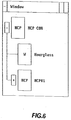
- Figure 6 shows an intermediate state on the display (13), when the user expands the object NCP_CON, by clicking on the expand button with the mouse (15). If some dependent objects are locally available and others are to be retrieved from the external unit (16), the locally available objects (NCP01) are shown in the window, while a hourglass object is created and shown on the display (13).
- Figure 7 is a pictorial representation of the display (13) at the end state, when all data have been retrieved from the external unit (16) and the actual objects (NCP03 and NCP04) are substituted for the hourglass in the window on the display (13).
Landscapes
- Engineering & Computer Science (AREA)
- Software Systems (AREA)
- Theoretical Computer Science (AREA)
- Physics & Mathematics (AREA)
- General Engineering & Computer Science (AREA)
- General Physics & Mathematics (AREA)
- Information Retrieval, Db Structures And Fs Structures Therefor (AREA)
- Digital Computer Display Output (AREA)
- Devices For Executing Special Programs (AREA)
Applications Claiming Priority (2)
| Application Number | Priority Date | Filing Date | Title |
|---|---|---|---|
| ITMI922214A IT1255833B (it) | 1992-09-25 | 1992-09-25 | Metodo e sistema per controllare l'accesso agli oggetti in un'applicazione per l'elaborazione di dati ad oggetti a struttura gerarchica |
| ITMI922214 | 1992-09-25 |
Publications (2)
| Publication Number | Publication Date |
|---|---|
| EP0591709A2 true EP0591709A2 (fr) | 1994-04-13 |
| EP0591709A3 EP0591709A3 (fr) | 1994-10-19 |
Family
ID=11364008
Family Applications (1)
| Application Number | Title | Priority Date | Filing Date |
|---|---|---|---|
| EP9393114659A Withdrawn EP0591709A3 (fr) | 1992-09-25 | 1993-09-13 | Méthode et système pour commander l'accès aux objets dans un système hiérarchique orienté objet. |
Country Status (3)
| Country | Link |
|---|---|
| EP (1) | EP0591709A3 (fr) |
| JP (1) | JP2837792B2 (fr) |
| IT (1) | IT1255833B (fr) |
Family Cites Families (2)
| Publication number | Priority date | Publication date | Assignee | Title |
|---|---|---|---|---|
| CA1317678C (fr) * | 1989-03-20 | 1993-05-11 | William Jaaskelainen | Icone d'indication dynamique de deroulement |
| DE68929162T2 (de) * | 1989-07-21 | 2000-11-16 | Hewlett Packard Co | Verteilte auf Objekte basierende Systeme |
-
1992
- 1992-09-25 IT ITMI922214A patent/IT1255833B/it active IP Right Grant
-
1993
- 1993-09-10 JP JP5225488A patent/JP2837792B2/ja not_active Expired - Fee Related
- 1993-09-13 EP EP9393114659A patent/EP0591709A3/fr not_active Withdrawn
Also Published As
| Publication number | Publication date |
|---|---|
| IT1255833B (it) | 1995-11-17 |
| ITMI922214A0 (it) | 1992-09-25 |
| JP2837792B2 (ja) | 1998-12-16 |
| EP0591709A3 (fr) | 1994-10-19 |
| JPH06202871A (ja) | 1994-07-22 |
| ITMI922214A1 (it) | 1994-03-25 |
Similar Documents
| Publication | Publication Date | Title |
|---|---|---|
| US5634128A (en) | Method and system for controlling access to objects in a data processing system | |
| US5471619A (en) | Method and system for controlling access to objects in a data processing system | |
| US5617526A (en) | Operating system provided notification area for displaying visual notifications from application programs | |
| US5872966A (en) | System and method for logging and enabling further manipulation of system state information | |
| US5956486A (en) | Method and apparatus for monitoring multiple electronic mail systems | |
| JP3725263B2 (ja) | ソース・オブジェクトとターゲット・オブジェクトとの対話を容易にする方法及び装置 | |
| US6463480B2 (en) | Method and system of processing a plurality of data processing requests, and method and system of executing a program | |
| US5502839A (en) | Object-oriented software architecture supporting input/output device independence | |
| US6636250B1 (en) | Methods and apparatus for presenting information to a user of a computer system | |
| JP4006036B2 (ja) | グラフィカル・ユーザ・インタフェースに表示される限定機能へのビジュアル・アクセス | |
| US6327613B1 (en) | Method and apparatus for sharing peripheral devices over a network | |
| US4835685A (en) | Virtual single machine with message-like hardware interrupts and processor exceptions | |
| US8185578B2 (en) | Client server system and method for executing an application utilizing distributed objects | |
| EP0550370A2 (fr) | Système d'ordinateur collaborant | |
| EP0550374A2 (fr) | Référence croisée à des applications interreliées pour des régions de verrouillage pouvant être sélectionnées par l'utilisateur | |
| JPH08255132A (ja) | 安全なデータ転送を行うための方法および機密レベル変更選択機構 | |
| US6335745B1 (en) | Method and system for invoking a function of a graphical object in a graphical user interface | |
| EP0938713A1 (fr) | Procede permettant d'acceder aux informations d'un ordinateur hote a partir d'un ordinateur client | |
| AU739850B2 (en) | Method and system for facilitating navigation among software applications and improved screen viewing | |
| JP2000056826A (ja) | 監視制御装置 | |
| US5946499A (en) | Method and apparatus for processing text inputs from multiple input devices in a plurality of applications | |
| EP1763751B1 (fr) | Transferts de donnees multi-source, multi-destination | |
| JP2974807B2 (ja) | 文書管理方法 | |
| EP0591709A2 (fr) | Méthode et système pour commander l'accès aux objets dans un système hiérarchique orienté objet | |
| US5784623A (en) | Using a parent latch that covers a plurality of child latches to track the progress of a process attempting to acquire resources |
Legal Events
| Date | Code | Title | Description |
|---|---|---|---|
| PUAI | Public reference made under article 153(3) epc to a published international application that has entered the european phase |
Free format text: ORIGINAL CODE: 0009012 |
|
| AK | Designated contracting states |
Kind code of ref document: A2 Designated state(s): DE FR GB |
|
| PUAL | Search report despatched |
Free format text: ORIGINAL CODE: 0009013 |
|
| 17P | Request for examination filed |
Effective date: 19940718 |
|
| AK | Designated contracting states |
Kind code of ref document: A3 Designated state(s): DE FR GB |
|
| 18W | Application withdrawn |
Withdrawal date: 19960730 |