EP0591923B1 - Continuous production of aromatic carbonates - Google Patents
Continuous production of aromatic carbonates Download PDFInfo
- Publication number
- EP0591923B1 EP0591923B1 EP93116075A EP93116075A EP0591923B1 EP 0591923 B1 EP0591923 B1 EP 0591923B1 EP 93116075 A EP93116075 A EP 93116075A EP 93116075 A EP93116075 A EP 93116075A EP 0591923 B1 EP0591923 B1 EP 0591923B1
- Authority
- EP
- European Patent Office
- Prior art keywords
- carbonate
- reactor
- reaction
- distillation tower
- catalyst
- Prior art date
- Legal status (The legal status is an assumption and is not a legal conclusion. Google has not performed a legal analysis and makes no representation as to the accuracy of the status listed.)
- Expired - Lifetime
Links
- -1 aromatic carbonates Chemical class 0.000 title claims 10
- 238000010924 continuous production Methods 0.000 title 1
- 238000000034 method Methods 0.000 claims 9
- 239000003054 catalyst Substances 0.000 claims 4
- 238000004821 distillation Methods 0.000 claims 4
- BVKZGUZCCUSVTD-UHFFFAOYSA-L Carbonate Chemical compound [O-]C([O-])=O BVKZGUZCCUSVTD-UHFFFAOYSA-L 0.000 claims 3
- DNIAPMSPPWPWGF-GSVOUGTGSA-N (R)-(-)-Propylene glycol Chemical compound C[C@@H](O)CO DNIAPMSPPWPWGF-GSVOUGTGSA-N 0.000 claims 2
- 230000014759 maintenance of location Effects 0.000 claims 1
- 238000010992 reflux Methods 0.000 claims 1
Images


Classifications
-
- C—CHEMISTRY; METALLURGY
- C07—ORGANIC CHEMISTRY
- C07C—ACYCLIC OR CARBOCYCLIC COMPOUNDS
- C07C68/00—Preparation of esters of carbonic or haloformic acids
- C07C68/06—Preparation of esters of carbonic or haloformic acids from organic carbonates
Definitions
- This invention relates to continuous production of aromatic carbonates. More particularly, it relates to a process for continuously producing an alkylaryl carbonate and/or a diaryl carbonate by reacting a dialkyl carbonate and an aromatic hydroxy compound and a process for continuously producing a diaryl carbonate from an alkylaryl carbonate.
- an alkylaryl carbonate is indispensable for the production of a diaryl carbonate.
- An alkylaryl carbonate can be obtained by reacting a dialkyl carbonate and an aromatic hydroxy compound in the presence of a catalyst as shown in reaction formula (III):
- Patent 4,552,704 JP-A-56-25138, JP-A-57-176932, JP-A-57-183745, JP-A-60-173016 (which corresponds to U.S. Patent 4,609,501), JP-A-1-93560, JP-A-1-265064, and JP-A-1-265064).
- JP-B-61-25696 the term "JP-B” as used herein means an "examined published Japanese patent application”
- JP-A-60-173016 JP-A-60-169445, JP-A-60-169444
- JP-A-56-123948 which corresponds to U.S. Patent 4,182,726
- JP-A-56-25138 JP-A-54-48733, JP-A-54-48732, JP-A-51-105032, and JP-A-51-75044.
- An object of the present invention is to provide an improved process for continuously producing an alkylaryl carbonate and/or a diaryl carbonate (hereinafter inclusively referred to as aromatic carbonates) comprising reacting a dialkyl carbonate and an aromatic hydroxy compound in the presence of a catalyst, in which a high reaction rate and a high selectivity can be attained without causing clogging of a distillation tower and thereby achieving continuous production in a stable manner.
- Another object of the present invention is to provide an improved process for continuously producing a diaryl carbonate from an alkylaryl carbonate in the presence of a catalyst, in which a high yield and a high selectivity can be attained without causing clogging of a distillation tower and thereby achieving continuous production in a stable manner.
- aromatic carbonates can be obtained at a high reaction rate and a high selectivity by continuously feeding a dialkyl carbonate, an aromatic hydroxy compound, and a catalyst to a reactor equipped with a distillation tower, continuously driving out a by-produced aliphatic alcohol from the top of the distillation tower so as to control the aliphatic alcohol concentration in the reactor to 2% by weight or less, and continuously withdrawing produced aromatic carbonates and the catalyst from the reactor. Since the catalyst is fed to the reactor, no clogging of the distillation tower was observed.
- the present inventors have found a counter-measure against clogging of a distillation tower, influences of the concentration of a by-produced dialkyl carbonate in a reactor, and means for suppressing a decarboxylation reaction.
- a diaryl carbonate can be continuously produced from an alkylaryl carbonate in the presence of a catalyst in a high yield at a high selectivity by continuously feeding an alkylaryl carbonate and a catalyst to a reactor equipped with a distillation tower, continuously driving out a by-produced dialkyl carbonate from the distillation tower so as to control the concentration of the dialkyl carbonate in the reactor to 2% by weight or less, and continuously withdrawing produced diaryl carbonate and the catalyst from the reactor.
- FIG. 1 shows laboratory equipment used in Examples 1 and 2 and Comparative Example 1.
- FIG. 2 shows laboratory equipment used in Example 3.
- FIG. 3 shows laboratory equipment used in Examples 4 to 6 and Comparative Examples 2 to 3.
- the aliphatic alcohol concentration in the reactor is controlled up to 2% by weight, preferably from 0.001 to 1% by weight, more preferably from 0.01 to 0.1% by weight.
- the reaction temperature depends on the operating conditions. Reaction at a too low temperature fails to attain a high reaction rate. Temperatures of not less than 120°C are recommended. A too high temperature not only involves difficulty in securing a heating source but causes side reactions. A particularly preferred reaction temperature ranges from 150° to 350°C.
- the reaction pressure is preferably from atmospheric pressure up to 10 MPa (100 kg/cm 2 G), and more preferably from (0,1 to 2 MPa) (1 to 20 kg/cm 2 G).
- the retention time in the reactor (the quantity of a residual liquid in the reactor (l) divided by the quantity of a withdrawn liquid per time unit (l/hour)) is usually at least 0.1 hour and preferably from 0.5 to 16 hours. A too long retention time requires a large-sized reactor.
- a recommended molar ratio of the dialkyl carbonate to the aromatic hydroxy compound is from 5/1 to 1/5. It the molar ratio is too high or too low, the unreacted materials to be returned to the reaction system will increase.
- a solvent is not necessarily needed. If necessary, for ease of reaction and operation, an inert solvent, such as an aliphatic hydrocarbon, an aromatic hydrocarbon, an ether, a halogenated aliphatic hydrocarbon or a halogenated aromatic hydrocarbon, may be employed.
- an inert solvent such as an aliphatic hydrocarbon, an aromatic hydrocarbon, an ether, a halogenated aliphatic hydrocarbon or a halogenated aromatic hydrocarbon, may be employed.
- a gas or a low-boiling organic compound which is inert to the reaction may be introduced into the reactor.
- An azeotropic agent which forms an azeotrope with the aliphatic alcohol may be added to the reaction system.
- JP-A-4-9358 which teaches a process for conducting the disproportionation reaction by feeding an alkylaryl carbonate and a catalyst to a multi-plate distillation tower in continuous operation mentions the occurrence of decarboxylation in a long time reaction. Notwithstanding, such a decarboxylation reaction hardly occurred when an alkylaryl carbonate and a catalyst were continuously fed to a reactor equipped with a distillation tower. The reasons for this seem to be as follows:
- the inventors determined the disproportionation rate constant of methylphenyl carbonate and estimated the time required for reaching the equilibrium at 195°C. It was found as a result that the reaction comes to equilibrium in 2 to 3 minutes.
- dialkyl carbonate having a lower boiling point than those of a starting alkylaryl carbonate and a produced diaryl carbonate is used in the present invention.
- the dialkyl carbonate recovered as a distillate may be a mixture containing the starting alkylaryl carbonate or the produced diaryl carbonate. In this case, however, the alkylaryl carbonate or diaryl carbonate must afterwards be separated from the dialkyl carbonate in a separate process. Accordingly, it is preferable to operate so as not to incorporate the alkylaryl carbonate or the diaryl carbonate into the distillate.
- the dialkyl carbonate concentration in the reactor is preferably controlled in the range of from 0.001 to 1% by weight, more preferably from 0.01 to 0.1% by weight.
- the residue withdrawn from the reactor may contain an alkylaryl carbonate or an aromatic hydroxy compound in addition to a catalyst.
- the concentration of the dialkyl carbonate in the distillate may be increased by increasing the reflux ratio (refluxing amount/distillated amount) of the distillation tower, but a too high reflux ratio needs much heat and increases the production cost.
- the refluxing amount is the amount returned to the distillation tower 3 through pipe 6 and the distillated amount is the amount driven out of the distillation tower 3 through 7.
- a recommended reflux ratio is from 0 to 20 and preferably from 0 to 10.
- the reaction temperature usually ranges from 50° to 300°C, and preferably from 100° to 250°C, while varying depending on the kind and the composition of the starting material.
- the reaction pressure is usually within a range of from 6,65 x 10 3 Pa (50 mmHg) to 10 MPa (100 kg/cm 2 G), while varying depending on the kind and the composition of the starting material and the reaction temperature.
- the retention time in the reactor is usually from 0.1 to 20 hours, and preferably from 0.3 to 10 hours, while depending on the reaction temperature and the kind and composition of the starting material.
- a solvent is not necessarily needed. If necessary, for ease of reaction and operation, an inert solvent, such as an aliphatic hydrocarbon, an aromatic hydrocarbon, an ether, a halogenated aliphatic hydrocarbon or a halogenated aromatic hydrocarbon, may be employed.
- an inert solvent such as an aliphatic hydrocarbon, an aromatic hydrocarbon, an ether, a halogenated aliphatic hydrocarbon or a halogenated aromatic hydrocarbon, may be employed.
- a gas or an organic compound of low-boiling temperature which is inert to the reaction may be introduced into the reactor.
- the starting material may contain an aromatic hydroxy compound. It may also contain the produced diaryl carbonate or dialkyl carbonate, but care should be taken not to increase too much the concentrations of the diaryl carbonate or dialkyl carbonate in the reaction system because a disproportionation reaction is a reversible reaction and too high concentrations of these products cause a reduction of the conversion of the starting alkylaryl carbonate.
- dialkyl carbonate which can be used in the present invention are represented by formula: wherein R represents an alkyl group, an aliphatic group, an aralkyl group, etc.; the two R's may be the same or different.
- the alkyl group, aliphatic group or aralkyl group as represented by R may be substituted with, for example, a lower alkyl group (C 1 to C 5 ), a lower alkoxy group (C 1 to C 5 ), a cyano group, a halogen atom, etc. and may contain therein an unsaturated bond.
- alkyl group examples are methyl, ethyl, propyl (inclusive of all the isomers), allyl, butyl (inclusive of all the isomers), butenyl (inclusive of all the isomers), pentyl (inclusive of all the isomers), hexyl (inclusive of all the isomers), heptyl (inclusive of all the isomers), octyl (inclusive of all the isomers), nonyl (inclusive of all the isomers), decyl (inclusive of all the isomers), and cyclohexylmethyl groups.
- aliphatic group examples include cyclopropyl, cyclobutyl, cyclopentyl, cyclohexyl, and cycloheptyl groups.
- aralkyl group examples include benzyl, phenethyl (inclusive of all the isomers), phenylpropyl (inclusive of all the isomers), phenylbutyl (inclusive of all the isomers), and methylbenzyl (inclusive of all the isomers) groups.
- dialkyl carbonate examples include dimethyl carbonate, diethyl carbonate, dipropyl carbonate (inclusive of all its isomers), dibutyl carbonate (inclusive of all the isomers), diallyl carbonate, dibutenyl carbonate (inclusive of all the isomers), methylethyl carbonate, methylpropyl carbonate (inclusive of all the isomers), methylbutyl carbonate (inclusive of all the isomers), ethylpropyl carbonate (inclusive of all the isomers), ethylbutyl carbonate (inclusive of all the isomers), dibenzyl carbonate, ethylene carbonate, and propylene carbonate.
- the alkylaryl carbonate which can be produced by the present invention is represented by formula: wherein R is as defined above; and Ar represents a monovalent aromatic group, such as a phenyl group, an alkylphenyl group, an alkoxyphenyl group, a halogenated phenyl group, a naphthyl group, a substituted naphthyl group, a heterocyclic aromatic group, and a substituted heterocyclic aromatic group.
- alkylphenyl group as represented by Ar examples include tolyl, xylyl, trimethylphenyl, tetramethylphenyl, ethylphenyl, propylphenyl, butylphenyl, diethylphenyl, methylethylphenyl, pentylphenyl, hexylphenyl, and cyclohexylphenyl groups, each inclusive of all their isomers.
- alkoxyphenyl group as Ar include methoxyphenyl, ethoxyphenyl and butoxyphenyl groups, each inclusive of all their isomers.
- halogenated phenyl group as Ar include fluorophenyl, chlorophenyl, bromophenyl, chloro(methyl)phenyl and dichlorophenyl groups, each inclusive of all their isomers.
- substituted or unsubstituted naphthyl groups as Ar include naphthyl, methylnaphthyl, dimethylnaphthyl, chloronaphthyl, methoxynaphthyl and cyanonaphthyl groups, each inclusive of all their isomers.
- Specific examples of the substituted or unsubstituted heterocyclic aromatic group as Ar include pyridyl, coumaryl, quinolyl, methylcoumaryl and methylquinolyl groups, each inclusive of all their isomers.
- R is preferably an alkyl group containing from 1 to 4 carbon atoms
- Ar is preferably an aromatic group containing from 6 to 10 carbon atoms.
- preferred examples of the alkylaryl carbonate include methylphenyl carbonate, ethylphenyl carbonate, propylphenyl carbonate, butylphenyl carbonate, allylphenyl carbonate, methyltolyl carbonate, ethyltolyl carbonate, propyltolyl carbonate, butyltolyl carbonate, methylxylyl carbonate, ethylxylyl carbonate, propylxylyl carbonate, and butylxylyl carbonate, each inclusive of all their isomers, if present.
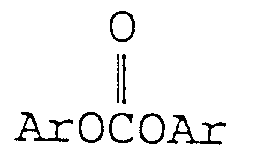
- the diaryl carbonate which can be produced according to the present invention is represented by formula: wherein Ar is as defined above; the two Ar's may be the same or different.
- diaryl carbonate examples include diphenyl carbonate, ditolyl carbonate, dixylyl carbonate, dinaphthyl carbonate, phenyltolyl carbonate, and di(ethylphenyl) carbonate, each inclusive of all their isomers if present.
- the catalyst which can be used in the present invention is not particularly limited as long as it catalyzes the reaction between a dialkyl carbonate and an aromatic hydroxy compound to produce an alkylaryl carbonate and/or a diaryl carbonate and also catalyzes an intramolecular interesterification (disproportionation) and intermolecular interesterification of an alkylaryl carbonate to produce a diaryl carbonate and a dialkyl carbonate.
- Catalysts which might have been precipitated to clog the distillation tower in the conventional continuous production of aromatic carbonates due to their low solubility in the liquid existing in the reaction system as well as catalysts which are soluble in the starting materials and the reaction products can be used in the present invention.
- the added amount of the catalyst is preferably from 0.006 to 20% by weight based on the reaction mixture in the reactor.
- Any reactor in which a liquid phase reaction can be carried out can be used in the present invention.
- Illustrative examples of applicable reactors include a tank reactor, a tower reactor, a fluidized bed reactor, and a reboiler of a distillation tower.
- distillation towers Any kind of distillation towers known in chemical engineering can be used in the present invention.
- Illustrative examples of usable plate distillation towers include a bubble cap tower, a sieve tower, and a bubble tower.
- Fillers for packed distillation towers include Raschig ring, pole ring, Berl saddle, interlock saddle, Dixon packing, MacMahon packing, Sulzer packing, and Mellapak.
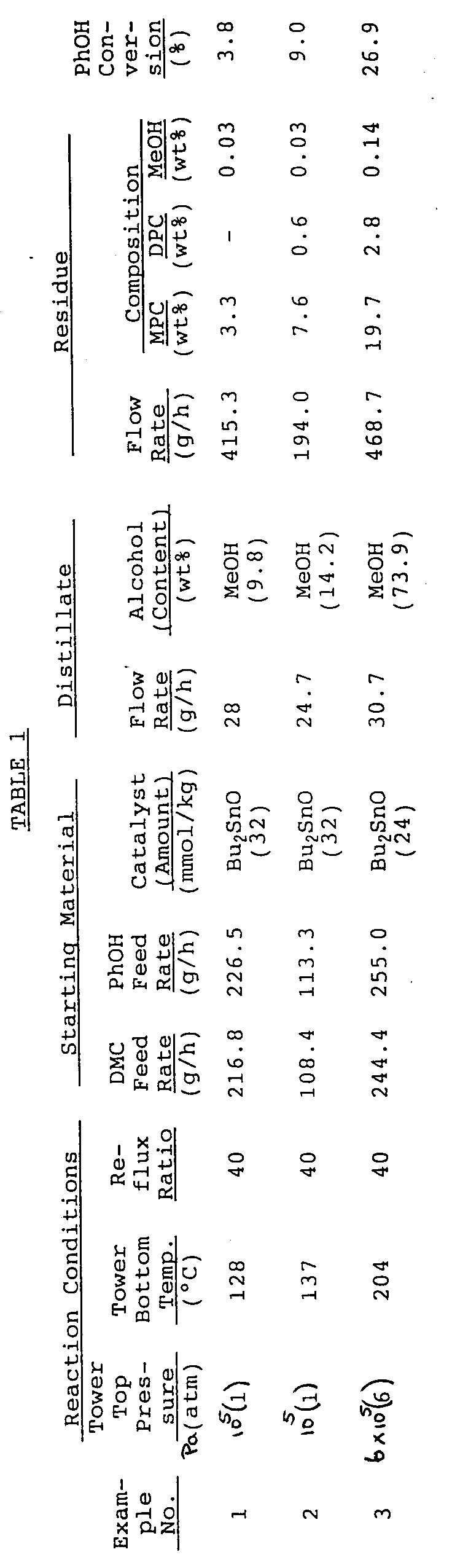
- the laboratory apparatus used in this Example is shown in FIG. 1.
- the apparatus is composed of 800 ml-volume thermosyphon type reboiler (reactor) 2, glass-made Oldshue distillation tower 3 (40 mm ⁇ x 20 plates), and condenser 5 set at the top of the distillation tower.
- DMC dimethyl carbonate
- PhOH phenol
- Bu 2 SnO dibutyltin oxide
- MPC methylphenyl carbonate
- DPC diphenyl carbonate
- a reaction was conducted in the same manner as in Example 1, except for feeding a mixture of DMC, PhOH and a catalyst to distillation tower 3 at the 7th plate from the top. Although the reaction results were equal to those obtained in Example 1, a part of the perforated trays of the plates lower than the plate where the DMC/PhOH/catalyst mixture was fed was found clogged after 720 hours of operation.
- the laboratory apparatus used in this Example is shown in FIG. 2.
- the apparatus is composed of 1200 ml-volume stainless steel-made tank reactor 2 which also serves as a reboiler, stainless steel-made distillation tower 3 (inner diameter: 28 mm; packing height: 2380 mm) packed with Dixon packing (6 mm), and condenser 5.
- Numeral 9 in FIG. 2 is an automatic pressure-control valve.
- the operating pressure was set at 6 atm, and a mixture of DMC, PhOH, and dibutyltin oxide as the catalyst was continuously fed to reactor 2 through pipe 1 to conduct a reaction.
- the reaction mixture containing MPC and DPC was continuously withdrawn from the bottom of reactor 2 through pipe 8 at a controlled rate so as to keep the amount of the liquid in reactor 2 at 620 ml.
- By-produced methanol was introduced to condenser 5 through pipe 4 and condensed there. Part of the condensate was continuously refluxed to the top of distillation tower 3 through pipe 6 while continuously distilling off the rest of the condensate through pipe 7.
- the distillate contained the starting DMC.
- the present invention makes it possible to achieve the reaction between a dialkyl carbonate and an aromatic hydroxy compound in the presence of a catalyst for the production of aromatic carbonates at a high conversion in a high yield without being accompanied by clogging of the distillation tower.
- the laboratory apparatus used in this Example is shown in FIG. 3.
- the apparatus is composed of 800 ml-volume reactor 2 equipped with a stirrer, Oldshue distillation tower 3 (40 mm ⁇ x 40 plates), and condenser 5 set at the top of the distillation tower.
- a mixture of MPC and dibutyltin oxide as the catalyst was continuously fed to reactor 2 through pipe 1 to conduct a reaction.
- the reaction mixture containing DPC was continuously withdrawn from the bottom of reactor 2 through pipe 8 at a controlled rate so as to keep the amount of the liquid in reactor 2 at 620 ml.
- By-produced DMC was continuously introduced to condenser 5 through pipe 4 and condensed there. Part of the condensate was refluxed to the top of the distillation tower 3 through pipe 6, and the rest of the condensate was continuously withdrawn through pipe 7.
- the distillate contained anisole as a by-product of decarboxylation. The selectivity to anisole was found to be 1% based on the reacted MPC.
- EPC Ethylphenyl carbonate
- a reaction was conducted in the same manner as in Example 4, except that the volume of the reactor was changed to 5 l and the amount of the liquid in the reactor was maintained at 5 l.
- the MPC conversion was 84%.
- the reaction conditions and the results are shown in Table 2.
- a reaction was conducted in the same manner as in Example 4, except for feeding a mixture of MPC and a catalyst to distillation tower 3 at the 7th plate from the top.
- the reaction results were equal to those in Example 4. After 720 hours' continuous operation, a part of the perforated trays of the plates lower than the plate where the MPC/catalyst mixture was fed were found clogged.
- Example 4 A reaction was conducted in the same manner as in Example 4, except for keeping the DMC concentration in the reaction mixture at about 3%. Although the selectivity to DPC was 99%, making no difference from that in Example 4, the conversion of MPC was as low as 58%.
- the present invention makes it possible to produce a diaryl carbonate from an alkylaryl carbonate in the presence of a catalyst in a good yield without being accompanied by clogging of the distillation tower.
Landscapes
- Chemical & Material Sciences (AREA)
- Organic Chemistry (AREA)
- Organic Low-Molecular-Weight Compounds And Preparation Thereof (AREA)
Description


wherein Ph represents a phenyl group; and Bu represents a butyl group (hereinafter the same)
wherein Ac represents an acetyl group.
wherein X represents a halogen atom, an acetoxy group, an alkoxy group or an aryloxy group.

Claims (7)
- A process for continuously producing an alkylaryl carbonate and/or a diaryl carbonate comprising continuously feeding a dialkyl carbonate, an aromatic hydroxy compound, and a catalyst to a reactor equipped with a distillation tower, characterized in that it is carried out by continuously distilling off a by-produced aliphatic alcohol from the distillation tower so as to keep the aliphatic alcohol concentration in the reactor at 2% by weight or less, and continuously withdrawing produced alkylaryl carbonate and/or diaryl carbonate and the catalyst from the reactor.
- A process as claimed in Claim 1, characterized in that the molar ratio of said dialkyl carbonate to said aromatic hydroxy compound is from 5/1 to 1/5.
- A process as claimed in Claim 1, characterized in that the process is carried out at a temperature of from 150°C to 350°C.
- A process for continuously producing a diaryl carbonate comprising continuously feeding an alkylaryl carbonate and a catalyst to a reactor equipped with a distillation tower, characterized in that it is carried out by continuously distilling off a by-produced dialkyl carbonate from the distillation tower so as to keep the dialkylcarbonate concentration in the reactor at 2% by weight or less, and continuously withdrawing the produced diaryl carbonate and the catalyst from the reactor.
- A process as claimed in Claim 4, characterized in that the process is carried out at a temperature of from 50 to 300°C.
- A process as claimed in Claim 4, characterized in that the reflux ratio is from 0 to 20.
- A process as claimed in Claim 4, characterized in that the retention time is from 0.1 to 20 hours.
Applications Claiming Priority (4)
| Application Number | Priority Date | Filing Date | Title |
|---|---|---|---|
| JP270238/92 | 1992-10-08 | ||
| JP4270238A JPH06116210A (en) | 1992-10-08 | 1992-10-08 | Continuous production of diaryl carbonate |
| JP315477/92 | 1992-11-26 | ||
| JP4315477A JPH06157410A (en) | 1992-11-26 | 1992-11-26 | Continuous production of aromatic carbonates |
Publications (2)
| Publication Number | Publication Date |
|---|---|
| EP0591923A1 EP0591923A1 (en) | 1994-04-13 |
| EP0591923B1 true EP0591923B1 (en) | 1998-08-26 |
Family
ID=26549114
Family Applications (1)
| Application Number | Title | Priority Date | Filing Date |
|---|---|---|---|
| EP93116075A Expired - Lifetime EP0591923B1 (en) | 1992-10-08 | 1993-10-05 | Continuous production of aromatic carbonates |
Country Status (4)
| Country | Link |
|---|---|
| US (1) | US5380908A (en) |
| EP (1) | EP0591923B1 (en) |
| CN (1) | CN1039903C (en) |
| DE (1) | DE69320580T2 (en) |
Families Citing this family (15)
| Publication number | Priority date | Publication date | Assignee | Title |
|---|---|---|---|---|
| US5627301A (en) * | 1994-03-29 | 1997-05-06 | Council Of Scientific & Industrial Research | Process for the preparation of mono-alkylcarbonate of bisphenols |
| JP3204983B2 (en) * | 1995-09-22 | 2001-09-04 | 旭化成株式会社 | Method for producing aromatic carbonate |
| JP3898246B2 (en) * | 1995-12-18 | 2007-03-28 | 日本ジーイープラスチックス株式会社 | Method for producing aromatic carbonate |
| IT1282363B1 (en) * | 1996-01-16 | 1998-03-20 | Enichem Spa | CONTINUOUS PROCEDURE FOR THE PREPARATION OF FENYL METHYL CARBONATE |
| JP4112048B2 (en) | 1997-09-16 | 2008-07-02 | 旭化成ケミカルズ株式会社 | Process for producing aromatic carbonates |
| US6600061B1 (en) | 2000-11-15 | 2003-07-29 | General Electric Company | Method for the continuous production of aromatic carbonates |
| AU2003206228A1 (en) * | 2002-02-05 | 2003-09-02 | Lg Chem, Ltd. | Continuous method for preparing aromatic carbonate using a heterogeneous catalyst and a reaction apparatus for the same |
| KR101042069B1 (en) | 2006-11-09 | 2011-06-16 | 주식회사 엘지화학 | Method for producing aromatic carbonate and apparatus for manufacturing same |
| IN2014DN07638A (en) * | 2007-02-16 | 2015-07-10 | Sabic Innovative Plastics Ip | |
| US7803961B2 (en) * | 2007-02-16 | 2010-09-28 | Sabic Innovative Plastics Ip B.V. | Process for manufacturing dimethyl carbonate |
| CN102753508B (en) | 2010-02-23 | 2014-12-10 | 旭化成化学株式会社 | Method for producing aryloxy titanium composition, and aryloxy titanium composition |
| ES2916720T3 (en) | 2010-02-23 | 2022-07-05 | Asahi Chemical Ind | Method for producing diaryl carbonate |
| SG11201402165VA (en) * | 2011-12-07 | 2014-09-26 | Shell Int Research | A process for producing aromatic carbonates |
| TWI717363B (en) * | 2015-06-30 | 2021-02-01 | 荷蘭商蜆殼國際研究所 | Process for degreasing a chemical plant |
| JP6889718B2 (en) * | 2016-07-21 | 2021-06-18 | 株式会社カネカ | Method for producing organic compounds |
Family Cites Families (2)
| Publication number | Priority date | Publication date | Assignee | Title |
|---|---|---|---|---|
| IT1025961B (en) * | 1974-11-25 | 1978-08-30 | Snam Progetti | PROCESS FOR THE PREPARATION OF AROMATIC CARBONATES |
| KR940005956B1 (en) * | 1989-12-28 | 1994-06-25 | 아사히가세이고오교 가부시끼가이샤 | Continuous production method of aromatic carbonate |
-
1993
- 1993-10-05 EP EP93116075A patent/EP0591923B1/en not_active Expired - Lifetime
- 1993-10-05 DE DE69320580T patent/DE69320580T2/en not_active Expired - Fee Related
- 1993-10-05 US US08/131,679 patent/US5380908A/en not_active Expired - Fee Related
- 1993-10-08 CN CN93118651A patent/CN1039903C/en not_active Expired - Fee Related
Also Published As
| Publication number | Publication date |
|---|---|
| DE69320580T2 (en) | 1999-02-11 |
| EP0591923A1 (en) | 1994-04-13 |
| US5380908A (en) | 1995-01-10 |
| DE69320580D1 (en) | 1998-10-01 |
| CN1039903C (en) | 1998-09-23 |
| CN1089256A (en) | 1994-07-13 |
Similar Documents
| Publication | Publication Date | Title |
|---|---|---|
| US5210268A (en) | Process for continuously producing an aromatic carbonate | |
| EP0591923B1 (en) | Continuous production of aromatic carbonates | |
| US6479689B1 (en) | Process for continuously producing dialkyl carbonate and diol | |
| US8148566B2 (en) | Method for producing a dialkyl carbonate and a diol | |
| US6346638B1 (en) | Process for continuous production of dialkyl carbonate and diol | |
| US5872275A (en) | Process for the producing of aromatic carbonate | |
| JPH03291257A (en) | Continuous production of aromatic carbonates | |
| EP0684221B1 (en) | Process for preparing carbonate esters | |
| JPWO1997011049A1 (en) | Method for producing aromatic carbonate | |
| JPH04224547A (en) | Continuous production of aromatic carbonate | |
| JPH04211038A (en) | Continuous production of diaryl carbonate | |
| US7417161B2 (en) | Continuous method for preparing aromatic carbonate using a heterogeneous catalyst and a reaction apparatus for the same | |
| JPH049358A (en) | Continuous production of diaryl carbonate | |
| JP4195717B2 (en) | Method for producing aromatic carbonate | |
| JPH04235951A (en) | Continuous production of diaryl carbonate | |
| JP3546098B2 (en) | Method for continuous production of diaryl carbonate | |
| JP5014787B2 (en) | Method for producing aromatic carbonate | |
| JPH06157410A (en) | Continuous production of aromatic carbonates | |
| JPH04230242A (en) | Continuous production of diaryl carbonate | |
| KR100536185B1 (en) | Continuous method for preparing aromatic carbonate and reaction equipment for the same | |
| JPH06116210A (en) | Continuous production of diaryl carbonate | |
| JPH06345697A (en) | Production of alkyl aryl carbonate | |
| JPH09221451A (en) | Process for producing oxalic acid diaryl ester |
Legal Events
| Date | Code | Title | Description |
|---|---|---|---|
| PUAI | Public reference made under article 153(3) epc to a published international application that has entered the european phase |
Free format text: ORIGINAL CODE: 0009012 |
|
| AK | Designated contracting states |
Kind code of ref document: A1 Designated state(s): DE FR GB IT |
|
| 17P | Request for examination filed |
Effective date: 19940830 |
|
| 17Q | First examination report despatched |
Effective date: 19960131 |
|
| GRAG | Despatch of communication of intention to grant |
Free format text: ORIGINAL CODE: EPIDOS AGRA |
|
| GRAG | Despatch of communication of intention to grant |
Free format text: ORIGINAL CODE: EPIDOS AGRA |
|
| GRAH | Despatch of communication of intention to grant a patent |
Free format text: ORIGINAL CODE: EPIDOS IGRA |
|
| GRAH | Despatch of communication of intention to grant a patent |
Free format text: ORIGINAL CODE: EPIDOS IGRA |
|
| GRAA | (expected) grant |
Free format text: ORIGINAL CODE: 0009210 |
|
| AK | Designated contracting states |
Kind code of ref document: B1 Designated state(s): DE FR GB IT |
|
| ITF | It: translation for a ep patent filed | ||
| PGFP | Annual fee paid to national office [announced via postgrant information from national office to epo] |
Ref country code: DE Payment date: 19980930 Year of fee payment: 6 |
|
| REF | Corresponds to: |
Ref document number: 69320580 Country of ref document: DE Date of ref document: 19981001 |
|
| PGFP | Annual fee paid to national office [announced via postgrant information from national office to epo] |
Ref country code: GB Payment date: 19981009 Year of fee payment: 6 |
|
| PGFP | Annual fee paid to national office [announced via postgrant information from national office to epo] |
Ref country code: FR Payment date: 19981030 Year of fee payment: 6 |
|
| ET | Fr: translation filed | ||
| PLBE | No opposition filed within time limit |
Free format text: ORIGINAL CODE: 0009261 |
|
| STAA | Information on the status of an ep patent application or granted ep patent |
Free format text: STATUS: NO OPPOSITION FILED WITHIN TIME LIMIT |
|
| 26N | No opposition filed | ||
| PG25 | Lapsed in a contracting state [announced via postgrant information from national office to epo] |
Ref country code: GB Free format text: LAPSE BECAUSE OF NON-PAYMENT OF DUE FEES Effective date: 19991005 |
|
| GBPC | Gb: european patent ceased through non-payment of renewal fee |
Effective date: 19991005 |
|
| PG25 | Lapsed in a contracting state [announced via postgrant information from national office to epo] |
Ref country code: FR Free format text: LAPSE BECAUSE OF NON-PAYMENT OF DUE FEES Effective date: 20000630 |
|
| PG25 | Lapsed in a contracting state [announced via postgrant information from national office to epo] |
Ref country code: DE Free format text: LAPSE BECAUSE OF NON-PAYMENT OF DUE FEES Effective date: 20000801 |
|
| REG | Reference to a national code |
Ref country code: FR Ref legal event code: ST |
|
| PG25 | Lapsed in a contracting state [announced via postgrant information from national office to epo] |
Ref country code: IT Free format text: LAPSE BECAUSE OF NON-PAYMENT OF DUE FEES;WARNING: LAPSES OF ITALIAN PATENTS WITH EFFECTIVE DATE BEFORE 2007 MAY HAVE OCCURRED AT ANY TIME BEFORE 2007. THE CORRECT EFFECTIVE DATE MAY BE DIFFERENT FROM THE ONE RECORDED. Effective date: 20051005 |