EP0592268A1 - Arbeitsleichter - Google Patents
Arbeitsleichter Download PDFInfo
- Publication number
- EP0592268A1 EP0592268A1 EP93402314A EP93402314A EP0592268A1 EP 0592268 A1 EP0592268 A1 EP 0592268A1 EP 93402314 A EP93402314 A EP 93402314A EP 93402314 A EP93402314 A EP 93402314A EP 0592268 A1 EP0592268 A1 EP 0592268A1
- Authority
- EP
- European Patent Office
- Prior art keywords
- pontoon
- service
- cutting tool
- hydraulic
- cutting
- Prior art date
- Legal status (The legal status is an assumption and is not a legal conclusion. Google has not performed a legal analysis and makes no representation as to the accuracy of the status listed.)
- Withdrawn
Links
- 238000005520 cutting process Methods 0.000 claims abstract description 53
- XLYOFNOQVPJJNP-UHFFFAOYSA-N water Substances O XLYOFNOQVPJJNP-UHFFFAOYSA-N 0.000 claims abstract description 21
- 238000004873 anchoring Methods 0.000 claims abstract description 18
- 238000006073 displacement reaction Methods 0.000 claims description 16
- 238000012423 maintenance Methods 0.000 claims description 9
- 238000000034 method Methods 0.000 claims description 5
- 230000000295 complement effect Effects 0.000 claims description 3
- 238000011084 recovery Methods 0.000 description 5
- 238000013138 pruning Methods 0.000 description 4
- 230000003068 static effect Effects 0.000 description 4
- 239000002699 waste material Substances 0.000 description 4
- 208000031968 Cadaver Diseases 0.000 description 3
- 238000009434 installation Methods 0.000 description 3
- 238000004140 cleaning Methods 0.000 description 2
- 230000000694 effects Effects 0.000 description 2
- 238000007747 plating Methods 0.000 description 2
- 229920001343 polytetrafluoroethylene Polymers 0.000 description 2
- 239000004810 polytetrafluoroethylene Substances 0.000 description 2
- 230000000750 progressive effect Effects 0.000 description 2
- 241000196324 Embryophyta Species 0.000 description 1
- 241001644893 Entandrophragma utile Species 0.000 description 1
- 244000007853 Sarothamnus scoparius Species 0.000 description 1
- 241000897276 Termes Species 0.000 description 1
- 240000008042 Zea mays Species 0.000 description 1
- 230000000903 blocking effect Effects 0.000 description 1
- 238000006243 chemical reaction Methods 0.000 description 1
- 230000012010 growth Effects 0.000 description 1
- 238000002513 implantation Methods 0.000 description 1
- 239000000463 material Substances 0.000 description 1
- -1 polytetrafluoroethylene Polymers 0.000 description 1
- 230000003252 repetitive effect Effects 0.000 description 1
- 230000002441 reversible effect Effects 0.000 description 1
- 238000005096 rolling process Methods 0.000 description 1
- 239000007787 solid Substances 0.000 description 1
- 238000010408 sweeping Methods 0.000 description 1
- 238000009966 trimming Methods 0.000 description 1
Images
Classifications
-
- E—FIXED CONSTRUCTIONS
- E02—HYDRAULIC ENGINEERING; FOUNDATIONS; SOIL SHIFTING
- E02F—DREDGING; SOIL-SHIFTING
- E02F9/00—Component parts of dredgers or soil-shifting machines, not restricted to one of the kinds covered by groups E02F3/00 - E02F7/00
- E02F9/06—Floating substructures as supports
- E02F9/062—Advancing equipment, e.g. spuds for floating dredgers
-
- B—PERFORMING OPERATIONS; TRANSPORTING
- B63—SHIPS OR OTHER WATERBORNE VESSELS; RELATED EQUIPMENT
- B63B—SHIPS OR OTHER WATERBORNE VESSELS; EQUIPMENT FOR SHIPPING
- B63B35/00—Vessels or similar floating structures specially adapted for specific purposes and not otherwise provided for
- B63B35/44—Floating buildings, stores, drilling platforms, or workshops, e.g. carrying water-oil separating devices
-
- E—FIXED CONSTRUCTIONS
- E02—HYDRAULIC ENGINEERING; FOUNDATIONS; SOIL SHIFTING
- E02F—DREDGING; SOIL-SHIFTING
- E02F5/00—Dredgers or soil-shifting machines for special purposes
- E02F5/28—Dredgers or soil-shifting machines for special purposes for cleaning watercourses or other ways
-
- E—FIXED CONSTRUCTIONS
- E02—HYDRAULIC ENGINEERING; FOUNDATIONS; SOIL SHIFTING
- E02F—DREDGING; SOIL-SHIFTING
- E02F5/00—Dredgers or soil-shifting machines for special purposes
- E02F5/28—Dredgers or soil-shifting machines for special purposes for cleaning watercourses or other ways
- E02F5/285—Dredgers or soil-shifting machines for special purposes for cleaning watercourses or other ways with drag buckets or scraper plates
-
- E—FIXED CONSTRUCTIONS
- E02—HYDRAULIC ENGINEERING; FOUNDATIONS; SOIL SHIFTING
- E02F—DREDGING; SOIL-SHIFTING
- E02F9/00—Component parts of dredgers or soil-shifting machines, not restricted to one of the kinds covered by groups E02F3/00 - E02F7/00
- E02F9/06—Floating substructures as supports
-
- E—FIXED CONSTRUCTIONS
- E02—HYDRAULIC ENGINEERING; FOUNDATIONS; SOIL SHIFTING
- E02F—DREDGING; SOIL-SHIFTING
- E02F9/00—Component parts of dredgers or soil-shifting machines, not restricted to one of the kinds covered by groups E02F3/00 - E02F7/00
- E02F9/08—Superstructures; Supports for superstructures
- E02F9/10—Supports for movable superstructures mounted on travelling or walking gears or on other superstructures
- E02F9/12—Slewing or traversing gears
Definitions
- the present invention relates to a service pontoon intended to be used in particular in the context of the maintenance of the banks of tracks or water bodies.
- Such pontoons equipped with a cutting tool can be used in particular for mowing and / or brushcutting of banks, towpaths and other places difficult to access from the ground, either because of their steep nature or for lack of access for a fairly large brushcutter machine.
- patent application EP-A-0133324 describes a road service truck intended for cleaning ditches along roads.
- the truck comprises a platform with a lateral carriage arrangement bucket holder with return movements, the stability of the carriage (whose overhang is low given the short distance from road to ditch) being ensured by four retractable feet each provided with an end pad placed on the road surface.
- a road service truck is not suitable for bank maintenance, which often requires significant lateral reach for the tool.
- Patent application DE-A-3,441,452 shows a heavy floating bridge, carrying a central guide track with rails receiving an excavator and two lateral rolling tracks for trucks and other heavy public works vehicles.
- the floating bridge is mounted across a large body of water (river, lake or canal) to be dredged or deepened.
- the dimensions of the bridge, in particular its draft, make it unsuitable for work along the banks.
- the floating bridge is held in place using cables and massive piles driven into the bottom of the body of water and does not have any equipment enabling it to lift its piles and move independently.
- the object of the invention is to propose an autonomous service pontoon, well suited to working on the bank of a mobile cutting tool permanently requiring precise positioning of the tool, and capable of frequent changes of work station.
- the invention proposes a self-propelled service pontoon which can be used in particular for the maintenance of the banks of a body of water, characterized in that it comprises a plate provided with a guide track extending longitudinally relative to the pontoon and consisting of two longitudinal rails mounted on the plate in the lateral position, a mobile tool holder assembly carrying a cutting tool and movable on the rails via a displacement carriage longitudinal provided with drive means and two anchor stakes equipped with vertical lifting means.
- the anchor piles of the pontoon are lowered to be planted in the bottom of the body of water and obtain a fixed and permanent static positioning of the pontoon.
- the moving part is then moved in a precise manner relative to the pontoon (therefore relative to the bank) to carry out the mowing, brush cutting or cutting operation proper of the bank section using a tool cutting.
- the piles are raised using their vertical lifting devices and the pontoon is moved to the next section to start the cycle of operations described above.
- the service pontoon according to the invention is easily maneuverable by a single operator, requiring no mooring on land or on anchor. It can also navigate, including passing the locks thanks to its reduced size.
- the self-propelled pontoon comprises a steerable rear hydraulic thruster and a hydraulic steerable bow thruster.
- Such propulsion equipment makes it easier to approach the pontoon relative to the bank, either along the latter (to pass from one section to another) or laterally.
- each anchoring pile equipped with its vertical lifting means comprises a movable vertical cylindrical tube and a hydraulic lifting cylinder, preferably double-acting, internal to the tube and in axial position relative to the tube.
- the jack has a body suspended from the end of a bracket secured to the plate and a rod secured to the tube, the movable tube being mounted in a vertical position in a guide well passing through the pontoon.
- the cylinder used is of the telescopic type.
- the stem is secured to said plate in a removable manner by means of a sole plate, said sole plate comprising a guide opening for the tube so that the assembly constituted by the stake associated with its stem is movable. individually to facilitate interchangeability or to equip different wells provided on the pontoon.
- the mounting of the piles through the pontoon is particularly robust, eliminates the lateral growths from the pontoon and reduces the size of the latter.
- the mobile assembly comprises, in addition to the carriage, a frame on which is mounted an articulated tool-carrying arm, a sliding mechanism extending perpendicular to the guide rails ensuring the connection between the carriage and the frame, the mechanism comprising means for actuating the frame in lateral displacement relative to the plate.
- the rails have dihedral sliding surfaces on which slide complementary sliding surfaces associated with the carriage with longitudinal displacement. Such an arrangement prevents the risks of the mobile equipment tipping over the rails.
- a similar anti-tilting arrangement is also provided at the sliding mechanism.
- the service pontoon according to the invention is used effectively for mowing or clearing of banks (in particular banks protected by riprap), banks, towpaths or the like accessible from a plan or a railway track. 'water; for this purpose the mobile tool holder assembly carries a cutting tool such as a mowing or brush cutter roller.
- the pontoon is also used for pruning brush growing through bank protection pavers (for example through the cells of seawall pavers) and / or pruning shrubs on the banks.
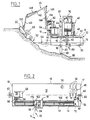
- the service pontoon comprises a shell 10 with a flat bottom, the bridge 12 substantially horizontal and generally rectangular in shape defines a platform carrying various pontoon equipment.
- the bridge (or plate) 12 is provided with a guide track extending longitudinally relative to the pontoon and consisting of two rails 14, 16 in lateral position relative to the plate (the rail 14 being placed in the immediate vicinity of the plating 13 from the pontoon).
- a crew is mounted on the guideway mobile tool holder 18 having an articulated arm 20, itself carrying a cutting tool 22, in this case a brush cutter tool.
- the articulated arm 20 (of which only the foot fitting 24 is illustrated in FIG. 2) is pivotally mounted relative to the vertical on a fastener 26 arranged along of the rear side wall 28 of the control cabin 30 of the mobile assembly 18.
- the service pontoon is provided with two anchoring piles equipped with vertical lifting means, a front pile 32 and a rear pile 34, each mounted in a guide well 36, 38 crossing the pontoon near the front edges 17 and rear 19 of it.
- the two anchoring piles of the pontoon 32, 34 are arranged parallel to the guide track near the rail 16, at the front 17 and at the rear 19 of the pontoon 10. This configuration is well suited to cutting work with a large lateral reach of the articulated arm (of the order of 10 meters).
- Each anchor pile 32, 34 is equipped with its vertical lifting means consisting essentially of a hydraulic cylinder 44.
- the front pile 32 the only one visible in FIG.
- the cylinder 44 is double-acting to allow, in addition to the lifting vertical of the pile, the assisted descent of it.
- the cylinder can be single rod or type telescopic better suited for great depths.
- the use of a double-acting cylinder makes it possible to accelerate the descent of the piles and to provide a thrust force on the bottom at the end of the descent to improve anchoring and adjust the attitude. of the pontoon relative to the horizontal plane.
- the assembly formed by the pile, its lifting means and its jib is removable and capable of being moved in a unitary manner by a collapsible telescopic crane 46 (not illustrated in FIG. 2), the base 48 of which is slidably mounted. on runners 50 arranged at the front of the pontoon on the port or external side 15 as opposed to the starboard or internal side 13 directly opposite the bank 52 to be maintained from the water body 54.
- body of water covers without limitation any both bodies of standing water such as basins, lakes or canals, as bodies of running water such as rivers or the like).
- the pontoon To carry out the cutting, mowing, brush-cutting or trimming operation of the shrubs 53 of the bank 52, the pontoon must be positioned statically or fixed relative thereto, which is achieved by intermediate of the two anchor piles 32 and 34, the ends of which (each provided with a point 58) are planted in the bottom 60 of the water body.
- the pile 32 (once in the high position) is capable of being moved into another configuration, in particular the pile 32 is removed from the well 36 using the crane 46 then placed in the well 56 arranged as illustrated in FIGS. 1 and 2 near the port side plating 15 of the pontoon slightly aft of the slides 50, in a lateral position opposite that of the guide rails 14 and 16.
- the pontoon according to the invention described here is of the self-propelled type and comprises on the rear an adjustable hydraulic thruster 62 and on the front a hydraulic bow thruster 64 which can also be tilted and disposed in a vertical notch 66 formed in the before 17 of the pontoon.
- the thrusters 62 and 64 are of the propeller type.
- a hydraulic power unit with a thermal engine 68 is disposed at the rear of the pontoon and supplies hydraulic power to the two propeller thrusters 62 and 64, the crane 46, the cylinders of the piles 32 and 34 and optional equipment.
- An operating position in the cabin 70 is also arranged behind the pontoon above the hydraulic unit 68.
- the pontoon has equipment (not illustrated in the figures) allowing the recovery of floating debris, such as debris from brushcutting, more particularly a floating recovery and lifting belt and waste bins.
- the removable mat that can be moved using the crane 46 has three anchor points 72 on the pontoon at the starboard bow of the pontoon.
- the dimensions of the pontoon illustrated in FIGS. 1 and 2 are approximately 18 m for the length, 6 m for the width and 0.40 m for the draft, the piles equipped with telescopic cylinders offering a possibility of anchoring in the order of 5.5 m deep in the water.
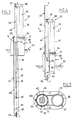
- FIGS. 3, 4 and 5 illustrate in detail an anchoring pile (for example pile 32) shown in the low end position in FIG. 3 and in the high end position in FIG. 4.
- anchoring pile for example pile 32
- the movable cylindrical tube 40 is hollow, split in the upper part by a longitudinal notch 74 and closed at the end of the foot by the tip 58 made of a cross of thick sheets. Just above the tip 58 is provided a waterproof compartment 80 for lightening.
- the internal cavity 82 of the hollow tube 40 communicates with the outside (air or water) through the open upper end 76 of the tube 40, the notch 74 and a plurality of openings 84 through the tube 40.
- the hydraulic jack for telescopic lifting 44 whose body 86 is suspended by means of a ball joint at the end of the horizontal beam 88 of the bracket 42 and the double telescopic rod 90, 91 of which is secured at its free end to the tube 40 by a diametrical transverse axis 92.
- the tube 40 is slidably mounted in a vertical guide well 36 crossing the pontoon 10.
- the tube 40 is also guided in an opening 93 formed in a sole 94 integral with the tubular mast 96 of the stem 42.
- On the outer wall of the tube 40 is welded a non-rotating guide rod 100 cooperating with a vertical groove 102 produced in the opening 93 and in the wall of the well 36.
- the sole 94 (shown in detail in FIG. 5) is fixed dismountably by means of six bolts 97 on the deck 12 of the pontoon, in the occurrence on a base 98 welded to the bridge 12 (during the movement of the pile 32 and its stem 42, the sole keeps the tube 40 in position relative to the stem 42).
- the double-acting lifting cylinder 44 is of the telescopic type with two rods 90 and 91 (it should be noted that the cylinder 44 shown in FIG. 5 in its axial position relative to the tube 40 is shown diagrammatically in this figure) .
- the cylinder stroke is around 4 meters allowing anchoring to a maximum water depth of around 5.5 meters.
- the jack 44 is capable of providing a maximum thrust force of the order of 5 tonnes (approximately 50,000 N).
- the effort provided is around 1.2 tonnes (approximately 12,000 N).
- the operation of the anchor piles 32 and 34 is controlled from the maneuvering or piloting station 70, the hydraulic power being supplied by the hydraulic unit 68.
- the hydraulic pile control circuit includes a set of hydraulic valves which allow the control of the pile descent and the blocking in position of the pile.
- the descent speed of the piles 32 and 34 is chosen to be around 1.7 m / min and the ascent speed to be around 4 m / min.
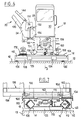
- the mobile assembly 18 comprises a longitudinal displacement carriage 104 slidably mounted on the rails 14 and 16 secured by crosspieces 106 to the deck 12 of the pontoon.
- the rails 14 and 16 which have a hollow square section, are arranged with respect to the pontoon with vertical and horizontal diagonals so that they have two sliding surfaces 108, 110 and 112, 114 in dihedral (in this case with an angle of 90 °) cooperating with complementary sliding surfaces, in this case shoes made of a material with a low coefficient of friction such as PTFE (polytetrafluoroethylene) suitably fixed to slides (or shoe boxes) secured to the carriage 104.
- PTFE polytetrafluoroethylene
- each longitudinal rail cooperates with two slides , the slides 120 and 124 for the rail 14.
- the purpose of this arrangement with a dihedral sliding surface is to prevent the tilting of the mobile assembly when the articulated arm 20 is d bent.
- a frame 126 supporting a hydraulic group 128 driven by a heat engine 130 and the control cabin 30 of the moving element 18 in the raised position.
- a frame 126 hooking lugs 132, 134 of the articulated arm 20 to which is fixed the attachment piece 26 carrying a vertical axis 136 on which pivots the foot fitting 24 of the articulated arm (the pivot angle of the fitting 24, therefore of the articulated arm, relative to the frame 126 is controlled by a hydraulic cylinder not shown).
- the frame 126 carries a hydraulic tank 135 also acting as a counterweight.
- the articulated arm 20 and the cutting tool 22 are of known types commonly used in land use (for example coupled to a tractor) and will not be described in detail below.
- the arm 20 comprises three articulated elements 138, 140 and 142 whose relative positions are controlled by three hydraulic cylinders 144, 146 and 148 to obtain a maximum lateral range of the order of 10 meters.
- the cutting tool also known in the art, of the rotor type is adjustable by a jack 150, the cutting width being of the order of 1.20 meters.
- the rotor 22 is equipped with articulated flails arranged in several alignments along the generatrices of the rotor. The flails are interchangeable and of various models (with blades or knives) according to the envisaged work, mowing or brush-cutting.
- the lower part of the frame 126 has two rails 152 and 154 similar to the rails 14 and 16 of the guide track but arranged perpendicular to them.
- the rails 152 and 154 slide on skid boxes, at the rate of two boxes per rail, fixed to the carriage 104 and similar to those constituted by the slides 120 and 122 (only the boxes 156, 158, 160 are visible in Figures 6 and 7).
- a hydraulic cylinder 162 suitably mounted between a double tab 164 secured to the frame 126 and a double tab 166 secured to the carriage 104 controls the movements sides of the frame 126 on the sliding mechanism thus formed.
- the frame (cylinder 162 retracted) is in the position of maximum lateral offset (of the order of 0.6 meters relative to the plate 12), the extension of the cylinder 162 causing the "retraction" of the frame 126 by a movement to the right of FIG. 7.
- the mechanism for lateral displacement of the frame has a double advantage, that of gaining scope for mowing or cutting and that of allowing the complete folding of the mobile assembly inside the pontoon, in particular for passing through narrow tracks, for example in a lock.
- the translation of the movable assembly 18 along the longitudinal rails 14 and 16 is ensured by a pinion-rack type device.
- the rack 168 fixed on the crosspieces 106 parallel to the rails 14 and 16 of the longitudinal guide track is produced by bolts 170 crossing the wings of a beam 172 of UPN type.
- Split elastic pins mounted on the bolts 170 act as chain rollers.
- the pinion 174, of the chain pinion type is mounted on the carriage and is rotated by a slow hydraulic piston motor 176, a braking system of the disc brake type being integrated in the motor 176.
- the mobile assembly 18 is capable of moving at slow speed up to a maximum speed of 0.5 m / s (i.e. 25 rpm for the hydraulic motor 176) to ensure rapid return of the moving element, the cutting tool 22 n 'being really effective only in one direction of movement of the moving element 18 in this case from the rear 19 towards the front of the pontoon 17.
- control cabin 30 In the control cabin 30 are gathered all the command and control members of the mobile assembly, in particular of the engine assembly 130, of the hydraulic unit 128, of the longitudinal movement of the carriage 104, of the offset of the frame 126, of the manipulation of the articulated arm 20 and of the movements and of the drive of the rotor of the cutting tool 22.
- the mobile assembly 18 is thus made completely autonomous with respect to the other pontoon maneuvering commands, gathered in the maneuvering cabin and piloting 70 (controls of the hydraulic unit 68, of the hydraulic thrusters 62 and 64 and of the pile cylinders 44).
- the front pile 32 once reassembled is removed from the well 36 and placed in the well 56 using the telescopic crane 46 (an attachment point 87 is provided for this purpose on the horizontal part 88 of the bracket 42 to the right of the axis of the tube 40).
- the floating recovery belt (not shown), the waste thus recovered being directed to a bucket placed provisionally on the guide rails at the exit of the belt.
- the deck 12 of the pontoon has sufficient space between the cabin 70 and the crane 46-48 (see FIG. 2) to accommodate the recovery belt and some waste bins awaiting use.
- the front pile 32 is placed in the external front well 56 on the port side, which allows to leave permanently the recovery belt in the working position.
- the invention is not limited by the type of tool used, or by the model of guide rails or by the type of lifting anchor pile (in particular at the level of its lifting control) here. described by way of nonlimiting example.
- the cutting tool can be changed or modified for mowing aquatic weeds or replaced by a broom roller for sweeping paths on the bank or docks.
Landscapes
- Engineering & Computer Science (AREA)
- Civil Engineering (AREA)
- Structural Engineering (AREA)
- Mining & Mineral Resources (AREA)
- General Engineering & Computer Science (AREA)
- Mechanical Engineering (AREA)
- Architecture (AREA)
- Chemical & Material Sciences (AREA)
- Combustion & Propulsion (AREA)
- Ocean & Marine Engineering (AREA)
- Harvester Elements (AREA)
Applications Claiming Priority (2)
| Application Number | Priority Date | Filing Date | Title |
|---|---|---|---|
| FR9211776A FR2696412B1 (fr) | 1992-10-05 | 1992-10-05 | Ponton de service. |
| FR9211776 | 1992-10-05 |
Publications (1)
| Publication Number | Publication Date |
|---|---|
| EP0592268A1 true EP0592268A1 (de) | 1994-04-13 |
Family
ID=9434145
Family Applications (1)
| Application Number | Title | Priority Date | Filing Date |
|---|---|---|---|
| EP93402314A Withdrawn EP0592268A1 (de) | 1992-10-05 | 1993-09-22 | Arbeitsleichter |
Country Status (2)
| Country | Link |
|---|---|
| EP (1) | EP0592268A1 (de) |
| FR (1) | FR2696412B1 (de) |
Cited By (9)
| Publication number | Priority date | Publication date | Assignee | Title |
|---|---|---|---|---|
| GB2354489A (en) * | 1999-09-23 | 2001-03-28 | Brian Boner | Work boat with hydraulically controlled boom |
| NL1020674C2 (nl) * | 2002-05-24 | 2003-11-27 | Jacobus Maria Josef Hofland | Inrichting en werkwijze voor het aan land brengen of vlot brengen van een drijflichaam. |
| RU2418136C1 (ru) * | 2009-10-05 | 2011-05-10 | Федеральное государственное унитарное предприятие "Российский Федеральный Ядерный Центр - Всероссийский Научно-Исследовательский Институт Технической Физики имени академика Е.И. Забабахина" (ФГУП "РФЯЦ-ВНИИТФ им. академ. Е.И. Забабахина") | Устройство для механической очистки дна бассейна выдержки, заполненного водой и кассетами с отвс |
| WO2018166522A1 (zh) * | 2017-03-17 | 2018-09-20 | 王燏斌 | 一种用于驳岸的施工装置及其施工法 |
| WO2018166521A1 (zh) * | 2017-03-17 | 2018-09-20 | 王燏斌 | 一种用于岸边基础的施工装置及其施工法 |
| CN113863415A (zh) * | 2021-10-27 | 2021-12-31 | 广州文冲船厂有限责任公司 | 一种活动平台的支撑装置及其安装方法 |
| US11674286B2 (en) | 2016-08-12 | 2023-06-13 | J.F. Brennan Company, Inc. | Dredge head assembly and related diver-assisted dredging system and methods |
| CN118547624A (zh) * | 2024-05-28 | 2024-08-27 | 中国长江电力股份有限公司 | 一种库坝深水作业平台及作业方法 |
| CN118830395A (zh) * | 2024-08-05 | 2024-10-25 | 江苏省工程勘测研究院有限责任公司 | 一种河道堤岸边坡清洁装置 |
Families Citing this family (1)
| Publication number | Priority date | Publication date | Assignee | Title |
|---|---|---|---|---|
| CN113186999B (zh) * | 2021-04-30 | 2024-11-19 | 中交四航工程研究院有限公司 | 一种水下混凝土底板渗漏检测及修补设备 |
Citations (5)
| Publication number | Priority date | Publication date | Assignee | Title |
|---|---|---|---|---|
| GB191015450A (en) * | 1910-06-28 | 1911-02-23 | Wm Simons & Company Ltd | Improvements in Dredgers. |
| DE2203928B1 (de) * | 1972-01-28 | 1973-06-28 | Deggendorfer Werft Eisenbau | Schwimmbagger mit greiferbaggereinrichtung |
| US4073078A (en) * | 1975-11-03 | 1978-02-14 | Leitz Julius H | Adjustable dredging and trenching apparatus |
| EP0133324A2 (de) * | 1983-08-08 | 1985-02-20 | FERCOS di PIZZIRANI, Cesare | Lastkraftwagen, besonders ausgestattet zum Reinigen von Gräben |
| DE3441452A1 (de) * | 1984-09-17 | 1986-03-20 | Alfred Kunz GmbH & Co, 8000 München | Verfahren und vorrichtung zum raeumen und vertiefen von stauseen, hafenbecken, kanaelen, flussbetten o.dgl. |
-
1992
- 1992-10-05 FR FR9211776A patent/FR2696412B1/fr not_active Expired - Fee Related
-
1993
- 1993-09-22 EP EP93402314A patent/EP0592268A1/de not_active Withdrawn
Patent Citations (5)
| Publication number | Priority date | Publication date | Assignee | Title |
|---|---|---|---|---|
| GB191015450A (en) * | 1910-06-28 | 1911-02-23 | Wm Simons & Company Ltd | Improvements in Dredgers. |
| DE2203928B1 (de) * | 1972-01-28 | 1973-06-28 | Deggendorfer Werft Eisenbau | Schwimmbagger mit greiferbaggereinrichtung |
| US4073078A (en) * | 1975-11-03 | 1978-02-14 | Leitz Julius H | Adjustable dredging and trenching apparatus |
| EP0133324A2 (de) * | 1983-08-08 | 1985-02-20 | FERCOS di PIZZIRANI, Cesare | Lastkraftwagen, besonders ausgestattet zum Reinigen von Gräben |
| DE3441452A1 (de) * | 1984-09-17 | 1986-03-20 | Alfred Kunz GmbH & Co, 8000 München | Verfahren und vorrichtung zum raeumen und vertiefen von stauseen, hafenbecken, kanaelen, flussbetten o.dgl. |
Cited By (12)
| Publication number | Priority date | Publication date | Assignee | Title |
|---|---|---|---|---|
| GB2354489A (en) * | 1999-09-23 | 2001-03-28 | Brian Boner | Work boat with hydraulically controlled boom |
| GB2354489B (en) * | 1999-09-23 | 2003-03-12 | Brian Boner | Work boat having a hydraulically controlled boom assembly |
| NL1020674C2 (nl) * | 2002-05-24 | 2003-11-27 | Jacobus Maria Josef Hofland | Inrichting en werkwijze voor het aan land brengen of vlot brengen van een drijflichaam. |
| EP1365075A3 (de) * | 2002-05-24 | 2004-04-07 | Jacobus Maria Josef Hofland | Einrichtung und Methode zum Festsetzen oder Freilegen eines schwimmenden Körpers auf einem Gewässergrund |
| US7188440B2 (en) | 2002-05-24 | 2007-03-13 | Jacobus Maria Josef Hofland | Device and method for bringing ashore or refloating a floating body |
| RU2418136C1 (ru) * | 2009-10-05 | 2011-05-10 | Федеральное государственное унитарное предприятие "Российский Федеральный Ядерный Центр - Всероссийский Научно-Исследовательский Институт Технической Физики имени академика Е.И. Забабахина" (ФГУП "РФЯЦ-ВНИИТФ им. академ. Е.И. Забабахина") | Устройство для механической очистки дна бассейна выдержки, заполненного водой и кассетами с отвс |
| US11674286B2 (en) | 2016-08-12 | 2023-06-13 | J.F. Brennan Company, Inc. | Dredge head assembly and related diver-assisted dredging system and methods |
| WO2018166522A1 (zh) * | 2017-03-17 | 2018-09-20 | 王燏斌 | 一种用于驳岸的施工装置及其施工法 |
| WO2018166521A1 (zh) * | 2017-03-17 | 2018-09-20 | 王燏斌 | 一种用于岸边基础的施工装置及其施工法 |
| CN113863415A (zh) * | 2021-10-27 | 2021-12-31 | 广州文冲船厂有限责任公司 | 一种活动平台的支撑装置及其安装方法 |
| CN118547624A (zh) * | 2024-05-28 | 2024-08-27 | 中国长江电力股份有限公司 | 一种库坝深水作业平台及作业方法 |
| CN118830395A (zh) * | 2024-08-05 | 2024-10-25 | 江苏省工程勘测研究院有限责任公司 | 一种河道堤岸边坡清洁装置 |
Also Published As
| Publication number | Publication date |
|---|---|
| FR2696412A1 (fr) | 1994-04-08 |
| FR2696412B1 (fr) | 1994-12-02 |
Similar Documents
| Publication | Publication Date | Title |
|---|---|---|
| US4713896A (en) | Inshore submersible amphibious machines | |
| EP0017593B1 (de) | Gerät zum Ausbaggern von Teichen, Morasten oder Gräben | |
| US8262423B2 (en) | Method for performing overhead work using air-propelled vessel with articulating member | |
| FR2472058A1 (fr) | Procede et appareil pour creuser dans le sol des tranchees a parois paralleles a peu pres verticales | |
| EP0592268A1 (de) | Arbeitsleichter | |
| EP1156163B1 (de) | Selbstschwimmende Erdbewegungsmaschine | |
| DE3524616A1 (de) | Wasserfahrzeug | |
| EP0177388B1 (de) | Grassmaschine für weichen oder unebenen Untergrund, insbesondere zum Reinigen von Teichen, Marschen oder Kanälen | |
| WO2006138617A2 (en) | Top loading wedge with adjustably engageable bottom apparatus and method | |
| NL1020674C2 (nl) | Inrichting en werkwijze voor het aan land brengen of vlot brengen van een drijflichaam. | |
| FI87822B (fi) | Dikesgraevmaskin | |
| FR2705630A1 (fr) | Engin de transport de charges d'encombrement important équipé d'une plate-forme orientable support de la charge. | |
| FR2718169A1 (fr) | Engin de façonnage et/ou de remise en état de bas-côtés. | |
| FR2631895A1 (fr) | Engin automoteur amphibie pour l'entretien et l'exploitation des plans d'eau | |
| FR3115524A1 (fr) | Plateforme nautique de nettoyage de crassats | |
| JPH04135425A (ja) | 樹木移植装置付自走式主動機および樹木移植施工法 | |
| WO1987005878A1 (en) | Inshore submersible amphibious machines | |
| EP0085790B1 (de) | Bauzug zur Erneuerung einer Eisenbahnschienenstrecke | |
| NL8202805A (nl) | Amfibisch voer- en vaartuig. | |
| JPH05209421A (ja) | 浅水域用掘削及び運搬システム | |
| FR2850987A1 (fr) | Engin amphibie de travaux publics | |
| FR2795041A1 (fr) | Dispositif pour maintenir un bateau dans une relation d'ecartement controle par rapport a une structure rectiligne | |
| BE534110A (de) | ||
| BE530814A (de) | ||
| FR3019567A1 (fr) | Machine pour le betonnage en continu de fosses munie d'un treuil |
Legal Events
| Date | Code | Title | Description |
|---|---|---|---|
| PUAI | Public reference made under article 153(3) epc to a published international application that has entered the european phase |
Free format text: ORIGINAL CODE: 0009012 |
|
| AK | Designated contracting states |
Kind code of ref document: A1 Designated state(s): BE CH DE LI NL |
|
| 17P | Request for examination filed |
Effective date: 19940616 |
|
| 17Q | First examination report despatched |
Effective date: 19950614 |
|
| STAA | Information on the status of an ep patent application or granted ep patent |
Free format text: STATUS: THE APPLICATION IS DEEMED TO BE WITHDRAWN |
|
| 18D | Application deemed to be withdrawn |
Effective date: 19951228 |