EP0592381A1 - Appareil d'anesthésie - Google Patents
Appareil d'anesthésie Download PDFInfo
- Publication number
- EP0592381A1 EP0592381A1 EP93850187A EP93850187A EP0592381A1 EP 0592381 A1 EP0592381 A1 EP 0592381A1 EP 93850187 A EP93850187 A EP 93850187A EP 93850187 A EP93850187 A EP 93850187A EP 0592381 A1 EP0592381 A1 EP 0592381A1
- Authority
- EP
- European Patent Office
- Prior art keywords
- gas
- patient
- conduit
- connection
- respiratory
- Prior art date
- Legal status (The legal status is an assumption and is not a legal conclusion. Google has not performed a legal analysis and makes no representation as to the accuracy of the status listed.)
- Withdrawn
Links
- 206010002091 Anaesthesia Diseases 0.000 title claims abstract description 15
- 238000001949 anaesthesia Methods 0.000 title claims abstract description 15
- 230000037005 anaesthesia Effects 0.000 title claims abstract description 15
- 239000007789 gas Substances 0.000 claims abstract description 111
- CURLTUGMZLYLDI-UHFFFAOYSA-N Carbon dioxide Chemical compound O=C=O CURLTUGMZLYLDI-UHFFFAOYSA-N 0.000 claims abstract description 46
- 229910002092 carbon dioxide Inorganic materials 0.000 claims abstract description 23
- 239000001569 carbon dioxide Substances 0.000 claims abstract description 23
- 208000010513 Stupor Diseases 0.000 claims abstract description 20
- 230000000241 respiratory effect Effects 0.000 claims abstract description 20
- 239000006096 absorbing agent Substances 0.000 claims abstract description 17
- MYMOFIZGZYHOMD-UHFFFAOYSA-N Dioxygen Chemical compound O=O MYMOFIZGZYHOMD-UHFFFAOYSA-N 0.000 claims abstract description 11
- 206010020952 Hypocapnia Diseases 0.000 claims abstract description 11
- 229910001882 dioxygen Inorganic materials 0.000 claims abstract description 11
- 230000029058 respiratory gaseous exchange Effects 0.000 claims abstract description 9
- 238000000034 method Methods 0.000 claims abstract 2
- 230000037396 body weight Effects 0.000 claims description 7
- 230000001020 rhythmical effect Effects 0.000 claims description 4
- 230000009286 beneficial effect Effects 0.000 claims 1
- QVGXLLKOCUKJST-UHFFFAOYSA-N atomic oxygen Chemical compound [O] QVGXLLKOCUKJST-UHFFFAOYSA-N 0.000 abstract description 6
- 239000001301 oxygen Substances 0.000 abstract description 6
- 229910052760 oxygen Inorganic materials 0.000 abstract description 6
- 239000000203 mixture Substances 0.000 description 11
- 210000002445 nipple Anatomy 0.000 description 5
- 238000010276 construction Methods 0.000 description 3
- 230000000694 effects Effects 0.000 description 3
- 230000036391 respiratory frequency Effects 0.000 description 3
- 238000009423 ventilation Methods 0.000 description 3
- 230000006978 adaptation Effects 0.000 description 2
- 230000001276 controlling effect Effects 0.000 description 2
- 208000000122 hyperventilation Diseases 0.000 description 2
- 230000000870 hyperventilation Effects 0.000 description 2
- 210000004072 lung Anatomy 0.000 description 2
- 239000000463 material Substances 0.000 description 2
- VUZPPFZMUPKLLV-UHFFFAOYSA-N methane;hydrate Chemical compound C.O VUZPPFZMUPKLLV-UHFFFAOYSA-N 0.000 description 2
- 210000000056 organ Anatomy 0.000 description 2
- 230000001105 regulatory effect Effects 0.000 description 2
- 230000002269 spontaneous effect Effects 0.000 description 2
- XLYOFNOQVPJJNP-UHFFFAOYSA-N water Substances O XLYOFNOQVPJJNP-UHFFFAOYSA-N 0.000 description 2
- OKTJSMMVPCPJKN-UHFFFAOYSA-N Carbon Chemical compound [C] OKTJSMMVPCPJKN-UHFFFAOYSA-N 0.000 description 1
- 239000011358 absorbing material Substances 0.000 description 1
- 238000010521 absorption reaction Methods 0.000 description 1
- 238000013459 approach Methods 0.000 description 1
- 239000008280 blood Substances 0.000 description 1
- 210000004369 blood Anatomy 0.000 description 1
- 238000009530 blood pressure measurement Methods 0.000 description 1
- 229910052799 carbon Inorganic materials 0.000 description 1
- 230000001419 dependent effect Effects 0.000 description 1
- 238000001035 drying Methods 0.000 description 1
- 230000004060 metabolic process Effects 0.000 description 1
- 210000004400 mucous membrane Anatomy 0.000 description 1
- 238000006213 oxygenation reaction Methods 0.000 description 1
- 210000001519 tissue Anatomy 0.000 description 1
- 239000012780 transparent material Substances 0.000 description 1
Images
Classifications
-
- A—HUMAN NECESSITIES
- A61—MEDICAL OR VETERINARY SCIENCE; HYGIENE
- A61M—DEVICES FOR INTRODUCING MEDIA INTO, OR ONTO, THE BODY; DEVICES FOR TRANSDUCING BODY MEDIA OR FOR TAKING MEDIA FROM THE BODY; DEVICES FOR PRODUCING OR ENDING SLEEP OR STUPOR
- A61M16/00—Devices for influencing the respiratory system of patients by gas treatment, e.g. ventilators; Tracheal tubes
- A61M16/0045—Means for re-breathing exhaled gases, e.g. for hyperventilation treatment
-
- A—HUMAN NECESSITIES
- A61—MEDICAL OR VETERINARY SCIENCE; HYGIENE
- A61M—DEVICES FOR INTRODUCING MEDIA INTO, OR ONTO, THE BODY; DEVICES FOR TRANSDUCING BODY MEDIA OR FOR TAKING MEDIA FROM THE BODY; DEVICES FOR PRODUCING OR ENDING SLEEP OR STUPOR
- A61M16/00—Devices for influencing the respiratory system of patients by gas treatment, e.g. ventilators; Tracheal tubes
- A61M16/0057—Pumps therefor
- A61M16/0081—Bag or bellow in a bottle
-
- A—HUMAN NECESSITIES
- A61—MEDICAL OR VETERINARY SCIENCE; HYGIENE
- A61M—DEVICES FOR INTRODUCING MEDIA INTO, OR ONTO, THE BODY; DEVICES FOR TRANSDUCING BODY MEDIA OR FOR TAKING MEDIA FROM THE BODY; DEVICES FOR PRODUCING OR ENDING SLEEP OR STUPOR
- A61M16/00—Devices for influencing the respiratory system of patients by gas treatment, e.g. ventilators; Tracheal tubes
- A61M16/10—Preparation of respiratory gases or vapours
- A61M16/104—Preparation of respiratory gases or vapours specially adapted for anaesthetics
-
- A—HUMAN NECESSITIES
- A61—MEDICAL OR VETERINARY SCIENCE; HYGIENE
- A61M—DEVICES FOR INTRODUCING MEDIA INTO, OR ONTO, THE BODY; DEVICES FOR TRANSDUCING BODY MEDIA OR FOR TAKING MEDIA FROM THE BODY; DEVICES FOR PRODUCING OR ENDING SLEEP OR STUPOR
- A61M16/00—Devices for influencing the respiratory system of patients by gas treatment, e.g. ventilators; Tracheal tubes
- A61M16/0057—Pumps therefor
- A61M16/0075—Bellows-type
Definitions
- the present invention relates to an anaesthesia apparatus of the type defined in the preamble of claim 1.
- the apparatus used in modern medical treatment for administering narcosis to a patient basically comprises two different main types.
- the first main type which works according to the so-called Bain-system
- fresh gas and thus oxygen is supplied for the patient's metabolism as well as anaesthesia gas for the narcosis, via a separate conduit which is connected close to the connection of the apparatus to the patient.
- a conduit having a certain volume is connected to the patient, said conduit receiving exhaled air during exhalation, said exhaled air in addition to the elements of the supplied gas comprising carbon dioxide and water vapour produced by the patient.
- a certain part of the exhaled air is sucked back from the latter conduit together with the fresh gas supplied via the particular conduit.
- the carbon dioxide supplied from the patient is removed in an absorber, through which the exhaled air is allowed to circulate.
- the exhaled air is directed into the absorber and the gas, purified from carbon dioxide, is directed through a second valve in a direction towards the connection location to the patient for re-inhalation.
- fresh gas is added as a replacement for the gas which is taken-up by the patient.
- a ventilator can also be used with the circle system for producing rhythmic pressure changes to assist or replace the patient's spontaneous respiration.
- the Bain-system is significantly simpler in its construction than the circle system, particularly due to fact that there is no absorber and thus no consumption of CO2-absorbing material either.
- the inhaled gas comprises a certain amount of carbon dioxide and also moisture.
- a part of the inhaled gas consists of exhaled gas which thus comprises carbon dioxide.
- a natural recirculation of the moisture from the respiratory passages is obtained, which contributes to the mucous membranes not drying out.
- the circle system is thus more complicated in its construction with double tubes at the patient connection and with directional valves for the gas in the absorber's circle system.
- the supplied gas lacks said carbon dioxide component to a higher degree than with the Bain-system. This results in a risk of hypocapnia or hyperventilation, an undesirable condition which occurs even in connection with normal respiratory volumes and frequencies.
- the carbon dioxide absorber however helps to warm and moisturize the gas.
- the aforesaid advantages of the Bain-system meant that it received a great deal of attention and also widespread use during a certain period.
- the consumption of fresh gas was however significantly larger when using the Bain-system than when using the circle system with which exhaled air is regenerated and which can constitute the inhaled gas to a large degree and whereby the need for fresh gas is reduced. Since consequently less fresh gas is supplied than with the Bain-system the release of surplus gas is also less.
- Surplus gas comprises anaesthesia gas not taken-up by the patient and this has to be dealt with in some way in a ventilation system and generally ends up in the air of the surroundings. With increased supply of gas there is also a risk for increased release into the locality where the patient is sleeping.
- an unfavourable effect on the environment of the surroundings as well as the working environment occurs, added to which are also the increased costs of gas consumption.
- the apparatus according to the invention can be characterized as representing a hybrid system whereby the advantages of the circle system with more limited consumption of gas are combined with the capacity of the Bain-system to give a certain self-regulation of the character of the inhaled gas in a form more suitable for the patient.
- the regulation itself gives the effect that this character of the inhaled air is maintained for a wide range of patients with differing physique.
- One advantage with the apparatus according to the invention is thus that the adjustment of the apparatus for adaptation of the same to various patients is simplified.
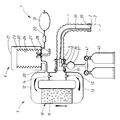
- reference numeral 1 denotes a connection tube with an outer end 2 to which the patient's respiratory organs are attached preferably by means of an oropharyngeal tube 3 indicated in dashed lines.
- the tube 1 is connected with its inner end 4 to the apparatus part of an anaesthesia apparatus which comprises a carbon dioxide absorber 5 having connection conduits and one-way valves, a bellows unit 6 with connection conduits and valve equipment as well as a ventilator 7 for producing artificial respiration for the patient when this is required.
- connection piece 10 which continues into a pipe 11 with two branches 12 and 13.
- branch 12 there is a one-way valve 14 which allows flow in one direction only (shown with an arrow in branch 12). The flow can thereby occur in the direction from the connection piece 10.
- a one-way valve 15 which allows flow in one direction only (shown with an arrow in branch 13) is placed in the branch 13. This flow direction is out towards the connection piece 10.
- the ventilator 7 for its part is connected to the outer chamber 23 in the bellows unit by means of a conduit 30.
- the active part of the bellows unit is shown here as a soft bladder 31 by means of which manual ventilation can occur upon rhythmic squashing of the bladder.
- the anaesthesia apparatus can, and is, suitably also connected to a ventilator machine which can be operated to give a rhythmical pressure variation with adjustable frequency.
- Hand ventilators as well as ventilator machines are well known in the art and therefore do not need to be described in further detail here. See for example US-A-3 307 542.
- a nipple 34 is positioned in the connection piece 10, to which nipple a thin tube 35 is connected, said tube being positioned in the larger tube 1.
- the tube 35 has its orifice at an open end 36 at the outer end 2 of the tube 1.
- Sources of narcosis gas and oxygen are connected to the nipple via a regulation device 37, said sources being represented by two gas cylinders 40 with connecting pipes as well as valve and pressure measurement means 41.
- the gas source is often a central system, to which connection occurs by means of fixedly arranged pipes.
- the regulation device 37 allows control of the quantities and proportions of the oxygen and narcosis gases which flow through the tube 35 via the nipple 34 and out to its open end 36. Measuring devices are suitably arranged for controlling the flow of gas.
- the outer end 2 of the tube 1 is connected to the patient preferably by means of the oropharyngeal tube 3.
- a mixture of narcosis gas and oxygen gas is supplied from the gas source 40 via the regulation device 37 and the nipple 34 and through the tube 35, from which the gas flows out through the open end 36.
- the outlet flow thus occurs in close proximity to the patient's respiratory passages and consequently the gas is supplied in a very direct manner without first having passed any gas-filled channels or chambers within the anaesthesia apparatus.
- correct amount is hereby to be understood that the supply of oxygen by means of the fresh gas should not exceed such an amount per unit of time that the gas mixture containing carbon dioxide, which is to be pulsed backwards and forwards in the tube 1, is suppressed to too high a degree.
- the oxygen gas must be supplied in such an amount that a sufficient oxygenation of the tissues of the patient is maintained.
- the amount of narcosis gas in turn must of course fulfil the requirement of keeping the patient asleep which occurs by the correct proportioning with respect to the total flow of fresh gas.
- the amount of inhaled gas mixture which is supplied to the patient per unit of time is dependent both on the volume in each respiratory cycle which is determined by the patient's bodily constitution and by the respiratory frequency which, with respiratory assistance, can be controlled with the help of the ventilator 7. How the respiration continues, independent of whether this is spontaneous or assisted, can be controlled by the movement of the bellows 22.
- An exhalation produces an overpressure in the system which propagates from the tube 1 via the valve 14 and the tube 20 to the chamber 24 so that the bellows lifts.
- an underpressure propagates during inhalation to the chamber 24 so that the bellows collapses.
- the volume per respiratory cycle and the respiratory frequency can be monitored for supplying artificial breathing assistance by means of the ventilator if this is required.
- the risk of hypocapnia is avoided in the present system as described by the return flow of exhaled gas which is collected from the tube 1.
- the volume in the tube 1 is however limited and at a certain volume of exhaled gas the tube 1 will be overfilled so that a surplus, which increases with increased volume of exhalation, will be passed into the tube 11 and via the valve 14 through the branch 12 and further through the absorber 18 to be sucked into the tube 1 via the branch 13 and the valve 15 at the next inhalation and in such a way can subsequently be used beneficially by the patient.
- the surplus which arises due to the successively supplied fresh gas and for which there is no room in the system will, as previously described, exit via the overflow valve 27.
- the system in the anaesthesia apparatus will function essentially in the same manner as the Bain-system with re-inhalation of non carbon dioxide-free inhalation air.
- a successively larger part of the exhaled air will, with increased volume, be regenerated in the absorber 18 in order to be re-supplied to the patient and does not need to be lost as with the Bain-system through the overflow valve.
- the reduced discharge means a reduced requirement of fresh gas which is that which should be achieved.
- the system can be used outside the range of 40-90 kg body weight, whereby with lower body weight it will function to a greater degree as a pure Bain-system whilst at higher body weights it will function similarly to the circle system. If it is deemed desirable the apparatus can be adapted to work as a hybrid between the Bain-system and the circle system as within the said range by adaptation of the volume in the tube 1. This can be particularly useful where larger volumes per unit of time are required. For patients outside the range to which the apparatus should be adapted, a regulation of the fresh gas supply per unit of time must be effected and determined according to the prevailing conditions.
Landscapes
- Health & Medical Sciences (AREA)
- Pulmonology (AREA)
- Life Sciences & Earth Sciences (AREA)
- Animal Behavior & Ethology (AREA)
- Anesthesiology (AREA)
- Biomedical Technology (AREA)
- Heart & Thoracic Surgery (AREA)
- Hematology (AREA)
- Emergency Medicine (AREA)
- Engineering & Computer Science (AREA)
- General Health & Medical Sciences (AREA)
- Public Health (AREA)
- Veterinary Medicine (AREA)
- Devices For Medical Bathing And Washing (AREA)
- Pharmaceuticals Containing Other Organic And Inorganic Compounds (AREA)
- Measurement Of The Respiration, Hearing Ability, Form, And Blood Characteristics Of Living Organisms (AREA)
- Respiratory Apparatuses And Protective Means (AREA)
Applications Claiming Priority (2)
| Application Number | Priority Date | Filing Date | Title |
|---|---|---|---|
| SE9202947 | 1992-10-07 | ||
| SE9202947A SE470487B (sv) | 1992-10-07 | 1992-10-07 | Anestesiapparat |
Publications (1)
| Publication Number | Publication Date |
|---|---|
| EP0592381A1 true EP0592381A1 (fr) | 1994-04-13 |
Family
ID=20387418
Family Applications (1)
| Application Number | Title | Priority Date | Filing Date |
|---|---|---|---|
| EP93850187A Withdrawn EP0592381A1 (fr) | 1992-10-07 | 1993-10-05 | Appareil d'anesthésie |
Country Status (2)
| Country | Link |
|---|---|
| EP (1) | EP0592381A1 (fr) |
| SE (1) | SE470487B (fr) |
Cited By (2)
| Publication number | Priority date | Publication date | Assignee | Title |
|---|---|---|---|---|
| GB2335604A (en) * | 1998-03-26 | 1999-09-29 | Eugenio Brugna | Anaesthesia apparatus |
| EP0904794A3 (fr) * | 1997-09-26 | 2000-01-12 | Ohmeda Inc. | Soufflet avec un système de remplissage automatique |
Citations (4)
| Publication number | Priority date | Publication date | Assignee | Title |
|---|---|---|---|---|
| FR2326943A1 (fr) * | 1975-10-07 | 1977-05-06 | Masson Yves Le | Respirateur generateur de carbogene |
| GB2025239A (en) * | 1978-05-17 | 1980-01-23 | Fukunaga A F | Anaesthetic device |
| US4188946A (en) * | 1977-10-07 | 1980-02-19 | Rayburn Robert L | Controllable partial rebreathing anesthesia circuit and respiratory assist device |
| US4596246A (en) * | 1984-02-24 | 1986-06-24 | Lyall Robert N | Method and apparatus for converting patient breathing system between circle and non-rebreathing configurations |
-
1992
- 1992-10-07 SE SE9202947A patent/SE470487B/sv not_active Application Discontinuation
-
1993
- 1993-10-05 EP EP93850187A patent/EP0592381A1/fr not_active Withdrawn
Patent Citations (4)
| Publication number | Priority date | Publication date | Assignee | Title |
|---|---|---|---|---|
| FR2326943A1 (fr) * | 1975-10-07 | 1977-05-06 | Masson Yves Le | Respirateur generateur de carbogene |
| US4188946A (en) * | 1977-10-07 | 1980-02-19 | Rayburn Robert L | Controllable partial rebreathing anesthesia circuit and respiratory assist device |
| GB2025239A (en) * | 1978-05-17 | 1980-01-23 | Fukunaga A F | Anaesthetic device |
| US4596246A (en) * | 1984-02-24 | 1986-06-24 | Lyall Robert N | Method and apparatus for converting patient breathing system between circle and non-rebreathing configurations |
Cited By (2)
| Publication number | Priority date | Publication date | Assignee | Title |
|---|---|---|---|---|
| EP0904794A3 (fr) * | 1997-09-26 | 2000-01-12 | Ohmeda Inc. | Soufflet avec un système de remplissage automatique |
| GB2335604A (en) * | 1998-03-26 | 1999-09-29 | Eugenio Brugna | Anaesthesia apparatus |
Also Published As
| Publication number | Publication date |
|---|---|
| SE9202947D0 (sv) | 1992-10-07 |
| SE9202947L (sv) | 1994-04-08 |
| SE470487B (sv) | 1994-05-30 |
Similar Documents
| Publication | Publication Date | Title |
|---|---|---|
| CA2109617C (fr) | Embout de catheter pour la ventilation intratracheale et la ventilation pulmonaire intratracheale | |
| EP0555343B1 (fr) | Dispositif de ventilation intratracheale et pulmonaire intratracheale | |
| EP0796119B1 (fr) | Respirateur | |
| US8667963B2 (en) | Ventilator circuit for oxygen generating system | |
| EP1499377B1 (fr) | Systeme de recirculation de gaz medical | |
| US20070163592A1 (en) | Gas reservoir bag, distributor housing, breathing mask, and respiration method | |
| CN109803703A (zh) | 麻醉释放和通气系统 | |
| US6718978B2 (en) | Manual ventilation bag | |
| JP2002532206A (ja) | 気管内気体吹送装置、吹送付属装置及び吹送気体供給法 | |
| US20180169369A1 (en) | Oxygen rebreathing apparatus and method for using the same | |
| CN116831842A (zh) | 一种高压氧舱供氧系统和高压氧舱监测系统 | |
| JP5759984B2 (ja) | 人工呼吸装置 | |
| US12318547B2 (en) | Apparatus for supplying therapeutic gas to a patient, with control of the pressure at the mask | |
| EP0592381A1 (fr) | Appareil d'anesthésie | |
| Bushman et al. | Closed circuit anaesthesia: a new approach | |
| CN215690758U (zh) | 新型麻醉科用麻醉器 | |
| Pablo | Anesthetic Machine | |
| CN116808369B (zh) | 一种自动补充调节二氧化碳作为呼吸气源的睡眠呼吸机 | |
| CN214970617U (zh) | 一种麻药挥发型呼吸麻醉机 | |
| Bihari et al. | Oxygen therapy, humidifiers and inhalation therapy | |
| EP4543516A1 (fr) | Appareil d'administration de gaz à des patients | |
| CN115154810A (zh) | 一种模拟调节人体的肺功能的自动装置 | |
| KR20250156102A (ko) | 수소 가스를 투여하기 위한 장치, 시스템 및 방법 | |
| JPH07116256A (ja) | 呼吸装置の通気管路 |
Legal Events
| Date | Code | Title | Description |
|---|---|---|---|
| PUAI | Public reference made under article 153(3) epc to a published international application that has entered the european phase |
Free format text: ORIGINAL CODE: 0009012 |
|
| AK | Designated contracting states |
Kind code of ref document: A1 Designated state(s): DE DK FR GB IT NL |
|
| STAA | Information on the status of an ep patent application or granted ep patent |
Free format text: STATUS: THE APPLICATION IS DEEMED TO BE WITHDRAWN |
|
| 18D | Application deemed to be withdrawn |
Effective date: 19941014 |