EP0592645B1 - Procede et dispositif de fabrication d'articles de decoration en polystyrene expanse - Google Patents
Procede et dispositif de fabrication d'articles de decoration en polystyrene expanse Download PDFInfo
- Publication number
- EP0592645B1 EP0592645B1 EP93909873A EP93909873A EP0592645B1 EP 0592645 B1 EP0592645 B1 EP 0592645B1 EP 93909873 A EP93909873 A EP 93909873A EP 93909873 A EP93909873 A EP 93909873A EP 0592645 B1 EP0592645 B1 EP 0592645B1
- Authority
- EP
- European Patent Office
- Prior art keywords
- punch
- blank
- blanks
- flat
- polystyrene
- Prior art date
- Legal status (The legal status is an assumption and is not a legal conclusion. Google has not performed a legal analysis and makes no representation as to the accuracy of the status listed.)
- Expired - Lifetime
Links
Images

Classifications
-
- B—PERFORMING OPERATIONS; TRANSPORTING
- B29—WORKING OF PLASTICS; WORKING OF SUBSTANCES IN A PLASTIC STATE IN GENERAL
- B29C—SHAPING OR JOINING OF PLASTICS; SHAPING OF MATERIAL IN A PLASTIC STATE, NOT OTHERWISE PROVIDED FOR; AFTER-TREATMENT OF THE SHAPED PRODUCTS, e.g. REPAIRING
- B29C44/00—Shaping by internal pressure generated in the material, e.g. swelling or foaming ; Producing porous or cellular expanded plastics articles
- B29C44/20—Shaping by internal pressure generated in the material, e.g. swelling or foaming ; Producing porous or cellular expanded plastics articles for articles of indefinite length
- B29C44/206—Using expandable particles or beads as starting material
-
- B—PERFORMING OPERATIONS; TRANSPORTING
- B29—WORKING OF PLASTICS; WORKING OF SUBSTANCES IN A PLASTIC STATE IN GENERAL
- B29C—SHAPING OR JOINING OF PLASTICS; SHAPING OF MATERIAL IN A PLASTIC STATE, NOT OTHERWISE PROVIDED FOR; AFTER-TREATMENT OF THE SHAPED PRODUCTS, e.g. REPAIRING
- B29C44/00—Shaping by internal pressure generated in the material, e.g. swelling or foaming ; Producing porous or cellular expanded plastics articles
- B29C44/34—Auxiliary operations
- B29C44/56—After-treatment of articles, e.g. for altering the shape
- B29C44/5627—After-treatment of articles, e.g. for altering the shape by mechanical deformation, e.g. crushing, embossing, stretching
- B29C44/5636—After-treatment of articles, e.g. for altering the shape by mechanical deformation, e.g. crushing, embossing, stretching with the addition of heat
-
- B—PERFORMING OPERATIONS; TRANSPORTING
- B29—WORKING OF PLASTICS; WORKING OF SUBSTANCES IN A PLASTIC STATE IN GENERAL
- B29C—SHAPING OR JOINING OF PLASTICS; SHAPING OF MATERIAL IN A PLASTIC STATE, NOT OTHERWISE PROVIDED FOR; AFTER-TREATMENT OF THE SHAPED PRODUCTS, e.g. REPAIRING
- B29C59/00—Surface shaping of articles, e.g. embossing; Apparatus therefor
- B29C59/02—Surface shaping of articles, e.g. embossing; Apparatus therefor by mechanical means, e.g. pressing
-
- B—PERFORMING OPERATIONS; TRANSPORTING
- B44—DECORATIVE ARTS
- B44B—MACHINES, APPARATUS OR TOOLS FOR ARTISTIC WORK, e.g. FOR SCULPTURING, GUILLOCHING, CARVING, BRANDING, INLAYING
- B44B5/00—Machines or apparatus for embossing decorations or marks, e.g. embossing coins
- B44B5/009—Machines or apparatus for embossing decorations or marks, e.g. embossing coins by multi-step processes
-
- B—PERFORMING OPERATIONS; TRANSPORTING
- B44—DECORATIVE ARTS
- B44B—MACHINES, APPARATUS OR TOOLS FOR ARTISTIC WORK, e.g. FOR SCULPTURING, GUILLOCHING, CARVING, BRANDING, INLAYING
- B44B5/00—Machines or apparatus for embossing decorations or marks, e.g. embossing coins
- B44B5/02—Dies; Accessories
- B44B5/028—Heated dies
-
- B—PERFORMING OPERATIONS; TRANSPORTING
- B44—DECORATIVE ARTS
- B44C—PRODUCING DECORATIVE EFFECTS; MOSAICS; TARSIA WORK; PAPERHANGING
- B44C3/00—Processes, not specifically provided for elsewhere, for producing ornamental structures
- B44C3/08—Stamping or bending
- B44C3/085—Stamping or bending stamping
-
- B—PERFORMING OPERATIONS; TRANSPORTING
- B29—WORKING OF PLASTICS; WORKING OF SUBSTANCES IN A PLASTIC STATE IN GENERAL
- B29C—SHAPING OR JOINING OF PLASTICS; SHAPING OF MATERIAL IN A PLASTIC STATE, NOT OTHERWISE PROVIDED FOR; AFTER-TREATMENT OF THE SHAPED PRODUCTS, e.g. REPAIRING
- B29C33/00—Moulds or cores; Details thereof or accessories therefor
- B29C33/56—Coatings, e.g. enameled or galvanised; Releasing, lubricating or separating agents
- B29C33/60—Releasing, lubricating or separating agents
-
- B—PERFORMING OPERATIONS; TRANSPORTING
- B29—WORKING OF PLASTICS; WORKING OF SUBSTANCES IN A PLASTIC STATE IN GENERAL
- B29C—SHAPING OR JOINING OF PLASTICS; SHAPING OF MATERIAL IN A PLASTIC STATE, NOT OTHERWISE PROVIDED FOR; AFTER-TREATMENT OF THE SHAPED PRODUCTS, e.g. REPAIRING
- B29C33/00—Moulds or cores; Details thereof or accessories therefor
- B29C33/56—Coatings, e.g. enameled or galvanised; Releasing, lubricating or separating agents
- B29C33/60—Releasing, lubricating or separating agents
- B29C33/62—Releasing, lubricating or separating agents based on polymers or oligomers
-
- B—PERFORMING OPERATIONS; TRANSPORTING
- B29—WORKING OF PLASTICS; WORKING OF SUBSTANCES IN A PLASTIC STATE IN GENERAL
- B29K—INDEXING SCHEME ASSOCIATED WITH SUBCLASSES B29B, B29C OR B29D, RELATING TO MOULDING MATERIALS OR TO MATERIALS FOR MOULDS, REINFORCEMENTS, FILLERS OR PREFORMED PARTS, e.g. INSERTS
- B29K2025/00—Use of polymers of vinyl-aromatic compounds or derivatives thereof as moulding material
-
- B—PERFORMING OPERATIONS; TRANSPORTING
- B29—WORKING OF PLASTICS; WORKING OF SUBSTANCES IN A PLASTIC STATE IN GENERAL
- B29K—INDEXING SCHEME ASSOCIATED WITH SUBCLASSES B29B, B29C OR B29D, RELATING TO MOULDING MATERIALS OR TO MATERIALS FOR MOULDS, REINFORCEMENTS, FILLERS OR PREFORMED PARTS, e.g. INSERTS
- B29K2105/00—Condition, form or state of moulded material or of the material to be shaped
- B29K2105/04—Condition, form or state of moulded material or of the material to be shaped cellular or porous
Definitions
- Decorative panels made of foam plastic approximately 75 x 75 cm in size and with a thickness of 5 - 20 mm, have long been installed in the interior for beautification and soundproofing. They are glued to a base with solvent-free glue. Experience has shown that customers prefer decorative panels that are made of 100% polystyrene foam plastic and whose visible surface is provided with a relief-like pattern. Such foam plastic sheets can be foamed in individual forms. According to this manufacturing process, they have a smooth and protection-insensitive surface that is no longer easily recognizable as foam plastic.
- This object is achieved in a method in which the decorating of the cut surface takes place in that the cut foam blanks are heated on one of their sides with a flat stamp heated to at least 125 ° C., provided with a relief that causes the decor, or in the case of profile strips by means of a Contours stamps following the last profile, briefly over the entire surface, ie deforming the entire side of the blank that presents the stamp, possibly with omission of marginal areas, the relief surface of the stamp being provided with an adhesion-preventing coating, preferably made of PTFE, and / or is provided with a release agent before pressing.
- a relief is pressed onto the blank for a short time over the entire surface (if necessary, omitting frame-like edges and using contoured profile side stamps).
- the surface of the blank has changed so that the individual cut polystyrene beads are fused together and form a compacted mass on the surface of the plate.
- the expert also calls this effect ironing or flattening, since the pores of the foam essentially close.
- a decorative panel produced according to the invention in particular in the case of relatively thin decorative panels, can have a bowl in the direction of the deformed decorative side due to the full-surface deformation and the fusion skin obtained in the process.
- Such "bowl” plates are very difficult to process with commercially available foam adhesives because always pull the corners of the decorative panels out of the still moist adhesive bed.
- the back of the plate is also pressed over the entire surface with a flat or relief die, whereby preferably the same process parameters are observed as for the Deformation of the front surface has already been selected. It is also possible to use a smooth but slightly convex die, so that if desired there is a slight cupping towards the back. It can be seen that after the back has been deformed, a stress-free, straight plate results.
- Liquid substances which, as is known, reduce the adhesive forces between the stamp surface and the polystyrene foam surface are preferably used as the release agent.
- Silicones in the form are suitable for this of oils, oil emulsions in water, metal soaps or fluorocarbons.
- the release agent is selected so that there is heat resistance in accordance with the selected parameters and there is no change in fire behavior due to the use of the release agent.
- a liquid release agent is preferably sprayed onto the unpressed surface of the blank. Subsequently, part of the release agent is transferred to the press die surface, so that, for example, a further 5 to 12 plate blanks can be pressed without further application of a release agent.
- Another interesting variant of the method is the possibility of sprinkling the surfaces of the blank to be pressed with a powder, platelet or granulate-like material before the pressing process and then connecting the granular material to the surface using the press ram, whereby a light superficial fusion can take place.
- Such materials can be, for example, so-called glitter plates, which are distributed over the surface at arbitrary tilt angles, so that an aesthetically interesting glitter effect results.
- a device for carrying out the method for producing decorative panels or decorative profiles is characterized by the features of claims 12 and 13, respectively.
- the blanks are preferably fixable on the stamping table by means of vacuum bores, which are introduced in a support plate of the stamping table, in which a vacuum pulls the blanks.
- This type of fixation is advantageous because, particularly in the case of plate-shaped blanks, the pressure is evened out over the surface takes place so that the stamp pressure is evenly distributed and does not require any intervention in the heated decorative surface.
- the end of the stamping table is preferably defined by a stop that can be lifted out vertically, which enables the blanks to be inserted and placed precisely at high speed.
- the stamp plate preferably consists of a heating plate and the stamp patrix which can be heated thereby, whereby thermocouples which serve to measure the temperature in the stamp patrix are embedded in the upper side of the stamp patrix plate facing the heating plate.
- the invention also relates to plates which were manufactured according to one of the preceding claims or features.
- the method can advantageously be used on relatively thin plates, ie those which are only about 3 to 19 mm thick after the pressing process.
- relatively thick plates for example 40 mm thick plates, are easy to manufacture, since such a solid plate is stiff and offers the possibility of holding the plate in place when the stamp is raised without being destroyed.
- there is no such possibility in the production of thin plates which are, however, particularly desirable because of the savings in material and the possibility of application.
- the hot embossing surface of the stamp melts when it is being lifted, especially from more structured plates, and thus destroys the entire plate in a fraction of a second. Holding the plate down, for example with metal rails around the entire edge of the plate, is not sufficient to fix the plate, since the center of a thin, flexible plate does not detach from the die quickly enough and thus bulges in the middle and is destroyed by melting.
- a block of several cubic meters in size is made from inflated, mutually adhering polystyrene beads using a blowing agent and at a temperature above 100 ° C. At this temperature, the polystyrene of these beads becomes soft enough that it can be inflated by the evaporating blowing agent, preferably pentane.
- the mold After the mold has been inflated and cooled, it is removed. After cooling, individual plate-shaped foam blanks 2 of small thickness are thermally cut from the block with a visible cut of the polystyrene beads located on the cut surface 3 of the blank. The thickness of the blanks essentially corresponds to the later thickness of the decorative panels.
- the cut foam blanks 2 are pressed on a flat side with a preferably rectangular or square flat stamp 1 heated to at least 125 ° C.
- the pressing takes place over the entire surface, ie the entire surface of the blank is deformed, an edge 4, which forms a frame, remains unformed on the outer edge.
- Such an edge 4 can also be dispensed with.
- the relief surface of the flat stamp which is provided with an adhesion-preventing coating, preferably made of PTFE, is preferably provided with a conventional release agent, for example a silicone oil.
- the pressure of the flat stamp is relatively low. It is between 1000 and 2000 N / m 2 (Pa).
- the pressing time is between 0.3 and 10 s, preferably 0.8-1.5 s.
- the temperature of the flat stamp surface in contact with the plate blank is between 125 ° and 200 ° C, preferably between 160 ° and 175 ° C.
- the parameters mentioned above can be varied within limits; a lower die temperature requires a longer press time and vice versa.
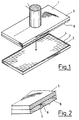
- Figures 1 and 2 show that the flat stamp 1 consists of two superimposed parts, namely a heating plate 5 and a male plate 6, which are also shown in section in Figure 2.
- Thermocouples 8, which face the heating plate, are embedded in recesses 7 of the male plate 6.
- the heating plate is covered with meandering electrical heating wires and can be controlled via a control circuit, the actual values of which are derived from the signals coming from the thermocouples 8.
- the depth of penetration of the flat stamp is preferably limited by a stop, so that a desired thickness of the decorative panels produced is retained in any case.
- the back of the plate can also be pressed over the entire surface with a flat or relief die, whereby essentially the same parameters are adhered to as have already been selected when pressing the front .
- the plate can also be guided through a pair of rollers under slight pressure, so that expansion folds, cracks and notches result, which, however, are closed again by the resilience forces inherent in the foam plastic as soon as the slight deformation is eliminated.
- the blank can also be embossed on both main surfaces simultaneously, preferably with the same parameters and decors, the two embossing dies embossing and demolding the blanks held only at the edge at exactly the same time.
- release agents can then be dispensed with, since adhesion forces are eliminated, as are the forces that hold the plate decorated on both sides straight.
- a finished decorative panel 2 with a decorated surface is shown in the figure, the structures of the polystyrene beads clearly showing in the side cut, but which are fused to the surface.
- the entire decorative surface is slightly deformed, the individual, cut and interconnected polystyrene beads of the decorative surface being fused through the top of the press ram.
- the visible edge of the surrounding skin of the cut foam beads and the visible core of the cut polystyrene beads are fused together.
- the surface is permanently deformed in accordance with the relief of the press ram without the edges of the cut polystyrene beads, which are less heat-sensitive in their structure, remain raised.
- the decorative surface is compacted with a closed-pore fusion skin.
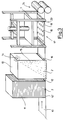
- a slide stack holder 11 which contains openings 12 or 12 ′ on its underside, can be passed under with a sliding plate 10, a blank 2 being introduced into the spray chamber 13 equipped with a corresponding opening.
- the blank plate in position 2 ' is adequately sprayed with a liquid release agent 15 using a spray head 14.
- the spray head 14 is switched off and the sliding plate 10 pushes in the next plate 2, which at the same time conveys the plate lying in position 2 'into the area in front of the pressing device 17.
- the sprayed plate then reaches with the Next stroke of the sliding plate 10, the stamp table 18, on which it is pushed until it stops 20.
- a vacuum is applied from below the plate via vacuum openings 19, which pulls the plate blank firmly onto the surface of the stamping table.
- the hot stamp 1 then moves down and presses the relief on, as has already been described. With the next stroke of the sliding plate 10, the plate is then ejected. It has been found that sufficient release agent comes from the first, sprayed stamp plate onto the surface of the stamp, so that the next 5 to 12 plate blanks can also be sufficiently separated from the stamp, since the small amount of the separating agent that is present practically removes the adhesion.
- the male plate can be exchanged in a simple manner without the entire pressing device having to be converted. So it is z. B. possible to attach a completely flat male plate with which very thin plate blanks can go through the cycle. In this way, so-called sub-wallpapers are obtained, which make it possible for a glued-on wallpaper to be removed again in a simple manner. Here there is a reduced paste adhesion and a wallpaper stripping effect is achieved.
- the release agent has a boiling point above 105 ° C and a long service life.
- the spraying time is, for example, only 1 s.
- the stop 20 can be moved up and down so that the plate can be ejected in a simple manner after the stamping process has ended.
- the pressing device 17 is followed by a roller station in which a restoring tension of the plates is released. This does result in small cracks and breaks; however, these are so small that they are not visible to the naked eye.
- FIG. 4 shows the application of the method to polystyrene profile parts.
- a stamp 1 ' which has a flat underside, is applied to a pre-shaped profile shape, for example a profile 21 with a C-shaped cross section, the curved surface bending horizontally and at the same time assuming the relief structure. If the stamp is removed again, the profile shape snaps back almost completely into the original shape, but has the surface quality that makes a closed-pore surface appear, as described at the beginning with the polystyrene foam sheets.
- the resulting decor is designated 22.
- the introduction of the decor 22 can be repeated. However, it is also possible to create a strip of 1 - 2 m length in one piece.
- Flat stamp surfaces and stamp surfaces adapted to the contour of the profile can be used.
Landscapes
- Engineering & Computer Science (AREA)
- Mechanical Engineering (AREA)
- Laminated Bodies (AREA)
- Shaping Of Tube Ends By Bending Or Straightening (AREA)
- Manufacture Of Porous Articles, And Recovery And Treatment Of Waste Products (AREA)
- Processing And Handling Of Plastics And Other Materials For Molding In General (AREA)
- Casting Or Compression Moulding Of Plastics Or The Like (AREA)
Claims (20)
- Procédé de fabrication d'articles décoratifs, à savoir de plaques et de baguettes profilées, en polystyrène cellulaire, comprenant les étapes opératoires suivantes :- fabrication, dans un moule, d'un bloc à partir de perles de polystyrène expansées adhérant les unes aux autres, à l'aide d'un agent de gonflement et à une température supérieure à la température de ramollissement du polystyrène,- après le refroidissement du bloc, découpage de différentes ébauches en forme de baguette ou de plaque avec coupe visible des perles de polystyrène se trouvant sur la surface de coupe de l'ébauche,- décoration d'une surface de coupe par formage à chaud et par compression,caractérisé par le fait que
les ébauches en mousse découpées sont comprimées sur l'un de leurs côtés, avec un poinçon plat (1) porté à une température d'au moins 125°C et pourvu d'un relief produisant le décor, dans le cas de baguettes profilées également au moyen d'un poinçon suivant les contours du profilé en forme de baguette, pendant une courte durée et sur toute la surface, c'est-à-dire en formant tout le côté de l'ébauche exposé au poinçon, éventuellement en omettant des zones situées au bord, la face en relief du poinçon étant pourvue d'un revêtement antiadhérant, de préférence en PTFE, et/ou étant dotée d'un agent de séparation avant la compression. - Procédé selon la revendication 1, caractérisé par le fait que la pression du poinçon plat est comprise entre 1000 et 2500 Pa.
- Procédé selon l'une des revendications précédentes, caractérisé par le fait que la durée de compression est comprise entre 0,3 et 10 secondes.
- Procédé selon l'une des revendications précédentes, caractérisé par le fait que la température de la surface du poinçon plat en contact avec l'ébauche de plaque est comprise entre 125 et 200 °C.
- Procédé selon l'une des revendications précédentes, caractérisé par le fait que la profondeur de pénétration du poinçon plat est limitée par une butée.
- Procédé selon l'une des revendications précédentes, caractérisé par le fait qu'après le formage du côté avant (décoré), on comprime également toute la surface du côté arrière de la baguette profilée ou de la plaque avec un poinçon plat ou pourvu d'un relief ou que l'ébauche est marquée simultanément sur deux faces principales.
- Procédé selon l'une des revendications précédentes, caractérisé par le fait qu'après le formage du côté avant (décoré), la plaque décorative traverse sous pression une paire de cylindres, des plis de dilatation, des fissures et/ou des entailles apparaissant sur la face décorée et produisant un relâchement de ladite face décorée.
- Procédé selon l'une des revendications précédentes, caractérisé par le fait que le matériau utilisé est du polystyrène cellulaire d'une densité spécifique de 0,015 à 0,020.
- Procédé selon l'une des revendications précédentes, caractérisé par le fait que l'agent de séparation est appliqué par pulvérisation sur la face (non comprimée) de la n-ème ébauche de plaque (n = 5 à 12) et se répartit à partir de là sur la surface en relief du poinçon.
- Procédé selon l'une des revendications précédentes, caractérisé par le fait qu'avant l'opération de compression, un matériau en poudre, en paillettes ou en granulés est répandu à la manière d'un ciel étoilé sur la face à comprimer de l'ébauche de plaque.
- Procédé selon la revendication 10, caractérisé par le fait que, lors de la compression, le matériau répandu se lie avec le matériau de la surface de l'ébauche de plaque en fondant partiellement.
- Dispositif pour la mise en oeuvre du procédé de fabrication de plaques décoratives à partir d'ébauches en forme de plaque avec coupe visible selon la revendication 1, caractérisé par :- un support de pile d'ébauches (11) d'où les ébauches en forme de plaque peuvent être prélevées individuellement,- une chambre de pulvérisation (13) pourvue d'une tête de pulvérisation (14) dirigée sur les ébauches, pour la pulvérisation d'un agent de séparation (15),- un plateau-support (18) sur lequel au moins une ébauche en forme de plaque peut être posée en étant fixée à plat, et- un poinçon de compression (10) chauffant qui permet de comprimer l'ébauche reposant sur le plateau-support.
- Dispositif pour la mise en oeuvre du procédé de fabrication de profilés décoratifs à partir d'ébauches profilées avec coupe visible, selon la revendication 1, caractérisé par :- une réserve dans laquelle les pièces profilées peuvent être prélevées,- une chambre de pulvérisation pourvue d'une tête de pulvérisation dirigée sur les ébauches pour la pulvérisation d'un agent de séparation,- un plateau-support sur lequel au moins une ébauche en forme de profilé peut être fixée, et- un poinçon de compression chauffant qui possède une surface profilée ou plane.
- Dispositif selon la revendication 10 ou 11, caractérisé par le fait que les ébauches peuvent être fixées sur le plateau-support à l'aide de perçages à vide qui sont ménagés dans le plateau-support du poinçon.
- Dispositif selon l'une des revendications 12 à 14, caractérisé par le fait que l'extrémité du plateau-support peut être définie par une butée (20) pouvant être soulevée verticalement.
- Dispositif selon l'une des revendications 12 à 15 précédentes, caractérisé par le fait que la plaque de poinçon se compose d'une plaque chauffante et d'une plaque de compression pouvant être chauffée par cette dernière et que des thermocouples (8) destinés à mesurer la température sont insérés dans le côté supérieur de la plaque de compression tourné vers la plaque chauffante.
- Dispositif selon l'une des revendications 12 à 16 précédentes, caractérisé par le fait qu'une paire de cylindres (24) est montée en aval du dispositif de compression (17).
- Plaque fabriquée selon l'une des revendications précédentes.
- Plaque selon la revendication 18, caractérisée par le fait qu'elle a une épaisseur de 3 à 19 mm après la compression.
- Baguette profilée fabriquée selon l'une des revendications précédentes.
Applications Claiming Priority (7)
| Application Number | Priority Date | Filing Date | Title |
|---|---|---|---|
| DE4214698 | 1992-05-02 | ||
| DE4214698 | 1992-05-02 | ||
| DE4226387 | 1992-08-03 | ||
| DE4226387 | 1992-08-03 | ||
| DE4234206 | 1992-10-10 | ||
| DE4234206A DE4234206A1 (de) | 1992-05-02 | 1992-10-10 | Verfahren zur herstellung von dekorplatten aus polystyrol-schaumstoff |
| PCT/EP1993/001054 WO1993022149A1 (fr) | 1992-05-02 | 1993-04-30 | Procede et dispositif de fabrication d'articles de decoration en polystyrene expanse |
Publications (2)
| Publication Number | Publication Date |
|---|---|
| EP0592645A1 EP0592645A1 (fr) | 1994-04-20 |
| EP0592645B1 true EP0592645B1 (fr) | 1996-07-10 |
Family
ID=27203702
Family Applications (1)
| Application Number | Title | Priority Date | Filing Date |
|---|---|---|---|
| EP93909873A Expired - Lifetime EP0592645B1 (fr) | 1992-05-02 | 1993-04-30 | Procede et dispositif de fabrication d'articles de decoration en polystyrene expanse |
Country Status (7)
| Country | Link |
|---|---|
| EP (1) | EP0592645B1 (fr) |
| AT (1) | ATE140191T1 (fr) |
| AU (1) | AU4063593A (fr) |
| DE (2) | DE4234206A1 (fr) |
| ES (1) | ES2089819T3 (fr) |
| PL (1) | PL172163B1 (fr) |
| WO (1) | WO1993022149A1 (fr) |
Families Citing this family (13)
| Publication number | Priority date | Publication date | Assignee | Title |
|---|---|---|---|---|
| DE4313334A1 (de) * | 1993-03-01 | 1994-09-08 | Linpac Technologie Gmbh | Schale zur Aufnahme von Nahrungsmitteln und Verfahren zur Herstellung derselben |
| EP0746473B1 (fr) * | 1994-02-22 | 1997-10-15 | INFRA-FOLIENKABEL GmbH | Procede et dispositif permettant de fabriquer des panneaux decoratifs en produit alveolaire |
| FR2726319B1 (fr) * | 1994-10-28 | 1997-01-17 | Tisserand Sa | Procede d'obtention de fermetures en pvc rigide expanse et fermeture obtenue par ledit procede |
| DE4439415A1 (de) * | 1994-11-04 | 1996-05-09 | Fraunhofer Ges Forschung | Dämmplatte aus nicht extrudiertem Hartschaumstoff für ein Umkehr-Dach |
| WO1996027505A1 (fr) * | 1995-03-03 | 1996-09-12 | Friedrich Wiegand Gmbh | Procede et equipement correspondant pour la fabrication de panneaux en tole |
| DE10003808C2 (de) * | 2000-01-28 | 2003-01-09 | Gefinex Jackon Gmbh | Oberflächenprägung von Kunststoffschaumplatten |
| DE10202180A1 (de) * | 2002-01-22 | 2003-07-31 | Infra Folienkabel Gmbh | Verfahren und Vorrichtung zur Herstellung von Dekoreckleisten |
| WO2004007088A1 (fr) * | 2002-07-13 | 2004-01-22 | 3M Innovative Properties Company | Articles polymeres structures |
| DE102004033535B4 (de) * | 2004-07-09 | 2009-01-08 | JOMA-Dämmstoffwerk Josef Mang GmbH & Co KG | Dämm- und/oder Drainageplatte und Verfahren zu ihrer Herstellung |
| EP1985463A1 (fr) * | 2007-04-24 | 2008-10-29 | Reinz-Dichtungs-Gmbh | Procédé de fabrication d'un outil d'estampage |
| CN112476927B (zh) * | 2020-11-09 | 2024-01-12 | 中山市新创能包装材料有限公司 | 一种铸造成型加工塑料泡沫模具处理系统 |
| EP4046775B1 (fr) * | 2021-02-19 | 2025-08-06 | GEKA GmbH | Procédé de décoration de surface et article obtenu par ledit procédé |
| IT202100005282A1 (it) * | 2021-03-08 | 2022-09-08 | Iltar Italbox Ind Riunite S P A | Pannello di copertura funzionale per un motore elettrico di un autoveicolo a propulsione elettrica e procedimento per la sua fabbricazione. |
Family Cites Families (10)
| Publication number | Priority date | Publication date | Assignee | Title |
|---|---|---|---|---|
| GB1190318A (en) * | 1967-08-18 | 1970-05-06 | Diarmuid O'riordain | Improvements in or relating to Compressible Rollers for Sheet Material Handling Apparatus and the like |
| US3608143A (en) * | 1970-04-08 | 1971-09-28 | Dart Ind Inc | Apparatus for making formed products |
| GB1477506A (en) * | 1975-05-06 | 1977-06-22 | Gt Enterprises Ltd | Method of moulding plastics materials |
| US4201818A (en) * | 1976-10-14 | 1980-05-06 | Mobil Oil Corporation | Flexible plastic foam |
| DE3019528A1 (de) * | 1980-05-22 | 1981-11-26 | Walter 8135 Söcking Brüser | Verfahren und vorrichtung zum einbringen von profilen in kunststoffplatten und -bloecke |
| US4353949A (en) * | 1981-04-08 | 1982-10-12 | The Celotex Corporation | Embossable coating and method of producing embossed coated substrate |
| DE3218527A1 (de) * | 1982-05-17 | 1983-11-17 | Kurt 4970 Bad Oeynhausen Varlemann | Selbststeuerndes hydraulisches umschalt-ventil fuer einen doppelwirkenden arbeitszylinder |
| US4493748A (en) * | 1984-01-06 | 1985-01-15 | Cross Carroll N | Process of making raised line imprinted display mounts |
| DE3538325A1 (de) * | 1985-10-28 | 1987-04-30 | Linnhoff & Thesenfitz Masch | Vorrichtung zum erwaermen und durchmischen von zur herstellung von strassenbelag verwendeten materialien |
| AT383543B (de) * | 1985-12-16 | 1987-07-10 | Rakoczy Jozef | Verfahren zum herstellen von reliefbildern |
-
1992
- 1992-10-10 DE DE4234206A patent/DE4234206A1/de not_active Withdrawn
-
1993
- 1993-04-30 AU AU40635/93A patent/AU4063593A/en not_active Abandoned
- 1993-04-30 DE DE59303190T patent/DE59303190D1/de not_active Expired - Lifetime
- 1993-04-30 AT AT93909873T patent/ATE140191T1/de not_active IP Right Cessation
- 1993-04-30 EP EP93909873A patent/EP0592645B1/fr not_active Expired - Lifetime
- 1993-04-30 PL PL93301961A patent/PL172163B1/pl not_active IP Right Cessation
- 1993-04-30 ES ES93909873T patent/ES2089819T3/es not_active Expired - Lifetime
- 1993-04-30 WO PCT/EP1993/001054 patent/WO1993022149A1/fr not_active Ceased
Also Published As
| Publication number | Publication date |
|---|---|
| ATE140191T1 (de) | 1996-07-15 |
| ES2089819T3 (es) | 1996-10-01 |
| EP0592645A1 (fr) | 1994-04-20 |
| PL172163B1 (pl) | 1997-08-29 |
| DE4234206A1 (de) | 1993-11-04 |
| WO1993022149A1 (fr) | 1993-11-11 |
| DE59303190D1 (de) | 1996-08-14 |
| AU4063593A (en) | 1993-11-29 |
Similar Documents
| Publication | Publication Date | Title |
|---|---|---|
| EP0592645B1 (fr) | Procede et dispositif de fabrication d'articles de decoration en polystyrene expanse | |
| DE69010968T2 (de) | Verfahren zum Herstellen von etikettierten Artikeln, Verfahren zum Herstellen von etikettierten Behältern nach diesem Verfahren und Vorrichtung zum Vorformen von Etiketten zur Anwendung bei der Ausführung dieses Verfahrens. | |
| EP0305714A2 (fr) | Dispositif pour mouler des objets dans un matériau thermoplastique | |
| DE10245025A1 (de) | Kunststoffstanzverfahren und Vorrichtungen zur Durchführung des Verfahrens | |
| EP0629487A1 (fr) | Procédé et dispositif pour fabriquer des articles laminés en matière plastique | |
| DE2106725A1 (de) | Verfahren und Vorrichtung zum Herstellen von Behaltern aus thermoplastischen Kunst stoffolien | |
| DE60223726T2 (de) | Verfahren zum dekorieren eines grossen, dreidimensionalen plastikgegenstandes | |
| DE1704129C3 (de) | Vakuum-Warmprägeform zum einseitigen Aufbringen eines Prägemusters auf ein thermoplastisches Werkstück | |
| DE2007388A1 (en) | Patterning plastic foam panel | |
| DE3043245C2 (de) | Verfahren zum Herstellen einer gemusterten Platte aus thermoplastischem Kunststoff | |
| DE3803979A1 (de) | Verfahren zum herstellen von verpackungsgut aufnehmenden blister-verpackungen und werkzeug zum siegeln von blister-verpackungen | |
| DE19542717C1 (de) | Verfahren und Vorrichtung zur Herstellung von gewölbten Schalen, insbesondere Verkaufsschalen, aus Polystyrol-Schaumstoff | |
| DE2903359A1 (de) | Wandfliese | |
| DE69027841T2 (de) | Verfahren und Vorrichtung zum Warmformen einer thermoplastischen Kunstharzfolie | |
| EP1147875A2 (fr) | Procédé pour recouvrir la surface profilée d'une pièce support devant être revêtue avec un matériau décoratif | |
| EP0746473B1 (fr) | Procede et dispositif permettant de fabriquer des panneaux decoratifs en produit alveolaire | |
| EP0201044B1 (fr) | Procédé et dispositif pour le formage de plaques en matière plastique, thermo-élastique ramollie | |
| DE2301814A1 (de) | Verfahren zur herstellung von tueren und fassadenplatten mit reliefartiger metallfrontseite | |
| DE19501598A1 (de) | Verfahren und Vorrichtung zur Herstellung von Schaumstoff-Dekorplatten | |
| DE4417102A1 (de) | Tiefziehverfahren und Tiefziehvorrichtung | |
| DE3211914A1 (de) | Verfahren zur herstellung von stuhlsitzen, rueckenlehnen und sitzschalen oder dergleichen gegenstaende aus pappe oder karton | |
| DE2417270A1 (de) | Verfahren und vorrichtung zur waermeausformung duennwandiger behaelter aus kunststoff | |
| DE102021104038A1 (de) | Verfahren zur Herstellung einer Sanitäreinrichtung | |
| DE69506210T2 (de) | Verfahren zur herstellung eines mehrschichtigen gegenstandes durch giessen und form zur herstellung eines solchen gegenstandes | |
| DE10202180A1 (de) | Verfahren und Vorrichtung zur Herstellung von Dekoreckleisten |
Legal Events
| Date | Code | Title | Description |
|---|---|---|---|
| PUAI | Public reference made under article 153(3) epc to a published international application that has entered the european phase |
Free format text: ORIGINAL CODE: 0009012 |
|
| AK | Designated contracting states |
Kind code of ref document: A1 Designated state(s): AT BE CH DE ES FR GB IT LI NL |
|
| 17P | Request for examination filed |
Effective date: 19940510 |
|
| GRAH | Despatch of communication of intention to grant a patent |
Free format text: ORIGINAL CODE: EPIDOS IGRA |
|
| 17Q | First examination report despatched |
Effective date: 19951204 |
|
| GRAH | Despatch of communication of intention to grant a patent |
Free format text: ORIGINAL CODE: EPIDOS IGRA |
|
| GRAA | (expected) grant |
Free format text: ORIGINAL CODE: 0009210 |
|
| AK | Designated contracting states |
Kind code of ref document: B1 Designated state(s): AT BE CH DE ES FR GB IT LI NL |
|
| REF | Corresponds to: |
Ref document number: 140191 Country of ref document: AT Date of ref document: 19960715 Kind code of ref document: T |
|
| GBT | Gb: translation of ep patent filed (gb section 77(6)(a)/1977) |
Effective date: 19960719 |
|
| REF | Corresponds to: |
Ref document number: 59303190 Country of ref document: DE Date of ref document: 19960814 |
|
| REG | Reference to a national code |
Ref country code: CH Ref legal event code: NV Representative=s name: PATMED AG |
|
| ITF | It: translation for a ep patent filed | ||
| REG | Reference to a national code |
Ref country code: ES Ref legal event code: FG2A Ref document number: 2089819 Country of ref document: ES Kind code of ref document: T3 |
|
| ET | Fr: translation filed | ||
| ET | Fr: translation filed | ||
| REG | Reference to a national code |
Ref country code: ES Ref legal event code: FG2A Ref document number: 2089819 Country of ref document: ES Kind code of ref document: T3 |
|
| PGFP | Annual fee paid to national office [announced via postgrant information from national office to epo] |
Ref country code: CH Payment date: 19970326 Year of fee payment: 5 |
|
| PLBQ | Unpublished change to opponent data |
Free format text: ORIGINAL CODE: EPIDOS OPPO |
|
| PLBI | Opposition filed |
Free format text: ORIGINAL CODE: 0009260 |
|
| PLBF | Reply of patent proprietor to notice(s) of opposition |
Free format text: ORIGINAL CODE: EPIDOS OBSO |
|
| 26 | Opposition filed |
Opponent name: SAARPOR KLAUS ECKHARDT GMBH NEUNKIRCHEN KUNSTSTOFF Effective date: 19970327 |
|
| NLR1 | Nl: opposition has been filed with the epo |
Opponent name: SAARPOR KLAUS ECKHARDT GMBH NEUNKIRCHEN KUNSTSTOFF |
|
| PLBF | Reply of patent proprietor to notice(s) of opposition |
Free format text: ORIGINAL CODE: EPIDOS OBSO |
|
| PLBF | Reply of patent proprietor to notice(s) of opposition |
Free format text: ORIGINAL CODE: EPIDOS OBSO |
|
| PG25 | Lapsed in a contracting state [announced via postgrant information from national office to epo] |
Ref country code: LI Free format text: LAPSE BECAUSE OF NON-PAYMENT OF DUE FEES Effective date: 19980430 Ref country code: CH Free format text: LAPSE BECAUSE OF NON-PAYMENT OF DUE FEES Effective date: 19980430 |
|
| PLBL | Opposition procedure terminated |
Free format text: ORIGINAL CODE: EPIDOS OPPC |
|
| PLBM | Termination of opposition procedure: date of legal effect published |
Free format text: ORIGINAL CODE: 0009276 |
|
| STAA | Information on the status of an ep patent application or granted ep patent |
Free format text: STATUS: OPPOSITION PROCEDURE CLOSED |
|
| 27C | Opposition proceedings terminated |
Effective date: 19980529 |
|
| NLR2 | Nl: decision of opposition | ||
| REG | Reference to a national code |
Ref country code: CH Ref legal event code: PL |
|
| REG | Reference to a national code |
Ref country code: GB Ref legal event code: IF02 |
|
| PGFP | Annual fee paid to national office [announced via postgrant information from national office to epo] |
Ref country code: ES Payment date: 20020429 Year of fee payment: 10 |
|
| PGFP | Annual fee paid to national office [announced via postgrant information from national office to epo] |
Ref country code: NL Payment date: 20020430 Year of fee payment: 10 |
|
| PGFP | Annual fee paid to national office [announced via postgrant information from national office to epo] |
Ref country code: BE Payment date: 20020523 Year of fee payment: 10 |
|
| PGFP | Annual fee paid to national office [announced via postgrant information from national office to epo] |
Ref country code: GB Payment date: 20030423 Year of fee payment: 11 |
|
| PGFP | Annual fee paid to national office [announced via postgrant information from national office to epo] |
Ref country code: FR Payment date: 20030425 Year of fee payment: 11 |
|
| PGFP | Annual fee paid to national office [announced via postgrant information from national office to epo] |
Ref country code: AT Payment date: 20030428 Year of fee payment: 11 |
|
| PG25 | Lapsed in a contracting state [announced via postgrant information from national office to epo] |
Ref country code: BE Free format text: LAPSE BECAUSE OF NON-PAYMENT OF DUE FEES Effective date: 20030430 |
|
| PG25 | Lapsed in a contracting state [announced via postgrant information from national office to epo] |
Ref country code: ES Free format text: LAPSE BECAUSE OF NON-PAYMENT OF DUE FEES Effective date: 20030503 |
|
| BERE | Be: lapsed |
Owner name: *INFRA-FOLIENKABEL G.M.B.H. Effective date: 20030430 |
|
| PG25 | Lapsed in a contracting state [announced via postgrant information from national office to epo] |
Ref country code: NL Free format text: LAPSE BECAUSE OF NON-PAYMENT OF DUE FEES Effective date: 20031101 |
|
| NLV4 | Nl: lapsed or anulled due to non-payment of the annual fee |
Effective date: 20031101 |
|
| PG25 | Lapsed in a contracting state [announced via postgrant information from national office to epo] |
Ref country code: GB Free format text: LAPSE BECAUSE OF NON-PAYMENT OF DUE FEES Effective date: 20040430 Ref country code: AT Free format text: LAPSE BECAUSE OF NON-PAYMENT OF DUE FEES Effective date: 20040430 |
|
| REG | Reference to a national code |
Ref country code: ES Ref legal event code: FD2A Effective date: 20030503 |
|
| GBPC | Gb: european patent ceased through non-payment of renewal fee |
Effective date: 20040430 |
|
| PG25 | Lapsed in a contracting state [announced via postgrant information from national office to epo] |
Ref country code: FR Free format text: LAPSE BECAUSE OF NON-PAYMENT OF DUE FEES Effective date: 20041231 |
|
| REG | Reference to a national code |
Ref country code: FR Ref legal event code: ST |
|
| PG25 | Lapsed in a contracting state [announced via postgrant information from national office to epo] |
Ref country code: IT Free format text: LAPSE BECAUSE OF NON-PAYMENT OF DUE FEES;WARNING: LAPSES OF ITALIAN PATENTS WITH EFFECTIVE DATE BEFORE 2007 MAY HAVE OCCURRED AT ANY TIME BEFORE 2007. THE CORRECT EFFECTIVE DATE MAY BE DIFFERENT FROM THE ONE RECORDED. Effective date: 20050430 |
|
| PGFP | Annual fee paid to national office [announced via postgrant information from national office to epo] |
Ref country code: DE Payment date: 20101018 Year of fee payment: 18 |
|
| REG | Reference to a national code |
Ref country code: DE Ref legal event code: R119 Ref document number: 59303190 Country of ref document: DE |
|
| REG | Reference to a national code |
Ref country code: DE Ref legal event code: R119 Ref document number: 59303190 Country of ref document: DE |
|
| PG25 | Lapsed in a contracting state [announced via postgrant information from national office to epo] |
Ref country code: DE Free format text: LAPSE BECAUSE OF NON-PAYMENT OF DUE FEES Effective date: 20111031 |