EP0592674B1 - Verfahren zur bestimmung von metallen in biologischen proben und reagenz dafür - Google Patents
Verfahren zur bestimmung von metallen in biologischen proben und reagenz dafür Download PDFInfo
- Publication number
- EP0592674B1 EP0592674B1 EP93900380A EP93900380A EP0592674B1 EP 0592674 B1 EP0592674 B1 EP 0592674B1 EP 93900380 A EP93900380 A EP 93900380A EP 93900380 A EP93900380 A EP 93900380A EP 0592674 B1 EP0592674 B1 EP 0592674B1
- Authority
- EP
- European Patent Office
- Prior art keywords
- metals
- interest
- metal
- sample
- reagent
- Prior art date
- Legal status (The legal status is an assumption and is not a legal conclusion. Google has not performed a legal analysis and makes no representation as to the accuracy of the status listed.)
- Expired - Lifetime
Links
Images


Classifications
-
- G—PHYSICS
- G01—MEASURING; TESTING
- G01N—INVESTIGATING OR ANALYSING MATERIALS BY DETERMINING THEIR CHEMICAL OR PHYSICAL PROPERTIES
- G01N33/00—Investigating or analysing materials by specific methods not covered by groups G01N1/00 - G01N31/00
- G01N33/48—Biological material, e.g. blood, urine; Haemocytometers
- G01N33/50—Chemical analysis of biological material, e.g. blood, urine; Testing involving biospecific ligand binding methods; Immunological testing
- G01N33/84—Chemical analysis of biological material, e.g. blood, urine; Testing involving biospecific ligand binding methods; Immunological testing involving inorganic compounds or pH
Definitions
- the present invention relates to a method to measure metals in samples of body fluid, in which metals other than the metals of interest (objective metals of measurement) are added to the measurement system to release the metals of interest bound to co-existing substances in the sample from said co-existing substances, so that even trace metals can be measured with high accuracy.
- the measurement of various kinds of metals in samples (components) of body fluid has frequently been used as index for disease diagnosis.
- Other metals encountered in the living body including aluminum, nickel, manganese, chromium and so on have also been measured and used as indices of various kinds of diseases.
- the typical methods of measurement of these metals are, for example, atomic absorption spectrometry, emission spectrochemical analysis, X-ray fluorescence analysis, voltammetry, chelatometry, and the like.
- these methods are inadequate, particularly for daily examinations in the clinical examination field, since not only they require special, expensive apparatuses but also pretreatments of samples in such methods are troublesome. Therefore, recently various other kinds of methods for measuring metals in body fluids and tissues have been developed.
- the methods for measuring major metals are, for example, the following:
- the samples to be tested for the presence of metals entail; blood (whole blood, blood serum, blood plasma, blood cell), urine, feces, hair, saliva, breast milk, and so on.
- blood whole blood, blood serum, blood plasma, blood cell
- urine feces, hair, saliva, breast milk, and so on.
- metals contained in blood or urine are mainly measured.
- color-producing agents which specifically react (bond) with the objective metals i.e., chelating agents
- the enzymes which are specifically acted upon by the metals of interest are chosen, and the existing amount of metals is determined quantitatively according to the variability of the enzyme activity values.
- One possibility is that the metals of interest in a sample bind to substances already present in or added to the sample.
- samples may contain substances derived from medicines containing components having a metal-binding capacity (e.g., eliminants of renal calculus, detoxifying agents, metal-eliminating agents, anti-coagulants, etc.).
- Other samples may contain substances derived from various kinds of agents used in blood sampling tubes, e.g. derivatives from ethylenediamine (e.g., ehtylenediaminetetraacetates, etc.), deferoxamine mesilate, citric acid, tartaric acid, etc.
- EDTA sodium ethylenediaminetetraacetate
- EDTA or other substances similar to EDTA they may form chelate complexes with the metals of interest, thus making an accurate measurement of the metals of interest impossible.
- clinical examination including the measurement of metals may be influenced by these substances. Re-sampling and re-examination may be necessary, which may burden not only patients but also the clinical examination facility.
- the Japanese Patent Application JP-A-48-3798 discloses a method to measure calcium contained in serum, while eliminating the inhibitory action of coexisting phosphorus by adding a dye under alkaline conditions and determining the color development corresponding to the calcium content by colorimetry or determining the amount of fluorescence corresponding to the calcium content, wherein a salt of molybdic acid is previously added to the serum sample and reacted with phosphorus contained in the sample, thereby eliminating the influence of phosphorus on the color development or the generation of fluorescence.
- a salt of molybdic acid is previously added to the serum sample and reacted with phosphorus contained in the sample, thereby eliminating the influence of phosphorus on the color development or the generation of fluorescence.
- the present inventors have carried out extensive studies to provide a method for measuring metals in body fluids, in which the metals of interest can be measured with high accuracy even in presence of various interfering chelating substances which may greatly affect the measured values in the measurement of metals in samples of body fluids. As a result, the present invention has been completed.
- interfering chelating substance substances able to bind to the metals of interest (hereinafter, referred to as interfering chelating substance) may be present in the samples and the metals of interest may be bound to it.
- metals other than the metals of interest are added to the sample.
- the latter also bind to the interfering chelating substances present in the sample and thus, via the principle of competition, free the metal of interest from these substances, thus enabling an accurate measurement of these metals.
- metals of interest examples include potassium, calcium, magnesium, zinc, manganese, aluminum, cadmium, chromium, mercury, iron, copper, lead, nickel, selenium, bismuth, arsenic, etc.
- metal indicator reagents As mentioned above, recently, various kinds of metal indicator reagents specific to such metals have been developed, and the colorimetric measurement can be carried out easily. A part of embodiments of the metal indicator reagents are shown in the following:
- Examples of enzymes used in the measurement of magnesium and calcium, in which the enzymatic reactions are applied include glucokinase, hexokinase, amylase, glycerolkinase, isocitrate dehydrogenase, etc. These enzymes are derived from bacteria or yeast, but the origins of the enzymes are not limited in particular.
- metals other than the metals of interest which have no reactivity or, if any, extremely little reactivity with the said color-producing metal indicator reagents, are arbitrarily selected and added to the measurement system.
- metals other than iron which never bind to NPS to develop color, are added to the measurement system.
- metals are lanthanum, manganese, terbium, yttrium, ytterbium, palladium, gallium, strontium, aluminum, etc.
- metals other than magnesium which never inhibit the physiological action of enzymes such as hexokinase, glucokinase, glycerolkinase, etc. and magnesium (i.e., expression of enzyme activity), are added to the measurement system.
- enzymes such as hexokinase, glucokinase, glycerolkinase, etc. and magnesium (i.e., expression of enzyme activity)
- examples of such metals are: cobalt, aluminum, lanthanum, bismuth, nickel, etc., and many other metals may be used.
- the present invention can be also applied according to the same method as mentioned above.
- the amount of metals other than the metals of interest to be added to the reaction system can be arbitrarily selected depending on the contents of interfering chelating substances and the metals of interest. Metals other than the metals of interest may be added in an amount at least enough to make the metals of interest free from the interfering chelating substance, i.e., enough to make occur the objective reaction with the color-producing metal indicator reagent or enzyme.
- the amount of the metals other than the metals of interest to be added should be adjusted according to amount and kinds of the metals of interest, the composition of the reaction system and the interfering chelating substances, as required.
- the reagents containing metals other than the metals of interest in an amount in the range from 5 ⁇ M to 2 M, preferably 10 ⁇ M to 1 M, may be used in the measurement.
- the form of the metals other than the metals of interest to be added is preferably the salts thereof, and they may be prepared within the above concentration range.
- the color-producing indicator reagents and enzymes may be contained within the known content range, and they are used preferably by dissolving in the known buffer solutions, i.e., the buffer solutions able to buffer the pH range in which the color developing reaction of metal indicator reagents and the expression of enzyme reactions are possible (i.e., around the appropriate pH within pH 4 to 10), such as tris-hydrochloride buffer solution, acetate buffer solution, phosphate buffer solution, citrate buffer solution, Good's buffer solution, etc.
- the metals other than the metals of interest may co-exist in said solutions or may be prepared as another reagent.
- Said reagents may contain known preservatives, stabilizers, various kinds of surfactants, reductants or oxidants.
- the reagents for enzymatic methods can be preserved for long periods by freeze-drying them using conventional means.
- Tris buffer solution which (pH 8.5) containing: ATP (adenosine triphosphate) 10 mM NADP (nicotinamide adenine dinucleotide phosphate) 0.5 mM Glucokinase 0.35 U/ml G6PDH (glucose-6-phosphate dehydrogenase) 0.6 U/ml GEDTA (glycoletherdiaminetetraacetic acid) 0.4 mM.
- ATP adenosine triphosphate
- NADP nicotinamide adenine dinucleotide phosphate
- G6PDH glycose-6-phosphate dehydrogenase
- GEDTA glycose-6-phosphate dehydrogenasetraacetic acid
- Example 1 The commercially available control blood serum of Example 1 was diluted two-fold with purified water (i.e., 1.4 mg/dl of magnesium content), and EDTA ⁇ 2Na was then added thereto to give samples containing 10, 20, 30, 40 and 50 mg/dl in a concentration of EDTA ⁇ 2Na, respectively.
- the magnesium content of each resulting sample was measured according to the same procedure as Example 1 using Reagents 1 and 2 of Example 1.
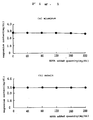
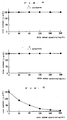
- Reagent 1 to be used was one which was prepared by adding nickel and bismuth as additional metals in a concentration of 150 ⁇ M, respectively. Results are shown in Fig. 3. Apparently from Fig. 3, the effect of addition of metals other than magnesium is confirmed.
- each control blood serum containing EDTA 350 ⁇ l of Reagent 3 which containing each one of lanthanum, manganese, terbium, yttrium, ytterbium, palladium, gallium, indium, strontium and aluminum in concentration of 20 mM, respectively, was added, followed by heating to 37°C. 200 ⁇ l Of Reagent 4 was added thereto, and the reaction was then started at 37°C. The absorbance of each sample was measured at 590 nm of wave length 5 minutes after reaction being started. At the same time, another procedure was carried out in the same manner as the above procedure except using purified water instead of the control blood serum, and the resulting value was defined as a blanc value.
- Example 3 A procedure was carried out in the same manner as Example 3 except using an aqueous solution in which 200 mg of Nitroso-PSAP was dissolved in purified water to a total volume of 1000 ml instead of Reagent 4 of said Example 3. In this procedure, the absorbance of each sample was measured at 760 nm of wave length. Results are shown in Table 2 below. Metal Iron Content ( ⁇ g/dl) La 149.1 Mg 148.9 Tb 143.3 Y 145.2 Yb 144.1 Pd 146.3 Ga 147.6 In 148.9 Sr 144.4 Al 145.7
- the method of the present invention apparently can measure the copper content more accurately compared to the conventional methods.
- the method for measuring metals in samples of body fluid which comprises the above mentioned, can release the metals of interest bound to the co-existing substances in the samples from the co-existing substances easily. Therefore, even trace amounts of metals in samples of body fluid can be measured with high accuracy; the method of the present invention can be widely utilized in the filed of clinical examination.
Landscapes
- Health & Medical Sciences (AREA)
- Life Sciences & Earth Sciences (AREA)
- Engineering & Computer Science (AREA)
- Chemical & Material Sciences (AREA)
- Immunology (AREA)
- Urology & Nephrology (AREA)
- Biomedical Technology (AREA)
- Molecular Biology (AREA)
- Hematology (AREA)
- Microbiology (AREA)
- Analytical Chemistry (AREA)
- Biotechnology (AREA)
- Inorganic Chemistry (AREA)
- Food Science & Technology (AREA)
- Medicinal Chemistry (AREA)
- Physics & Mathematics (AREA)
- Cell Biology (AREA)
- Biochemistry (AREA)
- General Health & Medical Sciences (AREA)
- General Physics & Mathematics (AREA)
- Pathology (AREA)
- Investigating Or Analysing Biological Materials (AREA)
- Measuring Or Testing Involving Enzymes Or Micro-Organisms (AREA)
Claims (2)
- Kolorimetrisches oder enzymatisches Verfahren zum Messen von Metallen in einer Probe von Körperflüssigkeit, die störende komplexbildende Substanzen enthält, das die Schritte umfaßt von:(A) Zugeben eines anderen Metalles als das Metall von Interesse zu der Probe in einer Menge im Bereich von 5 µM bis 2 M, wobei das zugegebene Metall das Metall von Interesse, das mit störenden, komplexbildenden Substanzen in der Probe kombiniert ist, von den störenden komplexbildenden Substanzen freisetzt;(B) Zugeben einer farberzeugenden Substanz zum spezifischen Binden an das Metall von Interesse oder Zugeben eines Enzymes zu der Probe; und(C) Spektroskopisches Nachweisen eines Signals, das von der farberzeugenden Substanz oder der Aktivität des Enzyms abgeleitet ist.
- Verfahren gemäß Anspruch 1, bei dem die Metalle von Interesse aus der Gruppe ausgewählt sind, die aus Magnesium, Eisen, Zink, Kalium, Kalzium, Mangan, Aluminium, Kadmium, Chrom, Quecksilber, Kupfer, Blei, Nickel, Seien, Bismuth, Arsen, Natrium und Phosphor besteht und die anderen Metalle als die Metalle von Interesse von den Metallen von Interesse verschieden sind und aus der Gruppe ausgewählt sind, die aus Lanthan, Mangan, Terbium, Yttrium, Ytterbium, Palladium, Gallium, Indium, Strontium, Aluminium, Kobalt, Bismuth und Nickel besteht.
Applications Claiming Priority (4)
| Application Number | Priority Date | Filing Date | Title |
|---|---|---|---|
| JP35642391 | 1991-12-25 | ||
| JP35642391 | 1991-12-25 | ||
| JP356423/91 | 1991-12-25 | ||
| PCT/JP1992/001685 WO1993013422A1 (fr) | 1991-12-25 | 1992-12-24 | Procede de titrage de metaux presents dans des echantillons biologiques et reactif relatif |
Publications (3)
| Publication Number | Publication Date |
|---|---|
| EP0592674A1 EP0592674A1 (de) | 1994-04-20 |
| EP0592674A4 EP0592674A4 (en) | 1996-02-14 |
| EP0592674B1 true EP0592674B1 (de) | 2000-11-29 |
Family
ID=18448941
Family Applications (1)
| Application Number | Title | Priority Date | Filing Date |
|---|---|---|---|
| EP93900380A Expired - Lifetime EP0592674B1 (de) | 1991-12-25 | 1992-12-24 | Verfahren zur bestimmung von metallen in biologischen proben und reagenz dafür |
Country Status (5)
| Country | Link |
|---|---|
| EP (1) | EP0592674B1 (de) |
| KR (1) | KR100255522B1 (de) |
| DE (1) | DE69231584T2 (de) |
| ES (1) | ES2153376T3 (de) |
| WO (1) | WO1993013422A1 (de) |
Families Citing this family (5)
| Publication number | Priority date | Publication date | Assignee | Title |
|---|---|---|---|---|
| TW546475B (en) * | 1998-12-07 | 2003-08-11 | Daiichi Pure Chemicals Co Ltd | A method for quantifying hydrogen sulfide or sulfide ion and a method for quantifying homocysteine or cysteine by using the method |
| JP5493517B2 (ja) * | 2009-07-06 | 2014-05-14 | ニプロ株式会社 | 血中銅濃度測定用試薬 |
| JP5889059B2 (ja) * | 2011-04-04 | 2016-03-22 | アークレイ株式会社 | 金属の回収方法 |
| JP5889060B2 (ja) * | 2011-04-04 | 2016-03-22 | アークレイ株式会社 | 金属の回収方法 |
| JP6186576B2 (ja) * | 2013-01-30 | 2017-08-30 | 株式会社シノテスト | 乳試料中の測定対象物質の比色測定方法、乳試料の前処理の方法及び試薬、並びに乳試料に由来する比色測定への影響の抑制方法 |
Family Cites Families (4)
| Publication number | Priority date | Publication date | Assignee | Title |
|---|---|---|---|---|
| US3547586A (en) * | 1967-06-05 | 1970-12-15 | Jerry W Denney | Inorganic phosphate assay,and reagents therefor |
| JPS5923252A (ja) * | 1982-07-30 | 1984-02-06 | Fuji Photo Film Co Ltd | チロキシンの蛍光測定もしくは比色による定量分析法 |
| JPS626170A (ja) * | 1985-07-03 | 1987-01-13 | Wako Pure Chem Ind Ltd | 蛋白測定用試験片 |
| JP2856757B2 (ja) * | 1989-03-13 | 1999-02-10 | ユニチカ株式会社 | 総ビリルビンの測定方法および測定用試薬 |
-
1992
- 1992-12-24 ES ES93900380T patent/ES2153376T3/es not_active Expired - Lifetime
- 1992-12-24 WO PCT/JP1992/001685 patent/WO1993013422A1/ja not_active Ceased
- 1992-12-24 KR KR1019930702436A patent/KR100255522B1/ko not_active Expired - Lifetime
- 1992-12-24 EP EP93900380A patent/EP0592674B1/de not_active Expired - Lifetime
- 1992-12-24 DE DE69231584T patent/DE69231584T2/de not_active Expired - Lifetime
Also Published As
| Publication number | Publication date |
|---|---|
| ES2153376T3 (es) | 2001-03-01 |
| EP0592674A1 (de) | 1994-04-20 |
| EP0592674A4 (en) | 1996-02-14 |
| KR100255522B1 (ko) | 2000-06-01 |
| WO1993013422A1 (fr) | 1993-07-08 |
| KR930703614A (ko) | 1993-11-30 |
| DE69231584T2 (de) | 2001-03-29 |
| DE69231584D1 (de) | 2001-01-04 |
Similar Documents
| Publication | Publication Date | Title |
|---|---|---|
| JP3194952B2 (ja) | 虚血状態の迅速な判定のための検査とそのキット | |
| US5516700A (en) | Automated urinalysis method | |
| Ryan et al. | Magnesium measurement in routine clinical practice | |
| EP0222700B1 (de) | Zusammensetzung und Verfahren zur Bestimmung der peroxidartigen Aktivität des Hämoglobins | |
| CN109613280B (zh) | 一种血清铁测定试剂盒及其制备方法和应用 | |
| US5925570A (en) | Method of measuring metals in samples of living body | |
| Ab Rahim et al. | The laboratory and clinical perspectives of magnesium imbalance | |
| JPS6382363A (ja) | 分析用コバルト(3)試薬組成物 | |
| EP0592674A1 (de) | Verfahren zur bestimmung von metallen in biologischen proben und reagenz dafür | |
| US6428972B2 (en) | Biochemical method to measure niacin status in a biological sample | |
| JPS6142823B2 (de) | ||
| JP3442022B2 (ja) | 改良されたクレアチニン検出検査 | |
| JP2749615B2 (ja) | 新規な指示薬化合物、その製造法及び鉄分析系における該化合物の使用 | |
| US4529708A (en) | Assay for the determination of creatinine | |
| JP4106270B2 (ja) | 新規測定方法 | |
| SUTOR et al. | Urinary inhibitors of calcium phosphate formation: the inhibitory activity of normal and artificial urines | |
| JP3220378B2 (ja) | 総蛋白質の定量方法および定量用試薬 | |
| JP3078881B2 (ja) | 生体試料中の成分測定法 | |
| JPH02251766A (ja) | 血清又は血漿中のフルクトサミンの測定法 | |
| JPWO1993013422A1 (ja) | 生体試料中の金属の測定方法及び測定用試薬 | |
| EP0091913B1 (de) | Harnsäuretest und reagenzsystem dazu | |
| US4454230A (en) | Assay method and reagent composition for the determination of magnesium | |
| JP4123181B2 (ja) | カルシウムの測定方法および測定試薬 | |
| US20070154879A1 (en) | Method for quantitatively determining a specific component in a biological specimen, and reagent for quantitative determination | |
| JPH03202770A (ja) | フルクトサミンの測定法 |
Legal Events
| Date | Code | Title | Description |
|---|---|---|---|
| PUAI | Public reference made under article 153(3) epc to a published international application that has entered the european phase |
Free format text: ORIGINAL CODE: 0009012 |
|
| 17P | Request for examination filed |
Effective date: 19930805 |
|
| AK | Designated contracting states |
Kind code of ref document: A1 Designated state(s): DE ES FR GB IT |
|
| A4 | Supplementary search report drawn up and despatched |
Effective date: 19960103 |
|
| AK | Designated contracting states |
Kind code of ref document: A4 Designated state(s): DE ES FR GB IT |
|
| 17Q | First examination report despatched |
Effective date: 19970725 |
|
| GRAG | Despatch of communication of intention to grant |
Free format text: ORIGINAL CODE: EPIDOS AGRA |
|
| 17Q | First examination report despatched |
Effective date: 19970725 |
|
| GRAG | Despatch of communication of intention to grant |
Free format text: ORIGINAL CODE: EPIDOS AGRA |
|
| GRAH | Despatch of communication of intention to grant a patent |
Free format text: ORIGINAL CODE: EPIDOS IGRA |
|
| GRAH | Despatch of communication of intention to grant a patent |
Free format text: ORIGINAL CODE: EPIDOS IGRA |
|
| GRAA | (expected) grant |
Free format text: ORIGINAL CODE: 0009210 |
|
| AK | Designated contracting states |
Kind code of ref document: B1 Designated state(s): DE ES FR GB IT |
|
| REF | Corresponds to: |
Ref document number: 69231584 Country of ref document: DE Date of ref document: 20010104 |
|
| ITF | It: translation for a ep patent filed | ||
| REG | Reference to a national code |
Ref country code: ES Ref legal event code: FG2A Ref document number: 2153376 Country of ref document: ES Kind code of ref document: T3 |
|
| ET | Fr: translation filed | ||
| PLBE | No opposition filed within time limit |
Free format text: ORIGINAL CODE: 0009261 |
|
| STAA | Information on the status of an ep patent application or granted ep patent |
Free format text: STATUS: NO OPPOSITION FILED WITHIN TIME LIMIT |
|
| 26N | No opposition filed | ||
| REG | Reference to a national code |
Ref country code: GB Ref legal event code: IF02 |
|
| REG | Reference to a national code |
Ref country code: GB Ref legal event code: 732E Free format text: REGISTERED BETWEEN 20091203 AND 20091209 |
|
| REG | Reference to a national code |
Ref country code: FR Ref legal event code: TP Ref country code: FR Ref legal event code: CD Ref country code: FR Ref legal event code: CA |
|
| REG | Reference to a national code |
Ref country code: ES Ref legal event code: PC2A |
|
| PGFP | Annual fee paid to national office [announced via postgrant information from national office to epo] |
Ref country code: GB Payment date: 20101222 Year of fee payment: 19 Ref country code: IT Payment date: 20101215 Year of fee payment: 19 |
|
| PGFP | Annual fee paid to national office [announced via postgrant information from national office to epo] |
Ref country code: FR Payment date: 20111219 Year of fee payment: 20 |
|
| PGFP | Annual fee paid to national office [announced via postgrant information from national office to epo] |
Ref country code: DE Payment date: 20111221 Year of fee payment: 20 |
|
| REG | Reference to a national code |
Ref country code: DE Ref legal event code: R071 Ref document number: 69231584 Country of ref document: DE |
|
| REG | Reference to a national code |
Ref country code: DE Ref legal event code: R071 Ref document number: 69231584 Country of ref document: DE |
|
| REG | Reference to a national code |
Ref country code: GB Ref legal event code: PE20 Expiry date: 20121223 |
|
| PG25 | Lapsed in a contracting state [announced via postgrant information from national office to epo] |
Ref country code: GB Free format text: LAPSE BECAUSE OF EXPIRATION OF PROTECTION Effective date: 20121223 |
|
| PGFP | Annual fee paid to national office [announced via postgrant information from national office to epo] |
Ref country code: ES Payment date: 20120116 Year of fee payment: 20 |
|
| REG | Reference to a national code |
Ref country code: ES Ref legal event code: FD2A Effective date: 20130718 |
|
| PG25 | Lapsed in a contracting state [announced via postgrant information from national office to epo] |
Ref country code: ES Free format text: LAPSE BECAUSE OF EXPIRATION OF PROTECTION Effective date: 20121225 |