EP0592790B1 - Negativ arbeitende Photoresistzusammensetzung - Google Patents
Negativ arbeitende Photoresistzusammensetzung Download PDFInfo
- Publication number
- EP0592790B1 EP0592790B1 EP93113271A EP93113271A EP0592790B1 EP 0592790 B1 EP0592790 B1 EP 0592790B1 EP 93113271 A EP93113271 A EP 93113271A EP 93113271 A EP93113271 A EP 93113271A EP 0592790 B1 EP0592790 B1 EP 0592790B1
- Authority
- EP
- European Patent Office
- Prior art keywords
- group
- photoresist composition
- negative photoresist
- composition according
- weight
- Prior art date
- Legal status (The legal status is an assumption and is not a legal conclusion. Google has not performed a legal analysis and makes no representation as to the accuracy of the status listed.)
- Revoked
Links
Classifications
-
- G—PHYSICS
- G03—PHOTOGRAPHY; CINEMATOGRAPHY; ANALOGOUS TECHNIQUES USING WAVES OTHER THAN OPTICAL WAVES; ELECTROGRAPHY; HOLOGRAPHY
- G03F—PHOTOMECHANICAL PRODUCTION OF TEXTURED OR PATTERNED SURFACES, e.g. FOR PRINTING, FOR PROCESSING OF SEMICONDUCTOR DEVICES; MATERIALS THEREFOR; ORIGINALS THEREFOR; APPARATUS SPECIALLY ADAPTED THEREFOR
- G03F7/00—Photomechanical, e.g. photolithographic, production of textured or patterned surfaces, e.g. printing surfaces; Materials therefor, e.g. comprising photoresists; Apparatus specially adapted therefor
- G03F7/004—Photosensitive materials
- G03F7/038—Macromolecular compounds which are rendered insoluble or differentially wettable
-
- C—CHEMISTRY; METALLURGY
- C07—ORGANIC CHEMISTRY
- C07D—HETEROCYCLIC COMPOUNDS
- C07D251/00—Heterocyclic compounds containing 1,3,5-triazine rings
- C07D251/02—Heterocyclic compounds containing 1,3,5-triazine rings not condensed with other rings
- C07D251/12—Heterocyclic compounds containing 1,3,5-triazine rings not condensed with other rings having three double bonds between ring members or between ring members and non-ring members
- C07D251/14—Heterocyclic compounds containing 1,3,5-triazine rings not condensed with other rings having three double bonds between ring members or between ring members and non-ring members with hydrogen or carbon atoms directly attached to at least one ring carbon atom
- C07D251/24—Heterocyclic compounds containing 1,3,5-triazine rings not condensed with other rings having three double bonds between ring members or between ring members and non-ring members with hydrogen or carbon atoms directly attached to at least one ring carbon atom to three ring carbon atoms
-
- C—CHEMISTRY; METALLURGY
- C07—ORGANIC CHEMISTRY
- C07D—HETEROCYCLIC COMPOUNDS
- C07D251/00—Heterocyclic compounds containing 1,3,5-triazine rings
- C07D251/02—Heterocyclic compounds containing 1,3,5-triazine rings not condensed with other rings
- C07D251/12—Heterocyclic compounds containing 1,3,5-triazine rings not condensed with other rings having three double bonds between ring members or between ring members and non-ring members
- C07D251/26—Heterocyclic compounds containing 1,3,5-triazine rings not condensed with other rings having three double bonds between ring members or between ring members and non-ring members with only hetero atoms directly attached to ring carbon atoms
- C07D251/40—Nitrogen atoms
- C07D251/54—Three nitrogen atoms
- C07D251/70—Other substituted melamines
-
- G—PHYSICS
- G03—PHOTOGRAPHY; CINEMATOGRAPHY; ANALOGOUS TECHNIQUES USING WAVES OTHER THAN OPTICAL WAVES; ELECTROGRAPHY; HOLOGRAPHY
- G03F—PHOTOMECHANICAL PRODUCTION OF TEXTURED OR PATTERNED SURFACES, e.g. FOR PRINTING, FOR PROCESSING OF SEMICONDUCTOR DEVICES; MATERIALS THEREFOR; ORIGINALS THEREFOR; APPARATUS SPECIALLY ADAPTED THEREFOR
- G03F7/00—Photomechanical, e.g. photolithographic, production of textured or patterned surfaces, e.g. printing surfaces; Materials therefor, e.g. comprising photoresists; Apparatus specially adapted therefor
- G03F7/004—Photosensitive materials
- G03F7/0045—Photosensitive materials with organic non-macromolecular light-sensitive compounds not otherwise provided for, e.g. dissolution inhibitors
-
- G—PHYSICS
- G03—PHOTOGRAPHY; CINEMATOGRAPHY; ANALOGOUS TECHNIQUES USING WAVES OTHER THAN OPTICAL WAVES; ELECTROGRAPHY; HOLOGRAPHY
- G03F—PHOTOMECHANICAL PRODUCTION OF TEXTURED OR PATTERNED SURFACES, e.g. FOR PRINTING, FOR PROCESSING OF SEMICONDUCTOR DEVICES; MATERIALS THEREFOR; ORIGINALS THEREFOR; APPARATUS SPECIALLY ADAPTED THEREFOR
- G03F7/00—Photomechanical, e.g. photolithographic, production of textured or patterned surfaces, e.g. printing surfaces; Materials therefor, e.g. comprising photoresists; Apparatus specially adapted therefor
- G03F7/004—Photosensitive materials
- G03F7/027—Non-macromolecular photopolymerisable compounds having carbon-to-carbon double bonds, e.g. ethylenic compounds
- G03F7/032—Non-macromolecular photopolymerisable compounds having carbon-to-carbon double bonds, e.g. ethylenic compounds with binders
- G03F7/0325—Non-macromolecular photopolymerisable compounds having carbon-to-carbon double bonds, e.g. ethylenic compounds with binders the binders being polysaccharides, e.g. cellulose
Definitions
- the present invention relates to a resist composition usable as a pattern-forming material in the production of semiconductors, and more particularly to a negative photoresist composition suitable for use in lithographies using far ultraviolet rays including excimer laser.
- JP-A-1-293339 (1989) discloses a photoresist composition comprising a polymer containing a group represented by the following formula (I): wherein R 1 represents a hydrogen atom or an alkyl group having from 1 to 5 carbons atoms, a crosslinking agent containing a group represented by the following formula: wherein R 2 represents a hydrogen atom or an alkyl group having 1 to 5 carbon atoms, and a photo-induced acid precursor containing a sulfonic acid ester group.
- formula (I) wherein R 1 represents a hydrogen atom or an alkyl group having from 1 to 5 carbons atoms
- R 2 represents a hydrogen atom or an alkyl group having 1 to 5 carbon atoms
- a photo-induced acid precursor containing a sulfonic acid ester group.
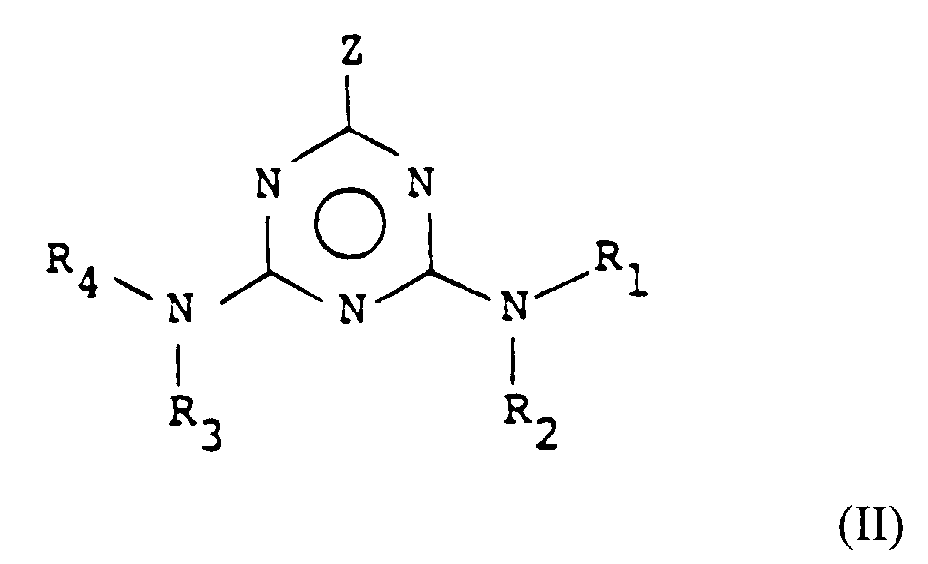
- a negative photoresist composition comprising 20 to 90 % by weight of a copolymer of p-hydroxystyrene and styrene having a molar ratio of p-hydroxystyrene to styrene of from 50/50 to 95/5, 5 to 50% by weight of a crosslinking agent represented by the following general formula (II): wherein Z represents -NRR' or an optionally substituted aryl group, and R, R' and R 1 to R 4 independently of one another each represents a hydrogen atom, a -CH 2 OH group or a -CH 2 OR a group in which R a is a lower alkyl group, and 0.1 to 20% by weight of a photo-induced acid precursor represented by the following general formula (III): wherein Y 3 , Y 4 , and Y 5 independently of one another each represents an optionally substituted alkyl, alkenyl, aralkyl or piperidino group, a
- the above-mentioned resin can easily be produced by a radical copolymerization or ion copolymerization of p-hydroxystyrene and styrene.
- the molar ratio of p-hydroxystyrene and styrene in the copolymer is from about 50/50 to about 95/5, and preferably from about 70/30 to about 85/15. If the proportion of p-hydroxystyrene is smaller than the above, the copolymer is difficult to dissolve in solvent at the time of preparing a resist solution or difficult to dissolve in aqueous alkali solution at the time of development.
- a weight average molecular weight of the resin is usually from about 1,000 to about 5,000, preferably from about 2,500 to about 4,000.
- the lower alkyl group represented by R a include straight chain and branched chain alkyl groups having 1 to 7 carbon atoms among which methyl, ethyl, n-propyl and n-butyl are preferable and methyl and ethyl are more preferable, and examples of the optionally substituted aryl group include optionally substituted phenyl or naphtyl.
- the crosslinking agents represented by the general formula (II) melamine and benzoguanamine are readily available commercially, and their methylol derivatives are obtainable through a condensation reaction of melamine or benzoguanamine with formalin. Their methylol ether derivatives can be obtained by reacting a methylol derivative with an alcohol according to known methods.
- examples of the alkyl group represented by Y 3 to Y 5 include straight chain and branched chain alkyl groups having 1 to 7 carbon atoms, among which methyl, ethyl, n-propyl, i-propyl, n-butyl and t-butyl are preferable.
- substituent present on the alkyl group halogen atoms
- alkenyl group represented by Y 3 to Y 5 include straight chain and branched chain alkenyl groups having 2 to 7 carbon atoms.
- substituent present on the alkenyl group aryl groups such as phenyl or naphthyl and heterocyclic groups such as benzoxazolyl or benzothiazolyl can be referred to, for example.
- aryl groups and heterocyclic groups may be additionally substituted by halogen atoms, alkoxy groups having 1 to 7 carbon atoms, an acetyl group or a nitro group.
- Preferable examples of the aralkyl group represented by Y 3 to Y 5 include phenylalkyl groups having 7 to 10 carbon atoms. As preferable substituents present on the phenyl moiety of these aralkyl groups, lower alkyl groups, lower alkoxy groups, halogen atom, nitro group, cyano group, dimethylamino group and diethylamino group can be referred to.
- Preferable examples of the optionally substituted alkyl group represented by Y 6 to Y 9 include straight chain and branched chain alkyl groups having 1 to 6 carbon atoms, among which methyl, ethyl, n-propyl, and n-butyl are more preferable.
- Preferable examples of the optionally substituted aryl group represented by Y 6 to Y 9 include a phenyl or naphthyl group among which the phenyl group is more preferable.
- the photo-induced acid precursor represented by the formula (III) can be produced by, for example, reacting the corresponding nitrile compound with aluminum bromide in the presence of hydrogen chloride or by using the corresponding imidate compound, according to Bull. Chem. Soc. Japan, 42 , 2924 (1969); US-A- 3,987,037; or F. C. Schaefer et. al, J. Org. Chem. 29 , 1527 (1964).
- Examples of the photo-induced acid precursor represented by the formula (III) include the compound disclosed in the papers mentioned above and the compound disclosed in GB-B- 1,388,492 and JP-A-53-133428 (1978).
- photo-induced acid precursors may be used either singly or in the form of a mixture of two or more members.
- the above-mentioned resin is used usually in an amount of from 20 to 90% by weight (preferably in an amount of from 40 to 80% by weight), the crosslinking agent is used usually in an amount of from 5 to 50% by weight (preferably in an amount of from 5 to 20% by weight) and the photo-induced acid precursor is used usually in an amount of from 0.1 to 20% by weight (preferably in an amount of from 1 to 20% by weight), respectively.
- the negative photoresist composition of the present invention may contain a sensitizer, and a dye.
- a negative resist solution is prepared by mixing the above-mentioned resin, a crosslinking agent, and a photo-induced acid precursor into a solvent. These ingredients are used in an amount of from 1 to 50% by weight in the resulting negative resist solution.
- the solvent is preferably one that evaporates at an appropriate drying rate to give a uniform and smooth coating film.
- solvent examples include methyl cellosolve acetate, ethyl cellosolve acetate, methyl cellosolve, ethyl cellosolve, propylene glycol monomethyl ether acetate, propylene glycol monoethyl ether acetate, butyl acetate, methyl isobutyl ketone, xylene, ethyl lactate, ethyl pyruvate and 2-heptanone. These solvents are used either singly or in the form of a mixture of two or more members.
- diethylene glycol dimethyl ether 50 Parts of diethylene glycol dimethyl ether were mixed with 13.33 parts of a resin [LYNCUR CST-70, manufactured by Maruzen Sekiyukagaku K. K., weight average molecular weight 2,900, p-hydroxystyrene/styrene molar ratio in copolymer 70/30], 1 part of hexamethylolmelamine hexamethyl ether as a crosslinking agent and 3 parts of tris(2,3-dibromopropyl)-1,3,5-triazine (a reagent manufactured by Tokyo Kasei Kogyo K. K.] as a photo-induced acid precursor.
- LYNCUR CST-70 manufactured by Maruzen Sekiyukagaku K. K., weight average molecular weight 2,900, p-hydroxystyrene/styrene molar ratio in copolymer 70/30
- the resulting mixture was filtered through a tetrafluoroethylene filter having a pore size of 0.2 ⁇ m to obtain a resist solution.
- the resist solution was coated on a silicon wafer which had been rinsed in a usual manner to form a resist film of 0.7 ⁇ m in thickness.
- the wafer was heated on a hot plate at 100°C for one minute to make progress a crosslinking reaction of the exposed area. Then, the wafer was developed with a 2.0% (by weight) aqueous solution of tetramethylammonium hydroxide to obtain a negative pattern. An observation by means of an electron microscope revealed that a 0.25 ⁇ m fine pattern was resolved with a good profile, provided that exposure dose was 60 mJ/cm 2 (effective sensitivity).
- a negative pattern was obtained by repeating Example 1, except that the resin was altered to LYNCUR CST-50 (manufactured by Maruzen Sekiyukagaku K. K., weight average molecular weight 3,600, p-hydroxystyrene/styrene ratio in copolymer 50/50).
- LYNCUR CST-50 manufactured by Maruzen Sekiyukagaku K. K., weight average molecular weight 3,600, p-hydroxystyrene/styrene ratio in copolymer 50/50.
- a 0.25 ⁇ m fine pattern was resolved with a good profile, provided that exposure dose was 80 mJ/cm 2 (effective sensitivity).
- Example 1 The procedure of Example 1 was repeated, except that the resin was altered to 13.33 parts of poly(p-hydroxystyrene) (MARUKA LYNCUR M, manufactured by Maruzen Sekiyukagaku K. K., weight average molecular weight 4,100). As a result, a sensitivity of 35 mJ/cm 2 was obtained. However, a 0.25 ⁇ m pattern could not be resolved.
- MARUKA LYNCUR M poly(p-hydroxystyrene)
Landscapes
- Physics & Mathematics (AREA)
- Chemical & Material Sciences (AREA)
- Organic Chemistry (AREA)
- Spectroscopy & Molecular Physics (AREA)
- General Physics & Mathematics (AREA)
- Materials For Photolithography (AREA)
- Addition Polymer Or Copolymer, Post-Treatments, Or Chemical Modifications (AREA)
Claims (14)
- Negativ arbeitende Photoresistzusammensetzung, umfassend 20 bis 90 Gewichts-% eines Copolymers von p-Hydroxystyrol und Styrol mit einem Molverhältnis von p-Hydroxystyrol zu Styrol von 50/50 bis 95/5, 5 bis 50 Gewichts-% eines Vernetzungsmittels der Formel (II):in der Z den Rest -NRR' oder einen gegebenenfalls substituierten Arylrest bedeutet, und R, R', R1, R2, R3 und R4 jeweils unabhängig voneinander ein Wasserstoffatom, eine -CH2OH-Gruppe oder einen -CH2ORa-Rest bedeuten, wobei Ra ein Niederalkylrest ist, und
0,1 bis 20 Gewichts-% einer licht-induzierten Säurevorstufe der Formel (III):in der Y3, Y4 und Y5 jeweils unabhängig voneinander einen gegebenenfalls substituierten Alkyl-, Alkenyl-, Aralkyl- oder Piperidinorest, einen -N(Y6)(Y7)-Rest, einen -OY8-Rest oder einen -SY9-Rest bedeuten, wobei Y6, Y7, Y8 und Y9 jeweils unabhängig voneinander ein Wasserstoffatom oder einen gegebenenfalls substituierten Alkyl- oder Arylrest bedeuten, mit der Maßgabe, daß wenigstens einer der Reste Y3, Y4 und Y5 einen mono-, di- oder trihalogensubstituierten Alkylrest darstellt,
oder 2-Phenyl-4,6-bis(trichlormethyl)-s-triazin, 2-(p-Acetylphenyl)-4,6-bis(trichlormethyl)-s-triazin oder 2-(p-Chlorphenyl)-4,6-bis(trichlormethyl)-s-triazin. - Negativ arbeitende Photoresistzusammensetzung nach Anspruch 1, wobei das Molverhältnis von p-Hydroxystyrol zu Styrol im Copolymer von 70/30 bis 85/15 beträgt.
- Negativ arbeitende Photoresistzusammensetzung nach Anspruch 1, wobei das gewichtsgemittelte Molekulargewicht des Copolymers von 1.000 bis 5.000 beträgt.
- Negativ arbeitende Photoresistzusammensetzung nach Anspruch 1, wobei das gewichtsgemittelte Molekulargewicht des Copolymers von 2.500 bis 4.000 beträgt.
- Negativ arbeitende Photoresistzusammensetzung nach Anspruch 1, wobei der durch Ra wiedergegebene Niederalkylrest aus der Methyl-, Ethyl-, n-Propyl- und n-Butylgruppe ausgewählt wird.
- Negativ arbeitende Photoresistzusammensetzung nach Anspruch 1, wobei das Vernetzungsmittel Melamin oder Benzoguanamin ist.
- Negativ arbeitende Photoresistzusammensetzung nach Anspruch 1, wobei der durch Y3, Y4 und Y5 wiedergegebene Alkylrest ein gerad- oder verzweigtkettiger Alkylrest mit 1 bis 7 Kohlenstoffatomen ist, der mit einem Halogenatom substituiert sein kann.
- Negativ arbeitende Photoresistzusammensetzung nach Anspruch 1, wobei der durch Y3, Y4 und Y5 wiedergegebene Alkylrest aus Methyl-, Ethyl, n-Propyl-, 1-Propyl-, n-Butyl und t-Butylgruppen, die mit einem Halogenatom substituiert sein können, ausgewählt wird.
- Negativ arbeitende Photoresistzusammensetzung nach Anspruch 1, wobei der durch Y3, Y4 und Y5 wiedergegebene Alkenylrest ein gerad- oder verzweigtkettiger Alkenylrest mit 2 bis 7 Kohlenstoffatomen ist, der mit einem Arylrest oder einem heterocyclischen Rest substituiert sein kann.
- Negativ arbeitende Photoresistzusammensetzung nach Anspruch 1, wobei der durch Y3, Y4 und Y5 wiedergegebene Aralkylrest ein Phenylalkylrest mit 7 bis 10 Kohlenstoffatomen ist.
- Negativ arbeitende Photoresistzusammensetzung nach Anspruch 1, wobei der gegebenenfalls substituierte, durch Y6 bis Y9 wiedergegebene Alkylrest ein gerad- oder verzweigtkettiger Alkylrest mit 1 bis 6 Kohlenstoffatomen ist
- Negativ arbeitende Photoresistzusammensetzung nach Anspruch 11, wobei der gegebenenfalls substituierte, durch Y6 bis Y9 wiedergegebene Alkylrest aus Methyl-, Ethyl-, n-Propyl- und n-Butylgruppen ausgewählt wird.
- Negativ arbeitende Photoresistzusammensetzung nach Anspruch 1, wobei der gegebenenfalls substituierte, durch Y6 bis Y9 wiedergegebene Arylrest eine Phenyl- oder Naphthylgruppe ist.
- Negativ arbeitende Photoresistzusammensetzung nach Anspruch 1, wobei die Zusammensetzung 40 bis 80 Gewichts-% des Copolymers, 5 bis 20 Gewichts-% des Vernetzungsmittels und 1 bis 20 Gewichts-% der lichtinduzierten Säurevorstufe umfaßt.
Applications Claiming Priority (2)
| Application Number | Priority Date | Filing Date | Title |
|---|---|---|---|
| JP221374/92 | 1992-08-20 | ||
| JP4221374A JPH0667431A (ja) | 1992-08-20 | 1992-08-20 | ネガ型フォトレジスト組成物 |
Publications (2)
| Publication Number | Publication Date |
|---|---|
| EP0592790A1 EP0592790A1 (de) | 1994-04-20 |
| EP0592790B1 true EP0592790B1 (de) | 1998-03-11 |
Family
ID=16765797
Family Applications (1)
| Application Number | Title | Priority Date | Filing Date |
|---|---|---|---|
| EP93113271A Revoked EP0592790B1 (de) | 1992-08-20 | 1993-08-19 | Negativ arbeitende Photoresistzusammensetzung |
Country Status (6)
| Country | Link |
|---|---|
| EP (1) | EP0592790B1 (de) |
| JP (1) | JPH0667431A (de) |
| KR (1) | KR940004387A (de) |
| CA (1) | CA2100392A1 (de) |
| DE (1) | DE69317347T2 (de) |
| MX (1) | MX9305047A (de) |
Families Citing this family (7)
| Publication number | Priority date | Publication date | Assignee | Title |
|---|---|---|---|---|
| WO1990010708A1 (en) * | 1989-03-09 | 1990-09-20 | The Sendai Institute Of Microbiology | Monoclonal antibody, and assay method, reagent kit, search method and drug missile using said antibody |
| TW339421B (en) * | 1994-09-12 | 1998-09-01 | Sumitomo Kagaku Kk | A photoresist composition comprising a polyfunctional vinyl ether compound |
| JP3989149B2 (ja) | 1999-12-16 | 2007-10-10 | 富士フイルム株式会社 | 電子線またはx線用化学増幅系ネガ型レジスト組成物 |
| JP4070393B2 (ja) | 2000-01-17 | 2008-04-02 | 富士フイルム株式会社 | ネガ型レジスト組成物 |
| KR20020082645A (ko) * | 2001-04-25 | 2002-10-31 | (주) 윌텍정보통신 | Ic 카드 단말기용 데이터 송수신 장치 |
| US7521168B2 (en) | 2002-02-13 | 2009-04-21 | Fujifilm Corporation | Resist composition for electron beam, EUV or X-ray |
| CN117311088A (zh) * | 2022-06-21 | 2023-12-29 | 清华大学 | 一种紫外光刻胶、紫外光刻胶图案化的方法及用途 |
Family Cites Families (3)
| Publication number | Priority date | Publication date | Assignee | Title |
|---|---|---|---|---|
| US4189323A (en) * | 1977-04-25 | 1980-02-19 | Hoechst Aktiengesellschaft | Radiation-sensitive copying composition |
| CA2019693A1 (en) * | 1989-07-07 | 1991-01-07 | Karen Ann Graziano | Acid-hardening photoresists of improved sensitivity |
| DE69130701T2 (de) * | 1990-10-29 | 1999-08-26 | Toyo Gosei Kogyo Co. Ltd. | Lichtempfindliches gefärbtes Harz, farbiges Bild, Verfahren zur Herstellung von Farbfiltern und Verfahren zur Herstellung einer Schwarzmatrix |
-
1992
- 1992-08-20 JP JP4221374A patent/JPH0667431A/ja active Pending
-
1993
- 1993-07-13 CA CA002100392A patent/CA2100392A1/en not_active Abandoned
- 1993-08-14 KR KR1019930015735A patent/KR940004387A/ko not_active Ceased
- 1993-08-19 EP EP93113271A patent/EP0592790B1/de not_active Revoked
- 1993-08-19 MX MX9305047A patent/MX9305047A/es unknown
- 1993-08-19 DE DE69317347T patent/DE69317347T2/de not_active Revoked
Also Published As
| Publication number | Publication date |
|---|---|
| DE69317347D1 (de) | 1998-04-16 |
| CA2100392A1 (en) | 1994-02-21 |
| EP0592790A1 (de) | 1994-04-20 |
| DE69317347T2 (de) | 1998-07-09 |
| JPH0667431A (ja) | 1994-03-11 |
| MX9305047A (es) | 1994-06-30 |
| KR940004387A (ko) | 1994-03-15 |
Similar Documents
| Publication | Publication Date | Title |
|---|---|---|
| JP3921748B2 (ja) | フォトレジスト組成物 | |
| US5525453A (en) | Positive-working radiation-sensitive mixture | |
| KR100377809B1 (ko) | 네거티브형 포토레지스트조성물 | |
| EP0881539B1 (de) | Photoresistzusammensetzung | |
| EP0632327B1 (de) | Photoresistzusammensetzung | |
| KR100528270B1 (ko) | 포지티브내식막조성물 | |
| JP3873372B2 (ja) | ポジ型フォトレジスト組成物 | |
| EP0592790B1 (de) | Negativ arbeitende Photoresistzusammensetzung | |
| US5298364A (en) | Radiation-sensitive sulfonic acid esters and their use | |
| KR20040044987A (ko) | 네가티브형 수성 포토레지스트 조성물 | |
| KR20030080185A (ko) | 내식막 조성물 | |
| EP0588092B1 (de) | Negativ arbeitende Photoresistzusammensetzung | |
| US5955241A (en) | Chemical-amplification-type negative resist composition and method for forming negative resist pattern | |
| KR100672221B1 (ko) | 네거티브형 내식막 조성물 | |
| JP3823449B2 (ja) | フォトレジスト組成物 | |
| US6284863B1 (en) | Polymers having O-substituted vinylphenol unit and resist compositions containing them | |
| JPH10177250A (ja) | フォトレジスト組成物 | |
| JP2005215112A (ja) | ネガ型レジスト組成物、および、レジストパターン形成方法 | |
| US6280902B1 (en) | Positive working photoresist compositions comprising a nitrogen-containing cyclic compound | |
| JP2002341522A (ja) | フォトレジスト組成物 | |
| KR19980032829A (ko) | 포지티브 감광성 내식막 조성물 | |
| KR20080024317A (ko) | 화학증폭형 포지티브 레지스트 조성물 | |
| KR20060056237A (ko) | 화학증폭형 포지티브 타입 레지스트 조성물 | |
| JPH08500911A (ja) | ポジ型放射線感応性混合物およびそれを使用して製造した記録材料 | |
| KR20100025158A (ko) | 화학증폭형 포지티브 포토레지스트 조성물 및 이를 이용한 레지스트 패턴형성방법 |
Legal Events
| Date | Code | Title | Description |
|---|---|---|---|
| PUAI | Public reference made under article 153(3) epc to a published international application that has entered the european phase |
Free format text: ORIGINAL CODE: 0009012 |
|
| AK | Designated contracting states |
Kind code of ref document: A1 Designated state(s): BE DE FR GB IT NL |
|
| 17P | Request for examination filed |
Effective date: 19940831 |
|
| 17Q | First examination report despatched |
Effective date: 19950522 |
|
| GRAG | Despatch of communication of intention to grant |
Free format text: ORIGINAL CODE: EPIDOS AGRA |
|
| GRAG | Despatch of communication of intention to grant |
Free format text: ORIGINAL CODE: EPIDOS AGRA |
|
| GRAG | Despatch of communication of intention to grant |
Free format text: ORIGINAL CODE: EPIDOS AGRA |
|
| GRAH | Despatch of communication of intention to grant a patent |
Free format text: ORIGINAL CODE: EPIDOS IGRA |
|
| GRAH | Despatch of communication of intention to grant a patent |
Free format text: ORIGINAL CODE: EPIDOS IGRA |
|
| GRAH | Despatch of communication of intention to grant a patent |
Free format text: ORIGINAL CODE: EPIDOS IGRA |
|
| GRAH | Despatch of communication of intention to grant a patent |
Free format text: ORIGINAL CODE: EPIDOS IGRA |
|
| ITF | It: translation for a ep patent filed | ||
| GRAA | (expected) grant |
Free format text: ORIGINAL CODE: 0009210 |
|
| AK | Designated contracting states |
Kind code of ref document: B1 Designated state(s): BE DE FR GB IT NL |
|
| REF | Corresponds to: |
Ref document number: 69317347 Country of ref document: DE Date of ref document: 19980416 |
|
| ET | Fr: translation filed | ||
| PLBQ | Unpublished change to opponent data |
Free format text: ORIGINAL CODE: EPIDOS OPPO |
|
| PLBI | Opposition filed |
Free format text: ORIGINAL CODE: 0009260 |
|
| PLBF | Reply of patent proprietor to notice(s) of opposition |
Free format text: ORIGINAL CODE: EPIDOS OBSO |
|
| 26 | Opposition filed |
Opponent name: CLARIANT GMBH PATENTE, MARKEN, LIZENZEN Effective date: 19981204 |
|
| NLR1 | Nl: opposition has been filed with the epo |
Opponent name: CLARIANT GMBH PATENTE, MARKEN, LIZENZEN |
|
| PGFP | Annual fee paid to national office [announced via postgrant information from national office to epo] |
Ref country code: FR Payment date: 20000811 Year of fee payment: 8 |
|
| PGFP | Annual fee paid to national office [announced via postgrant information from national office to epo] |
Ref country code: DE Payment date: 20000814 Year of fee payment: 8 |
|
| PGFP | Annual fee paid to national office [announced via postgrant information from national office to epo] |
Ref country code: GB Payment date: 20000816 Year of fee payment: 8 |
|
| PGFP | Annual fee paid to national office [announced via postgrant information from national office to epo] |
Ref country code: NL Payment date: 20000831 Year of fee payment: 8 |
|
| PGFP | Annual fee paid to national office [announced via postgrant information from national office to epo] |
Ref country code: BE Payment date: 20001024 Year of fee payment: 8 |
|
| RDAH | Patent revoked |
Free format text: ORIGINAL CODE: EPIDOS REVO |
|
| RDAG | Patent revoked |
Free format text: ORIGINAL CODE: 0009271 |
|
| 27W | Patent revoked |
Effective date: 20001231 |
|
| GBPR | Gb: patent revoked under art. 102 of the ep convention designating the uk as contracting state |
Free format text: 20001231 |
|
| NLR2 | Nl: decision of opposition |