EP0592827A1 - Commande d'un métier à tisser - Google Patents
Commande d'un métier à tisser Download PDFInfo
- Publication number
- EP0592827A1 EP0592827A1 EP93114784A EP93114784A EP0592827A1 EP 0592827 A1 EP0592827 A1 EP 0592827A1 EP 93114784 A EP93114784 A EP 93114784A EP 93114784 A EP93114784 A EP 93114784A EP 0592827 A1 EP0592827 A1 EP 0592827A1
- Authority
- EP
- European Patent Office
- Prior art keywords
- control unit
- thread
- image
- monitor
- assigned
- Prior art date
- Legal status (The legal status is an assumption and is not a legal conclusion. Google has not performed a legal analysis and makes no representation as to the accuracy of the status listed.)
- Granted
Links
Images

Classifications
-
- D—TEXTILES; PAPER
- D03—WEAVING
- D03J—AUXILIARY WEAVING APPARATUS; WEAVERS' TOOLS; SHUTTLES
- D03J1/00—Auxiliary apparatus combined with or associated with looms
-
- B—PERFORMING OPERATIONS; TRANSPORTING
- B65—CONVEYING; PACKING; STORING; HANDLING THIN OR FILAMENTARY MATERIAL
- B65H—HANDLING THIN OR FILAMENTARY MATERIAL, e.g. SHEETS, WEBS, CABLES
- B65H2551/00—Means for control to be used by operator; User interfaces
- B65H2551/20—Display means; Information output means
- B65H2551/21—Monitors; Displays
Definitions
- the invention relates to a controller for setting and / or checking the operating parameters of a weaving machine, which contains a control unit to which a monitor is connected.
- the control unit usually contains an input field which can be used to select and set operating parameters.
- the set operating parameters can also be displayed on the monitor during operation, so that the operating parameters can be checked and possibly changed.
- the operators of weaving machines usually keep records of the occurrence and the location and / or the type of thread breaks. From these records, the operator can then determine whether the weaving machine is set to work with favorable operating parameters. If thread breaks occur too often, in particular at the same location and in the same way, the operator can change the operating parameters via the control unit. This check and adjustment very much depends on the qualification of the operator, i.e. on the one hand whether the records of the thread breaks are correct and whether they are also correctly assessed with regard to the operating parameters, so that one or more of the operating parameters are not set in the wrong direction.
- the invention has for its object to improve a control for a weaving machine of the type mentioned.
- control unit contains a memory with images of locations and / or types of thread breaks stored therein, which can be displayed on the monitor when a thread break occurs and to which selection buttons are assigned, by actuating them, data about the location and / or the type of thread break that has occurred can be input into the control unit.
- the risk that an operator incorrectly evaluates and incorrectly records the location and / or the type of thread break is significantly reduced.
- the data entered into the control unit about the location and / or the type of thread break can be called up by the operator at any time, so that the evaluation of these thread breaks with respect to the operating parameters is also simplified for the operator.
- the control unit contains an evaluation unit which evaluates the data entered about the location and / or type of thread break in connection with the set operating parameters and, if necessary, emits a signal for changing the setting of one or more operating parameters. This also relieves the operator of the assessment of the thread breaks that have occurred with regard to the operating parameters and thus the optimization of the operation of the weaving machine. The assessment is therefore no longer dependent on the qualifications of the operating personnel.
- the signals that may be given to change the setting of one or more operating parameters can be displayed to the operator on the monitor, for example, so that the operator can then carry them out. However, it is also possible for the control unit to transmit these signals directly to actuators for setting the operating parameters, so that the operating parameters are set automatically.
- control unit contains a restart lock which can be released by pressing a selection button. This ensures that an operator enters the data of a thread break occurring in the control unit, otherwise the weaving machine will not start again.
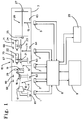
- FIG. 1 contains a control unit (8) to which a monitor (7) is connected.
- An input field (29) belongs to the control unit (8).
- the control unit of the individual weaving machines can be connected to a central control unit (9) which belongs to several weaving machines.
- a thread break occurs during the operation of the weaving machine, this is detected by a thread detector and reported to the control unit (8).
- the control unit (8) stops the loom, the control unit (8) possibly stopping the loom in accordance with a predetermined program.
- control unit (8) calls up images of possible locations and / or types of thread breaks from a memory and displays them on the monitor (7). If, for example, a thread monitor of the entry system for weft threads has reported a thread break, the image (10) shown in FIG. 1 is called up and displayed.
- the operator determines the location of the weft break and then presses the associated selection key (1, 2, 3, 4 or 5).
- These selection buttons (1 to 5) are assigned to the possible locations of weft breaks shown in the image (10).
- arrows (11, 12, 13, 14, 15) on the image (10) lead from the selection keys (1 to 5) to the corresponding locations.
- the operator is already given advance information as to where the breakage of the weft thread has probably occurred.
- the control unit (8) evaluates this signal in order to already have one or more of the selection buttons ( 1 to 5).
- the control unit (8) identifies the corresponding selection buttons (1, 2 or 5) in that a lamp assigned to these selection buttons (1, 2 or 5) lights up. If the lamps assigned to the selection buttons (1 and 2) light up, the operator has the preliminary information that the weft thread on the bobbin (17) or between the bobbin and the prewinder (19) is probably broken.
- the operator has the information that the weft thread is probably broken in the shed (26). If none of the lamps lights up, the operator has the information that the weft thread is likely in the area between the prewinder (19) and the auxiliary main blowing nozzle (21) or in the area between the auxiliary main blowing nozzle (21) and the main blowing nozzle (23 ) is broken.
- the weft thread is broken in the area of the shed (26), it is provided that not only the location of the thread break is entered into the control unit, but also the type of weft break. For this purpose it is provided that pressing the selection button (5) retrieves a further image (20) from the memory of the control unit (8) and displays it on the monitor (7).
- This image (20) contains a number of partial images (31, 32, 33, 34 and 35) which are each assigned to one of the selection buttons (1 to 5) using arrows (11, 12, 13, 14, 15).
- the partial image (31) shows a loop in the weft thread
- the partial image (32) shows a weft thread that is too short
- the partial image (33) shows a common weft thread
- the partial image (34) shows a weft thread with two parts
- the partial image (35) shows a weft thread break of any other Art.
- the selection key (5) is pressed, it can be provided that a further image with further types of weft breaks is called up and displayed, to which the selection keys (1 to 5) are then assigned again. This allows the operator to make a further selection from possible types of weft breaks. It is also possible for the operator to make further selections within the images (31, 32, 33 and 34) and to assign the weft break actually occurring to an image of a weft break precisely. If, for example, the selection button (4) that is assigned to the partial image (34) in FIG. 2 is pressed, a further image (30) is called up and displayed on the monitor (7). This image (30) contains three partial images which specify the partial image (34) of the image (20) in more detail.
- the partial image (36) shows a weft break at the beginning of the shed
- the partial image (37) shows a weft break in the middle of the shed
- the partial image (38) shows a weft break at the end of the shed.
- the control unit (8) calls an image (40) from the memory and displays it on the monitor (7), which contains the possible locations of warp thread breaks and assigns them to the selection buttons (1 to 5).
- the image (40) shown in FIG. 4 schematically shows a warp beam (41), a match beam (42), a warp thread tension meter (43), a warp thread monitor (44), shafts (45), a reed (46), a breast beam (47 ) and a merchandise tree (48).
- the selection buttons (1, 3, 4, 5) are assigned to the possible locations of warp thread breaks on the picture. After the operator determines the actual location of the warp thread break she presses the corresponding selection button (1, 3, 4 or 5).
- a further image (50) is called up and displayed on the monitor (7), which displays types of thread breaks in the warp threads in several partial images.
- the partial image (51) shows crossed warp threads, the partial image (52) a loop in the warp threads, the partial image (53) an interlaced warp thread, the partial image (54) an impermissible thick spot on a warp thread and the partial image (55) not one of them type of warp thread break belonging to previous partial images. If the selection button (5) is actuated, further images can be called up and displayed on the monitor, which represent further types of warp thread breaks in partial images and thus allow a fine assignment of the actual warp thread break to the information to be passed on to the control unit.
- the data entered in the control unit (8) of the weaving machine about the location and / or type of thread breaks can be processed in the control unit (8) or in the central control unit (9). For example, the number of actuations of the individual selection buttons (1 to 5) is counted, with a breakdown of the respective location and type taking place via the assignment to one of the pictures (10, 20, 30, 40, 50).
- the processing can be used for statistical purposes or as information that makes it possible to optimize the control or setting of weaving machine elements.
- control unit (8 or 9) contains an evaluation device which the data about the location and the type of yarn breaks that occurred are not only registered and counted in a retrievable manner, but are also designed in such a way that they evaluate this data in connection with the set operating parameters and when too many yarn breaks at a determined location and a determined type occur, causes a change in one or more operating parameters.
- control unit (8) automatically makes an adjustment in the sense of optimizing, ie to reduce the yarn breaks. If, for example, it is determined that there are too many loops in the weft threads (partial image 31 in FIG.
- this data is input into the control unit correspondingly often via the selection key (1), this indicates, for example, that the main blowing nozzle (23 ) blows out compressed air for too long.
- the control unit (8) can then automatically cause the valve (24) of the main blowing nozzle (23) to close earlier in order to avoid loops in the weft threads.
- control unit (8 or 9) on the monitor (7) indicates to the operator that the valve (24) of the main blowing nozzle (23) should close earlier. The operator can then carry out this setting via the input unit (29) of the control unit.
- the evaluation device can also be used to reduce the number of warp thread breaks. For example, can be initiated by the evaluation device be that the warp thread tension is automatically reduced or that the operator is given an appropriate instruction.
- the evaluation device can also be a component of the central control unit (9), to which the data of the locations and / or types of thread breaks are forwarded by the control unit (8).
- the central control unit (9) then transmits corresponding commands to the control unit (8) of the individual weaving machine in order to make changes to the settings of the operating parameters automatically or through the intervention of the weaver.
- the control unit (8) contains a restart lock, so that the weaving machine cannot be started as long as the location and / or type of thread break have not been entered into the control unit (8).
- a restart lock so that the weaving machine cannot be started as long as the location and / or type of thread break have not been entered into the control unit (8).
- one of the selection keys not in use (for example selection keys 2 and 4 in figure 30 of FIG. 3) does not release the restart lock.
- a thread break that has occurred is recorded only once in the control unit, i.e. only by pressing one of the selection buttons (1 to 5).
- the invention has the advantage that no complex and expensive sensors are required to detect and record the various locations and / or types of thread breaks.
- Appropriate training of the control unit (8) also makes it possible to display further information that is important for the operator in the images (10, 20, 30, 40, 50) that can be displayed on the monitor. For example, it can be provided that the operator gives the command to the control unit via the input unit (29), additional values to depict in the pictures.
- the selection buttons (1, 2, 3, 4, 5) in the image (10) according to FIG. 1 can be assigned displays (61, 62, 63, 64, 65) with which the number of operations of the relevant selection buttons ( 1 to 5) is displayed, for example after the last change in the setting of the weaving machine.
- additional information can be displayed simultaneously with the images on the monitor (7), for example the opening time (66) and the closing time (69) of the blocking pin (28) of the prewinder, the opening time (67) and the closing time (70) of the valve (22) and the opening time (68) and the closing time (71) of the valve (24).
- Additional representations are also possible in other images.
- the warp thread tension can be shown in a display (72) in image (40) of FIG. 4.
- selection buttons (1 to 5) it is not necessary to assign the selection buttons (1 to 5) to the individual locations and / or types of thread breaks in the pictures (10, 20, 30, 40, 50) using arrows (11 to 15).
- arrows (11 to 15) it is possible to mark the selection buttons (1 to 5) with numbers or letters and to assign the corresponding numbers or letters to the locations and / or the types of thread breaks.
- the selection buttons can then also be part of the input field (29).
Landscapes
- Engineering & Computer Science (AREA)
- Textile Engineering (AREA)
- Looms (AREA)
Applications Claiming Priority (2)
| Application Number | Priority Date | Filing Date | Title |
|---|---|---|---|
| BE9200891 | 1992-10-14 | ||
| BE9200891A BE1006295A3 (nl) | 1992-10-14 | 1992-10-14 | Werkwijze en inrichting voor het registreren van draadbreukkenmerken bij weefmachines. |
Publications (2)
| Publication Number | Publication Date |
|---|---|
| EP0592827A1 true EP0592827A1 (fr) | 1994-04-20 |
| EP0592827B1 EP0592827B1 (fr) | 1996-06-05 |
Family
ID=3886481
Family Applications (1)
| Application Number | Title | Priority Date | Filing Date |
|---|---|---|---|
| EP93114784A Expired - Lifetime EP0592827B1 (fr) | 1992-10-14 | 1993-09-15 | Commande d'un métier à tisser |
Country Status (5)
| Country | Link |
|---|---|
| US (1) | US5388618A (fr) |
| EP (1) | EP0592827B1 (fr) |
| JP (1) | JP3754462B2 (fr) |
| BE (1) | BE1006295A3 (fr) |
| DE (1) | DE59302813D1 (fr) |
Cited By (1)
| Publication number | Priority date | Publication date | Assignee | Title |
|---|---|---|---|---|
| CN101173413B (zh) * | 2003-05-14 | 2011-03-23 | 津田驹工业株式会社 | 织机数据的输入履历显示方法 |
Families Citing this family (19)
| Publication number | Priority date | Publication date | Assignee | Title |
|---|---|---|---|---|
| JP3157776B2 (ja) * | 1998-04-17 | 2001-04-16 | 津田駒工業株式会社 | 織機の起動方法 |
| US6260188B1 (en) | 1998-12-31 | 2001-07-10 | Kimberly-Clark Worldwide, Inc. | Control model |
| US6404910B1 (en) | 1998-12-31 | 2002-06-11 | Kimberly-Clark Worldwide, Inc. | Making absorbent articles using vision imaging system |
| US6266436B1 (en) | 1999-04-09 | 2001-07-24 | Kimberly-Clark Worldwide, Inc. | Process control using multiple detections |
| US6856859B1 (en) | 1998-12-31 | 2005-02-15 | Kimberly-Clark Worldwide, Inc. | Method of controlling cross-direction alignment in manufacturing process |
| US6253159B1 (en) | 1998-12-31 | 2001-06-26 | Kimberly-Clark Worldwide, Inc. | Process control using multiple detections |
| US6352497B1 (en) | 1999-04-02 | 2002-03-05 | Kimberly-Clark Worldwide, Inc. | Detectable marks in trim material |
| US6354984B1 (en) | 1999-04-02 | 2002-03-12 | Kimberly-Clark Worldwide, Inc. | Indirect registration of elements of web-derived product |
| US6163733A (en) * | 1999-04-06 | 2000-12-19 | Rubel; Laurence P. | Monitor and malfunction predictor for textile machines |
| US6553270B1 (en) | 1999-06-30 | 2003-04-22 | Kimberly-Clark Worldwide, Inc. | Proactive control of a process after the beginning of a destabilizing event |
| BE1014133A3 (nl) * | 2001-04-20 | 2003-05-06 | Picanol Nv | Werkwijze voor het optimaliseren van een textielproductieproces en inrichtingen die deze werkwijze toepassen. |
| US7130709B2 (en) * | 2002-08-07 | 2006-10-31 | Kimberly-Clark Worldwide, Inc. | Manufacturing information and alarming system and method |
| US6904330B2 (en) * | 2002-08-07 | 2005-06-07 | Kimberly-Clark Worldwide, Inc. | Manufacturing information and troubleshooting system and method |
| JP3982809B2 (ja) * | 2002-09-06 | 2007-09-26 | 津田駒工業株式会社 | 織機の不良内容表示装置 |
| JP4646191B2 (ja) * | 2004-05-24 | 2011-03-09 | 津田駒工業株式会社 | 繊維機械の支援方法 |
| BE1016287A6 (nl) * | 2004-07-14 | 2006-07-04 | Picanol Nv | Gaapvormingsonderdeel voor een weefmachine en weefmachine. |
| DE102005004064A1 (de) * | 2005-01-21 | 2006-07-27 | Picanol N.V. | Vorrichtung zum Eintragen von Schussfäden bei einer Luftdüsenwebmaschine |
| EP3754075B1 (fr) * | 2019-06-19 | 2022-12-07 | Stäubli Sargans AG | Ensemble de surveillance de peigne, machine d'insertion incorporant un tel ensemble de surveillance de peigne et procédé de surveillance d'un peigne à l'aide un tel ensemble de surveillance de peigne |
| CN112981675B (zh) * | 2021-02-07 | 2022-08-16 | 烟台海湾塑料制品有限公司 | 一种圆织机经纬线断线检测方法、系统、装置及存储介质 |
Citations (1)
| Publication number | Priority date | Publication date | Assignee | Title |
|---|---|---|---|---|
| DE192278C (fr) * |
Family Cites Families (2)
| Publication number | Priority date | Publication date | Assignee | Title |
|---|---|---|---|---|
| SE8900534D0 (sv) * | 1989-02-16 | 1989-02-16 | Iro Ab | Anordning foer att i eller vid textilmaskin styra och/eller oevervaka i foersta hand fournisoersorgan/fournisoersfunktioner |
| JPH0333250A (ja) * | 1989-06-26 | 1991-02-13 | Toyota Autom Loom Works Ltd | 織機における条件入力設定システム |
-
1992
- 1992-10-14 BE BE9200891A patent/BE1006295A3/nl not_active IP Right Cessation
-
1993
- 1993-09-15 DE DE59302813T patent/DE59302813D1/de not_active Expired - Fee Related
- 1993-09-15 EP EP93114784A patent/EP0592827B1/fr not_active Expired - Lifetime
- 1993-10-08 US US08/133,346 patent/US5388618A/en not_active Expired - Lifetime
- 1993-10-13 JP JP25567893A patent/JP3754462B2/ja not_active Expired - Fee Related
Patent Citations (1)
| Publication number | Priority date | Publication date | Assignee | Title |
|---|---|---|---|---|
| DE192278C (fr) * |
Non-Patent Citations (1)
| Title |
|---|
| ANDRE, INDUSTRIE TEXTILE, no. 1057, June 1976 (1976-06-01), PARIS FR, pages 361 - 362 * |
Cited By (1)
| Publication number | Priority date | Publication date | Assignee | Title |
|---|---|---|---|---|
| CN101173413B (zh) * | 2003-05-14 | 2011-03-23 | 津田驹工业株式会社 | 织机数据的输入履历显示方法 |
Also Published As
| Publication number | Publication date |
|---|---|
| BE1006295A3 (nl) | 1994-07-12 |
| EP0592827B1 (fr) | 1996-06-05 |
| JP3754462B2 (ja) | 2006-03-15 |
| JPH06228845A (ja) | 1994-08-16 |
| US5388618A (en) | 1995-02-14 |
| DE59302813D1 (de) | 1996-07-11 |
Similar Documents
| Publication | Publication Date | Title |
|---|---|---|
| EP0592827B1 (fr) | Commande d'un métier à tisser | |
| DE60106518T2 (de) | Verfahren und Vorrichtung zur Fehlererkennung im Fach einer Jacquardmaschine | |
| DE4137681C2 (de) | Verfahren zur Verhinderung der Erzeugung eines Schußstreifens in einer Webmaschine | |
| DE2704098A1 (de) | Elektro-hydraulische dampfturbinen- regeleinrichtung | |
| DE2908743A1 (de) | Elektronischer fadenwaechter an webmaschine mit ortsfester schussgarn- vorratsspule | |
| DE69005071T2 (de) | Blasvorrichtung für die Schussfäden in Webmaschinen. | |
| EP0656437B1 (fr) | Procédé pour fournir et insérer du fil de trame dans le tissu d'un métier à tisser et fournisseur | |
| DE2854257C2 (de) | Textilmaschine | |
| DE2848358C2 (de) | Störungsüberwachungsanordnung für eine Doppelventil-Einheit in einer pneumatischen Schaltung | |
| DE19602513C1 (de) | Verfahren zum Überwachen der Funktionstüchtigkeit elektrisch ansteuerbarer Magnetventile in Webmaschinen | |
| EP3741890A1 (fr) | Procédé de surveillance de flux d'air requis pour la manipulation d'un fil et/ou d'une bande de fibres et une unité d'un métier à filer | |
| DE69402356T2 (de) | Steuersystem für eine Vorrichtung zur Herstellung von Einlegekanten in Webmaschinen, insbesondere in Webmaschinen für durch Variation der Rietanschlagposition hergestellte Frottiergewebe | |
| DE2935507A1 (de) | Verfharen und einrichtung zum beheben eines schussfadenbruches | |
| DE3117750A1 (de) | Verfahren und vorrichtung zur ueberwachung eines mit stroemungsmittel-schussfadeneinzug arbeitenden webstuhls | |
| DE69614238T2 (de) | Zweihand-Steuerschaltung für Pressen | |
| CH669412A5 (fr) | ||
| EP0158655B1 (fr) | Procede de fonctionement d'un metier automatique et application du procede | |
| DE3721363C1 (de) | Vorrichtung zum Abschalten und Wiederanschalten einer Spinn- oder Zwirnspindel,insbesondere einer Doppeldraht-Spinn-oder Zwirnspindel | |
| DE602005003603T2 (de) | Startsteuervorrichtung und Startsteuerverfahren für eine Webmaschine | |
| DE69126569T2 (de) | Steuervorrichtung zum Programmieren von Rotationsschaftmaschinen für Webmaschinen | |
| EP0432401A2 (fr) | Métier à filer avec générateurs de signaux pour l'émission de signaux d'erreur en cas d'erreurs | |
| EP0102515B1 (fr) | Machine à tisser à fausse navette avec un dispositif de recherche de la duite | |
| EP0747519A2 (fr) | Procédé pour éviter l'entretissage d'un fil de trame cassé dans un tissu | |
| EP0118160A2 (fr) | Procédé pour détecter des pannes et générateur à rayons X pour la mise en oeuvre de ce procédé | |
| DE4421189C2 (de) | Vorrichtung zum Bestücken eines Spulengatters |
Legal Events
| Date | Code | Title | Description |
|---|---|---|---|
| PUAI | Public reference made under article 153(3) epc to a published international application that has entered the european phase |
Free format text: ORIGINAL CODE: 0009012 |
|
| AK | Designated contracting states |
Kind code of ref document: A1 Designated state(s): CH DE FR GB IT LI |
|
| 17P | Request for examination filed |
Effective date: 19940510 |
|
| 17Q | First examination report despatched |
Effective date: 19950828 |
|
| GRAH | Despatch of communication of intention to grant a patent |
Free format text: ORIGINAL CODE: EPIDOS IGRA |
|
| ITF | It: translation for a ep patent filed | ||
| GRAH | Despatch of communication of intention to grant a patent |
Free format text: ORIGINAL CODE: EPIDOS IGRA |
|
| GRAA | (expected) grant |
Free format text: ORIGINAL CODE: 0009210 |
|
| AK | Designated contracting states |
Kind code of ref document: B1 Designated state(s): CH DE FR GB IT LI |
|
| PG25 | Lapsed in a contracting state [announced via postgrant information from national office to epo] |
Ref country code: GB Effective date: 19960605 |
|
| REG | Reference to a national code |
Ref country code: CH Ref legal event code: NV Representative=s name: PATENTANWALTSBUERO G. PETSCHNER |
|
| REF | Corresponds to: |
Ref document number: 59302813 Country of ref document: DE Date of ref document: 19960711 |
|
| ET | Fr: translation filed | ||
| GBV | Gb: ep patent (uk) treated as always having been void in accordance with gb section 77(7)/1977 [no translation filed] |
Effective date: 19960605 |
|
| PLBE | No opposition filed within time limit |
Free format text: ORIGINAL CODE: 0009261 |
|
| 26N | No opposition filed | ||
| PGFP | Annual fee paid to national office [announced via postgrant information from national office to epo] |
Ref country code: FR Payment date: 20060922 Year of fee payment: 14 |
|
| PGFP | Annual fee paid to national office [announced via postgrant information from national office to epo] |
Ref country code: CH Payment date: 20060925 Year of fee payment: 14 |
|
| PGFP | Annual fee paid to national office [announced via postgrant information from national office to epo] |
Ref country code: IT Payment date: 20060930 Year of fee payment: 14 |
|
| PGFP | Annual fee paid to national office [announced via postgrant information from national office to epo] |
Ref country code: DE Payment date: 20061031 Year of fee payment: 14 |
|
| REG | Reference to a national code |
Ref country code: CH Ref legal event code: NV Representative=s name: ZIMMERLI, WAGNER & PARTNER AG |
|
| REG | Reference to a national code |
Ref country code: CH Ref legal event code: PL |
|
| PG25 | Lapsed in a contracting state [announced via postgrant information from national office to epo] |
Ref country code: LI Free format text: LAPSE BECAUSE OF NON-PAYMENT OF DUE FEES Effective date: 20070930 Ref country code: DE Free format text: LAPSE BECAUSE OF NON-PAYMENT OF DUE FEES Effective date: 20080401 Ref country code: CH Free format text: LAPSE BECAUSE OF NON-PAYMENT OF DUE FEES Effective date: 20070930 |
|
| REG | Reference to a national code |
Ref country code: FR Ref legal event code: ST Effective date: 20080531 |
|
| PG25 | Lapsed in a contracting state [announced via postgrant information from national office to epo] |
Ref country code: FR Free format text: LAPSE BECAUSE OF NON-PAYMENT OF DUE FEES Effective date: 20071001 |
|
| PG25 | Lapsed in a contracting state [announced via postgrant information from national office to epo] |
Ref country code: IT Free format text: LAPSE BECAUSE OF NON-PAYMENT OF DUE FEES Effective date: 20070915 |