EP0592912B1 - Verfahren zur Herstellung von Blockcopolymeren durch ionische Polymerisation - Google Patents
Verfahren zur Herstellung von Blockcopolymeren durch ionische Polymerisation Download PDFInfo
- Publication number
- EP0592912B1 EP0592912B1 EP93115986A EP93115986A EP0592912B1 EP 0592912 B1 EP0592912 B1 EP 0592912B1 EP 93115986 A EP93115986 A EP 93115986A EP 93115986 A EP93115986 A EP 93115986A EP 0592912 B1 EP0592912 B1 EP 0592912B1
- Authority
- EP
- European Patent Office
- Prior art keywords
- mixing
- monomer
- stretch
- reaction
- reactor
- Prior art date
- Legal status (The legal status is an assumption and is not a legal conclusion. Google has not performed a legal analysis and makes no representation as to the accuracy of the status listed.)
- Expired - Lifetime
Links
- 238000000034 method Methods 0.000 title claims description 13
- 229920001400 block copolymer Polymers 0.000 title claims description 10
- 239000000178 monomer Substances 0.000 claims description 25
- 238000006243 chemical reaction Methods 0.000 claims description 19
- PPBRXRYQALVLMV-UHFFFAOYSA-N Styrene Chemical compound C=CC1=CC=CC=C1 PPBRXRYQALVLMV-UHFFFAOYSA-N 0.000 claims description 16
- 229920000642 polymer Polymers 0.000 claims description 13
- KAKZBPTYRLMSJV-UHFFFAOYSA-N Butadiene Chemical compound C=CC=C KAKZBPTYRLMSJV-UHFFFAOYSA-N 0.000 claims description 12
- 239000003999 initiator Substances 0.000 claims description 9
- 238000006116 polymerization reaction Methods 0.000 claims description 9
- 238000004519 manufacturing process Methods 0.000 claims description 7
- 238000010539 anionic addition polymerization reaction Methods 0.000 claims description 4
- 239000011541 reaction mixture Substances 0.000 claims description 3
- 238000011144 upstream manufacturing Methods 0.000 claims description 3
- 150000002902 organometallic compounds Chemical class 0.000 claims description 2
- 238000001816 cooling Methods 0.000 claims 1
- 230000007704 transition Effects 0.000 description 7
- UAEPNZWRGJTJPN-UHFFFAOYSA-N methylcyclohexane Chemical compound CC1CCCCC1 UAEPNZWRGJTJPN-UHFFFAOYSA-N 0.000 description 6
- 150000002430 hydrocarbons Chemical class 0.000 description 4
- 239000000203 mixture Substances 0.000 description 4
- YXFVVABEGXRONW-UHFFFAOYSA-N Toluene Chemical compound CC1=CC=CC=C1 YXFVVABEGXRONW-UHFFFAOYSA-N 0.000 description 3
- WGOPGODQLGJZGL-UHFFFAOYSA-N lithium;butane Chemical compound [Li+].CC[CH-]C WGOPGODQLGJZGL-UHFFFAOYSA-N 0.000 description 3
- GYNNXHKOJHMOHS-UHFFFAOYSA-N methyl-cycloheptane Natural products CC1CCCCCC1 GYNNXHKOJHMOHS-UHFFFAOYSA-N 0.000 description 3
- -1 monolithium hydrocarbons Chemical class 0.000 description 3
- 230000003068 static effect Effects 0.000 description 3
- MYRTYDVEIRVNKP-UHFFFAOYSA-N 1,2-Divinylbenzene Chemical compound C=CC1=CC=CC=C1C=C MYRTYDVEIRVNKP-UHFFFAOYSA-N 0.000 description 2
- YNQLUTRBYVCPMQ-UHFFFAOYSA-N Ethylbenzene Chemical compound CCC1=CC=CC=C1 YNQLUTRBYVCPMQ-UHFFFAOYSA-N 0.000 description 2
- RRHGJUQNOFWUDK-UHFFFAOYSA-N Isoprene Chemical compound CC(=C)C=C RRHGJUQNOFWUDK-UHFFFAOYSA-N 0.000 description 2
- OFBQJSOFQDEBGM-UHFFFAOYSA-N Pentane Chemical compound CCCCC OFBQJSOFQDEBGM-UHFFFAOYSA-N 0.000 description 2
- WYURNTSHIVDZCO-UHFFFAOYSA-N Tetrahydrofuran Chemical compound C1CCOC1 WYURNTSHIVDZCO-UHFFFAOYSA-N 0.000 description 2
- 239000013543 active substance Substances 0.000 description 2
- 125000001931 aliphatic group Chemical group 0.000 description 2
- 150000001875 compounds Chemical class 0.000 description 2
- 230000008878 coupling Effects 0.000 description 2
- 238000010168 coupling process Methods 0.000 description 2
- 238000005859 coupling reaction Methods 0.000 description 2
- ZZUFCTLCJUWOSV-UHFFFAOYSA-N furosemide Chemical compound C1=C(Cl)C(S(=O)(=O)N)=CC(C(O)=O)=C1NCC1=CC=CO1 ZZUFCTLCJUWOSV-UHFFFAOYSA-N 0.000 description 2
- 229930195733 hydrocarbon Natural products 0.000 description 2
- 239000002904 solvent Substances 0.000 description 2
- 239000003381 stabilizer Substances 0.000 description 2
- XLYOFNOQVPJJNP-UHFFFAOYSA-N water Substances O XLYOFNOQVPJJNP-UHFFFAOYSA-N 0.000 description 2
- SDJHPPZKZZWAKF-UHFFFAOYSA-N 2,3-dimethylbuta-1,3-diene Chemical compound CC(=C)C(C)=C SDJHPPZKZZWAKF-UHFFFAOYSA-N 0.000 description 1
- DXIJHCSGLOHNES-UHFFFAOYSA-N 3,3-dimethylbut-1-enylbenzene Chemical compound CC(C)(C)C=CC1=CC=CC=C1 DXIJHCSGLOHNES-UHFFFAOYSA-N 0.000 description 1
- VXEGSRKPIUDPQT-UHFFFAOYSA-N 4-[4-(4-methoxyphenyl)piperazin-1-yl]aniline Chemical compound C1=CC(OC)=CC=C1N1CCN(C=2C=CC(N)=CC=2)CC1 VXEGSRKPIUDPQT-UHFFFAOYSA-N 0.000 description 1
- 229910018072 Al 2 O 3 Inorganic materials 0.000 description 1
- XDTMQSROBMDMFD-UHFFFAOYSA-N Cyclohexane Chemical compound C1CCCCC1 XDTMQSROBMDMFD-UHFFFAOYSA-N 0.000 description 1
- LFQSCWFLJHTTHZ-UHFFFAOYSA-N Ethanol Chemical compound CCO LFQSCWFLJHTTHZ-UHFFFAOYSA-N 0.000 description 1
- MZRVEZGGRBJDDB-UHFFFAOYSA-N N-Butyllithium Chemical compound [Li]CCCC MZRVEZGGRBJDDB-UHFFFAOYSA-N 0.000 description 1
- CTQNGGLPUBDAKN-UHFFFAOYSA-N O-Xylene Chemical compound CC1=CC=CC=C1C CTQNGGLPUBDAKN-UHFFFAOYSA-N 0.000 description 1
- 150000001299 aldehydes Chemical class 0.000 description 1
- XYLMUPLGERFSHI-UHFFFAOYSA-N alpha-Methylstyrene Chemical compound CC(=C)C1=CC=CC=C1 XYLMUPLGERFSHI-UHFFFAOYSA-N 0.000 description 1
- 239000003963 antioxidant agent Substances 0.000 description 1
- 150000004945 aromatic hydrocarbons Chemical class 0.000 description 1
- 125000003118 aryl group Chemical group 0.000 description 1
- 239000007795 chemical reaction product Substances 0.000 description 1
- 150000005690 diesters Chemical class 0.000 description 1
- CJSBUWDGPXGFGA-UHFFFAOYSA-N dimethyl-butadiene Natural products CC(C)=CC=C CJSBUWDGPXGFGA-UHFFFAOYSA-N 0.000 description 1
- 238000009826 distribution Methods 0.000 description 1
- 150000002118 epoxides Chemical class 0.000 description 1
- BLHLJVCOVBYQQS-UHFFFAOYSA-N ethyllithium Chemical compound [Li]CC BLHLJVCOVBYQQS-UHFFFAOYSA-N 0.000 description 1
- 238000002474 experimental method Methods 0.000 description 1
- 230000002349 favourable effect Effects 0.000 description 1
- 239000000945 filler Substances 0.000 description 1
- 229920001519 homopolymer Polymers 0.000 description 1
- 239000012442 inert solvent Substances 0.000 description 1
- 150000002576 ketones Chemical class 0.000 description 1
- 239000007788 liquid Substances 0.000 description 1
- 239000000314 lubricant Substances 0.000 description 1
- 239000000463 material Substances 0.000 description 1
- DVSDBMFJEQPWNO-UHFFFAOYSA-N methyllithium Chemical compound C[Li] DVSDBMFJEQPWNO-UHFFFAOYSA-N 0.000 description 1
- 230000004048 modification Effects 0.000 description 1
- 238000012986 modification Methods 0.000 description 1
- 239000002808 molecular sieve Substances 0.000 description 1
- NHKJPPKXDNZFBJ-UHFFFAOYSA-N phenyllithium Chemical compound [Li]C1=CC=CC=C1 NHKJPPKXDNZFBJ-UHFFFAOYSA-N 0.000 description 1
- 238000002360 preparation method Methods 0.000 description 1
- 239000000047 product Substances 0.000 description 1
- HJWLCRVIBGQPNF-UHFFFAOYSA-N prop-2-enylbenzene Chemical compound C=CCC1=CC=CC=C1 HJWLCRVIBGQPNF-UHFFFAOYSA-N 0.000 description 1
- 239000005049 silicon tetrachloride Substances 0.000 description 1
- URGAHOPLAPQHLN-UHFFFAOYSA-N sodium aluminosilicate Chemical compound [Na+].[Al+3].[O-][Si]([O-])=O.[O-][Si]([O-])=O URGAHOPLAPQHLN-UHFFFAOYSA-N 0.000 description 1
- 239000007858 starting material Substances 0.000 description 1
- 239000000126 substance Substances 0.000 description 1
- YLQBMQCUIZJEEH-UHFFFAOYSA-N tetrahydrofuran Natural products C=1C=COC=1 YLQBMQCUIZJEEH-UHFFFAOYSA-N 0.000 description 1
- 229920001169 thermoplastic Polymers 0.000 description 1
- 229920002725 thermoplastic elastomer Polymers 0.000 description 1
- 239000004416 thermosoftening plastic Substances 0.000 description 1
- 150000005691 triesters Chemical class 0.000 description 1
- 239000008096 xylene Substances 0.000 description 1
Images
Classifications
-
- C—CHEMISTRY; METALLURGY
- C08—ORGANIC MACROMOLECULAR COMPOUNDS; THEIR PREPARATION OR CHEMICAL WORKING-UP; COMPOSITIONS BASED THEREON
- C08F—MACROMOLECULAR COMPOUNDS OBTAINED BY REACTIONS ONLY INVOLVING CARBON-TO-CARBON UNSATURATED BONDS
- C08F297/00—Macromolecular compounds obtained by successively polymerising different monomer systems using a catalyst of the ionic or coordination type without deactivating the intermediate polymer
- C08F297/02—Macromolecular compounds obtained by successively polymerising different monomer systems using a catalyst of the ionic or coordination type without deactivating the intermediate polymer using a catalyst of the anionic type
- C08F297/04—Macromolecular compounds obtained by successively polymerising different monomer systems using a catalyst of the ionic or coordination type without deactivating the intermediate polymer using a catalyst of the anionic type polymerising vinyl aromatic monomers and conjugated dienes
Definitions
- the invention relates to a process for the production of block copolymers by anionic polymerization in tubular reactors.
- block copolymers from anionically polymerizable monomers is well known. It is generally carried out in batches in a stirred tank, as described, for example, in German patents 13 01 496 and 25 50 227.
- DE-A-21 11 966 describes the production of block copolymers in a reactor cascade. With this process, the space-time yield can be more favorable if complete polymerization is not carried out in the individual reaction zones, but then only polymers with regions with a statistical or largely statistical monomer distribution, ie so-called smeared transitions, are obtained.
- the object of the invention is therefore to produce block copolymers of styrene or its equivalents on the one hand and of butadiene or its equivalents on the other hand by sequential anionic polymerization, preferably with so-called sharp transitions with a high space-time yield, with first of all a first monomer and the organometallic compound serving as starter be combined in a reaction mixture and the reaction is continued until the at least partial consumption of the first monomer and then at least one further monomer is added and in each case partially or completely implemented.
- Space-time yield is understood to mean the yield of polymer formed, based on the effective reactor volume and based on the Time that elapses from the entry of the monomers and auxiliary substances into the reactor until the exit of the polymer solution from the reactor.
- the object is achieved in that the polymerization is carried out continuously in a manner known per se in a tubular reactor, the reaction of one monomer in each case being carried out in one reactor section and at least two reactor sections being separated by a mixing section.
- reaction zones or pipe sections For the production of e.g. a tripod A-B-A, three successive reaction zones or pipe sections are required. A mixture of an inert solvent freed from proton-active substances and the monomer A and separately the initiator are fed to the first reaction zone. Monomer B is fed into the second reaction zone and monomer A is fed into the third zone. A mixing section follows each of the first and second reaction zones; both the reaction zones and the mixing sections can be cooled. The reaction zones are dimensioned such that the monomer added last polymerizes completely before the reaction mixture reaches the next zone. This gives block copolymers with so-called sharp transitions between the blocks. Smeared transitions can be achieved if the reaction in the individual reaction zones is not carried out completely, intermittent or intermittent mixtures of monomers are permitted, or if small amounts of polar compounds, e.g. Tetrahydrofuran adds.
- polar compounds e.g. Tetrahydrofuran adds.
- the ratio of the amount of initiator to the amount of monomer determines the block length in the polymer. I. a. the entire amount of initiator is fed to a mixing element upstream of the first reaction zone.
- the metering of the initiator can also be distributed over several reaction zones and block copolymer mixtures of different block lengths are thereby obtained.
- the polymerization should expediently take place at temperatures between 20 and 150 ° C. and preferably between 35 and 120 ° C.
- styrene examples include, for example, ⁇ -methylstyrene, vinyltoluene or tert-butylstyrene.
- Dimethylbutadiene and isoprene are to be considered as equivalents of butadiene.
- Inert hydrocarbons can be used as solvents.
- Suitable compounds are aliphatic, cycloaliphatic or aromatic hydrocarbons that operate under reaction conditions are liquid and contain four to 12 hydrocarbon atoms.
- Examples include pentane, cyclohexane, methylcyclohexane, toluene, ethylbenzene or xylene.
- Suitable initiators for the polymerization are the known monolithium hydrocarbons of the general formula RLi, in which R represents an aliphatic, cycloaliphatic, aromatic or mixed aromatic-aliphatic hydrocarbon radical.
- the hydrocarbon residue can have 1 to 12 hydrocarbon atoms.
- examples of the initiators described are: methyl lithium, ethyl lithium, n- or sec-butyllithium, isopropyl-cyclohexyl or phenyllithium. N- or sec-butyllithium are particularly preferred.
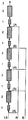
- a suitable device for carrying out the method according to the invention is shown in the figure and consists of a number of segments (1, 2), each of which has a mixing section 1 and a tubular reactor 2, with (1) a dwell zone, i.e. represents a static mixer.
- Suitable mixers are e.g. commercially available rigid internals, fillers or sequences of simple perforated plates, the holes of which are arranged offset.
- the different monomers - two monomers A and B are indicated here - are fed separately.
- the process according to the invention is suitable both for the production of thermoplastics - in particular based on styrene and butadiene - and for the production of thermoplastic elastomers, and instead of the linear block structure it is also possible to obtain star-shaped polymers if the living chain ends after the end of the polymerization in another reaction zone - consisting of e.g. B. from a static mixer - coupled in a known manner with a multifunctional connection and then canceled.
- divinylbenzene, silicon tetrachloride, di- or tri-esters, aldehydes, ketones and multifunctional epoxides such as under the trade name Edenol ® B 316 or B 81 products from Henkel are available.
- reaction products are treated with a proton-active substance, for example an alcohol or a mixture of CO 2 and water.
- a proton-active substance for example an alcohol or a mixture of CO 2 and water.
- a device comprising a total of four segments is used to demonstrate the invention.
- Each segment contains a tubular reactor with a diameter of 5 cm and a length of 800 cm, which contains so-called SMR elements installed.
- Each segment except the last one is followed by a static mixer with so-called SMX elements.
- Each pipe segment has a metering device for monomers.
- the first segment also contains a device for the initiator solution.
- the aforementioned internals and their mode of operation are e.g. in corresponding documents from the manufacturer Sulzer AG, Winthertur, Switzerland.
- the polymer solution at the end of the last reactor was collected, treated with CO 2 and water and then freed from the solvent.
- the molecular weight of the blocks with SBS polymer was 1 : 82,000 g / mol for S, 34,000 g / mol for B, and 43,000 g / mol for S 2 .
- the space-time yield was: 0.50 kg / l ⁇ h
- Example 2 The experiment according to Example 1 was repeated, with 5.0 kg / h of styrene instead of butadiene being added to the third segment and Edenol B 316 from Henkel instead of styrene added to the fourth segment.
- the space-time yield was: 0.58 kg / l ⁇ h
- the space-time yield was: 0.4 kg / l ⁇ h
Landscapes
- Chemical & Material Sciences (AREA)
- Inorganic Chemistry (AREA)
- Health & Medical Sciences (AREA)
- Chemical Kinetics & Catalysis (AREA)
- Medicinal Chemistry (AREA)
- Polymers & Plastics (AREA)
- Organic Chemistry (AREA)
- Graft Or Block Polymers (AREA)
Description
- Die Erfindung betrifft ein Verfahren zur Herstellung von Blockcopolymeren durch anionische Polymerisation in Rohrreaktoren.
- Die Herstellung von Blockcopolymeren aus anionisch polymerisierbaren Monomeren ist hinlänglich bekannt. Sie wird im allgemeinen absatzweise im Rührkessel vorgenommen, wie es beispielsweise in den deutschen Patentschriften 13 01 496 und 25 50 227 beschrieben ist.
- Um Polymerblöcke mit sog. scharfen Übergängen zu erhalten, müssen die einzelnen Monomeren streng sequentiell, d.h. jeweils ein Monomeres muß vollständig umgesetzt sein, bevor das weitere Monomere zugesetzt werden kann. Im Prinzip gilt dies auch für sog. verschmierte Übergänge, wenn sie kontrolliert bleiben sollen, d.h. nach dem Übergang schließlich wieder ein rein homopolymerer Block erhalten werden soll. Es werden dabei nur Polymerlösungen mit niedriger Konzentration erhalten, da andernfalls durch die Polymerisation die Temperatur so hoch ansteigt, daß ein thermischer Abbruch der Polymerkette eintritt. All dies führt zu einer sehr schlechten Raumzeitausbeute.
- In der DE-A-21 11 966 wird die Herstellung von Blockcopolymeren in einer Reaktorkaskade beschrieben. Die Raumzeitausbeute kann bei diesem Verfahren zwar günstiger sein, wenn man auf vollständige Polymerisation in den einzelnen Reaktionszonen verzichtet, dann erhält man aber nur Polymere mit Bereichen mit statistischer bzw. weitgehend statistischer Monomerverteilung, also sog. verschmierten Übergängen.
- Aufgabe der Erfindung ist es deshalb, Blockcopolymere des Styrols oder seiner Äquivalente einerseits und von Butadien oder seiner Äquivalente andererseits durch sequentielle anionische Polymerisation, vorzugsweise mit sog. scharfen Übergängen bei hoher Raumzeitausbeute herzustellen, wobei zunächst ein erstes Monomeres und die als Starter dienende metallorganische Verbindung zu einem Reaktionsgemisch vereinigt werden und die Umsetzung bis zum mindestens teilweisen Verbrauch des ersten Monomeren fortgeführt und sodann mindestens ein weiteres Monomeres zugesetzt und jeweils teilweise oder vollständig umgesetzt wird. Unter Raumzeitausbeute wird dabei die Ausbeute an gebildetem Polymer verstanden, bezogen auf das effektiv vorhandene Reaktorvolumen und bezogen auf die Zeit, die vergeht vom Eintritt der Monomeren und Hilfsstoffe in den Reaktor bis zum Austritt der Polymerlösung aus dem Reaktor.
- Die Aufgabe wird erfindungsgemäß dadurch gelöst, daß man die Polymerisation In an sich bekannter Weise kontinuierlich in einem Rohrreaktor durchgeführt, wobei die Umsetzung jeweils eines Monomeren in jeweils einem Reaktorabschnitt vorgenommen wird und mindestens zwei Reaktorabschnitte durch eine Mischstrecke getrennt sind.
- Für die Herstellung z.B.eines Dreiblocks A-B-A sind somit drei aufeinanderfolgende Reaktionszonen oder Rohrstrecken erforderlich. Dabei wird der ersten Reaktionszone ein Gemisch aus einem inerten und von protonenaktiven Substanzen befreiten Lösungsmittel und dem Monomer A sowie separat der Initiator zugeführt. Der zweiten Reaktionszone wird das Monomer B zugeführt und in die dritte Zone wird wiederum das Monomere A eingespeist. Auf die erste und zweite Reaktionszone folgt jeweils eine Mischstrecke; sowohl die Reaktionszonen wie die Mischstrecken können gekühlt werden. Die Reaktionszonen sind so dimensioniert, daß das zuletzt zugeführte Monomere jeweils vollständig polymerisiert, bevor das Reaktionsgemisch die nächste Zone erreicht. Man erhält dadurch Blockcopolymere mit sog. scharfen Übergängen zwischen den Blöcken. Verschmierte Übergänge lassen sich erreichen, wenn man die Umsetzung in den einzelnen Reaktionszonen nicht vollständig führt, zeit- bzw. abschnittsweise Gemische von Monomeren zuläßt, oder wenn man geringe Mengen polarer Verbindungen, wie z.B. Tetrahydrofuran zusetzt.
- Wie bei anionischen Polymerisationsverfahren üblich, bestimmt das Verhältnis von Initiatormenge zur Monomermenge die Blocklänge im Polymeren. I. a. wird die gesamte Initiatormenge einem Mischelement vor der ersten Reaktionszone zugeführt. Man kann aber auch die Dosierung des Initiators auf mehrere Reaktionszonen verteilen und erhält dadurch Blockcopolymergemische unterschiedlicher Blocklängen.
- Die Polymerisation soll zweckmäßigerweise bei Temperaturen zwischen 20 und 150°C und bevorzugt zwischen 35 und 120°C ablaufen.
- Als Äquivalente des Styrols kommen z.B., α-Methylstyrol, Vinyltoluol oder tert.-Butylstyrol in Frage. Als Äquivalente des Butadiens sind Dimethylbutadien und Isopren in Betracht zu ziehen.
- Als Lösungsmittel können inerte Kohlenwasserstoffe eingesetzt werden. Geeignete Verbindungen sind aliphatische, cycloaliphatische oder aromatische Kohlenwasserstoffe, die unter Reaktionsbedingungen flüssig sind und vier bis 12 Kohlenwasserstoffatome enthalten.
- Beispiele hierfür sind Pentan, Cyclohexan, Methylcyclohexan, Toluol, Ethylbenzol oder Xylol.
- Geeignete Initiatoren für die Polymerisation sind die bekannten Monolithiumkohlenwasserstoffe der allgemeinen Formel RLi, worin R einen aliphatischen, cycloaliphatischen, aromatischen oder gemischt aromatisch-aliphatischen Kohlenwasserstoffrest darstellt. Der Kohlenwasserstoffrest kann 1 bis 12 Kohlenwasserstoffatome besitzen. Als Beispiele für die beschriebenen Initiatoren seien genannt: Methyllithium, Ethyllithium, n- oder sec-Butyllithium, Isopropyl-Cyclohexyl oder Phenyllithium. Besonders bevorzugt sind n- oder sec-Butyllithium.
- Eine geeignete Vorrichtung zur Durchführung des erfindungsgemäßen Verfahrens ist in der Figur wiedergegeben und besteht aus einer Reihe von Segmenten (1, 2), welches jedes für sich eine Mischstrecke 1 und einen Rohrreaktor 2 aufweist, wobei (1) eine Verweilzone, d.h. einen statischen Mischer darstellt. Als Mischer geeignet sind z.B. handelsübliche starre Einbauten, Füllkörper oder Folgen einfacher Lochplatten, deren Löcher jeweils versetzt angeordnet sind. Die verschiedenen Monomeren - hier sind zwei Monomere A und B angedeutet - werden jeweils getrennt zugeführt.
- Das erfindungsgemäße Verfahren eignet sich sowohl für die Herstellung von Thermoplasten - insbesondere auf Basis von Styrol und Butadien - als auch für die Herstellung von thermoplastischen Elastomeren, wobei anstelle der linearen Blockstruktur auch sternförmig aufgebaute Polymere erhalten werden können, wenn die lebenden Kettenenden nach Abschluß der Polymerisation in einer weiteren Reaktionszone - bestehend z. B. aus einem statischen Mischer - in bekannter Weise mit einer multifunktionellen Verbindung gekoppelt und dann abgebrochen werden.
- Als solche eignen sich beispielsweise Divinylbenzol, Siliciumtetrachlorid, di- oder trifunktionelle Ester, Aldehyde, Ketone und multifunktionelle Epoxide wie z.B. unter der Handelsbezeichnung Edenol® B 316 oder B 81 der Firma Henkel erhältliche Produkte.
- Nach beendeter Polymerisation bzw. Kopplung werden die Reaktionsprodukte mit einer protonenaktiven Substanz behandelt wie beispielsweise einem Alkohol oder einem Gemisch aus CO2 und Wasser. Schließlich werden die Polymerlösungen in üblicher Weise von Lösungsmittel befreit und nach Bedarf mit Stabilisatoren, Antioxidantien, Gleitmitteln usw. versetzt.
- Zur Vorführung der Erfindung wird eine Vorrichtung aus insgesamt vier Segmenten verwendet. Jedes Segment enthält einen Rohrreaktor mit einem Durchmesser von 5 cm und einer Länge von 800 cm, der sog. SMR-Elemente eingebaut enthält. Jedem Segment außer dem letzten ist ein statischer Mischer mit sog. SMX-Elementen nachgeschaltet. Jedes Rohrsegment weist eine Dosiervorrichtung für Monomere auf. Das erste Segment enthält zusätzlich eine Vorrichtung für die Initiatorlösung. Die vorgenannten Einbauten und ihre Wirkungsweise sind z.B. in entsprechenden Druckschriften des Herstellers Sulzer AG, Winthertur, Schweiz beschrieben.
- Frisch destilliertes Styrol und Methylcyclohexan, die zuvor über Al2O3 getrocknet worden waren, wurden im Verhältnis 1:6 gemischt und mit einer Geschwindigkeit von 127 kg/h dem ersten Rohrsegment zugeführt. Gleichzeitig wurde eine 12%ige Lösung von sec-Butyllithium in Methylcyclohexan mit einer Geschwindigkeit von 0,12 kg/h zudosiert. Dem zweiten und dritten Rohrsegment wurden je 3,8 kg/h Butadien zugeführt, das über Molekularsieb getrocknet und vom Stabilisator befreit worden war. In den vierten Reaktor wurde wiederum Styrol mit einer Geschwindigkeit von 9,6 kg/h eingespeist. Die mittleren Polymerisationstemperaturen in den Reaktoren lagen in der Reihenfolge des Polymerflusses bei 65°C, 75°C, 75°C und 90°C.
- Die Polymerlösung am Ende des letzten Reaktors wurde gesammelt, mit CO2 und Wasser behandelt und anschließend vom Lösungsmittel befreit.
- Das Molekulargewicht der Blöcke mit SBS-Polymer betrug für S1: 82 000 g/mol, für B: 34 000 g/mol und für S2: 43 000 g/mol.
- Die Raumzeitausbeute betrug: 0,50 kg/l·h
- Der Versuch nach Beispiel 1 wurde wiederholt, wobei am dritten Segment 5,0 kg/h Styrol anstelle von Butadien und am vierten Segment Edenol B 316 von Henkel anstelle von Styrol zudosiert wurden.
- Die Raumzeitausbeute betrug: 0,58 kg/l·h
- Das mittlere Molekulargewicht lag bei 245 000 mol/g und die Kopplungsausbeute (= Verhältnis von gekoppeltem zu nicht gekoppeltem Material) lag bei 72 %.
- Wie in Beispiel 1 beschrieben wurde unter entsprechender Abänderung der Vorschrift ein Blockcopolymer B1SB2 mit den Molekulargewichten für B1 63 000 mol/g, B2 22 000 mol/g und S 84 000 mol/g hergestellt.
- Die Raumzeitausbeute betrug: 0,4 kg/l·h
Claims (9)
- Verfahren zur Herstellung von Blockcopolymeren des Styrols oder seiner Äquivalente einerseits und von Butadien oder seiner Äquivalente andererseits durch sequentielle anionische Polymerisation, wobei zunächst ein erstes Monomeres und die als Starter dienende metallorganische Verbindung zu einem Reaktionsgemisch vereinigt werden und die Umsetzung bis zum mindestens teilweisen Verbrauch des ersten Monomeren fortgeführt und sodann mindestens ein weiteres Monomeres zugesetzt und jeweils teilweise oder vollständig umgesetzt wird, dadurch gekennzeichnet, daß man die Umsetzung (Polymerisation) in an sich bekannter Weise kontinuierlich in einem Rohrreaktor durchführt, wobei die Umsetzung jeweils eines Monomeren in jeweils einem Reaktorabschnitt vorgenommen wird und mindestens zwei Reaktorabschnitte durch eine Mischstrecke getrennt sind.
- Verfahren nach Anspruch 1, dadurch gekennzeichnet, daß die Einspeisung des den zweiten oder weitere Polymerblöcke bildenden Monomeren in Strömungsrichtung jeweils vor einer Mischstrecke vorgenommen wird.
- Verfahren nach Anspruch 1, dadurch gekennzeichnet, daß mindestens ein Rohrreaktor mindestens in seinem - in Strömungsrichtung - vorderen oder hinteren Teil als Mischstrecke ausgebildet ist.
- Verfahren nach Anspruch 1, dadurch gekennzeichnet, daß die Mischstrecke als Rührkessel ausgebildet ist, mit der Maßgabe, daß die Verweilzeit bzw. das Rührkesselvolumen klein ist gegenüber der Bemessung des jeweils folgenden Rohrreaktors.
- Verfahren nach Anspruch 1, dadurch gekennzeichnet, daß die Gemischtemperatur an keiner Stelle eines Rohrreaktors 150°C überschreitet.
- Verfahren nach Anspruch 1, dadurch gekennzeichnet, daß mindestens ein Rohrreaktor durchgehend statisch mischende Einbauten und mindestens teilweise Kühlflächen aufweist.
- Verfahren nach Anspruch 1, dadurch gekennzeichnet, daß man jeweils eine Teilmenge der genannten Initiatormenge dem Eingang des Rohrreaktors und weitere Teilmengen wenigstens einem weiteren Reaktorabschnitt zuführt.
- Vorrichtung zur Durchführung des Verfahrens nach Anspruch 1, bestehend aus mindestens zwei aufeinanderfolgenden Reaktionsrohren, mindestens einer Mischstrecke, die zwischen den Rohren angeordnet ist, und Mitteln zur getrennten Einspeisung von mindestens 2 Monomeren.
- Vorrichtung nach Anspruch 8, enthaltend mindestens eine Rohrstrecke, die mindestens teilweise als Mischstrecke ausgebildet ist, die im wesentlichen rückvermischungsfrei bzw. nur radial-mischend wirkt.
Applications Claiming Priority (2)
| Application Number | Priority Date | Filing Date | Title |
|---|---|---|---|
| DE4234601A DE4234601A1 (de) | 1992-10-14 | 1992-10-14 | Verfahren zur Herstellung von Blockcopolymeren durch ionische Polymerisation |
| DE4234601 | 1992-10-14 |
Publications (2)
| Publication Number | Publication Date |
|---|---|
| EP0592912A1 EP0592912A1 (de) | 1994-04-20 |
| EP0592912B1 true EP0592912B1 (de) | 1996-07-17 |
Family
ID=6470424
Family Applications (1)
| Application Number | Title | Priority Date | Filing Date |
|---|---|---|---|
| EP93115986A Expired - Lifetime EP0592912B1 (de) | 1992-10-14 | 1993-10-04 | Verfahren zur Herstellung von Blockcopolymeren durch ionische Polymerisation |
Country Status (3)
| Country | Link |
|---|---|
| US (1) | US5587423A (de) |
| EP (1) | EP0592912B1 (de) |
| DE (2) | DE4234601A1 (de) |
Families Citing this family (39)
| Publication number | Priority date | Publication date | Assignee | Title |
|---|---|---|---|---|
| JP3838668B2 (ja) | 1996-08-19 | 2006-10-25 | ビーエーエスエフ アクチェンゲゼルシャフト | アニオン重合 |
| DE19721400A1 (de) * | 1997-05-22 | 1998-11-26 | Basf Ag | Verfahren zur Herstellung von Dienpolymerisatlösungen in vinylaromatischen Monomeren |
| US5955537A (en) * | 1998-02-13 | 1999-09-21 | The Goodyear Tire & Rubber Company | Continuous polymerization process |
| JP4312384B2 (ja) * | 1998-04-13 | 2009-08-12 | ラットガーズ ザ ステイト ユニヴァーシティ | コポリマーライブラリーの構築 |
| US6448353B1 (en) | 2000-02-08 | 2002-09-10 | 3M Innovative Properties Company | Continuous process for the production of controlled architecture materials |
| US7514263B2 (en) | 2001-04-02 | 2009-04-07 | 3M Innovative Properties Company | Continuous process for the production of combinatorial libraries of materials |
| US6956084B2 (en) | 2001-10-04 | 2005-10-18 | Bridgestone Corporation | Nano-particle preparation and applications |
| US7632916B2 (en) | 2002-08-02 | 2009-12-15 | 3M Innovative Properties Company | Process to modify polymeric materials and resulting compositions |
| KR100471716B1 (ko) * | 2002-08-03 | 2005-03-10 | 금호석유화학 주식회사 | 연속식 음이온 중합에 의한 내충격 비닐 방향족 고분자의제조방법 |
| US7576155B2 (en) | 2002-12-18 | 2009-08-18 | Bridgestone Corporation | Method for clay exfoliation, compositions therefore, and modified rubber containing same |
| US6875818B2 (en) | 2003-01-16 | 2005-04-05 | Bridgestone Corporation | Polymer nano-strings |
| US7205370B2 (en) | 2004-01-12 | 2007-04-17 | Bridgestone Corporation | Polymeric nano-particles of flower-like structure and applications |
| US7112369B2 (en) | 2004-03-02 | 2006-09-26 | Bridgestone Corporation | Nano-sized polymer-metal composites |
| US8063142B2 (en) | 2004-03-02 | 2011-11-22 | Bridgestone Corporation | Method of making nano-particles of selected size distribution |
| US7718737B2 (en) | 2004-03-02 | 2010-05-18 | Bridgestone Corporation | Rubber composition containing functionalized polymer nanoparticles |
| US20050282956A1 (en) | 2004-06-21 | 2005-12-22 | Xiaorong Wang | Reversible polymer/metal nano-composites and method for manufacturing same |
| US7998554B2 (en) | 2004-07-06 | 2011-08-16 | Bridgestone Corporation | Hydrophobic surfaces with nanoparticles |
| US7572855B2 (en) | 2005-01-28 | 2009-08-11 | Bridgestone Corporation | Nano-composite and compositions manufactured thereof |
| US7579398B2 (en) | 2005-02-02 | 2009-08-25 | Bridgestone Corporation | Nano-composite and compositions therefrom |
| US7659342B2 (en) | 2005-02-03 | 2010-02-09 | Bridgestone Corporation | Polymer nano-particle with polar core and method for manufacturing same |
| US9061900B2 (en) | 2005-12-16 | 2015-06-23 | Bridgestone Corporation | Combined use of liquid polymer and polymeric nanoparticles for rubber applications |
| US7538159B2 (en) | 2005-12-16 | 2009-05-26 | Bridgestone Corporation | Nanoparticles with controlled architecture and method thereof |
| US7884160B2 (en) | 2005-12-19 | 2011-02-08 | Bridgestone Corporation | Non-spherical nanoparticles made from living triblock polymer chains |
| US8288473B2 (en) | 2005-12-19 | 2012-10-16 | Bridgestone Corporation | Disk-like nanoparticles |
| US7560510B2 (en) | 2005-12-20 | 2009-07-14 | Bridgestone Corporation | Nano-sized inorganic metal particles, preparation thereof, and application thereof in improving rubber properties |
| US8877250B2 (en) | 2005-12-20 | 2014-11-04 | Bridgestone Corporation | Hollow nano-particles and method thereof |
| US8697775B2 (en) | 2005-12-20 | 2014-04-15 | Bridgestone Corporation | Vulcanizable nanoparticles having a core with a high glass transition temperature |
| US7601772B2 (en) | 2005-12-20 | 2009-10-13 | Bridgestone Corporation | Nano-composite and method thereof |
| US7935184B2 (en) | 2006-06-19 | 2011-05-03 | Bridgestone Corporation | Method of preparing imidazolium surfactants |
| JP6096398B2 (ja) | 2006-07-28 | 2017-03-15 | 株式会社ブリヂストン | 重合体ナノ粒子、ゴム組成物及び使用 |
| US20080058482A1 (en) * | 2006-08-29 | 2008-03-06 | 3M Innovative Properties Company | Continuous process polymerization of (meth)acrylate copolymers |
| US7597959B2 (en) | 2006-12-19 | 2009-10-06 | Bridgestone Corporation | Core-shell fluorescent nanoparticles |
| US7649049B2 (en) | 2006-12-20 | 2010-01-19 | Bridgestone Corporation | Rubber composition containing a polymer nanoparticle |
| US7829624B2 (en) | 2007-06-29 | 2010-11-09 | Bridgestone Corporation | One-pot synthesis of nanoparticles and liquid polymer for rubber applications |
| WO2010078320A2 (en) | 2008-12-31 | 2010-07-08 | Bridgestone Corporation | Core-first nanoparticle formation process, nanoparticle, and composition |
| US9062144B2 (en) | 2009-04-03 | 2015-06-23 | Bridgestone Corporation | Hairy polymeric nanoparticles with first and second shell block polymer arms |
| US9115222B2 (en) | 2009-12-29 | 2015-08-25 | Bridgestone Corporation | Well defined, highly crosslinked nanoparticles and method for making same |
| US9428604B1 (en) | 2011-12-30 | 2016-08-30 | Bridgestone Corporation | Nanoparticle fillers and methods of mixing into elastomers |
| WO2014075901A1 (de) * | 2012-11-15 | 2014-05-22 | Evonik Oil Additives Gmbh | Verfahren zur herstellung von polybutadien |
Family Cites Families (3)
| Publication number | Priority date | Publication date | Assignee | Title |
|---|---|---|---|---|
| DE2111966B2 (de) * | 1971-03-12 | 1979-03-08 | Basf Ag, 6700 Ludwigshafen | Kontinuierliches Verfahren zur Herstellung von Blockcopolymerisaten |
| US4346193A (en) * | 1981-05-04 | 1982-08-24 | Atlantic Richfield Company | Continuous process for making star-block copolymers |
| JPH0615597B2 (ja) * | 1984-08-15 | 1994-03-02 | 旭化成工業株式会社 | ブロツク共重合体 |
-
1992
- 1992-10-14 DE DE4234601A patent/DE4234601A1/de not_active Withdrawn
-
1993
- 1993-10-04 EP EP93115986A patent/EP0592912B1/de not_active Expired - Lifetime
- 1993-10-04 DE DE59303248T patent/DE59303248D1/de not_active Expired - Lifetime
- 1993-10-13 US US08/135,406 patent/US5587423A/en not_active Expired - Fee Related
Also Published As
| Publication number | Publication date |
|---|---|
| DE59303248D1 (de) | 1996-08-22 |
| EP0592912A1 (de) | 1994-04-20 |
| US5587423A (en) | 1996-12-24 |
| DE4234601A1 (de) | 1994-04-21 |
Similar Documents
| Publication | Publication Date | Title |
|---|---|---|
| EP0592912B1 (de) | Verfahren zur Herstellung von Blockcopolymeren durch ionische Polymerisation | |
| EP0211395B1 (de) | Polymerisate mit Aminogruppen, deren Herstellung und Verwendung | |
| EP0752268A2 (de) | Verfahren und Vorrichtung zur kontinuierlichen Herstellung von Polymeren | |
| EP0595119B1 (de) | Verfahren zur Herstellung einer vinylaromatischen Verbindung | |
| EP0752270A2 (de) | Verfahren und Vorrichtung zur kontinuierlichen Herstellung von Polymeren | |
| EP0288761B1 (de) | Verfahren zur Herstellung multifunktioneller Initiatoren für die anionische Polymerisation, oligomere multifunktionelle Initiatoren, Verwendung der erhaltenen Polymeren zur Herstellung gegebenenfalls funktionalisierter Polymere und als Prepolymere für andere Harze | |
| DE69408654T2 (de) | Sternblockcopolymer aus vinylaromatischen Monomer und konjugierten Dien Verfahren zu seiner Herstellung und die Zusammensetzung, die dieses Copolymer und Kristallines enthält | |
| EP1053267B1 (de) | Kontinuierliches verfahren zur herstellung thermoplastischer formmassen | |
| EP0312928A1 (de) | Verzweigte Copolymerisate und Verfahren zu ihrer Herstellung | |
| DE3537772A1 (de) | Transparente, schlagzaehe styrol-block-polymerisate und verfahren zu ihrer herstellung | |
| EP0797626A1 (de) | Verfahren zur herstellung von schlagzäh modifizierten polystyrol-formmassen | |
| DE69310943T2 (de) | Verfahren zur kontinuierlichen Herstellung von Blockcopolymeren aus Vinylaromat | |
| WO1998031721A1 (de) | Kontinuierliches verfahren zur herstellung von thermoplastischen formmassen | |
| EP0595121B1 (de) | Verfahren zur Herstellung von schlagzähem Polystyrol | |
| DE19715035A1 (de) | Verfahren zur kontinuierlichen Herstellung von Blockcopolymeren | |
| EP0797603A1 (de) | Verfahren zur herstellung von schlagzäh modifizierten polystyrol-formmassen | |
| WO1997001585A1 (de) | Verfahren zur anionischen polymerisation von vinylaromaten | |
| WO1998022518A1 (de) | Kontinuierliches verfahren zur herstellung thermoplastischer formmassen | |
| EP0904307A1 (de) | Verfahren zur herstellung von hydrophob-hydrophilen ab-blockcopolymeren | |
| DE4235786A1 (de) | Polystyrol-Formmasse und Verfahren zu ihrer Herstellung | |
| DE2111966B2 (de) | Kontinuierliches Verfahren zur Herstellung von Blockcopolymerisaten | |
| WO2003037501A1 (de) | Verfahren zur herstellung von (co)polymerisaten von olefinisch ungesättigten monomeren | |
| WO1999024481A1 (de) | Verfahren zur herstellung von dienkautschuk mit vermindertem anteil an unlöslichem | |
| EP0714414A1 (de) | Verfahren zur herstellung von anionisch polymerisierbaren vinylverbindungen | |
| DE19633273A1 (de) | Verfahren zur anionischen Polymerisation |
Legal Events
| Date | Code | Title | Description |
|---|---|---|---|
| PUAI | Public reference made under article 153(3) epc to a published international application that has entered the european phase |
Free format text: ORIGINAL CODE: 0009012 |
|
| 17P | Request for examination filed |
Effective date: 19940218 |
|
| AK | Designated contracting states |
Kind code of ref document: A1 Designated state(s): BE DE FR GB IT NL |
|
| RIN1 | Information on inventor provided before grant (corrected) |
Inventor name: THIELE, REINER Inventor name: GAUSEPOHL, HERMANN, DR. Inventor name: BRANDSTETTER, FRANZ, DR. |
|
| GRAG | Despatch of communication of intention to grant |
Free format text: ORIGINAL CODE: EPIDOS AGRA |
|
| GRAH | Despatch of communication of intention to grant a patent |
Free format text: ORIGINAL CODE: EPIDOS IGRA |
|
| 17Q | First examination report despatched |
Effective date: 19951208 |
|
| GRAH | Despatch of communication of intention to grant a patent |
Free format text: ORIGINAL CODE: EPIDOS IGRA |
|
| GRAA | (expected) grant |
Free format text: ORIGINAL CODE: 0009210 |
|
| AK | Designated contracting states |
Kind code of ref document: B1 Designated state(s): BE DE FR GB IT NL |
|
| REF | Corresponds to: |
Ref document number: 59303248 Country of ref document: DE Date of ref document: 19960822 |
|
| GBT | Gb: translation of ep patent filed (gb section 77(6)(a)/1977) |
Effective date: 19960822 |
|
| ITF | It: translation for a ep patent filed | ||
| ET | Fr: translation filed | ||
| PLBE | No opposition filed within time limit |
Free format text: ORIGINAL CODE: 0009261 |
|
| STAA | Information on the status of an ep patent application or granted ep patent |
Free format text: STATUS: NO OPPOSITION FILED WITHIN TIME LIMIT |
|
| 26N | No opposition filed | ||
| PGFP | Annual fee paid to national office [announced via postgrant information from national office to epo] |
Ref country code: FR Payment date: 19990924 Year of fee payment: 7 |
|
| PGFP | Annual fee paid to national office [announced via postgrant information from national office to epo] |
Ref country code: GB Payment date: 19991001 Year of fee payment: 7 |
|
| PGFP | Annual fee paid to national office [announced via postgrant information from national office to epo] |
Ref country code: NL Payment date: 19991007 Year of fee payment: 7 |
|
| PGFP | Annual fee paid to national office [announced via postgrant information from national office to epo] |
Ref country code: BE Payment date: 19991020 Year of fee payment: 7 |
|
| PGFP | Annual fee paid to national office [announced via postgrant information from national office to epo] |
Ref country code: DE Payment date: 19991026 Year of fee payment: 7 |
|
| PG25 | Lapsed in a contracting state [announced via postgrant information from national office to epo] |
Ref country code: GB Free format text: LAPSE BECAUSE OF NON-PAYMENT OF DUE FEES Effective date: 20001004 |
|
| PG25 | Lapsed in a contracting state [announced via postgrant information from national office to epo] |
Ref country code: DE Free format text: LAPSE BECAUSE OF THE APPLICANT RENOUNCES Effective date: 20001014 |
|
| PG25 | Lapsed in a contracting state [announced via postgrant information from national office to epo] |
Ref country code: BE Free format text: LAPSE BECAUSE OF NON-PAYMENT OF DUE FEES Effective date: 20001031 |
|
| BERE | Be: lapsed |
Owner name: BASF A.G. Effective date: 20001031 |
|
| PG25 | Lapsed in a contracting state [announced via postgrant information from national office to epo] |
Ref country code: NL Free format text: LAPSE BECAUSE OF NON-PAYMENT OF DUE FEES Effective date: 20010501 |
|
| GBPC | Gb: european patent ceased through non-payment of renewal fee |
Effective date: 20001004 |
|
| PG25 | Lapsed in a contracting state [announced via postgrant information from national office to epo] |
Ref country code: FR Free format text: LAPSE BECAUSE OF NON-PAYMENT OF DUE FEES Effective date: 20010629 |
|
| NLV4 | Nl: lapsed or anulled due to non-payment of the annual fee |
Effective date: 20010501 |
|
| REG | Reference to a national code |
Ref country code: FR Ref legal event code: ST |
|
| PG25 | Lapsed in a contracting state [announced via postgrant information from national office to epo] |
Ref country code: IT Free format text: LAPSE BECAUSE OF NON-PAYMENT OF DUE FEES Effective date: 20051004 |