EP0592968A1 - Automatischer Peptidsynthesereaktor - Google Patents
Automatischer Peptidsynthesereaktor Download PDFInfo
- Publication number
- EP0592968A1 EP0592968A1 EP93116375A EP93116375A EP0592968A1 EP 0592968 A1 EP0592968 A1 EP 0592968A1 EP 93116375 A EP93116375 A EP 93116375A EP 93116375 A EP93116375 A EP 93116375A EP 0592968 A1 EP0592968 A1 EP 0592968A1
- Authority
- EP
- European Patent Office
- Prior art keywords
- solvent
- peptide synthesizer
- acyl
- recovery
- automated peptide
- Prior art date
- Legal status (The legal status is an assumption and is not a legal conclusion. Google has not performed a legal analysis and makes no representation as to the accuracy of the status listed.)
- Ceased
Links
- 108090000765 processed proteins & peptides Proteins 0.000 title claims abstract description 23
- 125000002252 acyl group Chemical group 0.000 claims abstract description 42
- 238000011084 recovery Methods 0.000 claims abstract description 31
- 239000002904 solvent Substances 0.000 claims abstract description 26
- 230000037361 pathway Effects 0.000 claims abstract description 25
- 238000006243 chemical reaction Methods 0.000 claims abstract description 20
- 239000002699 waste material Substances 0.000 claims abstract description 19
- 239000007788 liquid Substances 0.000 claims abstract description 17
- 239000007810 chemical reaction solvent Substances 0.000 claims abstract description 9
- 238000000746 purification Methods 0.000 claims abstract description 5
- 230000003472 neutralizing effect Effects 0.000 claims description 4
- 239000002253 acid Substances 0.000 claims description 3
- 230000008859 change Effects 0.000 claims description 3
- 239000002808 molecular sieve Substances 0.000 claims description 2
- URGAHOPLAPQHLN-UHFFFAOYSA-N sodium aluminosilicate Chemical compound [Na+].[Al+3].[O-][Si]([O-])=O.[O-][Si]([O-])=O URGAHOPLAPQHLN-UHFFFAOYSA-N 0.000 claims description 2
- 150000007513 acids Chemical class 0.000 claims 1
- 238000010647 peptide synthesis reaction Methods 0.000 abstract description 9
- 230000006378 damage Effects 0.000 abstract description 5
- 230000007613 environmental effect Effects 0.000 abstract description 5
- ZMXDDKWLCZADIW-UHFFFAOYSA-N N,N-Dimethylformamide Chemical compound CN(C)C=O ZMXDDKWLCZADIW-UHFFFAOYSA-N 0.000 description 15
- 238000000034 method Methods 0.000 description 10
- 239000003153 chemical reaction reagent Substances 0.000 description 9
- 238000003786 synthesis reaction Methods 0.000 description 7
- YMWUJEATGCHHMB-UHFFFAOYSA-N Dichloromethane Chemical compound ClCCl YMWUJEATGCHHMB-UHFFFAOYSA-N 0.000 description 6
- XEKOWRVHYACXOJ-UHFFFAOYSA-N Ethyl acetate Chemical compound CCOC(C)=O XEKOWRVHYACXOJ-UHFFFAOYSA-N 0.000 description 6
- UIIMBOGNXHQVGW-UHFFFAOYSA-M Sodium bicarbonate Chemical class [Na+].OC([O-])=O UIIMBOGNXHQVGW-UHFFFAOYSA-M 0.000 description 6
- 230000015572 biosynthetic process Effects 0.000 description 6
- 150000001413 amino acids Chemical class 0.000 description 5
- XLYOFNOQVPJJNP-UHFFFAOYSA-N water Substances O XLYOFNOQVPJJNP-UHFFFAOYSA-N 0.000 description 5
- 150000003862 amino acid derivatives Chemical class 0.000 description 4
- 150000002148 esters Chemical class 0.000 description 4
- 230000008569 process Effects 0.000 description 4
- 239000000243 solution Substances 0.000 description 4
- 238000005406 washing Methods 0.000 description 4
- 108010033276 Peptide Fragments Proteins 0.000 description 3
- 102000007079 Peptide Fragments Human genes 0.000 description 3
- 150000001412 amines Chemical class 0.000 description 3
- KRKNYBCHXYNGOX-UHFFFAOYSA-N citric acid Chemical compound OC(=O)CC(O)(C(O)=O)CC(O)=O KRKNYBCHXYNGOX-UHFFFAOYSA-N 0.000 description 3
- 238000004821 distillation Methods 0.000 description 3
- 239000003960 organic solvent Substances 0.000 description 3
- 239000007787 solid Substances 0.000 description 3
- 239000007790 solid phase Substances 0.000 description 3
- 239000000126 substance Substances 0.000 description 3
- RTZKZFJDLAIYFH-UHFFFAOYSA-N Diethyl ether Chemical compound CCOCC RTZKZFJDLAIYFH-UHFFFAOYSA-N 0.000 description 2
- VEXZGXHMUGYJMC-UHFFFAOYSA-N Hydrochloric acid Chemical compound Cl VEXZGXHMUGYJMC-UHFFFAOYSA-N 0.000 description 2
- CSNNHWWHGAXBCP-UHFFFAOYSA-L Magnesium sulfate Chemical compound [Mg+2].[O-][S+2]([O-])([O-])[O-] CSNNHWWHGAXBCP-UHFFFAOYSA-L 0.000 description 2
- 238000004458 analytical method Methods 0.000 description 2
- 239000007864 aqueous solution Substances 0.000 description 2
- 238000005859 coupling reaction Methods 0.000 description 2
- 238000010511 deprotection reaction Methods 0.000 description 2
- 238000003912 environmental pollution Methods 0.000 description 2
- 125000000524 functional group Chemical group 0.000 description 2
- 239000002244 precipitate Substances 0.000 description 2
- 238000002360 preparation method Methods 0.000 description 2
- 230000002265 prevention Effects 0.000 description 2
- 230000009467 reduction Effects 0.000 description 2
- 235000017557 sodium bicarbonate Nutrition 0.000 description 2
- 229910000030 sodium bicarbonate Inorganic materials 0.000 description 2
- 239000007858 starting material Substances 0.000 description 2
- 238000003756 stirring Methods 0.000 description 2
- ASOKPJOREAFHNY-UHFFFAOYSA-N 1-Hydroxybenzotriazole Chemical compound C1=CC=C2N(O)N=NC2=C1 ASOKPJOREAFHNY-UHFFFAOYSA-N 0.000 description 1
- FXHOOIRPVKKKFG-UHFFFAOYSA-N N,N-Dimethylacetamide Chemical compound CN(C)C(C)=O FXHOOIRPVKKKFG-UHFFFAOYSA-N 0.000 description 1
- SECXISVLQFMRJM-UHFFFAOYSA-N N-Methylpyrrolidone Chemical compound CN1CCCC1=O SECXISVLQFMRJM-UHFFFAOYSA-N 0.000 description 1
- 239000007832 Na2SO4 Substances 0.000 description 1
- PMZURENOXWZQFD-UHFFFAOYSA-L Sodium Sulfate Chemical compound [Na+].[Na+].[O-]S([O-])(=O)=O PMZURENOXWZQFD-UHFFFAOYSA-L 0.000 description 1
- FAPWRFPIFSIZLT-UHFFFAOYSA-M Sodium chloride Chemical class [Na+].[Cl-] FAPWRFPIFSIZLT-UHFFFAOYSA-M 0.000 description 1
- 230000004913 activation Effects 0.000 description 1
- -1 amine compounds Chemical class 0.000 description 1
- 125000000539 amino acid group Chemical group 0.000 description 1
- 125000003277 amino group Chemical group 0.000 description 1
- 238000009835 boiling Methods 0.000 description 1
- 239000007795 chemical reaction product Substances 0.000 description 1
- 238000012790 confirmation Methods 0.000 description 1
- 239000000356 contaminant Substances 0.000 description 1
- 230000008878 coupling Effects 0.000 description 1
- 238000010168 coupling process Methods 0.000 description 1
- 239000007857 degradation product Substances 0.000 description 1
- 239000012634 fragment Substances 0.000 description 1
- 238000004128 high performance liquid chromatography Methods 0.000 description 1
- 239000012535 impurity Substances 0.000 description 1
- 239000000543 intermediate Substances 0.000 description 1
- 229910052943 magnesium sulfate Inorganic materials 0.000 description 1
- 235000019341 magnesium sulphate Nutrition 0.000 description 1
- 238000004519 manufacturing process Methods 0.000 description 1
- 238000004949 mass spectrometry Methods 0.000 description 1
- 239000000203 mixture Substances 0.000 description 1
- 230000004048 modification Effects 0.000 description 1
- 238000012986 modification Methods 0.000 description 1
- 230000003287 optical effect Effects 0.000 description 1
- 239000012044 organic layer Substances 0.000 description 1
- 239000003208 petroleum Substances 0.000 description 1
- 239000011148 porous material Substances 0.000 description 1
- 239000000047 product Substances 0.000 description 1
- 230000008929 regeneration Effects 0.000 description 1
- 238000011069 regeneration method Methods 0.000 description 1
- 238000007086 side reaction Methods 0.000 description 1
- 229910052938 sodium sulfate Inorganic materials 0.000 description 1
- 235000011152 sodium sulphate Nutrition 0.000 description 1
- 230000002194 synthesizing effect Effects 0.000 description 1
- 238000004809 thin layer chromatography Methods 0.000 description 1
- 239000010887 waste solvent Substances 0.000 description 1
Images
Classifications
-
- C—CHEMISTRY; METALLURGY
- C07—ORGANIC CHEMISTRY
- C07K—PEPTIDES
- C07K1/00—General methods for the preparation of peptides, i.e. processes for the organic chemical preparation of peptides or proteins of any length
- C07K1/04—General methods for the preparation of peptides, i.e. processes for the organic chemical preparation of peptides or proteins of any length on carriers
- C07K1/045—General methods for the preparation of peptides, i.e. processes for the organic chemical preparation of peptides or proteins of any length on carriers using devices to improve synthesis, e.g. reactors, special vessels
-
- B—PERFORMING OPERATIONS; TRANSPORTING
- B01—PHYSICAL OR CHEMICAL PROCESSES OR APPARATUS IN GENERAL
- B01J—CHEMICAL OR PHYSICAL PROCESSES, e.g. CATALYSIS OR COLLOID CHEMISTRY; THEIR RELEVANT APPARATUS
- B01J19/00—Chemical, physical or physico-chemical processes in general; Their relevant apparatus
- B01J19/0046—Sequential or parallel reactions, e.g. for the synthesis of polypeptides or polynucleotides; Apparatus and devices for combinatorial chemistry or for making molecular arrays
-
- B—PERFORMING OPERATIONS; TRANSPORTING
- B01—PHYSICAL OR CHEMICAL PROCESSES OR APPARATUS IN GENERAL
- B01J—CHEMICAL OR PHYSICAL PROCESSES, e.g. CATALYSIS OR COLLOID CHEMISTRY; THEIR RELEVANT APPARATUS
- B01J2219/00—Chemical, physical or physico-chemical processes in general; Their relevant apparatus
- B01J2219/00274—Sequential or parallel reactions; Apparatus and devices for combinatorial chemistry or for making arrays; Chemical library technology
- B01J2219/00277—Apparatus
- B01J2219/00279—Features relating to reactor vessels
- B01J2219/00281—Individual reactor vessels
- B01J2219/00286—Reactor vessels with top and bottom openings
-
- B—PERFORMING OPERATIONS; TRANSPORTING
- B01—PHYSICAL OR CHEMICAL PROCESSES OR APPARATUS IN GENERAL
- B01J—CHEMICAL OR PHYSICAL PROCESSES, e.g. CATALYSIS OR COLLOID CHEMISTRY; THEIR RELEVANT APPARATUS
- B01J2219/00—Chemical, physical or physico-chemical processes in general; Their relevant apparatus
- B01J2219/00274—Sequential or parallel reactions; Apparatus and devices for combinatorial chemistry or for making arrays; Chemical library technology
- B01J2219/00277—Apparatus
- B01J2219/00497—Features relating to the solid phase supports
- B01J2219/005—Beads
-
- B—PERFORMING OPERATIONS; TRANSPORTING
- B01—PHYSICAL OR CHEMICAL PROCESSES OR APPARATUS IN GENERAL
- B01J—CHEMICAL OR PHYSICAL PROCESSES, e.g. CATALYSIS OR COLLOID CHEMISTRY; THEIR RELEVANT APPARATUS
- B01J2219/00—Chemical, physical or physico-chemical processes in general; Their relevant apparatus
- B01J2219/00274—Sequential or parallel reactions; Apparatus and devices for combinatorial chemistry or for making arrays; Chemical library technology
- B01J2219/00583—Features relative to the processes being carried out
- B01J2219/0059—Sequential processes
-
- B—PERFORMING OPERATIONS; TRANSPORTING
- B01—PHYSICAL OR CHEMICAL PROCESSES OR APPARATUS IN GENERAL
- B01J—CHEMICAL OR PHYSICAL PROCESSES, e.g. CATALYSIS OR COLLOID CHEMISTRY; THEIR RELEVANT APPARATUS
- B01J2219/00—Chemical, physical or physico-chemical processes in general; Their relevant apparatus
- B01J2219/00274—Sequential or parallel reactions; Apparatus and devices for combinatorial chemistry or for making arrays; Chemical library technology
- B01J2219/00583—Features relative to the processes being carried out
- B01J2219/00596—Solid-phase processes
-
- B—PERFORMING OPERATIONS; TRANSPORTING
- B01—PHYSICAL OR CHEMICAL PROCESSES OR APPARATUS IN GENERAL
- B01J—CHEMICAL OR PHYSICAL PROCESSES, e.g. CATALYSIS OR COLLOID CHEMISTRY; THEIR RELEVANT APPARATUS
- B01J2219/00—Chemical, physical or physico-chemical processes in general; Their relevant apparatus
- B01J2219/00274—Sequential or parallel reactions; Apparatus and devices for combinatorial chemistry or for making arrays; Chemical library technology
- B01J2219/0068—Means for controlling the apparatus of the process
- B01J2219/00686—Automatic
-
- B—PERFORMING OPERATIONS; TRANSPORTING
- B01—PHYSICAL OR CHEMICAL PROCESSES OR APPARATUS IN GENERAL
- B01J—CHEMICAL OR PHYSICAL PROCESSES, e.g. CATALYSIS OR COLLOID CHEMISTRY; THEIR RELEVANT APPARATUS
- B01J2219/00—Chemical, physical or physico-chemical processes in general; Their relevant apparatus
- B01J2219/00274—Sequential or parallel reactions; Apparatus and devices for combinatorial chemistry or for making arrays; Chemical library technology
- B01J2219/00718—Type of compounds synthesised
- B01J2219/0072—Organic compounds
- B01J2219/00725—Peptides
-
- C—CHEMISTRY; METALLURGY
- C40—COMBINATORIAL TECHNOLOGY
- C40B—COMBINATORIAL CHEMISTRY; LIBRARIES, e.g. CHEMICAL LIBRARIES
- C40B40/00—Libraries per se, e.g. arrays, mixtures
- C40B40/04—Libraries containing only organic compounds
- C40B40/10—Libraries containing peptides or polypeptides, or derivatives thereof
-
- C—CHEMISTRY; METALLURGY
- C40—COMBINATORIAL TECHNOLOGY
- C40B—COMBINATORIAL CHEMISTRY; LIBRARIES, e.g. CHEMICAL LIBRARIES
- C40B60/00—Apparatus specially adapted for use in combinatorial chemistry or with libraries
- C40B60/14—Apparatus specially adapted for use in combinatorial chemistry or with libraries for creating libraries
Definitions
- the present invention relates an automated peptide synthesizer, and more particularly to an automated peptide synthesizer having flow pathways for recovering unreacted acyl components and reaction solvents.
- Solid-phase peptide synthesis is a technique for synthesizing the desired peptide by repeating a step of deprotection and acyl component introduction in the process of sequential couplings of amino acids on a solid-phase support.
- This technique is basically chemical synthesis, in which a great excess of acyl components is sequentially reacted to proceed the synthesis without confirmation of intermediates.
- the number of repeats of this step increases as the number of amino acids of the peptide chain increases, and because the remaining components such as acyl components remaining in the reaction product are potential contaminants for the following repeat, they should be washed out with an organic solvent. In this washing, an enormous amount of organic solvent is required. For example, in the BOC method using methylene chloride, more than about 10 liters of the waste solvent is discharged when 1 g of a peptide consisting of 5 amino acid residues is synthesized.
- solvents used for peptide synthesis such as dimethylformamide (DMF), methylene chloride, N-methylpyrrolidone and dimethylacetamide are not harmless substances which can cause environmental pollution when wasted as such, requiring an enormous amount of cost for their recovery and treatment.
- DMF dimethylformamide
- methylene chloride methylene chloride
- N-methylpyrrolidone N-methylpyrrolidone
- dimethylacetamide a frequently used solvent, is known to sometimes contain amine compounds as impurities and cause side reactions in the process of synthesis. Therefore, removal of trace amounts of amines and water from the reaction solvent allows synthesis at a high efficiency.
- the present inventor has investigated to develop an automated peptide synthesizer meeting the requirements of (1) running cost reduction in a large-scale peptide synthesis, and (2) prevention of environmental pollution (prevention of environmental destruction).
- the present inventor has found that the recovered reaction reagents can be purified, to such extent that its reuse is possible, by providing a line for recovering and purifying reaction reagents such as a solvent and a line for recovering acyl components on the flow pathway from the reaction chamber to a waste liquid reservoir, in which these lines are controlled by valve operation according to each reaction process.
- the present inventor has further investigated based on this finding, and thus developed the present invention.
- the present invention relates to an automated peptide synthesizer equipped with recovery lines comprising a line for recovering the unreacted acyl components, and a line for recovering and distilling a reaction solvent and passing it through a purification column to allow the reuse of the reaction solvent, both recovery lines being installed on the flow pathway from a reaction chamber to a waste liquid reservoir of the automated peptide synthesizer.
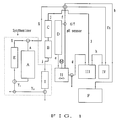
- Element I is a solvent chamber, element II a recovery chamber, element III a continuous distilling device, element IV a waste liquid reservoir, element A an acyl component preparation chamber, element B a column, element C a column, element D a reagent supplying unit, element E a reaction chamber (a reaction column), and element F a fraction collector.
- the unreacted acyl components can be recovered from a waste liquid discharged from the reaction chamber to allow the reuse of amino acid derivatives which are expensive acyl components, and reaction solvents can be also recovered and purified to allow its reuse. It is, therefore, possible to solve the problem of production cost reduction, including yield and purity, in a large-scale peptide synthesis, and also to significantly reduce the amount of the waste liquid, which causes environmental destruction.
- Pathways "Y1", “Y2" and “X-fx” are, respectively, acyl component supplying pathway, solvent supplying pathway and waste liquid pathways in a conventional peptide synthesizer. Switching of pathways “X” and “a” and that of pathways “f” and “fx” are achieved under valve operating direction by a computer (not illustrated) which controls peptide synthesis.
- a computer not illustrated
- one or more reaction chambers are used. Instead of the reaction chamber, one or more reaction columns may be used.
- An acyl component preparation chamber A is preferably a detachable cartridge.
- the acyl components which are preactivated such as an active ester are used.
- the acyl components used in the peptide synthesis is activated by a reagent, and is introduced to a reaction chamber (column) E in the form of, for instance, an active ester, whose side chain functional group and N ⁇ amino group are protected.
- the acyl components are recovered by a means for recovering using such as a fraction collector F via a pathway "b".
- the recovered acyl components contain the unreacted acyl components, added amine, hydroxybenzotriazole (HOBt) used for activation and other substances.
- HOBt hydroxybenzotriazole
- the acyl components recovered in the fraction collector F is manually or semi-automatically regenerated, thereby making it possible to reuse it as a protected amino acid derivative.
- the acyl components used are not an amino acid derivative but a protected peptide fragment, recovery is more important for cost performance.
- the unreacted acyl component in DMF is recovered to a fraction collector F via a pathway "X" and a pathway "b".
- the resulted solution (acyl component) is concentrated.
- the resultant gum or oil is triturated with a saturated NaHCO3 solution, and the solid and/or precipitate is washed with water. By this procedure, an active ester is hydrolyzed.
- the acyl components are extracted by washing with 1 M citric acid and rapidly with a saturated NaHCO3 solution, adjusted to a pH of 4 to 5 with 0.1 N HCl, followed by washing with a saturated NaCl solution. Then, the organic layer is dried over MgSO4 or Na2SO4. The obtained mixture is concentrated and precipitated from petroleum ether and/or solidified.
- an aqueous solution of sodium hydrogen carbonate is added to precipitate the amino acid whose NH2 group at the ⁇ position and functional groups of side chain are protected or to precipitate a protected peptide fragment on the basis of the principle that an aqueous solution of sodium hydrogen carbonate hydrolyzes the active ester. The precipitate is then collected and thoroughly washed with water.
- the purity of the recrystallized or reprecipitated product is determined by thin-layer chromatography, high performance liquid chromatography, mass spectrometry, DL analysis, optical rotation analysis, etc.
- the solvent used for washing the reaction chamber (column) E is sent to a recovery chamber II via a pathway "X."
- a pathway "f” for solvent recovery is provided. It is preferable to provide a pathway "f” with a means for sensing a pH change before distillation of the recovered solvent and neutralizing the acid and base therein.
- a neutralizing reagent is sent to the recovery chamber II via a pathway "e” from a reagent supplying unit D to neutralize the acid or base in the solvent being recovered.
- a neutralizing reagent such as dilute hydrochloric acid in, for example, DMF.
- the recovery chamber II has a stirring motor M therein, which offers as uniform stirring as possible.
- the recovered waste liquid is further introduced to a continuous distiller III via a pathway "g".
- the pathway "g” has a filter having a pore size, for instance, of 2 ⁇ m, and the waste liquid which passes the filter is transferred to the continuous distiller III, while the solids are removed from this purification pathway.
- the continuous distiller III performs a precision distillation. Waste liquids containing large amounts of high-boiling point substances, residues (e.g., the rest amount of amino acid derivatives) and components whose recovery does not warrant the cost of its reuse in the synthesis process, such as reagents for deprotection, are selectively introduced to the waste liquid reservoir IV via a pathway "h" or "fx".
- the continuous distiller III may be used singly or in a combination of two or more.
- the distilled solvent for reuse is introduced to a solvent chamber I of the peptide synthesizer through some columns (for instance, C and B) via a pathway "j" and supplied to the reaction chamber.
- These columns may be, for instance, packed with molecular sieves or activated charcoals to remove water, small amount of amines, etc. from the distilled solvent, which may contain trace amounts of water, degradation products during distillation, etc.
- the acyl component recovery line and the solvent recovery line in the present invention are installed in a continuous flow or batch-wise peptide synthesizer of large capacity.
- the recovery is performed by a valve switch in accordance with the progress of each procedure.
- the present invention reduces the cost required for the purchase of starting materials, the treatment of waste liquid, etc. by significantly reducing the amount of the starting material actually consumed and the waste liquid (organic solvent) which can cause environmental destruction.
Landscapes
- Chemical & Material Sciences (AREA)
- Organic Chemistry (AREA)
- Chemical Kinetics & Catalysis (AREA)
- Analytical Chemistry (AREA)
- Health & Medical Sciences (AREA)
- Life Sciences & Earth Sciences (AREA)
- Biochemistry (AREA)
- Biophysics (AREA)
- General Health & Medical Sciences (AREA)
- Genetics & Genomics (AREA)
- Medicinal Chemistry (AREA)
- Molecular Biology (AREA)
- Proteomics, Peptides & Aminoacids (AREA)
- Peptides Or Proteins (AREA)
Applications Claiming Priority (2)
| Application Number | Priority Date | Filing Date | Title |
|---|---|---|---|
| JP301775/92 | 1992-10-13 | ||
| JP4301775A JPH06128286A (ja) | 1992-10-13 | 1992-10-13 | 自動ペプチド合成装置 |
Publications (1)
| Publication Number | Publication Date |
|---|---|
| EP0592968A1 true EP0592968A1 (de) | 1994-04-20 |
Family
ID=17901025
Family Applications (1)
| Application Number | Title | Priority Date | Filing Date |
|---|---|---|---|
| EP93116375A Ceased EP0592968A1 (de) | 1992-10-13 | 1993-10-08 | Automatischer Peptidsynthesereaktor |
Country Status (3)
| Country | Link |
|---|---|
| US (1) | US5362447A (de) |
| EP (1) | EP0592968A1 (de) |
| JP (1) | JPH06128286A (de) |
Cited By (1)
| Publication number | Priority date | Publication date | Assignee | Title |
|---|---|---|---|---|
| WO1998049187A1 (en) | 1997-04-28 | 1998-11-05 | Chiron Corporation | Apparatus for synthesis of oligomers, especially peptoids, with reagent recycling |
Families Citing this family (8)
| Publication number | Priority date | Publication date | Assignee | Title |
|---|---|---|---|---|
| US5499193A (en) * | 1991-04-17 | 1996-03-12 | Takeda Chemical Industries, Ltd. | Automated synthesis apparatus and method of controlling the apparatus |
| US6558633B1 (en) | 1994-09-21 | 2003-05-06 | Isis Pharmaceuticals, Inc. | Chemical reaction apparatus and methods |
| US6649348B2 (en) * | 2001-06-29 | 2003-11-18 | Agilent Technologies Inc. | Methods for manufacturing arrays |
| US6822073B2 (en) * | 2001-12-20 | 2004-11-23 | Kimberly-Clark Worldwide, Inc. | Modular peptide-based reagent |
| WO2007065807A2 (en) * | 2005-12-06 | 2007-06-14 | F. Hoffmann-La Roche Ag | Automated solid phase synthesis |
| KR20090034636A (ko) * | 2007-10-04 | 2009-04-08 | 삼성전자주식회사 | 바이오 폴리머 합성 장치 및 방법, 바이오 폴리머 합성용시료의 회수 방법 |
| US11123436B2 (en) * | 2015-07-24 | 2021-09-21 | Hanmi Pharm. Co., Ltd. | Method of preparing physiologically active polypeptide conjugate |
| US12247049B1 (en) * | 2024-04-23 | 2025-03-11 | CSBio Instrumentation Co. | Apparatus and methods for solid phase peptide synthesis to minimize solvent utilization |
Citations (2)
| Publication number | Priority date | Publication date | Assignee | Title |
|---|---|---|---|---|
| EP0156588A2 (de) * | 1984-03-23 | 1985-10-02 | Applied Biosystems, Inc. | Automatisierter Polypeptidsyntheseapparat |
| WO1993012427A1 (en) * | 1991-12-19 | 1993-06-24 | Chiron Corporation | Automated apparatus for use in peptide synthesis |
Family Cites Families (3)
| Publication number | Priority date | Publication date | Assignee | Title |
|---|---|---|---|---|
| US4362699A (en) * | 1981-03-10 | 1982-12-07 | Bio Research, Inc. | Apparatus for high pressure peptide synthesis |
| FR2582655B1 (fr) * | 1985-06-03 | 1988-12-23 | Centre Nat Rech Scient | Multi-synthetiseur de peptides semi-automatique en phase solide |
| DE4005518A1 (de) * | 1990-02-22 | 1991-08-29 | Boehringer Ingelheim Kg | Verfahren und vorrichtung zur simultanen synthese mehrerer polypeptide |
-
1992
- 1992-10-13 JP JP4301775A patent/JPH06128286A/ja active Pending
-
1993
- 1993-10-05 US US08/131,618 patent/US5362447A/en not_active Expired - Lifetime
- 1993-10-08 EP EP93116375A patent/EP0592968A1/de not_active Ceased
Patent Citations (2)
| Publication number | Priority date | Publication date | Assignee | Title |
|---|---|---|---|---|
| EP0156588A2 (de) * | 1984-03-23 | 1985-10-02 | Applied Biosystems, Inc. | Automatisierter Polypeptidsyntheseapparat |
| WO1993012427A1 (en) * | 1991-12-19 | 1993-06-24 | Chiron Corporation | Automated apparatus for use in peptide synthesis |
Cited By (2)
| Publication number | Priority date | Publication date | Assignee | Title |
|---|---|---|---|---|
| WO1998049187A1 (en) | 1997-04-28 | 1998-11-05 | Chiron Corporation | Apparatus for synthesis of oligomers, especially peptoids, with reagent recycling |
| US6033631A (en) * | 1997-04-28 | 2000-03-07 | Chiron Corporation | Synthesizer with reagent recycling |
Also Published As
| Publication number | Publication date |
|---|---|
| JPH06128286A (ja) | 1994-05-10 |
| US5362447A (en) | 1994-11-08 |
Similar Documents
| Publication | Publication Date | Title |
|---|---|---|
| Pirrung et al. | Dimethoxybenzoin carbonates: Photochemically-removable alcohol protecting groups suitable for phosphoramidite-based DNA synthesis | |
| Theisen et al. | Fluorescent dye phosphoramidite labelling of oligonucleotides | |
| Watts et al. | Solution phase synthesis of β-peptides using micro reactors | |
| JP5201764B2 (ja) | 分離用担体、化合物の分離方法、及びこれを用いたペプチド合成方法 | |
| US5362447A (en) | Automated peptide synthesizer | |
| US4689405A (en) | Process for the simultaneous synthesis of several oligonucleotides on a solid phase | |
| US4192798A (en) | Rapid, large scale, automatable high pressure peptide synthesis | |
| AU2022332278B2 (en) | Compounds and methods for liquid phase synthesis | |
| CN109503655B (zh) | 一种Fmoc-氨基酸酯类衍生化产物的制备方法 | |
| Lawrence et al. | Automated synthesis and purification of amides: Exploitation of automated solid phase extraction in organic synthesis | |
| AU605283B2 (en) | Bop reagent for solid phase peptide synthesis | |
| NZ503444A (en) | Process for the purification of an used alkanolamine using a two step distillation process carried out in at least one film type evaporator | |
| CN109879936B (zh) | 一种利用微通道模块化反应装置合成棕榈酰六肽的方法 | |
| KR20230175279A (ko) | 펩티드의 화학적 합성을 위한 조성물 | |
| EP0675898B1 (de) | VERWENDUNG VON MOLEKULaR GEPRÄGTEN POLYMEREN FÜR STEREO- UND/ODER REGIOSELEKTIVE SYNTHESE | |
| Lyttle et al. | A phosphate bound universal linker for DNA synthesis | |
| Renil et al. | Synthesis of fully protected peptides on a tetraethyleneglycol diacrylate (TTEGDA)-crosslinked polystyrene support with a photolytically detachable 2-nitrobenzyl anchoring group | |
| Coe et al. | Solution-phase combinatorial chemistry | |
| EP0073828A1 (de) | Peptide synthese hoher ausbeute | |
| US5859259A (en) | Activated esters of 1-phenylpyrazolin-5-one for labeling amine-functionalized molecules | |
| EP0027319A2 (de) | Verfahren zur reduktiven Ausscheidung von Schutzgruppen und dieses Verfahren verwendendes Herstellungsverfahren | |
| CA2159038C (en) | Protecting group for use in oligodeoxyribonucleotide synthesis | |
| CN101255187B (zh) | Atl肽的固相合成方法 | |
| Katti et al. | A new base-labile linker for solid-phase peptide synthesis | |
| JPS6216497A (ja) | シチジン―5′―ジリン酸コリン1水和物結晶の製造法 |
Legal Events
| Date | Code | Title | Description |
|---|---|---|---|
| PUAI | Public reference made under article 153(3) epc to a published international application that has entered the european phase |
Free format text: ORIGINAL CODE: 0009012 |
|
| AK | Designated contracting states |
Kind code of ref document: A1 Designated state(s): DE FR GB |
|
| 17P | Request for examination filed |
Effective date: 19940714 |
|
| 17Q | First examination report despatched |
Effective date: 19960807 |
|
| STAA | Information on the status of an ep patent application or granted ep patent |
Free format text: STATUS: THE APPLICATION HAS BEEN REFUSED |
|
| 18R | Application refused |
Effective date: 19970606 |