EP0592990A1 - Momentenkontrollsystem für die Antriebsräder eines Kraftfahrzeuges - Google Patents
Momentenkontrollsystem für die Antriebsräder eines Kraftfahrzeuges Download PDFInfo
- Publication number
- EP0592990A1 EP0592990A1 EP93116447A EP93116447A EP0592990A1 EP 0592990 A1 EP0592990 A1 EP 0592990A1 EP 93116447 A EP93116447 A EP 93116447A EP 93116447 A EP93116447 A EP 93116447A EP 0592990 A1 EP0592990 A1 EP 0592990A1
- Authority
- EP
- European Patent Office
- Prior art keywords
- vehicle
- driving
- torque
- wheel
- control system
- Prior art date
- Legal status (The legal status is an assumption and is not a legal conclusion. Google has not performed a legal analysis and makes no representation as to the accuracy of the status listed.)
- Granted
Links
- 230000001419 dependent effect Effects 0.000 claims description 99
- 230000001133 acceleration Effects 0.000 claims description 39
- 230000008859 change Effects 0.000 claims description 35
- 230000007423 decrease Effects 0.000 claims description 15
- 230000003247 decreasing effect Effects 0.000 claims description 11
- 230000006399 behavior Effects 0.000 description 19
- 238000010586 diagram Methods 0.000 description 16
- 238000001514 detection method Methods 0.000 description 8
- 101150101057 PBA1 gene Proteins 0.000 description 5
- 230000015556 catabolic process Effects 0.000 description 3
- 238000006731 degradation reaction Methods 0.000 description 3
- 102000011202 Member 2 Subfamily B ATP Binding Cassette Transporter Human genes 0.000 description 2
- 108010023335 Member 2 Subfamily B ATP Binding Cassette Transporter Proteins 0.000 description 2
- 101100520663 Saccharomyces cerevisiae (strain ATCC 204508 / S288c) ADD66 gene Proteins 0.000 description 2
- 230000001747 exhibiting effect Effects 0.000 description 2
- 101001130128 Arabidopsis thaliana Leucoanthocyanidin dioxygenase Proteins 0.000 description 1
- 101100398584 Arabidopsis thaliana TT10 gene Proteins 0.000 description 1
- 238000002485 combustion reaction Methods 0.000 description 1
- 238000004891 communication Methods 0.000 description 1
- 238000010276 construction Methods 0.000 description 1
- 230000010485 coping Effects 0.000 description 1
- 230000006870 function Effects 0.000 description 1
- 230000009467 reduction Effects 0.000 description 1
- 230000004044 response Effects 0.000 description 1
- 238000007493 shaping process Methods 0.000 description 1
Images




Classifications
-
- B—PERFORMING OPERATIONS; TRANSPORTING
- B60—VEHICLES IN GENERAL
- B60K—ARRANGEMENT OR MOUNTING OF PROPULSION UNITS OR OF TRANSMISSIONS IN VEHICLES; ARRANGEMENT OR MOUNTING OF PLURAL DIVERSE PRIME-MOVERS IN VEHICLES; AUXILIARY DRIVES FOR VEHICLES; INSTRUMENTATION OR DASHBOARDS FOR VEHICLES; ARRANGEMENTS IN CONNECTION WITH COOLING, AIR INTAKE, GAS EXHAUST OR FUEL SUPPLY OF PROPULSION UNITS IN VEHICLES
- B60K23/00—Arrangement or mounting of control devices for vehicle transmissions, or parts thereof, not otherwise provided for
- B60K23/04—Arrangement or mounting of control devices for vehicle transmissions, or parts thereof, not otherwise provided for for differential gearing
Definitions
- This invention relates to a driving-wheel torque control system for automotive vehicles, and more particularly to a driving-wheel torque control system of this kind which has a variable-torque limited slip differential arranged between left and right driving wheels for properly distributing a limited slip differential torque (hereinafter referred to as "LSD torque") to a racing driving wheel and a non-racing driving wheel to thereby control the torque of the driving wheels.
- LSD torque limited slip differential torque
- the first prior art system which comprises a variable-torque limited slip differential having a multiple disc friction clutch, which is arranged between a pair of left and right driving wheels for generating a limited slip differential torque created by hydraulic pressure externally applied thereto.
- the first prior art system LSD torque is distributed between the left and right driving wheels according to a difference in the rotational speed between the left and right driving wheels so as to properly control relative driving forces of the left and right driving wheels.
- the LSD torque is reduced or canceled upon determining that both the left and right driving wheels are in slippage, based on the difference in the rotational speed between the driving wheels and the difference in the rotational speed between the front and rear wheels, to thereby prevent a so-called sideslip or skid and enhance the traveling stability when the vehicle is running straight.
- the first and second prior art systems still have a disadvantage encountered when the vehicle is travelling at a high speed on a pool on the road. That is, on such an occasion, there occurs a hydroplaning phenomenon that the during wheels race so that the balance in driving force between the two driving wheels is lost to make it impossible to control the vehicle by its steering wheel, resulting in a sideslip or skid of the vehicle. Therefore, the first and second prior art systems cannot prevent degradation in the drivability and traveling behavior of the automotive vehicle in such events.
- the second prior art system which reduces or cancels the LSD torque when it is determined that both the driving wheels are in slippage, has the disadvantage that when the vehicle is traveling on a road having a slippery surface, such as a snow-covered road and an icy road, both the driving wheels are liable to slip, and hence the LSD torque is frequently reduced or canceled, thereby making it impossible to effectively apply the LSD torque, which results in degraded drivability of the vehicle.
- the vehicle traveling on a snow-covered road exhibits better derivability when the degree of slippage is large provided that the studless tires are new. Therefore, in such cases, the driver of the vehicle may wish to intentionally cause the driving wheels to slip.
- the LSD torque is reduced or canceled immediately upon detection of slippage of the driving wheels, and hence it is impossible for the driver to obtain drivability of the vehicle as intended.
- the LSD torque is also reduced or canceled as described above, and hence the driver cannot expect a behavior of the vehicle as desired.
- a driving-wheel torque control system for an automotive vehicle having left and right driving wheels including a variable limited slip differential torque-creating device arranged between the left and right driving wheels for generating a predetermined limited slip differential torque such that reduced torque is transmitted to a racing one of the left and right driving wheels and increased torque is transmitted to a non-racing one of the left and right driving wheels.
- the driving-wheel torque control system is characterized by comprising: racing state-determining means for determining whether or not the driving wheels are in a predetermined racing state; and torque-holding means for holding the limited slip differential torque at a first value substantially equal to or close to a second value thereof assumed when it is determined that the driving wheels are in the predetermined racing state, if it is determined by the racing state-determining means that the driving wheels are in the predetermined racing state.
- the first value at which the limited slip differential torque is held is larger than the second value assumed when the driving wheels are in the predetermined racing state.
- the torque-holding means includes torque-reducing/canceling means for reducing or cancelling the limited slip differential torque, after the limited slip differential torque is held at the first value over a predetermined time period.
- the predetermined time period is set to a longer time period when the rotational speed of one of the driving wheels positioned on an inner side relative to the center of cornering of the vehicle has drastically dropped.
- the limited slip differential torque is decreased at a lower rate after the predetermined time period has elapsed, when the rotational speed of one of the driving wheels positioned on an inner side relative to the center of cornering of the vehicle has drastically dropped.
- the vehicle includes left and right trailing wheels
- the racing state-determining means determines that the driving wheels are in the predetermined racing state, when a ratio of a rotational speed of one of the driving wheels positioned on an outer side relative to a center of cornering of the vehicle to a rotational speed of the trailing wheel positioned on the outer side is larger than a predetermined value.
- the driving-wheel torque control system includes vehicle speed-detecting means for detecting a travelling speed of the vehicle, and the predetermined value is set depending on the travelling speed detected by the vehicle speed-detecting means increases.
- the predetermined value is set to a smaller value as the traveling speed detected by the vehicle speed-detecting means increases.
- the driving-wheel torque control system includes vehicle acceleration-detecting means for detecting an acceleration including deceleration of the vehicle, and the predetermined value is set depending on the acceleration including deceleration detected by the vehicle acceleration-detecting means.
- the predetermined value is set to a lower value as the acceleration of the vehicle assumes a lower value.
- the driving-wheel torque control system includes vehicle speed-detecting means for detecting a travelling speed of the vehicle, and the first value at which the limited slip differential torque is held by the torque-holding means is set to a value dependent on the travelling speed detected by the vehicle speed-detecting means.
- the vehicle includes left and right trailing wheels, and the vehicle speed-detecting means detects the traveling speed of the vehicle based on the larger one of rotational speeds of the trailing wheels.
- the driving-wheel torque control system includes vehicle acceleration-detecting means for detecting an acceleration including deceleration of the vehicle, and the first value at which the limited slip differential torque is held by the torque-holding means is set to a value dependent on the acceleration including deceleration detected by the vehicle acceleration-detecting means.
- the first value at which the limited slip differential torque is held is equal to the second value assumed when the driving wheels are in the predetermined racing state.
- the vehicle includes left and right trailing wheels, and the limited slip differential torque is reduced when acceleration of a racing one of the left and right driving wheels or deceleration of a racing one of the left and right trailing wheels exceeds a predetermined value thereof.
- the limited slip differential torque is decreased as the acceleration or deceleration is larger beyond a predetermined value.
- the driving-wheel torque control system includes vehicle speed-detecting means for detecting a traveling speed of the vehicle, driving wheel rotational speed difference-detecting means for detecting a difference between rotational speed of the driving wheels, acceleration-calculating means for calculating acceleration of one of the driving wheels having a higher rotational speed, and torque-reducing means for reducing the limited slip differential torque according to the acceleration calculated by the acceleration-calculating means, when the traveling speed of the vehicle detected by the vehicle speed-detecting means is higher than a first predetermined value, the difference between the rotational speeds of the driving wheels detected by the rotational speed difference-detecting means is higher than a second predetermined value, and at the same time the acceleration calculated by the acceleration-calculating means is higher than a third predetermined value.
- the driving-wheel torque control system includes vehicle speed-detecting means for detecting a traveling speed of the vehicle, trailing wheel rotational speed difference-detecting means for detecting a difference between rotational speeds of the trailing wheels, deceleration-calculating means for calculating deceleration of one of the trailing wheels having a lower rotational speed, and torque-reducing means for reducing the limited slip differential torque according to the deceleration calculated by the deceleration-calculating means, when the traveling speed of the vehicle detected by the vehicle speed-detecting means is higher than a first predetermined value, the trailing wheel rotational speed difference detected by the trailing wheel rotational speed difference-detecting means is higher than a second predetermined value, and at the same time the deceleration calculated by the deceleration-calculating means is higher than a third predetermined value.
- the vehicle includes an anti-lock brake system
- the driving-wheel torque control system includes torque-canceling means for canceling the limited slip differential torque immediately before or immediately after the anti-lock brake system starts to operate.
- the vehicle includes an engine having an intake passage
- the driving-wheel torque control system including pressure-detecting means for detecting pressure within the intake passage, change rate-calculating means for calculating a rate of change in the pressure within the intake passage, and engine rotational speed-detecting means for detecting a rotational speed of the engine, and vehicle speed-detecting means for detecting a traveling speed of the vehicle, and when the traveling speed of the vehicle detected by the vehicle speed-detecting means is lower than a predetermined value, the limited slip control torque is controlled depending on at least one of the pressure within the intake passage detected by the pressure-detecting means, the rate of change calculated by the change rate-calculating means, and the rotational speed of the engine detected by the engine rotational speed-detecting means.
- the vehicle includes an engine having an intake passage, the driving-wheel torque control system including pressure-detecting means for detecting pressure within the intake passage, and change rate-calculating means for calculating a rate of change in the pressure within the intake passage, and the limited slip control torque is controlled based on a basic control amount dependent on the pressure within the intake passage detected by the pressure-detecting means and the rate of change calculated by the change rate-calculating means.
- the driving-wheel torque control system including pressure-detecting means for detecting pressure within the intake passage, and change rate-calculating means for calculating a rate of change in the pressure within the intake passage, and the limited slip control torque is controlled based on a basic control amount dependent on the pressure within the intake passage detected by the pressure-detecting means and the rate of change calculated by the change rate-calculating means.
- the vehicle includes trailing wheels
- the driving-wheel torque control system including wheel rotational speed ratio-detecting means for detecting a difference between a ratio between rotational speeds of the left and right driving wheels and a ratio between rotational speeds of the left and right trailing wheels, vehicle speed-detecting means for detecting a traveling speed of the vehicle, and engine rotational speed-detecting means for detecting a rotational speed of the engine, and the basic control amount is corrected depending on at least one of the difference between the ratio between the rotational speeds of the left and right driving wheels and the ratio between the rotational speeds of the left and right trailing wheels detected by the wheel rotational speed ratio-detecting means, the traveling speed of the vehicle detected by the vehicle speed-detecting means, and the rotational speed of the engine detected by the engine rotational speed-detecting means.
- the driving wheel torque control system includes vehicle speed-detecting means for detecting a traveling speed of the vehicle, and the limited slip differential torque is calculated depending on the traveling speed of the vehicle detected by the vehicle speed-detecting means such that the limited slip differential torque progressively increases as the traveling speed of the vehicle increases from a first predetermined value to a second predetermined value, and progressively decreases as the traveling speed of the vehicle increases above the second predetermined value.
- the vehicle includes an engine having an intake passage, the driving-wheel torque control system including pressure-detecting means for detecting pressure within the intake passage, and decrease rate-calculating means for calculating a rate of decrease in the pressure within the intake passage detected by the pressure-detecting means, and the limited slip differential torque is calculated depending on the rate of decrease calculated by the decrease rate-calculating means.
- a portion of the limited slip differential torque is corrected, depending on the pressure within the intake passage detected by the pressure-detecting means, such that the limited slip differential torque progressively increases as the pressure within the intake passage increases from a first predetermined value to a second predetermined value.
- the vehicle includes left and right trailing wheels, and the limited slip differential torque is calculated depending on a difference between a ratio between rotational speeds of the driving wheels and a ratio between rotational speeds of the trailing wheels.
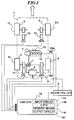
- Fig. 1 shows the whole arrangement of a driving-wheel torque control system for an automotive vehicle according to the preferred embodiment.
- reference numeral 1 designates a rear-engine rear wheel-driven vehicle (so-called RR car) having a straight-type four-cylinder internal combustion engine (hereinafter simply referred to as "the engine") 2 installed in a rear part of the vehicle.
- the vehicle includes a rear left wheel (RL) 3 and a rear right wheel (RR) 4 as driving wheels arranged at rear lateral sides thereof, and a front left wheel (FL) 5 and a front right wheel (FR) 6 as trailing wheels arranged at front lateral sides thereof.
- the rear left wheel (RL) 3 and the rear right wheel (RR) 4 are connected via a differential 7 to the engine 2.
- the differential 7 operates during cornering of the vehicle to create a proper difference in the rotational speed between the rear left (RL) wheel 3 and the rear right wheel (RR) 4 while evenly distributing the drive torque of the engine to the two driving wheels 3, 4.
- variable limited slip differential torque-creating device 8 Arranged between a drive torque input and a drive torque output of the differential 7 is a variable limited slip differential torque-creating device 8 which is formed of a multiple friction disc clutch, etc.
- the variable limited slip differential torque-creating device 8 operates to create a variable amount of limited slip differential torque (LSD torque) such that it is proportional to a clutch-engaging force applied by a hydraulic pressure generator, not shown, which is driven by a controller 9, to thereby transmit the LSD torque to a driving wheel on a low ⁇ road portion side which is racing and a driving wheel on a high ⁇ road portion side which is not racing, such that reduced torque is transmitted to the racing wheel and increased torque is transmitted to the non-racing wheel, when the vehicle is traveling on a split ⁇ road or the like to thereby properly control the difference in the rotational speed between the rear left and right driving wheels 3, 4.
- LSD torque limited slip differential torque
- a rear left wheel rotational speed (DRL) sensor 10 and a rear right wheel rotational speed (DRR) sensor 11 are arranged in the vicinity of the rear left wheel (RL) 3 and the rear right wheel (RR) 4, respectively, while a front left wheel rotational speed (NFL) sensor 12 and a front right wheel rotational speed (NFR) sensor 13 are arranged in the vicinity of the front left wheel (FL) 5 and the front right wheel (FR) 6 respectively.
- the DRL sensor 10, the DRR sensor 11, the NFL sensor 12, and the NFR sensor 13 detect the rotational speeds of the rear left wheel (RL) 3, the rear right wheel (RR) 4, the front left wheel (FL) 5, and the front right wheel (FR) 6, respectively, and supply electric signals indicative of the respective detected rotational speeds to an electronic control unit (hereinafter referred to as "the LSD-ECU") for controlling the LSD torque 14.
- the LSD-ECU electronice control unit
- an intake pipe absolute pressure (PBA) sensor 15 is provided in an intake pipe, not shown, in the vicinity of an intake port, not shown, of the engine 2.
- the PBA sensor 15 is electrically connected to the LSD-ECU 14 and supplies an electric signal indicative of the sensed intake pipe absolute pressure PBA thereto.
- An engine rotational speed (NE) sensor 16 is provided in facing relation to a camshaft or crankshaft, neither of which is shown, of the engine 2.
- the NE sensor 16 generates signal pulses (hereinafter referred to as "TDC signal pulses") whenever the crankshaft rotates through 180 ° , which are supplied to the LSD-ECU 14.
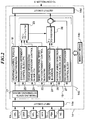
- the LSD-ECU 14 comprises an input circuit 14a having the functions of shaping the waveforms of input signals from various sensor as mentioned above, shifting the voltage levels of sensor output signals to a predetermined level, converting analog signals from analog-output sensors to digital signals, and so forth, a central processing unit (hereinafter referred to as "the CPU") 14b, memory means 14c formed of a ROM storing various operational programs which are executed by the CPU 14b, and various maps and tables, referred to hereinafter, and a RAM for storing results of calculations therefrom, etc.. and an output circuit 14d from which a signal of the LSD torque is delivered to the controller 9, which in turn supplies a command signal to the variable limited slip differential torque-creating device 8. Further, the LSD-ECU 14 calculates the engine rotational speed NE by measuring intervals of generation of the TDC signal pulses.
- Output signals from the DRL sensor 10, the DRR sensor 11, the NFL sensor 12, the NFR sensor 13, the PBA sensor 15, and the NE sensor 16 are supplied via the input circuit 14a to the CPU 14b, where the LSD torque T is calculated and supplied via the output circuit 14d to the controller 9.
- the CPU 14b includes traveling state-determining means 17, starting control torque-calculating means 18, and traveling control torque-calculating means 19.
- the traveling state-determining means 17 determines whether a vehicle speed VN, detected as described later, is lower than a predetermined lower limit value VLMT (e.g. 3 to 4 Km/hr). If VN ⁇ VLMT, it is determined that the vehicle is being started, and the starting control torque-calculating means 18 calculates a starting control torque TS and delivers a signal indicative of the calculated TS value via the output circuit 14d to the controller 9.
- VLMT e.g. 3 to 4 Km/hr
- the starting control torque TS i.e. LSD torque T suitable for the start of the vehicle, is calculated based on the intake pipe absolute pressure PBA and the engine rotational speed NE.
- the LSD-ECU 14 reads data of rotational speeds of the wheels supplied from the wheel rotational speed sensors (DRL sensor 10, DRR sensor 11, NFL sensor 12, NFR sensor 13), and the traveling control torque-calculating means 19 calculates the LSD torque T and delivers a signal indicative of the calculated T value via the output circuit 14d to the controller 9.
- the wheel rotational speed sensors DRR sensor 10, DRR sensor 11, NFL sensor 12, NFR sensor 13
- the traveling torque control means 19 comprises a driving force-dependent control block 20 which calculates a driving force-dependent control torque TT, i.e. control torque dependent on the driving force of the engine, based on the intake pipe absolute pressure PBA, the wheel rotational speeds, etc, a vehicle speed/engine brake-dependent control block 21 which calculates a vehicle speed/engine brake-dependent control torque TV based on the vehicle speed VN and the magnitude of force of the engine brake, and a wheel rotational speed ratio-dependent control block 22 which calculates a wheel rotational speed ratio-dependent control torque TW based on a ratio between the rotational speeds of the left and right driving wheels (rear wheels) 3, 4 and a ratio between the rotational speeds of the left and right trailing wheels (front wheels) 5, 6.
- a driving force-dependent control torque TT i.e. control torque dependent on the driving force of the engine
- PBA intake pipe absolute pressure
- PBA the wheel rotational speeds
- a vehicle speed/engine brake-dependent control block 21 which calculates a vehicle speed/engine
- the traveling control torque-calculating means 19 further comprises an ABS-dependent control block 24 which calculates an ABS-dependent correction coefficient to inhibit the LSD torque T from acting on the driving wheels when an anti-lock brake system (hereinafter referred to as "the ABS system"), not shown, which is installed in the vehicle, operates, and a hydroplaning detection/control block 25 which calculates a hydroplaning-dependent correction coefficient KHP for coping with a hydroplaning phenomenon occurring when the vehicle is traveling at a high speed.
- the ABS system anti-lock brake system
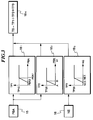
- the LSD-ECU 14 retrieves a TP1 map 181 and a TP2 map 182 stored in the ROM of the memory means 14c to determine control torque (first starting control torque TP1 and second starting control torque TP2) depending on the intake pipe absolute pressure PBA and a rate of change (PBA/ ⁇ t) thereof.
- TP1 map 181 when the intake pipe absolute pressure PBA is equal to or lower than a first predetermine value PBA0 (e.g. 100 mmHg), i.e. a very low value assumed when a throttle valve, not shown, of the engine is substantially fully closed, the first starting control torque TP1 is set to 0 since the LSD torque is then not required, and with an increase in the intake pipe absolute pressure PBA, the first starting control torque TP1 is increased.
- PBA1 e.g. 100 mmHg
- a second predetermined value PBA1 e.g. 300 mmHg
- the torque TP1 is set to and held at a predetermined value TP10 (e.g. 5 kg x m).
- the torque TP1 is held at the predetermined value TP10 when the intake pipe absolute pressure PBA exceeds the second predetermined value PBA1.
- the first starting control torque TAP1 is determined by reading predetermined map values from the TP1 map 181, and additionally by interpolation, if required.
- the second starting control torque TP2 when a rate of change (PBA/ ⁇ t) in the intake pipe absolute pressure PEA is equal to or lower than a predetermine very small value A, the second starting control torque TP2 is set to 0, and with an increase in the rate of change (PBA/ ⁇ t) of the intake pipe absolute pressure PBA, the second starting control torque TP2 is increased.
- the rate of change (PBA/ ⁇ t) exceeds a predetermined value B
- the torque TP2 is set to and held at a predetermined value TP20 (e.g. 5 kg x m).
- the second starting control torque TAP1 is determined by reading predetermined map values from the TP1 map 181, and additionally by interpolation, if required.
- the reason why the predetermined value TP2 is set to 0 when the rate of change (PBA/ ⁇ )of the intake pipe absolute pressure PBA is equal to or lower than the predetermined value A is that when the rate of change is very small, it is not required to apply the LSD torque.
- a third starting control torque TP3 is determined by retrieving a TP3 map 183 stored in the memory means 14c according to the engine rotational speed NE detected by the NE sensor 16.
- the third starting control torque TP3 is set to 0.
- the third starting control torque TP3 is increased.
- the control torque TP3 is set to and held at a predetermined value TP30 (e.g. 5kg x m).
- the third starting control torque TP3 is determined by reading predetermined map values from the TP3 map 183, and additionally by interpolation, if required.
- TS TP1 + TP2 + TP3 (3)
- the values of TP1 to TP3 are set to values not higher than the respective predetermined values TP10 to TP30, which prevents the starting torque TS from becoming larger than a predetermined value (e.g. 15 kg x m). Therefore, even if the accelerator pedal is stepped on in order to increase the engine rotational speed NE when the vehicle is in a garage, the vehicle can be easily turned round, and vibration of the variable limited slip differential torque-creating device 8 can be prevented.
- a predetermined value e.g. 15 kg x m
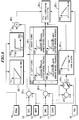
- Fig. 4 shows a block diagram showing details of the driving force-dependent control block 20, according to which a basic driving force-dependent control torque calculated based on the intake pipe absolute pressure PBA is multiplied by a wheel rotational speed-dependent correction coefficient KW1, a vehicle speed-dependent correction coefficient KWV, and an engine rotational speed-dependent correction coefficient KNE to thereby calculate the driving force-dependent control torque TT.
- the basic driving force control torque (a first basic driving force-dependent control torque TT1 and a second basic driving force-dependent control torque TT2) dependent on the intake pipe absolute pressure PBA and the rate of change (PBA/ ⁇ t) thereof is determined by retrieving a TT1 map 201 and a TT2 map 202 stored in the memory means 14c.
- the first basic driving force-dependent control torque TT1 is set to a larger value from TT10 (e.g. 0 kg x m) to TT11 (e.g. 100 kg x m), as the intake pipe absolute pressure PBA increases, for instance.
- the first basic driving force-dependent control torque TT1 is determined by reading predetermined map values from the TT1 map 201, and additionally by interpolation, if required.
- the TT2 map 202 is provided to cope with a sudden change in the intake pipe absolute pressure PBA which occurs when the accelerator pedal is suddenly stepped on.
- the second basic driving force-dependent control torque TT2 is set to 0, and when it exceeds a predetermined value D, the control torque TT2 is set to and held at a predetermined value TT20 (e.g. 5kg x m).
- the second basic driving force-dependent control torque TT2 is determined by reading predetermined map values from the TT2 map 202, and additionally by interpolation, if required.
- the first and second basic driving force-dependent control torques TT1 and TT2 are calculated based on the intake pipe absolute pressure PBA and the rate of change (PBA/ ⁇ t) thereof which has a more rapid response than changes in the rotational speeds of the wheels, to thereby make it possible to reduce a time lag in transmitting the LSD torque to the driving wheels.
- the intake pipe absolute pressure PBA is determined by the opening of the throttle valve linked to the accelerator pedal, and hence it is possible for the driver to control the LSD torque as he intends, to some extent.
- the values of the first and second basic driving force control torques TT1, TT'' thus determined are added together by adder means 203, and the resulting sum is input to driving force control-dependent torque-calculating means 204.
- the rotational speeds of the front left and right wheels 5 and 6 as the trailing wheels detected by the NFL sensor 12 and the NFR sensor 13 and input to the LSD-ECU 14 are compared with each other by comparator means 205, to determine whether the vehicle is turning left or right.
- the rotational speeds of the rear left and right wheels 3 and 4 as the driving wheels detected by the DRL sensor 10 and the DRR sensor 11 and input to the LSD-ECU 14 are compared with each other by comparator means 206, to determine whether the outer driving wheel is racing or the inner driving wheel is racing during cornering of the vehicle. Then, a wheel rotational speed ratio is determined, according to one of the following possible combinations of positive and negative values of output signals from both the comparator means 205 and 206:
- a wheel rotational speed ratio-dependent correction coefficient KW1 is read from a KW1 map 207 stored in the memory means 14c according to the determined wheel rotational speed ratio.
- the wheel rotational speed ratio-dependent correction coefficient KW1 increases with an increase in the wheel rotational speed ratio so long as the wheel rotational speed ratio is small, and the coefficient KW1 is set to "1" when the ratio reaches a predetermined value.
- the timing of applying the LSD torque T is determined depending on the state of racing of a driving wheel, and the wheel rotational speed ratio-dependent correction coefficient KW1 thus determined is delivered to the driving force torque-determining means 204.
- the rotational speeds of the front left and right wheels 5 and 6 detected by the NFL sensor 12 and the NFR sensor 13 are input to comparator means 208.
- the higher one of the rotational speeds of the front left and right wheels 5 and 6 is selected as the vehicle speed VN. That is, when one of the front wheels is traveling on a low ⁇ road surface, if the brakes are applied, the front wheel traveling on the low ⁇ road surface slips, so that the rotational speed of this wheel exhibits a larger drop than that of the other front wheel which does not slip.
- the vehicle speed VN based on an average value of the rotational speeds of the front wheels shows a value largely different from the actual vehicle speed VN. Therefore, the vehicle speed VN is determined based on the larger one of the rotational speeds of the front wheels 5 and 6, to prevent a detected value of the vehicle speed VN from exhibiting a false drop.
- the vehicle speed-dependent correction coefficient KWV is determined by retrieving a KWV map 2010 according to the vehicle speed VN.
- the coefficient KWV is set to a smaller value as the vehicle speed VN increases. That is, when the vehicle speed is traveling at a high speed, i.e. when the speed VN is high, the behavior of the vehicle is liable to be unstable. As a result, if the control torque is applied when the vehicle is traveling at such a high speed, in the same manner as it is traveling at a low speed, the vehicle exhibits too sensitive a behavior to the control torque applied. Therefore, with an increase in the vehicle speed VN, the vehicle speed-dependent correction coefficient VN is set to a smaller value, to thereby make stable the behavior of the vehicle traveling at a high speed.
- the vehicle speed-dependent correction coefficient thus determined is input to the driving force-dependent control torque-determining means 204.
- the engine rotational speed-dependent correction coefficient KNE is determined by retrieving a KNE map stored in the memory means 14c according to the engine rotational speed NE detected by the NE sensor 16.
- the KNE map 2011 is set similarly to the KWV map 2010 such that a map value of the coefficient KNE decreases with an increase in the engine rotational speed NE. That is, when the rotational speed NE is high, the output torque of the engine can change violently, and hence the behavior of the engine becomes unstable. Therefore, as the engine rotational speed NE increases, the engine rotational speed-dependent correction coefficient KNE is set to a smaller value, to thereby make stable the behavior of the vehicle traveling at a high speed.
- the engine rotational speed-dependent correction coefficient KNE thus determined is input to the driving force control-dependent torque-determining means 204.
- the basic driving force-dependent control torque is determined based on the intake pipe absolute pressure PBA and the rate of change thereof, and the timing of application of the LSD torque is determined based on the wheel rotational speed ratio during cornering of the vehicle. Further, the basic driving force-dependent control torque is corrected depending on the vehicle speed VN and the engine rotational speed NE, to thereby obtain the driving force control torque TT suitable for the behavior of the vehicle.
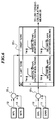
- Fig. 5 is a block diagram showing details of the vehicle speed/engine brake-dependent control.
- a vehicle speed-dependent control torque TV1 is calculated based on the rotational speeds of the front left and right wheels 5 and 6.
- the rotational speeds of the left and right front wheels 5 and 6 detected by the NFL sensor 12 and the NFR sensor 13 are input to comparator means 211, and selecting means 212 connected to the comparator means 211 selects the larger one of the rotational speeds as the vehicle speed VN.
- the vehicle speed-dependent control torque TV1 is determined by retrieving a TV1 map 213 stored in the memory means according to the vehicle speed VN.
- the vehicle speed-dependent control torque is increased, and as the vehicle speed VN increases above a second predetermine value VN2, the vehicle speed-dependent control torque is progressively decreased. That is, the stability of the vehicle at a high traveling speed obtained by the LSD torque T becomes lower as the vehicle speed VN increases, and hence if the control torque is always controlled to a small value suitable for a high vehicle speed, it is disadvantageous when the vehicle is put into a garage or the like.
- VN1 e.g. 50 km/hr
- the vehicle speed-dependent control torque TV1 is applied in such a moderate amount just sufficient for securing the stability of the vehicle traveling at a high speed to suppress the loss of energy, whereby it is possible to secure the stability of the vehicle when it is traveling at a high speed.
- the vehicle speed-dependent control torque 213 thus determined is input to vehicle speed/engine brake-dependent control torque-calculating means 214.
- the engine brake-dependent control is carried out based on the intake pipe absolute pressure PBA detected by the PBA sensor 15. That is, when the engine brake is applied, the deceleration of the vehicle increases to largely change the driving force of the engine, resulting in instability of the vehicle. Therefore, when the engine brake is applied, the control torque is applied in an adequate amount to thereby prevent the behavior of the vehicle from becoming unstable. More specifically, a basic engine brake-dependent control torque TV2 is determined by retrieving a TV2 map 215 stored in the memory means 14c according to a rate of decrease (-PBA/ ⁇ t) of the intake pipe absolute pressure PBA.
- the basic engine brake-dependent control torque TV2 is increased, and when the rate of change exceeds a second predetermined value F, the control torque TV2 is set to and held at a predetermined value TV20. That is, from the rate of decrease in the absolute pressure PBA, the magnitude of the force of the engine brake can be estimated.
- the engine brake-dependent control torque TV2 is determined by reading predetermined map values from the TV2 map 215, and additionally by interpolation, if required. The determined TV2 value is delivered to multiplying means 216.
- an engine brake-dependent correction coefficient KV is determined by retrieving a KV map stored in the memory means 14c according to the intake pipe absolute pressure PBA.
- the KV map is set such that predetermined map values are provided in a manner corresponding to predetermined values of the intake pipe absolute pressure PBA. More specifically, as the intake pipe absolute pressure PBA increases above a first predetermined value PBA0, the correction coefficient KV is increased, and as the intake pipe absolute pressure PBA increases above a second predetermined value PBA1, the correction coefficient KV is set to and held at a predetermined value KV0.
- the correction coefficient KV is decreased, and when the intake pipe absolute pressure PBA exceeds a fourth predetermined value PBA3; the correction coefficient KV is set to "0".
- the reason for decreasing the correction coefficient KV to smaller values as the intake pipe absolute pressure PBA increases above the third predetermined value PBA2 is that when the intake pipe absolute pressure PBA is large, i.e. when the throttle valve is substantially fully opened, the engine brake-dependent control need not be carried out.
- the correction coefficient KV may be set such that when the intake pipe absolute pressure PBA exceeds the second predetermined value PBA1, it assumes the predetermined value KV0 so long as the intake pipe absolute pressure PBA is higher than the second predetermined value PBA1.
- the engine brake-dependent correction coefficient KV thus determined is input to the multiplying means 216 where it is multiplied by the basic engine brake-dependent control torque TV2.
- control torque is calculated to a value suitable for a change in the driving force occurring during cornering of the vehicle at a decelerated speed.
- the LSD torque is calculated so as to achieve both the stability of the vehicle to be secured when the vehicle is running straight at a high speed, and the stability of same to be secured when it is cornering at a decelerated speed.
- Fig. 6 is a block diagram showing details of the wheel rotational speed ratio-dependent control block 22, according to which a wheel rotational speed ratio-dependent control torque TW is calculated in a similar manner to the wheel rotational speed ratio-dependent correction coefficient KW1 is calculated in the driving force-dependent control block 20 described above. More specifically, the rotational speeds of the front left and right wheels 5 and 6 detected by the NFL sensor 12 and the NFR sensor 13 are compared by comparator means 221, to determine whether the vehicle is turning left or right.
- the rotational speeds of the rear left and right wheels 3 and 4 detected by the DRL sensor 10 and the DRR sensor 11 are compared by comparator means 222, to determine whether the outer wheel of the driving wheels is racing or the inner wheel of same is racing during cornering of the vehicle. Then, similarly to the case where the wheel rotational speed ratio-dependent correction coefficient KW1 is calculated, it is determined from a combination of positive value(s) and/or negative value(s) of output signals from the comparator means 221 and 222 which of the aforementioned four types of behavior the vehicle is exhibiting, and accordingly the wheel rotational speed ratio corresponding to the determined behavior is calculated.
- the wheel rotational speed-dependent control torque TW is determined by retrieving a TW map 223 stored in the memory means 14c according to the calculated wheel rotational speed ratio.
- the wheel rotational speed ratio-dependent control torque TW is set, similarly to the wheel rotational speed-dependent correction coefficient KW1 (in Fig. 4), such that so long as the ratio is smaller than a predetermined value, the control torque TW is set to larger values as the ratio increases, and when the ratio exceeds the predetermined value, the control torque is set to and held at a predetermined value.
- An ABS-ECU performs the ABS control for preventing wheels from being locked to cause slippage thereof, when the braking operation is carried out.
- ABS control is performed on individual wheels on a road surface, independently of each other. Therefore, if the LSD torque is applied during the ABS control, there is a fear that the ABS control is interfered.
- the ABS-dependent control is performed.
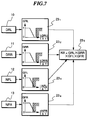
- ABS-dependent correction values GRL, GRR, GFL, GFR corresponding to decelerations of the rotational speeds of these wheels are determined by retrieving a GRL map 231, a GRR map 232, a GFL map 233, and a GFR map 234 shown in Fig. 7.
- the hatched portions indicate regions where the ABS control is performed.
- the application of the LSD torque T is stopped immediately before the ABS control starts to be carried out, whereas for the front left and right wheels 5, 6, the application of the LSD torque T is stopped immediately after the ABS control starts to be carried out.
- the LSD torque T is controlled by the use of the above maps prepared according to the decelerations of rotational speeds of the wheels, independently of the ABS control. Therefore, it is not required to receive a signal indicative of operation of the brake switch or the ABS control to interrupt the application of the LSD torque T, which dispenses with the use of communication lines between the ABS-ECU and the LSD-ECU 14, leading to a simplified construction of the system.
- Fig. 8 is a block diagram showing details of the hydroplaning detection/control, according to which when the vehicle speed exceeds a predetermined value, the wheels are checked for racing, and if the acceleration or deceleration of a racing wheel is above a predetermined value, it is determined that hydroplaning has occurred, whereupon the control torque is reduced by a hydroplaning-dependent correction coefficient.
- output signals from the NFL sensor 12 and the NFR sensor 13 are input to comparator means 241, and selecting means 242 connected thereto determines the vehicle speed VN from the input signals. Then, when the vehicle speed VN is higher than a predetermined value, a desired differential rotational speed DEFMD for the driving wheels and a desired differential rotational speed DEFMN for the trailing wheels are determined by retrieving a DEFMD map 243 and a DEFMN map 244 stored in the memory means 14c according to the vehicle speed VN. That is, if hydroplaning is detected based on the vehicle speed VN alone, the LSD torque control may be undesirably responsive to slight changes in the vehicle speed VN.
- the hydroplaning is detected also based on the differential rotational speeds between the left and right driving wheels or the left and right trailing wheels.
- the DEFMD map 243 and the DEFMN map 244 are set such that map values thereof are provided along a parabolic line relative to the vehicle speed VN. That is, from the point the vehicle speed VN exceeds a predetermined value VN1 or VN2 (e.g. 50 to 60 km/hr) above which hydroplaning can occur, the desired differential rotational speeds of the driving wheels and the trailing wheels are allowed to rise rather gently, which enables the desired differential rotational speeds to follow a change in the vehicle speed VN smoothly.
- VN1 or VN2 e.g. 50 to 60 km/hr
- a racing wheel-determining circuit 245 is supplied with outputs from the NFL sensor 12, the NFR sensor 13, the DRL sensor 10 and the DRR sensor 11, as well as values of the desired differential rotational speeds DEFMD and DEFMN to determine whether racing of a wheel occurs. If racing of a wheel occurs, it is determined which wheel is racing. If a driving wheel is racing, the acceleration (dv/dt) of the racing wheel is detected, whereas if a trailing wheel is racing, the deceleration (-dv/dt) of the racing wheel is detected.
- a hydroplaning-dependent coefficient KHPD for driving wheels is determined by retrieving a KHPD map 246 according to the acceleration (dv/dt)
- a hydroplaning-dependent coefficient KHPN for trailing wheels is determined by retrieving a KHPN map 247 according to the deceleration (-dv/dt).
- the KHPD map 246 and the KHPN map 247 are set such that as the acceleration (dv/dt) and the deceleration (-dv/dt) increase above predetermined values a1 and a2, the hydroplaning-dependent coefficients KHPD and KHPN are decreased, respectively.
- the thus determined hydroplaning-dependent correction coefficient KHP (KHPD or KHPN) is delivered to the LSD torque-calculating means 26.
- the hydroplaning-dependent correction coefficient KHPD or KHPN is decreased, to thereby reduce the LSD torque T.
- Fig. 9 shows a routine for detecting hydroplaning and performing hydroplaning-dependent LSD torque control executed by the LSD-ECU 14.
- step S1 outputs from the NFL sensor 12, NFR sensor 13, DRL sensor 10, and DRR sensor 11 are read, and at a step S2, the outputs from the NFL sensor 12 and the NFR sensor 13 are compared with each other, to determine the larger one of them as the vehicle speed VN.
- a step S3 it is determined whether or not the vehicle speed VN is larger than a predetermined value VX.
- the predetermined value VX is set to a value, e.g. 50 to 60 km/hr above which hydroplaning can occur, as described hereinabove. If the answer to this question is negative (NO), it is judged that hydroplaning will not occur, followed by terminating the program.
- step S3 if the answer to the question of the step S3 is affirmative (YES), it is judged that hydroplaning can take place, and then the program proceeds to a step S4 et seq. where it is determined whether or not hydroplaning has occurred based on a difference in the rotational speed between the left and right driving wheels and between the left and right trailing wheels, and calculate the hydroplaning-dependent correction coefficient KHP suitable for the behavior of the vehicle to control the LSD torque.
- step S4 desired differential rotational speeds DEFMD and DEFMN between the driving wheels and between the trailing wheels, respectively, are determined according to the vehicle speed VN. Then, it is determined at a step S5 whether or not the actual differential rotational speed DEFD between the driving wheels is larger than the desired differential rotational speed DEFMD. If the answer to this question is affirmative (YES), it is judged that a driving wheel is racing, and then it is determined at a step S6 that the driving wheel having the larger rotational speed is racing.
- the acceleration (dv/dt) of the racing driving wheel determined at the step S6 is calculated, and then at a step S8, the KHPD map is retrieved according to the acceleration (dv/dt), to determine a driving-wheel hydroplaning-dependent correction coefficient KHPD.
- the determined KHPD value is supplied to the LSD torque-determining means 26, followed by terminating the program.
- step S5 determines whether or not the actual differential rotational speed DEFN between the trailing wheels is larger than the desired differential rotational speed DEFMN. If the answer to this question is negative (NO), the program is immediately terminated, whereas if the answer is affirmative (YES), it is judged that a trailing wheel is racing, and then it is determined at a step S11 that the trailing wheel having the lower rotational speed is racing.
- the deceleration (-dv/dt) of the racing wheel determined at the step S11 is calculated, and then at a step S13, the KHPN map is retrieved according to the deceleration (-dv/dt), to determine a trailing wheel hydroplaning-dependent correction coefficient KHPN.
- the determined KHPN value is supplied to the LSD torque-calculating means 26, followed by terminating the program.
- the LSD torque can be promptly reduced based on the acceleration of the driving wheel or the deceleration of the trailing wheel when hydroplaning has occurred, to thereby secure improved drivability and stability of behavior of the vehicle travelling at a high speed.
- the hydroplaning detection/control is performed based on the differential rotational speeds between the left and right wheels, this is not limitative, but this control may be properly carried out insofar as it is based on a factor related to the rotational speeds of the wheels. Further, the control may be carried out based on the ratio between the rotational speeds of the left and right wheels.
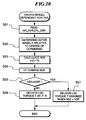
- Fig. 10 shows a routine for performing the LSD torque control when both of the driving or trailing wheels are racing during cornering of the vehicle.
- the rotational speeds of the four wheels detected by the NFL sensor 12, the NFR sensor 13, the DRL sensor 10, and the DRR sensor 11, are read.
- the determination of the inner or outer wheels is carried out as previously described with reference to Fig. 4 concerning the calculation of the wheel rotational speed ratio-dependent correction coefficient KW1.
- a calculation is made of a ratio in the rotational speed between the rear outer wheel and the front outer wheel, i.e. the detected outer wheel rotational speed ratio ND0 ( D/N).
- a basic outer rotational speed ratio NDP (the ratio of the rotational speed of the outer driving wheel to that of the outer trailing wheel) above which the outer wheels can race is determined by retrieving a NDP map at a step S24.
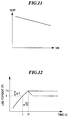
- the NDP map is set, e.g. as shown in Fig. 11, such that a map value of NDP decreases as the vehicle speed VN determined based on outputs from the NFL sensor 12 and the NFR sensor 13 increases.
- the basic outer rotational speed ratio NDP is determined by reading predetermined map values from the NDP map, and additionally by interpolation, if required.
- a step S25 it is determined whether or not the detected outer wheel rotational speed ratio ND0 is larger than the basic outer wheel rotational speed ratio NDP. If the answer to this question is negative (NO), a value of the LSD torque T calculated by the LSD torque-calculating means 26 is output as it is, whereas if the answer is affirmative (YES), it is judged that both the driving wheels are racing, and hence the LSD torque T is held at a value assumed when the outer wheel rotational speed ratio is equal to the basic outer wheel rotational speed ratio NDP, followed by delivering it to the LSD torque-calculating means 26 at a step S27.
- the LSD torque T is neither reduced nor canceled, to transmit a desired amount of the LSD torque to the driving wheels, which prevents the drivability of the vehicle from being degraded as well as offensive vibrations from being generated from the variable limited slip differential torque-creating device 8.
- the racing of both the driving wheels is determined based on the outer wheel rotational speed ratio ND0 assumed during cornering of the vehicle, this is not limitative, but wheel rotational speed ratios between the left driving and trailing wheels and between the right driving and trailing wheels may be calculated, and when one of these wheel rotational speed ratios exceeds a predetermined value, it may be determined that one wheel is racing, to hold the LSD torque T to a value assumed when the wheel rotational speed ratio is equal to the predetermined value for allowing same to be transmitted to the driving wheels.
- wheel rotational speed ratios between the left driving and trailing wheels and between the right driving and trailing wheels may be calculated, and when one of these wheel rotational speed ratios exceeds a predetermined value, it may be determined that one wheel is racing, to hold the LSD torque T to a value assumed when the wheel rotational speed ratio is equal to the predetermined value for allowing same to be transmitted to the driving wheels.
- no large variation should occur in the LSD torque, which makes it possible to prevent the variable limited differential torque-creating
- both the driving wheels are racing when the wheel rotational speed ratios between the driving (rear) wheels and the trailing (front) wheels both exceed respective predetermined values.
- both the driving wheels race when the vehicle is running straight on a snow-covered road, an icy road or the like, the LSD torque is not reduced or cancelled, which prevents the drivability of the vehicle from being degraded.
- the LSD torque T assumed when the racing of the driving wheel is detected is applied, there is a drop in the LSD torque as indicated by the two-dot chain line in the figure, to cause instability of behavior of the vehicle.
- the LSD torque T1 which is larger than the value T by ⁇ T is applied to prevent a drop in the LSD torque to secure stability of the vehicle.
- the driving-wheel torque control system may be constructed such that after holding the LSD torque T at a predetermined value over a predetermined time period, if it is found that this held value of the LSD torque cannot meet the driver's demand for the drivability and behavior of the vehicle, the LSD torque is reduced or canceled.
- the LSD-ECU 14 may incorporate a timer for counting the predetermined time period, or the driver may reduce or cancel the LSD torque as he desires by manually operating a switch therefor.
- the NDP map may be set, as shown in Fig. 13, in a simplified manner for explanation of a case of acceleration of the vehicle and a case of deceleration of same, such that different map values are applied depending on acceleration (including deceleration).
- the solid line in Fig. 13 indicates map values applied at a certain degree of acceleration of the vehicle, while the broken line indicates those applied at a certain degree of deceleration of the vehicle.
- a map value of the basic outer rotational speed ratio NDP applied at acceleration having a lower value is lower than one applied at acceleration having a higher value at the same vehicle speed.
- the driving wheels are racing when the vehicle is decelerating than when the vehicle is accelerating.
- the acceleration or deceleration of the vehicle is determined based on the rate ⁇ PBA of the intake pipe absolute pressure PBA or a rate ⁇ VN (VN/ ⁇ t) of change in the vehicle speed VN. This makes it possible to hold the LSD torque at a suitable value responsive to the state of acceleration or deceleration of the vehicle.
- predetermined coefficients may be provided in a manner corresponding to a plurality of ranges of acceleration of the vehicle (including a plurality of ranges of deceleration of same), respectively, for multiplying the map value of the outer wheel rotational speed ratio NDP determined by the use of the LDP map shown in Fig. 11 by one of the coefficients selected depending on the detected acceleration or deceleration of the vehicle. This makes it possible to perform more delicate control of the driving-wheel torque control responsive to various changes in the travelling state of the vehicle.
- the LSD torque T may be held over a longer time period as indicated by A in Fig. 15, or alternatively, the rate of reduction of the LSD torque after the lapse of the predetermined time period may be set to a smaller value as indicated by B in Fig. 15. This makes it possible to secure the stability of the vehicle when the rotational speed of the inner driving wheel has suddenly dropped (i.e. when the state of racing of the inner driving wheel has been drastically mitigated).
Landscapes
- Engineering & Computer Science (AREA)
- Chemical & Material Sciences (AREA)
- Combustion & Propulsion (AREA)
- Transportation (AREA)
- Mechanical Engineering (AREA)
- Control Of Vehicle Engines Or Engines For Specific Uses (AREA)
- Arrangement And Mounting Of Devices That Control Transmission Of Motive Force (AREA)
Applications Claiming Priority (4)
| Application Number | Priority Date | Filing Date | Title |
|---|---|---|---|
| JP29925192A JPH06122331A (ja) | 1992-10-12 | 1992-10-12 | 車輌の駆動輪トルク制御装置 |
| JP299251/92 | 1992-10-12 | ||
| JP301870/92 | 1992-10-14 | ||
| JP30187092A JPH06127284A (ja) | 1992-10-14 | 1992-10-14 | 車輌の駆動輪トルク制御装置 |
Publications (2)
| Publication Number | Publication Date |
|---|---|
| EP0592990A1 true EP0592990A1 (de) | 1994-04-20 |
| EP0592990B1 EP0592990B1 (de) | 1996-01-10 |
Family
ID=26561844
Family Applications (1)
| Application Number | Title | Priority Date | Filing Date |
|---|---|---|---|
| EP93116447A Expired - Lifetime EP0592990B1 (de) | 1992-10-12 | 1993-10-11 | Momentenkontrollsystem für die Antriebsräder eines Kraftfahrzeuges |
Country Status (3)
| Country | Link |
|---|---|
| US (1) | US5548513A (de) |
| EP (1) | EP0592990B1 (de) |
| DE (1) | DE69301298T2 (de) |
Families Citing this family (13)
| Publication number | Priority date | Publication date | Assignee | Title |
|---|---|---|---|---|
| DE4427040C2 (de) * | 1994-07-29 | 1998-05-20 | Steyr Daimler Puch Ag | Verfahren zur Steuerung einer als Differentialsperre wirkenden Sperrkupplung |
| US5690002A (en) * | 1996-03-06 | 1997-11-25 | Borg-Warner Automotive, Inc. | Method of operating a vehicle differential |
| US5699888A (en) * | 1996-03-06 | 1997-12-23 | Borg-Warner Automotive, Inc. | Modulating clutch having passive torque throughout threshold |
| JP3272617B2 (ja) * | 1996-11-13 | 2002-04-08 | 本田技研工業株式会社 | 車両のヨーモーメント制御装置 |
| JP3406169B2 (ja) * | 1997-01-14 | 2003-05-12 | 本田技研工業株式会社 | 四輪駆動車両における駆動力制御装置 |
| US6577944B1 (en) | 1999-02-19 | 2003-06-10 | Shannon R. Davis | Traction control system |
| JP3824146B2 (ja) * | 2001-03-28 | 2006-09-20 | 本田技研工業株式会社 | 車両用加速制御装置 |
| JP4457891B2 (ja) * | 2004-12-28 | 2010-04-28 | 日産自動車株式会社 | 車線逸脱防止装置 |
| US7680571B2 (en) * | 2006-09-11 | 2010-03-16 | Gm Global Technology Operations, Inc. | Vehicle differential score protection |
| DE102007051064B4 (de) * | 2007-10-17 | 2010-02-11 | Getrag Getriebe- Und Zahnradfabrik Hermann Hagenmeyer Gmbh & Cie Kg | Fehlererkennungsverfahren für automatisierte Kraftfahrzeuggetriebe |
| KR101020816B1 (ko) * | 2007-11-15 | 2011-03-09 | 현대자동차주식회사 | 차량의 휠 스핀 제어장치 및 방법 |
| US8554440B1 (en) | 2010-01-05 | 2013-10-08 | Davis Intellectual Properties LLC | Electronic traction control |
| US10836252B2 (en) * | 2017-09-19 | 2020-11-17 | Bombardier Recreational Products Inc. | Control of a limited slip differential based on an engine torque |
Citations (3)
| Publication number | Priority date | Publication date | Assignee | Title |
|---|---|---|---|---|
| JPS6460433A (en) * | 1987-08-31 | 1989-03-07 | Nissan Motor | Control device for distribution of driving force of vehicle |
| EP0311139A2 (de) * | 1987-10-09 | 1989-04-12 | Nissan Motor Co., Ltd. | Steuerungssystem für die Grenzkraft eines Differentials, ansprechend auf Fahrzeuggeschwindigkeit und Lenkwinkel |
| JPH03224827A (ja) * | 1990-01-29 | 1991-10-03 | Hino Motors Ltd | 自動車の差動制限制御装置 |
Family Cites Families (5)
| Publication number | Priority date | Publication date | Assignee | Title |
|---|---|---|---|---|
| JP2534730B2 (ja) * | 1987-09-29 | 1996-09-18 | 日産自動車株式会社 | 4輪操舵・差動制限力総合制御装置 |
| JPH0790715B2 (ja) * | 1987-09-29 | 1995-10-04 | 日産自動車株式会社 | 差動制限力制御装置 |
| JPH0764221B2 (ja) * | 1987-10-20 | 1995-07-12 | 日産自動車株式会社 | 差動制限力制御装置 |
| JP3009942B2 (ja) * | 1991-06-27 | 2000-02-14 | マツダ株式会社 | 車両の制御装置 |
| JP2946251B2 (ja) * | 1991-07-18 | 1999-09-06 | 本田技研工業株式会社 | 車両の駆動輪トルク制御装置 |
-
1993
- 1993-10-08 US US08/131,944 patent/US5548513A/en not_active Expired - Lifetime
- 1993-10-11 EP EP93116447A patent/EP0592990B1/de not_active Expired - Lifetime
- 1993-10-11 DE DE69301298T patent/DE69301298T2/de not_active Expired - Fee Related
Patent Citations (3)
| Publication number | Priority date | Publication date | Assignee | Title |
|---|---|---|---|---|
| JPS6460433A (en) * | 1987-08-31 | 1989-03-07 | Nissan Motor | Control device for distribution of driving force of vehicle |
| EP0311139A2 (de) * | 1987-10-09 | 1989-04-12 | Nissan Motor Co., Ltd. | Steuerungssystem für die Grenzkraft eines Differentials, ansprechend auf Fahrzeuggeschwindigkeit und Lenkwinkel |
| JPH03224827A (ja) * | 1990-01-29 | 1991-10-03 | Hino Motors Ltd | 自動車の差動制限制御装置 |
Non-Patent Citations (2)
| Title |
|---|
| PATENT ABSTRACTS OF JAPAN vol. 13, no. 257 (M - 837)<3605> 14 June 1989 (1989-06-14) * |
| PATENT ABSTRACTS OF JAPAN vol. 15, no. 509 (M - 1195)<5037> 24 December 1991 (1991-12-24) * |
Also Published As
| Publication number | Publication date |
|---|---|
| EP0592990B1 (de) | 1996-01-10 |
| DE69301298D1 (de) | 1996-02-22 |
| DE69301298T2 (de) | 1996-06-13 |
| US5548513A (en) | 1996-08-20 |
Similar Documents
| Publication | Publication Date | Title |
|---|---|---|
| EP0655361B1 (de) | Antriebskraft-Steuerungssystem für ein Fahrzeug | |
| US5168955A (en) | Traction control system for four-wheel drive vehicle | |
| EP1270305B1 (de) | Antriebskraftsteuerungsgerät und -verfahren für ein vierrad- getriebenes Fahrzeug | |
| US5927425A (en) | Torque distribution control system for automotive vehicles | |
| JP4396002B2 (ja) | 車輌のトラクション制御装置 | |
| US5944392A (en) | Road surface condition determining system | |
| US6587775B2 (en) | Driving force control system for four-wheel drive vehicles | |
| US5497333A (en) | Control system for integrally controlling operations of electronic torque split system and traction control system for automotive vehicle | |
| US5431242A (en) | Automobile traction control system | |
| EP0592990B1 (de) | Momentenkontrollsystem für die Antriebsräder eines Kraftfahrzeuges | |
| EP0523698B1 (de) | Antriebsrad-Drehmomentsteuersystem eines Kraftfahrzeugs | |
| US6493623B2 (en) | Driving force control system for four-wheel drive vehicles | |
| KR100262696B1 (ko) | 차량의 구동력 제어방법 | |
| JP3536523B2 (ja) | 車両用駆動力制御装置 | |
| US20070010929A1 (en) | Traction control device for preventing engine stalling | |
| KR100222343B1 (ko) | 구동력 분배 제어 장치 | |
| JP2002347477A (ja) | 4輪駆動車の駆動系制御装置 | |
| JP3620157B2 (ja) | 車両制御装置 | |
| JP3575223B2 (ja) | 車両用駆動力制御装置 | |
| JP3493046B2 (ja) | 車両の被駆動輪のスピン制御方法 | |
| JP3783241B2 (ja) | 車両用加速スリップ制御装置 | |
| JP3410514B2 (ja) | 差動制限制御装置 | |
| JP3506228B2 (ja) | 四輪駆動車の駆動力配分制御装置 | |
| JP2502758B2 (ja) | 前後輪駆動力配分と駆動力との総合制御装置 | |
| JP2864333B2 (ja) | 車両の駆動力配分制御装置 |
Legal Events
| Date | Code | Title | Description |
|---|---|---|---|
| PUAI | Public reference made under article 153(3) epc to a published international application that has entered the european phase |
Free format text: ORIGINAL CODE: 0009012 |
|
| AK | Designated contracting states |
Kind code of ref document: A1 Designated state(s): DE GB |
|
| 17P | Request for examination filed |
Effective date: 19940428 |
|
| 17Q | First examination report despatched |
Effective date: 19950328 |
|
| GRAA | (expected) grant |
Free format text: ORIGINAL CODE: 0009210 |
|
| AK | Designated contracting states |
Kind code of ref document: B1 Designated state(s): DE GB |
|
| REF | Corresponds to: |
Ref document number: 69301298 Country of ref document: DE Date of ref document: 19960222 |
|
| PLBE | No opposition filed within time limit |
Free format text: ORIGINAL CODE: 0009261 |
|
| STAA | Information on the status of an ep patent application or granted ep patent |
Free format text: STATUS: NO OPPOSITION FILED WITHIN TIME LIMIT |
|
| 26N | No opposition filed | ||
| REG | Reference to a national code |
Ref country code: GB Ref legal event code: IF02 |
|
| PGFP | Annual fee paid to national office [announced via postgrant information from national office to epo] |
Ref country code: GB Payment date: 20031008 Year of fee payment: 11 |
|
| PG25 | Lapsed in a contracting state [announced via postgrant information from national office to epo] |
Ref country code: GB Free format text: LAPSE BECAUSE OF NON-PAYMENT OF DUE FEES Effective date: 20041011 |
|
| GBPC | Gb: european patent ceased through non-payment of renewal fee |
Effective date: 20041011 |
|
| PGFP | Annual fee paid to national office [announced via postgrant information from national office to epo] |
Ref country code: DE Payment date: 20081014 Year of fee payment: 16 |
|
| PG25 | Lapsed in a contracting state [announced via postgrant information from national office to epo] |
Ref country code: DE Free format text: LAPSE BECAUSE OF NON-PAYMENT OF DUE FEES Effective date: 20100501 |